First steps for beginners, from rhythm to scanning a line; what metre is, how syllables are weighed, the notation and the rules of prosody; the Greek word accent; and how the texts reached us.
First steps · 1 of 7
Step 1. Rhythm by length, not loudness
Phonology › First steps gave you the sounds of Greek. This page shows what Greek verse does with them, in seven short steps. It leaves a great deal out on purpose, and the rest of the Metre section fills it in when you are ready.
Everything starts with syllables. A word falls into beats. Each beat is called a syllable. The English word goddess has two syllables, god and dess. Greek works the same way. μῆνιν (mēnin), “wrath”, has two, μῆ and νιν:
goddess · wrath
English ∿Greek: David Chamberlain, Iliad 1.1 · CC BY 4.0
Every syllable has one vowel sound at its heart, and the consonants gather round it.[1] Metre is about counting and measuring these syllables.[2]
Syllable: One beat of a word, built round one vowel sound: god-dess, μῆ-νιν. Greek metre counts and measures syllables.[3]
Loudness and length
English verse counts loudness. In English, some syllables are said louder than others. That loudness is called stress. Say the first line of Blake’s poem “The Tyger” aloud, and listen for the louder syllables:
Tyger Tyger, burning bright
Annie Coleman Rothenberg, The Tyger, line 1 · public-domain dedication
The first, third, fifth and seventh syllables come out louder, and the others are quieter. English verse is made of patterns of stressed and unstressed syllables. English speakers also tend to space the stresses out evenly, like beats in a bar of music.[4]
Stress: The extra loudness given to some syllables in English: Ty-ger. English verse is built on it; Greek verse is not.[5]
Greek verse counts length. What matters in Greek verse is not how loud a syllable is but how long it takes to say. Every Greek syllable is either long or short. A line of verse is a fixed pattern of longs and shorts, with a fixed number of places in it.[6] The length of a syllable is called its quantity.[2] Here are the first three words of the Iliad, cut into syllables, with the length of each written under it:
μῆνιν ἄειδε θεὰ
mēnin aeide theā
Sing, goddess, the wrath …
The long syllables are not louder. They simply last longer. Step 3 shows how to tell which syllables are long. For the moment, just take them as given.
Long and short: Every Greek syllable is one or the other. A long syllable takes longer to say than a short one. This length is called the syllable’s quantity. The pattern of longs and shorts is what makes the rhythm of a Greek line.[7]
Two signs. In the box above, a long syllable is written as — and a short syllable as ⏑.[8] So the three words are — ⏑ ⏑ — ⏑ ⏑ —. Step 2 adds the three other signs you need.
Blake’s line can be written in the same signs, — ⏑ — ⏑ — ⏑ —. Written so, it looks like a short phrase of Greek verse. But an English reader marks its rhythm by stress, over syllables of roughly equal length. In Greek the syllables had to keep their durations.[9]
Scanning. To scan a line, you go through it syllable by syllable. You decide which syllables are long and which are short, and you write the sign for each one under it. The row of signs you end up with is called the line’s scansion.[10] The box above is a scansion. Most of this page is about learning to scan. It is a skill, like reading music, and it comes with practice.
Scansion: To scan a line is to measure it. You mark each syllable long — or short ⏑. The row of signs you end up with is the line’s scansion.[10]
What about the accent marks?
Greek words carry accents (ά, ᾶ, ὰ), and you might expect them to be stresses. They were not. In classical Greek the accent was not extra loudness. It was a rise and fall of musical pitch, a higher note on one syllable.[11] The accent played no part in the metre.[12]
You can see this in ἄειδε. Its accent stands on ἄ, which is short. The next syllable, ει, has no accent, but it is long:
… ἄειδε …
… aeide …
… sing …
So for scanning you can ignore the accent. The Accent page explains it, if you are curious.
A long is worth two shorts
Think of music. A long syllable is like a crotchet (a quarter note), and a short one is like a quaver (an eighth note).[13] In sung verse the long was normally exactly twice the short.[14] In recited verse it was a little less, about 5 : 3.[15]
Books call this unit of time a mora. A short syllable has one mora, and a long syllable has two.[16] In English you may hear a long called dum and a short di. For Greek, though, the dum must really take twice as long as the di.[9] The diagram draws each syllable as a box as wide as its time:
Mora: The unit of time in verse. A short syllable lasts one mora, a long syllable two.[16]
Swapping a long for two shorts. The last two rows of the diagram take the same time. Because of this, many Greek metres allow a swap.[17]
- One long may stand in the place of two shorts. This is called contraction.
- Two shorts may stand in the place of one long. This is called resolution.
Contraction happens in the very first line of the Iliad. Where the rhythm leads you to expect — ⏑ ⏑, the third group has — —: ὰ Πη. The next group is a full — ⏑ ⏑ again:
… θεὰ Πηληϊάδεω …
… theā Pēlēiadeō …
… goddess, of the son of Peleus …
David Chamberlain, Iliad 1.1 · CC BY 4.0
Resolution happens in the second line of Euripides’ Medea. In the word κυανέας (kyaneās), “dark”, the two short syllables κυ and α share one place that would normally hold a long:
… κυανέας …
… kyaneās …
… the dark (Clashing Rocks) …
synthetic ∿
Step 4 comes back to contraction in Homer, and step 6 to resolution in drama.[18]
Resolution and contraction: Resolution: two short syllables fill a place meant for one long. Contraction: one long fills a place meant for two shorts. Both work because a long is worth two shorts.[19]
Try it
Say DAA, holding it for two counts. Then say da da, one count each. Then do it again. Count evenly, like the ticks of a clock, and do not make any syllable louder than the others. DAA takes two ticks, and da takes one:
If it helps, tap the table as you go. Tap once at the start of every syllable, so that after a DAA you wait a count before the next tap. This kind of counting, two units for every long and one for every short, is the method recommended for learning the rhythm.[16]
The foot
The group DAA da da, — ⏑ ⏑, is called a dactyl. The name is the Greek word δάκτυλος (daktylos), “finger”, and the shape matches. A finger has one long bone followed by two short ones, just as a dactyl has one long syllable followed by two short ones.[13]
synthetic ∿ · the rhythm: a long note for —, a short one for ⏑
A group of syllables like this, which repeats to make up a line, is called a foot.[20] Here is one foot of real Greek: the first three syllables of the Iliad, μῆ-νι-ν ἄ. The bracket under them marks the foot:
μῆνιν ἄ…
mēnin a…
wrath … (sing)
David Chamberlain, Iliad 1.1 · CC BY 4.0
The ν at the end of μῆνιν goes with the ἄ of the next word, so the third syllable is ν ἄ. Step 3 explains why.
Foot: A small group of syllables, two or three, that repeats to make up a line. μῆ-νι-ν ἄ is one foot.[20]
Dactyl: The foot — ⏑ ⏑: one long and two shorts, DAA da da. The name comes from Greek δάκτυλος (daktylos), “finger”. It is the foot of Homer’s verse.[13]
Hear it
Now hear the real thing. The first line of the Iliad begins with two dactyls. Its first seven syllables go exactly like the DAA da da DAA da da DAA above. Each rhythm word stands under its syllable and its sign:
μῆνιν ἄειδε θεὰ
mēnin aeide theā
Sing, goddess, the wrath …
David Chamberlain, Iliad 1.1 · CC BY 4.0
Press play below. A synthetic voice sings the whole line slowly. Each short syllable lasts half a second, and each long one a full second, twice as long. A drum stroke marks every long syllable and a light tap every short one. Each syllable lights up as it is sung, with its sign under it.
Four drum strokes count you in. Listen two or three times, then say it with the voice. The row of capitals and small letters under the Greek is the line spelt out in our alphabet, with the accented syllables in capitals.
A synthetic Greek voice sings the words in restored pronunciation, one tone per syllable. A long lasts twice as long as a short and starts with a frame-drum stroke; a short starts with a light tap. The voice sits low, steps up a fifth on an acute, glides up or rises and falls on an accented long syllable, and drops after each accent. A lyre chord marks the start of each line; four drum strokes count you in. Tap a line number to jump there.
Sing, goddess, the wrath of Achilles son of Peleus,
Notice the one place where the rhythm changes. At θεὰ Πηληϊάδεω three long syllables come in a row: ὰ, Πη and λη. The long Πη stands where two shorts could have stood. That is the contraction you saw above. Step 4 takes this line apart foot by foot.
Step 2 gives you the signs. Step 3 shows how to tell which syllables are long.
Notes
- ^ West 1987, p. 12.
- ^ a b West 1987, p. 10.
- ^ West 1987, pp. 10, 12.
- ^ West 1987, pp. 2, 7; D’Angour 2022, p. 133, who uses this very line.
- ^ West 1987, p. 2; D’Angour 2022, p. 133.
- ^ West 1987, p. 2; Battezzato 2009, p. 130.
- ^ West 1987, pp. 2, 10.
- ^ West 1987, p. ix; D’Angour 2022, p. 133.
- ^ a b D’Angour 2022, p. 133.
- ^ a b West 1987, pp. 5, 10.
- ^ West 1987, p. 2; Battezzato 2009, p. 143; D’Angour 2022, p. 132.
- ^ West 1987, p. 2.
- ^ a b c D’Angour 2022, p. 132.
- ^ West 1987, pp. 6–7; Battezzato 2009, p. 143.
- ^ West 1987, pp. 6–7.
- ^ a b c West 1987, p. 7.
- ^ West 1987, pp. 2, 6; Battezzato 2009, p. 131; D’Angour 2022, p. 133.
- ^ West 1987, p. 25.
- ^ West 1987, pp. 2, 6.
- ^ a b West 1987, p. 5; D’Angour 2022, p. 132.
First steps · 2 of 7
Step 2. The signs you need first
Books on metre write the rhythm of a line as a row of signs. There is one sign for each syllable, and the row is read from left to right like the Greek. You met two of the signs in step 1: — for a long syllable and ⏑ for a short one. Five signs are enough to begin with.[1] The table gives each one with an example from a real line.
| sign | name | what it means | example |
|---|---|---|---|
| — | long | a long syllable, or a place in a pattern that needs a long syllable | μῆ in μῆνιν (mēnin), Iliad 1.1 |
| ⏑ | short | a short syllable, or a place that needs a short syllable | νι in μῆνιν, Iliad 1.1 |
| × | anceps | a place where either a long or a short syllable will do[2] | ος, the last syllable of Ἀχιλῆος, Iliad 1.1 |
| ‖ | period-end | the end of a stretch of verse, most often simply the end of a line; the last syllable before it may be long or short[3] | after Ἀχιλῆος, the end of Iliad 1.1 |
| ||| | strophe-end | the end of a stanza in a song[4] | after θῦμον, the end of Sappho’s first stanza (fr. 1.4) |
Anceps
The sign × marks a place in a pattern that faces both ways. The poet may put a long syllable there or a short one, as he pleases. Such a place is called anceps, a Latin word.[5] In English it is also called “indifferent” or “variable”.[2]
An example. In Sappho’s long line the fourth place is anceps.[6] In the first line of her Hymn to Aphrodite it holds a short syllable, ρο. In the fifth line it holds a long one, δ’ἔλ. The ancient metrician Hephaestion already quoted these two lines to show it:[7]
1Ποικιλόθρον’ …
poikilothron’ …
5ἀλλὰ τυίδ’ ἔλθ’ …
alla tyid’ elth’ …
synthetic ∿
Both lines fit the same pattern, because the fourth place is ×. The last place of almost every line is anceps too.[8]
Anceps: A place in a pattern where a long or a short syllable will do. It is written ×. In English it is also called “indifferent”.[5]
Period and stanza
The sign ‖ closes a period, in Greek περίοδος (periodos). A period is a stretch of verse that the poet treated as one unbroken run of sound, and it ends in a metrical break.[9] In the lines of Homer and of drama on this page, a period is simply a line. So you can read ‖ as “end of line”.
A stanza is a group of lines that comes round again and again in the same shape through a song. It is made of one or more periods. Metricians call it a strophe, from Greek στροφή (strophē), and ||| closes it.[4] Sappho’s four-line stanza is one. Here is its pattern, one row to a line, with the two closing signs at work:
— ⏑ — × — ⏑ ⏑ — ⏑ — × ‖
— ⏑ — × — ⏑ ⏑ — ⏑ — × ‖
— ⏑ — × — ⏑ ⏑ — ⏑ — ×
— ⏑ ⏑ — × |||
synthetic ∿ · the rhythm: a long note for —, a short one for ⏑
Step 5 explains why line 3 has no ‖.[6]
Period: A run of verse said in one breath of rhythm. It ends in a break, marked ‖. In Homer and in drama a period is one line. The word is Greek περίοδος (periodos).[10]
Stanza (strophe): A group of lines that recurs in the same shape through a song. Its end is marked |||. Strophe is Greek στροφή (strophē).[4]
Pattern and line
Two different things are written with the same signs, and it helps to keep them apart from the start.[5]
The first is the pattern of a metre. Books call it the metre’s scheme. A pattern is the shape that every line of a metre must fit. It is written as a row of signs, and each sign in it stands for a position. A position is a place in the pattern. It may need a long syllable (—) or a short one (⏑), or it may take either (×).[5]
The second is the scansion of a real line, which you met in step 1. It uses the same signs, but now they are written under the actual syllables of an actual line. They tell you what each syllable really is.
Scheme (pattern): The shape of a metre written in signs, one sign per position, before any words are put to it.[5]
Position: One place in a pattern. A syllable of the right length must fill it. A position may be long, short or anceps.[5]
Here is a very short pattern. It is called the adonean, and it is the little line that closes each of Sappho’s stanzas.[11] Its five positions are written first, and under them a real adonean, with each syllable above its sign:
— ⏑ ⏑ — ×
the pattern
synthetic ∿ · the rhythm: a long note for —, a short one for ⏑
πότνια, θῦμον,
Lady, my heart,
synthetic ∿
Four of the positions are fixed: long, short, short, long. The last is free, and μον stands there. Under a real line, × marks a syllable whose length does not matter where it stands. You will see it at the end of every line in steps 3 to 7.
Adonean: The five-position pattern — ⏑ ⏑ — ×. It is the short last line of Sappho’s stanza.[11]
A whole line in signs
This is the first line of Homer’s Iliad, the line you heard in step 1. The Greek comes first, then its syllables, each standing above its sign, and under each sign the syllable in our alphabet:
μῆνιν ἄειδε θεὰ Πηληϊάδεω Ἀχιλῆος
Sing, goddess, of the wrath of Achilles, son of Peleus,
David Chamberlain, Iliad 1.1 · CC BY 4.0
Read along the middle row and you have the scansion of the line on its own:
— ⏑ ⏑ — ⏑ ⏑ — — — ⏑ ⏑ — ⏑ ⏑ — × ‖
synthetic ∿ · the rhythm: a long note for —, a short one for ⏑
Step 4 takes the line apart.
Two more marks
In steps 3 to 7 you will see the syllables of each line drawn in little groups, divided by dashed lines or held in brackets. The dashed lines and brackets only help the eye. They are not part of the notation.
The caesura mark. You will also see ¦ standing between two syllables. It marks a caesura. A caesura is a place where one word ends and the next begins at a regular point inside the line.[4] In the hexameter it normally falls in the third foot.[12] In Iliad 1.1 it falls after θεά:
… θεὰ ¦ Πηληϊάδεω …
… theā ¦ Pēlēiadeō …
David Chamberlain, Iliad 1.1 · CC BY 4.0
The ¦ sign is this site’s own. In West’s notation the caesura is a plain bar, |. Steps 4 and 6 show where the caesura falls in Homer and in drama.
Caesura: A word-end at a regular place inside a line, marked ¦ on this site.[4]
More signs, later. Books use more signs than these, such as ⏔ ⏓ ⏒ ⏕. All of them are listed, with their definitions, on the Notation tab. You will meet one of them in step 4. It is ⏔, a place that holds either two shorts or one long.[13]
Notes
- ^ West 1987, pp. ix, 4–5; Battezzato 2009, p. 131.
- ^ a b West 1987, p. 5; D’Angour 2022, p. 133.
- ^ West 1987, pp. 3–4; Battezzato 2009, p. 131.
- ^ a b c d e West 1987, p. 4.
- ^ a b c d e f West 1987, p. 5.
- ^ a b West 1987, p. 34.
- ^ Hephaestion, Ench. 14.1.
- ^ West 1987, p. 4; Battezzato 2009, p. 131.
- ^ West 1987, p. 3.
- ^ West 1987, pp. 3–4.
- ^ a b West 1987, p. ix.
- ^ West 1987, p. 19.
- ^ West 1987, p. 6.
First steps · 3 of 7
Step 3. How to tell long from short
To scan a line you decide, syllable by syllable, which syllables are long and which short. This step gives you the three rules that do most of the work, each with examples. Then it scans a whole line with them.
First, cut the line into syllables
Every syllable has one vowel at its heart. Sometimes two vowels are said as one sound, as in αι, ει, οι or ου. Such a pair is a diphthong or a digraph, as Phonology › First steps explains, and it counts as a single vowel.[1]
One consonant between two vowels goes with the vowel after it.
It begins the next syllable.[2] So μῆνιν is cut μῆ-νιν, not μῆν-ιν.
Two consonants between two vowels are split.
The first ends one syllable, and the second begins the next.[2] So ἄνδρα (andra), “man”, is cut ἄν-δρα.
The cutting runs across word-ends.
A line of verse is one stream of sound. So a consonant at the end of a word joins the vowel that begins the next word.[2] In μῆνιν ἄειδε the ν of μῆνιν moves across and starts the third syllable:
This is why the boxes on this page sometimes show a syllable like ν ἄ, made of the end of one word and the start of the next.
Then, three rules
Rule 1: a long vowel or a diphthong makes a long syllable.
The vowels η and ω are always long, and so is every diphthong. The vowels ε and ο are always short. The three remaining vowels, α, ι and υ, are long in some words and short in others. You learn their length with the word. A circumflex accent, as in ῆ or ᾶ, always marks a long one.[3] In these examples each long syllable is long because of its vowel:
Ἀχαιοῖς
Achaiois
on the Achaeans
πᾶσι
pāsi
to all
In Ἀχαιοῖς, χαι has the diphthong αι and οῖς the diphthong οι, so both are long. The first syllable, Ἀ, has a short α and no consonant after it, so it is short (rule 3). In πᾶσι the circumflex shows that the α is long.
Rule 2: two consonants after the vowel make a long syllable.
When a vowel, even a short one, is followed by two consonants, the first of them ends its syllable. A syllable that ends in a consonant is long.[4] Notice that the vowel itself stays short. It is the syllable that is long.[5] The ancient metrician Hephaestion calls such syllables “long by position”, θέσει μακραί (thesei makrai).[6]
ἄνδρα
andra
the man
πολλὰς
pollās
many
line 1: David Chamberlain, Iliad 1.78 · CC BY 4.0line 2: David Chamberlain, Iliad 1.3 · CC BY 4.0
In ἄν-δρα the α is short, but ν and δ follow it, so ἄν is long. In πολ-λὰς the ο is short, but λλ follows, so πολ is long.
Long by position: A syllable with a short vowel that is long all the same, because two consonants follow the vowel and the first of them closes the syllable. Greek θέσει μακραί (thesei makrai).[7]
ζ, ξ and ψ each count as two consonants.
As Phonology › First steps showed, each writes two sounds.[8] In ἄναξ ἀνδρῶν, “lord of men”, the α of ναξ is short, but the ξ is [ks]. So ναξ is long:
ἄναξ ἀνδρῶν
anax andrōn
lord of men
The rough breathing counts as no consonant.
The h sound, written as a rough breathing (ἁ, ὁ), does not count at all.[8] In αὐτὰρ ὁ, “but he”, the ρ of αὐτὰρ goes with ὁ, and τὰ stays short. If the [h] counted, ρ + h would be two consonants and τὰρ would be long.
αὐτὰρ ὁ
autar ho
but he
David Chamberlain, Odyssey 1.9 · CC BY 4.0
The ν in the first box is the last letter of ἤσθιον, the word before, which has crossed the word-end.
Rule 3: everything else is short.
That is, a short vowel with at most one consonant after it, before the next vowel, makes a short syllable.[2] In Διὸς, “of Zeus”, Δι has a short ι, and only the vowel ο follows it:
Διὸς
Dios
of Zeus
In one line: a syllable is long if its vowel is long or a diphthong, or if two consonants follow the vowel; otherwise it is short.
Two things you will meet at once
Elision. When a word ending in a short vowel is followed by a word beginning with a vowel, the short vowel is usually dropped. An apostrophe ’ marks the gap, so ὤφελ’ stands for ὤφελε.[5] The dropped vowel is simply not there to be counted. At the start of Euripides’ Medea, two words lose their last vowel, εἴθ’ for εἴθε and ὤφελ’ for ὤφελε:
Εἴθ’ ὤφελ’ Ἀρ…
eith’ ōphel’ ar…
If only (the hull) of the Argo …
synthetic ∿
The θ left over from εἴθ’ joins ὤ, and the λ left over from ὤφελ’ joins Ἀρ.
Elision: Dropping the short vowel at the end of a word before a word that begins with a vowel. The apostrophe ’ marks the place: ὤφελ’ for ὤφελε.[5]
Two exceptions. The first is an exception to rule 2. A stop consonant, such as κ, π, τ or θ, followed by λ, ρ, μ or ν does not always make the syllable before it long. So in tragedy τέκνα (tekna), “children”, can be long–short or short–short:[9]
“children”: two ways to scan one word
synthetic ∿
Early poets allow the short scansion only at the start of a word, and Sappho’s usual style avoids even that.[10] So inside a word they take the long way. In πολύτροπον, “of many ways”, the τρ makes λύτ long. In Sappho’s ποικιλόθρον’ the θρ makes λόθ long:
πολύτροπον
polytropon
of many ways
Ποικιλόθρον’
poikilothron’
of the intricate throne
line 1: David Chamberlain, Odyssey 1.1 · CC BY 4.0line 2: synthetic ∿
The second is an exception to rule 1. In Homer a long vowel or diphthong at the very end of a word is usually counted short when the next word begins with a vowel. This is called correption.[11] The first line of the Odyssey shows it. μοι has the diphthong οι, but ἔννεπε begins with a vowel, so μοι is short (uses this very line):[11]
ἄνδρα μοι ἔννεπε
andra moi ennepe
Tell me of the man …
David Chamberlain, Odyssey 1.1 · CC BY 4.0
The Quantity tab has the full details. For now, just know that these exceptions exist.
Correption: In Homer, a long vowel or diphthong at the end of a word is usually counted short when the next word begins with a vowel: μοι ἔννεπε.[11]
A worked example
Here is the first line of Euripides’ Medea, taken syllable by syllable. Each row gives the syllable, the rule that decides it, and the sign:
| syllable | why | sign |
|---|---|---|
| Εἴ | diphthong ει (rule 1) | — |
| θ’ὤ | ω is long (rule 1); the θ of εἴθ’ (for εἴθε, elided) joins it | — |
| φε | ε, then one consonant (rule 3) | ⏑ |
| λ’Ἀρ | α, then ρ and γ (rule 2) | — |
| γοῦς | diphthong ου (rule 1) | — |
| μὴ | η is long (rule 1) | — |
| δι | ι is short, as in the preposition διά;[12] a vowel follows (rule 3) | ⏑ |
| απ | α, then π and τ (rule 2) | — |
| τάσ | α, then σ and θ (rule 2) | — |
| θαι | diphthong αι (rule 1) | — |
| σκά | α is short in σκάφος (the dictionary marks it ᾰ), then one consonant (rule 3) | ⏑ |
| φος | the last syllable of a line may be long or short (step 2) | × |
Put together, with each syllable above its sign:
Εἴθ’ ὤφελ’ Ἀργοῦς μὴ διαπτάσθαι σκάφος
If only the hull of the Argo had never flown through …
synthetic ∿
Two elisions are at work here: εἴθ’ for εἴθε and ὤφελ’ for ὤφελε. Twice, too, a consonant has crossed a word-end. The θ of εἴθ’ begins the syllable θ’ὤ, and the λ of ὤφελ’ begins λ’Ἀρ.
Step 6 comes back to this line and shows the pattern it follows.
Notes
- ^ West 1987, pp. 10, 12.
- ^ a b c d West 1987, p. 12; Battezzato 2009, p. 130.
- ^ West 1987, p. 10; Battezzato 2009, pp. 130–131.
- ^ West 1987, p. 12; Battezzato 2009, pp. 130–131.
- ^ a b c West 1987, p. 13.
- ^ Hephaestion, Ench. 1.3.
- ^ West 1987, pp. 12–13; Hephaestion, Ench. 1.3.
- ^ a b West 1987, p. 12 n. 1.
- ^ West 1987, p. 16; Natoli et al. 2022, pp. 335–336.
- ^ West 1987, p. 16 with n. 7.
- ^ a b c West 1987, p. 14.
- ^ West 1987, p. 11.
First steps · 4 of 7
Step 4. Homer's line: the hexameter
The Iliad and the Odyssey, the poems of Hesiod, and all later Greek epic are composed in one metre. It is called the dactylic hexameter.[1] The name sounds forbidding, but it comes apart into three plain words.
Dactylic means “made of dactyls”. As you saw in step 1, the dactyl is the foot — ⏑ ⏑: one long syllable and two shorts, DAA da da. Its name is the Greek word for “finger”, δάκτυλος (daktylos). A finger has the same shape, one long part and two short.[2]
Hexa- is the Greek ἕξ (hex), “six”, and -meter is μέτρον (metron), a “measure”. So a hexameter is a line of six measures.[1] A dactylic hexameter is a line of six measures, each of them a dactyl or something standing in for a dactyl.
Dactyl: The foot — ⏑ ⏑: one long and two shorts, DAA da da. The name comes from Greek δάκτυλος (daktylos), “finger”.[2]
Hexameter: A line of six measures. The word comes from ἕξ (hex) “six” and μέτρον (metron) “measure”. The dactylic hexameter is the six-measure line of Homer, and each of its measures is a dactyl or a spondee.[1]
Stichic. Epic is stichic verse. In stichic verse the same line-pattern comes round again in every line, from the first line of the poem to the last. The lines are not gathered into stanzas.[3] The word comes from στίχος (stichos), a “row” or “line”. So the first three lines of the Iliad, which you will see below, all follow one pattern. Sappho’s songs in step 5 are the opposite. There the lines form stanzas.
Stichic: Verse in which one and the same line-pattern is repeated line after line, with no stanzas. The word comes from στίχος (stichos), “line”.[3]
Six feet
A foot is a small group of syllables that repeats to make up a line.[4] The hexameter is traditionally divided into six feet.[3] Every foot begins with a long syllable. What follows the long can vary, in two ways.
A dactyl: the long is followed by two shorts.
This is — ⏑ ⏑, DAA da da.[2] The first foot of the Iliad is one:
μῆνιν ἄ…
mēnin a…
David Chamberlain, Iliad 1.1 · CC BY 4.0
A spondee: the long is followed by one more long.
This is — —, DAA DAA. One long has taken the place of the two shorts. That swap is the contraction of step 1.[5] The third foot of the Iliad is one:
… θεὰ Πη…
… theā Pē…
David Chamberlain, Iliad 1.1 · CC BY 4.0
Spondee: The foot — —, two longs. In the hexameter a spondee may stand for a dactyl, with one long taking the place of the two shorts: ὰ Πη in Iliad 1.1.[6]
Foot: A small group of syllables, two or three, that repeats to make up a line. The hexameter has six.[7]
The sign ⏔. There is one sign for a place that may hold either two shorts or one long. It is ⏔, a long with two shorts above it.[8] Read it as a fork in the road:
μῆ νι ν ἄor—one long: the foot is a spondee
ὰ Πη
The sixth foot is shorter. It has only two syllables: a long, and the free last syllable of the line, — ×.[3] In the first line of the Iliad it is λῆ-ος, the end of Ἀχιλῆος.
With the sign ⏔, the whole pattern of the hexameter is this (the caesura marks West adds are left out here):[6]
— ⏔ | — ⏔ | — ⏔ | — ⏔ | — ⏔ | — × ‖
feet 1 to 5: long, then two shorts or one long · foot 6: long, then anything
synthetic ∿ · the rhythm: a long note for —, a short one for ⏑
The bars here only divide the feet, to help the eye.
The first line of the Iliad
Here is the line you listened to in step 1, cut into syllables and feet. A bracket holds each foot, and its name stands under it:
μῆνιν ἄειδε θεὰ Πηληϊάδεω Ἀχιλῆος
Sing, goddess, of the wrath of Achilles, son of Peleus,
David Chamberlain, Iliad 1.1 · CC BY 4.0
Things to notice:
- Feet 1, 2, 4 and 5 are dactyls. Foot 3 is a spondee, ὰ Πη. That is the DAA DAA you heard in step 1.
- The syllables run across words, as in step 3. The ν of μῆνιν goes with the ἄ of ἄειδε.
- In Πηληϊάδεω the last two vowels, ε and ω, are sounded together as one long syllable, δεω. This often happens inside a word when the first of the two vowels is ε.[9] Count it as one syllable.
- The α of θεά is long. It can be printed θεᾱ́ to show this.[10]
A line with three spondees
Lines vary a great deal in how many spondees they have. The third line of the Iliad has spondees in each of its first three feet, so it moves slowly and heavily. Then it ends with the usual dactyl and last foot:
πολλὰς δʼ ἰφθίμους ψυχὰς Ἄϊδι προΐαψεν
and hurled many mighty souls down to Hades,
David Chamberlain, Iliad 1.3 · CC BY 4.0
Its first seven syllables are all long, so the line opens with three spondees in a row. Each foot still begins with a long syllable, as every hexameter foot must.
A tip for scanning. The fifth foot is nearly always a dactyl. Homer puts a spondee there only about once in twenty lines.[10] So almost every hexameter ends — ⏑ ⏑ — ×, DAA da da DAA DAA. Lines 1 and 3 both end that way:
1… Πηληϊάδεω Ἀχιλῆος
3… Ἄϊδι προΐαψεν
line 1: David Chamberlain, Iliad 1.1 · CC BY 4.0line 2: David Chamberlain, Iliad 1.3 · CC BY 4.0
The end of the line is therefore the easiest place to start.
The caesura
A caesura is a word-end at a regular place inside the line. The poet ends a word there line after line.[11] Every hexameter has one, normally in the third foot.[3] In the first line it falls after θεά, marked ¦ in the box above. It cuts the line into two halves, μῆνιν ἄειδε θεὰ and Πηληϊάδεω Ἀχιλῆος.
These halves can be treated as the real building blocks of the line. Each half is then a colon (plural cola), which means a phrase of verse. The word is Greek κῶλον (kōlon).[12] On this view the hexameter is built from two cola joined at the caesura:[13]
μῆνιν ἄειδε θεὰ Πηληϊάδεω Ἀχιλῆος
Sing, goddess, … | … of Achilles, son of Peleus
David Chamberlain, Iliad 1.1 · CC BY 4.0
Caesura: A word-end at a regular place inside a line. In the hexameter it normally falls in the third foot.[12]
Colon: (plural cola) A single phrase of verse, up to about twelve syllables long. The two halves of a hexameter either side of the caesura are cola. The word is Greek κῶλον (kōlon).[12]
More. The hexameter page gives the rules in full, and the first 52 lines of the Iliad are scanned line by line on the Homer page. The slow recording of the first line is in step 1.
Notes
- ^ a b c West 1987, p. 19; D’Angour 2022, p. 132.
- ^ a b c D’Angour 2022, p. 132.
- ^ a b c d e West 1987, p. 19.
- ^ West 1987, p. 5.
- ^ West 1987, p. 6; Battezzato 2009, p. 138.
- ^ a b West 1987, pp. 6, 19.
- ^ West 1987, pp. 5, 19.
- ^ West 1987, p. 6.
- ^ West 1987, p. 15; Battezzato 2009, p. 139 n. 14.
- ^ a b West 1987, p. 20.
- ^ West 1987, p. 4; Battezzato 2009, p. 132.
- ^ a b c West 1987, pp. 4, 19.
- ^ Battezzato 2009, p. 138.
First steps · 5 of 7
Step 5. A song stanza: Sappho
Sappho of Lesbos made songs. Nearly all the verse of the Lesbian poets, Sappho and Alcaeus, comes in short stanzas of two, three or four lines.[1] A stanza is a group of lines in a fixed shape that comes round again and again through the song, like the verses of a hymn.[2] Step 2 called it by its technical name, the strophe, from Greek στροφή (strophē).
Stanza (strophe): A group of lines in a fixed shape, repeated through a song. Lesbian stanzas have two, three or four lines.[3]
The Sapphic stanza
The stanza named after Sappho has four lines. There are three long lines of eleven syllables each, and a short fourth line of five.[4] An eleven-syllable line is called a hendecasyllable, from the Greek for “eleven”, ἕνδεκα (hendeka).[5] Hephaestion was an ancient writer on metre. He adds that it is not clear whether Sappho or Alcaeus invented the line, although it is called Sapphic.[5]
Sapphic stanza: Four lines: three hendecasyllables (eleven syllables each) and then the five-syllable adonean.[4]
Hendecasyllable: A line of eleven syllables. The long lines of the Sapphic stanza are hendecasyllables.[5]
Two differences from Homer.
No swaps.
Sappho’s song metres never make the swaps of step 1. Two shorts never stand for a long, and a long never stands for two shorts.[6] So every long line has exactly eleven syllables, no more and no fewer.[7] Count them in line 1 below: there are eleven.
A fixed pattern, free in two places.
The pattern of the long line is fixed except in two places. The fourth syllable and the last are anceps.[8] Here is the pattern, with the first line of the Hymn to Aphrodite set syllable by syllable under it:
— ⏑ — × — ⏑ ⏑ — ⏑ — ×
the pattern of the long line
synthetic ∿ · the rhythm: a long note for —, a short one for ⏑
Ποικιλόθρον’ ἀθανάτ’ Ἀφρόδιτα,
Immortal Aphrodite of the intricate throne,
synthetic ∿
The two free places are coloured. In this line both happen to hold a short syllable.
The short fourth line is the adonean of step 2, — ⏑ ⏑ — ×.[9]
The opening of her Hymn to Aphrodite
Here are the first four lines of Sappho’s best-known song (fr. 1). Each long line is drawn the way Hephaestion describes it. There is a first group of four syllables, then the core — ⏑ ⏑ —, then a closing group of three.[5] Modern books divide the line differently. West, for example, divides it into — ⏑ — followed by × — ⏑ ⏑ — ⏑ — ×.[10] The syllables are the same either way. Only the dashed lines move.
1Ποικιλόθρον’ ἀθανάτ’ Ἀφρόδιτα,
Immortal Aphrodite of the intricate throne,
2παῖ Δίος δολόπλοκε, λίσσομαί σε,
child of Zeus, weaver of wiles, I beg you:
3μή μ’ ἄσαισι μηδ’ ὀνίαισι δάμνα,
do not with nausea and with sorrows break,
4πότνια, θῦμον,
Lady, my heart,
synthetic ∿
Hear line 1. Press play, and a synthetic voice sings the first line slowly. A drum stroke marks each long syllable and a tap each short one, and each syllable lights up as it is sung. The line begins DAA da DAA da. The dactyl’s DAA da da comes only once, in the middle. Compare the steady DAA da da of Homer in step 1.
A synthetic Greek voice sings the words in restored pronunciation, one tone per syllable. A long lasts twice as long as a short and starts with a frame-drum stroke; a short starts with a light tap. The voice sits low, steps up a fifth on an acute, glides up or rises and falls on an accented long syllable, and drops after each accent. A lyre chord marks the start of each line; four drum strokes count you in. Tap a line number to jump there.
Immortal Aphrodite of the intricate throne,
Line 3 runs on into line 4
There is no break between lines 3 and 4. The adonean continues line 3, and the two together make one period. A period, as you saw in step 2, is an unbroken run of verse.[11] That is why line 3 has no ‖ in the box above. Ancient copies already wrote the end of this period as a separate short line, and editions still do.[12]
Period: A run of verse said in one breath of rhythm, ending in a break (‖). In the Sapphic stanza lines 1 and 2 are each a period. Lines 3 and 4 together make the third.[13]
The free fourth syllable
In lines 1 to 3 the fourth syllable happens to be short. Hephaestion noticed that it can be either long or short, and quoted lines 1 and 5 of this very poem to show it:[5]
1Ποικιλόθρον’ ἀθανάτ’ Ἀφρόδιτα,
Immortal Aphrodite of the intricate throne,
5ἀλλὰ τυίδ’ ἔλθ’, αἴ ποτα κἀτέρωτα
but come here, if ever at another time
synthetic ∿
Two things from step 3 at work
Elision. The apostrophes in line 1 are elisions. Ποικιλόθρον’ and ἀθανάτ’ have lost their final vowels.
Stop and liquid. In Sappho’s normal style a consonant such as θ, π or τ followed by ρ, λ or ν makes the syllable before it long.[14] So the exception of step 3 goes the strict way here, in λόθ-ρο, λόπ-λο and πότ-νι:
…λόθρον’…
…λόπλοκε…
πότνια…
synthetic ∿
Elision: Dropping the short vowel at the end of a word before a word that begins with a vowel. The apostrophe ’ marks the place.[15]
The whole hymn is scanned line by line, with a note on every syllable, on the Hymn to Aphrodite tab.
Notes
- ^ West 1987, pp. 3, 34; Battezzato 2009, p. 135.
- ^ West 1987, p. 4.
- ^ West 1987, pp. 4, 34.
- ^ a b Hephaestion, Ench. 14.1; D’Angour 2022, p. 136.
- ^ a b c d e Hephaestion, Ench. 14.1.
- ^ West 1987, p. 2.
- ^ Battezzato 2009, pp. 134, 136.
- ^ West 1987, pp. 4, 34; Battezzato 2009, p. 135.
- ^ West 1987, p. ix.
- ^ West 1987, p. 34.
- ^ West 1987, pp. 3, 34; Battezzato 2009, p. 135; D’Angour 2022, p. 136.
- ^ West 1987, p. 35 n. 1; Battezzato 2009, p. 135.
- ^ West 1987, pp. 3, 34.
- ^ West 1987, p. 16 with n. 7.
- ^ West 1987, p. 13.
First steps · 6 of 7
Step 6. A line of drama: the iambic trimeter
When the characters of a Greek tragedy or comedy speak to one another, they speak in verse. The verse is nearly always the iambic trimeter. Before drama existed it was already the line of the early poets Archilochus and Semonides, and of Solon at Athens.[1] Like the hexameter, it is stichic. The same pattern comes in every line, and there are no stanzas.[2]
The name, taken apart
Iambic means “made of iambs”. An iamb, in Greek ἴαμβος (iambos), is the foot ⏑ —, a short followed by a long, da DAA. It is the opposite way round from the dactyl’s DAA da da:
synthetic ∿ · English
In iambic verse, though, the unit that counts is not the single foot. It is a pair of feet, called a metron, in which the first syllable is free: × — ⏑ —.[3]
Metron is the Greek word μέτρον (metron), “measure”. You met it inside “hexameter” in step 4. Metricians use it for a unit of three to six syllables that repeats within a line. They name the line by how many metra it has. A dimeter has two, a trimeter three, a tetrameter four.[4] Tri- is the Greek for “three”, as in τρεῖς (treis). So an iambic trimeter is a line of three iambic measures.[5]
Iamb: The foot ⏑ —, a short and then a long, da DAA. Greek ἴαμβος (iambos).[4]
Metron: (plural metra) A repeating unit of a line, three to six syllables long. In iambic verse it is two feet, × — ⏑ —. A trimeter has three metra.[4]
Iambic trimeter: A line of three iambic metra, × — ⏑ — × — ⏑ — × — ⏑ ×. It is the metre in which the characters of Greek drama speak.[5]
The pattern
Three metra of × — ⏑ — make twelve places. The last place, as always before ‖, may also be short:[6]
× — ⏑ — | × — ⏑ — | × — ⏑ × ‖
metron 1 · metron 2 · metron 3
synthetic ∿ · the rhythm: a long note for —, a short one for ⏑
So the line has three free places, one at the start of each metron, and a free last syllable. Why count in metra rather than in feet? The free place comes back every second foot. So the pair is the real repeating unit.[4]
Lines of Euripides’ Medea
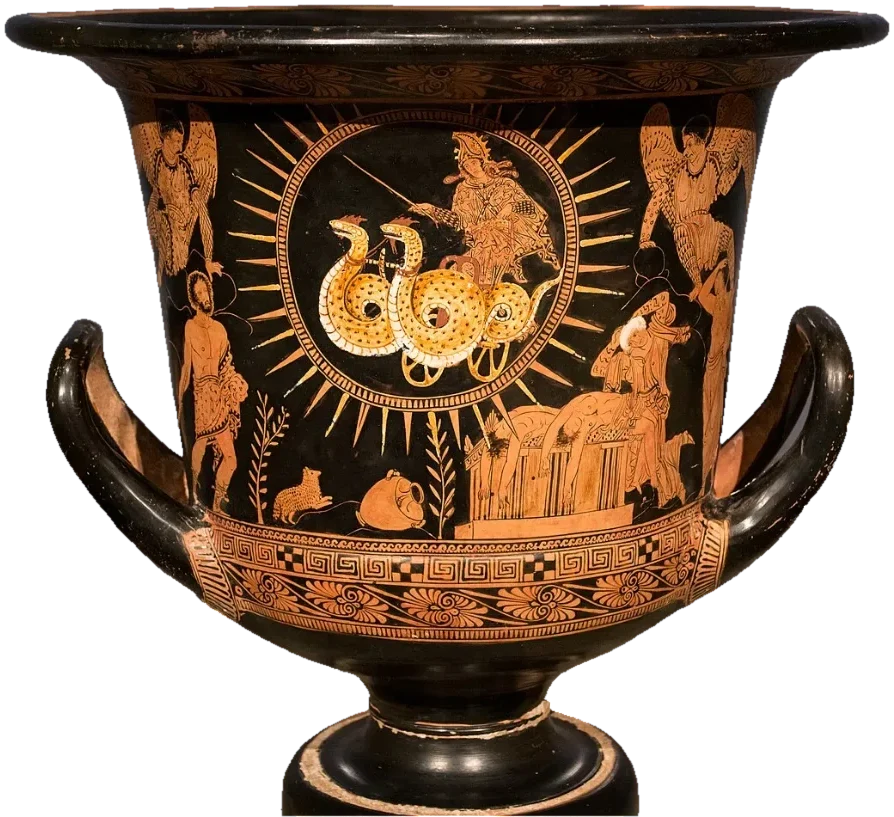
The first is the line you took apart in step 3. The third line of the play is set under it for comparison. A bracket holds each metron:
1Εἴθ’ ὤφελ’ Ἀργοῦς μὴ διαπτάσθαι σκάφος
If only the hull of the Argo had never flown through
3μηδ’ ἐν νάπαισι Πηλίου πεσεῖν ποτε
and the pine had never fallen in the glens of Pelion,
synthetic ∿
Things to notice:
- The free places, coloured. In line 1 all three are filled by longs: Εἴ, γοῦς, τάσ. In line 3 the first is long (μη), but the other two are short (σι, πε). Both lines fit the same pattern. That is what × means.
- The last syllable is free too. Both φος and τε stand there.
- The caesura. There is usually a word-end after the fifth place, which is the first place of the second metron.[7] Failing that, it comes after the seventh.[8] Here it comes after Ἀργοῦς and after νάπαισι, marked ¦.
Caesura: A word-end at a regular place inside a line. In the trimeter it usually comes after the fifth place.[9]
Two shorts for a long
In the trimeter a long place, other than the last, may sometimes be filled by two short syllables instead. This is the resolution of step 1.[10] The line between the two above has one. In κυανέας the two shorts κυ and α share the long place of metron 2, so that metron has five syllables instead of four:
2Κόλχων ἐς αἶαν κυανέας Συμπληγάδας,
the dark Clashing Rocks to the land of the Colchians,
synthetic ∿
The pattern still holds. Count the time instead of the syllables: two shorts take as long as one long, so the metron lasts as long as any other.
Resolution: Two short syllables filling a place meant for one long: κυ-α in κυανέας.[11]
A tip for scanning. Number the twelve places. In the pattern, places 2, 4, 6, 8 and 10 are long. Places 3, 7 and 11 are short. Places 1, 5 and 9 are free, and 12 is the free last place. Find a few sure longs with the rules of step 3, and the rest falls into line.
More. The whole of the Nurse’s opening speech is scanned line by line on the Euripides page. The iambic page gives the rules in full.
Notes
- ^ West 1987, p. 24; Battezzato 2009, p. 136; D’Angour 2022, p. 135.
- ^ West 1987, pp. 19, 24.
- ^ West 1987, p. 5; Battezzato 2009, p. 131.
- ^ a b c d West 1987, p. 5.
- ^ a b West 1987, pp. 5, 24.
- ^ West 1987, p. 4.
- ^ West 1987, p. 25; Battezzato 2009, p. 136.
- ^ West 1987, p. 25.
- ^ West 1987, pp. 4, 25.
- ^ West 1987, pp. 6, 25.
- ^ West 1987, p. 6.
First steps · 7 of 7
Step 7. Scan a line yourself
You now have everything you need to scan a simple line. You have the sounds, from Phonology › First steps, the signs (step 2) and the three rules for long and short (step 3). You also have two patterns: Homer’s hexameter (step 4) and the trimeter of drama (step 6). Work in five steps. Each step below is shown on the second line of the Iliad, which you will scan in full afterwards.
1. Know the pattern.
Find out what metre the poem is in, and write its pattern down in signs. For Homer and all epic, it is the hexameter (step 4). For speeches in drama, it is the trimeter (step 6). For a song, the edition or this site will tell you (step 5). The Iliad is in hexameters, so the pattern is:
— ⏔ | — ⏔ | — ⏔ | — ⏔ | — ⏔ | — ×
the hexameter
synthetic ∿ · the rhythm: a long note for —, a short one for ⏑
2. Split the line into syllables.
Give each syllable one vowel or diphthong. A single consonant goes with the vowel after it. Two consonants are split between syllables. All this runs across word-ends.[1] Mark elisions ’.[2] In Homer, watch for two vowels said as one, like δεω.[3] For example:
3. Mark the sure longs.
These are syllables with η, ω, a diphthong or a circumflex.[4] They are also syllables closed by a consonant, that is, with two consonants after the vowel.[5] For example, οὐ has the diphthong ου, and νη has η, so both are long.
There is one catch in Homer. A long vowel or diphthong at the very end of a word, with a vowel beginning the next word, is usually counted short. This is correption.[6] Step 3 showed it in μοι ἔννεπε.
4. Mark the sure shorts.
These are ε or ο with at most one consonant after it before the next vowel. For example, λο in οὐλομένην has ο followed by the single consonant μ, so it is short.
5. Fit the rest to the pattern.
An α, ι or υ you cannot decide is decided by the pattern. If the pattern needs a long there, it is long. Check that the syllables add up to the right number. Remember that the last one is free.[7] Then find the caesura. In a hexameter, start from the end, which is nearly always — ⏑ ⏑ — ×, DAA da da DAA DAA.[8] For example, the υ of μυρί’ in this line cannot be told from the spelling, but the pattern needs a long there.
To scan: To go through a line syllable by syllable, marking each long — or short ⏑. This shows how the line fits its pattern.[9]
Try it
Here is the second line of the Iliad. It follows straight on from the line you heard in step 1. Scan it on paper before you open the answer. It is a hexameter, so start from the end.
οὐλομένην, ἣ μυρί’ Ἀχαιοῖς ἄλγε’ ἔθηκε,
oulomenēn, hē myri’ Achaiois alge’ ethēke,
the accursed wrath, which laid countless sorrows on the Achaeans,
David Chamberlain, Iliad 1.2 · CC BY 4.0
Show the answer
οὐλομένην, ἣ μυρίʼ Ἀχαιοῖς ἄλγεʼ ἔθηκε,
the accursed wrath, which laid countless sorrows on the Achaeans,
David Chamberlain, Iliad 1.2 · CC BY 4.0
Two spondees this time, in feet 2 and 4. The υ of μυρί’ is long. The pattern needs a long there, and the dictionary marks the word μῡρίος. Two vowels are elided, in μυρί’ and ἄλγε’. As in line 1, a final consonant joins the next word. The ν of οὐλομένην goes with ἣ, and the ς of Ἀχαιοῖς goes with ἄλ. The rough breathing of ἣ does not count as a consonant.[10]
The caesura falls between the two shorts of foot 3, after μυρί’. A caesura in this place is called “feminine”. One straight after the long of foot 3, as in line 1, is called “masculine”.[11]
Masculine and feminine caesura: In the hexameter, a word-end straight after the long of the third foot is called masculine. One between the two shorts of the third foot is called feminine.[11]
One more
Here is the fifth line of the Iliad. Several of its words are in Phonology › First steps, where you can hear them read. Scan it, then open the answer.
οἰωνοῖσί τε πᾶσι, Διὸς δ’ ἐτελείετο βουλή,
oiōnoisi te pāsi, Dios d’ eteleieto boulē,
and for all the birds; and the plan of Zeus was being fulfilled,
Show the answer
οἰωνοῖσί τε πᾶσι, Διὸς δʼ ἐτελείετο βουλή,
and for all the birds; and the plan of Zeus was being fulfilled,
David Chamberlain, Iliad 1.5 · CC BY 4.0
Only the first foot is a spondee, οἰ ω: a diphthong and a long vowel. Every other foot up to the fifth is a dactyl, and the line ends βου λή, — ×. The circumflex of πᾶσι shows its α is long. The caesura falls after πᾶσι, between the two shorts of foot 3, so it is feminine, like the caesura of line 2.
Where to go next
- The Introduction gives the full rules: Quantity for long and short, with the exceptions this page left out, and Notation for every sign.
- The hexameter page covers caesurae, contraction and the special licences of Homer’s verse.
- The Hymn to Aphrodite tab scans all of Sappho’s poem, with a note on every syllable.
- The Homer page and the Euripides page carry on from the lines on this page.
- The Sounds page of the Phonology section says much more about the sounds met in its First steps.
- The Accent page explains what the accent marks meant, and why they do not decide the metre.
Notes
- ^ West 1987, p. 12; Battezzato 2009, p. 130.
- ^ West 1987, p. 13.
- ^ West 1987, p. 15.
- ^ West 1987, p. 10.
- ^ West 1987, p. 12; Battezzato 2009, pp. 130–131.
- ^ West 1987, p. 14; D’Angour 2022, p. 134.
- ^ West 1987, p. 4; Battezzato 2009, p. 131.
- ^ West 1987, p. 20.
- ^ West 1987, pp. 5, 10.
- ^ West 1987, p. 12 with n. 1.
- ^ a b West 1987, p. 19; Battezzato 2009, p. 138.


