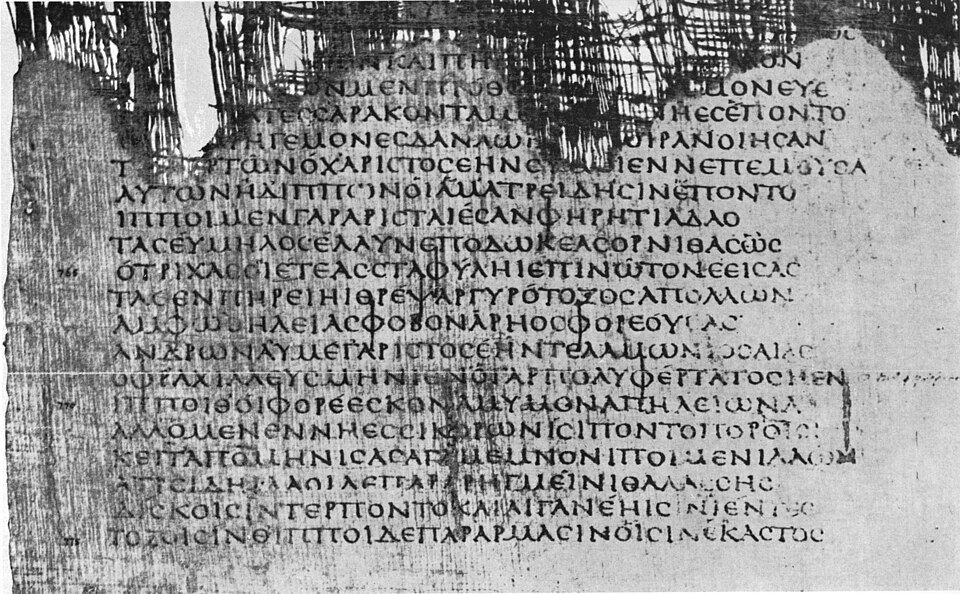
Homer
The Iliad and Odyssey: epic language, hexameter rhythm and oral tradition.
About
Works
- Recording
- Scansion and commentary
- Notes
- How to read each line
- Key to the labels
- Scansion
- Prosody, line by line
- Recording
- Scansion and commentary
- Notes
- How to read each line
- Key to the labels
- Scansion
- Prosody, line by line
- Synopsis
- Text and translation
- How to read each line
- Key to the labels
- Scansion
- Metre
- Prosody, line by line
- What the input marks
- Notes
- Synopsis
- Text and translation
- How to read each line
- Key to the labels
- Scansion
- Metre
- Prosody, line by line
- What the input marks
- The recording
- Notes
- Synopsis
- Text and translation
- How to read each line
- Key to the labels
- Scansion
- Metre
- Prosody, line by line
- What the input marks
- The recording
- Notes
- Synopsis
- Text and translation
- How to read each line
- Key to the labels
- Scansion
- Metre
- Prosody, line by line
- What the input marks
- The same half-line in Hesiod
- Notes
- Synopsis
- Text and translation
- How to read each line
- Key to the labels
- Scansion
- Metre
- Prosody, line by line
- What the input marks
- Notes
- Synopsis
- Text and translation
- How to read each line
- Key to the labels
- Scansion
- Metre
- Prosody, line by line
- What the input marks
- Notes
- Synopsis
- Text and translation
- How to read each line
- Key to the labels
- Scansion
- Metre
- Prosody, line by line
- What the input marks
- The simile in the passage
- Notes
- Synopsis
- Text and translation
- How to read each line
- Key to the labels
- Scansion
- Metre
- Prosody, line by line
- What the input marks
- Notes
About · 1 of 4
Homer and the Homeric question: what the metre says
None of the sources used on this site offers a life of Homer, and this page does not invent one. The metrical literature does say how the poems were made. That bears directly on how they scan.
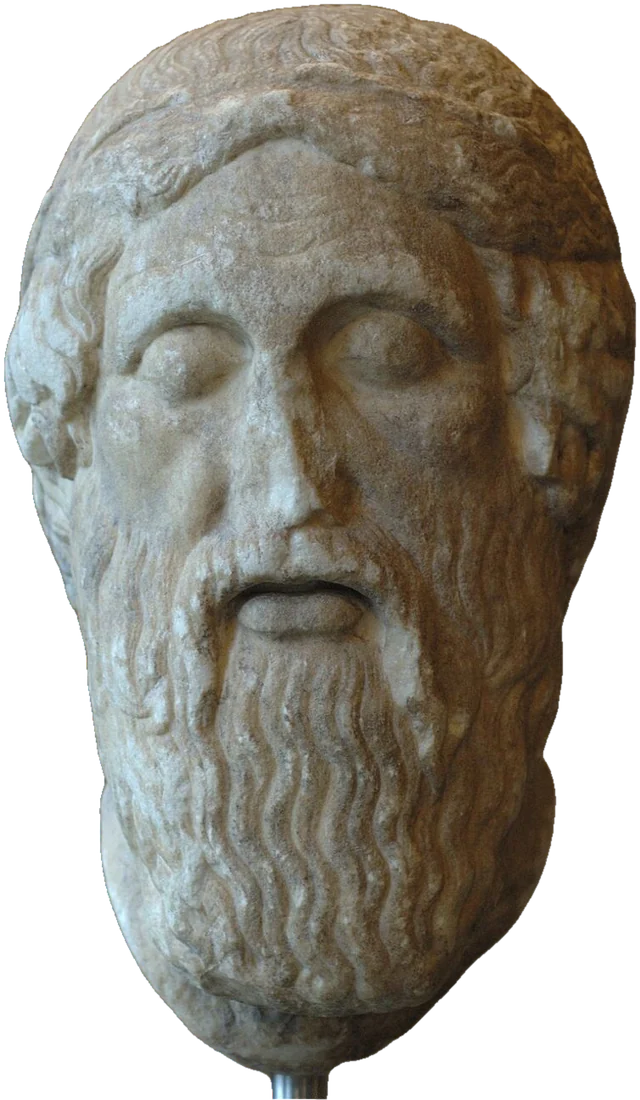
The ancient lives. Lives of Homer were written in antiquity, but they are entirely fictitious. They rest on inferences from the poems, on guesswork and on plain invention. The bard Phemius has a large part in the Odyssey, for example, so he was made into Homer’s stepfather. The poems give no real clue about the poet himself, and so seven cities could claim him.[1]
An oral, traditional verse form. For West the Homeric hexameter is an ancient, traditional form in the hands of oral poets who worked fast. In his view they did not improvise. They assembled their lines rapidly in the head while getting ready to recite.[2] Nagy, following Parry and Lord, places the composing in the performance itself.[3] Both treat the verse as oral and traditional.
Milman Parry showed in the 1920s and 1930s that the epics were made in the way illiterate singers make their poems. They were built from recurring metrical phrases, the formulae, made to fit one into the next.[4] Three things follow. The form carried traditional freedoms that later, more fastidious poets avoided. Those freedoms emboldened some singers to push further. And centuries of linguistic change altered the pronunciation of old formulae. This left metrical anomalies, which were accepted as traditional rather than removed.[2]
Time depth. West reckons with six to eight centuries of development before the Iliad and Odyssey. A conservative poetic language lived on through that time and slowly renewed itself. Meanwhile the spoken language changed around it, in some ways that altered the prosody of words.[5] The epic language is a blend of Aeolic and Ionic forms from different periods.[6]
Some phrases scan only if one restores a stage of Greek earlier than the Mycenaean tablets. ἀνδροτῆτα (androtēta), “manhood”, Ἐνυαλίῳ ἀνδρειφόντῃ (Enyaliōi andreiphontēi), “to Enyalius the man-slayer”, and νὺξ ἀμβρότη (nyx ambrotē), “immortal night”, presuppose syllabic r̥, an r that forms a syllable by itself. The Linear B texts have already lost it.[7] Διὶ μῆτιν ἀτάλαντος (Dii mētin atalantos), “equal to Zeus in counsel”, is explained from a Mycenaean formula, Diweí mḗtim ḥatálantos.[8] The epithet in ἀσπίδος ἀμφιβρότης (aspidos amphibrotēs), “of the man-covering shield”, may refer to the body-shield of the sixteenth and fifteenth centuries.[9]
Tichy, working on the Iliad, distinguishes an old layer of at least 250 years’ depth from Homer’s own Ionic hexameters. The old layer is rooted in an Aeolic tradition of oral lyric. She does not take it back to Mycenaean times, formulae and perhaps a few single verses apart.[10] Nussbaum, in the same volume, identifies Neo-Ionic forms that entered the epic repertory at a relatively recent date.[11]
Two poets. West treats the Iliad and the Odyssey as the work of different poets. In his judgement the Odyssey poet, whatever his merits, handled words and verse less well than the poet of the Iliad. He borrowed the Iliad poet’s lines and half-lines again and again, and did not always fit them neatly to their new place.[12] The reuse of Il. 12.447–448 at Od. 9.241–242 is West’s most glaring case.[13]
Whether one poet made both epics is disputed. A few ancient critics, the chorizontes or “separators”, already gave them to different poets. The introduction to the Loeb Iliad calls the question open. Since separate authorship has not been proved, it keeps to the traditional single Homer.[14]
Formulae and the metre. Whether formula shaped metre or metre shaped formula is disputed. Nagy holds that formula generated metre, and Kiparsky the reverse.[15] Parry’s definition of the formula and the arguments are on the Formula and metre tab. The earliest hexameters in writing that Kiparsky cites are the two on Nestor’s Cup, of the eighth century. They are preceded by an iambic line with a choriambic first foot.[16]
In epic, especially in formulae, the prosody sometimes follows the syllabification of older forms of words than those transmitted. This is notably so of forms containing the digamma, the old sound [w] that Ionic lost. In the majority of cases, words that once had a digamma are scanned as if it were still there.[17]
Disputed. The origin of the hexameter is disputed. Kiparsky reviews the proposals.[18] West (1973) suggested two shorter lyric verses welded together: a pherecratean and an expanded reizianum, or a hemiepes and a paroemiac. Nagy (1974) suggested a pherecratean expanded by three dactyls. He restated this in 1990 as a verse assembled from smaller inherited metres.[19] Berg (1978) suggested an eight-syllable dimeter followed by a pherecratean.
Kiparsky himself derives it from a fused pair of iambic eight-syllable dimeters, by syncopation. West later conceded that the origins can never be known exactly. But he noted that the most widely held theory derives the hexameter from two shorter verses resembling the classical glyconic and pherecratean.[20]
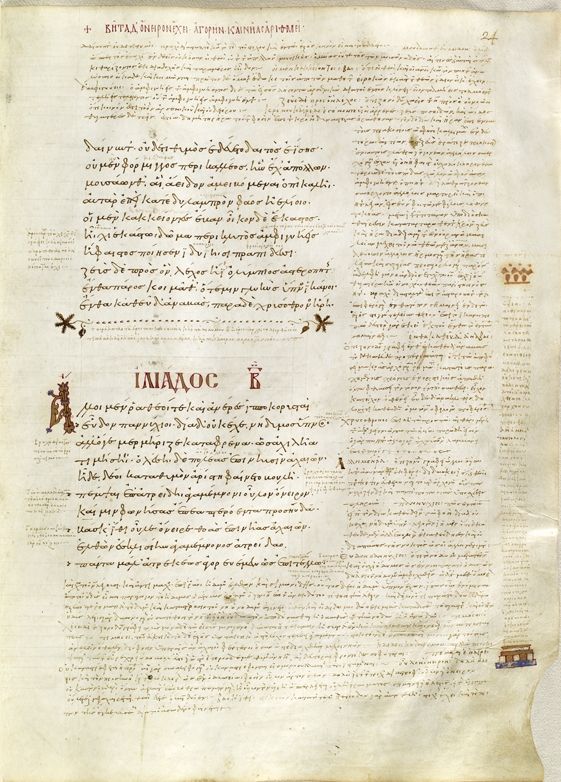
The Homeric question. The modern debate about how the poems were made began in 1788. That year Villoison published the ancient notes, the scholia, from the margins of the Venetus A, a tenth-century manuscript of the Iliad. In 1795 F. A. Wolf argued from them that the poems were put together long after Homer by a compiler. His starting point was that Homer’s age could not write, which is now known to be false.[21] Scholars then divided into two camps. The Analysts looked for layers by different hands. The Unitarians stressed the design of the whole. Parry’s discovery of the formula systems changed the terms of the debate.[22]
When were the poems made? The date is disputed. Two chapters of the Cambridge Companion to Homer put the Iliad about 700 BC, or a little after. The poems know things not found in Greece before the later eighth or early seventh century, such as writing, temples with cult statues and settlement overseas.[23] M. L. West argued for a later date, in the 670s to 650s BC.[24] A statistical study of the language by Richard Janko puts the early epics in the order Iliad, Odyssey, Theogony, Works and Days.[25]
When were they written down? One old view holds that the poems were first written down in sixth-century Athens, for the Panathenaic festival under Peisistratus and his sons. The ancient sources show that a text was made for the festival, but not that it was the first one.[26] Janko’s order also tells against the view. If the poems were fixed one after another, they were not all fixed together in sixth-century Athens.[25]
Writing material was not a problem in Homer’s time. The Greek word for “book”, βύβλος (byblos), comes from Byblos, the Phoenician port that supplied papyrus, and parchment was also available. The earliest Greek inscription dates from about 770 BC.[25] On one view the poet dictated his songs to a writer, as Parry’s South Slavic singers dictated theirs to him.[27]
By the middle of the sixth century the texts were in general circulation. Until then the Homeridae probably kept them. They were a guild of reciters who claimed descent from Homer.[28] In the archaic period most of the epic Cycle and the Homeric Hymns were ascribed to Homer as well.[28]
Notes
- ^ Fowler 2004, p. 5.
- ^ a b West 2018, p. 362.
- ^ Nagy 1990, p. 21.
- ^ Murray and Wyatt 1999, pp. 2–3.
- ^ West 2018, p. 372.
- ^ Kelly 2022, p. 34.
- ^ West 2018, pp. 375–376.
- ^ West 2018, pp. 374–375.
- ^ West 2018, p. 376.
- ^ Tichy 2018, p. 356; Gunkel and Hackstein 2018, p. 2.
- ^ Gunkel and Hackstein 2018, pp. 1–2.
- ^ West 2018, p. 377.
- ^ West 2018, pp. 377–378.
- ^ Murray and Wyatt 1999, pp. 1–2.
- ^ Nagy 1990, p. 29; Kiparsky 2018, pp. 118, 121.
- ^ Kiparsky 2018, p. 108.
- ^ West 1987, pp. 17, 22–23.
- ^ Kiparsky 2018, pp. 104–106.
- ^ Nagy 1990, p. 32.
- ^ West 2018, p. 369.
- ^ Fowler 2004, p. 220.
- ^ Fowler 2004, p. 221.
- ^ Osborne 2004, p. 218; Fowler 2004, p. 225.
- ^ Dowden 2004, p. 194.
- ^ a b c Fowler 2004, p. 225.
- ^ Fowler 2004, pp. 224–225.
- ^ Fowler 2004, pp. 224–226.
- ^ a b Fowler 2004, p. 231.
About · 2 of 4
The text and its metrical repairs
A well-preserved text. The text has come down in good condition. On the whole it is of very high quality.[1] Of some 28,000 lines, very few raise any difficulty at the caesura.[2] So a verse that will not scan is a verse to be explained, not a reason to loosen the rules.
Where the tradition has interfered. The metrical anomalies that do survive show copyists and ancient scholars at work:
- At Il. 4.202 some copyists wrote the place-name Τρίκης (Trikēs) with one kappa to put the metre right: Τρῐ-κης, ⏑ —, against Τρίκ-κης, — —. Yet at Il. 2.729 it has two, and scans as a spondee.[3]
- At Il. 9.414 scribes wrote ἵκωμι (hikōmi) or ἵκοιμι (hikoimi) for ἵκωμαι (hikōmai), forms that do not exist.[3]
- ἀδροτῆτα (adrotēta) for ἀνδροτῆτα (androtēta), and ἀβρο- (abro-) for ἀμβρο- (ambro-) at Il. 10.65 and 14.78, are efforts to mend what looked like a fault in the metre.[4]
- The unmetrical ἕως (heōs), “until” (eighteen cases, plus three of τέως, teōs), stands in almost every witness. Traces of other spellings in papyri and manuscripts are isolated.[5] The metrician Heliodorus (c. AD 100) read a trochaic first foot. Voss, Hermann and Curtius proposed older forms. Curtius’ ἧος (hēos), τῆος (tēos) were adopted by Nauck, Cauer and others.[6] Monro’s text, which this site quotes, prints ἧος at Il. 1.193. West 1987 prints the transmitted ἕως and notes “for older ἧος”.[7]
- Sometimes a syllable is lengthened by a following continuant, a consonant like n or m that can be held (τεν-νιφάδες, ten-niphades; δαμ-μελίην, dam-meliēn). There papyri and sometimes medieval manuscripts write the consonant double.[8]
- Lengthened ε and ο are written ει and ου in our text. This is a matter of spelling only: the earliest texts will have had plain Ε and Ο.[9] At Il. 21.362 ζεῖ (zei), “boils”, represents ζέει (zeei), the reading of a few manuscripts.[10]
The standard text. Even after the poems were fixed, lines were added and changed, as early quotations and papyri show. But the changes were kept in check by a fixed point of reference.[11] A stable standard text, the vulgate, emerged under the Alexandrian scholars, above all Aristarchus in the second century BC. The number of lines in his edition proved decisive. He left out lines that were very poorly attested. He kept other suspect lines but marked them with a critical sign. This marking is called athetesis, and the practice began with Zenodotus early in the third century BC.[12]
Aristarchus’ preferred readings in single lines had much less success than his count of lines. His “edition” was probably a good manuscript that he chose and linked to his commentary by critical signs.[13] Extra lines in the medieval manuscripts, or in the early “wild” papyri, are usually easy to spot.[13]
Editions named in the sources. Fowler names M. L. West’s Iliad and H. van Thiel’s Odyssey as the best modern editions.[13] West’s own Teubner edition records conjectures on Il. 9.414, and obelizes (marks as corrupt) the half-line at Il. 18.458.[14] Richard Payne Knight’s edition of 1820 printed genitives in -οϝο (-owo). West finds it eccentric but often perceptive.[15]
Allen tells the same story from the side of the sounds. Bentley in 1713 first saw that the lost digamma explained Homer’s anomalies. There are some 2,300 cases of absent elision, 400 of lengthening by position and 160 of absent correption. But Payne Knight’s attempt to restore the letter in the text ran to excess. Allen advises the reader not to attempt it in reciting.[16] Ahrens in 1843 explained apparent lengthening in Ἰλίου προπάροιθεν (Iliou proparoithen), “before Ilium”, by a genitive in -οο (-oo).[17]
The ancient metricians. Hephaestion takes his example of the dactylic hexameter, “the so-called ἔπος (epos)”, from the opening of the Iliad. He illustrates the indifferent final syllable from Il. 2.1–2.[18] So the Homeric text he knew already served as the schoolroom model of the metre. He defines the “common” syllable (κοινή, koinē), one that can count as long or short. His first case is a long vowel or diphthong followed by a vowel. He illustrates it from Od. 1.1–2, Ἄνδρα μοι ἔννεπε (andra moi ennepe), where μοι is short before ἔ-, and πλάγχθη ἐπεί (planchthē epei), where -θη is short before ἐ-.[19] This is the ancient statement of what West calls correption, and West uses the same two lines.[20]
This site’s text. Homer is quoted from the Perseus Digital Library edition of D. B. Monro (Iliad), under CC BY-SA 4.0. The reading of a line is noted wherever West’s discussion presupposes a different text.

Notes
- ^ West 2018, pp. 362, 376.
- ^ West 2018, p. 371.
- ^ a b West 2018, p. 372.
- ^ West 2018, p. 376.
- ^ West 2018, pp. 372–373 with n. 9.
- ^ West 2018, p. 373 with nn. 10–12.
- ^ West 1987, p. 23.
- ^ West 2018, p. 366.
- ^ West 1987, p. 21; West 2018, p. 364 n. 4.
- ^ West 1987, p. 22.
- ^ Fowler 2004, p. 231.
- ^ Fowler 2004, pp. 231–232.
- ^ a b c Fowler 2004, p. 232.
- ^ West 2018, pp. 372, 377.
- ^ West 2018, p. 365 n. 5.
- ^ Allen 1968, pp. 46–47.
- ^ West 2018, p. 365 with n. 5.
- ^ Hephaestion, Ench. 7.2 and 4.5.
- ^ Hephaestion, Ench. 1.4.
- ^ West 1987, p. 14.
About · 3 of 4
The Homeric hexameter
The scheme. The hexameter has six dactylic feet or metra (— ⏔). The last is catalectic, cut short to — ×. Seen from the side of the language, the line stylises natural phrasing into fixed sequences of light and heavy syllables. It has six feet, the sixth truncated. The fourth foot is usually dactylic, and the fifth overwhelmingly so.[1] A caesura is a word-end at a fixed place inside the line. West marks three such places with dots. There is always a caesura at one of them at least, normally at one of the two places in the third foot.[2] In the table ¦ stands for his marks:
| 1 | 2 | 3 | 4 | 5 | 6 |
|---|---|---|---|---|---|
| — ⏔ | — ⏔ | — ¦ ⏑ ¦ ⏑ | — ¦ ⏔ | — ⏔ | — × ‖ |
A caesura after the third princeps (the third long) is penthemimeral. One after the fourth princeps is hephthemimeral. In the third foot the “feminine” caesura, — ⏑ ¦ ⏑, predominates over the “masculine”, — ¦ ⏔, in the proportion 4 : 3. Formulaic phrases assume it more often. Just occasionally a long word extends across the whole third foot, and the caesura falls after the fourth princeps.
Because of the regular break, West regards the line as two cola: — ⏑ ⏑ — ⏑ ⏑ — ¦ ⏔ — ⏑ ⏑ — ⏑ ⏑ — × ‖ or — ⏑ ⏑ — ⏑ ⏑ — ⏑ ¦ ⏑ — ⏑ ⏑ — ⏑ ⏑ — × ‖. These cola also occur independently in other metres. For West they, not the notional “feet”, are what the line is actually built from. Many of epic’s repeated phrases are shaped to fill one colon or the other.[2]
Battezzato builds the line the same way. A hemiepes and a paroemiac make the line with the masculine caesura. A feminine hemiepes and an enoplion make the line with the feminine caesura.[3]
In Homer there is word-end at the hephthemimeral position in 45% of lines (Porter’s count). Only about 1% of lines lack the regular central caesura. These usually break after the second and fourth princeps instead, as Il. 6.3 ἀλλήλων | ἰθυνομένων | χαλκήρεα δοῦρα (allēlōn | ithynomenōn | chalkērea doura), “(as they aimed) their bronze-tipped spears at each other”.[4]
The same picture appears from the other side. About 99 lines in 100 have a word-end near the middle of the line, in the third foot. About nine lines in ten also have one in the fourth foot, either after its first long or at its end.[5] Some scholars, but not all, posit a third regular break near the start of the line, after the first foot or after the first long of the second.[6] With these breaks the line falls into four cola. Repeated words and phrases tend to take exactly these shapes and places. A name with its epithet, for example, often fills the line from the feminine caesura to the end, as ἄναξ ἀνδρῶν Ἀγαμέμνων (anax andrōn Agamemnōn), “lord of men Agamemnon”, does.[7]
Bridges. A bridge works the other way from a caesura: it marks a place where poets avoid ending a word. Hermann’s Bridge (1805) avoids word-end between the two shorts of the fourth biceps. Prepositives count with the following word, and postpositives with the preceding. Breaches occur about once in 550 lines in Homer.[8] Maas reckons about once in 390 lines. He puts the rarer caesura after the seventh element at about once in 100 lines, usually to fit a proper name.[9]
Two further habits of word-placing are agreed by all who have counted. A spondaic fifth foot is hardly ever followed by word-end, with three certain exceptions in Homer. And words shaped — — — — stand at the end of the line in over 95% of their 1,445 Homeric occurrences. Allen explains this pattern by the stress he supposes on heavy final syllables.[10]
Word-end after an uncontracted fourth biceps, the “bucolic caesura”, is frequent.[11] It comes in 47% of Homeric lines.[12] Callimachus later avoids two rhythms that Homer admits. One is word-end after a contracted fourth biceps (Naeke’s Law: Il. 1.2 Ἀχαιοῖς | ἄλγε’, Achaiois | alge’, in the box below). The other is word-end between the shorts of the second foot, or at its end, when there is none at the end of the first (Il. 1.1 μῆνιν ἄειδε | θεά, mēnin aeide | thea).[13]
μῆνιν ἄειδε θεὰ Πηληϊάδεω Ἀχιλῆος
οὐλομένην, ἣ μυρί’ Ἀχαιοῖς ἄλγε’ ἔθηκε,
πολλὰς δ’ ἰφθίμους ψυχὰς Ἄϊδι προΐαψεν
ἡρώων, αὐτοὺς δὲ ἑλώρια τεῦχε κύνεσσιν
οἰωνοῖσί τε πᾶσι, Διὸς δ’ ἐτελείετο βουλή,
mēnin aeide thea Pēlēïadeō Achilēos / oulomenēn, hē mūri’ Achaiois alge’ ethēke, / pollas d’ iphthimous psychas Aïdi proïapsen / hērōōn, autous de helōria teuche kynessin / oiōnoisi te pāsi, Dios d’ eteleieto boulē,
“Sing, goddess, the wrath of Achilles son of Peleus, the ruinous wrath that laid countless woes on the Achaeans and hurled to Hades many strong souls of heroes, making the men themselves prey for dogs and all the birds; and the will of Zeus was being accomplished.”
Line 1: masculine caesura after θεὰ; -δεω (red) is one syllable. Line 2: feminine caesura after μυρί’; the contracted fourth foot -χαι-οῖς (red) is followed by word-end. Line 3: word-end after the third and the fourth long; -δι (red) is lengthened before πρ-. Line 4: δὲ (red) stays unelided before ἑλώρια (hiatus) at the feminine caesura; bucolic caesura after ἑλώρια. Line 5: feminine caesura after πᾶσι.
Homer, Iliad 1.1–5, Monro’s text (Perseus)
David Chamberlain, Iliad 1.1–5 · CC BY 4.0
Prosodic licence. No other kind of Greek verse takes as many prosodic liberties as Homer’s.[11] The main heads:
| Licence | Examples | Where |
|---|---|---|
| Metrical lengthening of one vowel in words containing ⏑ ⏑ ⏑ or ⏑ — — ⏑ | ἀποδίωμαι (apodiōmai, ⏑ ⏑ ⏑ — ⏑) → ᾱ̓ποδίωμαι (āpodiōmai, — ⏑ ⏑ — ⏑); ὄνομα (onoma) → οὔνομα (ounoma); ὑπὲρ ἅλα (hyper hala) → ὑπεὶρ ἅλα (hypeir hala); Ἀπόλλωνα (Apollōna) → Ᾱ̓πόλλωνα (Āpollōna) | West 1987, p. 21; West 2018, pp. 363–365 |
| Correption of a final long vowel or diphthong before a vowel | Il. 21.359 δὲ καὶ αὐτίκα (de kai autika), with καί short | West 1987, pp. 14, 22 |
| Hiatus where no digamma is involved | long vowels in hiatus stand mostly in the princeps, short ones above all at the feminine or bucolic caesura (apparent hiatus before a lost ϝ is a separate matter)[14] | West 1987, pp. 21–23; West 2018, p. 363 |
| Lengthening by initial or final continuant (λ μ ν ρ σ) | τεν-νιφάδες (ten-niphades), “snowflakes” with a held ν after τε; δαμ-μελίην (dam-meliēn), with a held μ; nearly always in the princeps | West 1987, pp. 17–18, 22; West 2018, p. 366 |
Il. 21.359–360 shows several of these together:[15]
λῆγ’ ἔριδος, Τρῶας δὲ καὶ αὐτίκα δῖος Ἀχιλλεὺς
ἄστεος ἐξελάσειε· τί μοι ἔριδος καὶ ἀρωγῆς;
lēg’ eridos, Trōas de kai autika dios Achilleus / asteos exelaseie; ti moi eridos kai arōgēs?
“Stop your quarrel; let godlike Achilles drive the Trojans from the city at once. What have I to do with strife and rescue?”
Red: καί, shortened before a vowel twice (correption); μοι, left long before ἔ- in the princeps (hiatus).
Homer, Iliad 21.359–360, Monro’s text (Perseus)
synthetic ∿
Digamma. Many words once began with ϝ, the digamma, pronounced [w]. Usually, and above all in formulae, they still scan as though the consonant were there. Yet it was no longer pronounced when the poems were made.[16] The sound survived in some dialects. In Homer it works mostly inside formulaic phrases.[17]
Ἀτρεΐδης τε ἄναξ ἀνδρῶν καὶ δῖος Ἀχιλλεύς.
αἰδοῖός τέ μοί ἐσσι φίλε ἑκυρὲ δεινός τε·
Atreïdēs te anax andrōn kai dios Achilleus. / aidoios te moi essi phile hekyre deinos te;
“Atreus’ son, lord of men, and godlike Achilles. — You are respected by me and feared, dear father-in-law.”
Red: τε stays unelided before (ϝ)άναξ (Il. 1.7); φίλε and ἑκυρέ are long before the older σϝεκυρέ and δϝεινός (Il. 3.172).
Homer, Iliad 1.7 and 3.172, Monro’s text (Perseus)
line 1: David Chamberlain, Iliad 1.7 · CC BY 4.0line 2: synthetic ∿
Contraction. Contraction is the replacement of the two shorts of the biceps by one long. The biceps is a little longer than the princeps, about 6:5. So a single long in its place puts the rhythm under slight stress. Contraction is least common in the fifth foot, about once in twenty lines in Homer. There it often comes from vowel contraction (Od. 12.7 Ἠῶ, Ēō, one long, for older Ἠόα, Ēoa, two shorts after the long). Word-end after a contracted biceps is frequent only in the first foot. In the fourth foot such a word usually ends in a long vowel (Wernicke’s Law).[18] West’s specimen, Il. 1.215–222, is scanned on the Dactylic page.[19]
The first foot is the most loosely regulated part of the line. It has anomalous short syllables in sentence-initial words such as ἐπεὶ δή (epei dē), ἴομεν (iomen) and κλῦθι (klythi). The clausula, the close of the line, is strict, with a marked preference for a dactylic fifth foot.[20]
Notes
- ^ Horrocks 2010, p. 45.
- ^ a b West 1987, p. 19.
- ^ Battezzato 2009, p. 138.
- ^ Kiparsky 2018, p. 115.
- ^ Clark 2004, pp. 121–122.
- ^ Clark 2004, p. 122.
- ^ Clark 2004, pp. 123–124.
- ^ West 1987, p. 21; Kiparsky 2018, p. 114.
- ^ Maas 1962, p. 60.
- ^ Allen 1968, p. 122; Allen 1973, pp. 285–290; Devine and Stephens 1994, p. 105.
- ^ a b West 1987, p. 21.
- ^ West 1987, p. 78.
- ^ West 1987, pp. 78–79.
- ^ See below.
- ^ West 1987, p. 22.
- ^ West 1987, pp. 22–23.
- ^ West 2018, p. 373.
- ^ West 1987, p. 20.
- ^ See the Contraction tab.
- ^ West 2018, pp. 368–370.
About · 4 of 4
Formula and metre: oral composition and the hexameter
Oral composition. Epic was composed in a stichic metre, one repeated line by line: the dactylic hexameter. Its poetic language (Kunstsprache, “art-language”) combined Aeolic and Ionic dialect forms from different periods.[1] Since Milman Parry and Albert Lord it has been studied as oral poetry. Parry defined the formula as “a group of words which is regularly employed under the same metrical conditions to express a given essential idea”. He based the definition on the Homeric poems alone (Nagy, quoting Parry).[2]
Fieldwork on South Slavic epic showed that every performance was a distinct composition. A singer who composes as he performs needs a ready-made phrase for every position in the verse.[3] Epic was accompanied by a stringed instrument. Its delivery is sometimes thought closer to recitative than to song. But Homeric language shows a strong conception of epic as song.[4]
Formulae and the cola. The description of the metre points the same way. The regular word-break in the third foot divides the line into two cola. West treats these as the true building blocks of the verse. Epic’s recurring phrases are often made to fit one colon or the other. They assume the feminine caesura more often than the masculine.[5] Formulaic phrases are frequently joined at the caesura. How smoothly the join is made depends on the poet’s skill.[6] Parry had already observed that the hexameter’s regular word-breaks mark where formulas begin and end.[7]
Nagy’s example is an epithet and its slot:[8]
ἄνδρα μοι ἔννεπε, μοῦσα, πολύτροπον, ὃς μάλα πολλὰ
ἦ σύ γ’ Ὀδυσσεύς ἐσσι πολύτροπος, ὅν τέ μοι αἰεὶ
andra moi ennepe, mousa, polytropon, hos mala polla / ē sy g’ Odysseus essi polytropos, hon te moi aiei
“Speak to me, Muse, of the man of many turnings, who [wandered] a great deal … — Surely you are Odysseus of many turns, whom [Hermes] always [told] me …”
In both lines πολύτροπος, ⏑ — ⏑ ⏑ (red), runs from the feminine caesura, after the first short of the third foot, to the bucolic caesura at the end of the fourth.
Homer, Odyssey 1.1 and 10.330, Murray’s text (Perseus); translations ours
line 1: David Chamberlain, Odyssey 1.1 · CC BY 4.0line 2: synthetic ∿
In both lines πολύτροπος (polytropos), ⏑ — ⏑ ⏑, fills the stretch between two junctures. Nagy, after Fränkel, labels them B2 and C2. Here they are the feminine caesura and the bucolic caesura.[9] The generic epithet διίφιλος (diiphilos), “dear to Zeus”, would fit the same slot. The Hymn to Hermes uses πολύτροπος there for Hermes (lines 13 and 439).
The phrase πολύτροπον ὅς / πολύτροπος ὅν (polytropon hos / polytropos hon) runs across the metrical break at C2. Nagy suggests that such “spilling” over a juncture may be traditional. It may reflect rhythms older than the current norms of the hexameter.[10]
Which generates which? (disputed)
Nagy: formula before metre. Page’s “law of economy” allows one formula, and one only, for a given idea in a given place in the line. For Nagy this is an effect of traditional diction, not its cause. The regulator is traditional theme rather than metre, and he speaks of a “trend toward thrift”.[11] His definition leaves metre out. The formula is “a fixed phrase conditioned by the traditional themes of oral poetry”. Over time it is formula that gives rise to metre, not the other way round.[12]
Seen synchronically, at one moment in time, the metre frames the formula. Seen historically, formula shapes generated colon shapes. The hexameter, put together from smaller inherited metres, can hold two formulas or more.[13] His evidence is comparative. In the oldest Indic poetry, phraseology is regular even where metre is not.[14]
Kiparsky: metre before formula. The commonest fixed formulas, such as πολύμητις Ὀδυσσεύς (polymētis Odysseus), “Odysseus of many wiles”, and κορυθαίολος Ἕκτωρ (korythaiolos Hektōr), “Hector of the flashing helmet”, are suited to the hexameter. They could not have become formulaic before such metres existed. It “seems unlikely”, Kiparsky writes, that formulas created metre as Nagy proposed. Fixed formulas presuppose a metre, and flexible formulas and themes are not metrically constrained.[15]
Flexible formulas move about. The mist poured over the eyes appears as κατὰ δ’ ὀφθαλμῶν κέχυτ’ ἀχλύς (kata d’ ophthalmōn kechyt’ achlys), “and mist was poured over his eyes” (Il. 5.696), and κατ’ ὀφθαλμῶν χέεν ἀχλὺν (kat’ ophthalmōn cheen achlyn), “he poured mist over his eyes” (Il. 20.321). It is placed at the masculine or the feminine caesura, and Archilochus recasts it in iambics. Formulas, Kiparsky concludes, adapt to metrical change, and new ones are made for new metres.[16]
West’s figures show how a poet managed an awkward word. The vocative Τηλέμαχε (Tēlemache), — ⏑ ⏑ ⏑, occurs thirty-one times in the Odyssey. It is elided before a vowel twenty-seven times, and stands before a double consonant three times. Only once is it used irregularly.[17] Hainsworth’s “flexibility” of the formula is itself regular.[18]
Notes
- ^ Kelly 2022, p. 34.
- ^ Nagy 1990, p. 18.
- ^ Nagy 1990, p. 21.
- ^ Kelly 2022, p. 35.
- ^ West 1987, p. 19.
- ^ West 2018, p. 371.
- ^ Nagy 1990, p. 31.
- ^ Nagy 1990, pp. 33–34.
- ^ West 1987, pp. 19, 21.
- ^ Nagy 1990, p. 33.
- ^ Nagy 1990, pp. 21–24.
- ^ Nagy 1990, p. 29.
- ^ Nagy 1990, pp. 31–32.
- ^ Nagy 1990, pp. 29–30.
- ^ Kiparsky 2018, pp. 118, 121; Gunkel and Hackstein 2018, p. 1.
- ^ Kiparsky 2018, pp. 120–121.
- ^ West 2018, p. 367.
- ^ Nagy 1990, p. 32.
Complete Iliad
Greek text, scansion and metrical commentary, book by book. The Homer lesson explains the signs.
Recording
Choose a recording to open its passage. Chamberlain’s reading sometimes differs from the Greek edition below.
The highlight follows estimated line boundaries measured from the recording’s pauses. It does not mark individual words. Text differences are listed with each recording.
Recording © David Chamberlain · Original track · CC BY 4.0. Web copy compressed to 64 kbit/s mono; no cuts or pitch or speed changes.
Scansion and commentary
Each line has its Greek, accent contour, metrical syllables, quantity marks and transliteration. Select a syllable for its explanation and its place in the foot. The line commentary describes the rhythm and significant features; “Every syllable” opens the complete list of reasons. The accent contour is a teaching diagram of the written accents, not a measurement of the recording.
The commentary applies the credited scansion’s annotations. It distinguishes a source’s length assignment from a cause established by spelling. Written word-ends are marked as possible breaks; choosing a principal caesura also depends on the grammar. The earlier worked passages’ detailed discussions and translations are retained where available.
Metre, symbols and sources
Feet and positions
A hexameter has six feet. Each of the first five has one long followed by either two shorts (a dactyl, — ⏑ ⏑) or another long (a spondee, — —). The sixth has — ×. The first part of a foot is the princeps; the second is the biceps. Two shorts share that second position, so the twelve metrical positions are not twelve syllables.[1]
Vowel length
η and ω are long; ε and ο are short. α, ι and υ can be either. A circumflex requires a long vowel or diphthong. A long syllable does not necessarily contain a long vowel.[2]
Position
Consonants after a vowel can close the syllable and make it long. A word boundary does not prevent this. ξ, ψ and ζ count as two consonants for this purpose.[3]
Correption
A long vowel or diphthong may count short before another vowel. In Odyssey 1.1, μοι counts short before ἔννεπε; the two vowels remain separate.[4]
Merged vowels
Synizesis puts vowels within a word into one metrical syllable, as -εω in Πηληϊάδεω at Iliad 1.1. Synecphonesis can join vowels across words. These are distinct from shortening two vowels that remain separate.[5]
Stops and liquids
A stop followed by a liquid can be divided between syllables or carried into the next one. Early epic usually lets an internal group make position; at the beginning of a word either treatment is possible.[6]
Hiatus and elision
Hiatus leaves adjacent vowels separate across a word boundary. Elision removes a vowel; the edition marks it with an apostrophe. The removed vowel has no separate metrical position.[7]
Lengthening and shortening
Epic sometimes gives a syllable a length that ordinary spelling would not predict. A prolonged consonant and metrical lengthening are different possible explanations. The source’s quantity tag alone does not prove a particular historical cause.[8]
Digamma
The letter ϝ represents an earlier consonant, pronounced [w]. Its metrical effect sometimes remains where the consonant is no longer written. The retained consonant can prevent elision or contribute to a long syllable.[9]
Word breaks
A word-end inside a foot is a caesura; at a foot boundary it is a diaeresis. Common positions are after the first long in foot 3 (penthemimeral), after that foot’s first short (feminine), and after the first long in foot 4 (hephthemimeral). The bucolic break follows foot 4; the labels distinguish its dactylic and spondaic forms.[10]
Written spaces do not always separate independent word-groups: articles, prepositions and particles may belong closely with the adjacent word. A marked word-end is therefore not an instruction to pause.[11]
Accent contour
The acute marks a high pitch; over a long vowel it can rise within the syllable. A circumflex combines a high part and a falling part. A dashed acute contour leaves vowel duration undecided. A dashed level stroke marks the uncertain treatment of a grave. These diagrams do not prescribe an exact tune or follow the reader’s voice.[12]
References for the reading key
Notes
- ^ Clark 2004, p. 120; West 1987, pp. 19–20.
- ^ West 1987, pp. 10–13.
- ^ Clark 2004, p. 120; West 1987, p. 12.
- ^ West 1987, p. 14.
- ^ West 1987, pp. 15–16.
- ^ West 1987, pp. 16–17.
- ^ West 1987, pp. 13–16.
- ^ West 1987, pp. 17–18, 21–22.
- ^ West 1987, pp. 22–23.
- ^ Clark 2004, pp. 121–123; West 1987, pp. 19–21.
- ^ West 1987, p. 9.
- ^ Allen 1968, pp. 111–118; West 1987, p. 13.
How to read each line
A guide to the rows, foot highlights and line commentary.
Key to the labels
The line names, foot descriptions and word-break labels in the margin.
Show the labels and symbols
The right column names the metre, shows its pattern and lists the feet and marked word breaks. The labels below each line open its teaching notes. Recording options explain how the audio highlights are timed.
Scansion: David Chamberlain, Hypotactic, CC BY 4.0; adapted to the Greek edition credited below. The last position is shown as ×.
Scansion
- 1.1 μῆνιν ἄειδε θεὰ Πηληϊάδεω Ἀχιλῆος
- 1.2 οὐλομένην, ἣ μυρίʼ Ἀχαιοῖς ἄλγεʼ ἔθηκε,
- 1.3 πολλὰς δʼ ἰφθίμους ψυχὰς Ἄϊδι προΐαψεν
- 1.4 ἡρώων, αὐτοὺς δὲ ἑλώρια τεῦχε κύνεσσιν
- 1.5 οἰωνοῖσί τε πᾶσι, Διὸς δʼ ἐτελείετο βουλή,
- 1.6 ἐξ οὗ δὴ τὰ πρῶτα διαστήτην ἐρίσαντε
- 1.7 Ἀτρεΐδης τε ἄναξ ἀνδρῶν καὶ δῖος Ἀχιλλεύς.
- 1.8 τίς τʼ ἄρ σφωε θεῶν ἔριδι ξυνέηκε μάχεσθαι;
- 1.9 Λητοῦς καὶ Διὸς υἱός· ὃ γὰρ βασιλῆϊ χολωθεὶς
- 1.10 νοῦσον ἀνὰ στρατὸν ὄρσε κακήν, ὀλέκοντο δὲ λαοί,
- 1.11 οὕνεκα τὸν Χρύσην ἠτίμασεν ἀρητῆρα
- 1.12 Ἀτρεΐδης· ὃ γὰρ ἦλθε θοὰς ἐπὶ νῆας Ἀχαιῶν
- 1.13 λυσόμενός τε θύγατρα φέρων τʼ ἀπερείσιʼ ἄποινα,
- 1.14 στέμματʼ ἔχων ἐν χερσὶν ἑκηβόλου Ἀπόλλωνος
- 1.15 χρυσέῳ ἀνὰ σκήπτρῳ, καὶ λίσσετο πάντας Ἀχαιούς,
- 1.16 Ἀτρεΐδα δὲ μάλιστα δύω, κοσμήτορε λαῶν·
- 1.17 Ἀτρεΐδαι τε καὶ ἄλλοι ἐϋκνήμιδες Ἀχαιοί,
- 1.18 ὑμῖν μὲν θεοὶ δοῖεν Ὀλύμπια δώματʼ ἔχοντες
- 1.19 ἐκπέρσαι Πριάμοιο πόλιν, εὖ δʼ οἴκαδʼ ἱκέσθαι·
- 1.20 παῖδα δʼ ἐμοὶ λύσαιτε φίλην, τὰ δʼ ἄποινα δέχεσθαι,
- 1.21 ἁζόμενοι Διὸς υἱὸν ἑκηβόλον Ἀπόλλωνα.
- 1.22 ἔνθʼ ἄλλοι μὲν πάντες ἐπευφήμησαν Ἀχαιοὶ
- 1.23 αἰδεῖσθαί θʼ ἱερῆα καὶ ἀγλαὰ δέχθαι ἄποινα·
- 1.24 ἀλλʼ οὐκ Ἀτρεΐδῃ Ἀγαμέμνονι ἥνδανε θυμῷ,
- 1.25 ἀλλὰ κακῶς ἀφίει, κρατερὸν δʼ ἐπὶ μῦθον ἔτελλε·
- 1.26 μή σε γέρον κοίλῃσιν ἐγὼ παρὰ νηυσὶ κιχείω
- 1.27 ἢ νῦν δηθύνοντʼ ἢ ὕστερον αὖτις ἰόντα,
- 1.28 μή νύ τοι οὐ χραίσμῃ σκῆπτρον καὶ στέμμα θεοῖο·
- 1.29 τὴν δʼ ἐγὼ οὐ λύσω· πρίν μιν καὶ γῆρας ἔπεισιν
- 1.30 ἡμετέρῳ ἐνὶ οἴκῳ ἐν Ἄργεϊ τηλόθι πάτρης
- 1.31 ἱστὸν ἐποιχομένην καὶ ἐμὸν λέχος ἀντιόωσαν·
- 1.32 ἀλλʼ ἴθι μή μʼ ἐρέθιζε σαώτερος ὥς κε νέηαι.
- 1.33 ὣς ἔφατʼ, ἔδεισεν δʼ ὃ γέρων καὶ ἐπείθετο μύθῳ·
- 1.34 βῆ δʼ ἀκέων παρὰ θῖνα πολυφλοίσβοιο θαλάσσης·
- 1.35 πολλὰ δʼ ἔπειτʼ ἀπάνευθε κιὼν ἠρᾶθʼ ὁ γεραιὸς
- 1.36 Ἀπόλλωνι ἄνακτι, τὸν ἠΰκομος τέκε Λητώ·
- 1.37 κλῦθί μευ ἀργυρότοξʼ, ὃς Χρύσην ἀμφιβέβηκας
- 1.38 Κίλλαν τε ζαθέην Τενέδοιό τε ἶφι ἀνάσσεις,
- 1.39 Σμινθεῦ εἴ ποτέ τοι χαρίεντʼ ἐπὶ νηὸν ἔρεψα,
- 1.40 ἢ εἰ δή ποτέ τοι κατὰ πίονα μηρίʼ ἔκηα
- 1.41 ταύρων ἠδʼ αἰγῶν, τὸ δέ μοι κρήηνον ἐέλδωρ·
- 1.42 τίσειαν Δαναοὶ ἐμὰ δάκρυα σοῖσι βέλεσσιν.
- 1.43 ὣς ἔφατʼ εὐχόμενος, τοῦ δʼ ἔκλυε Φοῖβος Ἀπόλλων,
- 1.44 βῆ δὲ κατʼ Οὐλύμποιο καρήνων χωόμενος κῆρ,
- 1.45 τόξʼ ὤμοισιν ἔχων ἀμφηρεφέα τε φαρέτρην·
- 1.46 ἔκλαγξαν δʼ ἄρʼ ὀϊστοὶ ἐπʼ ὤμων χωομένοιο,
- 1.47 αὐτοῦ κινηθέντος· ὃ δʼ ἤϊε νυκτὶ ἐοικώς.
- 1.48 ἕζετʼ ἔπειτʼ ἀπάνευθε νεῶν, μετὰ δʼ ἰὸν ἕηκε·
- 1.49 δεινὴ δὲ κλαγγὴ γένετʼ ἀργυρέοιο βιοῖο·
- 1.50 οὐρῆας μὲν πρῶτον ἐπῴχετο καὶ κύνας ἀργούς,
Prosody, line by line
Text and scansion notes
The Greek follows Monro and Allen’s Homeri Opera (Oxford, 1908–1920), in the Perseus edition, CC BY-SA 4.0. Its wording, accents and numbering are retained.
Six bracketed lines are absent from that file. Lines 9.458–461 follow the quotation in Plutarch, How to Study Poetry 26f; 11.543 follows Aristotle, Rhetoric 2.9.11; 14.269 follows Greek Wikisource’s Iliad 14. These transcriptions are CC BY-SA 4.0. Square brackets retain the distinction from the main edition.
Chamberlain’s syllable divisions and quantities supply the scansion. The Greek readings at 1.277, 2.811, 10.65, 13.60 and 14.78 have been aligned to Perseus. A missing quantity tag at 2.181 and duplicated quantity tags at 21.301 have been resolved to the single reading that completes six feet. Relevant lines carry a note.
Odyssey 1–7
Greek text, scansion and metrical commentary, book by book. The Homer lesson explains the signs.
Recording
Choose a recording to open its passage. Chamberlain’s reading sometimes differs from the Greek edition below.
The highlight follows estimated line boundaries measured from the recording’s pauses. It does not mark individual words. Text differences are listed with each recording.
Recording © David Chamberlain · Original track · CC BY 4.0. Web copy compressed to 64 kbit/s mono; no cuts or pitch or speed changes.
Scansion and commentary
Each line has its Greek, accent contour, metrical syllables, quantity marks and transliteration. Select a syllable for its explanation and its place in the foot. The line commentary describes the rhythm and significant features; “Every syllable” opens the complete list of reasons. The accent contour is a teaching diagram of the written accents, not a measurement of the recording.
The commentary applies the credited scansion’s annotations. It distinguishes a source’s length assignment from a cause established by spelling. Written word-ends are marked as possible breaks; choosing a principal caesura also depends on the grammar. The earlier worked passages’ detailed discussions and translations are retained where available.
Metre, symbols and sources
Feet and positions
A hexameter has six feet. Each of the first five has one long followed by either two shorts (a dactyl, — ⏑ ⏑) or another long (a spondee, — —). The sixth has — ×. The first part of a foot is the princeps; the second is the biceps. Two shorts share that second position, so the twelve metrical positions are not twelve syllables.[1]
Vowel length
η and ω are long; ε and ο are short. α, ι and υ can be either. A circumflex requires a long vowel or diphthong. A long syllable does not necessarily contain a long vowel.[2]
Position
Consonants after a vowel can close the syllable and make it long. A word boundary does not prevent this. ξ, ψ and ζ count as two consonants for this purpose.[3]
Correption
A long vowel or diphthong may count short before another vowel. In Odyssey 1.1, μοι counts short before ἔννεπε; the two vowels remain separate.[4]
Merged vowels
Synizesis puts vowels within a word into one metrical syllable, as -εω in Πηληϊάδεω at Iliad 1.1. Synecphonesis can join vowels across words. These are distinct from shortening two vowels that remain separate.[5]
Stops and liquids
A stop followed by a liquid can be divided between syllables or carried into the next one. Early epic usually lets an internal group make position; at the beginning of a word either treatment is possible.[6]
Hiatus and elision
Hiatus leaves adjacent vowels separate across a word boundary. Elision removes a vowel; the edition marks it with an apostrophe. The removed vowel has no separate metrical position.[7]
Lengthening and shortening
Epic sometimes gives a syllable a length that ordinary spelling would not predict. A prolonged consonant and metrical lengthening are different possible explanations. The source’s quantity tag alone does not prove a particular historical cause.[8]
Digamma
The letter ϝ represents an earlier consonant, pronounced [w]. Its metrical effect sometimes remains where the consonant is no longer written. The retained consonant can prevent elision or contribute to a long syllable.[9]
Word breaks
A word-end inside a foot is a caesura; at a foot boundary it is a diaeresis. Common positions are after the first long in foot 3 (penthemimeral), after that foot’s first short (feminine), and after the first long in foot 4 (hephthemimeral). The bucolic break follows foot 4; the labels distinguish its dactylic and spondaic forms.[10]
Written spaces do not always separate independent word-groups: articles, prepositions and particles may belong closely with the adjacent word. A marked word-end is therefore not an instruction to pause.[11]
Accent contour
The acute marks a high pitch; over a long vowel it can rise within the syllable. A circumflex combines a high part and a falling part. A dashed acute contour leaves vowel duration undecided. A dashed level stroke marks the uncertain treatment of a grave. These diagrams do not prescribe an exact tune or follow the reader’s voice.[12]
References for the reading key
Notes
- ^ Clark 2004, p. 120; West 1987, pp. 19–20.
- ^ West 1987, pp. 10–13.
- ^ Clark 2004, p. 120; West 1987, p. 12.
- ^ West 1987, p. 14.
- ^ West 1987, pp. 15–16.
- ^ West 1987, pp. 16–17.
- ^ West 1987, pp. 13–16.
- ^ West 1987, pp. 17–18, 21–22.
- ^ West 1987, pp. 22–23.
- ^ Clark 2004, pp. 121–123; West 1987, pp. 19–21.
- ^ West 1987, p. 9.
- ^ Allen 1968, pp. 111–118; West 1987, p. 13.
How to read each line
A guide to the rows, foot highlights and line commentary.
Key to the labels
The line names, foot descriptions and word-break labels in the margin.
Show the labels and symbols
The right column names the metre, shows its pattern and lists the feet and marked word breaks. The labels below each line open its teaching notes. Recording options explain how the audio highlights are timed.
Scansion: David Chamberlain, Hypotactic, CC BY 4.0; adapted to the Greek edition credited below. The last position is shown as ×.
Scansion
- 1.1 ἄνδρα μοι ἔννεπε, μοῦσα, πολύτροπον, ὃς μάλα πολλὰ
- 1.2 πλάγχθη, ἐπεὶ Τροίης ἱερὸν πτολίεθρον ἔπερσεν·
- 1.3 πολλῶν δʼ ἀνθρώπων ἴδεν ἄστεα καὶ νόον ἔγνω,
- 1.4 πολλὰ δʼ ὅ γʼ ἐν πόντῳ πάθεν ἄλγεα ὃν κατὰ θυμόν,
- 1.5 ἀρνύμενος ἥν τε ψυχὴν καὶ νόστον ἑταίρων.
- 1.6 ἀλλʼ οὐδʼ ὣς ἑτάρους ἐρρύσατο, ἱέμενός περ·
- 1.7 αὐτῶν γὰρ σφετέρῃσιν ἀτασθαλίῃσιν ὄλοντο,
- 1.8 νήπιοι, οἳ κατὰ βοῦς Ὑπερίονος Ἠελίοιο
- 1.9 ἤσθιον· αὐτὰρ ὁ τοῖσιν ἀφείλετο νόστιμον ἦμαρ.
- 1.10 τῶν ἁμόθεν γε, θεά, θύγατερ Διός, εἰπὲ καὶ ἡμῖν.
- 1.11 ἔνθʼ ἄλλοι μὲν πάντες, ὅσοι φύγον αἰπὺν ὄλεθρον,
- 1.12 οἴκοι ἔσαν, πόλεμόν τε πεφευγότες ἠδὲ θάλασσαν·
- 1.13 τὸν δʼ οἶον νόστου κεχρημένον ἠδὲ γυναικὸς
- 1.14 νύμφη πότνιʼ ἔρυκε Καλυψὼ δῖα θεάων
- 1.15 ἐν σπέσσι γλαφυροῖσι, λιλαιομένη πόσιν εἶναι.
- 1.16 ἀλλʼ ὅτε δὴ ἔτος ἦλθε περιπλομένων ἐνιαυτῶν,
- 1.17 τῷ οἱ ἐπεκλώσαντο θεοὶ οἶκόνδε νέεσθαι
- 1.18 εἰς Ἰθάκην, οὐδʼ ἔνθα πεφυγμένος ἦεν ἀέθλων
- 1.19 καὶ μετὰ οἷσι φίλοισι. θεοὶ δʼ ἐλέαιρον ἅπαντες
- 1.20 νόσφι Ποσειδάωνος· ὁ δʼ ἀσπερχὲς μενέαινεν
- 1.21 ἀντιθέῳ Ὀδυσῆι πάρος ἣν γαῖαν ἱκέσθαι.
- 1.22 ἀλλʼ ὁ μὲν Αἰθίοπας μετεκίαθε τηλόθʼ ἐόντας,
- 1.23 Αἰθίοπας τοὶ διχθὰ δεδαίαται, ἔσχατοι ἀνδρῶν,
- 1.24 οἱ μὲν δυσομένου Ὑπερίονος οἱ δʼ ἀνιόντος,
- 1.25 ἀντιόων ταύρων τε καὶ ἀρνειῶν ἑκατόμβης.
- 1.26 ἔνθʼ ὅ γʼ ἐτέρπετο δαιτὶ παρήμενος· οἱ δὲ δὴ ἄλλοι
- 1.27 Ζηνὸς ἐνὶ μεγάροισιν Ὀλυμπίου ἁθρόοι ἦσαν.
- 1.28 τοῖσι δὲ μύθων ἦρχε πατὴρ ἀνδρῶν τε θεῶν τε·
- 1.29 μνήσατο γὰρ κατὰ θυμὸν ἀμύμονος Αἰγίσθοιο,
- 1.30 τόν ῥʼ Ἀγαμεμνονίδης τηλεκλυτὸς ἔκτανʼ Ὀρέστης·
- 1.31 τοῦ ὅ γʼ ἐπιμνησθεὶς ἔπεʼ ἀθανάτοισι μετηύδα·
- 1.32 ὢ πόποι, οἷον δή νυ θεοὺς βροτοὶ αἰτιόωνται·
- 1.33 ἐξ ἡμέων γάρ φασι κάκʼ ἔμμεναι, οἱ δὲ καὶ αὐτοὶ
- 1.34 σφῇσιν ἀτασθαλίῃσιν ὑπὲρ μόρον ἄλγεʼ ἔχουσιν,
- 1.35 ὡς καὶ νῦν Αἴγισθος ὑπὲρ μόρον Ἀτρεΐδαο
- 1.36 γῆμʼ ἄλοχον μνηστήν, τὸν δʼ ἔκτανε νοστήσαντα,
- 1.37 εἰδὼς αἰπὺν ὄλεθρον, ἐπεὶ πρό οἱ εἴπομεν ἡμεῖς,
- 1.38 Ἑρμείαν πέμψαντες, ἐύσκοπον ἀργεϊφόντην,
- 1.39 μήτʼ αὐτὸν κτείνειν μήτε μνάασθαι ἄκοιτιν·
- 1.40 ἐκ γὰρ Ὀρέσταο τίσις ἔσσεται Ἀτρεΐδαο,
- 1.41 ὁππότʼ ἂν ἡβήσῃ τε καὶ ἧς ἱμείρεται αἴης.
- 1.42 ὣς ἔφαθʼ Ἑρμείας, ἀλλʼ οὐ φρένας Αἰγίσθοιο
- 1.43 πεῖθʼ ἀγαθὰ φρονέων· νῦν δʼ ἁθρόα πάντʼ ἀπέτισεν.
- 1.44 τὸν δʼ ἠμείβετʼ ἔπειτα θεά, γλαυκῶπις Ἀθήνη·
- 1.45 ὦ πάτερ ἡμέτερε Κρονίδη, ὕπατε κρειόντων,
- 1.46 καὶ λίην κεῖνός γε ἐοικότι κεῖται ὀλέθρῳ·
- 1.47 ὡς ἀπόλοιτο καὶ ἄλλος, ὅτις τοιαῦτά γε ῥέζοι·
- 1.48 ἀλλά μοι ἀμφʼ Ὀδυσῆι δαΐφρονι δαίεται ἦτορ,
- 1.49 δυσμόρῳ, ὃς δὴ δηθὰ φίλων ἄπο πήματα πάσχει
- 1.50 νήσῳ ἐν ἀμφιρύτῃ, ὅθι τʼ ὀμφαλός ἐστι θαλάσσης.
Prosody, line by line
Text and scansion notes
The Greek follows A. T. Murray’s Odyssey (1919), in the Perseus edition, CC BY-SA 4.0. Wording, accents, punctuation and conventional line numbers are retained. Books 1–7 contain 3,393 lines.
Scansion uses Chamberlain’s independent syllables and quantities, CC BY 4.0. Damaged annotations at 2.72 and 3.149 follow his recording-linked pages. At 2.402 the epithet’s syllables and quantities follow the identical word at Iliad 1.17. A Latin letter at 1.129, the order of 3.304–305 and final ν in eleven lines have been aligned to Perseus; these lines carry notes.
Iliad 1.1–52 — the proemChryses and Apollo
Synopsis
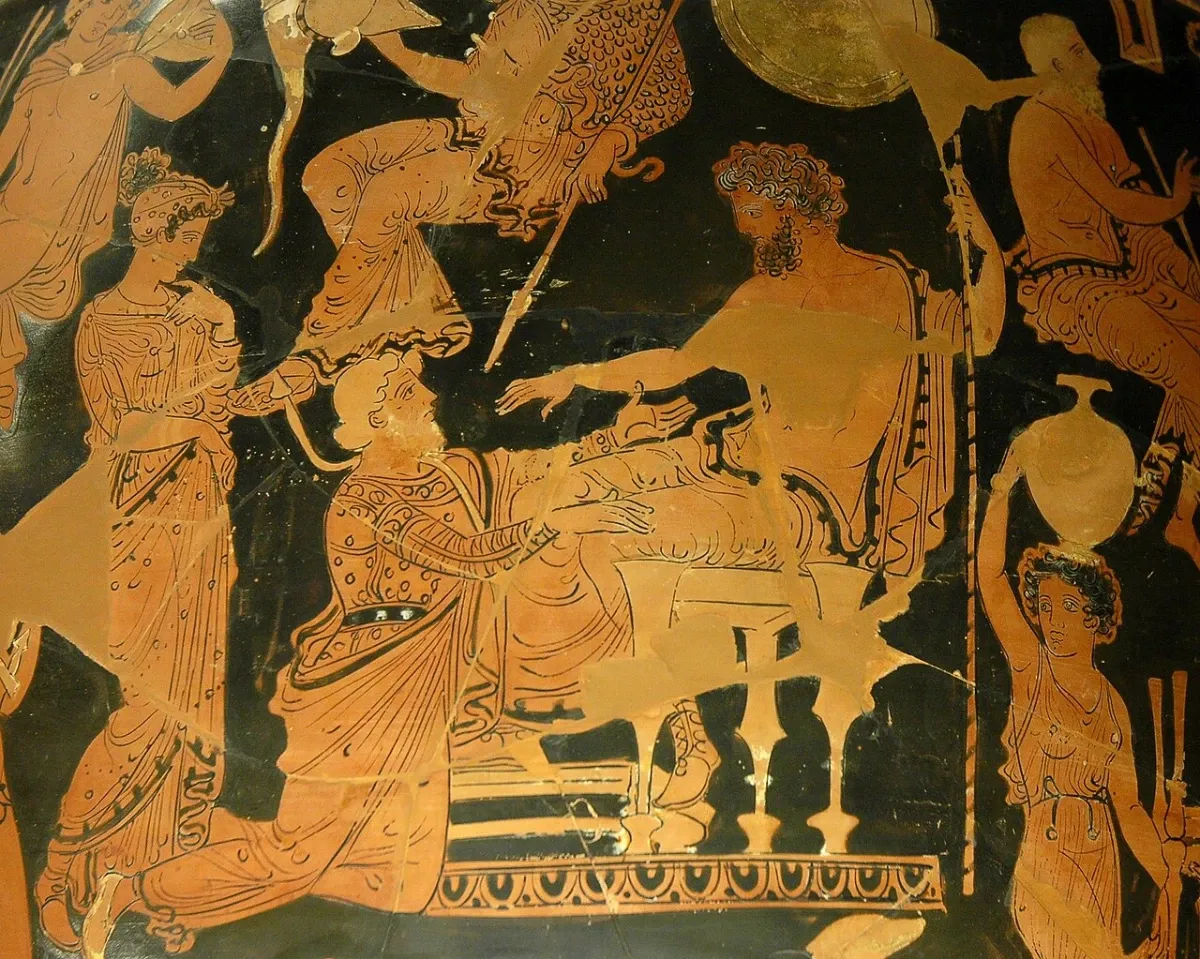
The Iliad is one of the two epics ascribed to Homer. Together they run to some 28,000 lines.[1] It sings of the wrath of Achilles in his quarrel with Agamemnon, and of the countless sorrows it brought on the Achaeans (Il. 1.1–7). The language of the two poems is a literary construct that grew over many years of performance. It seems to have been largely fixed by the seventh century BC.[2] West reckons with six to eight centuries of oral tradition behind the poems.[3] It is not known for what kind of occasion and purpose they were composed, how they were performed, or when their text became fixed.[4] A rhapsode was a professional reciter of epic. In classical Athens the poems were recited in full at the Panathenaea by rhapsodes competing for prizes.[2] Whether one poet composed both is disputed. West held that they were by different poets, and that the Odyssey poet borrowed lines from the Iliad.[5] The Loeb Iliad keeps to a single Homer: an eighth-century Ionian, perhaps the founder of a guild on Chios. It reports that most scholars now date the poems to the mid-eighth century BC, the Iliad a little earlier.[6]
Scanned here are lines 1–52: the proem and the opening episode. Agamemnon dishonours Chryses, priest of Apollo. The god answers with a plague on the Achaean army.
Text and translation
The uninterrupted Greek with its English translation, line by line.
Show text and translation
μῆνιν ἄειδε θεὰ Πηληϊάδεω Ἀχιλῆος
Homer · Iliad 1.1–52 · dactylic hexameters · text of Monro–Allen (OCT, 3rd ed.)
How to read each line
A guide to the Greek, syllables, pitch marks and quantities.
Show the reading key
- Above each line: the line as the edition prints it, each word placed over its own syllables. The main row: the same Greek divided into metrical syllables, each written as it is pronounced. A consonant that closes a syllable is written with it (λόθ | ρο); an elided word is closed up with the next vowel (ν’ἀ); a final consonant carried into the next word is set with a thin space (ς ἰ). Wider gaps mark word-ends.
- Above the syllables: the pitch of each syllable, from the accents. Under them: the quantity of each syllable as it falls in the line, then the transliteration, syllable by syllable, with accented syllables in capitals.
- Under each line: a line-for-line translation. In the right margin of the scansion: the line type, its scheme, and its analysis into cola.
Key to the labels
The names, patterns and symbols used beside this poem.
Show the labels and symbols
The labels in the right margin of the scansion below name the line, its scheme, the feet as the line realises them, and the caesurae and diaereses (the named word-ends) that fall in it. In the scheme ⏔ is a biceps, two shorts that may be contracted to one long; ⏕ is a long that may be resolved into two shorts; × is an anceps, long or short. A click on any syllable highlights its metron or colon, or, with the switch, its foot.
| Label | Name and shape | What it is |
|---|---|---|
| hem1 | First hemiepes— ⏔ — ⏔ — | The first two and a half feet of the hexameter, up to the penthemimeral caesura; in the pentameter, its whole first half. |
| hem2 | Second half of the hexameter⏔ — ⏔ — ⏑ ⏑ — × | From the penthemimeral caesura to the line-end: the fifth foot is nearly always a dactyl, the sixth is — ×. |
The traditional feet
| Foot and shape | Where |
|---|---|
| First foot: dactyl or spondee— ⏔ | Scheme positions 1–2. The biceps (⏑ ⏑) may be contracted to a single long, making a spondee. |
| Second foot: dactyl or spondee— ⏔ | Scheme positions 3–4. |
| Third foot: dactyl or spondee— ⏔ | Scheme positions 5–6. The penthemimeral caesura falls after its first syllable, the “trochaic” caesura after its second. |
| Fourth foot: dactyl or spondee— ⏔ | Scheme positions 7–8. Word-end at the end of this foot, when it is a dactyl, is the bucolic diaeresis (West’s “bucolic caesura”: word-end at the end of the fourth foot after an uncontracted biceps)[7]. |
| Fifth foot: dactyl— ⏑ ⏑ | Scheme positions 9–10. A spondee here (a “spondaic line”) is rare. |
| Sixth foot— × | Scheme positions 11–12: a long and the indifferent final syllable. |
Scansion
The opening of the Iliad, from the proem to Apollo’s arrows, scanned foot by foot: each syllable’s quantity and the reason for it, the feet as dactyls or spondees, the caesurae, and a note on every line naming its prosodic licences.
Recording: David Chamberlain (hypotactic.com), restored pronunciation, CC BY 4.0 — about this recording
David Chamberlain reads in restored pronunciation with a light pitch accent, keeping a regular hexameter beat throughout, with a pause at the caesura. Lines 1–52 are cut from the first track of his recording of Book 1 (Internet Archive, item Iliad1458611), licensed CC BY 4.0. The highlight follows the recording line by line; within a line it moves at an even pace and is only approximate. Tap a line number to play from there.
Sing, goddess, of the wrath of Achilles, son of Peleus,
the accursed wrath, which laid countless sorrows on the Achaeans
and hurled many mighty souls down to Hades,
souls of heroes, and made the men themselves a prey for dogs
and for all the birds; and the plan of Zeus was being fulfilled,
from the time when first the two of them quarrelled and parted,
the son of Atreus, lord of men, and godlike Achilles.
Which of the gods, then, set the two of them to fight in strife?
The son of Leto and Zeus; for he, angered with the king,
roused an evil sickness through the army, and the people were dying,
because the son of Atreus had dishonoured Chryses, his priest.
For Chryses had come to the swift ships of the Achaeans
to free his daughter, bringing a ransom beyond counting,
holding in his hands the wreaths of Apollo who shoots from afar
on a golden staff, and he begged all the Achaeans,
and most of all the two sons of Atreus, marshals of the host:
“Sons of Atreus, and you other well-greaved Achaeans,
may the gods who have their homes on Olympus grant you
to sack the city of Priam and to come safely home;
but set my dear child free for me, and accept the ransom,
in awe of the son of Zeus, Apollo who shoots from afar.”
Then all the other Achaeans shouted their assent,
to respect the priest and accept the splendid ransom;
but this did not please the heart of Agamemnon, son of Atreus;
he sent him away harshly and laid a stern command on him:
“Let me not find you, old man, beside the hollow ships,
either lingering now or coming back again later,
or the staff and the wreath of the god may not protect you.
Her I will not set free; before that, old age will come upon her
in our house, in Argos, far from her own country,
as she walks to and fro at the loom and shares my bed.
Go now, do not provoke me, so that you may return the safer.”
So he spoke, and the old man was afraid and obeyed his word.
He went in silence along the shore of the loud-roaring sea;
and then, when he had gone far off, the old man prayed long
to lord Apollo, whom Leto of the lovely hair bore:
“Hear me, god of the silver bow, who stand over Chryse
and holy Cilla, and rule Tenedos in might,
Smintheus, if ever I roofed a temple that pleased you,
or if ever I burned for you the fat thigh-pieces
of bulls and goats, fulfil this wish for me:
let the Danaans pay for my tears with your arrows.”
So he spoke in prayer, and Phoebus Apollo heard him,
and came down from the peaks of Olympus, angry at heart,
with his bow on his shoulders and his quiver closed at both ends.
The arrows clattered on the shoulders of the angry god
as he moved; and he came on like the night.
Then he sat down apart from the ships and let fly an arrow;
terrible was the twang of the silver bow.
First he went after the mules and the swift dogs,
but then he aimed his sharp arrows at the men themselves
and shot; and the pyres of the dead burned thick, without end.
Metre
- The line. Six feet. Each of the first five is a dactyl (— ⏑ ⏑) or, with its two shorts contracted into one long, a spondee (— —); the sixth is — ×, a long and the indifferent final syllable.[8] West calls the long the princeps and the two shorts or their contraction the biceps. The biceps is a little longer than the princeps (about 6 : 5), so it can be filled by a single long, though the rhythm is then a little stretched.[9]
- Contraction. Contraction is least common in the fifth foot, about once in 20 lines in Homer,[9] and West notes how strongly the poets favour a dactyl in the fifth foot.[10] In this passage ll. 11, 14 and 21 have a spondee there, two of them because of the lengthened Ἀ- of Ἀπόλλων. Words with three long syllables in a row are generally placed so that only one contraction is needed, — ⏔ — or, at verse-end, ⏔ — —:[9] ἰφθίμους (l. 3), ἡρώων (l. 4), οἰωνοῖσι (l. 5).
- Caesurae. There is always a word-end in the third foot, either after its long (the masculine or penthemimeral caesura, — | ⏑ ⏑) or between its two shorts (the feminine caesura, — ⏑ | ⏑, also called the caesura after the third trochee); the feminine is the more frequent, in the proportion 4 : 3. Occasionally a long word runs across the whole third foot and the caesura falls after the fourth princeps (hephthemimeral).[11] Word-end at the end of the fourth foot after an uncontracted biceps is the bucolic caesura;[7] the margin calls it the bucolic diaeresis.
- Wernicke’s Law. Word-end after a contracted biceps is frequent only in the first foot. Where it falls after the fourth foot, the word mostly ends in a syllable with a long vowel, and hardly ever in a short vowel left open; the same habit, less strongly marked, holds after the second foot. A prepositive counts with the word that follows it.[9] Every such word-end in this passage obeys the law: Ἀχαιοῖς (l. 2), εὖ δ’ (l. 19), Χρύσην (l. 37), καρήνων (l. 44), ὤμων (l. 46), and the prepositive καί in ll. 7, 28 and 29.
- Hermann’s bridge. No word ends between the two shorts of the fourth biceps; prepositives (article, prepositions, καί and other conjunctions, the relative) count with the word that follows and postpositives (δέ, τε, γάρ, enclitics) with the word before, so a written word-end next to them is no real break. Breaches come about once in 550 lines of Homer.[12] There is none in these 52 lines: the written word-ends there in ll. 20, 33 and 38 come next to appositives.
- Prosody. A short final vowel is elided before a vowel.[13] Before a vowel, a long vowel or diphthong ending a word is usually shortened (epic correption, p. 14)[14]. Two vowels inside a word may be sung as one syllable (synizesis, frequent when the first is ε: θεοί, -εω, -εῳ)[15]. Where vowels meet without elision or correption there is hiatus; many cases involve words that once began with ϝ (digamma), which Homer’s metre still treats as a consonant although it was no longer pronounced.[16] Inside a word a stop + liquid normally makes position in early epic; at the beginning of a word it may or may not.[17]
- Licences. Homer may lengthen one short vowel of a word that would otherwise not fit the verse (metrical lengthening: Ἀπόλλωνα, Οὐλύμποιο, p. 21). He may also treat an initial continuant (λ μ ν ρ σ) or a final ν ρ ς as if it closed the syllable before it, nearly always in the princeps.[18]
- Vowel quantities. Where the spelling does not show the length of an α ι υ, the workbench gives it the length the metre needs. Every such vowel that it makes long has been checked in LSJ (Perseus edition) and in West’s list of long endings;[19] none is marked short there. Examples are θεά (⏑ —), μῡρίος, ἴφθῑμος, ψῡχή, λᾱός, ἀρητήρ (ᾱ), τῑμάω, the future and aorist of λύω (ῡ), κνημῖδες, θῡμός, πίων (ῑ), τίνω (ῑ in epic), κῑνέω and ἰός “arrow” (ῑ). Where a short vowel’s syllable is long by a licence, the input marks it instead (ll. 14, 19, 21, 33, 36, 51).
- How to read the margin. The margin names every written word-end that falls at a caesura place. A word counts as ending after the syllable that holds its last vowel, even when its final consonant passes over to the next word’s vowel (υἱός· | ὃ, l. 9). A word-end after a contracted fourth foot is labelled as such, not as a bucolic caesura. The line notes say where a prepositive or postpositive means that a written word-end is no real break.
- Murray and Wyatt’s text. Monro and Allen’s text has been compared with the Loeb edition of A. T. Murray, revised by W. F. Wyatt. The line numbers are the same, and most differences are of accent and spelling: ὁ for the demonstrative ὃ (9, 12, 33), Πηληιάδεω and ἐυκνήμιδες without the diaeresis, τόδε μοι for τὸ δέ μοι (41). Murray prints ὦρσε in 10, where Monro and Allen have ὄρσε; the syllable is long either way. In 33 he writes ἔδδεισεν, spelling the lost consonant of the old root as a second δ, where this page marks the ε as lengthened: the scansion is the same. Only line 19 changes its rhythm[20].[21]
Prosody, line by line
Every syllable, with the reason for its length. Quantities are read from the vowel where the spelling shows it, from the consonants that follow (“position”), from the accent where it tells, and from the metre where nothing else does. Editors’ notes on the text follow in the boxed paragraphs.
- 1.1
Line 1.1 · μῆνιν ἄειδε θεὰ Πηληϊάδε‿ω Ἀχιλῆος
μῆνιν ἄειδε θεὰ Πηληϊάδε‿ω Ἀχιλῆος
μῆνιν ἄειδεθεὰΠηληϊάδε‿ωἈχιλῆοςdactyl, dactyl, spondee, dactyl, dactyl, — ×; penthemimeral caesura.
- 1 —μῆῆ is long by nature.
- 2 ⏑νιι is short by the accent rule: circumflex on the penult requires a short final syllable; one of the two shorts of the biceps at position 2.
- 3 ⏑ν ἄἄ is short by the metre (position 2 must be short); the first consonant belongs to the previous word and is carried over to this vowel; one of the two shorts of the biceps at position 2.
- 4 —ειει is a diphthong, long by nature.
- 5 ⏑δεε is short by nature; one of the two shorts of the biceps at position 4.
- 6 ⏑θεε is short by nature; one of the two shorts of the biceps at position 4.
- 7 —ὰὰ is long by the metre (position 5 must be long).
- 8 —Πηη is long by nature; a single long contracts the two shorts of the biceps at position 6.
- 9 —ληη is long by nature.
- 10 ⏑ϊϊ is short by the metre (position 8 must be short); one of the two shorts of the biceps at position 8.
- 11 ⏑άά is short by the metre (position 8 must be short); one of the two shorts of the biceps at position 8.
- 12 —δε‿ωεω is two vowels of one word pronounced together as one long syllable (synizesis); the next word begins with a vowel and nothing is elided: hiatus.
- 13 ⏑ἈἈ is short by the metre (position 10 must be short); one of the two shorts of the biceps at position 10.
- 14 ⏑χιι is short by the metre (position 10 must be short); one of the two shorts of the biceps at position 10.
- 15 —λῆῆ is long by nature.
- 16 ×οςο is short by nature; closed by ς: long by position; the position is anceps.
Dactyl, dactyl, spondee, dactyl, dactyl: the third foot is -ὰ Πη-, whose biceps is contracted. θεά has a long final α (θεᾱ́)[22]. The only caesura is the masculine one after θεά, and Katz notes that the opening phrase runs exactly up to it.[23] Πηληϊάδεω is read with synizesis of -εω into one long syllable.[15] That syllable keeps its length before Ἀχιλῆος in the fifth princeps: a long vowel in hiatus, which West says stands mostly in the princeps.[7] The α of ἄειδε is short.[23]- 1.2
Line 1.2 · οὐλομένην, ἣ μυρίʼ Ἀχαιοῖς ἄλγεʼ ἔθηκε,
οὐλομένην, ἣ μυρίʼ Ἀχαιοῖς ἄλγεʼ ἔθηκε,
οὐλομένην,ἣμυρί’Ἀχαιοῖςἄλγε’ἔθηκε,dactyl, spondee, dactyl, spondee, dactyl, — ×; caesura after the third trochee (with elision); word-end after a spondaic fourth foot.
- 1 —οὐοὐ is a diphthong, long by nature.
- 2 ⏑λοο is short by nature; one of the two shorts of the biceps at position 2.
- 3 ⏑μέέ is short by nature; one of the two shorts of the biceps at position 2.
- 4 —νην,η is long by nature.
- 5 —ἣἣ is long by nature; a single long contracts the two shorts of the biceps at position 4.
- 6 —μυυ is long by the metre (position 5 must be long).
- 7 ⏑ρί’ί is short by the metre (position 6 must be short); the apostrophe marks an elided vowel; the consonant before it joins this syllable; one of the two shorts of the biceps at position 6.
- 8 ⏑ἈἈ is short by the metre (position 6 must be short); one of the two shorts of the biceps at position 6.
- 9 —χαιαι is a diphthong, long by nature.
- 10 —οῖςοῖ is a diphthong, long by nature; a single long contracts the two shorts of the biceps at position 8.
- 11 —ἄλἄ is a vowel of unknown length; closed by λ: long by position.
- 12 ⏑γε’ε is short by nature; the apostrophe marks an elided vowel; the consonant before it joins this syllable; one of the two shorts of the biceps at position 10.
- 13 ⏑ἔἔ is short by nature; one of the two shorts of the biceps at position 10.
- 14 —θηη is long by nature.
- 15 ×κε,ε is short by nature; the position is anceps.
Spondees fill the second and fourth feet. μυρί’ (μυρία) and ἄλγε’ (ἄλγεα) are elided before vowels.[13] The elided μυρί’ ends between the two shorts of the third foot, so the caesura is feminine.[8] The word-end after Ἀχαιοῖς follows a contracted fourth foot, so it is not a bucolic caesura in West’s sense.[7] Such a word usually has a long vowel in its last syllable, as Ἀχαιοῖς has: Wernicke’s Law.[9]- 1.3
Line 1.3 · πολλὰς δʼ ἰφθίμους ψυχὰς Ἄϊδι προΐαψεν
πολλὰς δʼ ἰφθίμους ψυχὰς Ἄϊδι προΐαψεν
πολλὰςδ’ἰφθίμουςψυχὰςἌϊδιπροΐαψενspondee, spondee, spondee, dactyl, dactyl, — ×; penthemimeral caesura; hephthemimeral caesura.
- 1 —πολο is short by nature; closed by λ: long by position.
- 2 —λὰςὰ is a vowel of unknown length; closed by ς: long by position; a single long contracts the two shorts of the biceps at position 2.
- 3 —δ’ἰφἰ is a vowel of unknown length; closed by φ: long by position; the apostrophe marks an elided vowel; the consonant before it joins this syllable.
- 4 —θίί is long by the metre (position 4 must be long); a single long contracts the two shorts of the biceps at position 4.
- 5 —μουςου is a diphthong, long by nature; closed by ς: long by position.
- 6 —ψυυ is long by the metre (position 6 must be long); a single long contracts the two shorts of the biceps at position 6.
- 7 —χὰςὰ is long by the metre (position 7 must be long).
- 8 ⏑ἌἌ is short by the metre (position 8 must be short); one of the two shorts of the biceps at position 8.
- 9 ⏑ϊϊ is short by the metre (position 8 must be short); one of the two shorts of the biceps at position 8.
- 10 —διι is short by the accent rule (the accent falls too far back for a long final syllable); the next word begins with πρ: the syllable is closed before it: long by position.
- 11 ⏑προο is short by nature; one of the two shorts of the biceps at position 10.
- 12 ⏑ΐΐ is short by the metre (position 10 must be short); one of the two shorts of the biceps at position 10.
- 13 —αψ is a double consonant (two sounds) and closes the syllable: long by position.
- 14 ×ψενε is short by nature; closed by ν: long by position; the position is anceps.
Three of the five feet are contracted: πολλὰς δ’ | ἰφθί- | -μους ψυ-. There are two word-ends at caesura places, the penthemimeral after ἰφθίμους and the hephthemimeral after ψυχάς.[8] ἰφθίμους has three long syllables (ἴφθῑμος, LSJ) and stands so that only one contraction is needed, — ⏔ —, as West says such words generally do.[9] ψυχάς has the long -ᾱς of the first-declension accusative plural.[19] The last syllable of Ἄϊδι is made long by the initial πρ- of προΐαψεν in the fifth princeps, where West says a final syllable lengthened by an initial stop + liquid mostly stands.[24]- 1.4
Line 1.4 · ἡρώων, αὐτοὺς δὲ ἑλώρια τεῦχε κύνεσσιν
ἡρώων, αὐτοὺς δὲ ἑλώρια τεῦχε κύνεσσιν
ἡρώων,αὐτοὺςδὲἑλώριατεῦχεκύνεσσινspondee, spondee, dactyl, dactyl, dactyl, — ×; penthemimeral caesura; caesura after the third trochee; bucolic diaeresis.
- 1 —ἡἡ is long by nature.
- 2 —ρώώ is long by nature; a single long contracts the two shorts of the biceps at position 2.
- 3 —ων,ω is long by nature.
- 4 —αὐαὐ is a diphthong, long by nature; a single long contracts the two shorts of the biceps at position 4.
- 5 —τοὺςοὺ is a diphthong, long by nature; closed by ς: long by position.
- 6 ⏑δὲὲ is short by nature; the next word begins with a vowel and nothing is elided: hiatus; one of the two shorts of the biceps at position 6.
- 7 ⏑ἑἑ is short by nature; one of the two shorts of the biceps at position 6.
- 8 —λώώ is long by nature.
- 9 ⏑ριι is short by the metre (position 8 must be short); one of the two shorts of the biceps at position 8.
- 10 ⏑αα is short by the accent rule: acute on the antepenult requires a short final syllable; one of the two shorts of the biceps at position 8.
- 11 —τεῦεῦ is a diphthong, long by nature.
- 12 ⏑χεε is short by nature; one of the two shorts of the biceps at position 10.
- 13 ⏑κύύ is short by the metre (position 10 must be short); one of the two shorts of the biceps at position 10.
- 14 —νεσε is short by nature; closed by σ: long by position.
- 15 ×σινι is a vowel of unknown length; closed by ν: long by position; the position is anceps.
Two spondees and three dactyls. The written word-end after αὐτούς is followed by the postpositive δέ, which goes with the word before it,[12] so the real caesura is the feminine one after δέ. There δέ stands in hiatus before ἑλώρια: a short vowel in hiatus at the feminine caesura, one of the places where West finds such hiatus most often.[7] ἑλώρια is not among the words West lists as having begun with ϝ.[25] Word-end after ἑλώρια, after an uncontracted fourth biceps, is the bucolic caesura.[7]- 1.5
Line 1.5 · οἰωνοῖσί τε πᾶσι, Διὸς δʼ ἐτελείετο βουλή,
οἰωνοῖσί τε πᾶσι, Διὸς δʼ ἐτελείετο βουλή,
οἰωνοῖσίτεπᾶσι,Διὸςδ’ἐτελείετοβουλή,spondee, dactyl, dactyl, dactyl, dactyl, — ×; caesura after the third trochee; hephthemimeral caesura.
- 1 —οἰοἰ is a diphthong, long by nature.
- 2 —ωω is long by nature; a single long contracts the two shorts of the biceps at position 2.
- 3 —νοῖοῖ is a diphthong, long by nature.
- 4 ⏑σίί is short by the accent rule: circumflex on the penult requires a short final syllable; one of the two shorts of the biceps at position 4.
- 5 ⏑τεε is short by nature; one of the two shorts of the biceps at position 4.
- 6 —πᾶᾶ carries a circumflex, so it is long.
- 7 ⏑σι,ι is short by the accent rule: circumflex on the penult requires a short final syllable; one of the two shorts of the biceps at position 6.
- 8 ⏑Διι is short by the metre (position 6 must be short); one of the two shorts of the biceps at position 6.
- 9 —ὸςὸ is short by nature; closed by ς: long by position.
- 10 ⏑δ’ἐἐ is short by nature; the apostrophe marks an elided vowel; the consonant before it joins this syllable; one of the two shorts of the biceps at position 8.
- 11 ⏑τεε is short by nature; one of the two shorts of the biceps at position 8.
- 12 —λείεί is a diphthong, long by nature.
- 13 ⏑εε is short by nature; one of the two shorts of the biceps at position 10.
- 14 ⏑τοο is short by nature; one of the two shorts of the biceps at position 10.
- 15 —βουου is a diphthong, long by nature.
- 16 ×λή,ή is long by nature; the position is anceps.
- 1.6
Line 1.6 · ἐξ οὗ δὴ τὰ πρῶτα διαστήτην ἐρίσαντε
ἐξ οὗ δὴ τὰ πρῶτα διαστήτην ἐρίσαντε
ἐξοὗδὴτὰπρῶταδιαστήτηνἐρίσαντεspondee, spondee, dactyl, spondee, dactyl, — ×; caesura after the third trochee.
- 1 —ἐξἐ is short by nature; ξ is a double consonant (two sounds) and closes the syllable: long by position.
- 2 —οὗοὗ is a diphthong, long by nature; a single long contracts the two shorts of the biceps at position 2.
- 3 —δὴὴ is long by nature.
- 4 —τὰὰ is a vowel of unknown length; the next word begins with πρ: the syllable is closed before it: long by position; a single long contracts the two shorts of the biceps at position 4.
- 5 —πρῶῶ is long by nature.
- 6 ⏑ταα is short by the accent rule: circumflex on the penult requires a short final syllable; one of the two shorts of the biceps at position 6.
- 7 ⏑διι is short by the metre (position 6 must be short); one of the two shorts of the biceps at position 6.
- 8 —ασα is a vowel of unknown length; closed by σ: long by position.
- 9 —τήή is long by nature; a single long contracts the two shorts of the biceps at position 8.
- 10 —τηνη is long by nature.
- 11 ⏑ἐἐ is short by nature; one of the two shorts of the biceps at position 10.
- 12 ⏑ρίί is short by the metre (position 10 must be short); one of the two shorts of the biceps at position 10.
- 13 —σανα is a vowel of unknown length; closed by ν: long by position.
- 14 ×τεε is short by nature; the position is anceps.
Three of the five feet are contracted: ἐξ οὗ | δὴ τὰ | -αστή-. τά is made long by the initial πρ- of πρῶτα and fills the contracted second biceps. West observes that such lengthening of a final syllable by an initial stop + liquid is largely restricted to the princeps,[27] so this is an exception. The caesura is feminine, after πρῶτα;[8] διαστήτην then runs on through the fourth foot, so there is no hephthemimeral or bucolic word-end.- 1.7
Line 1.7 · Ἀτρεΐδης τε ἄναξ ἀνδρῶν καὶ δῖος Ἀχιλλεύς.
Ἀτρεΐδης τε ἄναξ ἀνδρῶν καὶ δῖος Ἀχιλλεύς.
Ἀτρεΐδηςτεἄναξἀνδρῶνκαὶδῖος Ἀχιλλεύς.dactyl, dactyl, spondee, spondee, dactyl, — ×; penthemimeral caesura; hephthemimeral caesura; word-end after a spondaic fourth foot.
- 1 —ἈτἈ is a vowel of unknown length; closed by τ before a liquid: stop + liquid makes position, as it usually does in epic.
- 2 ⏑ρεε is short by nature; one of the two shorts of the biceps at position 2.
- 3 ⏑ΐΐ is short by the metre (position 2 must be short); one of the two shorts of the biceps at position 2.
- 4 —δηςη is long by nature; closed by ς: long by position.
- 5 ⏑τεε is short by nature; the next word begins with a vowel and nothing is elided: hiatus; one of the two shorts of the biceps at position 4.
- 6 ⏑ἄἄ is short by the metre (position 4 must be short); one of the two shorts of the biceps at position 4.
- 7 —ναξξ is a double consonant (two sounds) and closes the syllable: long by position.
- 8 —ἀνἀ is a vowel of unknown length; closed by ν: long by position; a single long contracts the two shorts of the biceps at position 6.
- 9 —δρῶνῶ is long by nature; closed by ν: long by position.
- 10 —καὶαὶ is a diphthong, long by nature; a single long contracts the two shorts of the biceps at position 8.
- 11 —δῖῖ carries a circumflex, so it is long.
- 12 ⏑οο is short by nature; one of the two shorts of the biceps at position 10.
- 13 ⏑ς ἈἈ is short by the metre (position 10 must be short); the first consonant belongs to the previous word and is carried over to this vowel; one of the two shorts of the biceps at position 10.
- 14 —χιλι is a vowel of unknown length; closed by λ: long by position.
- 15 ×λεύς.εύ is a diphthong, long by nature; closed by ς: long by position; the position is anceps.
West quotes this line as Ἀτρεΐδης τε (ϝ)άναξ: τε is not elided before ἄναξ, which once began with ϝ, and the metre still treats that lost consonant as present.[28] The workbench reports the meeting of τε and ἄναξ as hiatus, which is how it looks on the page. The -τρ- of Ἀτρεΐδης makes position inside the word, as stop + liquid normally does in early epic.[17] Spondees fill the third and fourth feet. There are word-ends at the penthemimeral place (after ἄναξ) and the hephthemimeral place (after ἀνδρῶν). The word-end after the contracted fourth foot comes after the prepositive καί, which counts with δῖος, so the line does not run against Wernicke’s Law.[29]- 1.8
Line 1.8 · τίς τʼ ἄρ σφωε θεῶν ἔριδι ξυνέηκε μάχεσθαι;
τίς τʼ ἄρ σφωε θεῶν ἔριδι ξυνέηκε μάχεσθαι;
τίςτ’ἄρσφωεθεῶνἔριδιξυνέηκεμάχεσθαι;spondee, dactyl, dactyl, dactyl, dactyl, — ×; penthemimeral caesura; hephthemimeral caesura.
- 1 —τίςί is a vowel of unknown length; closed by ς: long by position.
- 2 —τ’ἄρἄ is a vowel of unknown length; closed by ρ: long by position; the apostrophe marks an elided vowel; the consonant before it joins this syllable; a single long contracts the two shorts of the biceps at position 2.
- 3 —σφωω is long by nature.
- 4 ⏑εε is short by nature; one of the two shorts of the biceps at position 4.
- 5 ⏑θεε is short by nature; one of the two shorts of the biceps at position 4.
- 6 —ῶνῶ is long by nature.
- 7 ⏑ἔἔ is short by nature; one of the two shorts of the biceps at position 6.
- 8 ⏑ριι is short by the metre (position 6 must be short); one of the two shorts of the biceps at position 6.
- 9 —διthe next word begins with the double consonant ξ: the syllable is closed before it: long by position.
- 10 ⏑ξυυ is short by the metre (position 8 must be short); one of the two shorts of the biceps at position 8.
- 11 ⏑νέέ is short by nature; one of the two shorts of the biceps at position 8.
- 12 —ηη is long by nature.
- 13 ⏑κεε is short by nature; one of the two shorts of the biceps at position 10.
- 14 ⏑μάά is short by the metre (position 10 must be short); one of the two shorts of the biceps at position 10.
- 15 —χεσε is short by nature; closed by σ: long by position.
- 16 ×θαι;αι is a diphthong, long by nature; the position is anceps.
A spondee and four dactyls. τ’ is τε elided,[13] and σφωε has two syllables. The caesura is penthemimeral, after θεῶν, with a second word-end at the hephthemimeral place after ἔριδι.[8] The last syllable of ἔριδι is long by position before the double consonant ξ of ξυνέηκε.[30] ξυνέηκε has the trisyllabic aorist ἕηκα, which West traces to an older form with a consonantal y, *éyēka.[31]- 1.9
Line 1.9 · Λητοῦς καὶ Διὸς υἱός· ὃ γὰρ βασιλῆϊ χολωθεὶς
Λητοῦς καὶ Διὸς υἱός· ὃ γὰρ βασιλῆϊ χολωθεὶς
ΛητοῦςκαὶΔιὸς υἱό·ς ὃγὰρβασιλῆϊχολωθεὶςspondee, dactyl, dactyl, dactyl, dactyl, — ×; caesura after the third trochee; hephthemimeral caesura.
- 1 —Ληη is long by nature.
- 2 —τοῦςοῦ is a diphthong, long by nature; closed by ς: long by position; a single long contracts the two shorts of the biceps at position 2.
- 3 —καὶαὶ is a diphthong, long by nature.
- 4 ⏑Διι is short by the metre (position 4 must be short); one of the two shorts of the biceps at position 4.
- 5 ⏑ὸὸ is short by nature; one of the two shorts of the biceps at position 4.
- 6 —ς υἱυἱ is a diphthong, long by nature; the first consonant belongs to the previous word and is carried over to this vowel.
- 7 ⏑ό·ό is short by nature; one of the two shorts of the biceps at position 6.
- 8 ⏑ς ὃὃ is short by nature; the first consonant belongs to the previous word and is carried over to this vowel; one of the two shorts of the biceps at position 6.
- 9 —γὰρὰ is a vowel of unknown length; closed by ρ: long by position.
- 10 ⏑βαα is short by the metre (position 8 must be short); one of the two shorts of the biceps at position 8.
- 11 ⏑σιι is short by the metre (position 8 must be short); one of the two shorts of the biceps at position 8.
- 12 —λῆῆ is long by nature.
- 13 ⏑ϊϊ is short by the accent rule: circumflex on the penult requires a short final syllable; one of the two shorts of the biceps at position 10.
- 14 ⏑χοο is short by nature; one of the two shorts of the biceps at position 10.
- 15 —λωω is long by nature.
- 16 ×θεὶςεὶ is a diphthong, long by nature; closed by ς: long by position; the position is anceps.
A spondee and four dactyls. The ς of υἱός passes to ὃ, but the word ends between the two shorts of the third foot, so the caesura is feminine.[8] A second word-end follows at the hephthemimeral place, after ὃ γάρ. υἱός keeps its first syllable long here in the third princeps; West notes that Homer sometimes shortens it by internal correption (⏑ —).[32] Katz compares the line with an alternative opening of the Iliad ascribed to Aristoxenus, whose third verse ends with the same words, ὁ γὰρ βασιλῆϊ χολωθείς.[33]- 1.10
Line 1.10 · νοῦσον ἀνὰ στρατὸν ὄρσε κακήν, ὀλέκοντο δὲ λαοί,
νοῦσον ἀνὰ στρατὸν ὄρσε κακήν, ὀλέκοντο δὲ λαοί,
νοῦσον ἀνὰστρατὸν ὄρσεκακήν,ὀλέκοντοδὲλαοί,dactyl, dactyl, dactyl, dactyl, dactyl, — ×; caesura after the third trochee; hephthemimeral caesura.
- 1 —νοῦοῦ is a diphthong, long by nature.
- 2 ⏑σοο is short by nature; one of the two shorts of the biceps at position 2.
- 3 ⏑ν ἀἀ is short by the metre (position 2 must be short); the first consonant belongs to the previous word and is carried over to this vowel; one of the two shorts of the biceps at position 2.
- 4 —νὰthe next word begins with στ: the syllable is closed before it: long by position.
- 5 ⏑στραα is short by the metre (position 4 must be short); one of the two shorts of the biceps at position 4.
- 6 ⏑τὸὸ is short by nature; one of the two shorts of the biceps at position 4.
- 7 —ν ὄρὄ is short by nature; closed by ρ: long by position; the first consonant belongs to the previous word and is carried over to this vowel.
- 8 ⏑σεε is short by nature; one of the two shorts of the biceps at position 6.
- 9 ⏑καα is short by the metre (position 6 must be short); one of the two shorts of the biceps at position 6.
- 10 —κήν,ή is long by nature.
- 11 ⏑ὀὀ is short by nature; one of the two shorts of the biceps at position 8.
- 12 ⏑λέέ is short by nature; one of the two shorts of the biceps at position 8.
- 13 —κονο is short by nature; closed by ν: long by position.
- 14 ⏑τοο is short by nature; one of the two shorts of the biceps at position 10.
- 15 ⏑δὲὲ is short by nature; one of the two shorts of the biceps at position 10.
- 16 —λαα is long by the metre (position 11 must be long).
- 17 ×οί,οί is a diphthong, long by nature; the position is anceps.
- 1.11
Line 1.11 · οὕνεκα τὸν Χρύσην ἠτίμασεν ἀρητῆρα
οὕνεκα τὸν Χρύσην ἠτίμασεν ἀρητῆρα
οὕνεκατὸνΧρύσηνἠτίμασεν ἀρητῆραdactyl, spondee, spondee, dactyl, spondee, — ×; penthemimeral caesura; bucolic diaeresis.
- 1 —οὕοὕ is a diphthong, long by nature.
- 2 ⏑νεε is short by nature; one of the two shorts of the biceps at position 2.
- 3 ⏑καα is short by the accent rule: acute on the antepenult requires a short final syllable; one of the two shorts of the biceps at position 2.
- 4 —τὸνὸ is short by nature; closed by ν: long by position.
- 5 —Χρύύ is long by the metre (position 4 must be long); a single long contracts the two shorts of the biceps at position 4.
- 6 —σηνη is long by nature.
- 7 —ἠἠ is long by nature; a single long contracts the two shorts of the biceps at position 6.
- 8 —τίί is long by the metre (position 7 must be long).
- 9 ⏑μαα is short by the metre (position 8 must be short); one of the two shorts of the biceps at position 8.
- 10 ⏑σεε is short by nature; one of the two shorts of the biceps at position 8.
- 11 —ν ἀἀ is long by the metre (position 9 must be long); the first consonant belongs to the previous word and is carried over to this vowel.
- 12 —ρηη is long by nature; a single long contracts the two shorts of the biceps at position 10.
- 13 —τῆῆ is long by nature.
- 14 ×ραα is short by the accent rule: circumflex on the penult requires a short final syllable; the position is anceps.
Spondees fill the second, third and fifth feet, so this is a spondaic line: the fifth foot is -ν ἀρη- of ἀρητῆρα. Contraction is least common in the fifth foot, about once in 20 lines in Homer,[35] so lines of this shape stand out. The α of ἀρητῆρα is long by nature (ἀρητήρ, ᾱ: LSJ). The caesura is penthemimeral, after Χρύσην. Word-end after ἠτίμασεν, after an uncontracted fourth biceps, is the bucolic caesura.[36]- 1.12
Line 1.12 · Ἀτρεΐδης· ὃ γὰρ ἦλθε θοὰς ἐπὶ νῆας Ἀχαιῶν
Ἀτρεΐδης· ὃ γὰρ ἦλθε θοὰς ἐπὶ νῆας Ἀχαιῶν
Ἀτρεΐδης·ὃγὰρ ἦλθεθοὰςἐπὶνῆας Ἀχαιῶνdactyl, dactyl, dactyl, dactyl, dactyl, — ×; caesura after the third trochee; hephthemimeral caesura; bucolic diaeresis.
- 1 —ἈτἈ is a vowel of unknown length; closed by τ before a liquid: stop + liquid makes position, as it usually does in epic.
- 2 ⏑ρεε is short by nature; one of the two shorts of the biceps at position 2.
- 3 ⏑ΐΐ is short by the metre (position 2 must be short); one of the two shorts of the biceps at position 2.
- 4 —δης·η is long by nature.
- 5 ⏑ὃὃ is short by nature; one of the two shorts of the biceps at position 4.
- 6 ⏑γὰὰ is short by the metre (position 4 must be short); one of the two shorts of the biceps at position 4.
- 7 —ρ ἦλἦ is long by nature; closed by λ: long by position; the first consonant belongs to the previous word and is carried over to this vowel.
- 8 ⏑θεε is short by nature; one of the two shorts of the biceps at position 6.
- 9 ⏑θοο is short by nature; one of the two shorts of the biceps at position 6.
- 10 —ὰςὰ is long by the metre (position 7 must be long).
- 11 ⏑ἐἐ is short by nature; one of the two shorts of the biceps at position 8.
- 12 ⏑πὶὶ is short by the metre (position 8 must be short); one of the two shorts of the biceps at position 8.
- 13 —νῆῆ is long by nature.
- 14 ⏑αα is short by the accent rule: circumflex on the penult requires a short final syllable; one of the two shorts of the biceps at position 10.
- 15 ⏑ς ἈἈ is short by the metre (position 10 must be short); the first consonant belongs to the previous word and is carried over to this vowel; one of the two shorts of the biceps at position 10.
- 16 —χαιαι is a diphthong, long by nature.
- 17 ×ῶνῶ is long by nature; closed by ν: long by position; the position is anceps.
All five feet are dactyls. The -τρ- of Ἀτρεΐδης makes position.[17] θοάς has the long -ᾱς of the first-declension accusative plural[19] and fills the fourth princeps. The caesura is feminine, after ἦλθε, with a hephthemimeral word-end after θοάς.[8] The word-end after ἐπί is no bucolic caesura, because a preposition goes with the word that follows it.[12]- 1.13
Line 1.13 · λυσόμενός τε θύγατρα φέρων τʼ ἀπερείσιʼ ἄποινα,
λυσόμενός τε θύγατρα φέρων τʼ ἀπερείσιʼ ἄποινα,
λυσόμενόςτεθύγατραφέρωντ’ἀπερείσι’ἄποινα,dactyl, dactyl, dactyl, dactyl, dactyl, — ×; caesura after the third trochee; hephthemimeral caesura.
- 1 —λυυ is long by the metre (position 1 must be long).
- 2 ⏑σόό is short by nature; one of the two shorts of the biceps at position 2.
- 3 ⏑μεε is short by nature; one of the two shorts of the biceps at position 2.
- 4 —νόςό is short by nature; closed by ς: long by position.
- 5 ⏑τεε is short by nature; one of the two shorts of the biceps at position 4.
- 6 ⏑θύύ is short by the metre (position 4 must be short); one of the two shorts of the biceps at position 4.
- 7 —γατα is a vowel of unknown length; closed by τ before a liquid: stop + liquid makes position, as it usually does in epic.
- 8 ⏑ραα is short by the accent rule: acute on the antepenult requires a short final syllable; one of the two shorts of the biceps at position 6.
- 9 ⏑φέέ is short by nature; one of the two shorts of the biceps at position 6.
- 10 —ρωνω is long by nature; closed by ν: long by position.
- 11 ⏑τ’ἀἀ is short by the metre (position 8 must be short); the apostrophe marks an elided vowel; the consonant before it joins this syllable; one of the two shorts of the biceps at position 8.
- 12 ⏑πεε is short by nature; one of the two shorts of the biceps at position 8.
- 13 —ρείεί is a diphthong, long by nature.
- 14 ⏑σι’ι is short by the metre (position 10 must be short); the apostrophe marks an elided vowel; the consonant before it joins this syllable; one of the two shorts of the biceps at position 10.
- 15 ⏑ἄἄ is short by the metre (position 10 must be short); one of the two shorts of the biceps at position 10.
- 16 —ποιοι is a diphthong, long by nature.
- 17 ×να,α is short by the accent rule: acute on the antepenult requires a short final syllable; the position is anceps.
- 1.14
Line 1.14 · στέμματʼ ἔχων ἐν χερσὶν ἑκηβόλου Ἀπόλλωνος
στέμματʼ ἔχων ἐν χερσὶν ἑκηβόλου Ἀπόλλωνος
στέμματ’ἔχωνἐνχερσὶν ἑκηβόλουἈπόλλωνοςdactyl, spondee, dactyl, dactyl, spondee, — ×; caesura after the third trochee; bucolic diaeresis.
- 1 —στέμέ is short by nature; closed by μ: long by position.
- 2 ⏑μαα is short by the metre (position 2 must be short); one of the two shorts of the biceps at position 2.
- 3 ⏑τ’ἔἔ is short by nature; the apostrophe marks an elided vowel; the consonant before it joins this syllable; one of the two shorts of the biceps at position 2.
- 4 —χωνω is long by nature.
- 5 —ἐνἐ is short by nature; closed by ν: long by position; a single long contracts the two shorts of the biceps at position 4.
- 6 —χερε is short by nature; closed by ρ: long by position.
- 7 ⏑σὶὶ is short by the metre (position 6 must be short); one of the two shorts of the biceps at position 6.
- 8 ⏑ν ἑἑ is short by nature; the first consonant belongs to the previous word and is carried over to this vowel; one of the two shorts of the biceps at position 6.
- 9 —κηη is long by nature.
- 10 ⏑βόό is short by nature; one of the two shorts of the biceps at position 8.
- 11 ⏑λουου is a diphthong, long by nature; shortened before the vowel that begins the next word (epic correption), as the metre requires; one of the two shorts of the biceps at position 8.
- 12 —ἈἈ is short by nature in Ἀπόλλων, but here it is lengthened in the princeps so that the word (⏑ — — ⏑) can stand in the verse: metrical lengthening (the input marks it as lengthened)[7].
- 13 —πόλό is short by nature; closed by λ: long by position; a single long contracts the two shorts of the biceps at position 10.
- 14 —λωω is long by nature.
- 15 ×νοςο is short by nature; closed by ς: long by position; the position is anceps.
Ἀπόλλωνος has a short first vowel, and the word (⏑ — — ⏑) cannot enter the hexameter as it stands. Here its Ἀ- is lengthened in the fifth princeps: metrical lengthening, for which West gives Ἀπόλλωνα as an example.[38] The input marks this as a lengthened syllable, and the fifth foot becomes a spondee, so this is a spondaic line, of a kind that comes about once in 20 lines in Homer.[9] -λου before Ἀ- is shortened by epic correption.[32] στέμματ’ is elided,[13] and ἐν is long by position before χερσίν.[39] The ν of χερσίν passes to ἑκηβόλου, but the word ends between the shorts of the third foot: a feminine caesura. Word-end after ἑκηβόλου is the bucolic caesura.[36]- 1.15
Line 1.15 · χρυσέ‿ῳ ἀνὰ σκήπτρῳ, καὶ λίσσετο πάντας Ἀχαιούς,
χρυσέ‿ῳ ἀνὰ σκήπτρῳ, καὶ λίσσετο πάντας Ἀχαιούς,
χρυσέ‿ῳἀνὰσκήπτρῳ,καὶλίσσετοπάντας Ἀχαιούς,dactyl, spondee, spondee, dactyl, dactyl, — ×; penthemimeral caesura; bucolic diaeresis.
- 1 —χρυυ is long by the metre (position 1 must be long).
- 2 ⏑σέ‿ῳέῳ is two vowels of one word pronounced together as one long syllable (synizesis); shortened before the vowel that begins the next word (epic correption), as the metre requires; one of the two shorts of the biceps at position 2.
- 3 ⏑ἀἀ is short by the metre (position 2 must be short); one of the two shorts of the biceps at position 2.
- 4 —νὰthe next word begins with σκ: the syllable is closed before it: long by position.
- 5 —σκήπή is long by nature; closed by π: long by position; a single long contracts the two shorts of the biceps at position 4.
- 6 —τρῳ,ῳ is long by nature.
- 7 —καὶαὶ is a diphthong, long by nature; a single long contracts the two shorts of the biceps at position 6.
- 8 —λίσί is a vowel of unknown length; closed by σ: long by position.
- 9 ⏑σεε is short by nature; one of the two shorts of the biceps at position 8.
- 10 ⏑τοο is short by nature; one of the two shorts of the biceps at position 8.
- 11 —πάνά is a vowel of unknown length; closed by ν: long by position.
- 12 ⏑ταα is short by the metre (position 10 must be short); one of the two shorts of the biceps at position 10.
- 13 ⏑ς ἈἈ is short by the metre (position 10 must be short); the first consonant belongs to the previous word and is carried over to this vowel; one of the two shorts of the biceps at position 10.
- 14 —χαιαι is a diphthong, long by nature.
- 15 ×ούς,ού is a diphthong, long by nature; closed by ς: long by position; the position is anceps.
χρυσέῳ is read with synizesis of -εῳ into one syllable.[15] That syllable is then shortened before ἀνά by epic correption,[32] so χρυσέῳ ἀ- makes a dactyl. The last syllable of ἀνά is long by position, closed by the σ of σκήπτρῳ.[34] Spondees fill the second and third feet. The caesura is penthemimeral, after σκήπτρῳ, and word-end after λίσσετο is the bucolic caesura.[36]- 1.16
Line 1.16 · Ἀτρεΐδα δὲ μάλιστα δύω, κοσμήτορε λαῶν·
Ἀτρεΐδα δὲ μάλιστα δύω, κοσμήτορε λαῶν·
Ἀτρεΐδαδὲμάλισταδύω,κοσμήτορελαῶν·dactyl, dactyl, dactyl, spondee, dactyl, — ×; caesura after the third trochee; hephthemimeral caesura.
- 1 —ἈτἈ is a vowel of unknown length; closed by τ before a liquid: stop + liquid makes position, as it usually does in epic.
- 2 ⏑ρεε is short by nature; one of the two shorts of the biceps at position 2.
- 3 ⏑ΐΐ is short by the metre (position 2 must be short); one of the two shorts of the biceps at position 2.
- 4 —δαα is long by the metre (position 3 must be long).
- 5 ⏑δὲὲ is short by nature; one of the two shorts of the biceps at position 4.
- 6 ⏑μάά is short by the metre (position 4 must be short); one of the two shorts of the biceps at position 4.
- 7 —λισι is a vowel of unknown length; closed by σ: long by position.
- 8 ⏑ταα is short by the accent rule: acute on the antepenult requires a short final syllable; one of the two shorts of the biceps at position 6.
- 9 ⏑δύύ is short by the metre (position 6 must be short); one of the two shorts of the biceps at position 6.
- 10 —ω,ω is long by nature.
- 11 —κοσο is short by nature; closed by σ: long by position; a single long contracts the two shorts of the biceps at position 8.
- 12 —μήή is long by nature.
- 13 ⏑τοο is short by nature; one of the two shorts of the biceps at position 10.
- 14 ⏑ρεε is short by nature; one of the two shorts of the biceps at position 10.
- 15 —λαα is long by the metre (position 11 must be long).
- 16 ×ῶν·ῶ is long by nature; closed by ν: long by position; the position is anceps.
- 1.17
Line 1.17 · Ἀτρεΐδαι τε καὶ ἄλλοι ἐϋκνήμιδες Ἀχαιοί,
Ἀτρεΐδαι τε καὶ ἄλλοι ἐϋκνήμιδες Ἀχαιοί,
Ἀτρεΐδαιτεκαὶἄλλοιἐϋκνήμιδες Ἀχαιοί,dactyl, dactyl, dactyl, spondee, dactyl, — ×; caesura after the third trochee.
- 1 —ἈτἈ is a vowel of unknown length; closed by τ before a liquid: stop + liquid makes position, as it usually does in epic.
- 2 ⏑ρεε is short by nature; one of the two shorts of the biceps at position 2.
- 3 ⏑ΐΐ is short by the metre (position 2 must be short); one of the two shorts of the biceps at position 2.
- 4 —δαιαι is a diphthong, long by nature.
- 5 ⏑τεε is short by nature; one of the two shorts of the biceps at position 4.
- 6 ⏑καὶαὶ is a diphthong, long by nature; shortened before the vowel that begins the next word (epic correption), as the metre requires; one of the two shorts of the biceps at position 4.
- 7 —ἄλἄ is a vowel of unknown length; closed by λ: long by position.
- 8 ⏑λοιοι is a diphthong, long by nature; shortened before the vowel that begins the next word (epic correption), as the metre requires; one of the two shorts of the biceps at position 6.
- 9 ⏑ἐἐ is short by nature; one of the two shorts of the biceps at position 6.
- 10 —ϋκϋ is a vowel of unknown length; closed by κ before a nasal: stop + nasal makes position, as it usually does in epic.
- 11 —νήή is long by nature; a single long contracts the two shorts of the biceps at position 8.
- 12 —μιι is long by the metre (position 9 must be long).
- 13 ⏑δεε is short by nature; one of the two shorts of the biceps at position 10.
- 14 ⏑ς ἈἈ is short by the metre (position 10 must be short); the first consonant belongs to the previous word and is carried over to this vowel; one of the two shorts of the biceps at position 10.
- 15 —χαιαι is a diphthong, long by nature.
- 16 ×οί,οί is a diphthong, long by nature; the position is anceps.
Three dactyls, a spondee and a dactyl. καί is shortened before ἄλλοι, and -λοι before ἐϋκνήμιδες, by epic correption;[32] West notes that καί before a vowel was almost always shortened or merged.[40] In ἐϋκνήμιδες the κ closes the syllable before ν: West says a stop + nasal was seldom left to begin the next syllable before the fifth century.[40] The caesura is feminine, after ἄλλοι.[8]- 1.18
Line 1.18 · ὑμῖν μὲν θε‿οὶ δοῖεν Ὀλύμπια δώματʼ ἔχοντες
ὑμῖν μὲν θε‿οὶ δοῖεν Ὀλύμπια δώματʼ ἔχοντες
ὑμῖνμὲνθε‿οὶδοῖεν Ὀλύμπιαδώματ’ἔχοντεςspondee, spondee, dactyl, dactyl, dactyl, — ×; caesura after the third trochee; bucolic diaeresis.
- 1 —ὑὑ is long by the metre (position 1 must be long).
- 2 —μῖνῖ carries a circumflex, so it is long; closed by ν: long by position; a single long contracts the two shorts of the biceps at position 2.
- 3 —μὲνὲ is short by nature; closed by ν: long by position.
- 4 —θε‿οὶεοὶ is two vowels of one word pronounced together as one long syllable (synizesis); a single long contracts the two shorts of the biceps at position 4.
- 5 —δοῖοῖ is a diphthong, long by nature.
- 6 ⏑εε is short by nature; one of the two shorts of the biceps at position 6.
- 7 ⏑ν ὈὈ is short by nature; the first consonant belongs to the previous word and is carried over to this vowel; one of the two shorts of the biceps at position 6.
- 8 —λύμύ is a vowel of unknown length; closed by μ: long by position.
- 9 ⏑πιι is short by the metre (position 8 must be short); one of the two shorts of the biceps at position 8.
- 10 ⏑αα is short by the accent rule: acute on the antepenult requires a short final syllable; one of the two shorts of the biceps at position 8.
- 11 —δώώ is long by nature.
- 12 ⏑μαα is short by the metre (position 10 must be short); one of the two shorts of the biceps at position 10.
- 13 ⏑τ’ἔἔ is short by nature; the apostrophe marks an elided vowel; the consonant before it joins this syllable; one of the two shorts of the biceps at position 10.
- 14 —χονο is short by nature; closed by ν: long by position.
- 15 ×τεςε is short by nature; closed by ς: long by position; the position is anceps.
- 1.19
Line 1.19 · ἐκπέρσαι Πριάμοιο πόλιν, εὖ δʼ οἴκαδʼ ἱκέσθαι·
ἐκπέρσαι Πριάμοιο πόλιν, εὖ δʼ οἴκαδʼ ἱκέσθαι·
ἐκπέρσαιΠριάμοιοπόλιν,εὖδ’οἴκαδ’ἱκέσθαι·spondee, dactyl, dactyl, spondee, dactyl, — ×; caesura after the third trochee; hephthemimeral caesura; word-end after a spondaic fourth foot.
- 1 —ἐκἐ is short by nature; closed by κ: long by position.
- 2 —πέρέ is short by nature; closed by ρ: long by position; a single long contracts the two shorts of the biceps at position 2.
- 3 —σαιαι is a diphthong, long by nature; the next word begins with Πρ: the syllable is closed before it: long by position.
- 4 ⏑Πριι is short by the metre (position 4 must be short); one of the two shorts of the biceps at position 4.
- 5 ⏑άά is short by the metre (position 4 must be short); one of the two shorts of the biceps at position 4.
- 6 —μοιοι is a diphthong, long by nature.
- 7 ⏑οο is short by nature; one of the two shorts of the biceps at position 6.
- 8 ⏑πόό is short by nature; one of the two shorts of the biceps at position 6.
- 9 —λιν,ι is short by nature, but the final ν is treated as closing the syllable although a vowel follows: lengthening by a final continuant, which West finds nearly always in the princeps (the input marks the syllable as lengthened, not the vowel)[41].
- 10 —εὖεὖ is a diphthong, long by nature; a single long contracts the two shorts of the biceps at position 8.
- 11 —δ’οἴοἴ is a diphthong, long by nature; the apostrophe marks an elided vowel; the consonant before it joins this syllable.
- 12 ⏑καα is short by the metre (position 10 must be short); one of the two shorts of the biceps at position 10.
- 13 ⏑δ’ἱἱ is short by the metre (position 10 must be short); the apostrophe marks an elided vowel; the consonant before it joins this syllable; one of the two shorts of the biceps at position 10.
- 14 —κέσέ is short by nature; closed by σ: long by position.
- 15 ×θαι·αι is a diphthong, long by nature; the position is anceps.
The ι of πόλιν is short, yet its syllable stands in the fourth princeps before εὖ. The final ν is treated as closing the syllable although a vowel follows: the lengthening by a final continuant, which West finds almost only in the princeps.[41] A lengthening mark in the input tells the workbench that the syllable is long; it does not mean that the vowel is. The caesura is feminine, after Πριάμοιο, with a hephthemimeral word-end at the comma after πόλιν.[8] The next word-end, after εὖ δ’, follows a contracted fourth foot; εὖ has a long diphthong, as Wernicke’s Law expects of a word ending there.[9] δ’ and οἴκαδ’ are elided.[13]Murray prints ἐὺ δ’ for εὖ δ’. ἐΰ is the epic two-syllable form of εὖ,[42] with both syllables short. With it πόλιν is still lengthened, as here, and the fourth foot becomes a dactyl (-λῑν ἐ ὐ) instead of a spondee.[43]
- 1.20
Line 1.20 · παῖδα δʼ ἐμοὶ λύσαιτε φίλην, τὰ δʼ ἄποινα δέχεσθαι,
παῖδα δʼ ἐμοὶ λύσαιτε φίλην, τὰ δʼ ἄποινα δέχεσθαι,
παῖδαδ’ἐμοὶλύσαιτεφίλην,τὰδ’ἄποιναδέχεσθαι,dactyl, spondee, dactyl, dactyl, dactyl, — ×; caesura after the third trochee; hephthemimeral caesura.
- 1 —παῖαῖ is a diphthong, long by nature.
- 2 ⏑δαα is short by the accent rule: circumflex on the penult requires a short final syllable; one of the two shorts of the biceps at position 2.
- 3 ⏑δ’ἐἐ is short by nature; the apostrophe marks an elided vowel; the consonant before it joins this syllable; one of the two shorts of the biceps at position 2.
- 4 —μοὶοὶ is a diphthong, long by nature.
- 5 —λύύ is long by the metre (position 4 must be long); a single long contracts the two shorts of the biceps at position 4.
- 6 —σαιαι is a diphthong, long by nature.
- 7 ⏑τεε is short by nature; one of the two shorts of the biceps at position 6.
- 8 ⏑φίί is short by the metre (position 6 must be short); one of the two shorts of the biceps at position 6.
- 9 —λην,η is long by nature; closed by ν: long by position.
- 10 ⏑τὰὰ is short by the metre (position 8 must be short); one of the two shorts of the biceps at position 8.
- 11 ⏑δ’ἄἄ is short by the metre (position 8 must be short); the apostrophe marks an elided vowel; the consonant before it joins this syllable; one of the two shorts of the biceps at position 8.
- 12 —ποιοι is a diphthong, long by nature.
- 13 ⏑ναα is short by the accent rule: acute on the antepenult requires a short final syllable; one of the two shorts of the biceps at position 10.
- 14 ⏑δέέ is short by nature; one of the two shorts of the biceps at position 10.
- 15 —χεσε is short by nature; closed by σ: long by position.
- 16 ×θαι,αι is a diphthong, long by nature; the position is anceps.
A dactyl, a spondee and three dactyls. Both δ’ are elided.[13] The caesura is feminine, after λύσαιτε, with a hephthemimeral word-end after φίλην.[8] Between the two shorts of the fourth biceps there is a written word-end after τά, but τά is a prepositive and δ’ a postpositive, so Hermann’s bridge is not broken.[7]- 1.21
Line 1.21 · ἁζόμενοι Διὸς υἱὸν ἑκηβόλον Ἀπόλλωνα.
ἁζόμενοι Διὸς υἱὸν ἑκηβόλον Ἀπόλλωνα.
ἁζόμενοιΔιὸς υἱὸν ἑκηβόλον Ἀπόλλωνα.dactyl, dactyl, dactyl, dactyl, spondee, — ×; caesura after the third trochee; bucolic diaeresis.
- 1 —ἁζ is a double consonant (two sounds) and closes the syllable: long by position.
- 2 ⏑ζόό is short by nature; one of the two shorts of the biceps at position 2.
- 3 ⏑μεε is short by nature; one of the two shorts of the biceps at position 2.
- 4 —νοιοι is a diphthong, long by nature.
- 5 ⏑Διι is short by the metre (position 4 must be short); one of the two shorts of the biceps at position 4.
- 6 ⏑ὸὸ is short by nature; one of the two shorts of the biceps at position 4.
- 7 —ς υἱυἱ is a diphthong, long by nature; the first consonant belongs to the previous word and is carried over to this vowel.
- 8 ⏑ὸὸ is short by nature; one of the two shorts of the biceps at position 6.
- 9 ⏑ν ἑἑ is short by nature; the first consonant belongs to the previous word and is carried over to this vowel; one of the two shorts of the biceps at position 6.
- 10 —κηη is long by nature.
- 11 ⏑βόό is short by nature; one of the two shorts of the biceps at position 8.
- 12 ⏑λοο is short by nature; one of the two shorts of the biceps at position 8.
- 13 —ν ἈἈ is short by nature in Ἀπόλλων, but here it is lengthened in the princeps so that the word (⏑ — — ⏑) can stand in the verse: metrical lengthening, with Ἀπόλλωνα as West’s own example (the input marks it as lengthened)[7]; the first consonant belongs to the previous word and is carried over to this vowel.
- 14 —πόλό is short by nature; closed by λ: long by position; a single long contracts the two shorts of the biceps at position 10.
- 15 —λωω is long by nature.
- 16 ×να.α is short by the accent rule: acute on the antepenult requires a short final syllable; the position is anceps.
Ἀπόλλωνα is West’s own example of metrical lengthening: its short Ἀ- is lengthened, here in the fifth princeps.[7] West adds that the nominative Ἀπόλλων was never treated so.[44] The input marks the lengthening, and the fifth foot is a spondee, so this is a spondaic line, rare in Homer.[9] The ν of υἱόν passes to ἑκηβόλον, but the word ends between the shorts of the third foot: a feminine caesura. Word-end after ἑκηβόλον is the bucolic caesura.[36]- 1.22
Line 1.22 · ἔνθʼ ἄλλοι μὲν πάντες ἐπευφήμησαν Ἀχαιοὶ
ἔνθʼ ἄλλοι μὲν πάντες ἐπευφήμησαν Ἀχαιοὶ
ἔνθ’ἄλλοιμὲνπάντες ἐπευφήμησαν Ἀχαιοὶspondee, spondee, dactyl, spondee, dactyl, — ×; caesura after the third trochee.
- 1 —ἔνἔ is short by nature; closed by ν: long by position.
- 2 —θ’ἄλἄ is a vowel of unknown length; closed by λ: long by position; the apostrophe marks an elided vowel; the consonant before it joins this syllable; a single long contracts the two shorts of the biceps at position 2.
- 3 —λοιοι is a diphthong, long by nature.
- 4 —μὲνὲ is short by nature; closed by ν: long by position; a single long contracts the two shorts of the biceps at position 4.
- 5 —πάνά is a vowel of unknown length; closed by ν: long by position.
- 6 ⏑τεε is short by nature; one of the two shorts of the biceps at position 6.
- 7 ⏑ς ἐἐ is short by nature; the first consonant belongs to the previous word and is carried over to this vowel; one of the two shorts of the biceps at position 6.
- 8 —πευευ is a diphthong, long by nature.
- 9 —φήή is long by nature; a single long contracts the two shorts of the biceps at position 8.
- 10 —μηη is long by nature.
- 11 ⏑σαα is short by the accent rule: acute on the antepenult requires a short final syllable; one of the two shorts of the biceps at position 10.
- 12 ⏑ν ἈἈ is short by the metre (position 10 must be short); the first consonant belongs to the previous word and is carried over to this vowel; one of the two shorts of the biceps at position 10.
- 13 —χαιαι is a diphthong, long by nature.
- 14 ×οὶοὶ is a diphthong, long by nature; the position is anceps.
- 1.23
Line 1.23 · αἰδεῖσθαί θʼ ἱερῆα καὶ ἀγλαὰ δέχθαι ἄποινα·
αἰδεῖσθαί θʼ ἱερῆα καὶ ἀγλαὰ δέχθαι ἄποινα·
αἰδεῖσθαίθ’ἱερῆακαὶἀγλαὰδέχθαιἄποινα·spondee, dactyl, dactyl, dactyl, dactyl, — ×; caesura after the third trochee; bucolic diaeresis.
- 1 —αἰαἰ is a diphthong, long by nature.
- 2 —δεῖσεῖ is a diphthong, long by nature; closed by σ: long by position; a single long contracts the two shorts of the biceps at position 2.
- 3 —θαίαί is a diphthong, long by nature.
- 4 ⏑θ’ἱἱ is short by the metre (position 4 must be short); the apostrophe marks an elided vowel; the consonant before it joins this syllable; one of the two shorts of the biceps at position 4.
- 5 ⏑εε is short by nature; one of the two shorts of the biceps at position 4.
- 6 —ρῆῆ is long by nature.
- 7 ⏑αα is short by the accent rule: circumflex on the penult requires a short final syllable; one of the two shorts of the biceps at position 6.
- 8 ⏑καὶαὶ is a diphthong, long by nature; shortened before the vowel that begins the next word (epic correption), as the metre requires; one of the two shorts of the biceps at position 6.
- 9 —ἀγἀ is a vowel of unknown length; closed by γ before a liquid: stop + liquid makes position, as it usually does in epic.
- 10 ⏑λαα is short by the metre (position 8 must be short); one of the two shorts of the biceps at position 8.
- 11 ⏑ὰὰ is short by the metre (position 8 must be short); one of the two shorts of the biceps at position 8.
- 12 —δέχέ is short by nature; closed by χ: long by position.
- 13 ⏑θαιαι is a diphthong, long by nature; shortened before the vowel that begins the next word (epic correption), as the metre requires; one of the two shorts of the biceps at position 10.
- 14 ⏑ἄἄ is short by the metre (position 10 must be short); one of the two shorts of the biceps at position 10.
- 15 —ποιοι is a diphthong, long by nature.
- 16 ×να·α is short by the accent rule: acute on the antepenult requires a short final syllable; the position is anceps.
A spondee and four dactyls. θ’ is τε elided before the rough breathing of ἱερῆα.[13] καί is shortened before ἀγλαά, and -θαι before ἄποινα, by epic correption.[32] The γλ of ἀγλαά makes position, as West says it always does before the fifth century.[40] The caesura is feminine, after ἱερῆα; word-end after ἀγλαά is the bucolic caesura.[36]- 1.24
Line 1.24 · ἀλλʼ οὐκ Ἀτρεΐδῃ Ἀγαμέμνονι ἥνδανε θυμῷ,
ἀλλʼ οὐκ Ἀτρεΐδῃ Ἀγαμέμνονι ἥνδανε θυμῷ,
ἀλλ’οὐκἈτρεΐδῃἈγαμέμνονιἥνδανεθυμῷ,spondee, dactyl, dactyl, dactyl, dactyl, — ×; penthemimeral caesura; bucolic diaeresis.
- 1 —ἀλἀ is a vowel of unknown length; closed by λ: long by position.
- 2 —λ’οὐκοὐ is a diphthong, long by nature; the apostrophe marks an elided vowel; the consonant before it joins this syllable; a single long contracts the two shorts of the biceps at position 2.
- 3 —ἈτἈ is a vowel of unknown length; closed by τ before a liquid: stop + liquid makes position, as it usually does in epic.
- 4 ⏑ρεε is short by nature; one of the two shorts of the biceps at position 4.
- 5 ⏑ΐΐ is short by the metre (position 4 must be short); one of the two shorts of the biceps at position 4.
- 6 —δῃῃ is long by nature; the next word begins with a vowel and nothing is elided: hiatus.
- 7 ⏑ἈἈ is short by the metre (position 6 must be short); one of the two shorts of the biceps at position 6.
- 8 ⏑γαα is short by the metre (position 6 must be short); one of the two shorts of the biceps at position 6.
- 9 —μέμέ is short by nature; closed by μ: long by position.
- 10 ⏑νοο is short by nature; one of the two shorts of the biceps at position 8.
- 11 ⏑νιι is short by the accent rule: acute on the antepenult requires a short final syllable; the next word begins with a vowel and nothing is elided: hiatus; one of the two shorts of the biceps at position 8.
- 12 —ἥνἥ is long by nature; closed by ν: long by position.
- 13 ⏑δαα is short by the metre (position 10 must be short); one of the two shorts of the biceps at position 10.
- 14 ⏑νεε is short by nature; one of the two shorts of the biceps at position 10.
- 15 —θυυ is long by the metre (position 11 must be long).
- 16 ×μῷ,ῷ is long by nature; the position is anceps.
A spondee and four dactyls. The -ῃ of Ἀτρεΐδῃ keeps its length before Ἀγαμέμνονι in the third princeps, where West says long vowels in hiatus mostly stand.[7] The dative -ι of Ἀγαμέμνονι is not elided before ἥνδανε, which Homer allows,[13] and ἥνδανε belongs with ἁδεῖν, a word West lists as having begun with ϝ.[25] ἀλλ’ is elided. The caesura is penthemimeral, after Ἀτρεΐδῃ; word-end after Ἀγαμέμνονι is the bucolic caesura.[36]- 1.25
Line 1.25 · ἀλλὰ κακῶς ἀφίει, κρατερὸν δʼ ἐπὶ μῦθον ἔτελλε·
ἀλλὰ κακῶς ἀφίει, κρατερὸν δʼ ἐπὶ μῦθον ἔτελλε·
ἀλλὰκακῶςἀφίει,κρατερὸνδ’ἐπὶμῦθον ἔτελλε·dactyl, dactyl, dactyl, dactyl, dactyl, — ×; penthemimeral caesura; hephthemimeral caesura; bucolic diaeresis.
- 1 —ἀλἀ is a vowel of unknown length; closed by λ: long by position.
- 2 ⏑λὰὰ is short by the metre (position 2 must be short); one of the two shorts of the biceps at position 2.
- 3 ⏑καα is short by the metre (position 2 must be short); one of the two shorts of the biceps at position 2.
- 4 —κῶςῶ is long by nature.
- 5 ⏑ἀἀ is short by the metre (position 4 must be short); one of the two shorts of the biceps at position 4.
- 6 ⏑φίί is short by the metre (position 4 must be short); one of the two shorts of the biceps at position 4.
- 7 —ει,ει is a diphthong, long by nature; the next word begins with κρ: the syllable is closed before it: long by position.
- 8 ⏑κραα is short by the metre (position 6 must be short); one of the two shorts of the biceps at position 6.
- 9 ⏑τεε is short by nature; one of the two shorts of the biceps at position 6.
- 10 —ρὸνὸ is short by nature; closed by ν: long by position.
- 11 ⏑δ’ἐἐ is short by nature; the apostrophe marks an elided vowel; the consonant before it joins this syllable; one of the two shorts of the biceps at position 8.
- 12 ⏑πὶὶ is short by the metre (position 8 must be short); one of the two shorts of the biceps at position 8.
- 13 —μῦῦ carries a circumflex, so it is long.
- 14 ⏑θοο is short by nature; one of the two shorts of the biceps at position 10.
- 15 ⏑ν ἔἔ is short by nature; the first consonant belongs to the previous word and is carried over to this vowel; one of the two shorts of the biceps at position 10.
- 16 —τελε is short by nature; closed by λ: long by position.
- 17 ×λε·ε is short by nature; the position is anceps.
All five feet are dactyls. The caesura is penthemimeral, after ἀφίει.[8] Further word-ends fall at the hephthemimeral place, after κρατερὸν δ’, and at the end of the fourth foot, after ἐπί.[36] The ι of ἀφίει is short here, as the metre shows; LSJ gives ῐ as the usual epic quantity in ἀφίημι. In ἐφιείς (l. 51), another compound of ἵημι, it is long, as Homer always has it in that word.[45]- 1.26
Line 1.26 · μή σε γέρον κοίλῃσιν ἐγὼ παρὰ νηυσὶ κιχείω
μή σε γέρον κοίλῃσιν ἐγὼ παρὰ νηυσὶ κιχείω
μήσεγέρονκοίλῃσιν ἐγὼπαρὰνηυσὶκιχείωdactyl, spondee, dactyl, dactyl, dactyl, — ×; caesura after the third trochee; hephthemimeral caesura; bucolic diaeresis.
- 1 —μήή is long by nature.
- 2 ⏑σεε is short by nature; one of the two shorts of the biceps at position 2.
- 3 ⏑γέέ is short by nature; one of the two shorts of the biceps at position 2.
- 4 —ρονο is short by nature; closed by ν: long by position.
- 5 —κοίοί is a diphthong, long by nature; a single long contracts the two shorts of the biceps at position 4.
- 6 —λῃῃ is long by nature.
- 7 ⏑σιι is short by the accent rule: acute on the antepenult requires a short final syllable; one of the two shorts of the biceps at position 6.
- 8 ⏑ν ἐἐ is short by nature; the first consonant belongs to the previous word and is carried over to this vowel; one of the two shorts of the biceps at position 6.
- 9 —γὼὼ is long by nature.
- 10 ⏑παα is short by the metre (position 8 must be short); one of the two shorts of the biceps at position 8.
- 11 ⏑ρὰὰ is short by the metre (position 8 must be short); one of the two shorts of the biceps at position 8.
- 12 —νηυηυ is a diphthong, long by nature.
- 13 ⏑σὶὶ is short by the metre (position 10 must be short); one of the two shorts of the biceps at position 10.
- 14 ⏑κιι is short by the metre (position 10 must be short); one of the two shorts of the biceps at position 10.
- 15 —χείεί is a diphthong, long by nature.
- 16 ×ωω is long by nature; the position is anceps.
A dactyl, a spondee and three dactyls. The ν of κοίλῃσιν passes to ἐγώ, but the word ends between the shorts of the third foot: a feminine caesura, followed by a hephthemimeral word-end after ἐγώ.[8] The word-end after παρά falls before the noun the preposition governs, so it is not a true bucolic caesura.[12]- 1.27
Line 1.27 · ἢ νῦν δηθύνοντʼ ἢ ὕστερον αὖτις ἰόντα,
ἢ νῦν δηθύνοντʼ ἢ ὕστερον αὖτις ἰόντα,
ἢνῦνδηθύνοντ’ἢὕστερον αὖτις ἰόντα,spondee, spondee, spondee, dactyl, dactyl, — ×; penthemimeral caesura (with elision); bucolic diaeresis.
- 1 —ἢἢ is long by nature.
- 2 —νῦνῦ carries a circumflex, so it is long; closed by ν: long by position; a single long contracts the two shorts of the biceps at position 2.
- 3 —δηη is long by nature.
- 4 —θύύ is long by the metre (position 4 must be long); a single long contracts the two shorts of the biceps at position 4.
- 5 —νονο is short by nature; closed by ν: long by position.
- 6 —τ’ἢἢ is long by nature; the apostrophe marks an elided vowel; the consonant before it joins this syllable; the next word begins with a vowel and nothing is elided: hiatus; a single long contracts the two shorts of the biceps at position 6.
- 7 —ὕσὕ is a vowel of unknown length; closed by σ: long by position.
- 8 ⏑τεε is short by nature; one of the two shorts of the biceps at position 8.
- 9 ⏑ροο is short by nature; one of the two shorts of the biceps at position 8.
- 10 —ν αὖαὖ is a diphthong, long by nature; the first consonant belongs to the previous word and is carried over to this vowel.
- 11 ⏑τιι is short by the accent rule: circumflex on the penult requires a short final syllable; one of the two shorts of the biceps at position 10.
- 12 ⏑ς ἰἰ is short by the metre (position 10 must be short); the first consonant belongs to the previous word and is carried over to this vowel; one of the two shorts of the biceps at position 10.
- 13 —όνό is short by nature; closed by ν: long by position.
- 14 ×τα,α is of unknown length; the position is anceps, so either scans.
The first three feet are spondees. δηθύνοντ’ is elided,[13] and it ends at the penthemimeral place.[8] ἤ keeps its long vowel before ὕστερον, filling the contracted third biceps: West notes that hiatus after ἤ is found in epic and may really be an elided ἠέ.[40] Word-end after ὕστερον is the bucolic caesura.[7]- 1.28
Line 1.28 · μή νύ τοι οὐ χραίσμῃ σκῆπτρον καὶ στέμμα θεοῖο·
μή νύ τοι οὐ χραίσμῃ σκῆπτρον καὶ στέμμα θεοῖο·
μήνύτοιοὐχραίσμῃσκῆπτρονκαὶστέμμαθεοῖο·dactyl, spondee, spondee, spondee, dactyl, — ×; penthemimeral caesura; hephthemimeral caesura; word-end after a spondaic fourth foot.
- 1 —μήή is long by nature.
- 2 ⏑νύύ is short by the metre (position 2 must be short); one of the two shorts of the biceps at position 2.
- 3 ⏑τοιοι is a diphthong, long by nature; shortened before the vowel that begins the next word (epic correption), as the metre requires; one of the two shorts of the biceps at position 2.
- 4 —οὐοὐ is a diphthong, long by nature; the next word begins with χρ: the syllable is closed before it: long by position.
- 5 —χραίσαί is a diphthong, long by nature; closed by σ: long by position; a single long contracts the two shorts of the biceps at position 4.
- 6 —μῃῃ is long by nature; the next word begins with σκ: the syllable is closed before it: long by position.
- 7 —σκῆπῆ is long by nature; closed by π: long by position; a single long contracts the two shorts of the biceps at position 6.
- 8 —τρονο is short by nature; closed by ν: long by position.
- 9 —καὶαὶ is a diphthong, long by nature; the next word begins with στ: the syllable is closed before it: long by position; a single long contracts the two shorts of the biceps at position 8.
- 10 —στέμέ is short by nature; closed by μ: long by position.
- 11 ⏑μαα is short by the metre (position 10 must be short); one of the two shorts of the biceps at position 10.
- 12 ⏑θεε is short by nature; one of the two shorts of the biceps at position 10.
- 13 —οῖοῖ is a diphthong, long by nature.
- 14 ×ο·ο is short by nature; the position is anceps.
Spondees fill the second, third and fourth feet. τοι is shortened before οὐ by epic correption.[32] The caesura is penthemimeral, after χραίσμῃ, with a hephthemimeral word-end after σκῆπτρον.[8] The word-end after καί follows a contracted fourth foot, so it is no bucolic caesura,[7] and καί is a prepositive that counts with στέμμα, so Wernicke’s Law is kept.[9]- 1.29
Line 1.29 · τὴν δʼ ἐγὼ οὐ λύσω· πρίν μιν καὶ γῆρας ἔπεισιν
τὴν δʼ ἐγὼ οὐ λύσω· πρίν μιν καὶ γῆρας ἔπεισιν
τὴνδ’ἐγὼοὐλύσω·πρίνμινκαὶγῆρας ἔπεισινdactyl, spondee, spondee, spondee, dactyl, — ×; penthemimeral caesura; hephthemimeral caesura; word-end after a spondaic fourth foot.
- 1 —τὴνὴ is long by nature; closed by ν: long by position.
- 2 ⏑δ’ἐἐ is short by nature; the apostrophe marks an elided vowel; the consonant before it joins this syllable; one of the two shorts of the biceps at position 2.
- 3 ⏑γὼὼ is long by nature; shortened before the vowel that begins the next word (epic correption), as the metre requires; one of the two shorts of the biceps at position 2.
- 4 —οὐοὐ is a diphthong, long by nature.
- 5 —λύύ is long by the metre (position 4 must be long); a single long contracts the two shorts of the biceps at position 4.
- 6 —σω·ω is long by nature; the next word begins with πρ: the syllable is closed before it: long by position.
- 7 —πρίνί is a vowel of unknown length; closed by ν: long by position; a single long contracts the two shorts of the biceps at position 6.
- 8 —μινι is a vowel of unknown length; closed by ν: long by position.
- 9 —καὶαὶ is a diphthong, long by nature; a single long contracts the two shorts of the biceps at position 8.
- 10 —γῆῆ is long by nature.
- 11 ⏑ραα is short by the accent rule: circumflex on the penult requires a short final syllable; one of the two shorts of the biceps at position 10.
- 12 ⏑ς ἔἔ is short by nature; the first consonant belongs to the previous word and is carried over to this vowel; one of the two shorts of the biceps at position 10.
- 13 —πειει is a diphthong, long by nature.
- 14 ×σινι is a vowel of unknown length; closed by ν: long by position; the position is anceps.
Spondees fill the second, third and fourth feet. δ’ is elided, and ἐγώ is shortened before οὐ by epic correption.[46] The caesura is penthemimeral, at the strong stop after λύσω, with a hephthemimeral word-end after the enclitic μιν.[8] The word-end after καί again follows a contracted fourth foot, and again καί is a prepositive that counts with the next word.[9]- 1.30
Line 1.30 · ἡμετέρῳ ἐνὶ οἴκῳ ἐν Ἄργεϊ τηλόθι πάτρης
ἡμετέρῳ ἐνὶ οἴκῳ ἐν Ἄργεϊ τηλόθι πάτρης
ἡμετέρῳἐνὶοἴκῳἐν Ἄργεϊτηλόθιπάτρηςdactyl, dactyl, dactyl, dactyl, dactyl, — ×; caesura after the third trochee; bucolic diaeresis.
- 1 —ἡἡ is long by nature.
- 2 ⏑μεε is short by nature; one of the two shorts of the biceps at position 2.
- 3 ⏑τέέ is short by nature; one of the two shorts of the biceps at position 2.
- 4 —ρῳῳ is long by nature; the next word begins with a vowel and nothing is elided: hiatus.
- 5 ⏑ἐἐ is short by nature; one of the two shorts of the biceps at position 4.
- 6 ⏑νὶὶ is short by the metre (position 4 must be short); the next word begins with a vowel and nothing is elided: hiatus; one of the two shorts of the biceps at position 4.
- 7 —οἴοἴ is a diphthong, long by nature.
- 8 ⏑κῳῳ is long by nature; shortened before the vowel that begins the next word (epic correption), as the metre requires; one of the two shorts of the biceps at position 6.
- 9 ⏑ἐἐ is short by nature; one of the two shorts of the biceps at position 6.
- 10 —ν ἌρἌ is a vowel of unknown length; closed by ρ: long by position; the first consonant belongs to the previous word and is carried over to this vowel.
- 11 ⏑γεε is short by nature; one of the two shorts of the biceps at position 8.
- 12 ⏑ϊϊ is short by the accent rule: acute on the antepenult requires a short final syllable; one of the two shorts of the biceps at position 8.
- 13 —τηη is long by nature.
- 14 ⏑λόό is short by nature; one of the two shorts of the biceps at position 10.
- 15 ⏑θιι is short by the metre (position 10 must be short); one of the two shorts of the biceps at position 10.
- 16 —πάτά is a vowel of unknown length; closed by τ before a liquid: stop + liquid makes position, as it usually does in epic.
- 17 ×ρηςη is long by nature; closed by ς: long by position; the position is anceps.
All five feet are dactyls. The -ῳ of ἡμετέρῳ keeps its length before ἐνί in the second princeps.[7] ἐνί then stands in hiatus before οἴκῳ; οἶκος is not among the words West lists as having begun with ϝ,[25] so no digamma is claimed here. The -ῳ of οἴκῳ is shortened before ἐν by epic correption,[32] and the word-end after it is the feminine caesura.[8] Word-end after Ἄργεϊ is the bucolic caesura.[7] The τρ of πάτρης makes position in the sixth princeps.[17]- 1.31
Line 1.31 · ἱστὸν ἐποιχομένην καὶ ἐμὸν λέχος ἀντιόωσαν·
ἱστὸν ἐποιχομένην καὶ ἐμὸν λέχος ἀντιόωσαν·
ἱστὸν ἐποιχομένηνκαὶἐμὸνλέχος ἀντιόωσαν·dactyl, dactyl, dactyl, dactyl, dactyl, — ×; penthemimeral caesura; caesura after the third trochee; hephthemimeral caesura; bucolic diaeresis.
- 1 —ἱσἱ is a vowel of unknown length; closed by σ: long by position.
- 2 ⏑τὸὸ is short by nature; one of the two shorts of the biceps at position 2.
- 3 ⏑ν ἐἐ is short by nature; the first consonant belongs to the previous word and is carried over to this vowel; one of the two shorts of the biceps at position 2.
- 4 —ποιοι is a diphthong, long by nature.
- 5 ⏑χοο is short by nature; one of the two shorts of the biceps at position 4.
- 6 ⏑μέέ is short by nature; one of the two shorts of the biceps at position 4.
- 7 —νηνη is long by nature; closed by ν: long by position.
- 8 ⏑καὶαὶ is a diphthong, long by nature; shortened before the vowel that begins the next word (epic correption), as the metre requires; one of the two shorts of the biceps at position 6.
- 9 ⏑ἐἐ is short by nature; one of the two shorts of the biceps at position 6.
- 10 —μὸνὸ is short by nature; closed by ν: long by position.
- 11 ⏑λέέ is short by nature; one of the two shorts of the biceps at position 8.
- 12 ⏑χοο is short by nature; one of the two shorts of the biceps at position 8.
- 13 —ς ἀνἀ is a vowel of unknown length; closed by ν: long by position; the first consonant belongs to the previous word and is carried over to this vowel.
- 14 ⏑τιι is short by the metre (position 10 must be short); one of the two shorts of the biceps at position 10.
- 15 ⏑όό is short by nature; one of the two shorts of the biceps at position 10.
- 16 —ωω is long by nature.
- 17 ×σαν·α is a vowel of unknown length; closed by ν: long by position; the position is anceps.
All five feet are dactyls. καί is shortened before ἐμόν by epic correption.[32] The caesura is penthemimeral, after ἐποιχομένην; the written word-end after καί is no feminine caesura, because καί is a prepositive.[12] Further word-ends fall at the hephthemimeral place, after ἐμόν, and at the bucolic caesura, after λέχος.[36]- 1.32
Line 1.32 · ἀλλʼ ἴθι μή μʼ ἐρέθιζε σαώτερος ὥς κε νέηαι.
ἀλλʼ ἴθι μή μʼ ἐρέθιζε σαώτερος ὥς κε νέηαι.
ἀλλ’ἴθιμήμ’ἐρέθιζεσαώτερος ὥςκενέηαι.dactyl, dactyl, dactyl, dactyl, dactyl, — ×; caesura after the third trochee; bucolic diaeresis.
- 1 —ἀλἀ is a vowel of unknown length; closed by λ: long by position.
- 2 ⏑λ’ἴἴ is short by the metre (position 2 must be short); the apostrophe marks an elided vowel; the consonant before it joins this syllable; one of the two shorts of the biceps at position 2.
- 3 ⏑θιι is short by the metre (position 2 must be short); one of the two shorts of the biceps at position 2.
- 4 —μήή is long by nature.
- 5 ⏑μ’ἐἐ is short by nature; the apostrophe marks an elided vowel; the consonant before it joins this syllable; one of the two shorts of the biceps at position 4.
- 6 ⏑ρέέ is short by nature; one of the two shorts of the biceps at position 4.
- 7 —θιζ is a double consonant (two sounds) and closes the syllable: long by position.
- 8 ⏑ζεε is short by nature; one of the two shorts of the biceps at position 6.
- 9 ⏑σαα is short by the metre (position 6 must be short); one of the two shorts of the biceps at position 6.
- 10 —ώώ is long by nature.
- 11 ⏑τεε is short by nature; one of the two shorts of the biceps at position 8.
- 12 ⏑ροο is short by nature; one of the two shorts of the biceps at position 8.
- 13 —ς ὥςὥ is long by nature; closed by ς: long by position; the first consonant belongs to the previous word and is carried over to this vowel.
- 14 ⏑κεε is short by nature; one of the two shorts of the biceps at position 10.
- 15 ⏑νέέ is short by nature; one of the two shorts of the biceps at position 10.
- 16 —ηη is long by nature.
- 17 ×αι.αι is a diphthong, long by nature; the position is anceps.
- 1.33
Line 1.33 · ὣς ἔφατʼ, ἔδεισεν δʼ ὃ γέρων καὶ ἐπείθετο μύθῳ·
ὣς ἔφατʼ, ἔδεισεν δʼ ὃ γέρων καὶ ἐπείθετο μύθῳ·
ὣςἔφατ’,ἔδεισενδ’ὃγέρωνκαὶἐπείθετομύθῳ·dactyl, spondee, dactyl, dactyl, dactyl, — ×; penthemimeral caesura; caesura after the third trochee; hephthemimeral caesura.
- 1 —ὣςὣ is long by nature.
- 2 ⏑ἔἔ is short by nature; one of the two shorts of the biceps at position 2.
- 3 ⏑φαα is short by the metre (position 2 must be short); one of the two shorts of the biceps at position 2.
- 4 —τ’,ἔε is short by nature, but the syllable is long by position: the verb was once ἔδϝεισεν, and δ + ϝ made position although the ϝ was no longer pronounced (the input marks the syllable as lengthened, not the vowel)[47]; the apostrophe marks an elided vowel; the consonant before it joins this syllable.
- 5 —δειει is a diphthong, long by nature; a single long contracts the two shorts of the biceps at position 4.
- 6 —σενε is short by nature; closed by ν: long by position.
- 7 ⏑δ’ὃὃ is short by nature; the apostrophe marks an elided vowel; the consonant before it joins this syllable; one of the two shorts of the biceps at position 6.
- 8 ⏑γέέ is short by nature; one of the two shorts of the biceps at position 6.
- 9 —ρωνω is long by nature; closed by ν: long by position.
- 10 ⏑καὶαὶ is a diphthong, long by nature; shortened before the vowel that begins the next word (epic correption), as the metre requires; one of the two shorts of the biceps at position 8.
- 11 ⏑ἐἐ is short by nature; one of the two shorts of the biceps at position 8.
- 12 —πείεί is a diphthong, long by nature.
- 13 ⏑θεε is short by nature; one of the two shorts of the biceps at position 10.
- 14 ⏑τοο is short by nature; one of the two shorts of the biceps at position 10.
- 15 —μύύ is long by the metre (position 11 must be long).
- 16 ×θῳ·ῳ is long by nature; the position is anceps.
West quotes this line as ὣς ἔφατ’, ἔδ(ϝ)εισεν: the verb once had δϝ inside the word, and δ + ϝ made position, so the first syllable of ἔδεισεν is long although its ε is short.[25] He scans δέος in the same way, as if it still began δϝ-.[48] For ἔδεισαν the tradition has both ἔδεισαν (Aristarchus) and ἔδδεισαν.[49] The workbench cannot see a lost consonant inside a word, so the input puts a lengthening mark on the ε to make the syllable long; the mark makes the syllable long, not the vowel. The caesura is penthemimeral, after ἔδεισεν δ’.[8] The written word-end after ὃ is no feminine caesura, ὃ being a prepositive here, and καί before ἐπείθετο does not break Hermann’s bridge for the same reason.[12] καί is shortened before ἐπείθετο by epic correption.[32]- 1.34
Line 1.34 · βῆ δʼ ἀκέων παρὰ θῖνα πολυφλοίσβοιο θαλάσσης·
βῆ δʼ ἀκέων παρὰ θῖνα πολυφλοίσβοιο θαλάσσης·
βῆδ’ἀκέωνπαρὰθῖναπολυφλοίσβοιοθαλάσσης·dactyl, dactyl, dactyl, spondee, dactyl, — ×; caesura after the third trochee.
- 1 —βῆῆ is long by nature.
- 2 ⏑δ’ἀἀ is short by the metre (position 2 must be short); the apostrophe marks an elided vowel; the consonant before it joins this syllable; one of the two shorts of the biceps at position 2.
- 3 ⏑κέέ is short by nature; one of the two shorts of the biceps at position 2.
- 4 —ωνω is long by nature; closed by ν: long by position.
- 5 ⏑παα is short by the metre (position 4 must be short); one of the two shorts of the biceps at position 4.
- 6 ⏑ρὰὰ is short by the metre (position 4 must be short); one of the two shorts of the biceps at position 4.
- 7 —θῖῖ carries a circumflex, so it is long.
- 8 ⏑ναα is short by the accent rule: circumflex on the penult requires a short final syllable; one of the two shorts of the biceps at position 6.
- 9 ⏑ποο is short by nature; one of the two shorts of the biceps at position 6.
- 10 —λυφυ is a vowel of unknown length; closed by φ before a liquid: stop + liquid makes position, as it usually does in epic.
- 11 —λοίσοί is a diphthong, long by nature; closed by σ: long by position; a single long contracts the two shorts of the biceps at position 8.
- 12 —βοιοι is a diphthong, long by nature.
- 13 ⏑οο is short by nature; one of the two shorts of the biceps at position 10.
- 14 ⏑θαα is short by the metre (position 10 must be short); one of the two shorts of the biceps at position 10.
- 15 —λάσά is a vowel of unknown length; closed by σ: long by position.
- 16 ×σης·η is long by nature; closed by ς: long by position; the position is anceps.
- 1.35
Line 1.35 · πολλὰ δʼ ἔπειτʼ ἀπάνευθε κιὼν ἠρᾶθʼ ὁ γεραιὸς
πολλὰ δʼ ἔπειτʼ ἀπάνευθε κιὼν ἠρᾶθʼ ὁ γεραιὸς
πολλὰδ’ἔπειτ’ἀπάνευθεκιὼνἠρᾶθ’ὁγεραιὸςdactyl, dactyl, dactyl, spondee, dactyl, — ×; caesura after the third trochee; hephthemimeral caesura.
- 1 —πολο is short by nature; closed by λ: long by position.
- 2 ⏑λὰὰ is short by the metre (position 2 must be short); one of the two shorts of the biceps at position 2.
- 3 ⏑δ’ἔἔ is short by nature; the apostrophe marks an elided vowel; the consonant before it joins this syllable; one of the two shorts of the biceps at position 2.
- 4 —πειει is a diphthong, long by nature.
- 5 ⏑τ’ἀἀ is short by the metre (position 4 must be short); the apostrophe marks an elided vowel; the consonant before it joins this syllable; one of the two shorts of the biceps at position 4.
- 6 ⏑πάά is short by the metre (position 4 must be short); one of the two shorts of the biceps at position 4.
- 7 —νευευ is a diphthong, long by nature.
- 8 ⏑θεε is short by nature; one of the two shorts of the biceps at position 6.
- 9 ⏑κιι is short by the metre (position 6 must be short); one of the two shorts of the biceps at position 6.
- 10 —ὼνὼ is long by nature.
- 11 —ἠἠ is long by nature; a single long contracts the two shorts of the biceps at position 8.
- 12 —ρᾶᾶ carries a circumflex, so it is long.
- 13 ⏑θ’ὁὁ is short by nature; the apostrophe marks an elided vowel; the consonant before it joins this syllable; one of the two shorts of the biceps at position 10.
- 14 ⏑γεε is short by nature; one of the two shorts of the biceps at position 10.
- 15 —ραιαι is a diphthong, long by nature.
- 16 ×ὸςὸ is short by nature; closed by ς: long by position; the position is anceps.
- 1.36
Line 1.36 · Ἀπόλλωνι ἄνακτι, τὸν ἠΰκομος τέκε Λητώ·
Ἀπόλλωνι ἄνακτι, τὸν ἠΰκομος τέκε Λητώ·
Ἀπόλλωνιἄνακτι,τὸν ἠΰκομοςτέκεΛητώ·spondee, dactyl, dactyl, dactyl, dactyl, — ×; caesura after the third trochee.
- 1 —ἈἈ is short by nature in Ἀπόλλων, but here it is lengthened in the princeps so that the word (⏑ — — ⏑) can stand in the verse: metrical lengthening (the input marks it as lengthened)[7].
- 2 —πόλό is short by nature; closed by λ: long by position; a single long contracts the two shorts of the biceps at position 2.
- 3 —λωω is long by nature.
- 4 ⏑νιι is short by the accent rule: acute on the antepenult requires a short final syllable; the next word begins with a vowel and nothing is elided: hiatus; one of the two shorts of the biceps at position 4.
- 5 ⏑ἄἄ is short by the metre (position 4 must be short); one of the two shorts of the biceps at position 4.
- 6 —νακα is a vowel of unknown length; closed by κ: long by position.
- 7 ⏑τι,ι is short by the accent rule: acute on the antepenult requires a short final syllable; one of the two shorts of the biceps at position 6.
- 8 ⏑τὸὸ is short by nature; one of the two shorts of the biceps at position 6.
- 9 —ν ἠἠ is long by nature; the first consonant belongs to the previous word and is carried over to this vowel.
- 10 ⏑ΰΰ is short by the metre (position 8 must be short); one of the two shorts of the biceps at position 8.
- 11 ⏑κοο is short by nature; one of the two shorts of the biceps at position 8.
- 12 —μοςο is short by nature; closed by ς: long by position.
- 13 ⏑τέέ is short by nature; one of the two shorts of the biceps at position 10.
- 14 ⏑κεε is short by nature; one of the two shorts of the biceps at position 10.
- 15 —Ληη is long by nature.
- 16 ×τώ·ώ is long by nature; the position is anceps.
- 1.37
Line 1.37 · κλῦθί μευ ἀργυρότοξʼ, ὃς Χρύσην ἀμφιβέβηκας
κλῦθί μευ ἀργυρότοξʼ, ὃς Χρύσην ἀμφιβέβηκας
κλῦθίμευἀργυρότοξ’,ὃςΧρύσηνἀμφιβέβηκαςdactyl, dactyl, spondee, spondee, dactyl, — ×; penthemimeral caesura (with elision); word-end after a spondaic fourth foot.
- 1 —κλῦῦ carries a circumflex, so it is long.
- 2 ⏑θίί is short by the accent rule: circumflex on the penult requires a short final syllable; one of the two shorts of the biceps at position 2.
- 3 ⏑μευευ is a diphthong, long by nature; shortened before the vowel that begins the next word (epic correption), as the metre requires; one of the two shorts of the biceps at position 2.
- 4 —ἀρἀ is a vowel of unknown length; closed by ρ: long by position.
- 5 ⏑γυυ is short by the metre (position 4 must be short); one of the two shorts of the biceps at position 4.
- 6 ⏑ρόό is short by nature; one of the two shorts of the biceps at position 4.
- 7 —τοο is short by nature; ξ is a double consonant (two sounds) and closes the syllable: long by position.
- 8 —ξ’,ὃςὃ is short by nature; closed by ς: long by position; the apostrophe marks an elided vowel; the consonant before it joins this syllable; a single long contracts the two shorts of the biceps at position 6.
- 9 —Χρύύ is long by the metre (position 7 must be long).
- 10 —σηνη is long by nature; a single long contracts the two shorts of the biceps at position 8.
- 11 —ἀμἀ is a vowel of unknown length; closed by μ: long by position.
- 12 ⏑φιι is short by the metre (position 10 must be short); one of the two shorts of the biceps at position 10.
- 13 ⏑βέέ is short by nature; one of the two shorts of the biceps at position 10.
- 14 —βηη is long by nature.
- 15 ×καςα is a vowel of unknown length; closed by ς: long by position; the position is anceps.
Eighteen lines of Homer begin with the imperative κλῦθι or κλῦτε, which the tradition accents as if the root vowel were long, although West holds that it was historically short;[50] LSJ likewise gives the verb a short υ except in these imperatives (s.v. κλύω). The workbench follows the circumflex and scans κλῦ- long; if the vowel is short, the line begins with one of the anomalous shorts that West finds mostly at the beginning of the line, with imperatives among them.[50] μευ is shortened before ἀργυρότοξ’ by epic correption.[32] The syllable before the elided ξ’ is long by position, since ξ counts as two consonants.[30] The word-end after ἀργυρότοξ’ is the penthemimeral caesura, with elision.[8] Spondees fill the third and fourth feet. The word-end after Χρύσην follows a contracted fourth foot, and Χρύσην has the long final vowel that Wernicke’s Law expects there.[9]- 1.38
Line 1.38 · Κίλλαν τε ζαθέην Τενέδοιό τε ἶφι ἀνάσσεις,
Κίλλαν τε ζαθέην Τενέδοιό τε ἶφι ἀνάσσεις,
ΚίλλαντεζαθέηνΤενέδοιότεἶφιἀνάσσεις,spondee, dactyl, dactyl, dactyl, dactyl, — ×; penthemimeral caesura; bucolic diaeresis.
- 1 —Κίλί is a vowel of unknown length; closed by λ: long by position.
- 2 —λανα is a vowel of unknown length; closed by ν: long by position; a single long contracts the two shorts of the biceps at position 2.
- 3 —τεε is short by nature; the next word begins with the double consonant ζ: the syllable is closed before it: long by position.
- 4 ⏑ζαα is short by the metre (position 4 must be short); one of the two shorts of the biceps at position 4.
- 5 ⏑θέέ is short by nature; one of the two shorts of the biceps at position 4.
- 6 —ηνη is long by nature; closed by ν: long by position.
- 7 ⏑Τεε is short by nature; one of the two shorts of the biceps at position 6.
- 8 ⏑νέέ is short by nature; one of the two shorts of the biceps at position 6.
- 9 —δοιοι is a diphthong, long by nature.
- 10 ⏑όό is short by nature; one of the two shorts of the biceps at position 8.
- 11 ⏑τεε is short by nature; the next word begins with a vowel and nothing is elided: hiatus; one of the two shorts of the biceps at position 8.
- 12 —ἶἶ carries a circumflex, so it is long.
- 13 ⏑φιι is short by the accent rule: circumflex on the penult requires a short final syllable; the next word begins with a vowel and nothing is elided: hiatus; one of the two shorts of the biceps at position 10.
- 14 ⏑ἀἀ is short by the metre (position 10 must be short); one of the two shorts of the biceps at position 10.
- 15 —νάσά is a vowel of unknown length; closed by σ: long by position.
- 16 ×σεις,ει is a diphthong, long by nature; closed by ς: long by position; the position is anceps.
The τε after Κίλλαν is long by position before the double consonant ζ.[30] The caesura is penthemimeral, after ζαθέην.[8] The written word-end between the shorts of the fourth biceps, after Τενέδοιο, is followed by the postpositive τε, so Hermann’s bridge is not broken;[7] word-end after τε is the bucolic caesura. That τε stands unelided before ἶφι, and ἶφι before ἀνάσσεις: ἶφι and ἄναξ, the noun of ἀνάσσω, are both among the words West lists as having begun with ϝ.[25]- 1.39
Line 1.39 · Σμινθεῦ εἴ ποτέ τοι χαρίεντʼ ἐπὶ νηὸν ἔρεψα,
Σμινθεῦ εἴ ποτέ τοι χαρίεντʼ ἐπὶ νηὸν ἔρεψα,
Σμινθεῦεἴποτέτοιχαρίεντ’ἐπὶνηὸν ἔρεψα,spondee, dactyl, dactyl, dactyl, dactyl, — ×; penthemimeral caesura; hephthemimeral caesura (with elision); bucolic diaeresis.
- 1 —Σμινι is a vowel of unknown length; closed by ν: long by position.
- 2 —θεῦεῦ is a diphthong, long by nature; the next word begins with a vowel and nothing is elided: hiatus; a single long contracts the two shorts of the biceps at position 2.
- 3 —εἴεἴ is a diphthong, long by nature.
- 4 ⏑ποο is short by nature; one of the two shorts of the biceps at position 4.
- 5 ⏑τέέ is short by nature; one of the two shorts of the biceps at position 4.
- 6 —τοιοι is a diphthong, long by nature.
- 7 ⏑χαα is short by the metre (position 6 must be short); one of the two shorts of the biceps at position 6.
- 8 ⏑ρίί is short by the metre (position 6 must be short); one of the two shorts of the biceps at position 6.
- 9 —ενε is short by nature; closed by ν: long by position.
- 10 ⏑τ’ἐἐ is short by nature; the apostrophe marks an elided vowel; the consonant before it joins this syllable; one of the two shorts of the biceps at position 8.
- 11 ⏑πὶὶ is short by the metre (position 8 must be short); one of the two shorts of the biceps at position 8.
- 12 —νηη is long by nature.
- 13 ⏑ὸὸ is short by nature; one of the two shorts of the biceps at position 10.
- 14 ⏑ν ἔἔ is short by nature; the first consonant belongs to the previous word and is carried over to this vowel; one of the two shorts of the biceps at position 10.
- 15 —ρεε is short by nature; ψ is a double consonant (two sounds) and closes the syllable: long by position.
- 16 ×ψα,α is short by the accent rule: acute on the antepenult requires a short final syllable; the position is anceps.
The vocative Σμινθεῦ keeps its long diphthong before εἴ, in the contracted first biceps. West says long vowels in hiatus mostly stand in the princeps,[7] and he finds the first foot the least strictly regulated part of the line.[51] The caesura is penthemimeral, after ποτέ τοι, the enclitics going with εἴ.[37] χαρίεντ’ is elided and ends at the hephthemimeral place; the word-end after ἐπί falls before the noun it governs.[12]- 1.40
Line 1.40 · ἢ εἰ δή ποτέ τοι κατὰ πίονα μηρίʼ ἔκηα
ἢ εἰ δή ποτέ τοι κατὰ πίονα μηρίʼ ἔκηα
ἢεἰδήποτέτοικατὰπίοναμηρί’ἔκηαspondee, dactyl, dactyl, dactyl, dactyl, — ×; penthemimeral caesura; bucolic diaeresis.
- 1 —ἢἢ is long by nature; the next word begins with a vowel and nothing is elided: hiatus.
- 2 —εἰεἰ is a diphthong, long by nature; a single long contracts the two shorts of the biceps at position 2.
- 3 —δήή is long by nature.
- 4 ⏑ποο is short by nature; one of the two shorts of the biceps at position 4.
- 5 ⏑τέέ is short by nature; one of the two shorts of the biceps at position 4.
- 6 —τοιοι is a diphthong, long by nature.
- 7 ⏑καα is short by the metre (position 6 must be short); one of the two shorts of the biceps at position 6.
- 8 ⏑τὰὰ is short by the metre (position 6 must be short); one of the two shorts of the biceps at position 6.
- 9 —πίί is long by the metre (position 7 must be long).
- 10 ⏑οο is short by nature; one of the two shorts of the biceps at position 8.
- 11 ⏑ναα is short by the accent rule: acute on the antepenult requires a short final syllable; one of the two shorts of the biceps at position 8.
- 12 —μηη is long by nature.
- 13 ⏑ρί’ί is short by the metre (position 10 must be short); the apostrophe marks an elided vowel; the consonant before it joins this syllable; one of the two shorts of the biceps at position 10.
- 14 ⏑ἔἔ is short by nature; one of the two shorts of the biceps at position 10.
- 15 —κηη is long by nature.
- 16 ×αα is short by the accent rule: acute on the antepenult requires a short final syllable; the position is anceps.
- 1.41
Line 1.41 · ταύρων ἠδʼ αἰγῶν, τὸ δέ μοι κρήηνον ἐέλδωρ·
ταύρων ἠδʼ αἰγῶν, τὸ δέ μοι κρήηνον ἐέλδωρ·
ταύρωνἠδ’αἰγῶν,τὸδέμοικρήηνον ἐέλδωρ·spondee, spondee, dactyl, spondee, dactyl, — ×; penthemimeral caesura; caesura after the third trochee; hephthemimeral caesura.
- 1 —ταύαύ is a diphthong, long by nature.
- 2 —ρωνω is long by nature; a single long contracts the two shorts of the biceps at position 2.
- 3 —ἠἠ is long by nature.
- 4 —δ’αἰαἰ is a diphthong, long by nature; the apostrophe marks an elided vowel; the consonant before it joins this syllable; a single long contracts the two shorts of the biceps at position 4.
- 5 —γῶν,ῶ is long by nature; closed by ν: long by position.
- 6 ⏑τὸὸ is short by nature; one of the two shorts of the biceps at position 6.
- 7 ⏑δέέ is short by nature; one of the two shorts of the biceps at position 6.
- 8 —μοιοι is a diphthong, long by nature; the next word begins with κρ: the syllable is closed before it: long by position.
- 9 —κρήή is long by nature; a single long contracts the two shorts of the biceps at position 8.
- 10 —ηη is long by nature.
- 11 ⏑νοο is short by nature; one of the two shorts of the biceps at position 10.
- 12 ⏑ν ἐἐ is short by nature; the first consonant belongs to the previous word and is carried over to this vowel; one of the two shorts of the biceps at position 10.
- 13 —έλέ is short by nature; closed by λ: long by position.
- 14 ×δωρ·ω is long by nature; closed by ρ: long by position; the position is anceps.
Three of the five feet are contracted: the first, second and fourth. ἠδ’ (ἠδέ) is elided.[13] The caesura is penthemimeral, at the comma after αἰγῶν. The written word-end after τό is no feminine caesura, since τό is a prepositive and δέ a postpositive.[12] A hephthemimeral word-end follows after the enclitic μοι.[8]- 1.42
Line 1.42 · τίσειαν Δαναοὶ ἐμὰ δάκρυα σοῖσι βέλεσσιν.
τίσειαν Δαναοὶ ἐμὰ δάκρυα σοῖσι βέλεσσιν.
τίσειανΔαναοὶἐμὰδάκρυασοῖσιβέλεσσιν.spondee, dactyl, dactyl, dactyl, dactyl, — ×; penthemimeral caesura; bucolic diaeresis.
- 1 —τίί is long by the metre (position 1 must be long).
- 2 —σειει is a diphthong, long by nature; a single long contracts the two shorts of the biceps at position 2.
- 3 —ανα is a vowel of unknown length; closed by ν: long by position.
- 4 ⏑Δαα is short by the metre (position 4 must be short); one of the two shorts of the biceps at position 4.
- 5 ⏑ναα is short by the metre (position 4 must be short); one of the two shorts of the biceps at position 4.
- 6 —οὶοὶ is a diphthong, long by nature; the next word begins with a vowel and nothing is elided: hiatus.
- 7 ⏑ἐἐ is short by nature; one of the two shorts of the biceps at position 6.
- 8 ⏑μὰὰ is short by the metre (position 6 must be short); one of the two shorts of the biceps at position 6.
- 9 —δάκά is a vowel of unknown length; closed by κ before a liquid: stop + liquid makes position, as it usually does in epic.
- 10 ⏑ρυυ is short by the metre (position 8 must be short); one of the two shorts of the biceps at position 8.
- 11 ⏑αα is short by the accent rule: acute on the antepenult requires a short final syllable; one of the two shorts of the biceps at position 8.
- 12 —σοῖοῖ is a diphthong, long by nature.
- 13 ⏑σιι is short by the accent rule: circumflex on the penult requires a short final syllable; one of the two shorts of the biceps at position 10.
- 14 ⏑βέέ is short by nature; one of the two shorts of the biceps at position 10.
- 15 —λεσε is short by nature; closed by σ: long by position.
- 16 ×σιν.ι is a vowel of unknown length; closed by ν: long by position; the position is anceps.
- 1.43
Line 1.43 · ὣς ἔφατʼ εὐχόμενος, τοῦ δʼ ἔκλυε Φοῖβος Ἀπόλλων,
ὣς ἔφατʼ εὐχόμενος, τοῦ δʼ ἔκλυε Φοῖβος Ἀπόλλων,
ὣςἔφατ’εὐχόμενος,τοῦδ’ἔκλυεΦοῖβος Ἀπόλλων,dactyl, dactyl, spondee, dactyl, dactyl, — ×; penthemimeral caesura; bucolic diaeresis.
- 1 —ὣςὣ is long by nature.
- 2 ⏑ἔἔ is short by nature; one of the two shorts of the biceps at position 2.
- 3 ⏑φαα is short by the metre (position 2 must be short); one of the two shorts of the biceps at position 2.
- 4 —τ’εὐεὐ is a diphthong, long by nature; the apostrophe marks an elided vowel; the consonant before it joins this syllable.
- 5 ⏑χόό is short by nature; one of the two shorts of the biceps at position 4.
- 6 ⏑μεε is short by nature; one of the two shorts of the biceps at position 4.
- 7 —νος,ο is short by nature; closed by ς: long by position.
- 8 —τοῦοῦ is a diphthong, long by nature; a single long contracts the two shorts of the biceps at position 6.
- 9 —δ’ἔκἔ is short by nature; closed by κ before a liquid: stop + liquid makes position, as it usually does in epic; the apostrophe marks an elided vowel; the consonant before it joins this syllable.
- 10 ⏑λυυ is short by the metre (position 8 must be short); one of the two shorts of the biceps at position 8.
- 11 ⏑εε is short by nature; one of the two shorts of the biceps at position 8.
- 12 —Φοῖοῖ is a diphthong, long by nature.
- 13 ⏑βοο is short by nature; one of the two shorts of the biceps at position 10.
- 14 ⏑ς ἈἈ is short by the metre (position 10 must be short); the first consonant belongs to the previous word and is carried over to this vowel; one of the two shorts of the biceps at position 10.
- 15 —πόλό is short by nature; closed by λ: long by position.
- 16 ×λων,ω is long by nature; closed by ν: long by position; the position is anceps.
Two dactyls, a spondee and two dactyls. ἔφατ’ and δ’ are elided.[13] In ἔκλυε the κ closes the first syllable: West notes that ἔκλυε “he heard” may scan — ⏑ ⏑ or ⏑ ⏑ ⏑,[48] and here it is — ⏑ ⏑. The caesura is penthemimeral, after εὐχόμενος, and word-end after ἔκλυε is the bucolic caesura.[36] The nominative Ἀπόλλων keeps its short Ἀ-.[52]- 1.44
Line 1.44 · βῆ δὲ κατʼ Οὐλύμποιο καρήνων χωόμενος κῆρ,
βῆ δὲ κατʼ Οὐλύμποιο καρήνων χωόμενος κῆρ,
βῆδὲκατ’Οὐλύμποιοκαρήνωνχωόμενοςκῆρ,dactyl, spondee, dactyl, spondee, dactyl, — ×; caesura after the third trochee; word-end after a spondaic fourth foot.
- 1 —βῆῆ is long by nature.
- 2 ⏑δὲὲ is short by nature; one of the two shorts of the biceps at position 2.
- 3 ⏑καα is short by the metre (position 2 must be short); one of the two shorts of the biceps at position 2.
- 4 —τ’ΟὐΟὐ is a diphthong, long by nature; the apostrophe marks an elided vowel; the consonant before it joins this syllable.
- 5 —λύμύ is a vowel of unknown length; closed by μ: long by position; a single long contracts the two shorts of the biceps at position 4.
- 6 —ποιοι is a diphthong, long by nature.
- 7 ⏑οο is short by nature; one of the two shorts of the biceps at position 6.
- 8 ⏑καα is short by the metre (position 6 must be short); one of the two shorts of the biceps at position 6.
- 9 —ρήή is long by nature.
- 10 —νωνω is long by nature; closed by ν: long by position; a single long contracts the two shorts of the biceps at position 8.
- 11 —χωω is long by nature.
- 12 ⏑όό is short by nature; one of the two shorts of the biceps at position 10.
- 13 ⏑μεε is short by nature; one of the two shorts of the biceps at position 10.
- 14 —νοςο is short by nature; closed by ς: long by position.
- 15 ×κῆρ,ῆ is long by nature; closed by ρ: long by position; the position is anceps.
Dactyls fill the first, third and fifth feet. Οὐλύμποιο shows metrical lengthening in its spelling: its ου stands for a lengthened ο, and West lists it beside Ἀπόλλωνα.[38] κατ’ is elided.[13] The caesura is feminine, after Οὐλύμποιο.[8] The word-end after καρήνων follows a contracted fourth foot; καρήνων ends in a long vowel, as Wernicke’s Law expects.[9] The line ends with the monosyllable κῆρ.- 1.45
Line 1.45 · τόξʼ ὤμοισιν ἔχων ἀμφηρεφέα τε φαρέτρην·
τόξʼ ὤμοισιν ἔχων ἀμφηρεφέα τε φαρέτρην·
τόξ’ὤμοισιν ἔχωνἀμφηρεφέατεφαρέτρην·spondee, dactyl, spondee, dactyl, dactyl, — ×; penthemimeral caesura.
- 1 —τόό is short by nature; ξ is a double consonant (two sounds) and closes the syllable: long by position.
- 2 —ξ’ὤὤ is long by nature; the apostrophe marks an elided vowel; the consonant before it joins this syllable; a single long contracts the two shorts of the biceps at position 2.
- 3 —μοιοι is a diphthong, long by nature.
- 4 ⏑σιι is short by the accent rule: acute on the antepenult requires a short final syllable; one of the two shorts of the biceps at position 4.
- 5 ⏑ν ἔἔ is short by nature; the first consonant belongs to the previous word and is carried over to this vowel; one of the two shorts of the biceps at position 4.
- 6 —χωνω is long by nature.
- 7 —ἀμἀ is a vowel of unknown length; closed by μ: long by position; a single long contracts the two shorts of the biceps at position 6.
- 8 —φηη is long by nature.
- 9 ⏑ρεε is short by nature; one of the two shorts of the biceps at position 8.
- 10 ⏑φέέ is short by nature; one of the two shorts of the biceps at position 8.
- 11 —αα is long by the metre (position 9 must be long).
- 12 ⏑τεε is short by nature; one of the two shorts of the biceps at position 10.
- 13 ⏑φαα is short by the metre (position 10 must be short); one of the two shorts of the biceps at position 10.
- 14 —ρέτέ is short by nature; closed by τ before a liquid: stop + liquid makes position, as it usually does in epic.
- 15 ×ρην·η is long by nature; closed by ν: long by position; the position is anceps.
A spondee, a dactyl, a spondee and two dactyls. τόξ’ is elided, and its first syllable is long by position before the double consonant ξ.[53] The caesura is penthemimeral, after ἔχων.[8] The final -α of ἀμφηρεφέα is long in the fifth princeps: West notes that the accusative singular ending -α is short, but that -εα is an occasional exception.[19] The τρ of φαρέτρην makes position.[17]- 1.46
Line 1.46 · ἔκλαγξαν δʼ ἄρʼ ὀϊστοὶ ἐπʼ ὤμων χωομένοιο,
ἔκλαγξαν δʼ ἄρʼ ὀϊστοὶ ἐπʼ ὤμων χωομένοιο,
ἔκλαγξανδ’ἄρ’ὀϊστοὶἐπ’ὤμωνχωομένοιο,spondee, dactyl, dactyl, spondee, dactyl, — ×; caesura after the third trochee; word-end after a spondaic fourth foot.
- 1 —ἔκἔ is short by nature; closed by κ before a liquid: stop + liquid makes position, as it usually does in epic.
- 2 —λαγα is a vowel of unknown length; closed by γ: long by position; a single long contracts the two shorts of the biceps at position 2.
- 3 —ξανα is a vowel of unknown length; closed by ν: long by position.
- 4 ⏑δ’ἄἄ is short by the metre (position 4 must be short); the apostrophe marks an elided vowel; the consonant before it joins this syllable; one of the two shorts of the biceps at position 4.
- 5 ⏑ρ’ὀὀ is short by nature; the apostrophe marks an elided vowel; the consonant before it joins this syllable; one of the two shorts of the biceps at position 4.
- 6 —ϊσϊ is a vowel of unknown length; closed by σ: long by position.
- 7 ⏑τοὶοὶ is a diphthong, long by nature; shortened before the vowel that begins the next word (epic correption), as the metre requires; one of the two shorts of the biceps at position 6.
- 8 ⏑ἐἐ is short by nature; one of the two shorts of the biceps at position 6.
- 9 —π’ὤὤ is long by nature; the apostrophe marks an elided vowel; the consonant before it joins this syllable.
- 10 —μωνω is long by nature; closed by ν: long by position; a single long contracts the two shorts of the biceps at position 8.
- 11 —χωω is long by nature.
- 12 ⏑οο is short by nature; one of the two shorts of the biceps at position 10.
- 13 ⏑μέέ is short by nature; one of the two shorts of the biceps at position 10.
- 14 —νοιοι is a diphthong, long by nature.
- 15 ×ο,ο is short by nature; the position is anceps.
A spondee, two dactyls, a spondee and a dactyl. The κλ of ἔκλαγξαν makes position.[17] δ’, ἄρ’ and ἐπ’ are elided,[13] and -τοί is shortened before ἐπ’ by epic correption.[32] The caesura is feminine, after ὀϊστοί.[8] The word-end after ὤμων follows a contracted fourth foot, and ὤμων ends in a long vowel, as Wernicke’s Law expects.[9]- 1.47
Line 1.47 · αὐτοῦ κινηθέντος· ὃ δʼ ἤϊε νυκτὶ ἐοικώς.
αὐτοῦ κινηθέντος· ὃ δʼ ἤϊε νυκτὶ ἐοικώς.
αὐτοῦκινηθέντο·ς ὃδ’ἤϊενυκτὶἐοικώς.spondee, spondee, dactyl, dactyl, dactyl, — ×; caesura after the third trochee; bucolic diaeresis.
- 1 —αὐαὐ is a diphthong, long by nature.
- 2 —τοῦοῦ is a diphthong, long by nature; a single long contracts the two shorts of the biceps at position 2.
- 3 —κιι is long by the metre (position 3 must be long).
- 4 —νηη is long by nature; a single long contracts the two shorts of the biceps at position 4.
- 5 —θένέ is short by nature; closed by ν: long by position.
- 6 ⏑το·ο is short by nature; one of the two shorts of the biceps at position 6.
- 7 ⏑ς ὃὃ is short by nature; the first consonant belongs to the previous word and is carried over to this vowel; one of the two shorts of the biceps at position 6.
- 8 —δ’ἤἤ is long by nature; the apostrophe marks an elided vowel; the consonant before it joins this syllable.
- 9 ⏑ϊϊ is short by the metre (position 8 must be short); one of the two shorts of the biceps at position 8.
- 10 ⏑εε is short by nature; one of the two shorts of the biceps at position 8.
- 11 —νυκυ is a vowel of unknown length; closed by κ: long by position.
- 12 ⏑τὶὶ is short by the metre (position 10 must be short); the next word begins with a vowel and nothing is elided: hiatus; one of the two shorts of the biceps at position 10.
- 13 ⏑ἐἐ is short by nature; one of the two shorts of the biceps at position 10.
- 14 —οιοι is a diphthong, long by nature.
- 15 ×κώς.ώ is long by nature; closed by ς: long by position; the position is anceps.
Two spondees and three dactyls. The ς of κινηθέντος passes to ὃ, but the word ends between the shorts of the third foot: a feminine caesura, at the strong stop.[8] Word-end after ἤϊε is the bucolic caesura.[7] νυκτί stands unelided before ἐοικώς, as Homer allows a dative -ι to do,[13] and ἔοικα (ϝέϝοικα) is one of the words that began with ϝ.[25]- 1.48
Line 1.48 · ἕζετʼ ἔπειτʼ ἀπάνευθε νεῶν, μετὰ δʼ ἰὸν ἕηκε·
ἕζετʼ ἔπειτʼ ἀπάνευθε νεῶν, μετὰ δʼ ἰὸν ἕηκε·
ἕζετ’ἔπειτ’ἀπάνευθενεῶν,μετὰδ’ἰὸν ἕηκε·dactyl, dactyl, dactyl, dactyl, dactyl, — ×; caesura after the third trochee; hephthemimeral caesura; bucolic diaeresis.
- 1 —ἕἕ is short by nature; ζ is a double consonant (two sounds) and closes the syllable: long by position.
- 2 ⏑ζεε is short by nature; one of the two shorts of the biceps at position 2.
- 3 ⏑τ’ἔἔ is short by nature; the apostrophe marks an elided vowel; the consonant before it joins this syllable; one of the two shorts of the biceps at position 2.
- 4 —πειει is a diphthong, long by nature.
- 5 ⏑τ’ἀἀ is short by the metre (position 4 must be short); the apostrophe marks an elided vowel; the consonant before it joins this syllable; one of the two shorts of the biceps at position 4.
- 6 ⏑πάά is short by the metre (position 4 must be short); one of the two shorts of the biceps at position 4.
- 7 —νευευ is a diphthong, long by nature.
- 8 ⏑θεε is short by nature; one of the two shorts of the biceps at position 6.
- 9 ⏑νεε is short by nature; one of the two shorts of the biceps at position 6.
- 10 —ῶν,ῶ is long by nature; closed by ν: long by position.
- 11 ⏑μεε is short by nature; one of the two shorts of the biceps at position 8.
- 12 ⏑τὰὰ is short by the metre (position 8 must be short); one of the two shorts of the biceps at position 8.
- 13 —δ’ἰἰ is long by the metre (position 9 must be long); the apostrophe marks an elided vowel; the consonant before it joins this syllable.
- 14 ⏑ὸὸ is short by nature; one of the two shorts of the biceps at position 10.
- 15 ⏑ν ἕἕ is short by nature; the first consonant belongs to the previous word and is carried over to this vowel; one of the two shorts of the biceps at position 10.
- 16 —ηη is long by nature.
- 17 ×κε·ε is short by nature; the position is anceps.
All five feet are dactyls. ἕζετ’, ἔπειτ’ and δ’ are elided.[13] The caesura is feminine, after ἀπάνευθε, with word-ends at the hephthemimeral place, after νεῶν, and at the bucolic caesura, after μετὰ δ’.[36] ἕηκε is the trisyllabic aorist of ἵημι, which West traces to *éyēka, with the consonantal y of the root.[31]- 1.49
Line 1.49 · δεινὴ δὲ κλαγγὴ γένετʼ ἀργυρέοιο βιοῖο·
δεινὴ δὲ κλαγγὴ γένετʼ ἀργυρέοιο βιοῖο·
δεινὴδὲκλαγγὴγένετ’ἀργυρέοιοβιοῖο·spondee, spondee, dactyl, dactyl, dactyl, — ×; penthemimeral caesura.
- 1 —δειει is a diphthong, long by nature.
- 2 —νὴὴ is long by nature; a single long contracts the two shorts of the biceps at position 2.
- 3 —δὲὲ is short by nature; the next word begins with κλ: the syllable is closed before it: long by position.
- 4 —κλαγα is a vowel of unknown length; closed by γ: long by position; a single long contracts the two shorts of the biceps at position 4.
- 5 —γὴὴ is long by nature.
- 6 ⏑γέέ is short by nature; one of the two shorts of the biceps at position 6.
- 7 ⏑νεε is short by nature; one of the two shorts of the biceps at position 6.
- 8 —τ’ἀρἀ is a vowel of unknown length; closed by ρ: long by position; the apostrophe marks an elided vowel; the consonant before it joins this syllable.
- 9 ⏑γυυ is short by the metre (position 8 must be short); one of the two shorts of the biceps at position 8.
- 10 ⏑ρέέ is short by nature; one of the two shorts of the biceps at position 8.
- 11 —οιοι is a diphthong, long by nature.
- 12 ⏑οο is short by nature; one of the two shorts of the biceps at position 10.
- 13 ⏑βιι is short by the metre (position 10 must be short); one of the two shorts of the biceps at position 10.
- 14 —οῖοῖ is a diphthong, long by nature.
- 15 ×ο·ο is short by nature; the position is anceps.
- 1.50
Line 1.50 · οὐρῆας μὲν πρῶτον ἐπῴχετο καὶ κύνας ἀργούς,
οὐρῆας μὲν πρῶτον ἐπῴχετο καὶ κύνας ἀργούς,
οὐρῆαςμὲνπρῶτον ἐπῴχετοκαὶκύνας ἀργούς,spondee, spondee, dactyl, dactyl, dactyl, — ×; caesura after the third trochee; bucolic diaeresis.
- 1 —οὐοὐ is a diphthong, long by nature.
- 2 —ρῆῆ is long by nature; a single long contracts the two shorts of the biceps at position 2.
- 3 —αςα is a vowel of unknown length; closed by ς: long by position.
- 4 —μὲνὲ is short by nature; closed by ν: long by position; a single long contracts the two shorts of the biceps at position 4.
- 5 —πρῶῶ is long by nature.
- 6 ⏑τοο is short by nature; one of the two shorts of the biceps at position 6.
- 7 ⏑ν ἐἐ is short by nature; the first consonant belongs to the previous word and is carried over to this vowel; one of the two shorts of the biceps at position 6.
- 8 —πῴῴ is long by nature.
- 9 ⏑χεε is short by nature; one of the two shorts of the biceps at position 8.
- 10 ⏑τοο is short by nature; one of the two shorts of the biceps at position 8.
- 11 —καὶαὶ is a diphthong, long by nature.
- 12 ⏑κύύ is short by the metre (position 10 must be short); one of the two shorts of the biceps at position 10.
- 13 ⏑ναα is short by the metre (position 10 must be short); one of the two shorts of the biceps at position 10.
- 14 —ς ἀρἀ is a vowel of unknown length; closed by ρ: long by position; the first consonant belongs to the previous word and is carried over to this vowel.
- 15 ×γούς,ού is a diphthong, long by nature; closed by ς: long by position; the position is anceps.
- 1.51
Line 1.51 · αὐτὰρ ἔπειτʼ αὐτοῖσι βέλος ἐχεπευκὲς ἐφιεὶς
αὐτὰρ ἔπειτʼ αὐτοῖσι βέλος ἐχεπευκὲς ἐφιεὶς
αὐτὰρ ἔπειτ’αὐτοῖσιβέλοςἐχεπευκὲς ἐφιεὶςdactyl, spondee, dactyl, dactyl, dactyl, — ×; caesura after the third trochee; hephthemimeral caesura.
- 1 —αὐαὐ is a diphthong, long by nature.
- 2 ⏑τὰὰ is short by the metre (position 2 must be short); one of the two shorts of the biceps at position 2.
- 3 ⏑ρ ἔἔ is short by nature; the first consonant belongs to the previous word and is carried over to this vowel; one of the two shorts of the biceps at position 2.
- 4 —πειει is a diphthong, long by nature.
- 5 —τ’αὐαὐ is a diphthong, long by nature; the apostrophe marks an elided vowel; the consonant before it joins this syllable; a single long contracts the two shorts of the biceps at position 4.
- 6 —τοῖοῖ is a diphthong, long by nature.
- 7 ⏑σιι is short by the accent rule: circumflex on the penult requires a short final syllable; one of the two shorts of the biceps at position 6.
- 8 ⏑βέέ is short by nature; one of the two shorts of the biceps at position 6.
- 9 —λοςο is short by nature and the ς would normally pass to the next vowel, but here the final ς is treated as closing the syllable: lengthening by a final continuant, nearly always in the princeps as here (the input marks the syllable as lengthened, not the vowel)[41].
- 10 ⏑ἐἐ is short by nature; one of the two shorts of the biceps at position 8.
- 11 ⏑χεε is short by nature; one of the two shorts of the biceps at position 8.
- 12 —πευευ is a diphthong, long by nature.
- 13 ⏑κὲὲ is short by nature; one of the two shorts of the biceps at position 10.
- 14 ⏑ς ἐἐ is short by nature; the first consonant belongs to the previous word and is carried over to this vowel; one of the two shorts of the biceps at position 10.
- 15 —φιι is long by the metre (position 11 must be long).
- 16 ×εὶςεὶ is a diphthong, long by nature; closed by ς: long by position; the position is anceps.
The last syllable of βέλος stands in the fourth princeps before ἐχεπευκές. Its ο is short and its ς would normally pass to the next vowel, but here the final continuant is treated as closing the syllable. West calls this lengthening by a final continuant and finds it nearly always in the princeps, as in Il. 21.361.[41] A lengthening mark in the input tells the workbench that the syllable is long; it does not mean that the vowel is. The caesura is feminine, after αὐτοῖσι, with a hephthemimeral word-end after βέλος.[8] ἔπειτ’ is elided.[13] The ι of ἐφιείς is long in the sixth princeps: LSJ notes that Homer always has ἐφιείς with ῑ (s.v. ἐφίημι).- 1.52
Line 1.52 · βάλλʼ· αἰεὶ δὲ πυραὶ νεκύων καίοντο θαμειαί.
βάλλʼ· αἰεὶ δὲ πυραὶ νεκύων καίοντο θαμειαί.
βάλλ’·αἰεὶδὲπυραὶνεκύωνκαίοντοθαμειαί.spondee, dactyl, dactyl, spondee, dactyl, — ×; penthemimeral caesura; hephthemimeral caesura.
- 1 —βάλά is a vowel of unknown length; closed by λ: long by position.
- 2 —λ’·αἰαἰ is a diphthong, long by nature; the apostrophe marks an elided vowel; the consonant before it joins this syllable; a single long contracts the two shorts of the biceps at position 2.
- 3 —εὶεὶ is a diphthong, long by nature.
- 4 ⏑δὲὲ is short by nature; one of the two shorts of the biceps at position 4.
- 5 ⏑πυυ is short by the metre (position 4 must be short); one of the two shorts of the biceps at position 4.
- 6 —ραὶαὶ is a diphthong, long by nature.
- 7 ⏑νεε is short by nature; one of the two shorts of the biceps at position 6.
- 8 ⏑κύύ is short by the metre (position 6 must be short); one of the two shorts of the biceps at position 6.
- 9 —ωνω is long by nature; closed by ν: long by position.
- 10 —καίαί is a diphthong, long by nature; a single long contracts the two shorts of the biceps at position 8.
- 11 —ονο is short by nature; closed by ν: long by position.
- 12 ⏑τοο is short by nature; one of the two shorts of the biceps at position 10.
- 13 ⏑θαα is short by the metre (position 10 must be short); one of the two shorts of the biceps at position 10.
- 14 —μειει is a diphthong, long by nature.
- 15 ×αί.αί is a diphthong, long by nature; the position is anceps.
What the input marks
The text is Monro–Allen’s, with its elision marks; it has been checked letter by letter against the Perseus file. Two kinds of mark are added to the workbench’s copy of it and are not shown on the page. A tie joins vowels sung as one syllable: Πηληϊάδε‿ω (l. 1), χρυσέ‿ῳ (l. 15), θε‿οί (l. 18). A lengthening mark (a macron below the vowel) tells the workbench that a syllable with a short vowel is long: the Ἀ- of Ἀπόλλων in ll. 14, 21 and 36 (metrical lengthening), the last syllable of πόλιν in l. 19 and of βέλος in l. 51 (a final continuant), and the first syllable of ἔδεισεν in l. 33 (a lost ϝ inside the word). The mark makes the syllable long, not the vowel, and the explanation on the page says so.
Notes
- ^ West 2018, p. 371.
- ^ a b Goldhill 1997b, p. 129.
- ^ West 2018, p. 372.
- ^ Graziosi and Haubold 2009, p. 97.
- ^ West 2018, p. 377.
- ^ Murray and Wyatt 1999, pp. 1–2, 4.
- ^ a b c d e f g h i j k l m n o p q r s t u v w x y West 1987, p. 21.
- ^ a b c d e f g h i j k l m n o p q r s t u v w x y z aa ab ac ad ae af ag ah ai aj ak al am West 1987, p. 19.
- ^ a b c d e f g h i j k l m n West 1987, p. 20.
- ^ West 2018, p. 370.
- ^ West 1987, p. 19; Battezzato 2009, p. 138, on the masculine and feminine caesurae as the two commonest shapes of the line.
- ^ a b c d e f g h West 1987, pp. 9, 21.
- ^ a b c d e f g h i j k l m n o p q r s t u v w x y West 1987, p. 13.
- ^ D’Angour 2022, p. 134, lists correption among the ancient terms for ways of varying a metre: the shortening of a naturally long syllable in certain conditions.
- ^ a b c d West 1987, p. 15.
- ^ West 1987, pp. 15, 22–23.
- ^ a b c d e f g h i j West 1987, pp. 16–17.
- ^ West 1987, pp. 17–18, 22.
- ^ a b c d e West 1987, p. 11.
- ^ See the note.
- ^ Murray and Wyatt 1999, pp. 12–17.
- ^ LSJ s.v. θεά; Katz 2018, p. 62.
- ^ a b Katz 2018, p. 61.
- ^ West 1987, pp. 16, 22.
- ^ a b c d e f g West 1987, p. 23.
- ^ West 1987, pp. 9, 13.
- ^ a b West 1987, p. 22.
- ^ West 1987, pp. 22–23.
- ^ West 1987, pp. 9, 20.
- ^ a b c West 1987, p. 12 n. 1.
- ^ a b West 2018, p. 374.
- ^ a b c d e f g h i j k West 1987, p. 14.
- ^ Katz 2018, pp. 59–60.
- ^ a b West 1987, pp. 12–13.
- ^ West 1987, p. 20; West 2018, p. 370.
- ^ a b c d e f g h i j West 1987, pp. 19, 21.
- ^ a b West 1987, pp. 9, 19.
- ^ a b c West 1987, p. 21; West 2018, p. 365.
- ^ West 1987, p. 12.
- ^ a b c d e West 1987, p. 16.
- ^ a b c d West 1987, pp. 18, 22.
- ^ LSJ s.v. εὖ.
- ^ Murray and Wyatt 1999, p. 14.
- ^ West 2018, p. 365.
- ^ LSJ s.vv. ἀφίημι, ἐφίημι.
- ^ West 1987, pp. 13–14.
- ^ West 1987, pp. 17, 23.
- ^ a b West 1987, p. 17.
- ^ West 2018, p. 364 n. 4.
- ^ a b West 2018, p. 368.
- ^ West 2018, p. 369.
- ^ West 2018, p. 365; compare ll. 14, 21 and 36.
- ^ West 1987, pp. 12 n. 1, 13.
Text and sources
- Text: Homer, Homeri Opera, ed. D. B. Monro and T. W. Allen, 3rd ed. (Oxford 1920), from the Perseus Digital Library (urn:cts:greekLit:tlg0012.tlg001.perseus-grc2), licensed CC BY-SA 4.0 (the licence of the Perseus repository; the file’s TEI header states none). Elision marks as in the edition.
- M. L. West, Introduction to Greek Metre (Oxford 1987), checked against the page images: p. 9 (prepositives and postpositives), pp. 10–11 (vowel quantity), pp. 12–18 (syllables, elision, correption, synecphonesis, hiatus, stop + liquid, digamma, continuants), p. 19 (the hexameter and its caesurae), p. 20 (contraction, the fifth foot, Wernicke’s Law), pp. 21–23 (Hermann’s bridge, metrical lengthening, other licences, digamma). Cited as “West 1987”.
- M. L. West, “Unmetrical Verses in Homer”, in D. Gunkel and O. Hackstein (eds), Language and Meter (Leiden 2018), ch. 14: pp. 364–365 (metrical lengthening; ἔδεισαν), pp. 368–370 (line-initial anomalies; the first foot; the fifth foot), p. 374 (ἕηκα). Cited as “West 2018”.
- J. T. Katz, “Μῆνιν ἄειδε, θεά and the Form of the Homeric Word for ‘Goddess’”, in Gunkel and Hackstein (eds), Language and Meter, ch. 3: pp. 59–62. Cited as “Katz 2018”.
- H. G. Liddell and R. Scott, A Greek-English Lexicon, revised by H. S. Jones with R. McKenzie (Oxford 1940), in the Perseus Digital Library edition (CC BY-SA 4.0), for vowel quantities. Cited as “LSJ”.
- L. Battezzato, ‘Metre and music’, in F. Budelmann (ed.), The Cambridge Companion to Greek Lyric (Cambridge 2009), ch. 7, p. 138 (the hexameter: its two commonest caesurae; contraction).
- A. D’Angour, ‘Meter and Music’, in L. Swift (ed.), A Companion to Greek Lyric (Wiley 2022), ch. 9, p. 134 (correption). Cited as “D’Angour 2022”.
- Translation: metrehelp.org, CC BY-SA 4.0.
- Compared with: A. T. Murray (trans.), revised by W. F. Wyatt, Homer, Iliad I: Books 1–12 (Loeb Classical Library 170, 2nd ed., Cambridge, MA 1999; the Loeb site’s bibliographic reference gives 1924, the year of Murray’s first edition), pp. 12–17 (text of 1.1–52).
- Audio: David Chamberlain (hypotactic.com), Iliad Book 1 (Ancient Greek), 2016, Internet Archive item Iliad1458611, track Iliad1_1-100, licensed CC BY 4.0. Restored pronunciation with a light pitch accent, hexameter rhythm kept. Lines 1–52 cut from the track, with a fade-out and the line timings added, by metrehelp.org (2026); the highlighting is per line, approximate within the line.
Quotations from copyrighted works are not covered by this page’s licence.
Iliad 1.53–100 — the assembly and Calchas
Synopsis
The Iliad is one of the two epics ascribed to Homer. Together they run to some 28,000 lines.[1] It sings of the wrath of Achilles in his quarrel with Agamemnon, and of the countless sorrows it brought on the Achaeans (Il. 1.1–7). The language of the two poems is a literary construct that grew over many years of performance. It seems to have been largely fixed by the seventh century BC.[2] West reckons with six to eight centuries of oral tradition behind the poems.[3] It is not known for what kind of occasion and purpose they were composed, how they were performed, or when their text became fixed.[4] A rhapsode was a professional reciter of epic. In classical Athens the poems were recited in full at the Panathenaea by rhapsodes competing for prizes.[2] Whether one poet composed both is disputed. West held that they were by different poets, and that the Odyssey poet borrowed lines from the Iliad.[5] The Loeb Iliad keeps to a single Homer: an eighth-century Ionian, perhaps the founder of a guild on Chios. It reports that most scholars now date the poems to the mid-eighth century BC, the Iliad a little earlier.[6]
Scanned here are lines 53–100. After nine days of plague Achilles calls an assembly, and the seer Calchas, promised his protection, names the cause: Agamemnon’s treatment of Apollo’s priest.
Text and translation
The uninterrupted Greek with its English translation, line by line.
Show text and translation
ἐννῆμαρ μὲν ἀνὰ στρατὸν ᾤχετο κῆλα θεοῖο
Homer · Iliad 1.53–100 · dactylic hexameters · text of Monro–Allen (OCT, 3rd ed.)
How to read each line
A guide to the Greek, syllables, pitch marks and quantities.
Show the reading key
- Above each line: the line as the edition prints it, each word placed over its own syllables. The main row: the same Greek divided into metrical syllables, each written as it is pronounced. A consonant that closes a syllable is written with it (λόθ | ρο); an elided word is closed up with the next vowel (ν’ἀ); a final consonant carried into the next word is set with a thin space (ς ἰ). Wider gaps mark word-ends.
- Above the syllables: the pitch of each syllable, from the accents. Under them: the quantity of each syllable as it falls in the line, then the transliteration, syllable by syllable, with accented syllables in capitals.
- Under each line: a line-for-line translation. In the right margin of the scansion: the line type, its scheme, and its analysis into cola.
Key to the labels
The names, patterns and symbols used beside this poem.
Show the labels and symbols
The labels in the right margin of the scansion below name the line, its scheme, the feet as the line realises them, and the caesurae and diaereses (the named word-ends) that fall in it. In the scheme ⏔ is a biceps, two shorts that may be contracted to one long; ⏕ is a long that may be resolved into two shorts; × is an anceps, long or short. A click on any syllable highlights its metron or colon, or, with the switch, its foot.
| Label | Name and shape | What it is |
|---|---|---|
| hem1 | First hemiepes— ⏔ — ⏔ — | The first two and a half feet of the hexameter, up to the penthemimeral caesura; in the pentameter, its whole first half. |
| hem2 | Second half of the hexameter⏔ — ⏔ — ⏑ ⏑ — × | From the penthemimeral caesura to the line-end: the fifth foot is nearly always a dactyl, the sixth is — ×. |
The traditional feet
| Foot and shape | Where |
|---|---|
| First foot: dactyl or spondee— ⏔ | Scheme positions 1–2. The biceps (⏑ ⏑) may be contracted to a single long, making a spondee. |
| Second foot: dactyl or spondee— ⏔ | Scheme positions 3–4. |
| Third foot: dactyl or spondee— ⏔ | Scheme positions 5–6. The penthemimeral caesura falls after its first syllable, the “trochaic” caesura after its second. |
| Fourth foot: dactyl or spondee— ⏔ | Scheme positions 7–8. Word-end at the end of this foot, when it is a dactyl, is the bucolic diaeresis (West’s “bucolic caesura”: word-end at the end of the fourth foot after an uncontracted biceps)[7]. |
| Fifth foot: dactyl— ⏑ ⏑ | Scheme positions 9–10. A spondee here (a “spondaic line”) is rare. |
| Sixth foot— × | Scheme positions 11–12: a long and the indifferent final syllable. |
Scansion
The plague lasts nine days, and on the tenth Achilles calls an assembly. Calchas will name the cause only under Achilles’ protection, and then tells it: Apollo is angry because Agamemnon dishonoured his priest. Every line is scanned foot by foot, with a note on the lines whose prosody needs comment, and David Chamberlain’s reading follows the text line by line.
Recording: David Chamberlain (hypotactic.com), restored pronunciation, CC BY 4.0 — about this recording
David Chamberlain reads in restored pronunciation with a light pitch accent, keeping a regular hexameter beat. Lines 1.53–100 are cut from a track of his recording of Iliad Book 1 (Internet Archive, item Iliad1458611), licensed CC BY 4.0. The highlight follows the recording line by line; within a line it moves at an even pace and is only approximate. Tap a line number to play from there.
For nine days the shafts of the god flew through the army,
and on the tenth Achilles called the people to an assembly;
for the goddess, white-armed Hera, had put it into his mind,
since she cared for the Danaans, because she saw them dying.
So when they had gathered and were all assembled together,
swift-footed Achilles rose up and spoke among them:
“Son of Atreus, now I think that we shall be driven back
and make our way home again, if we escape death at all,
if war and plague together are to crush the Achaeans.
But come, let us ask some seer or priest,
or even an interpreter of dreams (for a dream too comes from Zeus),
who might tell us why Phoebus Apollo is so angry,
whether he finds fault with us for a vow or for a hecatomb,
in the hope that he may somehow accept the savour of lambs and of goats without blemish
and be willing to keep the destruction away from us.”
When he had spoken so, he sat down; and among them stood up
Calchas son of Thestor, far the best of the readers of birds,
who knew the things that are, and the things to come, and the things that were before,
and had guided the ships of the Achaeans to Ilios
by his gift of prophecy, which Phoebus Apollo had given him.
With kind intent he addressed the assembly and spoke among them:
“Achilles, dear to Zeus, you bid me declare
the wrath of Apollo, the lord who shoots from afar.
Then I will speak; but you take heed and swear to me
that you will be ready to defend me with words and with your hands.
For I think I shall anger a man who rules with great power
over all the Argives, and whom the Achaeans obey.
A king is the stronger when he is angry with a lesser man;
for even if he swallows down his anger for that day,
yet afterwards he keeps a grudge in his heart, until he has brought it to fulfilment,
in his own breast. So consider whether you will keep me safe.”
Then swift-footed Achilles answered him and said:
“Take courage, and speak out the oracle that you know;
for by Apollo, dear to Zeus, to whom you pray, Calchas,
when you reveal the oracles to the Danaans,
no one, while I live and look upon the earth,
shall lay heavy hands on you beside the hollow ships,
no one of all the Danaans, not even if you name Agamemnon,
who now boasts that he is by far the best of the Achaeans.”
Then the blameless seer took courage and spoke:
“It is not then for a vow or a hecatomb that he finds fault with us,
but because of his priest, whom Agamemnon dishonoured:
he did not release his daughter and would not take the ransom.
For this the far-shooter has given us sorrows, and he will give more;
and he will not drive the shameful destruction from the Danaans
until the bright-eyed girl is given back to her dear father,
unbought, without ransom, and a holy hecatomb is led
to Chryse. Then we might appease him and win him over.”
Metre
- The line. Homer’s line is the dactylic hexameter.[8] Each of the first five feet is a dactyl (— ⏑ ⏑) or a spondee (— —), in which the two shorts are contracted into one long. The sixth foot is — ×. The long that begins each foot is called the princeps. The two shorts, or the long that replaces them, are called the biceps. The biceps lasts a little longer than the princeps, in the proportion of about 6 : 5. A single long can therefore fill it, though the rhythm is then a little stretched.[9] Contraction is rarest in the fifth foot, about once in 20 lines in Homer,[9] and poets preferred a dactyl there.[10] Here the fifth foot is contracted in 1.74. 14 of the 48 lines are wholly dactylic.
- Contraction. Words of three long syllables in a row are usually placed so that only one contraction is needed: — ⏔ —, or ⏔ — — at the end of the line.[9] The two shapes of the line with the masculine and the feminine caesura are the commonest, and contraction of the biceps is the main source of variety.[11]
- Caesurae. A word always ends somewhere in the third foot. If it ends after the long, the break is called the masculine or penthemimeral caesura. If it ends between the two shorts, it is called the feminine caesura, or the caesura after the third trochee. The feminine is the more frequent, in the proportion 4 : 3. Now and then a long word runs across the third foot, and the break comes after the fourth princeps instead; this is the hephthemimeral caesura.[8] A word-end after an uncontracted fourth foot is called the bucolic caesura;[7] the margin calls it the bucolic diaeresis. The margin counts every written word-end. Here it finds the penthemimeral caesura in 27 of the 48 lines, the feminine in 29, a hephthemimeral word-end in 21 and the bucolic diaeresis in 23. Where a prepositive or a postpositive stands at the break, the real caesura may be the other one;[12] the line notes say so for the lines they discuss.
- Hermann’s bridge. A bridge is a place in the line where word-end is avoided. Here no word ends between the two shorts of the fourth biceps. A prepositive counts with the word after it, and a postpositive with the word before it. Homer breaks the rule about once in 550 lines.[13] No line here has a word-end there once the appositives are counted with their words.
- Wernicke’s Law. A word-end after a contracted biceps is frequent only in the first foot. Where it comes after the fourth foot, the word mostly ends in a syllable with a long vowel, and hardly ever in an open short vowel. The same habit holds less strictly after the second foot. A prepositive counts with the word that follows it.[9] The margin labels such a word-end “word-end after a spondaic fourth foot”.
- Prosody. Elision drops a final short vowel before a vowel.[14] Epic correption shortens a final long vowel or diphthong before a vowel.[15] Synizesis and crasis merge two vowels into one syllable.[16] Hiatus leaves two vowels side by side. It often occurs where a word once began with ϝ, and with short vowels especially at the feminine and bucolic caesurae.[17] A stop followed by a liquid or a nasal makes position inside a word in early epic; at the beginning of a word it may or may not.[18] A final short syllable lengthened by the stop + liquid at the start of the next word stands mostly in the princeps.[19] An initial continuant (λ μ ν ρ σ) could also lengthen the syllable before it, nearly always in the princeps.[20] Metrical lengthening lets a word of the shape ⏑ ⏑ ⏑ or ⏑ — — ⏑ into the line; Ἀπόλλωνα is one of the examples.[21] Where a syllable with a short vowel is long by one of these licences, the input marks it and the page names the licence. The line notes discuss each case.
- Digamma. Many words of epic once began with the consonant ϝ, among them ἄναξ, ἔργον, οἶκος, οἶνος, ἰδεῖν, ἕκαστος, ἔπος, ἑκών and ἴον.[22] Sometimes the lost consonant still counts: a short vowel before such a word is not elided, or a final syllable before it is long. Sometimes it does not count.[23] The page marks the syllables where the workbench has had to treat the ϝ as a consonant, and the line notes name the cases.
- Vowel quantities. The letters α, ι and υ can stand for a long or a short vowel, and the spelling does not show which. Every one of them that the workbench makes long because the metre needs it has been listed and checked in LSJ (Perseus edition): θεά has a long final α (θεᾱ́)[24]; κνίσης has ῑ;[25] λᾱός, μῡθέομαι, ἀμῡ́μων, ἀρητήρ (ᾱ), ἀτῑμάω and Ἴλιος (ῑ) are long in LSJ; ἀπέλυσε has the ῡ of the aorist of λύω;[26] ὀΐω at the end of a line and ὀΐομαι have ῑ;[27] Διῒ φίλος has ῑ;[28] Χρύσην has the ῡ of χρυσός.[29] ηὔδα is contracted from ηὔδαε, and a vowel that arises from contraction is long.[30] θεοπροπίας has the long -ᾱς of the first-declension accusative plural.[31] The ᾱ of the genitive in -ᾱο (ἑκατηβελέταο, 75) and of the participle ἀντιάσας (67) has no mark in LSJ; the metre needs both long.
- How to read the margin. A word counts as ending after the syllable that holds its last vowel, even when its final consonant passes to the next word’s vowel. A word-end after a contracted fourth foot is labelled as such, not as a bucolic caesura. The line notes say where a prepositive or a postpositive means that a written word-end is no real break.
Prosody, line by line
Every syllable, with the reason for its length. Quantities are read from the vowel where the spelling shows it, from the consonants that follow (“position”), from the accent where it tells, and from the metre where nothing else does. Editors’ notes on the text follow in the boxed paragraphs.
- 1.53
Line 1.53 · ἐννῆμαρ μὲν ἀνὰ στρατὸν ᾤχετο κῆλα θεοῖο,
ἐννῆμαρ μὲν ἀνὰ στρατὸν ᾤχετο κῆλα θεοῖο,
ἐννῆμαρμὲν ἀνὰστρατὸν ᾤχετοκῆλαθεοῖο,spondee, dactyl, dactyl, dactyl, dactyl, — ×; penthemimeral caesura; bucolic diaeresis.
- 1 —ἐνἐ is short by nature; closed by ν: long by position.
- 2 —νῆῆ is long by nature; a single long contracts the two shorts of the biceps at position 2.
- 3 —μαρα is a vowel of unknown length; closed by ρ: long by position.
- 4 ⏑μὲὲ is short by nature; one of the two shorts of the biceps at position 4.
- 5 ⏑ν ἀἀ is short by the metre (position 4 must be short); the first consonant belongs to the previous word and is carried over to this vowel; one of the two shorts of the biceps at position 4.
- 6 —νὰthe next word begins with στ: the syllable is closed before it: long by position.
- 7 ⏑στραα is short by the metre (position 6 must be short); one of the two shorts of the biceps at position 6.
- 8 ⏑τὸὸ is short by nature; one of the two shorts of the biceps at position 6.
- 9 —ν ᾤᾤ is long by nature; the first consonant belongs to the previous word and is carried over to this vowel.
- 10 ⏑χεε is short by nature; one of the two shorts of the biceps at position 8.
- 11 ⏑τοο is short by nature; one of the two shorts of the biceps at position 8.
- 12 —κῆῆ is long by nature.
- 13 ⏑λαα is short by the accent rule: circumflex on the penult requires a short final syllable; one of the two shorts of the biceps at position 10.
- 14 ⏑θεε is short by nature; one of the two shorts of the biceps at position 10.
- 15 —οῖοῖ is a diphthong, long by nature.
- 16 ×ο,ο is short by nature; the position is anceps.
- 1.54
Line 1.54 · τῇ δεκάτῃ δʼ ἀγορὴν δὲ καλέσσατο λαὸν Ἀχιλλεύς·
τῇ δεκάτῃ δʼ ἀγορὴν δὲ καλέσσατο λαὸν Ἀχιλλεύς·
τῇδεκάτῃδ’ἀγορὴνδὲκαλέσσατολαὸν Ἀχιλλεύς·dactyl, dactyl, dactyl, dactyl, dactyl, — ×; penthemimeral caesura; caesura after the third trochee; bucolic diaeresis.
- 1 —τῇῇ is long by nature.
- 2 ⏑δεε is short by nature; one of the two shorts of the biceps at position 2.
- 3 ⏑κάά is short by the metre (position 2 must be short); one of the two shorts of the biceps at position 2.
- 4 —τῃῃ is long by nature.
- 5 ⏑δ’ἀἀ is short by the metre (position 4 must be short); the apostrophe marks an elided vowel; the consonant before it joins this syllable; one of the two shorts of the biceps at position 4.
- 6 ⏑γοο is short by nature; one of the two shorts of the biceps at position 4.
- 7 —ρὴνὴ is long by nature; closed by ν: long by position.
- 8 ⏑δὲὲ is short by nature; one of the two shorts of the biceps at position 6.
- 9 ⏑καα is short by the metre (position 6 must be short); one of the two shorts of the biceps at position 6.
- 10 —λέσέ is short by nature; closed by σ: long by position.
- 11 ⏑σαα is short by the metre (position 8 must be short); one of the two shorts of the biceps at position 8.
- 12 ⏑τοο is short by nature; one of the two shorts of the biceps at position 8.
- 13 —λαα is long by the metre (position 9 must be long).
- 14 ⏑ὸὸ is short by nature; one of the two shorts of the biceps at position 10.
- 15 ⏑ν ἈἈ is short by the metre (position 10 must be short); the first consonant belongs to the previous word and is carried over to this vowel; one of the two shorts of the biceps at position 10.
- 16 —χιλι is a vowel of unknown length; closed by λ: long by position.
- 17 ×λεύς·εύ is a diphthong, long by nature; closed by ς: long by position; the position is anceps.
- 1.55
Line 1.55 · τῷ γὰρ ἐπὶ φρεσὶ θῆκε θεὰ λευκώλενος Ἥρη·
τῷ γὰρ ἐπὶ φρεσὶ θῆκε θεὰ λευκώλενος Ἥρη·
τῷγὰρ ἐπὶφρεσὶθῆκεθεὰλευκώλενος Ἥρη·dactyl, dactyl, dactyl, spondee, dactyl, — ×; caesura after the third trochee; hephthemimeral caesura.
- 1 —τῷῷ is long by nature.
- 2 ⏑γὰὰ is short by the metre (position 2 must be short); one of the two shorts of the biceps at position 2.
- 3 ⏑ρ ἐἐ is short by nature; the first consonant belongs to the previous word and is carried over to this vowel; one of the two shorts of the biceps at position 2.
- 4 —πὶὶ is a vowel of unknown length; the next word begins with φρ: the syllable is closed before it: long by position.
- 5 ⏑φρεε is short by nature; one of the two shorts of the biceps at position 4.
- 6 ⏑σὶὶ is short by the metre (position 4 must be short); one of the two shorts of the biceps at position 4.
- 7 —θῆῆ is long by nature.
- 8 ⏑κεε is short by nature; one of the two shorts of the biceps at position 6.
- 9 ⏑θεε is short by nature; one of the two shorts of the biceps at position 6.
- 10 —ὰὰ is long by the metre (position 7 must be long).
- 11 —λευευ is a diphthong, long by nature; a single long contracts the two shorts of the biceps at position 8.
- 12 —κώώ is long by nature.
- 13 ⏑λεε is short by nature; one of the two shorts of the biceps at position 10.
- 14 ⏑νοο is short by nature; one of the two shorts of the biceps at position 10.
- 15 —ς ἭἭ is long by nature; the first consonant belongs to the previous word and is carried over to this vowel.
- 16 ×ρη·η is long by nature; the position is anceps.
- 1.56
Line 1.56 · κήδετο γὰρ Δαναῶν, ὅτι ῥα θνήσκοντας ὁρᾶτο.
κήδετο γὰρ Δαναῶν, ὅτι ῥα θνήσκοντας ὁρᾶτο.
κήδετογὰρΔαναῶν,ὅτιῥαθνήσκοντας ὁρᾶτο.dactyl, dactyl, dactyl, spondee, dactyl, — ×; penthemimeral caesura; hephthemimeral caesura.
- 1 —κήή is long by nature.
- 2 ⏑δεε is short by nature; one of the two shorts of the biceps at position 2.
- 3 ⏑τοο is short by nature; one of the two shorts of the biceps at position 2.
- 4 —γὰρὰ is a vowel of unknown length; closed by ρ: long by position.
- 5 ⏑Δαα is short by the metre (position 4 must be short); one of the two shorts of the biceps at position 4.
- 6 ⏑ναα is short by the metre (position 4 must be short); one of the two shorts of the biceps at position 4.
- 7 —ῶν,ῶ is long by nature.
- 8 ⏑ὅὅ is short by nature; one of the two shorts of the biceps at position 6.
- 9 ⏑τιι is short by the metre (position 6 must be short); one of the two shorts of the biceps at position 6.
- 10 —ῥαα is a vowel of unknown length; the next word begins with θν: the syllable is closed before it: long by position.
- 11 —θνήσή is long by nature; closed by σ: long by position; a single long contracts the two shorts of the biceps at position 8.
- 12 —κονο is short by nature; closed by ν: long by position.
- 13 ⏑ταα is short by the accent rule: acute on the antepenult requires a short final syllable; one of the two shorts of the biceps at position 10.
- 14 ⏑ς ὁὁ is short by nature; the first consonant belongs to the previous word and is carried over to this vowel; one of the two shorts of the biceps at position 10.
- 15 —ρᾶᾶ carries a circumflex, so it is long.
- 16 ×το.ο is short by nature; the position is anceps.
- 1.57
Line 1.57 · οἳ δʼ ἐπεὶ οὖν ἤγερθεν ὁμηγερέες τε γένοντο,
οἳ δʼ ἐπεὶ οὖν ἤγερθεν ὁμηγερέες τε γένοντο,
οἳδ’ἐπεὶοὖνἤγερθεν ὁμηγερέεςτεγένοντο,dactyl, spondee, dactyl, dactyl, dactyl, — ×; caesura after the third trochee.
- 1 —οἳοἳ is a diphthong, long by nature.
- 2 ⏑δ’ἐἐ is short by nature; the apostrophe marks an elided vowel; the consonant before it joins this syllable; one of the two shorts of the biceps at position 2.
- 3 ⏑πεὶεὶ is a diphthong, long by nature; shortened before the vowel that begins the next word (epic correption), as the metre requires; one of the two shorts of the biceps at position 2.
- 4 —οὖνοὖ is a diphthong, long by nature.
- 5 —ἤἤ is long by nature; a single long contracts the two shorts of the biceps at position 4.
- 6 —γερε is short by nature; closed by ρ: long by position.
- 7 ⏑θεε is short by nature; one of the two shorts of the biceps at position 6.
- 8 ⏑ν ὁὁ is short by nature; the first consonant belongs to the previous word and is carried over to this vowel; one of the two shorts of the biceps at position 6.
- 9 —μηη is long by nature.
- 10 ⏑γεε is short by nature; one of the two shorts of the biceps at position 8.
- 11 ⏑ρέέ is short by nature; one of the two shorts of the biceps at position 8.
- 12 —εςε is short by nature; closed by ς: long by position.
- 13 ⏑τεε is short by nature; one of the two shorts of the biceps at position 10.
- 14 ⏑γέέ is short by nature; one of the two shorts of the biceps at position 10.
- 15 —νονο is short by nature; closed by ν: long by position.
- 16 ×το,ο is short by nature; the position is anceps.
- 1.58
Line 1.58 · τοῖσι δʼ ἀνιστάμενος μετέφη πόδας ὠκὺς Ἀχιλλεύς·
τοῖσι δʼ ἀνιστάμενος μετέφη πόδας ὠκὺς Ἀχιλλεύς·
τοῖσιδ’ἀνιστάμενοςμετέφηπόδας ὠκὺς Ἀχιλλεύς·dactyl, dactyl, dactyl, dactyl, dactyl, — ×; penthemimeral caesura; hephthemimeral caesura; bucolic diaeresis.
- 1 —τοῖοῖ is a diphthong, long by nature.
- 2 ⏑σιι is short by the accent rule: circumflex on the penult requires a short final syllable; one of the two shorts of the biceps at position 2.
- 3 ⏑δ’ἀἀ is short by the metre (position 2 must be short); the apostrophe marks an elided vowel; the consonant before it joins this syllable; one of the two shorts of the biceps at position 2.
- 4 —νισι is a vowel of unknown length; closed by σ: long by position.
- 5 ⏑τάά is short by the metre (position 4 must be short); one of the two shorts of the biceps at position 4.
- 6 ⏑μεε is short by nature; one of the two shorts of the biceps at position 4.
- 7 —νοςο is short by nature; closed by ς: long by position.
- 8 ⏑μεε is short by nature; one of the two shorts of the biceps at position 6.
- 9 ⏑τέέ is short by nature; one of the two shorts of the biceps at position 6.
- 10 —φηη is long by nature.
- 11 ⏑πόό is short by nature; one of the two shorts of the biceps at position 8.
- 12 ⏑δαα is short by the metre (position 8 must be short); one of the two shorts of the biceps at position 8.
- 13 —ς ὠὠ is long by nature; the first consonant belongs to the previous word and is carried over to this vowel.
- 14 ⏑κὺὺ is short by the metre (position 10 must be short); one of the two shorts of the biceps at position 10.
- 15 ⏑ς ἈἈ is short by the metre (position 10 must be short); the first consonant belongs to the previous word and is carried over to this vowel; one of the two shorts of the biceps at position 10.
- 16 —χιλι is a vowel of unknown length; closed by λ: long by position.
- 17 ×λεύς·εύ is a diphthong, long by nature; closed by ς: long by position; the position is anceps.
- 1.59
Line 1.59 · Ἀτρεΐδη νῦν ἄμμε παλιμπλαγχθέντας ὀΐω
Ἀτρεΐδη νῦν ἄμμε παλιμπλαγχθέντας ὀΐω
Ἀτρεΐδηνῦνἄμμεπαλιμπλαγχθέντας ὀΐωdactyl, spondee, dactyl, spondee, dactyl, — ×; caesura after the third trochee.
- 1 —ἈτἈ is a vowel of unknown length; closed by τ before a liquid: stop + liquid makes position, as it usually does in epic.
- 2 ⏑ρεε is short by nature; one of the two shorts of the biceps at position 2.
- 3 ⏑ΐΐ is short by the metre (position 2 must be short); one of the two shorts of the biceps at position 2.
- 4 —δηη is long by nature.
- 5 —νῦνῦ carries a circumflex, so it is long; a single long contracts the two shorts of the biceps at position 4.
- 6 —ἄμἄ is a vowel of unknown length; closed by μ: long by position.
- 7 ⏑μεε is short by nature; one of the two shorts of the biceps at position 6.
- 8 ⏑παα is short by the metre (position 6 must be short); one of the two shorts of the biceps at position 6.
- 9 —λιμι is a vowel of unknown length; closed by μ: long by position.
- 10 —πλαγχα is a vowel of unknown length; closed by γχ: long by position; a single long contracts the two shorts of the biceps at position 8.
- 11 —θένέ is short by nature; closed by ν: long by position.
- 12 ⏑ταα is short by the metre (position 10 must be short); one of the two shorts of the biceps at position 10.
- 13 ⏑ς ὀὀ is short by nature; the first consonant belongs to the previous word and is carried over to this vowel; one of the two shorts of the biceps at position 10.
- 14 —ΐΐ is long by the metre (position 11 must be long).
- 15 ×ωω is long by nature; the position is anceps.
- 1.60
Line 1.60 · ἂψ ἀπονοστήσειν, εἴ κεν θάνατόν γε φύγοιμεν,
ἂψ ἀπονοστήσειν, εἴ κεν θάνατόν γε φύγοιμεν,
ἂψἀπονοστήσειν,εἴκενθάνατόνγεφύγοιμεν,dactyl, spondee, spondee, dactyl, dactyl, — ×; penthemimeral caesura; hephthemimeral caesura.
- 1 —ἂψψ is a double consonant (two sounds) and closes the syllable: long by position.
- 2 ⏑ἀἀ is short by the metre (position 2 must be short); one of the two shorts of the biceps at position 2.
- 3 ⏑ποο is short by nature; one of the two shorts of the biceps at position 2.
- 4 —νοσο is short by nature; closed by σ: long by position.
- 5 —τήή is long by nature; a single long contracts the two shorts of the biceps at position 4.
- 6 —σειν,ει is a diphthong, long by nature.
- 7 —εἴεἴ is a diphthong, long by nature; a single long contracts the two shorts of the biceps at position 6.
- 8 —κενε is short by nature; closed by ν: long by position.
- 9 ⏑θάά is short by the metre (position 8 must be short); one of the two shorts of the biceps at position 8.
- 10 ⏑ναα is short by the metre (position 8 must be short); one of the two shorts of the biceps at position 8.
- 11 —τόνό is short by nature; closed by ν: long by position.
- 12 ⏑γεε is short by nature; one of the two shorts of the biceps at position 10.
- 13 ⏑φύύ is short by the metre (position 10 must be short); one of the two shorts of the biceps at position 10.
- 14 —γοιοι is a diphthong, long by nature.
- 15 ×μεν,ε is short by nature; closed by ν: long by position; the position is anceps.
- 1.61
Line 1.61 · εἰ δὴ ὁμοῦ πόλεμός τε δαμᾷ καὶ λοιμὸς Ἀχαιούς·
εἰ δὴ ὁμοῦ πόλεμός τε δαμᾷ καὶ λοιμὸς Ἀχαιούς·
εἰδὴὁμοῦπόλεμόςτεδαμᾷκαὶλοιμὸς Ἀχαιούς·dactyl, dactyl, dactyl, spondee, dactyl, — ×; penthemimeral caesura; caesura after the third trochee; hephthemimeral caesura; word-end after a spondaic fourth foot.
- 1 —εἰεἰ is a diphthong, long by nature.
- 2 ⏑δὴὴ is long by nature; shortened before the vowel that begins the next word (epic correption), as the metre requires; one of the two shorts of the biceps at position 2.
- 3 ⏑ὁὁ is short by nature; one of the two shorts of the biceps at position 2.
- 4 —μοῦοῦ is a diphthong, long by nature.
- 5 ⏑πόό is short by nature; one of the two shorts of the biceps at position 4.
- 6 ⏑λεε is short by nature; one of the two shorts of the biceps at position 4.
- 7 —μόςό is short by nature; closed by ς: long by position.
- 8 ⏑τεε is short by nature; one of the two shorts of the biceps at position 6.
- 9 ⏑δαα is short by the metre (position 6 must be short); one of the two shorts of the biceps at position 6.
- 10 —μᾷᾷ is long by nature.
- 11 —καὶαὶ is a diphthong, long by nature; a single long contracts the two shorts of the biceps at position 8.
- 12 —λοιοι is a diphthong, long by nature.
- 13 ⏑μὸὸ is short by nature; one of the two shorts of the biceps at position 10.
- 14 ⏑ς ἈἈ is short by the metre (position 10 must be short); the first consonant belongs to the previous word and is carried over to this vowel; one of the two shorts of the biceps at position 10.
- 15 —χαιαι is a diphthong, long by nature.
- 16 ×ούς·ού is a diphthong, long by nature; closed by ς: long by position; the position is anceps.
- 1.62
Line 1.62 · ἀλλʼ ἄγε δή τινα μάντιν ἐρείομεν ἢ ἱερῆα
ἀλλʼ ἄγε δή τινα μάντιν ἐρείομεν ἢ ἱερῆα
ἀλλ’ἄγεδήτιναμάντιν ἐρείομεν ἢἱερῆαdactyl, dactyl, dactyl, dactyl, dactyl, — ×; caesura after the third trochee; bucolic diaeresis.
- 1 —ἀλἀ is a vowel of unknown length; closed by λ: long by position.
- 2 ⏑λ’ἄἄ is short by the metre (position 2 must be short); the apostrophe marks an elided vowel; the consonant before it joins this syllable; one of the two shorts of the biceps at position 2.
- 3 ⏑γεε is short by nature; one of the two shorts of the biceps at position 2.
- 4 —δήή is long by nature.
- 5 ⏑τιι is short by the metre (position 4 must be short); one of the two shorts of the biceps at position 4.
- 6 ⏑ναα is short by the metre (position 4 must be short); one of the two shorts of the biceps at position 4.
- 7 —μάνά is a vowel of unknown length; closed by ν: long by position.
- 8 ⏑τιι is short by the metre (position 6 must be short); one of the two shorts of the biceps at position 6.
- 9 ⏑ν ἐἐ is short by nature; the first consonant belongs to the previous word and is carried over to this vowel; one of the two shorts of the biceps at position 6.
- 10 —ρείεί is a diphthong, long by nature.
- 11 ⏑οο is short by nature; one of the two shorts of the biceps at position 8.
- 12 ⏑μεε is short by nature; one of the two shorts of the biceps at position 8.
- 13 —ν ἢἢ is long by nature; the first consonant belongs to the previous word and is carried over to this vowel; the next word begins with a vowel and nothing is elided: hiatus.
- 14 ⏑ἱἱ is short by the metre (position 10 must be short); one of the two shorts of the biceps at position 10.
- 15 ⏑εε is short by nature; one of the two shorts of the biceps at position 10.
- 16 —ρῆῆ is long by nature.
- 17 ×αα is short by the accent rule: circumflex on the penult requires a short final syllable; the position is anceps.
- 1.63
Line 1.63 · ἢ καὶ ὀνειροπόλον, καὶ γάρ τʼ ὄναρ ἐκ Διός ἐστιν,
ἢ καὶ ὀνειροπόλον, καὶ γάρ τʼ ὄναρ ἐκ Διός ἐστιν,
ἢκαὶὀνειροπόλον,καὶγάρτ’ὄναρ ἐκΔιός ἐστιν,dactyl, dactyl, spondee, dactyl, dactyl, — ×; penthemimeral caesura; hephthemimeral caesura; bucolic diaeresis.
- 1 —ἢἢ is long by nature.
- 2 ⏑καὶαὶ is a diphthong, long by nature; shortened before the vowel that begins the next word (epic correption), as the metre requires; one of the two shorts of the biceps at position 2.
- 3 ⏑ὀὀ is short by nature; one of the two shorts of the biceps at position 2.
- 4 —νειει is a diphthong, long by nature.
- 5 ⏑ροο is short by nature; one of the two shorts of the biceps at position 4.
- 6 ⏑πόό is short by nature; one of the two shorts of the biceps at position 4.
- 7 —λον,ο is short by nature; closed by ν: long by position.
- 8 —καὶαὶ is a diphthong, long by nature; a single long contracts the two shorts of the biceps at position 6.
- 9 —γάρά is a vowel of unknown length; closed by ρ: long by position.
- 10 ⏑τ’ὄὄ is short by nature; the apostrophe marks an elided vowel; the consonant before it joins this syllable; one of the two shorts of the biceps at position 8.
- 11 ⏑ναα is short by the metre (position 8 must be short); one of the two shorts of the biceps at position 8.
- 12 —ρ ἐκἐ is short by nature; closed by κ: long by position; the first consonant belongs to the previous word and is carried over to this vowel.
- 13 ⏑Διι is short by the metre (position 10 must be short); one of the two shorts of the biceps at position 10.
- 14 ⏑όό is short by nature; one of the two shorts of the biceps at position 10.
- 15 —ς ἐσἐ is short by nature; closed by σ: long by position; the first consonant belongs to the previous word and is carried over to this vowel.
- 16 ×τιν,ι is a vowel of unknown length; closed by ν: long by position; the position is anceps.
- 1.64
Line 1.64 · ὅς κʼ εἴποι ὅ τι τόσσον ἐχώσατο Φοῖβος Ἀπόλλων,
ὅς κʼ εἴποι ὅ τι τόσσον ἐχώσατο Φοῖβος Ἀπόλλων,
ὅςκ’εἴποιὅτιτόσσον ἐχώσατοΦοῖβος Ἀπόλλων,spondee, dactyl, dactyl, dactyl, dactyl, — ×; caesura after the third trochee; bucolic diaeresis.
- 1 —ὅςὅ is short by nature; closed by ς: long by position.
- 2 —κ’εἴεἴ is a diphthong, long by nature; the apostrophe marks an elided vowel; the consonant before it joins this syllable; a single long contracts the two shorts of the biceps at position 2.
- 3 —ποιοι is a diphthong, long by nature; the next word begins with a vowel and nothing is elided: hiatus.
- 4 ⏑ὅὅ is short by nature; one of the two shorts of the biceps at position 4.
- 5 ⏑τιι is short by the metre (position 4 must be short); one of the two shorts of the biceps at position 4.
- 6 —τόσό is short by nature; closed by σ: long by position.
- 7 ⏑σοο is short by nature; one of the two shorts of the biceps at position 6.
- 8 ⏑ν ἐἐ is short by nature; the first consonant belongs to the previous word and is carried over to this vowel; one of the two shorts of the biceps at position 6.
- 9 —χώώ is long by nature.
- 10 ⏑σαα is short by the metre (position 8 must be short); one of the two shorts of the biceps at position 8.
- 11 ⏑τοο is short by nature; one of the two shorts of the biceps at position 8.
- 12 —Φοῖοῖ is a diphthong, long by nature.
- 13 ⏑βοο is short by nature; one of the two shorts of the biceps at position 10.
- 14 ⏑ς ἈἈ is short by the metre (position 10 must be short); the first consonant belongs to the previous word and is carried over to this vowel; one of the two shorts of the biceps at position 10.
- 15 —πόλό is short by nature; closed by λ: long by position.
- 16 ×λων,ω is long by nature; closed by ν: long by position; the position is anceps.
- 1.65
Line 1.65 · εἴτʼ ἄρʼ ὅ γʼ εὐχωλῆς ἐπιμέμφεται ἠδʼ ἑκατόμβης,
εἴτʼ ἄρʼ ὅ γʼ εὐχωλῆς ἐπιμέμφεται ἠδʼ ἑκατόμβης,
εἴτ’ἄρ’ὅγ’εὐχωλῆςἐπιμέμφεταιἠδ’ἑκατόμβης,dactyl, spondee, dactyl, dactyl, dactyl, — ×; penthemimeral caesura; bucolic diaeresis.
- 1 —εἴεἴ is a diphthong, long by nature.
- 2 ⏑τ’ἄἄ is short by the metre (position 2 must be short); the apostrophe marks an elided vowel; the consonant before it joins this syllable; one of the two shorts of the biceps at position 2.
- 3 ⏑ρ’ὅὅ is short by nature; the apostrophe marks an elided vowel; the consonant before it joins this syllable; one of the two shorts of the biceps at position 2.
- 4 —γ’εὐεὐ is a diphthong, long by nature; the apostrophe marks an elided vowel; the consonant before it joins this syllable.
- 5 —χωω is long by nature; a single long contracts the two shorts of the biceps at position 4.
- 6 —λῆςῆ is long by nature.
- 7 ⏑ἐἐ is short by nature; one of the two shorts of the biceps at position 6.
- 8 ⏑πιι is short by the metre (position 6 must be short); one of the two shorts of the biceps at position 6.
- 9 —μέμέ is short by nature; closed by μ: long by position.
- 10 ⏑φεε is short by nature; one of the two shorts of the biceps at position 8.
- 11 ⏑ταιαι is a diphthong, long by nature; shortened before the vowel that begins the next word (epic correption), as the metre requires; one of the two shorts of the biceps at position 8.
- 12 —ἠἠ is long by nature.
- 13 ⏑δ’ἑἑ is short by nature; the apostrophe marks an elided vowel; the consonant before it joins this syllable; one of the two shorts of the biceps at position 10.
- 14 ⏑καα is short by the metre (position 10 must be short); one of the two shorts of the biceps at position 10.
- 15 —τόμό is short by nature; closed by μ: long by position.
- 16 ×βης,η is long by nature; closed by ς: long by position; the position is anceps.
- 1.66
Line 1.66 · αἴ κέν πως ἀρνῶν κνίσης αἰγῶν τε τελείων
αἴ κέν πως ἀρνῶν κνίσης αἰγῶν τε τελείων
αἴκένπωςἀρνῶνκνίσηςαἰγῶντετελείωνspondee, spondee, spondee, spondee, dactyl, — ×; penthemimeral caesura; hephthemimeral caesura.
- 1 —αἴαἴ is a diphthong, long by nature.
- 2 —κένέ is short by nature; closed by ν: long by position; a single long contracts the two shorts of the biceps at position 2.
- 3 —πωςω is long by nature.
- 4 —ἀρἀ is a vowel of unknown length; closed by ρ: long by position; a single long contracts the two shorts of the biceps at position 4.
- 5 —νῶνῶ is long by nature; closed by ν: long by position.
- 6 —κνίί is long by the metre (position 6 must be long); a single long contracts the two shorts of the biceps at position 6.
- 7 —σηςη is long by nature.
- 8 —αἰαἰ is a diphthong, long by nature; a single long contracts the two shorts of the biceps at position 8.
- 9 —γῶνῶ is long by nature; closed by ν: long by position.
- 10 ⏑τεε is short by nature; one of the two shorts of the biceps at position 10.
- 11 ⏑τεε is short by nature; one of the two shorts of the biceps at position 10.
- 12 —λείεί is a diphthong, long by nature.
- 13 ×ωνω is long by nature; closed by ν: long by position; the position is anceps.
- 1.67
Line 1.67 · βούλεται ἀντιάσας ἡμῖν ἀπὸ λοιγὸν ἀμῦναι.
βούλεται ἀντιάσας ἡμῖν ἀπὸ λοιγὸν ἀμῦναι.
βούλεταιἀντιάσαςἡμῖνἀπὸλοιγὸν ἀμῦναι.dactyl, dactyl, spondee, dactyl, dactyl, — ×; penthemimeral caesura; hephthemimeral caesura; bucolic diaeresis.
- 1 —βούού is a diphthong, long by nature.
- 2 ⏑λεε is short by nature; one of the two shorts of the biceps at position 2.
- 3 ⏑ταιαι is a diphthong, long by nature; shortened before the vowel that begins the next word (epic correption), as the metre requires; one of the two shorts of the biceps at position 2.
- 4 —ἀνἀ is a vowel of unknown length; closed by ν: long by position.
- 5 ⏑τιι is short by the metre (position 4 must be short); one of the two shorts of the biceps at position 4.
- 6 ⏑άά is short by the metre (position 4 must be short); one of the two shorts of the biceps at position 4.
- 7 —σαςα is long by the metre (position 5 must be long).
- 8 —ἡἡ is long by nature; a single long contracts the two shorts of the biceps at position 6.
- 9 —μῖνῖ carries a circumflex, so it is long.
- 10 ⏑ἀἀ is short by the metre (position 8 must be short); one of the two shorts of the biceps at position 8.
- 11 ⏑πὸὸ is short by nature; one of the two shorts of the biceps at position 8.
- 12 —λοιοι is a diphthong, long by nature.
- 13 ⏑γὸὸ is short by nature; one of the two shorts of the biceps at position 10.
- 14 ⏑ν ἀἀ is short by the metre (position 10 must be short); the first consonant belongs to the previous word and is carried over to this vowel; one of the two shorts of the biceps at position 10.
- 15 —μῦῦ carries a circumflex, so it is long.
- 16 ×ναι.αι is a diphthong, long by nature; the position is anceps.
The participle ἀντιάσας ends in a long syllable before ἡμῖν; the metre needs it long in the third princeps.- 1.68
Line 1.68 · ἤτοι ὅ γʼ ὣς εἰπὼν κατʼ ἄρʼ ἕζετο· τοῖσι δʼ ἀνέστη
ἤτοι ὅ γʼ ὣς εἰπὼν κατʼ ἄρʼ ἕζετο· τοῖσι δʼ ἀνέστη
ἤτοιὅγ’ὣςεἰπὼνκατ’ἄρ’ἕζετο·τοῖσιδ’ἀνέστηdactyl, spondee, dactyl, dactyl, dactyl, — ×; penthemimeral caesura; caesura after the third trochee (with elision); bucolic diaeresis.
- 1 —ἤἤ is long by nature.
- 2 ⏑τοιοι is a diphthong, long by nature; shortened before the vowel that begins the next word (epic correption), as the metre requires; one of the two shorts of the biceps at position 2.
- 3 ⏑ὅὅ is short by nature; one of the two shorts of the biceps at position 2.
- 4 —γ’ὣςὣ is long by nature; the apostrophe marks an elided vowel; the consonant before it joins this syllable.
- 5 —εἰεἰ is a diphthong, long by nature; a single long contracts the two shorts of the biceps at position 4.
- 6 —πὼνὼ is long by nature; closed by ν: long by position.
- 7 ⏑καα is short by the metre (position 6 must be short); one of the two shorts of the biceps at position 6.
- 8 ⏑τ’ἄἄ is short by the metre (position 6 must be short); the apostrophe marks an elided vowel; the consonant before it joins this syllable; one of the two shorts of the biceps at position 6.
- 9 —ρ’ἕἕ is short by nature; ζ is a double consonant (two sounds) and closes the syllable: long by position; the apostrophe marks an elided vowel; the consonant before it joins this syllable.
- 10 ⏑ζεε is short by nature; one of the two shorts of the biceps at position 8.
- 11 ⏑το·ο is short by nature; one of the two shorts of the biceps at position 8.
- 12 —τοῖοῖ is a diphthong, long by nature.
- 13 ⏑σιι is short by the accent rule: circumflex on the penult requires a short final syllable; one of the two shorts of the biceps at position 10.
- 14 ⏑δ’ἀἀ is short by the metre (position 10 must be short); the apostrophe marks an elided vowel; the consonant before it joins this syllable; one of the two shorts of the biceps at position 10.
- 15 —νέσέ is short by nature; closed by σ: long by position.
- 16 ×τηη is long by nature; the position is anceps.
- 1.69
Line 1.69 · Κάλχας Θεστορίδης οἰωνοπόλων ὄχʼ ἄριστος,
Κάλχας Θεστορίδης οἰωνοπόλων ὄχʼ ἄριστος,
ΚάλχαςΘεστορίδηςοἰωνοπόλωνὄχ’ἄριστος,spondee, dactyl, spondee, dactyl, dactyl, — ×; penthemimeral caesura.
- 1 —Κάλά is a vowel of unknown length; closed by λ: long by position.
- 2 —χαςα is a vowel of unknown length; closed by ς: long by position; a single long contracts the two shorts of the biceps at position 2.
- 3 —Θεσε is short by nature; closed by σ: long by position.
- 4 ⏑τοο is short by nature; one of the two shorts of the biceps at position 4.
- 5 ⏑ρίί is short by the metre (position 4 must be short); one of the two shorts of the biceps at position 4.
- 6 —δηςη is long by nature.
- 7 —οἰοἰ is a diphthong, long by nature; a single long contracts the two shorts of the biceps at position 6.
- 8 —ωω is long by nature.
- 9 ⏑νοο is short by nature; one of the two shorts of the biceps at position 8.
- 10 ⏑πόό is short by nature; one of the two shorts of the biceps at position 8.
- 11 —λωνω is long by nature.
- 12 ⏑ὄὄ is short by nature; one of the two shorts of the biceps at position 10.
- 13 ⏑χ’ἄἄ is short by the metre (position 10 must be short); the apostrophe marks an elided vowel; the consonant before it joins this syllable; one of the two shorts of the biceps at position 10.
- 14 —ρισι is a vowel of unknown length; closed by σ: long by position.
- 15 ×τος,ο is short by nature; closed by ς: long by position; the position is anceps.
- 1.70
Line 1.70 · ὃς ᾔδη τά τʼ ἐόντα τά τʼ ἐσσόμενα πρό τʼ ἐόντα,
ὃς ᾔδη τά τʼ ἐόντα τά τʼ ἐσσόμενα πρό τʼ ἐόντα,
ὃςᾔδητάτ’ἐόντατάτ’ἐσσόμεναπρότ’ἐόντα,spondee, dactyl, dactyl, dactyl, dactyl, — ×; caesura after the third trochee.
- 1 —ὃςὃ is short by nature, but the final ς is treated as closing the syllable although a vowel follows: lengthening by a final continuant.[32]
- 2 —ᾔᾔ is long by nature; a single long contracts the two shorts of the biceps at position 2.
- 3 —δηη is long by nature.
- 4 ⏑τάά is short by the metre (position 4 must be short); one of the two shorts of the biceps at position 4.
- 5 ⏑τ’ἐἐ is short by nature; the apostrophe marks an elided vowel; the consonant before it joins this syllable; one of the two shorts of the biceps at position 4.
- 6 —όνό is short by nature; closed by ν: long by position.
- 7 ⏑ταα is short by the metre (position 6 must be short); one of the two shorts of the biceps at position 6.
- 8 ⏑τάά is short by the metre (position 6 must be short); one of the two shorts of the biceps at position 6.
- 9 —τ’ἐσἐ is short by nature; closed by σ: long by position; the apostrophe marks an elided vowel; the consonant before it joins this syllable.
- 10 ⏑σόό is short by nature; one of the two shorts of the biceps at position 8.
- 11 ⏑μεε is short by nature; one of the two shorts of the biceps at position 8.
- 12 —ναα is short by the accent rule (the accent falls too far back for a long final syllable); the next word begins with πρ: the syllable is closed before it: long by position.
- 13 ⏑πρόό is short by nature; one of the two shorts of the biceps at position 10.
- 14 ⏑τ’ἐἐ is short by nature; the apostrophe marks an elided vowel; the consonant before it joins this syllable; one of the two shorts of the biceps at position 10.
- 15 —όνό is short by nature; closed by ν: long by position.
- 16 ×τα,α is of unknown length; the position is anceps, so either scans.
ὃς is long before ᾔδη. ᾔδη is a past tense of οἶδα, which West lists among the words that once began with ϝ,[22] and the lost consonant closes the syllable. The line has only the feminine caesura, after τ’ ἐόντα.- 1.71
Line 1.71 · καὶ νήεσσʼ ἡγήσατʼ Ἀχαιῶν Ἴλιον εἴσω
καὶ νήεσσʼ ἡγήσατʼ Ἀχαιῶν Ἴλιον εἴσω
καὶνήεσσ’ἡγήσατ’ἈχαιῶνἼλιον εἴσωspondee, spondee, dactyl, spondee, dactyl, — ×; caesura after the third trochee (with elision); word-end after a spondaic fourth foot.
- 1 —καὶαὶ is a diphthong, long by nature.
- 2 —νήή is long by nature; a single long contracts the two shorts of the biceps at position 2.
- 3 —εσε is short by nature; closed by σ: long by position.
- 4 —σ’ἡἡ is long by nature; the apostrophe marks an elided vowel; the consonant before it joins this syllable; a single long contracts the two shorts of the biceps at position 4.
- 5 —γήή is long by nature.
- 6 ⏑σαα is short by the metre (position 6 must be short); one of the two shorts of the biceps at position 6.
- 7 ⏑τ’ἈἈ is short by the metre (position 6 must be short); the apostrophe marks an elided vowel; the consonant before it joins this syllable; one of the two shorts of the biceps at position 6.
- 8 —χαιαι is a diphthong, long by nature.
- 9 —ῶνῶ is long by nature; a single long contracts the two shorts of the biceps at position 8.
- 10 —ἼἼ is long by the metre (position 9 must be long).
- 11 ⏑λιι is short by the metre (position 10 must be short); one of the two shorts of the biceps at position 10.
- 12 ⏑οο is short by nature; one of the two shorts of the biceps at position 10.
- 13 —ν εἴεἴ is a diphthong, long by nature; the first consonant belongs to the previous word and is carried over to this vowel.
- 14 ×σωω is long by nature; the position is anceps.
Ἴλιον has a long Ι[33] and fills the fifth princeps. The word-end after Ἀχαιῶν follows a contracted fourth foot, and the word ends in a long vowel, as Wernicke’s Law requires.[9]- 1.72
Line 1.72 · ἣν διὰ μαντοσύνην, τήν οἱ πόρε Φοῖβος Ἀπόλλων·
ἣν διὰ μαντοσύνην, τήν οἱ πόρε Φοῖβος Ἀπόλλων·
ἣνδιὰμαντοσύνην,τήνοἱπόρεΦοῖβος Ἀπόλλων·dactyl, dactyl, spondee, dactyl, dactyl, — ×; penthemimeral caesura; hephthemimeral caesura; bucolic diaeresis.
- 1 —ἣνἣ is long by nature; closed by ν: long by position.
- 2 ⏑διι is short by the metre (position 2 must be short); one of the two shorts of the biceps at position 2.
- 3 ⏑ὰὰ is short by the metre (position 2 must be short); one of the two shorts of the biceps at position 2.
- 4 —μανα is a vowel of unknown length; closed by ν: long by position.
- 5 ⏑τοο is short by nature; one of the two shorts of the biceps at position 4.
- 6 ⏑σύύ is short by the metre (position 4 must be short); one of the two shorts of the biceps at position 4.
- 7 —νην,η is long by nature; closed by ν: long by position.
- 8 —τήνή is long by nature; a single long contracts the two shorts of the biceps at position 6.
- 9 —οἱοἱ is a diphthong, long by nature.
- 10 ⏑πόό is short by nature; one of the two shorts of the biceps at position 8.
- 11 ⏑ρεε is short by nature; one of the two shorts of the biceps at position 8.
- 12 —Φοῖοῖ is a diphthong, long by nature.
- 13 ⏑βοο is short by nature; one of the two shorts of the biceps at position 10.
- 14 ⏑ς ἈἈ is short by the metre (position 10 must be short); the first consonant belongs to the previous word and is carried over to this vowel; one of the two shorts of the biceps at position 10.
- 15 —πόλό is short by nature; closed by λ: long by position.
- 16 ×λων·ω is long by nature; closed by ν: long by position; the position is anceps.
- 1.73
Line 1.73 · ὅ σφιν ἐὺ φρονέων ἀγορήσατο καὶ μετέειπεν·
ὅ σφιν ἐὺ φρονέων ἀγορήσατο καὶ μετέειπεν·
ὅσφιν ἐὺφρονέωνἀγορήσατοκαὶμετέειπεν·dactyl, dactyl, dactyl, dactyl, dactyl, — ×; penthemimeral caesura; bucolic diaeresis.
- 1 —ὅὅ is short by nature; the next word begins with σφ: the syllable is closed before it: long by position.
- 2 ⏑σφιι is short by the metre (position 2 must be short); one of the two shorts of the biceps at position 2.
- 3 ⏑ν ἐἐ is short by nature; the first consonant belongs to the previous word and is carried over to this vowel; one of the two shorts of the biceps at position 2.
- 4 —ὺὺ is a vowel of unknown length; the next word begins with φρ: the syllable is closed before it: long by position.
- 5 ⏑φροο is short by nature; one of the two shorts of the biceps at position 4.
- 6 ⏑νέέ is short by nature; one of the two shorts of the biceps at position 4.
- 7 —ωνω is long by nature.
- 8 ⏑ἀἀ is short by the metre (position 6 must be short); one of the two shorts of the biceps at position 6.
- 9 ⏑γοο is short by nature; one of the two shorts of the biceps at position 6.
- 10 —ρήή is long by nature.
- 11 ⏑σαα is short by the metre (position 8 must be short); one of the two shorts of the biceps at position 8.
- 12 ⏑τοο is short by nature; one of the two shorts of the biceps at position 8.
- 13 —καὶαὶ is a diphthong, long by nature.
- 14 ⏑μεε is short by nature; one of the two shorts of the biceps at position 10.
- 15 ⏑τέέ is short by nature; one of the two shorts of the biceps at position 10.
- 16 —ειει is a diphthong, long by nature.
- 17 ×πεν·ε is short by nature; closed by ν: long by position; the position is anceps.
- 1.74
Line 1.74 · ὦ Ἀχιλεῦ κέλεαί με Διῒ φίλε μυθήσασθαι
ὦ Ἀχιλεῦ κέλεαί με Διῒ φίλε μυθήσασθαι
ὦἈχιλεῦκέλεαίμεΔιῒφίλεμυθήσασθαιdactyl, dactyl, dactyl, dactyl, spondee, — ×; penthemimeral caesura; caesura after the third trochee; hephthemimeral caesura; bucolic diaeresis.
- 1 —ὦὦ is long by nature; the next word begins with a vowel and nothing is elided: hiatus.
- 2 ⏑ἈἈ is short by the metre (position 2 must be short); one of the two shorts of the biceps at position 2.
- 3 ⏑χιι is short by the metre (position 2 must be short); one of the two shorts of the biceps at position 2.
- 4 —λεῦεῦ is a diphthong, long by nature.
- 5 ⏑κέέ is short by nature; one of the two shorts of the biceps at position 4.
- 6 ⏑λεε is short by nature; one of the two shorts of the biceps at position 4.
- 7 —αίαί is a diphthong, long by nature.
- 8 ⏑μεε is short by nature; one of the two shorts of the biceps at position 6.
- 9 ⏑Διι is short by the metre (position 6 must be short); one of the two shorts of the biceps at position 6.
- 10 —ῒῒ is long by the metre (position 7 must be long).
- 11 ⏑φίί is short by the metre (position 8 must be short); one of the two shorts of the biceps at position 8.
- 12 ⏑λεε is short by nature; one of the two shorts of the biceps at position 8.
- 13 —μυυ is long by the metre (position 9 must be long).
- 14 —θήή is long by nature; a single long contracts the two shorts of the biceps at position 10.
- 15 —σασα is a vowel of unknown length; closed by σ: long by position.
- 16 ×θαιαι is a diphthong, long by nature; the position is anceps.
- 1.75
Line 1.75 · μῆνιν Ἀπόλλωνος ἑκατηβελέταο ἄνακτος·
μῆνιν Ἀπόλλωνος ἑκατηβελέταο ἄνακτος·
μῆνιν Ἀπόλλωνοςἑκατηβελέταοἄνακτος·dactyl, spondee, dactyl, dactyl, dactyl, — ×; penthemimeral caesura.
- 1 —μῆῆ is long by nature.
- 2 ⏑νιι is short by the accent rule: circumflex on the penult requires a short final syllable; one of the two shorts of the biceps at position 2.
- 3 ⏑ν ἈἈ is short by the metre (position 2 must be short); the first consonant belongs to the previous word and is carried over to this vowel; one of the two shorts of the biceps at position 2.
- 4 —πόλό is short by nature; closed by λ: long by position.
- 5 —λωω is long by nature; a single long contracts the two shorts of the biceps at position 4.
- 6 —νοςο is short by nature, but the final ς is treated as closing the syllable although a vowel follows: lengthening by a final continuant.[32]
- 7 ⏑ἑἑ is short by nature; one of the two shorts of the biceps at position 6.
- 8 ⏑καα is short by the metre (position 6 must be short); one of the two shorts of the biceps at position 6.
- 9 —τηη is long by nature.
- 10 ⏑βεε is short by nature; one of the two shorts of the biceps at position 8.
- 11 ⏑λέέ is short by nature; one of the two shorts of the biceps at position 8.
- 12 —ταα is long by the metre (position 9 must be long).
- 13 ⏑οο is short by nature; the next word begins with a vowel and nothing is elided: hiatus; one of the two shorts of the biceps at position 10.
- 14 ⏑ἄἄ is short by the metre (position 10 must be short); one of the two shorts of the biceps at position 10.
- 15 —νακα is a vowel of unknown length; closed by κ: long by position.
- 16 ×τος·ο is short by nature; closed by ς: long by position; the position is anceps.
The final ς of Ἀπόλλωνος is treated as closing its syllable before ἑκατηβελέταο, so the syllable is long in the third princeps. Such lengthening by a final continuant stands nearly always in the princeps.[32] The ο of -ταο is not elided before ἄνακτος: ἄναξ once began with ϝ.[22] The only caesura is the masculine one after Ἀπόλλωνος.- 1.76
Line 1.76 · τοὶ γὰρ ἐγὼν ἐρέω· σὺ δὲ σύνθεο καί μοι ὄμοσσον
τοὶ γὰρ ἐγὼν ἐρέω· σὺ δὲ σύνθεο καί μοι ὄμοσσον
τοὶγὰρ ἐγὼνἐρέω·σὺδὲσύνθεοκαίμοιὄμοσσονdactyl, dactyl, dactyl, dactyl, dactyl, — ×; penthemimeral caesura; caesura after the third trochee; bucolic diaeresis.
- 1 —τοὶοὶ is a diphthong, long by nature.
- 2 ⏑γὰὰ is short by the metre (position 2 must be short); one of the two shorts of the biceps at position 2.
- 3 ⏑ρ ἐἐ is short by nature; the first consonant belongs to the previous word and is carried over to this vowel; one of the two shorts of the biceps at position 2.
- 4 —γὼνὼ is long by nature.
- 5 ⏑ἐἐ is short by nature; one of the two shorts of the biceps at position 4.
- 6 ⏑ρέέ is short by nature; one of the two shorts of the biceps at position 4.
- 7 —ω·ω is long by nature.
- 8 ⏑σὺὺ is short by the metre (position 6 must be short); one of the two shorts of the biceps at position 6.
- 9 ⏑δὲὲ is short by nature; one of the two shorts of the biceps at position 6.
- 10 —σύνύ is a vowel of unknown length; closed by ν: long by position.
- 11 ⏑θεε is short by nature; one of the two shorts of the biceps at position 8.
- 12 ⏑οο is short by nature; one of the two shorts of the biceps at position 8.
- 13 —καίαί is a diphthong, long by nature.
- 14 ⏑μοιοι is a diphthong, long by nature; shortened before the vowel that begins the next word (epic correption), as the metre requires; one of the two shorts of the biceps at position 10.
- 15 ⏑ὄὄ is short by nature; one of the two shorts of the biceps at position 10.
- 16 —μοσο is short by nature; closed by σ: long by position.
- 17 ×σονο is short by nature; closed by ν: long by position; the position is anceps.
- 1.77
Line 1.77 · ἦ μέν μοι πρόφρων ἔπεσιν καὶ χερσὶν ἀρήξειν·
ἦ μέν μοι πρόφρων ἔπεσιν καὶ χερσὶν ἀρήξειν·
ἦμένμοιπρόφρωνἔπεσινκαὶχερσὶν ἀρήξειν·spondee, spondee, dactyl, spondee, dactyl, — ×; penthemimeral caesura; hephthemimeral caesura; word-end after a spondaic fourth foot.
- 1 —ἦἦ is long by nature.
- 2 —μένέ is short by nature; closed by ν: long by position; a single long contracts the two shorts of the biceps at position 2.
- 3 —μοιοι is a diphthong, long by nature; the next word begins with πρ: the syllable is closed before it: long by position.
- 4 —πρόφό is short by nature; closed by φ before a liquid: stop + liquid makes position, as it usually does in epic; a single long contracts the two shorts of the biceps at position 4.
- 5 —ρωνω is long by nature.
- 6 ⏑ἔἔ is short by nature; one of the two shorts of the biceps at position 6.
- 7 ⏑πεε is short by nature; one of the two shorts of the biceps at position 6.
- 8 —σινι is a vowel of unknown length; closed by ν: long by position.
- 9 —καὶαὶ is a diphthong, long by nature; a single long contracts the two shorts of the biceps at position 8.
- 10 —χερε is short by nature; closed by ρ: long by position.
- 11 ⏑σὶὶ is short by the metre (position 10 must be short); one of the two shorts of the biceps at position 10.
- 12 ⏑ν ἀἀ is short by the metre (position 10 must be short); the first consonant belongs to the previous word and is carried over to this vowel; one of the two shorts of the biceps at position 10.
- 13 —ρήή is long by nature; ξ is a double consonant (two sounds) and closes the syllable: long by position.
- 14 ×ξειν·ει is a diphthong, long by nature; closed by ν: long by position; the position is anceps.
- 1.78
Line 1.78 · ἦ γὰρ ὀΐομαι ἄνδρα χολωσέμεν, ὃς μέγα πάντων
ἦ γὰρ ὀΐομαι ἄνδρα χολωσέμεν, ὃς μέγα πάντων
ἦγὰρ ὀΐομαιἄνδραχολωσέμε,ν ὃςμέγαπάντωνdactyl, dactyl, dactyl, dactyl, dactyl, — ×; caesura after the third trochee; bucolic diaeresis.
- 1 —ἦἦ is long by nature.
- 2 ⏑γὰὰ is short by the metre (position 2 must be short); one of the two shorts of the biceps at position 2.
- 3 ⏑ρ ὀὀ is short by nature; the first consonant belongs to the previous word and is carried over to this vowel; one of the two shorts of the biceps at position 2.
- 4 —ΐΐ is long by the metre (position 3 must be long).
- 5 ⏑οο is short by nature; one of the two shorts of the biceps at position 4.
- 6 ⏑μαιαι is a diphthong, long by nature; shortened before the vowel that begins the next word (epic correption), as the metre requires; one of the two shorts of the biceps at position 4.
- 7 —ἄνἄ is a vowel of unknown length; closed by ν: long by position.
- 8 ⏑δραα is short by the metre (position 6 must be short); one of the two shorts of the biceps at position 6.
- 9 ⏑χοο is short by nature; one of the two shorts of the biceps at position 6.
- 10 —λωω is long by nature.
- 11 ⏑σέέ is short by nature; one of the two shorts of the biceps at position 8.
- 12 ⏑με,ε is short by nature; one of the two shorts of the biceps at position 8.
- 13 —ν ὃςὃ is short by nature; closed by ς: long by position; the first consonant belongs to the previous word and is carried over to this vowel.
- 14 ⏑μέέ is short by nature; one of the two shorts of the biceps at position 10.
- 15 ⏑γαα is short by the metre (position 10 must be short); one of the two shorts of the biceps at position 10.
- 16 —πάνά is a vowel of unknown length; closed by ν: long by position.
- 17 ×τωνω is long by nature; closed by ν: long by position; the position is anceps.
ὀΐομαι has a long ι, as Homer uses it in the uncontracted forms.[27]- 1.79
Line 1.79 · Ἀργείων κρατέει καί οἱ πείθονται Ἀχαιοί·
Ἀργείων κρατέει καί οἱ πείθονται Ἀχαιοί·
ἈργείωνκρατέεικαίοἱπείθονταιἈχαιοί·spondee, dactyl, spondee, spondee, dactyl, — ×; penthemimeral caesura; hephthemimeral caesura.
- 1 —ἈρἈ is a vowel of unknown length; closed by ρ: long by position.
- 2 —γείεί is a diphthong, long by nature; a single long contracts the two shorts of the biceps at position 2.
- 3 —ωνω is long by nature; closed by ν: long by position.
- 4 ⏑κραα is short by the metre (position 4 must be short); one of the two shorts of the biceps at position 4.
- 5 ⏑τέέ is short by nature; one of the two shorts of the biceps at position 4.
- 6 —ειει is a diphthong, long by nature.
- 7 —καίαί is a diphthong, long by nature; the next word begins with a vowel and nothing is elided: hiatus; a single long contracts the two shorts of the biceps at position 6.
- 8 —οἱοἱ is a diphthong, long by nature.
- 9 —πείεί is a diphthong, long by nature; a single long contracts the two shorts of the biceps at position 8.
- 10 —θονο is short by nature; closed by ν: long by position.
- 11 ⏑ταιαι is a diphthong, long by nature; shortened before the vowel that begins the next word (epic correption), as the metre requires; one of the two shorts of the biceps at position 10.
- 12 ⏑ἈἈ is short by the metre (position 10 must be short); one of the two shorts of the biceps at position 10.
- 13 —χαιαι is a diphthong, long by nature.
- 14 ×οί·οί is a diphthong, long by nature; the position is anceps.
καί is not shortened before οἱ: the pronoun οἱ once began with ϝ,[22] so καί keeps its length and fills the contracted third biceps.- 1.80
Line 1.80 · κρείσσων γὰρ βασιλεὺς ὅτε χώσεται ἀνδρὶ χέρηϊ·
κρείσσων γὰρ βασιλεὺς ὅτε χώσεται ἀνδρὶ χέρηϊ·
κρείσσωνγὰρβασιλεὺςὅτεχώσεταιἀνδρὶχέρηϊ·spondee, dactyl, dactyl, dactyl, dactyl, — ×; penthemimeral caesura; bucolic diaeresis.
- 1 —κρείσεί is a diphthong, long by nature; closed by σ: long by position.
- 2 —σωνω is long by nature; closed by ν: long by position; a single long contracts the two shorts of the biceps at position 2.
- 3 —γὰρὰ is a vowel of unknown length; closed by ρ: long by position.
- 4 ⏑βαα is short by the metre (position 4 must be short); one of the two shorts of the biceps at position 4.
- 5 ⏑σιι is short by the metre (position 4 must be short); one of the two shorts of the biceps at position 4.
- 6 —λεὺςεὺ is a diphthong, long by nature.
- 7 ⏑ὅὅ is short by nature; one of the two shorts of the biceps at position 6.
- 8 ⏑τεε is short by nature; one of the two shorts of the biceps at position 6.
- 9 —χώώ is long by nature.
- 10 ⏑σεε is short by nature; one of the two shorts of the biceps at position 8.
- 11 ⏑ταιαι is a diphthong, long by nature; shortened before the vowel that begins the next word (epic correption), as the metre requires; one of the two shorts of the biceps at position 8.
- 12 —ἀνἀ is a vowel of unknown length; closed by ν: long by position.
- 13 ⏑δρὶὶ is short by the metre (position 10 must be short); one of the two shorts of the biceps at position 10.
- 14 ⏑χέέ is short by nature; one of the two shorts of the biceps at position 10.
- 15 —ρηη is long by nature.
- 16 ×ϊ·ϊ is short by the accent rule: acute on the antepenult requires a short final syllable; the position is anceps.
- 1.81
Line 1.81 · εἴ περ γάρ τε χόλον γε καὶ αὐτῆμαρ καταπέψῃ,
εἴ περ γάρ τε χόλον γε καὶ αὐτῆμαρ καταπέψῃ,
εἴπεργάρτεχόλονγεκαὶαὐτῆμαρκαταπέψῃ,spondee, dactyl, dactyl, spondee, dactyl, — ×; penthemimeral caesura; caesura after the third trochee.
- 1 —εἴεἴ is a diphthong, long by nature.
- 2 —περε is short by nature; closed by ρ: long by position; a single long contracts the two shorts of the biceps at position 2.
- 3 —γάρά is a vowel of unknown length; closed by ρ: long by position.
- 4 ⏑τεε is short by nature; one of the two shorts of the biceps at position 4.
- 5 ⏑χόό is short by nature; one of the two shorts of the biceps at position 4.
- 6 —λονο is short by nature; closed by ν: long by position.
- 7 ⏑γεε is short by nature; one of the two shorts of the biceps at position 6.
- 8 ⏑καὶαὶ is a diphthong, long by nature; shortened before the vowel that begins the next word (epic correption), as the metre requires; one of the two shorts of the biceps at position 6.
- 9 —αὐαὐ is a diphthong, long by nature.
- 10 —τῆῆ is long by nature; a single long contracts the two shorts of the biceps at position 8.
- 11 —μαρα is a vowel of unknown length; closed by ρ: long by position.
- 12 ⏑καα is short by the metre (position 10 must be short); one of the two shorts of the biceps at position 10.
- 13 ⏑ταα is short by the metre (position 10 must be short); one of the two shorts of the biceps at position 10.
- 14 —πέέ is short by nature; ψ is a double consonant (two sounds) and closes the syllable: long by position.
- 15 ×ψῃ,ῃ is long by nature; the position is anceps.
- 1.82
Line 1.82 · ἀλλά τε καὶ μετόπισθεν ἔχει κότον, ὄφρα τελέσσῃ,
ἀλλά τε καὶ μετόπισθεν ἔχει κότον, ὄφρα τελέσσῃ,
ἀλλάτεκαὶμετόπισθεν ἔχεικότο,ν ὄφρατελέσσῃ,dactyl, dactyl, dactyl, dactyl, dactyl, — ×; caesura after the third trochee; hephthemimeral caesura; bucolic diaeresis.
- 1 —ἀλἀ is a vowel of unknown length; closed by λ: long by position.
- 2 ⏑λάά is short by the metre (position 2 must be short); one of the two shorts of the biceps at position 2.
- 3 ⏑τεε is short by nature; one of the two shorts of the biceps at position 2.
- 4 —καὶαὶ is a diphthong, long by nature.
- 5 ⏑μεε is short by nature; one of the two shorts of the biceps at position 4.
- 6 ⏑τόό is short by nature; one of the two shorts of the biceps at position 4.
- 7 —πισι is a vowel of unknown length; closed by σ: long by position.
- 8 ⏑θεε is short by nature; one of the two shorts of the biceps at position 6.
- 9 ⏑ν ἔἔ is short by nature; the first consonant belongs to the previous word and is carried over to this vowel; one of the two shorts of the biceps at position 6.
- 10 —χειει is a diphthong, long by nature.
- 11 ⏑κόό is short by nature; one of the two shorts of the biceps at position 8.
- 12 ⏑το,ο is short by nature; one of the two shorts of the biceps at position 8.
- 13 —ν ὄφὄ is short by nature; closed by φ before a liquid: stop + liquid makes position, as it usually does in epic; the first consonant belongs to the previous word and is carried over to this vowel.
- 14 ⏑ραα is short by the metre (position 10 must be short); one of the two shorts of the biceps at position 10.
- 15 ⏑τεε is short by nature; one of the two shorts of the biceps at position 10.
- 16 —λέσέ is short by nature; closed by σ: long by position.
- 17 ×σῃ,ῃ is long by nature; the position is anceps.
- 1.83
Line 1.83 · ἐν στήθεσσιν ἑοῖσι· σὺ δὲ φράσαι εἴ με σαώσεις.
ἐν στήθεσσιν ἑοῖσι· σὺ δὲ φράσαι εἴ με σαώσεις.
ἐνστήθεσσιν ἑοῖσι·σὺδὲφράσαιεἴμεσαώσεις.spondee, dactyl, dactyl, dactyl, dactyl, — ×; caesura after the third trochee; hephthemimeral caesura; bucolic diaeresis.
- 1 —ἐνἐ is short by nature; closed by ν: long by position.
- 2 —στήή is long by nature; a single long contracts the two shorts of the biceps at position 2.
- 3 —θεσε is short by nature; closed by σ: long by position.
- 4 ⏑σιι is short by the accent rule: acute on the antepenult requires a short final syllable; one of the two shorts of the biceps at position 4.
- 5 ⏑ν ἑἑ is short by nature; the first consonant belongs to the previous word and is carried over to this vowel; one of the two shorts of the biceps at position 4.
- 6 —οῖοῖ is a diphthong, long by nature.
- 7 ⏑σι·ι is short by the accent rule: circumflex on the penult requires a short final syllable; one of the two shorts of the biceps at position 6.
- 8 ⏑σὺὺ is short by the metre (position 6 must be short); one of the two shorts of the biceps at position 6.
- 9 —δὲὲ is short by nature; the next word begins with φρ: the syllable is closed before it: long by position.
- 10 ⏑φράά is short by the metre (position 8 must be short); one of the two shorts of the biceps at position 8.
- 11 ⏑σαιαι is a diphthong, long by nature; shortened before the vowel that begins the next word (epic correption), as the metre requires; one of the two shorts of the biceps at position 8.
- 12 —εἴεἴ is a diphthong, long by nature.
- 13 ⏑μεε is short by nature; one of the two shorts of the biceps at position 10.
- 14 ⏑σαα is short by the metre (position 10 must be short); one of the two shorts of the biceps at position 10.
- 15 —ώώ is long by nature.
- 16 ×σεις.ει is a diphthong, long by nature; closed by ς: long by position; the position is anceps.
- 1.84
Line 1.84 · τὸν δʼ ἀπαμειβόμενος προσέφη πόδας ὠκὺς Ἀχιλλεύς·
τὸν δʼ ἀπαμειβόμενος προσέφη πόδας ὠκὺς Ἀχιλλεύς·
τὸνδ’ἀπαμειβόμενοςπροσέφηπόδας ὠκὺς Ἀχιλλεύς·dactyl, dactyl, dactyl, dactyl, dactyl, — ×; penthemimeral caesura; hephthemimeral caesura; bucolic diaeresis.
- 1 —τὸνὸ is short by nature; closed by ν: long by position.
- 2 ⏑δ’ἀἀ is short by the metre (position 2 must be short); the apostrophe marks an elided vowel; the consonant before it joins this syllable; one of the two shorts of the biceps at position 2.
- 3 ⏑παα is short by the metre (position 2 must be short); one of the two shorts of the biceps at position 2.
- 4 —μειει is a diphthong, long by nature.
- 5 ⏑βόό is short by nature; one of the two shorts of the biceps at position 4.
- 6 ⏑μεε is short by nature; one of the two shorts of the biceps at position 4.
- 7 —νοςο is short by nature; closed by ς: long by position.
- 8 ⏑προο is short by nature; one of the two shorts of the biceps at position 6.
- 9 ⏑σέέ is short by nature; one of the two shorts of the biceps at position 6.
- 10 —φηη is long by nature.
- 11 ⏑πόό is short by nature; one of the two shorts of the biceps at position 8.
- 12 ⏑δαα is short by the metre (position 8 must be short); one of the two shorts of the biceps at position 8.
- 13 —ς ὠὠ is long by nature; the first consonant belongs to the previous word and is carried over to this vowel.
- 14 ⏑κὺὺ is short by the metre (position 10 must be short); one of the two shorts of the biceps at position 10.
- 15 ⏑ς ἈἈ is short by the metre (position 10 must be short); the first consonant belongs to the previous word and is carried over to this vowel; one of the two shorts of the biceps at position 10.
- 16 —χιλι is a vowel of unknown length; closed by λ: long by position.
- 17 ×λεύς·εύ is a diphthong, long by nature; closed by ς: long by position; the position is anceps.
- 1.85
Line 1.85 · θαρσήσας μάλα εἰπὲ θεοπρόπιον ὅ τι οἶσθα·
θαρσήσας μάλα εἰπὲ θεοπρόπιον ὅ τι οἶσθα·
θαρσήσαςμάλαεἰπὲθεοπρόπιονὅτιοἶσθα·spondee, dactyl, dactyl, dactyl, dactyl, — ×; caesura after the third trochee.
- 1 —θαρα is a vowel of unknown length; closed by ρ: long by position.
- 2 —σήή is long by nature; a single long contracts the two shorts of the biceps at position 2.
- 3 —σαςα is a vowel of unknown length; closed by ς: long by position.
- 4 ⏑μάά is short by the metre (position 4 must be short); one of the two shorts of the biceps at position 4.
- 5 ⏑λαα is short by the metre (position 4 must be short); the next word begins with a vowel and nothing is elided: hiatus; one of the two shorts of the biceps at position 4.
- 6 —εἰεἰ is a diphthong, long by nature.
- 7 ⏑πὲὲ is short by nature; one of the two shorts of the biceps at position 6.
- 8 ⏑θεε is short by nature; one of the two shorts of the biceps at position 6.
- 9 —οο is short by nature; the syllable is lengthened metrically.[7]
- 10 ⏑πρόό is short by nature; one of the two shorts of the biceps at position 8.
- 11 ⏑πιι is short by the metre (position 8 must be short); one of the two shorts of the biceps at position 8.
- 12 —ονο is short by nature, but the final ν is treated as closing the syllable although a vowel follows: lengthening by a final continuant.[32]
- 13 ⏑ὅὅ is short by nature; one of the two shorts of the biceps at position 10.
- 14 ⏑τιι is short by the metre (position 10 must be short); the next word begins with a vowel and nothing is elided: hiatus; one of the two shorts of the biceps at position 10.
- 15 —οἶσοἶ is a diphthong, long by nature; closed by σ: long by position.
- 16 ×θα·α is short by the accent rule: circumflex on the penult requires a short final syllable; the position is anceps.
μάλα is not elided before εἰπέ, because εἰπεῖν once began with ϝ;[22] the same is true of τι before οἶσθα, from οἶδα. In θεοπρόπιον the ο is long because the πρ that follows inside the word makes position, as a stop + liquid normally does inside a word in early epic.[18] The final ν of θεοπρόπιον is treated as closing its syllable before ὅ, in the fifth princeps.[32] The only caesura is the feminine one after εἰπέ.- 1.86
Line 1.86 · οὐ μὰ γὰρ Ἀπόλλωνα Διῒ φίλον, ᾧ τε σὺ Κάλχαν
οὐ μὰ γὰρ Ἀπόλλωνα Διῒ φίλον, ᾧ τε σὺ Κάλχαν
οὐμὰγὰρ ἈπόλλωναΔιῒφίλο,ν ᾧτεσὺΚάλχανdactyl, spondee, dactyl, dactyl, dactyl, — ×; caesura after the third trochee; hephthemimeral caesura; bucolic diaeresis.
- 1 —οὐοὐ is a diphthong, long by nature.
- 2 ⏑μὰὰ is short by the metre (position 2 must be short); one of the two shorts of the biceps at position 2.
- 3 ⏑γὰὰ is short by the metre (position 2 must be short); one of the two shorts of the biceps at position 2.
- 4 —ρ ἈἈ is short by nature; the syllable is lengthened metrically;[7] the first consonant belongs to the previous word and is carried over to this vowel.
- 5 —πόλό is short by nature; closed by λ: long by position; a single long contracts the two shorts of the biceps at position 4.
- 6 —λωω is long by nature.
- 7 ⏑ναα is short by the accent rule: acute on the antepenult requires a short final syllable; one of the two shorts of the biceps at position 6.
- 8 ⏑Διι is short by the metre (position 6 must be short); one of the two shorts of the biceps at position 6.
- 9 —ῒῒ is long by the metre (position 7 must be long).
- 10 ⏑φίί is short by the metre (position 8 must be short); one of the two shorts of the biceps at position 8.
- 11 ⏑λο,ο is short by nature; one of the two shorts of the biceps at position 8.
- 12 —ν ᾧᾧ is long by nature; the first consonant belongs to the previous word and is carried over to this vowel.
- 13 ⏑τεε is short by nature; one of the two shorts of the biceps at position 10.
- 14 ⏑σὺὺ is short by the metre (position 10 must be short); one of the two shorts of the biceps at position 10.
- 15 —Κάλά is a vowel of unknown length; closed by λ: long by position.
- 16 ×χανα is a vowel of unknown length; closed by ν: long by position; the position is anceps.
The Ἀ- of Ἀπόλλωνα is lengthened in the second princeps: the word would not fit the hexameter otherwise, and West gives Ἀπόλλωνα among his examples of metrical lengthening.[35] Διῒ φίλον has a long ι.[28]- 1.87
Line 1.87 · εὐχόμενος Δαναοῖσι θεοπροπίας ἀναφαίνεις,
εὐχόμενος Δαναοῖσι θεοπροπίας ἀναφαίνεις,
εὐχόμενοςΔαναοῖσιθεοπροπίαςἀναφαίνεις,dactyl, dactyl, dactyl, dactyl, dactyl, — ×; caesura after the third trochee.
- 1 —εὐεὐ is a diphthong, long by nature.
- 2 ⏑χόό is short by nature; one of the two shorts of the biceps at position 2.
- 3 ⏑μεε is short by nature; one of the two shorts of the biceps at position 2.
- 4 —νοςο is short by nature; closed by ς: long by position.
- 5 ⏑Δαα is short by the metre (position 4 must be short); one of the two shorts of the biceps at position 4.
- 6 ⏑ναα is short by the metre (position 4 must be short); one of the two shorts of the biceps at position 4.
- 7 —οῖοῖ is a diphthong, long by nature.
- 8 ⏑σιι is short by the accent rule: circumflex on the penult requires a short final syllable; one of the two shorts of the biceps at position 6.
- 9 ⏑θεε is short by nature; one of the two shorts of the biceps at position 6.
- 10 —οπο is short by nature; closed by π before a liquid: stop + liquid makes position, as it usually does in epic.
- 11 ⏑ροο is short by nature; one of the two shorts of the biceps at position 8.
- 12 ⏑πίί is short by the metre (position 8 must be short); one of the two shorts of the biceps at position 8.
- 13 —αςα is long by the metre (position 9 must be long).
- 14 ⏑ἀἀ is short by the metre (position 10 must be short); one of the two shorts of the biceps at position 10.
- 15 ⏑ναα is short by the metre (position 10 must be short); one of the two shorts of the biceps at position 10.
- 16 —φαίαί is a diphthong, long by nature.
- 17 ×νεις,ει is a diphthong, long by nature; closed by ς: long by position; the position is anceps.
- 1.88
Line 1.88 · οὔ τις ἐμεῦ ζῶντος καὶ ἐπὶ χθονὶ δερκομένοιο
οὔ τις ἐμεῦ ζῶντος καὶ ἐπὶ χθονὶ δερκομένοιο
οὔτις ἐμεῦζῶντοςκαὶἐπὶχθονὶδερκομένοιοdactyl, spondee, dactyl, dactyl, dactyl, — ×; penthemimeral caesura; caesura after the third trochee; hephthemimeral caesura; bucolic diaeresis.
- 1 —οὔοὔ is a diphthong, long by nature.
- 2 ⏑τιι is short by the metre (position 2 must be short); one of the two shorts of the biceps at position 2.
- 3 ⏑ς ἐἐ is short by nature; the first consonant belongs to the previous word and is carried over to this vowel; one of the two shorts of the biceps at position 2.
- 4 —μεῦεῦ is a diphthong, long by nature; the next word begins with the double consonant ζ: the syllable is closed before it: long by position.
- 5 —ζῶνῶ is long by nature; closed by ν: long by position; a single long contracts the two shorts of the biceps at position 4.
- 6 —τοςο is short by nature; closed by ς: long by position.
- 7 ⏑καὶαὶ is a diphthong, long by nature; shortened before the vowel that begins the next word (epic correption), as the metre requires; one of the two shorts of the biceps at position 6.
- 8 ⏑ἐἐ is short by nature; one of the two shorts of the biceps at position 6.
- 9 —πὶthe next word begins with χθ: the syllable is closed before it: long by position.
- 10 ⏑χθοο is short by nature; one of the two shorts of the biceps at position 8.
- 11 ⏑νὶὶ is short by the metre (position 8 must be short); one of the two shorts of the biceps at position 8.
- 12 —δερε is short by nature; closed by ρ: long by position.
- 13 ⏑κοο is short by nature; one of the two shorts of the biceps at position 10.
- 14 ⏑μέέ is short by nature; one of the two shorts of the biceps at position 10.
- 15 —νοιοι is a diphthong, long by nature.
- 16 ×οο is short by nature; the position is anceps.
- 1.89
Line 1.89 · σοὶ κοίλῃς παρὰ νηυσί βαρείας χεῖρας ἐποίσει
σοὶ κοίλῃς παρὰ νηυσί βαρείας χεῖρας ἐποίσει
σοὶκοίλῃςπαρὰνηυσίβαρείαςχεῖρας ἐποίσειspondee, dactyl, dactyl, spondee, dactyl, — ×; caesura after the third trochee; word-end after a spondaic fourth foot.
- 1 —σοὶοὶ is a diphthong, long by nature.
- 2 —κοίοί is a diphthong, long by nature; a single long contracts the two shorts of the biceps at position 2.
- 3 —λῃςῃ is long by nature; closed by ς: long by position.
- 4 ⏑παα is short by the metre (position 4 must be short); one of the two shorts of the biceps at position 4.
- 5 ⏑ρὰὰ is short by the metre (position 4 must be short); one of the two shorts of the biceps at position 4.
- 6 —νηυηυ is a diphthong, long by nature.
- 7 ⏑σίί is short by the metre (position 6 must be short); one of the two shorts of the biceps at position 6.
- 8 ⏑βαα is short by the metre (position 6 must be short); one of the two shorts of the biceps at position 6.
- 9 —ρείεί is a diphthong, long by nature.
- 10 —αςα is a vowel of unknown length; closed by ς: long by position; a single long contracts the two shorts of the biceps at position 8.
- 11 —χεῖεῖ is a diphthong, long by nature.
- 12 ⏑ραα is short by the accent rule: circumflex on the penult requires a short final syllable; one of the two shorts of the biceps at position 10.
- 13 ⏑ς ἐἐ is short by nature; the first consonant belongs to the previous word and is carried over to this vowel; one of the two shorts of the biceps at position 10.
- 14 —ποίοί is a diphthong, long by nature.
- 15 ×σειει is a diphthong, long by nature; the position is anceps.
- 1.90
Line 1.90 · συμπάντων Δαναῶν, οὐδʼ ἢν Ἀγαμέμνονα εἴπῃς,
συμπάντων Δαναῶν, οὐδʼ ἢν Ἀγαμέμνονα εἴπῃς,
συμπάντωνΔαναῶν,οὐδ’ἢνἈγαμέμνοναεἴπῃς,spondee, dactyl, spondee, dactyl, dactyl, — ×; penthemimeral caesura; hephthemimeral caesura.
- 1 —συμυ is a vowel of unknown length; closed by μ: long by position.
- 2 —πάνά is a vowel of unknown length; closed by ν: long by position; a single long contracts the two shorts of the biceps at position 2.
- 3 —τωνω is long by nature; closed by ν: long by position.
- 4 ⏑Δαα is short by the metre (position 4 must be short); one of the two shorts of the biceps at position 4.
- 5 ⏑ναα is short by the metre (position 4 must be short); one of the two shorts of the biceps at position 4.
- 6 —ῶν,ῶ is long by nature.
- 7 —οὐοὐ is a diphthong, long by nature; a single long contracts the two shorts of the biceps at position 6.
- 8 —δ’ἢνἢ is long by nature; the apostrophe marks an elided vowel; the consonant before it joins this syllable.
- 9 ⏑ἈἈ is short by the metre (position 8 must be short); one of the two shorts of the biceps at position 8.
- 10 ⏑γαα is short by the metre (position 8 must be short); one of the two shorts of the biceps at position 8.
- 11 —μέμέ is short by nature; closed by μ: long by position.
- 12 ⏑νοο is short by nature; one of the two shorts of the biceps at position 10.
- 13 ⏑ναα is short by the accent rule: acute on the antepenult requires a short final syllable; the next word begins with a vowel and nothing is elided: hiatus; one of the two shorts of the biceps at position 10.
- 14 —εἴεἴ is a diphthong, long by nature.
- 15 ×πῃς,ῃ is long by nature; closed by ς: long by position; the position is anceps.
The final α of Ἀγαμέμνονα is not elided before εἴπῃς: εἰπεῖν once began with ϝ.[22]- 1.91
Line 1.91 · ὃς νῦν πολλὸν ἄριστος Ἀχαιῶν εὔχεται εἶναι.
ὃς νῦν πολλὸν ἄριστος Ἀχαιῶν εὔχεται εἶναι.
ὃςνῦνπολλὸν ἄριστος Ἀχαιῶνεὔχεταιεἶναι.spondee, dactyl, dactyl, spondee, dactyl, — ×; caesura after the third trochee; word-end after a spondaic fourth foot.
- 1 —ὃςὃ is short by nature; closed by ς: long by position.
- 2 —νῦνῦ carries a circumflex, so it is long; closed by ν: long by position; a single long contracts the two shorts of the biceps at position 2.
- 3 —πολο is short by nature; closed by λ: long by position.
- 4 ⏑λὸὸ is short by nature; one of the two shorts of the biceps at position 4.
- 5 ⏑ν ἄἄ is short by the metre (position 4 must be short); the first consonant belongs to the previous word and is carried over to this vowel; one of the two shorts of the biceps at position 4.
- 6 —ρισι is a vowel of unknown length; closed by σ: long by position.
- 7 ⏑τοο is short by nature; one of the two shorts of the biceps at position 6.
- 8 ⏑ς ἈἈ is short by the metre (position 6 must be short); the first consonant belongs to the previous word and is carried over to this vowel; one of the two shorts of the biceps at position 6.
- 9 —χαιαι is a diphthong, long by nature.
- 10 —ῶνῶ is long by nature; a single long contracts the two shorts of the biceps at position 8.
- 11 —εὔεὔ is a diphthong, long by nature.
- 12 ⏑χεε is short by nature; one of the two shorts of the biceps at position 10.
- 13 ⏑ταιαι is a diphthong, long by nature; shortened before the vowel that begins the next word (epic correption), as the metre requires; one of the two shorts of the biceps at position 10.
- 14 —εἶεἶ is a diphthong, long by nature.
- 15 ×ναι.αι is a diphthong, long by nature; the position is anceps.
- 1.92
Line 1.92 · καὶ τότε δὴ θάρσησε καὶ ηὔδα μάντις ἀμύμων·
καὶ τότε δὴ θάρσησε καὶ ηὔδα μάντις ἀμύμων·
καὶτότεδὴθάρσησεκαὶηὔδαμάντις ἀμύμων·dactyl, spondee, dactyl, spondee, dactyl, — ×; caesura after the third trochee; word-end after a spondaic fourth foot.
- 1 —καὶαὶ is a diphthong, long by nature.
- 2 ⏑τόό is short by nature; one of the two shorts of the biceps at position 2.
- 3 ⏑τεε is short by nature; one of the two shorts of the biceps at position 2.
- 4 —δὴὴ is long by nature.
- 5 —θάρά is a vowel of unknown length; closed by ρ: long by position; a single long contracts the two shorts of the biceps at position 4.
- 6 —σηη is long by nature.
- 7 ⏑σεε is short by nature; one of the two shorts of the biceps at position 6.
- 8 ⏑καὶαὶ is a diphthong, long by nature; shortened before the vowel that begins the next word (epic correption), as the metre requires; one of the two shorts of the biceps at position 6.
- 9 —ηὔηὔ is a diphthong, long by nature.
- 10 —δαα is long by the metre (position 8 must be long); a single long contracts the two shorts of the biceps at position 8.
- 11 —μάνά is a vowel of unknown length; closed by ν: long by position.
- 12 ⏑τιι is short by the metre (position 10 must be short); one of the two shorts of the biceps at position 10.
- 13 ⏑ς ἀἀ is short by the metre (position 10 must be short); the first consonant belongs to the previous word and is carried over to this vowel; one of the two shorts of the biceps at position 10.
- 14 —μύύ is long by the metre (position 11 must be long).
- 15 ×μων·ω is long by nature; closed by ν: long by position; the position is anceps.
ηὔδα is contracted from ηὔδαε, so its α is long,[30] and it fills the contracted fourth biceps. The word-end after it follows a contracted fourth foot, on a long vowel, as Wernicke’s Law requires.[9]- 1.93
Line 1.93 · οὔ τʼ ἄρ ὅ γʼ εὐχωλῆς ἐπιμέμφεται οὐδʼ ἑκατόμβης,
οὔ τʼ ἄρ ὅ γʼ εὐχωλῆς ἐπιμέμφεται οὐδʼ ἑκατόμβης,
οὔτ’ἄρ ὅγ’εὐχωλῆςἐπιμέμφεταιοὐδ’ἑκατόμβης,dactyl, spondee, dactyl, dactyl, dactyl, — ×; penthemimeral caesura; bucolic diaeresis.
- 1 —οὔοὔ is a diphthong, long by nature.
- 2 ⏑τ’ἄἄ is short by the metre (position 2 must be short); the apostrophe marks an elided vowel; the consonant before it joins this syllable; one of the two shorts of the biceps at position 2.
- 3 ⏑ρ ὅὅ is short by nature; the first consonant belongs to the previous word and is carried over to this vowel; one of the two shorts of the biceps at position 2.
- 4 —γ’εὐεὐ is a diphthong, long by nature; the apostrophe marks an elided vowel; the consonant before it joins this syllable.
- 5 —χωω is long by nature; a single long contracts the two shorts of the biceps at position 4.
- 6 —λῆςῆ is long by nature.
- 7 ⏑ἐἐ is short by nature; one of the two shorts of the biceps at position 6.
- 8 ⏑πιι is short by the metre (position 6 must be short); one of the two shorts of the biceps at position 6.
- 9 —μέμέ is short by nature; closed by μ: long by position.
- 10 ⏑φεε is short by nature; one of the two shorts of the biceps at position 8.
- 11 ⏑ταιαι is a diphthong, long by nature; shortened before the vowel that begins the next word (epic correption), as the metre requires; one of the two shorts of the biceps at position 8.
- 12 —οὐοὐ is a diphthong, long by nature.
- 13 ⏑δ’ἑἑ is short by nature; the apostrophe marks an elided vowel; the consonant before it joins this syllable; one of the two shorts of the biceps at position 10.
- 14 ⏑καα is short by the metre (position 10 must be short); one of the two shorts of the biceps at position 10.
- 15 —τόμό is short by nature; closed by μ: long by position.
- 16 ×βης,η is long by nature; closed by ς: long by position; the position is anceps.
- 1.94
Line 1.94 · ἀλλʼ ἕνεκʼ ἀρητῆρος ὃν ἠτίμησʼ Ἀγαμέμνων,
ἀλλʼ ἕνεκʼ ἀρητῆρος ὃν ἠτίμησʼ Ἀγαμέμνων,
ἀλλ’ἕνεκ’ἀρητῆρος ὃν ἠτίμησ’Ἀγαμέμνων,dactyl, spondee, dactyl, spondee, dactyl, — ×; caesura after the third trochee.
- 1 —ἀλἀ is a vowel of unknown length; closed by λ: long by position.
- 2 ⏑λ’ἕἕ is short by nature; the apostrophe marks an elided vowel; the consonant before it joins this syllable; one of the two shorts of the biceps at position 2.
- 3 ⏑νεε is short by nature; one of the two shorts of the biceps at position 2.
- 4 —κ’ἀἀ is long by the metre (position 3 must be long); the apostrophe marks an elided vowel; the consonant before it joins this syllable.
- 5 —ρηη is long by nature; a single long contracts the two shorts of the biceps at position 4.
- 6 —τῆῆ is long by nature.
- 7 ⏑ροο is short by nature; one of the two shorts of the biceps at position 6.
- 8 ⏑ς ὃὃ is short by nature; the first consonant belongs to the previous word and is carried over to this vowel; one of the two shorts of the biceps at position 6.
- 9 —ν ἠἠ is long by nature; the first consonant belongs to the previous word and is carried over to this vowel.
- 10 —τίί is long by the metre (position 8 must be long); a single long contracts the two shorts of the biceps at position 8.
- 11 —μηη is long by nature.
- 12 ⏑σ’ἈἈ is short by the metre (position 10 must be short); the apostrophe marks an elided vowel; the consonant before it joins this syllable; one of the two shorts of the biceps at position 10.
- 13 ⏑γαα is short by the metre (position 10 must be short); one of the two shorts of the biceps at position 10.
- 14 —μέμέ is short by nature; closed by μ: long by position.
- 15 ×νων,ω is long by nature; closed by ν: long by position; the position is anceps.
- 1.95
Line 1.95 · οὐδʼ ἀπέλυσε θύγατρα καὶ οὐκ ἀπεδέξατʼ ἄποινα,
οὐδʼ ἀπέλυσε θύγατρα καὶ οὐκ ἀπεδέξατʼ ἄποινα,
οὐδ’ἀπέλυσεθύγατρακαὶοὐκἀπεδέξατ’ἄποινα,dactyl, dactyl, dactyl, dactyl, dactyl, — ×; caesura after the third trochee; hephthemimeral caesura.
- 1 —οὐοὐ is a diphthong, long by nature.
- 2 ⏑δ’ἀἀ is short by the metre (position 2 must be short); the apostrophe marks an elided vowel; the consonant before it joins this syllable; one of the two shorts of the biceps at position 2.
- 3 ⏑πέέ is short by nature; one of the two shorts of the biceps at position 2.
- 4 —λυυ is long by the metre (position 3 must be long).
- 5 ⏑σεε is short by nature; one of the two shorts of the biceps at position 4.
- 6 ⏑θύύ is short by the metre (position 4 must be short); one of the two shorts of the biceps at position 4.
- 7 —γατα is a vowel of unknown length; closed by τ before a liquid: stop + liquid makes position, as it usually does in epic.
- 8 ⏑ραα is short by the accent rule: acute on the antepenult requires a short final syllable; one of the two shorts of the biceps at position 6.
- 9 ⏑καὶαὶ is a diphthong, long by nature; shortened before the vowel that begins the next word (epic correption), as the metre requires; one of the two shorts of the biceps at position 6.
- 10 —οὐκοὐ is a diphthong, long by nature.
- 11 ⏑ἀἀ is short by the metre (position 8 must be short); one of the two shorts of the biceps at position 8.
- 12 ⏑πεε is short by nature; one of the two shorts of the biceps at position 8.
- 13 —δέέ is short by nature; ξ is a double consonant (two sounds) and closes the syllable: long by position.
- 14 ⏑ξαα is short by the metre (position 10 must be short); one of the two shorts of the biceps at position 10.
- 15 ⏑τ’ἄἄ is short by the metre (position 10 must be short); the apostrophe marks an elided vowel; the consonant before it joins this syllable; one of the two shorts of the biceps at position 10.
- 16 —ποιοι is a diphthong, long by nature.
- 17 ×να,α is short by the accent rule: acute on the antepenult requires a short final syllable; the position is anceps.
- 1.96
Line 1.96 · τοὔνεκʼ ἄρʼ ἄλγεʼ ἔδωκεν ἑκηβόλος ἠδʼ ἔτι δώσει·
τοὔνεκʼ ἄρʼ ἄλγεʼ ἔδωκεν ἑκηβόλος ἠδʼ ἔτι δώσει·
τοὔνεκ’ἄρ’ἄλγε’ἔδωκεν ἑκηβόλος ἠδ’ἔτιδώσει·dactyl, dactyl, dactyl, dactyl, dactyl, — ×; caesura after the third trochee; bucolic diaeresis.
- 1 —τοὔοὔ is a diphthong, long by nature.
- 2 ⏑νεε is short by nature; one of the two shorts of the biceps at position 2.
- 3 ⏑κ’ἄἄ is short by the metre (position 2 must be short); the apostrophe marks an elided vowel; the consonant before it joins this syllable; one of the two shorts of the biceps at position 2.
- 4 —ρ’ἄλἄ is a vowel of unknown length; closed by λ: long by position; the apostrophe marks an elided vowel; the consonant before it joins this syllable.
- 5 ⏑γε’ε is short by nature; the apostrophe marks an elided vowel; the consonant before it joins this syllable; one of the two shorts of the biceps at position 4.
- 6 ⏑ἔἔ is short by nature; one of the two shorts of the biceps at position 4.
- 7 —δωω is long by nature.
- 8 ⏑κεε is short by nature; one of the two shorts of the biceps at position 6.
- 9 ⏑ν ἑἑ is short by nature; the first consonant belongs to the previous word and is carried over to this vowel; one of the two shorts of the biceps at position 6.
- 10 —κηη is long by nature.
- 11 ⏑βόό is short by nature; one of the two shorts of the biceps at position 8.
- 12 ⏑λοο is short by nature; one of the two shorts of the biceps at position 8.
- 13 —ς ἠἠ is long by nature; the first consonant belongs to the previous word and is carried over to this vowel.
- 14 ⏑δ’ἔἔ is short by nature; the apostrophe marks an elided vowel; the consonant before it joins this syllable; one of the two shorts of the biceps at position 10.
- 15 ⏑τιι is short by the metre (position 10 must be short); one of the two shorts of the biceps at position 10.
- 16 —δώώ is long by nature.
- 17 ×σει·ει is a diphthong, long by nature; the position is anceps.
- 1.97
Line 1.97 · οὐδʼ ὅ γε πρὶν Δαναοῖσιν ἀεικέα λοιγὸν ἀπώσει
οὐδʼ ὅ γε πρὶν Δαναοῖσιν ἀεικέα λοιγὸν ἀπώσει
οὐδ’ὅγεπρὶνΔαναοῖσιν ἀεικέαλοιγὸν ἀπώσειdactyl, dactyl, dactyl, dactyl, dactyl, — ×; caesura after the third trochee; bucolic diaeresis.
- 1 —οὐοὐ is a diphthong, long by nature.
- 2 ⏑δ’ὅὅ is short by nature; the apostrophe marks an elided vowel; the consonant before it joins this syllable; one of the two shorts of the biceps at position 2.
- 3 ⏑γεε is short by nature; the next word begins with πρ, a stop + liquid that does not make position here, so the syllable stays short; one of the two shorts of the biceps at position 2.
- 4 —πρὶνὶ is a vowel of unknown length; closed by ν: long by position.
- 5 ⏑Δαα is short by the metre (position 4 must be short); one of the two shorts of the biceps at position 4.
- 6 ⏑ναα is short by the metre (position 4 must be short); one of the two shorts of the biceps at position 4.
- 7 —οῖοῖ is a diphthong, long by nature.
- 8 ⏑σιι is short by the accent rule: circumflex on the penult requires a short final syllable; one of the two shorts of the biceps at position 6.
- 9 ⏑ν ἀἀ is short by the metre (position 6 must be short); the first consonant belongs to the previous word and is carried over to this vowel; one of the two shorts of the biceps at position 6.
- 10 —ειει is a diphthong, long by nature.
- 11 ⏑κέέ is short by nature; one of the two shorts of the biceps at position 8.
- 12 ⏑αα is short by the metre (position 8 must be short); one of the two shorts of the biceps at position 8.
- 13 —λοιοι is a diphthong, long by nature.
- 14 ⏑γὸὸ is short by nature; one of the two shorts of the biceps at position 10.
- 15 ⏑ν ἀἀ is short by the metre (position 10 must be short); the first consonant belongs to the previous word and is carried over to this vowel; one of the two shorts of the biceps at position 10.
- 16 —πώώ is long by nature.
- 17 ×σειει is a diphthong, long by nature; the position is anceps.
- 1.98
Line 1.98 · πρίν γʼ ἀπὸ πατρὶ φίλῳ δόμεναι ἑλικώπιδα κούρην
πρίν γʼ ἀπὸ πατρὶ φίλῳ δόμεναι ἑλικώπιδα κούρην
πρίνγ’ἀπὸπατρὶφίλῳδόμεναιἑλικώπιδακούρηνdactyl, dactyl, dactyl, dactyl, dactyl, — ×; penthemimeral caesura; hephthemimeral caesura.
- 1 —πρίνί is a vowel of unknown length; closed by ν: long by position.
- 2 ⏑γ’ἀἀ is short by the metre (position 2 must be short); the apostrophe marks an elided vowel; the consonant before it joins this syllable; one of the two shorts of the biceps at position 2.
- 3 ⏑πὸὸ is short by nature; one of the two shorts of the biceps at position 2.
- 4 —πατα is a vowel of unknown length; closed by τ before a liquid: stop + liquid makes position, as it usually does in epic.
- 5 ⏑ρὶὶ is short by the metre (position 4 must be short); one of the two shorts of the biceps at position 4.
- 6 ⏑φίί is short by the metre (position 4 must be short); one of the two shorts of the biceps at position 4.
- 7 —λῳῳ is long by nature.
- 8 ⏑δόό is short by nature; one of the two shorts of the biceps at position 6.
- 9 ⏑μεε is short by nature; one of the two shorts of the biceps at position 6.
- 10 —ναιαι is a diphthong, long by nature; the next word begins with a vowel and nothing is elided: hiatus.
- 11 ⏑ἑἑ is short by nature; one of the two shorts of the biceps at position 8.
- 12 ⏑λιι is short by the metre (position 8 must be short); one of the two shorts of the biceps at position 8.
- 13 —κώώ is long by nature.
- 14 ⏑πιι is short by the metre (position 10 must be short); one of the two shorts of the biceps at position 10.
- 15 ⏑δαα is short by the accent rule: acute on the antepenult requires a short final syllable; one of the two shorts of the biceps at position 10.
- 16 —κούού is a diphthong, long by nature.
- 17 ×ρηνη is long by nature; closed by ν: long by position; the position is anceps.
The -αι of δόμεναι keeps its length before ἑλικώπιδα in the fourth princeps: hiatus with a long vowel in the princeps.[7]- 1.99
Line 1.99 · ἀπριάτην ἀνάποινον, ἄγειν θʼ ἱερὴν ἑκατόμβην
ἀπριάτην ἀνάποινον, ἄγειν θʼ ἱερὴν ἑκατόμβην
ἀπριάτηνἀνάποινο,ν ἄγεινθ’ἱερὴνἑκατόμβηνdactyl, dactyl, dactyl, dactyl, dactyl, — ×; caesura after the third trochee; hephthemimeral caesura.
- 1 —ἀπἀ is a vowel of unknown length; closed by π before a liquid: stop + liquid makes position, as it usually does in epic.
- 2 ⏑ριι is short by the metre (position 2 must be short); one of the two shorts of the biceps at position 2.
- 3 ⏑άά is short by the metre (position 2 must be short); one of the two shorts of the biceps at position 2.
- 4 —τηνη is long by nature.
- 5 ⏑ἀἀ is short by the metre (position 4 must be short); one of the two shorts of the biceps at position 4.
- 6 ⏑νάά is short by the metre (position 4 must be short); one of the two shorts of the biceps at position 4.
- 7 —ποιοι is a diphthong, long by nature.
- 8 ⏑νο,ο is short by nature; one of the two shorts of the biceps at position 6.
- 9 ⏑ν ἄἄ is short by the metre (position 6 must be short); the first consonant belongs to the previous word and is carried over to this vowel; one of the two shorts of the biceps at position 6.
- 10 —γεινει is a diphthong, long by nature; closed by ν: long by position.
- 11 ⏑θ’ἱἱ is short by the metre (position 8 must be short); the apostrophe marks an elided vowel; the consonant before it joins this syllable; one of the two shorts of the biceps at position 8.
- 12 ⏑εε is short by nature; one of the two shorts of the biceps at position 8.
- 13 —ρὴνὴ is long by nature.
- 14 ⏑ἑἑ is short by nature; one of the two shorts of the biceps at position 10.
- 15 ⏑καα is short by the metre (position 10 must be short); one of the two shorts of the biceps at position 10.
- 16 —τόμό is short by nature; closed by μ: long by position.
- 17 ×βηνη is long by nature; closed by ν: long by position; the position is anceps.
- 1.100
Line 1.100 · ἐς Χρύσην· τότε κέν μιν ἱλασσάμενοι πεπίθοιμεν.
ἐς Χρύσην· τότε κέν μιν ἱλασσάμενοι πεπίθοιμεν.
ἐςΧρύσην·τότεκένμιν ἱλασσάμενοιπεπίθοιμεν.spondee, dactyl, dactyl, dactyl, dactyl, — ×; penthemimeral caesura; caesura after the third trochee.
- 1 —ἐςἐ is short by nature; closed by ς: long by position.
- 2 —Χρύύ is long by the metre (position 2 must be long); a single long contracts the two shorts of the biceps at position 2.
- 3 —σην·η is long by nature; closed by ν: long by position.
- 4 ⏑τόό is short by nature; one of the two shorts of the biceps at position 4.
- 5 ⏑τεε is short by nature; one of the two shorts of the biceps at position 4.
- 6 —κένέ is short by nature; closed by ν: long by position.
- 7 ⏑μιι is short by the metre (position 6 must be short); one of the two shorts of the biceps at position 6.
- 8 ⏑ν ἱἱ is short by the metre (position 6 must be short); the first consonant belongs to the previous word and is carried over to this vowel; one of the two shorts of the biceps at position 6.
- 9 —λασα is a vowel of unknown length; closed by σ: long by position.
- 10 ⏑σάά is short by the metre (position 8 must be short); one of the two shorts of the biceps at position 8.
- 11 ⏑μεε is short by nature; one of the two shorts of the biceps at position 8.
- 12 —νοιοι is a diphthong, long by nature.
- 13 ⏑πεε is short by nature; one of the two shorts of the biceps at position 10.
- 14 ⏑πίί is short by the metre (position 10 must be short); one of the two shorts of the biceps at position 10.
- 15 —θοιοι is a diphthong, long by nature.
- 16 ×μεν.ε is short by nature; closed by ν: long by position; the position is anceps.
Χρύσην has the long υ of χρυσός[29] and fills the contracted first biceps.
What the input marks
The text is Monro and Allen’s, from the Perseus file, with its elision marks. A lengthening mark (a macron below the vowel, not shown on the page) tells the workbench that a syllable with a short vowel is long. It stands on ὃς in 70 (before ᾔδη, which once began with ϝ), on the last syllable of Ἀπόλλωνος in 75 (a final continuant), on the Ἀ- of Ἀπόλλωνα in 86 (metrical lengthening), and twice in θεοπρόπιον in 85 (the ο before πρ inside the word, and the final ν before a vowel). The mark makes the syllable long, not the vowel, and the explanation on the page says so.
The recording
David Chamberlain reads in the restored pronunciation, with a light pitch accent and a steady hexameter beat. Measured on these lines and the rest of his Book 1, his long syllables last about twice as long as his short ones, η stays an open vowel distinct from ι, and φ θ χ are aspirated stops, not fricatives. The Sound lab’s line explorer shows the same lines with their pitch and loudness.
Notes
- ^ West 2018, p. 371.
- ^ a b Goldhill 1997b, p. 129.
- ^ West 2018, p. 372.
- ^ Graziosi and Haubold 2009, p. 97.
- ^ West 2018, p. 377.
- ^ Murray and Wyatt 1999, pp. 1–2, 4.
- ^ a b c d e f g h West 1987, p. 21.
- ^ a b c West 1987, p. 19.
- ^ a b c d e f g h West 1987, p. 20.
- ^ West 2018, p. 370.
- ^ Battezzato 2009, p. 138.
- ^ West 1987, p. 9.
- ^ West 1987, pp. 9, 21.
- ^ West 1987, p. 13.
- ^ West 1987, p. 14.
- ^ West 1987, p. 15.
- ^ West 1987, pp. 15–16, 21–23.
- ^ a b West 1987, pp. 16–17.
- ^ West 1987, p. 22.
- ^ West 1987, pp. 17, 22; West 2018, p. 366.
- ^ West 2018, p. 21; West 2018, p. 364.
- ^ a b c d e f g West 1987, p. 23.
- ^ a b West 2018, p. 373.
- ^ LSJ s.v. θεά.
- ^ a b LSJ s.v. κνῖσα.
- ^ LSJ s.v. λύω.
- ^ a b c LSJ s.v. οἴομαι.
- ^ a b c LSJ s.v. Διίφιλος.
- ^ a b LSJ s.v. χρυσός.
- ^ a b West 1987, p. 10.
- ^ West 1987, p. 11.
- ^ a b c d e West 1987, pp. 18, 22.
- ^ LSJ s.v. Ἴλιος.
- ^ LSJ.
- ^ West 1987, p. 21; West 2018, p. 364.
Text and sources
- Text: Homer, Iliad 1.53–100, ed. D. B. Monro and T. W. Allen, Homeri Opera, 3rd ed. (Oxford 1920), from the Perseus Digital Library (urn:cts:greekLit:tlg0012.tlg001.perseus-grc2), licensed CC BY-SA 4.0.
- M. L. West, Introduction to Greek Metre (Oxford 1987), checked against the page images: p. 9 (appositives), pp. 11–18 (syllables, elision, correption, synizesis and crasis, hiatus, stop + liquid, continuants), p. 19 (the hexameter; caesurae), p. 20 (contraction, words of three long syllables, Wernicke’s Law), pp. 21–23 (Hermann’s bridge, metrical lengthening, licences, digamma). Cited as “West 1987”.
- M. L. West, “Unmetrical Verses in Homer”, in D. Gunkel and O. Hackstein (eds), Language and Meter (Leiden 2018), ch. 14: pp. 364, 366 (metrical lengthening; continuants), p. 370 (the fifth foot), p. 373 (digamma neglected). Cited as “West 2018”.
- L. Battezzato, ‘Metre and music’, in F. Budelmann (ed.), The Cambridge Companion to Greek Lyric (Cambridge 2009), ch. 7, p. 138 (the hexameter: its two commonest caesurae; contraction).
- H. G. Liddell and R. Scott, A Greek-English Lexicon, revised by H. S. Jones with R. McKenzie (Oxford 1940), in the Perseus Digital Library edition (CC BY-SA 4.0), for vowel quantities. Cited as “LSJ”.
- Translation: metrehelp.org, CC BY-SA 4.0 (our own; the sense checked against the Greek with LSJ).
- Audio: David Chamberlain (hypotactic.com), Iliad Book 1 (Ancient Greek), 2016, Internet Archive item Iliad1458611, track Iliad1_1-100, licensed CC BY 4.0. Restored pronunciation with a light pitch accent, hexameter rhythm kept. Lines 1.53–100 cut from the track, with the line timings added, by metrehelp.org (2026); the highlighting is per line, approximate within the line.
Quotations from copyrighted works are not covered by this page’s licence.
Iliad 1.101–200 — the quarrel
Synopsis
The Iliad is one of the two epics ascribed to Homer. Together they run to some 28,000 lines.[1] It sings of the wrath of Achilles in his quarrel with Agamemnon, and of the countless sorrows it brought on the Achaeans (Il. 1.1–7). The language of the two poems is a literary construct that grew over many years of performance. It seems to have been largely fixed by the seventh century BC.[2] West reckons with six to eight centuries of oral tradition behind the poems.[3] It is not known for what kind of occasion and purpose they were composed, how they were performed, or when their text became fixed.[4] A rhapsode was a professional reciter of epic. In classical Athens the poems were recited in full at the Panathenaea by rhapsodes competing for prizes.[2] Whether one poet composed both is disputed. West held that they were by different poets, and that the Odyssey poet borrowed lines from the Iliad.[5] The Loeb Iliad keeps to a single Homer: an eighth-century Ionian, perhaps the founder of a guild on Chios. It reports that most scholars now date the poems to the mid-eighth century BC, the Iliad a little earlier.[6]
Scanned here are lines 101–200: the quarrel. Agamemnon will give Chryseis back only for another prize, Achilles threatens to sail home, Agamemnon claims Briseis, and Athena checks Achilles’ sword.
Text and translation
The uninterrupted Greek with its English translation, line by line.
Show text and translation
ἤτοι ὅ γʼ ὣς εἰπὼν κατʼ ἄρʼ ἕζετο· τοῖσι δʼ ἀνέστη
Homer · Iliad 1.101–200 · dactylic hexameters · text of Monro–Allen (OCT, 3rd ed.)
How to read each line
A guide to the Greek, syllables, pitch marks and quantities.
Show the reading key
- Above each line: the line as the edition prints it, each word placed over its own syllables. The main row: the same Greek divided into metrical syllables, each written as it is pronounced. A consonant that closes a syllable is written with it (λόθ | ρο); an elided word is closed up with the next vowel (ν’ἀ); a final consonant carried into the next word is set with a thin space (ς ἰ). Wider gaps mark word-ends.
- Above the syllables: the pitch of each syllable, from the accents. Under them: the quantity of each syllable as it falls in the line, then the transliteration, syllable by syllable, with accented syllables in capitals.
- Under each line: a line-for-line translation. In the right margin of the scansion: the line type, its scheme, and its analysis into cola.
Key to the labels
The names, patterns and symbols used beside this poem.
Show the labels and symbols
The labels in the right margin of the scansion below name the line, its scheme, the feet as the line realises them, and the caesurae and diaereses (the named word-ends) that fall in it. In the scheme ⏔ is a biceps, two shorts that may be contracted to one long; ⏕ is a long that may be resolved into two shorts; × is an anceps, long or short. A click on any syllable highlights its metron or colon, or, with the switch, its foot.
| Label | Name and shape | What it is |
|---|---|---|
| hem1 | First hemiepes— ⏔ — ⏔ — | The first two and a half feet of the hexameter, up to the penthemimeral caesura; in the pentameter, its whole first half. |
| hem2 | Second half of the hexameter⏔ — ⏔ — ⏑ ⏑ — × | From the penthemimeral caesura to the line-end: the fifth foot is nearly always a dactyl, the sixth is — ×. |
The traditional feet
| Foot and shape | Where |
|---|---|
| First foot: dactyl or spondee— ⏔ | Scheme positions 1–2. The biceps (⏑ ⏑) may be contracted to a single long, making a spondee. |
| Second foot: dactyl or spondee— ⏔ | Scheme positions 3–4. |
| Third foot: dactyl or spondee— ⏔ | Scheme positions 5–6. The penthemimeral caesura falls after its first syllable, the “trochaic” caesura after its second. |
| Fourth foot: dactyl or spondee— ⏔ | Scheme positions 7–8. Word-end at the end of this foot, when it is a dactyl, is the bucolic diaeresis (West’s “bucolic caesura”: word-end at the end of the fourth foot after an uncontracted biceps)[7]. |
| Fifth foot: dactyl— ⏑ ⏑ | Scheme positions 9–10. A spondee here (a “spondaic line”) is rare. |
| Sixth foot— × | Scheme positions 11–12: a long and the indifferent final syllable. |
Scansion
Agamemnon agrees to give Chryseis back, but demands another prize. Achilles answers that there is none, and the quarrel grows until Agamemnon threatens to take Briseis and Achilles reaches for his sword; Athena stops him. Every line is scanned foot by foot, with a note on the lines whose prosody needs comment, and David Chamberlain’s reading follows the text line by line.
Recording: David Chamberlain (hypotactic.com), restored pronunciation, CC BY 4.0 — about this recording
David Chamberlain reads in restored pronunciation with a light pitch accent, keeping a regular hexameter beat. Lines 1.101–200 are cut from a track of his recording of Iliad Book 1 (Internet Archive, item Iliad1458611), licensed CC BY 4.0. The highlight follows the recording line by line; within a line it moves at an even pace and is only approximate. Tap a line number to play from there.
When he had spoken so, he sat down; and among them stood up
the hero son of Atreus, wide-ruling Agamemnon,
in distress; his heart, black all round, was greatly filled
with fury, and his eyes were like blazing fire.
To Calchas first of all he spoke, with an evil look:
“Prophet of evil, never yet have you told me anything welcome;
always it is dear to your heart to prophesy evil,
and no good word have you ever yet spoken or brought to pass.
And now among the Danaans you proclaim in your prophecy
that it is for this that the far-shooter brings sorrows on them,
because I would not accept the splendid ransom
for the girl, the daughter of Chryses, since I much prefer
to keep her at home. For indeed I prefer her to Clytaemnestra,
my wedded wife, since she is in no way inferior to her,
not in body nor in stature, nor in mind nor in handiwork.
Yet even so I am willing to give her back, if that is better:
I would rather the people were safe than perishing.
But make ready a prize for me at once, so that I may not be
alone of the Argives without a prize, since that is not fitting either.
For you all see this, that my prize is going elsewhere.”
Then swift-footed, godlike Achilles answered him:
“Most glorious son of Atreus, greediest of all men,
how shall the great-hearted Achaeans give you a prize?
We know of no store of common goods laid up anywhere;
what we took by sacking the cities has been shared out,
and it is not fitting to gather it back from the people.
No: give her up now to the god, and we Achaeans
will repay you three and four times over, if ever Zeus
grants that we sack the well-walled city of Troy.”
Then lord Agamemnon answered him and said:
“Not so, good as you are, godlike Achilles:
do not try to cheat me with your wits, for you will not get past me or persuade me.
Do you want to keep a prize for yourself, while I just
sit here without one, and do you tell me to give her back?
No: if the great-hearted Achaeans will give me a prize,
suited to my heart, so that it is worth as much, well and good;
but if they will not give one, then I myself will go and take
your prize, or that of Ajax, or I will seize the prize of Odysseus
and carry it off; and the man I come to will be angry.
But we will consider these things again later.
Now come, let us drag a black ship down to the bright sea,
gather rowers into it with care, and put a hecatomb on board,
and set on it the daughter of Chryses herself, the fair-cheeked one;
and let one man be in command, a man of counsel,
either Ajax or Idomeneus or godlike Odysseus,
or you, son of Peleus, most fearsome of all men,
so that you may appease the far-worker for us by offering sacrifice.”
Then swift-footed Achilles looked at him from under his brows and said:
“Ah, you clothed in shamelessness, you with your mind on gain,
how shall any of the Achaeans readily obey your words,
either to go on a journey or to fight men in strength?
It was not because of the Trojan spearmen that I came
here to fight, since they have done me no wrong;
they have never driven off my cattle, nor my horses,
nor ever in Phthia, rich in soil and nurse of men,
have they ravaged the harvest, since a great deal lies between,
shadowy mountains and the roaring sea.
No, it was you we followed, you great shameless one, to please you,
seeking satisfaction from the Trojans for Menelaus and for you, dog-face;
for this you have no regard or care.
And now you threaten that you yourself will take my prize away,
for which I toiled hard, and which the sons of the Achaeans gave me.
I never have a prize equal to yours, whenever the Achaeans
sack a well-peopled city of the Trojans;
no, the greater part of the furious fighting
my hands carry through; but whenever it comes to a sharing,
your prize is much the greater, and I go back to the ships
with something small but dear, when I am weary with fighting.
Now I will go to Phthia, since it is far better
to go home with my curved ships, and I do not think
that I shall stay here dishonoured and heap up wealth and riches for you.”
Then Agamemnon, lord of men, answered him:
“Run away, then, if your heart urges you; I will not beg you
to stay for my sake. I have others beside me
who will honour me, and above all Zeus the counsellor.
To me you are the most hateful of the kings whom Zeus nurtures;
for always strife is dear to you, and wars and battles.
If you are very strong, it was a god, I think, who gave you that.
Go home with your ships and your companions
and rule over the Myrmidons; I care nothing for you,
and I do not heed your anger. But this is my threat to you:
since Phoebus Apollo is taking the daughter of Chryses from me,
I shall send her with my ship and my companions,
but I shall take the fair-cheeked daughter of Briseus,
going to your hut myself, your own prize, so that you may know well
how much greater I am than you, and another may shrink
from calling himself my equal and likening himself to me face to face.”
So he spoke; and grief came upon the son of Peleus, and the heart
in his shaggy breast was torn two ways,
whether to draw the sharp sword from beside his thigh,
make the others stand aside, and kill the son of Atreus,
or to stop his anger and restrain his spirit.
While he was turning this over in his mind and heart,
and was drawing the great sword from its sheath, Athena came
from heaven; for the white-armed goddess Hera had sent her,
who loved and cared for both men alike.
She stood behind him and seized the son of Peleus by his fair hair,
visible to him alone; none of the others saw her.
Achilles was amazed, and turned round, and at once he knew
Pallas Athena; and her eyes shone terribly.
Metre
- The line. Homer’s line is the dactylic hexameter.[8] Each of the first five feet is a dactyl (— ⏑ ⏑) or a spondee (— —), in which the two shorts are contracted into one long. The sixth foot is — ×. The long that begins each foot is called the princeps. The two shorts, or the long that replaces them, are called the biceps. The biceps lasts a little longer than the princeps, in the proportion of about 6 : 5. A single long can therefore fill it, though the rhythm is then a little stretched.[9] Contraction is rarest in the fifth foot, about once in 20 lines in Homer,[9] and poets preferred a dactyl there.[10] Here the fifth foot is contracted in 1.107, 1.152, 1.157 and 1.189. 22 of the 100 lines are wholly dactylic.
- Contraction. Words of three long syllables in a row are usually placed so that only one contraction is needed: — ⏔ —, or ⏔ — — at the end of the line.[9] The two shapes of the line with the masculine and the feminine caesura are the commonest, and contraction of the biceps is the main source of variety.[11]
- Caesurae. A word always ends somewhere in the third foot. If it ends after the long, the break is called the masculine or penthemimeral caesura. If it ends between the two shorts, it is called the feminine caesura, or the caesura after the third trochee. The feminine is the more frequent, in the proportion 4 : 3. Now and then a long word runs across the third foot, and the break comes after the fourth princeps instead; this is the hephthemimeral caesura.[8] A word-end after an uncontracted fourth foot is called the bucolic caesura;[7] the margin calls it the bucolic diaeresis. The margin counts every written word-end. Here it finds the penthemimeral caesura in 50 of the 100 lines, the feminine in 59, a hephthemimeral word-end in 50 and the bucolic diaeresis in 59. Where a prepositive or a postpositive stands at the break, the real caesura may be the other one;[12] the line notes say so for the lines they discuss.
- Hermann’s bridge. A bridge is a place in the line where word-end is avoided. Here no word ends between the two shorts of the fourth biceps. A prepositive counts with the word after it, and a postpositive with the word before it. Homer breaks the rule about once in 550 lines.[13] The written word-ends there, after κε (1.168), πάρʼ (1.174), are discussed in the line notes.
- Wernicke’s Law. A word-end after a contracted biceps is frequent only in the first foot. Where it comes after the fourth foot, the word mostly ends in a syllable with a long vowel, and hardly ever in an open short vowel. The same habit holds less strictly after the second foot. A prepositive counts with the word that follows it.[9] The margin labels such a word-end “word-end after a spondaic fourth foot”.
- Prosody. Elision drops a final short vowel before a vowel.[14] Epic correption shortens a final long vowel or diphthong before a vowel.[15] Synizesis and crasis merge two vowels into one syllable.[16] Hiatus leaves two vowels side by side. It often occurs where a word once began with ϝ, and with short vowels especially at the feminine and bucolic caesurae.[17] A stop followed by a liquid or a nasal makes position inside a word in early epic; at the beginning of a word it may or may not.[18] A final short syllable lengthened by the stop + liquid at the start of the next word stands mostly in the princeps.[19] An initial continuant (λ μ ν ρ σ) could also lengthen the syllable before it, nearly always in the princeps.[20] Metrical lengthening lets a word of the shape ⏑ ⏑ ⏑ or ⏑ — — ⏑ into the line; Ἀπόλλωνα is one of the examples.[21] Where a syllable with a short vowel is long by one of these licences, the input marks it and the page names the licence. The line notes discuss each case.
- Digamma. Many words of epic once began with the consonant ϝ, among them ἄναξ, ἔργον, οἶκος, οἶνος, ἰδεῖν, ἕκαστος, ἔπος, ἑκών and ἴον.[22] Sometimes the lost consonant still counts: a short vowel before such a word is not elided, or a final syllable before it is long. Sometimes it does not count.[23] The page marks the syllables where the workbench has had to treat the ϝ as a consonant, and the line notes name the cases.
- Vowel quantities. The letters α, ι and υ can stand for a long or a short vowel, and the spelling does not show which. Every one of them that the workbench makes long because the metre needs it has been listed and checked in LSJ (Perseus edition): θυμός has ῡ in LSJ, and so have κῦδος (κύδιστε, 122), ξῡνήϊος, λᾱός, τῑμή and τῑμάω, ἄτῑμος, Μενέλᾱος, Φθίη (ῑ) and Αἴᾱς; ἐρητύσειε has the ῡ that LSJ gives ἐρητύω before a consonant; πολυάϊκος has ᾱ,[24] and the metre needs its ι long as well; ὀΐω at the end of the line has ῑ;[25] ἱερά has ῑ, as Homer’s ἱερός sometimes does near the end of the line, and LSJ cites this line (s.v. ἱερός); θεά has a long final α.[26] Χρυσηΐς has the ῡ of χρυσός.[27] ἐρέτας has the long -ᾱς of the first-declension accusative plural.[28] The ᾱ of the genitive plural αἰχμητάων (152) has no mark in LSJ; it is long, as the Doric αἰχμᾱτάς shows.[29] The first syllables of the names Ἰδομενεύς and Βρισηΐς are long in the metre; LSJ has no entry for either.
- How to read the margin. A word counts as ending after the syllable that holds its last vowel, even when its final consonant passes to the next word’s vowel. A word-end after a contracted fourth foot is labelled as such, not as a bucolic caesura. The line notes say where a prepositive or a postpositive means that a written word-end is no real break.
Prosody, line by line
Every syllable, with the reason for its length. Quantities are read from the vowel where the spelling shows it, from the consonants that follow (“position”), from the accent where it tells, and from the metre where nothing else does. Editors’ notes on the text follow in the boxed paragraphs.
- 1.101
Line 1.101 · ἤτοι ὅ γʼ ὣς εἰπὼν κατʼ ἄρʼ ἕζετο· τοῖσι δʼ ἀνέστη
ἤτοι ὅ γʼ ὣς εἰπὼν κατʼ ἄρʼ ἕζετο· τοῖσι δʼ ἀνέστη
ἤτοιὅγ’ὣςεἰπὼνκατ’ἄρ’ἕζετο·τοῖσιδ’ἀνέστηdactyl, spondee, dactyl, dactyl, dactyl, — ×; penthemimeral caesura; caesura after the third trochee (with elision); bucolic diaeresis.
- 1 —ἤἤ is long by nature.
- 2 ⏑τοιοι is a diphthong, long by nature; shortened before the vowel that begins the next word (epic correption), as the metre requires; one of the two shorts of the biceps at position 2.
- 3 ⏑ὅὅ is short by nature; one of the two shorts of the biceps at position 2.
- 4 —γ’ὣςὣ is long by nature; the apostrophe marks an elided vowel; the consonant before it joins this syllable.
- 5 —εἰεἰ is a diphthong, long by nature; a single long contracts the two shorts of the biceps at position 4.
- 6 —πὼνὼ is long by nature; closed by ν: long by position.
- 7 ⏑καα is short by the metre (position 6 must be short); one of the two shorts of the biceps at position 6.
- 8 ⏑τ’ἄἄ is short by the metre (position 6 must be short); the apostrophe marks an elided vowel; the consonant before it joins this syllable; one of the two shorts of the biceps at position 6.
- 9 —ρ’ἕἕ is short by nature; ζ is a double consonant (two sounds) and closes the syllable: long by position; the apostrophe marks an elided vowel; the consonant before it joins this syllable.
- 10 ⏑ζεε is short by nature; one of the two shorts of the biceps at position 8.
- 11 ⏑το·ο is short by nature; one of the two shorts of the biceps at position 8.
- 12 —τοῖοῖ is a diphthong, long by nature.
- 13 ⏑σιι is short by the accent rule: circumflex on the penult requires a short final syllable; one of the two shorts of the biceps at position 10.
- 14 ⏑δ’ἀἀ is short by the metre (position 10 must be short); the apostrophe marks an elided vowel; the consonant before it joins this syllable; one of the two shorts of the biceps at position 10.
- 15 —νέσέ is short by nature; closed by σ: long by position.
- 16 ×τηη is long by nature; the position is anceps.
- 1.102
Line 1.102 · ἥρως Ἀτρεΐδης εὐρὺ κρείων Ἀγαμέμνων
ἥρως Ἀτρεΐδης εὐρὺ κρείων Ἀγαμέμνων
ἥρωςἈτρεΐδηςεὐρὺκρείωνἈγαμέμνωνspondee, dactyl, spondee, spondee, dactyl, — ×; penthemimeral caesura; hephthemimeral caesura.
- 1 —ἥἥ is long by nature.
- 2 —ρωςω is long by nature; a single long contracts the two shorts of the biceps at position 2.
- 3 —ἈτἈ is a vowel of unknown length; closed by τ before a liquid: stop + liquid makes position, as it usually does in epic.
- 4 ⏑ρεε is short by nature; one of the two shorts of the biceps at position 4.
- 5 ⏑ΐΐ is short by the metre (position 4 must be short); one of the two shorts of the biceps at position 4.
- 6 —δηςη is long by nature.
- 7 —εὐεὐ is a diphthong, long by nature; a single long contracts the two shorts of the biceps at position 6.
- 8 —ρὺὺ is a vowel of unknown length; the next word begins with κρ: the syllable is closed before it: long by position.
- 9 —κρείεί is a diphthong, long by nature; a single long contracts the two shorts of the biceps at position 8.
- 10 —ωνω is long by nature.
- 11 ⏑ἈἈ is short by the metre (position 10 must be short); one of the two shorts of the biceps at position 10.
- 12 ⏑γαα is short by the metre (position 10 must be short); one of the two shorts of the biceps at position 10.
- 13 —μέμέ is short by nature; closed by μ: long by position.
- 14 ×νωνω is long by nature; closed by ν: long by position; the position is anceps.
- 1.103
Line 1.103 · ἀχνύμενος· μένεος δὲ μέγα φρένες ἀμφιμέλαιναι
ἀχνύμενος· μένεος δὲ μέγα φρένες ἀμφιμέλαιναι
ἀχνύμενος·μένεοςδὲμέγαφρένες ἀμφιμέλαιναιdactyl, dactyl, dactyl, dactyl, dactyl, — ×; penthemimeral caesura; caesura after the third trochee; hephthemimeral caesura; bucolic diaeresis.
- 1 —ἀχἀ is a vowel of unknown length; closed by χ before a nasal: stop + nasal makes position, as it usually does in epic.
- 2 ⏑νύύ is short by the metre (position 2 must be short); one of the two shorts of the biceps at position 2.
- 3 ⏑μεε is short by nature; one of the two shorts of the biceps at position 2.
- 4 —νος·ο is short by nature; closed by ς: long by position.
- 5 ⏑μέέ is short by nature; one of the two shorts of the biceps at position 4.
- 6 ⏑νεε is short by nature; one of the two shorts of the biceps at position 4.
- 7 —οςο is short by nature; closed by ς: long by position.
- 8 ⏑δὲὲ is short by nature; one of the two shorts of the biceps at position 6.
- 9 ⏑μέέ is short by nature; one of the two shorts of the biceps at position 6.
- 10 —γαα is a vowel of unknown length; the next word begins with φρ: the syllable is closed before it: long by position.
- 11 ⏑φρέέ is short by nature; one of the two shorts of the biceps at position 8.
- 12 ⏑νεε is short by nature; one of the two shorts of the biceps at position 8.
- 13 —ς ἀμἀ is a vowel of unknown length; closed by μ: long by position; the first consonant belongs to the previous word and is carried over to this vowel.
- 14 ⏑φιι is short by the metre (position 10 must be short); one of the two shorts of the biceps at position 10.
- 15 ⏑μέέ is short by nature; one of the two shorts of the biceps at position 10.
- 16 —λαιαι is a diphthong, long by nature.
- 17 ×ναιαι is a diphthong, long by nature; the position is anceps.
- 1.104
Line 1.104 · πίμπλαντʼ, ὄσσε δέ οἱ πυρὶ λαμπετόωντι ἐΐκτην·
πίμπλαντʼ, ὄσσε δέ οἱ πυρὶ λαμπετόωντι ἐΐκτην·
πίμπλαντ’,ὄσσεδέοἱπυρὶλαμπετόωντιἐΐκτην·spondee, dactyl, dactyl, dactyl, dactyl, — ×; penthemimeral caesura.
- 1 —πίμί is a vowel of unknown length; closed by μ: long by position.
- 2 —πλανα is a vowel of unknown length; closed by ν: long by position; a single long contracts the two shorts of the biceps at position 2.
- 3 —τ’,ὄσὄ is short by nature; closed by σ: long by position; the apostrophe marks an elided vowel; the consonant before it joins this syllable.
- 4 ⏑σεε is short by nature; one of the two shorts of the biceps at position 4.
- 5 ⏑δέέ is short by nature; the next word begins with a vowel and nothing is elided: hiatus; one of the two shorts of the biceps at position 4.
- 6 —οἱοἱ is a diphthong, long by nature.
- 7 ⏑πυυ is short by the metre (position 6 must be short); one of the two shorts of the biceps at position 6.
- 8 ⏑ρὶὶ is short by the metre (position 6 must be short); one of the two shorts of the biceps at position 6.
- 9 —λαμα is a vowel of unknown length; closed by μ: long by position.
- 10 ⏑πεε is short by nature; one of the two shorts of the biceps at position 8.
- 11 ⏑τόό is short by nature; one of the two shorts of the biceps at position 8.
- 12 —ωνω is long by nature; closed by ν: long by position.
- 13 ⏑τιι is short by the accent rule: acute on the antepenult requires a short final syllable; the next word begins with a vowel and nothing is elided: hiatus; one of the two shorts of the biceps at position 10.
- 14 ⏑ἐἐ is short by nature; one of the two shorts of the biceps at position 10.
- 15 —ΐκΐ is a vowel of unknown length; closed by κ: long by position.
- 16 ×την·η is long by nature; closed by ν: long by position; the position is anceps.
- 1.105
Line 1.105 · Κάλχαντα πρώτιστα κάκʼ ὀσσόμενος προσέειπε·
Κάλχαντα πρώτιστα κάκʼ ὀσσόμενος προσέειπε·
Κάλχανταπρώτιστακάκ’ὀσσόμενοςπροσέειπε·spondee, spondee, dactyl, dactyl, dactyl, — ×; caesura after the third trochee.
- 1 —Κάλά is a vowel of unknown length; closed by λ: long by position.
- 2 —χανα is a vowel of unknown length; closed by ν: long by position; a single long contracts the two shorts of the biceps at position 2.
- 3 —ταα is short by the accent rule (the accent falls too far back for a long final syllable); the next word begins with πρ: the syllable is closed before it: long by position.
- 4 —πρώώ is long by nature; a single long contracts the two shorts of the biceps at position 4.
- 5 —τισι is a vowel of unknown length; closed by σ: long by position.
- 6 ⏑ταα is short by the accent rule: acute on the antepenult requires a short final syllable; one of the two shorts of the biceps at position 6.
- 7 ⏑κάά is short by the metre (position 6 must be short); one of the two shorts of the biceps at position 6.
- 8 —κ’ὀσὀ is short by nature; closed by σ: long by position; the apostrophe marks an elided vowel; the consonant before it joins this syllable.
- 9 ⏑σόό is short by nature; one of the two shorts of the biceps at position 8.
- 10 ⏑μεε is short by nature; one of the two shorts of the biceps at position 8.
- 11 —νοςο is short by nature; closed by ς: long by position.
- 12 ⏑προο is short by nature; one of the two shorts of the biceps at position 10.
- 13 ⏑σέέ is short by nature; one of the two shorts of the biceps at position 10.
- 14 —ειει is a diphthong, long by nature.
- 15 ×πε·ε is short by nature; the position is anceps.
- 1.106
Line 1.106 · μάντι κακῶν οὐ πώ ποτέ μοι τὸ κρήγυον εἶπας·
μάντι κακῶν οὐ πώ ποτέ μοι τὸ κρήγυον εἶπας·
μάντικακῶνοὐπώποτέμοιτὸκρήγυον εἶπας·dactyl, spondee, dactyl, spondee, dactyl, — ×; penthemimeral caesura; hephthemimeral caesura; word-end after a spondaic fourth foot.
- 1 —μάνά is a vowel of unknown length; closed by ν: long by position.
- 2 ⏑τιι is short by the metre (position 2 must be short); one of the two shorts of the biceps at position 2.
- 3 ⏑καα is short by the metre (position 2 must be short); one of the two shorts of the biceps at position 2.
- 4 —κῶνῶ is long by nature.
- 5 —οὐοὐ is a diphthong, long by nature; a single long contracts the two shorts of the biceps at position 4.
- 6 —πώώ is long by nature.
- 7 ⏑ποο is short by nature; one of the two shorts of the biceps at position 6.
- 8 ⏑τέέ is short by nature; one of the two shorts of the biceps at position 6.
- 9 —μοιοι is a diphthong, long by nature.
- 10 —τὸὸ is short by nature; the next word begins with κρ: the syllable is closed before it: long by position; a single long contracts the two shorts of the biceps at position 8.
- 11 —κρήή is long by nature.
- 12 ⏑γυυ is short by the metre (position 10 must be short); one of the two shorts of the biceps at position 10.
- 13 ⏑οο is short by nature; one of the two shorts of the biceps at position 10.
- 14 —ν εἶεἶ is a diphthong, long by nature; the first consonant belongs to the previous word and is carried over to this vowel.
- 15 ×πας·α is a vowel of unknown length; closed by ς: long by position; the position is anceps.
- 1.107
Line 1.107 · αἰεί τοι τὰ κάκʼ ἐστὶ φίλα φρεσὶ μαντεύεσθαι,
αἰεί τοι τὰ κάκʼ ἐστὶ φίλα φρεσὶ μαντεύεσθαι,
αἰείτοιτὰκάκ’ἐστὶφίλαφρεσὶμαντεύεσθαι,spondee, dactyl, dactyl, dactyl, spondee, — ×; caesura after the third trochee; hephthemimeral caesura; bucolic diaeresis.
- 1 —αἰαἰ is a diphthong, long by nature.
- 2 —είεί is a diphthong, long by nature; a single long contracts the two shorts of the biceps at position 2.
- 3 —τοιοι is a diphthong, long by nature.
- 4 ⏑τὰὰ is short by the metre (position 4 must be short); one of the two shorts of the biceps at position 4.
- 5 ⏑κάά is short by the metre (position 4 must be short); one of the two shorts of the biceps at position 4.
- 6 —κ’ἐσἐ is short by nature; closed by σ: long by position; the apostrophe marks an elided vowel; the consonant before it joins this syllable.
- 7 ⏑τὶὶ is short by the metre (position 6 must be short); one of the two shorts of the biceps at position 6.
- 8 ⏑φίί is short by the metre (position 6 must be short); one of the two shorts of the biceps at position 6.
- 9 —λαα is a vowel of unknown length; the next word begins with φρ: the syllable is closed before it: long by position.
- 10 ⏑φρεε is short by nature; one of the two shorts of the biceps at position 8.
- 11 ⏑σὶὶ is short by the metre (position 8 must be short); one of the two shorts of the biceps at position 8.
- 12 —μανα is a vowel of unknown length; closed by ν: long by position.
- 13 —τεύεύ is a diphthong, long by nature; a single long contracts the two shorts of the biceps at position 10.
- 14 —εσε is short by nature; closed by σ: long by position.
- 15 ×θαι,αι is a diphthong, long by nature; the position is anceps.
- 1.108
Line 1.108 · ἐσθλὸν δʼ οὔτέ τί πω εἶπας ἔπος οὔτʼ ἐτέλεσσας·
ἐσθλὸν δʼ οὔτέ τί πω εἶπας ἔπος οὔτʼ ἐτέλεσσας·
ἐσθλὸνδ’οὔτέτίπωεἶπαςἔπος οὔτ’ἐτέλεσσας·spondee, dactyl, spondee, dactyl, dactyl, — ×; penthemimeral caesura; hephthemimeral caesura; bucolic diaeresis.
- 1 —ἐσἐ is short by nature; closed by σ: long by position.
- 2 —θλὸνὸ is short by nature; closed by ν: long by position; a single long contracts the two shorts of the biceps at position 2.
- 3 —δ’οὔοὔ is a diphthong, long by nature; the apostrophe marks an elided vowel; the consonant before it joins this syllable.
- 4 ⏑τέέ is short by nature; one of the two shorts of the biceps at position 4.
- 5 ⏑τίί is short by the metre (position 4 must be short); one of the two shorts of the biceps at position 4.
- 6 —πωω is long by nature; the next word begins with a vowel and nothing is elided: hiatus.
- 7 —εἶεἶ is a diphthong, long by nature; a single long contracts the two shorts of the biceps at position 6.
- 8 —παςα is a vowel of unknown length; closed by ς: long by position.
- 9 ⏑ἔἔ is short by nature; the word once began with ϝ (digamma), which the metre still treats as a consonant; one of the two shorts of the biceps at position 8.
- 10 ⏑ποο is short by nature; one of the two shorts of the biceps at position 8.
- 11 —ς οὔοὔ is a diphthong, long by nature; the first consonant belongs to the previous word and is carried over to this vowel.
- 12 ⏑τ’ἐἐ is short by nature; the apostrophe marks an elided vowel; the consonant before it joins this syllable; one of the two shorts of the biceps at position 10.
- 13 ⏑τέέ is short by nature; one of the two shorts of the biceps at position 10.
- 14 —λεσε is short by nature; closed by σ: long by position.
- 15 ×σας·α is a vowel of unknown length; closed by ς: long by position; the position is anceps.
- 1.109
Line 1.109 · καὶ νῦν ἐν Δαναοῖσι θεοπροπέων ἀγορεύεις
καὶ νῦν ἐν Δαναοῖσι θεοπροπέων ἀγορεύεις
καὶνῦνἐνΔαναοῖσιθεοπροπέωνἀγορεύειςspondee, dactyl, dactyl, dactyl, dactyl, — ×; caesura after the third trochee.
- 1 —καὶαὶ is a diphthong, long by nature.
- 2 —νῦνῦ carries a circumflex, so it is long; a single long contracts the two shorts of the biceps at position 2.
- 3 —ἐνἐ is short by nature; closed by ν: long by position.
- 4 ⏑Δαα is short by the metre (position 4 must be short); one of the two shorts of the biceps at position 4.
- 5 ⏑ναα is short by the metre (position 4 must be short); one of the two shorts of the biceps at position 4.
- 6 —οῖοῖ is a diphthong, long by nature.
- 7 ⏑σιι is short by the accent rule: circumflex on the penult requires a short final syllable; one of the two shorts of the biceps at position 6.
- 8 ⏑θεε is short by nature; one of the two shorts of the biceps at position 6.
- 9 —οπο is short by nature; closed by π before a liquid: stop + liquid makes position, as it usually does in epic.
- 10 ⏑ροο is short by nature; one of the two shorts of the biceps at position 8.
- 11 ⏑πέέ is short by nature; one of the two shorts of the biceps at position 8.
- 12 —ωνω is long by nature.
- 13 ⏑ἀἀ is short by the metre (position 10 must be short); one of the two shorts of the biceps at position 10.
- 14 ⏑γοο is short by nature; one of the two shorts of the biceps at position 10.
- 15 —ρεύεύ is a diphthong, long by nature.
- 16 ×ειςει is a diphthong, long by nature; closed by ς: long by position; the position is anceps.
- 1.110
Line 1.110 · ὡς δὴ τοῦδʼ ἕνεκά σφιν ἑκηβόλος ἄλγεα τεύχει,
ὡς δὴ τοῦδʼ ἕνεκά σφιν ἑκηβόλος ἄλγεα τεύχει,
ὡςδὴτοῦδ’ἕνεκάσφιν ἑκηβόλος ἄλγεατεύχει,spondee, dactyl, dactyl, dactyl, dactyl, — ×; penthemimeral caesura; caesura after the third trochee; bucolic diaeresis.
- 1 —ὡςὡ is long by nature; closed by ς: long by position.
- 2 —δὴὴ is long by nature; a single long contracts the two shorts of the biceps at position 2.
- 3 —τοῦοῦ is a diphthong, long by nature.
- 4 ⏑δ’ἕἕ is short by nature; the apostrophe marks an elided vowel; the consonant before it joins this syllable; one of the two shorts of the biceps at position 4.
- 5 ⏑νεε is short by nature; one of the two shorts of the biceps at position 4.
- 6 —κάthe next word begins with σφ: the syllable is closed before it: long by position.
- 7 ⏑σφιι is short by the metre (position 6 must be short); one of the two shorts of the biceps at position 6.
- 8 ⏑ν ἑἑ is short by nature; the first consonant belongs to the previous word and is carried over to this vowel; one of the two shorts of the biceps at position 6.
- 9 —κηη is long by nature.
- 10 ⏑βόό is short by nature; one of the two shorts of the biceps at position 8.
- 11 ⏑λοο is short by nature; one of the two shorts of the biceps at position 8.
- 12 —ς ἄλἄ is a vowel of unknown length; closed by λ: long by position; the first consonant belongs to the previous word and is carried over to this vowel.
- 13 ⏑γεε is short by nature; one of the two shorts of the biceps at position 10.
- 14 ⏑αα is short by the accent rule: acute on the antepenult requires a short final syllable; one of the two shorts of the biceps at position 10.
- 15 —τεύεύ is a diphthong, long by nature.
- 16 ×χει,ει is a diphthong, long by nature; the position is anceps.
- 1.111
Line 1.111 · οὕνεκʼ ἐγὼ κούρης Χρυσηΐδος ἀγλάʼ ἄποινα
οὕνεκʼ ἐγὼ κούρης Χρυσηΐδος ἀγλάʼ ἄποινα
οὕνεκ’ἐγὼκούρηςΧρυσηΐδος ἀγλά’ἄποιναdactyl, spondee, spondee, dactyl, dactyl, — ×; penthemimeral caesura; bucolic diaeresis.
- 1 —οὕοὕ is a diphthong, long by nature.
- 2 ⏑νεε is short by nature; one of the two shorts of the biceps at position 2.
- 3 ⏑κ’ἐἐ is short by nature; the apostrophe marks an elided vowel; the consonant before it joins this syllable; one of the two shorts of the biceps at position 2.
- 4 —γὼὼ is long by nature.
- 5 —κούού is a diphthong, long by nature; a single long contracts the two shorts of the biceps at position 4.
- 6 —ρηςη is long by nature; closed by ς: long by position.
- 7 —Χρυυ is long by the metre (position 6 must be long); a single long contracts the two shorts of the biceps at position 6.
- 8 —σηη is long by nature.
- 9 ⏑ΐΐ is short by the metre (position 8 must be short); one of the two shorts of the biceps at position 8.
- 10 ⏑δοο is short by nature; one of the two shorts of the biceps at position 8.
- 11 —ς ἀγἀ is a vowel of unknown length; closed by γ before a liquid: stop + liquid makes position, as it usually does in epic; the first consonant belongs to the previous word and is carried over to this vowel.
- 12 ⏑λά’ά is short by the metre (position 10 must be short); the apostrophe marks an elided vowel; the consonant before it joins this syllable; one of the two shorts of the biceps at position 10.
- 13 ⏑ἄἄ is short by the metre (position 10 must be short); one of the two shorts of the biceps at position 10.
- 14 —ποιοι is a diphthong, long by nature.
- 15 ×ναα is short by the accent rule: acute on the antepenult requires a short final syllable; the position is anceps.
- 1.112
Line 1.112 · οὐκ ἔθελον δέξασθαι, ἐπεὶ πολὺ βούλομαι αὐτὴν
οὐκ ἔθελον δέξασθαι, ἐπεὶ πολὺ βούλομαι αὐτὴν
οὐκἔθελονδέξασθαι,ἐπεὶπολὺβούλομαιαὐτὴνdactyl, spondee, dactyl, dactyl, dactyl, — ×; caesura after the third trochee; hephthemimeral caesura; bucolic diaeresis.
- 1 —οὐκοὐ is a diphthong, long by nature.
- 2 ⏑ἔἔ is short by nature; one of the two shorts of the biceps at position 2.
- 3 ⏑θεε is short by nature; one of the two shorts of the biceps at position 2.
- 4 —λονο is short by nature; closed by ν: long by position.
- 5 —δέέ is short by nature; ξ is a double consonant (two sounds) and closes the syllable: long by position; a single long contracts the two shorts of the biceps at position 4.
- 6 —ξασα is a vowel of unknown length; closed by σ: long by position.
- 7 ⏑θαι,αι is a diphthong, long by nature; shortened before the vowel that begins the next word (epic correption), as the metre requires; one of the two shorts of the biceps at position 6.
- 8 ⏑ἐἐ is short by nature; one of the two shorts of the biceps at position 6.
- 9 —πεὶεὶ is a diphthong, long by nature.
- 10 ⏑ποο is short by nature; one of the two shorts of the biceps at position 8.
- 11 ⏑λὺὺ is short by the metre (position 8 must be short); one of the two shorts of the biceps at position 8.
- 12 —βούού is a diphthong, long by nature.
- 13 ⏑λοο is short by nature; one of the two shorts of the biceps at position 10.
- 14 ⏑μαιαι is a diphthong, long by nature; shortened before the vowel that begins the next word (epic correption), as the metre requires; one of the two shorts of the biceps at position 10.
- 15 —αὐαὐ is a diphthong, long by nature.
- 16 ×τὴνὴ is long by nature; closed by ν: long by position; the position is anceps.
- 1.113
Line 1.113 · οἴκοι ἔχειν· καὶ γάρ ῥα Κλυταιμνήστρης προβέβουλα
οἴκοι ἔχειν· καὶ γάρ ῥα Κλυταιμνήστρης προβέβουλα
οἴκοιἔχειν·καὶγάρῥαΚλυταιμνήστρηςπροβέβουλαdactyl, spondee, dactyl, spondee, dactyl, — ×; penthemimeral caesura; caesura after the third trochee.
- 1 —οἴοἴ is a diphthong, long by nature.
- 2 ⏑κοιοι is a diphthong, long by nature; shortened before the vowel that begins the next word (epic correption), as the metre requires; one of the two shorts of the biceps at position 2.
- 3 ⏑ἔἔ is short by nature; one of the two shorts of the biceps at position 2.
- 4 —χειν·ει is a diphthong, long by nature; closed by ν: long by position.
- 5 —καὶαὶ is a diphthong, long by nature; a single long contracts the two shorts of the biceps at position 4.
- 6 —γάρά is a vowel of unknown length; closed by ρ: long by position.
- 7 ⏑ῥαα is a vowel of unknown length; the next word begins with Κλ, a stop + liquid that does not make position here, so the syllable stays short; one of the two shorts of the biceps at position 6.
- 8 ⏑Κλυυ is short by the metre (position 6 must be short); one of the two shorts of the biceps at position 6.
- 9 —ταιμαι is a diphthong, long by nature; closed by μ: long by position.
- 10 —νήσή is long by nature; closed by σ: long by position; a single long contracts the two shorts of the biceps at position 8.
- 11 —τρηςη is long by nature; closed by ς: long by position.
- 12 ⏑προο is short by nature; one of the two shorts of the biceps at position 10.
- 13 ⏑βέέ is short by nature; one of the two shorts of the biceps at position 10.
- 14 —βουου is a diphthong, long by nature.
- 15 ×λαα is short by the accent rule: acute on the antepenult requires a short final syllable; the position is anceps.
The κλ- of Κλυταιμνήστρης does not make position after ῥα, so ῥα stays short in the third biceps. At the start of a word a stop + liquid may or may not make position.[18]- 1.114
Line 1.114 · κουριδίης ἀλόχου, ἐπεὶ οὔ ἑθέν ἐστι χερείων,
κουριδίης ἀλόχου, ἐπεὶ οὔ ἑθέν ἐστι χερείων,
κουριδίηςἀλόχου,ἐπεὶοὔἑθέν ἐστιχερείων,dactyl, dactyl, dactyl, dactyl, dactyl, — ×; penthemimeral caesura; hephthemimeral caesura; bucolic diaeresis.
- 1 —κουου is a diphthong, long by nature.
- 2 ⏑ριι is short by the metre (position 2 must be short); one of the two shorts of the biceps at position 2.
- 3 ⏑δίί is short by the metre (position 2 must be short); one of the two shorts of the biceps at position 2.
- 4 —ηςη is long by nature.
- 5 ⏑ἀἀ is short by the metre (position 4 must be short); one of the two shorts of the biceps at position 4.
- 6 ⏑λόό is short by nature; one of the two shorts of the biceps at position 4.
- 7 —χου,ου is a diphthong, long by nature; the next word begins with a vowel and nothing is elided: hiatus.
- 8 ⏑ἐἐ is short by nature; one of the two shorts of the biceps at position 6.
- 9 ⏑πεὶεὶ is a diphthong, long by nature; shortened before the vowel that begins the next word (epic correption), as the metre requires; one of the two shorts of the biceps at position 6.
- 10 —οὔοὔ is a diphthong, long by nature; the next word begins with a vowel and nothing is elided: hiatus.
- 11 ⏑ἑἑ is short by nature; one of the two shorts of the biceps at position 8.
- 12 ⏑θέέ is short by nature; one of the two shorts of the biceps at position 8.
- 13 —ν ἐσἐ is short by nature; closed by σ: long by position; the first consonant belongs to the previous word and is carried over to this vowel.
- 14 ⏑τιι is short by the metre (position 10 must be short); one of the two shorts of the biceps at position 10.
- 15 ⏑χεε is short by nature; one of the two shorts of the biceps at position 10.
- 16 —ρείεί is a diphthong, long by nature.
- 17 ×ων,ω is long by nature; closed by ν: long by position; the position is anceps.
- 1.115
Line 1.115 · οὐ δέμας οὐδὲ φυήν, οὔτʼ ἂρ φρένας οὔτέ τι ἔργα.
οὐ δέμας οὐδὲ φυήν, οὔτʼ ἂρ φρένας οὔτέ τι ἔργα.
οὐδέμας οὐδὲφυήν,οὔτ’ἂρφρένας οὔτέτιἔργα.dactyl, dactyl, spondee, dactyl, dactyl, — ×; penthemimeral caesura; hephthemimeral caesura; bucolic diaeresis.
- 1 —οὐοὐ is a diphthong, long by nature.
- 2 ⏑δέέ is short by nature; one of the two shorts of the biceps at position 2.
- 3 ⏑μαα is short by the metre (position 2 must be short); one of the two shorts of the biceps at position 2.
- 4 —ς οὐοὐ is a diphthong, long by nature; the first consonant belongs to the previous word and is carried over to this vowel.
- 5 ⏑δὲὲ is short by nature; one of the two shorts of the biceps at position 4.
- 6 ⏑φυυ is short by the metre (position 4 must be short); one of the two shorts of the biceps at position 4.
- 7 —ήν,ή is long by nature.
- 8 —οὔοὔ is a diphthong, long by nature; a single long contracts the two shorts of the biceps at position 6.
- 9 —τ’ἂρἂ is a vowel of unknown length; closed by ρ: long by position; the apostrophe marks an elided vowel; the consonant before it joins this syllable.
- 10 ⏑φρέέ is short by nature; one of the two shorts of the biceps at position 8.
- 11 ⏑ναα is short by the metre (position 8 must be short); one of the two shorts of the biceps at position 8.
- 12 —ς οὔοὔ is a diphthong, long by nature; the first consonant belongs to the previous word and is carried over to this vowel.
- 13 ⏑τέέ is short by nature; one of the two shorts of the biceps at position 10.
- 14 ⏑τιι is short by the metre (position 10 must be short); the next word begins with a vowel and nothing is elided: hiatus; one of the two shorts of the biceps at position 10.
- 15 —ἔρἔ is short by nature; closed by ρ: long by position.
- 16 ×γα.α is of unknown length; the position is anceps, so either scans.
τι is not elided before ἔργα: ἔργον once began with ϝ.[22]- 1.116
Line 1.116 · ἀλλὰ καὶ ὧς ἐθέλω δόμεναι πάλιν εἰ τό γʼ ἄμεινον·
ἀλλὰ καὶ ὧς ἐθέλω δόμεναι πάλιν εἰ τό γʼ ἄμεινον·
ἀλλὰκαὶὧςἐθέλωδόμεναιπάλιν εἰτόγ’ἄμεινον·dactyl, dactyl, dactyl, dactyl, dactyl, — ×; penthemimeral caesura; hephthemimeral caesura; bucolic diaeresis.
- 1 —ἀλἀ is a vowel of unknown length; closed by λ: long by position.
- 2 ⏑λὰὰ is short by the metre (position 2 must be short); one of the two shorts of the biceps at position 2.
- 3 ⏑καὶαὶ is a diphthong, long by nature; shortened before the vowel that begins the next word (epic correption), as the metre requires; one of the two shorts of the biceps at position 2.
- 4 —ὧςὧ is long by nature.
- 5 ⏑ἐἐ is short by nature; one of the two shorts of the biceps at position 4.
- 6 ⏑θέέ is short by nature; one of the two shorts of the biceps at position 4.
- 7 —λωω is long by nature.
- 8 ⏑δόό is short by nature; one of the two shorts of the biceps at position 6.
- 9 ⏑μεε is short by nature; one of the two shorts of the biceps at position 6.
- 10 —ναιαι is a diphthong, long by nature.
- 11 ⏑πάά is short by the metre (position 8 must be short); one of the two shorts of the biceps at position 8.
- 12 ⏑λιι is short by the metre (position 8 must be short); one of the two shorts of the biceps at position 8.
- 13 —ν εἰεἰ is a diphthong, long by nature; the first consonant belongs to the previous word and is carried over to this vowel.
- 14 ⏑τόό is short by nature; one of the two shorts of the biceps at position 10.
- 15 ⏑γ’ἄἄ is short by the metre (position 10 must be short); the apostrophe marks an elided vowel; the consonant before it joins this syllable; one of the two shorts of the biceps at position 10.
- 16 —μειει is a diphthong, long by nature.
- 17 ×νον·ο is short by nature; closed by ν: long by position; the position is anceps.
- 1.117
Line 1.117 · βούλομʼ ἐγὼ λαὸν σῶν ἔμμεναι ἢ ἀπολέσθαι·
βούλομʼ ἐγὼ λαὸν σῶν ἔμμεναι ἢ ἀπολέσθαι·
βούλομ’ἐγὼλαὸνσῶνἔμμεναιἢἀπολέσθαι·dactyl, spondee, spondee, dactyl, dactyl, — ×; penthemimeral caesura; bucolic diaeresis.
- 1 —βούού is a diphthong, long by nature.
- 2 ⏑λοο is short by nature; one of the two shorts of the biceps at position 2.
- 3 ⏑μ’ἐἐ is short by nature; the apostrophe marks an elided vowel; the consonant before it joins this syllable; one of the two shorts of the biceps at position 2.
- 4 —γὼὼ is long by nature.
- 5 —λαα is long by the metre (position 4 must be long); a single long contracts the two shorts of the biceps at position 4.
- 6 —ὸνὸ is short by nature; closed by ν: long by position.
- 7 —σῶνῶ is long by nature; a single long contracts the two shorts of the biceps at position 6.
- 8 —ἔμἔ is short by nature; closed by μ: long by position.
- 9 ⏑μεε is short by nature; one of the two shorts of the biceps at position 8.
- 10 ⏑ναιαι is a diphthong, long by nature; shortened before the vowel that begins the next word (epic correption), as the metre requires; one of the two shorts of the biceps at position 8.
- 11 —ἢἢ is long by nature; the next word begins with a vowel and nothing is elided: hiatus.
- 12 ⏑ἀἀ is short by the metre (position 10 must be short); one of the two shorts of the biceps at position 10.
- 13 ⏑ποο is short by nature; one of the two shorts of the biceps at position 10.
- 14 —λέσέ is short by nature; closed by σ: long by position.
- 15 ×θαι·αι is a diphthong, long by nature; the position is anceps.
- 1.118
Line 1.118 · αὐτὰρ ἐμοὶ γέρας αὐτίχʼ ἑτοιμάσατʼ ὄφρα μὴ οἶος
αὐτὰρ ἐμοὶ γέρας αὐτίχʼ ἑτοιμάσατʼ ὄφρα μὴ οἶος
αὐτὰρ ἐμοὶγέρας αὐτίχ’ἑτοιμάσατ’ὄφραμὴοἶοςdactyl, dactyl, dactyl, dactyl, dactyl, — ×; caesura after the third trochee (with elision); bucolic diaeresis (with elision).
- 1 —αὐαὐ is a diphthong, long by nature.
- 2 ⏑τὰὰ is short by the metre (position 2 must be short); one of the two shorts of the biceps at position 2.
- 3 ⏑ρ ἐἐ is short by nature; the first consonant belongs to the previous word and is carried over to this vowel; one of the two shorts of the biceps at position 2.
- 4 —μοὶοὶ is a diphthong, long by nature.
- 5 ⏑γέέ is short by nature; one of the two shorts of the biceps at position 4.
- 6 ⏑ραα is short by the metre (position 4 must be short); one of the two shorts of the biceps at position 4.
- 7 —ς αὐαὐ is a diphthong, long by nature; the first consonant belongs to the previous word and is carried over to this vowel.
- 8 ⏑τίί is short by the metre (position 6 must be short); one of the two shorts of the biceps at position 6.
- 9 ⏑χ’ἑἑ is short by nature; the apostrophe marks an elided vowel; the consonant before it joins this syllable; one of the two shorts of the biceps at position 6.
- 10 —τοιοι is a diphthong, long by nature.
- 11 ⏑μάά is short by the metre (position 8 must be short); one of the two shorts of the biceps at position 8.
- 12 ⏑σαα is short by the metre (position 8 must be short); one of the two shorts of the biceps at position 8.
- 13 —τ’ὄφὄ is short by nature; closed by φ before a liquid: stop + liquid makes position, as it usually does in epic; the apostrophe marks an elided vowel; the consonant before it joins this syllable.
- 14 ⏑ραα is short by the metre (position 10 must be short); one of the two shorts of the biceps at position 10.
- 15 ⏑μὴὴ is long by nature; shortened before the vowel that begins the next word (epic correption), as the metre requires; one of the two shorts of the biceps at position 10.
- 16 —οἶοἶ is a diphthong, long by nature.
- 17 ×οςο is short by nature; closed by ς: long by position; the position is anceps.
- 1.119
Line 1.119 · Ἀργείων ἀγέραστος ἔω, ἐπεὶ οὐδὲ ἔοικε·
Ἀργείων ἀγέραστος ἔω, ἐπεὶ οὐδὲ ἔοικε·
Ἀργείωνἀγέραστος ἔω,ἐπεὶοὐδὲἔοικε·spondee, dactyl, dactyl, dactyl, dactyl, — ×; caesura after the third trochee; hephthemimeral caesura; bucolic diaeresis.
- 1 —ἈρἈ is a vowel of unknown length; closed by ρ: long by position.
- 2 —γείεί is a diphthong, long by nature; a single long contracts the two shorts of the biceps at position 2.
- 3 —ωνω is long by nature.
- 4 ⏑ἀἀ is short by the metre (position 4 must be short); one of the two shorts of the biceps at position 4.
- 5 ⏑γέέ is short by nature; one of the two shorts of the biceps at position 4.
- 6 —ρασα is a vowel of unknown length; closed by σ: long by position.
- 7 ⏑τοο is short by nature; one of the two shorts of the biceps at position 6.
- 8 ⏑ς ἔἔ is short by nature; the first consonant belongs to the previous word and is carried over to this vowel; one of the two shorts of the biceps at position 6.
- 9 —ω,ω is long by nature; the next word begins with a vowel and nothing is elided: hiatus.
- 10 ⏑ἐἐ is short by nature; one of the two shorts of the biceps at position 8.
- 11 ⏑πεὶεὶ is a diphthong, long by nature; shortened before the vowel that begins the next word (epic correption), as the metre requires; one of the two shorts of the biceps at position 8.
- 12 —οὐοὐ is a diphthong, long by nature.
- 13 ⏑δὲὲ is short by nature; the next word begins with a vowel and nothing is elided: hiatus; one of the two shorts of the biceps at position 10.
- 14 ⏑ἔἔ is short by nature; one of the two shorts of the biceps at position 10.
- 15 —οιοι is a diphthong, long by nature.
- 16 ×κε·ε is short by nature; the position is anceps.
- 1.120
Line 1.120 · λεύσσετε γὰρ τό γε πάντες ὅ μοι γέρας ἔρχεται ἄλλῃ.
λεύσσετε γὰρ τό γε πάντες ὅ μοι γέρας ἔρχεται ἄλλῃ.
λεύσσετεγὰρτόγεπάντες ὅμοιγέρας ἔρχεταιἄλλῃ.dactyl, dactyl, dactyl, dactyl, dactyl, — ×; caesura after the third trochee; hephthemimeral caesura; bucolic diaeresis.
- 1 —λεύσεύ is a diphthong, long by nature; closed by σ: long by position.
- 2 ⏑σεε is short by nature; one of the two shorts of the biceps at position 2.
- 3 ⏑τεε is short by nature; one of the two shorts of the biceps at position 2.
- 4 —γὰρὰ is a vowel of unknown length; closed by ρ: long by position.
- 5 ⏑τόό is short by nature; one of the two shorts of the biceps at position 4.
- 6 ⏑γεε is short by nature; one of the two shorts of the biceps at position 4.
- 7 —πάνά is a vowel of unknown length; closed by ν: long by position.
- 8 ⏑τεε is short by nature; one of the two shorts of the biceps at position 6.
- 9 ⏑ς ὅὅ is short by nature; the first consonant belongs to the previous word and is carried over to this vowel; one of the two shorts of the biceps at position 6.
- 10 —μοιοι is a diphthong, long by nature.
- 11 ⏑γέέ is short by nature; one of the two shorts of the biceps at position 8.
- 12 ⏑ραα is short by the metre (position 8 must be short); one of the two shorts of the biceps at position 8.
- 13 —ς ἔρἔ is short by nature; closed by ρ: long by position; the first consonant belongs to the previous word and is carried over to this vowel.
- 14 ⏑χεε is short by nature; one of the two shorts of the biceps at position 10.
- 15 ⏑ταιαι is a diphthong, long by nature; shortened before the vowel that begins the next word (epic correption), as the metre requires; one of the two shorts of the biceps at position 10.
- 16 —ἄλἄ is a vowel of unknown length; closed by λ: long by position.
- 17 ×λῃ.ῃ is long by nature; the position is anceps.
- 1.121
Line 1.121 · τὸν δʼ ἠμείβετʼ ἔπειτα ποδάρκης δῖος Ἀχιλλεύς·
τὸν δʼ ἠμείβετʼ ἔπειτα ποδάρκης δῖος Ἀχιλλεύς·
τὸνδ’ἠμείβετ’ἔπειταποδάρκηςδῖος Ἀχιλλεύς·spondee, dactyl, dactyl, spondee, dactyl, — ×; caesura after the third trochee; word-end after a spondaic fourth foot.
- 1 —τὸνὸ is short by nature; closed by ν: long by position.
- 2 —δ’ἠἠ is long by nature; the apostrophe marks an elided vowel; the consonant before it joins this syllable; a single long contracts the two shorts of the biceps at position 2.
- 3 —μείεί is a diphthong, long by nature.
- 4 ⏑βεε is short by nature; one of the two shorts of the biceps at position 4.
- 5 ⏑τ’ἔἔ is short by nature; the apostrophe marks an elided vowel; the consonant before it joins this syllable; one of the two shorts of the biceps at position 4.
- 6 —πειει is a diphthong, long by nature.
- 7 ⏑ταα is short by the accent rule: acute on the antepenult requires a short final syllable; one of the two shorts of the biceps at position 6.
- 8 ⏑ποο is short by nature; one of the two shorts of the biceps at position 6.
- 9 —δάρά is a vowel of unknown length; closed by ρ: long by position.
- 10 —κηςη is long by nature; closed by ς: long by position; a single long contracts the two shorts of the biceps at position 8.
- 11 —δῖῖ carries a circumflex, so it is long.
- 12 ⏑οο is short by nature; one of the two shorts of the biceps at position 10.
- 13 ⏑ς ἈἈ is short by the metre (position 10 must be short); the first consonant belongs to the previous word and is carried over to this vowel; one of the two shorts of the biceps at position 10.
- 14 —χιλι is a vowel of unknown length; closed by λ: long by position.
- 15 ×λεύς·εύ is a diphthong, long by nature; closed by ς: long by position; the position is anceps.
- 1.122
Line 1.122 · Ἀτρεΐδη κύδιστε φιλοκτεανώτατε πάντων,
Ἀτρεΐδη κύδιστε φιλοκτεανώτατε πάντων,
Ἀτρεΐδηκύδιστεφιλοκτεανώτατεπάντων,dactyl, spondee, dactyl, dactyl, dactyl, — ×; caesura after the third trochee.
- 1 —ἈτἈ is a vowel of unknown length; closed by τ before a liquid: stop + liquid makes position, as it usually does in epic.
- 2 ⏑ρεε is short by nature; one of the two shorts of the biceps at position 2.
- 3 ⏑ΐΐ is short by the metre (position 2 must be short); one of the two shorts of the biceps at position 2.
- 4 —δηη is long by nature.
- 5 —κύύ is long by the metre (position 4 must be long); a single long contracts the two shorts of the biceps at position 4.
- 6 —δισι is a vowel of unknown length; closed by σ: long by position.
- 7 ⏑τεε is short by nature; one of the two shorts of the biceps at position 6.
- 8 ⏑φιι is short by the metre (position 6 must be short); one of the two shorts of the biceps at position 6.
- 9 —λοκο is short by nature; closed by κ: long by position.
- 10 ⏑τεε is short by nature; one of the two shorts of the biceps at position 8.
- 11 ⏑αα is short by the metre (position 8 must be short); one of the two shorts of the biceps at position 8.
- 12 —νώώ is long by nature.
- 13 ⏑ταα is short by the metre (position 10 must be short); one of the two shorts of the biceps at position 10.
- 14 ⏑τεε is short by nature; one of the two shorts of the biceps at position 10.
- 15 —πάνά is a vowel of unknown length; closed by ν: long by position.
- 16 ×των,ω is long by nature; closed by ν: long by position; the position is anceps.
- 1.123
Line 1.123 · πῶς γάρ τοι δώσουσι γέρας μεγάθυμοι Ἀχαιοί;
πῶς γάρ τοι δώσουσι γέρας μεγάθυμοι Ἀχαιοί;
πῶςγάρτοιδώσουσιγέραςμεγάθυμοιἈχαιοί;spondee, spondee, dactyl, dactyl, dactyl, — ×; caesura after the third trochee; hephthemimeral caesura.
- 1 —πῶςῶ is long by nature; closed by ς: long by position.
- 2 —γάρά is a vowel of unknown length; closed by ρ: long by position; a single long contracts the two shorts of the biceps at position 2.
- 3 —τοιοι is a diphthong, long by nature.
- 4 —δώώ is long by nature; a single long contracts the two shorts of the biceps at position 4.
- 5 —σουου is a diphthong, long by nature.
- 6 ⏑σιι is short by the accent rule: acute on the antepenult requires a short final syllable; one of the two shorts of the biceps at position 6.
- 7 ⏑γέέ is short by nature; one of the two shorts of the biceps at position 6.
- 8 —ραςα is a vowel of unknown length; closed by ς: long by position.
- 9 ⏑μεε is short by nature; one of the two shorts of the biceps at position 8.
- 10 ⏑γάά is short by the metre (position 8 must be short); one of the two shorts of the biceps at position 8.
- 11 —θυυ is long by the metre (position 9 must be long).
- 12 ⏑μοιοι is a diphthong, long by nature; shortened before the vowel that begins the next word (epic correption), as the metre requires; one of the two shorts of the biceps at position 10.
- 13 ⏑ἈἈ is short by the metre (position 10 must be short); one of the two shorts of the biceps at position 10.
- 14 —χαιαι is a diphthong, long by nature.
- 15 ×οί;οί is a diphthong, long by nature; the position is anceps.
- 1.124
Line 1.124 · οὐδέ τί που ἴδμεν ξυνήϊα κείμενα πολλά·
οὐδέ τί που ἴδμεν ξυνήϊα κείμενα πολλά·
οὐδέτίπουἴδμενξυνήϊακείμεναπολλά·dactyl, spondee, spondee, dactyl, dactyl, — ×; penthemimeral caesura; bucolic diaeresis.
- 1 —οὐοὐ is a diphthong, long by nature.
- 2 ⏑δέέ is short by nature; one of the two shorts of the biceps at position 2.
- 3 ⏑τίί is short by the metre (position 2 must be short); one of the two shorts of the biceps at position 2.
- 4 —πουου is a diphthong, long by nature; the next word begins with a vowel and nothing is elided: hiatus.
- 5 —ἴδἴ is a vowel of unknown length; closed by δ: long by position; δμ is one of the four clusters (γμ, γν, δμ, δν) that never leave the syllable before them short;[31] a single long contracts the two shorts of the biceps at position 4.
- 6 —μενε is short by nature; closed by ν: long by position.
- 7 —ξυυ is long by the metre (position 6 must be long); a single long contracts the two shorts of the biceps at position 6.
- 8 —νήή is long by nature.
- 9 ⏑ϊϊ is short by the metre (position 8 must be short); one of the two shorts of the biceps at position 8.
- 10 ⏑αα is short by the accent rule: acute on the antepenult requires a short final syllable; one of the two shorts of the biceps at position 8.
- 11 —κείεί is a diphthong, long by nature.
- 12 ⏑μεε is short by nature; one of the two shorts of the biceps at position 10.
- 13 ⏑ναα is short by the accent rule: acute on the antepenult requires a short final syllable; one of the two shorts of the biceps at position 10.
- 14 —πολο is short by nature; closed by λ: long by position.
- 15 ×λά·ά is of unknown length; the position is anceps, so either scans.
- 1.125
Line 1.125 · ἀλλὰ τὰ μὲν πολίων ἐξεπράθομεν, τὰ δέδασται,
ἀλλὰ τὰ μὲν πολίων ἐξεπράθομεν, τὰ δέδασται,
ἀλλὰτὰμὲνπολίωνἐξεπράθομεν,τὰδέδασται,dactyl, dactyl, spondee, dactyl, dactyl, — ×; penthemimeral caesura.
- 1 —ἀλἀ is a vowel of unknown length; closed by λ: long by position.
- 2 ⏑λὰὰ is short by the metre (position 2 must be short); one of the two shorts of the biceps at position 2.
- 3 ⏑τὰὰ is short by the metre (position 2 must be short); one of the two shorts of the biceps at position 2.
- 4 —μὲνὲ is short by nature; closed by ν: long by position.
- 5 ⏑ποο is short by nature; one of the two shorts of the biceps at position 4.
- 6 ⏑λίί is short by the metre (position 4 must be short); one of the two shorts of the biceps at position 4.
- 7 —ωνω is long by nature.
- 8 —ἐἐ is short by nature; ξ is a double consonant (two sounds) and closes the syllable: long by position; a single long contracts the two shorts of the biceps at position 6.
- 9 —ξεπε is short by nature; closed by π before a liquid: stop + liquid makes position, as it usually does in epic.
- 10 ⏑ράά is short by the metre (position 8 must be short); one of the two shorts of the biceps at position 8.
- 11 ⏑θοο is short by nature; one of the two shorts of the biceps at position 8.
- 12 —μεν,ε is short by nature; closed by ν: long by position.
- 13 ⏑τὰὰ is short by the metre (position 10 must be short); one of the two shorts of the biceps at position 10.
- 14 ⏑δέέ is short by nature; one of the two shorts of the biceps at position 10.
- 15 —δασα is a vowel of unknown length; closed by σ: long by position.
- 16 ×ται,αι is a diphthong, long by nature; the position is anceps.
- 1.126
Line 1.126 · λαοὺς δʼ οὐκ ἐπέοικε παλίλλογα ταῦτʼ ἐπαγείρειν.
λαοὺς δʼ οὐκ ἐπέοικε παλίλλογα ταῦτʼ ἐπαγείρειν.
λαοὺςδ’οὐκἐπέοικεπαλίλλογαταῦτ’ἐπαγείρειν.spondee, dactyl, dactyl, dactyl, dactyl, — ×; caesura after the third trochee; bucolic diaeresis.
- 1 —λαα is long by the metre (position 1 must be long).
- 2 —οὺςοὺ is a diphthong, long by nature; closed by ς: long by position; a single long contracts the two shorts of the biceps at position 2.
- 3 —δ’οὐκοὐ is a diphthong, long by nature; the apostrophe marks an elided vowel; the consonant before it joins this syllable.
- 4 ⏑ἐἐ is short by nature; one of the two shorts of the biceps at position 4.
- 5 ⏑πέέ is short by nature; one of the two shorts of the biceps at position 4.
- 6 —οιοι is a diphthong, long by nature.
- 7 ⏑κεε is short by nature; one of the two shorts of the biceps at position 6.
- 8 ⏑παα is short by the metre (position 6 must be short); one of the two shorts of the biceps at position 6.
- 9 —λίλί is a vowel of unknown length; closed by λ: long by position.
- 10 ⏑λοο is short by nature; one of the two shorts of the biceps at position 8.
- 11 ⏑γαα is short by the accent rule: acute on the antepenult requires a short final syllable; one of the two shorts of the biceps at position 8.
- 12 —ταῦαῦ is a diphthong, long by nature.
- 13 ⏑τ’ἐἐ is short by nature; the apostrophe marks an elided vowel; the consonant before it joins this syllable; one of the two shorts of the biceps at position 10.
- 14 ⏑παα is short by the metre (position 10 must be short); one of the two shorts of the biceps at position 10.
- 15 —γείεί is a diphthong, long by nature.
- 16 ×ρειν.ει is a diphthong, long by nature; closed by ν: long by position; the position is anceps.
- 1.127
Line 1.127 · ἀλλὰ σὺ μὲν νῦν τήνδε θεῷ πρόες· αὐτὰρ Ἀχαιοὶ
ἀλλὰ σὺ μὲν νῦν τήνδε θεῷ πρόες· αὐτὰρ Ἀχαιοὶ
ἀλλὰσὺμὲννῦντήνδεθεῷπρόε·ς αὐτὰρ Ἀχαιοὶdactyl, spondee, dactyl, dactyl, dactyl, — ×; caesura after the third trochee; hephthemimeral caesura; bucolic diaeresis.
- 1 —ἀλἀ is a vowel of unknown length; closed by λ: long by position.
- 2 ⏑λὰὰ is short by the metre (position 2 must be short); one of the two shorts of the biceps at position 2.
- 3 ⏑σὺὺ is short by the metre (position 2 must be short); one of the two shorts of the biceps at position 2.
- 4 —μὲνὲ is short by nature; closed by ν: long by position.
- 5 —νῦνῦ carries a circumflex, so it is long; closed by ν: long by position; a single long contracts the two shorts of the biceps at position 4.
- 6 —τήνή is long by nature; closed by ν: long by position.
- 7 ⏑δεε is short by nature; one of the two shorts of the biceps at position 6.
- 8 ⏑θεε is short by nature; one of the two shorts of the biceps at position 6.
- 9 —ῷῷ is long by nature; the next word begins with πρ: the syllable is closed before it: long by position.
- 10 ⏑πρόό is short by nature; one of the two shorts of the biceps at position 8.
- 11 ⏑ε·ε is short by nature; one of the two shorts of the biceps at position 8.
- 12 —ς αὐαὐ is a diphthong, long by nature; the first consonant belongs to the previous word and is carried over to this vowel.
- 13 ⏑τὰὰ is short by the metre (position 10 must be short); one of the two shorts of the biceps at position 10.
- 14 ⏑ρ ἈἈ is short by the metre (position 10 must be short); the first consonant belongs to the previous word and is carried over to this vowel; one of the two shorts of the biceps at position 10.
- 15 —χαιαι is a diphthong, long by nature.
- 16 ×οὶοὶ is a diphthong, long by nature; the position is anceps.
- 1.128
Line 1.128 · τριπλῇ τετραπλῇ τʼ ἀποτείσομεν, αἴ κέ ποθι Ζεὺς
τριπλῇ τετραπλῇ τʼ ἀποτείσομεν, αἴ κέ ποθι Ζεὺς
τριπλῇτετραπλῇτ’ἀποτείσομε,ν αἴκέποθιΖεὺςspondee, spondee, dactyl, dactyl, dactyl, — ×; penthemimeral caesura; bucolic diaeresis.
- 1 —τριπι is a vowel of unknown length; closed by π before a liquid: stop + liquid makes position, as it usually does in epic.
- 2 —λῇῇ is long by nature; a single long contracts the two shorts of the biceps at position 2.
- 3 —τετε is short by nature; closed by τ before a liquid: stop + liquid makes position, as it usually does in epic.
- 4 —ραπα is a vowel of unknown length; closed by π before a liquid: stop + liquid makes position, as it usually does in epic; a single long contracts the two shorts of the biceps at position 4.
- 5 —λῇῇ is long by nature.
- 6 ⏑τ’ἀἀ is short by the metre (position 6 must be short); the apostrophe marks an elided vowel; the consonant before it joins this syllable; one of the two shorts of the biceps at position 6.
- 7 ⏑ποο is short by nature; one of the two shorts of the biceps at position 6.
- 8 —τείεί is a diphthong, long by nature.
- 9 ⏑σοο is short by nature; one of the two shorts of the biceps at position 8.
- 10 ⏑με,ε is short by nature; one of the two shorts of the biceps at position 8.
- 11 —ν αἴαἴ is a diphthong, long by nature; the first consonant belongs to the previous word and is carried over to this vowel.
- 12 ⏑κέέ is short by nature; one of the two shorts of the biceps at position 10.
- 13 ⏑ποο is short by nature; one of the two shorts of the biceps at position 10.
- 14 —θιthe next word begins with the double consonant Ζ: the syllable is closed before it: long by position.
- 15 ×Ζεὺςεὺ is a diphthong, long by nature; closed by ς: long by position; the position is anceps.
- 1.129
Line 1.129 · δῷσι πόλιν Τροίην εὐτείχεον ἐξαλαπάξαι.
δῷσι πόλιν Τροίην εὐτείχεον ἐξαλαπάξαι.
δῷσιπόλινΤροίηνεὐτείχεον ἐξαλαπάξαι.dactyl, spondee, spondee, dactyl, dactyl, — ×; penthemimeral caesura; bucolic diaeresis.
- 1 —δῷῷ is long by nature.
- 2 ⏑σιι is short by the accent rule: circumflex on the penult requires a short final syllable; one of the two shorts of the biceps at position 2.
- 3 ⏑πόό is short by nature; one of the two shorts of the biceps at position 2.
- 4 —λινι is a vowel of unknown length; closed by ν: long by position.
- 5 —Τροίοί is a diphthong, long by nature; a single long contracts the two shorts of the biceps at position 4.
- 6 —ηνη is long by nature.
- 7 —εὐεὐ is a diphthong, long by nature; a single long contracts the two shorts of the biceps at position 6.
- 8 —τείεί is a diphthong, long by nature.
- 9 ⏑χεε is short by nature; one of the two shorts of the biceps at position 8.
- 10 ⏑οο is short by nature; one of the two shorts of the biceps at position 8.
- 11 —ν ἐἐ is short by nature; ξ is a double consonant (two sounds) and closes the syllable: long by position; the first consonant belongs to the previous word and is carried over to this vowel.
- 12 ⏑ξαα is short by the metre (position 10 must be short); one of the two shorts of the biceps at position 10.
- 13 ⏑λαα is short by the metre (position 10 must be short); one of the two shorts of the biceps at position 10.
- 14 —πάξ is a double consonant (two sounds) and closes the syllable: long by position.
- 15 ×ξαι.αι is a diphthong, long by nature; the position is anceps.
- 1.130
Line 1.130 · τὸν δʼ ἀπαμειβόμενος προσέφη κρείων Ἀγαμέμνων·
τὸν δʼ ἀπαμειβόμενος προσέφη κρείων Ἀγαμέμνων·
τὸνδ’ἀπαμειβόμενοςπροσέφηκρείωνἈγαμέμνων·dactyl, dactyl, dactyl, spondee, dactyl, — ×; penthemimeral caesura; hephthemimeral caesura.
- 1 —τὸνὸ is short by nature; closed by ν: long by position.
- 2 ⏑δ’ἀἀ is short by the metre (position 2 must be short); the apostrophe marks an elided vowel; the consonant before it joins this syllable; one of the two shorts of the biceps at position 2.
- 3 ⏑παα is short by the metre (position 2 must be short); one of the two shorts of the biceps at position 2.
- 4 —μειει is a diphthong, long by nature.
- 5 ⏑βόό is short by nature; one of the two shorts of the biceps at position 4.
- 6 ⏑μεε is short by nature; one of the two shorts of the biceps at position 4.
- 7 —νοςο is short by nature; closed by ς: long by position.
- 8 ⏑προο is short by nature; one of the two shorts of the biceps at position 6.
- 9 ⏑σέέ is short by nature; one of the two shorts of the biceps at position 6.
- 10 —φηη is long by nature; the next word begins with κρ: the syllable is closed before it: long by position.
- 11 —κρείεί is a diphthong, long by nature; a single long contracts the two shorts of the biceps at position 8.
- 12 —ωνω is long by nature.
- 13 ⏑ἈἈ is short by the metre (position 10 must be short); one of the two shorts of the biceps at position 10.
- 14 ⏑γαα is short by the metre (position 10 must be short); one of the two shorts of the biceps at position 10.
- 15 —μέμέ is short by nature; closed by μ: long by position.
- 16 ×νων·ω is long by nature; closed by ν: long by position; the position is anceps.
- 1.131
Line 1.131 · μὴ δʼ οὕτως ἀγαθός περ ἐὼν θεοείκελʼ Ἀχιλλεῦ
μὴ δʼ οὕτως ἀγαθός περ ἐὼν θεοείκελʼ Ἀχιλλεῦ
μὴδ’οὕτωςἀγαθόςπερ ἐὼνθεοείκελ’Ἀχιλλεῦspondee, dactyl, dactyl, dactyl, dactyl, — ×; penthemimeral caesura; caesura after the third trochee; hephthemimeral caesura.
- 1 —μὴὴ is long by nature.
- 2 —δ’οὕοὕ is a diphthong, long by nature; the apostrophe marks an elided vowel; the consonant before it joins this syllable; a single long contracts the two shorts of the biceps at position 2.
- 3 —τωςω is long by nature.
- 4 ⏑ἀἀ is short by the metre (position 4 must be short); one of the two shorts of the biceps at position 4.
- 5 ⏑γαα is short by the metre (position 4 must be short); one of the two shorts of the biceps at position 4.
- 6 —θόςό is short by nature; closed by ς: long by position.
- 7 ⏑πεε is short by nature; one of the two shorts of the biceps at position 6.
- 8 ⏑ρ ἐἐ is short by nature; the first consonant belongs to the previous word and is carried over to this vowel; one of the two shorts of the biceps at position 6.
- 9 —ὼνὼ is long by nature; closed by ν: long by position.
- 10 ⏑θεε is short by nature; one of the two shorts of the biceps at position 8.
- 11 ⏑οο is short by nature; one of the two shorts of the biceps at position 8.
- 12 —είεί is a diphthong, long by nature.
- 13 ⏑κεε is short by nature; one of the two shorts of the biceps at position 10.
- 14 ⏑λ’ἈἈ is short by the metre (position 10 must be short); the apostrophe marks an elided vowel; the consonant before it joins this syllable; one of the two shorts of the biceps at position 10.
- 15 —χιλι is a vowel of unknown length; closed by λ: long by position.
- 16 ×λεῦεῦ is a diphthong, long by nature; the position is anceps.
- 1.132
Line 1.132 · κλέπτε νόῳ, ἐπεὶ οὐ παρελεύσεαι οὐδέ με πείσεις.
κλέπτε νόῳ, ἐπεὶ οὐ παρελεύσεαι οὐδέ με πείσεις.
κλέπτενόῳ,ἐπεὶοὐπαρελεύσεαιοὐδέμεπείσεις.dactyl, dactyl, dactyl, dactyl, dactyl, — ×; penthemimeral caesura; bucolic diaeresis.
- 1 —κλέπέ is short by nature; closed by π: long by position.
- 2 ⏑τεε is short by nature; one of the two shorts of the biceps at position 2.
- 3 ⏑νόό is short by nature; one of the two shorts of the biceps at position 2.
- 4 —ῳ,ῳ is long by nature; the next word begins with a vowel and nothing is elided: hiatus.
- 5 ⏑ἐἐ is short by nature; one of the two shorts of the biceps at position 4.
- 6 ⏑πεὶεὶ is a diphthong, long by nature; shortened before the vowel that begins the next word (epic correption), as the metre requires; one of the two shorts of the biceps at position 4.
- 7 —οὐοὐ is a diphthong, long by nature.
- 8 ⏑παα is short by the metre (position 6 must be short); one of the two shorts of the biceps at position 6.
- 9 ⏑ρεε is short by nature; one of the two shorts of the biceps at position 6.
- 10 —λεύεύ is a diphthong, long by nature.
- 11 ⏑σεε is short by nature; one of the two shorts of the biceps at position 8.
- 12 ⏑αιαι is a diphthong, long by nature; shortened before the vowel that begins the next word (epic correption), as the metre requires; one of the two shorts of the biceps at position 8.
- 13 —οὐοὐ is a diphthong, long by nature.
- 14 ⏑δέέ is short by nature; one of the two shorts of the biceps at position 10.
- 15 ⏑μεε is short by nature; one of the two shorts of the biceps at position 10.
- 16 —πείεί is a diphthong, long by nature.
- 17 ×σεις.ει is a diphthong, long by nature; closed by ς: long by position; the position is anceps.
The -ῳ of νόῳ keeps its length before ἐπεί in the second princeps: hiatus with a long vowel in the princeps.[7]- 1.133
Line 1.133 · ἦ ἐθέλεις ὄφρʼ αὐτὸς ἔχῃς γέρας, αὐτὰρ ἔμʼ αὔτως
ἦ ἐθέλεις ὄφρʼ αὐτὸς ἔχῃς γέρας, αὐτὰρ ἔμʼ αὔτως
ἦἐθέλειςὄφρ’αὐτὸς ἔχῃςγέρα,ς αὐτὰρ ἔμ’αὔτωςdactyl, spondee, dactyl, dactyl, dactyl, — ×; caesura after the third trochee; hephthemimeral caesura; bucolic diaeresis.
- 1 —ἦἦ is long by nature; the next word begins with a vowel and nothing is elided: hiatus.
- 2 ⏑ἐἐ is short by nature; one of the two shorts of the biceps at position 2.
- 3 ⏑θέέ is short by nature; one of the two shorts of the biceps at position 2.
- 4 —λειςει is a diphthong, long by nature.
- 5 —ὄφὄ is short by nature; closed by φ before a liquid: stop + liquid makes position, as it usually does in epic; a single long contracts the two shorts of the biceps at position 4.
- 6 —ρ’αὐαὐ is a diphthong, long by nature; the apostrophe marks an elided vowel; the consonant before it joins this syllable.
- 7 ⏑τὸὸ is short by nature; one of the two shorts of the biceps at position 6.
- 8 ⏑ς ἔἔ is short by nature; the first consonant belongs to the previous word and is carried over to this vowel; one of the two shorts of the biceps at position 6.
- 9 —χῃςῃ is long by nature; closed by ς: long by position.
- 10 ⏑γέέ is short by nature; one of the two shorts of the biceps at position 8.
- 11 ⏑ρα,α is short by the metre (position 8 must be short); one of the two shorts of the biceps at position 8.
- 12 —ς αὐαὐ is a diphthong, long by nature; the first consonant belongs to the previous word and is carried over to this vowel.
- 13 ⏑τὰὰ is short by the metre (position 10 must be short); one of the two shorts of the biceps at position 10.
- 14 ⏑ρ ἔἔ is short by nature; the first consonant belongs to the previous word and is carried over to this vowel; one of the two shorts of the biceps at position 10.
- 15 —μ’αὔαὔ is a diphthong, long by nature; the apostrophe marks an elided vowel; the consonant before it joins this syllable.
- 16 ×τωςω is long by nature; closed by ς: long by position; the position is anceps.
ἦ keeps its length before ἐθέλεις in the first princeps.[7]- 1.134
Line 1.134 · ἧσθαι δευόμενον, κέλεαι δέ με τήνδʼ ἀποδοῦναι;
ἧσθαι δευόμενον, κέλεαι δέ με τήνδʼ ἀποδοῦναι;
ἧσθαιδευόμενον,κέλεαιδέμετήνδ’ἀποδοῦναι;spondee, dactyl, dactyl, dactyl, dactyl, — ×; penthemimeral caesura; hephthemimeral caesura; bucolic diaeresis.
- 1 —ἧσἧ is long by nature; closed by σ: long by position.
- 2 —θαιαι is a diphthong, long by nature; a single long contracts the two shorts of the biceps at position 2.
- 3 —δευευ is a diphthong, long by nature.
- 4 ⏑όό is short by nature; one of the two shorts of the biceps at position 4.
- 5 ⏑μεε is short by nature; one of the two shorts of the biceps at position 4.
- 6 —νον,ο is short by nature; closed by ν: long by position.
- 7 ⏑κέέ is short by nature; one of the two shorts of the biceps at position 6.
- 8 ⏑λεε is short by nature; one of the two shorts of the biceps at position 6.
- 9 —αιαι is a diphthong, long by nature.
- 10 ⏑δέέ is short by nature; one of the two shorts of the biceps at position 8.
- 11 ⏑μεε is short by nature; one of the two shorts of the biceps at position 8.
- 12 —τήνή is long by nature; closed by ν: long by position.
- 13 ⏑δ’ἀἀ is short by the metre (position 10 must be short); the apostrophe marks an elided vowel; the consonant before it joins this syllable; one of the two shorts of the biceps at position 10.
- 14 ⏑ποο is short by nature; one of the two shorts of the biceps at position 10.
- 15 —δοῦοῦ is a diphthong, long by nature.
- 16 ×ναι;αι is a diphthong, long by nature; the position is anceps.
- 1.135
Line 1.135 · ἀλλʼ εἰ μὲν δώσουσι γέρας μεγάθυμοι Ἀχαιοὶ
ἀλλʼ εἰ μὲν δώσουσι γέρας μεγάθυμοι Ἀχαιοὶ
ἀλλ’εἰμὲνδώσουσιγέραςμεγάθυμοιἈχαιοὶspondee, spondee, dactyl, dactyl, dactyl, — ×; caesura after the third trochee; hephthemimeral caesura.
- 1 —ἀλἀ is a vowel of unknown length; closed by λ: long by position.
- 2 —λ’εἰεἰ is a diphthong, long by nature; the apostrophe marks an elided vowel; the consonant before it joins this syllable; a single long contracts the two shorts of the biceps at position 2.
- 3 —μὲνὲ is short by nature; closed by ν: long by position.
- 4 —δώώ is long by nature; a single long contracts the two shorts of the biceps at position 4.
- 5 —σουου is a diphthong, long by nature.
- 6 ⏑σιι is short by the accent rule: acute on the antepenult requires a short final syllable; one of the two shorts of the biceps at position 6.
- 7 ⏑γέέ is short by nature; one of the two shorts of the biceps at position 6.
- 8 —ραςα is a vowel of unknown length; closed by ς: long by position.
- 9 ⏑μεε is short by nature; one of the two shorts of the biceps at position 8.
- 10 ⏑γάά is short by the metre (position 8 must be short); one of the two shorts of the biceps at position 8.
- 11 —θυυ is long by the metre (position 9 must be long).
- 12 ⏑μοιοι is a diphthong, long by nature; shortened before the vowel that begins the next word (epic correption), as the metre requires; one of the two shorts of the biceps at position 10.
- 13 ⏑ἈἈ is short by the metre (position 10 must be short); one of the two shorts of the biceps at position 10.
- 14 —χαιαι is a diphthong, long by nature.
- 15 ×οὶοὶ is a diphthong, long by nature; the position is anceps.
- 1.136
Line 1.136 · ἄρσαντες κατὰ θυμὸν ὅπως ἀντάξιον ἔσται·
ἄρσαντες κατὰ θυμὸν ὅπως ἀντάξιον ἔσται·
ἄρσαντεςκατὰθυμὸν ὅπωςἀντάξιον ἔσται·spondee, dactyl, dactyl, spondee, dactyl, — ×; caesura after the third trochee; hephthemimeral caesura.
- 1 —ἄρἄ is a vowel of unknown length; closed by ρ: long by position.
- 2 —σανα is a vowel of unknown length; closed by ν: long by position; a single long contracts the two shorts of the biceps at position 2.
- 3 —τεςε is short by nature; closed by ς: long by position.
- 4 ⏑καα is short by the metre (position 4 must be short); one of the two shorts of the biceps at position 4.
- 5 ⏑τὰὰ is short by the metre (position 4 must be short); one of the two shorts of the biceps at position 4.
- 6 —θυυ is long by the metre (position 5 must be long).
- 7 ⏑μὸὸ is short by nature; one of the two shorts of the biceps at position 6.
- 8 ⏑ν ὅὅ is short by nature; the first consonant belongs to the previous word and is carried over to this vowel; one of the two shorts of the biceps at position 6.
- 9 —πωςω is long by nature.
- 10 —ἀνἀ is a vowel of unknown length; closed by ν: long by position; a single long contracts the two shorts of the biceps at position 8.
- 11 —τάξ is a double consonant (two sounds) and closes the syllable: long by position.
- 12 ⏑ξιι is short by the metre (position 10 must be short); one of the two shorts of the biceps at position 10.
- 13 ⏑οο is short by nature; one of the two shorts of the biceps at position 10.
- 14 —ν ἔσἔ is short by nature; closed by σ: long by position; the first consonant belongs to the previous word and is carried over to this vowel.
- 15 ×ται·αι is a diphthong, long by nature; the position is anceps.
- 1.137
Line 1.137 · εἰ δέ κε μὴ δώωσιν ἐγὼ δέ κεν αὐτὸς ἕλωμαι
εἰ δέ κε μὴ δώωσιν ἐγὼ δέ κεν αὐτὸς ἕλωμαι
εἰδέκεμὴδώωσιν ἐγὼδέκεν αὐτὸς ἕλωμαιdactyl, spondee, dactyl, dactyl, dactyl, — ×; caesura after the third trochee; hephthemimeral caesura; bucolic diaeresis.
- 1 —εἰεἰ is a diphthong, long by nature.
- 2 ⏑δέέ is short by nature; one of the two shorts of the biceps at position 2.
- 3 ⏑κεε is short by nature; one of the two shorts of the biceps at position 2.
- 4 —μὴὴ is long by nature.
- 5 —δώώ is long by nature; a single long contracts the two shorts of the biceps at position 4.
- 6 —ωω is long by nature.
- 7 ⏑σιι is short by the accent rule: acute on the antepenult requires a short final syllable; one of the two shorts of the biceps at position 6.
- 8 ⏑ν ἐἐ is short by nature; the first consonant belongs to the previous word and is carried over to this vowel; one of the two shorts of the biceps at position 6.
- 9 —γὼὼ is long by nature.
- 10 ⏑δέέ is short by nature; one of the two shorts of the biceps at position 8.
- 11 ⏑κεε is short by nature; one of the two shorts of the biceps at position 8.
- 12 —ν αὐαὐ is a diphthong, long by nature; the first consonant belongs to the previous word and is carried over to this vowel.
- 13 ⏑τὸὸ is short by nature; one of the two shorts of the biceps at position 10.
- 14 ⏑ς ἕἕ is short by nature; the first consonant belongs to the previous word and is carried over to this vowel; one of the two shorts of the biceps at position 10.
- 15 —λωω is long by nature.
- 16 ×μαιαι is a diphthong, long by nature; the position is anceps.
- 1.138
Line 1.138 · ἢ τεὸν ἢ Αἴαντος ἰὼν γέρας, ἢ Ὀδυσῆος
ἢ τεὸν ἢ Αἴαντος ἰὼν γέρας, ἢ Ὀδυσῆος
ἢτεὸν ἢΑἴαντος ἰὼνγέρα,ς ἢὈδυσῆοςdactyl, spondee, dactyl, dactyl, dactyl, — ×; caesura after the third trochee; hephthemimeral caesura; bucolic diaeresis.
- 1 —ἢἢ is long by nature.
- 2 ⏑τεε is short by nature; one of the two shorts of the biceps at position 2.
- 3 ⏑ὸὸ is short by nature; one of the two shorts of the biceps at position 2.
- 4 —ν ἢἢ is long by nature; the first consonant belongs to the previous word and is carried over to this vowel; the next word begins with a vowel and nothing is elided: hiatus.
- 5 —ΑἴΑἴ is a diphthong, long by nature; a single long contracts the two shorts of the biceps at position 4.
- 6 —ανα is a vowel of unknown length; closed by ν: long by position.
- 7 ⏑τοο is short by nature; one of the two shorts of the biceps at position 6.
- 8 ⏑ς ἰἰ is short by the metre (position 6 must be short); the first consonant belongs to the previous word and is carried over to this vowel; one of the two shorts of the biceps at position 6.
- 9 —ὼνὼ is long by nature; closed by ν: long by position.
- 10 ⏑γέέ is short by nature; one of the two shorts of the biceps at position 8.
- 11 ⏑ρα,α is short by the metre (position 8 must be short); one of the two shorts of the biceps at position 8.
- 12 —ς ἢἢ is long by nature; the first consonant belongs to the previous word and is carried over to this vowel; the next word begins with a vowel and nothing is elided: hiatus.
- 13 ⏑ὈὈ is short by nature; one of the two shorts of the biceps at position 10.
- 14 ⏑δυυ is short by the metre (position 10 must be short); one of the two shorts of the biceps at position 10.
- 15 —σῆῆ is long by nature.
- 16 ×οςο is short by nature; closed by ς: long by position; the position is anceps.
ἢ keeps its length twice in the princeps, before Αἴαντος and before Ὀδυσῆος.[7]- 1.139
Line 1.139 · ἄξω ἑλών· ὃ δέ κεν κεχολώσεται ὅν κεν ἵκωμαι.
ἄξω ἑλών· ὃ δέ κεν κεχολώσεται ὅν κεν ἵκωμαι.
ἄξωἑλών·ὃδέκενκεχολώσεταιὅνκεν ἵκωμαι.dactyl, dactyl, dactyl, dactyl, dactyl, — ×; penthemimeral caesura; bucolic diaeresis.
- 1 —ἄξ is a double consonant (two sounds) and closes the syllable: long by position.
- 2 ⏑ξωω is long by nature; shortened before the vowel that begins the next word (epic correption), as the metre requires; one of the two shorts of the biceps at position 2.
- 3 ⏑ἑἑ is short by nature; one of the two shorts of the biceps at position 2.
- 4 —λών·ώ is long by nature.
- 5 ⏑ὃὃ is short by nature; one of the two shorts of the biceps at position 4.
- 6 ⏑δέέ is short by nature; one of the two shorts of the biceps at position 4.
- 7 —κενε is short by nature; closed by ν: long by position.
- 8 ⏑κεε is short by nature; one of the two shorts of the biceps at position 6.
- 9 ⏑χοο is short by nature; one of the two shorts of the biceps at position 6.
- 10 —λώώ is long by nature.
- 11 ⏑σεε is short by nature; one of the two shorts of the biceps at position 8.
- 12 ⏑ταιαι is a diphthong, long by nature; shortened before the vowel that begins the next word (epic correption), as the metre requires; one of the two shorts of the biceps at position 8.
- 13 —ὅνὅ is short by nature; closed by ν: long by position.
- 14 ⏑κεε is short by nature; one of the two shorts of the biceps at position 10.
- 15 ⏑ν ἵἵ is short by the metre (position 10 must be short); the first consonant belongs to the previous word and is carried over to this vowel; one of the two shorts of the biceps at position 10.
- 16 —κωω is long by nature.
- 17 ×μαι.αι is a diphthong, long by nature; the position is anceps.
- 1.140
Line 1.140 · ἀλλʼ ἤτοι μὲν ταῦτα μεταφρασόμεσθα καὶ αὖτις,
ἀλλʼ ἤτοι μὲν ταῦτα μεταφρασόμεσθα καὶ αὖτις,
ἀλλ’ἤτοιμὲνταῦταμεταφρασόμεσθακαὶαὖτις,spondee, spondee, dactyl, dactyl, dactyl, — ×; caesura after the third trochee.
- 1 —ἀλἀ is a vowel of unknown length; closed by λ: long by position.
- 2 —λ’ἤἤ is long by nature; the apostrophe marks an elided vowel; the consonant before it joins this syllable; a single long contracts the two shorts of the biceps at position 2.
- 3 —τοιοι is a diphthong, long by nature.
- 4 —μὲνὲ is short by nature; closed by ν: long by position; a single long contracts the two shorts of the biceps at position 4.
- 5 —ταῦαῦ is a diphthong, long by nature.
- 6 ⏑ταα is short by the accent rule: circumflex on the penult requires a short final syllable; one of the two shorts of the biceps at position 6.
- 7 ⏑μεε is short by nature; one of the two shorts of the biceps at position 6.
- 8 —ταφα is a vowel of unknown length; closed by φ before a liquid: stop + liquid makes position, as it usually does in epic.
- 9 ⏑ραα is short by the metre (position 8 must be short); one of the two shorts of the biceps at position 8.
- 10 ⏑σόό is short by nature; one of the two shorts of the biceps at position 8.
- 11 —μεσε is short by nature; closed by σ: long by position.
- 12 ⏑θαα is short by the accent rule: acute on the antepenult requires a short final syllable; one of the two shorts of the biceps at position 10.
- 13 ⏑καὶαὶ is a diphthong, long by nature; shortened before the vowel that begins the next word (epic correption), as the metre requires; one of the two shorts of the biceps at position 10.
- 14 —αὖαὖ is a diphthong, long by nature.
- 15 ×τις,ι is a vowel of unknown length; closed by ς: long by position; the position is anceps.
- 1.141
Line 1.141 · νῦν δʼ ἄγε νῆα μέλαιναν ἐρύσσομεν εἰς ἅλα δῖαν,
νῦν δʼ ἄγε νῆα μέλαιναν ἐρύσσομεν εἰς ἅλα δῖαν,
νῦνδ’ἄγενῆαμέλαιναν ἐρύσσομεν εἰςἅλαδῖαν,dactyl, dactyl, dactyl, dactyl, dactyl, — ×; caesura after the third trochee; bucolic diaeresis.
- 1 —νῦνῦ carries a circumflex, so it is long; closed by ν: long by position.
- 2 ⏑δ’ἄἄ is short by the metre (position 2 must be short); the apostrophe marks an elided vowel; the consonant before it joins this syllable; one of the two shorts of the biceps at position 2.
- 3 ⏑γεε is short by nature; one of the two shorts of the biceps at position 2.
- 4 —νῆῆ is long by nature.
- 5 ⏑αα is short by the accent rule: circumflex on the penult requires a short final syllable; one of the two shorts of the biceps at position 4.
- 6 ⏑μέέ is short by nature; one of the two shorts of the biceps at position 4.
- 7 —λαιαι is a diphthong, long by nature.
- 8 ⏑ναα is short by the accent rule: acute on the antepenult requires a short final syllable; one of the two shorts of the biceps at position 6.
- 9 ⏑ν ἐἐ is short by nature; the first consonant belongs to the previous word and is carried over to this vowel; one of the two shorts of the biceps at position 6.
- 10 —ρύσύ is a vowel of unknown length; closed by σ: long by position.
- 11 ⏑σοο is short by nature; one of the two shorts of the biceps at position 8.
- 12 ⏑μεε is short by nature; one of the two shorts of the biceps at position 8.
- 13 —ν εἰςεἰ is a diphthong, long by nature; the first consonant belongs to the previous word and is carried over to this vowel.
- 14 ⏑ἅἅ is short by the metre (position 10 must be short); one of the two shorts of the biceps at position 10.
- 15 ⏑λαα is short by the metre (position 10 must be short); one of the two shorts of the biceps at position 10.
- 16 —δῖῖ carries a circumflex, so it is long.
- 17 ×αν,α is a vowel of unknown length; closed by ν: long by position; the position is anceps.
- 1.142
Line 1.142 · ἐν δʼ ἐρέτας ἐπιτηδὲς ἀγείρομεν, ἐς δʼ ἑκατόμβην
ἐν δʼ ἐρέτας ἐπιτηδὲς ἀγείρομεν, ἐς δʼ ἑκατόμβην
ἐνδ’ἐρέταςἐπιτηδὲς ἀγείρομε,ν ἐςδ’ἑκατόμβηνdactyl, dactyl, dactyl, dactyl, dactyl, — ×; caesura after the third trochee; bucolic diaeresis.
- 1 —ἐνἐ is short by nature; closed by ν: long by position.
- 2 ⏑δ’ἐἐ is short by nature; the apostrophe marks an elided vowel; the consonant before it joins this syllable; one of the two shorts of the biceps at position 2.
- 3 ⏑ρέέ is short by nature; one of the two shorts of the biceps at position 2.
- 4 —ταςα is long by the metre (position 3 must be long).
- 5 ⏑ἐἐ is short by nature; one of the two shorts of the biceps at position 4.
- 6 ⏑πιι is short by the metre (position 4 must be short); one of the two shorts of the biceps at position 4.
- 7 —τηη is long by nature.
- 8 ⏑δὲὲ is short by nature; one of the two shorts of the biceps at position 6.
- 9 ⏑ς ἀἀ is short by the metre (position 6 must be short); the first consonant belongs to the previous word and is carried over to this vowel; one of the two shorts of the biceps at position 6.
- 10 —γείεί is a diphthong, long by nature.
- 11 ⏑ροο is short by nature; one of the two shorts of the biceps at position 8.
- 12 ⏑με,ε is short by nature; one of the two shorts of the biceps at position 8.
- 13 —ν ἐςἐ is short by nature; closed by ς: long by position; the first consonant belongs to the previous word and is carried over to this vowel.
- 14 ⏑δ’ἑἑ is short by nature; the apostrophe marks an elided vowel; the consonant before it joins this syllable; one of the two shorts of the biceps at position 10.
- 15 ⏑καα is short by the metre (position 10 must be short); one of the two shorts of the biceps at position 10.
- 16 —τόμό is short by nature; closed by μ: long by position.
- 17 ×βηνη is long by nature; closed by ν: long by position; the position is anceps.
- 1.143
Line 1.143 · θείομεν, ἂν δʼ αὐτὴν Χρυσηΐδα καλλιπάρῃον
θείομεν, ἂν δʼ αὐτὴν Χρυσηΐδα καλλιπάρῃον
θείομε,ν ἂνδ’αὐτὴνΧρυσηΐδακαλλιπάρῃονdactyl, spondee, spondee, dactyl, dactyl, — ×; penthemimeral caesura; bucolic diaeresis.
- 1 —θείεί is a diphthong, long by nature.
- 2 ⏑οο is short by nature; one of the two shorts of the biceps at position 2.
- 3 ⏑με,ε is short by nature; one of the two shorts of the biceps at position 2.
- 4 —ν ἂνἂ is a vowel of unknown length; closed by ν: long by position; the first consonant belongs to the previous word and is carried over to this vowel.
- 5 —δ’αὐαὐ is a diphthong, long by nature; the apostrophe marks an elided vowel; the consonant before it joins this syllable; a single long contracts the two shorts of the biceps at position 4.
- 6 —τὴνὴ is long by nature; closed by ν: long by position.
- 7 —Χρυυ is long by the metre (position 6 must be long); a single long contracts the two shorts of the biceps at position 6.
- 8 —σηη is long by nature.
- 9 ⏑ΐΐ is short by the metre (position 8 must be short); one of the two shorts of the biceps at position 8.
- 10 ⏑δαα is short by the metre (position 8 must be short); one of the two shorts of the biceps at position 8.
- 11 —καλα is a vowel of unknown length; closed by λ: long by position.
- 12 ⏑λιι is short by the metre (position 10 must be short); one of the two shorts of the biceps at position 10.
- 13 ⏑πάά is short by the metre (position 10 must be short); one of the two shorts of the biceps at position 10.
- 14 —ρῃῃ is long by nature.
- 15 ×ονο is short by nature; closed by ν: long by position; the position is anceps.
- 1.144
Line 1.144 · βήσομεν· εἷς δέ τις ἀρχὸς ἀνὴρ βουληφόρος ἔστω,
βήσομεν· εἷς δέ τις ἀρχὸς ἀνὴρ βουληφόρος ἔστω,
βήσομε·ν εἷςδέτις ἀρχὸς ἀνὴρβουληφόρος ἔστω,dactyl, dactyl, dactyl, spondee, dactyl, — ×; caesura after the third trochee; hephthemimeral caesura.
- 1 —βήή is long by nature.
- 2 ⏑σοο is short by nature; one of the two shorts of the biceps at position 2.
- 3 ⏑με·ε is short by nature; one of the two shorts of the biceps at position 2.
- 4 —ν εἷςεἷ is a diphthong, long by nature; closed by ς: long by position; the first consonant belongs to the previous word and is carried over to this vowel.
- 5 ⏑δέέ is short by nature; one of the two shorts of the biceps at position 4.
- 6 ⏑τιι is short by the metre (position 4 must be short); one of the two shorts of the biceps at position 4.
- 7 —ς ἀρἀ is a vowel of unknown length; closed by ρ: long by position; the first consonant belongs to the previous word and is carried over to this vowel.
- 8 ⏑χὸὸ is short by nature; one of the two shorts of the biceps at position 6.
- 9 ⏑ς ἀἀ is short by the metre (position 6 must be short); the first consonant belongs to the previous word and is carried over to this vowel; one of the two shorts of the biceps at position 6.
- 10 —νὴρὴ is long by nature; closed by ρ: long by position.
- 11 —βουου is a diphthong, long by nature; a single long contracts the two shorts of the biceps at position 8.
- 12 —ληη is long by nature.
- 13 ⏑φόό is short by nature; one of the two shorts of the biceps at position 10.
- 14 ⏑ροο is short by nature; one of the two shorts of the biceps at position 10.
- 15 —ς ἔσἔ is short by nature; closed by σ: long by position; the first consonant belongs to the previous word and is carried over to this vowel.
- 16 ×τω,ω is long by nature; the position is anceps.
- 1.145
Line 1.145 · ἢ Αἴας ἢ Ἰδομενεὺς ἢ δῖος Ὀδυσσεὺς
ἢ Αἴας ἢ Ἰδομενεὺς ἢ δῖος Ὀδυσσεὺς
ἢΑἴαςἢἸδομενεὺςἢδῖος Ὀδυσσεὺςspondee, spondee, dactyl, spondee, dactyl, — ×; hephthemimeral caesura; word-end after a spondaic fourth foot.
- 1 —ἢἢ is long by nature; the next word begins with a vowel and nothing is elided: hiatus.
- 2 —ΑἴΑἴ is a diphthong, long by nature; a single long contracts the two shorts of the biceps at position 2.
- 3 —αςα is long by the metre (position 3 must be long).
- 4 —ἢἢ is long by nature; the next word begins with a vowel and nothing is elided: hiatus; a single long contracts the two shorts of the biceps at position 4.
- 5 —ἸἸ is long by the metre (position 5 must be long).
- 6 ⏑δοο is short by nature; one of the two shorts of the biceps at position 6.
- 7 ⏑μεε is short by nature; one of the two shorts of the biceps at position 6.
- 8 —νεὺςεὺ is a diphthong, long by nature.
- 9 —ἢἢ is long by nature; a single long contracts the two shorts of the biceps at position 8.
- 10 —δῖῖ carries a circumflex, so it is long.
- 11 ⏑οο is short by nature; one of the two shorts of the biceps at position 10.
- 12 ⏑ς ὈὈ is short by nature; the first consonant belongs to the previous word and is carried over to this vowel; one of the two shorts of the biceps at position 10.
- 13 —δυσυ is a vowel of unknown length; closed by σ: long by position.
- 14 ×σεὺςεὺ is a diphthong, long by nature; closed by ς: long by position; the position is anceps.
Three times ἢ stands before a vowel and keeps its length. The first stands in the first princeps. The second fills the contracted second biceps, a rarer place for a long vowel in hiatus.[7] The third, after Ἰδομενεύς, ends a contracted fourth foot on a long vowel, as Wernicke’s Law requires.[9] The name Ἰδομενεύς runs across the whole third foot, so there is no caesura there; the main break comes after the fourth princeps, the hephthemimeral caesura.[8]- 1.146
Line 1.146 · ἠὲ σὺ Πηλεΐδη πάντων ἐκπαγλότατʼ ἀνδρῶν,
ἠὲ σὺ Πηλεΐδη πάντων ἐκπαγλότατʼ ἀνδρῶν,
ἠὲσὺΠηλεΐδηπάντωνἐκπαγλότατ’ἀνδρῶν,dactyl, dactyl, spondee, spondee, dactyl, — ×; penthemimeral caesura; hephthemimeral caesura.
- 1 —ἠἠ is long by nature.
- 2 ⏑ὲὲ is short by nature; one of the two shorts of the biceps at position 2.
- 3 ⏑σὺὺ is short by the metre (position 2 must be short); one of the two shorts of the biceps at position 2.
- 4 —Πηη is long by nature.
- 5 ⏑λεε is short by nature; one of the two shorts of the biceps at position 4.
- 6 ⏑ΐΐ is short by the metre (position 4 must be short); one of the two shorts of the biceps at position 4.
- 7 —δηη is long by nature.
- 8 —πάνά is a vowel of unknown length; closed by ν: long by position; a single long contracts the two shorts of the biceps at position 6.
- 9 —τωνω is long by nature.
- 10 —ἐκἐ is short by nature; closed by κ: long by position; a single long contracts the two shorts of the biceps at position 8.
- 11 —παγα is a vowel of unknown length; closed by γ before a liquid: stop + liquid makes position, as it usually does in epic.
- 12 ⏑λόό is short by nature; one of the two shorts of the biceps at position 10.
- 13 ⏑ταα is short by the metre (position 10 must be short); one of the two shorts of the biceps at position 10.
- 14 —τ’ἀνἀ is a vowel of unknown length; closed by ν: long by position; the apostrophe marks an elided vowel; the consonant before it joins this syllable.
- 15 ×δρῶν,ῶ is long by nature; closed by ν: long by position; the position is anceps.
- 1.147
Line 1.147 · ὄφρʼ ἥμιν ἑκάεργον ἱλάσσεαι ἱερὰ ῥέξας.
ὄφρʼ ἥμιν ἑκάεργον ἱλάσσεαι ἱερὰ ῥέξας.
ὄφρ’ἥμινἑκάεργον ἱλάσσεαιἱερὰῥέξας.spondee, dactyl, dactyl, dactyl, dactyl, — ×; caesura after the third trochee; bucolic diaeresis.
- 1 —ὄφὄ is short by nature; closed by φ before a liquid: stop + liquid makes position, as it usually does in epic.
- 2 —ρ’ἥἥ is long by nature; the apostrophe marks an elided vowel; the consonant before it joins this syllable; a single long contracts the two shorts of the biceps at position 2.
- 3 —μινι is long by the metre (position 3 must be long).
- 4 ⏑ἑἑ is short by nature; one of the two shorts of the biceps at position 4.
- 5 ⏑κάά is short by the metre (position 4 must be short); one of the two shorts of the biceps at position 4.
- 6 —ερε is short by nature; closed by ρ: long by position.
- 7 ⏑γοο is short by nature; one of the two shorts of the biceps at position 6.
- 8 ⏑ν ἱἱ is short by the metre (position 6 must be short); the first consonant belongs to the previous word and is carried over to this vowel; one of the two shorts of the biceps at position 6.
- 9 —λάσά is a vowel of unknown length; closed by σ: long by position.
- 10 ⏑σεε is short by nature; one of the two shorts of the biceps at position 8.
- 11 ⏑αιαι is a diphthong, long by nature; shortened before the vowel that begins the next word (epic correption), as the metre requires; one of the two shorts of the biceps at position 8.
- 12 —ἱἱ is long by the metre (position 9 must be long).
- 13 ⏑εε is short by nature; one of the two shorts of the biceps at position 10.
- 14 ⏑ρὰὰ is short by the metre (position 10 must be short); one of the two shorts of the biceps at position 10.
- 15 —ῥέέ is short by nature; ξ is a double consonant (two sounds) and closes the syllable: long by position.
- 16 ×ξας.α is a vowel of unknown length; closed by ς: long by position; the position is anceps.
The ν of ἥμιν is treated as closing its syllable before ἑκάεργον, in the second princeps: lengthening by a final continuant.[32] ἱερά has a long ι here; LSJ notes that Homer sometimes has ῑ in ἱερός near the end of the line and cites this line (s.v. ἱερός).- 1.148
Line 1.148 · τὸν δʼ ἄρʼ ὑπόδρα ἰδὼν προσέφη πόδας ὠκὺς Ἀχιλλεύς·
τὸν δʼ ἄρʼ ὑπόδρα ἰδὼν προσέφη πόδας ὠκὺς Ἀχιλλεύς·
τὸνδ’ἄρ’ὑπόδραἰδὼνπροσέφηπόδας ὠκὺς Ἀχιλλεύς·dactyl, dactyl, dactyl, dactyl, dactyl, — ×; penthemimeral caesura; hephthemimeral caesura; bucolic diaeresis.
- 1 —τὸνὸ is short by nature; closed by ν: long by position.
- 2 ⏑δ’ἄἄ is short by the metre (position 2 must be short); the apostrophe marks an elided vowel; the consonant before it joins this syllable; one of the two shorts of the biceps at position 2.
- 3 ⏑ρ’ὑὑ is short by the metre (position 2 must be short); the apostrophe marks an elided vowel; the consonant before it joins this syllable; one of the two shorts of the biceps at position 2.
- 4 —πόδό is short by nature; closed by δ before a liquid: stop + liquid makes position, as it usually does in epic.
- 5 ⏑ραα is short by the metre (position 4 must be short); the next word begins with a vowel and nothing is elided: hiatus; one of the two shorts of the biceps at position 4.
- 6 ⏑ἰἰ is short by the metre (position 4 must be short); one of the two shorts of the biceps at position 4.
- 7 —δὼνὼ is long by nature; closed by ν: long by position.
- 8 ⏑προο is short by nature; one of the two shorts of the biceps at position 6.
- 9 ⏑σέέ is short by nature; one of the two shorts of the biceps at position 6.
- 10 —φηη is long by nature.
- 11 ⏑πόό is short by nature; one of the two shorts of the biceps at position 8.
- 12 ⏑δαα is short by the metre (position 8 must be short); one of the two shorts of the biceps at position 8.
- 13 —ς ὠὠ is long by nature; the first consonant belongs to the previous word and is carried over to this vowel.
- 14 ⏑κὺὺ is short by the metre (position 10 must be short); one of the two shorts of the biceps at position 10.
- 15 ⏑ς ἈἈ is short by the metre (position 10 must be short); the first consonant belongs to the previous word and is carried over to this vowel; one of the two shorts of the biceps at position 10.
- 16 —χιλι is a vowel of unknown length; closed by λ: long by position.
- 17 ×λεύς·εύ is a diphthong, long by nature; closed by ς: long by position; the position is anceps.
The α of ὑπόδρα is not elided before ἰδών: ἰδεῖν once began with ϝ.[22]- 1.149
Line 1.149 · ὤ μοι ἀναιδείην ἐπιειμένε κερδαλεόφρον
ὤ μοι ἀναιδείην ἐπιειμένε κερδαλεόφρον
ὤμοιἀναιδείηνἐπιειμένεκερδαλεόφρονdactyl, spondee, dactyl, dactyl, dactyl, — ×; penthemimeral caesura; bucolic diaeresis.
- 1 —ὤὤ is long by nature.
- 2 ⏑μοιοι is a diphthong, long by nature; shortened before the vowel that begins the next word (epic correption), as the metre requires; one of the two shorts of the biceps at position 2.
- 3 ⏑ἀἀ is short by the metre (position 2 must be short); one of the two shorts of the biceps at position 2.
- 4 —ναιαι is a diphthong, long by nature.
- 5 —δείεί is a diphthong, long by nature; a single long contracts the two shorts of the biceps at position 4.
- 6 —ηνη is long by nature.
- 7 ⏑ἐἐ is short by nature; one of the two shorts of the biceps at position 6.
- 8 ⏑πιι is short by the metre (position 6 must be short); one of the two shorts of the biceps at position 6.
- 9 —ειει is a diphthong, long by nature.
- 10 ⏑μέέ is short by nature; one of the two shorts of the biceps at position 8.
- 11 ⏑νεε is short by nature; one of the two shorts of the biceps at position 8.
- 12 —κερε is short by nature; closed by ρ: long by position.
- 13 ⏑δαα is short by the metre (position 10 must be short); one of the two shorts of the biceps at position 10.
- 14 ⏑λεε is short by nature; one of the two shorts of the biceps at position 10.
- 15 —όφό is short by nature; closed by φ before a liquid: stop + liquid makes position, as it usually does in epic.
- 16 ×ρονο is short by nature; closed by ν: long by position; the position is anceps.
- 1.150
Line 1.150 · πῶς τίς τοι πρόφρων ἔπεσιν πείθηται Ἀχαιῶν
πῶς τίς τοι πρόφρων ἔπεσιν πείθηται Ἀχαιῶν
πῶςτίςτοιπρόφρωνἔπεσινπείθηταιἈχαιῶνspondee, spondee, dactyl, spondee, dactyl, — ×; penthemimeral caesura; hephthemimeral caesura.
- 1 —πῶςῶ is long by nature; closed by ς: long by position.
- 2 —τίςί is a vowel of unknown length; closed by ς: long by position; a single long contracts the two shorts of the biceps at position 2.
- 3 —τοιοι is a diphthong, long by nature; the next word begins with πρ: the syllable is closed before it: long by position.
- 4 —πρόφό is short by nature; closed by φ before a liquid: stop + liquid makes position, as it usually does in epic; a single long contracts the two shorts of the biceps at position 4.
- 5 —ρωνω is long by nature.
- 6 ⏑ἔἔ is short by nature; one of the two shorts of the biceps at position 6.
- 7 ⏑πεε is short by nature; one of the two shorts of the biceps at position 6.
- 8 —σινι is a vowel of unknown length; closed by ν: long by position.
- 9 —πείεί is a diphthong, long by nature; a single long contracts the two shorts of the biceps at position 8.
- 10 —θηη is long by nature.
- 11 ⏑ταιαι is a diphthong, long by nature; shortened before the vowel that begins the next word (epic correption), as the metre requires; one of the two shorts of the biceps at position 10.
- 12 ⏑ἈἈ is short by the metre (position 10 must be short); one of the two shorts of the biceps at position 10.
- 13 —χαιαι is a diphthong, long by nature.
- 14 ×ῶνῶ is long by nature; closed by ν: long by position; the position is anceps.
- 1.151
Line 1.151 · ἢ ὁδὸν ἐλθέμεναι ἢ ἀνδράσιν ἶφι μάχεσθαι;
ἢ ὁδὸν ἐλθέμεναι ἢ ἀνδράσιν ἶφι μάχεσθαι;
ἢὁδὸν ἐλθέμεναιἢἀνδράσιν ἶφιμάχεσθαι;dactyl, dactyl, spondee, dactyl, dactyl, — ×; penthemimeral caesura; bucolic diaeresis.
- 1 —ἢἢ is long by nature; the next word begins with a vowel and nothing is elided: hiatus.
- 2 ⏑ὁὁ is short by nature; one of the two shorts of the biceps at position 2.
- 3 ⏑δὸὸ is short by nature; one of the two shorts of the biceps at position 2.
- 4 —ν ἐλἐ is short by nature; closed by λ: long by position; the first consonant belongs to the previous word and is carried over to this vowel.
- 5 ⏑θέέ is short by nature; one of the two shorts of the biceps at position 4.
- 6 ⏑μεε is short by nature; one of the two shorts of the biceps at position 4.
- 7 —ναιαι is a diphthong, long by nature; the next word begins with a vowel and nothing is elided: hiatus.
- 8 —ἢἢ is long by nature; the next word begins with a vowel and nothing is elided: hiatus; a single long contracts the two shorts of the biceps at position 6.
- 9 —ἀνἀ is a vowel of unknown length; closed by ν: long by position.
- 10 ⏑δράά is short by the metre (position 8 must be short); one of the two shorts of the biceps at position 8.
- 11 ⏑σιι is short by the metre (position 8 must be short); one of the two shorts of the biceps at position 8.
- 12 —ν ἶἶ carries a circumflex, so it is long; the first consonant belongs to the previous word and is carried over to this vowel.
- 13 ⏑φιι is short by the accent rule: circumflex on the penult requires a short final syllable; one of the two shorts of the biceps at position 10.
- 14 ⏑μάά is short by the metre (position 10 must be short); one of the two shorts of the biceps at position 10.
- 15 —χεσε is short by nature; closed by σ: long by position.
- 16 ×θαι;αι is a diphthong, long by nature; the position is anceps.
ἢ keeps its length in the first princeps, and again in the contracted third biceps; the -αι of ἐλθέμεναι keeps its length in the third princeps.[7] Hiatus with a long vowel is commonest in the princeps.- 1.152
Line 1.152 · οὐ γὰρ ἐγὼ Τρώων ἕνεκʼ ἤλυθον αἰχμητάων
οὐ γὰρ ἐγὼ Τρώων ἕνεκʼ ἤλυθον αἰχμητάων
οὐγὰρ ἐγὼΤρώωνἕνεκ’ἤλυθον αἰχμητάωνdactyl, spondee, dactyl, dactyl, spondee, — ×; penthemimeral caesura; bucolic diaeresis.
- 1 —οὐοὐ is a diphthong, long by nature.
- 2 ⏑γὰὰ is short by the metre (position 2 must be short); one of the two shorts of the biceps at position 2.
- 3 ⏑ρ ἐἐ is short by nature; the first consonant belongs to the previous word and is carried over to this vowel; one of the two shorts of the biceps at position 2.
- 4 —γὼὼ is long by nature; the next word begins with Τρ: the syllable is closed before it: long by position.
- 5 —Τρώώ is long by nature; a single long contracts the two shorts of the biceps at position 4.
- 6 —ωνω is long by nature.
- 7 ⏑ἕἕ is short by nature; one of the two shorts of the biceps at position 6.
- 8 ⏑νεε is short by nature; one of the two shorts of the biceps at position 6.
- 9 —κ’ἤἤ is long by nature; the apostrophe marks an elided vowel; the consonant before it joins this syllable.
- 10 ⏑λυυ is short by the metre (position 8 must be short); one of the two shorts of the biceps at position 8.
- 11 ⏑θοο is short by nature; one of the two shorts of the biceps at position 8.
- 12 —ν αἰαἰ is a diphthong, long by nature; the first consonant belongs to the previous word and is carried over to this vowel.
- 13 —χμηη is long by nature; a single long contracts the two shorts of the biceps at position 10.
- 14 —τάά is long by the metre (position 11 must be long).
- 15 ×ωνω is long by nature; closed by ν: long by position; the position is anceps.
- 1.153
Line 1.153 · δεῦρο μαχησόμενος, ἐπεὶ οὔ τί μοι αἴτιοί εἰσιν·
δεῦρο μαχησόμενος, ἐπεὶ οὔ τί μοι αἴτιοί εἰσιν·
δεῦρομαχησόμενος,ἐπεὶοὔτίμοιαἴτιοίεἰσιν·dactyl, dactyl, dactyl, dactyl, dactyl, — ×; penthemimeral caesura; hephthemimeral caesura; bucolic diaeresis.
- 1 —δεῦεῦ is a diphthong, long by nature.
- 2 ⏑ροο is short by nature; one of the two shorts of the biceps at position 2.
- 3 ⏑μαα is short by the metre (position 2 must be short); one of the two shorts of the biceps at position 2.
- 4 —χηη is long by nature.
- 5 ⏑σόό is short by nature; one of the two shorts of the biceps at position 4.
- 6 ⏑μεε is short by nature; one of the two shorts of the biceps at position 4.
- 7 —νος,ο is short by nature, but the final ς is treated as closing the syllable although a vowel follows: lengthening by a final continuant.[32]
- 8 ⏑ἐἐ is short by nature; one of the two shorts of the biceps at position 6.
- 9 ⏑πεὶεὶ is a diphthong, long by nature; shortened before the vowel that begins the next word (epic correption), as the metre requires; one of the two shorts of the biceps at position 6.
- 10 —οὔοὔ is a diphthong, long by nature.
- 11 ⏑τίί is short by the metre (position 8 must be short); one of the two shorts of the biceps at position 8.
- 12 ⏑μοιοι is a diphthong, long by nature; shortened before the vowel that begins the next word (epic correption), as the metre requires; one of the two shorts of the biceps at position 8.
- 13 —αἴαἴ is a diphthong, long by nature.
- 14 ⏑τιι is short by the metre (position 10 must be short); one of the two shorts of the biceps at position 10.
- 15 ⏑οίοί is a diphthong, long by nature; shortened before the vowel that begins the next word (epic correption), as the metre requires; one of the two shorts of the biceps at position 10.
- 16 —εἰεἰ is a diphthong, long by nature.
- 17 ×σιν·ι is a vowel of unknown length; closed by ν: long by position; the position is anceps.
The final ς of μαχησόμενος is treated as closing its syllable before ἐπεί, so the syllable is long in the third princeps, at the masculine caesura. Such lengthening by a final continuant stands nearly always in the princeps.[32]- 1.154
Line 1.154 · οὐ γὰρ πώποτʼ ἐμὰς βοῦς ἤλασαν οὐδὲ μὲν ἵππους,
οὐ γὰρ πώποτʼ ἐμὰς βοῦς ἤλασαν οὐδὲ μὲν ἵππους,
οὐγὰρπώποτ’ἐμὰςβοῦςἤλασαν οὐδὲμὲν ἵππους,spondee, dactyl, spondee, dactyl, dactyl, — ×; penthemimeral caesura; bucolic diaeresis.
- 1 —οὐοὐ is a diphthong, long by nature.
- 2 —γὰρὰ is a vowel of unknown length; closed by ρ: long by position; a single long contracts the two shorts of the biceps at position 2.
- 3 —πώώ is long by nature.
- 4 ⏑ποο is short by nature; one of the two shorts of the biceps at position 4.
- 5 ⏑τ’ἐἐ is short by nature; the apostrophe marks an elided vowel; the consonant before it joins this syllable; one of the two shorts of the biceps at position 4.
- 6 —μὰςὰ is a vowel of unknown length; closed by ς: long by position.
- 7 —βοῦςοῦ is a diphthong, long by nature; a single long contracts the two shorts of the biceps at position 6.
- 8 —ἤἤ is long by nature.
- 9 ⏑λαα is short by the metre (position 8 must be short); one of the two shorts of the biceps at position 8.
- 10 ⏑σαα is short by the accent rule: acute on the antepenult requires a short final syllable; one of the two shorts of the biceps at position 8.
- 11 —ν οὐοὐ is a diphthong, long by nature; the first consonant belongs to the previous word and is carried over to this vowel.
- 12 ⏑δὲὲ is short by nature; one of the two shorts of the biceps at position 10.
- 13 ⏑μὲὲ is short by nature; one of the two shorts of the biceps at position 10.
- 14 —ν ἵπἵ is a vowel of unknown length; closed by π: long by position; the first consonant belongs to the previous word and is carried over to this vowel.
- 15 ×πους,ου is a diphthong, long by nature; closed by ς: long by position; the position is anceps.
- 1.155
Line 1.155 · οὐδέ ποτʼ ἐν Φθίῃ ἐριβώλακι βωτιανείρῃ
οὐδέ ποτʼ ἐν Φθίῃ ἐριβώλακι βωτιανείρῃ
οὐδέποτ’ἐνΦθίῃἐριβώλακιβωτιανείρῃdactyl, spondee, dactyl, dactyl, dactyl, — ×; penthemimeral caesura; bucolic diaeresis.
- 1 —οὐοὐ is a diphthong, long by nature.
- 2 ⏑δέέ is short by nature; one of the two shorts of the biceps at position 2.
- 3 ⏑ποο is short by nature; one of the two shorts of the biceps at position 2.
- 4 —τ’ἐνἐ is short by nature; closed by ν: long by position; the apostrophe marks an elided vowel; the consonant before it joins this syllable.
- 5 —Φθίί is long by the metre (position 4 must be long); a single long contracts the two shorts of the biceps at position 4.
- 6 —ῃῃ is long by nature; the next word begins with a vowel and nothing is elided: hiatus.
- 7 ⏑ἐἐ is short by nature; one of the two shorts of the biceps at position 6.
- 8 ⏑ριι is short by the metre (position 6 must be short); one of the two shorts of the biceps at position 6.
- 9 —βώώ is long by nature.
- 10 ⏑λαα is short by the metre (position 8 must be short); one of the two shorts of the biceps at position 8.
- 11 ⏑κιι is short by the accent rule: acute on the antepenult requires a short final syllable; one of the two shorts of the biceps at position 8.
- 12 —βωω is long by nature.
- 13 ⏑τιι is short by the metre (position 10 must be short); one of the two shorts of the biceps at position 10.
- 14 ⏑αα is short by the metre (position 10 must be short); one of the two shorts of the biceps at position 10.
- 15 —νείεί is a diphthong, long by nature.
- 16 ×ρῃῃ is long by nature; the position is anceps.
- 1.156
Line 1.156 · καρπὸν ἐδηλήσαντʼ, ἐπεὶ ἦ μάλα πολλὰ μεταξὺ
καρπὸν ἐδηλήσαντʼ, ἐπεὶ ἦ μάλα πολλὰ μεταξὺ
καρπὸν ἐδηλήσαντ’,ἐπεὶἦμάλαπολλὰμεταξὺdactyl, spondee, dactyl, dactyl, dactyl, — ×; penthemimeral caesura (with elision); hephthemimeral caesura; bucolic diaeresis.
- 1 —καρα is a vowel of unknown length; closed by ρ: long by position.
- 2 ⏑πὸὸ is short by nature; one of the two shorts of the biceps at position 2.
- 3 ⏑ν ἐἐ is short by nature; the first consonant belongs to the previous word and is carried over to this vowel; one of the two shorts of the biceps at position 2.
- 4 —δηη is long by nature.
- 5 —λήή is long by nature; a single long contracts the two shorts of the biceps at position 4.
- 6 —σανα is a vowel of unknown length; closed by ν: long by position.
- 7 ⏑τ’,ἐἐ is short by nature; the apostrophe marks an elided vowel; the consonant before it joins this syllable; one of the two shorts of the biceps at position 6.
- 8 ⏑πεὶεὶ is a diphthong, long by nature; shortened before the vowel that begins the next word (epic correption), as the metre requires; one of the two shorts of the biceps at position 6.
- 9 —ἦἦ is long by nature.
- 10 ⏑μάά is short by the metre (position 8 must be short); one of the two shorts of the biceps at position 8.
- 11 ⏑λαα is short by the metre (position 8 must be short); one of the two shorts of the biceps at position 8.
- 12 —πολο is short by nature; closed by λ: long by position.
- 13 ⏑λὰὰ is short by the metre (position 10 must be short); one of the two shorts of the biceps at position 10.
- 14 ⏑μεε is short by nature; one of the two shorts of the biceps at position 10.
- 15 —ταξ is a double consonant (two sounds) and closes the syllable: long by position.
- 16 ×ξὺὺ is of unknown length; the position is anceps, so either scans.
- 1.157
Line 1.157 · οὔρεά τε σκιόεντα θάλασσά τε ἠχήεσσα·
οὔρεά τε σκιόεντα θάλασσά τε ἠχήεσσα·
οὔρεάτεσκιόενταθάλασσάτεἠχήεσσα·dactyl, dactyl, dactyl, dactyl, spondee, — ×; caesura after the third trochee; bucolic diaeresis.
- 1 —οὔοὔ is a diphthong, long by nature.
- 2 ⏑ρεε is short by nature; one of the two shorts of the biceps at position 2.
- 3 ⏑άά is short by the accent rule: acute on the antepenult requires a short final syllable; one of the two shorts of the biceps at position 2.
- 4 —τεε is short by nature; the next word begins with σκ: the syllable is closed before it: long by position.
- 5 ⏑σκιι is short by the metre (position 4 must be short); one of the two shorts of the biceps at position 4.
- 6 ⏑όό is short by nature; one of the two shorts of the biceps at position 4.
- 7 —ενε is short by nature; closed by ν: long by position.
- 8 ⏑ταα is short by the accent rule: acute on the antepenult requires a short final syllable; one of the two shorts of the biceps at position 6.
- 9 ⏑θάά is short by the metre (position 6 must be short); one of the two shorts of the biceps at position 6.
- 10 —λασα is a vowel of unknown length; closed by σ: long by position.
- 11 ⏑σάά is short by the accent rule: acute on the antepenult requires a short final syllable; one of the two shorts of the biceps at position 8.
- 12 ⏑τεε is short by nature; the next word begins with a vowel and nothing is elided: hiatus; one of the two shorts of the biceps at position 8.
- 13 —ἠἠ is long by nature.
- 14 —χήή is long by nature; a single long contracts the two shorts of the biceps at position 10.
- 15 —εσε is short by nature; closed by σ: long by position.
- 16 ×σα·α is short by the accent rule: acute on the antepenult requires a short final syllable; the position is anceps.
τε is not elided before ἠχήεσσα, and the two vowels stand side by side in the fourth biceps. Hiatus with a short vowel is commonest at the caesurae;[7] here it falls inside the fourth foot.- 1.158
Line 1.158 · ἀλλὰ σοὶ ὦ μέγʼ ἀναιδὲς ἅμʼ ἑσπόμεθʼ ὄφρα σὺ χαίρῃς,
ἀλλὰ σοὶ ὦ μέγʼ ἀναιδὲς ἅμʼ ἑσπόμεθʼ ὄφρα σὺ χαίρῃς,
ἀλλὰσοὶὦμέγ’ἀναιδὲς ἅμ’ἑσπόμεθ’ὄφρασὺχαίρῃς,dactyl, dactyl, dactyl, dactyl, dactyl, — ×; caesura after the third trochee; bucolic diaeresis (with elision).
- 1 —ἀλἀ is a vowel of unknown length; closed by λ: long by position.
- 2 ⏑λὰὰ is short by the metre (position 2 must be short); one of the two shorts of the biceps at position 2.
- 3 ⏑σοὶοὶ is a diphthong, long by nature; shortened before the vowel that begins the next word (epic correption), as the metre requires; one of the two shorts of the biceps at position 2.
- 4 —ὦὦ is long by nature.
- 5 ⏑μέέ is short by nature; one of the two shorts of the biceps at position 4.
- 6 ⏑γ’ἀἀ is short by the metre (position 4 must be short); the apostrophe marks an elided vowel; the consonant before it joins this syllable; one of the two shorts of the biceps at position 4.
- 7 —ναιαι is a diphthong, long by nature.
- 8 ⏑δὲὲ is short by nature; one of the two shorts of the biceps at position 6.
- 9 ⏑ς ἅἅ is short by the metre (position 6 must be short); the first consonant belongs to the previous word and is carried over to this vowel; one of the two shorts of the biceps at position 6.
- 10 —μ’ἑσἑ is short by nature; closed by σ: long by position; the apostrophe marks an elided vowel; the consonant before it joins this syllable.
- 11 ⏑πόό is short by nature; one of the two shorts of the biceps at position 8.
- 12 ⏑μεε is short by nature; one of the two shorts of the biceps at position 8.
- 13 —θ’ὄφὄ is short by nature; closed by φ before a liquid: stop + liquid makes position, as it usually does in epic; the apostrophe marks an elided vowel; the consonant before it joins this syllable.
- 14 ⏑ραα is short by the metre (position 10 must be short); one of the two shorts of the biceps at position 10.
- 15 ⏑σὺὺ is short by the metre (position 10 must be short); one of the two shorts of the biceps at position 10.
- 16 —χαίαί is a diphthong, long by nature.
- 17 ×ρῃς,ῃ is long by nature; closed by ς: long by position; the position is anceps.
- 1.159
Line 1.159 · τιμὴν ἀρνύμενοι Μενελάῳ σοί τε κυνῶπα
τιμὴν ἀρνύμενοι Μενελάῳ σοί τε κυνῶπα
τιμὴνἀρνύμενοιΜενελάῳσοίτεκυνῶπαspondee, dactyl, dactyl, spondee, dactyl, — ×; penthemimeral caesura; word-end after a spondaic fourth foot.
- 1 —τιι is long by the metre (position 1 must be long).
- 2 —μὴνὴ is long by nature; a single long contracts the two shorts of the biceps at position 2.
- 3 —ἀρἀ is a vowel of unknown length; closed by ρ: long by position.
- 4 ⏑νύύ is short by the metre (position 4 must be short); one of the two shorts of the biceps at position 4.
- 5 ⏑μεε is short by nature; one of the two shorts of the biceps at position 4.
- 6 —νοιοι is a diphthong, long by nature.
- 7 ⏑Μεε is short by nature; one of the two shorts of the biceps at position 6.
- 8 ⏑νεε is short by nature; one of the two shorts of the biceps at position 6.
- 9 —λάά is long by the metre (position 7 must be long).
- 10 —ῳῳ is long by nature; a single long contracts the two shorts of the biceps at position 8.
- 11 —σοίοί is a diphthong, long by nature.
- 12 ⏑τεε is short by nature; one of the two shorts of the biceps at position 10.
- 13 ⏑κυυ is short by the metre (position 10 must be short); one of the two shorts of the biceps at position 10.
- 14 —νῶῶ is long by nature.
- 15 ×παα is short by the accent rule: circumflex on the penult requires a short final syllable; the position is anceps.
- 1.160
Line 1.160 · πρὸς Τρώων· τῶν οὔ τι μετατρέπῃ οὐδʼ ἀλεγίζεις·
πρὸς Τρώων· τῶν οὔ τι μετατρέπῃ οὐδʼ ἀλεγίζεις·
πρὸςΤρώων·τῶνοὔτιμετατρέπῃοὐδ’ἀλεγίζεις·spondee, spondee, dactyl, dactyl, dactyl, — ×; penthemimeral caesura; caesura after the third trochee; bucolic diaeresis.
- 1 —πρὸςὸ is short by nature; closed by ς: long by position.
- 2 —Τρώώ is long by nature; a single long contracts the two shorts of the biceps at position 2.
- 3 —ων·ω is long by nature; closed by ν: long by position.
- 4 —τῶνῶ is long by nature; a single long contracts the two shorts of the biceps at position 4.
- 5 —οὔοὔ is a diphthong, long by nature.
- 6 ⏑τιι is short by the metre (position 6 must be short); one of the two shorts of the biceps at position 6.
- 7 ⏑μεε is short by nature; one of the two shorts of the biceps at position 6.
- 8 —τατα is a vowel of unknown length; closed by τ before a liquid: stop + liquid makes position, as it usually does in epic.
- 9 ⏑ρέέ is short by nature; one of the two shorts of the biceps at position 8.
- 10 ⏑πῃῃ is long by nature; shortened before the vowel that begins the next word (epic correption), as the metre requires; one of the two shorts of the biceps at position 8.
- 11 —οὐοὐ is a diphthong, long by nature.
- 12 ⏑δ’ἀἀ is short by the metre (position 10 must be short); the apostrophe marks an elided vowel; the consonant before it joins this syllable; one of the two shorts of the biceps at position 10.
- 13 ⏑λεε is short by nature; one of the two shorts of the biceps at position 10.
- 14 —γίζ is a double consonant (two sounds) and closes the syllable: long by position.
- 15 ×ζεις·ει is a diphthong, long by nature; closed by ς: long by position; the position is anceps.
- 1.161
Line 1.161 · καὶ δή μοι γέρας αὐτὸς ἀφαιρήσεσθαι ἀπειλεῖς,
καὶ δή μοι γέρας αὐτὸς ἀφαιρήσεσθαι ἀπειλεῖς,
καὶδήμοιγέρας αὐτὸς ἀφαιρήσεσθαιἀπειλεῖς,spondee, dactyl, dactyl, spondee, dactyl, — ×; caesura after the third trochee.
- 1 —καὶαὶ is a diphthong, long by nature.
- 2 —δήή is long by nature; a single long contracts the two shorts of the biceps at position 2.
- 3 —μοιοι is a diphthong, long by nature.
- 4 ⏑γέέ is short by nature; one of the two shorts of the biceps at position 4.
- 5 ⏑ραα is short by the metre (position 4 must be short); one of the two shorts of the biceps at position 4.
- 6 —ς αὐαὐ is a diphthong, long by nature; the first consonant belongs to the previous word and is carried over to this vowel.
- 7 ⏑τὸὸ is short by nature; one of the two shorts of the biceps at position 6.
- 8 ⏑ς ἀἀ is short by the metre (position 6 must be short); the first consonant belongs to the previous word and is carried over to this vowel; one of the two shorts of the biceps at position 6.
- 9 —φαιαι is a diphthong, long by nature.
- 10 —ρήή is long by nature; a single long contracts the two shorts of the biceps at position 8.
- 11 —σεσε is short by nature; closed by σ: long by position.
- 12 ⏑θαιαι is a diphthong, long by nature; shortened before the vowel that begins the next word (epic correption), as the metre requires; one of the two shorts of the biceps at position 10.
- 13 ⏑ἀἀ is short by the metre (position 10 must be short); one of the two shorts of the biceps at position 10.
- 14 —πειει is a diphthong, long by nature.
- 15 ×λεῖς,εῖ is a diphthong, long by nature; closed by ς: long by position; the position is anceps.
- 1.162
Line 1.162 · ᾧ ἔπι πολλὰ μόγησα, δόσαν δέ μοι υἷες Ἀχαιῶν.
ᾧ ἔπι πολλὰ μόγησα, δόσαν δέ μοι υἷες Ἀχαιῶν.
ᾧἔπιπολλὰμόγησα,δόσανδέμοιυἷες Ἀχαιῶν.dactyl, dactyl, dactyl, dactyl, dactyl, — ×; caesura after the third trochee; hephthemimeral caesura; bucolic diaeresis.
- 1 —ᾧᾧ is long by nature; the next word begins with a vowel and nothing is elided: hiatus.
- 2 ⏑ἔἔ is short by nature; one of the two shorts of the biceps at position 2.
- 3 ⏑πιι is short by the metre (position 2 must be short); one of the two shorts of the biceps at position 2.
- 4 —πολο is short by nature; closed by λ: long by position.
- 5 ⏑λὰὰ is short by the metre (position 4 must be short); one of the two shorts of the biceps at position 4.
- 6 ⏑μόό is short by nature; one of the two shorts of the biceps at position 4.
- 7 —γηη is long by nature.
- 8 ⏑σα,α is short by the accent rule: acute on the antepenult requires a short final syllable; one of the two shorts of the biceps at position 6.
- 9 ⏑δόό is short by nature; one of the two shorts of the biceps at position 6.
- 10 —σανα is a vowel of unknown length; closed by ν: long by position.
- 11 ⏑δέέ is short by nature; one of the two shorts of the biceps at position 8.
- 12 ⏑μοιοι is a diphthong, long by nature; shortened before the vowel that begins the next word (epic correption), as the metre requires; one of the two shorts of the biceps at position 8.
- 13 —υἷυἷ is a diphthong, long by nature.
- 14 ⏑εε is short by nature; one of the two shorts of the biceps at position 10.
- 15 ⏑ς ἈἈ is short by the metre (position 10 must be short); the first consonant belongs to the previous word and is carried over to this vowel; one of the two shorts of the biceps at position 10.
- 16 —χαιαι is a diphthong, long by nature.
- 17 ×ῶν.ῶ is long by nature; closed by ν: long by position; the position is anceps.
ᾧ keeps its length before ἔπι in the first princeps.[7]- 1.163
Line 1.163 · οὐ μὲν σοί ποτε ἶσον ἔχω γέρας ὁππότʼ Ἀχαιοὶ
οὐ μὲν σοί ποτε ἶσον ἔχω γέρας ὁππότʼ Ἀχαιοὶ
οὐμὲνσοίποτεἶσον ἔχωγέρας ὁππότ’Ἀχαιοὶspondee, dactyl, dactyl, dactyl, dactyl, — ×; caesura after the third trochee; hephthemimeral caesura; bucolic diaeresis.
- 1 —οὐοὐ is a diphthong, long by nature.
- 2 —μὲνὲ is short by nature; closed by ν: long by position; a single long contracts the two shorts of the biceps at position 2.
- 3 —σοίοί is a diphthong, long by nature.
- 4 ⏑ποο is short by nature; one of the two shorts of the biceps at position 4.
- 5 ⏑τεε is short by nature; the next word begins with a vowel and nothing is elided: hiatus; one of the two shorts of the biceps at position 4.
- 6 —ἶἶ carries a circumflex, so it is long.
- 7 ⏑σοο is short by nature; one of the two shorts of the biceps at position 6.
- 8 ⏑ν ἔἔ is short by nature; the first consonant belongs to the previous word and is carried over to this vowel; one of the two shorts of the biceps at position 6.
- 9 —χωω is long by nature.
- 10 ⏑γέέ is short by nature; one of the two shorts of the biceps at position 8.
- 11 ⏑ραα is short by the metre (position 8 must be short); one of the two shorts of the biceps at position 8.
- 12 —ς ὁπὁ is short by nature; closed by π: long by position; the first consonant belongs to the previous word and is carried over to this vowel.
- 13 ⏑πόό is short by nature; one of the two shorts of the biceps at position 10.
- 14 ⏑τ’ἈἈ is short by the metre (position 10 must be short); the apostrophe marks an elided vowel; the consonant before it joins this syllable; one of the two shorts of the biceps at position 10.
- 15 —χαιαι is a diphthong, long by nature.
- 16 ×οὶοὶ is a diphthong, long by nature; the position is anceps.
ποτε is not elided before ἶσον: ἴσος once began with ϝ.[22]- 1.164
Line 1.164 · Τρώων ἐκπέρσωσʼ εὖ ναιόμενον πτολίεθρον·
Τρώων ἐκπέρσωσʼ εὖ ναιόμενον πτολίεθρον·
Τρώωνἐκπέρσωσ’εὖναιόμενονπτολίεθρον·spondee, spondee, spondee, dactyl, dactyl, — ×; penthemimeral caesura (with elision).
- 1 —Τρώώ is long by nature.
- 2 —ωνω is long by nature; a single long contracts the two shorts of the biceps at position 2.
- 3 —ἐκἐ is short by nature; closed by κ: long by position.
- 4 —πέρέ is short by nature; closed by ρ: long by position; a single long contracts the two shorts of the biceps at position 4.
- 5 —σωω is long by nature.
- 6 —σ’εὖεὖ is a diphthong, long by nature; the apostrophe marks an elided vowel; the consonant before it joins this syllable; a single long contracts the two shorts of the biceps at position 6.
- 7 —ναιαι is a diphthong, long by nature.
- 8 ⏑όό is short by nature; one of the two shorts of the biceps at position 8.
- 9 ⏑μεε is short by nature; one of the two shorts of the biceps at position 8.
- 10 —νονο is short by nature; closed by ν: long by position.
- 11 ⏑πτοο is short by nature; one of the two shorts of the biceps at position 10.
- 12 ⏑λίί is short by the metre (position 10 must be short); one of the two shorts of the biceps at position 10.
- 13 —εθε is short by nature; closed by θ before a liquid: stop + liquid makes position, as it usually does in epic.
- 14 ×ρον·ο is short by nature; closed by ν: long by position; the position is anceps.
- 1.165
Line 1.165 · ἀλλὰ τὸ μὲν πλεῖον πολυάϊκος πολέμοιο
ἀλλὰ τὸ μὲν πλεῖον πολυάϊκος πολέμοιο
ἀλλὰτὸμὲνπλεῖονπολυάϊκοςπολέμοιοdactyl, spondee, dactyl, spondee, dactyl, — ×; penthemimeral caesura.
- 1 —ἀλἀ is a vowel of unknown length; closed by λ: long by position.
- 2 ⏑λὰὰ is short by the metre (position 2 must be short); one of the two shorts of the biceps at position 2.
- 3 ⏑τὸὸ is short by nature; one of the two shorts of the biceps at position 2.
- 4 —μὲνὲ is short by nature; closed by ν: long by position.
- 5 —πλεῖεῖ is a diphthong, long by nature; a single long contracts the two shorts of the biceps at position 4.
- 6 —ονο is short by nature; closed by ν: long by position.
- 7 ⏑ποο is short by nature; one of the two shorts of the biceps at position 6.
- 8 ⏑λυυ is short by the metre (position 6 must be short); one of the two shorts of the biceps at position 6.
- 9 —άά is long by the metre (position 7 must be long).
- 10 —ϊϊ is long by the metre (position 8 must be long); a single long contracts the two shorts of the biceps at position 8.
- 11 —κοςο is short by nature; closed by ς: long by position.
- 12 ⏑ποο is short by nature; one of the two shorts of the biceps at position 10.
- 13 ⏑λέέ is short by nature; one of the two shorts of the biceps at position 10.
- 14 —μοιοι is a diphthong, long by nature.
- 15 ×οο is short by nature; the position is anceps.
πολυάϊκος fills the whole fourth foot with two long syllables, ᾱ and ῑ (the ᾱ in LSJ s.v. πολυᾶιξ). Its last syllable, -κος, is long before the π of πολέμοιο.- 1.166
Line 1.166 · χεῖρες ἐμαὶ διέπουσʼ· ἀτὰρ ἤν ποτε δασμὸς ἵκηται,
χεῖρες ἐμαὶ διέπουσʼ· ἀτὰρ ἤν ποτε δασμὸς ἵκηται,
χεῖρες ἐμαὶδιέπουσ’·ἀτὰρ ἤνποτεδασμὸς ἵκηται,dactyl, dactyl, dactyl, dactyl, dactyl, — ×; penthemimeral caesura (with elision); hephthemimeral caesura; bucolic diaeresis.
- 1 —χεῖεῖ is a diphthong, long by nature.
- 2 ⏑ρεε is short by nature; one of the two shorts of the biceps at position 2.
- 3 ⏑ς ἐἐ is short by nature; the first consonant belongs to the previous word and is carried over to this vowel; one of the two shorts of the biceps at position 2.
- 4 —μαὶαὶ is a diphthong, long by nature.
- 5 ⏑διι is short by the metre (position 4 must be short); one of the two shorts of the biceps at position 4.
- 6 ⏑έέ is short by nature; one of the two shorts of the biceps at position 4.
- 7 —πουου is a diphthong, long by nature.
- 8 ⏑σ’·ἀἀ is short by the metre (position 6 must be short); the apostrophe marks an elided vowel; the consonant before it joins this syllable; one of the two shorts of the biceps at position 6.
- 9 ⏑τὰὰ is short by the metre (position 6 must be short); one of the two shorts of the biceps at position 6.
- 10 —ρ ἤνἤ is long by nature; closed by ν: long by position; the first consonant belongs to the previous word and is carried over to this vowel.
- 11 ⏑ποο is short by nature; one of the two shorts of the biceps at position 8.
- 12 ⏑τεε is short by nature; one of the two shorts of the biceps at position 8.
- 13 —δασα is a vowel of unknown length; closed by σ: long by position.
- 14 ⏑μὸὸ is short by nature; one of the two shorts of the biceps at position 10.
- 15 ⏑ς ἵἵ is short by the metre (position 10 must be short); the first consonant belongs to the previous word and is carried over to this vowel; one of the two shorts of the biceps at position 10.
- 16 —κηη is long by nature.
- 17 ×ται,αι is a diphthong, long by nature; the position is anceps.
- 1.167
Line 1.167 · σοὶ τὸ γέρας πολὺ μεῖζον, ἐγὼ δʼ ὀλίγον τε φίλον τε
σοὶ τὸ γέρας πολὺ μεῖζον, ἐγὼ δʼ ὀλίγον τε φίλον τε
σοὶτὸγέραςπολὺμεῖζο,ν ἐγὼδ’ὀλίγοντεφίλοντεdactyl, dactyl, dactyl, dactyl, dactyl, — ×; caesura after the third trochee; hephthemimeral caesura.
- 1 —σοὶοὶ is a diphthong, long by nature.
- 2 ⏑τὸὸ is short by nature; one of the two shorts of the biceps at position 2.
- 3 ⏑γέέ is short by nature; one of the two shorts of the biceps at position 2.
- 4 —ραςα is a vowel of unknown length; closed by ς: long by position.
- 5 ⏑ποο is short by nature; one of the two shorts of the biceps at position 4.
- 6 ⏑λὺὺ is short by the metre (position 4 must be short); one of the two shorts of the biceps at position 4.
- 7 —μεῖεῖ is a diphthong, long by nature; ζ is a double consonant (two sounds) and closes the syllable: long by position.
- 8 ⏑ζο,ο is short by nature; one of the two shorts of the biceps at position 6.
- 9 ⏑ν ἐἐ is short by nature; the first consonant belongs to the previous word and is carried over to this vowel; one of the two shorts of the biceps at position 6.
- 10 —γὼὼ is long by nature.
- 11 ⏑δ’ὀὀ is short by nature; the apostrophe marks an elided vowel; the consonant before it joins this syllable; one of the two shorts of the biceps at position 8.
- 12 ⏑λίί is short by the metre (position 8 must be short); one of the two shorts of the biceps at position 8.
- 13 —γονο is short by nature; closed by ν: long by position.
- 14 ⏑τεε is short by nature; one of the two shorts of the biceps at position 10.
- 15 ⏑φίί is short by the metre (position 10 must be short); one of the two shorts of the biceps at position 10.
- 16 —λονο is short by nature; closed by ν: long by position.
- 17 ×τεε is short by nature; the position is anceps.
- 1.168
Line 1.168 · ἔρχομʼ ἔχων ἐπὶ νῆας, ἐπεί κε κάμω πολεμίζων.
ἔρχομʼ ἔχων ἐπὶ νῆας, ἐπεί κε κάμω πολεμίζων.
ἔρχομ’ἔχωνἐπὶνῆα,ς ἐπείκεκάμωπολεμίζων.dactyl, dactyl, dactyl, dactyl, dactyl, — ×; caesura after the third trochee; hephthemimeral caesura.
- 1 —ἔρἔ is short by nature; closed by ρ: long by position.
- 2 ⏑χοο is short by nature; one of the two shorts of the biceps at position 2.
- 3 ⏑μ’ἔἔ is short by nature; the apostrophe marks an elided vowel; the consonant before it joins this syllable; one of the two shorts of the biceps at position 2.
- 4 —χωνω is long by nature.
- 5 ⏑ἐἐ is short by nature; one of the two shorts of the biceps at position 4.
- 6 ⏑πὶὶ is short by the metre (position 4 must be short); one of the two shorts of the biceps at position 4.
- 7 —νῆῆ is long by nature.
- 8 ⏑α,α is short by the accent rule: circumflex on the penult requires a short final syllable; one of the two shorts of the biceps at position 6.
- 9 ⏑ς ἐἐ is short by nature; the first consonant belongs to the previous word and is carried over to this vowel; one of the two shorts of the biceps at position 6.
- 10 —πείεί is a diphthong, long by nature.
- 11 ⏑κεε is short by nature; one of the two shorts of the biceps at position 8.
- 12 ⏑κάά is short by the metre (position 8 must be short); one of the two shorts of the biceps at position 8.
- 13 —μωω is long by nature.
- 14 ⏑ποο is short by nature; one of the two shorts of the biceps at position 10.
- 15 ⏑λεε is short by nature; one of the two shorts of the biceps at position 10.
- 16 —μίζ is a double consonant (two sounds) and closes the syllable: long by position.
- 17 ×ζων.ω is long by nature; closed by ν: long by position; the position is anceps.
- 1.169
Line 1.169 · νῦν δʼ εἶμι Φθίην δʼ, ἐπεὶ ἦ πολὺ φέρτερόν ἐστιν
νῦν δʼ εἶμι Φθίην δʼ, ἐπεὶ ἦ πολὺ φέρτερόν ἐστιν
νῦνδ’εἶμιΦθίηνδ’,ἐπεὶἦπολὺφέρτερόν ἐστινspondee, spondee, dactyl, dactyl, dactyl, — ×; penthemimeral caesura; hephthemimeral caesura; bucolic diaeresis.
- 1 —νῦνῦ carries a circumflex, so it is long; closed by ν: long by position.
- 2 —δ’εἶεἶ is a diphthong, long by nature; the apostrophe marks an elided vowel; the consonant before it joins this syllable; a single long contracts the two shorts of the biceps at position 2.
- 3 —μιthe next word begins with Φθ: the syllable is closed before it: long by position.
- 4 —Φθίί is long by the metre (position 4 must be long); a single long contracts the two shorts of the biceps at position 4.
- 5 —ηνη is long by nature; closed by ν: long by position.
- 6 ⏑δ’,ἐἐ is short by nature; the apostrophe marks an elided vowel; the consonant before it joins this syllable; one of the two shorts of the biceps at position 6.
- 7 ⏑πεὶεὶ is a diphthong, long by nature; shortened before the vowel that begins the next word (epic correption), as the metre requires; one of the two shorts of the biceps at position 6.
- 8 —ἦἦ is long by nature.
- 9 ⏑ποο is short by nature; one of the two shorts of the biceps at position 8.
- 10 ⏑λὺὺ is short by the metre (position 8 must be short); one of the two shorts of the biceps at position 8.
- 11 —φέρέ is short by nature; closed by ρ: long by position.
- 12 ⏑τεε is short by nature; one of the two shorts of the biceps at position 10.
- 13 ⏑ρόό is short by nature; one of the two shorts of the biceps at position 10.
- 14 —ν ἐσἐ is short by nature; closed by σ: long by position; the first consonant belongs to the previous word and is carried over to this vowel.
- 15 ×τινι is a vowel of unknown length; closed by ν: long by position; the position is anceps.
- 1.170
Line 1.170 · οἴκαδʼ ἴμεν σὺν νηυσὶ κορωνίσιν, οὐδέ σʼ ὀΐω
οἴκαδʼ ἴμεν σὺν νηυσὶ κορωνίσιν, οὐδέ σʼ ὀΐω
οἴκαδ’ἴμενσὺννηυσὶκορωνίσι,ν οὐδέσ’ὀΐωdactyl, spondee, dactyl, dactyl, dactyl, — ×; caesura after the third trochee; bucolic diaeresis.
- 1 —οἴοἴ is a diphthong, long by nature.
- 2 ⏑καα is short by the metre (position 2 must be short); one of the two shorts of the biceps at position 2.
- 3 ⏑δ’ἴἴ is short by the metre (position 2 must be short); the apostrophe marks an elided vowel; the consonant before it joins this syllable; one of the two shorts of the biceps at position 2.
- 4 —μενε is short by nature; closed by ν: long by position.
- 5 —σὺνὺ is a vowel of unknown length; closed by ν: long by position; a single long contracts the two shorts of the biceps at position 4.
- 6 —νηυηυ is a diphthong, long by nature.
- 7 ⏑σὶὶ is short by the metre (position 6 must be short); one of the two shorts of the biceps at position 6.
- 8 ⏑κοο is short by nature; one of the two shorts of the biceps at position 6.
- 9 —ρωω is long by nature.
- 10 ⏑νίί is short by the metre (position 8 must be short); one of the two shorts of the biceps at position 8.
- 11 ⏑σι,ι is short by the metre (position 8 must be short); one of the two shorts of the biceps at position 8.
- 12 —ν οὐοὐ is a diphthong, long by nature; the first consonant belongs to the previous word and is carried over to this vowel.
- 13 ⏑δέέ is short by nature; one of the two shorts of the biceps at position 10.
- 14 ⏑σ’ὀὀ is short by nature; the apostrophe marks an elided vowel; the consonant before it joins this syllable; one of the two shorts of the biceps at position 10.
- 15 —ΐΐ is long by the metre (position 11 must be long).
- 16 ×ωω is long by nature; the position is anceps.
- 1.171
Line 1.171 · ἐνθάδʼ ἄτιμος ἐὼν ἄφενος καὶ πλοῦτον ἀφύξειν.
ἐνθάδʼ ἄτιμος ἐὼν ἄφενος καὶ πλοῦτον ἀφύξειν.
ἐνθάδ’ἄτιμος ἐὼνἄφενοςκαὶπλοῦτον ἀφύξειν.dactyl, dactyl, dactyl, spondee, dactyl, — ×; penthemimeral caesura; hephthemimeral caesura; word-end after a spondaic fourth foot.
- 1 —ἐνἐ is short by nature; closed by ν: long by position.
- 2 ⏑θάά is short by the metre (position 2 must be short); one of the two shorts of the biceps at position 2.
- 3 ⏑δ’ἄἄ is short by the metre (position 2 must be short); the apostrophe marks an elided vowel; the consonant before it joins this syllable; one of the two shorts of the biceps at position 2.
- 4 —τιι is long by the metre (position 3 must be long).
- 5 ⏑μοο is short by nature; one of the two shorts of the biceps at position 4.
- 6 ⏑ς ἐἐ is short by nature; the first consonant belongs to the previous word and is carried over to this vowel; one of the two shorts of the biceps at position 4.
- 7 —ὼνὼ is long by nature.
- 8 ⏑ἄἄ is short by the metre (position 6 must be short); one of the two shorts of the biceps at position 6.
- 9 ⏑φεε is short by nature; one of the two shorts of the biceps at position 6.
- 10 —νοςο is short by nature; closed by ς: long by position.
- 11 —καὶαὶ is a diphthong, long by nature; the next word begins with πλ: the syllable is closed before it: long by position; a single long contracts the two shorts of the biceps at position 8.
- 12 —πλοῦοῦ is a diphthong, long by nature.
- 13 ⏑τοο is short by nature; one of the two shorts of the biceps at position 10.
- 14 ⏑ν ἀἀ is short by the metre (position 10 must be short); the first consonant belongs to the previous word and is carried over to this vowel; one of the two shorts of the biceps at position 10.
- 15 —φύξ is a double consonant (two sounds) and closes the syllable: long by position.
- 16 ×ξειν.ει is a diphthong, long by nature; closed by ν: long by position; the position is anceps.
- 1.172
Line 1.172 · τὸν δʼ ἠμείβετʼ ἔπειτα ἄναξ ἀνδρῶν Ἀγαμέμνων·
τὸν δʼ ἠμείβετʼ ἔπειτα ἄναξ ἀνδρῶν Ἀγαμέμνων·
τὸνδ’ἠμείβετ’ἔπειταἄναξἀνδρῶνἈγαμέμνων·spondee, dactyl, dactyl, spondee, dactyl, — ×; caesura after the third trochee; hephthemimeral caesura.
- 1 —τὸνὸ is short by nature; closed by ν: long by position.
- 2 —δ’ἠἠ is long by nature; the apostrophe marks an elided vowel; the consonant before it joins this syllable; a single long contracts the two shorts of the biceps at position 2.
- 3 —μείεί is a diphthong, long by nature.
- 4 ⏑βεε is short by nature; one of the two shorts of the biceps at position 4.
- 5 ⏑τ’ἔἔ is short by nature; the apostrophe marks an elided vowel; the consonant before it joins this syllable; one of the two shorts of the biceps at position 4.
- 6 —πειει is a diphthong, long by nature.
- 7 ⏑ταα is short by the accent rule: acute on the antepenult requires a short final syllable; the next word begins with a vowel and nothing is elided: hiatus; one of the two shorts of the biceps at position 6.
- 8 ⏑ἄἄ is short by the metre (position 6 must be short); one of the two shorts of the biceps at position 6.
- 9 —ναξξ is a double consonant (two sounds) and closes the syllable: long by position.
- 10 —ἀνἀ is a vowel of unknown length; closed by ν: long by position; a single long contracts the two shorts of the biceps at position 8.
- 11 —δρῶνῶ is long by nature.
- 12 ⏑ἈἈ is short by the metre (position 10 must be short); one of the two shorts of the biceps at position 10.
- 13 ⏑γαα is short by the metre (position 10 must be short); one of the two shorts of the biceps at position 10.
- 14 —μέμέ is short by nature; closed by μ: long by position.
- 15 ×νων·ω is long by nature; closed by ν: long by position; the position is anceps.
The α of ἔπειτα is not elided before ἄναξ: ἄναξ once began with ϝ.[22]- 1.173
Line 1.173 · φεῦγε μάλʼ εἴ τοι θυμὸς ἐπέσσυται, οὐδέ σʼ ἔγωγε
φεῦγε μάλʼ εἴ τοι θυμὸς ἐπέσσυται, οὐδέ σʼ ἔγωγε
φεῦγεμάλ’εἴτοιθυμὸς ἐπέσσυται,οὐδέσ’ἔγωγεdactyl, spondee, dactyl, dactyl, dactyl, — ×; caesura after the third trochee; bucolic diaeresis.
- 1 —φεῦεῦ is a diphthong, long by nature.
- 2 ⏑γεε is short by nature; one of the two shorts of the biceps at position 2.
- 3 ⏑μάά is short by the metre (position 2 must be short); one of the two shorts of the biceps at position 2.
- 4 —λ’εἴεἴ is a diphthong, long by nature; the apostrophe marks an elided vowel; the consonant before it joins this syllable.
- 5 —τοιοι is a diphthong, long by nature; a single long contracts the two shorts of the biceps at position 4.
- 6 —θυυ is long by the metre (position 5 must be long).
- 7 ⏑μὸὸ is short by nature; one of the two shorts of the biceps at position 6.
- 8 ⏑ς ἐἐ is short by nature; the first consonant belongs to the previous word and is carried over to this vowel; one of the two shorts of the biceps at position 6.
- 9 —πέσέ is short by nature; closed by σ: long by position.
- 10 ⏑συυ is short by the metre (position 8 must be short); one of the two shorts of the biceps at position 8.
- 11 ⏑ται,αι is a diphthong, long by nature; shortened before the vowel that begins the next word (epic correption), as the metre requires; one of the two shorts of the biceps at position 8.
- 12 —οὐοὐ is a diphthong, long by nature.
- 13 ⏑δέέ is short by nature; one of the two shorts of the biceps at position 10.
- 14 ⏑σ’ἔἔ is short by nature; the apostrophe marks an elided vowel; the consonant before it joins this syllable; one of the two shorts of the biceps at position 10.
- 15 —γωω is long by nature.
- 16 ×γεε is short by nature; the position is anceps.
- 1.174
Line 1.174 · λίσσομαι εἵνεκʼ ἐμεῖο μένειν· πάρʼ ἔμοιγε καὶ ἄλλοι
λίσσομαι εἵνεκʼ ἐμεῖο μένειν· πάρʼ ἔμοιγε καὶ ἄλλοι
λίσσομαιεἵνεκ’ἐμεῖομένειν·πάρ’ἔμοιγεκαὶἄλλοιdactyl, dactyl, dactyl, dactyl, dactyl, — ×; caesura after the third trochee; hephthemimeral caesura.
- 1 —λίσί is a vowel of unknown length; closed by σ: long by position.
- 2 ⏑σοο is short by nature; one of the two shorts of the biceps at position 2.
- 3 ⏑μαιαι is a diphthong, long by nature; shortened before the vowel that begins the next word (epic correption), as the metre requires; one of the two shorts of the biceps at position 2.
- 4 —εἵεἵ is a diphthong, long by nature.
- 5 ⏑νεε is short by nature; one of the two shorts of the biceps at position 4.
- 6 ⏑κ’ἐἐ is short by nature; the apostrophe marks an elided vowel; the consonant before it joins this syllable; one of the two shorts of the biceps at position 4.
- 7 —μεῖεῖ is a diphthong, long by nature.
- 8 ⏑οο is short by nature; one of the two shorts of the biceps at position 6.
- 9 ⏑μέέ is short by nature; one of the two shorts of the biceps at position 6.
- 10 —νειν·ει is a diphthong, long by nature; closed by ν: long by position.
- 11 ⏑πάά is short by the metre (position 8 must be short); one of the two shorts of the biceps at position 8.
- 12 ⏑ρ’ἔἔ is short by nature; the apostrophe marks an elided vowel; the consonant before it joins this syllable; one of the two shorts of the biceps at position 8.
- 13 —μοιοι is a diphthong, long by nature.
- 14 ⏑γεε is short by nature; one of the two shorts of the biceps at position 10.
- 15 ⏑καὶαὶ is a diphthong, long by nature; shortened before the vowel that begins the next word (epic correption), as the metre requires; one of the two shorts of the biceps at position 10.
- 16 —ἄλἄ is a vowel of unknown length; closed by λ: long by position.
- 17 ×λοιοι is a diphthong, long by nature; the position is anceps.
- 1.175
Line 1.175 · οἵ κέ με τιμήσουσι, μάλιστα δὲ μητίετα Ζεύς.
οἵ κέ με τιμήσουσι, μάλιστα δὲ μητίετα Ζεύς.
οἵκέμετιμήσουσι,μάλισταδὲμητίεταΖεύς.dactyl, spondee, dactyl, dactyl, dactyl, — ×; caesura after the third trochee; bucolic diaeresis.
- 1 —οἵοἵ is a diphthong, long by nature.
- 2 ⏑κέέ is short by nature; one of the two shorts of the biceps at position 2.
- 3 ⏑μεε is short by nature; one of the two shorts of the biceps at position 2.
- 4 —τιι is long by the metre (position 3 must be long).
- 5 —μήή is long by nature; a single long contracts the two shorts of the biceps at position 4.
- 6 —σουου is a diphthong, long by nature.
- 7 ⏑σι,ι is short by the accent rule: acute on the antepenult requires a short final syllable; one of the two shorts of the biceps at position 6.
- 8 ⏑μάά is short by the metre (position 6 must be short); one of the two shorts of the biceps at position 6.
- 9 —λισι is a vowel of unknown length; closed by σ: long by position.
- 10 ⏑ταα is short by the accent rule: acute on the antepenult requires a short final syllable; one of the two shorts of the biceps at position 8.
- 11 ⏑δὲὲ is short by nature; one of the two shorts of the biceps at position 8.
- 12 —μηη is long by nature.
- 13 ⏑τίί is short by the metre (position 10 must be short); one of the two shorts of the biceps at position 10.
- 14 ⏑εε is short by nature; one of the two shorts of the biceps at position 10.
- 15 —ταthe next word begins with the double consonant Ζ: the syllable is closed before it: long by position.
- 16 ×Ζεύς.εύ is a diphthong, long by nature; closed by ς: long by position; the position is anceps.
- 1.176
Line 1.176 · ἔχθιστος δέ μοί ἐσσι διοτρεφέων βασιλήων·
ἔχθιστος δέ μοί ἐσσι διοτρεφέων βασιλήων·
ἔχθιστοςδέμοίἐσσιδιοτρεφέωνβασιλήων·spondee, dactyl, dactyl, dactyl, dactyl, — ×; caesura after the third trochee.
- 1 —ἔχἔ is short by nature; closed by χ: long by position.
- 2 —θισι is a vowel of unknown length; closed by σ: long by position; a single long contracts the two shorts of the biceps at position 2.
- 3 —τοςο is short by nature; closed by ς: long by position.
- 4 ⏑δέέ is short by nature; one of the two shorts of the biceps at position 4.
- 5 ⏑μοίοί is a diphthong, long by nature; shortened before the vowel that begins the next word (epic correption), as the metre requires; one of the two shorts of the biceps at position 4.
- 6 —ἐσἐ is short by nature; closed by σ: long by position.
- 7 ⏑σιι is short by the metre (position 6 must be short); one of the two shorts of the biceps at position 6.
- 8 ⏑διι is short by the metre (position 6 must be short); one of the two shorts of the biceps at position 6.
- 9 —οτο is short by nature; closed by τ before a liquid: stop + liquid makes position, as it usually does in epic.
- 10 ⏑ρεε is short by nature; one of the two shorts of the biceps at position 8.
- 11 ⏑φέέ is short by nature; one of the two shorts of the biceps at position 8.
- 12 —ωνω is long by nature; closed by ν: long by position.
- 13 ⏑βαα is short by the metre (position 10 must be short); one of the two shorts of the biceps at position 10.
- 14 ⏑σιι is short by the metre (position 10 must be short); one of the two shorts of the biceps at position 10.
- 15 —λήή is long by nature.
- 16 ×ων·ω is long by nature; closed by ν: long by position; the position is anceps.
- 1.177
Line 1.177 · αἰεὶ γάρ τοι ἔρις τε φίλη πόλεμοί τε μάχαι τε·
αἰεὶ γάρ τοι ἔρις τε φίλη πόλεμοί τε μάχαι τε·
αἰεὶγάρτοιἔριςτεφίληπόλεμοίτεμάχαιτε·spondee, dactyl, dactyl, dactyl, dactyl, — ×; penthemimeral caesura; caesura after the third trochee; hephthemimeral caesura.
- 1 —αἰαἰ is a diphthong, long by nature.
- 2 —εὶεὶ is a diphthong, long by nature; a single long contracts the two shorts of the biceps at position 2.
- 3 —γάρά is a vowel of unknown length; closed by ρ: long by position.
- 4 ⏑τοιοι is a diphthong, long by nature; shortened before the vowel that begins the next word (epic correption), as the metre requires; one of the two shorts of the biceps at position 4.
- 5 ⏑ἔἔ is short by nature; one of the two shorts of the biceps at position 4.
- 6 —ριςι is a vowel of unknown length; closed by ς: long by position.
- 7 ⏑τεε is short by nature; one of the two shorts of the biceps at position 6.
- 8 ⏑φίί is short by the metre (position 6 must be short); one of the two shorts of the biceps at position 6.
- 9 —ληη is long by nature.
- 10 ⏑πόό is short by nature; one of the two shorts of the biceps at position 8.
- 11 ⏑λεε is short by nature; one of the two shorts of the biceps at position 8.
- 12 —μοίοί is a diphthong, long by nature.
- 13 ⏑τεε is short by nature; one of the two shorts of the biceps at position 10.
- 14 ⏑μάά is short by the metre (position 10 must be short); one of the two shorts of the biceps at position 10.
- 15 —χαιαι is a diphthong, long by nature.
- 16 ×τε·ε is short by nature; the position is anceps.
- 1.178
Line 1.178 · εἰ μάλα καρτερός ἐσσι, θεός που σοὶ τό γʼ ἔδωκεν·
εἰ μάλα καρτερός ἐσσι, θεός που σοὶ τό γʼ ἔδωκεν·
εἰμάλακαρτερός ἐσσι,θεόςπουσοὶτόγ’ἔδωκεν·dactyl, dactyl, dactyl, spondee, dactyl, — ×; caesura after the third trochee; hephthemimeral caesura; word-end after a spondaic fourth foot.
- 1 —εἰεἰ is a diphthong, long by nature.
- 2 ⏑μάά is short by the metre (position 2 must be short); one of the two shorts of the biceps at position 2.
- 3 ⏑λαα is short by the metre (position 2 must be short); one of the two shorts of the biceps at position 2.
- 4 —καρα is a vowel of unknown length; closed by ρ: long by position.
- 5 ⏑τεε is short by nature; one of the two shorts of the biceps at position 4.
- 6 ⏑ρόό is short by nature; one of the two shorts of the biceps at position 4.
- 7 —ς ἐσἐ is short by nature; closed by σ: long by position; the first consonant belongs to the previous word and is carried over to this vowel.
- 8 ⏑σι,ι is short by the metre (position 6 must be short); one of the two shorts of the biceps at position 6.
- 9 ⏑θεε is short by nature; one of the two shorts of the biceps at position 6.
- 10 —όςό is short by nature; closed by ς: long by position.
- 11 —πουου is a diphthong, long by nature; a single long contracts the two shorts of the biceps at position 8.
- 12 —σοὶοὶ is a diphthong, long by nature.
- 13 ⏑τόό is short by nature; one of the two shorts of the biceps at position 10.
- 14 ⏑γ’ἔἔ is short by nature; the apostrophe marks an elided vowel; the consonant before it joins this syllable; one of the two shorts of the biceps at position 10.
- 15 —δωω is long by nature.
- 16 ×κεν·ε is short by nature; closed by ν: long by position; the position is anceps.
- 1.179
Line 1.179 · οἴκαδʼ ἰὼν σὺν νηυσί τε σῇς καὶ σοῖς ἑτάροισι
οἴκαδʼ ἰὼν σὺν νηυσί τε σῇς καὶ σοῖς ἑτάροισι
οἴκαδ’ἰὼνσὺννηυσίτεσῇςκαὶσοῖςἑτάροισιdactyl, spondee, dactyl, spondee, dactyl, — ×; caesura after the third trochee; hephthemimeral caesura; word-end after a spondaic fourth foot.
- 1 —οἴοἴ is a diphthong, long by nature.
- 2 ⏑καα is short by the metre (position 2 must be short); one of the two shorts of the biceps at position 2.
- 3 ⏑δ’ἰἰ is short by the metre (position 2 must be short); the apostrophe marks an elided vowel; the consonant before it joins this syllable; one of the two shorts of the biceps at position 2.
- 4 —ὼνὼ is long by nature; closed by ν: long by position.
- 5 —σὺνὺ is a vowel of unknown length; closed by ν: long by position; a single long contracts the two shorts of the biceps at position 4.
- 6 —νηυηυ is a diphthong, long by nature.
- 7 ⏑σίί is short by the metre (position 6 must be short); one of the two shorts of the biceps at position 6.
- 8 ⏑τεε is short by nature; one of the two shorts of the biceps at position 6.
- 9 —σῇςῇ is long by nature; closed by ς: long by position.
- 10 —καὶαὶ is a diphthong, long by nature; a single long contracts the two shorts of the biceps at position 8.
- 11 —σοῖςοῖ is a diphthong, long by nature.
- 12 ⏑ἑἑ is short by nature; one of the two shorts of the biceps at position 10.
- 13 ⏑τάά is short by the metre (position 10 must be short); one of the two shorts of the biceps at position 10.
- 14 —ροιοι is a diphthong, long by nature.
- 15 ×σιι is short by the accent rule: acute on the antepenult requires a short final syllable; the position is anceps.
- 1.180
Line 1.180 · Μυρμιδόνεσσιν ἄνασσε, σέθεν δʼ ἐγὼ οὐκ ἀλεγίζω,
Μυρμιδόνεσσιν ἄνασσε, σέθεν δʼ ἐγὼ οὐκ ἀλεγίζω,
Μυρμιδόνεσσιν ἄνασσε,σέθενδ’ἐγὼοὐκἀλεγίζω,dactyl, dactyl, dactyl, dactyl, dactyl, — ×; caesura after the third trochee; hephthemimeral caesura; bucolic diaeresis.
- 1 —Μυρυ is a vowel of unknown length; closed by ρ: long by position.
- 2 ⏑μιι is short by the metre (position 2 must be short); one of the two shorts of the biceps at position 2.
- 3 ⏑δόό is short by nature; one of the two shorts of the biceps at position 2.
- 4 —νεσε is short by nature; closed by σ: long by position.
- 5 ⏑σιι is short by the accent rule: acute on the antepenult requires a short final syllable; one of the two shorts of the biceps at position 4.
- 6 ⏑ν ἄἄ is short by the metre (position 4 must be short); the first consonant belongs to the previous word and is carried over to this vowel; one of the two shorts of the biceps at position 4.
- 7 —νασα is a vowel of unknown length; closed by σ: long by position.
- 8 ⏑σε,ε is short by nature; one of the two shorts of the biceps at position 6.
- 9 ⏑σέέ is short by nature; one of the two shorts of the biceps at position 6.
- 10 —θενε is short by nature; closed by ν: long by position.
- 11 ⏑δ’ἐἐ is short by nature; the apostrophe marks an elided vowel; the consonant before it joins this syllable; one of the two shorts of the biceps at position 8.
- 12 ⏑γὼὼ is long by nature; shortened before the vowel that begins the next word (epic correption), as the metre requires; one of the two shorts of the biceps at position 8.
- 13 —οὐκοὐ is a diphthong, long by nature.
- 14 ⏑ἀἀ is short by the metre (position 10 must be short); one of the two shorts of the biceps at position 10.
- 15 ⏑λεε is short by nature; one of the two shorts of the biceps at position 10.
- 16 —γίζ is a double consonant (two sounds) and closes the syllable: long by position.
- 17 ×ζω,ω is long by nature; the position is anceps.
- 1.181
Line 1.181 · οὐδʼ ὄθομαι κοτέοντος· ἀπειλήσω δέ τοι ὧδε·
οὐδʼ ὄθομαι κοτέοντος· ἀπειλήσω δέ τοι ὧδε·
οὐδ’ὄθομαικοτέοντο·ς ἀπειλήσωδέτοιὧδε·dactyl, dactyl, dactyl, spondee, dactyl, — ×; caesura after the third trochee.
- 1 —οὐοὐ is a diphthong, long by nature.
- 2 ⏑δ’ὄὄ is short by nature; the apostrophe marks an elided vowel; the consonant before it joins this syllable; one of the two shorts of the biceps at position 2.
- 3 ⏑θοο is short by nature; one of the two shorts of the biceps at position 2.
- 4 —μαιαι is a diphthong, long by nature.
- 5 ⏑κοο is short by nature; one of the two shorts of the biceps at position 4.
- 6 ⏑τέέ is short by nature; one of the two shorts of the biceps at position 4.
- 7 —ονο is short by nature; closed by ν: long by position.
- 8 ⏑το·ο is short by nature; one of the two shorts of the biceps at position 6.
- 9 ⏑ς ἀἀ is short by the metre (position 6 must be short); the first consonant belongs to the previous word and is carried over to this vowel; one of the two shorts of the biceps at position 6.
- 10 —πειει is a diphthong, long by nature.
- 11 —λήή is long by nature; a single long contracts the two shorts of the biceps at position 8.
- 12 —σωω is long by nature.
- 13 ⏑δέέ is short by nature; one of the two shorts of the biceps at position 10.
- 14 ⏑τοιοι is a diphthong, long by nature; shortened before the vowel that begins the next word (epic correption), as the metre requires; one of the two shorts of the biceps at position 10.
- 15 —ὧὧ is long by nature.
- 16 ×δε·ε is short by nature; the position is anceps.
- 1.182
Line 1.182 · ὡς ἔμʼ ἀφαιρεῖται Χρυσηΐδα Φοῖβος Ἀπόλλων,
ὡς ἔμʼ ἀφαιρεῖται Χρυσηΐδα Φοῖβος Ἀπόλλων,
ὡςἔμ’ἀφαιρεῖταιΧρυσηΐδαΦοῖβος Ἀπόλλων,dactyl, spondee, spondee, dactyl, dactyl, — ×; penthemimeral caesura; bucolic diaeresis.
- 1 —ὡςὡ is long by nature.
- 2 ⏑ἔἔ is short by nature; one of the two shorts of the biceps at position 2.
- 3 ⏑μ’ἀἀ is short by the metre (position 2 must be short); the apostrophe marks an elided vowel; the consonant before it joins this syllable; one of the two shorts of the biceps at position 2.
- 4 —φαιαι is a diphthong, long by nature.
- 5 —ρεῖεῖ is a diphthong, long by nature; a single long contracts the two shorts of the biceps at position 4.
- 6 —ταιαι is a diphthong, long by nature; the next word begins with Χρ: the syllable is closed before it: long by position.
- 7 —Χρυυ is long by the metre (position 6 must be long); a single long contracts the two shorts of the biceps at position 6.
- 8 —σηη is long by nature.
- 9 ⏑ΐΐ is short by the metre (position 8 must be short); one of the two shorts of the biceps at position 8.
- 10 ⏑δαα is short by the metre (position 8 must be short); one of the two shorts of the biceps at position 8.
- 11 —Φοῖοῖ is a diphthong, long by nature.
- 12 ⏑βοο is short by nature; one of the two shorts of the biceps at position 10.
- 13 ⏑ς ἈἈ is short by the metre (position 10 must be short); the first consonant belongs to the previous word and is carried over to this vowel; one of the two shorts of the biceps at position 10.
- 14 —πόλό is short by nature; closed by λ: long by position.
- 15 ×λων,ω is long by nature; closed by ν: long by position; the position is anceps.
- 1.183
Line 1.183 · τὴν μὲν ἐγὼ σὺν νηΐ τʼ ἐμῇ καὶ ἐμοῖς ἑτάροισι
τὴν μὲν ἐγὼ σὺν νηΐ τʼ ἐμῇ καὶ ἐμοῖς ἑτάροισι
τὴνμὲν ἐγὼσὺννηΐτ’ἐμῇκαὶἐμοῖςἑτάροισιdactyl, spondee, dactyl, dactyl, dactyl, — ×; caesura after the third trochee; hephthemimeral caesura.
- 1 —τὴνὴ is long by nature; closed by ν: long by position.
- 2 ⏑μὲὲ is short by nature; one of the two shorts of the biceps at position 2.
- 3 ⏑ν ἐἐ is short by nature; the first consonant belongs to the previous word and is carried over to this vowel; one of the two shorts of the biceps at position 2.
- 4 —γὼὼ is long by nature.
- 5 —σὺνὺ is a vowel of unknown length; closed by ν: long by position; a single long contracts the two shorts of the biceps at position 4.
- 6 —νηη is long by nature.
- 7 ⏑ΐΐ is short by the metre (position 6 must be short); one of the two shorts of the biceps at position 6.
- 8 ⏑τ’ἐἐ is short by nature; the apostrophe marks an elided vowel; the consonant before it joins this syllable; one of the two shorts of the biceps at position 6.
- 9 —μῇῇ is long by nature.
- 10 ⏑καὶαὶ is a diphthong, long by nature; shortened before the vowel that begins the next word (epic correption), as the metre requires; one of the two shorts of the biceps at position 8.
- 11 ⏑ἐἐ is short by nature; one of the two shorts of the biceps at position 8.
- 12 —μοῖςοῖ is a diphthong, long by nature.
- 13 ⏑ἑἑ is short by nature; one of the two shorts of the biceps at position 10.
- 14 ⏑τάά is short by the metre (position 10 must be short); one of the two shorts of the biceps at position 10.
- 15 —ροιοι is a diphthong, long by nature.
- 16 ×σιι is short by the accent rule: acute on the antepenult requires a short final syllable; the position is anceps.
- 1.184
Line 1.184 · πέμψω, ἐγὼ δέ κʼ ἄγω Βρισηΐδα καλλιπάρῃον
πέμψω, ἐγὼ δέ κʼ ἄγω Βρισηΐδα καλλιπάρῃον
πέμψω,ἐγὼδέκ’ἄγωΒρισηΐδακαλλιπάρῃονdactyl, dactyl, spondee, dactyl, dactyl, — ×; penthemimeral caesura; bucolic diaeresis.
- 1 —πέμέ is short by nature; closed by μ: long by position.
- 2 ⏑ψω,ω is long by nature; shortened before the vowel that begins the next word (epic correption), as the metre requires; one of the two shorts of the biceps at position 2.
- 3 ⏑ἐἐ is short by nature; one of the two shorts of the biceps at position 2.
- 4 —γὼὼ is long by nature.
- 5 ⏑δέέ is short by nature; one of the two shorts of the biceps at position 4.
- 6 ⏑κ’ἄἄ is short by the metre (position 4 must be short); the apostrophe marks an elided vowel; the consonant before it joins this syllable; one of the two shorts of the biceps at position 4.
- 7 —γωω is long by nature; the next word begins with Βρ: the syllable is closed before it: long by position.
- 8 —Βριι is long by the metre (position 6 must be long); a single long contracts the two shorts of the biceps at position 6.
- 9 —σηη is long by nature.
- 10 ⏑ΐΐ is short by the metre (position 8 must be short); one of the two shorts of the biceps at position 8.
- 11 ⏑δαα is short by the metre (position 8 must be short); one of the two shorts of the biceps at position 8.
- 12 —καλα is a vowel of unknown length; closed by λ: long by position.
- 13 ⏑λιι is short by the metre (position 10 must be short); one of the two shorts of the biceps at position 10.
- 14 ⏑πάά is short by the metre (position 10 must be short); one of the two shorts of the biceps at position 10.
- 15 —ρῃῃ is long by nature.
- 16 ×ονο is short by nature; closed by ν: long by position; the position is anceps.
Βρισηΐδα has a long first syllable, which fills the contracted third biceps.- 1.185
Line 1.185 · αὐτὸς ἰὼν κλισίην δὲ τὸ σὸν γέρας ὄφρʼ ἐῢ εἰδῇς
αὐτὸς ἰὼν κλισίην δὲ τὸ σὸν γέρας ὄφρʼ ἐῢ εἰδῇς
αὐτὸς ἰὼνκλισίηνδὲτὸσὸνγέρας ὄφρ’ἐῢεἰδῇςdactyl, dactyl, dactyl, dactyl, dactyl, — ×; penthemimeral caesura; caesura after the third trochee; hephthemimeral caesura; bucolic diaeresis.
- 1 —αὐαὐ is a diphthong, long by nature.
- 2 ⏑τὸὸ is short by nature; one of the two shorts of the biceps at position 2.
- 3 ⏑ς ἰἰ is short by the metre (position 2 must be short); the first consonant belongs to the previous word and is carried over to this vowel; one of the two shorts of the biceps at position 2.
- 4 —ὼνὼ is long by nature; closed by ν: long by position.
- 5 ⏑κλιι is short by the metre (position 4 must be short); one of the two shorts of the biceps at position 4.
- 6 ⏑σίί is short by the metre (position 4 must be short); one of the two shorts of the biceps at position 4.
- 7 —ηνη is long by nature; closed by ν: long by position.
- 8 ⏑δὲὲ is short by nature; one of the two shorts of the biceps at position 6.
- 9 ⏑τὸὸ is short by nature; one of the two shorts of the biceps at position 6.
- 10 —σὸνὸ is short by nature; closed by ν: long by position.
- 11 ⏑γέέ is short by nature; one of the two shorts of the biceps at position 8.
- 12 ⏑ραα is short by the metre (position 8 must be short); one of the two shorts of the biceps at position 8.
- 13 —ς ὄφὄ is short by nature; closed by φ before a liquid: stop + liquid makes position, as it usually does in epic; the first consonant belongs to the previous word and is carried over to this vowel.
- 14 ⏑ρ’ἐἐ is short by nature; the apostrophe marks an elided vowel; the consonant before it joins this syllable; one of the two shorts of the biceps at position 10.
- 15 ⏑ῢῢ is short by the metre (position 10 must be short); the next word begins with a vowel and nothing is elided: hiatus; one of the two shorts of the biceps at position 10.
- 16 —εἰεἰ is a diphthong, long by nature.
- 17 ×δῇςῇ is long by nature; closed by ς: long by position; the position is anceps.
The υ of ἐΰ is not elided before εἰδῇς, which belongs with οἶδα, a word that once began with ϝ.[22]- 1.186
Line 1.186 · ὅσσον φέρτερός εἰμι σέθεν, στυγέῃ δὲ καὶ ἄλλος
ὅσσον φέρτερός εἰμι σέθεν, στυγέῃ δὲ καὶ ἄλλος
ὅσσονφέρτερός εἰμισέθεν,στυγέῃδὲκαὶἄλλοςspondee, dactyl, dactyl, dactyl, dactyl, — ×; caesura after the third trochee; hephthemimeral caesura.
- 1 —ὅσὅ is short by nature; closed by σ: long by position.
- 2 —σονο is short by nature; closed by ν: long by position; a single long contracts the two shorts of the biceps at position 2.
- 3 —φέρέ is short by nature; closed by ρ: long by position.
- 4 ⏑τεε is short by nature; one of the two shorts of the biceps at position 4.
- 5 ⏑ρόό is short by nature; one of the two shorts of the biceps at position 4.
- 6 —ς εἰεἰ is a diphthong, long by nature; the first consonant belongs to the previous word and is carried over to this vowel.
- 7 ⏑μιι is short by the metre (position 6 must be short); one of the two shorts of the biceps at position 6.
- 8 ⏑σέέ is short by nature; one of the two shorts of the biceps at position 6.
- 9 —θεν,ε is short by nature; closed by ν: long by position.
- 10 ⏑στυυ is short by the metre (position 8 must be short); one of the two shorts of the biceps at position 8.
- 11 ⏑γέέ is short by nature; one of the two shorts of the biceps at position 8.
- 12 —ῃῃ is long by nature.
- 13 ⏑δὲὲ is short by nature; one of the two shorts of the biceps at position 10.
- 14 ⏑καὶαὶ is a diphthong, long by nature; shortened before the vowel that begins the next word (epic correption), as the metre requires; one of the two shorts of the biceps at position 10.
- 15 —ἄλἄ is a vowel of unknown length; closed by λ: long by position.
- 16 ×λοςο is short by nature; closed by ς: long by position; the position is anceps.
- 1.187
Line 1.187 · ἶσον ἐμοὶ φάσθαι καὶ ὁμοιωθήμεναι ἄντην.
ἶσον ἐμοὶ φάσθαι καὶ ὁμοιωθήμεναι ἄντην.
ἶσον ἐμοὶφάσθαικαὶὁμοιωθήμεναιἄντην.dactyl, spondee, dactyl, spondee, dactyl, — ×; penthemimeral caesura; caesura after the third trochee.
- 1 —ἶἶ carries a circumflex, so it is long.
- 2 ⏑σοο is short by nature; one of the two shorts of the biceps at position 2.
- 3 ⏑ν ἐἐ is short by nature; the first consonant belongs to the previous word and is carried over to this vowel; one of the two shorts of the biceps at position 2.
- 4 —μοὶοὶ is a diphthong, long by nature.
- 5 —φάσά is a vowel of unknown length; closed by σ: long by position; a single long contracts the two shorts of the biceps at position 4.
- 6 —θαιαι is a diphthong, long by nature.
- 7 ⏑καὶαὶ is a diphthong, long by nature; shortened before the vowel that begins the next word (epic correption), as the metre requires; one of the two shorts of the biceps at position 6.
- 8 ⏑ὁὁ is short by nature; one of the two shorts of the biceps at position 6.
- 9 —μοιοι is a diphthong, long by nature.
- 10 —ωω is long by nature; a single long contracts the two shorts of the biceps at position 8.
- 11 —θήή is long by nature.
- 12 ⏑μεε is short by nature; one of the two shorts of the biceps at position 10.
- 13 ⏑ναιαι is a diphthong, long by nature; shortened before the vowel that begins the next word (epic correption), as the metre requires; one of the two shorts of the biceps at position 10.
- 14 —ἄνἄ is a vowel of unknown length; closed by ν: long by position.
- 15 ×την.η is long by nature; closed by ν: long by position; the position is anceps.
- 1.188
Line 1.188 · ὣς φάτο· Πηλεΐωνι δʼ ἄχος γένετʼ, ἐν δέ οἱ ἦτορ
ὣς φάτο· Πηλεΐωνι δʼ ἄχος γένετʼ, ἐν δέ οἱ ἦτορ
ὣςφάτο·Πηλεΐωνιδ’ἄχοςγένετ’,ἐνδέοἱἦτορdactyl, dactyl, dactyl, dactyl, dactyl, — ×; caesura after the third trochee; hephthemimeral caesura; bucolic diaeresis (with elision).
- 1 —ὣςὣ is long by nature; closed by ς: long by position.
- 2 ⏑φάά is short by the metre (position 2 must be short); one of the two shorts of the biceps at position 2.
- 3 ⏑το·ο is short by nature; one of the two shorts of the biceps at position 2.
- 4 —Πηη is long by nature.
- 5 ⏑λεε is short by nature; one of the two shorts of the biceps at position 4.
- 6 ⏑ΐΐ is short by the metre (position 4 must be short); one of the two shorts of the biceps at position 4.
- 7 —ωω is long by nature.
- 8 ⏑νιι is short by the accent rule: acute on the antepenult requires a short final syllable; one of the two shorts of the biceps at position 6.
- 9 ⏑δ’ἄἄ is short by the metre (position 6 must be short); the apostrophe marks an elided vowel; the consonant before it joins this syllable; one of the two shorts of the biceps at position 6.
- 10 —χοςο is short by nature; closed by ς: long by position.
- 11 ⏑γέέ is short by nature; one of the two shorts of the biceps at position 8.
- 12 ⏑νεε is short by nature; one of the two shorts of the biceps at position 8.
- 13 —τ’,ἐνἐ is short by nature; closed by ν: long by position; the apostrophe marks an elided vowel; the consonant before it joins this syllable.
- 14 ⏑δέέ is short by nature; the next word begins with a vowel and nothing is elided: hiatus; one of the two shorts of the biceps at position 10.
- 15 ⏑οἱοἱ is a diphthong, long by nature; shortened before the vowel that begins the next word (epic correption), as the metre requires; one of the two shorts of the biceps at position 10.
- 16 —ἦἦ is long by nature.
- 17 ×τορο is short by nature; closed by ρ: long by position; the position is anceps.
δέ is not elided before οἱ: the pronoun once began with ϝ.[22]- 1.189
Line 1.189 · στήθεσσιν λασίοισι διάνδιχα μερμήριξεν,
στήθεσσιν λασίοισι διάνδιχα μερμήριξεν,
στήθεσσινλασίοισιδιάνδιχαμερμήριξεν,spondee, dactyl, dactyl, dactyl, spondee, — ×; caesura after the third trochee; bucolic diaeresis.
- 1 —στήή is long by nature.
- 2 —θεσε is short by nature; closed by σ: long by position; a single long contracts the two shorts of the biceps at position 2.
- 3 —σινι is a vowel of unknown length; closed by ν: long by position.
- 4 ⏑λαα is short by the metre (position 4 must be short); one of the two shorts of the biceps at position 4.
- 5 ⏑σίί is short by the metre (position 4 must be short); one of the two shorts of the biceps at position 4.
- 6 —οιοι is a diphthong, long by nature.
- 7 ⏑σιι is short by the accent rule: acute on the antepenult requires a short final syllable; one of the two shorts of the biceps at position 6.
- 8 ⏑διι is short by the metre (position 6 must be short); one of the two shorts of the biceps at position 6.
- 9 —άνά is a vowel of unknown length; closed by ν: long by position.
- 10 ⏑διι is short by the metre (position 8 must be short); one of the two shorts of the biceps at position 8.
- 11 ⏑χαα is short by the accent rule: acute on the antepenult requires a short final syllable; one of the two shorts of the biceps at position 8.
- 12 —μερε is short by nature; closed by ρ: long by position.
- 13 —μήή is long by nature; a single long contracts the two shorts of the biceps at position 10.
- 14 —ριξ is a double consonant (two sounds) and closes the syllable: long by position.
- 15 ×ξεν,ε is short by nature; closed by ν: long by position; the position is anceps.
- 1.190
Line 1.190 · ἢ ὅ γε φάσγανον ὀξὺ ἐρυσσάμενος παρὰ μηροῦ
ἢ ὅ γε φάσγανον ὀξὺ ἐρυσσάμενος παρὰ μηροῦ
ἢὅγεφάσγανον ὀξὺἐρυσσάμενοςπαρὰμηροῦdactyl, dactyl, dactyl, dactyl, dactyl, — ×; caesura after the third trochee.
- 1 —ἢἢ is long by nature; the next word begins with a vowel and nothing is elided: hiatus.
- 2 ⏑ὅὅ is short by nature; one of the two shorts of the biceps at position 2.
- 3 ⏑γεε is short by nature; one of the two shorts of the biceps at position 2.
- 4 —φάσά is a vowel of unknown length; closed by σ: long by position.
- 5 ⏑γαα is short by the metre (position 4 must be short); one of the two shorts of the biceps at position 4.
- 6 ⏑νοο is short by nature; one of the two shorts of the biceps at position 4.
- 7 —ν ὀὀ is short by nature; ξ is a double consonant (two sounds) and closes the syllable: long by position; the first consonant belongs to the previous word and is carried over to this vowel.
- 8 ⏑ξὺὺ is short by the metre (position 6 must be short); the next word begins with a vowel and nothing is elided: hiatus; one of the two shorts of the biceps at position 6.
- 9 ⏑ἐἐ is short by nature; one of the two shorts of the biceps at position 6.
- 10 —ρυσυ is a vowel of unknown length; closed by σ: long by position.
- 11 ⏑σάά is short by the metre (position 8 must be short); one of the two shorts of the biceps at position 8.
- 12 ⏑μεε is short by nature; one of the two shorts of the biceps at position 8.
- 13 —νοςο is short by nature; closed by ς: long by position.
- 14 ⏑παα is short by the metre (position 10 must be short); one of the two shorts of the biceps at position 10.
- 15 ⏑ρὰὰ is short by the metre (position 10 must be short); one of the two shorts of the biceps at position 10.
- 16 —μηη is long by nature.
- 17 ×ροῦοῦ is a diphthong, long by nature; the position is anceps.
- 1.191
Line 1.191 · τοὺς μὲν ἀναστήσειεν, ὃ δʼ Ἀτρεΐδην ἐναρίζοι,
τοὺς μὲν ἀναστήσειεν, ὃ δʼ Ἀτρεΐδην ἐναρίζοι,
τοὺςμὲν ἀναστήσειε,ν ὃδ’Ἀτρεΐδηνἐναρίζοι,dactyl, spondee, dactyl, dactyl, dactyl, — ×; caesura after the third trochee.
- 1 —τοὺςοὺ is a diphthong, long by nature; closed by ς: long by position.
- 2 ⏑μὲὲ is short by nature; one of the two shorts of the biceps at position 2.
- 3 ⏑ν ἀἀ is short by the metre (position 2 must be short); the first consonant belongs to the previous word and is carried over to this vowel; one of the two shorts of the biceps at position 2.
- 4 —νασα is a vowel of unknown length; closed by σ: long by position.
- 5 —τήή is long by nature; a single long contracts the two shorts of the biceps at position 4.
- 6 —σειει is a diphthong, long by nature.
- 7 ⏑ε,ε is short by nature; one of the two shorts of the biceps at position 6.
- 8 ⏑ν ὃὃ is short by nature; the first consonant belongs to the previous word and is carried over to this vowel; one of the two shorts of the biceps at position 6.
- 9 —δ’ἈτἈ is a vowel of unknown length; closed by τ before a liquid: stop + liquid makes position, as it usually does in epic; the apostrophe marks an elided vowel; the consonant before it joins this syllable.
- 10 ⏑ρεε is short by nature; one of the two shorts of the biceps at position 8.
- 11 ⏑ΐΐ is short by the metre (position 8 must be short); one of the two shorts of the biceps at position 8.
- 12 —δηνη is long by nature.
- 13 ⏑ἐἐ is short by nature; one of the two shorts of the biceps at position 10.
- 14 ⏑ναα is short by the metre (position 10 must be short); one of the two shorts of the biceps at position 10.
- 15 —ρίζ is a double consonant (two sounds) and closes the syllable: long by position.
- 16 ×ζοι,οι is a diphthong, long by nature; the position is anceps.
- 1.192
Line 1.192 · ἦε χόλον παύσειεν ἐρητύσειέ τε θυμόν.
ἦε χόλον παύσειεν ἐρητύσειέ τε θυμόν.
ἦεχόλονπαύσειεν ἐρητύσειέτεθυμόν.dactyl, spondee, dactyl, spondee, dactyl, — ×; caesura after the third trochee.
- 1 —ἦἦ is long by nature.
- 2 ⏑εε is short by nature; one of the two shorts of the biceps at position 2.
- 3 ⏑χόό is short by nature; one of the two shorts of the biceps at position 2.
- 4 —λονο is short by nature; closed by ν: long by position.
- 5 —παύαύ is a diphthong, long by nature; a single long contracts the two shorts of the biceps at position 4.
- 6 —σειει is a diphthong, long by nature.
- 7 ⏑εε is short by nature; one of the two shorts of the biceps at position 6.
- 8 ⏑ν ἐἐ is short by nature; the first consonant belongs to the previous word and is carried over to this vowel; one of the two shorts of the biceps at position 6.
- 9 —ρηη is long by nature.
- 10 —τύύ is long by the metre (position 8 must be long); a single long contracts the two shorts of the biceps at position 8.
- 11 —σειει is a diphthong, long by nature.
- 12 ⏑έέ is short by nature; one of the two shorts of the biceps at position 10.
- 13 ⏑τεε is short by nature; one of the two shorts of the biceps at position 10.
- 14 —θυυ is long by the metre (position 11 must be long).
- 15 ×μόν.ό is short by nature; closed by ν: long by position; the position is anceps.
ἐρητύσειε has a long υ, as LSJ gives ἐρητύω before a consonant (s.v. ἐρητύω), and fills the contracted fourth biceps.- 1.193
Line 1.193 · ἧος ὃ ταῦθʼ ὥρμαινε κατὰ φρένα καὶ κατὰ θυμόν,
ἧος ὃ ταῦθʼ ὥρμαινε κατὰ φρένα καὶ κατὰ θυμόν,
ἧος ὃταῦθ’ὥρμαινεκατὰφρένακαὶκατὰθυμόν,dactyl, spondee, dactyl, dactyl, dactyl, — ×; caesura after the third trochee; hephthemimeral caesura; bucolic diaeresis.
- 1 —ἧἧ is long by nature.
- 2 ⏑οο is short by nature; one of the two shorts of the biceps at position 2.
- 3 ⏑ς ὃὃ is short by nature; the first consonant belongs to the previous word and is carried over to this vowel; one of the two shorts of the biceps at position 2.
- 4 —ταῦαῦ is a diphthong, long by nature.
- 5 —θ’ὥρὥ is long by nature; closed by ρ: long by position; the apostrophe marks an elided vowel; the consonant before it joins this syllable; a single long contracts the two shorts of the biceps at position 4.
- 6 —μαιαι is a diphthong, long by nature.
- 7 ⏑νεε is short by nature; one of the two shorts of the biceps at position 6.
- 8 ⏑καα is short by the metre (position 6 must be short); one of the two shorts of the biceps at position 6.
- 9 —τὰὰ is a vowel of unknown length; the next word begins with φρ: the syllable is closed before it: long by position.
- 10 ⏑φρέέ is short by nature; one of the two shorts of the biceps at position 8.
- 11 ⏑ναα is short by the metre (position 8 must be short); one of the two shorts of the biceps at position 8.
- 12 —καὶαὶ is a diphthong, long by nature.
- 13 ⏑καα is short by the metre (position 10 must be short); one of the two shorts of the biceps at position 10.
- 14 ⏑τὰὰ is short by the metre (position 10 must be short); one of the two shorts of the biceps at position 10.
- 15 —θυυ is long by the metre (position 11 must be long).
- 16 ×μόν,ό is short by nature; closed by ν: long by position; the position is anceps.
- 1.194
Line 1.194 · ἕλκετο δʼ ἐκ κολεοῖο μέγα ξίφος, ἦλθε δʼ Ἀθήνη
ἕλκετο δʼ ἐκ κολεοῖο μέγα ξίφος, ἦλθε δʼ Ἀθήνη
ἕλκετοδ’ἐκκολεοῖομέγαξίφο,ς ἦλθεδ’Ἀθήνηdactyl, dactyl, dactyl, dactyl, dactyl, — ×; caesura after the third trochee; hephthemimeral caesura; bucolic diaeresis.
- 1 —ἕλἕ is short by nature; closed by λ: long by position.
- 2 ⏑κεε is short by nature; one of the two shorts of the biceps at position 2.
- 3 ⏑τοο is short by nature; one of the two shorts of the biceps at position 2.
- 4 —δ’ἐκἐ is short by nature; closed by κ: long by position; the apostrophe marks an elided vowel; the consonant before it joins this syllable.
- 5 ⏑κοο is short by nature; one of the two shorts of the biceps at position 4.
- 6 ⏑λεε is short by nature; one of the two shorts of the biceps at position 4.
- 7 —οῖοῖ is a diphthong, long by nature.
- 8 ⏑οο is short by nature; one of the two shorts of the biceps at position 6.
- 9 ⏑μέέ is short by nature; one of the two shorts of the biceps at position 6.
- 10 —γαthe next word begins with the double consonant ξ: the syllable is closed before it: long by position.
- 11 ⏑ξίί is short by the metre (position 8 must be short); one of the two shorts of the biceps at position 8.
- 12 ⏑φο,ο is short by nature; one of the two shorts of the biceps at position 8.
- 13 —ς ἦλἦ is long by nature; closed by λ: long by position; the first consonant belongs to the previous word and is carried over to this vowel.
- 14 ⏑θεε is short by nature; one of the two shorts of the biceps at position 10.
- 15 ⏑δ’ἈἈ is short by the metre (position 10 must be short); the apostrophe marks an elided vowel; the consonant before it joins this syllable; one of the two shorts of the biceps at position 10.
- 16 —θήή is long by nature.
- 17 ×νηη is long by nature; the position is anceps.
- 1.195
Line 1.195 · οὐρανόθεν· πρὸ γὰρ ἧκε θεὰ λευκώλενος Ἥρη
οὐρανόθεν· πρὸ γὰρ ἧκε θεὰ λευκώλενος Ἥρη
οὐρανόθεν·πρὸγὰρ ἧκεθεὰλευκώλενος Ἥρηdactyl, dactyl, dactyl, spondee, dactyl, — ×; caesura after the third trochee; hephthemimeral caesura.
- 1 —οὐοὐ is a diphthong, long by nature.
- 2 ⏑ραα is short by the metre (position 2 must be short); one of the two shorts of the biceps at position 2.
- 3 ⏑νόό is short by nature; one of the two shorts of the biceps at position 2.
- 4 —θεν·ε is short by nature; closed by ν: long by position.
- 5 ⏑πρὸὸ is short by nature; one of the two shorts of the biceps at position 4.
- 6 ⏑γὰὰ is short by the metre (position 4 must be short); one of the two shorts of the biceps at position 4.
- 7 —ρ ἧἧ is long by nature; the first consonant belongs to the previous word and is carried over to this vowel.
- 8 ⏑κεε is short by nature; one of the two shorts of the biceps at position 6.
- 9 ⏑θεε is short by nature; one of the two shorts of the biceps at position 6.
- 10 —ὰὰ is long by the metre (position 7 must be long).
- 11 —λευευ is a diphthong, long by nature; a single long contracts the two shorts of the biceps at position 8.
- 12 —κώώ is long by nature.
- 13 ⏑λεε is short by nature; one of the two shorts of the biceps at position 10.
- 14 ⏑νοο is short by nature; one of the two shorts of the biceps at position 10.
- 15 —ς ἭἭ is long by nature; the first consonant belongs to the previous word and is carried over to this vowel.
- 16 ×ρηη is long by nature; the position is anceps.
- 1.196
Line 1.196 · ἄμφω ὁμῶς θυμῷ φιλέουσά τε κηδομένη τε·
ἄμφω ὁμῶς θυμῷ φιλέουσά τε κηδομένη τε·
ἄμφωὁμῶςθυμῷφιλέουσάτεκηδομένητε·dactyl, spondee, dactyl, dactyl, dactyl, — ×; penthemimeral caesura; bucolic diaeresis.
- 1 —ἄμἄ is a vowel of unknown length; closed by μ: long by position.
- 2 ⏑φωω is long by nature; shortened before the vowel that begins the next word (epic correption), as the metre requires; one of the two shorts of the biceps at position 2.
- 3 ⏑ὁὁ is short by nature; one of the two shorts of the biceps at position 2.
- 4 —μῶςῶ is long by nature; closed by ς: long by position.
- 5 —θυυ is long by the metre (position 4 must be long); a single long contracts the two shorts of the biceps at position 4.
- 6 —μῷῷ is long by nature.
- 7 ⏑φιι is short by the metre (position 6 must be short); one of the two shorts of the biceps at position 6.
- 8 ⏑λέέ is short by nature; one of the two shorts of the biceps at position 6.
- 9 —ουου is a diphthong, long by nature.
- 10 ⏑σάά is short by the accent rule: acute on the antepenult requires a short final syllable; one of the two shorts of the biceps at position 8.
- 11 ⏑τεε is short by nature; one of the two shorts of the biceps at position 8.
- 12 —κηη is long by nature.
- 13 ⏑δοο is short by nature; one of the two shorts of the biceps at position 10.
- 14 ⏑μέέ is short by nature; one of the two shorts of the biceps at position 10.
- 15 —νηη is long by nature.
- 16 ×τε·ε is short by nature; the position is anceps.
- 1.197
Line 1.197 · στῆ δʼ ὄπιθεν, ξανθῆς δὲ κόμης ἕλε Πηλεΐωνα
στῆ δʼ ὄπιθεν, ξανθῆς δὲ κόμης ἕλε Πηλεΐωνα
στῆδ’ὄπιθεν,ξανθῆςδὲκόμηςἕλεΠηλεΐωναdactyl, spondee, dactyl, dactyl, dactyl, — ×; penthemimeral caesura; caesura after the third trochee; hephthemimeral caesura; bucolic diaeresis.
- 1 —στῆῆ is long by nature.
- 2 ⏑δ’ὄὄ is short by nature; the apostrophe marks an elided vowel; the consonant before it joins this syllable; one of the two shorts of the biceps at position 2.
- 3 ⏑πιι is short by the metre (position 2 must be short); one of the two shorts of the biceps at position 2.
- 4 —θεν,ε is short by nature; closed by ν: long by position.
- 5 —ξανα is a vowel of unknown length; closed by ν: long by position; a single long contracts the two shorts of the biceps at position 4.
- 6 —θῆςῆ is long by nature; closed by ς: long by position.
- 7 ⏑δὲὲ is short by nature; one of the two shorts of the biceps at position 6.
- 8 ⏑κόό is short by nature; one of the two shorts of the biceps at position 6.
- 9 —μηςη is long by nature.
- 10 ⏑ἕἕ is short by nature; one of the two shorts of the biceps at position 8.
- 11 ⏑λεε is short by nature; one of the two shorts of the biceps at position 8.
- 12 —Πηη is long by nature.
- 13 ⏑λεε is short by nature; one of the two shorts of the biceps at position 10.
- 14 ⏑ΐΐ is short by the metre (position 10 must be short); one of the two shorts of the biceps at position 10.
- 15 —ωω is long by nature.
- 16 ×ναα is short by the accent rule: acute on the antepenult requires a short final syllable; the position is anceps.
- 1.198
Line 1.198 · οἴῳ φαινομένη· τῶν δʼ ἄλλων οὔ τις ὁρᾶτο·
οἴῳ φαινομένη· τῶν δʼ ἄλλων οὔ τις ὁρᾶτο·
οἴῳφαινομένη·τῶνδ’ἄλλωνοὔτις ὁρᾶτο·spondee, dactyl, spondee, spondee, dactyl, — ×; penthemimeral caesura; word-end after a spondaic fourth foot.
- 1 —οἴοἴ is a diphthong, long by nature.
- 2 —ῳῳ is long by nature; a single long contracts the two shorts of the biceps at position 2.
- 3 —φαιαι is a diphthong, long by nature.
- 4 ⏑νοο is short by nature; one of the two shorts of the biceps at position 4.
- 5 ⏑μέέ is short by nature; one of the two shorts of the biceps at position 4.
- 6 —νη·η is long by nature.
- 7 —τῶνῶ is long by nature; closed by ν: long by position; a single long contracts the two shorts of the biceps at position 6.
- 8 —δ’ἄλἄ is a vowel of unknown length; closed by λ: long by position; the apostrophe marks an elided vowel; the consonant before it joins this syllable.
- 9 —λωνω is long by nature; a single long contracts the two shorts of the biceps at position 8.
- 10 —οὔοὔ is a diphthong, long by nature.
- 11 ⏑τιι is short by the metre (position 10 must be short); one of the two shorts of the biceps at position 10.
- 12 ⏑ς ὁὁ is short by nature; the first consonant belongs to the previous word and is carried over to this vowel; one of the two shorts of the biceps at position 10.
- 13 —ρᾶᾶ carries a circumflex, so it is long.
- 14 ×το·ο is short by nature; the position is anceps.
- 1.199
Line 1.199 · θάμβησεν δʼ Ἀχιλεύς, μετὰ δʼ ἐτράπετʼ, αὐτίκα δʼ ἔγνω
θάμβησεν δʼ Ἀχιλεύς, μετὰ δʼ ἐτράπετʼ, αὐτίκα δʼ ἔγνω
θάμβησενδ’Ἀχιλεύς,μετὰδ’ἐτράπετ’,αὐτίκαδ’ἔγνωspondee, dactyl, dactyl, dactyl, dactyl, — ×; penthemimeral caesura; bucolic diaeresis (with elision).
- 1 —θάμά is a vowel of unknown length; closed by μ: long by position.
- 2 —βηη is long by nature; a single long contracts the two shorts of the biceps at position 2.
- 3 —σενε is short by nature; closed by ν: long by position.
- 4 ⏑δ’ἈἈ is short by the metre (position 4 must be short); the apostrophe marks an elided vowel; the consonant before it joins this syllable; one of the two shorts of the biceps at position 4.
- 5 ⏑χιι is short by the metre (position 4 must be short); one of the two shorts of the biceps at position 4.
- 6 —λεύς,εύ is a diphthong, long by nature; closed by ς: long by position.
- 7 ⏑μεε is short by nature; one of the two shorts of the biceps at position 6.
- 8 ⏑τὰὰ is short by the metre (position 6 must be short); one of the two shorts of the biceps at position 6.
- 9 —δ’ἐτἐ is short by nature; closed by τ before a liquid: stop + liquid makes position, as it usually does in epic; the apostrophe marks an elided vowel; the consonant before it joins this syllable.
- 10 ⏑ράά is short by the metre (position 8 must be short); one of the two shorts of the biceps at position 8.
- 11 ⏑πεε is short by nature; one of the two shorts of the biceps at position 8.
- 12 —τ’,αὐαὐ is a diphthong, long by nature; the apostrophe marks an elided vowel; the consonant before it joins this syllable.
- 13 ⏑τίί is short by the metre (position 10 must be short); one of the two shorts of the biceps at position 10.
- 14 ⏑καα is short by the metre (position 10 must be short); one of the two shorts of the biceps at position 10.
- 15 —δ’ἔγἔ is short by nature; closed by γ: long by position; γν is one of the four clusters (γμ, γν, δμ, δν) that never leave the syllable before them short;[31] the apostrophe marks an elided vowel; the consonant before it joins this syllable.
- 16 ×νωω is long by nature; the position is anceps.
- 1.200
Line 1.200 · Παλλάδʼ Ἀθηναίην· δεινὼ δέ οἱ ὄσσε φάανθεν·
Παλλάδʼ Ἀθηναίην· δεινὼ δέ οἱ ὄσσε φάανθεν·
Παλλάδ’Ἀθηναίην·δεινὼδέοἱὄσσεφάανθεν·dactyl, spondee, spondee, dactyl, dactyl, — ×; penthemimeral caesura; hephthemimeral caesura; bucolic diaeresis.
- 1 —Παλα is a vowel of unknown length; closed by λ: long by position.
- 2 ⏑λάά is short by the metre (position 2 must be short); one of the two shorts of the biceps at position 2.
- 3 ⏑δ’ἈἈ is short by the metre (position 2 must be short); the apostrophe marks an elided vowel; the consonant before it joins this syllable; one of the two shorts of the biceps at position 2.
- 4 —θηη is long by nature.
- 5 —ναίαί is a diphthong, long by nature; a single long contracts the two shorts of the biceps at position 4.
- 6 —ην·η is long by nature; closed by ν: long by position.
- 7 —δειει is a diphthong, long by nature; a single long contracts the two shorts of the biceps at position 6.
- 8 —νὼὼ is long by nature.
- 9 ⏑δέέ is short by nature; the next word begins with a vowel and nothing is elided: hiatus; one of the two shorts of the biceps at position 8.
- 10 ⏑οἱοἱ is a diphthong, long by nature; shortened before the vowel that begins the next word (epic correption), as the metre requires; one of the two shorts of the biceps at position 8.
- 11 —ὄσὄ is short by nature; closed by σ: long by position.
- 12 ⏑σεε is short by nature; one of the two shorts of the biceps at position 10.
- 13 ⏑φάά is short by the metre (position 10 must be short); one of the two shorts of the biceps at position 10.
- 14 —ανα is a vowel of unknown length; closed by ν: long by position.
- 15 ×θεν·ε is short by nature; closed by ν: long by position; the position is anceps.
δέ is not elided before οἱ: the pronoun once began with ϝ.[22]
What the input marks
The text is Monro and Allen’s, from the Perseus file, with its elision marks. A lengthening mark (a macron below the vowel, not shown on the page) tells the workbench that a syllable with a short vowel is long. It stands only on the last syllable of μαχησόμενος in 153, a final continuant before a vowel. The mark makes the syllable long, not the vowel, and the explanation on the page says so.
The recording
David Chamberlain reads in the restored pronunciation, with a light pitch accent and a steady hexameter beat. Measured on these lines, his long syllables last about twice as long as his short ones, η stays an open vowel distinct from ι, and φ θ χ are aspirated stops, not fricatives. The Sound lab’s line explorer shows the same lines with their pitch and loudness.
Notes
- ^ West 2018, p. 371.
- ^ a b Goldhill 1997b, p. 129.
- ^ West 2018, p. 372.
- ^ Graziosi and Haubold 2009, p. 97.
- ^ West 2018, p. 377.
- ^ Murray and Wyatt 1999, pp. 1–2, 4.
- ^ a b c d e f g h i j k l m n o West 1987, p. 21.
- ^ a b c West 1987, p. 19.
- ^ a b c d e West 1987, p. 20.
- ^ West 2018, p. 370.
- ^ Battezzato 2009, p. 138.
- ^ West 1987, p. 9.
- ^ West 1987, pp. 9, 21.
- ^ West 1987, p. 13.
- ^ West 1987, p. 14.
- ^ West 1987, p. 15.
- ^ West 1987, pp. 15–16, 21–23.
- ^ a b West 1987, pp. 16–17.
- ^ West 1987, p. 22.
- ^ West 1987, pp. 17, 22; West 2018, p. 366.
- ^ West 2018, p. 21; West 2018, p. 364.
- ^ a b c d e f g h i j k l m n West 1987, p. 23.
- ^ West 2018, p. 373.
- ^ LSJ s.v. πολυᾶιξ.
- ^ LSJ s.v. οἴομαι.
- ^ LSJ s.v. θεά.
- ^ LSJ s.v. χρυσός.
- ^ West 1987, p. 11.
- ^ LSJ s.v. αἰχμητής.
- ^ a b LSJ.
- ^ a b West 1987, p. 16.
- ^ a b c West 1987, pp. 18, 22.
- ^ LSJ s.v. Φθία.
Text and sources
- Text: Homer, Iliad 1.101–200, ed. D. B. Monro and T. W. Allen, Homeri Opera, 3rd ed. (Oxford 1920), from the Perseus Digital Library (urn:cts:greekLit:tlg0012.tlg001.perseus-grc2), licensed CC BY-SA 4.0.
- M. L. West, Introduction to Greek Metre (Oxford 1987), checked against the page images: p. 9 (appositives), pp. 11–18 (syllables, elision, correption, synizesis and crasis, hiatus, stop + liquid, continuants), p. 19 (the hexameter; caesurae), p. 20 (contraction, words of three long syllables, Wernicke’s Law), pp. 21–23 (Hermann’s bridge, metrical lengthening, licences, digamma). Cited as “West 1987”.
- M. L. West, “Unmetrical Verses in Homer”, in D. Gunkel and O. Hackstein (eds), Language and Meter (Leiden 2018), ch. 14: pp. 364, 366 (metrical lengthening; continuants), p. 370 (the fifth foot), p. 373 (digamma neglected). Cited as “West 2018”.
- L. Battezzato, ‘Metre and music’, in F. Budelmann (ed.), The Cambridge Companion to Greek Lyric (Cambridge 2009), ch. 7, p. 138 (the hexameter: its two commonest caesurae; contraction).
- H. G. Liddell and R. Scott, A Greek-English Lexicon, revised by H. S. Jones with R. McKenzie (Oxford 1940), in the Perseus Digital Library edition (CC BY-SA 4.0), for vowel quantities. Cited as “LSJ”.
- Translation: metrehelp.org, CC BY-SA 4.0 (our own; the sense checked against the Greek with LSJ).
- Audio: David Chamberlain (hypotactic.com), Iliad Book 1 (Ancient Greek), 2016, Internet Archive item Iliad1458611, track Iliad1_101-222, licensed CC BY 4.0. Restored pronunciation with a light pitch accent, hexameter rhythm kept. Lines 1.101–200 cut from the track, with the line timings added, by metrehelp.org (2026); the highlighting is per line, approximate within the line.
Quotations from copyrighted works are not covered by this page’s licence.
Iliad · 2.484–510 (invocation; Catalogue)
Iliad 2.484–510 — the invocation and the Boeotians
Synopsis
The Iliad is one of the two epics ascribed to Homer. Together they run to some 28,000 lines.[1] It sings of the wrath of Achilles in his quarrel with Agamemnon, and of the countless sorrows it brought on the Achaeans (Il. 1.1–7). The language of the two poems is a literary construct that grew over many years of performance. It seems to have been largely fixed by the seventh century BC.[2] West reckons with six to eight centuries of oral tradition behind the poems.[3] It is not known for what kind of occasion and purpose they were composed, how they were performed, or when their text became fixed.[4] A rhapsode was a professional reciter of epic. In classical Athens the poems were recited in full at the Panathenaea by rhapsodes competing for prizes.[2] Whether one poet composed both is disputed. West held that they were by different poets, and that the Odyssey poet borrowed lines from the Iliad.[5] The Loeb Iliad keeps to a single Homer: an eighth-century Ionian, perhaps the founder of a guild on Chios. It reports that most scholars now date the poems to the mid-eighth century BC, the Iliad a little earlier.[6]
Scanned here are lines 484–510 of Book 2. They make a fresh appeal to the all-knowing Muses before the Catalogue of Ships. Then comes the Catalogue’s first entry, the Boeotians.
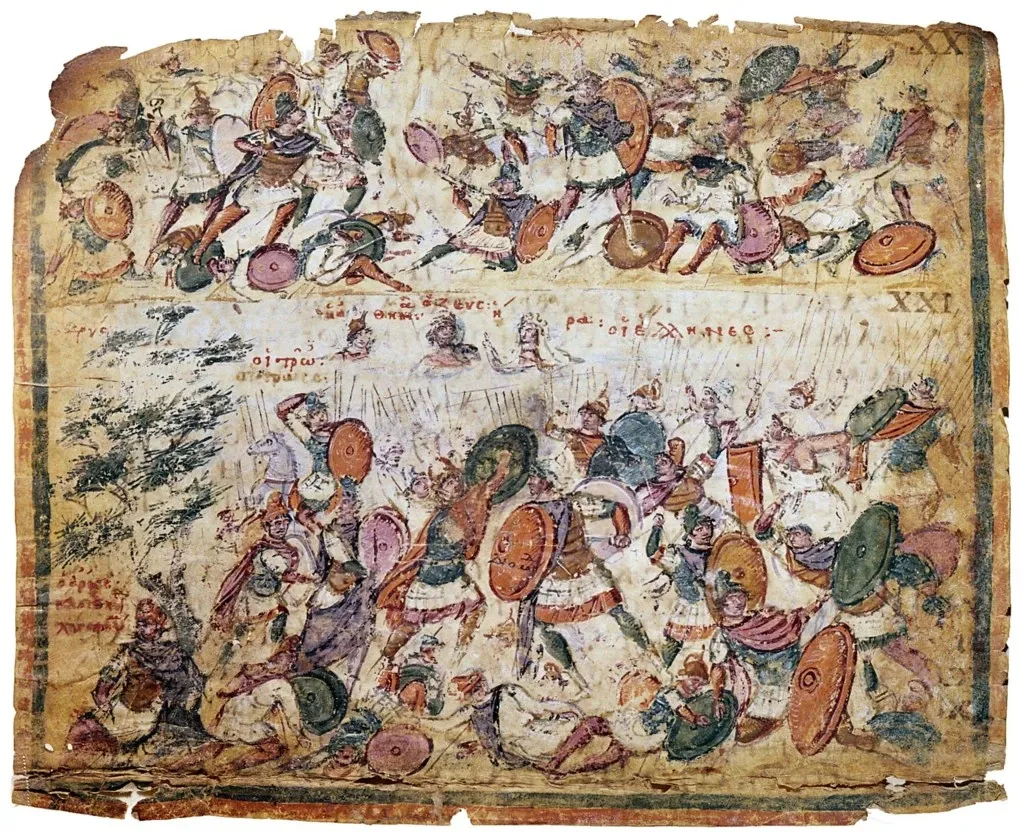
Text and translation
The uninterrupted Greek with its English translation, line by line.
Show text and translation
ἔσπετε νῦν μοι Μοῦσαι Ὀλύμπια δώματʼ ἔχουσαι
Homer · Iliad 2.484–510 · dactylic hexameters · text of Monro–Allen (OCT, 3rd ed.)
How to read each line
A guide to the Greek, syllables, pitch marks and quantities.
Show the reading key
- Above each line: the line as the edition prints it, each word placed over its own syllables. The main row: the same Greek divided into metrical syllables, each written as it is pronounced. A consonant that closes a syllable is written with it (λόθ | ρο); an elided word is closed up with the next vowel (ν’ἀ); a final consonant carried into the next word is set with a thin space (ς ἰ). Wider gaps mark word-ends.
- Above the syllables: the pitch of each syllable, from the accents. Under them: the quantity of each syllable as it falls in the line, then the transliteration, syllable by syllable, with accented syllables in capitals.
- Under each line: a line-for-line translation. In the right margin of the scansion: the line type, its scheme, and its analysis into cola.
Key to the labels
The names, patterns and symbols used beside this poem.
Show the labels and symbols
The labels in the right margin of the scansion below name the line, its scheme, the feet as the line realises them, and the caesurae and diaereses (the named word-ends) that fall in it. In the scheme ⏔ is a biceps, two shorts that may be contracted to one long; ⏕ is a long that may be resolved into two shorts; × is an anceps, long or short. A click on any syllable highlights its metron or colon, or, with the switch, its foot.
| Label | Name and shape | What it is |
|---|---|---|
| hem1 | First hemiepes— ⏔ — ⏔ — | The first two and a half feet of the hexameter, up to the penthemimeral caesura; in the pentameter, its whole first half. |
| hem2 | Second half of the hexameter⏔ — ⏔ — ⏑ ⏑ — × | From the penthemimeral caesura to the line-end: the fifth foot is nearly always a dactyl, the sixth is — ×. |
The traditional feet
| Foot and shape | Where |
|---|---|
| First foot: dactyl or spondee— ⏔ | Scheme positions 1–2. The biceps (⏑ ⏑) may be contracted to a single long, making a spondee. |
| Second foot: dactyl or spondee— ⏔ | Scheme positions 3–4. |
| Third foot: dactyl or spondee— ⏔ | Scheme positions 5–6. The penthemimeral caesura falls after its first syllable, the “trochaic” caesura after its second. |
| Fourth foot: dactyl or spondee— ⏔ | Scheme positions 7–8. Word-end at the end of this foot, when it is a dactyl, is the bucolic diaeresis (West’s “bucolic caesura”: word-end at the end of the fourth foot after an uncontracted biceps)[7]. |
| Fifth foot: dactyl— ⏑ ⏑ | Scheme positions 9–10. A spondee here (a “spondaic line”) is rare. |
| Sixth foot— × | Scheme positions 11–12: a long and the indifferent final syllable. |
Scansion
The poet calls on the Muses before the Catalogue of Ships, then begins it with the Boeotians: ten lines of invocation and seventeen of leaders and towns. A list of place-names is a hard test for the hexameter, and three lines here keep the metre only by a licence.
Recording: David Chamberlain (hypotactic.com), restored pronunciation, CC BY 4.0 — about this recording
David Chamberlain reads in restored pronunciation with a light pitch accent, keeping a regular hexameter beat. Lines 2.484–510 are cut from two tracks of his recording of Iliad Book 2 (Internet Archive, item Iliad2210335), licensed CC BY 4.0. The highlight follows the recording line by line; within a line it moves at an even pace and is only approximate. Tap a line number to play from there.
Speak to me now, Muses, you whose homes are on Olympus –
you are goddesses, you are there when things happen, you know everything,
while we hear nothing but the story and have no knowledge –
who the chiefs and rulers of the Danaans were.
The rank and file I could never recount or name,
not if I had ten tongues and ten mouths,
a voice that could not be broken and a heart of bronze inside me,
unless the Muses of Olympus, daughters of aegis-holding Zeus,
called back to my mind all the men who went to Ilios.
I shall speak, then, of the ships' commanders and of the ships entire.
Peneleos and Leitus led the Boeotians,
with Arcesilaus, Prothoenor and Clonius:
the men who lived in Hyria and in Aulis of the rocks,
in Schoenus and Scolus and Eteonus of the many ridges,
in Thespeia and Graea and Mycalessus of the broad dancing-places;
the men who lived about Harma and Eilesion and Erythrae;
the men who held Eleon and Hyle and Peteon,
Ocalea, and Medeon the well-built stronghold,
Copae and Eutresis and Thisbe of the many doves;
the men of Coroneia and of grassy Haliartus;
the men who held Plataea and who lived in Glisas;
the men who held Hypothebae, the well-built stronghold,
and sacred Onchestus, Poseidon's splendid grove;
the men who held Arne with its many vines, and those of Mideia,
of holy Nisa and of Anthedon at the furthest edge.
Fifty ships of theirs set out, and on board each
went a hundred and twenty Boeotian young men.
Metre
- The line. Six feet. Each of the first five is a dactyl (— ⏑ ⏑) or, with its two shorts contracted, a spondee (— —); the sixth is — ×.[8] Contraction is least common in the fifth foot, about once in 20 lines in Homer.[9] Here only line 496 has a spondaic fifth foot, with the four-syllable πετρήεσσαν at the end.
- Caesurae. Every line but one has a word-end in the third foot, after its long (masculine, or penthemimeral) or between its two shorts (feminine); West gives the proportion of feminine to masculine as about 4 : 3.[8] Prepositives count with the word after them and postpositives with the word before.[7] On that count, twelve lines have the feminine caesura (484, 485, 486, 492, 496, 497, 498, 499, 501, 502, 505, 509) and fourteen the masculine. In 497, 498 and 502 a written word-end at the masculine place is followed by τε, so the real break is the feminine one after it; in 495 τε itself stands in the third princeps and the break comes after it. The list of names pushes the balance towards the masculine caesura: the names and their epithets come in blocks that end on a long.
- A line with no third-foot caesura. In 494 the name Πηνέλεως runs across the whole of the third foot, and the only main break is after the fourth princeps (the hephthemimeral caesura). West notes that a long word occasionally does this.[8]
- Hermann’s Bridge. No word ends between the two shorts of the fourth biceps.[7] In 485 and 490 a word ends there in writing, but the next word is an enclitic (τε; δέ μοι), which goes with it, so the bridge is kept.[7] Breaches occur about once in 550 lines of Homer by West’s count,[7] and about once in 390 lines by Maas’s.[10]
- Homer and the stricter hexameter. Later poets made rules that Homer does not keep.[11] Naeke’s Law forbids word-end after a contracted fourth biceps:[12] Ὕλην in 500 breaks it. In 487, 494 and 510 the syllable in that place is καί, a prepositive, so no word really ends there. Hilberg’s Law forbids word-end after a contracted second biceps:[13] νῦν μοι in 484, Βοιωτῶν μέν in 494 and Ὑποθήβας in 505 break it. West notes that in Homer such word-end is frequent only in the first foot.[9]
- Three lines that need a licence. In 500, 504 and 507 a short syllable ending in -ν stands in the third princeps, just before the masculine caesura, with a vowel after it: εἶχον ἠδ’, ἔχον ἠδ’, πολυστάφυλον Ἄρνην. The final ν is treated as if it closed the syllable. West calls this lengthening by a final continuant and says it falls nearly always in the princeps.[14] In a later study he observes that, after the start of the line, the caesura is where irregularities are most often found in Homer, since phrases are joined there.[15] The input marks the three syllables as lengthened.
- Prosody. Elision;[16] epic correption of a final long vowel or diphthong before a vowel;[17] synecphonesis of ε with the next vowel inside a word;[18] hiatus, often where a word once began with ϝ;[19] stop + liquid, which inside a word normally makes position in early epic, while at the start of a word it may or may not.[20] A final short syllable lengthened by the stop + liquid at the start of the next word stands mostly in the princeps,[21] as in 486 and 495; in 493 and 504 τε stays short before πρ- and Πλ- in a biceps.
- Vowel quantities. The vowels the metre alone makes long were checked in LSJ: ὑμεῖς (485; LSJ marks the Doric ὑμές long), θυγατέρες (492; LSJ says epic lengthens the υ in the longer forms for the metre), Ἴλιον (492), προπάσας (493; LSJ cites this line), μυθήσομαι (488)[22]. Some names are not in LSJ (Ἀρκεσίλαος, Γλισᾶς, Ὑποθῆβαι); there the line notes say only what the metre requires.
- Murray and Wyatt’s text. Compared with the Loeb edition of A. T. Murray, revised by W. F. Wyatt.[23] The line numbers and the words are the same. The differences are of punctuation, diaeresis and the iota subscript (Λήιτος, ἐυκτίμενον, Ποσιδήιον), none of which changes the scansion.
Prosody, line by line
Every syllable, with the reason for its length. Quantities are read from the vowel where the spelling shows it, from the consonants that follow (“position”), from the accent where it tells, and from the metre where nothing else does. Editors’ notes on the text follow in the boxed paragraphs.
- 2.484
Line 2.484 · ἔσπετε νῦν μοι Μοῦσαι Ὀλύμπια δώματʼ ἔχουσαι·
ἔσπετε νῦν μοι Μοῦσαι Ὀλύμπια δώματʼ ἔχουσαι·
ἔσπετενῦνμοιΜοῦσαιὈλύμπιαδώματ’ἔχουσαι·dactyl, spondee, dactyl, dactyl, dactyl, — ×; caesura after the third trochee; bucolic diaeresis.
- 1 —ἔσἔ is short by nature; closed by σ: long by position.
- 2 ⏑πεε is short by nature; one of the two shorts of the biceps at position 2.
- 3 ⏑τεε is short by nature; one of the two shorts of the biceps at position 2.
- 4 —νῦνῦ carries a circumflex, so it is long; closed by ν: long by position.
- 5 —μοιοι is a diphthong, long by nature; a single long contracts the two shorts of the biceps at position 4.
- 6 —Μοῦοῦ is a diphthong, long by nature.
- 7 ⏑σαιαι is a diphthong, long by nature; shortened before the vowel that begins the next word (epic correption), as the metre requires; one of the two shorts of the biceps at position 6.
- 8 ⏑ὈὈ is short by nature; one of the two shorts of the biceps at position 6.
- 9 —λύμύ is a vowel of unknown length; closed by μ: long by position.
- 10 ⏑πιι is short by the metre (position 8 must be short); one of the two shorts of the biceps at position 8.
- 11 ⏑αα is short by the accent rule: acute on the antepenult requires a short final syllable; one of the two shorts of the biceps at position 8.
- 12 —δώώ is long by nature.
- 13 ⏑μαα is short by the metre (position 10 must be short); one of the two shorts of the biceps at position 10.
- 14 ⏑τ’ἔἔ is short by nature; the apostrophe marks an elided vowel; the consonant before it joins this syllable; one of the two shorts of the biceps at position 10.
- 15 —χουου is a diphthong, long by nature.
- 16 ×σαι·αι is a diphthong, long by nature; the position is anceps.
A dactyl, a spondee and three dactyls. νῦν μοι ends after the contracted second biceps; μοι is an enclitic and goes with νῦν. Homer allows this, though it is frequent only in the first foot;[9] the strict hexameter forbids it by Hilberg’s Law.[13] Μοῦσαι ends between the shorts of the third foot, a feminine caesura,[8] and its -αι is shortened before Ὀλύμπια by epic correption.[17] Word-end after Ὀλύμπια is the bucolic caesura.[7] δώματ’ is elided.[16]- 2.485
Line 2.485 · ὑμεῖς γὰρ θεαί ἐστε πάρεστέ τε ἴστέ τε πάντα,
ὑμεῖς γὰρ θεαί ἐστε πάρεστέ τε ἴστέ τε πάντα,
ὑμεῖςγὰρθεαίἐστεπάρεστέτεἴστέτεπάντα,spondee, dactyl, dactyl, dactyl, dactyl, — ×; caesura after the third trochee; bucolic diaeresis.
- 1 —ὑυ is long: LSJ marks it long in the Doric form ὑμές (s.v. ὑμές), and here it fills the first princeps.
- 2 —μεῖςεῖ is a diphthong, long by nature; closed by ς: long by position; a single long contracts the two shorts of the biceps at position 2.
- 3 —γὰρὰ is a vowel of unknown length; closed by ρ: long by position.
- 4 ⏑θεε is short by nature; one of the two shorts of the biceps at position 4.
- 5 ⏑αίαί is a diphthong, long by nature; shortened before the vowel that begins the next word (epic correption), as the metre requires; one of the two shorts of the biceps at position 4.
- 6 —ἐσἐ is short by nature; closed by σ: long by position.
- 7 ⏑τεε is short by nature; one of the two shorts of the biceps at position 6.
- 8 ⏑πάά is short by the metre (position 6 must be short); one of the two shorts of the biceps at position 6.
- 9 —ρεσε is short by nature; closed by σ: long by position.
- 10 ⏑τέέ is short by nature; one of the two shorts of the biceps at position 8.
- 11 ⏑τεε is short by nature; the next word begins with a vowel and nothing is elided: hiatus; one of the two shorts of the biceps at position 8.
- 12 —ἴσἴ is a vowel of unknown length; closed by σ: long by position.
- 13 ⏑τέέ is short by nature; one of the two shorts of the biceps at position 10.
- 14 ⏑τεε is short by nature; one of the two shorts of the biceps at position 10.
- 15 —πάνά is a vowel of unknown length; closed by ν: long by position.
- 16 ×τα,α is of unknown length; the position is anceps, so either scans.
A spondee and four dactyls. The υ of ὑμεῖς is long (LSJ marks it long in the Doric ὑμές). -αί of θεαί is shortened before ἐστε by correption.[17] ἐστε ends between the shorts of the third foot, a feminine caesura.[8] πάρεστε ends between the shorts of the fourth biceps, but the enclitic τε goes with it, so Hermann’s Bridge is kept.[7] That τε stands unelided before ἴστε: ἴστε belongs with οἶδα, one of the words West lists as having once begun with ϝ.[24] The bucolic caesura follows the τε.[7]- 2.486
Line 2.486 · ἡμεῖς δὲ κλέος οἶον ἀκούομεν οὐδέ τι ἴδμεν·
ἡμεῖς δὲ κλέος οἶον ἀκούομεν οὐδέ τι ἴδμεν·
ἡμεῖςδὲκλέος οἶον ἀκούομεν οὐδέτιἴδμεν·spondee, dactyl, dactyl, dactyl, dactyl, — ×; caesura after the third trochee; bucolic diaeresis.
- 1 —ἡἡ is long by nature.
- 2 —μεῖςεῖ is a diphthong, long by nature; closed by ς: long by position; a single long contracts the two shorts of the biceps at position 2.
- 3 —δὲὲ is short by nature; the next word begins with κλ: the syllable is closed before it: long by position.
- 4 ⏑κλέέ is short by nature; one of the two shorts of the biceps at position 4.
- 5 ⏑οο is short by nature; one of the two shorts of the biceps at position 4.
- 6 —ς οἶοἶ is a diphthong, long by nature; the first consonant belongs to the previous word and is carried over to this vowel.
- 7 ⏑οο is short by nature; one of the two shorts of the biceps at position 6.
- 8 ⏑ν ἀἀ is short by the metre (position 6 must be short); the first consonant belongs to the previous word and is carried over to this vowel; one of the two shorts of the biceps at position 6.
- 9 —κούού is a diphthong, long by nature.
- 10 ⏑οο is short by nature; one of the two shorts of the biceps at position 8.
- 11 ⏑μεε is short by nature; one of the two shorts of the biceps at position 8.
- 12 —ν οὐοὐ is a diphthong, long by nature; the first consonant belongs to the previous word and is carried over to this vowel.
- 13 ⏑δέέ is short by nature; one of the two shorts of the biceps at position 10.
- 14 ⏑τιι is short by nature and stays unelided before ἴδμεν: ἴδμεν belongs with οἶδα, which once began with ϝ;[24] one of the two shorts of the biceps at position 10.
- 15 —ἴδἴ is a vowel of unknown length; closed by δ: long by position; δμ is one of the four clusters (γμ, γν, δμ, δν) that never leave the syllable before them short.[25]
- 16 ×μεν·ε is short by nature; closed by ν: long by position; the position is anceps.
A spondee and four dactyls. δέ is long in the second princeps before the κλ- of κλέος: a final short syllable lengthened by an initial stop + liquid, a thing mostly found in the princeps.[21] The ς of κλέος and the ν of οἶον pass to the following vowels. οἶον ends between the shorts of the third foot, a feminine caesura.[8] Word-end after ἀκούομεν is the bucolic caesura.[7] τι stays unelided before ἴδμεν, which belongs with οἶδα and once began with ϝ.[24]- 2.487
Line 2.487 · οἵ τινες ἡγεμόνες Δαναῶν καὶ κοίρανοι ἦσαν·
οἵ τινες ἡγεμόνες Δαναῶν καὶ κοίρανοι ἦσαν·
οἵτινες ἡγεμόνεςΔαναῶνκαὶκοίρανοιἦσαν·dactyl, dactyl, dactyl, spondee, dactyl, — ×; penthemimeral caesura; hephthemimeral caesura; word-end after a spondaic fourth foot.
- 1 —οἵοἵ is a diphthong, long by nature.
- 2 ⏑τιι is short by the metre (position 2 must be short); one of the two shorts of the biceps at position 2.
- 3 ⏑νεε is short by nature; one of the two shorts of the biceps at position 2.
- 4 —ς ἡἡ is long by nature; the first consonant belongs to the previous word and is carried over to this vowel.
- 5 ⏑γεε is short by nature; one of the two shorts of the biceps at position 4.
- 6 ⏑μόό is short by nature; one of the two shorts of the biceps at position 4.
- 7 —νεςε is short by nature; closed by ς: long by position.
- 8 ⏑Δαα is short by the metre (position 6 must be short); one of the two shorts of the biceps at position 6.
- 9 ⏑ναα is short by the metre (position 6 must be short); one of the two shorts of the biceps at position 6.
- 10 —ῶνῶ is long by nature; closed by ν: long by position.
- 11 —καὶαὶ is a diphthong, long by nature; a single long contracts the two shorts of the biceps at position 8.
- 12 —κοίοί is a diphthong, long by nature.
- 13 ⏑ραα is short by the metre (position 10 must be short); one of the two shorts of the biceps at position 10.
- 14 ⏑νοιοι is a diphthong, long by nature; shortened before the vowel that begins the next word (epic correption), as the metre requires; one of the two shorts of the biceps at position 10.
- 15 —ἦἦ is long by nature.
- 16 ×σαν·α is a vowel of unknown length; closed by ν: long by position; the position is anceps.
Three dactyls, a spondee and a dactyl. οἵ τινες is the relative pronoun split in two (ὅστις). The caesura is penthemimeral, after ἡγεμόνες,[8] with a hephthemimeral word-end after Δαναῶν. καί fills the contracted fourth biceps but goes with κοίρανοι as a prepositive.[26] -οι of κοίρανοι is shortened before ἦσαν by correption.[17] LSJ cites this line s.v. κοίρανος.- 2.488
Line 2.488 · πληθὺν δʼ οὐκ ἂν ἐγὼ μυθήσομαι οὐδʼ ὀνομήνω,
πληθὺν δʼ οὐκ ἂν ἐγὼ μυθήσομαι οὐδʼ ὀνομήνω,
πληθὺνδ’οὐκἂν ἐγὼμυθήσομαιοὐδ’ὀνομήνω,spondee, dactyl, spondee, dactyl, dactyl, — ×; penthemimeral caesura; bucolic diaeresis.
- 1 —πληη is long by nature.
- 2 —θὺνὺ is a vowel of unknown length; closed by ν: long by position; a single long contracts the two shorts of the biceps at position 2.
- 3 —δ’οὐκοὐ is a diphthong, long by nature; the apostrophe marks an elided vowel; the consonant before it joins this syllable.
- 4 ⏑ἂἂ is short by the metre (position 4 must be short); one of the two shorts of the biceps at position 4.
- 5 ⏑ν ἐἐ is short by nature; the first consonant belongs to the previous word and is carried over to this vowel; one of the two shorts of the biceps at position 4.
- 6 —γὼὼ is long by nature.
- 7 —μυυ is long by the metre (position 6 must be long); a single long contracts the two shorts of the biceps at position 6.
- 8 —θήή is long by nature.
- 9 ⏑σοο is short by nature; one of the two shorts of the biceps at position 8.
- 10 ⏑μαιαι is a diphthong, long by nature; shortened before the vowel that begins the next word (epic correption), as the metre requires; one of the two shorts of the biceps at position 8.
- 11 —οὐοὐ is a diphthong, long by nature.
- 12 ⏑δ’ὀὀ is short by nature; the apostrophe marks an elided vowel; the consonant before it joins this syllable; one of the two shorts of the biceps at position 10.
- 13 ⏑νοο is short by nature; one of the two shorts of the biceps at position 10.
- 14 —μήή is long by nature.
- 15 ×νω,ω is long by nature; the position is anceps.
A spondee, a dactyl, a spondee and two dactyls. πληθύν ends after the contracted first biceps, the one place where Homer often allows this.[9] δ’ and οὐδ’ are elided.[16] ἄν is short and its ν passes to ἐγώ. The caesura is penthemimeral, after ἐγώ.[8] The υ of μυθήσομαι is long.[27] -μαι is shortened before οὐδ’ by correption,[17] and word-end after μυθήσομαι is the bucolic caesura.[7]- 2.489
Line 2.489 · οὐδʼ εἴ μοι δέκα μὲν γλῶσσαι, δέκα δὲ στόματʼ εἶεν,
οὐδʼ εἴ μοι δέκα μὲν γλῶσσαι, δέκα δὲ στόματʼ εἶεν,
οὐδ’εἴμοιδέκαμὲνγλῶσσαι,δέκαδὲστόματ’εἶεν,spondee, dactyl, spondee, dactyl, dactyl, — ×; penthemimeral caesura; hephthemimeral caesura; bucolic diaeresis.
- 1 —οὐοὐ is a diphthong, long by nature.
- 2 —δ’εἴεἴ is a diphthong, long by nature; the apostrophe marks an elided vowel; the consonant before it joins this syllable; a single long contracts the two shorts of the biceps at position 2.
- 3 —μοιοι is a diphthong, long by nature.
- 4 ⏑δέέ is short by nature; one of the two shorts of the biceps at position 4.
- 5 ⏑καα is short by the metre (position 4 must be short); one of the two shorts of the biceps at position 4.
- 6 —μὲνὲ is short by nature; closed by ν: long by position.
- 7 —γλῶσῶ is long by nature; closed by σ: long by position; a single long contracts the two shorts of the biceps at position 6.
- 8 —σαι,αι is a diphthong, long by nature.
- 9 ⏑δέέ is short by nature; one of the two shorts of the biceps at position 8.
- 10 ⏑καα is short by the metre (position 8 must be short); one of the two shorts of the biceps at position 8.
- 11 —δὲὲ is short by nature; the next word begins with στ: the syllable is closed before it: long by position.
- 12 ⏑στόό is short by nature; one of the two shorts of the biceps at position 10.
- 13 ⏑μαα is short by the metre (position 10 must be short); one of the two shorts of the biceps at position 10.
- 14 —τ’εἶεἶ is a diphthong, long by nature; the apostrophe marks an elided vowel; the consonant before it joins this syllable.
- 15 ×εν,ε is short by nature; closed by ν: long by position; the position is anceps.
A spondee, a dactyl, a spondee and two dactyls. δ’ is elided.[16] εἰ ends after the contracted first biceps.[9] The caesura is penthemimeral, after μέν, with a hephthemimeral word-end after γλῶσσαι.[8] The word-end after the second δέκα is the bucolic caesura.[7] δέ is long in the fifth princeps before the στ- of στόματ’,[28] and στόματ’ is elided before εἶεν.[16]- 2.490
Line 2.490 · φωνὴ δʼ ἄρρηκτος, χάλκε‿ον δέ μοι ἦτορ ἐνείη,
φωνὴ δʼ ἄρρηκτος, χάλκε‿ον δέ μοι ἦτορ ἐνείη,
φωνὴδ’ἄρρηκτος,χάλκε‿ονδέμοιἦτορ ἐνείη,spondee, spondee, spondee, dactyl, dactyl, — ×; penthemimeral caesura; hephthemimeral caesura; bucolic diaeresis.
- 1 —φωω is long by nature.
- 2 —νὴὴ is long by nature; a single long contracts the two shorts of the biceps at position 2.
- 3 —δ’ἄρἄ is a vowel of unknown length; closed by ρ: long by position; the apostrophe marks an elided vowel; the consonant before it joins this syllable.
- 4 —ρηκη is long by nature; closed by κ: long by position; a single long contracts the two shorts of the biceps at position 4.
- 5 —τος,ο is short by nature; closed by ς: long by position.
- 6 —χάλά is a vowel of unknown length; closed by λ: long by position; a single long contracts the two shorts of the biceps at position 6.
- 7 —κε‿ονεο is two vowels of one word pronounced together as one long syllable (synizesis); closed by ν: long by position.
- 8 ⏑δέέ is short by nature; one of the two shorts of the biceps at position 8.
- 9 ⏑μοιοι is a diphthong, long by nature; shortened before the vowel that begins the next word (epic correption), as the metre requires; one of the two shorts of the biceps at position 8.
- 10 —ἦἦ is long by nature.
- 11 ⏑τοο is short by nature; one of the two shorts of the biceps at position 10.
- 12 ⏑ρ ἐἐ is short by nature; the first consonant belongs to the previous word and is carried over to this vowel; one of the two shorts of the biceps at position 10.
- 13 —νείεί is a diphthong, long by nature.
- 14 ×η,η is long by nature; the position is anceps.
Three spondees, then two dactyls. δ’ is elided.[16] The caesura is penthemimeral, after ἄρρηκτος.[8] χάλκεον is two syllables, χαλ-κεον: ε and ο are run together, as often happens inside a word when the first vowel is ε (synecphonesis, p. 15). Its second syllable takes the fourth princeps. A word ends after δέ between the shorts of the fourth biceps, but δέ and μοι are postpositives that go with χάλκεον, so Hermann’s Bridge is kept.[7] μοι is shortened before ἦτορ by correption,[17] and the bucolic caesura follows it.[7]- 2.491
Line 2.491 · εἰ μὴ Ὀλυμπιάδες Μοῦσαι Διὸς αἰγιόχοιο
εἰ μὴ Ὀλυμπιάδες Μοῦσαι Διὸς αἰγιόχοιο
εἰμὴὈλυμπιάδεςΜοῦσαιΔιὸς αἰγιόχοιοdactyl, dactyl, spondee, dactyl, dactyl, — ×; penthemimeral caesura; hephthemimeral caesura; bucolic diaeresis.
- 1 —εἰεἰ is a diphthong, long by nature.
- 2 ⏑μὴὴ is long by nature; shortened before the vowel that begins the next word (epic correption), as the metre requires; one of the two shorts of the biceps at position 2.
- 3 ⏑ὈὈ is short by nature; one of the two shorts of the biceps at position 2.
- 4 —λυμυ is a vowel of unknown length; closed by μ: long by position.
- 5 ⏑πιι is short by the metre (position 4 must be short); one of the two shorts of the biceps at position 4.
- 6 ⏑άά is short by the metre (position 4 must be short); one of the two shorts of the biceps at position 4.
- 7 —δεςε is short by nature; closed by ς: long by position.
- 8 —Μοῦοῦ is a diphthong, long by nature; a single long contracts the two shorts of the biceps at position 6.
- 9 —σαιαι is a diphthong, long by nature.
- 10 ⏑Διι is short by the metre (position 8 must be short); one of the two shorts of the biceps at position 8.
- 11 ⏑ὸὸ is short by nature; one of the two shorts of the biceps at position 8.
- 12 —ς αἰαἰ is a diphthong, long by nature; the first consonant belongs to the previous word and is carried over to this vowel.
- 13 ⏑γιι is short by the metre (position 10 must be short); one of the two shorts of the biceps at position 10.
- 14 ⏑όό is short by nature; one of the two shorts of the biceps at position 10.
- 15 —χοιοι is a diphthong, long by nature.
- 16 ×οο is short by nature; the position is anceps.
Two dactyls, a spondee and two dactyls. μή is shortened before Ὀλυμπιάδες by correption.[17] The caesura is penthemimeral, after Ὀλυμπιάδες, with a hephthemimeral word-end after Μοῦσαι.[8] Word-end after Διός, whose ς passes to αἰγιόχοιο, is the bucolic caesura.[7] LSJ cites this line s.v. Ὀλυμπιάς, an epithet of the Muses.- 2.492
Line 2.492 · θυγατέρες μνησαίαθʼ ὅσοι ὑπὸ Ἴλιον ἦλθον·
θυγατέρες μνησαίαθʼ ὅσοι ὑπὸ Ἴλιον ἦλθον·
θυγατέρεςμνησαίαθ’ὅσοιὑπὸἼλιον ἦλθον·dactyl, spondee, dactyl, dactyl, dactyl, — ×; caesura after the third trochee (with elision); hephthemimeral caesura; bucolic diaeresis.
- 1 —θυυ is short by nature in θυγάτηρ, but LSJ notes that epic verse makes it long in the longer forms for the sake of the metre (s.v. θυγάτηρ); here it fills the first princeps.
- 2 ⏑γαα is short by the metre (position 2 must be short); one of the two shorts of the biceps at position 2.
- 3 ⏑τέέ is short by nature; one of the two shorts of the biceps at position 2.
- 4 —ρεςε is short by nature; closed by ς: long by position.
- 5 —μνηη is long by nature; a single long contracts the two shorts of the biceps at position 4.
- 6 —σαίαί is a diphthong, long by nature.
- 7 ⏑αα is short by the metre (position 6 must be short); one of the two shorts of the biceps at position 6.
- 8 ⏑θ’ὅὅ is short by nature; the apostrophe marks an elided vowel; the consonant before it joins this syllable; one of the two shorts of the biceps at position 6.
- 9 —σοιοι is a diphthong, long by nature, and keeps its length before ὑπό in the fourth princeps: hiatus with a long vowel, mostly found in the princeps.[7]
- 10 ⏑ὑὑ is short by the metre (position 8 must be short); one of the two shorts of the biceps at position 8.
- 11 ⏑πὸο is short by nature and stays unelided before Ἴλιον: Ἴλιος once began with ϝ;[24] one of the two shorts of the biceps at position 8.
- 12 —ἼἼ is long by nature.[29]
- 13 ⏑λιι is short by the metre (position 10 must be short); one of the two shorts of the biceps at position 10.
- 14 ⏑οο is short by nature; one of the two shorts of the biceps at position 10.
- 15 —ν ἦλἦ is long by nature; closed by λ: long by position; the first consonant belongs to the previous word and is carried over to this vowel.
- 16 ×θον·ο is short by nature; closed by ν: long by position; the position is anceps.
A dactyl, a spondee and three dactyls. The first syllable of θυγατέρες stands in the first princeps although its υ is short by nature; LSJ notes that epic verse makes it long in the longer forms of the word for the sake of the metre (s.v. θυγάτηρ). μνησαίαθ’ (for μνησαίατο) is elided,[16] and the word ends between the shorts of the third foot, a feminine caesura.[8] -οι of ὅσοι keeps its length before ὑπό in the fourth princeps: hiatus with a long vowel, mostly found in the princeps.[7] ὑπό stays unelided before Ἴλιον, which once began with ϝ.[24] The Ἰ- of Ἴλιον is long.[29]- 2.493
Line 2.493 · ἀρχοὺς αὖ νηῶν ἐρέω νῆάς τε προπάσας.
ἀρχοὺς αὖ νηῶν ἐρέω νῆάς τε προπάσας.
ἀρχοὺςαὖνηῶνἐρέωνῆάςτεπροπάσας.spondee, spondee, dactyl, spondee, dactyl, — ×; penthemimeral caesura; hephthemimeral caesura.
- 1 —ἀρἀ is a vowel of unknown length; closed by ρ: long by position.
- 2 —χοὺςοὺ is a diphthong, long by nature; a single long contracts the two shorts of the biceps at position 2.
- 3 —αὖαὖ is a diphthong, long by nature.
- 4 —νηη is long by nature; a single long contracts the two shorts of the biceps at position 4.
- 5 —ῶνῶ is long by nature.
- 6 ⏑ἐἐ is short by nature; one of the two shorts of the biceps at position 6.
- 7 ⏑ρέέ is short by nature; one of the two shorts of the biceps at position 6.
- 8 —ωω is long by nature.
- 9 —νῆῆ is long by nature; a single long contracts the two shorts of the biceps at position 8.
- 10 —άςά is a vowel of unknown length; closed by ς: long by position.
- 11 ⏑τεε is short by nature; the next word begins with πρ, a stop + liquid that does not make position here, so the syllable stays short; one of the two shorts of the biceps at position 10.
- 12 ⏑προο is short by nature; one of the two shorts of the biceps at position 10.
- 13 —πάα is long by nature.[30]
- 14 ×σας.α is a vowel of unknown length; closed by ς: long by position; the position is anceps.
Two spondees, a dactyl, a spondee and a dactyl. ἀρχούς ends after the contracted first biceps.[9] The caesura is penthemimeral, after νηῶν, with a hephthemimeral word-end after ἐρέω.[8] τε stays short before the πρ- of προπάσας in a biceps: at the start of a word stop + liquid need not make position.[25] The α of προπάσας is long.[30]- 2.494
Line 2.494 · Βοιωτῶν μὲν Πηνέλεως καὶ Λήϊτος ἦρχον
Βοιωτῶν μὲν Πηνέλεως καὶ Λήϊτος ἦρχον
ΒοιωτῶνμὲνΠηνέλεωςκαὶΛήϊτος ἦρχονspondee, spondee, dactyl, spondee, dactyl, — ×; hephthemimeral caesura; word-end after a spondaic fourth foot.
- 1 —Βοιοι is a diphthong, long by nature.
- 2 —ωω is long by nature; a single long contracts the two shorts of the biceps at position 2.
- 3 —τῶνῶ is long by nature; closed by ν: long by position.
- 4 —μὲνὲ is short by nature; closed by ν: long by position; a single long contracts the two shorts of the biceps at position 4.
- 5 —Πηη is long by nature.
- 6 ⏑νέέ is short by nature; one of the two shorts of the biceps at position 6.
- 7 ⏑λεε is short by nature; one of the two shorts of the biceps at position 6.
- 8 —ωςω is long by nature; closed by ς: long by position.
- 9 —καὶαὶ is a diphthong, long by nature; a single long contracts the two shorts of the biceps at position 8.
- 10 —Λήή is long by nature.
- 11 ⏑ϊϊ is short by the metre (position 10 must be short); one of the two shorts of the biceps at position 10.
- 12 ⏑τοο is short by nature; one of the two shorts of the biceps at position 10.
- 13 —ς ἦρἦ is long by nature; closed by ρ: long by position; the first consonant belongs to the previous word and is carried over to this vowel.
- 14 ×χονο is short by nature; closed by ν: long by position; the position is anceps.
Two spondees, a dactyl, a spondee and a dactyl. Βοιωτῶν μέν ends after the contracted second biceps (μέν is a postpositive): allowed in Homer, forbidden in the strict hexameter by Hilberg’s Law.[31] Πηνέλεως then runs across the whole third foot, so there is no third-foot caesura; the main break is the hephthemimeral one after it.[8] καί fills the contracted fourth biceps but goes with Λήϊτος as a prepositive.[7] The ς of Λήϊτος passes to ἦρχον.- 2.495
Line 2.495 · Ἀρκεσίλαός τε Προθοήνωρ τε Κλονίος τε,
Ἀρκεσίλαός τε Προθοήνωρ τε Κλονίος τε,
ἈρκεσίλαόςτεΠροθοήνωρτεΚλονίοςτε,dactyl, spondee, dactyl, spondee, dactyl, — ×; penthemimeral caesura; word-end after a spondaic fourth foot.
- 1 —ἈρἈ is a vowel of unknown length; closed by ρ: long by position.
- 2 ⏑κεε is short by nature; one of the two shorts of the biceps at position 2.
- 3 ⏑σίί is short by the metre (position 2 must be short); one of the two shorts of the biceps at position 2.
- 4 —λαα is long: the name is a compound of λαός, whose α is long.[32]
- 5 —όςό is short by nature; closed by ς: long by position; a single long contracts the two shorts of the biceps at position 4.
- 6 —τεε is short by nature; the next word begins with Πρ: the syllable is closed before it: long by position.
- 7 ⏑Προο is short by nature; one of the two shorts of the biceps at position 6.
- 8 ⏑θοο is short by nature; one of the two shorts of the biceps at position 6.
- 9 —ήή is long by nature.
- 10 —νωρω is long by nature; closed by ρ: long by position; a single long contracts the two shorts of the biceps at position 8.
- 11 —τεε is short by nature; the next word begins with Κλ: the syllable is closed before it: long by position.
- 12 ⏑Κλοο is short by nature; one of the two shorts of the biceps at position 10.
- 13 ⏑νίί is short by the metre (position 10 must be short); one of the two shorts of the biceps at position 10.
- 14 —οςο is short by nature; closed by ς: long by position.
- 15 ×τε,ε is short by nature; the position is anceps.
A dactyl, a spondee, a dactyl, a spondee and a dactyl. The α of Ἀρκεσίλαος is long, as in λαός.[32] The first τε, a postpositive going with Ἀρκεσίλαος, stands in the third princeps and is long before the Πρ- of Προθοήνωρ: a final short syllable lengthened by an initial stop + liquid in the princeps.[33] So the caesura is penthemimeral, after τε.[34] The second τε is lengthened in the same way before Κλ- in the fifth princeps. Προθοήνωρ ends in writing after the contracted fourth biceps, but its τε follows in the next princeps.- 2.496
Line 2.496 · οἵ θʼ Ὑρίην ἐνέμοντο καὶ Αὐλίδα πετρήεσσαν
οἵ θʼ Ὑρίην ἐνέμοντο καὶ Αὐλίδα πετρήεσσαν
οἵθ’ὙρίηνἐνέμοντοκαὶΑὐλίδαπετρήεσσανdactyl, dactyl, dactyl, dactyl, spondee, — ×; caesura after the third trochee; bucolic diaeresis.
- 1 —οἵοἵ is a diphthong, long by nature.
- 2 ⏑θ’ὙὙ is short by the metre (position 2 must be short); the apostrophe marks an elided vowel; the consonant before it joins this syllable; one of the two shorts of the biceps at position 2.
- 3 ⏑ρίί is short by the metre (position 2 must be short); one of the two shorts of the biceps at position 2.
- 4 —ηνη is long by nature.
- 5 ⏑ἐἐ is short by nature; one of the two shorts of the biceps at position 4.
- 6 ⏑νέέ is short by nature; one of the two shorts of the biceps at position 4.
- 7 —μονο is short by nature; closed by ν: long by position.
- 8 ⏑τοο is short by nature; one of the two shorts of the biceps at position 6.
- 9 ⏑καὶαὶ is a diphthong, long by nature; shortened before the vowel that begins the next word (epic correption), as the metre requires; one of the two shorts of the biceps at position 6.
- 10 —ΑὐΑὐ is a diphthong, long by nature.
- 11 ⏑λίί is short by the metre (position 8 must be short); one of the two shorts of the biceps at position 8.
- 12 ⏑δαα is short by the metre (position 8 must be short); one of the two shorts of the biceps at position 8.
- 13 —πετε is short by nature; closed by τ before a liquid: stop + liquid makes position, as it usually does in epic.
- 14 —ρήή is long by nature; a single long contracts the two shorts of the biceps at position 10.
- 15 —εσε is short by nature; closed by σ: long by position.
- 16 ×σανα is a vowel of unknown length; closed by ν: long by position; the position is anceps.
Four dactyls and a spondee: the only spondaic fifth foot in the passage, a rare thing in Homer.[9] θ’ is elided.[16] ἐνέμοντο ends between the shorts of the third foot, a feminine caesura.[8] καί is shortened before Αὐλίδα by correption.[17] Word-end after Αὐλίδα is the bucolic caesura.[7] The τρ of πετρήεσσαν makes position inside the word.[20] LSJ cites this line s.v. πετρήεις.- 2.497
Line 2.497 · Σχοῖνόν τε Σκῶλόν τε πολύκνημόν τʼ Ἐτεωνόν,
Σχοῖνόν τε Σκῶλόν τε πολύκνημόν τʼ Ἐτεωνόν,
ΣχοῖνόντεΣκῶλόντεπολύκνημόντ’Ἐτεωνόν,spondee, spondee, dactyl, spondee, dactyl, — ×; penthemimeral caesura; caesura after the third trochee.
- 1 —Σχοῖοῖ is a diphthong, long by nature.
- 2 —νόνό is short by nature; closed by ν: long by position; a single long contracts the two shorts of the biceps at position 2.
- 3 —τεε is short by nature; the next word begins with Σκ: the syllable is closed before it: long by position.
- 4 —Σκῶῶ is long by nature; a single long contracts the two shorts of the biceps at position 4.
- 5 —λόνό is short by nature; closed by ν: long by position.
- 6 ⏑τεε is short by nature; one of the two shorts of the biceps at position 6.
- 7 ⏑ποο is short by nature; one of the two shorts of the biceps at position 6.
- 8 —λύκύ is a vowel of unknown length; closed by κ before a nasal: stop + nasal makes position, as it usually does in epic.
- 9 —νηη is long by nature; a single long contracts the two shorts of the biceps at position 8.
- 10 —μόνό is short by nature; closed by ν: long by position.
- 11 ⏑τ’ἘἘ is short by nature; the apostrophe marks an elided vowel; the consonant before it joins this syllable; one of the two shorts of the biceps at position 10.
- 12 ⏑τεε is short by nature; one of the two shorts of the biceps at position 10.
- 13 —ωω is long by nature.
- 14 ×νόν,ό is short by nature; closed by ν: long by position; the position is anceps.
Two spondees, a dactyl, a spondee and a dactyl. The first τε is long in the second princeps before the σκ- of Σκῶλον. The written word-end after Σκῶλον at the masculine place is followed by the postpositive τε, so the real caesura is the feminine one after it.[34] The κν of πολύκνημον makes position, as stop + nasal usually does in epic.[25] τ’ is elided.[16]- 2.498
Line 2.498 · Θέσπειαν Γραῖάν τε καὶ εὐρύχορον Μυκαλησσόν,
Θέσπειαν Γραῖάν τε καὶ εὐρύχορον Μυκαλησσόν,
ΘέσπειανΓραῖάντεκαὶεὐρύχορονΜυκαλησσόν,spondee, spondee, dactyl, dactyl, dactyl, — ×; penthemimeral caesura; caesura after the third trochee.
- 1 —Θέσέ is short by nature; closed by σ: long by position.
- 2 —πειει is a diphthong, long by nature; a single long contracts the two shorts of the biceps at position 2.
- 3 —ανα is a vowel of unknown length; closed by ν: long by position.
- 4 —Γραῖαῖ is a diphthong, long by nature; a single long contracts the two shorts of the biceps at position 4.
- 5 —άνά is a vowel of unknown length; closed by ν: long by position.
- 6 ⏑τεε is short by nature; one of the two shorts of the biceps at position 6.
- 7 ⏑καὶαὶ is a diphthong, long by nature; shortened before the vowel that begins the next word (epic correption), as the metre requires; one of the two shorts of the biceps at position 6.
- 8 —εὐεὐ is a diphthong, long by nature.
- 9 ⏑ρύύ is short by the metre (position 8 must be short); one of the two shorts of the biceps at position 8.
- 10 ⏑χοο is short by nature; one of the two shorts of the biceps at position 8.
- 11 —ρονο is short by nature; closed by ν: long by position.
- 12 ⏑Μυυ is short by the metre (position 10 must be short); one of the two shorts of the biceps at position 10.
- 13 ⏑καα is short by the metre (position 10 must be short); one of the two shorts of the biceps at position 10.
- 14 —ληση is long by nature; closed by σ: long by position.
- 15 ×σόν,ό is short by nature; closed by ν: long by position; the position is anceps.
- 2.499
Line 2.499 · οἵ τʼ ἀμφʼ Ἅρμʼ ἐνέμοντο καὶ Εἰλέσιον καὶ Ἐρυθράς,
οἵ τʼ ἀμφʼ Ἅρμʼ ἐνέμοντο καὶ Εἰλέσιον καὶ Ἐρυθράς,
οἵτ’ἀμφ’Ἅρμ’ἐνέμοντοκαὶΕἰλέσιονκαὶἘρυθράς,spondee, dactyl, dactyl, dactyl, dactyl, — ×; caesura after the third trochee.
- 1 —οἵοἵ is a diphthong, long by nature.
- 2 —τ’ἀμἀ is a vowel of unknown length; closed by μ: long by position; the apostrophe marks an elided vowel; the consonant before it joins this syllable; a single long contracts the two shorts of the biceps at position 2.
- 3 —φ’ἍρἍ is a vowel of unknown length; closed by ρ: long by position; the apostrophe marks an elided vowel; the consonant before it joins this syllable.
- 4 ⏑μ’ἐἐ is short by nature; the apostrophe marks an elided vowel; the consonant before it joins this syllable; one of the two shorts of the biceps at position 4.
- 5 ⏑νέέ is short by nature; one of the two shorts of the biceps at position 4.
- 6 —μονο is short by nature; closed by ν: long by position.
- 7 ⏑τοο is short by nature; one of the two shorts of the biceps at position 6.
- 8 ⏑καὶαὶ is a diphthong, long by nature; shortened before the vowel that begins the next word (epic correption), as the metre requires; one of the two shorts of the biceps at position 6.
- 9 —ΕἰΕἰ is a diphthong, long by nature.
- 10 ⏑λέέ is short by nature; one of the two shorts of the biceps at position 8.
- 11 ⏑σιι is short by the metre (position 8 must be short); one of the two shorts of the biceps at position 8.
- 12 —ονο is short by nature; closed by ν: long by position.
- 13 ⏑καὶαὶ is a diphthong, long by nature; shortened before the vowel that begins the next word (epic correption), as the metre requires; one of the two shorts of the biceps at position 10.
- 14 ⏑ἘἘ is short by nature; one of the two shorts of the biceps at position 10.
- 15 —ρυθυ is a vowel of unknown length; closed by θ before a liquid: stop + liquid makes position, as it usually does in epic.
- 16 ×ράς,ά is a vowel of unknown length; closed by ς: long by position; the position is anceps.
- 2.500
Line 2.500 · οἵ τʼ Ἐλεῶνʼ εἶχον ἠδʼ Ὕλην καὶ Πετεῶνα,
οἵ τʼ Ἐλεῶνʼ εἶχον ἠδʼ Ὕλην καὶ Πετεῶνα,
οἵτ’Ἐλεῶν’εἶχονἠδ’ὝληνκαὶΠετεῶνα,dactyl, spondee, spondee, spondee, dactyl, — ×; penthemimeral caesura; word-end after a spondaic fourth foot.
- 1 —οἵοἵ is a diphthong, long by nature.
- 2 ⏑τ’ἘἘ is short by nature; the apostrophe marks an elided vowel; the consonant before it joins this syllable; one of the two shorts of the biceps at position 2.
- 3 ⏑λεε is short by nature; one of the two shorts of the biceps at position 2.
- 4 —ῶῶ is long by nature.
- 5 —ν’εἶεἶ is a diphthong, long by nature; the apostrophe marks an elided vowel; the consonant before it joins this syllable; a single long contracts the two shorts of the biceps at position 4.
- 6 —χονο is short by nature, but the final ν is treated as closing the syllable although a vowel follows: lengthening by a final continuant.[14]
- 7 —ἠἠ is long by nature; a single long contracts the two shorts of the biceps at position 6.
- 8 —δ’ὝὝ must be long to fill the fourth princeps; LSJ gives a long υ for ὕλη, 'wood' (s.v. ὕλη), the noun the place-name shares; the apostrophe marks an elided vowel and the δ joins this syllable.
- 9 —ληνη is long by nature; closed by ν: long by position; a single long contracts the two shorts of the biceps at position 8.
- 10 —καὶαὶ is a diphthong, long by nature.
- 11 ⏑Πεε is short by nature; one of the two shorts of the biceps at position 10.
- 12 ⏑τεε is short by nature; one of the two shorts of the biceps at position 10.
- 13 —ῶῶ is long by nature.
- 14 ×να,α is short by the accent rule: circumflex on the penult requires a short final syllable; the position is anceps.
A dactyl, three spondees and a dactyl. τ’, Ἐλεῶν’ and ἠδ’ are elided.[16] The last syllable of εἶχον is short by nature and stands before a vowel, yet it fills the third princeps: its final ν is treated as closing the syllable, lengthening by a final continuant, which falls nearly always in the princeps.[14] The input marks it. Here it falls just before the caesura, the place where West later finds most of Homer’s irregularities after the start of the line.[15] The caesura is penthemimeral, after εἶχον.[8] The Ὑ- of Ὕλην is long, as in ὕλη, “wood”.[35] Ὕλην ends after the contracted fourth biceps, in the long vowel that Wernicke’s Law expects,[9] but at a word-end that Naeke’s Law forbids in the strict hexameter.[12] Murray and Wyatt print the same words.[36]- 2.501
Line 2.501 · Ὠκαλέην Μεδεῶνά τʼ ἐϋκτίμενον πτολίεθρον,
Ὠκαλέην Μεδεῶνά τʼ ἐϋκτίμενον πτολίεθρον,
ὨκαλέηνΜεδεῶνάτ’ἐϋκτίμενονπτολίεθρον,dactyl, dactyl, dactyl, dactyl, dactyl, — ×; caesura after the third trochee.
- 1 —ὨὨ is long by nature.
- 2 ⏑καα is short by the metre (position 2 must be short); one of the two shorts of the biceps at position 2.
- 3 ⏑λέέ is short by nature; one of the two shorts of the biceps at position 2.
- 4 —ηνη is long by nature; closed by ν: long by position.
- 5 ⏑Μεε is short by nature; one of the two shorts of the biceps at position 4.
- 6 ⏑δεε is short by nature; one of the two shorts of the biceps at position 4.
- 7 —ῶῶ is long by nature.
- 8 ⏑νάά is short by the accent rule: circumflex on the penult requires a short final syllable; one of the two shorts of the biceps at position 6.
- 9 ⏑τ’ἐἐ is short by nature; the apostrophe marks an elided vowel; the consonant before it joins this syllable; one of the two shorts of the biceps at position 6.
- 10 —ϋκϋ is a vowel of unknown length; closed by κ: long by position.
- 11 ⏑τίί is short by the metre (position 8 must be short); one of the two shorts of the biceps at position 8.
- 12 ⏑μεε is short by nature; one of the two shorts of the biceps at position 8.
- 13 —νονο is short by nature; closed by ν: long by position.
- 14 ⏑πτοο is short by nature; one of the two shorts of the biceps at position 10.
- 15 ⏑λίί is short by the metre (position 10 must be short); one of the two shorts of the biceps at position 10.
- 16 —εθε is short by nature; closed by θ before a liquid: stop + liquid makes position, as it usually does in epic.
- 17 ×ρον,ο is short by nature; closed by ν: long by position; the position is anceps.
All five feet are dactyls. Μεδεῶνά τ’ ends between the shorts of the third foot, the elided τ’ going with it: a feminine caesura.[37] ἐϋκτίμενον is four syllables, ἐ-ϋκ-τί-με-νον, the diaeresis keeping ε and υ apart. The θρ of πτολίεθρον makes position inside the word.[20] The second half of the line recurs at 505.- 2.502
Line 2.502 · Κώπας Εὔτρησίν τε πολυτρήρωνά τε Θίσβην,
Κώπας Εὔτρησίν τε πολυτρήρωνά τε Θίσβην,
ΚώπαςΕὔτρησίντεπολυτρήρωνάτεΘίσβην,spondee, spondee, dactyl, spondee, dactyl, — ×; penthemimeral caesura; caesura after the third trochee.
- 1 —Κώώ is long by nature.
- 2 —παςα is long by the metre (position 2 must be long); a single long contracts the two shorts of the biceps at position 2.
- 3 —ΕὔΕὔ is a diphthong, long by nature.
- 4 —τρηη is long by nature; a single long contracts the two shorts of the biceps at position 4.
- 5 —σίνί is a vowel of unknown length; closed by ν: long by position.
- 6 ⏑τεε is short by nature; one of the two shorts of the biceps at position 6.
- 7 ⏑ποο is short by nature; one of the two shorts of the biceps at position 6.
- 8 —λυτυ is a vowel of unknown length; closed by τ before a liquid: stop + liquid makes position, as it usually does in epic.
- 9 —ρήή is long by nature; a single long contracts the two shorts of the biceps at position 8.
- 10 —ρωω is long by nature.
- 11 ⏑νάά is short by the accent rule: acute on the antepenult requires a short final syllable; one of the two shorts of the biceps at position 10.
- 12 ⏑τεε is short by nature; one of the two shorts of the biceps at position 10.
- 13 —Θίσί is a vowel of unknown length; closed by σ: long by position.
- 14 ×βην,η is long by nature; closed by ν: long by position; the position is anceps.
Two spondees, a dactyl, a spondee and a dactyl. Κώπας ends after the contracted first biceps.[9] The written word-end after Εὔτρησιν at the masculine place is followed by τε, so the real caesura is the feminine one after it.[34] The τρ of πολυτρήρωνα makes position inside the word.[20] LSJ cites this line s.v. πολυτρήρων, “full of doves”.- 2.503
Line 2.503 · οἵ τε Κορώνειαν καὶ ποιήενθʼ Ἁλίαρτον,
οἵ τε Κορώνειαν καὶ ποιήενθʼ Ἁλίαρτον,
οἵτεΚορώνειανκαὶποιήενθ’Ἁλίαρτον,dactyl, spondee, spondee, spondee, dactyl, — ×; penthemimeral caesura.
- 1 —οἵοἵ is a diphthong, long by nature.
- 2 ⏑τεε is short by nature; one of the two shorts of the biceps at position 2.
- 3 ⏑Κοο is short by nature; one of the two shorts of the biceps at position 2.
- 4 —ρώώ is long by nature.
- 5 —νειει is a diphthong, long by nature; a single long contracts the two shorts of the biceps at position 4.
- 6 —ανα is a vowel of unknown length; closed by ν: long by position.
- 7 —καὶαὶ is a diphthong, long by nature; a single long contracts the two shorts of the biceps at position 6.
- 8 —ποιοι is a diphthong, long by nature.
- 9 —ήή is long by nature; a single long contracts the two shorts of the biceps at position 8.
- 10 —ενε is short by nature; closed by ν: long by position.
- 11 ⏑θ’ἉἉ is short by the metre (position 10 must be short); the apostrophe marks an elided vowel; the consonant before it joins this syllable; one of the two shorts of the biceps at position 10.
- 12 ⏑λίί is short by the metre (position 10 must be short); one of the two shorts of the biceps at position 10.
- 13 —αρα is a vowel of unknown length; closed by ρ: long by position.
- 14 ×τον,ο is short by nature; closed by ν: long by position; the position is anceps.
- 2.504
Line 2.504 · οἵ τε Πλάταιαν ἔχον ἠδʼ οἳ Γλισᾶντʼ ἐνέμοντο,
οἵ τε Πλάταιαν ἔχον ἠδʼ οἳ Γλισᾶντʼ ἐνέμοντο,
οἵτεΠλάταιαν ἔχονἠδ’οἳΓλισᾶντ’ἐνέμοντο,dactyl, dactyl, spondee, spondee, dactyl, — ×; penthemimeral caesura; hephthemimeral caesura.
- 1 —οἵοἵ is a diphthong, long by nature.
- 2 ⏑τεε is short by nature; the next word begins with Πλ, a stop + liquid that does not make position here, so the syllable stays short; one of the two shorts of the biceps at position 2.
- 3 ⏑Πλάά is short by the metre (position 2 must be short); one of the two shorts of the biceps at position 2.
- 4 —ταιαι is a diphthong, long by nature.
- 5 ⏑αα is short by the accent rule: acute on the antepenult requires a short final syllable; one of the two shorts of the biceps at position 4.
- 6 ⏑ν ἔἔ is short by nature; the first consonant belongs to the previous word and is carried over to this vowel; one of the two shorts of the biceps at position 4.
- 7 —χονο is short by nature, but the final ν is treated as closing the syllable although a vowel follows: lengthening by a final continuant.[14]
- 8 —ἠἠ is long by nature; a single long contracts the two shorts of the biceps at position 6.
- 9 —δ’οἳοἳ is a diphthong, long by nature; the next word begins with Γλ: the syllable is closed before it: long by position; the apostrophe marks an elided vowel; the consonant before it joins this syllable.
- 10 —Γλιι must be long, since a single long syllable fills the contracted biceps at position 8; the name is not in LSJ.
- 11 —σᾶνᾶ carries a circumflex, so it is long; closed by ν: long by position.
- 12 ⏑τ’ἐἐ is short by nature; the apostrophe marks an elided vowel; the consonant before it joins this syllable; one of the two shorts of the biceps at position 10.
- 13 ⏑νέέ is short by nature; one of the two shorts of the biceps at position 10.
- 14 —μονο is short by nature; closed by ν: long by position.
- 15 ×το,ο is short by nature; the position is anceps.
Two dactyls, two spondees and a dactyl. τε stays short before the Πλ- of Πλάταιαν in a biceps: lengthening by an initial stop + liquid is mostly confined to the princeps.[33] The second α of Πλάταιαν is short.[38] The last syllable of ἔχον fills the third princeps before a vowel by lengthening of its final ν, as in 500;[14] the input marks it, and the caesura is penthemimeral after it.[8] ἠδ’ and Γλισᾶντ’ are elided.[16] The ι of Γλισᾶντ’ must be long to fill the contracted fourth biceps; the name is not in LSJ. οἵ is a prepositive, so no word really ends after the fourth princeps.[7]- 2.505
Line 2.505 · οἵ θʼ Ὑποθήβας εἶχον ἐϋκτίμενον πτολίεθρον,
οἵ θʼ Ὑποθήβας εἶχον ἐϋκτίμενον πτολίεθρον,
οἵθ’Ὑποθήβαςεἶχον ἐϋκτίμενονπτολίεθρον,dactyl, spondee, dactyl, dactyl, dactyl, — ×; caesura after the third trochee.
- 1 —οἵοἵ is a diphthong, long by nature.
- 2 ⏑θ’ὙὙ is short by the metre (position 2 must be short); the apostrophe marks an elided vowel; the consonant before it joins this syllable; one of the two shorts of the biceps at position 2.
- 3 ⏑ποο is short by nature; one of the two shorts of the biceps at position 2.
- 4 —θήή is long by nature.
- 5 —βαςα must be long, since a single long syllable fills the contracted biceps at position 4; the name is not in LSJ.
- 6 —εἶεἶ is a diphthong, long by nature.
- 7 ⏑χοο is short by nature; one of the two shorts of the biceps at position 6.
- 8 ⏑ν ἐἐ is short by nature; the first consonant belongs to the previous word and is carried over to this vowel; one of the two shorts of the biceps at position 6.
- 9 —ϋκϋ is a vowel of unknown length; closed by κ: long by position.
- 10 ⏑τίί is short by the metre (position 8 must be short); one of the two shorts of the biceps at position 8.
- 11 ⏑μεε is short by nature; one of the two shorts of the biceps at position 8.
- 12 —νονο is short by nature; closed by ν: long by position.
- 13 ⏑πτοο is short by nature; one of the two shorts of the biceps at position 10.
- 14 ⏑λίί is short by the metre (position 10 must be short); one of the two shorts of the biceps at position 10.
- 15 —εθε is short by nature; closed by θ before a liquid: stop + liquid makes position, as it usually does in epic.
- 16 ×ρον,ο is short by nature; closed by ν: long by position; the position is anceps.
A dactyl, a spondee and three dactyls. θ’ is elided.[16] Ὑποθήβας ends after the contracted second biceps: allowed in Homer, forbidden in the strict hexameter by Hilberg’s Law.[31] The ν of εἶχον passes to ἐϋκτίμενον, and εἶχον ends between the shorts of the third foot, a feminine caesura.[8] The second half of the line is the same as in 501.- 2.506
Line 2.506 · Ὀγχηστόν θʼ ἱερὸν Ποσιδήϊον ἀγλαὸν ἄλσος,
Ὀγχηστόν θʼ ἱερὸν Ποσιδήϊον ἀγλαὸν ἄλσος,
Ὀγχηστόνθ’ἱερὸνΠοσιδήϊον ἀγλαὸν ἄλσος,spondee, dactyl, dactyl, dactyl, dactyl, — ×; penthemimeral caesura; bucolic diaeresis.
- 1 —ὈγὈ is short by nature; closed by γ: long by position.
- 2 —χηση is long by nature; closed by σ: long by position; a single long contracts the two shorts of the biceps at position 2.
- 3 —τόνό is short by nature; closed by ν: long by position.
- 4 ⏑θ’ἱἱ is short by the metre (position 4 must be short); the apostrophe marks an elided vowel; the consonant before it joins this syllable; one of the two shorts of the biceps at position 4.
- 5 ⏑εε is short by nature; one of the two shorts of the biceps at position 4.
- 6 —ρὸνὸ is short by nature; closed by ν: long by position.
- 7 ⏑Ποο is short by nature; one of the two shorts of the biceps at position 6.
- 8 ⏑σιι is short by the metre (position 6 must be short); one of the two shorts of the biceps at position 6.
- 9 —δήή is long by nature.
- 10 ⏑ϊϊ is short by the metre (position 8 must be short); one of the two shorts of the biceps at position 8.
- 11 ⏑οο is short by nature; one of the two shorts of the biceps at position 8.
- 12 —ν ἀγἀ is a vowel of unknown length; closed by γ before a liquid: stop + liquid makes position, as it usually does in epic; the first consonant belongs to the previous word and is carried over to this vowel.
- 13 ⏑λαα is short by the metre (position 10 must be short); one of the two shorts of the biceps at position 10.
- 14 ⏑ὸὸ is short by nature; one of the two shorts of the biceps at position 10.
- 15 —ν ἄλἄ is a vowel of unknown length; closed by λ: long by position; the first consonant belongs to the previous word and is carried over to this vowel.
- 16 ×σος,ο is short by nature; closed by ς: long by position; the position is anceps.
A spondee and four dactyls. θ’ is elided.[16] The ι of ἱερόν is short here, its usual quantity.[39] The caesura is penthemimeral, after ἱερόν.[8] Word-end after Ποσιδήϊον, whose ν passes to ἀγλαόν, is the bucolic caesura.[7] The γλ of ἀγλαόν makes position inside the word.[20] LSJ cites this line s.v. Ποσιδήϊος, with a short ι in the second syllable.- 2.507
Line 2.507 · οἵ τε πολυστάφυλον Ἄρνην ἔχον, οἵ τε Μίδειαν
οἵ τε πολυστάφυλον Ἄρνην ἔχον, οἵ τε Μίδειαν
οἵτεπολυστάφυλονἌρνηνἔχο,ν οἵτεΜίδειανdactyl, dactyl, spondee, dactyl, dactyl, — ×; penthemimeral caesura; hephthemimeral caesura; bucolic diaeresis.
- 1 —οἵοἵ is a diphthong, long by nature.
- 2 ⏑τεε is short by nature; one of the two shorts of the biceps at position 2.
- 3 ⏑ποο is short by nature; one of the two shorts of the biceps at position 2.
- 4 —λυσυ is a vowel of unknown length; closed by σ: long by position.
- 5 ⏑τάά is short by the metre (position 4 must be short); one of the two shorts of the biceps at position 4.
- 6 ⏑φυυ is short by the metre (position 4 must be short); one of the two shorts of the biceps at position 4.
- 7 —λονο is short by nature, but the final ν is treated as closing the syllable although a vowel follows: lengthening by a final continuant.[14]
- 8 —ἌρἌ is a vowel of unknown length; closed by ρ: long by position; a single long contracts the two shorts of the biceps at position 6.
- 9 —νηνη is long by nature.
- 10 ⏑ἔἔ is short by nature; one of the two shorts of the biceps at position 8.
- 11 ⏑χο,ο is short by nature; one of the two shorts of the biceps at position 8.
- 12 —ν οἵοἵ is a diphthong, long by nature; the first consonant belongs to the previous word and is carried over to this vowel.
- 13 ⏑τεε is short by nature; one of the two shorts of the biceps at position 10.
- 14 ⏑Μίί is short by the metre (position 10 must be short); one of the two shorts of the biceps at position 10.
- 15 —δειει is a diphthong, long by nature.
- 16 ×ανα is a vowel of unknown length; closed by ν: long by position; the position is anceps.
Two dactyls, a spondee and two dactyls. The λυ of πολυστάφυλον is long by position before στ.[28] The last syllable of πολυστάφυλον, short by nature and before a vowel, fills the third princeps by lengthening of its final ν;[14] the input marks it, and the caesura is penthemimeral after it.[8] LSJ cites this line s.v. πολυστάφυλος and marks the α short. Ἄρνην fills the contracted third biceps and the fourth princeps, with a hephthemimeral word-end after it. Word-end at the comma after ἔχον is the bucolic caesura.[7]- 2.508
Line 2.508 · Νῖσάν τε ζαθέην Ἀνθηδόνα τʼ ἐσχατόωσαν·
Νῖσάν τε ζαθέην Ἀνθηδόνα τʼ ἐσχατόωσαν·
ΝῖσάντεζαθέηνἈνθηδόνατ’ἐσχατόωσαν·spondee, dactyl, spondee, dactyl, dactyl, — ×; penthemimeral caesura; bucolic diaeresis.
- 1 —Νῖῖ carries a circumflex, so it is long.
- 2 —σάνά is a vowel of unknown length; closed by ν: long by position; a single long contracts the two shorts of the biceps at position 2.
- 3 —τεε is short by nature; the next word begins with the double consonant ζ: the syllable is closed before it: long by position.
- 4 ⏑ζαα is short by the metre (position 4 must be short); one of the two shorts of the biceps at position 4.
- 5 ⏑θέέ is short by nature; one of the two shorts of the biceps at position 4.
- 6 —ηνη is long by nature.
- 7 —ἈνἈ is a vowel of unknown length; closed by ν: long by position; a single long contracts the two shorts of the biceps at position 6.
- 8 —θηη is long by nature.
- 9 ⏑δόό is short by nature; one of the two shorts of the biceps at position 8.
- 10 ⏑ναα is short by the metre (position 8 must be short); one of the two shorts of the biceps at position 8.
- 11 —τ’ἐσἐ is short by nature; closed by σ: long by position; the apostrophe marks an elided vowel; the consonant before it joins this syllable.
- 12 ⏑χαα is short by the metre (position 10 must be short); one of the two shorts of the biceps at position 10.
- 13 ⏑τόό is short by nature; one of the two shorts of the biceps at position 10.
- 14 —ωω is long by nature.
- 15 ×σαν·α is a vowel of unknown length; closed by ν: long by position; the position is anceps.
- 2.509
Line 2.509 · τῶν μὲν πεντήκοντα νέες κίον, ἐν δὲ ἑκάστῃ
τῶν μὲν πεντήκοντα νέες κίον, ἐν δὲ ἑκάστῃ
τῶνμὲνπεντήκοντανέεςκίο,ν ἐνδὲἑκάστῃspondee, spondee, dactyl, dactyl, dactyl, — ×; caesura after the third trochee; hephthemimeral caesura; bucolic diaeresis.
- 1 —τῶνῶ is long by nature; closed by ν: long by position.
- 2 —μὲνὲ is short by nature; closed by ν: long by position; a single long contracts the two shorts of the biceps at position 2.
- 3 —πενε is short by nature; closed by ν: long by position.
- 4 —τήή is long by nature; a single long contracts the two shorts of the biceps at position 4.
- 5 —κονο is short by nature; closed by ν: long by position.
- 6 ⏑ταα is short by the accent rule: acute on the antepenult requires a short final syllable; one of the two shorts of the biceps at position 6.
- 7 ⏑νέέ is short by nature; one of the two shorts of the biceps at position 6.
- 8 —εςε is short by nature; closed by ς: long by position.
- 9 ⏑κίί is short by the metre (position 8 must be short); one of the two shorts of the biceps at position 8.
- 10 ⏑ο,ο is short by nature; one of the two shorts of the biceps at position 8.
- 11 —ν ἐνἐ is short by nature; closed by ν: long by position; the first consonant belongs to the previous word and is carried over to this vowel.
- 12 ⏑δὲε is short by nature and stays unelided before ἑκάστῃ: ἕκαστος once began with ϝ;[24] one of the two shorts of the biceps at position 10.
- 13 ⏑ἑἑ is short by nature; one of the two shorts of the biceps at position 10.
- 14 —κάσά is a vowel of unknown length; closed by σ: long by position.
- 15 ×τῃῃ is long by nature; the position is anceps.
Two spondees and three dactyls. μέν ends after the contracted first biceps.[9] πεντήκοντα ends between the shorts of the third foot, a feminine caesura.[8] Word-end at the comma after κίον, whose ν passes to ἐν, is the bucolic caesura.[7] δέ stays unelided before ἑκάστῃ, a word that once began with ϝ.[24]- 2.510
Line 2.510 · κοῦροι Βοιωτῶν ἑκατὸν καὶ εἴκοσι βαῖνον.
κοῦροι Βοιωτῶν ἑκατὸν καὶ εἴκοσι βαῖνον.
κοῦροιΒοιωτῶνἑκατὸνκαὶεἴκοσιβαῖνον.spondee, spondee, dactyl, spondee, dactyl, — ×; penthemimeral caesura; hephthemimeral caesura; word-end after a spondaic fourth foot.
- 1 —κοῦοῦ is a diphthong, long by nature.
- 2 —ροιοι is a diphthong, long by nature; a single long contracts the two shorts of the biceps at position 2.
- 3 —Βοιοι is a diphthong, long by nature.
- 4 —ωω is long by nature; a single long contracts the two shorts of the biceps at position 4.
- 5 —τῶνῶ is long by nature.
- 6 ⏑ἑἑ is short by nature; one of the two shorts of the biceps at position 6.
- 7 ⏑καα is short by the metre (position 6 must be short); one of the two shorts of the biceps at position 6.
- 8 —τὸνὸ is short by nature; closed by ν: long by position.
- 9 —καὶαι is a diphthong, long by nature, and keeps its length before εἴκοσι: εἴκοσι once began with ϝ;[24] a single long contracts the two shorts of the biceps at position 8.
- 10 —εἴεἴ is a diphthong, long by nature.
- 11 ⏑κοο is short by nature; one of the two shorts of the biceps at position 10.
- 12 ⏑σιι is short by the accent rule: acute on the antepenult requires a short final syllable; one of the two shorts of the biceps at position 10.
- 13 —βαῖαῖ is a diphthong, long by nature.
- 14 ×νον.ο is short by nature; closed by ν: long by position; the position is anceps.
Two spondees, a dactyl, a spondee and a dactyl. κοῦροι ends after the contracted first biceps.[9] The caesura is penthemimeral, after Βοιωτῶν, with a hephthemimeral word-end after ἑκατόν.[8] καί fills the contracted fourth biceps and keeps its length before εἴκοσι, which once began with ϝ;[24] as a prepositive it goes with εἴκοσι, so no word really ends there.[7] LSJ cites this line s.vv. ἑκατόν and εἴκοσι.
What the input marks
The text is Monro–Allen’s, with its elision marks, checked letter by letter against the Perseus file. The input adds four marks, none shown on the page. A tie joins the ε and ο of χάλκεον (l. 490), which are run together as one syllable (synecphonesis inside the word)[18]. A lengthening mark (a macron below the vowel) makes the last syllable of εἶχον (500), ἔχον (504) and πολυστάφυλον (507) long: the final ν counts as closing the syllable although a vowel follows.[14] In each case the mark makes the syllable long, not the vowel.
The same half-line in Hesiod
The second half of line 484, from the feminine caesura, is Μοῦσαι Ὀλύμπια δώματ’ ἔχουσαι. Hesiod uses the same words in the same place at the end of his own invocation (Theogony 114)[42]. West notes that the two halves of the hexameter are its real units and that many repeated phrases of epic are made to fill one of them.[8]
Notes
- ^ West 2018, p. 371.
- ^ a b Goldhill 1997b, p. 129.
- ^ West 2018, p. 372.
- ^ Graziosi and Haubold 2009, p. 97.
- ^ West 2018, p. 377.
- ^ Murray and Wyatt 1999, pp. 1–2, 4.
- ^ a b c d e f g h i j k l m n o p q r s t u v w x West 1987, p. 21.
- ^ a b c d e f g h i j k l m n o p q r s t u v w x y z West 1987, p. 19.
- ^ a b c d e f g h i j k l West 1987, p. 20.
- ^ Maas 1962, p. 60, § 87.
- ^ West 1987, pp. 78–79; Maas 1962, pp. 61–62, §§ 89–92.
- ^ a b West 1987, p. 78; Maas 1962, p. 62, § 92.
- ^ a b Maas 1962, p. 62, § 92.
- ^ a b c d e f g h West 1987, pp. 18, 22.
- ^ a b West 2018, p. 371.
- ^ a b c d e f g h i j k l m n o West 1987, p. 13.
- ^ a b c d e f g h i j West 1987, p. 14.
- ^ a b West 1987, p. 15.
- ^ West 1987, pp. 15–16, 21–23.
- ^ a b c d e f West 1987, pp. 16–17.
- ^ a b West 1987, p. 22.
- ^ LSJ s.v. μυθέομαι.
- ^ Murray and Wyatt 1999, pp. 96–99.
- ^ a b c d e f g h i West 1987, p. 23.
- ^ a b c West 1987, p. 16.
- ^ West 1987, pp. 20–21.
- ^ LSJ s.v. μυθέομαι, which cites this line for the future.
- ^ a b c West 1987, p. 12.
- ^ a b LSJ s.v. Ἴλιος.
- ^ a b LSJ s.v. πρόπας, which cites this line.
- ^ a b West 1987, p. 20; Maas 1962, p. 62, § 92.
- ^ a b LSJ s.v. λαός.
- ^ a b West 1987, pp. 16, 22.
- ^ a b c d West 1987, pp. 19, 21.
- ^ LSJ s.v. ὕλη.
- ^ Murray and Wyatt 1999, pp. 98–99.
- ^ West 1987, pp. 13, 19, 21.
- ^ LSJ s.v. Πλάταια, citing this line.
- ^ LSJ s.v. ἱερός.
- ^ LSJ s.v. ζάθεος.
- ^ West 1987, pp. 13, 21.
- ^ See the Hesiod page.
Text and sources
- Text: Homer, Homeri Opera, ed. D. B. Monro and T. W. Allen, 3rd ed. (Oxford 1920), from the Perseus Digital Library (urn:cts:greekLit:tlg0012.tlg001.perseus-grc2), licensed CC BY-SA 4.0 (the licence of the Perseus repository; the file’s TEI header states none).
- M. L. West, Introduction to Greek Metre (Oxford 1987): p. 12 (syllables), pp. 13–17 (elision, correption, synecphonesis, hiatus, stop + liquid, initial continuants), p. 18 (final continuants), p. 19 (the hexameter and its caesurae), p. 20 (contraction, Wernicke’s Law; a photograph of pp. 20–21), pp. 21–23 (Hermann’s Bridge, licences, digamma), p. 78 (Naeke’s Law). Cited as “West 1987”.
- M. L. West, “Unmetrical Verses in Homer”, in D. Gunkel and O. Hackstein (eds), Language and Meter (Leiden 2018), ch. 14, p. 371 (irregularities at the caesura). Cited as “West 2018”.
- P. Maas, Greek Metre, trans. H. Lloyd-Jones (Oxford 1962; 1972 reprint): p. 60 (§ 87, Hermann’s Bridge), pp. 61–62 (§§ 89–92, the strict hexameter; Naeke’s and Hilberg’s Laws). Cited as “Maas 1962”.
- H. G. Liddell and R. Scott, A Greek-English Lexicon, revised by H. S. Jones with R. McKenzie (Oxford 1940), in the Perseus Digital Library edition (CC BY-SA 4.0), for vowel quantities and citations of these lines: s.vv. ὑμές, θυγάτηρ, Ἴλιος, πρόπας, λαός, ὕλη, μυθέομαι, κοίρανος, Ὀλυμπιάς, πετρήεις, πολυτρήρων, ποιήεις, Πλάταια, ἱερός, Ποσιδήϊος, πολυστάφυλος, ζάθεος, ἑκατόν, εἴκοσι. Cited as “LSJ”.
- Translation: metrehelp.org, CC BY-SA 4.0.
- Compared with: A. T. Murray (trans.), revised by W. F. Wyatt, Homer, Iliad I: Books 1–12 (Loeb Classical Library 170, 2nd ed., Cambridge, MA 1999; the Loeb site’s bibliographic reference gives 1924), pp. 96–99 (text of 2.484–510).
- Audio: David Chamberlain (hypotactic.com), Iliad Book 2 (Ancient Greek), 2016, Internet Archive item Iliad2210335, track 445-492 and track 493-614, licensed CC BY 4.0. Restored pronunciation with a light pitch accent, hexameter rhythm kept. Lines 2.484–510 cut from the tracks, with the line timings added, by metrehelp.org (2026); the highlighting is per line, approximate within the line.
Quotations from copyrighted works are not covered by this page’s licence.
Iliad 6.440–465 — Hector answers Andromache
Synopsis
The Iliad is one of the two epics ascribed to Homer. Together they run to some 28,000 lines.[1] It sings of the wrath of Achilles in his quarrel with Agamemnon, and of the countless sorrows it brought on the Achaeans (Il. 1.1–7). The language of the two poems is a literary construct that grew over many years of performance. It seems to have been largely fixed by the seventh century BC.[2] West reckons with six to eight centuries of oral tradition behind the poems.[3] It is not known for what kind of occasion and purpose they were composed, how they were performed, or when their text became fixed.[4] A rhapsode was a professional reciter of epic. In classical Athens the poems were recited in full at the Panathenaea by rhapsodes competing for prizes.[2] Whether one poet composed both is disputed. West held that they were by different poets, and that the Odyssey poet borrowed lines from the Iliad.[5] The Loeb Iliad keeps to a single Homer: an eighth-century Ionian, perhaps the founder of a guild on Chios. It reports that most scholars now date the poems to the mid-eighth century BC, the Iliad a little earlier.[6]
Scanned here are lines 440–465 of Book 6. Andromache has begged Hector to stay inside the walls. He tells her that shame and courage keep him fighting, though Troy will fall. His worst grief is for her future as a slave.
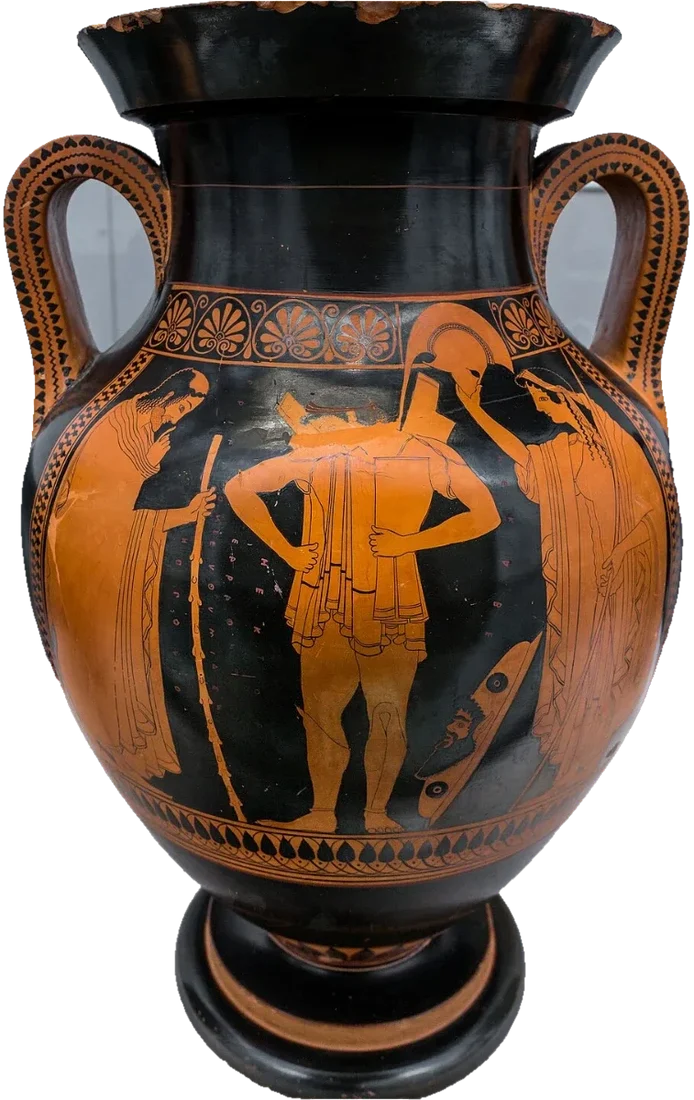
Text and translation
The uninterrupted Greek with its English translation, line by line.
Show text and translation
τὴν δ’ αὖτε προσέειπε μέγας κορυθαίολος Ἕκτωρ
Homer · Iliad 6.440–465 · dactylic hexameters · text of Monro–Allen (OCT, 3rd ed.)
How to read each line
A guide to the Greek, syllables, pitch marks and quantities.
Show the reading key
- Above each line: the line as the edition prints it, each word placed over its own syllables. The main row: the same Greek divided into metrical syllables, each written as it is pronounced. A consonant that closes a syllable is written with it (λόθ | ρο); an elided word is closed up with the next vowel (ν’ἀ); a final consonant carried into the next word is set with a thin space (ς ἰ). Wider gaps mark word-ends.
- Above the syllables: the pitch of each syllable, from the accents. Under them: the quantity of each syllable as it falls in the line, then the transliteration, syllable by syllable, with accented syllables in capitals.
- Under each line: a line-for-line translation. In the right margin of the scansion: the line type, its scheme, and its analysis into cola.
Key to the labels
The names, patterns and symbols used beside this poem.
Show the labels and symbols
The labels in the right margin of the scansion below name the line, its scheme, the feet as the line realises them, and the caesurae and diaereses (the named word-ends) that fall in it. In the scheme ⏔ is a biceps, two shorts that may be contracted to one long; ⏕ is a long that may be resolved into two shorts; × is an anceps, long or short. A click on any syllable highlights its metron or colon, or, with the switch, its foot.
| Label | Name and shape | What it is |
|---|---|---|
| hem1 | First hemiepes— ⏔ — ⏔ — | The first two and a half feet of the hexameter, up to the penthemimeral caesura; in the pentameter, its whole first half. |
| hem2 | Second half of the hexameter⏔ — ⏔ — ⏑ ⏑ — × | From the penthemimeral caesura to the line-end: the fifth foot is nearly always a dactyl, the sixth is — ×. |
The traditional feet
| Foot and shape | Where |
|---|---|
| First foot: dactyl or spondee— ⏔ | Scheme positions 1–2. The biceps (⏑ ⏑) may be contracted to a single long, making a spondee. |
| Second foot: dactyl or spondee— ⏔ | Scheme positions 3–4. |
| Third foot: dactyl or spondee— ⏔ | Scheme positions 5–6. The penthemimeral caesura falls after its first syllable, the “trochaic” caesura after its second. |
| Fourth foot: dactyl or spondee— ⏔ | Scheme positions 7–8. Word-end at the end of this foot, when it is a dactyl, is the bucolic diaeresis (West’s “bucolic caesura”: word-end at the end of the fourth foot after an uncontracted biceps)[7]. |
| Fifth foot: dactyl— ⏑ ⏑ | Scheme positions 9–10. A spondee here (a “spondaic line”) is rare. |
| Sixth foot— × | Scheme positions 11–12: a long and the indifferent final syllable. |
Scansion
Hector answers Andromache: the passage scanned foot by foot, with each syllable’s quantity and the reason for it, the feet, the caesurae, and a note on every line naming its prosodic licences.
Recording: David Chamberlain (hypotactic.com), restored pronunciation, CC BY 4.0 — about this recording
David Chamberlain reads in restored pronunciation with a light pitch accent, keeping a regular hexameter beat. Lines 6.440–465 are cut from a track of his recording of Iliad Book 6 (Internet Archive, item daybird66_gmail_136R), licensed CC BY 4.0. The highlight follows the recording line by line; within a line it moves at an even pace and is only approximate. Tap a line number to play from there.
Then great Hector of the shining helmet answered her:
“All this is on my mind too, wife; but I would feel deep shame
before the Trojans and the Trojan women with their trailing robes
if like a coward I kept away from the fighting;
nor does my own heart bid me, since I have learned to be brave
always and to fight among the foremost Trojans,
winning great glory for my father and for myself.
For I know this well in my mind and in my heart:
the day will come when holy Ilios shall perish,
and Priam, and the people of Priam of the good ash spear.
But it is not so much the Trojans’ pain to come that troubles me,
nor Hecuba’s own, nor lord Priam’s,
nor my brothers’, who, many and brave,
may fall in the dust at the hands of their enemies,
as yours, when some bronze-clad Achaean
leads you off in tears and takes away your day of freedom;
and in Argos you may weave at the loom at another woman’s bidding,
and carry water from the spring Messeis or Hypereia,
much against your will, and hard necessity will lie upon you.
And some day someone will say as he sees you weeping:
‘This is the wife of Hector, who was always the best in battle
of the horse-taming Trojans, when they fought around Ilios.’
So some day someone will say; and for you there will be fresh pain
for the want of such a man to keep away the day of slavery.
But may the heaped earth cover me in death
before I hear your cries as you are dragged away.”
Metre
- The line. Six feet. Each of the first five is a dactyl (— ⏑ ⏑) or, with its two shorts contracted, a spondee (— —); the sixth is — ×.[8] West calls the long the princeps and the two shorts or their contraction the biceps. Contraction is least common in the fifth foot, about once in 20 lines in Homer,[9] and the poets prefer a dactylic fifth foot;[10] every fifth foot in this passage is a dactyl.
- Caesurae. There is always a word-end in the third foot, after its long (masculine or penthemimeral) or between its shorts (feminine, also called the caesura after the third trochee), the feminine being the more frequent in the proportion 4 : 3; occasionally a long word spans the third foot and the caesura falls after the fourth princeps (hephthemimeral).[11] Word-end after an uncontracted fourth foot is the bucolic caesura;[7] the margin calls it the bucolic diaeresis.
- Wernicke’s Law. Where a word ends after a contracted fourth biceps, it mostly ends in a syllable with a long vowel, and hardly ever in a short vowel left open; a prepositive counts with the word that follows it.[9] All four such word-ends here keep the law: ὀλώλῃ (l. 448), Ἀχαιῶν (l. 454), ἄλλης (l. 456), ἀμύνειν (l. 463).
- Hermann’s bridge. No word ends between the two shorts of the fourth biceps, a prepositive being reckoned with the word after it and a postpositive with the word before.[12] No line here has a word-end there.
- Prosody. Elision;[13] epic correption of a final long vowel or diphthong before a vowel;[14] hiatus, often where a word once began with ϝ;[15] stop + liquid, which normally makes position inside a word in early epic, while at the beginning of a word it may or may not.[16] A final short syllable lengthened by the initial stop + liquid of the next word stands mostly in the princeps,[17] as in ll. 440, 445, 446, 447 and 451.
- Vowel quantities. Every α ι υ that the workbench makes long because the metre needs it has been checked in LSJ (Perseus edition); none is marked short there: θῡμός, Ἴλιος (ῑ), λᾱός, ἀμύνω (ῡ) and ἱρή (ἱρός, the Ionic and epic form of ἱερός, unmarked in LSJ).
- How to read the margin. A word counts as ending after the syllable that holds its last vowel, even when its final consonant passes to the next word’s vowel. A word-end after a contracted fourth foot is labelled as such, not as a bucolic caesura. The line notes say where a prepositive or postpositive means that a written word-end is no real break.
- Murray and Wyatt’s text. Compared with the Loeb edition of A. T. Murray, revised by W. F. Wyatt: lines 440–465 are the same as Monro and Allen’s apart from accents, punctuation and the diaeresis (ἐυμμελίω, Μεσσηίδος), and the line numbers are the same.[18]
Prosody, line by line
Every syllable, with the reason for its length. Quantities are read from the vowel where the spelling shows it, from the consonants that follow (“position”), from the accent where it tells, and from the metre where nothing else does. Editors’ notes on the text follow in the boxed paragraphs.
- 6.440
Line 6.440 · τὴν δʼ αὖτε προσέειπε μέγας κορυθαίολος Ἕκτωρ·
τὴν δʼ αὖτε προσέειπε μέγας κορυθαίολος Ἕκτωρ·
τὴνδ’αὖτεπροσέειπεμέγαςκορυθαίολος Ἕκτωρ·spondee, dactyl, dactyl, dactyl, dactyl, — ×; caesura after the third trochee; hephthemimeral caesura.
- 1 —τὴνὴ is long by nature; closed by ν: long by position.
- 2 —δ’αὖαὖ is a diphthong, long by nature; the apostrophe marks an elided vowel; the consonant before it joins this syllable; a single long contracts the two shorts of the biceps at position 2.
- 3 —τεε is short by nature; the next word begins with πρ: the syllable is closed before it: long by position.
- 4 ⏑προο is short by nature; one of the two shorts of the biceps at position 4.
- 5 ⏑σέέ is short by nature; one of the two shorts of the biceps at position 4.
- 6 —ειει is a diphthong, long by nature.
- 7 ⏑πεε is short by nature; one of the two shorts of the biceps at position 6.
- 8 ⏑μέέ is short by nature; one of the two shorts of the biceps at position 6.
- 9 —γαςα is a vowel of unknown length; closed by ς: long by position.
- 10 ⏑κοο is short by nature; one of the two shorts of the biceps at position 8.
- 11 ⏑ρυυ is short by the metre (position 8 must be short); one of the two shorts of the biceps at position 8.
- 12 —θαίαί is a diphthong, long by nature.
- 13 ⏑οο is short by nature; one of the two shorts of the biceps at position 10.
- 14 ⏑λοο is short by nature; one of the two shorts of the biceps at position 10.
- 15 —ς ἝκἝ is short by nature; closed by κ: long by position; the first consonant belongs to the previous word and is carried over to this vowel.
- 16 ×τωρ·ω is long by nature; closed by ρ: long by position; the position is anceps.
A spondee and four dactyls. κορυθαίολος Ἕκτωρ is one of the fixed formulas that Kiparsky singles out as shaped for the hexameter.[19] Nagy, after Parry, calls μέγας κορυθαίολος a distinctive epithet, one applied to Hector only;[20] here the whole formula μέγας κορυθαίολος Ἕκτωρ runs from the caesura to the end of the line, as formulas begin and end at the regular word-breaks of the verse.[21] δ’ is elided.[13] τε is long by position before the initial πρ- of προσέειπε, in the second princeps, where West says such lengthening mostly stands.[22] The caesura is feminine, after προσέειπε, with a hephthemimeral word-end after μέγας.[8]- 6.441
Line 6.441 · ἦ καὶ ἐμοὶ τάδε πάντα μέλει γύναι· ἀλλὰ μάλʼ αἰνῶς
ἦ καὶ ἐμοὶ τάδε πάντα μέλει γύναι· ἀλλὰ μάλʼ αἰνῶς
ἦκαὶἐμοὶτάδεπάνταμέλειγύναι·ἀλλὰμάλ’αἰνῶςdactyl, dactyl, dactyl, dactyl, dactyl, — ×; caesura after the third trochee; hephthemimeral caesura; bucolic diaeresis.
- 1 —ἦἦ is long by nature.
- 2 ⏑καὶαὶ is a diphthong, long by nature; shortened before the vowel that begins the next word (epic correption), as the metre requires; one of the two shorts of the biceps at position 2.
- 3 ⏑ἐἐ is short by nature; one of the two shorts of the biceps at position 2.
- 4 —μοὶοὶ is a diphthong, long by nature.
- 5 ⏑τάά is short by the metre (position 4 must be short); one of the two shorts of the biceps at position 4.
- 6 ⏑δεε is short by nature; one of the two shorts of the biceps at position 4.
- 7 —πάνά is a vowel of unknown length; closed by ν: long by position.
- 8 ⏑ταα is short by the metre (position 6 must be short); one of the two shorts of the biceps at position 6.
- 9 ⏑μέέ is short by nature; one of the two shorts of the biceps at position 6.
- 10 —λειει is a diphthong, long by nature.
- 11 ⏑γύύ is short by the metre (position 8 must be short); one of the two shorts of the biceps at position 8.
- 12 ⏑ναι·αι is a diphthong, long by nature; shortened before the vowel that begins the next word (epic correption), as the metre requires; one of the two shorts of the biceps at position 8.
- 13 —ἀλἀ is a vowel of unknown length; closed by λ: long by position.
- 14 ⏑λὰὰ is short by the metre (position 10 must be short); one of the two shorts of the biceps at position 10.
- 15 ⏑μάά is short by the metre (position 10 must be short); one of the two shorts of the biceps at position 10.
- 16 —λ’αἰαἰ is a diphthong, long by nature; the apostrophe marks an elided vowel; the consonant before it joins this syllable.
- 17 ×νῶςῶ is long by nature; closed by ς: long by position; the position is anceps.
- 6.442
Line 6.442 · αἰδέομαι Τρῶας καὶ Τρῳάδας ἑλκεσιπέπλους,
αἰδέομαι Τρῶας καὶ Τρῳάδας ἑλκεσιπέπλους,
αἰδέομαιΤρῶαςκαὶΤρῳάδας ἑλκεσιπέπλους,dactyl, spondee, spondee, dactyl, dactyl, — ×; penthemimeral caesura; bucolic diaeresis.
- 1 —αἰαἰ is a diphthong, long by nature.
- 2 ⏑δέέ is short by nature; one of the two shorts of the biceps at position 2.
- 3 ⏑οο is short by nature; one of the two shorts of the biceps at position 2.
- 4 —μαιαι is a diphthong, long by nature; the next word begins with Τρ: the syllable is closed before it: long by position.
- 5 —Τρῶῶ is long by nature; a single long contracts the two shorts of the biceps at position 4.
- 6 —αςα is a vowel of unknown length; closed by ς: long by position.
- 7 —καὶαὶ is a diphthong, long by nature; the next word begins with Τρ: the syllable is closed before it: long by position; a single long contracts the two shorts of the biceps at position 6.
- 8 —Τρῳῳ is long by nature.
- 9 ⏑άά is short by the metre (position 8 must be short); one of the two shorts of the biceps at position 8.
- 10 ⏑δαα is short by the metre (position 8 must be short); one of the two shorts of the biceps at position 8.
- 11 —ς ἑλἑ is short by nature; closed by λ: long by position; the first consonant belongs to the previous word and is carried over to this vowel.
- 12 ⏑κεε is short by nature; one of the two shorts of the biceps at position 10.
- 13 ⏑σιι is short by the metre (position 10 must be short); one of the two shorts of the biceps at position 10.
- 14 —πέπέ is short by nature; closed by π before a liquid: stop + liquid makes position, as it usually does in epic.
- 15 ×λους,ου is a diphthong, long by nature; closed by ς: long by position; the position is anceps.
- 6.443
Line 6.443 · αἴ κε κακὸς ὣς νόσφιν ἀλυσκάζω πολέμοιο·
αἴ κε κακὸς ὣς νόσφιν ἀλυσκάζω πολέμοιο·
αἴκεκακὸςὣςνόσφιν ἀλυσκάζωπολέμοιο·dactyl, spondee, dactyl, spondee, dactyl, — ×; caesura after the third trochee.
- 1 —αἴαἴ is a diphthong, long by nature.
- 2 ⏑κεε is short by nature; one of the two shorts of the biceps at position 2.
- 3 ⏑καα is short by the metre (position 2 must be short); one of the two shorts of the biceps at position 2.
- 4 —κὸςο is short by nature, but the syllable counts long before ὥς: the comparative particle goes back to *yōs and is often treated as if it still began with a consonant (the input marks the syllable as lengthened, not the vowel)[24].
- 5 —ὣςὣ is long by nature; closed by ς: long by position; a single long contracts the two shorts of the biceps at position 4.
- 6 —νόσό is short by nature; closed by σ: long by position.
- 7 ⏑φιι is short by the metre (position 6 must be short); one of the two shorts of the biceps at position 6.
- 8 ⏑ν ἀἀ is short by the metre (position 6 must be short); the first consonant belongs to the previous word and is carried over to this vowel; one of the two shorts of the biceps at position 6.
- 9 —λυσυ is a vowel of unknown length; closed by σ: long by position.
- 10 —κάζ is a double consonant (two sounds) and closes the syllable: long by position; a single long contracts the two shorts of the biceps at position 8.
- 11 —ζωω is long by nature.
- 12 ⏑ποο is short by nature; one of the two shorts of the biceps at position 10.
- 13 ⏑λέέ is short by nature; one of the two shorts of the biceps at position 10.
- 14 —μοιοι is a diphthong, long by nature.
- 15 ×ο·ο is short by nature; the position is anceps.
The last syllable of κακός is long in the second princeps although its ο is short, because ὥς (“like”), which goes back to *yōs, is often scanned as though a consonant still stood at its start.[24] The workbench cannot know this, so the input marks the syllable with a lengthening mark; the mark makes the syllable long, not the vowel. The ν of νόσφιν passes to ἀλυσκάζω, but the word ends between the shorts of the third foot: a feminine caesura.[8] ἀλυσκάζω then runs from the third foot into the fifth, so there is no further word-end at a caesura place.- 6.444
Line 6.444 · οὐδέ με θυμὸς ἄνωγεν, ἐπεὶ μάθον ἔμμεναι ἐσθλὸς
οὐδέ με θυμὸς ἄνωγεν, ἐπεὶ μάθον ἔμμεναι ἐσθλὸς
οὐδέμεθυμὸς ἄνωγε,ν ἐπεὶμάθον ἔμμεναιἐσθλὸςdactyl, dactyl, dactyl, dactyl, dactyl, — ×; caesura after the third trochee; hephthemimeral caesura; bucolic diaeresis.
- 1 —οὐοὐ is a diphthong, long by nature.
- 2 ⏑δέέ is short by nature; one of the two shorts of the biceps at position 2.
- 3 ⏑μεε is short by nature; one of the two shorts of the biceps at position 2.
- 4 —θυυ is long by the metre (position 3 must be long).
- 5 ⏑μὸὸ is short by nature; one of the two shorts of the biceps at position 4.
- 6 ⏑ς ἄἄ is short by the metre (position 4 must be short); the first consonant belongs to the previous word and is carried over to this vowel; one of the two shorts of the biceps at position 4.
- 7 —νωω is long by nature.
- 8 ⏑γε,ε is short by nature; one of the two shorts of the biceps at position 6.
- 9 ⏑ν ἐἐ is short by nature; the first consonant belongs to the previous word and is carried over to this vowel; one of the two shorts of the biceps at position 6.
- 10 —πεὶεὶ is a diphthong, long by nature.
- 11 ⏑μάά is short by the metre (position 8 must be short); one of the two shorts of the biceps at position 8.
- 12 ⏑θοο is short by nature; one of the two shorts of the biceps at position 8.
- 13 —ν ἔμἔ is short by nature; closed by μ: long by position; the first consonant belongs to the previous word and is carried over to this vowel.
- 14 ⏑μεε is short by nature; one of the two shorts of the biceps at position 10.
- 15 ⏑ναιαι is a diphthong, long by nature; shortened before the vowel that begins the next word (epic correption), as the metre requires; one of the two shorts of the biceps at position 10.
- 16 —ἐσἐ is short by nature; closed by σ: long by position.
- 17 ×θλὸςὸ is short by nature; closed by ς: long by position; the position is anceps.
All five feet are dactyls. The ν of ἄνωγεν passes to ἐπεί, but the word ends between the shorts of the third foot: a feminine caesura at the comma.[8] The written word-end after ἐπεί, a conjunction and so a prepositive, is no real hephthemimeral caesura; word-end after μάθον is the bucolic caesura.[12] -ναι of ἔμμεναι is shortened before ἐσθλός by epic correption.[14]- 6.445
Line 6.445 · αἰεὶ καὶ πρώτοισι μετὰ Τρώεσσι μάχεσθαι
αἰεὶ καὶ πρώτοισι μετὰ Τρώεσσι μάχεσθαι
αἰεὶκαὶπρώτοισιμετὰΤρώεσσιμάχεσθαιspondee, spondee, dactyl, spondee, dactyl, — ×; caesura after the third trochee; hephthemimeral caesura.
- 1 —αἰαἰ is a diphthong, long by nature.
- 2 —εὶεὶ is a diphthong, long by nature; a single long contracts the two shorts of the biceps at position 2.
- 3 —καὶαὶ is a diphthong, long by nature; the next word begins with πρ: the syllable is closed before it: long by position.
- 4 —πρώώ is long by nature; a single long contracts the two shorts of the biceps at position 4.
- 5 —τοιοι is a diphthong, long by nature.
- 6 ⏑σιι is short by the accent rule: acute on the antepenult requires a short final syllable; one of the two shorts of the biceps at position 6.
- 7 ⏑μεε is short by nature; one of the two shorts of the biceps at position 6.
- 8 —τὰὰ is a vowel of unknown length; the next word begins with Τρ: the syllable is closed before it: long by position.
- 9 —Τρώώ is long by nature; a single long contracts the two shorts of the biceps at position 8.
- 10 —εσε is short by nature; closed by σ: long by position.
- 11 ⏑σιι is short by the accent rule: acute on the antepenult requires a short final syllable; one of the two shorts of the biceps at position 10.
- 12 ⏑μάά is short by the metre (position 10 must be short); one of the two shorts of the biceps at position 10.
- 13 —χεσε is short by nature; closed by σ: long by position.
- 14 ×θαιαι is a diphthong, long by nature; the position is anceps.
Three of the five feet are contracted: the first, second and fourth. The caesura is feminine, after πρώτοισι.[8] The last syllable of μετά is long by position before the initial Τρ- of Τρώεσσι in the fourth princeps;[17] the word-end after it is no real hephthemimeral caesura, since a preposition goes with the word it governs.[12]- 6.446
Line 6.446 · ἀρνύμενος πατρός τε μέγα κλέος ἠδʼ ἐμὸν αὐτοῦ.
ἀρνύμενος πατρός τε μέγα κλέος ἠδʼ ἐμὸν αὐτοῦ.
ἀρνύμενοςπατρόςτεμέγακλέος ἠδ’ἐμὸν αὐτοῦ.dactyl, spondee, dactyl, dactyl, dactyl, — ×; penthemimeral caesura; caesura after the third trochee; hephthemimeral caesura; bucolic diaeresis.
- 1 —ἀρἀ is a vowel of unknown length; closed by ρ: long by position.
- 2 ⏑νύύ is short by the metre (position 2 must be short); one of the two shorts of the biceps at position 2.
- 3 ⏑μεε is short by nature; one of the two shorts of the biceps at position 2.
- 4 —νοςο is short by nature; closed by ς: long by position.
- 5 —πατα is a vowel of unknown length; closed by τ before a liquid: stop + liquid makes position, as it usually does in epic; a single long contracts the two shorts of the biceps at position 4.
- 6 —ρόςό is short by nature; closed by ς: long by position.
- 7 ⏑τεε is short by nature; one of the two shorts of the biceps at position 6.
- 8 ⏑μέέ is short by nature; one of the two shorts of the biceps at position 6.
- 9 —γαα is a vowel of unknown length; the next word begins with κλ: the syllable is closed before it: long by position.
- 10 ⏑κλέέ is short by nature; one of the two shorts of the biceps at position 8.
- 11 ⏑οο is short by nature; one of the two shorts of the biceps at position 8.
- 12 —ς ἠἠ is long by nature; the first consonant belongs to the previous word and is carried over to this vowel.
- 13 ⏑δ’ἐἐ is short by nature; the apostrophe marks an elided vowel; the consonant before it joins this syllable; one of the two shorts of the biceps at position 10.
- 14 ⏑μὸὸ is short by nature; one of the two shorts of the biceps at position 10.
- 15 —ν αὐαὐ is a diphthong, long by nature; the first consonant belongs to the previous word and is carried over to this vowel.
- 16 ×τοῦ.οῦ is a diphthong, long by nature; the position is anceps.
A dactyl, a spondee and three dactyls. The τρ of πατρός makes position inside the word.[16] The written word-end after πατρός is followed by the postpositive τε, so the real caesura is the feminine one after τε.[25] The last syllable of μέγα is long by position before the initial κλ- of κλέος in the fourth princeps,[17] and the word-end after it is hephthemimeral; word-end after κλέος is the bucolic caesura.[7] ἠδ’ is elided.[13]- 6.447
Line 6.447 · εὖ γὰρ ἐγὼ τόδε οἶδα κατὰ φρένα καὶ κατὰ θυμόν·
εὖ γὰρ ἐγὼ τόδε οἶδα κατὰ φρένα καὶ κατὰ θυμόν·
εὖγὰρ ἐγὼτόδεοἶδακατὰφρένακαὶκατὰθυμόν·dactyl, dactyl, dactyl, dactyl, dactyl, — ×; caesura after the third trochee; hephthemimeral caesura; bucolic diaeresis.
- 1 —εὖεὖ is a diphthong, long by nature.
- 2 ⏑γὰὰ is short by the metre (position 2 must be short); one of the two shorts of the biceps at position 2.
- 3 ⏑ρ ἐἐ is short by nature; the first consonant belongs to the previous word and is carried over to this vowel; one of the two shorts of the biceps at position 2.
- 4 —γὼὼ is long by nature.
- 5 ⏑τόό is short by nature; one of the two shorts of the biceps at position 4.
- 6 ⏑δεε is short by nature; the next word begins with a vowel and nothing is elided: hiatus; one of the two shorts of the biceps at position 4.
- 7 —οἶοἶ is a diphthong, long by nature.
- 8 ⏑δαα is short by the accent rule: circumflex on the penult requires a short final syllable; one of the two shorts of the biceps at position 6.
- 9 ⏑καα is short by the metre (position 6 must be short); one of the two shorts of the biceps at position 6.
- 10 —τὰὰ is a vowel of unknown length; the next word begins with φρ: the syllable is closed before it: long by position.
- 11 ⏑φρέέ is short by nature; one of the two shorts of the biceps at position 8.
- 12 ⏑ναα is short by the metre (position 8 must be short); one of the two shorts of the biceps at position 8.
- 13 —καὶαὶ is a diphthong, long by nature.
- 14 ⏑καα is short by the metre (position 10 must be short); one of the two shorts of the biceps at position 10.
- 15 ⏑τὰὰ is short by the metre (position 10 must be short); one of the two shorts of the biceps at position 10.
- 16 —θυυ is long by the metre (position 11 must be long).
- 17 ×μόν·ό is short by nature; closed by ν: long by position; the position is anceps.
All five feet are dactyls. τόδε stands unelided before οἶδα, which once began with ϝ.[26] The caesura is feminine, after οἶδα.[8] The last syllable of κατά is long by position before φρένα in the fourth princeps,[17] but as a preposition it goes with φρένα, so the word-end after it is no real hephthemimeral caesura.[12] Word-end after φρένα is the bucolic caesura.[7]- 6.448
Line 6.448 · ἔσσεται ἦμαρ ὅτʼ ἄν ποτʼ ὀλώλῃ Ἴλιος ἱρὴ
ἔσσεται ἦμαρ ὅτʼ ἄν ποτʼ ὀλώλῃ Ἴλιος ἱρὴ
ἔσσεταιἦμαρ ὅτ’ἄνποτ’ὀλώλῃἼλιος ἱρὴdactyl, dactyl, dactyl, spondee, dactyl, — ×; penthemimeral caesura; caesura after the third trochee (with elision); word-end after a spondaic fourth foot.
- 1 —ἔσἔ is short by nature; closed by σ: long by position.
- 2 ⏑σεε is short by nature; one of the two shorts of the biceps at position 2.
- 3 ⏑ταιαι is a diphthong, long by nature; shortened before the vowel that begins the next word (epic correption), as the metre requires; one of the two shorts of the biceps at position 2.
- 4 —ἦἦ is long by nature.
- 5 ⏑μαα is short by the accent rule: circumflex on the penult requires a short final syllable; one of the two shorts of the biceps at position 4.
- 6 ⏑ρ ὅὅ is short by nature; the first consonant belongs to the previous word and is carried over to this vowel; one of the two shorts of the biceps at position 4.
- 7 —τ’ἄνἄ is a vowel of unknown length; closed by ν: long by position; the apostrophe marks an elided vowel; the consonant before it joins this syllable.
- 8 ⏑ποο is short by nature; one of the two shorts of the biceps at position 6.
- 9 ⏑τ’ὀὀ is short by nature; the apostrophe marks an elided vowel; the consonant before it joins this syllable; one of the two shorts of the biceps at position 6.
- 10 —λώώ is long by nature.
- 11 —λῃῃ is long by nature; the next word begins with a vowel and nothing is elided: hiatus; a single long contracts the two shorts of the biceps at position 8.
- 12 —ἼἼ is long by the metre (position 9 must be long).
- 13 ⏑λιι is short by the metre (position 10 must be short); one of the two shorts of the biceps at position 10.
- 14 ⏑οο is short by nature; one of the two shorts of the biceps at position 10.
- 15 —ς ἱἱ is long by the metre (position 11 must be long); the first consonant belongs to the previous word and is carried over to this vowel.
- 16 ×ρὴὴ is long by nature; the position is anceps.
-ται of ἔσσεται is shortened before ἦμαρ by epic correption.[14] The written word-end after ἄν is followed by the enclitic ποτ’, so the real caesura is the feminine one after ποτ’, with elision.[27] The -ῃ of ὀλώλῃ keeps its length before Ἴλιος and fills the contracted fourth biceps: Ἴλιος is one of the words West lists as having begun with ϝ,[26] so the vowel stood before a consonant and there is no true hiatus. The word-end after ὀλώλῃ therefore follows a contracted fourth foot, and ὀλώλῃ ends in a long vowel, as Wernicke’s Law expects.[9] The Ἴ- of Ἴλιος is long by nature.[28]- 6.449
Line 6.449 · καὶ Πρίαμος καὶ λαὸς ἐϋμμελίω Πριάμοιο.
καὶ Πρίαμος καὶ λαὸς ἐϋμμελίω Πριάμοιο.
καὶΠρίαμοςκαὶλαὸς ἐϋμμελίωΠριάμοιο.dactyl, spondee, dactyl, dactyl, dactyl, — ×; caesura after the third trochee.
- 1 —καὶαὶ is a diphthong, long by nature; the next word begins with Πρ: the syllable is closed before it: long by position.
- 2 ⏑Πρίί is short by the metre (position 2 must be short); one of the two shorts of the biceps at position 2.
- 3 ⏑αα is short by the metre (position 2 must be short); one of the two shorts of the biceps at position 2.
- 4 —μοςο is short by nature; closed by ς: long by position.
- 5 —καὶαὶ is a diphthong, long by nature; a single long contracts the two shorts of the biceps at position 4.
- 6 —λαα is long by the metre (position 5 must be long).
- 7 ⏑ὸὸ is short by nature; one of the two shorts of the biceps at position 6.
- 8 ⏑ς ἐἐ is short by nature; the first consonant belongs to the previous word and is carried over to this vowel; one of the two shorts of the biceps at position 6.
- 9 —ϋμϋ is a vowel of unknown length; closed by μ: long by position.
- 10 ⏑μεε is short by nature; one of the two shorts of the biceps at position 8.
- 11 ⏑λίί is short by the metre (position 8 must be short); one of the two shorts of the biceps at position 8.
- 12 —ωω is long by nature; the next word begins with Πρ: the syllable is closed before it: long by position.
- 13 ⏑Πριι is short by the metre (position 10 must be short); one of the two shorts of the biceps at position 10.
- 14 ⏑άά is short by the metre (position 10 must be short); one of the two shorts of the biceps at position 10.
- 15 —μοιοι is a diphthong, long by nature.
- 16 ×ο.ο is short by nature; the position is anceps.
A dactyl, a spondee and three dactyls. The ς of λαός passes to ἐϋμμελίω, but the word ends between the shorts of the third foot: a feminine caesura, the only one in the line.[8] ἐϋμμελίω then runs from the third foot into the fifth.- 6.450
Line 6.450 · ἀλλʼ οὔ μοι Τρώων τόσσον μέλει ἄλγος ὀπίσσω,
ἀλλʼ οὔ μοι Τρώων τόσσον μέλει ἄλγος ὀπίσσω,
ἀλλ’οὔμοιΤρώωντόσσονμέλειἄλγος ὀπίσσω,spondee, spondee, spondee, dactyl, dactyl, — ×; penthemimeral caesura; hephthemimeral caesura; bucolic diaeresis.
- 1 —ἀλἀ is a vowel of unknown length; closed by λ: long by position.
- 2 —λ’οὔοὔ is a diphthong, long by nature; the apostrophe marks an elided vowel; the consonant before it joins this syllable; a single long contracts the two shorts of the biceps at position 2.
- 3 —μοιοι is a diphthong, long by nature; the next word begins with Τρ: the syllable is closed before it: long by position.
- 4 —Τρώώ is long by nature; a single long contracts the two shorts of the biceps at position 4.
- 5 —ωνω is long by nature; closed by ν: long by position.
- 6 —τόσό is short by nature; closed by σ: long by position; a single long contracts the two shorts of the biceps at position 6.
- 7 —σονο is short by nature; closed by ν: long by position.
- 8 ⏑μέέ is short by nature; one of the two shorts of the biceps at position 8.
- 9 ⏑λειει is a diphthong, long by nature; shortened before the vowel that begins the next word (epic correption), as the metre requires; one of the two shorts of the biceps at position 8.
- 10 —ἄλἄ is a vowel of unknown length; closed by λ: long by position.
- 11 ⏑γοο is short by nature; one of the two shorts of the biceps at position 10.
- 12 ⏑ς ὀὀ is short by nature; the first consonant belongs to the previous word and is carried over to this vowel; one of the two shorts of the biceps at position 10.
- 13 —πίσί is a vowel of unknown length; closed by σ: long by position.
- 14 ×σω,ω is long by nature; the position is anceps.
- 6.451
Line 6.451 · οὔτʼ αὐτῆς Ἑκάβης οὔτε Πριάμοιο ἄνακτος
οὔτʼ αὐτῆς Ἑκάβης οὔτε Πριάμοιο ἄνακτος
οὔτ’αὐτῆςἙκάβηςοὔτεΠριάμοιοἄνακτοςspondee, dactyl, spondee, dactyl, dactyl, — ×; penthemimeral caesura; hephthemimeral caesura.
- 1 —οὔοὔ is a diphthong, long by nature.
- 2 —τ’αὐαὐ is a diphthong, long by nature; the apostrophe marks an elided vowel; the consonant before it joins this syllable; a single long contracts the two shorts of the biceps at position 2.
- 3 —τῆςῆ is long by nature.
- 4 ⏑ἙἙ is short by nature; one of the two shorts of the biceps at position 4.
- 5 ⏑κάά is short by the metre (position 4 must be short); one of the two shorts of the biceps at position 4.
- 6 —βηςη is long by nature.
- 7 —οὔοὔ is a diphthong, long by nature; a single long contracts the two shorts of the biceps at position 6.
- 8 —τεε is short by nature; the next word begins with Πρ: the syllable is closed before it: long by position.
- 9 ⏑Πριι is short by the metre (position 8 must be short); one of the two shorts of the biceps at position 8.
- 10 ⏑άά is short by the metre (position 8 must be short); one of the two shorts of the biceps at position 8.
- 11 —μοιοι is a diphthong, long by nature.
- 12 ⏑οο is short by nature; the next word begins with a vowel and nothing is elided: hiatus; one of the two shorts of the biceps at position 10.
- 13 ⏑ἄἄ is short by the metre (position 10 must be short); one of the two shorts of the biceps at position 10.
- 14 —νακα is a vowel of unknown length; closed by κ: long by position.
- 15 ×τοςο is short by nature; closed by ς: long by position; the position is anceps.
A spondee, a dactyl, a spondee and two dactyls. οὔτ’ is elided.[13] The caesura is penthemimeral, after Ἑκάβης.[8] The last syllable of οὔτε is long by position before the initial Πρ- of Πριάμοιο in the fourth princeps;[17] οὔτε being a conjunction, the word-end after it is no real hephthemimeral caesura.[29] The -ο of Πριάμοιο stands unelided before ἄνακτος, which once began with ϝ.[26]- 6.452
Line 6.452 · οὔτε κασιγνήτων, οἵ κεν πολέες τε καὶ ἐσθλοὶ
οὔτε κασιγνήτων, οἵ κεν πολέες τε καὶ ἐσθλοὶ
οὔτεκασιγνήτων,οἵκενπολέεςτεκαὶἐσθλοὶdactyl, spondee, spondee, dactyl, dactyl, — ×; penthemimeral caesura; hephthemimeral caesura.
- 1 —οὔοὔ is a diphthong, long by nature.
- 2 ⏑τεε is short by nature; one of the two shorts of the biceps at position 2.
- 3 ⏑καα is short by the metre (position 2 must be short); one of the two shorts of the biceps at position 2.
- 4 —σιγι is a vowel of unknown length; closed by γ: long by position; γν is one of the four clusters (γμ, γν, δμ, δν) that never leave the syllable before them short.[30]
- 5 —νήή is long by nature; a single long contracts the two shorts of the biceps at position 4.
- 6 —των,ω is long by nature.
- 7 —οἵοἵ is a diphthong, long by nature; a single long contracts the two shorts of the biceps at position 6.
- 8 —κενε is short by nature; closed by ν: long by position.
- 9 ⏑ποο is short by nature; one of the two shorts of the biceps at position 8.
- 10 ⏑λέέ is short by nature; one of the two shorts of the biceps at position 8.
- 11 —εςε is short by nature; closed by ς: long by position.
- 12 ⏑τεε is short by nature; one of the two shorts of the biceps at position 10.
- 13 ⏑καὶαὶ is a diphthong, long by nature; shortened before the vowel that begins the next word (epic correption), as the metre requires; one of the two shorts of the biceps at position 10.
- 14 —ἐσἐ is short by nature; closed by σ: long by position.
- 15 ×θλοὶοὶ is a diphthong, long by nature; the position is anceps.
A dactyl, two spondees and two dactyls. The γν of κασιγνήτων makes position, as γν always does.[30] κασιγνήτων thus has three long syllables and stands so that only one contraction is needed, — ⏔ —.[9] The caesura is penthemimeral, at the comma after κασιγνήτων, with a hephthemimeral word-end after οἵ κεν, the particle going with the relative.[31] καί is shortened before ἐσθλοί by epic correption.[14]- 6.453
Line 6.453 · ἐν κονίῃσι πέσοιεν ὑπʼ ἀνδράσι δυσμενέεσσιν,
ἐν κονίῃσι πέσοιεν ὑπʼ ἀνδράσι δυσμενέεσσιν,
ἐνκονίῃσιπέσοιεν ὑπ’ἀνδράσιδυσμενέεσσιν,dactyl, dactyl, dactyl, dactyl, dactyl, — ×; caesura after the third trochee; bucolic diaeresis.
- 1 —ἐνἐ is short by nature; closed by ν: long by position.
- 2 ⏑κοο is short by nature; one of the two shorts of the biceps at position 2.
- 3 ⏑νίί is short by the metre (position 2 must be short); one of the two shorts of the biceps at position 2.
- 4 —ῃῃ is long by nature.
- 5 ⏑σιι is short by the accent rule: acute on the antepenult requires a short final syllable; one of the two shorts of the biceps at position 4.
- 6 ⏑πέέ is short by nature; one of the two shorts of the biceps at position 4.
- 7 —σοιοι is a diphthong, long by nature.
- 8 ⏑εε is short by nature; one of the two shorts of the biceps at position 6.
- 9 ⏑ν ὑὑ is short by the metre (position 6 must be short); the first consonant belongs to the previous word and is carried over to this vowel; one of the two shorts of the biceps at position 6.
- 10 —π’ἀνἀ is a vowel of unknown length; closed by ν: long by position; the apostrophe marks an elided vowel; the consonant before it joins this syllable.
- 11 ⏑δράά is short by the metre (position 8 must be short); one of the two shorts of the biceps at position 8.
- 12 ⏑σιι is short by the metre (position 8 must be short); one of the two shorts of the biceps at position 8.
- 13 —δυσυ is a vowel of unknown length; closed by σ: long by position.
- 14 ⏑μεε is short by nature; one of the two shorts of the biceps at position 10.
- 15 ⏑νέέ is short by nature; one of the two shorts of the biceps at position 10.
- 16 —εσε is short by nature; closed by σ: long by position.
- 17 ×σιν,ι is a vowel of unknown length; closed by ν: long by position; the position is anceps.
- 6.454
Line 6.454 · ὅσσον σεῦ, ὅτε κέν τις Ἀχαιῶν χαλκοχιτώνων
ὅσσον σεῦ, ὅτε κέν τις Ἀχαιῶν χαλκοχιτώνων
ὅσσονσεῦ,ὅτεκέντις Ἀχαιῶνχαλκοχιτώνωνspondee, dactyl, dactyl, spondee, dactyl, — ×; penthemimeral caesura; caesura after the third trochee; word-end after a spondaic fourth foot.
- 1 —ὅσὅ is short by nature; closed by σ: long by position.
- 2 —σονο is short by nature; closed by ν: long by position; a single long contracts the two shorts of the biceps at position 2.
- 3 —σεῦ,εῦ is a diphthong, long by nature; the next word begins with a vowel and nothing is elided: hiatus.
- 4 ⏑ὅὅ is short by nature; one of the two shorts of the biceps at position 4.
- 5 ⏑τεε is short by nature; one of the two shorts of the biceps at position 4.
- 6 —κένέ is short by nature; closed by ν: long by position.
- 7 ⏑τιι is short by the metre (position 6 must be short); one of the two shorts of the biceps at position 6.
- 8 ⏑ς ἈἈ is short by the metre (position 6 must be short); the first consonant belongs to the previous word and is carried over to this vowel; one of the two shorts of the biceps at position 6.
- 9 —χαιαι is a diphthong, long by nature.
- 10 —ῶνῶ is long by nature; closed by ν: long by position; a single long contracts the two shorts of the biceps at position 8.
- 11 —χαλα is a vowel of unknown length; closed by λ: long by position.
- 12 ⏑κοο is short by nature; one of the two shorts of the biceps at position 10.
- 13 ⏑χιι is short by the metre (position 10 must be short); one of the two shorts of the biceps at position 10.
- 14 —τώώ is long by nature.
- 15 ×νωνω is long by nature; closed by ν: long by position; the position is anceps.
A spondee, two dactyls, a spondee and a dactyl. σεῦ keeps its long diphthong before ὅτε in the second princeps, where long vowels in hiatus mostly stand.[7] The written word-end after κέν is followed by the enclitic τις, so the real caesura is the feminine one after τις, whose ς passes to Ἀχαιῶν.[31] The word-end after Ἀχαιῶν follows a contracted fourth foot, and Ἀχαιῶν ends in a long vowel, as Wernicke’s Law expects.[9]- 6.455
Line 6.455 · δακρυόεσσαν ἄγηται ἐλεύθερον ἦμαρ ἀπούρας·
δακρυόεσσαν ἄγηται ἐλεύθερον ἦμαρ ἀπούρας·
δακρυόεσσαν ἄγηταιἐλεύθερον ἦμαρ ἀπούρας·dactyl, dactyl, dactyl, dactyl, dactyl, — ×; caesura after the third trochee; bucolic diaeresis.
- 1 —δακα is a vowel of unknown length; closed by κ before a liquid: stop + liquid makes position, as it usually does in epic.
- 2 ⏑ρυυ is short by the metre (position 2 must be short); one of the two shorts of the biceps at position 2.
- 3 ⏑όό is short by nature; one of the two shorts of the biceps at position 2.
- 4 —εσε is short by nature; closed by σ: long by position.
- 5 ⏑σαα is short by the accent rule: acute on the antepenult requires a short final syllable; one of the two shorts of the biceps at position 4.
- 6 ⏑ν ἄἄ is short by the metre (position 4 must be short); the first consonant belongs to the previous word and is carried over to this vowel; one of the two shorts of the biceps at position 4.
- 7 —γηη is long by nature.
- 8 ⏑ταιαι is a diphthong, long by nature; shortened before the vowel that begins the next word (epic correption), as the metre requires; one of the two shorts of the biceps at position 6.
- 9 ⏑ἐἐ is short by nature; one of the two shorts of the biceps at position 6.
- 10 —λεύεύ is a diphthong, long by nature.
- 11 ⏑θεε is short by nature; one of the two shorts of the biceps at position 8.
- 12 ⏑ροο is short by nature; one of the two shorts of the biceps at position 8.
- 13 —ν ἦἦ is long by nature; the first consonant belongs to the previous word and is carried over to this vowel.
- 14 ⏑μαα is short by the accent rule: circumflex on the penult requires a short final syllable; one of the two shorts of the biceps at position 10.
- 15 ⏑ρ ἀἀ is short by the metre (position 10 must be short); the first consonant belongs to the previous word and is carried over to this vowel; one of the two shorts of the biceps at position 10.
- 16 —πούού is a diphthong, long by nature.
- 17 ×ρας·α is a vowel of unknown length; closed by ς: long by position; the position is anceps.
- 6.456
Line 6.456 · καί κεν ἐν Ἄργει ἐοῦσα πρὸς ἄλλης ἱστὸν ὑφαίνοις,
καί κεν ἐν Ἄργει ἐοῦσα πρὸς ἄλλης ἱστὸν ὑφαίνοις,
καίκεν ἐν Ἄργειἐοῦσαπρὸς ἄλληςἱστὸν ὑφαίνοις,dactyl, dactyl, dactyl, spondee, dactyl, — ×; caesura after the third trochee; word-end after a spondaic fourth foot.
- 1 —καίαί is a diphthong, long by nature.
- 2 ⏑κεε is short by nature; one of the two shorts of the biceps at position 2.
- 3 ⏑ν ἐἐ is short by nature; the first consonant belongs to the previous word and is carried over to this vowel; one of the two shorts of the biceps at position 2.
- 4 —ν ἌρἌ is a vowel of unknown length; closed by ρ: long by position; the first consonant belongs to the previous word and is carried over to this vowel.
- 5 ⏑γειει is a diphthong, long by nature; shortened before the vowel that begins the next word (epic correption), as the metre requires; one of the two shorts of the biceps at position 4.
- 6 ⏑ἐἐ is short by nature; one of the two shorts of the biceps at position 4.
- 7 —οῦοῦ is a diphthong, long by nature.
- 8 ⏑σαα is short by the accent rule (the accent falls too far back for a long final syllable); the next word begins with πρ, a stop + liquid that does not make position here, so the syllable stays short; one of the two shorts of the biceps at position 6.
- 9 ⏑πρὸὸ is short by nature; one of the two shorts of the biceps at position 6.
- 10 —ς ἄλἄ is a vowel of unknown length; closed by λ: long by position; the first consonant belongs to the previous word and is carried over to this vowel.
- 11 —ληςη is long by nature; a single long contracts the two shorts of the biceps at position 8.
- 12 —ἱσἱ is a vowel of unknown length; closed by σ: long by position.
- 13 ⏑τὸὸ is short by nature; one of the two shorts of the biceps at position 10.
- 14 ⏑ν ὑὑ is short by the metre (position 10 must be short); the first consonant belongs to the previous word and is carried over to this vowel; one of the two shorts of the biceps at position 10.
- 15 —φαίαί is a diphthong, long by nature.
- 16 ×νοις,οι is a diphthong, long by nature; closed by ς: long by position; the position is anceps.
Three dactyls, a spondee and a dactyl. -γει of Ἄργει is shortened before ἐοῦσα by epic correption.[14] The last syllable of ἐοῦσα stays short before the initial πρ- of πρός: at the beginning of a word a stop + liquid need not make position.[30] The caesura is feminine, after ἐοῦσα;[8] the word-end after ἄλλης follows a contracted fourth foot, and ἄλλης has the long final vowel that Wernicke’s Law expects.[9]- 6.457
Line 6.457 · καί κεν ὕδωρ φορέοις Μεσσηΐδος ἢ Ὑπερείης
καί κεν ὕδωρ φορέοις Μεσσηΐδος ἢ Ὑπερείης
καίκεν ὕδωρφορέοιςΜεσσηΐδος ἢὙπερείηςdactyl, dactyl, spondee, dactyl, dactyl, — ×; penthemimeral caesura; bucolic diaeresis.
- 1 —καίαί is a diphthong, long by nature.
- 2 ⏑κεε is short by nature; one of the two shorts of the biceps at position 2.
- 3 ⏑ν ὕὕ is short by the metre (position 2 must be short); the first consonant belongs to the previous word and is carried over to this vowel; one of the two shorts of the biceps at position 2.
- 4 —δωρω is long by nature; closed by ρ: long by position.
- 5 ⏑φοο is short by nature; one of the two shorts of the biceps at position 4.
- 6 ⏑ρέέ is short by nature; one of the two shorts of the biceps at position 4.
- 7 —οιςοι is a diphthong, long by nature; closed by ς: long by position.
- 8 —Μεσε is short by nature; closed by σ: long by position; a single long contracts the two shorts of the biceps at position 6.
- 9 —σηη is long by nature.
- 10 ⏑ΐΐ is short by the metre (position 8 must be short); one of the two shorts of the biceps at position 8.
- 11 ⏑δοο is short by nature; one of the two shorts of the biceps at position 8.
- 12 —ς ἢἢ is long by nature; the first consonant belongs to the previous word and is carried over to this vowel; the next word begins with a vowel and nothing is elided: hiatus.
- 13 ⏑ὙὙ is short by the metre (position 10 must be short); one of the two shorts of the biceps at position 10.
- 14 ⏑πεε is short by nature; one of the two shorts of the biceps at position 10.
- 15 —ρείεί is a diphthong, long by nature.
- 16 ×ηςη is long by nature; closed by ς: long by position; the position is anceps.
Two dactyls, a spondee and two dactyls. The υ of ὕδωρ is short here; West notes that a long ῡ in ὕδωρ arose only by analogy with the metrically lengthened ὕδατι.[32] The caesura is penthemimeral, after φορέοις,[8] and word-end after Μεσσηΐδος is the bucolic caesura.[7] ἤ keeps its long vowel before Ὑπερείης in the fifth princeps: West notes that hiatus after ἤ occurs in epic and may really be an elided ἠέ.[30]- 6.458
Line 6.458 · πόλλʼ ἀεκαζομένη, κρατερὴ δʼ ἐπικείσετʼ ἀνάγκη·
πόλλʼ ἀεκαζομένη, κρατερὴ δʼ ἐπικείσετʼ ἀνάγκη·
πόλλ’ἀεκαζομένη,κρατερὴδ’ἐπικείσετ’ἀνάγκη·dactyl, dactyl, dactyl, dactyl, dactyl, — ×; penthemimeral caesura; hephthemimeral caesura.
- 1 —πόλό is short by nature; closed by λ: long by position.
- 2 ⏑λ’ἀἀ is short by the metre (position 2 must be short); the apostrophe marks an elided vowel; the consonant before it joins this syllable; one of the two shorts of the biceps at position 2.
- 3 ⏑εε is short by nature; one of the two shorts of the biceps at position 2.
- 4 —καζ is a double consonant (two sounds) and closes the syllable: long by position.
- 5 ⏑ζοο is short by nature; one of the two shorts of the biceps at position 4.
- 6 ⏑μέέ is short by nature; one of the two shorts of the biceps at position 4.
- 7 —νη,η is long by nature; the next word begins with κρ: the syllable is closed before it: long by position.
- 8 ⏑κραα is short by the metre (position 6 must be short); one of the two shorts of the biceps at position 6.
- 9 ⏑τεε is short by nature; one of the two shorts of the biceps at position 6.
- 10 —ρὴὴ is long by nature.
- 11 ⏑δ’ἐἐ is short by nature; the apostrophe marks an elided vowel; the consonant before it joins this syllable; one of the two shorts of the biceps at position 8.
- 12 ⏑πιι is short by the metre (position 8 must be short); one of the two shorts of the biceps at position 8.
- 13 —κείεί is a diphthong, long by nature.
- 14 ⏑σεε is short by nature; one of the two shorts of the biceps at position 10.
- 15 ⏑τ’ἀἀ is short by the metre (position 10 must be short); the apostrophe marks an elided vowel; the consonant before it joins this syllable; one of the two shorts of the biceps at position 10.
- 16 —νάγά is a vowel of unknown length; closed by γ: long by position.
- 17 ×κη·η is long by nature; the position is anceps.
- 6.459
Line 6.459 · καί ποτέ τις εἴπῃσιν ἰδὼν κατὰ δάκρυ χέουσαν·
καί ποτέ τις εἴπῃσιν ἰδὼν κατὰ δάκρυ χέουσαν·
καίποτέτιςεἴπῃσιν ἰδὼνκατὰδάκρυχέουσαν·dactyl, spondee, dactyl, dactyl, dactyl, — ×; caesura after the third trochee; hephthemimeral caesura; bucolic diaeresis.
- 1 —καίαί is a diphthong, long by nature.
- 2 ⏑ποο is short by nature; one of the two shorts of the biceps at position 2.
- 3 ⏑τέέ is short by nature; one of the two shorts of the biceps at position 2.
- 4 —τιςι is short by nature, but the syllable is long by position: εἰπεῖν once began with ϝ, and ς + ϝ made position although the ϝ was no longer pronounced (the input marks the syllable as lengthened, not the vowel)[26].
- 5 —εἴεἴ is a diphthong, long by nature; a single long contracts the two shorts of the biceps at position 4.
- 6 —πῃῃ is long by nature.
- 7 ⏑σιι is short by the accent rule: acute on the antepenult requires a short final syllable; one of the two shorts of the biceps at position 6.
- 8 ⏑ν ἰἰ is short by the metre (position 6 must be short); the first consonant belongs to the previous word and is carried over to this vowel; one of the two shorts of the biceps at position 6.
- 9 —δὼνὼ is long by nature; closed by ν: long by position.
- 10 ⏑καα is short by the metre (position 8 must be short); one of the two shorts of the biceps at position 8.
- 11 ⏑τὰὰ is short by the metre (position 8 must be short); one of the two shorts of the biceps at position 8.
- 12 —δάκά is a vowel of unknown length; closed by κ before a liquid: stop + liquid makes position, as it usually does in epic.
- 13 ⏑ρυυ is short by the metre (position 10 must be short); one of the two shorts of the biceps at position 10.
- 14 ⏑χέέ is short by nature; one of the two shorts of the biceps at position 10.
- 15 —ουου is a diphthong, long by nature.
- 16 ×σαν·α is a vowel of unknown length; closed by ν: long by position; the position is anceps.
The last syllable of τις is long in the second princeps although its ι is short: εἴπῃσιν belongs with εἰπεῖν, which once began with ϝ, and ς + ϝ made position.[26] The input marks the syllable, not the vowel, as long. The ν of εἴπῃσιν passes to ἰδών, but the word ends between the shorts of the third foot: a feminine caesura, followed by a hephthemimeral word-end after ἰδών.[8] The word-end after κατά falls before the noun it governs.[12] The κρ of δάκρυ makes position in the fifth princeps.[16]- 6.460
Line 6.460 · Ἕκτορος ἥδε γυνὴ ὃς ἀριστεύεσκε μάχεσθαι
Ἕκτορος ἥδε γυνὴ ὃς ἀριστεύεσκε μάχεσθαι
Ἕκτορος ἥδεγυνὴὃς ἀριστεύεσκεμάχεσθαιdactyl, dactyl, dactyl, spondee, dactyl, — ×; penthemimeral caesura; caesura after the third trochee.
- 1 —ἝκἝ is short by nature; closed by κ: long by position.
- 2 ⏑τοο is short by nature; one of the two shorts of the biceps at position 2.
- 3 ⏑ροο is short by nature; one of the two shorts of the biceps at position 2.
- 4 —ς ἥἥ is long by nature; the first consonant belongs to the previous word and is carried over to this vowel.
- 5 ⏑δεε is short by nature; one of the two shorts of the biceps at position 4.
- 6 ⏑γυυ is short by the metre (position 4 must be short); one of the two shorts of the biceps at position 4.
- 7 —νὴὴ is long by nature; the next word begins with a vowel and nothing is elided: hiatus.
- 8 ⏑ὃὃ is short by nature; one of the two shorts of the biceps at position 6.
- 9 ⏑ς ἀἀ is short by the metre (position 6 must be short); the first consonant belongs to the previous word and is carried over to this vowel; one of the two shorts of the biceps at position 6.
- 10 —ρισι is a vowel of unknown length; closed by σ: long by position.
- 11 —τεύεύ is a diphthong, long by nature; a single long contracts the two shorts of the biceps at position 8.
- 12 —εσε is short by nature; closed by σ: long by position.
- 13 ⏑κεε is short by nature; one of the two shorts of the biceps at position 10.
- 14 ⏑μάά is short by the metre (position 10 must be short); one of the two shorts of the biceps at position 10.
- 15 —χεσε is short by nature; closed by σ: long by position.
- 16 ×θαιαι is a diphthong, long by nature; the position is anceps.
- 6.461
Line 6.461 · Τρώων ἱπποδάμων ὅτε Ἴλιον ἀμφεμάχοντο.
Τρώων ἱπποδάμων ὅτε Ἴλιον ἀμφεμάχοντο.
ΤρώωνἱπποδάμωνὅτεἼλιον ἀμφεμάχοντο.spondee, dactyl, dactyl, dactyl, dactyl, — ×; penthemimeral caesura; bucolic diaeresis.
- 1 —Τρώώ is long by nature.
- 2 —ωνω is long by nature; a single long contracts the two shorts of the biceps at position 2.
- 3 —ἱπἱ is a vowel of unknown length; closed by π: long by position.
- 4 ⏑ποο is short by nature; one of the two shorts of the biceps at position 4.
- 5 ⏑δάά is short by the metre (position 4 must be short); one of the two shorts of the biceps at position 4.
- 6 —μωνω is long by nature.
- 7 ⏑ὅὅ is short by nature; one of the two shorts of the biceps at position 6.
- 8 ⏑τεε is short by nature; the next word begins with a vowel and nothing is elided: hiatus; one of the two shorts of the biceps at position 6.
- 9 —ἼἼ is long by the metre (position 7 must be long).
- 10 ⏑λιι is short by the metre (position 8 must be short); one of the two shorts of the biceps at position 8.
- 11 ⏑οο is short by nature; one of the two shorts of the biceps at position 8.
- 12 —ν ἀμἀ is a vowel of unknown length; closed by μ: long by position; the first consonant belongs to the previous word and is carried over to this vowel.
- 13 ⏑φεε is short by nature; one of the two shorts of the biceps at position 10.
- 14 ⏑μάά is short by the metre (position 10 must be short); one of the two shorts of the biceps at position 10.
- 15 —χονο is short by nature; closed by ν: long by position.
- 16 ×το.ο is short by nature; the position is anceps.
- 6.462
Line 6.462 · ὥς ποτέ τις ἐρέει· σοὶ δʼ αὖ νέον ἔσσεται ἄλγος
ὥς ποτέ τις ἐρέει· σοὶ δʼ αὖ νέον ἔσσεται ἄλγος
ὥςποτέτιςἐρέει·σοὶδ’αὖνέον ἔσσεταιἄλγοςdactyl, dactyl, spondee, dactyl, dactyl, — ×; penthemimeral caesura; hephthemimeral caesura; bucolic diaeresis.
- 1 —ὥςὥ is long by nature; closed by ς: long by position.
- 2 ⏑ποο is short by nature; one of the two shorts of the biceps at position 2.
- 3 ⏑τέέ is short by nature; one of the two shorts of the biceps at position 2.
- 4 —τιςι is short by nature, but the syllable is long by position: ἐρέω once began with ϝ, and ς + ϝ made position although the ϝ was no longer pronounced (the input marks the syllable as lengthened, not the vowel)[26].
- 5 ⏑ἐἐ is short by nature; one of the two shorts of the biceps at position 4.
- 6 ⏑ρέέ is short by nature; one of the two shorts of the biceps at position 4.
- 7 —ει·ει is a diphthong, long by nature.
- 8 —σοὶοὶ is a diphthong, long by nature; a single long contracts the two shorts of the biceps at position 6.
- 9 —δ’αὖαὖ is a diphthong, long by nature; the apostrophe marks an elided vowel; the consonant before it joins this syllable.
- 10 ⏑νέέ is short by nature; one of the two shorts of the biceps at position 8.
- 11 ⏑οο is short by nature; one of the two shorts of the biceps at position 8.
- 12 —ν ἔσἔ is short by nature; closed by σ: long by position; the first consonant belongs to the previous word and is carried over to this vowel.
- 13 ⏑σεε is short by nature; one of the two shorts of the biceps at position 10.
- 14 ⏑ταιαι is a diphthong, long by nature; shortened before the vowel that begins the next word (epic correption), as the metre requires; one of the two shorts of the biceps at position 10.
- 15 —ἄλἄ is a vowel of unknown length; closed by λ: long by position.
- 16 ×γοςο is short by nature; closed by ς: long by position; the position is anceps.
As in l. 459, the last syllable of τις is long in the second princeps because the next word once began with ϝ: West lists ἐρέω among such words,[26] and the input marks the syllable as lengthened. The caesura is penthemimeral, at the strong stop after ἐρέει, with a hephthemimeral word-end after σοὶ δ’ αὖ;[8] δ’ is elided.[13] Word-end after νέον is the bucolic caesura,[7] and -ται of ἔσσεται is shortened before ἄλγος by epic correption.[14]- 6.463
Line 6.463 · χήτεϊ τοιοῦδʼ ἀνδρὸς ἀμύνειν δούλιον ἦμαρ.
χήτεϊ τοιοῦδʼ ἀνδρὸς ἀμύνειν δούλιον ἦμαρ.
χήτεϊτοιοῦδ’ἀνδρὸς ἀμύνεινδούλιον ἦμαρ.dactyl, spondee, dactyl, spondee, dactyl, — ×; caesura after the third trochee; word-end after a spondaic fourth foot.
- 1 —χήή is long by nature.
- 2 ⏑τεε is short by nature; one of the two shorts of the biceps at position 2.
- 3 ⏑ϊϊ is short by the accent rule: acute on the antepenult requires a short final syllable; one of the two shorts of the biceps at position 2.
- 4 —τοιοι is a diphthong, long by nature.
- 5 —οῦοῦ is a diphthong, long by nature; a single long contracts the two shorts of the biceps at position 4.
- 6 —δ’ἀνἀ is a vowel of unknown length; closed by ν: long by position; the apostrophe marks an elided vowel; the consonant before it joins this syllable.
- 7 ⏑δρὸὸ is short by nature; one of the two shorts of the biceps at position 6.
- 8 ⏑ς ἀἀ is short by the metre (position 6 must be short); the first consonant belongs to the previous word and is carried over to this vowel; one of the two shorts of the biceps at position 6.
- 9 —μύύ is long by the metre (position 7 must be long).
- 10 —νεινει is a diphthong, long by nature; closed by ν: long by position; a single long contracts the two shorts of the biceps at position 8.
- 11 —δούού is a diphthong, long by nature.
- 12 ⏑λιι is short by the metre (position 10 must be short); one of the two shorts of the biceps at position 10.
- 13 ⏑οο is short by nature; one of the two shorts of the biceps at position 10.
- 14 —ν ἦἦ is long by nature; the first consonant belongs to the previous word and is carried over to this vowel.
- 15 ×μαρ.α is a vowel of unknown length; closed by ρ: long by position; the position is anceps.
A dactyl, a spondee, a dactyl, a spondee and a dactyl. In τοιοῦδ’ the diphthong οι keeps its length before the vowel that follows it inside the word and fills the second princeps; West notes that Homer shortens such diphthongs only sometimes, and with only a few words.[14] τοιοῦδ’ is elided.[13] The ς of ἀνδρός passes to ἀμύνειν, but the word ends between the shorts of the third foot: a feminine caesura.[8] The υ of ἀμύνειν is long by nature[33] and fills the fourth princeps. The word-end after ἀμύνειν follows a contracted fourth foot, and its last syllable has a long diphthong, as Wernicke’s Law expects.[9]- 6.464
Line 6.464 · ἀλλά με τεθνηῶτα χυτὴ κατὰ γαῖα καλύπτοι
ἀλλά με τεθνηῶτα χυτὴ κατὰ γαῖα καλύπτοι
ἀλλάμετεθνηῶταχυτὴκατὰγαῖακαλύπτοιdactyl, spondee, dactyl, dactyl, dactyl, — ×; caesura after the third trochee; hephthemimeral caesura; bucolic diaeresis.
- 1 —ἀλἀ is a vowel of unknown length; closed by λ: long by position.
- 2 ⏑λάά is short by the metre (position 2 must be short); one of the two shorts of the biceps at position 2.
- 3 ⏑μεε is short by nature; one of the two shorts of the biceps at position 2.
- 4 —τεθε is short by nature; closed by θ before a nasal: stop + nasal makes position, as it usually does in epic.
- 5 —νηη is long by nature; a single long contracts the two shorts of the biceps at position 4.
- 6 —ῶῶ is long by nature.
- 7 ⏑ταα is short by the accent rule: circumflex on the penult requires a short final syllable; one of the two shorts of the biceps at position 6.
- 8 ⏑χυυ is short by the metre (position 6 must be short); one of the two shorts of the biceps at position 6.
- 9 —τὴὴ is long by nature.
- 10 ⏑καα is short by the metre (position 8 must be short); one of the two shorts of the biceps at position 8.
- 11 ⏑τὰὰ is short by the metre (position 8 must be short); one of the two shorts of the biceps at position 8.
- 12 —γαῖαῖ is a diphthong, long by nature.
- 13 ⏑αα is short by the accent rule: circumflex on the penult requires a short final syllable; one of the two shorts of the biceps at position 10.
- 14 ⏑καα is short by the metre (position 10 must be short); one of the two shorts of the biceps at position 10.
- 15 —λύπύ is a vowel of unknown length; closed by π: long by position.
- 16 ×τοιοι is a diphthong, long by nature; the position is anceps.
- 6.465
Line 6.465 · πρίν γέ τι σῆς τε βοῆς σοῦ θʼ ἑλκηθμοῖο πυθέσθαι.
πρίν γέ τι σῆς τε βοῆς σοῦ θʼ ἑλκηθμοῖο πυθέσθαι.
πρίνγέτισῆςτεβοῆςσοῦθ’ἑλκηθμοῖοπυθέσθαι.dactyl, dactyl, spondee, spondee, dactyl, — ×; penthemimeral caesura.
- 1 —πρίνί is a vowel of unknown length; closed by ν: long by position.
- 2 ⏑γέέ is short by nature; one of the two shorts of the biceps at position 2.
- 3 ⏑τιι is short by the metre (position 2 must be short); one of the two shorts of the biceps at position 2.
- 4 —σῆςῆ is long by nature; closed by ς: long by position.
- 5 ⏑τεε is short by nature; one of the two shorts of the biceps at position 4.
- 6 ⏑βοο is short by nature; one of the two shorts of the biceps at position 4.
- 7 —ῆςῆ is long by nature; closed by ς: long by position.
- 8 —σοῦοῦ is a diphthong, long by nature; a single long contracts the two shorts of the biceps at position 6.
- 9 —θ’ἑλἑ is short by nature; closed by λ: long by position; the apostrophe marks an elided vowel; the consonant before it joins this syllable.
- 10 —κηη is long by nature; a single long contracts the two shorts of the biceps at position 8.
- 11 —θμοῖοῖ is a diphthong, long by nature.
- 12 ⏑οο is short by nature; one of the two shorts of the biceps at position 10.
- 13 ⏑πυυ is short by the metre (position 10 must be short); one of the two shorts of the biceps at position 10.
- 14 —θέσέ is short by nature; closed by σ: long by position.
- 15 ×θαι.αι is a diphthong, long by nature; the position is anceps.
Two dactyls, two spondees and a dactyl. The caesura is penthemimeral, after βοῆς.[8] θ’ is τε elided before the rough breathing of ἑλκηθμοῖο.[13] σοῦ θ’ fills the contracted third biceps, and ἑλκηθμοῖο then runs into the fifth foot, so there is no further word-end at a caesura place.
What the input marks
The text is Monro–Allen’s, with its elision marks. It has been checked letter by letter against the Perseus file. In three lines a short vowel stands in a princeps because of a consonant the workbench cannot see, and the input marks the syllable as long with a lengthening mark (a macron below the vowel), which is not shown on the page: κακός before ὥς (l. 443, once *yōs) and τις before εἴπῃσιν and ἐρέει (ll. 459, 462, both once with ϝ). In each case the mark makes the syllable long, not the vowel, and the explanation on the page says so.
Notes
- ^ West 2018, p. 371.
- ^ a b Goldhill 1997b, p. 129.
- ^ West 2018, p. 372.
- ^ Graziosi and Haubold 2009, p. 97.
- ^ West 2018, p. 377.
- ^ Murray and Wyatt 1999, pp. 1–2, 4.
- ^ a b c d e f g h i j k l m West 1987, p. 21.
- ^ a b c d e f g h i j k l m n o p q r s t u West 1987, p. 19.
- ^ a b c d e f g West 1987, p. 20.
- ^ West 2018, p. 370.
- ^ West 1987, p. 19; Battezzato 2009, p. 138, on the masculine and feminine caesurae as the two commonest shapes of the line.
- ^ a b c d e West 1987, pp. 9, 21.
- ^ a b c d e f g h i j k West 1987, p. 13.
- ^ a b c d e f g h i j West 1987, p. 14.
- ^ West 1987, pp. 15–16, 22–23.
- ^ a b c d e West 1987, pp. 16–17.
- ^ a b c d e West 1987, p. 22.
- ^ Murray and Wyatt 1999, pp. 306–309.
- ^ Kiparsky 2018, p. 118.
- ^ Nagy 1990, p. 22.
- ^ Nagy 1990, p. 31.
- ^ West 1987, pp. 16, 22.
- ^ a b West 1987, pp. 19, 21.
- ^ a b West 2018, p. 374.
- ^ West 1987, pp. 9, 19, 21.
- ^ a b c d e f g h West 1987, p. 23.
- ^ West 1987, pp. 9, 13, 19.
- ^ LSJ s.v. Ἴλιος.
- ^ a b West 1987, p. 9.
- ^ a b c d e West 1987, p. 16.
- ^ a b West 1987, pp. 9, 19.
- ^ West 1987, p. 21 and n. 1.
- ^ LSJ s.v. ἀμύνω.
Text and sources
- Text: Homer, Homeri Opera, ed. D. B. Monro and T. W. Allen, 3rd ed. (Oxford 1920), from the Perseus Digital Library (urn:cts:greekLit:tlg0012.tlg001.perseus-grc2), licensed CC BY-SA 4.0 (the licence of the Perseus repository; the file’s TEI header states none).
- M. L. West, Introduction to Greek Metre (Oxford 1987), checked against the page images: p. 9 (appositives), pp. 12–17 (syllables, elision, correption, hiatus, stop + liquid), p. 19 (the hexameter and its caesurae), p. 20 (contraction, Wernicke’s Law), pp. 21–23 (Hermann’s bridge, licences, digamma). Cited as “West 1987”.
- M. L. West, “Unmetrical Verses in Homer”, in D. Gunkel and O. Hackstein (eds), Language and Meter (Leiden 2018), ch. 14: p. 370 (the fifth foot), p. 374 (ὥς from *yōs). Cited as “West 2018”.
- P. Kiparsky, “Indo-European Origins of the Greek Hexameter”, in Gunkel and Hackstein (eds), Language and Meter, ch. 4: p. 118 (formulae). Cited as “Kiparsky 2018”.
- G. Nagy, “Formula and Meter: The Oral Poetics of Homer”, ch. 2 of Greek Mythology and Poetics (Ithaca 1990): p. 22 (distinctive epithets), p. 31 (formulas and word-breaks). Cited as “Nagy 1990”.
- H. G. Liddell and R. Scott, A Greek-English Lexicon, revised by H. S. Jones with R. McKenzie (Oxford 1940), in the Perseus Digital Library edition (CC BY-SA 4.0), for vowel quantities. Cited as “LSJ”.
- L. Battezzato, ‘Metre and music’, in F. Budelmann (ed.), The Cambridge Companion to Greek Lyric (Cambridge 2009), ch. 7, p. 138 (the hexameter: its two commonest caesurae; contraction).
- Translation: metrehelp.org, CC BY-SA 4.0.
- Compared with: A. T. Murray (trans.), revised by W. F. Wyatt, Homer, Iliad I: Books 1–12 (Loeb Classical Library 170, 2nd ed., Cambridge, MA 1999; the Loeb site’s bibliographic reference gives 1924, the year of Murray’s first edition), pp. 306–309 (text of 6.430–485).
- Audio: David Chamberlain (hypotactic.com), Iliad Book 6 (Ancient Greek), 2016, Internet Archive item daybird66_gmail_136R, track Iliad6_390-493, licensed CC BY 4.0. Restored pronunciation with a light pitch accent, hexameter rhythm kept. Lines 6.440–465 cut from the track, with the line timings added, by metrehelp.org (2026); the highlighting is per line, approximate within the line.
Quotations from copyrighted works are not covered by this page’s licence.
Iliad 6.466–481 — Hector and Astyanax
Synopsis
The Iliad is one of the two epics ascribed to Homer. Together they run to some 28,000 lines.[1] It sings of the wrath of Achilles in his quarrel with Agamemnon, and of the countless sorrows it brought on the Achaeans (Il. 1.1–7). The language of the two poems is a literary construct that grew over many years of performance. It seems to have been largely fixed by the seventh century BC.[2] West reckons with six to eight centuries of oral tradition behind the poems.[3] It is not known for what kind of occasion and purpose they were composed, how they were performed, or when their text became fixed.[4] A rhapsode was a professional reciter of epic. In classical Athens the poems were recited in full at the Panathenaea by rhapsodes competing for prizes.[2] Whether one poet composed both is disputed. West held that they were by different poets, and that the Odyssey poet borrowed lines from the Iliad.[5] The Loeb Iliad keeps to a single Homer: an eighth-century Ionian, perhaps the founder of a guild on Chios. It reports that most scholars now date the poems to the mid-eighth century BC, the Iliad a little earlier.[6]
Scanned here are the next lines, 466–481. Hector’s baby son shrinks from his father’s nodding helmet. Hector lays it aside, and prays that the boy may one day be called better than his father.
Text and translation
The uninterrupted Greek with its English translation, line by line.
Show text and translation
ὣς εἰπὼν οὗ παιδὸς ὀρέξατο φαίδιμος Ἕκτωρ
Homer · Iliad 6.466–481 · dactylic hexameters · text of Monro–Allen (OCT, 3rd ed.)
How to read each line
A guide to the Greek, syllables, pitch marks and quantities.
Show the reading key
- Above each line: the line as the edition prints it, each word placed over its own syllables. The main row: the same Greek divided into metrical syllables, each written as it is pronounced. A consonant that closes a syllable is written with it (λόθ | ρο); an elided word is closed up with the next vowel (ν’ἀ); a final consonant carried into the next word is set with a thin space (ς ἰ). Wider gaps mark word-ends.
- Above the syllables: the pitch of each syllable, from the accents. Under them: the quantity of each syllable as it falls in the line, then the transliteration, syllable by syllable, with accented syllables in capitals.
- Under each line: a line-for-line translation. In the right margin of the scansion: the line type, its scheme, and its analysis into cola.
Key to the labels
The names, patterns and symbols used beside this poem.
Show the labels and symbols
The labels in the right margin of the scansion below name the line, its scheme, the feet as the line realises them, and the caesurae and diaereses (the named word-ends) that fall in it. In the scheme ⏔ is a biceps, two shorts that may be contracted to one long; ⏕ is a long that may be resolved into two shorts; × is an anceps, long or short. A click on any syllable highlights its metron or colon, or, with the switch, its foot.
| Label | Name and shape | What it is |
|---|---|---|
| hem1 | First hemiepes— ⏔ — ⏔ — | The first two and a half feet of the hexameter, up to the penthemimeral caesura; in the pentameter, its whole first half. |
| hem2 | Second half of the hexameter⏔ — ⏔ — ⏑ ⏑ — × | From the penthemimeral caesura to the line-end: the fifth foot is nearly always a dactyl, the sixth is — ×. |
The traditional feet
| Foot and shape | Where |
|---|---|
| First foot: dactyl or spondee— ⏔ | Scheme positions 1–2. The biceps (⏑ ⏑) may be contracted to a single long, making a spondee. |
| Second foot: dactyl or spondee— ⏔ | Scheme positions 3–4. |
| Third foot: dactyl or spondee— ⏔ | Scheme positions 5–6. The penthemimeral caesura falls after its first syllable, the “trochaic” caesura after its second. |
| Fourth foot: dactyl or spondee— ⏔ | Scheme positions 7–8. Word-end at the end of this foot, when it is a dactyl, is the bucolic diaeresis (West’s “bucolic caesura”: word-end at the end of the fourth foot after an uncontracted biceps)[7]. |
| Fifth foot: dactyl— ⏑ ⏑ | Scheme positions 9–10. A spondee here (a “spondaic line”) is rare. |
| Sixth foot— × | Scheme positions 11–12: a long and the indifferent final syllable. |
Scansion
Hector reaches for Astyanax, who shrinks from the nodding crest; Hector lays the helmet down and prays for his son. The passage continues the one before it (6.440–465), scanned foot by foot, with a note on every line.
Recording: David Chamberlain (hypotactic.com), restored pronunciation, CC BY 4.0 — about this recording
David Chamberlain reads in restored pronunciation with a light pitch accent, keeping a regular hexameter beat. Lines 6.466–481 are cut from a track of his recording of Iliad Book 6 (Internet Archive, item daybird66_gmail_136R), licensed CC BY 4.0. The highlight follows the recording line by line; within a line it moves at an even pace and is only approximate. Tap a line number to play from there.
So saying, glorious Hector reached out for his son;
but the boy shrank back, crying, into the bosom of his fair-belted nurse,
frightened at the sight of his dear father,
afraid of the bronze and the horsehair crest
as he saw it nodding terribly from the top of the helmet.
His dear father and his lady mother laughed aloud;
at once glorious Hector took the helmet from his head
and laid it on the ground, all gleaming;
then he kissed his dear son and dandled him in his arms,
and spoke in prayer to Zeus and the other gods:
“Zeus and you other gods, grant that this boy too,
my son, may become, as I am, outstanding among the Trojans,
as strong and brave, and rule Ilios with might;
and one day may people say, ‘This one is much better than his father’,
when he returns from battle; may he carry home the bloodstained armour
of a foe he has slain, and may his mother be glad in her heart.”
Metre
- The line. Six feet. Each of the first five is a dactyl (— ⏑ ⏑) or, with its two shorts contracted, a spondee (— —); the sixth is — ×.[8] Contraction is least common in the fifth foot, about once in 20 lines in Homer.[9] Here only line 477 has a spondaic fifth foot.
- Caesurae. Every line has a word-end in the third foot. It falls after the long of that foot (masculine or penthemimeral) or between its two shorts (feminine); West gives the proportion of feminine to masculine as about 4 : 3.[8] Prepositives count with the word after them and postpositives with the word before.[7] On that count, nine lines here have the feminine caesura (466, 467, 469, 471, 473, 474, 477, 480, 481). In 469, 471 and 477 the written word-end at the masculine place is followed by a postpositive (τε, περ), so the real break is the feminine one after it. The other seven lines have the masculine caesura. Word-end after an uncontracted fourth foot, the bucolic caesura,[7] comes in eight of the sixteen lines.
- Hermann’s Bridge. No word ends between the two shorts of the fourth biceps.[7] Breaches occur about once in 550 lines of Homer by West’s count,[7] and about once in 390 lines by Maas’s, who credits G. Hermann (1805) with the rule.[10] There is none here.
- Wernicke’s Law. When a word ends after a contracted fourth biceps, its last syllable usually has a long vowel and practically never ends in a short open vowel.[9] Maas treats the place in terms of lengthening by position, and keeps two rules apart. That in Homer a word ending in a vowel never has its final syllable made long by position in that place he credits to Hilberg (1879); the name Wernicke’s Law he gives to the rule that such lengthening is rare there for a word ending in a consonant.[11] In line 481, χαρείη ends after the contracted fourth biceps in the long vowel -η, as the law expects. In 471 and 476 the syllable that fills the contracted biceps is καί, a prepositive that goes with the next word, so no word really ends there.
- Homer and the stricter hexameter. Later poets, from the Alexandrians to Nonnus, made rules that Homer does not keep.[12] Maas lists them for Callimachus’ Hymns (except the fifth), the Hecale and Nonnus.[13] Two of these rules bear on this passage.
- Naeke’s Law forbids word-end after a contracted fourth biceps.[14] χαρείη in line 481 breaks it.
- Hilberg’s Law forbids word-end after a contracted second biceps.[15] οὗ in line 466 breaks it. In 467 the contracted second biceps is the preposition πρός, which goes with κόλπον, so there is no real word-end. West notes that in Homer word-end after a contracted biceps is frequent only in the first foot.[9]
- Prosody. Elision;[16] epic correption of a final long vowel or diphthong before a vowel;[17] hiatus, often where a word once began with ϝ;[18] stop + liquid, which inside a word normally makes position in early epic, while at the start of a word it may or may not.[19] A final short syllable lengthened by the initial stop + liquid of the next word stands mostly in the princeps,[20] as in lines 477, 480 and 481.
- Vowel quantities. Only two α ι υ are made long by the metre alone, and both are long in LSJ: κρᾱτός (472)[21] and Ἴλιος (478)[22]. The ι of ἶφι (478) carries a circumflex and so is long.
- Murray and Wyatt’s text. Compared with the Loeb edition of A. T. Murray, revised by W. F. Wyatt.[23] The line numbers are the same. The differences are of accent, diaeresis and punctuation (ὁ πάις, ἐυζώνοιο, δήιον), with one more: Murray and Wyatt print εἶπεν ἐπευξάμενος in 475 for Monro and Allen’s εἶπε δ’ ἐπευξάμενος. The scansion is the same, since the ν, like the δ’, passes to the next vowel.
- How to read the margin. A word counts as ending after the syllable that holds its last vowel, even when its final consonant passes to the next word’s vowel. The line notes say where a prepositive or postpositive means that a written word-end is no real break.[24]
Prosody, line by line
Every syllable, with the reason for its length. Quantities are read from the vowel where the spelling shows it, from the consonants that follow (“position”), from the accent where it tells, and from the metre where nothing else does. Editors’ notes on the text follow in the boxed paragraphs.
- 6.466
Line 6.466 · ὣς εἰπὼν οὗ παιδὸς ὀρέξατο φαίδιμος Ἕκτωρ·
ὣς εἰπὼν οὗ παιδὸς ὀρέξατο φαίδιμος Ἕκτωρ·
ὣςεἰπὼνοὗπαιδὸς ὀρέξατοφαίδιμος Ἕκτωρ·spondee, spondee, dactyl, dactyl, dactyl, — ×; caesura after the third trochee; bucolic diaeresis.
- 1 —ὣςὣ is long by nature.
- 2 —εἰεἰ is a diphthong, long by nature; a single long contracts the two shorts of the biceps at position 2.
- 3 —πὼνὼ is long by nature.
- 4 —οὗοὗ is a diphthong, long by nature; a single long contracts the two shorts of the biceps at position 4.
- 5 —παιαι is a diphthong, long by nature.
- 6 ⏑δὸὸ is short by nature; one of the two shorts of the biceps at position 6.
- 7 ⏑ς ὀὀ is short by nature; the first consonant belongs to the previous word and is carried over to this vowel; one of the two shorts of the biceps at position 6.
- 8 —ρέέ is short by nature; ξ is a double consonant (two sounds) and closes the syllable: long by position.
- 9 ⏑ξαα is short by the metre (position 8 must be short); one of the two shorts of the biceps at position 8.
- 10 ⏑τοο is short by nature; one of the two shorts of the biceps at position 8.
- 11 —φαίαί is a diphthong, long by nature.
- 12 ⏑διι is short by the metre (position 10 must be short); one of the two shorts of the biceps at position 10.
- 13 ⏑μοο is short by nature; one of the two shorts of the biceps at position 10.
- 14 —ς ἝκἝ is short by nature; closed by κ: long by position; the first consonant belongs to the previous word and is carried over to this vowel.
- 15 ×τωρ·ω is long by nature; closed by ρ: long by position; the position is anceps.
Two spondees and three dactyls. The ς of παιδός passes to ὀρέξατο, but the word ends between the shorts of the third foot: a feminine caesura.[8] Word-end after ὀρέξατο is the bucolic caesura.[7] οὗ (“his own”) fills the contracted second biceps and ends a word there. Homer allows this, though less often than in the first foot;[9] the strict hexameter of Callimachus and Nonnus forbids it by Hilberg’s Law.[25] The formula φαίδιμος Ἕκτωρ fills the last two feet, as at 472.- 6.467
Line 6.467 · ἂψ δʼ ὃ πάϊς πρὸς κόλπον ἐϋζώνοιο τιθήνης
ἂψ δʼ ὃ πάϊς πρὸς κόλπον ἐϋζώνοιο τιθήνης
ἂψδ’ὃπάϊςπρὸςκόλπον ἐϋζώνοιοτιθήνηςdactyl, spondee, dactyl, spondee, dactyl, — ×; caesura after the third trochee.
- 1 —ἂψἂ is a vowel of unknown length; closed by ψ: long by position.
- 2 ⏑δ’ὃὃ is short by nature; the apostrophe marks an elided vowel; the consonant before it joins this syllable; one of the two shorts of the biceps at position 2.
- 3 ⏑πάά is short by the metre (position 2 must be short); one of the two shorts of the biceps at position 2.
- 4 —ϊςϊ is a vowel of unknown length; closed by ς: long by position.
- 5 —πρὸςὸ is short by nature; closed by ς: long by position; a single long contracts the two shorts of the biceps at position 4.
- 6 —κόλό is short by nature; closed by λ: long by position.
- 7 ⏑ποο is short by nature; one of the two shorts of the biceps at position 6.
- 8 ⏑ν ἐἐ is short by nature; the first consonant belongs to the previous word and is carried over to this vowel; one of the two shorts of the biceps at position 6.
- 9 —ϋζ is a double consonant (two sounds) and closes the syllable: long by position.
- 10 —ζώώ is long by nature; a single long contracts the two shorts of the biceps at position 8.
- 11 —νοιοι is a diphthong, long by nature.
- 12 ⏑οο is short by nature; one of the two shorts of the biceps at position 10.
- 13 ⏑τιι is short by the metre (position 10 must be short); one of the two shorts of the biceps at position 10.
- 14 —θήή is long by nature.
- 15 ×νηςη is long by nature; closed by ς: long by position; the position is anceps.
A dactyl, a spondee, a dactyl, a spondee and a dactyl. δ’ is elided.[16] πάϊς is two syllables: πα- is short and -ϊς is long by position before πρ-, at the second princeps.[26] πρός fills the contracted second biceps; as a preposition it goes with κόλπον, so no word really ends there.[7] The ν of κόλπον passes to ἐϋζώνοιο, but the word ends between the shorts of the third foot: a feminine caesura.[8] ἐϋζώνοιο then runs on into the fifth foot, so there is no word-end at the bucolic place.- 6.468
Line 6.468 · ἐκλίνθη ἰάχων πατρὸς φίλου ὄψιν ἀτυχθεὶς
ἐκλίνθη ἰάχων πατρὸς φίλου ὄψιν ἀτυχθεὶς
ἐκλίνθηἰάχωνπατρὸςφίλουὄψιν ἀτυχθεὶςspondee, dactyl, spondee, dactyl, dactyl, — ×; penthemimeral caesura; hephthemimeral caesura; bucolic diaeresis.
- 1 —ἐκἐ is short by nature; closed by κ before a liquid: stop + liquid makes position, as it usually does in epic.
- 2 —λίνί is a vowel of unknown length; closed by ν: long by position; a single long contracts the two shorts of the biceps at position 2.
- 3 —θηη is long by nature and keeps its length before ἰάχων: ἰάχω once began with ϝ, so the vowel stood before a consonant and there is no true hiatus.[27]
- 4 ⏑ἰἰ is short by the metre (position 4 must be short); one of the two shorts of the biceps at position 4.
- 5 ⏑άά is short by the metre (position 4 must be short); one of the two shorts of the biceps at position 4.
- 6 —χωνω is long by nature; closed by ν: long by position.
- 7 —πατα is a vowel of unknown length; closed by τ before a liquid: stop + liquid makes position, as it usually does in epic; a single long contracts the two shorts of the biceps at position 6.
- 8 —ρὸςὸ is short by nature; closed by ς: long by position.
- 9 ⏑φίί is short by the metre (position 8 must be short); one of the two shorts of the biceps at position 8.
- 10 ⏑λουου is a diphthong, long by nature; shortened before the vowel that begins the next word (epic correption), as the metre requires; one of the two shorts of the biceps at position 8.
- 11 —ὄὄ is short by nature; ψ is a double consonant (two sounds) and closes the syllable: long by position.
- 12 ⏑ψιι is short by the metre (position 10 must be short); one of the two shorts of the biceps at position 10.
- 13 ⏑ν ἀἀ is short by the metre (position 10 must be short); the first consonant belongs to the previous word and is carried over to this vowel; one of the two shorts of the biceps at position 10.
- 14 —τυχυ is a vowel of unknown length; closed by χ: long by position.
- 15 ×θεὶςεὶ is a diphthong, long by nature; closed by ς: long by position; the position is anceps.
A spondee, a dactyl, a spondee and two dactyls. The ε of ἐκ- is long by position: the κ of ἐκ never belongs to the following syllable.[28] -θη of ἐκλίνθη keeps its length before ἰάχων in the second princeps: ἰάχω is one of the words West lists as having once begun with ϝ.[27] The caesura is penthemimeral, after ἰάχων, with a hephthemimeral word-end after πατρός.[8] The τρ of πατρός makes position inside the word.[19] -λου of φίλου is shortened before ὄψιν by epic correption,[17] and the word-end after φίλου is the bucolic caesura.[7]- 6.469
Line 6.469 · ταρβήσας χαλκόν τε ἰδὲ λόφον ἱππιοχαίτην,
ταρβήσας χαλκόν τε ἰδὲ λόφον ἱππιοχαίτην,
ταρβήσαςχαλκόντεἰδὲλόφον ἱππιοχαίτην,spondee, spondee, dactyl, dactyl, dactyl, — ×; penthemimeral caesura; caesura after the third trochee; hephthemimeral caesura; bucolic diaeresis.
- 1 —ταρα is a vowel of unknown length; closed by ρ: long by position.
- 2 —βήή is long by nature; a single long contracts the two shorts of the biceps at position 2.
- 3 —σαςα is a vowel of unknown length; closed by ς: long by position.
- 4 —χαλα is a vowel of unknown length; closed by λ: long by position; a single long contracts the two shorts of the biceps at position 4.
- 5 —κόνό is short by nature; closed by ν: long by position.
- 6 ⏑τεε is short by nature; the next word begins with a vowel and nothing is elided: hiatus; one of the two shorts of the biceps at position 6.
- 7 ⏑ἰἰ is short by the metre (position 6 must be short); one of the two shorts of the biceps at position 6.
- 8 —δὲὲ is short by nature, but the syllable is long before the initial λ of the next word: an initial continuant could be prolonged so as to add length to the syllable before it.[29]
- 9 ⏑λόό is short by nature; one of the two shorts of the biceps at position 8.
- 10 ⏑φοο is short by nature; one of the two shorts of the biceps at position 8.
- 11 —ν ἱπἱ is a vowel of unknown length; closed by π: long by position; the first consonant belongs to the previous word and is carried over to this vowel.
- 12 ⏑πιι is short by the metre (position 10 must be short); one of the two shorts of the biceps at position 10.
- 13 ⏑οο is short by nature; one of the two shorts of the biceps at position 10.
- 14 —χαίαί is a diphthong, long by nature.
- 15 ×την,η is long by nature; closed by ν: long by position; the position is anceps.
Two spondees and three dactyls. τε stands unelided before ἰδέ, a short vowel in hiatus at the feminine caesura, where West says such hiatus mostly falls.[7] There is also a word-end at the masculine place, after χαλκόν, but τε is a postpositive, so the true break is the feminine one after it.[30] The last syllable of ἰδέ is long in the fourth princeps before the initial λ of λόφον: lengthening by an initial continuant, nearly always in the princeps.[29] The input marks it. Word-end after λόφον is the bucolic caesura.[7]- 6.470
Line 6.470 · δεινὸν ἀπʼ ἀκροτάτης κόρυθος νεύοντα νοήσας.
δεινὸν ἀπʼ ἀκροτάτης κόρυθος νεύοντα νοήσας.
δεινὸν ἀπ’ἀκροτάτηςκόρυθοςνεύοντανοήσας.dactyl, dactyl, dactyl, spondee, dactyl, — ×; penthemimeral caesura; hephthemimeral caesura.
- 1 —δειει is a diphthong, long by nature.
- 2 ⏑νὸὸ is short by nature; one of the two shorts of the biceps at position 2.
- 3 ⏑ν ἀἀ is short by the metre (position 2 must be short); the first consonant belongs to the previous word and is carried over to this vowel; one of the two shorts of the biceps at position 2.
- 4 —π’ἀκἀ is a vowel of unknown length; closed by κ before a liquid: stop + liquid makes position, as it usually does in epic; the apostrophe marks an elided vowel; the consonant before it joins this syllable.
- 5 ⏑ροο is short by nature; one of the two shorts of the biceps at position 4.
- 6 ⏑τάά is short by the metre (position 4 must be short); one of the two shorts of the biceps at position 4.
- 7 —τηςη is long by nature; closed by ς: long by position.
- 8 ⏑κόό is short by nature; one of the two shorts of the biceps at position 6.
- 9 ⏑ρυυ is short by the metre (position 6 must be short); one of the two shorts of the biceps at position 6.
- 10 —θοςο is short by nature; closed by ς: long by position.
- 11 —νεύεύ is a diphthong, long by nature; a single long contracts the two shorts of the biceps at position 8.
- 12 —ονο is short by nature; closed by ν: long by position.
- 13 ⏑ταα is short by the accent rule: acute on the antepenult requires a short final syllable; one of the two shorts of the biceps at position 10.
- 14 ⏑νοο is short by nature; one of the two shorts of the biceps at position 10.
- 15 —ήή is long by nature.
- 16 ×σας.α is a vowel of unknown length; closed by ς: long by position; the position is anceps.
Three dactyls, a spondee and a dactyl. The ν of δεινόν passes to ἀπ’, which is elided.[16] The κρ of ἀκροτάτης makes position inside the word.[19] The caesura is penthemimeral, after ἀκροτάτης, and the hephthemimeral place has a word-end after κόρυθος.[8] νεύοντα runs from the contracted fourth biceps into the fifth foot, so there is no bucolic caesura.- 6.471
Line 6.471 · ἐκ δʼ ἐγέλασσε πατήρ τε φίλος καὶ πότνια μήτηρ·
ἐκ δʼ ἐγέλασσε πατήρ τε φίλος καὶ πότνια μήτηρ·
ἐκδ’ἐγέλασσεπατήρτεφίλοςκαὶπότνιαμήτηρ·dactyl, dactyl, dactyl, spondee, dactyl, — ×; penthemimeral caesura; caesura after the third trochee; hephthemimeral caesura; word-end after a spondaic fourth foot.
- 1 —ἐκἐ is short by nature; closed by κ: long by position.
- 2 ⏑δ’ἐἐ is short by nature; the apostrophe marks an elided vowel; the consonant before it joins this syllable; one of the two shorts of the biceps at position 2.
- 3 ⏑γέέ is short by nature; one of the two shorts of the biceps at position 2.
- 4 —λασα is a vowel of unknown length; closed by σ: long by position.
- 5 ⏑σεε is short by nature; one of the two shorts of the biceps at position 4.
- 6 ⏑παα is short by the metre (position 4 must be short); one of the two shorts of the biceps at position 4.
- 7 —τήρή is long by nature; closed by ρ: long by position.
- 8 ⏑τεε is short by nature; one of the two shorts of the biceps at position 6.
- 9 ⏑φίί is short by the metre (position 6 must be short); one of the two shorts of the biceps at position 6.
- 10 —λοςο is short by nature; closed by ς: long by position.
- 11 —καὶαὶ is a diphthong, long by nature; a single long contracts the two shorts of the biceps at position 8.
- 12 —πότό is short by nature; closed by τ before a nasal: stop + nasal makes position, as it usually does in epic.
- 13 ⏑νιι is short by the metre (position 10 must be short); one of the two shorts of the biceps at position 10.
- 14 ⏑αα is short by the accent rule: acute on the antepenult requires a short final syllable; one of the two shorts of the biceps at position 10.
- 15 —μήή is long by nature.
- 16 ×τηρ·η is long by nature; closed by ρ: long by position; the position is anceps.
Three dactyls, a spondee and a dactyl. δ’ is elided.[16] The written word-end after πατήρ is followed by the postpositive τε, which goes with it, so the real caesura is the feminine one after τε.[30] The ς of φίλος makes position before καί. καί fills the contracted fourth biceps, but it is a prepositive and goes with πότνια, so no word ends after a contracted fourth biceps here.[31] The τν of πότνια makes position inside the word.[19]- 6.472
Line 6.472 · αὐτίκʼ ἀπὸ κρατὸς κόρυθʼ εἵλετο φαίδιμος Ἕκτωρ,
αὐτίκʼ ἀπὸ κρατὸς κόρυθʼ εἵλετο φαίδιμος Ἕκτωρ,
αὐτίκ’ἀπὸκρατὸςκόρυθ’εἵλετοφαίδιμος Ἕκτωρ,dactyl, spondee, dactyl, dactyl, dactyl, — ×; penthemimeral caesura; bucolic diaeresis.
- 1 —αὐαὐ is a diphthong, long by nature.
- 2 ⏑τίί is short by the metre (position 2 must be short); one of the two shorts of the biceps at position 2.
- 3 ⏑κ’ἀἀ is short by the metre (position 2 must be short); the apostrophe marks an elided vowel; the consonant before it joins this syllable; one of the two shorts of the biceps at position 2.
- 4 —πὸὸ is short by nature; the next word begins with κρ: the syllable is closed before it: long by position.
- 5 —κραα is long by the metre (position 4 must be long); a single long contracts the two shorts of the biceps at position 4.
- 6 —τὸςὸ is short by nature; closed by ς: long by position.
- 7 ⏑κόό is short by nature; one of the two shorts of the biceps at position 6.
- 8 ⏑ρυυ is short by the metre (position 6 must be short); one of the two shorts of the biceps at position 6.
- 9 —θ’εἵεἵ is a diphthong, long by nature; the apostrophe marks an elided vowel; the consonant before it joins this syllable.
- 10 ⏑λεε is short by nature; one of the two shorts of the biceps at position 8.
- 11 ⏑τοο is short by nature; one of the two shorts of the biceps at position 8.
- 12 —φαίαί is a diphthong, long by nature.
- 13 ⏑διι is short by the metre (position 10 must be short); one of the two shorts of the biceps at position 10.
- 14 ⏑μοο is short by nature; one of the two shorts of the biceps at position 10.
- 15 —ς ἝκἝ is short by nature; closed by κ: long by position; the first consonant belongs to the previous word and is carried over to this vowel.
- 16 ×τωρ,ω is long by nature; closed by ρ: long by position; the position is anceps.
A dactyl, a spondee and three dactyls. αὐτίκ’ and κόρυθ’ are elided.[16] The ᾱ of κρᾱτός is long[32] and fills the contracted second biceps. ἀπό is a preposition and goes with κρατός.[7] The caesura is penthemimeral, after κρατός.[8] κόρυθ’ ends with the third foot, and its elided θ’ passes to εἵλετο. Word-end after εἵλετο is the bucolic caesura,[7] and φαίδιμος Ἕκτωρ ends the line as in 466.- 6.473
Line 6.473 · καὶ τὴν μὲν κατέθηκεν ἐπὶ χθονὶ παμφανόωσαν·
καὶ τὴν μὲν κατέθηκεν ἐπὶ χθονὶ παμφανόωσαν·
καὶτὴνμὲνκατέθηκεν ἐπὶχθονὶπαμφανόωσαν·spondee, dactyl, dactyl, dactyl, dactyl, — ×; caesura after the third trochee; hephthemimeral caesura; bucolic diaeresis.
- 1 —καὶαὶ is a diphthong, long by nature.
- 2 —τὴνὴ is long by nature; closed by ν: long by position; a single long contracts the two shorts of the biceps at position 2.
- 3 —μὲνὲ is short by nature; closed by ν: long by position.
- 4 ⏑καα is short by the metre (position 4 must be short); one of the two shorts of the biceps at position 4.
- 5 ⏑τέέ is short by nature; one of the two shorts of the biceps at position 4.
- 6 —θηη is long by nature.
- 7 ⏑κεε is short by nature; one of the two shorts of the biceps at position 6.
- 8 ⏑ν ἐἐ is short by nature; the first consonant belongs to the previous word and is carried over to this vowel; one of the two shorts of the biceps at position 6.
- 9 —πὶthe next word begins with χθ: the syllable is closed before it: long by position.
- 10 ⏑χθοο is short by nature; one of the two shorts of the biceps at position 8.
- 11 ⏑νὶὶ is short by the metre (position 8 must be short); one of the two shorts of the biceps at position 8.
- 12 —παμα is a vowel of unknown length; closed by μ: long by position.
- 13 ⏑φαα is short by the metre (position 10 must be short); one of the two shorts of the biceps at position 10.
- 14 ⏑νόό is short by nature; one of the two shorts of the biceps at position 10.
- 15 —ωω is long by nature.
- 16 ×σαν·α is a vowel of unknown length; closed by ν: long by position; the position is anceps.
A spondee and four dactyls. τήν fills the contracted first biceps, the only foot where word-end after contraction is frequent.[9] The ν of κατέθηκεν passes to ἐπί, but the word ends between the shorts of the third foot: a feminine caesura.[8] The last syllable of ἐπί is long by position before the χθ of χθονί, in the fourth princeps.[26] The word-end after ἐπί, a preposition going with χθονί, is no real hephthemimeral caesura.[24] Word-end after χθονί is the bucolic caesura.[7]- 6.474
Line 6.474 · αὐτὰρ ὅ γʼ ὃν φίλον υἱὸν ἐπεὶ κύσε πῆλέ τε χερσὶν
αὐτὰρ ὅ γʼ ὃν φίλον υἱὸν ἐπεὶ κύσε πῆλέ τε χερσὶν
αὐτὰρ ὅγ’ὃνφίλον υἱὸν ἐπεὶκύσεπῆλέτεχερσὶνdactyl, dactyl, dactyl, dactyl, dactyl, — ×; caesura after the third trochee; hephthemimeral caesura; bucolic diaeresis.
- 1 —αὐαὐ is a diphthong, long by nature.
- 2 ⏑τὰὰ is short by the metre (position 2 must be short); one of the two shorts of the biceps at position 2.
- 3 ⏑ρ ὅὅ is short by nature; the first consonant belongs to the previous word and is carried over to this vowel; one of the two shorts of the biceps at position 2.
- 4 —γ’ὃνὃ is short by nature; closed by ν: long by position; the apostrophe marks an elided vowel; the consonant before it joins this syllable.
- 5 ⏑φίί is short by the metre (position 4 must be short); one of the two shorts of the biceps at position 4.
- 6 ⏑λοο is short by nature; one of the two shorts of the biceps at position 4.
- 7 —ν υἱυἱ is a diphthong, long by nature; the first consonant belongs to the previous word and is carried over to this vowel.
- 8 ⏑ὸὸ is short by nature; one of the two shorts of the biceps at position 6.
- 9 ⏑ν ἐἐ is short by nature; the first consonant belongs to the previous word and is carried over to this vowel; one of the two shorts of the biceps at position 6.
- 10 —πεὶεὶ is a diphthong, long by nature.
- 11 ⏑κύύ is short by the metre (position 8 must be short); one of the two shorts of the biceps at position 8.
- 12 ⏑σεε is short by nature; one of the two shorts of the biceps at position 8.
- 13 —πῆῆ is long by nature.
- 14 ⏑λέέ is short by nature; one of the two shorts of the biceps at position 10.
- 15 ⏑τεε is short by nature; one of the two shorts of the biceps at position 10.
- 16 —χερε is short by nature; closed by ρ: long by position.
- 17 ×σὶνὶ is a vowel of unknown length; closed by ν: long by position; the position is anceps.
All five feet are dactyls. γ’ is elided.[16] The ρ of αὐτάρ, the ν of φίλον and the ν of υἱόν pass to the following vowels. υἱόν ends between the shorts of the third foot: a feminine caesura.[8] The word-end after ἐπεί, a conjunction and so a prepositive, is no real hephthemimeral caesura; word-end after κύσε is the bucolic caesura.[24]- 6.475
Line 6.475 · εἶπε δʼ ἐπευξάμενος Διί τʼ ἄλλοισίν τε θεοῖσι·
εἶπε δʼ ἐπευξάμενος Διί τʼ ἄλλοισίν τε θεοῖσι·
εἶπεδ’ἐπευξάμενοςΔιίτ’ἄλλοισίντεθεοῖσι·dactyl, dactyl, dactyl, spondee, dactyl, — ×; penthemimeral caesura.
- 1 —εἶεἶ is a diphthong, long by nature.
- 2 ⏑πεε is short by nature; one of the two shorts of the biceps at position 2.
- 3 ⏑δ’ἐἐ is short by nature; the apostrophe marks an elided vowel; the consonant before it joins this syllable; one of the two shorts of the biceps at position 2.
- 4 —πευευ is a diphthong, long by nature; ξ is a double consonant (two sounds) and closes the syllable: long by position.
- 5 ⏑ξάά is short by the metre (position 4 must be short); one of the two shorts of the biceps at position 4.
- 6 ⏑μεε is short by nature; one of the two shorts of the biceps at position 4.
- 7 —νοςο is short by nature; closed by ς: long by position.
- 8 ⏑Διι is short by the metre (position 6 must be short); one of the two shorts of the biceps at position 6.
- 9 ⏑ίί is short by the metre (position 6 must be short); one of the two shorts of the biceps at position 6.
- 10 —τ’ἄλἄ is a vowel of unknown length; closed by λ: long by position; the apostrophe marks an elided vowel; the consonant before it joins this syllable.
- 11 —λοιοι is a diphthong, long by nature; a single long contracts the two shorts of the biceps at position 8.
- 12 —σίνί is a vowel of unknown length; closed by ν: long by position.
- 13 ⏑τεε is short by nature; one of the two shorts of the biceps at position 10.
- 14 ⏑θεε is short by nature; one of the two shorts of the biceps at position 10.
- 15 —οῖοῖ is a diphthong, long by nature.
- 16 ×σι·ι is short by the accent rule: circumflex on the penult requires a short final syllable; the position is anceps.
- 6.476
Line 6.476 · Ζεῦ ἄλλοι τε θεοὶ δότε δὴ καὶ τόνδε γενέσθαι
Ζεῦ ἄλλοι τε θεοὶ δότε δὴ καὶ τόνδε γενέσθαι
Ζεῦἄλλοιτεθεοὶδότεδὴκαὶτόνδεγενέσθαιspondee, dactyl, dactyl, spondee, dactyl, — ×; penthemimeral caesura; hephthemimeral caesura; word-end after a spondaic fourth foot.
- 1 —Ζεῦεῦ is a diphthong, long by nature; the next word begins with a vowel and nothing is elided: hiatus.
- 2 —ἄλἄ is a vowel of unknown length; closed by λ: long by position; a single long contracts the two shorts of the biceps at position 2.
- 3 —λοιοι is a diphthong, long by nature.
- 4 ⏑τεε is short by nature; one of the two shorts of the biceps at position 4.
- 5 ⏑θεε is short by nature; one of the two shorts of the biceps at position 4.
- 6 —οὶοὶ is a diphthong, long by nature.
- 7 ⏑δόό is short by nature; one of the two shorts of the biceps at position 6.
- 8 ⏑τεε is short by nature; one of the two shorts of the biceps at position 6.
- 9 —δὴὴ is long by nature.
- 10 —καὶαὶ is a diphthong, long by nature; a single long contracts the two shorts of the biceps at position 8.
- 11 —τόνό is short by nature; closed by ν: long by position.
- 12 ⏑δεε is short by nature; one of the two shorts of the biceps at position 10.
- 13 ⏑γεε is short by nature; one of the two shorts of the biceps at position 10.
- 14 —νέσέ is short by nature; closed by σ: long by position.
- 15 ×θαιαι is a diphthong, long by nature; the position is anceps.
A spondee, two dactyls, a spondee and a dactyl. Ζεῦ keeps its long diphthong before ἄλλοι in the first princeps: hiatus with a long vowel, mostly found in the princeps.[7] The caesura is penthemimeral, after θεοί, with a hephthemimeral word-end after δή.[8] καί fills the contracted fourth biceps but goes with τόνδε as a prepositive.[31]- 6.477
Line 6.477 · παῖδʼ ἐμὸν ὡς καὶ ἐγώ περ ἀριπρεπέα Τρώεσσιν,
παῖδʼ ἐμὸν ὡς καὶ ἐγώ περ ἀριπρεπέα Τρώεσσιν,
παῖδ’ἐμὸν ὡςκαὶἐγώπερ ἀριπρεπέαΤρώεσσιν,dactyl, dactyl, dactyl, dactyl, spondee, — ×; penthemimeral caesura; caesura after the third trochee.
- 1 —παῖαῖ is a diphthong, long by nature.
- 2 ⏑δ’ἐἐ is short by nature; the apostrophe marks an elided vowel; the consonant before it joins this syllable; one of the two shorts of the biceps at position 2.
- 3 ⏑μὸὸ is short by nature; one of the two shorts of the biceps at position 2.
- 4 —ν ὡςὡ is long by nature; closed by ς: long by position; the first consonant belongs to the previous word and is carried over to this vowel.
- 5 ⏑καὶαὶ is a diphthong, long by nature; shortened before the vowel that begins the next word (epic correption), as the metre requires; one of the two shorts of the biceps at position 4.
- 6 ⏑ἐἐ is short by nature; one of the two shorts of the biceps at position 4.
- 7 —γώώ is long by nature.
- 8 ⏑πεε is short by nature; one of the two shorts of the biceps at position 6.
- 9 ⏑ρ ἀἀ is short by the metre (position 6 must be short); the first consonant belongs to the previous word and is carried over to this vowel; one of the two shorts of the biceps at position 6.
- 10 —ριπι is a vowel of unknown length; closed by π before a liquid: stop + liquid makes position, as it usually does in epic.
- 11 ⏑ρεε is short by nature; one of the two shorts of the biceps at position 8.
- 12 ⏑πέέ is short by nature; one of the two shorts of the biceps at position 8.
- 13 —αα is a vowel of unknown length; the next word begins with Τρ: the syllable is closed before it: long by position.
- 14 —Τρώώ is long by nature; a single long contracts the two shorts of the biceps at position 10.
- 15 —εσε is short by nature; closed by σ: long by position.
- 16 ×σιν,ι is a vowel of unknown length; closed by ν: long by position; the position is anceps.
Four dactyls and a spondee: the only contracted fifth foot in the passage, a rare thing in Homer.[9] δ’ is elided.[16] καί is shortened before ἐγώ by epic correption.[17] The written word-end after ἐγώ is followed by the enclitic περ, so the real caesura is the feminine one after περ, whose ρ passes to ἀριπρεπέα.[30] The πρ of ἀριπρεπέα makes position inside the word.[19] The last syllable of ἀριπρεπέα, short by nature, is long in the fifth princeps before the initial Τρ- of Τρώεσσιν.[20]- 6.478
Line 6.478 · ὧδε βίην τʼ ἀγαθόν, καὶ Ἰλίου ἶφι ἀνάσσειν·
ὧδε βίην τʼ ἀγαθόν, καὶ Ἰλίου ἶφι ἀνάσσειν·
ὧδεβίηντ’ἀγαθόν,καὶἸλίουἶφιἀνάσσειν·dactyl, dactyl, spondee, dactyl, dactyl, — ×; penthemimeral caesura; bucolic diaeresis.
- 1 —ὧὧ is long by nature.
- 2 ⏑δεε is short by nature; one of the two shorts of the biceps at position 2.
- 3 ⏑βίί is short by the metre (position 2 must be short); one of the two shorts of the biceps at position 2.
- 4 —ηνη is long by nature; closed by ν: long by position.
- 5 ⏑τ’ἀἀ is short by the metre (position 4 must be short); the apostrophe marks an elided vowel; the consonant before it joins this syllable; one of the two shorts of the biceps at position 4.
- 6 ⏑γαα is short by the metre (position 4 must be short); one of the two shorts of the biceps at position 4.
- 7 —θόν,ό is short by nature; closed by ν: long by position.
- 8 —καὶαὶ is a diphthong, long by nature, and keeps its length before Ἰλίου: Ἴλιος once began with ϝ, so there is no true hiatus;[27] a single long contracts the two shorts of the biceps at position 6.
- 9 —ἸἸ is long by the metre (position 7 must be long).
- 10 ⏑λίί is short by the metre (position 8 must be short); one of the two shorts of the biceps at position 8.
- 11 ⏑ουου is a diphthong, long by nature; shortened before the vowel that begins the next word (epic correption), as the metre requires; one of the two shorts of the biceps at position 8.
- 12 —ἶἶ carries a circumflex, so it is long.
- 13 ⏑φιι is short (ἶφι has a circumflex on the penult, so the final syllable is short) and stays unelided before ἀνάσσειν: ἀνάσσω is the verb of ἄναξ, which West lists among the words that once began with ϝ;[27] one of the two shorts of the biceps at position 10.
- 14 ⏑ἀἀ is short by the metre (position 10 must be short); one of the two shorts of the biceps at position 10.
- 15 —νάσά is a vowel of unknown length; closed by σ: long by position.
- 16 ×σειν·ει is a diphthong, long by nature; closed by ν: long by position; the position is anceps.
Two dactyls, a spondee and two dactyls. τ’ is elided.[16] The caesura is penthemimeral, at the comma after ἀγαθόν.[8] καί fills the contracted third biceps and keeps its length before Ἰλίου, which once began with ϝ.[27] The Ἰ- of Ἰλίου is long by nature.[22] Here the ϝ of ἶφι, which West also lists,[27] has no effect: -ου of Ἰλίου is shortened before it by correption, as before any vowel.[17] West notes that the old ϝ is observed in most cases, not all.[27] Word-end after Ἰλίου is the bucolic caesura.[7] ἶφι then stays unelided before ἀνάσσειν, the verb of ἄναξ, a word West lists among those that once began with ϝ.[27] LSJ (s.v. ἶφι) gives ἶφι ἀνάσσειν as a Homeric phrase.- 6.479
Line 6.479 · καί ποτέ τις εἴποι πατρός γʼ ὅδε πολλὸν ἀμείνων
καί ποτέ τις εἴποι πατρός γʼ ὅδε πολλὸν ἀμείνων
καίποτέτιςεἴποιπατρόςγ’ὅδεπολλὸν ἀμείνωνdactyl, spondee, spondee, dactyl, dactyl, — ×; penthemimeral caesura; hephthemimeral caesura; bucolic diaeresis.
- 1 —καίαί is a diphthong, long by nature.
- 2 ⏑ποο is short by nature; one of the two shorts of the biceps at position 2.
- 3 ⏑τέέ is short by nature; one of the two shorts of the biceps at position 2.
- 4 —τιςι is short by nature, but the syllable is long by position: εἴποι belongs with εἰπεῖν, which once began with ϝ, and ς + ϝ made position although the ϝ was no longer pronounced (the input marks the syllable as lengthened, not the vowel)[27].
- 5 —εἴεἴ is a diphthong, long by nature; a single long contracts the two shorts of the biceps at position 4.
- 6 —ποιοι is a diphthong, long by nature.
- 7 —πατα is a vowel of unknown length; closed by τ before a liquid: stop + liquid makes position, as it usually does in epic; a single long contracts the two shorts of the biceps at position 6.
- 8 —ρόςό is short by nature; closed by ς: long by position.
- 9 ⏑γ’ὅὅ is short by nature; the apostrophe marks an elided vowel; the consonant before it joins this syllable; one of the two shorts of the biceps at position 8.
- 10 ⏑δεε is short by nature; one of the two shorts of the biceps at position 8.
- 11 —πολο is short by nature; closed by λ: long by position.
- 12 ⏑λὸὸ is short by nature; one of the two shorts of the biceps at position 10.
- 13 ⏑ν ἀἀ is short by the metre (position 10 must be short); the first consonant belongs to the previous word and is carried over to this vowel; one of the two shorts of the biceps at position 10.
- 14 —μείεί is a diphthong, long by nature.
- 15 ×νωνω is long by nature; closed by ν: long by position; the position is anceps.
A dactyl, two spondees and two dactyls. The last syllable of τις is long in the second princeps although its ι is short: εἴποι belongs with εἰπεῖν, which once began with ϝ, and ς + ϝ made position.[27] The input marks the syllable, not the vowel, as long, as at 6.459. The caesura is penthemimeral, after εἴποι.[8] The τρ of πατρός makes position inside the word,[19] and the hephthemimeral word-end comes after πατρός γ’, the elided particle going with it.[33] Word-end after ὅδε is the bucolic caesura.[7]- 6.480
Line 6.480 · ἐκ πολέμου ἀνιόντα· φέροι δʼ ἔναρα βροτόεντα
ἐκ πολέμου ἀνιόντα· φέροι δʼ ἔναρα βροτόεντα
ἐκπολέμουἀνιόντα·φέροιδ’ἔναραβροτόενταdactyl, dactyl, dactyl, dactyl, dactyl, — ×; caesura after the third trochee; hephthemimeral caesura.
- 1 —ἐκἐ is short by nature; closed by κ: long by position.
- 2 ⏑ποο is short by nature; one of the two shorts of the biceps at position 2.
- 3 ⏑λέέ is short by nature; one of the two shorts of the biceps at position 2.
- 4 —μουου is a diphthong, long by nature; the next word begins with a vowel and nothing is elided: hiatus.
- 5 ⏑ἀἀ is short by the metre (position 4 must be short); one of the two shorts of the biceps at position 4.
- 6 ⏑νιι is short by the metre (position 4 must be short); one of the two shorts of the biceps at position 4.
- 7 —όνό is short by nature; closed by ν: long by position.
- 8 ⏑τα·α is short by the metre (position 6 must be short); one of the two shorts of the biceps at position 6.
- 9 ⏑φέέ is short by nature; one of the two shorts of the biceps at position 6.
- 10 —ροιοι is a diphthong, long by nature.
- 11 ⏑δ’ἔἔ is short by nature; the apostrophe marks an elided vowel; the consonant before it joins this syllable; one of the two shorts of the biceps at position 8.
- 12 ⏑ναα is short by the metre (position 8 must be short); one of the two shorts of the biceps at position 8.
- 13 —ραα is short by the accent rule (the accent falls too far back for a long final syllable); the next word begins with βρ: the syllable is closed before it: long by position.
- 14 ⏑βροο is short by nature; one of the two shorts of the biceps at position 10.
- 15 ⏑τόό is short by nature; one of the two shorts of the biceps at position 10.
- 16 —ενε is short by nature; closed by ν: long by position.
- 17 ×ταα is short by the accent rule: acute on the antepenult requires a short final syllable; the position is anceps.
All five feet are dactyls. -μου of πολέμου keeps its length before ἀνιόντα in the second princeps: hiatus with a long vowel in the princeps.[7] The caesura is feminine, at the strong stop after ἀνιόντα.[8] The hephthemimeral word-end follows φέροι δ’, the elided particle going with φέροι.[33] The last syllable of ἔναρα is long in the fifth princeps before the initial βρ- of βροτόεντα: a final short syllable lengthened by an initial stop + liquid, mostly found in the princeps.[20]- 6.481
Line 6.481 · κτείνας δήϊον ἄνδρα, χαρείη δὲ φρένα μήτηρ.
κτείνας δήϊον ἄνδρα, χαρείη δὲ φρένα μήτηρ.
κτείναςδήϊον ἄνδρα,χαρείηδὲφρέναμήτηρ.spondee, dactyl, dactyl, spondee, dactyl, — ×; caesura after the third trochee; word-end after a spondaic fourth foot.
- 1 —κτείεί is a diphthong, long by nature.
- 2 —ναςα is a vowel of unknown length; closed by ς: long by position; a single long contracts the two shorts of the biceps at position 2.
- 3 —δήή is long by nature.
- 4 ⏑ϊϊ is short by the metre (position 4 must be short); one of the two shorts of the biceps at position 4.
- 5 ⏑οο is short by nature; one of the two shorts of the biceps at position 4.
- 6 —ν ἄνἄ is a vowel of unknown length; closed by ν: long by position; the first consonant belongs to the previous word and is carried over to this vowel.
- 7 ⏑δρα,α is short by the metre (position 6 must be short); one of the two shorts of the biceps at position 6.
- 8 ⏑χαα is short by the metre (position 6 must be short); one of the two shorts of the biceps at position 6.
- 9 —ρείεί is a diphthong, long by nature.
- 10 —ηη is long by nature; a single long contracts the two shorts of the biceps at position 8.
- 11 —δὲὲ is short by nature; the next word begins with φρ: the syllable is closed before it: long by position.
- 12 ⏑φρέέ is short by nature; one of the two shorts of the biceps at position 10.
- 13 ⏑ναα is short by the metre (position 10 must be short); one of the two shorts of the biceps at position 10.
- 14 —μήή is long by nature.
- 15 ×τηρ.η is long by nature; closed by ρ: long by position; the position is anceps.
A spondee, two dactyls, a spondee and a dactyl. The ν of δήϊον passes to ἄνδρα, which ends between the shorts of the third foot: a feminine caesura at the comma.[8] χαρείη fills the fourth foot and ends after its contracted biceps. Its last syllable has the long vowel that Wernicke’s Law expects,[9] but the word-end itself is one that Naeke’s Law forbids in the strict hexameter.[34] δέ is long in the fifth princeps before the initial φρ- of φρένα.[20]
What the input marks
The text is Monro–Allen’s, with its elision marks, checked letter by letter against the Perseus file. Two syllables are marked as long with a lengthening mark (a macron below the vowel), which is not shown on the page. ἰδέ before λόφον (l. 469) is lengthened by the initial continuant λ.[29] τις before εἴποι (l. 479) is long because εἰπεῖν once began with ϝ.[27] In each case the mark makes the syllable long, not the vowel. Three more syllables, in lines 468 and 478, are explained on the page by the lost ϝ of the next word.[27]
Notes
- ^ West 2018, p. 371.
- ^ a b Goldhill 1997b, p. 129.
- ^ West 2018, p. 372.
- ^ Graziosi and Haubold 2009, p. 97.
- ^ West 2018, p. 377.
- ^ Murray and Wyatt 1999, pp. 1–2, 4.
- ^ a b c d e f g h i j k l m n o p q West 1987, p. 21.
- ^ a b c d e f g h i j k l m n o West 1987, p. 19.
- ^ a b c d e f g West 1987, p. 20.
- ^ Maas 1962, p. 60, § 87.
- ^ Maas 1962, p. 77, § 125.
- ^ West 1987, pp. 78–79.
- ^ Maas 1962, pp. 61–62, §§ 89–92.
- ^ West 1987, p. 78; Maas 1962, p. 62, § 92, crediting A. F. Naeke, 1835.
- ^ Maas 1962, p. 62, § 92, crediting J. Hilberg, 1879.
- ^ a b c d e f g h i West 1987, p. 13.
- ^ a b c d West 1987, p. 14.
- ^ West 1987, pp. 15–16, 21–23.
- ^ a b c d e f West 1987, pp. 16–17.
- ^ a b c d West 1987, p. 22.
- ^ LSJ s.v. κράς, gen. κρᾱτός, citing Il. 5.7.
- ^ a b LSJ s.v. Ἴλιος.
- ^ Murray and Wyatt 1999, pp. 308–309.
- ^ a b c West 1987, pp. 9, 21.
- ^ Maas 1962, p. 62, § 92.
- ^ a b West 1987, p. 12.
- ^ a b c d e f g h i j k l West 1987, p. 23.
- ^ West 1987, p. 17.
- ^ a b c West 1987, pp. 17, 22.
- ^ a b c West 1987, pp. 19, 21.
- ^ a b West 1987, pp. 20–21.
- ^ LSJ s.v. κράς.
- ^ a b West 1987, pp. 13, 21.
- ^ West 1987, p. 78; Maas 1962, p. 62, § 92.
Text and sources
- Text: Homer, Homeri Opera, ed. D. B. Monro and T. W. Allen, 3rd ed. (Oxford 1920), from the Perseus Digital Library (urn:cts:greekLit:tlg0012.tlg001.perseus-grc2), licensed CC BY-SA 4.0 (the licence of the Perseus repository; the file’s TEI header states none).
- M. L. West, Introduction to Greek Metre (Oxford 1987): p. 9 (appositives), pp. 13–17 (elision, correption, hiatus, stop + liquid, initial continuants), p. 19 (the hexameter and its caesurae), p. 20 (contraction, Wernicke’s Law; a photograph of pp. 20–21), pp. 21–23 (Hermann’s Bridge, licences, digamma), pp. 78–79 (the Callimachean hexameter, Naeke’s Law). Cited as “West 1987”.
- P. Maas, Greek Metre, trans. H. Lloyd-Jones (Oxford 1962; 1972 reprint): p. 60 (§ 87, Hermann’s Bridge), pp. 61–62 (§§ 89–92, the strict hexameter; Naeke’s and Hilberg’s Laws), p. 77 (§ 125, Wernicke’s Law). Cited as “Maas 1962”.
- H. G. Liddell and R. Scott, A Greek-English Lexicon, revised by H. S. Jones with R. McKenzie (Oxford 1940), in the Perseus Digital Library edition (CC BY-SA 4.0), for vowel quantities: s.vv. κράς, Ἴλιος, ἶφι. Cited as “LSJ”.
- Translation: metrehelp.org, CC BY-SA 4.0.
- Compared with: A. T. Murray (trans.), revised by W. F. Wyatt, Homer, Iliad I: Books 1–12 (Loeb Classical Library 170, 2nd ed., Cambridge, MA 1999; the Loeb site’s bibliographic reference gives 1924), pp. 308–309 (text of 6.458–485).
- Audio: David Chamberlain (hypotactic.com), Iliad Book 6 (Ancient Greek), 2016, Internet Archive item daybird66_gmail_136R, track Iliad6_390-493, licensed CC BY 4.0. Restored pronunciation with a light pitch accent, hexameter rhythm kept. Lines 6.466–481 cut from the track, with the line timings added, by metrehelp.org (2026); the highlighting is per line, approximate within the line.
Quotations from copyrighted works are not covered by this page’s licence.
Iliad 16.155–167 — the wolves simile
Synopsis
The Iliad is one of the two epics ascribed to Homer. Together they run to some 28,000 lines.[1] It sings of the wrath of Achilles in his quarrel with Agamemnon, and of the countless sorrows it brought on the Achaeans (Il. 1.1–7). The language of the two poems is a literary construct that grew over many years of performance. It seems to have been largely fixed by the seventh century BC.[2] West reckons with six to eight centuries of oral tradition behind the poems.[3] It is not known for what kind of occasion and purpose they were composed, how they were performed, or when their text became fixed.[4] A rhapsode was a professional reciter of epic. In classical Athens the poems were recited in full at the Panathenaea by rhapsodes competing for prizes.[2] Whether one poet composed both is disputed. West held that they were by different poets, and that the Odyssey poet borrowed lines from the Iliad.[5] The Loeb Iliad keeps to a single Homer: an eighth-century Ionian, perhaps the founder of a guild on Chios. It reports that most scholars now date the poems to the mid-eighth century BC, the Iliad a little earlier.[6]
Scanned here are lines 155–167 of Book 16. Achilles arms the Myrmidons to go into battle under Patroclus. Their leaders are compared to wolves fresh from a kill, their jaws red with blood.
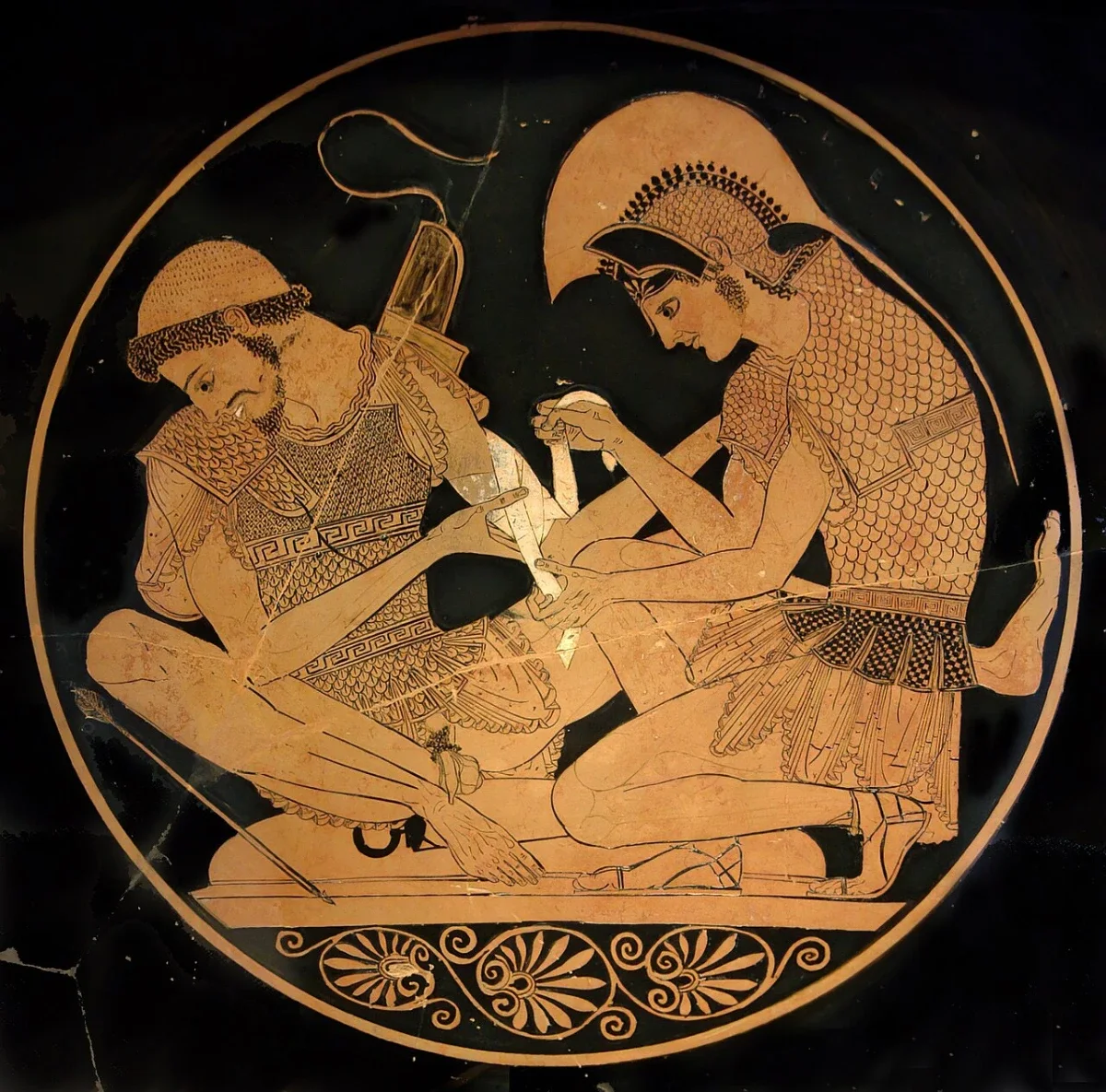
Text and translation
The uninterrupted Greek with its English translation, line by line.
Show text and translation
Μυρμιδόνας δʼ ἄρʼ ἐποιχόμενος θώρηξεν Ἀχιλλεὺς
Homer · Iliad 16.155–167 · dactylic hexameters · text of Monro–Allen (OCT, 3rd ed.)
How to read each line
A guide to the Greek, syllables, pitch marks and quantities.
Show the reading key
- Above each line: the line as the edition prints it, each word placed over its own syllables. The main row: the same Greek divided into metrical syllables, each written as it is pronounced. A consonant that closes a syllable is written with it (λόθ | ρο); an elided word is closed up with the next vowel (ν’ἀ); a final consonant carried into the next word is set with a thin space (ς ἰ). Wider gaps mark word-ends.
- Above the syllables: the pitch of each syllable, from the accents. Under them: the quantity of each syllable as it falls in the line, then the transliteration, syllable by syllable, with accented syllables in capitals.
- Under each line: a line-for-line translation. In the right margin of the scansion: the line type, its scheme, and its analysis into cola.
Key to the labels
The names, patterns and symbols used beside this poem.
Show the labels and symbols
The labels in the right margin of the scansion below name the line, its scheme, the feet as the line realises them, and the caesurae and diaereses (the named word-ends) that fall in it. In the scheme ⏔ is a biceps, two shorts that may be contracted to one long; ⏕ is a long that may be resolved into two shorts; × is an anceps, long or short. A click on any syllable highlights its metron or colon, or, with the switch, its foot.
| Label | Name and shape | What it is |
|---|---|---|
| hem1 | First hemiepes— ⏔ — ⏔ — | The first two and a half feet of the hexameter, up to the penthemimeral caesura; in the pentameter, its whole first half. |
| hem2 | Second half of the hexameter⏔ — ⏔ — ⏑ ⏑ — × | From the penthemimeral caesura to the line-end: the fifth foot is nearly always a dactyl, the sixth is — ×. |
The traditional feet
| Foot and shape | Where |
|---|---|
| First foot: dactyl or spondee— ⏔ | Scheme positions 1–2. The biceps (⏑ ⏑) may be contracted to a single long, making a spondee. |
| Second foot: dactyl or spondee— ⏔ | Scheme positions 3–4. |
| Third foot: dactyl or spondee— ⏔ | Scheme positions 5–6. The penthemimeral caesura falls after its first syllable, the “trochaic” caesura after its second. |
| Fourth foot: dactyl or spondee— ⏔ | Scheme positions 7–8. Word-end at the end of this foot, when it is a dactyl, is the bucolic diaeresis (West’s “bucolic caesura”: word-end at the end of the fourth foot after an uncontracted biceps)[7]. |
| Fifth foot: dactyl— ⏑ ⏑ | Scheme positions 9–10. A spondee here (a “spondaic line”) is rare. |
| Sixth foot— × | Scheme positions 11–12: a long and the indifferent final syllable. |
Scansion
Achilles arms the Myrmidons, and the poet compares them to a pack of wolves after a kill. The simile runs from “like wolves” in line 156 to the end of 163, and line 164 turns back to the men. A short extended simile shows how a long sentence runs on through the line-ends of the hexameter.
Recording: David Chamberlain (hypotactic.com), restored pronunciation, CC BY 3.0 — about this recording
David Chamberlain reads in restored pronunciation with a light pitch accent, keeping a regular hexameter beat. Lines 16.155–167 are cut from a track of his recording of Iliad Book 16 (Internet Archive, item 297410), licensed CC BY 3.0. The highlight follows the recording line by line; within a line it moves at an even pace and is only approximate. Tap a line number to play from there.
Achilles went all through the Myrmidons and had them arm
in their armour, all along the huts. And they, like wolves
that eat raw flesh, with a strength past telling in their hearts,
wolves that have killed a big antlered stag in the mountains
and tear it apart, and every one of them has jaws red with blood;
and they go off in a pack to a spring of dark water
to lap with their thin tongues the black water's
surface, belching up the blood of the kill; the heart
in their chests knows no fear, and their bellies are swollen tight –
just so the leaders and rulers of the Myrmidons
around the brave companion of Aeacus' swift-footed grandson
went surging; and Achilles the warrior stood in their midst,
driving on the horses and the men who carry shields.
Metre
- The line. Six feet. Each of the first five is a dactyl (— ⏑ ⏑) or, with its two shorts contracted, a spondee (— —); the sixth is — ×.[8] Contraction is least common in the fifth foot, about once in 20 lines in Homer.[9] Here only line 158 has a spondaic fifth foot, ending in δῃώσαντες. Lines 162, 163 and 165 are all dactyls.
- Caesurae. Twelve of the thirteen lines have a word-end in the third foot, after its long (masculine, or penthemimeral) or between its two shorts (feminine); West gives the proportion of feminine to masculine as about 4 : 3.[8] Prepositives count with the word after them and postpositives with the word before.[7] On that count eight lines have the feminine caesura (157, 159, 160, 161, 163, 165, 166, 167) and four the masculine (156, 158, 162, 164). In 157, 159 and 167 a written word-end at the masculine place is followed by τε or δέ, so the real break is the feminine one after it.
- A line with no third-foot caesura. In 155 ἐποιχόμενος runs across the whole of the third foot, and the only main break is after the fourth princeps (the hephthemimeral caesura). West notes that a long word occasionally does this.[8]
- Hermann’s Bridge (no word-end between the two shorts of the fourth biceps)[7] is kept in every line. Breaches occur about once in 550 lines of Homer by West’s count,[7] and about once in 390 lines by Maas’s.[10] Nor is there any word-end after a contracted second or fourth biceps, which the strict hexameter of Callimachus and Nonnus forbids (Hilberg’s and Naeke’s Laws)[11]. Of the two word-ends after a contracted first biceps (166 ῥώοντ’, 164 τοῖοι), Homer allows both: the first foot is the one place where such word-end is frequent.[9]
- Sentence and line. The simile is one long sentence that runs over line-end after line-end, while its clauses often stop in mid-line: after the second foot (159 δάπτουσιν) and at the bucolic caesura (156, 162). West notes that the hexameter is made of two cola joined at the caesura, the real units of the verse.[8] Line 161 ends with μέλαν ὕδωρ and the next line begins with the word it goes with, ἄκρον, “the surface”.
- Prosody. Elision;[12] epic correption;[13] hiatus with a long vowel in the princeps;[7] stop + liquid, which inside a word normally makes position in early epic, while at the start of a word it may or may not.[14] A final short syllable lengthened by the stop + liquid at the start of the next word stands in the princeps,[15] as in 156, 157 and 160.
- Metrical lengthening. Three words have a vowel that the metre makes long, all in West’s lists: οὔρεσι (158) for ὄρεσι, ἀνέρας (167) with a long α, and ὕδωρ (161) with a long υ.[16] LSJ confirms the long α of ἀνέρας (s.v. ἀνήρ) and notes that Homer has a long υ in ὕδωρ at the end of the line (s.v. ὕδωρ).
- Vowel quantities. The other vowels the metre alone makes long were checked in LSJ: ἴασιν (160; s.v. εἶμι, ἴᾱσι), θυμός (162), ὀτρύνων (167). The α of the genitive Αἰακίδαο (165) fills the sixth princeps; the name is not in LSJ.
- Murray and Wyatt’s text. Compared with the Loeb edition of A. T. Murray, revised by W. F. Wyatt (Murray and Wyatt 1999, vol. II, pp. 174–175). The line numbers and the words are the same. They print δηώσαντες (158) without the iota subscript, and παρήιον (159) and ἀρήιος (166) without the diaeresis, with no effect on the scansion.
Prosody, line by line
Every syllable, with the reason for its length. Quantities are read from the vowel where the spelling shows it, from the consonants that follow (“position”), from the accent where it tells, and from the metre where nothing else does. Editors’ notes on the text follow in the boxed paragraphs.
- 16.155
Line 16.155 · Μυρμιδόνας δʼ ἄρʼ ἐποιχόμενος θώρηξεν Ἀχιλλεὺς
Μυρμιδόνας δʼ ἄρʼ ἐποιχόμενος θώρηξεν Ἀχιλλεὺς
Μυρμιδόναςδ’ἄρ’ἐποιχόμενοςθώρηξεν Ἀχιλλεὺςdactyl, dactyl, dactyl, spondee, dactyl, — ×; hephthemimeral caesura.
- 1 —Μυρυ is a vowel of unknown length; closed by ρ: long by position.
- 2 ⏑μιι is short by the metre (position 2 must be short); one of the two shorts of the biceps at position 2.
- 3 ⏑δόό is short by nature; one of the two shorts of the biceps at position 2.
- 4 —ναςα is a vowel of unknown length; closed by ς: long by position.
- 5 ⏑δ’ἄἄ is short by the metre (position 4 must be short); the apostrophe marks an elided vowel; the consonant before it joins this syllable; one of the two shorts of the biceps at position 4.
- 6 ⏑ρ’ἐἐ is short by nature; the apostrophe marks an elided vowel; the consonant before it joins this syllable; one of the two shorts of the biceps at position 4.
- 7 —ποιοι is a diphthong, long by nature.
- 8 ⏑χόό is short by nature; one of the two shorts of the biceps at position 6.
- 9 ⏑μεε is short by nature; one of the two shorts of the biceps at position 6.
- 10 —νοςο is short by nature; closed by ς: long by position.
- 11 —θώώ is long by nature; a single long contracts the two shorts of the biceps at position 8.
- 12 —ρηη is long by nature; ξ is a double consonant (two sounds) and closes the syllable: long by position.
- 13 ⏑ξεε is short by nature; one of the two shorts of the biceps at position 10.
- 14 ⏑ν ἈἈ is short by the metre (position 10 must be short); the first consonant belongs to the previous word and is carried over to this vowel; one of the two shorts of the biceps at position 10.
- 15 —χιλι is a vowel of unknown length; closed by λ: long by position.
- 16 ×λεὺςεὺ is a diphthong, long by nature; closed by ς: long by position; the position is anceps.
Three dactyls, a spondee and a dactyl. The caesura is not in the third foot: ἐποιχόμενος runs from the second biceps to the fourth princeps, and the break comes after it, the hephthemimeral caesura.[8] δ’ and ἄρ’ are elided.[12] θώρηξεν fills the contracted fourth biceps and the fifth foot, so there is no bucolic caesura; its ν passes to Ἀχιλλεύς, whose first α is short.- 16.156
Line 16.156 · πάντας ἀνὰ κλισίας σὺν τεύχεσιν· οἳ δὲ λύκοι ὣς
πάντας ἀνὰ κλισίας σὺν τεύχεσιν· οἳ δὲ λύκοι ὣς
πάντας ἀνὰκλισίαςσὺντεύχεσι·ν οἳδὲλύκοιὣςdactyl, dactyl, spondee, dactyl, dactyl, — ×; penthemimeral caesura; bucolic diaeresis.
- 1 —πάνά is a vowel of unknown length; closed by ν: long by position.
- 2 ⏑ταα is short by the metre (position 2 must be short); one of the two shorts of the biceps at position 2.
- 3 ⏑ς ἀἀ is short by the metre (position 2 must be short); the first consonant belongs to the previous word and is carried over to this vowel; one of the two shorts of the biceps at position 2.
- 4 —νὰὰ is a vowel of unknown length; the next word begins with κλ: the syllable is closed before it: long by position.
- 5 ⏑κλιι is short by the metre (position 4 must be short); one of the two shorts of the biceps at position 4.
- 6 ⏑σίί is short by the metre (position 4 must be short); one of the two shorts of the biceps at position 4.
- 7 —αςα is a vowel of unknown length; closed by ς: long by position.
- 8 —σὺνὺ is a vowel of unknown length; closed by ν: long by position; a single long contracts the two shorts of the biceps at position 6.
- 9 —τεύεύ is a diphthong, long by nature.
- 10 ⏑χεε is short by nature; one of the two shorts of the biceps at position 8.
- 11 ⏑σι·ι is short by the accent rule: acute on the antepenult requires a short final syllable; one of the two shorts of the biceps at position 8.
- 12 —ν οἳοἳ is a diphthong, long by nature; the first consonant belongs to the previous word and is carried over to this vowel.
- 13 ⏑δὲὲ is short by nature; one of the two shorts of the biceps at position 10.
- 14 ⏑λύύ is short by the metre (position 10 must be short); one of the two shorts of the biceps at position 10.
- 15 —κοιοι is a diphthong, long by nature, and keeps its length before ὥς in the sixth princeps: hiatus with a long vowel, mostly found in the princeps.[7]
- 16 ×ὣςὣ is long by nature; closed by ς: long by position; the position is anceps.
Two dactyls, a spondee and two dactyls. The ς of πάντας passes to ἀνά. The last syllable of ἀνά is long in the second princeps before the κλ- of κλισίας: a final short syllable lengthened by an initial stop + liquid in the princeps.[15] The caesura is penthemimeral, after κλισίας.[8] Word-end at the stop after τεύχεσιν, whose ν passes to οἵ, is the bucolic caesura.[7] -οι of λύκοι keeps its length before ὥς in the sixth princeps: hiatus with a long vowel, mostly found in the princeps.[7] LSJ cites this line s.v. λύκος (with a short υ).- 16.157
Line 16.157 · ὠμοφάγοι, τοῖσίν τε περὶ φρεσὶν ἄσπετος ἀλκή,
ὠμοφάγοι, τοῖσίν τε περὶ φρεσὶν ἄσπετος ἀλκή,
ὠμοφάγοι,τοῖσίντεπερὶφρεσὶν ἄσπετος ἀλκή,dactyl, spondee, dactyl, dactyl, dactyl, — ×; penthemimeral caesura; caesura after the third trochee; hephthemimeral caesura; bucolic diaeresis.
- 1 —ὠὠ is long by nature.
- 2 ⏑μοο is short by nature; one of the two shorts of the biceps at position 2.
- 3 ⏑φάά is short by the metre (position 2 must be short); one of the two shorts of the biceps at position 2.
- 4 —γοι,οι is a diphthong, long by nature.
- 5 —τοῖοῖ is a diphthong, long by nature; a single long contracts the two shorts of the biceps at position 4.
- 6 —σίνί is a vowel of unknown length; closed by ν: long by position.
- 7 ⏑τεε is short by nature; one of the two shorts of the biceps at position 6.
- 8 ⏑πεε is short by nature; one of the two shorts of the biceps at position 6.
- 9 —ρὶὶ is a vowel of unknown length; the next word begins with φρ: the syllable is closed before it: long by position.
- 10 ⏑φρεε is short by nature; one of the two shorts of the biceps at position 8.
- 11 ⏑σὶὶ is short by the metre (position 8 must be short); one of the two shorts of the biceps at position 8.
- 12 —ν ἄσἄ is a vowel of unknown length; closed by σ: long by position; the first consonant belongs to the previous word and is carried over to this vowel.
- 13 ⏑πεε is short by nature; one of the two shorts of the biceps at position 10.
- 14 ⏑τοο is short by nature; one of the two shorts of the biceps at position 10.
- 15 —ς ἀλἀ is a vowel of unknown length; closed by λ: long by position; the first consonant belongs to the previous word and is carried over to this vowel.
- 16 ×κή,ή is long by nature; the position is anceps.
A dactyl, a spondee and three dactyls. The written word-end after τοῖσιν at the masculine place is followed by τε, so the real caesura is the feminine one after it.[17] The last syllable of περί is long in the fourth princeps before the φρ- of φρεσίν;[15] as a preposition περί goes with φρεσίν, so no word really ends after the fourth princeps.[7] Word-end after φρεσίν, whose ν passes to ἄσπετος, is the bucolic caesura.[7]- 16.158
Line 16.158 · οἵ τʼ ἔλαφον κεραὸν μέγαν οὔρεσι δῃώσαντες
οἵ τʼ ἔλαφον κεραὸν μέγαν οὔρεσι δῃώσαντες
οἵτ’ἔλαφονκεραὸνμέγαν οὔρεσιδῃώσαντεςdactyl, dactyl, dactyl, dactyl, spondee, — ×; penthemimeral caesura; bucolic diaeresis.
- 1 —οἵοἵ is a diphthong, long by nature.
- 2 ⏑τ’ἔἔ is short by nature; the apostrophe marks an elided vowel; the consonant before it joins this syllable; one of the two shorts of the biceps at position 2.
- 3 ⏑λαα is short by the metre (position 2 must be short); one of the two shorts of the biceps at position 2.
- 4 —φονο is short by nature; closed by ν: long by position.
- 5 ⏑κεε is short by nature; one of the two shorts of the biceps at position 4.
- 6 ⏑ραα is short by the metre (position 4 must be short); one of the two shorts of the biceps at position 4.
- 7 —ὸνὸ is short by nature; closed by ν: long by position.
- 8 ⏑μέέ is short by nature; one of the two shorts of the biceps at position 6.
- 9 ⏑γαα is short by the metre (position 6 must be short); one of the two shorts of the biceps at position 6.
- 10 —ν οὔοὔ is a diphthong, long by nature; the first consonant belongs to the previous word and is carried over to this vowel.
- 11 ⏑ρεε is short by nature; one of the two shorts of the biceps at position 8.
- 12 ⏑σιι is short by the accent rule: acute on the antepenult requires a short final syllable; one of the two shorts of the biceps at position 8.
- 13 —δῃῃ is long by nature.
- 14 —ώώ is long by nature; a single long contracts the two shorts of the biceps at position 10.
- 15 —σανα is a vowel of unknown length; closed by ν: long by position.
- 16 ×τεςε is short by nature; closed by ς: long by position; the position is anceps.
Four dactyls and a spondee: the only spondaic fifth foot in the passage.[9] τ’ is elided.[12] The ν of ἔλαφον stays with its syllable before κ and makes it long.[18] The caesura is penthemimeral, after κεραόν.[8] οὔρεσι has the metrically lengthened first syllable that West lists for ὄρεσι;[19] without it the word would begin with three shorts. Word-end after οὔρεσι is the bucolic caesura.[7] The δῃ- of δῃώσαντες is long: LSJ gives δῃόω as the contracted form of δηϊόω (s.v. δῃόω).- 16.159
Line 16.159 · δάπτουσιν· πᾶσιν δὲ παρήϊον αἵματι φοινόν·
δάπτουσιν· πᾶσιν δὲ παρήϊον αἵματι φοινόν·
δάπτουσιν·πᾶσινδὲπαρήϊον αἵματιφοινόν·spondee, spondee, dactyl, dactyl, dactyl, — ×; penthemimeral caesura; caesura after the third trochee; bucolic diaeresis.
- 1 —δάπά is a vowel of unknown length; closed by π: long by position.
- 2 —τουου is a diphthong, long by nature; a single long contracts the two shorts of the biceps at position 2.
- 3 —σιν·ι is a vowel of unknown length; closed by ν: long by position.
- 4 —πᾶᾶ carries a circumflex, so it is long; a single long contracts the two shorts of the biceps at position 4.
- 5 —σινι is a vowel of unknown length; closed by ν: long by position.
- 6 ⏑δὲὲ is short by nature; one of the two shorts of the biceps at position 6.
- 7 ⏑παα is short by the metre (position 6 must be short); one of the two shorts of the biceps at position 6.
- 8 —ρήή is long by nature.
- 9 ⏑ϊϊ is short by the metre (position 8 must be short); one of the two shorts of the biceps at position 8.
- 10 ⏑οο is short by nature; one of the two shorts of the biceps at position 8.
- 11 —ν αἵαἵ is a diphthong, long by nature; the first consonant belongs to the previous word and is carried over to this vowel.
- 12 ⏑μαα is short by the metre (position 10 must be short); one of the two shorts of the biceps at position 10.
- 13 ⏑τιι is short by the accent rule: acute on the antepenult requires a short final syllable; one of the two shorts of the biceps at position 10.
- 14 —φοιοι is a diphthong, long by nature.
- 15 ×νόν·ό is short by nature; closed by ν: long by position; the position is anceps.
Two spondees and three dactyls. The ν of δάπτουσιν stays with its syllable before π. The written word-end after πᾶσιν at the masculine place is followed by δέ, so the real caesura is the feminine one after it.[17] Word-end after παρήϊον, whose ν passes to αἵματι, is the bucolic caesura.[7] The ι of παρήϊον is short, in the biceps.- 16.160
Line 16.160 · καί τʼ ἀγεληδὸν ἴασιν ἀπὸ κρήνης μελανύδρου
καί τʼ ἀγεληδὸν ἴασιν ἀπὸ κρήνης μελανύδρου
καίτ’ἀγεληδὸν ἴασιν ἀπὸκρήνηςμελανύδρουdactyl, dactyl, dactyl, spondee, dactyl, — ×; caesura after the third trochee; hephthemimeral caesura.
- 1 —καίαί is a diphthong, long by nature.
- 2 ⏑τ’ἀἀ is short by the metre (position 2 must be short); the apostrophe marks an elided vowel; the consonant before it joins this syllable; one of the two shorts of the biceps at position 2.
- 3 ⏑γεε is short by nature; one of the two shorts of the biceps at position 2.
- 4 —ληη is long by nature.
- 5 ⏑δὸὸ is short by nature; one of the two shorts of the biceps at position 4.
- 6 ⏑ν ἴἴ is short by the metre (position 4 must be short); the first consonant belongs to the previous word and is carried over to this vowel; one of the two shorts of the biceps at position 4.
- 7 —αα is long by nature: LSJ gives ἴᾱσι, the third person plural of εἶμι, 'go' (s.v. εἶμι).
- 8 ⏑σιι is short by the accent rule: acute on the antepenult requires a short final syllable; one of the two shorts of the biceps at position 6.
- 9 ⏑ν ἀἀ is short by the metre (position 6 must be short); the first consonant belongs to the previous word and is carried over to this vowel; one of the two shorts of the biceps at position 6.
- 10 —πὸὸ is short by nature; the next word begins with κρ: the syllable is closed before it: long by position.
- 11 —κρήή is long by nature; a single long contracts the two shorts of the biceps at position 8.
- 12 —νηςη is long by nature; closed by ς: long by position.
- 13 ⏑μεε is short by nature; one of the two shorts of the biceps at position 10.
- 14 ⏑λαα is short by the metre (position 10 must be short); one of the two shorts of the biceps at position 10.
- 15 —νύδύ is a vowel of unknown length; closed by δ before a liquid: stop + liquid makes position, as it usually does in epic.
- 16 ×ρουου is a diphthong, long by nature; the position is anceps.
Three dactyls, a spondee and a dactyl. τ’ is elided.[12] The ν of ἀγεληδόν passes to ἴασιν, whose α is long.[20] ἴασιν ends between the shorts of the third foot, a feminine caesura.[8] The last syllable of ἀπό is long in the fourth princeps before the κρ- of κρήνης;[15] ἀπό goes with κρήνης, so no word really ends there.[7] The δρ of μελανύδρου makes position inside the word.[14] LSJ cites this line s.v. ἀγεληδόν.- 16.161
Line 16.161 · λάψοντες γλώσσῃσιν ἀραιῇσιν μέλαν ὕδωρ
λάψοντες γλώσσῃσιν ἀραιῇσιν μέλαν ὕδωρ
λάψοντεςγλώσσῃσιν ἀραιῇσινμέλαν ὕδωρspondee, spondee, dactyl, spondee, dactyl, — ×; caesura after the third trochee.
- 1 —λάψ is a double consonant (two sounds) and closes the syllable: long by position.
- 2 —ψονο is short by nature; closed by ν: long by position; a single long contracts the two shorts of the biceps at position 2.
- 3 —τεςε is short by nature; closed by ς: long by position.
- 4 —γλώσώ is long by nature; closed by σ: long by position; a single long contracts the two shorts of the biceps at position 4.
- 5 —σῃῃ is long by nature.
- 6 ⏑σιι is short by the accent rule: acute on the antepenult requires a short final syllable; one of the two shorts of the biceps at position 6.
- 7 ⏑ν ἀἀ is short by the metre (position 6 must be short); the first consonant belongs to the previous word and is carried over to this vowel; one of the two shorts of the biceps at position 6.
- 8 —ραιαι is a diphthong, long by nature.
- 9 —ῇῇ is long by nature; a single long contracts the two shorts of the biceps at position 8.
- 10 —σινι is a vowel of unknown length; closed by ν: long by position.
- 11 ⏑μέέ is short by nature; one of the two shorts of the biceps at position 10.
- 12 ⏑λαα is short by the metre (position 10 must be short); one of the two shorts of the biceps at position 10.
- 13 —ν ὕυ is long: LSJ notes that Homer often has a long υ in ὕδωρ, always at the end of the line but for one phrase (s.v. ὕδωρ); West explains the long vowel as spreading from the metrically lengthened ὕδατι;[21] the ν of μέλαν passes to this syllable.
- 14 ×δωρω is long by nature; closed by ρ: long by position; the position is anceps.
Two spondees, a dactyl, a spondee and a dactyl. λάψοντες ends after the second princeps. The ν of γλώσσῃσιν passes to ἀραιῇσιν, and the word ends between the shorts of the third foot, a feminine caesura.[8] ἀραιῇσιν runs from the third biceps to the fifth princeps, so there is no bucolic caesura. The υ of ὕδωρ is long at the end of the line: LSJ notes that Homer often has a long υ in this word, always at line-end but for one phrase (s.v. ὕδωρ), and West explains the long vowel in the nominative by analogy with the metrically lengthened ὕδατι.[21] LSJ cites this line s.v. ἀραιός, with a short first α.- 16.162
Line 16.162 · ἄκρον ἐρευγόμενοι φόνον αἵματος· ἐν δέ τε θυμὸς
ἄκρον ἐρευγόμενοι φόνον αἵματος· ἐν δέ τε θυμὸς
ἄκρον ἐρευγόμενοιφόνον αἵματο·ς ἐνδέτεθυμὸςdactyl, dactyl, dactyl, dactyl, dactyl, — ×; penthemimeral caesura; bucolic diaeresis.
- 1 —ἄκἄ is a vowel of unknown length; closed by κ before a liquid: stop + liquid makes position, as it usually does in epic.
- 2 ⏑ροο is short by nature; one of the two shorts of the biceps at position 2.
- 3 ⏑ν ἐἐ is short by nature; the first consonant belongs to the previous word and is carried over to this vowel; one of the two shorts of the biceps at position 2.
- 4 —ρευευ is a diphthong, long by nature.
- 5 ⏑γόό is short by nature; one of the two shorts of the biceps at position 4.
- 6 ⏑μεε is short by nature; one of the two shorts of the biceps at position 4.
- 7 —νοιοι is a diphthong, long by nature.
- 8 ⏑φόό is short by nature; one of the two shorts of the biceps at position 6.
- 9 ⏑νοο is short by nature; one of the two shorts of the biceps at position 6.
- 10 —ν αἵαἵ is a diphthong, long by nature; the first consonant belongs to the previous word and is carried over to this vowel.
- 11 ⏑μαα is short by the metre (position 8 must be short); one of the two shorts of the biceps at position 8.
- 12 ⏑το·ο is short by nature; one of the two shorts of the biceps at position 8.
- 13 —ς ἐνἐ is short by nature; closed by ν: long by position; the first consonant belongs to the previous word and is carried over to this vowel.
- 14 ⏑δέέ is short by nature; one of the two shorts of the biceps at position 10.
- 15 ⏑τεε is short by nature; one of the two shorts of the biceps at position 10.
- 16 —θυυ is long by nature.[22]
- 17 ×μὸςὸ is short by nature; closed by ς: long by position; the position is anceps.
All five feet are dactyls. The κρ of ἄκρον makes position inside the word;[14] the ν passes to ἐρευγόμενοι. The caesura is penthemimeral, after ἐρευγόμενοι.[8] Word-end at the stop after αἵματος, whose ς passes to ἐν, is the bucolic caesura.[7] The υ of θυμός is long.[22] ἄκρον belongs with ὕδωρ at the end of 161: the sentence runs over the line-end.- 16.163
Line 16.163 · στήθεσιν ἄτρομός ἐστι, περιστένεται δέ τε γαστήρ·
στήθεσιν ἄτρομός ἐστι, περιστένεται δέ τε γαστήρ·
στήθεσιν ἄτρομός ἐστι,περιστένεταιδέτεγαστήρ·dactyl, dactyl, dactyl, dactyl, dactyl, — ×; caesura after the third trochee.
- 1 —στήή is long by nature.
- 2 ⏑θεε is short by nature; one of the two shorts of the biceps at position 2.
- 3 ⏑σιι is short by the accent rule: acute on the antepenult requires a short final syllable; one of the two shorts of the biceps at position 2.
- 4 —ν ἄτἄ is a vowel of unknown length; closed by τ before a liquid: stop + liquid makes position, as it usually does in epic; the first consonant belongs to the previous word and is carried over to this vowel.
- 5 ⏑ροο is short by nature; one of the two shorts of the biceps at position 4.
- 6 ⏑μόό is short by nature; one of the two shorts of the biceps at position 4.
- 7 —ς ἐσἐ is short by nature; closed by σ: long by position; the first consonant belongs to the previous word and is carried over to this vowel.
- 8 ⏑τι,ι is short by the metre (position 6 must be short); one of the two shorts of the biceps at position 6.
- 9 ⏑πεε is short by nature; one of the two shorts of the biceps at position 6.
- 10 —ρισι is a vowel of unknown length; closed by σ: long by position.
- 11 ⏑τέέ is short by nature; one of the two shorts of the biceps at position 8.
- 12 ⏑νεε is short by nature; one of the two shorts of the biceps at position 8.
- 13 —ταιαι is a diphthong, long by nature.
- 14 ⏑δέέ is short by nature; one of the two shorts of the biceps at position 10.
- 15 ⏑τεε is short by nature; one of the two shorts of the biceps at position 10.
- 16 —γασα is a vowel of unknown length; closed by σ: long by position.
- 17 ×τήρ·ή is long by nature; closed by ρ: long by position; the position is anceps.
All five feet are dactyls. The ν of στήθεσιν passes to ἄτρομος, whose τρ makes position inside the word.[14] ἐστι is an enclitic (ἄτρομός takes a second accent from it) and ends between the shorts of the third foot: a feminine caesura.[17] περιστένεται runs from the third biceps to the fifth princeps, across the fourth biceps, so Hermann’s Bridge is kept and there is no bucolic caesura.[7]- 16.164
Line 16.164 · τοῖοι Μυρμιδόνων ἡγήτορες ἠδὲ μέδοντες
τοῖοι Μυρμιδόνων ἡγήτορες ἠδὲ μέδοντες
τοῖοιΜυρμιδόνωνἡγήτορες ἠδὲμέδοντεςspondee, dactyl, spondee, dactyl, dactyl, — ×; penthemimeral caesura; bucolic diaeresis.
- 1 —τοῖοῖ is a diphthong, long by nature.
- 2 —οιοι is a diphthong, long by nature; a single long contracts the two shorts of the biceps at position 2.
- 3 —Μυρυ is a vowel of unknown length; closed by ρ: long by position.
- 4 ⏑μιι is short by the metre (position 4 must be short); one of the two shorts of the biceps at position 4.
- 5 ⏑δόό is short by nature; one of the two shorts of the biceps at position 4.
- 6 —νωνω is long by nature.
- 7 —ἡἡ is long by nature; a single long contracts the two shorts of the biceps at position 6.
- 8 —γήή is long by nature.
- 9 ⏑τοο is short by nature; one of the two shorts of the biceps at position 8.
- 10 ⏑ρεε is short by nature; one of the two shorts of the biceps at position 8.
- 11 —ς ἠἠ is long by nature; the first consonant belongs to the previous word and is carried over to this vowel.
- 12 ⏑δὲὲ is short by nature; one of the two shorts of the biceps at position 10.
- 13 ⏑μέέ is short by nature; one of the two shorts of the biceps at position 10.
- 14 —δονο is short by nature; closed by ν: long by position.
- 15 ×τεςε is short by nature; closed by ς: long by position; the position is anceps.
- 16.165
Line 16.165 · ἀμφʼ ἀγαθὸν θεράποντα ποδώκεος Αἰακίδαο
ἀμφʼ ἀγαθὸν θεράποντα ποδώκεος Αἰακίδαο
ἀμφ’ἀγαθὸνθεράπονταποδώκεος Αἰακίδαοdactyl, dactyl, dactyl, dactyl, dactyl, — ×; caesura after the third trochee; bucolic diaeresis.
- 1 —ἀμἀ is a vowel of unknown length; closed by μ: long by position.
- 2 ⏑φ’ἀἀ is short by the metre (position 2 must be short); the apostrophe marks an elided vowel; the consonant before it joins this syllable; one of the two shorts of the biceps at position 2.
- 3 ⏑γαα is short by the metre (position 2 must be short); one of the two shorts of the biceps at position 2.
- 4 —θὸνὸ is short by nature; closed by ν: long by position.
- 5 ⏑θεε is short by nature; one of the two shorts of the biceps at position 4.
- 6 ⏑ράά is short by the metre (position 4 must be short); one of the two shorts of the biceps at position 4.
- 7 —πονο is short by nature; closed by ν: long by position.
- 8 ⏑ταα is short by the accent rule: acute on the antepenult requires a short final syllable; one of the two shorts of the biceps at position 6.
- 9 ⏑ποο is short by nature; one of the two shorts of the biceps at position 6.
- 10 —δώώ is long by nature.
- 11 ⏑κεε is short by nature; one of the two shorts of the biceps at position 8.
- 12 ⏑οο is short by nature; one of the two shorts of the biceps at position 8.
- 13 —ς ΑἰΑἰ is a diphthong, long by nature; the first consonant belongs to the previous word and is carried over to this vowel.
- 14 ⏑αα is short by the metre (position 10 must be short); one of the two shorts of the biceps at position 10.
- 15 ⏑κίί is short by the metre (position 10 must be short); one of the two shorts of the biceps at position 10.
- 16 —δαα must be long to fill the sixth princeps; the name is not in LSJ.
- 17 ×οο is short by nature; the position is anceps.
- 16.166
Line 16.166 · ῥώοντʼ· ἐν δʼ ἄρα τοῖσιν ἀρήϊος ἵστατʼ Ἀχιλλεύς,
ῥώοντʼ· ἐν δʼ ἄρα τοῖσιν ἀρήϊος ἵστατʼ Ἀχιλλεύς,
ῥώοντ’·ἐνδ’ἄρατοῖσιν ἀρήϊος ἵστατ’Ἀχιλλεύς,spondee, dactyl, dactyl, dactyl, dactyl, — ×; caesura after the third trochee; bucolic diaeresis.
- 1 —ῥώώ is long by nature.
- 2 —ονο is short by nature; closed by ν: long by position; a single long contracts the two shorts of the biceps at position 2.
- 3 —τ’·ἐνἐ is short by nature; closed by ν: long by position; the apostrophe marks an elided vowel; the consonant before it joins this syllable.
- 4 ⏑δ’ἄἄ is short by the metre (position 4 must be short); the apostrophe marks an elided vowel; the consonant before it joins this syllable; one of the two shorts of the biceps at position 4.
- 5 ⏑ραα is short by the metre (position 4 must be short); one of the two shorts of the biceps at position 4.
- 6 —τοῖοῖ is a diphthong, long by nature.
- 7 ⏑σιι is short by the accent rule: circumflex on the penult requires a short final syllable; one of the two shorts of the biceps at position 6.
- 8 ⏑ν ἀἀ is short by the metre (position 6 must be short); the first consonant belongs to the previous word and is carried over to this vowel; one of the two shorts of the biceps at position 6.
- 9 —ρήή is long by nature.
- 10 ⏑ϊϊ is short by the metre (position 8 must be short); one of the two shorts of the biceps at position 8.
- 11 ⏑οο is short by nature; one of the two shorts of the biceps at position 8.
- 12 —ς ἵσἵ is a vowel of unknown length; closed by σ: long by position; the first consonant belongs to the previous word and is carried over to this vowel.
- 13 ⏑ταα is short by the metre (position 10 must be short); one of the two shorts of the biceps at position 10.
- 14 ⏑τ’ἈἈ is short by the metre (position 10 must be short); the apostrophe marks an elided vowel; the consonant before it joins this syllable; one of the two shorts of the biceps at position 10.
- 15 —χιλι is a vowel of unknown length; closed by λ: long by position.
- 16 ×λεύς,εύ is a diphthong, long by nature; closed by ς: long by position; the position is anceps.
A spondee and four dactyls. ῥώοντ’ ends after the contracted first biceps, its elided τ’ passing to ἐν.[23] δ’ is elided. The ν of τοῖσιν passes to ἀρήϊος, and τοῖσιν ends between the shorts of the third foot, a feminine caesura.[8] Word-end after ἀρήϊος is the bucolic caesura.[7] ἵστατ’ is elided before Ἀχιλλεύς, whose name ends the line as in 155.- 16.167
Line 16.167 · ὀτρύνων ἵππους τε καὶ ἀνέρας ἀσπιδιώτας.
ὀτρύνων ἵππους τε καὶ ἀνέρας ἀσπιδιώτας.
ὀτρύνωνἵππουςτεκαὶἀνέρας ἀσπιδιώτας.spondee, spondee, dactyl, dactyl, dactyl, — ×; penthemimeral caesura; caesura after the third trochee; bucolic diaeresis.
- 1 —ὀτὀ is short by nature; closed by τ before a liquid: stop + liquid makes position, as it usually does in epic.
- 2 —ρύυ is long by nature;[24] a single long contracts the two shorts of the biceps at position 2.
- 3 —νωνω is long by nature.
- 4 —ἵπἵ is a vowel of unknown length; closed by π: long by position; a single long contracts the two shorts of the biceps at position 4.
- 5 —πουςου is a diphthong, long by nature; closed by ς: long by position.
- 6 ⏑τεε is short by nature; one of the two shorts of the biceps at position 6.
- 7 ⏑καὶαὶ is a diphthong, long by nature; shortened before the vowel that begins the next word (epic correption), as the metre requires; one of the two shorts of the biceps at position 6.
- 8 —ἀα is long: in the three-syllable forms with the stem ἀνέρ- epic always has a long α;[25] West lists ἀνέρι among the words given metrical lengthening.[7]
- 9 ⏑νέέ is short by nature; one of the two shorts of the biceps at position 8.
- 10 ⏑ραα is short by the metre (position 8 must be short); one of the two shorts of the biceps at position 8.
- 11 —ς ἀσἀ is a vowel of unknown length; closed by σ: long by position; the first consonant belongs to the previous word and is carried over to this vowel.
- 12 ⏑πιι is short by the metre (position 10 must be short); one of the two shorts of the biceps at position 10.
- 13 ⏑διι is short by the metre (position 10 must be short); one of the two shorts of the biceps at position 10.
- 14 —ώώ is long by nature.
- 15 ×τας.α is a vowel of unknown length; closed by ς: long by position; the position is anceps.
Two spondees and three dactyls. The τρ of ὀτρύνων makes position inside the word,[14] and its υ is long.[24] The written word-end after ἵππους at the masculine place is followed by τε, so the real caesura is the feminine one after it.[17] καί is shortened before ἀνέρας by correption.[13] The first α of ἀνέρας is long in the fourth princeps: LSJ says epic always has a long α in the three-syllable forms of the stem ἀνέρ- (s.v. ἀνήρ), and West lists ἀνέρι among the metrically lengthened words.[7] Word-end after ἀνέρας is the bucolic caesura.[7] LSJ cites this line s.v. ἀσπιδιώτης.
What the input marks
The text is Monro–Allen’s, with its elision marks, checked letter by letter against the Perseus file. The input adds no marks: the scanner finds every quantity from the text and the metre, and the page explains the long syllables it cannot account for itself (ἴασιν, ὕδωρ, θυμός, ἀνέρας, ὀτρύνων, the hiatus after λύκοι).
The simile in the passage
The comparison begins with οἳ δὲ λύκοι ὥς at the end of 156: the wolves are introduced in the last two feet, after the bucolic caesura, and their description fills the next seven lines. τοῖοι at the start of 164 (“such were …”) closes it and returns to the Myrmidons. LSJ cites lines 156–157 for λύκος and ὠμοφάγος, 160 for ἀγεληδόν (“in packs”) and 161 for ἀραιός (“thin”).
Notes
- ^ West 2018, p. 371.
- ^ a b Goldhill 1997b, p. 129.
- ^ West 2018, p. 372.
- ^ Graziosi and Haubold 2009, p. 97.
- ^ West 2018, p. 377.
- ^ Murray and Wyatt 1999, pp. 1–2, 4.
- ^ a b c d e f g h i j k l m n o p q r s t u West 1987, p. 21.
- ^ a b c d e f g h i j k l m West 1987, p. 19.
- ^ a b c d West 1987, p. 20.
- ^ Maas 1962, p. 60, § 87.
- ^ Maas 1962, p. 62, § 92; West 1987, p. 78.
- ^ a b c d e West 1987, p. 13.
- ^ a b West 1987, p. 14.
- ^ a b c d e West 1987, pp. 16–17.
- ^ a b c d West 1987, p. 22.
- ^ West 1987, p. 21 and n. 1; West 2018, p. 364.
- ^ a b c d West 1987, pp. 19, 21.
- ^ West 1987, p. 12.
- ^ West 2018, p. 364.
- ^ LSJ s.v. εἶμι, ἴᾱσι.
- ^ a b West 1987, p. 21 and n. 1.
- ^ a b LSJ s.v. θυμός.
- ^ West 1987, pp. 13, 20.
- ^ a b LSJ s.v. ὀτρύνω.
- ^ LSJ s.v. ἀνήρ.
Text and sources
- Text: Homer, Homeri Opera, ed. D. B. Monro and T. W. Allen, 3rd ed. (Oxford 1920), from the Perseus Digital Library (urn:cts:greekLit:tlg0012.tlg001.perseus-grc2), licensed CC BY-SA 4.0 (the licence of the Perseus repository; the file’s TEI header states none).
- M. L. West, Introduction to Greek Metre (Oxford 1987): p. 12 (syllables), pp. 13–17 (elision, correption, hiatus, stop + liquid), p. 19 (the hexameter, its caesurae and cola), p. 20 (contraction; a photograph of pp. 20–21), pp. 21–22 (Hermann’s Bridge, metrical lengthening, licences), p. 78 (Naeke’s Law). Cited as “West 1987”.
- M. L. West, “Unmetrical Verses in Homer”, in D. Gunkel and O. Hackstein (eds), Language and Meter (Leiden 2018), ch. 14, p. 364 (metrical lengthening, ὄρεσι > οὔρεσι). Cited as “West 2018”.
- P. Maas, Greek Metre, trans. H. Lloyd-Jones (Oxford 1962; 1972 reprint): p. 60 (§ 87, Hermann’s Bridge), p. 62 (§ 92, Naeke’s and Hilberg’s Laws). Cited as “Maas 1962”.
- H. G. Liddell and R. Scott, A Greek-English Lexicon, revised by H. S. Jones with R. McKenzie (Oxford 1940), in the Perseus Digital Library edition (CC BY-SA 4.0), for vowel quantities and citations of these lines: s.vv. εἶμι, ὕδωρ, θυμός, ὀτρύνω, ἀνήρ, δῃόω, λύκος, ὠμοφάγος, ἀγεληδόν, ἀραιός, ἀσπιδιώτης. Cited as “LSJ”.
- Translation: metrehelp.org, CC BY-SA 4.0.
- Compared with: A. T. Murray (trans.), revised by W. F. Wyatt, Homer, Iliad II: Books 13–24 (Loeb Classical Library 171, 2nd ed., Cambridge, MA 1999; the Loeb site’s bibliographic reference gives 1925), pp. 174–175 (text of 16.155–175).
- Audio: David Chamberlain (hypotactic.com), Iliad Book 16 (Ancient Greek), Internet Archive item 297410, track 101-197, licensed CC BY 3.0. Restored pronunciation with a light pitch accent, hexameter rhythm kept. Lines 16.155–167 cut from the track, with the line timings added, by metrehelp.org (2026); the highlighting is per line, approximate within the line.
Quotations from copyrighted works are not covered by this page’s licence.
Odyssey 1.1–21 — the proem
Synopsis
The Odyssey is one of the two epics ascribed to Homer. Together they run to some 28,000 lines.[1] It tells of the man of many ways who wandered far after sacking Troy, and could not save his companions on the way home (Od. 1.1–9). The language of the two poems is a literary construct that grew over many years of performance. It seems to have been largely fixed by the seventh century BC.[2] West reckons with six to eight centuries of oral tradition behind the poems.[3] It is not known for what kind of occasion and purpose they were composed, how they were performed, or when their text became fixed.[4] A rhapsode was a professional reciter of epic. In classical Athens the poems were recited in full at the Panathenaea by rhapsodes competing for prizes.[2] Whether one poet composed both is disputed. West held that they were by different poets, and that the Odyssey poet borrowed lines from the Iliad.[5] The Loeb Iliad keeps to a single Homer: an eighth-century Ionian, perhaps the founder of a guild on Chios.[6] The Loeb Odyssey cites Janko’s dates: about 750 BC for the Iliad, and 735 for the Odyssey.[7]
Scanned here are lines 1–21: the proem and the start of the story. The other Greeks are home. But Odysseus is held by the nymph Calypso, pitied by every god but Poseidon.
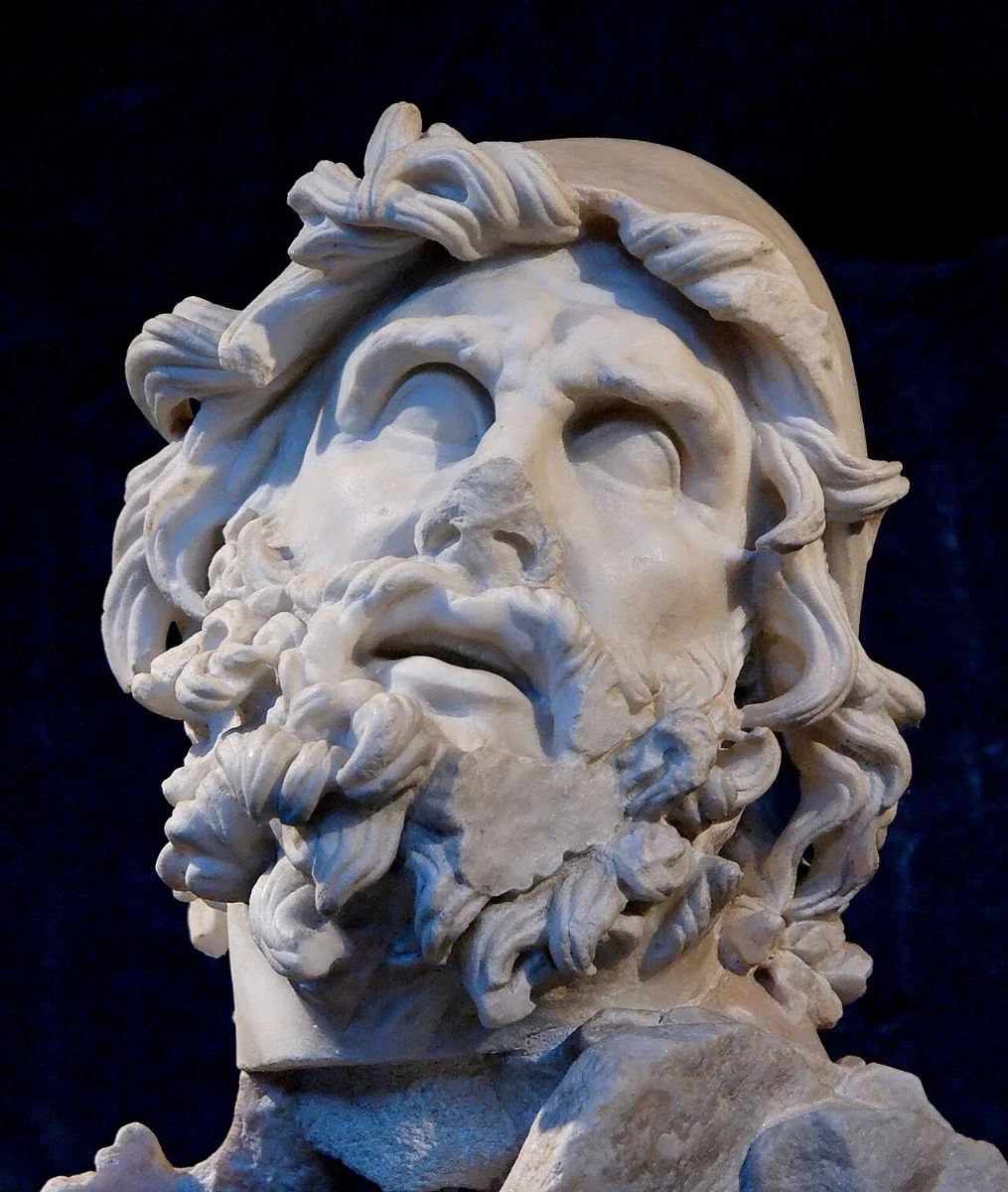
Text and translation
The uninterrupted Greek with its English translation, line by line.
Show text and translation
ἄνδρα μοι ἔννεπε, μοῦσα, πολύτροπον, ὃς μάλα πολλὰ
Homer · Odyssey 1.1–21 · dactylic hexameters · text of A. T. Murray (Loeb, 1919)
How to read each line
A guide to the Greek, syllables, pitch marks and quantities.
Show the reading key
- Above each line: the line as the edition prints it, each word placed over its own syllables. The main row: the same Greek divided into metrical syllables, each written as it is pronounced. A consonant that closes a syllable is written with it (λόθ | ρο); an elided word is closed up with the next vowel (ν’ἀ); a final consonant carried into the next word is set with a thin space (ς ἰ). Wider gaps mark word-ends.
- Above the syllables: the pitch of each syllable, from the accents. Under them: the quantity of each syllable as it falls in the line, then the transliteration, syllable by syllable, with accented syllables in capitals.
- Under each line: a line-for-line translation. In the right margin of the scansion: the line type, its scheme, and its analysis into cola.
Key to the labels
The names, patterns and symbols used beside this poem.
Show the labels and symbols
The labels in the right margin of the scansion below name the line, its scheme, the feet as the line realises them, and the caesurae and diaereses (the named word-ends) that fall in it. In the scheme ⏔ is a biceps, two shorts that may be contracted to one long; ⏕ is a long that may be resolved into two shorts; × is an anceps, long or short. A click on any syllable highlights its metron or colon, or, with the switch, its foot.
| Label | Name and shape | What it is |
|---|---|---|
| hem1 | First hemiepes— ⏔ — ⏔ — | The first two and a half feet of the hexameter, up to the penthemimeral caesura; in the pentameter, its whole first half. |
| hem2 | Second half of the hexameter⏔ — ⏔ — ⏑ ⏑ — × | From the penthemimeral caesura to the line-end: the fifth foot is nearly always a dactyl, the sixth is — ×. |
The traditional feet
| Foot and shape | Where |
|---|---|
| First foot: dactyl or spondee— ⏔ | Scheme positions 1–2. The biceps (⏑ ⏑) may be contracted to a single long, making a spondee. |
| Second foot: dactyl or spondee— ⏔ | Scheme positions 3–4. |
| Third foot: dactyl or spondee— ⏔ | Scheme positions 5–6. The penthemimeral caesura falls after its first syllable, the “trochaic” caesura after its second. |
| Fourth foot: dactyl or spondee— ⏔ | Scheme positions 7–8. Word-end at the end of this foot, when it is a dactyl, is the bucolic diaeresis (West’s “bucolic caesura”: word-end at the end of the fourth foot after an uncontracted biceps)[8]. |
| Fifth foot: dactyl— ⏑ ⏑ | Scheme positions 9–10. A spondee here (a “spondaic line”) is rare. |
| Sixth foot— × | Scheme positions 11–12: a long and the indifferent final syllable. |
Scansion
The proem of the Odyssey scanned foot by foot: each syllable’s quantity and the reason for it, the feet, the caesurae, and a note on every line naming its prosodic licences.
Recording: David Chamberlain (hypotactic.com), restored pronunciation, CC BY 4.0 — about this recording
David Chamberlain reads in restored pronunciation with a light pitch accent, keeping a regular hexameter beat. Lines 1.1–21 are cut from a track of his recording of Odyssey Book 1 (Internet Archive, item odyssey1), licensed CC BY 4.0. The highlight follows the recording line by line; within a line it moves at an even pace and is only approximate. Tap a line number to play from there.
Muse, tell me of the man of many ways, who was driven
far and wide once he had sacked Troy’s sacred city;
many were the peoples whose towns he saw and whose minds he came to know,
and many the griefs he endured at heart out on the open sea,
fighting to keep his own life and to bring his comrades home.
Yet even so he could not rescue his comrades, much as he wished to:
they were destroyed by their own wicked recklessness,
the fools, who devoured the oxen of Hyperion the Sun-god,
and he took from them the day of their homecoming.
Begin where you will, goddess, daughter of Zeus, and tell this to us as well.
Now all the rest, those who had escaped steep ruin,
were back home, clear of the war and of the sea;
him alone, yearning for his homecoming and his wife,
the nymph held back, queenly Calypso, brightest of goddesses,
in her hollow caverns, eager that he should be her husband.
But when, as the years circled round, the year arrived
that the gods had spun out for his journey home
to Ithaca, not even there was he free of struggles,
not even among his own. All the gods felt pity for him,
apart from Poseidon, who stayed fiercely angry
with godlike Odysseus until he reached his own country.
Metre
- The line. Six feet. Each of the first five is a dactyl (— ⏑ ⏑) or, with its two shorts contracted, a spondee (— —); the sixth is — ×.[9] West calls the long the princeps and the two shorts or their contraction the biceps. Contraction is least common in the fifth foot, about once in 20 lines in Homer,[10] and the poets prefer a dactylic fifth foot;[11] every fifth foot in this passage is a dactyl.
- Caesurae. There is always a word-end in the third foot, after its long (masculine or penthemimeral) or between its shorts (feminine, also called the caesura after the third trochee), the feminine being the more frequent in the proportion 4 : 3; occasionally a long word spans the third foot and the caesura falls after the fourth princeps (hephthemimeral).[12] Word-end after an uncontracted fourth foot is the bucolic caesura;[8] the margin calls it the bucolic diaeresis.
- Wernicke’s Law. Where a word ends after a contracted fourth biceps, it mostly ends in a syllable with a long vowel, and hardly ever in a short vowel left open; a prepositive counts with the word that follows it.[10] The three such word-ends here keep the law: καί (a prepositive, l. 5), Καλυψώ (l. 14) and ἥν (l. 21).
- Hermann’s bridge. No word ends between the two shorts of the fourth biceps, a prepositive being reckoned with the word after it and a postpositive with the word before.[13] No line here has a word-end there.
- Prosody. Elision of short final vowels;[14] epic correption of a final long vowel or diphthong before a vowel, for which West’s own examples are ll. 1 and 2 of this poem;[15] synizesis;[16] hiatus, often where a word once began with ϝ;[17] stop + liquid, which normally makes position inside a word in early epic.[18]
- Vowel quantities. Every α ι υ that the workbench makes long because the metre needs it has been checked in LSJ (Perseus edition); none is marked short there: θῡμός, ψῡχή, ἐρρύσατο (ῡ, LSJ citing this very line, s.v. ἐρύω B), ἱέμενος (ῑ in Homer, s.v. ἵημι), Ὑπερίων (ῑ), θεά (⏑ —), ἐρύκω (ῡ), θεάων, Ποσειδάων (ᾱ).
- How to read the margin. A word counts as ending after the syllable that holds its last vowel, even when its final consonant passes to the next word’s vowel. A word-end after a contracted fourth foot is labelled as such, not as a bucolic caesura. The line notes say where a prepositive or postpositive means that a written word-end is no real break.
- Murray and Dimock’s text. Murray’s text of 1919, used here from Perseus, has been compared with the Loeb edition revised by G. E. Dimock. Lines 1–21 are the same apart from capitals (Ἄνδρα, Μοῦσα). A footnote records Zenodotus’ νόμον for νόον in line 3; νόμον before ἔγνω scans as νόον does, ⏑ ⏑.[19]
Prosody, line by line
Every syllable, with the reason for its length. Quantities are read from the vowel where the spelling shows it, from the consonants that follow (“position”), from the accent where it tells, and from the metre where nothing else does. Editors’ notes on the text follow in the boxed paragraphs.
- 1.1
Line 1.1 · ἄνδρα μοι ἔννεπε, μοῦσα, πολύτροπον, ὃς μάλα πολλὰ
ἄνδρα μοι ἔννεπε, μοῦσα, πολύτροπον, ὃς μάλα πολλὰ
ἄνδραμοιἔννεπε,μοῦσα,πολύτροπο,ν ὃςμάλαπολλὰdactyl, dactyl, dactyl, dactyl, dactyl, — ×; caesura after the third trochee; bucolic diaeresis.
- 1 —ἄνἄ is a vowel of unknown length; closed by ν: long by position.
- 2 ⏑δραα is short by the metre (position 2 must be short); one of the two shorts of the biceps at position 2.
- 3 ⏑μοιοι is a diphthong, long by nature; shortened before the vowel that begins the next word (epic correption), as the metre requires; one of the two shorts of the biceps at position 2.
- 4 —ἔνἔ is short by nature; closed by ν: long by position.
- 5 ⏑νεε is short by nature; one of the two shorts of the biceps at position 4.
- 6 ⏑πε,ε is short by nature; one of the two shorts of the biceps at position 4.
- 7 —μοῦοῦ is a diphthong, long by nature.
- 8 ⏑σα,α is short by the accent rule: circumflex on the penult requires a short final syllable; one of the two shorts of the biceps at position 6.
- 9 ⏑ποο is short by nature; one of the two shorts of the biceps at position 6.
- 10 —λύτύ is a vowel of unknown length; closed by τ before a liquid: stop + liquid makes position, as it usually does in epic.
- 11 ⏑ροο is short by nature; one of the two shorts of the biceps at position 8.
- 12 ⏑πο,ο is short by nature; one of the two shorts of the biceps at position 8.
- 13 —ν ὃςὃ is short by nature; closed by ς: long by position; the first consonant belongs to the previous word and is carried over to this vowel.
- 14 ⏑μάά is short by the metre (position 10 must be short); one of the two shorts of the biceps at position 10.
- 15 ⏑λαα is short by the metre (position 10 must be short); one of the two shorts of the biceps at position 10.
- 16 —πολο is short by nature; closed by λ: long by position.
- 17 ×λὰὰ is of unknown length; the position is anceps, so either scans.
All five feet are dactyls. West uses the opening words as his first example of epic correption: μοι is shortened before ἔννεπε.[15] The caesura is feminine, after μοῦσα.[9] The τρ of πολύτροπον makes position inside the word,[18] and word-end after πολύτροπον is the bucolic caesura.[8] Nagy uses this line to show formula and colon working together: he marks the word-breaks after μοῦσα and after πολύτροπον as colon junctures (Fränkel’s B2 and C2), and πολύτροπον fills the slot ⏑ — ⏑ ⏑ between them, where the generic epithet διίφιλος would otherwise stand.[20]- 1.2
Line 1.2 · πλάγχθη, ἐπεὶ Τροίης ἱερὸν πτολίεθρον ἔπερσεν·
πλάγχθη, ἐπεὶ Τροίης ἱερὸν πτολίεθρον ἔπερσεν·
πλάγχθη,ἐπεὶΤροίηςἱερὸνπτολίεθρον ἔπερσεν·dactyl, spondee, dactyl, dactyl, dactyl, — ×; penthemimeral caesura; hephthemimeral caesura.
- 1 —πλάγχά is a vowel of unknown length; closed by γχ: long by position.
- 2 ⏑θη,η is long by nature; shortened before the vowel that begins the next word (epic correption), as the metre requires; one of the two shorts of the biceps at position 2.
- 3 ⏑ἐἐ is short by nature; one of the two shorts of the biceps at position 2.
- 4 —πεὶεὶ is a diphthong, long by nature; the next word begins with Τρ: the syllable is closed before it: long by position.
- 5 —Τροίοί is a diphthong, long by nature; a single long contracts the two shorts of the biceps at position 4.
- 6 —ηςη is long by nature.
- 7 ⏑ἱἱ is short by the metre (position 6 must be short); one of the two shorts of the biceps at position 6.
- 8 ⏑εε is short by nature; one of the two shorts of the biceps at position 6.
- 9 —ρὸνὸ is short by nature; closed by ν: long by position.
- 10 ⏑πτοο is short by nature; one of the two shorts of the biceps at position 8.
- 11 ⏑λίί is short by the metre (position 8 must be short); one of the two shorts of the biceps at position 8.
- 12 —εθε is short by nature; closed by θ before a liquid: stop + liquid makes position, as it usually does in epic.
- 13 ⏑ροο is short by nature; one of the two shorts of the biceps at position 10.
- 14 ⏑ν ἔἔ is short by nature; the first consonant belongs to the previous word and is carried over to this vowel; one of the two shorts of the biceps at position 10.
- 15 —περε is short by nature; closed by ρ: long by position.
- 16 ×σεν·ε is short by nature; closed by ν: long by position; the position is anceps.
A dactyl, a spondee and three dactyls. West’s second example of correption is the beginning of this line: the -η of πλάγχθη is shortened before ἐπεί.[15] The caesura is penthemimeral, after Τροίης, with a hephthemimeral word-end after ἱερόν.[9] The θρ of πτολίεθρον makes position in the fifth princeps.[18]- 1.3
Line 1.3 · πολλῶν δʼ ἀνθρώπων ἴδεν ἄστεα καὶ νόον ἔγνω,
πολλῶν δʼ ἀνθρώπων ἴδεν ἄστεα καὶ νόον ἔγνω,
πολλῶνδ’ἀνθρώπωνἴδεν ἄστεακαὶνόον ἔγνω,spondee, spondee, dactyl, dactyl, dactyl, — ×; penthemimeral caesura; bucolic diaeresis.
- 1 —πολο is short by nature; closed by λ: long by position.
- 2 —λῶνῶ is long by nature; closed by ν: long by position; a single long contracts the two shorts of the biceps at position 2.
- 3 —δ’ἀνἀ is a vowel of unknown length; closed by ν: long by position; the apostrophe marks an elided vowel; the consonant before it joins this syllable.
- 4 —θρώώ is long by nature; a single long contracts the two shorts of the biceps at position 4.
- 5 —πωνω is long by nature.
- 6 ⏑ἴἴ is short by the metre (position 6 must be short); one of the two shorts of the biceps at position 6.
- 7 ⏑δεε is short by nature; one of the two shorts of the biceps at position 6.
- 8 —ν ἄσἄ is a vowel of unknown length; closed by σ: long by position; the first consonant belongs to the previous word and is carried over to this vowel.
- 9 ⏑τεε is short by nature; one of the two shorts of the biceps at position 8.
- 10 ⏑αα is short by the accent rule: acute on the antepenult requires a short final syllable; one of the two shorts of the biceps at position 8.
- 11 —καὶαὶ is a diphthong, long by nature.
- 12 ⏑νόό is short by nature; one of the two shorts of the biceps at position 10.
- 13 ⏑οο is short by nature; one of the two shorts of the biceps at position 10.
- 14 —ν ἔγἔ is short by nature; closed by γ: long by position; γν is one of the four clusters (γμ, γν, δμ, δν) that never leave the syllable before them short;[21] the first consonant belongs to the previous word and is carried over to this vowel.
- 15 ×νω,ω is long by nature; the position is anceps.
Two spondees and three dactyls. δ’ is elided.[14] The caesura is penthemimeral, after ἀνθρώπων.[9] ἀνθρώπων has three long syllables and stands so that only one contraction is needed, — ⏔ —.[10] ἄστεα once began with ϝ (West lists ἄστυ, p. 23), but here the ν of ἴδεν passes to it as if to a plain vowel and -δε- stays short: one of the many places where the lost consonant is not observed.[22] Word-end after ἄστεα is the bucolic caesura.[8] The γν of ἔγνω makes position, as γν always does.[21]- 1.4
Line 1.4 · πολλὰ δʼ ὅ γʼ ἐν πόντῳ πάθεν ἄλγεα ὃν κατὰ θυμόν,
πολλὰ δʼ ὅ γʼ ἐν πόντῳ πάθεν ἄλγεα ὃν κατὰ θυμόν,
πολλὰδ’ὅγ’ἐνπόντῳπάθεν ἄλγεαὃνκατὰθυμόν,dactyl, spondee, dactyl, dactyl, dactyl, — ×; penthemimeral caesura; bucolic diaeresis.
- 1 —πολο is short by nature; closed by λ: long by position.
- 2 ⏑λὰὰ is short by the metre (position 2 must be short); one of the two shorts of the biceps at position 2.
- 3 ⏑δ’ὅὅ is short by nature; the apostrophe marks an elided vowel; the consonant before it joins this syllable; one of the two shorts of the biceps at position 2.
- 4 —γ’ἐνἐ is short by nature; closed by ν: long by position; the apostrophe marks an elided vowel; the consonant before it joins this syllable.
- 5 —πόνό is short by nature; closed by ν: long by position; a single long contracts the two shorts of the biceps at position 4.
- 6 —τῳῳ is long by nature.
- 7 ⏑πάά is short by the metre (position 6 must be short); one of the two shorts of the biceps at position 6.
- 8 ⏑θεε is short by nature; one of the two shorts of the biceps at position 6.
- 9 —ν ἄλἄ is a vowel of unknown length; closed by λ: long by position; the first consonant belongs to the previous word and is carried over to this vowel.
- 10 ⏑γεε is short by nature; one of the two shorts of the biceps at position 8.
- 11 ⏑αα is short by the accent rule: acute on the antepenult requires a short final syllable; the next word begins with a vowel and nothing is elided: hiatus; one of the two shorts of the biceps at position 8.
- 12 —ὃνὃ is short by nature; closed by ν: long by position.
- 13 ⏑καα is short by the metre (position 10 must be short); one of the two shorts of the biceps at position 10.
- 14 ⏑τὰὰ is short by the metre (position 10 must be short); one of the two shorts of the biceps at position 10.
- 15 —θυυ is long by the metre (position 11 must be long).
- 16 ×μόν,ό is short by nature; closed by ν: long by position; the position is anceps.
A dactyl, a spondee and three dactyls. δ’ and γ’ are elided.[14] The caesura is penthemimeral, after πόντῳ.[9] ἄλγεα keeps its final -α unelided before ὅν, the possessive “his own”, which once began with ϝ.[23] The hiatus falls at the bucolic caesura, after ἄλγεα, where West also finds short vowels in hiatus without a digamma.[8]- 1.5
Line 1.5 · ἀρνύμενος ἥν τε ψυχὴν καὶ νόστον ἑταίρων.
ἀρνύμενος ἥν τε ψυχὴν καὶ νόστον ἑταίρων.
ἀρνύμενοςἥντεψυχὴνκαὶνόστον ἑταίρων.dactyl, spondee, spondee, spondee, dactyl, — ×; penthemimeral caesura; hephthemimeral caesura; word-end after a spondaic fourth foot.
- 1 —ἀρἀ is a vowel of unknown length; closed by ρ: long by position.
- 2 ⏑νύύ is short by the metre (position 2 must be short); one of the two shorts of the biceps at position 2.
- 3 ⏑μεε is short by nature; one of the two shorts of the biceps at position 2.
- 4 —νοςο is short by nature, but the syllable is long by position: ἥν (‘his own’) once began with ϝ, and ς + ϝ made position although the ϝ was no longer pronounced (the input marks the syllable as lengthened, not the vowel)[23].
- 5 —ἥνἥ is long by nature; closed by ν: long by position; a single long contracts the two shorts of the biceps at position 4.
- 6 —τεε is short by nature; the next word begins with the double consonant ψ: the syllable is closed before it: long by position.
- 7 —ψυυ is long by the metre (position 6 must be long); a single long contracts the two shorts of the biceps at position 6.
- 8 —χὴνὴ is long by nature; closed by ν: long by position.
- 9 —καὶαὶ is a diphthong, long by nature; a single long contracts the two shorts of the biceps at position 8.
- 10 —νόσό is short by nature; closed by σ: long by position.
- 11 ⏑τοο is short by nature; one of the two shorts of the biceps at position 10.
- 12 ⏑ν ἑἑ is short by nature; the first consonant belongs to the previous word and is carried over to this vowel; one of the two shorts of the biceps at position 10.
- 13 —ταίαί is a diphthong, long by nature.
- 14 ×ρων.ω is long by nature; closed by ν: long by position; the position is anceps.
Three of the five feet are contracted. The last syllable of ἀρνύμενος is long in the second princeps although its ο is short: ἥν (“his own”) once began with ϝ, and ς + ϝ made position.[23] The workbench cannot know this, so the input marks the syllable with a lengthening mark; the mark makes the syllable long, not the vowel. τε is long by position before the double consonant ψ of ψυχήν.[24] The word-end after ἥν τε, the enclitic going with ἥν, is the penthemimeral caesura, and a hephthemimeral word-end follows after ψυχήν.[25] The word-end after καί follows a contracted fourth foot, but καί is a prepositive and counts with νόστον, so Wernicke’s Law is kept.[10]- 1.6
Line 1.6 · ἀλλʼ οὐδʼ ὣς ἑτάρους ἐρρύσατο, ἱέμενός περ·
ἀλλʼ οὐδʼ ὣς ἑτάρους ἐρρύσατο, ἱέμενός περ·
ἀλλ’οὐδ’ὣςἑτάρουςἐρρύσατο,ἱέμενόςπερ·spondee, dactyl, spondee, dactyl, dactyl, — ×; penthemimeral caesura; bucolic diaeresis.
- 1 —ἀλἀ is a vowel of unknown length; closed by λ: long by position.
- 2 —λ’οὐοὐ is a diphthong, long by nature; the apostrophe marks an elided vowel; the consonant before it joins this syllable; a single long contracts the two shorts of the biceps at position 2.
- 3 —δ’ὣςὣ is long by nature; the apostrophe marks an elided vowel; the consonant before it joins this syllable.
- 4 ⏑ἑἑ is short by nature; one of the two shorts of the biceps at position 4.
- 5 ⏑τάά is short by the metre (position 4 must be short); one of the two shorts of the biceps at position 4.
- 6 —ρουςου is a diphthong, long by nature.
- 7 —ἐρἐ is short by nature; closed by ρ: long by position; a single long contracts the two shorts of the biceps at position 6.
- 8 —ρύύ is long by the metre (position 7 must be long).
- 9 ⏑σαα is short by the metre (position 8 must be short); one of the two shorts of the biceps at position 8.
- 10 ⏑το,ο is short by nature; the next word begins with a vowel and nothing is elided: hiatus; one of the two shorts of the biceps at position 8.
- 11 —ἱἱ is long by the metre (position 9 must be long).
- 12 ⏑έέ is short by nature; one of the two shorts of the biceps at position 10.
- 13 ⏑μεε is short by nature; one of the two shorts of the biceps at position 10.
- 14 —νόςό is short by nature; closed by ς: long by position.
- 15 ×περ·ε is short by nature; closed by ρ: long by position; the position is anceps.
A spondee, a dactyl, a spondee and two dactyls. ἀλλ’ and οὐδ’ are elided.[14] The caesura is penthemimeral, after ἑτάρους.[9] The -ο of ἐρρύσατο stands unelided before ἱέμενος at the bucolic caesura, one of the places where West finds a short vowel in hiatus.[8] The ι of ἱέμενος is long in the fifth princeps, as LSJ says it is in this participle in Homer (s.v. ἵημι).- 1.7
Line 1.7 · αὐτῶν γὰρ σφετέρῃσιν ἀτασθαλίῃσιν ὄλοντο,
αὐτῶν γὰρ σφετέρῃσιν ἀτασθαλίῃσιν ὄλοντο,
αὐτῶνγὰρσφετέρῃσιν ἀτασθαλίῃσιν ὄλοντο,spondee, dactyl, dactyl, dactyl, dactyl, — ×; caesura after the third trochee.
- 1 —αὐαὐ is a diphthong, long by nature.
- 2 —τῶνῶ is long by nature; closed by ν: long by position; a single long contracts the two shorts of the biceps at position 2.
- 3 —γὰρὰ is a vowel of unknown length; closed by ρ: long by position.
- 4 ⏑σφεε is short by nature; one of the two shorts of the biceps at position 4.
- 5 ⏑τέέ is short by nature; one of the two shorts of the biceps at position 4.
- 6 —ρῃῃ is long by nature.
- 7 ⏑σιι is short by the accent rule: acute on the antepenult requires a short final syllable; one of the two shorts of the biceps at position 6.
- 8 ⏑ν ἀἀ is short by the metre (position 6 must be short); the first consonant belongs to the previous word and is carried over to this vowel; one of the two shorts of the biceps at position 6.
- 9 —τασα is a vowel of unknown length; closed by σ: long by position.
- 10 ⏑θαα is short by the metre (position 8 must be short); one of the two shorts of the biceps at position 8.
- 11 ⏑λίί is short by the metre (position 8 must be short); one of the two shorts of the biceps at position 8.
- 12 —ῃῃ is long by nature.
- 13 ⏑σιι is short by the accent rule: acute on the antepenult requires a short final syllable; one of the two shorts of the biceps at position 10.
- 14 ⏑ν ὄὄ is short by nature; the first consonant belongs to the previous word and is carried over to this vowel; one of the two shorts of the biceps at position 10.
- 15 —λονο is short by nature; closed by ν: long by position.
- 16 ×το,ο is short by nature; the position is anceps.
A spondee and four dactyls. The ν of σφετέρῃσιν passes to ἀτασθαλίῃσιν, but the word ends between the shorts of the third foot: a feminine caesura.[9] ἀτασθαλίῃσιν then runs on into the fifth foot, so there is no further word-end at a caesura place.- 1.8
Line 1.8 · νήπιοι, οἳ κατὰ βοῦς Ὑπερίονος Ἠελίοιο
νήπιοι, οἳ κατὰ βοῦς Ὑπερίονος Ἠελίοιο
νήπιοι,οἳκατὰβοῦςὙπερίονος Ἠελίοιοdactyl, dactyl, dactyl, dactyl, dactyl, — ×; penthemimeral caesura; bucolic diaeresis.
- 1 —νήή is long by nature.
- 2 ⏑πιι is short by the metre (position 2 must be short); one of the two shorts of the biceps at position 2.
- 3 ⏑οι,οι is a diphthong, long by nature; shortened before the vowel that begins the next word (epic correption), as the metre requires; one of the two shorts of the biceps at position 2.
- 4 —οἳοἳ is a diphthong, long by nature.
- 5 ⏑καα is short by the metre (position 4 must be short); one of the two shorts of the biceps at position 4.
- 6 ⏑τὰὰ is short by the metre (position 4 must be short); one of the two shorts of the biceps at position 4.
- 7 —βοῦςοῦ is a diphthong, long by nature.
- 8 ⏑ὙὙ is short by the metre (position 6 must be short); one of the two shorts of the biceps at position 6.
- 9 ⏑πεε is short by nature; one of the two shorts of the biceps at position 6.
- 10 —ρίί is long by the metre (position 7 must be long).
- 11 ⏑οο is short by nature; one of the two shorts of the biceps at position 8.
- 12 ⏑νοο is short by nature; one of the two shorts of the biceps at position 8.
- 13 —ς ἨἨ is long by nature; the first consonant belongs to the previous word and is carried over to this vowel.
- 14 ⏑εε is short by nature; one of the two shorts of the biceps at position 10.
- 15 ⏑λίί is short by the metre (position 10 must be short); one of the two shorts of the biceps at position 10.
- 16 —οιοι is a diphthong, long by nature.
- 17 ×οο is short by nature; the position is anceps.
- 1.9
Line 1.9 · ἤσθιον· αὐτὰρ ὁ τοῖσιν ἀφείλετο νόστιμον ἦμαρ.
ἤσθιον· αὐτὰρ ὁ τοῖσιν ἀφείλετο νόστιμον ἦμαρ.
ἤσθιο·ν αὐτὰρ ὁτοῖσιν ἀφείλετονόστιμον ἦμαρ.dactyl, dactyl, dactyl, dactyl, dactyl, — ×; caesura after the third trochee; bucolic diaeresis.
- 1 —ἤσἤ is long by nature; closed by σ: long by position.
- 2 ⏑θιι is short by the metre (position 2 must be short); one of the two shorts of the biceps at position 2.
- 3 ⏑ο·ο is short by nature; one of the two shorts of the biceps at position 2.
- 4 —ν αὐαὐ is a diphthong, long by nature; the first consonant belongs to the previous word and is carried over to this vowel.
- 5 ⏑τὰὰ is short by the metre (position 4 must be short); one of the two shorts of the biceps at position 4.
- 6 ⏑ρ ὁὁ is short by nature; the first consonant belongs to the previous word and is carried over to this vowel; one of the two shorts of the biceps at position 4.
- 7 —τοῖοῖ is a diphthong, long by nature.
- 8 ⏑σιι is short by the accent rule: circumflex on the penult requires a short final syllable; one of the two shorts of the biceps at position 6.
- 9 ⏑ν ἀἀ is short by the metre (position 6 must be short); the first consonant belongs to the previous word and is carried over to this vowel; one of the two shorts of the biceps at position 6.
- 10 —φείεί is a diphthong, long by nature.
- 11 ⏑λεε is short by nature; one of the two shorts of the biceps at position 8.
- 12 ⏑τοο is short by nature; one of the two shorts of the biceps at position 8.
- 13 —νόσό is short by nature; closed by σ: long by position.
- 14 ⏑τιι is short by the metre (position 10 must be short); one of the two shorts of the biceps at position 10.
- 15 ⏑μοο is short by nature; one of the two shorts of the biceps at position 10.
- 16 —ν ἦἦ is long by nature; the first consonant belongs to the previous word and is carried over to this vowel.
- 17 ×μαρ.α is a vowel of unknown length; closed by ρ: long by position; the position is anceps.
- 1.10
Line 1.10 · τῶν ἁμόθεν γε, θεά, θύγατερ Διός, εἰπὲ καὶ ἡμῖν.
τῶν ἁμόθεν γε, θεά, θύγατερ Διός, εἰπὲ καὶ ἡμῖν.
τῶνἁμόθενγε,θεά,θύγατερΔιό,ς εἰπὲκαὶἡμῖν.dactyl, dactyl, dactyl, dactyl, dactyl, — ×; penthemimeral caesura; hephthemimeral caesura; bucolic diaeresis.
- 1 —τῶνῶ is long by nature.
- 2 ⏑ἁἁ is short by the metre (position 2 must be short); one of the two shorts of the biceps at position 2.
- 3 ⏑μόό is short by nature; one of the two shorts of the biceps at position 2.
- 4 —θενε is short by nature; closed by ν: long by position.
- 5 ⏑γε,ε is short by nature; one of the two shorts of the biceps at position 4.
- 6 ⏑θεε is short by nature; one of the two shorts of the biceps at position 4.
- 7 —ά,ά is long by the metre (position 5 must be long).
- 8 ⏑θύύ is short by the metre (position 6 must be short); one of the two shorts of the biceps at position 6.
- 9 ⏑γαα is short by the metre (position 6 must be short); one of the two shorts of the biceps at position 6.
- 10 —τερε is short by nature; closed by ρ: long by position.
- 11 ⏑Διι is short by the metre (position 8 must be short); one of the two shorts of the biceps at position 8.
- 12 ⏑ό,ό is short by nature; one of the two shorts of the biceps at position 8.
- 13 —ς εἰεἰ is a diphthong, long by nature; the first consonant belongs to the previous word and is carried over to this vowel.
- 14 ⏑πὲὲ is short by nature; one of the two shorts of the biceps at position 10.
- 15 ⏑καὶαὶ is a diphthong, long by nature; shortened before the vowel that begins the next word (epic correption), as the metre requires; one of the two shorts of the biceps at position 10.
- 16 —ἡἡ is long by nature.
- 17 ×μῖν.ῖ carries a circumflex, so it is long; closed by ν: long by position; the position is anceps.
All five feet are dactyls. The caesura is penthemimeral, after θεά, whose final α is long,[27] with word-ends at the hephthemimeral place, after θύγατερ, and at the bucolic caesura, after Διός.[28] Katz notes that the vocative θεά, θύγατερ Διός picks up the vocative μοῦσα of l. 1.[29] καί is shortened before ἡμῖν by epic correption.[15]- 1.11
Line 1.11 · ἔνθʼ ἄλλοι μὲν πάντες, ὅσοι φύγον αἰπὺν ὄλεθρον,
ἔνθʼ ἄλλοι μὲν πάντες, ὅσοι φύγον αἰπὺν ὄλεθρον,
ἔνθ’ἄλλοιμὲνπάντε,ς ὅσοιφύγον αἰπὺν ὄλεθρον,spondee, spondee, dactyl, dactyl, dactyl, — ×; caesura after the third trochee; hephthemimeral caesura; bucolic diaeresis.
- 1 —ἔνἔ is short by nature; closed by ν: long by position.
- 2 —θ’ἄλἄ is a vowel of unknown length; closed by λ: long by position; the apostrophe marks an elided vowel; the consonant before it joins this syllable; a single long contracts the two shorts of the biceps at position 2.
- 3 —λοιοι is a diphthong, long by nature.
- 4 —μὲνὲ is short by nature; closed by ν: long by position; a single long contracts the two shorts of the biceps at position 4.
- 5 —πάνά is a vowel of unknown length; closed by ν: long by position.
- 6 ⏑τε,ε is short by nature; one of the two shorts of the biceps at position 6.
- 7 ⏑ς ὅὅ is short by nature; the first consonant belongs to the previous word and is carried over to this vowel; one of the two shorts of the biceps at position 6.
- 8 —σοιοι is a diphthong, long by nature.
- 9 ⏑φύύ is short by the metre (position 8 must be short); one of the two shorts of the biceps at position 8.
- 10 ⏑γοο is short by nature; one of the two shorts of the biceps at position 8.
- 11 —ν αἰαἰ is a diphthong, long by nature; the first consonant belongs to the previous word and is carried over to this vowel.
- 12 ⏑πὺὺ is short by the metre (position 10 must be short); one of the two shorts of the biceps at position 10.
- 13 ⏑ν ὄὄ is short by nature; the first consonant belongs to the previous word and is carried over to this vowel; one of the two shorts of the biceps at position 10.
- 14 —λεθε is short by nature; closed by θ before a liquid: stop + liquid makes position, as it usually does in epic.
- 15 ×ρον,ο is short by nature; closed by ν: long by position; the position is anceps.
Two spondees and three dactyls. ἔνθ’ is elided.[14] The ς of πάντες passes to ὅσοι, but the word ends between the shorts of the third foot: a feminine caesura at the comma.[9] Further word-ends fall at the hephthemimeral place, after ὅσοι, and at the bucolic caesura, after φύγον.[28] The θρ of ὄλεθρον makes position in the sixth princeps.[18]- 1.12
Line 1.12 · οἴκοι ἔσαν, πόλεμόν τε πεφευγότες ἠδὲ θάλασσαν·
οἴκοι ἔσαν, πόλεμόν τε πεφευγότες ἠδὲ θάλασσαν·
οἴκοιἔσαν,πόλεμόντεπεφευγότες ἠδὲθάλασσαν·dactyl, dactyl, dactyl, dactyl, dactyl, — ×; penthemimeral caesura; caesura after the third trochee; bucolic diaeresis.
- 1 —οἴοἴ is a diphthong, long by nature.
- 2 ⏑κοιοι is a diphthong, long by nature; shortened before the vowel that begins the next word (epic correption), as the metre requires; one of the two shorts of the biceps at position 2.
- 3 ⏑ἔἔ is short by nature; one of the two shorts of the biceps at position 2.
- 4 —σαν,α is a vowel of unknown length; closed by ν: long by position.
- 5 ⏑πόό is short by nature; one of the two shorts of the biceps at position 4.
- 6 ⏑λεε is short by nature; one of the two shorts of the biceps at position 4.
- 7 —μόνό is short by nature; closed by ν: long by position.
- 8 ⏑τεε is short by nature; one of the two shorts of the biceps at position 6.
- 9 ⏑πεε is short by nature; one of the two shorts of the biceps at position 6.
- 10 —φευευ is a diphthong, long by nature.
- 11 ⏑γόό is short by nature; one of the two shorts of the biceps at position 8.
- 12 ⏑τεε is short by nature; one of the two shorts of the biceps at position 8.
- 13 —ς ἠἠ is long by nature; the first consonant belongs to the previous word and is carried over to this vowel.
- 14 ⏑δὲὲ is short by nature; one of the two shorts of the biceps at position 10.
- 15 ⏑θάά is short by the metre (position 10 must be short); one of the two shorts of the biceps at position 10.
- 16 —λασα is a vowel of unknown length; closed by σ: long by position.
- 17 ×σαν·α is a vowel of unknown length; closed by ν: long by position; the position is anceps.
- 1.13
Line 1.13 · τὸν δʼ οἶον νόστου κεχρημένον ἠδὲ γυναικὸς
τὸν δʼ οἶον νόστου κεχρημένον ἠδὲ γυναικὸς
τὸνδ’οἶοννόστουκεχρημένον ἠδὲγυναικὸςspondee, spondee, spondee, dactyl, dactyl, — ×; penthemimeral caesura; bucolic diaeresis.
- 1 —τὸνὸ is short by nature; closed by ν: long by position.
- 2 —δ’οἶοἶ is a diphthong, long by nature; the apostrophe marks an elided vowel; the consonant before it joins this syllable; a single long contracts the two shorts of the biceps at position 2.
- 3 —ονο is short by nature; closed by ν: long by position.
- 4 —νόσό is short by nature; closed by σ: long by position; a single long contracts the two shorts of the biceps at position 4.
- 5 —τουου is a diphthong, long by nature.
- 6 —κεχε is short by nature; closed by χ before a liquid: stop + liquid makes position, as it usually does in epic; a single long contracts the two shorts of the biceps at position 6.
- 7 —ρηη is long by nature.
- 8 ⏑μέέ is short by nature; one of the two shorts of the biceps at position 8.
- 9 ⏑νοο is short by nature; one of the two shorts of the biceps at position 8.
- 10 —ν ἠἠ is long by nature; the first consonant belongs to the previous word and is carried over to this vowel.
- 11 ⏑δὲὲ is short by nature; one of the two shorts of the biceps at position 10.
- 12 ⏑γυυ is short by the metre (position 10 must be short); one of the two shorts of the biceps at position 10.
- 13 —ναιαι is a diphthong, long by nature.
- 14 ×κὸςὸ is short by nature; closed by ς: long by position; the position is anceps.
- 1.14
Line 1.14 · νύμφη πότνιʼ ἔρυκε Καλυψὼ δῖα θεάων
νύμφη πότνιʼ ἔρυκε Καλυψὼ δῖα θεάων
νύμφηπότνι’ἔρυκεΚαλυψὼδῖαθεάωνspondee, dactyl, dactyl, spondee, dactyl, — ×; caesura after the third trochee; word-end after a spondaic fourth foot.
- 1 —νύμύ is a vowel of unknown length; closed by μ: long by position.
- 2 —φηη is long by nature; a single long contracts the two shorts of the biceps at position 2.
- 3 —πότό is short by nature; closed by τ before a nasal: stop + nasal makes position, as it usually does in epic.
- 4 ⏑νι’ι is short by the metre (position 4 must be short); the apostrophe marks an elided vowel; the consonant before it joins this syllable; one of the two shorts of the biceps at position 4.
- 5 ⏑ἔἔ is short by nature; one of the two shorts of the biceps at position 4.
- 6 —ρυυ is long by the metre (position 5 must be long).
- 7 ⏑κεε is short by nature; one of the two shorts of the biceps at position 6.
- 8 ⏑Καα is short by the metre (position 6 must be short); one of the two shorts of the biceps at position 6.
- 9 —λυψ is a double consonant (two sounds) and closes the syllable: long by position.
- 10 —ψὼὼ is long by nature; a single long contracts the two shorts of the biceps at position 8.
- 11 —δῖῖ carries a circumflex, so it is long.
- 12 ⏑αα is short by the accent rule: circumflex on the penult requires a short final syllable; one of the two shorts of the biceps at position 10.
- 13 ⏑θεε is short by nature; one of the two shorts of the biceps at position 10.
- 14 —άά is long by the metre (position 11 must be long).
- 15 ×ωνω is long by nature; closed by ν: long by position; the position is anceps.
A spondee, two dactyls, a spondee and a dactyl. The τν of πότνι’ makes position, as a stop + nasal seldom fails to do before the fifth century,[21] and πότνι’ (πότνια) is elided.[14] The caesura is feminine, after ἔρυκε.[9] The double consonant ψ of Καλυψώ makes the syllable before it long;[24] the word-end after Καλυψώ follows a contracted fourth foot, and Καλυψώ ends in a long vowel, as Wernicke’s Law expects.[10]- 1.15
Line 1.15 · ἐν σπέσσι γλαφυροῖσι, λιλαιομένη πόσιν εἶναι.
ἐν σπέσσι γλαφυροῖσι, λιλαιομένη πόσιν εἶναι.
ἐνσπέσσιγλαφυροῖσι,λιλαιομένηπόσιν εἶναι.spondee, dactyl, dactyl, dactyl, dactyl, — ×; caesura after the third trochee.
- 1 —ἐνἐ is short by nature; closed by ν: long by position.
- 2 —σπέσέ is short by nature; closed by σ: long by position; a single long contracts the two shorts of the biceps at position 2.
- 3 —σιι is a vowel of unknown length; the next word begins with γλ: the syllable is closed before it: long by position.
- 4 ⏑γλαα is short by the metre (position 4 must be short); one of the two shorts of the biceps at position 4.
- 5 ⏑φυυ is short by the metre (position 4 must be short); one of the two shorts of the biceps at position 4.
- 6 —ροῖοῖ is a diphthong, long by nature.
- 7 ⏑σι,ι is short by the accent rule: circumflex on the penult requires a short final syllable; one of the two shorts of the biceps at position 6.
- 8 ⏑λιι is short by the metre (position 6 must be short); one of the two shorts of the biceps at position 6.
- 9 —λαιαι is a diphthong, long by nature.
- 10 ⏑οο is short by nature; one of the two shorts of the biceps at position 8.
- 11 ⏑μέέ is short by nature; one of the two shorts of the biceps at position 8.
- 12 —νηη is long by nature.
- 13 ⏑πόό is short by nature; one of the two shorts of the biceps at position 10.
- 14 ⏑σιι is short by the metre (position 10 must be short); one of the two shorts of the biceps at position 10.
- 15 —ν εἶεἶ is a diphthong, long by nature; the first consonant belongs to the previous word and is carried over to this vowel.
- 16 ×ναι.αι is a diphthong, long by nature; the position is anceps.
- 1.16
Line 1.16 · ἀλλʼ ὅτε δὴ ἔτος ἦλθε περιπλομένων ἐνιαυτῶν,
ἀλλʼ ὅτε δὴ ἔτος ἦλθε περιπλομένων ἐνιαυτῶν,
ἀλλ’ὅτεδὴἔτος ἦλθεπεριπλομένωνἐνιαυτῶν,dactyl, dactyl, dactyl, dactyl, dactyl, — ×; caesura after the third trochee.
- 1 —ἀλἀ is a vowel of unknown length; closed by λ: long by position.
- 2 ⏑λ’ὅὅ is short by nature; the apostrophe marks an elided vowel; the consonant before it joins this syllable; one of the two shorts of the biceps at position 2.
- 3 ⏑τεε is short by nature; one of the two shorts of the biceps at position 2.
- 4 —δὴὴ is long by nature; the next word begins with a vowel and nothing is elided: hiatus.
- 5 ⏑ἔἔ is short by nature; one of the two shorts of the biceps at position 4.
- 6 ⏑τοο is short by nature; one of the two shorts of the biceps at position 4.
- 7 —ς ἦλἦ is long by nature; closed by λ: long by position; the first consonant belongs to the previous word and is carried over to this vowel.
- 8 ⏑θεε is short by nature; one of the two shorts of the biceps at position 6.
- 9 ⏑πεε is short by nature; one of the two shorts of the biceps at position 6.
- 10 —ριπι is a vowel of unknown length; closed by π before a liquid: stop + liquid makes position, as it usually does in epic.
- 11 ⏑λοο is short by nature; one of the two shorts of the biceps at position 8.
- 12 ⏑μέέ is short by nature; one of the two shorts of the biceps at position 8.
- 13 —νωνω is long by nature.
- 14 ⏑ἐἐ is short by nature; one of the two shorts of the biceps at position 10.
- 15 ⏑νιι is short by the metre (position 10 must be short); one of the two shorts of the biceps at position 10.
- 16 —αυαυ is a diphthong, long by nature.
- 17 ×τῶν,ῶ is long by nature; closed by ν: long by position; the position is anceps.
- 1.17
Line 1.17 · τῷ οἱ ἐπεκλώσαντο θεοὶ οἶκόνδε νέεσθαι
τῷ οἱ ἐπεκλώσαντο θεοὶ οἶκόνδε νέεσθαι
τῷοἱἐπεκλώσαντοθεοὶοἶκόνδενέεσθαιdactyl, spondee, dactyl, spondee, dactyl, — ×; caesura after the third trochee; hephthemimeral caesura.
- 1 —τῷῷ is long by nature; the next word begins with a vowel and nothing is elided: hiatus.
- 2 ⏑οἱοἱ is a diphthong, long by nature; shortened before the vowel that begins the next word (epic correption), as the metre requires; one of the two shorts of the biceps at position 2.
- 3 ⏑ἐἐ is short by nature; one of the two shorts of the biceps at position 2.
- 4 —πεκε is short by nature; closed by κ before a liquid: stop + liquid makes position, as it usually does in epic.
- 5 —λώώ is long by nature; a single long contracts the two shorts of the biceps at position 4.
- 6 —σανα is a vowel of unknown length; closed by ν: long by position.
- 7 ⏑τοο is short by nature; one of the two shorts of the biceps at position 6.
- 8 ⏑θεε is short by nature; one of the two shorts of the biceps at position 6.
- 9 —οὶοὶ is a diphthong, long by nature; the next word begins with a vowel and nothing is elided: hiatus.
- 10 —οἶοἶ is a diphthong, long by nature; a single long contracts the two shorts of the biceps at position 8.
- 11 —κόνό is short by nature; closed by ν: long by position.
- 12 ⏑δεε is short by nature; one of the two shorts of the biceps at position 10.
- 13 ⏑νέέ is short by nature; one of the two shorts of the biceps at position 10.
- 14 —εσε is short by nature; closed by σ: long by position.
- 15 ×θαιαι is a diphthong, long by nature; the position is anceps.
A dactyl, a spondee, a dactyl, a spondee and a dactyl. τῷ stands in hiatus before οἱ: West notes that before the pronoun οἱ, which once began with ϝ, we seldom find anything but hiatus.[32] οἱ is itself shortened before ἐπεκλώσαντο by epic correption.[15] The κλ of ἐπεκλώσαντο makes position.[18] The caesura is feminine, after ἐπεκλώσαντο, with a hephthemimeral word-end after θεοί, which has two syllables here. Its -οί keeps its length before οἶκόνδε in the fourth princeps.[28]- 1.18
Line 1.18 · εἰς Ἰθάκην, οὐδʼ ἔνθα πεφυγμένος ἦεν ἀέθλων
εἰς Ἰθάκην, οὐδʼ ἔνθα πεφυγμένος ἦεν ἀέθλων
εἰςἸθάκην,οὐδ’ἔνθαπεφυγμένος ἦεν ἀέθλωνdactyl, spondee, dactyl, dactyl, dactyl, — ×; caesura after the third trochee; bucolic diaeresis.
- 1 —εἰςεἰ is a diphthong, long by nature.
- 2 ⏑ἸἸ is short by the metre (position 2 must be short); one of the two shorts of the biceps at position 2.
- 3 ⏑θάά is short by the metre (position 2 must be short); one of the two shorts of the biceps at position 2.
- 4 —κην,η is long by nature.
- 5 —οὐοὐ is a diphthong, long by nature; a single long contracts the two shorts of the biceps at position 4.
- 6 —δ’ἔνἔ is short by nature; closed by ν: long by position; the apostrophe marks an elided vowel; the consonant before it joins this syllable.
- 7 ⏑θαα is short by the metre (position 6 must be short); one of the two shorts of the biceps at position 6.
- 8 ⏑πεε is short by nature; one of the two shorts of the biceps at position 6.
- 9 —φυγυ is a vowel of unknown length; closed by γ: long by position; γμ is one of the four clusters (γμ, γν, δμ, δν) that never leave the syllable before them short.[21]
- 10 ⏑μέέ is short by nature; one of the two shorts of the biceps at position 8.
- 11 ⏑νοο is short by nature; one of the two shorts of the biceps at position 8.
- 12 —ς ἦἦ is long by nature; the first consonant belongs to the previous word and is carried over to this vowel.
- 13 ⏑εε is short by nature; one of the two shorts of the biceps at position 10.
- 14 ⏑ν ἀἀ is short by the metre (position 10 must be short); the first consonant belongs to the previous word and is carried over to this vowel; one of the two shorts of the biceps at position 10.
- 15 —έθέ is short by nature; closed by θ before a liquid: stop + liquid makes position, as it usually does in epic.
- 16 ×λωνω is long by nature; closed by ν: long by position; the position is anceps.
- 1.19
Line 1.19 · καὶ μετὰ οἷσι φίλοισι. θεοὶ δʼ ἐλέαιρον ἅπαντες
καὶ μετὰ οἷσι φίλοισι. θεοὶ δʼ ἐλέαιρον ἅπαντες
καὶμετὰοἷσιφίλοισι.θεοὶδ’ἐλέαιρον ἅπαντεςdactyl, dactyl, dactyl, dactyl, dactyl, — ×; caesura after the third trochee; hephthemimeral caesura.
- 1 —καὶαὶ is a diphthong, long by nature.
- 2 ⏑μεε is short by nature; one of the two shorts of the biceps at position 2.
- 3 ⏑τὰὰ is short by the metre (position 2 must be short); the next word begins with a vowel and nothing is elided: hiatus; one of the two shorts of the biceps at position 2.
- 4 —οἷοἷ is a diphthong, long by nature.
- 5 ⏑σιι is short by the accent rule: circumflex on the penult requires a short final syllable; one of the two shorts of the biceps at position 4.
- 6 ⏑φίί is short by the metre (position 4 must be short); one of the two shorts of the biceps at position 4.
- 7 —λοιοι is a diphthong, long by nature.
- 8 ⏑σι.ι is short by the accent rule: acute on the antepenult requires a short final syllable; one of the two shorts of the biceps at position 6.
- 9 ⏑θεε is short by nature; one of the two shorts of the biceps at position 6.
- 10 —οὶοὶ is a diphthong, long by nature.
- 11 ⏑δ’ἐἐ is short by nature; the apostrophe marks an elided vowel; the consonant before it joins this syllable; one of the two shorts of the biceps at position 8.
- 12 ⏑λέέ is short by nature; one of the two shorts of the biceps at position 8.
- 13 —αιαι is a diphthong, long by nature.
- 14 ⏑ροο is short by nature; one of the two shorts of the biceps at position 10.
- 15 ⏑ν ἅἅ is short by the metre (position 10 must be short); the first consonant belongs to the previous word and is carried over to this vowel; one of the two shorts of the biceps at position 10.
- 16 —πανα is a vowel of unknown length; closed by ν: long by position.
- 17 ×τεςε is short by nature; closed by ς: long by position; the position is anceps.
- 1.20
Line 1.20 · νόσφι Ποσειδάωνος· ὁ δʼ ἀσπερχὲς μενέαινεν
νόσφι Ποσειδάωνος· ὁ δʼ ἀσπερχὲς μενέαινεν
νόσφιΠοσειδάωνο·ς ὁδ’ἀσπερχὲςμενέαινενdactyl, spondee, dactyl, spondee, dactyl, — ×; caesura after the third trochee.
- 1 —νόσό is short by nature; closed by σ: long by position.
- 2 ⏑φιι is short by the metre (position 2 must be short); one of the two shorts of the biceps at position 2.
- 3 ⏑Ποο is short by nature; one of the two shorts of the biceps at position 2.
- 4 —σειει is a diphthong, long by nature.
- 5 —δάά is long by the metre (position 4 must be long); a single long contracts the two shorts of the biceps at position 4.
- 6 —ωω is long by nature.
- 7 ⏑νο·ο is short by nature; one of the two shorts of the biceps at position 6.
- 8 ⏑ς ὁὁ is short by nature; the first consonant belongs to the previous word and is carried over to this vowel; one of the two shorts of the biceps at position 6.
- 9 —δ’ἀσἀ is a vowel of unknown length; closed by σ: long by position; the apostrophe marks an elided vowel; the consonant before it joins this syllable.
- 10 —περε is short by nature; closed by ρ: long by position; a single long contracts the two shorts of the biceps at position 8.
- 11 —χὲςὲ is short by nature; closed by ς: long by position.
- 12 ⏑μεε is short by nature; one of the two shorts of the biceps at position 10.
- 13 ⏑νέέ is short by nature; one of the two shorts of the biceps at position 10.
- 14 —αιαι is a diphthong, long by nature.
- 15 ×νενε is short by nature; closed by ν: long by position; the position is anceps.
A dactyl, a spondee, a dactyl, a spondee and a dactyl. The -δά- of Ποσειδάωνος fills the contracted second biceps. The ς of Ποσειδάωνος passes to ὁ, but the word ends between the shorts of the third foot: a feminine caesura at the strong stop.[9] δ’ is elided.[14] ἀσπερχές ends after the fifth princeps, so there is no hephthemimeral or bucolic word-end.- 1.21
Line 1.21 · ἀντιθέῳ Ὀδυσῆι πάρος ἣν γαῖαν ἱκέσθαι.
ἀντιθέῳ Ὀδυσῆι πάρος ἣν γαῖαν ἱκέσθαι.
ἀντιθέῳὈδυσῆιπάροςἣνγαῖαν ἱκέσθαι.dactyl, dactyl, dactyl, spondee, dactyl, — ×; caesura after the third trochee; hephthemimeral caesura; word-end after a spondaic fourth foot.
- 1 —ἀνἀ is a vowel of unknown length; closed by ν: long by position.
- 2 ⏑τιι is short by the metre (position 2 must be short); one of the two shorts of the biceps at position 2.
- 3 ⏑θέέ is short by nature; one of the two shorts of the biceps at position 2.
- 4 —ῳῳ is long by nature; the next word begins with a vowel and nothing is elided: hiatus.
- 5 ⏑ὈὈ is short by nature; one of the two shorts of the biceps at position 4.
- 6 ⏑δυυ is short by the metre (position 4 must be short); one of the two shorts of the biceps at position 4.
- 7 —σῆῆ is long by nature.
- 8 ⏑ιι is short by the accent rule: circumflex on the penult requires a short final syllable; one of the two shorts of the biceps at position 6.
- 9 ⏑πάά is short by the metre (position 6 must be short); one of the two shorts of the biceps at position 6.
- 10 —ροςο is short by nature, but the syllable is long by position: ἥν (‘his own’) once began with ϝ, and ς + ϝ made position although the ϝ was no longer pronounced (the input marks the syllable as lengthened, not the vowel)[23].
- 11 —ἣνἣ is long by nature; closed by ν: long by position; a single long contracts the two shorts of the biceps at position 8.
- 12 —γαῖαῖ is a diphthong, long by nature.
- 13 ⏑αα is short by the accent rule: circumflex on the penult requires a short final syllable; one of the two shorts of the biceps at position 10.
- 14 ⏑ν ἱἱ is short by the metre (position 10 must be short); the first consonant belongs to the previous word and is carried over to this vowel; one of the two shorts of the biceps at position 10.
- 15 —κέσέ is short by nature; closed by σ: long by position.
- 16 ×θαι.αι is a diphthong, long by nature; the position is anceps.
Three dactyls, a spondee and a dactyl. The -ῳ of ἀντιθέῳ keeps its length before Ὀδυσῆι in the second princeps.[8] Ὀδυσῆι has the dative -ι as a syllable of its own, short in the third biceps. The word ends between the shorts of the third foot: a feminine caesura.[9] The last syllable of πάρος is long in the fourth princeps because ἥν (“his own”) once began with ϝ, and ς + ϝ made position;[23] as in l. 5, the lengthening mark in the input makes the syllable long, not the vowel. The word-end after πάρος is hephthemimeral; the one after ἥν follows a contracted fourth foot, and ἥν has the long vowel that Wernicke’s Law expects there.[10]
What the input marks
The text is Murray’s, checked letter by letter against the Perseus file. Two marks are added to the workbench’s copy and not shown on the page. In l. 21 a dot below the ι of Murray’s Ὀδυσῆι keeps the workbench from reading -ηι as η with iota adscript, so that -ῆι is two syllables, as in Murray’s text. In ll. 5 and 21 a lengthening mark (a macron below the vowel) makes the last syllable of ἀρνύμενος and of πάρος long: in both the vowel is short and the syllable is long because the next word, ἥν, once began with ϝ, which the workbench cannot see. The explanation on the page says so.
Notes
- ^ West 2018, p. 371.
- ^ a b Goldhill 1997b, p. 129.
- ^ West 2018, p. 372.
- ^ Graziosi and Haubold 2009, p. 97.
- ^ West 2018, p. 377.
- ^ Murray and Wyatt 1999, pp. 1–2, 4.
- ^ Murray and Dimock 1995, p. 4.
- ^ a b c d e f g h i j k l m West 1987, p. 21.
- ^ a b c d e f g h i j k l m n o p q r West 1987, p. 19.
- ^ a b c d e f West 1987, p. 20.
- ^ West 2018, p. 370.
- ^ West 1987, p. 19; Battezzato 2009, p. 138, on the masculine and feminine caesurae as the two commonest shapes of the line.
- ^ West 1987, pp. 9, 21.
- ^ a b c d e f g h i j West 1987, p. 13.
- ^ a b c d e f g West 1987, p. 14.
- ^ West 1987, p. 15.
- ^ West 1987, pp. 15–16, 22–23.
- ^ a b c d e f g h West 1987, pp. 16–17.
- ^ Murray and Dimock 1995, pp. 12–13.
- ^ Nagy 1990, pp. 33–34.
- ^ a b c d e West 1987, p. 16.
- ^ West 2018, p. 373.
- ^ a b c d e f West 1987, p. 23.
- ^ a b West 1987, p. 12 n. 1.
- ^ West 1987, pp. 9, 19.
- ^ LSJ s.v. Ὑπερίων.
- ^ LSJ s.v. θεά.
- ^ a b c West 1987, pp. 19, 21.
- ^ Katz 2018, p. 62 n. 37.
- ^ West 1987, pp. 9, 19, 21.
- ^ West 1987, pp. 16, 22.
- ^ West 1987, pp. 16, 23.
Text and sources
- Text: Homer, The Odyssey, ed. A. T. Murray (Loeb Classical Library, 1919), from the Perseus Digital Library (urn:cts:greekLit:tlg0012.tlg002.perseus-grc2), licensed CC BY-SA 4.0 (the licence of the Perseus repository; the file’s TEI header states none). Perseus does not carry the Monro–Allen Odyssey.
- M. L. West, Introduction to Greek Metre (Oxford 1987), checked against the page images: p. 9 (appositives), pp. 12–17 (syllables, elision, correption, hiatus, stop + liquid), p. 19 (the hexameter and its caesurae), p. 20 (contraction, Wernicke’s Law), pp. 21–23 (Hermann’s bridge, licences, digamma). Cited as “West 1987”.
- M. L. West, “Unmetrical Verses in Homer”, in D. Gunkel and O. Hackstein (eds), Language and Meter (Leiden 2018), ch. 14: p. 370 (the fifth foot), p. 373 (digamma neglected). Cited as “West 2018”.
- J. T. Katz, “Μῆνιν ἄειδε, θεά and the Form of the Homeric Word for ‘Goddess’”, in Gunkel and Hackstein (eds), Language and Meter, ch. 3: p. 62 n. 37. Cited as “Katz 2018”.
- G. Nagy, “Formula and Meter: The Oral Poetics of Homer”, ch. 2 of Greek Mythology and Poetics (Ithaca 1990): pp. 33–34. Cited as “Nagy 1990”.
- H. G. Liddell and R. Scott, A Greek-English Lexicon, revised by H. S. Jones with R. McKenzie (Oxford 1940), in the Perseus Digital Library edition (CC BY-SA 4.0), for vowel quantities. Cited as “LSJ”.
- L. Battezzato, ‘Metre and music’, in F. Budelmann (ed.), The Cambridge Companion to Greek Lyric (Cambridge 2009), ch. 7, p. 138 (the hexameter: its two commonest caesurae; contraction).
- Translation: metrehelp.org, CC BY-SA 4.0.
- Compared with: A. T. Murray (trans.), revised by G. E. Dimock, Homer, Odyssey I: Books 1–12 (Loeb Classical Library 104, 2nd ed., Cambridge, MA 1995; the Loeb site’s bibliographic reference gives 1919, the year of Murray’s first edition), pp. 12–13.
- Audio: David Chamberlain (hypotactic.com), Odyssey Book 1 (Ancient Greek), 2018, Internet Archive item odyssey1, track 1-79, licensed CC BY 4.0. Restored pronunciation with a light pitch accent, hexameter rhythm kept. Lines 1.1–21 cut from the track, with the line timings added, by metrehelp.org (2026); the highlighting is per line, approximate within the line.
Quotations from copyrighted works are not covered by this page’s licence.
Odyssey · 6.149–185 (Odysseus to Nausicaa)
Odyssey 6.149–185 — Odysseus and Nausicaa
Synopsis
The Odyssey is one of the two epics ascribed to Homer. Together they run to some 28,000 lines.[1] It tells of the man of many ways who wandered far after sacking Troy, and could not save his companions on the way home (Od. 1.1–9). The language of the two poems is a literary construct that grew over many years of performance. It seems to have been largely fixed by the seventh century BC.[2] West reckons with six to eight centuries of oral tradition behind the poems.[3] It is not known for what kind of occasion and purpose they were composed, how they were performed, or when their text became fixed.[4] A rhapsode was a professional reciter of epic. In classical Athens the poems were recited in full at the Panathenaea by rhapsodes competing for prizes.[2] Whether one poet composed both is disputed. West held that they were by different poets, and that the Odyssey poet borrowed lines from the Iliad.[5] The Loeb Iliad keeps to a single Homer: an eighth-century Ionian, perhaps the founder of a guild on Chios.[6] The Loeb Odyssey cites Janko’s dates: about 750 BC for the Iliad, and 735 for the Odyssey.[7]
Scanned here are lines 149–185 of Book 6. Shipwrecked on the coast of the Phaeacians, Odysseus comes upon the princess Nausicaa and her maids by the river, and asks her for help.
Text and translation
The uninterrupted Greek with its English translation, line by line.
Show text and translation
γουνοῦμαί σε, ἄνασσα· θεός νύ τις, ἦ βροτός ἐσσι
Homer · Odyssey 6.149–185 · dactylic hexameters · text of Murray (Loeb, 1919)
How to read each line
A guide to the Greek, syllables, pitch marks and quantities.
Show the reading key
- Above each line: the line as the edition prints it, each word placed over its own syllables. The main row: the same Greek divided into metrical syllables, each written as it is pronounced. A consonant that closes a syllable is written with it (λόθ | ρο); an elided word is closed up with the next vowel (ν’ἀ); a final consonant carried into the next word is set with a thin space (ς ἰ). Wider gaps mark word-ends.
- Above the syllables: the pitch of each syllable, from the accents. Under them: the quantity of each syllable as it falls in the line, then the transliteration, syllable by syllable, with accented syllables in capitals.
- Under each line: a line-for-line translation. In the right margin of the scansion: the line type, its scheme, and its analysis into cola.
Key to the labels
The names, patterns and symbols used beside this poem.
Show the labels and symbols
The labels in the right margin of the scansion below name the line, its scheme, the feet as the line realises them, and the caesurae and diaereses (the named word-ends) that fall in it. In the scheme ⏔ is a biceps, two shorts that may be contracted to one long; ⏕ is a long that may be resolved into two shorts; × is an anceps, long or short. A click on any syllable highlights its metron or colon, or, with the switch, its foot.
| Label | Name and shape | What it is |
|---|---|---|
| hem1 | First hemiepes— ⏔ — ⏔ — | The first two and a half feet of the hexameter, up to the penthemimeral caesura; in the pentameter, its whole first half. |
| hem2 | Second half of the hexameter⏔ — ⏔ — ⏑ ⏑ — × | From the penthemimeral caesura to the line-end: the fifth foot is nearly always a dactyl, the sixth is — ×. |
The traditional feet
| Foot and shape | Where |
|---|---|
| First foot: dactyl or spondee— ⏔ | Scheme positions 1–2. The biceps (⏑ ⏑) may be contracted to a single long, making a spondee. |
| Second foot: dactyl or spondee— ⏔ | Scheme positions 3–4. |
| Third foot: dactyl or spondee— ⏔ | Scheme positions 5–6. The penthemimeral caesura falls after its first syllable, the “trochaic” caesura after its second. |
| Fourth foot: dactyl or spondee— ⏔ | Scheme positions 7–8. Word-end at the end of this foot, when it is a dactyl, is the bucolic diaeresis (West’s “bucolic caesura”: word-end at the end of the fourth foot after an uncontracted biceps)[8]. |
| Fifth foot: dactyl— ⏑ ⏑ | Scheme positions 9–10. A spondee here (a “spondaic line”) is rare. |
| Sixth foot— × | Scheme positions 11–12: a long and the indifferent final syllable. |
Scansion
Odysseus, shipwrecked and naked, comes out of the thicket on the shore of Scheria and speaks to Nausicaa from a distance: is she a goddess or a mortal? Every line is scanned foot by foot, with a note on the lines whose prosody needs comment, and David Chamberlain’s reading follows the text line by line.
Recording: David Chamberlain (hypotactic.com), restored pronunciation, CC BY 4.0 — about this recording
David Chamberlain reads in restored pronunciation with a light pitch accent, keeping a regular hexameter beat. Lines 6.149–185 are cut from a track of his recording of Odyssey Book 6 (Internet Archive, item odyssey6), licensed CC BY 4.0. The highlight follows the recording line by line; within a line it moves at an even pace and is only approximate. Tap a line number to play from there.
“I clasp your knees, lady: are you a goddess or a mortal?
If you are a goddess, one of those who hold the wide heaven,
then to Artemis, the daughter of great Zeus,
I liken you most closely in beauty, stature and form;
but if you are one of the mortals who live upon the earth,
thrice blessed are your father and your lady mother,
and thrice blessed your brothers; surely their hearts
are always warm with gladness because of you
when they see such a young shoot entering the dance.
But blessed in his heart above all others is he
who prevails with his bride-gifts and leads you to his home.
For I have never yet seen with my eyes a mortal like you,
neither man nor woman: awe holds me as I look at you.
Once in Delos, beside the altar of Apollo, I saw
something like this, a young shoot of a palm springing up;
for I went there too, and many people followed me,
on that journey on which I was to meet with bitter sorrows.
And just as, when I saw that, I marvelled at it in my heart
a long while, since no such tree had ever yet sprung up from the earth,
so, lady, I admire you and marvel, and I am terribly afraid
to clasp your knees; but grievous sorrow is upon me.
Yesterday, on the twentieth day, I escaped from the wine-dark sea;
all that while the waves and the rushing storms carried me
from the island of Ogygia; and now a god has cast me up here,
so that here too, I suppose, I may suffer some evil; for I do not think
it will cease: the gods will bring about much more before that.
But, lady, have pity; for it is to you, after many hardships,
that I have come first, and I know none of the others,
the people who hold this city and this land.
Show me the town, and give me a rag to throw around me,
if you had some wrapping for the clothes when you came here.
And may the gods give you all that your heart desires,
a husband and a home, and may they grant you a mind at one with his,
a good thing; for nothing is better or finer than this,
when a man and a woman keep house together
with minds in harmony: a great grief to their enemies
and a joy to their friends; and they themselves have the best name of all.”
Metre
- The line. Homer’s line is the dactylic hexameter.[9] Each of the first five feet is a dactyl (— ⏑ ⏑) or a spondee (— —), in which the two shorts are contracted into one long. The sixth foot is — ×. The long that begins each foot is called the princeps. The two shorts, or the long that replaces them, are called the biceps. The biceps lasts a little longer than the princeps, in the proportion of about 6 : 5. A single long can therefore fill it, though the rhythm is then a little stretched.[10] Contraction is rarest in the fifth foot, about once in 20 lines in Homer,[10] and poets preferred a dactyl there.[11] Here the fifth foot is contracted in 6.157 and 6.160. 7 of the 37 lines are wholly dactylic.
- Contraction. Words of three long syllables in a row are usually placed so that only one contraction is needed: — ⏔ —, or ⏔ — — at the end of the line.[10] The two shapes of the line with the masculine and the feminine caesura are the commonest, and contraction of the biceps is the main source of variety.[12]
- Caesurae. A word always ends somewhere in the third foot. If it ends after the long, the break is called the masculine or penthemimeral caesura. If it ends between the two shorts, it is called the feminine caesura, or the caesura after the third trochee. The feminine is the more frequent, in the proportion 4 : 3. Now and then a long word runs across the third foot, and the break comes after the fourth princeps instead; this is the hephthemimeral caesura.[9] A word-end after an uncontracted fourth foot is called the bucolic caesura;[8] the margin calls it the bucolic diaeresis. The margin counts every written word-end. Here it finds the penthemimeral caesura in 16 of the 37 lines, the feminine in 26, a hephthemimeral word-end in 23 and the bucolic diaeresis in 24. Where a prepositive or a postpositive stands at the break, the real caesura may be the other one;[13] the line notes say so for the lines they discuss.
- Hermann’s bridge. A bridge is a place in the line where word-end is avoided. Here no word ends between the two shorts of the fourth biceps. A prepositive counts with the word after it, and a postpositive with the word before it. Homer breaks the rule about once in 550 lines.[14] No line here has a word-end there once the appositives are counted with their words.
- Wernicke’s Law. A word-end after a contracted biceps is frequent only in the first foot. Where it comes after the fourth foot, the word mostly ends in a syllable with a long vowel, and hardly ever in an open short vowel. The same habit holds less strictly after the second foot. A prepositive counts with the word that follows it.[10] The margin labels such a word-end “word-end after a spondaic fourth foot”.
- Prosody. Elision drops a final short vowel before a vowel.[15] Epic correption shortens a final long vowel or diphthong before a vowel.[16] Synizesis and crasis merge two vowels into one syllable.[17] Hiatus leaves two vowels side by side. It often occurs where a word once began with ϝ, and with short vowels especially at the feminine and bucolic caesurae.[18] A stop followed by a liquid or a nasal makes position inside a word in early epic; at the beginning of a word it may or may not.[19] A final short syllable lengthened by the stop + liquid at the start of the next word stands mostly in the princeps.[20] An initial continuant (λ μ ν ρ σ) could also lengthen the syllable before it, nearly always in the princeps.[21] Metrical lengthening lets a word of the shape ⏑ ⏑ ⏑ or ⏑ — — ⏑ into the line; Ἀπόλλωνα is one of the examples.[22] Where a syllable with a short vowel is long by one of these licences, the input marks it and the page names the licence. The line notes discuss each case.
- Digamma. Many words of epic once began with the consonant ϝ, among them ἄναξ, ἔργον, οἶκος, οἶνος, ἰδεῖν, ἕκαστος, ἔπος, ἑκών and ἴον.[23] Sometimes the lost consonant still counts: a short vowel before such a word is not elided, or a final syllable before it is long. Sometimes it does not count.[24] The page marks the syllables where the workbench has had to treat the ϝ as a consonant, and the line notes name the cases.
- Vowel quantities. The letters α, ι and υ can stand for a long or a short vowel, and the spelling does not show which. Every one of them that the workbench makes long because the metre needs it has been listed and checked in LSJ (Perseus edition): θυμός has ῡ in LSJ, and so have λᾱός, φοῖνιξ (gen. φοίνῑκος) and εἴλῡμα; βρίσας has the ῑ of βρίθω;[25] ἱκάνει has ᾱ;[26] ὀίω at the end of the line has ῑ;[27] the ἀ- of ἀνήρ is long in the princeps, as the epic poets mostly use it there.[28]
- How to read the margin. A word counts as ending after the syllable that holds its last vowel, even when its final consonant passes to the next word’s vowel. A word-end after a contracted fourth foot is labelled as such, not as a bucolic caesura. The line notes say where a prepositive or a postpositive means that a written word-end is no real break.
Prosody, line by line
Every syllable, with the reason for its length. Quantities are read from the vowel where the spelling shows it, from the consonants that follow (“position”), from the accent where it tells, and from the metre where nothing else does. Editors’ notes on the text follow in the boxed paragraphs.
- 6.149
Line 6.149 · γουνοῦμαί σε, ἄνασσα· θεός νύ τις, ἦ βροτός ἐσσι;
γουνοῦμαί σε, ἄνασσα· θεός νύ τις, ἦ βροτός ἐσσι;
γουνοῦμαίσε,ἄνασσα·θεόςνύτι,ς ἦβροτός ἐσσι;spondee, dactyl, dactyl, dactyl, dactyl, — ×; caesura after the third trochee; hephthemimeral caesura; bucolic diaeresis.
- 1 —γουου is a diphthong, long by nature.
- 2 —νοῦοῦ is a diphthong, long by nature; a single long contracts the two shorts of the biceps at position 2.
- 3 —μαίαί is a diphthong, long by nature.
- 4 ⏑σε,ε is short by nature; the next word begins with a vowel and nothing is elided: hiatus; one of the two shorts of the biceps at position 4.
- 5 ⏑ἄἄ is short by the metre (position 4 must be short); one of the two shorts of the biceps at position 4.
- 6 —νασα is a vowel of unknown length; closed by σ: long by position.
- 7 ⏑σα·α is short by the accent rule: acute on the antepenult requires a short final syllable; one of the two shorts of the biceps at position 6.
- 8 ⏑θεε is short by nature; one of the two shorts of the biceps at position 6.
- 9 —όςό is short by nature; closed by ς: long by position.
- 10 ⏑νύύ is short by the metre (position 8 must be short); one of the two shorts of the biceps at position 8.
- 11 ⏑τι,ι is short by the metre (position 8 must be short); one of the two shorts of the biceps at position 8.
- 12 —ς ἦἦ is long by nature; the next word begins with βρ: the syllable is closed before it: long by position; the first consonant belongs to the previous word and is carried over to this vowel.
- 13 ⏑βροο is short by nature; one of the two shorts of the biceps at position 10.
- 14 ⏑τόό is short by nature; one of the two shorts of the biceps at position 10.
- 15 —ς ἐσἐ is short by nature; closed by σ: long by position; the first consonant belongs to the previous word and is carried over to this vowel.
- 16 ×σι;ι is of unknown length; the position is anceps, so either scans.
σε is not elided before ἄνασσα, and the two vowels stand side by side in the second biceps. ἄνασσα, like ἄναξ, once began with ϝ.[23]- 6.150
Line 6.150 · εἰ μέν τις θεός ἐσσι, τοὶ οὐρανὸν εὐρὺν ἔχουσιν,
εἰ μέν τις θεός ἐσσι, τοὶ οὐρανὸν εὐρὺν ἔχουσιν,
εἰμέντιςθεός ἐσσι,τοὶοὐρανὸν εὐρὺν ἔχουσιν,spondee, dactyl, dactyl, dactyl, dactyl, — ×; caesura after the third trochee; bucolic diaeresis.
- 1 —εἰεἰ is a diphthong, long by nature.
- 2 —μένέ is short by nature; closed by ν: long by position; a single long contracts the two shorts of the biceps at position 2.
- 3 —τιςι is a vowel of unknown length; closed by ς: long by position.
- 4 ⏑θεε is short by nature; one of the two shorts of the biceps at position 4.
- 5 ⏑όό is short by nature; one of the two shorts of the biceps at position 4.
- 6 —ς ἐσἐ is short by nature; closed by σ: long by position; the first consonant belongs to the previous word and is carried over to this vowel.
- 7 ⏑σι,ι is short by the metre (position 6 must be short); one of the two shorts of the biceps at position 6.
- 8 ⏑τοὶοὶ is a diphthong, long by nature; shortened before the vowel that begins the next word (epic correption), as the metre requires; one of the two shorts of the biceps at position 6.
- 9 —οὐοὐ is a diphthong, long by nature.
- 10 ⏑ραα is short by the metre (position 8 must be short); one of the two shorts of the biceps at position 8.
- 11 ⏑νὸὸ is short by nature; one of the two shorts of the biceps at position 8.
- 12 —ν εὐεὐ is a diphthong, long by nature; the first consonant belongs to the previous word and is carried over to this vowel.
- 13 ⏑ρὺὺ is short by the metre (position 10 must be short); one of the two shorts of the biceps at position 10.
- 14 ⏑ν ἔἔ is short by nature; the first consonant belongs to the previous word and is carried over to this vowel; one of the two shorts of the biceps at position 10.
- 15 —χουου is a diphthong, long by nature.
- 16 ×σιν,ι is a vowel of unknown length; closed by ν: long by position; the position is anceps.
- 6.151
Line 6.151 · Ἀρτέμιδί σε ἐγώ γε, Διὸς κούρῃ μεγάλοιο,
Ἀρτέμιδί σε ἐγώ γε, Διὸς κούρῃ μεγάλοιο,
Ἀρτέμιδίσεἐγώγε,Διὸςκούρῃμεγάλοιο,dactyl, dactyl, dactyl, spondee, dactyl, — ×; penthemimeral caesura; caesura after the third trochee; hephthemimeral caesura.
- 1 —ἈρἈ is a vowel of unknown length; closed by ρ: long by position.
- 2 ⏑τέέ is short by nature; one of the two shorts of the biceps at position 2.
- 3 ⏑μιι is short by the metre (position 2 must be short); one of the two shorts of the biceps at position 2.
- 4 —δίί is short by nature, but the syllable is long before the initial σ of the next word: an initial continuant could be prolonged so as to add length to the syllable before it.[29]
- 5 ⏑σεε is short by nature; the next word begins with a vowel and nothing is elided: hiatus; one of the two shorts of the biceps at position 4.
- 6 ⏑ἐἐ is short by nature; one of the two shorts of the biceps at position 4.
- 7 —γώώ is long by nature.
- 8 ⏑γε,ε is short by nature; one of the two shorts of the biceps at position 6.
- 9 ⏑Διι is short by the metre (position 6 must be short); one of the two shorts of the biceps at position 6.
- 10 —ὸςὸ is short by nature; closed by ς: long by position.
- 11 —κούού is a diphthong, long by nature; a single long contracts the two shorts of the biceps at position 8.
- 12 —ρῃῃ is long by nature.
- 13 ⏑μεε is short by nature; one of the two shorts of the biceps at position 10.
- 14 ⏑γάά is short by the metre (position 10 must be short); one of the two shorts of the biceps at position 10.
- 15 —λοιοι is a diphthong, long by nature.
- 16 ×ο,ο is short by nature; the position is anceps.
The last syllable of Ἀρτέμιδι is long before the σ of σε, in the second princeps. An initial continuant could be prolonged so as to add length to the syllable before it, nearly always in the princeps.[29] σε is then not elided before ἐγώ, and the two short vowels stand side by side in the second biceps.- 6.152
Line 6.152 · εἶδός τε μέγεθός τε φυήν τʼ ἄγχιστα ἐίσκω·
εἶδός τε μέγεθός τε φυήν τʼ ἄγχιστα ἐίσκω·
εἶδόςτεμέγεθόςτεφυήντ’ἄγχισταἐίσκω·spondee, dactyl, dactyl, spondee, dactyl, — ×; penthemimeral caesura; caesura after the third trochee; hephthemimeral caesura.
- 1 —εἶεἶ is a diphthong, long by nature.
- 2 —δόςό is short by nature; closed by ς: long by position; a single long contracts the two shorts of the biceps at position 2.
- 3 —τεε is short by nature, but the syllable is long before the initial μ of the next word: an initial continuant could be prolonged so as to add length to the syllable before it.[29]
- 4 ⏑μέέ is short by nature; one of the two shorts of the biceps at position 4.
- 5 ⏑γεε is short by nature; one of the two shorts of the biceps at position 4.
- 6 —θόςό is short by nature; closed by ς: long by position.
- 7 ⏑τεε is short by nature; one of the two shorts of the biceps at position 6.
- 8 ⏑φυυ is short by the metre (position 6 must be short); one of the two shorts of the biceps at position 6.
- 9 —ήνή is long by nature; closed by ν: long by position.
- 10 —τ’ἄγἄ is a vowel of unknown length; closed by γ: long by position; the apostrophe marks an elided vowel; the consonant before it joins this syllable; a single long contracts the two shorts of the biceps at position 8.
- 11 —χισι is a vowel of unknown length; closed by σ: long by position.
- 12 ⏑ταα is short by the accent rule: acute on the antepenult requires a short final syllable; the next word begins with a vowel and nothing is elided: hiatus; one of the two shorts of the biceps at position 10.
- 13 ⏑ἐἐ is short by nature; one of the two shorts of the biceps at position 10.
- 14 —ίσί is a vowel of unknown length; closed by σ: long by position.
- 15 ×κω·ω is long by nature; the position is anceps.
- 6.153
Line 6.153 · εἰ δέ τίς ἐσσι βροτῶν, τοὶ ἐπὶ χθονὶ ναιετάουσιν,
εἰ δέ τίς ἐσσι βροτῶν, τοὶ ἐπὶ χθονὶ ναιετάουσιν,
εἰδέτίς ἐσσιβροτῶν,τοὶἐπὶχθονὶναιετάουσιν,dactyl, dactyl, dactyl, dactyl, dactyl, — ×; penthemimeral caesura; caesura after the third trochee; hephthemimeral caesura; bucolic diaeresis.
- 1 —εἰεἰ is a diphthong, long by nature.
- 2 ⏑δέέ is short by nature; one of the two shorts of the biceps at position 2.
- 3 ⏑τίί is short by the metre (position 2 must be short); one of the two shorts of the biceps at position 2.
- 4 —ς ἐσἐ is short by nature; closed by σ: long by position; the first consonant belongs to the previous word and is carried over to this vowel.
- 5 ⏑σιι is a vowel of unknown length; the next word begins with βρ, a stop + liquid that does not make position here, so the syllable stays short; one of the two shorts of the biceps at position 4.
- 6 ⏑βροο is short by nature; one of the two shorts of the biceps at position 4.
- 7 —τῶν,ῶ is long by nature; closed by ν: long by position.
- 8 ⏑τοὶοὶ is a diphthong, long by nature; shortened before the vowel that begins the next word (epic correption), as the metre requires; one of the two shorts of the biceps at position 6.
- 9 ⏑ἐἐ is short by nature; one of the two shorts of the biceps at position 6.
- 10 —πὶthe next word begins with χθ: the syllable is closed before it: long by position.
- 11 ⏑χθοο is short by nature; one of the two shorts of the biceps at position 8.
- 12 ⏑νὶὶ is short by the metre (position 8 must be short); one of the two shorts of the biceps at position 8.
- 13 —ναιαι is a diphthong, long by nature.
- 14 ⏑εε is short by nature; one of the two shorts of the biceps at position 10.
- 15 ⏑τάά is short by the metre (position 10 must be short); one of the two shorts of the biceps at position 10.
- 16 —ουου is a diphthong, long by nature.
- 17 ×σιν,ι is a vowel of unknown length; closed by ν: long by position; the position is anceps.
- 6.154
Line 6.154 · τρὶς μάκαρες μὲν σοί γε πατὴρ καὶ πότνια μήτηρ,
τρὶς μάκαρες μὲν σοί γε πατὴρ καὶ πότνια μήτηρ,
τρὶςμάκαρεςμὲνσοίγεπατὴρκαὶπότνιαμήτηρ,dactyl, spondee, dactyl, spondee, dactyl, — ×; penthemimeral caesura; caesura after the third trochee; hephthemimeral caesura; word-end after a spondaic fourth foot.
- 1 —τρὶςὶ is a vowel of unknown length; closed by ς: long by position.
- 2 ⏑μάά is short by the metre (position 2 must be short); one of the two shorts of the biceps at position 2.
- 3 ⏑καα is short by the metre (position 2 must be short); one of the two shorts of the biceps at position 2.
- 4 —ρεςε is short by nature; closed by ς: long by position.
- 5 —μὲνὲ is short by nature; closed by ν: long by position; a single long contracts the two shorts of the biceps at position 4.
- 6 —σοίοί is a diphthong, long by nature.
- 7 ⏑γεε is short by nature; one of the two shorts of the biceps at position 6.
- 8 ⏑παα is short by the metre (position 6 must be short); one of the two shorts of the biceps at position 6.
- 9 —τὴρὴ is long by nature; closed by ρ: long by position.
- 10 —καὶαὶ is a diphthong, long by nature; a single long contracts the two shorts of the biceps at position 8.
- 11 —πότό is short by nature; closed by τ before a nasal: stop + nasal makes position, as it usually does in epic.
- 12 ⏑νιι is short by the metre (position 10 must be short); one of the two shorts of the biceps at position 10.
- 13 ⏑αα is short by the accent rule: acute on the antepenult requires a short final syllable; one of the two shorts of the biceps at position 10.
- 14 —μήή is long by nature.
- 15 ×τηρ,η is long by nature; closed by ρ: long by position; the position is anceps.
- 6.155
Line 6.155 · τρὶς μάκαρες δὲ κασίγνητοι· μάλα πού σφισι θυμὸς
τρὶς μάκαρες δὲ κασίγνητοι· μάλα πού σφισι θυμὸς
τρὶςμάκαρεςδὲκασίγνητοι·μάλαπούσφισιθυμὸςdactyl, dactyl, spondee, dactyl, dactyl, — ×; hephthemimeral caesura; bucolic diaeresis.
- 1 —τρὶςὶ is a vowel of unknown length; closed by ς: long by position.
- 2 ⏑μάά is short by the metre (position 2 must be short); one of the two shorts of the biceps at position 2.
- 3 ⏑καα is short by the metre (position 2 must be short); one of the two shorts of the biceps at position 2.
- 4 —ρεςε is short by nature; closed by ς: long by position.
- 5 ⏑δὲὲ is short by nature; one of the two shorts of the biceps at position 4.
- 6 ⏑καα is short by the metre (position 4 must be short); one of the two shorts of the biceps at position 4.
- 7 —σίγί is a vowel of unknown length; closed by γ: long by position; γν is one of the four clusters (γμ, γν, δμ, δν) that never leave the syllable before them short.[30]
- 8 —νηη is long by nature; a single long contracts the two shorts of the biceps at position 6.
- 9 —τοι·οι is a diphthong, long by nature.
- 10 ⏑μάά is short by the metre (position 8 must be short); one of the two shorts of the biceps at position 8.
- 11 ⏑λαα is short by the metre (position 8 must be short); one of the two shorts of the biceps at position 8.
- 12 —πούού is a diphthong, long by nature; the next word begins with σφ: the syllable is closed before it: long by position.
- 13 ⏑σφιι is short by the metre (position 10 must be short); one of the two shorts of the biceps at position 10.
- 14 ⏑σιι is short by the metre (position 10 must be short); one of the two shorts of the biceps at position 10.
- 15 —θυυ is long by the metre (position 11 must be long).
- 16 ×μὸςὸ is short by nature; closed by ς: long by position; the position is anceps.
- 6.156
Line 6.156 · αἰὲν ἐυφροσύνῃσιν ἰαίνεται εἵνεκα σεῖο,
αἰὲν ἐυφροσύνῃσιν ἰαίνεται εἵνεκα σεῖο,
αἰὲν ἐυφροσύνῃσιν ἰαίνεταιεἵνεκασεῖο,dactyl, dactyl, dactyl, dactyl, dactyl, — ×; caesura after the third trochee; bucolic diaeresis.
- 1 —αἰαἰ is a diphthong, long by nature.
- 2 ⏑ὲὲ is short by nature; one of the two shorts of the biceps at position 2.
- 3 ⏑ν ἐἐ is short by nature; the first consonant belongs to the previous word and is carried over to this vowel; one of the two shorts of the biceps at position 2.
- 4 —υφυ is a vowel of unknown length; closed by φ before a liquid: stop + liquid makes position, as it usually does in epic.
- 5 ⏑ροο is short by nature; one of the two shorts of the biceps at position 4.
- 6 ⏑σύύ is short by the metre (position 4 must be short); one of the two shorts of the biceps at position 4.
- 7 —νῃῃ is long by nature.
- 8 ⏑σιι is short by the accent rule: acute on the antepenult requires a short final syllable; one of the two shorts of the biceps at position 6.
- 9 ⏑ν ἰἰ is short by the metre (position 6 must be short); the first consonant belongs to the previous word and is carried over to this vowel; one of the two shorts of the biceps at position 6.
- 10 —αίαί is a diphthong, long by nature.
- 11 ⏑νεε is short by nature; one of the two shorts of the biceps at position 8.
- 12 ⏑ταιαι is a diphthong, long by nature; shortened before the vowel that begins the next word (epic correption), as the metre requires; one of the two shorts of the biceps at position 8.
- 13 —εἵεἵ is a diphthong, long by nature.
- 14 ⏑νεε is short by nature; one of the two shorts of the biceps at position 10.
- 15 ⏑καα is short by the accent rule: acute on the antepenult requires a short final syllable; one of the two shorts of the biceps at position 10.
- 16 —σεῖεῖ is a diphthong, long by nature.
- 17 ×ο,ο is short by nature; the position is anceps.
- 6.157
Line 6.157 · λευσσόντων τοιόνδε θάλος χορὸν εἰσοιχνεῦσαν.
λευσσόντων τοιόνδε θάλος χορὸν εἰσοιχνεῦσαν.
λευσσόντωντοιόνδεθάλοςχορὸν εἰσοιχνεῦσαν.spondee, spondee, dactyl, dactyl, spondee, — ×; caesura after the third trochee; hephthemimeral caesura; bucolic diaeresis.
- 1 —λευσευ is a diphthong, long by nature; closed by σ: long by position.
- 2 —σόνό is short by nature; closed by ν: long by position; a single long contracts the two shorts of the biceps at position 2.
- 3 —τωνω is long by nature; closed by ν: long by position.
- 4 —τοιοι is a diphthong, long by nature; a single long contracts the two shorts of the biceps at position 4.
- 5 —όνό is short by nature; closed by ν: long by position.
- 6 ⏑δεε is short by nature; one of the two shorts of the biceps at position 6.
- 7 ⏑θάά is short by the metre (position 6 must be short); one of the two shorts of the biceps at position 6.
- 8 —λοςο is short by nature; closed by ς: long by position.
- 9 ⏑χοο is short by nature; one of the two shorts of the biceps at position 8.
- 10 ⏑ρὸὸ is short by nature; one of the two shorts of the biceps at position 8.
- 11 —ν εἰεἰ is a diphthong, long by nature; the first consonant belongs to the previous word and is carried over to this vowel.
- 12 —σοιοι is a diphthong, long by nature; a single long contracts the two shorts of the biceps at position 10.
- 13 —χνεῦεῦ is a diphthong, long by nature.
- 14 ×σαν.α is a vowel of unknown length; closed by ν: long by position; the position is anceps.
- 6.158
Line 6.158 · κεῖνος δʼ αὖ περὶ κῆρι μακάρτατος ἔξοχον ἄλλων,
κεῖνος δʼ αὖ περὶ κῆρι μακάρτατος ἔξοχον ἄλλων,
κεῖνοςδ’αὖπερὶκῆριμακάρτατος ἔξοχον ἄλλων,spondee, dactyl, dactyl, dactyl, dactyl, — ×; caesura after the third trochee; bucolic diaeresis.
- 1 —κεῖεῖ is a diphthong, long by nature.
- 2 —νοςο is short by nature; closed by ς: long by position; a single long contracts the two shorts of the biceps at position 2.
- 3 —δ’αὖαὖ is a diphthong, long by nature; the apostrophe marks an elided vowel; the consonant before it joins this syllable.
- 4 ⏑πεε is short by nature; one of the two shorts of the biceps at position 4.
- 5 ⏑ρὶὶ is short by the metre (position 4 must be short); one of the two shorts of the biceps at position 4.
- 6 —κῆῆ is long by nature.
- 7 ⏑ριι is short by the accent rule: circumflex on the penult requires a short final syllable; one of the two shorts of the biceps at position 6.
- 8 ⏑μαα is short by the metre (position 6 must be short); one of the two shorts of the biceps at position 6.
- 9 —κάρά is a vowel of unknown length; closed by ρ: long by position.
- 10 ⏑ταα is short by the metre (position 8 must be short); one of the two shorts of the biceps at position 8.
- 11 ⏑τοο is short by nature; one of the two shorts of the biceps at position 8.
- 12 —ς ἔἔ is short by nature; ξ is a double consonant (two sounds) and closes the syllable: long by position; the first consonant belongs to the previous word and is carried over to this vowel.
- 13 ⏑ξοο is short by nature; one of the two shorts of the biceps at position 10.
- 14 ⏑χοο is short by nature; one of the two shorts of the biceps at position 10.
- 15 —ν ἄλἄ is a vowel of unknown length; closed by λ: long by position; the first consonant belongs to the previous word and is carried over to this vowel.
- 16 ×λων,ω is long by nature; closed by ν: long by position; the position is anceps.
- 6.159
Line 6.159 · ὅς κέ σʼ ἐέδνοισι βρίσας οἶκόνδʼ ἀγάγηται.
ὅς κέ σʼ ἐέδνοισι βρίσας οἶκόνδʼ ἀγάγηται.
ὅςκέσ’ἐέδνοισιβρίσαςοἶκόνδ’ἀγάγηται.dactyl, spondee, spondee, spondee, dactyl, — ×; penthemimeral caesura; hephthemimeral caesura.
- 1 —ὅςὅ is short by nature; closed by ς: long by position.
- 2 ⏑κέέ is short by nature; one of the two shorts of the biceps at position 2.
- 3 ⏑σ’ἐἐ is short by nature; the apostrophe marks an elided vowel; the consonant before it joins this syllable; one of the two shorts of the biceps at position 2.
- 4 —έδέ is short by nature; closed by δ: long by position; δν is one of the four clusters (γμ, γν, δμ, δν) that never leave the syllable before them short.[30]
- 5 —νοιοι is a diphthong, long by nature; a single long contracts the two shorts of the biceps at position 4.
- 6 —σιι is short by the accent rule (the accent falls too far back for a long final syllable); the next word begins with βρ: the syllable is closed before it: long by position.
- 7 —βρίί is long by the metre (position 6 must be long); a single long contracts the two shorts of the biceps at position 6.
- 8 —σαςα is long by the metre (position 7 must be long).
- 9 —οἶοἶ is a diphthong, long by nature; a single long contracts the two shorts of the biceps at position 8.
- 10 —κόνό is short by nature; closed by ν: long by position.
- 11 ⏑δ’ἀἀ is short by the metre (position 10 must be short); the apostrophe marks an elided vowel; the consonant before it joins this syllable; one of the two shorts of the biceps at position 10.
- 12 ⏑γάά is short by the metre (position 10 must be short); one of the two shorts of the biceps at position 10.
- 13 —γηη is long by nature.
- 14 ×ται.αι is a diphthong, long by nature; the position is anceps.
βρίσας has the long ι of βρίθω[25] and fills the contracted third biceps.- 6.160
Line 6.160 · οὐ γάρ πω τοιοῦτον ἴδον βροτὸν ὀφθαλμοῖσιν,
οὐ γάρ πω τοιοῦτον ἴδον βροτὸν ὀφθαλμοῖσιν,
οὐγάρπωτοιοῦτον ἴδονβροτὸν ὀφθαλμοῖσιν,spondee, spondee, dactyl, dactyl, spondee, — ×; caesura after the third trochee; hephthemimeral caesura; bucolic diaeresis.
- 1 —οὐοὐ is a diphthong, long by nature.
- 2 —γάρά is a vowel of unknown length; closed by ρ: long by position; a single long contracts the two shorts of the biceps at position 2.
- 3 —πωω is long by nature.
- 4 —τοιοι is a diphthong, long by nature; a single long contracts the two shorts of the biceps at position 4.
- 5 —οῦοῦ is a diphthong, long by nature.
- 6 ⏑τοο is short by nature; one of the two shorts of the biceps at position 6.
- 7 ⏑ν ἴἴ is short by the metre (position 6 must be short); the first consonant belongs to the previous word and is carried over to this vowel; one of the two shorts of the biceps at position 6.
- 8 —δονο is short by nature; closed by ν: long by position.
- 9 ⏑βροο is short by nature; one of the two shorts of the biceps at position 8.
- 10 ⏑τὸὸ is short by nature; one of the two shorts of the biceps at position 8.
- 11 —ν ὀφὀ is short by nature; closed by φ: long by position; the first consonant belongs to the previous word and is carried over to this vowel.
- 12 —θαλα is a vowel of unknown length; closed by λ: long by position; a single long contracts the two shorts of the biceps at position 10.
- 13 —μοῖοῖ is a diphthong, long by nature.
- 14 ×σιν,ι is a vowel of unknown length; closed by ν: long by position; the position is anceps.
- 6.161
Line 6.161 · οὔτʼ ἄνδρʼ οὔτε γυναῖκα· σέβας μʼ ἔχει εἰσορόωντα.
οὔτʼ ἄνδρʼ οὔτε γυναῖκα· σέβας μʼ ἔχει εἰσορόωντα.
οὔτ’ἄνδρ’οὔτεγυναῖκα·σέβαςμ’ἔχειεἰσορόωντα.spondee, dactyl, dactyl, dactyl, dactyl, — ×; caesura after the third trochee; hephthemimeral caesura; bucolic diaeresis.
- 1 —οὔοὔ is a diphthong, long by nature.
- 2 —τ’ἄνἄ is a vowel of unknown length; closed by ν: long by position; the apostrophe marks an elided vowel; the consonant before it joins this syllable; a single long contracts the two shorts of the biceps at position 2.
- 3 —δρ’οὔοὔ is a diphthong, long by nature; the apostrophe marks an elided vowel; the consonant before it joins this syllable.
- 4 ⏑τεε is short by nature; one of the two shorts of the biceps at position 4.
- 5 ⏑γυυ is short by the metre (position 4 must be short); one of the two shorts of the biceps at position 4.
- 6 —ναῖαῖ is a diphthong, long by nature.
- 7 ⏑κα·α is short by the accent rule: circumflex on the penult requires a short final syllable; one of the two shorts of the biceps at position 6.
- 8 ⏑σέέ is short by nature; one of the two shorts of the biceps at position 6.
- 9 —βαςα is a vowel of unknown length; closed by ς: long by position.
- 10 ⏑μ’ἔἔ is short by nature; the apostrophe marks an elided vowel; the consonant before it joins this syllable; one of the two shorts of the biceps at position 8.
- 11 ⏑χειει is a diphthong, long by nature; shortened before the vowel that begins the next word (epic correption), as the metre requires; one of the two shorts of the biceps at position 8.
- 12 —εἰεἰ is a diphthong, long by nature.
- 13 ⏑σοο is short by nature; one of the two shorts of the biceps at position 10.
- 14 ⏑ρόό is short by nature; one of the two shorts of the biceps at position 10.
- 15 —ωνω is long by nature; closed by ν: long by position.
- 16 ×τα.α is short by the accent rule: acute on the antepenult requires a short final syllable; the position is anceps.
- 6.162
Line 6.162 · Δήλῳ δή ποτε τοῖον Ἀπόλλωνος παρὰ βωμῷ
Δήλῳ δή ποτε τοῖον Ἀπόλλωνος παρὰ βωμῷ
Δήλῳδήποτετοῖον Ἀπόλλωνοςπαρὰβωμῷspondee, dactyl, dactyl, spondee, dactyl, — ×; caesura after the third trochee.
- 1 —Δήή is long by nature.
- 2 —λῳῳ is long by nature; a single long contracts the two shorts of the biceps at position 2.
- 3 —δήή is long by nature.
- 4 ⏑ποο is short by nature; one of the two shorts of the biceps at position 4.
- 5 ⏑τεε is short by nature; one of the two shorts of the biceps at position 4.
- 6 —τοῖοῖ is a diphthong, long by nature.
- 7 ⏑οο is short by nature; one of the two shorts of the biceps at position 6.
- 8 ⏑ν ἈἈ is short by the metre (position 6 must be short); the first consonant belongs to the previous word and is carried over to this vowel; one of the two shorts of the biceps at position 6.
- 9 —πόλό is short by nature; closed by λ: long by position.
- 10 —λωω is long by nature; a single long contracts the two shorts of the biceps at position 8.
- 11 —νοςο is short by nature; closed by ς: long by position.
- 12 ⏑παα is short by the metre (position 10 must be short); one of the two shorts of the biceps at position 10.
- 13 ⏑ρὰὰ is short by the metre (position 10 must be short); one of the two shorts of the biceps at position 10.
- 14 —βωω is long by nature.
- 15 ×μῷῷ is long by nature; the position is anceps.
- 6.163
Line 6.163 · φοίνικος νέον ἔρνος ἀνερχόμενον ἐνόησα·
φοίνικος νέον ἔρνος ἀνερχόμενον ἐνόησα·
φοίνικοςνέον ἔρνος ἀνερχόμενονἐνόησα·spondee, dactyl, dactyl, dactyl, dactyl, — ×; caesura after the third trochee.
- 1 —φοίοί is a diphthong, long by nature.
- 2 —νιι is long by the metre (position 2 must be long); a single long contracts the two shorts of the biceps at position 2.
- 3 —κοςο is short by nature; closed by ς: long by position.
- 4 ⏑νέέ is short by nature; one of the two shorts of the biceps at position 4.
- 5 ⏑οο is short by nature; one of the two shorts of the biceps at position 4.
- 6 —ν ἔρἔ is short by nature; closed by ρ: long by position; the first consonant belongs to the previous word and is carried over to this vowel.
- 7 ⏑νοο is short by nature; one of the two shorts of the biceps at position 6.
- 8 ⏑ς ἀἀ is short by the metre (position 6 must be short); the first consonant belongs to the previous word and is carried over to this vowel; one of the two shorts of the biceps at position 6.
- 9 —νερε is short by nature; closed by ρ: long by position.
- 10 ⏑χόό is short by nature; one of the two shorts of the biceps at position 8.
- 11 ⏑μεε is short by nature; one of the two shorts of the biceps at position 8.
- 12 —νονο is short by nature, but the final ν is treated as closing the syllable although a vowel follows: lengthening by a final continuant.[31]
- 13 ⏑ἐἐ is short by nature; one of the two shorts of the biceps at position 10.
- 14 ⏑νόό is short by nature; one of the two shorts of the biceps at position 10.
- 15 —ηη is long by nature.
- 16 ×σα·α is short by the accent rule: acute on the antepenult requires a short final syllable; the position is anceps.
- 6.164
Line 6.164 · ἦλθον γὰρ καὶ κεῖσε, πολὺς δέ μοι ἕσπετο λαός,
ἦλθον γὰρ καὶ κεῖσε, πολὺς δέ μοι ἕσπετο λαός,
ἦλθονγὰρκαὶκεῖσε,πολὺςδέμοιἕσπετολαός,spondee, spondee, dactyl, dactyl, dactyl, — ×; caesura after the third trochee; hephthemimeral caesura; bucolic diaeresis.
- 1 —ἦλἦ is long by nature; closed by λ: long by position.
- 2 —θονο is short by nature; closed by ν: long by position; a single long contracts the two shorts of the biceps at position 2.
- 3 —γὰρὰ is a vowel of unknown length; closed by ρ: long by position.
- 4 —καὶαὶ is a diphthong, long by nature; a single long contracts the two shorts of the biceps at position 4.
- 5 —κεῖεῖ is a diphthong, long by nature.
- 6 ⏑σε,ε is short by nature; one of the two shorts of the biceps at position 6.
- 7 ⏑ποο is short by nature; one of the two shorts of the biceps at position 6.
- 8 —λὺςὺ is a vowel of unknown length; closed by ς: long by position.
- 9 ⏑δέέ is short by nature; one of the two shorts of the biceps at position 8.
- 10 ⏑μοιοι is a diphthong, long by nature; shortened before the vowel that begins the next word (epic correption), as the metre requires; one of the two shorts of the biceps at position 8.
- 11 —ἕσἕ is short by nature; closed by σ: long by position.
- 12 ⏑πεε is short by nature; one of the two shorts of the biceps at position 10.
- 13 ⏑τοο is short by nature; one of the two shorts of the biceps at position 10.
- 14 —λαα is long by the metre (position 11 must be long).
- 15 ×ός,ό is short by nature; closed by ς: long by position; the position is anceps.
- 6.165
Line 6.165 · τὴν ὁδὸν ᾗ δὴ μέλλεν ἐμοὶ κακὰ κήδεʼ ἔσεσθαι.
τὴν ὁδὸν ᾗ δὴ μέλλεν ἐμοὶ κακὰ κήδεʼ ἔσεσθαι.
τὴνὁδὸν ᾗδὴμέλλεν ἐμοὶκακὰκήδε’ἔσεσθαι.dactyl, spondee, dactyl, dactyl, dactyl, — ×; caesura after the third trochee; hephthemimeral caesura; bucolic diaeresis.
- 1 —τὴνὴ is long by nature.
- 2 ⏑ὁὁ is short by nature; one of the two shorts of the biceps at position 2.
- 3 ⏑δὸὸ is short by nature; one of the two shorts of the biceps at position 2.
- 4 —ν ᾗᾗ is long by nature; the first consonant belongs to the previous word and is carried over to this vowel.
- 5 —δὴὴ is long by nature; a single long contracts the two shorts of the biceps at position 4.
- 6 —μέλέ is short by nature; closed by λ: long by position.
- 7 ⏑λεε is short by nature; one of the two shorts of the biceps at position 6.
- 8 ⏑ν ἐἐ is short by nature; the first consonant belongs to the previous word and is carried over to this vowel; one of the two shorts of the biceps at position 6.
- 9 —μοὶοὶ is a diphthong, long by nature.
- 10 ⏑καα is short by the metre (position 8 must be short); one of the two shorts of the biceps at position 8.
- 11 ⏑κὰὰ is short by the metre (position 8 must be short); one of the two shorts of the biceps at position 8.
- 12 —κήή is long by nature.
- 13 ⏑δε’ε is short by nature; the apostrophe marks an elided vowel; the consonant before it joins this syllable; one of the two shorts of the biceps at position 10.
- 14 ⏑ἔἔ is short by nature; one of the two shorts of the biceps at position 10.
- 15 —σεσε is short by nature; closed by σ: long by position.
- 16 ×θαι.αι is a diphthong, long by nature; the position is anceps.
- 6.166
Line 6.166 · ὣς δʼ αὔτως καὶ κεῖνο ἰδὼν ἐτεθήπεα θυμῷ
ὣς δʼ αὔτως καὶ κεῖνο ἰδὼν ἐτεθήπεα θυμῷ
ὣςδ’αὔτωςκαὶκεῖνοἰδὼνἐτεθήπεαθυμῷspondee, spondee, dactyl, dactyl, dactyl, — ×; caesura after the third trochee; hephthemimeral caesura.
- 1 —ὣςὣ is long by nature; closed by ς: long by position.
- 2 —δ’αὔαὔ is a diphthong, long by nature; the apostrophe marks an elided vowel; the consonant before it joins this syllable; a single long contracts the two shorts of the biceps at position 2.
- 3 —τωςω is long by nature; closed by ς: long by position.
- 4 —καὶαὶ is a diphthong, long by nature; a single long contracts the two shorts of the biceps at position 4.
- 5 —κεῖεῖ is a diphthong, long by nature.
- 6 ⏑νοο is short by nature; the next word begins with a vowel and nothing is elided: hiatus; one of the two shorts of the biceps at position 6.
- 7 ⏑ἰἰ is short by the metre (position 6 must be short); one of the two shorts of the biceps at position 6.
- 8 —δὼνὼ is long by nature.
- 9 ⏑ἐἐ is short by nature; one of the two shorts of the biceps at position 8.
- 10 ⏑τεε is short by nature; one of the two shorts of the biceps at position 8.
- 11 —θήή is long by nature.
- 12 ⏑πεε is short by nature; one of the two shorts of the biceps at position 10.
- 13 ⏑αα is short by the accent rule: acute on the antepenult requires a short final syllable; one of the two shorts of the biceps at position 10.
- 14 —θυυ is long by the metre (position 11 must be long).
- 15 ×μῷῷ is long by nature; the position is anceps.
The ο of κεῖνο is not elided before ἰδών: ἰδεῖν once began with ϝ.[23]- 6.167
Line 6.167 · δήν, ἐπεὶ οὔ πω τοῖον ἀνήλυθεν ἐκ δόρυ γαίης,
δήν, ἐπεὶ οὔ πω τοῖον ἀνήλυθεν ἐκ δόρυ γαίης,
δήν,ἐπεὶοὔπωτοῖον ἀνήλυθεν ἐκδόρυγαίης,dactyl, spondee, dactyl, dactyl, dactyl, — ×; caesura after the third trochee; bucolic diaeresis.
- 1 —δήν,ή is long by nature.
- 2 ⏑ἐἐ is short by nature; one of the two shorts of the biceps at position 2.
- 3 ⏑πεὶεὶ is a diphthong, long by nature; shortened before the vowel that begins the next word (epic correption), as the metre requires; one of the two shorts of the biceps at position 2.
- 4 —οὔοὔ is a diphthong, long by nature.
- 5 —πωω is long by nature; a single long contracts the two shorts of the biceps at position 4.
- 6 —τοῖοῖ is a diphthong, long by nature.
- 7 ⏑οο is short by nature; one of the two shorts of the biceps at position 6.
- 8 ⏑ν ἀἀ is short by the metre (position 6 must be short); the first consonant belongs to the previous word and is carried over to this vowel; one of the two shorts of the biceps at position 6.
- 9 —νήή is long by nature.
- 10 ⏑λυυ is short by the metre (position 8 must be short); one of the two shorts of the biceps at position 8.
- 11 ⏑θεε is short by nature; one of the two shorts of the biceps at position 8.
- 12 —ν ἐκἐ is short by nature; closed by κ: long by position; the first consonant belongs to the previous word and is carried over to this vowel.
- 13 ⏑δόό is short by nature; one of the two shorts of the biceps at position 10.
- 14 ⏑ρυυ is short by the metre (position 10 must be short); one of the two shorts of the biceps at position 10.
- 15 —γαίαί is a diphthong, long by nature.
- 16 ×ης,η is long by nature; closed by ς: long by position; the position is anceps.
- 6.168
Line 6.168 · ὡς σέ, γύναι, ἄγαμαί τε τέθηπά τε, δείδια δʼ αἰνῶς
ὡς σέ, γύναι, ἄγαμαί τε τέθηπά τε, δείδια δʼ αἰνῶς
ὡςσέ,γύναι,ἄγαμαίτετέθηπάτε,δείδιαδ’αἰνῶςdactyl, dactyl, dactyl, dactyl, dactyl, — ×; penthemimeral caesura; caesura after the third trochee; bucolic diaeresis.
- 1 —ὡςὡ is long by nature; closed by ς: long by position.
- 2 ⏑σέ,έ is short by nature; one of the two shorts of the biceps at position 2.
- 3 ⏑γύύ is short by the metre (position 2 must be short); one of the two shorts of the biceps at position 2.
- 4 —ναι,αι is a diphthong, long by nature; the next word begins with a vowel and nothing is elided: hiatus.
- 5 ⏑ἄἄ is short by the metre (position 4 must be short); one of the two shorts of the biceps at position 4.
- 6 ⏑γαα is short by the metre (position 4 must be short); one of the two shorts of the biceps at position 4.
- 7 —μαίαί is a diphthong, long by nature.
- 8 ⏑τεε is short by nature; one of the two shorts of the biceps at position 6.
- 9 ⏑τέέ is short by nature; one of the two shorts of the biceps at position 6.
- 10 —θηη is long by nature.
- 11 ⏑πάά is short by the accent rule: acute on the antepenult requires a short final syllable; one of the two shorts of the biceps at position 8.
- 12 ⏑τε,ε is short by nature; one of the two shorts of the biceps at position 8.
- 13 —δείεί is a diphthong, long by nature.
- 14 ⏑διι is short by the metre (position 10 must be short); one of the two shorts of the biceps at position 10.
- 15 ⏑αα is short by the accent rule: acute on the antepenult requires a short final syllable; one of the two shorts of the biceps at position 10.
- 16 —δ’αἰαἰ is a diphthong, long by nature; the apostrophe marks an elided vowel; the consonant before it joins this syllable.
- 17 ×νῶςῶ is long by nature; closed by ς: long by position; the position is anceps.
The -αι of γύναι keeps its length before ἄγαμαι in the second princeps.[8]- 6.169
Line 6.169 · γούνων ἅψασθαι· χαλεπὸν δέ με πένθος ἱκάνει.
γούνων ἅψασθαι· χαλεπὸν δέ με πένθος ἱκάνει.
γούνωνἅψασθαι·χαλεπὸνδέμεπένθος ἱκάνει.spondee, spondee, dactyl, dactyl, dactyl, — ×; penthemimeral caesura; hephthemimeral caesura; bucolic diaeresis.
- 1 —γούού is a diphthong, long by nature.
- 2 —νωνω is long by nature; a single long contracts the two shorts of the biceps at position 2.
- 3 —ἅψ is a double consonant (two sounds) and closes the syllable: long by position.
- 4 —ψασα is a vowel of unknown length; closed by σ: long by position; a single long contracts the two shorts of the biceps at position 4.
- 5 —θαι·αι is a diphthong, long by nature.
- 6 ⏑χαα is short by the metre (position 6 must be short); one of the two shorts of the biceps at position 6.
- 7 ⏑λεε is short by nature; one of the two shorts of the biceps at position 6.
- 8 —πὸνὸ is short by nature; closed by ν: long by position.
- 9 ⏑δέέ is short by nature; one of the two shorts of the biceps at position 8.
- 10 ⏑μεε is short by nature; one of the two shorts of the biceps at position 8.
- 11 —πένέ is short by nature; closed by ν: long by position.
- 12 ⏑θοο is short by nature; one of the two shorts of the biceps at position 10.
- 13 ⏑ς ἱἱ is short by the metre (position 10 must be short); the first consonant belongs to the previous word and is carried over to this vowel; one of the two shorts of the biceps at position 10.
- 14 —κάά is long by the metre (position 11 must be long).
- 15 ×νει.ει is a diphthong, long by nature; the position is anceps.
- 6.170
Line 6.170 · χθιζὸς ἐεικοστῷ φύγον ἤματι οἴνοπα πόντον·
χθιζὸς ἐεικοστῷ φύγον ἤματι οἴνοπα πόντον·
χθιζὸς ἐεικοστῷφύγον ἤματιοἴνοπαπόντον·dactyl, spondee, dactyl, dactyl, dactyl, — ×; penthemimeral caesura; bucolic diaeresis.
- 1 —χθιζ is a double consonant (two sounds) and closes the syllable: long by position.
- 2 ⏑ζὸὸ is short by nature; one of the two shorts of the biceps at position 2.
- 3 ⏑ς ἐἐ is short by nature; the first consonant belongs to the previous word and is carried over to this vowel; one of the two shorts of the biceps at position 2.
- 4 —ειει is a diphthong, long by nature.
- 5 —κοσο is short by nature; closed by σ: long by position; a single long contracts the two shorts of the biceps at position 4.
- 6 —τῷῷ is long by nature.
- 7 ⏑φύύ is short by the metre (position 6 must be short); one of the two shorts of the biceps at position 6.
- 8 ⏑γοο is short by nature; one of the two shorts of the biceps at position 6.
- 9 —ν ἤἤ is long by nature; the first consonant belongs to the previous word and is carried over to this vowel.
- 10 ⏑μαα is short by the metre (position 8 must be short); one of the two shorts of the biceps at position 8.
- 11 ⏑τιι is short by the accent rule: acute on the antepenult requires a short final syllable; the next word begins with a vowel and nothing is elided: hiatus; one of the two shorts of the biceps at position 8.
- 12 —οἴοἴ is a diphthong, long by nature.
- 13 ⏑νοο is short by nature; one of the two shorts of the biceps at position 10.
- 14 ⏑παα is short by the accent rule: acute on the antepenult requires a short final syllable; one of the two shorts of the biceps at position 10.
- 15 —πόνό is short by nature; closed by ν: long by position.
- 16 ×τον·ο is short by nature; closed by ν: long by position; the position is anceps.
The ι of ἤματι is not elided before οἴνοπα, and the two vowels stand side by side in the fourth biceps. οἶνος, from which the compound comes, once began with ϝ.[23]- 6.171
Line 6.171 · τόφρα δέ μʼ αἰεὶ κῦμʼ ἐφόρει κραιπναί τε θύελλαι
τόφρα δέ μʼ αἰεὶ κῦμʼ ἐφόρει κραιπναί τε θύελλαι
τόφραδέμ’αἰεὶκῦμ’ἐφόρεικραιπναίτεθύελλαιdactyl, spondee, dactyl, spondee, dactyl, — ×; penthemimeral caesura (with elision); hephthemimeral caesura.
- 1 —τόφό is short by nature; closed by φ before a liquid: stop + liquid makes position, as it usually does in epic.
- 2 ⏑ραα is short by the metre (position 2 must be short); one of the two shorts of the biceps at position 2.
- 3 ⏑δέέ is short by nature; one of the two shorts of the biceps at position 2.
- 4 —μ’αἰαἰ is a diphthong, long by nature; the apostrophe marks an elided vowel; the consonant before it joins this syllable.
- 5 —εὶεὶ is a diphthong, long by nature; a single long contracts the two shorts of the biceps at position 4.
- 6 —κῦῦ carries a circumflex, so it is long.
- 7 ⏑μ’ἐἐ is short by nature; the apostrophe marks an elided vowel; the consonant before it joins this syllable; one of the two shorts of the biceps at position 6.
- 8 ⏑φόό is short by nature; one of the two shorts of the biceps at position 6.
- 9 —ρειει is a diphthong, long by nature; the next word begins with κρ: the syllable is closed before it: long by position.
- 10 —κραιαι is a diphthong, long by nature; a single long contracts the two shorts of the biceps at position 8.
- 11 —πναίαί is a diphthong, long by nature.
- 12 ⏑τεε is short by nature; one of the two shorts of the biceps at position 10.
- 13 ⏑θύύ is short by the metre (position 10 must be short); one of the two shorts of the biceps at position 10.
- 14 —ελε is short by nature; closed by λ: long by position.
- 15 ×λαιαι is a diphthong, long by nature; the position is anceps.
- 6.172
Line 6.172 · νήσου ἀπʼ Ὠγυγίης. νῦν δʼ ἐνθάδε κάββαλε δαίμων,
νήσου ἀπʼ Ὠγυγίης. νῦν δʼ ἐνθάδε κάββαλε δαίμων,
νήσουἀπ’Ὠγυγίης.νῦνδ’ἐνθάδεκάββαλεδαίμων,dactyl, dactyl, spondee, dactyl, dactyl, — ×; penthemimeral caesura; bucolic diaeresis.
- 1 —νήή is long by nature.
- 2 ⏑σουου is a diphthong, long by nature; shortened before the vowel that begins the next word (epic correption), as the metre requires; one of the two shorts of the biceps at position 2.
- 3 ⏑ἀἀ is short by the metre (position 2 must be short); one of the two shorts of the biceps at position 2.
- 4 —π’ὨὨ is long by nature; the apostrophe marks an elided vowel; the consonant before it joins this syllable.
- 5 ⏑γυυ is short by the metre (position 4 must be short); one of the two shorts of the biceps at position 4.
- 6 ⏑γίί is short by the metre (position 4 must be short); one of the two shorts of the biceps at position 4.
- 7 —ης.η is long by nature; closed by ς: long by position.
- 8 —νῦνῦ carries a circumflex, so it is long; closed by ν: long by position; a single long contracts the two shorts of the biceps at position 6.
- 9 —δ’ἐνἐ is short by nature; closed by ν: long by position; the apostrophe marks an elided vowel; the consonant before it joins this syllable.
- 10 ⏑θάά is short by the metre (position 8 must be short); one of the two shorts of the biceps at position 8.
- 11 ⏑δεε is short by nature; one of the two shorts of the biceps at position 8.
- 12 —κάβά is a vowel of unknown length; closed by β: long by position.
- 13 ⏑βαα is short by the metre (position 10 must be short); one of the two shorts of the biceps at position 10.
- 14 ⏑λεε is short by nature; one of the two shorts of the biceps at position 10.
- 15 —δαίαί is a diphthong, long by nature.
- 16 ×μων,ω is long by nature; closed by ν: long by position; the position is anceps.
- 6.173
Line 6.173 · ὄφρʼ ἔτι που καὶ τῇδε πάθω κακόν· οὐ γὰρ ὀίω
ὄφρʼ ἔτι που καὶ τῇδε πάθω κακόν· οὐ γὰρ ὀίω
ὄφρ’ἔτιπουκαὶτῇδεπάθωκακό·ν οὐγὰρ ὀίωdactyl, spondee, dactyl, dactyl, dactyl, — ×; caesura after the third trochee; hephthemimeral caesura; bucolic diaeresis.
- 1 —ὄφὄ is short by nature; closed by φ before a liquid: stop + liquid makes position, as it usually does in epic.
- 2 ⏑ρ’ἔἔ is short by nature; the apostrophe marks an elided vowel; the consonant before it joins this syllable; one of the two shorts of the biceps at position 2.
- 3 ⏑τιι is short by the metre (position 2 must be short); one of the two shorts of the biceps at position 2.
- 4 —πουου is a diphthong, long by nature.
- 5 —καὶαὶ is a diphthong, long by nature; a single long contracts the two shorts of the biceps at position 4.
- 6 —τῇῇ is long by nature.
- 7 ⏑δεε is short by nature; one of the two shorts of the biceps at position 6.
- 8 ⏑πάά is short by the metre (position 6 must be short); one of the two shorts of the biceps at position 6.
- 9 —θωω is long by nature.
- 10 ⏑καα is short by the metre (position 8 must be short); one of the two shorts of the biceps at position 8.
- 11 ⏑κό·ό is short by nature; one of the two shorts of the biceps at position 8.
- 12 —ν οὐοὐ is a diphthong, long by nature; the first consonant belongs to the previous word and is carried over to this vowel.
- 13 ⏑γὰὰ is short by the metre (position 10 must be short); one of the two shorts of the biceps at position 10.
- 14 ⏑ρ ὀὀ is short by nature; the first consonant belongs to the previous word and is carried over to this vowel; one of the two shorts of the biceps at position 10.
- 15 —ίί is long by the metre (position 11 must be long).
- 16 ×ωω is long by nature; the position is anceps.
ὀίω stands at the end of the line, where it has a long ι.[27]- 6.174
Line 6.174 · παύσεσθʼ, ἀλλʼ ἔτι πολλὰ θεοὶ τελέουσι πάροιθεν.
παύσεσθʼ, ἀλλʼ ἔτι πολλὰ θεοὶ τελέουσι πάροιθεν.
παύσεσθ’,ἀλλ’ἔτιπολλὰθεοὶτελέουσιπάροιθεν.spondee, dactyl, dactyl, dactyl, dactyl, — ×; caesura after the third trochee; hephthemimeral caesura.
- 1 —παύαύ is a diphthong, long by nature.
- 2 —σεσε is short by nature; closed by σ: long by position; a single long contracts the two shorts of the biceps at position 2.
- 3 —θ’,ἀλἀ is a vowel of unknown length; closed by λ: long by position; the apostrophe marks an elided vowel; the consonant before it joins this syllable.
- 4 ⏑λ’ἔἔ is short by nature; the apostrophe marks an elided vowel; the consonant before it joins this syllable; one of the two shorts of the biceps at position 4.
- 5 ⏑τιι is short by the metre (position 4 must be short); one of the two shorts of the biceps at position 4.
- 6 —πολο is short by nature; closed by λ: long by position.
- 7 ⏑λὰὰ is short by the metre (position 6 must be short); one of the two shorts of the biceps at position 6.
- 8 ⏑θεε is short by nature; one of the two shorts of the biceps at position 6.
- 9 —οὶοὶ is a diphthong, long by nature.
- 10 ⏑τεε is short by nature; one of the two shorts of the biceps at position 8.
- 11 ⏑λέέ is short by nature; one of the two shorts of the biceps at position 8.
- 12 —ουου is a diphthong, long by nature.
- 13 ⏑σιι is short by the accent rule: acute on the antepenult requires a short final syllable; one of the two shorts of the biceps at position 10.
- 14 ⏑πάά is short by the metre (position 10 must be short); one of the two shorts of the biceps at position 10.
- 15 —ροιοι is a diphthong, long by nature.
- 16 ×θεν.ε is short by nature; closed by ν: long by position; the position is anceps.
- 6.175
Line 6.175 · ἀλλά, ἄνασσʼ, ἐλέαιρε· σὲ γὰρ κακὰ πολλὰ μογήσας
ἀλλά, ἄνασσʼ, ἐλέαιρε· σὲ γὰρ κακὰ πολλὰ μογήσας
ἀλλά,ἄνασσ’,ἐλέαιρε·σὲγὰρκακὰπολλὰμογήσαςdactyl, dactyl, dactyl, dactyl, dactyl, — ×; caesura after the third trochee; hephthemimeral caesura; bucolic diaeresis.
- 1 —ἀλἀ is a vowel of unknown length; closed by λ: long by position.
- 2 ⏑λά,ά is short by the metre (position 2 must be short); the next word begins with a vowel and nothing is elided: hiatus; one of the two shorts of the biceps at position 2.
- 3 ⏑ἄἄ is short by the metre (position 2 must be short); one of the two shorts of the biceps at position 2.
- 4 —νασα is a vowel of unknown length; closed by σ: long by position.
- 5 ⏑σ’,ἐἐ is short by nature; the apostrophe marks an elided vowel; the consonant before it joins this syllable; one of the two shorts of the biceps at position 4.
- 6 ⏑λέέ is short by nature; one of the two shorts of the biceps at position 4.
- 7 —αιαι is a diphthong, long by nature.
- 8 ⏑ρε·ε is short by nature; one of the two shorts of the biceps at position 6.
- 9 ⏑σὲὲ is short by nature; one of the two shorts of the biceps at position 6.
- 10 —γὰρὰ is a vowel of unknown length; closed by ρ: long by position.
- 11 ⏑καα is short by the metre (position 8 must be short); one of the two shorts of the biceps at position 8.
- 12 ⏑κὰὰ is short by the metre (position 8 must be short); one of the two shorts of the biceps at position 8.
- 13 —πολο is short by nature; closed by λ: long by position.
- 14 ⏑λὰὰ is short by the metre (position 10 must be short); one of the two shorts of the biceps at position 10.
- 15 ⏑μοο is short by nature; one of the two shorts of the biceps at position 10.
- 16 —γήή is long by nature.
- 17 ×σαςα is a vowel of unknown length; closed by ς: long by position; the position is anceps.
ἀλλά is not elided before ἄνασσ’, which, like ἄναξ, once began with ϝ.[23]- 6.176
Line 6.176 · ἐς πρώτην ἱκόμην, τῶν δʼ ἄλλων οὔ τινα οἶδα
ἐς πρώτην ἱκόμην, τῶν δʼ ἄλλων οὔ τινα οἶδα
ἐςπρώτηνἱκόμην,τῶνδ’ἄλλωνοὔτιναοἶδαspondee, dactyl, spondee, spondee, dactyl, — ×; penthemimeral caesura; word-end after a spondaic fourth foot.
- 1 —ἐςἐ is short by nature; closed by ς: long by position.
- 2 —πρώώ is long by nature; a single long contracts the two shorts of the biceps at position 2.
- 3 —τηνη is long by nature.
- 4 ⏑ἱἱ is short by the metre (position 4 must be short); one of the two shorts of the biceps at position 4.
- 5 ⏑κόό is short by nature; one of the two shorts of the biceps at position 4.
- 6 —μην,η is long by nature; closed by ν: long by position.
- 7 —τῶνῶ is long by nature; closed by ν: long by position; a single long contracts the two shorts of the biceps at position 6.
- 8 —δ’ἄλἄ is a vowel of unknown length; closed by λ: long by position; the apostrophe marks an elided vowel; the consonant before it joins this syllable.
- 9 —λωνω is long by nature; a single long contracts the two shorts of the biceps at position 8.
- 10 —οὔοὔ is a diphthong, long by nature.
- 11 ⏑τιι is short by the metre (position 10 must be short); one of the two shorts of the biceps at position 10.
- 12 ⏑ναα is short by the metre (position 10 must be short); the next word begins with a vowel and nothing is elided: hiatus; one of the two shorts of the biceps at position 10.
- 13 —οἶοἶ is a diphthong, long by nature.
- 14 ×δαα is short by the accent rule: circumflex on the penult requires a short final syllable; the position is anceps.
The α of τινα is not elided before οἶδα: οἶδα once began with ϝ.[23]- 6.177
Line 6.177 · ἀνθρώπων, οἳ τήνδε πόλιν καὶ γαῖαν ἔχουσιν.
ἀνθρώπων, οἳ τήνδε πόλιν καὶ γαῖαν ἔχουσιν.
ἀνθρώπων,οἳτήνδεπόλινκαὶγαῖαν ἔχουσιν.spondee, spondee, dactyl, spondee, dactyl, — ×; caesura after the third trochee; hephthemimeral caesura; word-end after a spondaic fourth foot.
- 1 —ἀνἀ is a vowel of unknown length; closed by ν: long by position.
- 2 —θρώώ is long by nature; a single long contracts the two shorts of the biceps at position 2.
- 3 —πων,ω is long by nature.
- 4 —οἳοἳ is a diphthong, long by nature; a single long contracts the two shorts of the biceps at position 4.
- 5 —τήνή is long by nature; closed by ν: long by position.
- 6 ⏑δεε is short by nature; one of the two shorts of the biceps at position 6.
- 7 ⏑πόό is short by nature; one of the two shorts of the biceps at position 6.
- 8 —λινι is a vowel of unknown length; closed by ν: long by position.
- 9 —καὶαὶ is a diphthong, long by nature; a single long contracts the two shorts of the biceps at position 8.
- 10 —γαῖαῖ is a diphthong, long by nature.
- 11 ⏑αα is short by the accent rule: circumflex on the penult requires a short final syllable; one of the two shorts of the biceps at position 10.
- 12 ⏑ν ἔἔ is short by nature; the first consonant belongs to the previous word and is carried over to this vowel; one of the two shorts of the biceps at position 10.
- 13 —χουου is a diphthong, long by nature.
- 14 ×σιν.ι is a vowel of unknown length; closed by ν: long by position; the position is anceps.
- 6.178
Line 6.178 · ἄστυ δέ μοι δεῖξον, δὸς δὲ ῥάκος ἀμφιβαλέσθαι,
ἄστυ δέ μοι δεῖξον, δὸς δὲ ῥάκος ἀμφιβαλέσθαι,
ἄστυδέμοιδεῖξον,δὸςδὲῥάκος ἀμφιβαλέσθαι,dactyl, spondee, spondee, dactyl, dactyl, — ×; penthemimeral caesura; hephthemimeral caesura; bucolic diaeresis.
- 1 —ἄσἄ is a vowel of unknown length; closed by σ: long by position.
- 2 ⏑τυυ is short by the metre (position 2 must be short); one of the two shorts of the biceps at position 2.
- 3 ⏑δέέ is short by nature; one of the two shorts of the biceps at position 2.
- 4 —μοιοι is a diphthong, long by nature.
- 5 —δεῖεῖ is a diphthong, long by nature; ξ is a double consonant (two sounds) and closes the syllable: long by position; a single long contracts the two shorts of the biceps at position 4.
- 6 —ξον,ο is short by nature; closed by ν: long by position.
- 7 —δὸςὸ is short by nature; closed by ς: long by position; a single long contracts the two shorts of the biceps at position 6.
- 8 —δὲὲ is short by nature, but the syllable is long before the initial ρ of the next word: an initial continuant could be prolonged so as to add length to the syllable before it; before ρ this remains common in iambus and lyric, and in epic it is found nearly always in the princeps.[29]
- 9 ⏑ῥάά is short by the metre (position 8 must be short); one of the two shorts of the biceps at position 8.
- 10 ⏑κοο is short by nature; one of the two shorts of the biceps at position 8.
- 11 —ς ἀμἀ is a vowel of unknown length; closed by μ: long by position; the first consonant belongs to the previous word and is carried over to this vowel.
- 12 ⏑φιι is short by the metre (position 10 must be short); one of the two shorts of the biceps at position 10.
- 13 ⏑βαα is short by the metre (position 10 must be short); one of the two shorts of the biceps at position 10.
- 14 —λέσέ is short by nature; closed by σ: long by position.
- 15 ×θαι,αι is a diphthong, long by nature; the position is anceps.
δέ is long before the initial ρ of ῥάκος, in the fourth princeps. With ρ such lengthening is common.[29]- 6.179
Line 6.179 · εἴ τί που εἴλυμα σπείρων ἔχες ἐνθάδʼ ἰοῦσα.
εἴ τί που εἴλυμα σπείρων ἔχες ἐνθάδʼ ἰοῦσα.
εἴτίπουεἴλυμασπείρωνἔχες ἐνθάδ’ἰοῦσα.dactyl, spondee, spondee, dactyl, dactyl, — ×; penthemimeral caesura; hephthemimeral caesura; bucolic diaeresis.
- 1 —εἴεἴ is a diphthong, long by nature.
- 2 ⏑τίί is short by the metre (position 2 must be short); one of the two shorts of the biceps at position 2.
- 3 ⏑πουου is a diphthong, long by nature; shortened before the vowel that begins the next word (epic correption), as the metre requires; one of the two shorts of the biceps at position 2.
- 4 —εἴεἴ is a diphthong, long by nature.
- 5 —λυυ is long by the metre (position 4 must be long); a single long contracts the two shorts of the biceps at position 4.
- 6 —μαthe next word begins with σπ: the syllable is closed before it: long by position.
- 7 —σπείεί is a diphthong, long by nature; a single long contracts the two shorts of the biceps at position 6.
- 8 —ρωνω is long by nature.
- 9 ⏑ἔἔ is short by nature; one of the two shorts of the biceps at position 8.
- 10 ⏑χεε is short by nature; one of the two shorts of the biceps at position 8.
- 11 —ς ἐνἐ is short by nature; closed by ν: long by position; the first consonant belongs to the previous word and is carried over to this vowel.
- 12 ⏑θάά is short by the metre (position 10 must be short); one of the two shorts of the biceps at position 10.
- 13 ⏑δ’ἰἰ is short by the metre (position 10 must be short); the apostrophe marks an elided vowel; the consonant before it joins this syllable; one of the two shorts of the biceps at position 10.
- 14 —οῦοῦ is a diphthong, long by nature.
- 15 ×σα.α is short by the accent rule: circumflex on the penult requires a short final syllable; the position is anceps.
- 6.180
Line 6.180 · σοὶ δὲ θεοὶ τόσα δοῖεν ὅσα φρεσὶ σῇσι μενοινᾷς,
σοὶ δὲ θεοὶ τόσα δοῖεν ὅσα φρεσὶ σῇσι μενοινᾷς,
σοὶδὲθεοὶτόσαδοῖεν ὅσαφρεσὶσῇσιμενοινᾷς,dactyl, dactyl, dactyl, dactyl, dactyl, — ×; caesura after the third trochee; hephthemimeral caesura; bucolic diaeresis.
- 1 —σοὶοὶ is a diphthong, long by nature.
- 2 ⏑δὲὲ is short by nature; one of the two shorts of the biceps at position 2.
- 3 ⏑θεε is short by nature; one of the two shorts of the biceps at position 2.
- 4 —οὶοὶ is a diphthong, long by nature.
- 5 ⏑τόό is short by nature; one of the two shorts of the biceps at position 4.
- 6 ⏑σαα is short by the metre (position 4 must be short); one of the two shorts of the biceps at position 4.
- 7 —δοῖοῖ is a diphthong, long by nature.
- 8 ⏑εε is short by nature; one of the two shorts of the biceps at position 6.
- 9 ⏑ν ὅὅ is short by nature; the first consonant belongs to the previous word and is carried over to this vowel; one of the two shorts of the biceps at position 6.
- 10 —σαα is a vowel of unknown length; the next word begins with φρ: the syllable is closed before it: long by position.
- 11 ⏑φρεε is short by nature; one of the two shorts of the biceps at position 8.
- 12 ⏑σὶὶ is short by the metre (position 8 must be short); one of the two shorts of the biceps at position 8.
- 13 —σῇῇ is long by nature.
- 14 ⏑σιι is short by the accent rule: circumflex on the penult requires a short final syllable; one of the two shorts of the biceps at position 10.
- 15 ⏑μεε is short by nature; one of the two shorts of the biceps at position 10.
- 16 —νοιοι is a diphthong, long by nature.
- 17 ×νᾷς,ᾷ is long by nature; closed by ς: long by position; the position is anceps.
- 6.181
Line 6.181 · ἄνδρα τε καὶ οἶκον, καὶ ὁμοφροσύνην ὀπάσειαν
ἄνδρα τε καὶ οἶκον, καὶ ὁμοφροσύνην ὀπάσειαν
ἄνδρατεκαὶοἶκον,καὶὁμοφροσύνηνὀπάσειανdactyl, spondee, dactyl, dactyl, dactyl, — ×; penthemimeral caesura; caesura after the third trochee.
- 1 —ἄνἄ is a vowel of unknown length; closed by ν: long by position.
- 2 ⏑δραα is short by the metre (position 2 must be short); one of the two shorts of the biceps at position 2.
- 3 ⏑τεε is short by nature; one of the two shorts of the biceps at position 2.
- 4 —καὶαὶ is a diphthong, long by nature; the next word begins with a vowel and nothing is elided: hiatus.
- 5 —οἶοἶ is a diphthong, long by nature; a single long contracts the two shorts of the biceps at position 4.
- 6 —κον,ο is short by nature; closed by ν: long by position.
- 7 ⏑καὶαὶ is a diphthong, long by nature; shortened before the vowel that begins the next word (epic correption), as the metre requires; one of the two shorts of the biceps at position 6.
- 8 ⏑ὁὁ is short by nature; one of the two shorts of the biceps at position 6.
- 9 —μοφο is short by nature; closed by φ before a liquid: stop + liquid makes position, as it usually does in epic.
- 10 ⏑ροο is short by nature; one of the two shorts of the biceps at position 8.
- 11 ⏑σύύ is short by the metre (position 8 must be short); one of the two shorts of the biceps at position 8.
- 12 —νηνη is long by nature.
- 13 ⏑ὀὀ is short by nature; one of the two shorts of the biceps at position 10.
- 14 ⏑πάά is short by the metre (position 10 must be short); one of the two shorts of the biceps at position 10.
- 15 —σειει is a diphthong, long by nature.
- 16 ×ανα is a vowel of unknown length; closed by ν: long by position; the position is anceps.
καί is not shortened before οἶκον: οἶκος once began with ϝ,[23] so καί keeps its length in the second princeps.- 6.182
Line 6.182 · ἐσθλήν· οὐ μὲν γὰρ τοῦ γε κρεῖσσον καὶ ἄρειον,
ἐσθλήν· οὐ μὲν γὰρ τοῦ γε κρεῖσσον καὶ ἄρειον,
ἐσθλήν·οὐμὲνγὰρτοῦγεκρεῖσσονκαὶἄρειον,spondee, spondee, spondee, spondee, dactyl, — ×; penthemimeral caesura; hephthemimeral caesura.
- 1 —ἐσἐ is short by nature; closed by σ: long by position.
- 2 —θλήν·ή is long by nature; a single long contracts the two shorts of the biceps at position 2.
- 3 —οὐοὐ is a diphthong, long by nature.
- 4 —μὲνὲ is short by nature; closed by ν: long by position; a single long contracts the two shorts of the biceps at position 4.
- 5 —γὰρὰ is a vowel of unknown length; closed by ρ: long by position.
- 6 —τοῦοῦ is a diphthong, long by nature; a single long contracts the two shorts of the biceps at position 6.
- 7 —γεε is short by nature; the next word begins with κρ: the syllable is closed before it: long by position.
- 8 —κρεῖσεῖ is a diphthong, long by nature; closed by σ: long by position; a single long contracts the two shorts of the biceps at position 8.
- 9 —σονο is short by nature; closed by ν: long by position.
- 10 ⏑καὶαὶ is a diphthong, long by nature; shortened before the vowel that begins the next word (epic correption), as the metre requires; one of the two shorts of the biceps at position 10.
- 11 ⏑ἄἄ is short by the metre (position 10 must be short); one of the two shorts of the biceps at position 10.
- 12 —ρειει is a diphthong, long by nature.
- 13 ×ον,ο is short by nature; closed by ν: long by position; the position is anceps.
- 6.183
Line 6.183 · ἢ ὅθʼ ὁμοφρονέοντε νοήμασιν οἶκον ἔχητον
ἢ ὅθʼ ὁμοφρονέοντε νοήμασιν οἶκον ἔχητον
ἢὅθ’ὁμοφρονέοντενοήμασιν οἶκον ἔχητονdactyl, dactyl, dactyl, dactyl, dactyl, — ×; caesura after the third trochee; bucolic diaeresis.
- 1 —ἢἢ is long by nature; the next word begins with a vowel and nothing is elided: hiatus.
- 2 ⏑ὅὅ is short by nature; one of the two shorts of the biceps at position 2.
- 3 ⏑θ’ὁὁ is short by nature; the apostrophe marks an elided vowel; the consonant before it joins this syllable; one of the two shorts of the biceps at position 2.
- 4 —μοφο is short by nature; closed by φ before a liquid: stop + liquid makes position, as it usually does in epic.
- 5 ⏑ροο is short by nature; one of the two shorts of the biceps at position 4.
- 6 ⏑νέέ is short by nature; one of the two shorts of the biceps at position 4.
- 7 —ονο is short by nature; closed by ν: long by position.
- 8 ⏑τεε is short by nature; one of the two shorts of the biceps at position 6.
- 9 ⏑νοο is short by nature; one of the two shorts of the biceps at position 6.
- 10 —ήή is long by nature.
- 11 ⏑μαα is short by the metre (position 8 must be short); one of the two shorts of the biceps at position 8.
- 12 ⏑σιι is short by the accent rule: acute on the antepenult requires a short final syllable; one of the two shorts of the biceps at position 8.
- 13 —ν οἶοἶ is a diphthong, long by nature; the first consonant belongs to the previous word and is carried over to this vowel.
- 14 ⏑κοο is short by nature; one of the two shorts of the biceps at position 10.
- 15 ⏑ν ἔἔ is short by nature; the first consonant belongs to the previous word and is carried over to this vowel; one of the two shorts of the biceps at position 10.
- 16 —χηη is long by nature.
- 17 ×τονο is short by nature; closed by ν: long by position; the position is anceps.
ἢ keeps its length before ὅθ’ in the first princeps.[8]- 6.184
Line 6.184 · ἀνὴρ ἠδὲ γυνή· πόλλʼ ἄλγεα δυσμενέεσσι,
ἀνὴρ ἠδὲ γυνή· πόλλʼ ἄλγεα δυσμενέεσσι,
ἀνὴρἠδὲγυνή·πόλλ’ἄλγεαδυσμενέεσσι,spondee, dactyl, spondee, dactyl, dactyl, — ×; penthemimeral caesura; bucolic diaeresis.
- 1 —ἀἀ is long by the metre (position 1 must be long).
- 2 —νὴρὴ is long by nature; a single long contracts the two shorts of the biceps at position 2.
- 3 —ἠἠ is long by nature.
- 4 ⏑δὲὲ is short by nature; one of the two shorts of the biceps at position 4.
- 5 ⏑γυυ is short by the metre (position 4 must be short); one of the two shorts of the biceps at position 4.
- 6 —νή·ή is long by nature.
- 7 —πόλό is short by nature; closed by λ: long by position; a single long contracts the two shorts of the biceps at position 6.
- 8 —λ’ἄλἄ is a vowel of unknown length; closed by λ: long by position; the apostrophe marks an elided vowel; the consonant before it joins this syllable.
- 9 ⏑γεε is short by nature; one of the two shorts of the biceps at position 8.
- 10 ⏑αα is short by the accent rule: acute on the antepenult requires a short final syllable; one of the two shorts of the biceps at position 8.
- 11 —δυσυ is a vowel of unknown length; closed by σ: long by position.
- 12 ⏑μεε is short by nature; one of the two shorts of the biceps at position 10.
- 13 ⏑νέέ is short by nature; one of the two shorts of the biceps at position 10.
- 14 —εσε is short by nature; closed by σ: long by position.
- 15 ×σι,ι is short by the accent rule: acute on the antepenult requires a short final syllable; the position is anceps.
The ἀ- of ἀνήρ is long in the first princeps; the epic poets mostly use it long there.[28]- 6.185
Line 6.185 · χάρματα δʼ εὐμενέτῃσι, μάλιστα δέ τʼ ἔκλυον αὐτοί.
χάρματα δʼ εὐμενέτῃσι, μάλιστα δέ τʼ ἔκλυον αὐτοί.
χάρματαδ’εὐμενέτῃσι,μάλισταδέτ’ἔκλυον αὐτοί.dactyl, dactyl, dactyl, dactyl, dactyl, — ×; caesura after the third trochee; bucolic diaeresis.
- 1 —χάρά is a vowel of unknown length; closed by ρ: long by position.
- 2 ⏑μαα is short by the metre (position 2 must be short); one of the two shorts of the biceps at position 2.
- 3 ⏑ταα is short by the accent rule: acute on the antepenult requires a short final syllable; one of the two shorts of the biceps at position 2.
- 4 —δ’εὐεὐ is a diphthong, long by nature; the apostrophe marks an elided vowel; the consonant before it joins this syllable.
- 5 ⏑μεε is short by nature; one of the two shorts of the biceps at position 4.
- 6 ⏑νέέ is short by nature; one of the two shorts of the biceps at position 4.
- 7 —τῃῃ is long by nature.
- 8 ⏑σι,ι is short by the accent rule: acute on the antepenult requires a short final syllable; one of the two shorts of the biceps at position 6.
- 9 ⏑μάά is short by the metre (position 6 must be short); one of the two shorts of the biceps at position 6.
- 10 —λισι is a vowel of unknown length; closed by σ: long by position.
- 11 ⏑ταα is short by the accent rule: acute on the antepenult requires a short final syllable; one of the two shorts of the biceps at position 8.
- 12 ⏑δέέ is short by nature; one of the two shorts of the biceps at position 8.
- 13 —τ’ἔκἔ is short by nature; closed by κ before a liquid: stop + liquid makes position, as it usually does in epic; the apostrophe marks an elided vowel; the consonant before it joins this syllable.
- 14 ⏑λυυ is short by the metre (position 10 must be short); one of the two shorts of the biceps at position 10.
- 15 ⏑οο is short by nature; one of the two shorts of the biceps at position 10.
- 16 —ν αὐαὐ is a diphthong, long by nature; the first consonant belongs to the previous word and is carried over to this vowel.
- 17 ×τοί.οί is a diphthong, long by nature; the position is anceps.
What the input marks
The text is Murray’s, from the Perseus file, with its elision marks. A lengthening mark (a macron below the vowel, not shown on the page) tells the workbench that a syllable with a short vowel is long. It stands on the last syllable of Ἀρτέμιδι in 151 and on τε in 152, both before an initial continuant, and on the last syllable of ἀνερχόμενον in 163, a final continuant before a vowel. The mark makes the syllable long, not the vowel, and the explanation on the page says so.
The recording
David Chamberlain reads in the restored pronunciation, with a light pitch accent and a steady hexameter beat. Measured on the first 185 lines of Book 6, his long syllables last about twice as long as his short ones, η stays an open vowel distinct from ι, υ is rounded, and φ θ χ are aspirated stops, not fricatives. A LibriVox recording of Book 6 (2010, in the public domain) was compared and not used: its three readers keep the restored vowels but lengthen the long syllables much less.
Notes
- ^ West 2018, p. 371.
- ^ a b Goldhill 1997b, p. 129.
- ^ West 2018, p. 372.
- ^ Graziosi and Haubold 2009, p. 97.
- ^ West 2018, p. 377.
- ^ Murray and Wyatt 1999, pp. 1–2, 4.
- ^ Murray and Dimock 1995, p. 4.
- ^ a b c d West 1987, p. 21.
- ^ a b West 1987, p. 19.
- ^ a b c d West 1987, p. 20.
- ^ West 2018, p. 370.
- ^ Battezzato 2009, p. 138.
- ^ West 1987, p. 9.
- ^ West 1987, pp. 9, 21.
- ^ West 1987, p. 13.
- ^ West 1987, p. 14.
- ^ West 1987, p. 15.
- ^ West 1987, pp. 15–16, 21–23.
- ^ a b West 1987, pp. 16–17.
- ^ West 1987, p. 22.
- ^ West 1987, pp. 17, 22; West 2018, p. 366.
- ^ West 2018, p. 21; West 2018, p. 364.
- ^ a b c d e f g h West 1987, p. 23.
- ^ West 2018, p. 373.
- ^ a b LSJ s.v. βρίθω.
- ^ LSJ s.v. ἱκάνω.
- ^ a b LSJ s.v. οἴομαι.
- ^ a b LSJ s.v. ἀνήρ.
- ^ a b c d e f West 1987, pp. 17, 22.
- ^ a b West 1987, p. 16.
- ^ a b West 1987, pp. 18, 22.
- ^ LSJ s.v. φοῖνιξ.
Text and sources
- Text: Homer, Odyssey 6.149–185, ed. A. T. Murray, Homer: The Odyssey (Loeb Classical Library, 1919), from the Perseus Digital Library (urn:cts:greekLit:tlg0012.tlg002.perseus-grc2), licensed CC BY-SA 4.0.
- M. L. West, Introduction to Greek Metre (Oxford 1987), checked against the page images: p. 9 (appositives), pp. 11–18 (syllables, elision, correption, synizesis and crasis, hiatus, stop + liquid, continuants), p. 19 (the hexameter; caesurae), p. 20 (contraction, words of three long syllables, Wernicke’s Law), pp. 21–23 (Hermann’s bridge, metrical lengthening, licences, digamma). Cited as “West 1987”.
- M. L. West, “Unmetrical Verses in Homer”, in D. Gunkel and O. Hackstein (eds), Language and Meter (Leiden 2018), ch. 14: pp. 364, 366 (metrical lengthening; continuants), p. 370 (the fifth foot), p. 373 (digamma neglected). Cited as “West 2018”.
- L. Battezzato, ‘Metre and music’, in F. Budelmann (ed.), The Cambridge Companion to Greek Lyric (Cambridge 2009), ch. 7, p. 138 (the hexameter: its two commonest caesurae; contraction).
- H. G. Liddell and R. Scott, A Greek-English Lexicon, revised by H. S. Jones with R. McKenzie (Oxford 1940), in the Perseus Digital Library edition (CC BY-SA 4.0), for vowel quantities. Cited as “LSJ”.
- Translation: metrehelp.org, CC BY-SA 4.0 (our own; the sense checked against the Greek with LSJ).
- Audio: David Chamberlain (hypotactic.com), Odyssey Book 6, Ancient Greek, 2018, Internet Archive item odyssey6, track 71-185, licensed CC BY 4.0. Restored pronunciation with a light pitch accent, hexameter rhythm kept. Lines 6.149–185 cut from the track, with the line timings added, by metrehelp.org (2026); the highlighting is per line, approximate within the line.
Quotations from copyrighted works are not covered by this page’s licence.
Odyssey 9.1–20 — Odysseus names himself
Synopsis
The Odyssey is one of the two epics ascribed to Homer. Together they run to some 28,000 lines.[1] It tells of the man of many ways who wandered far after sacking Troy, and could not save his companions on the way home (Od. 1.1–9). The language of the two poems is a literary construct that grew over many years of performance. It seems to have been largely fixed by the seventh century BC.[2] West reckons with six to eight centuries of oral tradition behind the poems.[3] It is not known for what kind of occasion and purpose they were composed, how they were performed, or when their text became fixed.[4] A rhapsode was a professional reciter of epic. In classical Athens the poems were recited in full at the Panathenaea by rhapsodes competing for prizes.[2] Whether one poet composed both is disputed. West held that they were by different poets, and that the Odyssey poet borrowed lines from the Iliad.[5] The Loeb Iliad keeps to a single Homer: an eighth-century Ionian, perhaps the founder of a guild on Chios.[6] The Loeb Odyssey cites Janko’s dates: about 750 BC for the Iliad, and 735 for the Odyssey.[7]
Scanned here are lines 1–20 of Book 9. Odysseus praises the pleasure of a feast with a singer like Demodocus. Demodocus’ songs at the Phaeacian court are among the Odyssey’s pictures of epic performed in a great household.[8] Then Odysseus names himself.
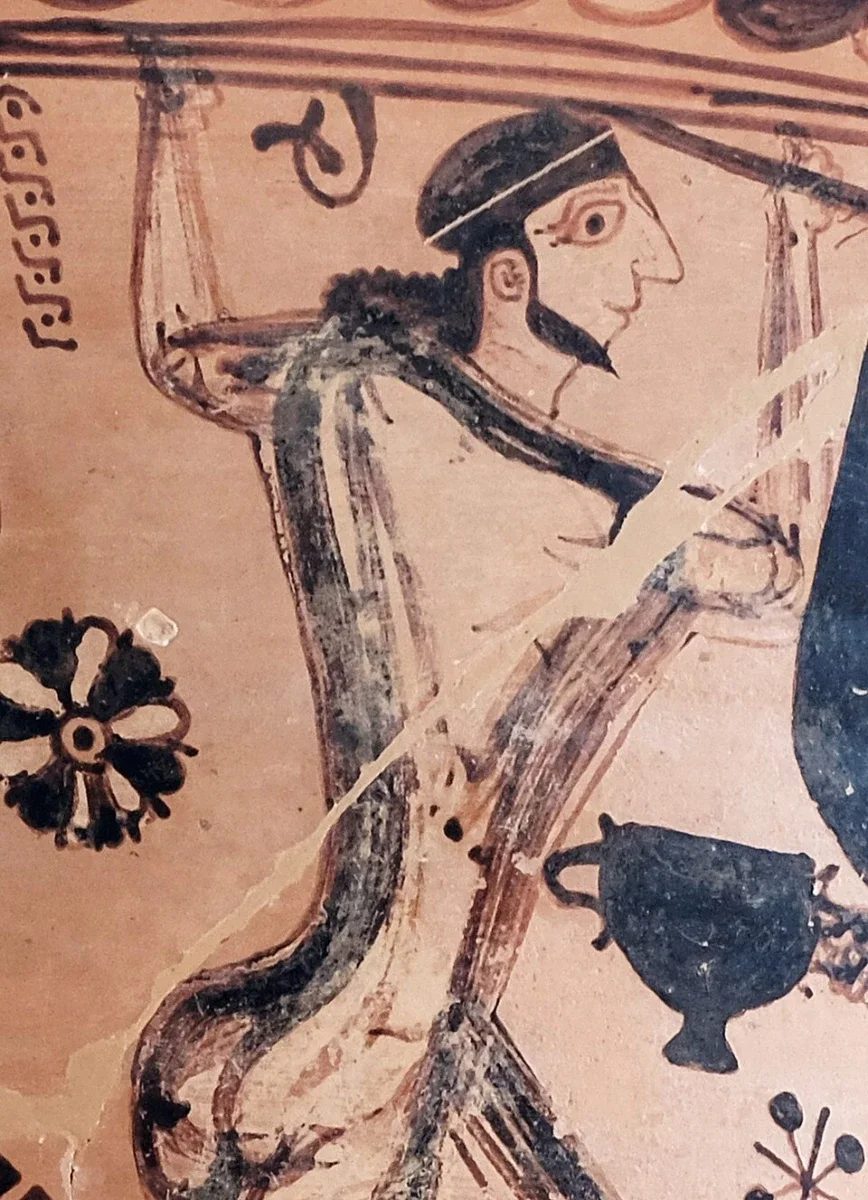
Text and translation
The uninterrupted Greek with its English translation, line by line.
Show text and translation
τὸν δ’ ἀπαμειβόμενος προσέφη πολύμητις Ὀδυσσεύς
Homer · Odyssey 9.1–20 · dactylic hexameters · text of A. T. Murray (Loeb, 1919)
How to read each line
A guide to the Greek, syllables, pitch marks and quantities.
Show the reading key
- Above each line: the line as the edition prints it, each word placed over its own syllables. The main row: the same Greek divided into metrical syllables, each written as it is pronounced. A consonant that closes a syllable is written with it (λόθ | ρο); an elided word is closed up with the next vowel (ν’ἀ); a final consonant carried into the next word is set with a thin space (ς ἰ). Wider gaps mark word-ends.
- Above the syllables: the pitch of each syllable, from the accents. Under them: the quantity of each syllable as it falls in the line, then the transliteration, syllable by syllable, with accented syllables in capitals.
- Under each line: a line-for-line translation. In the right margin of the scansion: the line type, its scheme, and its analysis into cola.
Key to the labels
The names, patterns and symbols used beside this poem.
Show the labels and symbols
The labels in the right margin of the scansion below name the line, its scheme, the feet as the line realises them, and the caesurae and diaereses (the named word-ends) that fall in it. In the scheme ⏔ is a biceps, two shorts that may be contracted to one long; ⏕ is a long that may be resolved into two shorts; × is an anceps, long or short. A click on any syllable highlights its metron or colon, or, with the switch, its foot.
| Label | Name and shape | What it is |
|---|---|---|
| hem1 | First hemiepes— ⏔ — ⏔ — | The first two and a half feet of the hexameter, up to the penthemimeral caesura; in the pentameter, its whole first half. |
| hem2 | Second half of the hexameter⏔ — ⏔ — ⏑ ⏑ — × | From the penthemimeral caesura to the line-end: the fifth foot is nearly always a dactyl, the sixth is — ×. |
The traditional feet
| Foot and shape | Where |
|---|---|
| First foot: dactyl or spondee— ⏔ | Scheme positions 1–2. The biceps (⏑ ⏑) may be contracted to a single long, making a spondee. |
| Second foot: dactyl or spondee— ⏔ | Scheme positions 3–4. |
| Third foot: dactyl or spondee— ⏔ | Scheme positions 5–6. The penthemimeral caesura falls after its first syllable, the “trochaic” caesura after its second. |
| Fourth foot: dactyl or spondee— ⏔ | Scheme positions 7–8. Word-end at the end of this foot, when it is a dactyl, is the bucolic diaeresis (West’s “bucolic caesura”: word-end at the end of the fourth foot after an uncontracted biceps)[9]. |
| Fifth foot: dactyl— ⏑ ⏑ | Scheme positions 9–10. A spondee here (a “spondaic line”) is rare. |
| Sixth foot— × | Scheme positions 11–12: a long and the indifferent final syllable. |
Scansion
Odysseus begins his tale at the court of Alcinous: the passage scanned foot by foot, with each syllable’s quantity and the reason for it, the feet, the caesurae, and a note on every line naming its prosodic licences.
Then Odysseus of many wiles answered him:
“Lord Alcinous, most renowned of all the people,
truly it is a fine thing to listen to a singer
such as this one, like the gods in his voice.
For I say there is no fulfilment more delightful
than when good cheer holds the whole people,
and the banqueters through the hall listen to the singer,
sitting in rows, and the tables beside them are laden
with bread and meat, and the wine-pourer draws wine from the mixing-bowl,
carries it round and pours it into the cups:
this seems to me in my heart the finest thing there is.
But your heart has turned to my grievous sorrows,
to ask about them, so that I may weep and groan still more.
What then shall I tell you first, and what last?
For the gods of heaven have given me many sorrows.
Now first I will tell you my name, so that you too
may know it, and I, if I escape the pitiless day,
may be your guest-friend, though I live in a house far away.
I am Odysseus, son of Laertes, who for all my wiles
am in the minds of men, and my fame reaches heaven.
Metre
- The line. Six feet. Each of the first five is a dactyl (— ⏑ ⏑) or, with its two shorts contracted, a spondee (— —); the sixth is — ×.[10] West calls the long the princeps and the two shorts or their contraction the biceps. Contraction is least common in the fifth foot, about once in 20 lines in Homer,[11] and the poets prefer a dactylic fifth foot;[12] every fifth foot in this passage is a dactyl.
- Caesurae. There is always a word-end in the third foot, after its long (masculine or penthemimeral) or between its shorts (feminine, also called the caesura after the third trochee), the feminine being the more frequent in the proportion 4 : 3; occasionally a long word spans the third foot and the caesura falls after the fourth princeps (hephthemimeral), as in l. 19 here.[13] Word-end after an uncontracted fourth foot is the bucolic caesura;[9] the margin calls it the bucolic diaeresis.
- Wernicke’s Law. Where a word ends after a contracted fourth biceps, it mostly ends in a syllable with a long vowel, and hardly ever in a short vowel left open; a prepositive counts with the word that follows it.[11] The only such word-end here, after the relative ὅς in l. 19, involves a prepositive.
- Hermann’s bridge. No word ends between the two shorts of the fourth biceps, a prepositive being reckoned with the word after it and a postpositive with the word before.[14] No line here has a word-end there.
- Prosody. Elision;[15] epic correption of a final long vowel or diphthong before a vowel;[16] hiatus;[17] stop + liquid, which normally makes position inside a word in early epic, while at the beginning of a word it may or may not.[18] A final short syllable lengthened by the initial stop + liquid of the next word stands mostly in the princeps,[19] as in ll. 2, 8, 11, 14 and 16; in l. 8 the same kind of cluster leaves a syllable short in the biceps.
- Vowel quantities. Every α ι υ that the workbench makes long because the metre needs it has been checked in LSJ (Perseus edition); none is marked short there: λᾱός, καλός (ᾱ in epic), σῖτος, θῡμός, ὀδύρομαι (ῡ), μῡθέομαι, ὑμεῖς (unmarked), Λαέρτης (ᾱ) and ἵκω (ῑ).
- How to read the margin. A word counts as ending after the syllable that holds its last vowel, even when its final consonant passes to the next word’s vowel. A word-end after a contracted fourth foot is labelled as such, not as a bucolic caesura. The line notes say where a prepositive or postpositive means that a written word-end is no real break.
- Murray and Dimock’s text. Compared with the Loeb edition revised by G. E. Dimock: lines 1–20 are the same, except that Οὐρανίωνες (15) is printed with a small letter.[20]
Prosody, line by line
Every syllable, with the reason for its length. Quantities are read from the vowel where the spelling shows it, from the consonants that follow (“position”), from the accent where it tells, and from the metre where nothing else does. Editors’ notes on the text follow in the boxed paragraphs.
- 9.1
Line 9.1 · τὸν δʼ ἀπαμειβόμενος προσέφη πολύμητις Ὀδυσσεύς·
τὸν δʼ ἀπαμειβόμενος προσέφη πολύμητις Ὀδυσσεύς·
τὸνδ’ἀπαμειβόμενοςπροσέφηπολύμητις Ὀδυσσεύς·dactyl, dactyl, dactyl, dactyl, dactyl, — ×; penthemimeral caesura; hephthemimeral caesura.
- 1 —τὸνὸ is short by nature; closed by ν: long by position.
- 2 ⏑δ’ἀἀ is short by the metre (position 2 must be short); the apostrophe marks an elided vowel; the consonant before it joins this syllable; one of the two shorts of the biceps at position 2.
- 3 ⏑παα is short by the metre (position 2 must be short); one of the two shorts of the biceps at position 2.
- 4 —μειει is a diphthong, long by nature.
- 5 ⏑βόό is short by nature; one of the two shorts of the biceps at position 4.
- 6 ⏑μεε is short by nature; one of the two shorts of the biceps at position 4.
- 7 —νοςο is short by nature; closed by ς: long by position.
- 8 ⏑προο is short by nature; one of the two shorts of the biceps at position 6.
- 9 ⏑σέέ is short by nature; one of the two shorts of the biceps at position 6.
- 10 —φηη is long by nature.
- 11 ⏑ποο is short by nature; one of the two shorts of the biceps at position 8.
- 12 ⏑λύύ is short by the metre (position 8 must be short); one of the two shorts of the biceps at position 8.
- 13 —μηη is long by nature.
- 14 ⏑τιι is short by the accent rule: acute on the antepenult requires a short final syllable; one of the two shorts of the biceps at position 10.
- 15 ⏑ς ὈὈ is short by nature; the first consonant belongs to the previous word and is carried over to this vowel; one of the two shorts of the biceps at position 10.
- 16 —δυσυ is a vowel of unknown length; closed by σ: long by position.
- 17 ×σεύς·εύ is a diphthong, long by nature; closed by ς: long by position; the position is anceps.
All five feet are dactyls. πολύμητις Ὀδυσσεύς is one of the fixed formulas that Kiparsky singles out as shaped for the hexameter.[21] δ’ is elided.[15] The caesura is penthemimeral, after ἀπαμειβόμενος, with a hephthemimeral word-end after προσέφη.[10] The formula πολύμητις Ὀδυσσεύς fills the line from that word-end to the end, in keeping with Parry’s observation, reported by Nagy, that the regular word-breaks of the hexameter mark where formulas begin and end.[22]- 9.2
Line 9.2 · Ἀλκίνοε κρεῖον, πάντων ἀριδείκετε λαῶν,
Ἀλκίνοε κρεῖον, πάντων ἀριδείκετε λαῶν,
Ἀλκίνοεκρεῖον,πάντωνἀριδείκετελαῶν,dactyl, spondee, spondee, dactyl, dactyl, — ×; penthemimeral caesura; hephthemimeral caesura.
- 1 —ἈλἈ is a vowel of unknown length; closed by λ: long by position.
- 2 ⏑κίί is short by the metre (position 2 must be short); one of the two shorts of the biceps at position 2.
- 3 ⏑νοο is short by nature; one of the two shorts of the biceps at position 2.
- 4 —εε is short by nature; the next word begins with κρ: the syllable is closed before it: long by position.
- 5 —κρεῖεῖ is a diphthong, long by nature; a single long contracts the two shorts of the biceps at position 4.
- 6 —ον,ο is short by nature; closed by ν: long by position.
- 7 —πάνά is a vowel of unknown length; closed by ν: long by position; a single long contracts the two shorts of the biceps at position 6.
- 8 —τωνω is long by nature.
- 9 ⏑ἀἀ is short by the metre (position 8 must be short); one of the two shorts of the biceps at position 8.
- 10 ⏑ριι is short by the metre (position 8 must be short); one of the two shorts of the biceps at position 8.
- 11 —δείεί is a diphthong, long by nature.
- 12 ⏑κεε is short by nature; one of the two shorts of the biceps at position 10.
- 13 ⏑τεε is short by nature; one of the two shorts of the biceps at position 10.
- 14 —λαα is long by the metre (position 11 must be long).
- 15 ×ῶν,ῶ is long by nature; closed by ν: long by position; the position is anceps.
- 9.3
Line 9.3 · ἦ τοι μὲν τόδε καλὸν ἀκουέμεν ἐστὶν ἀοιδοῦ
ἦ τοι μὲν τόδε καλὸν ἀκουέμεν ἐστὶν ἀοιδοῦ
ἦτοιμὲντόδεκαλὸν ἀκουέμεν ἐστὶν ἀοιδοῦspondee, dactyl, dactyl, dactyl, dactyl, — ×; caesura after the third trochee; bucolic diaeresis.
- 1 —ἦἦ is long by nature.
- 2 —τοιοι is a diphthong, long by nature; a single long contracts the two shorts of the biceps at position 2.
- 3 —μὲνὲ is short by nature; closed by ν: long by position.
- 4 ⏑τόό is short by nature; one of the two shorts of the biceps at position 4.
- 5 ⏑δεε is short by nature; one of the two shorts of the biceps at position 4.
- 6 —καα is long by the metre (position 5 must be long).
- 7 ⏑λὸὸ is short by nature; one of the two shorts of the biceps at position 6.
- 8 ⏑ν ἀἀ is short by the metre (position 6 must be short); the first consonant belongs to the previous word and is carried over to this vowel; one of the two shorts of the biceps at position 6.
- 9 —κουου is a diphthong, long by nature.
- 10 ⏑έέ is short by nature; one of the two shorts of the biceps at position 8.
- 11 ⏑μεε is short by nature; one of the two shorts of the biceps at position 8.
- 12 —ν ἐσἐ is short by nature; closed by σ: long by position; the first consonant belongs to the previous word and is carried over to this vowel.
- 13 ⏑τὶὶ is short by the metre (position 10 must be short); one of the two shorts of the biceps at position 10.
- 14 ⏑ν ἀἀ is short by the metre (position 10 must be short); the first consonant belongs to the previous word and is carried over to this vowel; one of the two shorts of the biceps at position 10.
- 15 —οιοι is a diphthong, long by nature.
- 16 ×δοῦοῦ is a diphthong, long by nature; the position is anceps.
- 9.4
Line 9.4 · τοιοῦδʼ οἷος ὅδʼ ἐστί, θεοῖς ἐναλίγκιος αὐδήν.
τοιοῦδʼ οἷος ὅδʼ ἐστί, θεοῖς ἐναλίγκιος αὐδήν.
τοιοῦδ’οἷος ὅδ’ἐστί,θεοῖςἐναλίγκιος αὐδήν.spondee, dactyl, dactyl, dactyl, dactyl, — ×; caesura after the third trochee; hephthemimeral caesura.
- 1 —τοιοι is a diphthong, long by nature.
- 2 —οῦοῦ is a diphthong, long by nature; a single long contracts the two shorts of the biceps at position 2.
- 3 —δ’οἷοἷ is a diphthong, long by nature; the apostrophe marks an elided vowel; the consonant before it joins this syllable.
- 4 ⏑οο is short by nature; one of the two shorts of the biceps at position 4.
- 5 ⏑ς ὅὅ is short by nature; the first consonant belongs to the previous word and is carried over to this vowel; one of the two shorts of the biceps at position 4.
- 6 —δ’ἐσἐ is short by nature; closed by σ: long by position; the apostrophe marks an elided vowel; the consonant before it joins this syllable.
- 7 ⏑τί,ί is short by the metre (position 6 must be short); one of the two shorts of the biceps at position 6.
- 8 ⏑θεε is short by nature; one of the two shorts of the biceps at position 6.
- 9 —οῖςοῖ is a diphthong, long by nature.
- 10 ⏑ἐἐ is short by nature; one of the two shorts of the biceps at position 8.
- 11 ⏑ναα is short by the metre (position 8 must be short); one of the two shorts of the biceps at position 8.
- 12 —λίγί is a vowel of unknown length; closed by γ: long by position.
- 13 ⏑κιι is short by the metre (position 10 must be short); one of the two shorts of the biceps at position 10.
- 14 ⏑οο is short by nature; one of the two shorts of the biceps at position 10.
- 15 —ς αὐαὐ is a diphthong, long by nature; the first consonant belongs to the previous word and is carried over to this vowel.
- 16 ×δήν.ή is long by nature; closed by ν: long by position; the position is anceps.
A spondee and four dactyls. In τοιοῦδ’ the diphthong οι keeps its length before the vowel that follows it inside the word; West notes that Homer shortens such diphthongs only sometimes.[16] τοιοῦδ’ and ὅδ’ are elided.[15] The caesura is feminine, after ἐστί, with a hephthemimeral word-end after θεοῖς.[10]- 9.5
Line 9.5 · οὐ γὰρ ἐγώ γέ τί φημι τέλος χαριέστερον εἶναι
οὐ γὰρ ἐγώ γέ τί φημι τέλος χαριέστερον εἶναι
οὐγὰρ ἐγώγέτίφημιτέλοςχαριέστερον εἶναιdactyl, dactyl, dactyl, dactyl, dactyl, — ×; caesura after the third trochee; hephthemimeral caesura.
- 1 —οὐοὐ is a diphthong, long by nature.
- 2 ⏑γὰὰ is short by the metre (position 2 must be short); one of the two shorts of the biceps at position 2.
- 3 ⏑ρ ἐἐ is short by nature; the first consonant belongs to the previous word and is carried over to this vowel; one of the two shorts of the biceps at position 2.
- 4 —γώώ is long by nature.
- 5 ⏑γέέ is short by nature; one of the two shorts of the biceps at position 4.
- 6 ⏑τίί is short by the metre (position 4 must be short); one of the two shorts of the biceps at position 4.
- 7 —φηη is long by nature.
- 8 ⏑μιι is short by the metre (position 6 must be short); one of the two shorts of the biceps at position 6.
- 9 ⏑τέέ is short by nature; one of the two shorts of the biceps at position 6.
- 10 —λοςο is short by nature; closed by ς: long by position.
- 11 ⏑χαα is short by the metre (position 8 must be short); one of the two shorts of the biceps at position 8.
- 12 ⏑ριι is short by the metre (position 8 must be short); one of the two shorts of the biceps at position 8.
- 13 —έσέ is short by nature; closed by σ: long by position.
- 14 ⏑τεε is short by nature; one of the two shorts of the biceps at position 10.
- 15 ⏑ροο is short by nature; one of the two shorts of the biceps at position 10.
- 16 —ν εἶεἶ is a diphthong, long by nature; the first consonant belongs to the previous word and is carried over to this vowel.
- 17 ×ναιαι is a diphthong, long by nature; the position is anceps.
All five feet are dactyls. The caesura is feminine, after φημι, with a hephthemimeral word-end after τέλος.[10] χαριέστερον then runs from the fourth foot into the fifth.- 9.6
Line 9.6 · ἢ ὅτʼ ἐυφροσύνη μὲν ἔχῃ κάτα δῆμον ἅπαντα,
ἢ ὅτʼ ἐυφροσύνη μὲν ἔχῃ κάτα δῆμον ἅπαντα,
ἢὅτ’ἐυφροσύνημὲν ἔχῃκάταδῆμον ἅπαντα,dactyl, dactyl, dactyl, dactyl, dactyl, — ×; penthemimeral caesura; caesura after the third trochee; hephthemimeral caesura; bucolic diaeresis.
- 1 —ἢἢ is long by nature; the next word begins with a vowel and nothing is elided: hiatus.
- 2 ⏑ὅὅ is short by nature; one of the two shorts of the biceps at position 2.
- 3 ⏑τ’ἐἐ is short by nature; the apostrophe marks an elided vowel; the consonant before it joins this syllable; one of the two shorts of the biceps at position 2.
- 4 —υφυ is a vowel of unknown length; closed by φ before a liquid: stop + liquid makes position, as it usually does in epic.
- 5 ⏑ροο is short by nature; one of the two shorts of the biceps at position 4.
- 6 ⏑σύύ is short by the metre (position 4 must be short); one of the two shorts of the biceps at position 4.
- 7 —νηη is long by nature.
- 8 ⏑μὲὲ is short by nature; one of the two shorts of the biceps at position 6.
- 9 ⏑ν ἔἔ is short by nature; the first consonant belongs to the previous word and is carried over to this vowel; one of the two shorts of the biceps at position 6.
- 10 —χῃῃ is long by nature.
- 11 ⏑κάά is short by the metre (position 8 must be short); one of the two shorts of the biceps at position 8.
- 12 ⏑ταα is short by the metre (position 8 must be short); one of the two shorts of the biceps at position 8.
- 13 —δῆῆ is long by nature.
- 14 ⏑μοο is short by nature; one of the two shorts of the biceps at position 10.
- 15 ⏑ν ἅἅ is short by the metre (position 10 must be short); the first consonant belongs to the previous word and is carried over to this vowel; one of the two shorts of the biceps at position 10.
- 16 —πανα is a vowel of unknown length; closed by ν: long by position.
- 17 ×τα,α is short by the accent rule: acute on the antepenult requires a short final syllable; the position is anceps.
All five feet are dactyls. ἤ keeps its long vowel before ὅτ’ in the first princeps: West notes that hiatus after ἤ occurs in epic and may really be an elided ἠέ.[23] ὅτ’ is elided.[15] In ἐυφροσύνη the ε and the υ are separate syllables, as Murray’s breathing on the ε shows (LSJ writes the epic form ἐϋφροσύνη), and the φρ makes position.[18] The written word-end after ἐυφροσύνη is followed by the postpositive μέν, so the real caesura is the feminine one after μέν.[24] A hephthemimeral word-end follows after ἔχῃ.[10] The written word-end after κάτα falls before δῆμον, the noun the preposition governs, so it is no real bucolic caesura.[14]- 9.7
Line 9.7 · δαιτυμόνες δʼ ἀνὰ δώματʼ ἀκουάζωνται ἀοιδοῦ
δαιτυμόνες δʼ ἀνὰ δώματʼ ἀκουάζωνται ἀοιδοῦ
δαιτυμόνεςδ’ἀνὰδώματ’ἀκουάζωνταιἀοιδοῦdactyl, dactyl, dactyl, spondee, dactyl, — ×; caesura after the third trochee (with elision).
- 1 —δαιαι is a diphthong, long by nature.
- 2 ⏑τυυ is short by the metre (position 2 must be short); one of the two shorts of the biceps at position 2.
- 3 ⏑μόό is short by nature; one of the two shorts of the biceps at position 2.
- 4 —νεςε is short by nature; closed by ς: long by position.
- 5 ⏑δ’ἀἀ is short by the metre (position 4 must be short); the apostrophe marks an elided vowel; the consonant before it joins this syllable; one of the two shorts of the biceps at position 4.
- 6 ⏑νὰὰ is short by the metre (position 4 must be short); one of the two shorts of the biceps at position 4.
- 7 —δώώ is long by nature.
- 8 ⏑μαα is short by the metre (position 6 must be short); one of the two shorts of the biceps at position 6.
- 9 ⏑τ’ἀἀ is short by the metre (position 6 must be short); the apostrophe marks an elided vowel; the consonant before it joins this syllable; one of the two shorts of the biceps at position 6.
- 10 —κουου is a diphthong, long by nature.
- 11 —άζ is a double consonant (two sounds) and closes the syllable: long by position; a single long contracts the two shorts of the biceps at position 8.
- 12 —ζωνω is long by nature; closed by ν: long by position.
- 13 ⏑ταιαι is a diphthong, long by nature; shortened before the vowel that begins the next word (epic correption), as the metre requires; one of the two shorts of the biceps at position 10.
- 14 ⏑ἀἀ is short by the metre (position 10 must be short); one of the two shorts of the biceps at position 10.
- 15 —οιοι is a diphthong, long by nature.
- 16 ×δοῦοῦ is a diphthong, long by nature; the position is anceps.
Three dactyls, a spondee and a dactyl. δ’ and δώματ’ are elided;[15] the word-end after δώματ’ is the feminine caesura, with elision.[10] In ἀκουάζωνται the syllable before ζ is long by position, ζ counting as two consonants;[25] it fills the contracted fourth biceps, and -ται is shortened before ἀοιδοῦ by epic correption.[16]- 9.8
Line 9.8 · ἥμενοι ἑξείης, παρὰ δὲ πλήθωσι τράπεζαι
ἥμενοι ἑξείης, παρὰ δὲ πλήθωσι τράπεζαι
ἥμενοιἑξείης,παρὰδὲπλήθωσιτράπεζαιdactyl, spondee, dactyl, spondee, dactyl, — ×; penthemimeral caesura; hephthemimeral caesura.
- 1 —ἥἥ is long by nature.
- 2 ⏑μεε is short by nature; one of the two shorts of the biceps at position 2.
- 3 ⏑νοιοι is a diphthong, long by nature; shortened before the vowel that begins the next word (epic correption), as the metre requires; one of the two shorts of the biceps at position 2.
- 4 —ἑἑ is short by nature; ξ is a double consonant (two sounds) and closes the syllable: long by position.
- 5 —ξείεί is a diphthong, long by nature; a single long contracts the two shorts of the biceps at position 4.
- 6 —ης,η is long by nature; closed by ς: long by position.
- 7 ⏑παα is short by the metre (position 6 must be short); one of the two shorts of the biceps at position 6.
- 8 ⏑ρὰὰ is short by the metre (position 6 must be short); one of the two shorts of the biceps at position 6.
- 9 —δὲὲ is short by nature; the next word begins with πλ: the syllable is closed before it: long by position.
- 10 —πλήή is long by nature; a single long contracts the two shorts of the biceps at position 8.
- 11 —θωω is long by nature.
- 12 ⏑σιι is short by the accent rule (the accent falls too far back for a long final syllable); the next word begins with τρ, a stop + liquid that does not make position here, so the syllable stays short; one of the two shorts of the biceps at position 10.
- 13 ⏑τράά is short by the metre (position 10 must be short); one of the two shorts of the biceps at position 10.
- 14 —πεε is short by nature; ζ is a double consonant (two sounds) and closes the syllable: long by position.
- 15 ×ζαιαι is a diphthong, long by nature; the position is anceps.
A dactyl, a spondee, a dactyl, a spondee and a dactyl. -νοι of ἥμενοι is shortened before ἑξείης by epic correption.[16] The caesura is penthemimeral, at the comma after ἑξείης;[10] ἑξείης has three long syllables and stands so that only one contraction is needed, — ⏔ —.[11] δέ is long by position before the initial πλ- of πλήθωσι in the fourth princeps, giving a hephthemimeral word-end.[26] The last syllable of πλήθωσι, by contrast, stays short before the initial τρ- of τράπεζαι, in the fifth biceps: at the beginning of a word a stop + liquid need not make position.[23]- 9.9
Line 9.9 · σίτου καὶ κρειῶν, μέθυ δʼ ἐκ κρητῆρος ἀφύσσων
σίτου καὶ κρειῶν, μέθυ δʼ ἐκ κρητῆρος ἀφύσσων
σίτουκαὶκρειῶν,μέθυδ’ἐκκρητῆρος ἀφύσσωνspondee, spondee, dactyl, spondee, dactyl, — ×; penthemimeral caesura; hephthemimeral caesura.
- 1 —σίί is long by the metre (position 1 must be long).
- 2 —τουου is a diphthong, long by nature; a single long contracts the two shorts of the biceps at position 2.
- 3 —καὶαὶ is a diphthong, long by nature; the next word begins with κρ: the syllable is closed before it: long by position.
- 4 —κρειει is a diphthong, long by nature; a single long contracts the two shorts of the biceps at position 4.
- 5 —ῶν,ῶ is long by nature; closed by ν: long by position.
- 6 ⏑μέέ is short by nature; one of the two shorts of the biceps at position 6.
- 7 ⏑θυυ is short by the metre (position 6 must be short); one of the two shorts of the biceps at position 6.
- 8 —δ’ἐκἐ is short by nature; closed by κ: long by position; the apostrophe marks an elided vowel; the consonant before it joins this syllable.
- 9 —κρηη is long by nature; a single long contracts the two shorts of the biceps at position 8.
- 10 —τῆῆ is long by nature.
- 11 ⏑ροο is short by nature; one of the two shorts of the biceps at position 10.
- 12 ⏑ς ἀἀ is short by the metre (position 10 must be short); the first consonant belongs to the previous word and is carried over to this vowel; one of the two shorts of the biceps at position 10.
- 13 —φύσύ is a vowel of unknown length; closed by σ: long by position.
- 14 ×σωνω is long by nature; closed by ν: long by position; the position is anceps.
- 9.10
Line 9.10 · οἰνοχόος φορέῃσι καὶ ἐγχείῃ δεπάεσσι·
οἰνοχόος φορέῃσι καὶ ἐγχείῃ δεπάεσσι·
οἰνοχόοςφορέῃσικαὶἐγχείῃδεπάεσσι·dactyl, dactyl, dactyl, spondee, dactyl, — ×; caesura after the third trochee.
- 1 —οἰοἰ is a diphthong, long by nature.
- 2 ⏑νοο is short by nature; one of the two shorts of the biceps at position 2.
- 3 ⏑χόό is short by nature; one of the two shorts of the biceps at position 2.
- 4 —οςο is short by nature; closed by ς: long by position.
- 5 ⏑φοο is short by nature; one of the two shorts of the biceps at position 4.
- 6 ⏑ρέέ is short by nature; one of the two shorts of the biceps at position 4.
- 7 —ῃῃ is long by nature.
- 8 ⏑σιι is short by the accent rule: acute on the antepenult requires a short final syllable; one of the two shorts of the biceps at position 6.
- 9 ⏑καὶαὶ is a diphthong, long by nature; shortened before the vowel that begins the next word (epic correption), as the metre requires; one of the two shorts of the biceps at position 6.
- 10 —ἐγἐ is short by nature; closed by γ: long by position.
- 11 —χείεί is a diphthong, long by nature; a single long contracts the two shorts of the biceps at position 8.
- 12 —ῃῃ is long by nature.
- 13 ⏑δεε is short by nature; one of the two shorts of the biceps at position 10.
- 14 ⏑πάά is short by the metre (position 10 must be short); one of the two shorts of the biceps at position 10.
- 15 —εσε is short by nature; closed by σ: long by position.
- 16 ×σι·ι is short by the accent rule: acute on the antepenult requires a short final syllable; the position is anceps.
- 9.11
Line 9.11 · τοῦτό τί μοι κάλλιστον ἐνὶ φρεσὶν εἴδεται εἶναι.
τοῦτό τί μοι κάλλιστον ἐνὶ φρεσὶν εἴδεται εἶναι.
τοῦτότίμοικάλλιστον ἐνὶφρεσὶν εἴδεταιεἶναι.dactyl, spondee, dactyl, dactyl, dactyl, — ×; caesura after the third trochee; hephthemimeral caesura; bucolic diaeresis.
- 1 —τοῦοῦ is a diphthong, long by nature.
- 2 ⏑τόό is short by nature; one of the two shorts of the biceps at position 2.
- 3 ⏑τίί is short by the metre (position 2 must be short); one of the two shorts of the biceps at position 2.
- 4 —μοιοι is a diphthong, long by nature.
- 5 —κάλά is a vowel of unknown length; closed by λ: long by position; a single long contracts the two shorts of the biceps at position 4.
- 6 —λισι is a vowel of unknown length; closed by σ: long by position.
- 7 ⏑τοο is short by nature; one of the two shorts of the biceps at position 6.
- 8 ⏑ν ἐἐ is short by nature; the first consonant belongs to the previous word and is carried over to this vowel; one of the two shorts of the biceps at position 6.
- 9 —νὶὶ is a vowel of unknown length; the next word begins with φρ: the syllable is closed before it: long by position.
- 10 ⏑φρεε is short by nature; one of the two shorts of the biceps at position 8.
- 11 ⏑σὶὶ is short by the metre (position 8 must be short); one of the two shorts of the biceps at position 8.
- 12 —ν εἴεἴ is a diphthong, long by nature; the first consonant belongs to the previous word and is carried over to this vowel.
- 13 ⏑δεε is short by nature; one of the two shorts of the biceps at position 10.
- 14 ⏑ταιαι is a diphthong, long by nature; shortened before the vowel that begins the next word (epic correption), as the metre requires; one of the two shorts of the biceps at position 10.
- 15 —εἶεἶ is a diphthong, long by nature.
- 16 ×ναι.αι is a diphthong, long by nature; the position is anceps.
A dactyl, a spondee and three dactyls. The ν of κάλλιστον passes to ἐνί, but the word ends between the shorts of the third foot: a feminine caesura.[10] The last syllable of ἐνί is long by position before the initial φρ- of φρεσίν in the fourth princeps;[19] as a preposition it goes with φρεσίν, so the word-end after it is no real hephthemimeral caesura.[14] Word-end after φρεσίν is the bucolic caesura.[9] εἴδεται belongs with εἶδος, which West lists among words that began with ϝ,[27] but here the ν of φρεσίν passes to it and -σι- stays short: the lost consonant is not observed.[28] -ται is shortened before εἶναι by epic correption.[16]- 9.12
Line 9.12 · σοὶ δʼ ἐμὰ κήδεα θυμὸς ἐπετράπετο στονόεντα
σοὶ δʼ ἐμὰ κήδεα θυμὸς ἐπετράπετο στονόεντα
σοὶδ’ἐμὰκήδεαθυμὸς ἐπετράπετοστονόενταdactyl, dactyl, dactyl, dactyl, dactyl, — ×; caesura after the third trochee.
- 1 —σοὶοὶ is a diphthong, long by nature.
- 2 ⏑δ’ἐἐ is short by nature; the apostrophe marks an elided vowel; the consonant before it joins this syllable; one of the two shorts of the biceps at position 2.
- 3 ⏑μὰὰ is short by the metre (position 2 must be short); one of the two shorts of the biceps at position 2.
- 4 —κήή is long by nature.
- 5 ⏑δεε is short by nature; one of the two shorts of the biceps at position 4.
- 6 ⏑αα is short by the accent rule: acute on the antepenult requires a short final syllable; one of the two shorts of the biceps at position 4.
- 7 —θυυ is long by the metre (position 5 must be long).
- 8 ⏑μὸὸ is short by nature; one of the two shorts of the biceps at position 6.
- 9 ⏑ς ἐἐ is short by nature; the first consonant belongs to the previous word and is carried over to this vowel; one of the two shorts of the biceps at position 6.
- 10 —πετε is short by nature; closed by τ before a liquid: stop + liquid makes position, as it usually does in epic.
- 11 ⏑ράά is short by the metre (position 8 must be short); one of the two shorts of the biceps at position 8.
- 12 ⏑πεε is short by nature; one of the two shorts of the biceps at position 8.
- 13 —τοο is short by nature; the next word begins with στ: the syllable is closed before it: long by position.
- 14 ⏑στοο is short by nature; one of the two shorts of the biceps at position 10.
- 15 ⏑νόό is short by nature; one of the two shorts of the biceps at position 10.
- 16 —ενε is short by nature; closed by ν: long by position.
- 17 ×ταα is short by the accent rule: acute on the antepenult requires a short final syllable; the position is anceps.
All five feet are dactyls. δ’ is elided.[15] The ς of θυμός passes to ἐπετράπετο, but the word ends between the shorts of the third foot: a feminine caesura.[10] The τρ of ἐπετράπετο makes position in the fourth princeps,[18] and its last syllable is long before the στ- of στονόεντα in the fifth princeps.[29] ἐπετράπετο runs from the third foot into the fifth, so there is no hephthemimeral or bucolic word-end.- 9.13
Line 9.13 · εἴρεσθʼ, ὄφρʼ ἔτι μᾶλλον ὀδυρόμενος στεναχίζω·
εἴρεσθʼ, ὄφρʼ ἔτι μᾶλλον ὀδυρόμενος στεναχίζω·
εἴρεσθ’,ὄφρ’ἔτιμᾶλλον ὀδυρόμενοςστεναχίζω·spondee, dactyl, dactyl, dactyl, dactyl, — ×; caesura after the third trochee.
- 1 —εἴεἴ is a diphthong, long by nature.
- 2 —ρεσε is short by nature; closed by σ: long by position; a single long contracts the two shorts of the biceps at position 2.
- 3 —θ’,ὄφὄ is short by nature; closed by φ before a liquid: stop + liquid makes position, as it usually does in epic; the apostrophe marks an elided vowel; the consonant before it joins this syllable.
- 4 ⏑ρ’ἔἔ is short by nature; the apostrophe marks an elided vowel; the consonant before it joins this syllable; one of the two shorts of the biceps at position 4.
- 5 ⏑τιι is short by the metre (position 4 must be short); one of the two shorts of the biceps at position 4.
- 6 —μᾶλᾶ carries a circumflex, so it is long; closed by λ: long by position.
- 7 ⏑λοο is short by nature; one of the two shorts of the biceps at position 6.
- 8 ⏑ν ὀὀ is short by nature; the first consonant belongs to the previous word and is carried over to this vowel; one of the two shorts of the biceps at position 6.
- 9 —δυυ is long by the metre (position 7 must be long).
- 10 ⏑ρόό is short by nature; one of the two shorts of the biceps at position 8.
- 11 ⏑μεε is short by nature; one of the two shorts of the biceps at position 8.
- 12 —νοςο is short by nature; closed by ς: long by position.
- 13 ⏑στεε is short by nature; one of the two shorts of the biceps at position 10.
- 14 ⏑ναα is short by the metre (position 10 must be short); one of the two shorts of the biceps at position 10.
- 15 —χίζ is a double consonant (two sounds) and closes the syllable: long by position.
- 16 ×ζω·ω is long by nature; the position is anceps.
A spondee and four dactyls. εἴρεσθ’ and ὄφρ’ are elided.[15] The φρ of ὄφρ’ makes position inside the word, so the syllable θ’ ὀφ- is long in the second princeps.[18] The ν of μᾶλλον passes to ὀδυρόμενος, but the word ends between the shorts of the third foot: a feminine caesura.[10] ὀδυρόμενος, whose υ is long by nature,[30] then runs into the fifth foot.- 9.14
Line 9.14 · τί πρῶτόν τοι ἔπειτα, τί δʼ ὑστάτιον καταλέξω;
τί πρῶτόν τοι ἔπειτα, τί δʼ ὑστάτιον καταλέξω;
τίπρῶτόντοιἔπειτα,τίδ’ὑστάτιονκαταλέξω;spondee, dactyl, dactyl, dactyl, dactyl, — ×; caesura after the third trochee.
- 1 —τίί is a vowel of unknown length; the next word begins with πρ: the syllable is closed before it: long by position.
- 2 —πρῶῶ is long by nature; a single long contracts the two shorts of the biceps at position 2.
- 3 —τόνό is short by nature; closed by ν: long by position.
- 4 ⏑τοιοι is a diphthong, long by nature; shortened before the vowel that begins the next word (epic correption), as the metre requires; one of the two shorts of the biceps at position 4.
- 5 ⏑ἔἔ is short by nature; one of the two shorts of the biceps at position 4.
- 6 —πειει is a diphthong, long by nature.
- 7 ⏑τα,α is short by the accent rule: acute on the antepenult requires a short final syllable; one of the two shorts of the biceps at position 6.
- 8 ⏑τίί is short by the metre (position 6 must be short); one of the two shorts of the biceps at position 6.
- 9 —δ’ὑσὑ is a vowel of unknown length; closed by σ: long by position; the apostrophe marks an elided vowel; the consonant before it joins this syllable.
- 10 ⏑τάά is short by the metre (position 8 must be short); one of the two shorts of the biceps at position 8.
- 11 ⏑τιι is short by the metre (position 8 must be short); one of the two shorts of the biceps at position 8.
- 12 —ονο is short by nature; closed by ν: long by position.
- 13 ⏑καα is short by the metre (position 10 must be short); one of the two shorts of the biceps at position 10.
- 14 ⏑ταα is short by the metre (position 10 must be short); one of the two shorts of the biceps at position 10.
- 15 —λέέ is short by nature; ξ is a double consonant (two sounds) and closes the syllable: long by position.
- 16 ×ξω;ω is long by nature; the position is anceps.
- 9.15
Line 9.15 · κήδεʼ ἐπεί μοι πολλὰ δόσαν θεοὶ Οὐρανίωνες.
κήδεʼ ἐπεί μοι πολλὰ δόσαν θεοὶ Οὐρανίωνες.
κήδε’ἐπείμοιπολλὰδόσανθεοὶΟὐρανίωνες.dactyl, spondee, dactyl, dactyl, dactyl, — ×; caesura after the third trochee; hephthemimeral caesura; bucolic diaeresis.
- 1 —κήή is long by nature.
- 2 ⏑δε’ε is short by nature; the apostrophe marks an elided vowel; the consonant before it joins this syllable; one of the two shorts of the biceps at position 2.
- 3 ⏑ἐἐ is short by nature; one of the two shorts of the biceps at position 2.
- 4 —πείεί is a diphthong, long by nature.
- 5 —μοιοι is a diphthong, long by nature; a single long contracts the two shorts of the biceps at position 4.
- 6 —πολο is short by nature; closed by λ: long by position.
- 7 ⏑λὰὰ is short by the metre (position 6 must be short); one of the two shorts of the biceps at position 6.
- 8 ⏑δόό is short by nature; one of the two shorts of the biceps at position 6.
- 9 —σανα is a vowel of unknown length; closed by ν: long by position.
- 10 ⏑θεε is short by nature; one of the two shorts of the biceps at position 8.
- 11 ⏑οὶοὶ is a diphthong, long by nature; shortened before the vowel that begins the next word (epic correption), as the metre requires; one of the two shorts of the biceps at position 8.
- 12 —ΟὐΟὐ is a diphthong, long by nature.
- 13 ⏑ραα is short by the metre (position 10 must be short); one of the two shorts of the biceps at position 10.
- 14 ⏑νίί is short by the metre (position 10 must be short); one of the two shorts of the biceps at position 10.
- 15 —ωω is long by nature.
- 16 ×νες.ε is short by nature; closed by ς: long by position; the position is anceps.
A dactyl, a spondee and three dactyls. κήδε’ (κήδεα) is elided.[15] The caesura is feminine, after πολλά, with word-ends at the hephthemimeral place, after δόσαν, and at the bucolic caesura, after θεοί.[31] θεοί has two syllables here, and its -οί is shortened before Οὐρανίωνες by epic correption.[16]- 9.16
Line 9.16 · νῦν δʼ ὄνομα πρῶτον μυθήσομαι, ὄφρα καὶ ὑμεῖς
νῦν δʼ ὄνομα πρῶτον μυθήσομαι, ὄφρα καὶ ὑμεῖς
νῦνδ’ὄνομαπρῶτονμυθήσομαι,ὄφρακαὶὑμεῖςdactyl, spondee, spondee, dactyl, dactyl, — ×; penthemimeral caesura; bucolic diaeresis.
- 1 —νῦνῦ carries a circumflex, so it is long; closed by ν: long by position.
- 2 ⏑δ’ὄὄ is short by nature; the apostrophe marks an elided vowel; the consonant before it joins this syllable; one of the two shorts of the biceps at position 2.
- 3 ⏑νοο is short by nature; one of the two shorts of the biceps at position 2.
- 4 —μαα is short by the accent rule (the accent falls too far back for a long final syllable); the next word begins with πρ: the syllable is closed before it: long by position.
- 5 —πρῶῶ is long by nature; a single long contracts the two shorts of the biceps at position 4.
- 6 —τονο is short by nature; closed by ν: long by position.
- 7 —μυυ is long by the metre (position 6 must be long); a single long contracts the two shorts of the biceps at position 6.
- 8 —θήή is long by nature.
- 9 ⏑σοο is short by nature; one of the two shorts of the biceps at position 8.
- 10 ⏑μαι,αι is a diphthong, long by nature; shortened before the vowel that begins the next word (epic correption), as the metre requires; one of the two shorts of the biceps at position 8.
- 11 —ὄφὄ is short by nature; closed by φ before a liquid: stop + liquid makes position, as it usually does in epic.
- 12 ⏑ραα is short by the metre (position 10 must be short); one of the two shorts of the biceps at position 10.
- 13 ⏑καὶαὶ is a diphthong, long by nature; shortened before the vowel that begins the next word (epic correption), as the metre requires; one of the two shorts of the biceps at position 10.
- 14 —ὑὑ is long by the metre (position 11 must be long).
- 15 ×μεῖςεῖ is a diphthong, long by nature; closed by ς: long by position; the position is anceps.
A dactyl, two spondees and two dactyls. ὄνομα, a word of three shorts that West lists among those Homer can lengthen to οὔνομα,[9] fits here unchanged: its last syllable is made long by the initial πρ- of πρῶτον in the second princeps.[19] δ’ is elided.[15] The caesura is penthemimeral, after πρῶτον.[10] -μαι of μυθήσομαι is shortened before ὄφρα by epic correption,[16] and the word-end after it is the bucolic caesura.[9] The φρ of ὄφρα makes position, and καί is shortened before ὑμεῖς.[32]- 9.17
Line 9.17 · εἴδετʼ, ἐγὼ δʼ ἂν ἔπειτα φυγὼν ὕπο νηλεὲς ἦμαρ
εἴδετʼ, ἐγὼ δʼ ἂν ἔπειτα φυγὼν ὕπο νηλεὲς ἦμαρ
εἴδετ’,ἐγὼδ’ἂν ἔπειταφυγὼνὕπονηλεὲς ἦμαρdactyl, dactyl, dactyl, dactyl, dactyl, — ×; caesura after the third trochee; hephthemimeral caesura; bucolic diaeresis.
- 1 —εἴεἴ is a diphthong, long by nature.
- 2 ⏑δεε is short by nature; one of the two shorts of the biceps at position 2.
- 3 ⏑τ’,ἐἐ is short by nature; the apostrophe marks an elided vowel; the consonant before it joins this syllable; one of the two shorts of the biceps at position 2.
- 4 —γὼὼ is long by nature.
- 5 ⏑δ’ἂἂ is short by the metre (position 4 must be short); the apostrophe marks an elided vowel; the consonant before it joins this syllable; one of the two shorts of the biceps at position 4.
- 6 ⏑ν ἔἔ is short by nature; the first consonant belongs to the previous word and is carried over to this vowel; one of the two shorts of the biceps at position 4.
- 7 —πειει is a diphthong, long by nature.
- 8 ⏑ταα is short by the accent rule: acute on the antepenult requires a short final syllable; one of the two shorts of the biceps at position 6.
- 9 ⏑φυυ is short by the metre (position 6 must be short); one of the two shorts of the biceps at position 6.
- 10 —γὼνὼ is long by nature.
- 11 ⏑ὕὕ is short by the metre (position 8 must be short); one of the two shorts of the biceps at position 8.
- 12 ⏑ποο is short by nature; one of the two shorts of the biceps at position 8.
- 13 —νηη is long by nature.
- 14 ⏑λεε is short by nature; one of the two shorts of the biceps at position 10.
- 15 ⏑ὲὲ is short by nature; one of the two shorts of the biceps at position 10.
- 16 —ς ἦἦ is long by nature; the first consonant belongs to the previous word and is carried over to this vowel.
- 17 ×μαρα is a vowel of unknown length; closed by ρ: long by position; the position is anceps.
- 9.18
Line 9.18 · ὑμῖν ξεῖνος ἔω καὶ ἀπόπροθι δώματα ναίων.
ὑμῖν ξεῖνος ἔω καὶ ἀπόπροθι δώματα ναίων.
ὑμῖνξεῖνος ἔωκαὶἀπόπροθιδώματαναίων.spondee, dactyl, dactyl, dactyl, dactyl, — ×; penthemimeral caesura; caesura after the third trochee; bucolic diaeresis.
- 1 —ὑὑ is long by the metre (position 1 must be long).
- 2 —μῖνῖ carries a circumflex, so it is long; closed by ν: long by position; a single long contracts the two shorts of the biceps at position 2.
- 3 —ξεῖεῖ is a diphthong, long by nature.
- 4 ⏑νοο is short by nature; one of the two shorts of the biceps at position 4.
- 5 ⏑ς ἔἔ is short by nature; the first consonant belongs to the previous word and is carried over to this vowel; one of the two shorts of the biceps at position 4.
- 6 —ωω is long by nature.
- 7 ⏑καὶαὶ is a diphthong, long by nature; shortened before the vowel that begins the next word (epic correption), as the metre requires; one of the two shorts of the biceps at position 6.
- 8 ⏑ἀἀ is short by the metre (position 6 must be short); one of the two shorts of the biceps at position 6.
- 9 —πόπό is short by nature; closed by π before a liquid: stop + liquid makes position, as it usually does in epic.
- 10 ⏑ροο is short by nature; one of the two shorts of the biceps at position 8.
- 11 ⏑θιι is short by the accent rule: acute on the antepenult requires a short final syllable; one of the two shorts of the biceps at position 8.
- 12 —δώώ is long by nature.
- 13 ⏑μαα is short by the metre (position 10 must be short); one of the two shorts of the biceps at position 10.
- 14 ⏑ταα is short by the accent rule: acute on the antepenult requires a short final syllable; one of the two shorts of the biceps at position 10.
- 15 —ναίαί is a diphthong, long by nature.
- 16 ×ων.ω is long by nature; closed by ν: long by position; the position is anceps.
A spondee and four dactyls. The caesura is penthemimeral, after ἔω;[10] the written word-end after καί is no feminine caesura, καί being a prepositive.[14] καί is shortened before ἀπόπροθι by epic correption.[16] The πρ of ἀπόπροθι makes position in the fourth princeps,[18] and word-end after ἀπόπροθι is the bucolic caesura.[9]- 9.19
Line 9.19 · εἴμʼ Ὀδυσεὺς Λαερτιάδης, ὃς πᾶσι δόλοισιν
εἴμʼ Ὀδυσεὺς Λαερτιάδης, ὃς πᾶσι δόλοισιν
εἴμ’ὈδυσεὺςΛαερτιάδης,ὃςπᾶσιδόλοισινdactyl, spondee, dactyl, spondee, dactyl, — ×; hephthemimeral caesura; word-end after a spondaic fourth foot.
- 1 —εἴεἴ is a diphthong, long by nature.
- 2 ⏑μ’ὈὈ is short by nature; the apostrophe marks an elided vowel; the consonant before it joins this syllable; one of the two shorts of the biceps at position 2.
- 3 ⏑δυυ is short by the metre (position 2 must be short); one of the two shorts of the biceps at position 2.
- 4 —σεὺςεὺ is a diphthong, long by nature; closed by ς: long by position.
- 5 —Λαα is long by the metre (position 4 must be long); a single long contracts the two shorts of the biceps at position 4.
- 6 —ερε is short by nature; closed by ρ: long by position.
- 7 ⏑τιι is short by the metre (position 6 must be short); one of the two shorts of the biceps at position 6.
- 8 ⏑άά is short by the metre (position 6 must be short); one of the two shorts of the biceps at position 6.
- 9 —δης,η is long by nature.
- 10 —ὃςὃ is short by nature; closed by ς: long by position; a single long contracts the two shorts of the biceps at position 8.
- 11 —πᾶᾶ carries a circumflex, so it is long.
- 12 ⏑σιι is short by the accent rule: circumflex on the penult requires a short final syllable; one of the two shorts of the biceps at position 10.
- 13 ⏑δόό is short by nature; one of the two shorts of the biceps at position 10.
- 14 —λοιοι is a diphthong, long by nature.
- 15 ×σινι is a vowel of unknown length; closed by ν: long by position; the position is anceps.
A dactyl, a spondee, a dactyl, a spondee and a dactyl. There is no word-end in the third foot: Λαερτιάδης runs across it, and the caesura is the hephthemimeral one after the name, the case West describes as occasional.[10] εἴμ’ is elided.[15] The word-end after ὅς follows a contracted fourth foot, so it is no bucolic caesura;[9] ὅς is a prepositive and counts with πᾶσι, so Wernicke’s Law is kept.[33] The α of Λαερτιάδης, in the contracted second biceps, is long by nature.[34]- 9.20
Line 9.20 · ἀνθρώποισι μέλω, καί μευ κλέος οὐρανὸν ἵκει.
ἀνθρώποισι μέλω, καί μευ κλέος οὐρανὸν ἵκει.
ἀνθρώποισιμέλω,καίμευκλέος οὐρανὸν ἵκει.spondee, dactyl, spondee, dactyl, dactyl, — ×; penthemimeral caesura; hephthemimeral caesura; bucolic diaeresis.
- 1 —ἀνἀ is a vowel of unknown length; closed by ν: long by position.
- 2 —θρώώ is long by nature; a single long contracts the two shorts of the biceps at position 2.
- 3 —ποιοι is a diphthong, long by nature.
- 4 ⏑σιι is short by the accent rule: acute on the antepenult requires a short final syllable; one of the two shorts of the biceps at position 4.
- 5 ⏑μέέ is short by nature; one of the two shorts of the biceps at position 4.
- 6 —λω,ω is long by nature.
- 7 —καίαί is a diphthong, long by nature; a single long contracts the two shorts of the biceps at position 6.
- 8 —μευευ is a diphthong, long by nature; the next word begins with κλ: the syllable is closed before it: long by position.
- 9 ⏑κλέέ is short by nature; one of the two shorts of the biceps at position 8.
- 10 ⏑οο is short by nature; one of the two shorts of the biceps at position 8.
- 11 —ς οὐοὐ is a diphthong, long by nature; the first consonant belongs to the previous word and is carried over to this vowel.
- 12 ⏑ραα is short by the metre (position 10 must be short); one of the two shorts of the biceps at position 10.
- 13 ⏑νὸὸ is short by nature; one of the two shorts of the biceps at position 10.
- 14 —ν ἵἵ is long by the metre (position 11 must be long); the first consonant belongs to the previous word and is carried over to this vowel.
- 15 ×κει.ει is a diphthong, long by nature; the position is anceps.
What the input marks
The text is Murray’s, with his elision marks, checked letter by letter against the Perseus file. Every line scans as it stands: the input adds nothing.
Notes
- ^ West 2018, p. 371.
- ^ a b Goldhill 1997b, p. 129.
- ^ West 2018, p. 372.
- ^ Graziosi and Haubold 2009, p. 97.
- ^ West 2018, p. 377.
- ^ Murray and Wyatt 1999, pp. 1–2, 4.
- ^ Murray and Dimock 1995, p. 4.
- ^ Kelly 2022, p. 35.
- ^ a b c d e f g h West 1987, p. 21.
- ^ a b c d e f g h i j k l m n o p q r s West 1987, p. 19.
- ^ a b c West 1987, p. 20.
- ^ West 2018, p. 370.
- ^ West 1987, p. 19; Battezzato 2009, p. 138, on the masculine and feminine caesurae as the two commonest shapes of the line.
- ^ a b c d e West 1987, pp. 9, 21.
- ^ a b c d e f g h i j k l m West 1987, p. 13.
- ^ a b c d e f g h i j West 1987, p. 14.
- ^ West 1987, pp. 15–16, 21.
- ^ a b c d e West 1987, pp. 16–17.
- ^ a b c d e West 1987, p. 22.
- ^ Murray and Dimock 1995, pp. 316–317.
- ^ Kiparsky 2018, p. 118.
- ^ Nagy 1990, p. 31.
- ^ a b West 1987, p. 16.
- ^ West 1987, pp. 9, 19.
- ^ West 1987, p. 12 n. 1.
- ^ West 1987, pp. 19, 22.
- ^ West 1987, p. 23.
- ^ West 2018, p. 373.
- ^ West 1987, pp. 12–13.
- ^ LSJ s.v. ὀδύρομαι.
- ^ a b c West 1987, pp. 19, 21.
- ^ West 1987, pp. 14, 16–17.
- ^ West 1987, pp. 9, 20.
- ^ LSJ s.v. λαέρτης, as the name of Laertes.
- ^ LSJ s.v. ἵκω.
Text and sources
- Text: Homer, The Odyssey, ed. A. T. Murray (Loeb Classical Library, 1919), from the Perseus Digital Library (urn:cts:greekLit:tlg0012.tlg002.perseus-grc2), licensed CC BY-SA 4.0 (the licence of the Perseus repository; the file’s TEI header states none). Perseus does not carry the Monro–Allen Odyssey.
- M. L. West, Introduction to Greek Metre (Oxford 1987), checked against the page images: p. 9 (appositives), pp. 12–17 (syllables, elision, correption, hiatus, stop + liquid), p. 19 (the hexameter and its caesurae), p. 20 (contraction, Wernicke’s Law), pp. 21–23 (Hermann’s bridge, licences, digamma). Cited as “West 1987”.
- M. L. West, “Unmetrical Verses in Homer”, in D. Gunkel and O. Hackstein (eds), Language and Meter (Leiden 2018), ch. 14: p. 370 (the fifth foot), p. 373 (digamma neglected). Cited as “West 2018”.
- P. Kiparsky, “Indo-European Origins of the Greek Hexameter”, in Gunkel and Hackstein (eds), Language and Meter, ch. 4: p. 118 (formulae). Cited as “Kiparsky 2018”.
- G. Nagy, “Formula and Meter: The Oral Poetics of Homer”, ch. 2 of Greek Mythology and Poetics (Ithaca 1990): p. 31 (formulas and word-breaks). Cited as “Nagy 1990”.
- H. G. Liddell and R. Scott, A Greek-English Lexicon, revised by H. S. Jones with R. McKenzie (Oxford 1940), in the Perseus Digital Library edition (CC BY-SA 4.0), for vowel quantities. Cited as “LSJ”.
- L. Battezzato, ‘Metre and music’, in F. Budelmann (ed.), The Cambridge Companion to Greek Lyric (Cambridge 2009), ch. 7, p. 138 (the hexameter: its two commonest caesurae; contraction).
- Translation: metrehelp.org, CC BY-SA 4.0.
- Compared with: A. T. Murray (trans.), revised by G. E. Dimock, Homer, Odyssey I: Books 1–12 (Loeb Classical Library 104, 2nd ed., Cambridge, MA 1995; the Loeb site’s bibliographic reference gives 1919, the year of Murray’s first edition), pp. 316–317.
Quotations from copyrighted works are not covered by this page’s licence.


