Poets and playwrightsLesbian monody
Sappho
Sappho of Lesbos: lyric stanzas, wedding songs and hymns preserved in quotations and papyri.
Works
- Synopsis
- Text and translation
- How to read each line
- Key to the labels
- Scansion
- Metre
- Prosody, line by line
- The poem’s shape
- The text and its witnesses
- Notes
- Modern performances
- Synopsis
- Text and translation
- How to read each line
- Key to the labels
- Scansion
- Metre
- Prosody, line by line
- The poem
- Notes
- Synopsis
- Text and translation
- How to read each line
- Key to the labels
- Scansion
- Metre
- Prosody, line by line
- The poem
- Notes
- Synopsis
- Text and translation
- How to read each line
- Key to the labels
- Scansion
- Metre
- Prosody, line by line
- The poem
- Notes
- Synopsis
- Text and translation
- How to read each line
- Key to the labels
- Scansion
- Metre
- Prosody, line by line
- The text
- The recording
- Notes
- Synopsis
- Text and translation
- How to read each line
- Key to the labels
- Scansion
- Metre
- Prosody, line by line
- The poem
- Notes
About · 1 of 12
Who Sappho was
Sappho lived on Lesbos around 600 BC. Lardinois dates her “around 600” because she is reported to be the contemporary of Alcaeus and of his rival Pittacus. Her songs give that link some support.[1] Natoli and her co-authors say that the ancient sources agree on the late seventh to early sixth century.[2] A poet’s floruit is the height of his or her activity. Yatromanolakis puts Sappho’s at c. 620–580 BC.[3]
The ancient chronographers already differed. Herodotus linked her to Amasis and Croesus. Eusebius linked her to Croesus’ father Alyattes, a generation earlier. On modern dates she belongs to the first part of the sixth century.[4]
What the testimonia are worth. Testimonia are the ancient statements about a poet. The first fairly full account of her life is a treatise On Sappho, on a papyrus copied around the turn of the second and third centuries AD (P.Oxy. 1800). The next is the tenth-century Suda.[5] Their authors read her poems autobiographically, and filled gaps by deduction.[6] They shaped the details to the usual pattern of a poet’s life.[7] Practically all the sources are unreliable. So, Kivilo concludes, we cannot tell whether anything in the tradition reflects the historical Sappho.[4] Comedy added caricature: at least six comedies were called Sappho.[8]
Family. The Suda gives her father eight possible names. It gives her a mother, Cleïs; three brothers, Larichus, Charaxus and Eurygius; a very wealthy husband, Cercylas, a trader from Andros; and a daughter, Cleïs (test. 2).[9] Herodotus, among others, reports the father’s name as Scamander or Scamandronymus. That would place the family in the genealogies of the nearby Troad.[10]
A daughter Cleïs seems to be named in frr. 98b and 132. But πάις (pais), “child”, in fr. 132 need not mean a biological child. The mother’s name looks suspiciously like the daughter’s. The husband’s name is an obscene pun. It plays on κέρκος (kerkos), “tail”, slang for the penis, and on Andros as the island of “Man”.[11] It plausibly comes from a comedy.[12] Campbell too suspects that the husband’s unusual name was the invention of a comic writer.[13]
A papyrus published in 2014 shows that she named Charaxus and Larichus in a poem. Whether they were real brothers or characters is unknown.[14] Charaxus was said to have bought the freedom of the courtesan Rhodopis or Doricha in Egypt.[15] Whatever the truth of that, Mytilenean traders at Naucratis were a fact.[16]
Home town. Eresus and Mytilene both claimed her.[17] Kivilo reads the evidence differently. Sappho herself mentions Mytilene, and Herodotus implies it was her home. Some authors link Eresus with a “second” Sappho, a courtesan.[18] Rösler accepts Eresus as a reported birthplace. But he has her family living in Mytilene, at least later in her life.[19]
Exile. The Parian Marble records that she sailed from Mytilene into exile in Sicily.[20] It dates this to an Athenian archonship just before 595/4 BC.[21] The same inscription, however, also dates mythical events.[2] Lardinois suggests that the exile arose from rivalries between families. This was the world in which Pittacus married into the house of Penthilus.[22] Campbell likewise takes the exile as a sign that her family, or her husband’s, was active in politics. He notes her apparent hostility to the house of Penthilus (fr. 71).[13]
Legends. For Lardinois, the love for the ferryman Phaon and the leap from the Leucadian rock are later fabrications.[17] No ancient source points out her grave. That suggests the leap entered the tradition early.[23]
Her island. Lesbos had six cities, later five. Its material culture looked to western Anatolia. Mytilene traded with Egypt and fought for land on the Asian coast. Which side Sappho’s family took in the feuds of Mytilene is unknown. But strife and exile were part of her world.[24] Lydia appears in her poems as a measure of beauty and luxury (frr. 16, 39, 96, 98, 132).[25]
Notes
- ^ Lardinois 2022, p. 264; Campbell 1982, p. x.
- ^ a b Natoli et al. 2022, p. 16.
- ^ Yatromanolakis 2009, p. 218.
- ^ a b Kivilo 2021, p. 20.
- ^ Kivilo 2021, p. 11.
- ^ Lardinois 2022, p. 262.
- ^ Kivilo 2021, pp. 11–12.
- ^ Kivilo 2021, p. 17; Natoli et al. 2022, pp. 15–16.
- ^ Quoted by Lardinois 2022, pp. 262–263.
- ^ Kivilo 2021, p. 12 with n. 7.
- ^ Coo 2021, p. 270.
- ^ Lardinois 2022, pp. 263–264; Kivilo 2021, p. 13.
- ^ a b Campbell 1982, p. xi.
- ^ Lardinois 2022, p. 263; Kivilo 2021, p. 13.
- ^ Kivilo 2021, p. 14.
- ^ Thomas 2021, p. 27.
- ^ a b Lardinois 2022, p. 264.
- ^ Kivilo 2021, p. 12.
- ^ Rösler 2021, p. 66.
- ^ Kivilo 2021, p. 19.
- ^ Campbell 1982, p. x.
- ^ Lardinois 2022, p. 267 with n. 9.
- ^ Kivilo 2021, p. 16.
- ^ Thomas 2021, pp. 24–25, 27–29, 35.
- ^ Thomas 2021, pp. 29–30; Lardinois 2022, p. 268.
About · 2 of 12
Who sang Sappho's songs?
Sappho’s poems were songs, which she performed to music or had others perform.[1] Where they were sung, and for whom, is among the most disputed questions about her.
Monody and choral song. One distinction matters most. Monody is song for a solo singer, who accompanies himself or herself on the lyre. It has short fixed metrical structures, often used by many singers. Its language is simple, with little simile or quoted speech. Choral song was sung and danced by groups, sorted by age and sex, at public festivals. It has specially made metres, often triadic, and longer, richer stanzas.[2] Most of Sappho’s best-known poems (frr. 1, 2, 16, 31, 94, 96) fit the monodic pattern.[2]
Kurke finds three groups in the corpus. There are wedding songs; other ritual songs, such as the dialogue between Aphrodite and girls mourning Adonis (fr. 140a);[3] and informal personal songs. They differ in the age-classes they mention, and in metre, language and dialect. So they probably differed in performance too.[4]
Wedding songs. The common view is that the epithalamia (frr. 104–117) were choral and public. For Ferrari this “cannot be doubted”, though they could be shared between semi-choruses, or between a soloist and a group.[5] Scholars “normally agree” on this.[6] The run of short verses in fr. 111 suggests a lively chorus that needed little training.[7] The wedding songs admit more non-Aeolic forms and metrical licences than the personal songs.[8]
They were sung at the banquet, in the procession and even outside the bridal chamber. Some were sung by female choruses, some with young men, and some perhaps solo.[9] Yatromanolakis cautions that not even all the wedding songs need have been choral.[10]
The other songs: authorities differ.
| Scholar | Position | Pages |
|---|---|---|
| Lardinois 2022 | She most plausibly trained and led choruses of young women, as Alcman did at Sparta; Book 1 mixed choral and solo songs (fr. 17 says “we perform”); the solo songs too were probably public | pp. 271–272 |
| Rösler 2021 | She led a circle of girls, preparing them for adulthood and marriage; the “we” of fr. 17 need not mean a chorus | pp. 66–67, 70 n. 20 |
| Kurke 2021 | No evidence for choral performance or for a religious thiasos; most were monodies for a small group of women, much as Alcaeus sang for his hetaireia | pp. 94–95 |
| Ferrari 2021 | Teenage girls, not peers, were her interlocutors; nothing resembles the male symposium; the songs belong to the festivals of Mytilene and Lesbos | pp. 108, 119 |
| Parker, Stehle, Schlesier; E. Bowie | Gatherings modelled on the symposium; songs for or about courtesans at male symposia; Sappho as a virtuoso at male symposia | as reported by Ferrari p. 108, Lardinois pp. 273–274, Rösler p. 76 |
| Yatromanolakis 2009 | No single context fits the non-wedding songs; one should speak of “contexts” | pp. 218, 220 |
Against the sympotic views, Lardinois and Kurke make the same point. Outside some religious festivals, there is no evidence for drinking parties of women alone in archaic Greece. And Sappho never mentions wine.[11] Lardinois also rejects the teacher and the priestess. The “pupils” of the testimonia are more likely anachronistic names for the young women of her choruses. Nothing shows that she held a religious office.[12] Giesecke’s verdict is the most cautious. Sappho was a singer-poet performing for an audience whose size, sex and setting cannot be determined.[13]
A test case. In the Tithonus poem the singer can no longer dance. Many scholars suppose that Sappho sang it solo, while a silent chorus of girls danced.[14] Natoli et al. allow that it may have been a choral song.[15] Yatromanolakis objects that this picture rests largely on a late epigram (Anth. Pal. 9.189). A gathering of women and children, he says, cannot be excluded.[16]
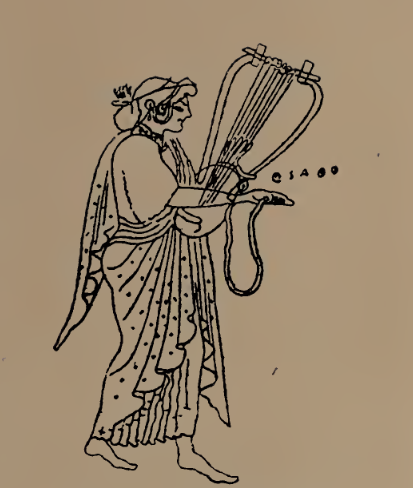
Later performance. In later antiquity her songs were sung at dinners and symposia. Aelian’s story of Solon’s nephew, Plutarch and Aulus Gellius all show this.[17] Attic vases of the late sixth and fifth centuries show her with the barbitos, an instrument of the symposium.[18] The same double setting can be found inside fr. 1. Its iambic invective suits the symposium, and its hymnic form suits a ritual occasion.[19] Yatromanolakis warns that the late sources tell us nothing about archaic or classical practice.[20]
Notes
- ^ Lardinois 2022, p. 265; Campbell 1982, p. ix.
- ^ a b Kurke 2021, p. 94.
- ^ Campbell 1982, p. xiii.
- ^ Kurke 2021, pp. 95–96.
- ^ Ferrari 2021, p. 107.
- ^ Battezzato 2021, p. 131.
- ^ Battezzato 2021, p. 129.
- ^ Kurke 2021, p. 96.
- ^ Lardinois 2022, p. 267.
- ^ Yatromanolakis 2009, p. 218 n. 56.
- ^ Lardinois 2022, p. 273; Kurke 2021, p. 95.
- ^ Lardinois 2022, pp. 272–273.
- ^ Giesecke 2022, p. 188.
- ^ Battezzato 2021, p. 131; Lardinois 2022, p. 270; Ferrari 2021, p. 115.
- ^ Natoli et al. 2022, p. 49.
- ^ Yatromanolakis 2009, pp. 219–220.
- ^ Kivilo 2021, p. 19.
- ^ Kivilo 2021, p. 19; Yatromanolakis 2009, pp. 221–222.
- ^ Steiner 2021, p. 83.
- ^ Yatromanolakis 2009, p. 221.
About · 3 of 12
The Alexandrian edition and its books
The editors. Systematic Alexandrian work on the canonical lyric poets falls between about 285 and 145 BC. The uniform layout of the Sappho papyri points back to a scholarly edition, written in cola with critical signs.[1] Who made it is not certain. Hephaestion reports editions of Alcaeus by both Aristophanes of Byzantium and Aristarchus. Sappho is named alongside Alcaeus, so Prauscello infers that she was edited by both. She thinks that local copies kept at Mytilene were a main source.[2] Phillips leaves open which scholar was chiefly responsible.[3]
How many books? Authorities differ. The Suda and an epigram by Cicero’s freedman Tullius Laurea both say nine.[4] Most recent scholars, following Lobel, hold that there were eight, the eighth mostly or wholly wedding songs. Prauscello argues for eight books cited by number, plus a separate book entitled Epithalamia, nine in all.[5] The other accounts differ again:
- Lardinois writes “around nine”, perhaps eight or seven.[6]
- Finglass and Kelly write “probably nine”.[7]
- Campbell has nine. The ninth held the epithalamia, which their metres kept out of the other books.[8]
- Natoli et al. write “either eight or nine”, and elsewhere “probably eight”. They cite Yatromanolakis, who finds little reliable evidence for a ninth.[9]
Natoli et al. also say that two books consisted of wedding songs.[10] Prauscello’s survey of the evidence finds one book so titled.[11]
Order. Metre was the main principle of book division, except for the Epithalamia. Books 1–3 were each in one metre, and Books 5 and 7 were not. So the change probably came in Book 4.[2] Phillips says that the poems were grouped “by meter and subject”.[3] Within Book 1 the poems ran alphabetically, by first letter only.[12] Obbink sees thematic clusters inside the alphabetical order, and Neri the reverse. But the priority of the alphabet “seems beyond question”.[13]
Programmatic poems stood outside the sequence. Fr. 1 opened Book 1. Poems of wedding character closed Book 1 (frr. 27, 30) and Book 2 (fr. 44).[14] Lidov warns that the evidence for a metrical arrangement is sparse, though papyri often show runs of poems in one metre (as reported by Natoli et al.).[15]
| Book | Metre | What is known |
|---|---|---|
| 1 | Sapphic stanza | frr. 1–42 (Voigt A 1);[16] 1,320 lines = 330 stanzas, from the colophon of P.Oxy. 1231;[17] some fifty poems if they averaged seven stanzas[18] |
| 2 | gl²ᵈ, Hephaestion’s “Sapphic fourteen-syllable” | frr. 43–52 (Voigt C 3 c);[16] the whole book in this metre;[19] perhaps over a thousand lines[20] |
| 3 | gl²ᶜ, the “Sapphic sixteen-syllable” | frr. 53–57 (Voigt C 3 h)[21] |
| 4 | built around the hipponactean: ∧hipp²ᶜ in many poems; pairs and three-line stanzas | frr. 58–91;[22] Voigt assigns ∧hipp²ᶜ to the book “perhaps” (C 3 k) |
| 5 | mixed: phalaecians, lesser asclepiads, glyconic strophes | frr. 92–101[23] |
| 6 | nothing known | Prauscello 2021, p. 224 |
| 7 | mixed | fr. 102, ia gl ba ‖ ia gl ba[24] |
| 8 | uncertain | the list of opening lines in fr. 103 allows no safe inference;[25] Campbell takes fr. 103 to show that the book had only about a tenth as many lines as Book 1[8] |
| Epithalamia | mixed, including hexameters | frr. 104–117[26] |
Couplets or single lines? Authorities differ. A paragraphos is a short horizontal stroke in the margin that marks a division. Hephaestion says that the old copies of Books 2 and 3 marked each song with a paragraphos every two lines (On Poems 1.2, as cited by de Kreij).[27] Lidov, Battezzato and de Kreij treat these books as built of two-line strophes. For Lidov, the marking-off of every second line makes them stanzaic (Lidov, §The Arrangement of Meters in Books).[28]
A stichic metre repeats the same line without stanzas. West calls the gl²ᵈ of fr. 44 “used stichically”.[29] Arukask calls the Book 4 line stichic, “often marked down in dyads”.[30] Battezzato infers that imperial copies of Books 2 and 3 dropped the paragraphoi. For de Kreij that inference is “too optimistic”.[31]
Book 2 and fr. 44. Fr. 44 is on the wedding of Hector and Andromache. De Kreij argues that it was not a regular part of Book 2. In P.Oxy. 1232 it seems to have been added after the end-title. And the book’s other fragments are in Sappho’s usual first-person manner. Fr. 44A (P.Fouad inv. 239) is often assigned to the book. But it carries an asterisk, which by Hephaestion’s account excludes it.[32] Natoli et al. note that a papyrus and Athenaeus independently place fr. 44 at the end of Book 2.[33] Athenaeus’ citation of the poem from the second book is among Campbell’s testimonia for it.[34]
Notes
- ^ Prauscello 2021, pp. 219–221.
- ^ a b Prauscello 2021, p. 221.
- ^ a b Phillips 2022, p. 121.
- ^ Prauscello 2021, p. 224.
- ^ Prauscello 2021, pp. 225–227.
- ^ Lardinois 2022, p. 265.
- ^ Finglass and Kelly 2021, p. 1.
- ^ a b Campbell 1982, p. xiii.
- ^ Natoli et al. 2022, pp. 17, 35, 56 n. 31.
- ^ Natoli et al. 2022, p. 17.
- ^ Prauscello 2021, pp. 224–225.
- ^ Lardinois 2022, p. 270.
- ^ Prauscello 2021, p. 222.
- ^ Prauscello 2021, p. 223; Finglass 2021, pp. 244–245.
- ^ Natoli et al. 2022, p. 56 n. 19.
- ^ a b Campbell 1982, p. 53.
- ^ Sampson 2022, p. 109; Campbell 1982, p. xiii.
- ^ Prauscello 2021, p. 223.
- ^ Hephaestion, Ench. 7.7.
- ^ de Kreij 2022, p. 622.
- ^ Hephaestion, Ench. 10.6.
- ^ Prauscello 2021, p. 223; Battezzato 2021, pp. 125, 128.
- ^ Prauscello 2021, pp. 223–224; Battezzato 2021, p. 128.
- ^ Battezzato 2021, p. 129; Prauscello 2021, p. 224.
- ^ Prauscello 2021, pp. 224, 228–229.
- ^ Prauscello 2021, p. 224; Campbell 1982, p. 53.
- ^ de Kreij 2022, p. 608.
- ^ Battezzato 2021, pp. 127–128, 133; de Kreij 2022, p. 613 n. 46.
- ^ West 1987, p. 35.
- ^ Arukask 2020, p. 102.
- ^ de Kreij 2022, p. 608 n. 31.
- ^ de Kreij 2022, pp. 603, 607–609, 618–623; Sampson 2022, p. 113.
- ^ Natoli et al. 2022, p. 45.
- ^ Campbell 1982, p. 90.
About · 4 of 12
Her metres
Sappho’s verse is Aeolic. Resolution is the replacement of a long by two shorts. Contraction is the replacement of two shorts by a long. Lesbian lyric admits neither. So each verse has a set number of syllables. Much of it is built from the aeolic cola, the short units of a few positions from which longer verses are made: the glyconic, pherecratean, hipponactean and their relatives. These are often extended by repeating a dactyl (— ⏑ ⏑) or a choriamb (— ⏑ ⏑ —) inside the colon.[1]
The fixed count of syllables is called isosyllabism, and it is the main peculiarity of the tradition. The second is the aeolic base. This is a pair of free positions, where only the count of syllables matters and not their quantity. Both features probably go back to Indo-European verse.[2] Hiatus is the meeting of two vowels across a word-end, and it is avoided altogether. Where vowels meet, they are regularly elided or run together by synecphonesis.[3] Elision is the dropping of a word’s final vowel before a vowel; synecphonesis is the running of two vowels into one syllable. The first line of fr. 1 shows the count and the elision at work.
Ποικιλόθρον’ ἀθανάτ’ Ἀφρόδιτα,
Poikilothron’ athanat’ Aphrodita,
“Immortal Aphrodite of the intricate throne”
Eleven syllables fill eleven positions: no long is split into two shorts, and no two shorts are merged. Where vowels meet, one is elided (ἀθανάτ’ for ἀθανάτα), so there is no hiatus. λόθ- is long because θρ follows: the Lesbian treatment of stop + liquid.
Sappho fr. 1.1, the first line of the Sapphic stanza
synthetic ∿
The glyconic is shown below at three lengths, each with a line written above it. The two base positions come first.
One colon, three lengths. The red positions are the repeated dactyls (— ⏑ ⏑) or choriambs (— ⏑ ⏑ —); the base and the ending stay the same.
The first three books used one stanza or line throughout, and so did many poems of the fourth.[4] Voigt’s schemes are these:
| Book | Form (Voigt’s analysis) | Scheme (Voigt) |
|---|---|---|
| 1 | Sapphic stanza: cr ∧hipp ‖ cr ∧hipp ‖ cr ∧gl ∧pher ||| (A 1) | — ⏑ — ⏓ — ⏑ ⏑ — ⏑ — × ‖ (twice), — ⏑ — × — ⏑ ⏑ — ⏑ ⁝ — × ⁝ — ⏑ ⏑ — × ||| |
| 2 | gl²ᵈ, glyconic with two dactyls (C 3 c) | ⏓ ⏓ — ⏑ ⏑ — ⏑ ⏑ — ⏑ ⏑ — ⏑ × ‖ |
| 3 | gl²ᶜ, glyconic with two choriambs (C 3 h) | ⏓ × — ⏑ ⏑ — ⁝ — ⏑ ⏑ — ⁝ — ⏑ ⏑ — ⏑ ⏓ ‖ |
| 4 (perhaps) | ∧hipp²ᶜ, acephalous hipponactean with two choriambs (C 3 k) | × — ⏑ ⏑ — ⁝ — ⏑ ⏑ — ⁝ — ⏑ ⏑ — ⁝ ⏑ — ⏓ ‖ |
In Voigt’s notation ⏓ marks a position where at least eight of twelve syllables are long, × one where no more than seven of twelve are long, and ⁝ a place where at least half the words end (key to the conspectus).[5]
The Sapphic stanza: three analyses. West writes the first two periods — ⏑ — × — ⏑ ⏑ — ⏑ — — ‖, and labels them ∧ia hag. The third is — ⏑ — × — ⏑ ⏑ — ⏑ ⁝ —⁀× ⁝ — ⏑ ⏑ — — |||. It might be labelled ∧ia hag ⁝ ad. But that label, he warns, hides the main point: the third period is the first two stretched out.[6] A bridge is a place where word-end is avoided. West’s tie ⁀ between the tenth and eleventh positions marks one.[7] Voigt’s cr ∧hipp and West’s ∧ia hag describe the same syllables in different terms. Here is West’s scheme with the first stanza of fr. 1 written over it.
Sappho fr. 1.1–4 on West’s scheme. The third period is the first two stretched by five positions (red). The curved tie marks a bridge: no word ends there.
In short: two equal periods, then the same period again, stretched by an adonean (— ⏑ ⏑ — —).
Battezzato gives cr ∧hipp ‖ cr ∧hipp ‖ cr ∧hipp ad ||| as the easiest form to memorise. But for the third period he prefers cr ∧gl ∧pher. The pherecratean is a catalectic glyconic, and it signals an ending. Word-end often falls one syllable into it, and West calls this dovetailing.[8]
Three lines or four? Hephaestion already describes three hendecasyllables to each stanza, followed by a fourth colon of five syllables.[9] D’Angour sets the stanza out as four lines, AAAB.[10] Battezzato explains the four-line layout as a Hellenistic and imperial convenience. It shows the recurring cr ∧hipp at a glance, and it saves space. But there is no pause between the third and fourth lines, and words run over from one to the other.[8]
Hence Horace treats the stanzas as four-line stanzas, and most modern editions still print them that way.[11] Even between the first and second lines, where the period ends, a word may be elided into the next line. This is called “episynaloephe”, and it also happens between Sophocles’ trimeters.[8] How the stanza has been read and heard, mostly in English, over two centuries, and what that means for scanning it, is on Reading the rhythm, after Yopie Prins (2019); the stanza itself is scanned line by line on fr. 1, the Hymn to Aphrodite.
Whose stanza? Hephaestion notes that it occurs in Alcaeus too, “and it is unclear whose invention it is, even though it is called Sapphic” (Ench. 14.1: ἄδηλον ὁποτέρου ἐστὶν εὕρημα, εἰ καὶ Σαπφικὸν καλεῖται (adēlon hopoterou estin heurēma, ei kai Sapphikon kaleitai)). The ancients nonetheless agreed that she used it more (Arukask adds Marius Victorinus).[12]
Prosody. In “normal” Lesbian lyric a syllable is not left short, even before a stop + liquid at the start of a word.[13] Two short syllables in the aeolic base are rare in the Lesbian poets, and later they are avoided almost completely.[14] Sappho’s examples are fr. 53 βροδοπάχεες (brodopachees), “rosy-armed”, 94.22 ἀπάλαν (apalan), “soft”, and 98a.8 σ]τεφάνοισιν (stephanoisin), “with garlands”.[15]
βροδοπάχεες
bro-do-pa-che-es
“rosy-armed”
βρο-δο-, ⏑ ⏑: two short syllables fill the two positions of the aeolic base (fr. 53). The Attic form of the word is ῥοδόπηχυς (rhodopēchys), without the initial β.[16]
Some fragments stand apart. Fr. 105 is in hexameters after the Ionian model. It has contraction, epic correption and a short syllable before δρ (dr), all foreign to ordinary Lesbian verse. Fr. 44 is a narrative with a heroic setting, in gl²ᵈ. It admits the same abnormalities, except contraction.[17] The glyconic strophes of the later books, the hexameters and the other forms are on the next tab.
Notes
- ^ West 1987, pp. 32–34.
- ^ Battezzato 2021, pp. 121–122; cf. Arukask 2020, p. 100.
- ^ West 1987, pp. 16, 35 n. 2.
- ^ Battezzato 2021, pp. 127–128; see the Books tab.
- ^ Voigt 1971, p. 15.
- ^ West 1987, p. 34.
- ^ West 1987, p. ix.
- ^ a b c Battezzato 2021, p. 127.
- ^ Hephaestion, Ench. 14.1.
- ^ D’Angour 2022, p. 136.
- ^ West 1987, p. 35 n. 1.
- ^ Kivilo 2021, p. 18; cf. Arukask 2020, p. 107.
- ^ West 1987, p. 16 n. 7.
- ^ West 1987, p. 33.
- ^ Tichy 2018, p. 348 n. 2.
- ^ Natoli et al. 2022, p. 330.
- ^ West 1987, p. 35.
About · 5 of 12
The other strophes and lines
Beyond the single-metre books Sappho used many forms. They can be described in Snell’s terms, as two ways of making a colon longer.[1]
Internal expansion. A colon is lengthened from inside, by extra choriambs or dactyls (gl²ᶜ, gl²ᵈ). Example: the glyconic of fr. 94.1, τεθνάκην δ’ ἀδόλως θέλω (tethnakēn d’ adolōs thelō), ○ ○ — ⏑ ⏑ — ⏑ —, grows by two dactyls into the line of fr. 44.5, Ἔκτωρ καὶ συνέταιροι ἄγοισ’ ἐλικώπιδα (Hektōr kai synetairoi agois’ elikōpida), ○ ○ — ⏑ ⏑ — ⏑ ⏑ — ⏑ ⏑ — ⏑ —. The diagram on the Metres tab sets the two side by side.
External expansion. Iambic, cretic, bacchiac, trochaic or dactylic units are added before or after the colon. Example: in fr. 96.12 a cretic, — ⏑ —, stands before the glyconic: ᾱ̓ δ’ ἐέρσᾱ | κάλᾱ κέχυται, τεθᾱ́- (ā d’ eersā | kalā kechytai, tethā-), — ⏑ — | — ⏑ — ⏑ ⏑ — ⏑ —. The whole strophe is scanned below.
Dale describes the same growth of cola by added choriambs in the aeolic of tragedy. Glyconics grow into asclepiads, and a hendecasyllable is read as a glyconic prolonged by a bacchiac.[2] The Lesbian poets also bind the lines of a strophe into one rhythmical unit. This contrasts with the end-stopped lines of Archilochus’ epodes.[3] That habit is what makes the one-verse strophes below possible.
Glyconic strophes (Book 5)
The Berlin parchment and other papyri preserve three-line strophes built on the glyconic. Battezzato sets out their structure.[4] In his notation “/” marks a line-end in the ancient layout that cannot be a verse-end, and “|” one that can. Brackets mark a colon not fully preserved. Voigt’s and West’s analyses are given beside his:
| Fr. | Battezzato | Voigt | West |
|---|---|---|---|
| 94 | glyc ‖ glyc ‖ glyc da ||| | gl ‖ gl ‖ glᵈ ||| (A 2) | gl ‖ gl ‖ glᵈ |||[5] |
| 95 | cr [glyc] / glyc / glyc [ba] ||| | perhaps as fr. 96 (C 5) | — |
| 96 | cr glyc / glyc / glyc ba ||| | cr 3gl ba (C 5) | ∧ia gl / gl / gl ia∧ |||[6] |
| 98 | glyc | glyc | cr glyc ||| | gl ‖ gl ‖ cr gl ||| (A 3) | — |
West’s ∧ia is the cretic, and his ia∧ the bacchiac, of the other two analyses. In the second line of frr. 95 and 96 (95.9, 96.7) the glyconic is replaced by a choriambic dimeter, or “wilamowitzian”: × × — ⏑ — ⏑ ⏑ —. Sappho, like later poets, uses it in responsion with the glyconic (Voigt, C 5).[7] Responsion is the matching of one passage’s metre by another’s. The wilamowitzian has the glyconic’s eight positions, but the choriamb — ⏑ ⏑ — comes at the end instead of the middle.
κεσσιν ὤς ποτ’ ἀελίω
kessin hōs pot’ aeliō
“as, once the sun …”
× × — ⏑ — ⏑ ⏑ —: the choriamb (red) closes the line. In the glyconic, ○ ○ — ⏑ ⏑ — ⏑ —, it stands in the middle.
Sappho fr. 96.7 (the line begins with the end of γυναίκεσσιν, “women”, from line 6)
synthetic ∿
One verse of thirty syllables? Disputed. In fr. 96 no pause falls inside the strophe, and words are split between lines. Some scholars object that thirty syllables cannot be sung without a break. Battezzato replies with parallels. Alcaeus has a one-verse strophe of twenty syllables. The third verse of the Alcaic stanza has nineteen. Pindar has runs of twenty-two and twenty-three positions. And a singer can take breath unnoticed. So Sappho “occasionally wrote a one-verse strophe”.[8] West too treats such a strophe as a single compound period.[6]
In a common pattern, the last verse amplifies the others. West’s example is fr. 94.6–8.[5] The translations of both examples are this site’s.
τὰν δ’ ἔγω τάδ’ ἀμειβόμᾱν·
χαίροισ’ ἔρχεο κἄμεθεν
μέμναισ’· οἶσθα γὰρ ὤς σε πεδήπομεν.
tan d’ egō tad’ ameibomān; / chairois’ ercheo kamethen / memnais’; oistha gar hōs se pedēpomen.
“And this was my answer to her: ‘Go, and be happy, and keep me in mind; for you know how we tended you.’”
gl ‖ gl ‖ glᵈ |||. The third line repeats the glyconic with one dactyl more (red), and so rounds off the strophe.
Sappho fr. 94.6–8: Greek from Waddell’s Dickinson text, CC BY-SA4.0; metrical analysis[5]
synthetic ∿
Occasionally a whole strophe is a single compound period, with words running over the line-ends, as in fr. 96.12–14.[6] West’s mark in βˈρόδα divides βρ between the syllables, so that δὲ is long. The βρ- itself is the Lesbian spelling of a word that once began with digamma, ϝρόδα (wroda).[9]
ᾱ̓ δ’ ἐέρσᾱ κάλᾱ κέχυται, τεθᾱ́-
λαισι δὲ βρόδα κἄπαλ’ ἄν-
θρυσκα καὶ μελίλωτος ἀνθεμώδης.
ā d’ eersā kalā kechytai, tethā- / laisi de broda kapal’ an- / thryska kai melilōtos anthemōdēs.
“The lovely dew lies spread, and roses are in flower, and soft chervil, and melilot thick with blossom.”
∧ia gl / gl / gl ia∧ |||. The cretic before the first glyconic and the bacchiac after the last (red) are units added from outside. Words run over two line-ends (τεθά-λαισι, ἄν-θρυσκα), so the three lines are one period. δὲ is long because βρ follows it.
Sappho fr. 96.12–14: Greek from Waddell’s Dickinson text, CC BY-SA4.0; metrical analysis[6]
synthetic ∿
Other lines
| Form | Where | Sources |
|---|---|---|
| hexameter, 6da | fr. 105(c).2: a dactylic “base”, unattested in Sappho and Alcaeus, and a contraction impossible in their aeolic cola show a true hexameter | Battezzato 2021, p. 125; Voigt B 1 b; West 1987, p. 35 |
| pher³ᵈ or hexameter | frr. 142, 143; the epic correption in fr. 142 favours the dactylic reading | Battezzato 2021, p. 125; Voigt B 1 b |
| ionic trimeter, 3io | frr. 113, 135 | Battezzato 2021, p. 126; Voigt B 2 a |
| anacreontics (anaclastic ionics) | test. 238 V | Battezzato 2021, p. 126; Voigt B 2 c |
| two ithyphallics; three choriambs and a bacchiac | frr. 127, 128 | Battezzato 2021, p. 126; Voigt E 3, D 2 |
| short wedding verses: pher ‖ ia ‖ ∧pher da … | fr. 111 | Battezzato 2021, p. 129; Voigt A 8 |
| ia gl ba ‖ ia gl ba ‖ | fr. 102 (Book 7) | Battezzato 2021, p. 129; Voigt C 2 g |
| Alcaic stanza | fr. 137.1–2, “if authentic” | Battezzato 2021, p. 129; Voigt A 9 |
The shapes named in the table are these: an ionic metron is ⏑ ⏑ — —, so the ionic trimeter runs ⏑ ⏑ — — ⏑ ⏑ — — ⏑ ⏑ — —; the anacreontic is ⏑ ⏑ — ⏑ — ⏑ — —, an ionic dimeter with two positions exchanged (anaclasis); the ithyphallic is — ⏑ — ⏑ — —.[10]
Some scholars derive the hexameter itself from cola like pher³ᵈ. This kinship would explain why true hexameters occur in Sappho.[11] Whether the hexameter, ionic and pher³ᵈ fragments came from longer strophes cannot be known.[12]
Notes
- ^ Battezzato 2021, pp. 124, 126.
- ^ Dale 1968, pp. 141–142, 144.
- ^ D’Angour 2022, p. 136.
- ^ Battezzato 2021, p. 128 with n. 27.
- ^ a b c West 1987, p. 34.
- ^ a b c d West 1987, p. 35.
- ^ Battezzato 2021, pp. 123, 128.
- ^ Battezzato 2021, p. 128.
- ^ Allen 1968, p. 48.
- ^ West 1987, pp. ix–x.
- ^ Battezzato 2021, p. 125.
- ^ Battezzato 2021, p. 129.
About · 6 of 12
Sappho's metres in numbers
How much survives. The first book held 1,320 lines, and there were about nine books. So Sappho wrote roughly 10,000 lines. About 650 survive: one complete poem, about twelve substantial fragments, a hundred short citations and some fifty papyrus scraps.[1]
Other counts differ. Natoli et al. speak of two complete poems among some two hundred fragments.[2] The Tithonus poem was completed by the overlap of the Cologne papyrus with P.Oxy. 1787, and Finglass calls it “virtually complete”.[3] Arukask counts every line printed in Voigt’s frr. 1–168C. There are 1,384 lines in 176 fragments, and about 42% of them cannot be assigned a metre with certainty.[4]
How the surviving lines divide. Arukask made two counts. The first uses only lines whose metre is certain. The second adds probable cases:[5]
| Sapphic stanza | aiolikon (∧hipp²ᶜ) | other metres | undetermined | |
|---|---|---|---|---|
| certain only | c. 38% | c. 3% | c. 18% | c. 42% |
| with probable lines | c. 38% | c. 8% | c. 24% | c. 30% |
At least 40 fragments are in Sapphic stanzas, and 4 to 12 in the aiolikon.[4] Hephaestion gave that line its name, “Aeolic”, “because Sappho used it much”. He analysed it as three ionics and a trochee.[6] An ionic is the unit — — ⏑ ⏑ (or ⏑ ⏑ — —); a choriamb is — ⏑ ⏑ —. The diagram sets Voigt’s analysis of the line beside Hephaestion’s.
The same sixteen positions, divided two ways. Above, the two inserted choriambs are red; below, Hephaestion’s three ionics (— — ⏑ ⏑, the first opening with a free position) and a closing trochaic metron.
For Book 1 alone the colophon, the note at the end of the roll, gives 330 stanzas, perhaps fifty poems.[7]
Voigt’s inventory. Her conspectus of Sappho’s metres has 49 entries:[8]
- 9 kinds of strophe (A 1–9).
Example: the Sapphic stanza (A 1). - 9 lines repeated κατὰ μέτρον (kata metron), “by the measure”, that is, the same line used again and again (B).
Example: the hexameter of fr. 105 (B 1 b). - 22 aeolic lines (C).
Example: the glyconic with two dactyls of Book 2, fr. 44 (C 3 c). - 2 ionic or choriambic compounds (D).
Example: three choriambs and a bacchiac, fr. 128 (D 2). - 5 asynarteta (E), verses made of two cola that keep their own rhythms.
Example: two ithyphallics, — ⏑ — ⏑ — — twice, fr. 127 (E 3). - 2 of uncertain analysis (F).
Many entries rest on a single fragment. Many assignments are marked “fort.” (perhaps).
Free positions. A free position is one that can hold either a long or a short syllable. Arukask measured how often the free positions are filled by a heavy syllable:[9]
| Line | Anceps heavy | Line-end heavy | Positions counted |
|---|---|---|---|
| Sapphic hendecasyllable, Sappho | 68.24% (69.10% with doubtful lines) | 80.79% (81.17%) | 170 and 151 (178 and 154) |
| Sapphic hendecasyllable, Alcaeus | 83.93% (82.61%) | 90.48% (90.32%) | 56 and 21 (71 and 31) |
| aiolikon, Sappho (first position) | 23.81% (46.15%) | 96.30% (84.62%) | 21 and 27 (52 and 39) |
Her hendecasyllable counts include the first eleven positions of each third line.[10] She counts a period-final syllable closed by a consonant as heavy, so the results lean towards heavy syllables. With samples this small, they show tendencies, not laws.[11] She also reports Barris’s count of light eleventh syllables. There are nearly 40% in the first and second lines, and 35–36% in the third.[12] In every case but the aiolikon’s opening, heavy syllables prevail. Alcaeus prefers them more than Sappho.[13] A heavy syllable is a long one; a light syllable is short. Two first lines of stanzas show both fillings of the free positions.
παῖ Δίος δολόπλοκε, λίσσομαί σε,
[Ο]ἰ μὲν ἰππήων στρότον, οἰ δὲ πέσδων,
pai Dios doloploke, lissomai se, / Oi men ippēōn stroton, oi de pesdōn,
“child of Zeus who plaits deceits, I pray you / Some say a host of horsemen, some an army on foot”
The marks show each syllable as it is. The free fourth and last positions (red) are light in fr. 1.2 (δο, σε) and heavy in fr. 16.1 (πή, and -δων with its long ω).
Sappho frr. 1.2 and 16.1
synthetic ∿
Word-end. Lidov counted word-group end in the first three lines of the stanza (as written). He found it after the fourth syllable in 41% of lines, and after the fifth in 37%. Battezzato’s count of 33 lines from the 2014 papyri gives 27% and 42%. With them, the totals for 153 lines are equal: 52 lines each, 34% each.[14] The two places look like this:
Φαίνεταί μοι κῆνος ἴσος θέοισιν
μαινόλαι θύμωι· τίνα δηὖτε πείθω
Phainetai moi kēnos isos theoisin / mainolai thȳmōi; tina dēute peithō
“He seems to me equal to the gods / in my maddened heart. ‘Whom this time am I to persuade …’”
Fr. 31.1: a word ends after the fourth position (μοι, red). Fr. 1.18: a word ends after the fifth (θύμωι, red), and none after the fourth.
Sappho frr. 31.1 and 1.18
synthetic ∿
Lidov adds a point of style. In Book 1 Sappho usually does not let word-end, or its absence, fall at the same position for many lines running. The exceptions stand out as tightly unified and conspicuous. In fr. 31, word-end comes after the fourth position in every line but the last. In fr. 1.18–25, it always comes after the fifth syllable (Lidov, §Metrical Style).[15] In the Tithonus poem the ninth and tenth syllables belong to one word in each of lines 1–6. The pattern breaks at line 7 with ἀλλά.[16] Lesbian poets hardly ever combine lines with different kinds of ending, blunt and pendant.[17] A blunt ending closes on a long after a short, … ⏑ —, like the glyconic; a pendant ending has one more position, … ⏑ — ×, like the pherecratean or the Sapphic line.[18]
Notes
- ^ Lardinois 2022, p. 265.
- ^ Natoli et al. 2022, p. 19.
- ^ Finglass 2021, p. 237.
- ^ a b Arukask 2020, p. 98.
- ^ Arukask 2020, pp. 98–99.
- ^ Hephaestion, Ench. 11.5.
- ^ Prauscello 2021, p. 223.
- ^ Voigt 1971, pp. 15–20.
- ^ Arukask 2020, pp. 103–109.
- ^ Arukask 2020, p. 103.
- ^ Arukask 2020, p. 104.
- ^ Arukask 2020, p. 103 n. 14.
- ^ Arukask 2020, p. 111.
- ^ Battezzato 2021, p. 133 n. 57.
- ^ cf. Battezzato 2021, p. 133.
- ^ Battezzato 2021, p. 134.
- ^ Lidov 2009, as reported by Arukask; Arukask 2020, p. 101.
- ^ West 1987, p. 6.
About · 7 of 12
Music and instruments
Sappho’s poems were songs, but nothing of their melodies survives. From the Hellenistic period at least, they were also read as texts.[1] Musical notation probably did not exist before the fifth century BC. So it is very unlikely that her music reached the classical age in written form. Most of what we know about archaic music comes from writers of the imperial period, such as pseudo-Plutarch and Aristides Quintilianus. They drew on lost earlier works.[2]
Scales. Greek scales were called harmoniai, “tunings”. They were built not on the octave but on the tetrachord. A tetrachord is the interval of a fourth, divided into steps that could be larger than a tone or smaller than a semitone. A lyre played a limited set of notes, and it had to be tuned to a particular mode.[3]
Sappho and Terpander of Lesbos are said to have used the Mixolydian. This was a mournful mode that “mixed” the Lydian with other elements. The ancient writers may have inferred this from passages of their poems.[4] The sources differ over its inventor. Pseudo-Plutarch’s On Music, citing Aristoxenus, gives it to Sappho (test. 37).[5] But the same work elsewhere gives it to Terpander.[6] Plato called it melancholic. His Socrates would have banned it from the ideal state as the mode of lament.[7] Whether Sappho used other modes is unknown, though Battezzato thinks it plausible.[4] Later tradition also credited her with inventing the plectrum and the harp called pēktis.[8]
Voice and instrument. The accompanying instrument mostly played the singer’s notes, in unison or an octave apart. Playing a different line from the voice is attested from Plato’s time on. There is no evidence for it in archaic music. Singing several notes to one syllable began with late-classical musicians, and classical sources criticised it. So each syllable of Sappho’s songs was probably sung to a single note.[9] Modern attempts to give each syllable an exact duration in modern note-values are speculative. This is all the more so because the aeolic base admits any combination of long and short.[4]
One tune for every stanza? Disputed. Dionysius of Halicarnassus says that composers could not change the melody from strophe to antistrophe. Many scholars suppose that the tune was repeated in each stanza. Others argue that it varied with the pitch accent of the words in each line.[10] D’Angour judges it most plausible that early melody followed the natural pitches of the words. The composer fitted them to a prearranged set of notes, with some flexibility between performances.[11]
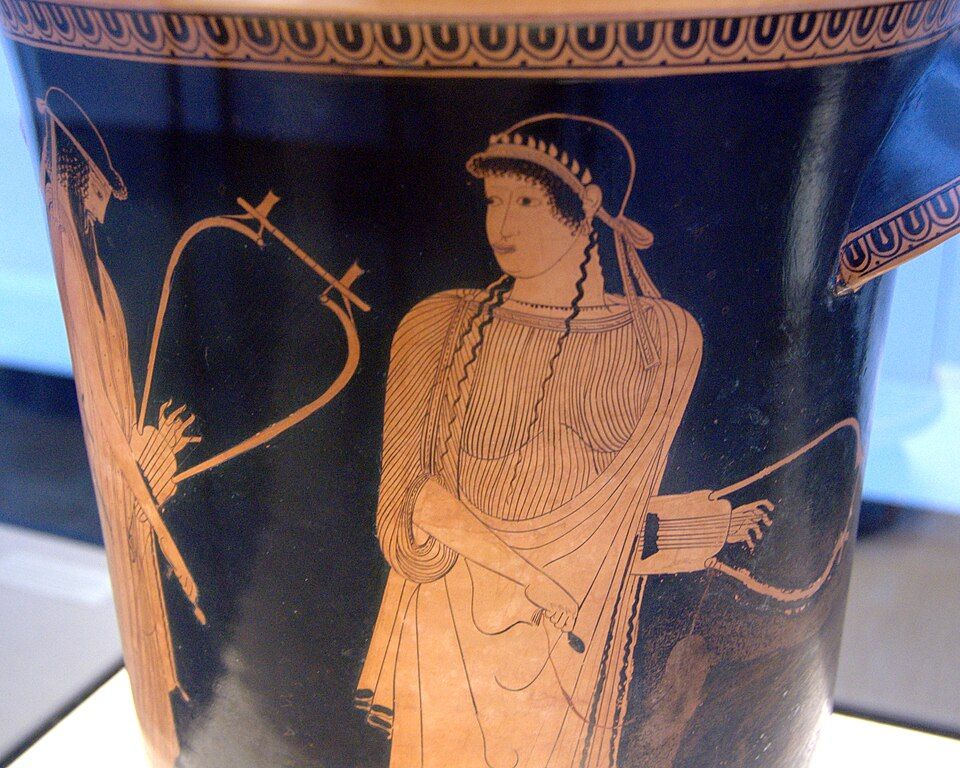
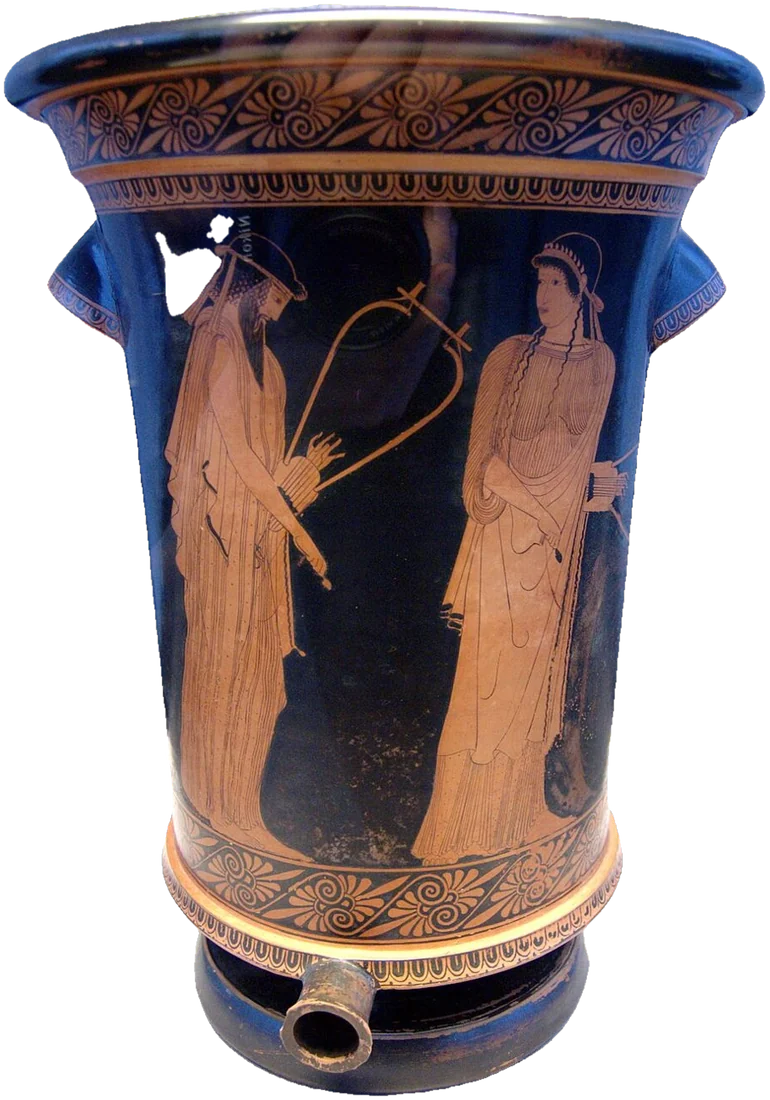
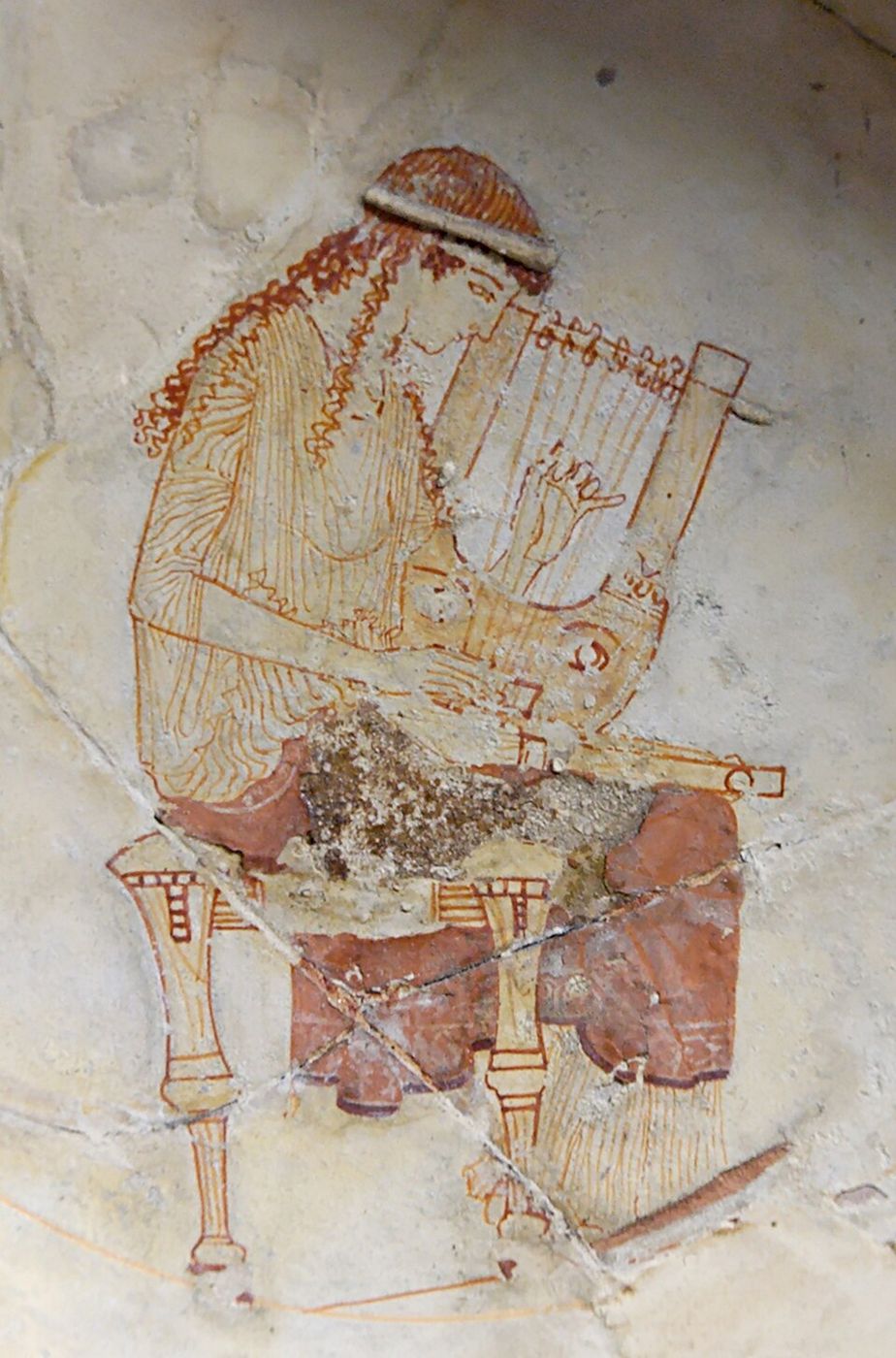
Instruments. Sappho names the lyre, λύρα (lyra), the “tortoise”, χελύννα (chelynna), and the pēktis, a harp that came from Lydia. Athenaeus credits her with the word βάρβιτος (barbitos). The barbitos was a deeper-pitched lyre with a long curved arm. A famous fifth-century vase shows her and Alcaeus holding barbitoi.[12] Pindar said that Terpander introduced the barbitos, which is another link between Terpander and Sappho.[13]
The aulos was the double reed-pipe of the symposium, and later of the theatre. It is never named as accompanying her own songs. But in fr. 44 it sounds with castanets at the wedding of Hector and Andromache.[13] Lesbos, close to the Anatolian coast, was a centre of music in the archaic and classical periods.[13]
Style. Ancient critics named charm as the mark of her poetry. Dionysius observed that Sappho and Alcaeus, with their short stanzas, varied their few cola little. Battezzato answers that she varies her fixed lines from within, by the placing of word-end and enjambment. He calls this an “inner metre”.[14]
Modern performances
Modern performances, not ancient music: no melody for these words survives. They are shown for listening; each makes its own choices, described under it.
Jump to Stanza 1 0:32 · 2 0:56 · 3 1:20 · 4 1:50 · 5 2:12 · 6 2:38 · 7 3:08
Notes
- ^ Lardinois 2022, p. 265.
- ^ Battezzato 2021, p. 129.
- ^ Battezzato 2021, pp. 129–130.
- ^ a b c Battezzato 2021, p. 130.
- ^ Campbell 1982, p. x.
- ^ Natoli et al. 2022, p. 56 n. 22.
- ^ Natoli et al. 2022, p. 17.
- ^ Kivilo 2021, p. 18; Campbell 1982, p. x.
- ^ Battezzato 2021, pp. 130–131.
- ^ Battezzato 2021, p. 133 with nn. 60–61.
- ^ D’Angour 2022, pp. 140–141.
- ^ Battezzato 2021, p. 131.
- ^ a b c Battezzato 2021, p. 132.
- ^ Battezzato 2021, pp. 132–134; see the In numbers tab.
About · 8 of 12
Sappho's dialect
The basis of Sappho’s literary language is the dialect spoken on Lesbos, which is a form of East Aeolic.[1] The full inventory of its sounds and forms is on the Lesbian Aeolic page. What bears on reading her verse is added here.
A vernacular or a literary language? Until the mid-twentieth century, scholars took her language for pure vernacular. They followed nineteenth-century dialectologists such as Ahrens, and dismissed epic elements as un-Sapphic. Lobel’s label “abnormal poems”, for pieces such as fr. 44, reflects that view. Her language is now seen as a literary product. It reuses epic material, and may draw on an unattested Aeolic poetic tradition.[2] It is reductive to equate it with the dialect spoken on Lesbos in her time.[3]
Features that touch the metre. Seven features of her language change how a line scans or how it is read.
No compensatory lengthening. Words such as ξένος (xenos) and κάλος (kalos) keep a short first vowel, with no compensatory lengthening. Ionic has ξεῖνος (xeinos), κᾱλός (kālos) instead.[4] Compensatory lengthening is the lengthening of a vowel when a consonant after it is lost.
“stranger, guest”
ξέ- is short in Sappho (⏑ ×); Ionic ξεῖ- is long (— ×).
Doubled consonants. The loss of s before m gives doubled consonants, as in ἔμμι (emmi), ἄμμες (ammes), ἔμμεναι (emmenai). Attic lengthens the vowel instead.[5]
“I am”
Both first syllables are long: the Lesbian one because two consonants, μμ, follow its vowel; the Attic one because its vowel ει is long.
The digamma ignored. Initial w, written with the letter digamma (ϝ), is usually ignored in her prosody. The elision before ἴδοισαν (idoisan), “having seen”, in fr. 22.14 shows this. The digamma written in some pronouns reflects the grammarians’ belief.[6]
ἐπτόαισʼ ἴδοισαν
eptoais’ idoisan
— ⏑ — ⏑ — …
“(it) set you aflutter when you saw (it)”
ἴδοισαν once began with ϝ. If the ϝ still counted, the final -ε of ἐπτόαισε could not be elided before it. It is elided, so the ϝ counts for nothing.
Sappho fr. 22.14
βρ- for ῥ-. The spelling βρ- for ῥ- (βρόδον (brodon), “rose”; βράδινος (bradinos), “slender”) is generally explained as an editorial signal that the preceding syllable scans long.[7] The point is debated. Bowie argues from the cases where βρ- makes position, against Hooker.[8] Allen takes βρόδα as a spelling of the old ϝρόδα (wroda). He notes a papyrus of Sappho that still writes the digamma in the possessive ϝοι (woi), “his, her”.[9] The worked example is βροδοπάχεες on the Metres tab.
Recessive accent. Every word is accented recessively, as far back as the rule for the antepenult allows. An oxytone is a word with the accent on its last syllable, and so the text of the Lesbian poets has none. The innovation is older than Sappho and Alcaeus, and only prepositions and conjunctions are exempt.[10]
“heart” (accusative)
Lesbian draws the accent back from the last syllable; the Attic word is oxytone.
Vowel sequences in ι. Ancient grammarians held that vowel sequences ending in ι were two syllables, and some papyri accent them accordingly (τύιδ’, τυϊδ’ (tuid’), “hither”). Yet in fr. 17.7 the sequence scans as one long syllable. So the accentuation, and the theory behind it, are wrong.[11] Fr. 1.5 shows the same scansion.
ἀλλὰ τυίδ’ ἔλθ’, αἴ ποτα κἀτέρωτα
alla tuid’ elth’, ai pota katerōta
“but come here, if ever at another time”
τυί- fills one long position. Read as two syllables, τυ-ί-, the line would have twelve syllables for eleven positions.
Sappho fr. 1.5
synthetic ∿
σδ for ζ. σδ for ζ is a grammatical spelling, meant to show the pronunciation [zd]. The earliest papyri are inconsistent.[12] The spelling is absent from early Lesbian inscriptions. For Allen this shows that Lesbian kept [zd] after other dialects had moved to [z].[13]
“of foot-soldiers”
σδ stands where Attic writes ζ.[14] Either way the first syllable is long: σδ is two consonants, and ζ counts as a double consonant.
Choice of forms. Sappho seems to have chosen between conjugation types to suit metre or content. She has athematic πεσδομ]άχεντας (pesdomachentas), “fighting on foot”, in fr. 16.20, and thematic ὀνκαλέοντες (onkaleontes), “calling upon”, in the epic-coloured fr. 44.33.[15] An athematic verb adds its endings straight to the stem, like the -μι verbs; Aeolic often conjugates this way verbs that in Attic are contracted, such as κάλημι (kalēmi), “I call”, for Attic καλῶ (kalō).[16] A thematic verb puts the vowel ε or ο before the ending: καλέ-ο-ντες (kale-o-ntes). Her wedding songs admit more non-Aeolic forms than her personal songs.[17]
The Alexandrian filter. What we read is the Lesbian of the Alexandrian edition. Its editors normalised spelling by rules of their own. This produced impossible “hyperaeolic” forms.[18] For the grammarians “Aeolic” meant the Lesbian poets, and they invented forms by false analogy, such as αι (ai) for ᾱ (ā).[19] Inscriptions help little for her period. No East Aeolic documents survive from the seventh and sixth centuries.[20]
Disputed: Voigt prints first-person forms such as κάλημμι (kalēmmi), “I call”. De Kreij finds the double μ unsupported by linguistic theory or manuscripts.[21] Tribulato cites κάλημι (kalēmi).[22] The double μ copies ἔμμι, “I am”, where μμ is genuine.[21]
Notes
- ^ Tribulato 2021, p. 135; de Kreij 2022, p. 146.
- ^ Tribulato 2021, pp. 135–136.
- ^ de Kreij 2022, p. 147.
- ^ Tribulato 2021, p. 136.
- ^ Tribulato 2021, p. 137.
- ^ Tribulato 2021, p. 142 with n. 20.
- ^ Tribulato 2021, p. 142 n. 20.
- ^ de Kreij 2022, p. 148 n. 11.
- ^ Allen 1968, p. 48.
- ^ Tribulato 2021, p. 144; Probert 2006, pp. 72–73.
- ^ Tribulato 2021, p. 144.
- ^ Tribulato 2021, p. 145; de Kreij 2022, p. 147.
- ^ Allen 1968, p. 56.
- ^ Natoli et al. 2022, p. 330.
- ^ Tribulato 2021, p. 141.
- ^ Natoli et al. 2022, p. 330; Tribulato 2021, p. 140.
- ^ Kurke 2021, p. 96.
- ^ de Kreij 2022, p. 143.
- ^ Tribulato 2021, pp. 142, 144–145.
- ^ Tribulato 2021, p. 142.
- ^ a b de Kreij 2022, p. 148 n. 12.
- ^ Tribulato 2021, p. 140.
About · 9 of 12
Sappho on papyrus
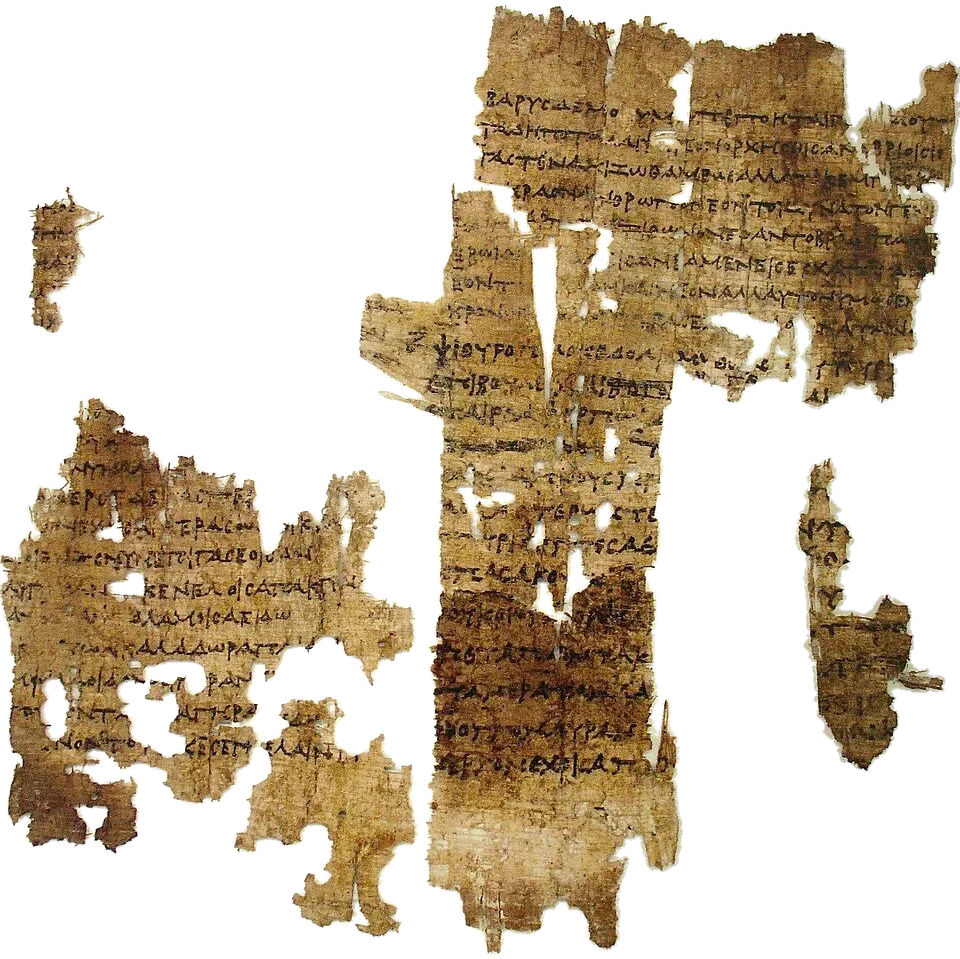
A late survival. The first papyrus of Sappho to be published was edited by Blass in 1880 (P.Berol. inv. 5006, frr. 3–4). It is in fact a parchment of the seventh century AD, from Krokodilopolis in the Fayum. So Sappho was still read in Egypt some twelve hundred years after her lifetime. Alcaeus is not securely attested on papyrus after the third century. None of the other canonical lyric poets seems to have lasted as long.[1] Many of the papyri come from the rubbish mounds of Oxyrhynchus.[2][3]
| Published | Papyrus | Fragments |
|---|---|---|
| 1880 | P.Berol. inv. 5006 (parchment, 7th c. AD) | frr. 3–4 |
| 1898 | P.Oxy. 7 (3rd c. AD) | fr. 5 |
| 1902 | P.Berol. inv. 9722 (parchment codex, late 6th or early 7th c. AD) | frr. 92–97 |
| 1914 | P.Oxy. 1231 and 1232 (2nd and 3rd c. AD) | frr. 15a–30, 43–44 |
| 1922 | P.Oxy. 1787 (2nd or 3rd c. AD) | frr. 58–87 |
| 1937 | PSI 1300, a potsherd (225–150 BC) | fr. 2 |
| 1951 | eight Oxyrhynchus papyri, among them P.Oxy. 2288 (fr. 1) and the first commentaries on Sappho | |
| 2004 | P.Köln 429 + 430 (3rd c. BC) | the Tithonus poem (fr. 58) |
| 2014 | P.GC inv. 105 and P.Sapph.Obbink (late 2nd or early 3rd c. AD) | the Brothers Poem, the Cypris Poem, additions to known poems |
Voigt’s edition of 1971 includes everything published up to 1965.[4] The 2014 finds preserve parts of nine poems, two of them new.[5] They add to frr. 5, 9, 16, 17 and 18. They give traces of two unknown songs (16a, 18a), the Brothers Song, and the opening of the Cypris Song, which overlaps fr. 26.[6]
What the papyri show. There are twenty-four papyri of Sappho’s text, a high number for a lyric poet, and seven of commentary. They peak in the second century AD and hardly decline in the third. A codex is a book with pages, which in late antiquity replaced the roll. Her poems survived that change, which finished off less popular authors.[7] Where the find-spot is known, it is Oxyrhynchus, apart from Krokodilopolis.[8]
P.Oxy. 2076 belonged to a family library that was thrown out about AD 300. P.Oxy. 1787 may have been copied by Spartas, a member of the same family, though one scholar argues for two scribes.[9] The potsherd of fr. 2 has been read as a school dictation, and alternatively as the work of a cultured amateur.[8] Papyri also confirm that fr. 1 opened Book 1.[10] The ancient commentaries on lyric poets found on papyrus are being collected in the Commentaria et lexica Graeca in papyris reperta.[11]
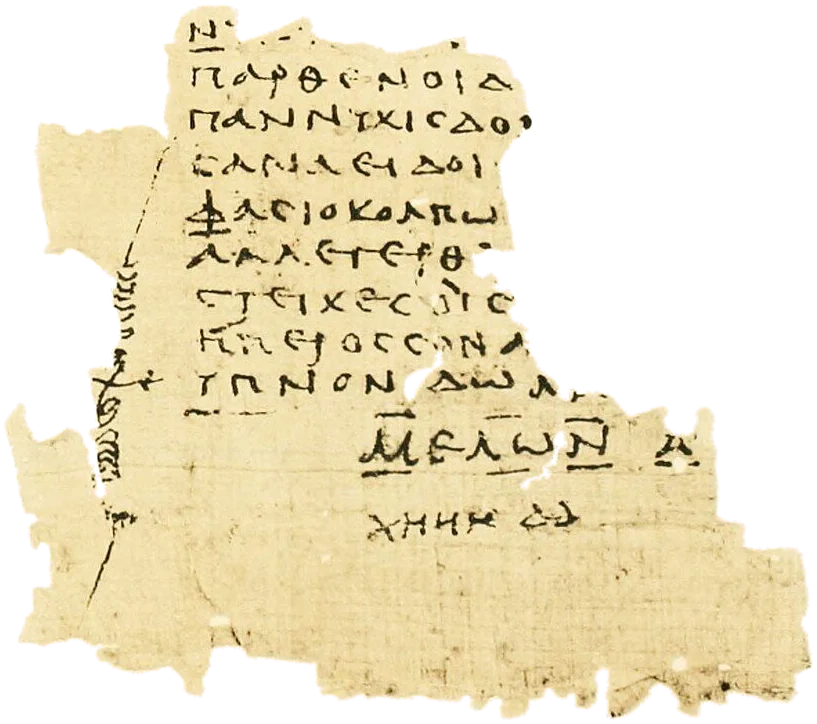
The Cologne papyrus. The oldest Sappho papyrus was recovered from mummy cartonnage. It probably reflects an arrangement older than the Alexandrian edition.[12] In it a poem in the same metre precedes the Tithonus poem. That poem is different from the one that precedes it in P.Oxy. 1787.[13] The last poem is not by Sappho.[14] The papyrus also showed that the editions had put a poem-end in P.Oxy. 1787 in the wrong place.[15] Disputed: Lardinois thinks two versions of the Tithonus poem may have existed, with and without four further lines.[6] Spelman is not convinced.[16]
The newest papyri: provenance unknown. The owner and present location of P.Sapph.Obbink are unknown. So is the provenance of both 2014 papyri.[17] The case is an example of an owner constructing a legitimate-looking provenance for resale.[18] Sampson’s analysis of a sale brochure “all but prove[s]” the published account of its provenance false.[19]
No one has argued that the texts are forgeries, and they contain no error of language or metre at all. The Cambridge Companion to Sappho treats them as authentic, while stressing that the circumstances fall far short of ideal.[20] Natoli et al. print them separately, in an appendix of disputed texts.[21]
Notes
- ^ Finglass 2021, p. 232.
- ^ Lardinois 2022, p. 266.
- ^ Finglass 2021, pp. 232–239 and Table 1, pp. 240–242.
- ^ Finglass 2021, p. 236.
- ^ Finglass 2021, p. 238.
- ^ a b Lardinois 2022, p. 270.
- ^ Finglass 2021, pp. 239, 244.
- ^ a b Finglass 2021, p. 244.
- ^ Finglass 2021, p. 245.
- ^ Finglass 2021, pp. 244–245.
- ^ Sampson 2022, p. 110.
- ^ Finglass 2021, p. 237.
- ^ Prauscello 2021, p. 222.
- ^ Finglass 2021, p. 237; Yatromanolakis 2009, p. 218.
- ^ Finglass 2021, pp. 237–238.
- ^ Spelman 2022, p. 283 n. 23.
- ^ Finglass and Kelly 2021, p. 6; Lardinois 2022, p. 270 n. 13.
- ^ Sampson 2022, p. 117.
- ^ Natoli et al. 2022, pp. 55–56 n. 17.
- ^ Finglass and Kelly 2021, pp. 6–7.
- ^ Natoli et al. 2022, pp. 17–18.
About · 10 of 12
Before Alexandria: Sappho in more than one version
The Papyri and Books tabs describe the Alexandrian edition and what came after it. What came before is described here. There is also a warning that applies to every fragment on this page. A fragment, as an edition prints it, is an editor’s construct. It is assembled from witnesses that do not always agree.
No master copy. Lardinois doubts that there was ever a master edition of Sappho on Lesbos. A text of her songs in classical Athens would have come from a local expert’s copy, or from memory. Athenians learned archaic songs as children or at symposia, and improvised on them. Sympotic compilations mixed poets, and adjusted songs to fit each other. That is what the Cologne papyrus seems to show.[1] Such anthologies are also a route by which Sappho and Alcaeus could have reached Athenaeus without passing through Alexandria at all.[2]
Fr. 2 in two versions. An ostrakon is a potsherd used for writing. Fr. 2 survives on one of the third century BC. Athenaeus quotes the poem five centuries later. The two witnesses end it differently. The ostrakon closes on an imperative, οἰνοχόαισον (oinochoaison), “pour”, and keeps Aeolic forms, ἔλοισα (eloisa), “having taken”, among them. Athenaeus begins his quotation with ἐλθέ (elthe), “come”. He has Attic forms, and makes the last word a participle, οἰνοχοοῦσα (oinochoousa), “pouring”. Either Athenaeus deliberately altered syntax and dialect to fit his text, or the two witnesses preserve two ways in which the song was remembered.[3]
Caciagli reconstructs the first possibility. Athenaeus or his source dropped the opening, since a sacred grove is no setting for a banquet, and kept the libation. Having lost the poem’s invocatory verb, he supplied ἐλθέ (elthe). He perhaps lifted it from the lost beginning, and put it where the ostrakon has the similar-sounding ἔλοισα (eloisa). That then forced the imperative into a participle. Caciagli calls this an oral technique of sympotic reworking, as old as the symposium itself. He does not think that line 1 of the ostrakon is the poem’s first line.[4] The Works tab follows the imperative in the licensed Bodard–Vierros corpus. The participle printed by Voigt, οἰνοχόεισα (oinochoeisa), is already present in Smyth’s older edition; his apparatus also gives Athenaeus’ form.[5]
“pouring wine” (feminine participle)
The same word in Lesbian and in Attic dress. Lesbian has -εισα where Attic contracts to -οῦσα.
Sappho fr. 2.16
A caution about the Loeb Athenaeus. Olson’s Loeb edition of Athenaeus changes the Attic forms of his quotations from Sappho and Alcaeus back into Aeolic. By its own editorial statement, it prints the reconstructions of modern editors such as Voigt. So a reader can no longer tell what Athenaeus wrote, or which versions he knew.[6] Anyone comparing a quotation with a papyrus should go to a text of Athenaeus that prints the manuscripts.
Editions before the edition. The Cologne papyrus is the earliest text of any canonical lyric poet. In it, the poem that precedes the Tithonus poem is not the one that precedes it in the Oxyrhynchus roll, which follows the Alexandrian edition.[7] For Lardinois this is clear proof that different editions of Sappho existed in antiquity. Both neighbouring poems are in the Tithonus poem’s metre. So strophes attributed to her may have been combined differently in different collections. He would like a “multiform” edition that records such variants, instead of choosing between them.[8]
Sappho sung in Athens. On the Munich vase of about 480–470 BC, Sappho and Alcaeus sing to barbitoi. Nagy reads it as a picture of the lyric poets as Panathenaic repertoire. It is matched by the exchange of verses that Aristotle quotes in the Rhetoric (conventionally fr. 137). Nagy thinks that citharodic performance favoured stichic, expandable forms over strophes. For him fr. 44, the wedding of Hector and Andromache, is the ideal citharodic piece.[9]
The Peripatos was Aristotle’s school. There Chamaeleon wrote a monograph On Sappho. A fragment of it reports that some took a song of Anacreon to be addressed to her, and a Sapphic poem to be her reply. Athenaeus, who preserves the fragment, rejects this pairing.[10] The contributors to the volume do not agree. Nagy gives Athens a central part in the canon’s formation, and Hadjimichael a small one.[11]
Notes
- ^ Lardinois 2020, pp. 43–45.
- ^ Currie and Rutherford 2020, pp. 6–7.
- ^ Lardinois 2020, pp. 62–63.
- ^ Caciagli 2020, pp. 337–338 with n. 36.
- ^ Smyth 1900, p. 27.
- ^ Lardinois 2020, p. 62 n. 79.
- ^ Currie and Rutherford 2020, p. 7.
- ^ Lardinois 2020, pp. 63–65.
- ^ Nagy 2020, pp. 103–104.
- ^ Hadjimichael 2020, pp. 159, 167–169.
- ^ Currie and Rutherford 2020, p. 13.
About · 11 of 12
Printed editions
From quotation to collection. Before printing, a reader of Sappho would have had to hunt through manuscripts of the authors who quote her. There is no evidence that anyone did.[1] Fr. 1 first appeared in print in 1508, in the Aldine edition of Dionysius of Halicarnassus edited by Demetrios Doukas. It was set as prose, and it was faulty in metre and dialect.[2] Fr. 31 followed in 1554, in Robortellus’ first edition of “Longinus” On the Sublime. A couple of months later it appeared again in Muretus’ Catullus.[3]
In the same year Henricus Stephanus printed frr. 1 and 168B at the end of a book of Anacreon. This was the first gathering of Sappho’s poems since antiquity. His collection of 1560, with a Latin translation, offered dozens of fragments, nearly thirty for the first time. It presented the spurious epigrams as genuine.[4] Ursinus (1568) added more. J. C. Wolf (1733) published the first edition of Sappho on her own, with a critical commentary.[5]
The nineteenth century. Editions by Volger (1810), Blomfield (1814) and Neue (1827) led to Bergk’s (1843). From its second edition (1853) to its fourth (1882), Bergk’s contained 120 fragments and 50 testimonia.[6] Bergk made a conjecture at fr. 1.24 in 1835, which was later found to have manuscript support. It allowed readers, for the first time since antiquity, to see that the beloved in that poem is a woman.[7]
Papyri and the modern editions. From 1880 papyri steadily enlarged the corpus.[8] Edmonds’ complete edition of 1922 filled the gaps in the papyri far too freely. Lobel demolished it in a review, and his own Sappho (1925) was cautious.[9] Lobel and Page’s Poetarum Lesbiorum Fragmenta (1955, corrected 1963) set Sappho beside Alcaeus, with a section for fragments that could belong to either. But its austerity in supplementing made it less useful than it might have been.[10]
Voigt’s edition (1971) was apparently finished before 1967. In West’s judgement it is “thoroughly prudent”. It includes the testimonia, and gives three apparatus: sources, parallels and bibliography. It is written in Latin.[11] Page’s Supplementum Lyricis Graecis (1974) followed, and so did Campbell’s Loeb (1982), with an English translation. Later Italian and German editions largely rely on Voigt’s text.[12]
Which edition now? Authorities differ. For Finglass, Voigt’s is still the last edition to rework the text of Sappho from the ground up, though it is rare, expensive and out of date. Lobel–Page, older still, is frequently cited. Neri’s edition with Cinti (2017) lacks an apparatus, and Neri was preparing a full critical edition.[12] Lardinois calls Neri 2021, with Italian commentary and translation, “the standard text edition of Sappho”. For an English translation of all the fragments, including the newest, he recommends Rayor and Lardinois 2022.[13]
There is no complete critical edition of the fragments or testimonia. So Finglass and Kelly cite Campbell’s numbers, because his edition is easily available.[14] Lardinois does the same.[15] Scholars cite Sappho and Alcaeus from either Lobel–Page or Voigt.[16] Yatromanolakis had called a new critical edition necessary.[17] De Kreij proposes numbering the fragments by book, wherever their place is known.[18]
On this site. The Greek text and fragment numbers follow Voigt 1971, whose page images we use. Quotations from scholars who use Campbell’s numeration are cited with the numbers they give.
Notes
- ^ Finglass 2021, p. 247.
- ^ Finglass 2021, pp. 247–248.
- ^ Finglass 2021, p. 250.
- ^ Finglass 2021, pp. 251–252.
- ^ Finglass 2021, pp. 252–253.
- ^ Finglass 2021, pp. 253–254.
- ^ Finglass 2021, pp. 254–255.
- ^ Finglass 2021, p. 255.
- ^ Finglass 2021, pp. 256–257.
- ^ Finglass 2021, p. 257.
- ^ Finglass 2021, pp. 257–258.
- ^ a b Finglass 2021, p. 258.
- ^ Lardinois 2022, p. 274.
- ^ Finglass and Kelly 2021, p. 5.
- ^ Lardinois 2022, p. 261 n. 2.
- ^ Sampson 2022, p. 94.
- ^ Yatromanolakis 2009, p. 215 n. 43.
- ^ de Kreij 2022, p. 623.
About · 12 of 12
Reading the rhythm: how the Sapphic stanza has been heard
The essay. Yopie Prins, “Sapphic Stanzas: How Can We Read the Rhythm?”, appeared in Critical Rhythm, edited by Ben Glaser and Jonathan Culler (Fordham University Press, 2019), pp. 247–273. It studies how the Sapphic stanza has been read and heard, mostly in English, over two centuries. It is not about Greek metre, but it bears on how we scan the stanza.
The question. Prins begins with the headlines of 2014, when new fragments of Sappho were announced. In the account she quotes, the poem was recognised by its shape on the papyrus: three long lines followed by a short fourth. So identification depended “first and foremost” on recognising the stanza.[1] In 1914 the New York Times had greeted the papyrus of fr. 16 with Joyce Kilmer’s article and his own English Sapphics.[2] The Alexandrian edition arranged Sappho’s songs by metre. Since then, she adds, they have been poems to be read, not heard. We imagine her voice because we know how to read the stanza — “Or do we?”.[3]
One scheme, many rhythms. She scans her own title as a Sapphic line in five ways: by long and short syllables, with a choriamb in the middle (“how can we read”); as feet (trochee, trochee, dactyl, trochee, trochee); as five strong beats; or simply as eleven syllables.[4] Her diagram of the stanza uses one sign for a syllable “long or stressed” and another for “short or unstressed”. It uses x for one “either stressed or unstressed”.[5]
Ideas of metre and rhythm, she argues, are historically contingent. The stanza has been made to produce “allegories of rhythm”.[6] Modern poets hear it as a heartbeat.[7] Victorians drew it as a grid, or called it “a woman’s Hexameter”.[8] J. W. White (1909) traced it to an Indo-European line of eight syllables of free quantity. W. R. Hardie (1920) objected that verse also meant to be read could not be in part “unregulated”.[9]
Translators of fr. 16 heard it in different ways. One heard four marching trochees with “a dancing dactyl” (Miller).[10] Another replaced quantity with stress, and praised Sappho for “keeping her caesura moving” (Powell).[11] Anne Carson’s brackets make the papyrus’s gaps a rhythm on the page.[12]
What it means for scanning.
- Quantity, not stress. A diagram that marks “long or stressed” serves English imitations. In English verse, rhythm is a sequence of stressed and unstressed syllables. In Greek it is a sequence of long and short syllables. The Greek word-accent was a pitch, and it played no part in the metre.[13] On these pages — and ⏑ mark syllable length only. The sign × marks an anceps position, open to a long or a short.[14]
- Four lines or three. The shape recognised in 2014 is the ancient layout. Hephaestion counts three hendecasyllables and a fourth line of five syllables.[15] West counts three periods. The third was written as two lines, divided after its eleventh position, and this gave Horace’s four-line stanzas and our editions’.[16] Voigt analyses the third line and the adonean together (cr ∧gl ∧pher, A 1). Barham (1860) proposed printing the stanza as three lines.[17] The works pages draw the adonean as continuing line 3.[18]
- Feet or cola. “Trochee, trochee, dactyl, trochee, trochee” is a foot reading. Hephaestion divided the line into a trochaic syzygy, a choriamb and a close.[15] Voigt divides it into cr ∧hipp, and West into ∧ia hag.[19] The colon/foot switch on the works pages shows the line both ways.
- What is free. Something of White’s idea survives. West takes the aeolic base, ○ ○, as a relic of the verse’s original freedom of quantity before the cadence, in cola related to Vedic ones.[20] The Sapphic hendecasyllable has no base, and it begins — ⏑ —. Its free position is the fourth.[21] That position is heavy in 68.24% of Sappho’s analysable lines.[22] Powell’s moving caesura can be measured. In the first three lines, word-group end falls after the fourth or the fifth syllable in roughly equal shares, and fr. 31 departs from this.[23]
The diagram puts these readings side by side on the first line of fr. 1, Ποικιλόθρον’ ἀθανάτ’ Ἀφρόδιτα (Poikilothron’ athanat’ Aphrodita), “Immortal Aphrodite of the intricate throne”.
One line, four readings. The marks do not change; only the grouping does. The fourth position (red) is the line’s one free position.
Notes
- ^ Prins 2019, pp. 247–248.
- ^ Prins 2019, pp. 248–249.
- ^ Prins 2019, pp. 249–250.
- ^ Prins 2019, pp. 250–251.
- ^ Prins 2019, p. 250.
- ^ Prins 2019, p. 251.
- ^ Prins 2019, pp. 252–254.
- ^ Prins 2019, pp. 255–256.
- ^ Prins 2019, pp. 259–260.
- ^ Quoted by Prins 2019, p. 264.
- ^ Quoted by Prins 2019, pp. 266–267.
- ^ Prins 2019, pp. 268–271.
- ^ West 1987, p. 2.
- ^ West 1987, p. ix.
- ^ a b Hephaestion, Ench. 14.1.
- ^ West 1987, pp. 34–35 n. 1.
- ^ Prins 2019, p. 255.
- ^ See fr. 1, the Hymn to Aphrodite and the Metres tab.
- ^ West 1987, p. 34.
- ^ West 1987, p. 33.
- ^ Hephaestion, Ench. 14.1; West 1987, p. 34.
- ^ Arukask 2020, p. 104.
- ^ Battezzato 2021, p. 133 with n. 57.
Fr. 1 — Hymn to Aphrodite
Synopsis
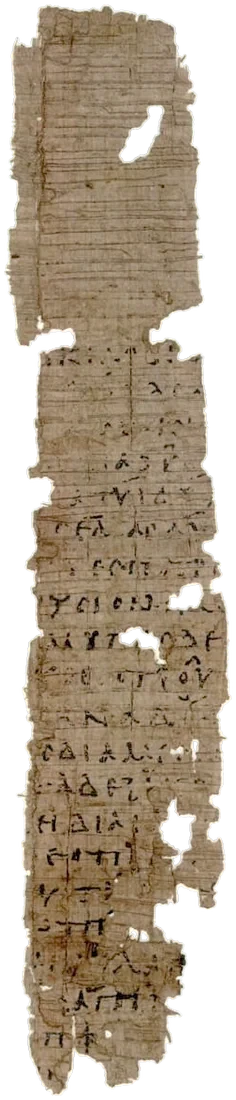
A song in the form of a prayer. The speaker asks Aphrodite to leave her father’s golden house and come to her. The goddess has come once before, in a chariot drawn by sparrows. On that visit she asked what the speaker had suffered, and whom she should persuade to love her. In line 20 the goddess calls the speaker Sappho. The last stanza begs Aphrodite to come again and be an ally in a love for a woman that is not returned.[1] Lardinois reads the poem as a love song, not a cult hymn. The beloved is not named, so the song could be sung on many occasions. Following Carson, he notes that Aphrodite’s promise in lines 21–24 does not say whom the woman will pursue.[2] Sappho worked on Lesbos around 600 BC. No date or occasion is known for this song.[3] It is her only complete poem.[4] Dionysius of Halicarnassus, writing in Augustan Rome, quotes all 28 lines. Hephaestion takes its first line as his example of the Sapphic stanza, which shows that the poem opened the Alexandrian edition.[5] P.Oxy. 2288, a roll of the first or second century AD, confirms this.[6]
The whole poem is scanned below.
Text and translation
The uninterrupted Greek with its English translation, line by line.
Show text and translation
Ποικιλόθρον’ ἀθανάτ’ Ἀφρόδιτα
Sappho · fr. 1 · Book 1 of the Alexandrian edition · 7 Sapphic stanzas · Greek from Waddell/DCC, with line 20 from Antonini 2020
How to read each line
A guide to the Greek, syllables, pitch marks and quantities.
Show the reading key
- Above each line: the line as the edition prints it, each word placed over its own syllables. The main row: the same Greek divided into metrical syllables, each written as it is pronounced. A consonant that closes a syllable is written with it (λόθ | ρο); an elided word is closed up with the next vowel (ν’ἀ); a final consonant carried into the next word is set with a thin space (ς ἰ). Wider gaps mark word-ends.
- Above the syllables: the pitch of each syllable, from the accents. Under them: the quantity of each syllable as it falls in the line, then the transliteration, syllable by syllable, with accented syllables in capitals.
- Under each line: a line-for-line translation. In the right margin of the scansion: the line type, its scheme, and its analysis into cola.
Key to the labels
The names, patterns and symbols used beside this poem.
Show the labels and symbols
The labels in the right margin of the scansion below name the cola, the rhythmic units each line is built from (Voigt’s and West’s analysis). A caret before a name (∧hipp) means the colon has lost its first position (acephalous). × marks an anceps position, which takes a long or a short. ⏓ is an anceps that is usually long (West’s and Voigt’s sign). A click on any syllable highlights its colon, or, with the colon/foot switch, its foot in the traditional analysis. After the scheme, ‖ marks the end of a period and ||| the end of the strophe.[7] A line that ends without either runs on into the next line (synapheia): the two are one period, with no metrical break between them,[8] and the page sets them together and links them. The sources of the labels, with their page numbers, are given line by line under Prosody, line by line.
| Label | Name and shape | What it is |
|---|---|---|
| cr | Cretic— ⏑ — | The three positions that open every hendecasyllable. Voigt calls it a cretic (cr); West calls the same thing an acephalous iambic metron (∧ia). |
| ∧hipp | Acephalous hipponactean (∧hipp), West’s hagesichorean (hag)× — ⏑ ⏑ — ⏑ — × | An eight-position Aeolic colon with a pendant ending. Its core is the choriamb — ⏑ ⏑ — at positions 5–8. The first position is anceps, usually long. |
| ∧gl | Acephalous glyconic (∧gl), the telesillean× — ⏑ ⏑ — ⏑ — | The same colon as ∧hipp but with a blunt ending. It hands over at position 11 to the ∧pher that runs into the adonean. |
| ∧pher | Acephalous pherecratean (∧pher), the reizianum× — ⏑ ⏑ — × | Begins on the last position of the third line and is completed by the adonean, so there is no pause between them (synapheia). The adonean alone is — ⏑ ⏑ — ×. |
The traditional feet
| Foot and shape | Where |
|---|---|
| Trochee— ⏑ | Positions 1–2. The traditional foot analysis of the Sapphic line (Hephaestion; most school grammars) is trochee, spondee or trochee, dactyl, trochee, spondee or trochee. |
| Spondee or trochee— × | Positions 3–4: the second syllable is anceps, so this foot is a spondee (— —) when a long stands there and a trochee (— ⏑) when a short does. |
| Dactyl— ⏑ ⏑ | Positions 5–7: the one place in the line with two shorts in a row. With the following long it forms the choriamb that modern metrics treats as the real core of the line. |
| Trochee— ⏑ | Positions 8–9. |
| Spondee or trochee— × | Positions 10–11. At a period-end the last syllable is indifferent; where the third line runs on into the adonean it keeps its real length. |
| Dactyl— ⏑ ⏑ | Positions 1–3 of the adonean. |
| Spondee or trochee— × | Positions 4–5 of the adonean, the last syllable indifferent. |
Scansion
Full metrical scansion, position by position: Greek in metrical syllables, the quantity and pitch of each syllable, a syllabified transliteration, and a line-for-line translation, with the line type in the right margin.
Immortal Aphrodite of the intricate throne,
child of Zeus who plaits deceits, I pray you:
do not with nausea and with sorrows break,
Lady, my heart,
but come here, if ever at another time
hearing my voice from far away
you listened, and leaving your father’s house
of gold, you came,
having yoked your chariot; and they drew you, lovely
swift sparrows, over the dark earth,
beating their wings thick and fast, down from heaven through the
middle air.
And swiftly they arrived; and you, O blessed one,
your deathless face smiling,
asked what I had suffered this time, and why
this time I was calling,
and what I most wanted to happen for me
in my maddened heart. “Whom this time am I to persuade
to lead you back into her love? Who, O
Sappho, does you wrong?
For even if she runs away, she will quickly give chase;
if she will not take gifts, she will be giving them;
if she feels no love, she will love before long,
though she does not want to.”
Come to me now as well, and free me from harsh
cares; and whatever my heart longs to have
fulfilled for me, fulfil; and you yourself
be my ally in the fight.
Metre
- The stanza. Written as four lines: three Sapphic hendecasyllables (eleven positions) and a five-position adonean, the pattern D’Angour calls AAAB.[9] Hephaestion already describes it that way: three hendecasyllables to each strophe, then a fourth line of five syllables, with this poem’s ll. 1, 5 and 4 as his examples.[10] Metrically the stanza has three periods. Voigt’s Conspectus metrorum (A 1, p. 15) sets it out as cr ∧hipp ‖ cr ∧hipp ‖ cr ∧gl ∧pher |||: the third hendecasyllable and the adonean are one continuous period, with no pause at the line-end. West[11] labels the first two periods ∧ia hag. The third could be labelled ∧ia hag ⁝ ad, he allows, but that label hides what matters about it: it is the first two periods stretched out (his pattern aaA). Battezzato[12] gives both analyses, cr ∧hipp adon and cr ∧glyc ∧pher, and prefers the second as the better metrical sense. The four-line layout goes back to antiquity: the ancient texts divided the third period after its eleventh position, where word-end is frequent.[13]
- Voigt’s symbols. At position 4 of the first two lines Voigt prints ⏓, which in her key means that at least eight syllables in twelve are long there; at position 4 of the third line she prints ×, which means that no more than seven in twelve are (Conspectus, p. 15 n. 1). Her ⁝ after positions 9 and 11 of the third line marks places where at least half the words end. West’s scheme of the third period marks frequent word-end (⁝) at the same two places and a bridge (⁀, word-end avoided) between positions 10 and 11.[14] In this poem no third line has word-end there: in l. 19 τίς σ’ is one word-group, the enclitic σ’ leaning on τίς.
- Line types. Every stanza runs hendecasyllable, hendecasyllable, hendecasyllable, adonean. The hendecasyllable is a cretic (— ⏑ —) prefixed to an eight-position Aeolic colon, Voigt’s acephalous hipponactean (× — ⏑ ⏑ — ⏑ — ×), West’s hagesichorean, whose core is the choriamb — ⏑ ⏑ — at positions 5–8. In the third line Voigt divides the same positions as an acephalous glyconic (× — ⏑ ⏑ — ⏑ —) and an acephalous pherecratean that runs on into the adonean. The adonean’s first four positions are a choriamb too. Lesbian verse keeps a fixed syllable count, with no resolution and no contraction;[15] when vowels meet between words they are elided or joined, never left in hiatus.[16]
- Long and short. A syllable is long if its vowel is long by nature (η, ω, long ᾱ ῑ ῡ, a diphthong) or if it is closed by a consonant, as a short vowel is when two consonants follow it.[17] The traditional phrase is “long by position”; West warns that it is the closed syllable that is long, not the vowel.[18] A vowel of unknown length (α ι υ without a mark) is fixed by the metre where the position is not anceps; where it is anceps the page has to choose, and marks its choice with a macron or breve in the input (ἐξῐ́κοντο, μᾰ́λιστα, αὔτᾱ)[19].
- “Makes position.” A stop followed by a liquid or nasal (πλ, φρ, θρ, κλ, τρ, χρ) is the one case where poets could choose. Attic speech, and the dialogue of comedy, normally carried the whole cluster into the next syllable (λό‑πλο) and left the vowel before it short; in early poetry that treatment is admitted mostly at the start of a word, and West notes that even this is avoided in “normal” Lesbian lyric.[20] Here the first consonant therefore always closes the syllable (λόπ‑λο, τ’Ἀφ‑ρό, ἔκ‑λυ, πάτ‑ρος), and the metre requires it: with λό‑πλο, position 5 of line 2 would be short, and the line would not scan. The vowel itself does not change: ό in δολόπλοκε stays a short o; the syllable is heavy because it is closed. For pronunciation, say do‑LOP‑lo‑ke and n’ā‑tha‑NA‑t’aph‑RO‑dī‑ta, with the stop closing the syllable. Where the vowel before the cluster is long anyway (προσώπωι, χρύσιον at a line-start) the cluster is written with the following syllable.
- Position 4 and the line-end. Hephaestion quotes l. 1 and l. 5 of this poem for the two forms of the hendecasyllable, “around the fourth syllable, sometimes short, sometimes long”:[10] here position 4 is short in 8 of the 21 hendecasyllables (ll. 1, 2, 3, 13, 15, 17, 22, 23) and long in 13. He adds that the line is also found in Alcaeus and that it is unclear which of the two invented it, though it is called Sapphic. Arukask[21] counted the two free positions in the hendecasyllables of Sappho that can be analysed, third lines included:[22] position 4 is heavy in 68.24% of them and the line-end in 80.79%, against 83.93% and 90.48% in Alcaeus, whose hendecasyllables are heavier in both places.[23] In fr. 1 position 4 is heavy in 13 of 21 lines and the line-end in 14 of 21 (light line-ends at ll. 1, 2, 3, 5, 11, 13, 15). Arukask[24] also reports Barris’s finding (2011) that the eleventh syllable is light in 35–36% of third lines but in nearly 40% of first and second lines; fr. 1 goes the other way, with 3 light line-ends in 7 third lines against 4 in 14 first and second lines. These counts follow the page’s choices at two doubtful vowels (the α of δάμνα, l. 3, and the ι of ἐξίκοντο, l. 13)[25], and the samples are small: Arukask warns that the figures show tendencies, not laws.[26]
- Line-end and synapheia. Lines 1 and 2 of each stanza end a period, so their last syllable is free. The third line runs on into the adonean: a word is split across the join at 11–12 (ὠράνω‿αἴθε|ρος), and at 7–8 the χρ of χρύσιον lengthens the last syllable of λίποισα; Battezzato cites ll. 7–8 and 19–20 as signs of this continuity.[12] The last position of the third line is still anceps (Voigt’s ×): short at ll. 11 and 15 (and at l. 3, where the page takes the α of δάμνα as short); long at ll. 7, 19, 23, 27.
- Word-end. The end of a word-group after position 4 and after position 5 of the hendecasyllable are about equally common in Sappho’s Sapphic stanzas (Lidov’s and Battezzato’s counts)[27]. Lidov observes that she normally avoids long runs with word-end in the same place, and notes the exception in the epiphany, ll. 18–25, where word-end falls after position 5 in every line.
Pitch
- What the pitch row shows. The Greek accent was one of musical pitch, not stress: the accented syllable was spoken on a higher note than its neighbours, and the accent had no effect on the metre.[28] The workbench derives the pitch row from the written accents: high on a syllable with an acute (rising, where the vowel is long or a diphthong), high and then falling within the syllable with a circumflex, and a drop on the unaccented syllable after an acute (after a circumflex the fall lies within the circumflex syllable itself); a grave counts as low. On the transliteration row the accented syllables are set in capitals.
- Lesbian accentuation. Lesbian draws the accent back as far as the rules allow (Ἀφρόδιτα for Attic Ἀφροδίτη, θῦμον for θυμόν), apart from prepositions, particles and a few other words.[29] The page and track use that accentuation syllable by syllable.
- Speech pitch, not Sappho’s tune. This is the melody of the words as spoken. Her sung melody is lost. D’Angour[30] thinks the most plausible hypothesis is that early lyric melody followed the natural pitches of the words; scholars differ on whether one tune was repeated for every stanza or the melody varied with the accents of each line.[31] Use the track for rhythm and word pitch together, not as a reconstruction of the song.
Dialect and transliteration
- Psilosis. Lesbian has lost initial aspiration, so ὐπασδεύξαισα and ἰμέρρει have smooth breathing and no h in transliteration.[29]
- σδ is the spelling of ζ in the texts of the Lesbian poets, a way of keeping the old pronunciation [zd];[32] it closes the syllable πασ|δεύ.
- Long ᾱ is kept where Attic–Ionic has η: γᾶς, μελαίνας, φιλότᾱτα, χαλέπαν, μερίμναν, αὔτᾱ, ἆγον, and the genitive τὰς ἔμας αὔδας (“my voice”).
- Other forms. Participles in -οισα / -αισα (ἀίοισα, λίποισα, ὐπασδεύξαισα, μειδιαίσαισ’, ἐθέλοισα); genitive singular in -ω (ὠράνω, μέσσω); dative plural in -αισι (ἄσαισι, ὀνίαισι); αἰ for εἰ; πότα for ποτε; ὤκεες left uncontracted.[33]
- Elision. Lesbian elides more than Attic: δέκετ’ is δέκεται and Ψάπφ’ is the vocative Ψάπφοι.[34] ἤρε’ is ἤρεο: when a word ends in two vowels only the last can be elided, and the one before keeps its value.[35]
- Key. η = ē, ω = ō, long α ι υ = ā ī ȳ, υ = y, χ = ch, ϝ = w, αι ωι (Voigt’s adscript) = āi ōi. The transliteration marks a vowel long only where its length is known (by nature, by accent, or by an open syllable the metre fixes as long); a vowel in a closed syllable is left unmarked.
Prosody, line by line
Every syllable, with the reason for its length. Quantities are read from the vowel where the spelling shows it, from the consonants that follow (“position”), from the accent where it tells, and from the metre where nothing else does. Editors’ notes on the text follow in the boxed paragraphs.
- 1.1
Line 1.1 · Ποικιλόθρον’ ἀθανάτ’ Ἀφρόδιτα,
Ποικιλόθρον’ ἀθανάτ’ Ἀφρόδιτα,
Ποικιλόθρον’ἀθανάτ’Ἀφρόδιτα,The label in the margin, with its sources: cr ∧hipp (Voigt A 1) = ∧ia hag (West p. 34).
- 1 —Ποιοι is a diphthong, long by nature.
- 2 ⏑κιι is short by the metre (position 2 must be short).
- 3 —λόθό is short by nature; closed by θ before a liquid: stop + liquid makes position in Lesbian verse, so the syllable is long whatever the vowel.
- 4 ⏑ροο is short by nature; the position is anceps (⏓: usually long).
- 5 —ν’ἀἀ is long by the metre (position 5 must be long); the apostrophe marks an elided vowel; the consonant before it joins this syllable.
- 6 ⏑θαα is short by the metre (position 6 must be short).
- 7 ⏑νάά is short by the metre (position 7 must be short).
- 8 —τ’ἈφἈ is a vowel of unknown length; closed by φ before a liquid: stop + liquid makes position in Lesbian verse, so the syllable is long whatever the vowel; the apostrophe marks an elided vowel; the consonant before it joins this syllable.
- 9 ⏑ρόό is short by nature.
- 10 —διι is long by the metre (position 10 must be long).
- 11 ×τα,α is short by the accent rule: acute on the antepenult requires a short final syllable; the position is anceps.
The variant ποικιλόφρον’ (“of intricate mind”), in some manuscripts of the epitome of Dionysius and of Choeroboscus (Voigt’s apparatus), scans the same. ἀθανάτ’ is ἀθανάτα with its final vowel elided; Ἀφρόδιτα shows the Lesbian recessive accent. The first syllable of ἀθανάτ’ is long (position 5), as again in l. 14: the α of the negative prefix is short in origin, and the long scansion is the metrical lengthening that epic gives words of this shape.[36]
- 1.2
Line 1.2 · παῖ Δίος δολόπλοκε, λίσσομαί σε,
παῖ Δίος δολόπλοκε, λίσσομαί σε,
παῖΔίοςδολόπλοκε,λίσσομαίσε,The label in the margin, with its sources: cr ∧hipp (Voigt A 1) = ∧ia hag (West p. 34).
- 1 —παῖαῖ is a diphthong, long by nature.
- 2 ⏑Δίί is short by the metre (position 2 must be short).
- 3 —οςο is short by nature; closed by ς: long by position.
- 4 ⏑δοο is short by nature; the position is anceps (⏓: usually long).
- 5 —λόπό is short by nature; closed by π before a liquid: stop + liquid makes position in Lesbian verse, so the syllable is long whatever the vowel.
- 6 ⏑λοο is short by nature.
- 7 ⏑κε,ε is short by nature.
- 8 —λίσί is a vowel of unknown length; closed by σ: long by position.
- 9 ⏑σοο is short by nature.
- 10 —μαίαί is a diphthong, long by nature.
- 11 ×σε,ε is short by nature; the position is anceps.
- 1.3
Line 1.3 · μή μ’ ἄσαισι μηδ’ ὀνίαισι δάμνα,
μή μ’ ἄσαισι μηδ’ ὀνίαισι δάμνα,
μήμ’ἄσαισιμηδ’ὀνίαισιδάμνα,the period runs on into 1.4 (synapheia).
The label in the margin, with its sources: cr ∧gl ∧pher… (Voigt A 1); ⁀ West p. 34.
- 1 —μήή is long by nature.
- 2 ⏑μ’ἄἄ is short by the metre (position 2 must be short); the apostrophe marks an elided vowel; the consonant before it joins this syllable.
- 3 —σαιαι is a diphthong, long by nature.
- 4 ⏑σιι is short by the accent rule: acute on the antepenult requires a short final syllable; the position is anceps.
- 5 —μηη is long by nature.
- 6 ⏑δ’ὀὀ is short by nature; the apostrophe marks an elided vowel; the consonant before it joins this syllable.
- 7 ⏑νίί is short by the metre (position 7 must be short).
- 8 —αιαι is a diphthong, long by nature.
- 9 ⏑σιι is short by the accent rule: acute on the antepenult requires a short final syllable.
- 10 —δάμά is a vowel of unknown length; closed by μ: long by position.
- 11 ○να,α is of unknown length; the position is anceps, so either scans; the line-end is not a period-end: the period runs on into the next line (synapheia), so this syllable keeps its own length, with no brevis in longo, and a word may run over into the next line.[37]
δάμνα is the imperative;[38] LSJ marks no quantity for its final α, and Voigt prints none. LSJ adds only that these forms may belong originally to δάμνᾱμι, the Aeolic form of δάμνημι, which does not settle the imperative. It stands at the anceps that ends the third line, so either length scans; the page takes it as short.
No line in the verse searched (the Perseus texts of Homer, Hesiod, the Homeric Hymns, Apollonius, Theocritus and the dramatists) fixes the final α of an imperative δάμνα, so the evidence leaves it open.
- 1.4
Line 1.4 · πότνια, θῦμον,
πότνια, θῦμον,
πότνια,θῦμον,continues 1.3 · one period (synapheia).
The label in the margin, with its sources: end of ∧pher (Voigt A 1; West p. 34).
- 1 —πότό is short by nature; closed by τ before a nasal: stop + nasal makes position in Lesbian verse, so the syllable is long whatever the vowel.
- 2 ⏑νιι is short by the metre (position 2 must be short).
- 3 ⏑α,α is short by the accent rule: acute on the antepenult requires a short final syllable.
- 4 —θῦῦ carries a circumflex, so it is long.
- 5 ×μον,ο is short by nature; closed by ν: long by position; the position is anceps.
- 1.5
Line 1.5 · ἀλλὰ τυίδ’ ἔλθ’, αἴ ποτα κἀτέρωτα
ἀλλὰ τυίδ’ ἔλθ’, αἴ ποτα κἀτέρωτα
ἀλλὰτυίδ’ἔλθ’,αἴποτακἀτέρωταThe label in the margin, with its sources: cr ∧hipp (Voigt A 1) = ∧ia hag (West p. 34).
- 1 —ἀλἀ is a vowel of unknown length; closed by λ: long by position.
- 2 ⏑λὰὰ is short by the metre (position 2 must be short).
- 3 —τυίυί is a diphthong, long by nature.
- 4 —δ’ἔλἔ is short by nature; closed by λ: long by position; the apostrophe marks an elided vowel; the consonant before it joins this syllable; the position is anceps (⏓: usually long).
- 5 —θ’,αἴαἴ is a diphthong, long by nature; the apostrophe marks an elided vowel; the consonant before it joins this syllable.
- 6 ⏑ποο is short by nature.
- 7 ⏑ταα is short by the metre (position 7 must be short).
- 8 —κἀἀ is long by crasis: the coronis marks two words contracted into one long vowel.
- 9 ⏑τέέ is short by nature.
- 10 —ρωω is long by nature.
- 11 ×ταα is short by the accent rule: acute on the antepenult requires a short final syllable; the position is anceps.
- 1.6
Line 1.6 · τὰς ἔμας αὔδας ἀίοισα πήλοι
τὰς ἔμας αὔδας ἀίοισα πήλοι
τὰςἔμαςαὔδαςἀίοισαπήλοιThe label in the margin, with its sources: cr ∧hipp (Voigt A 1) = ∧ia hag (West p. 34).
- 1 —τὰςὰ is long by the metre (position 1 must be long).
- 2 ⏑ἔἔ is short by nature.
- 3 —μαςα is long by the metre (position 3 must be long).
- 4 —αὔαὔ is a diphthong, long by nature; the position is anceps (⏓: usually long).
- 5 —δαςα is long by the metre (position 5 must be long).
- 6 ⏑ἀἀ is short by the metre (position 6 must be short).
- 7 ⏑ίί is short by the metre (position 7 must be short).
- 8 —οιοι is a diphthong, long by nature.
- 9 ⏑σαα is short by the accent rule: acute on the antepenult requires a short final syllable.
- 10 —πήή is long by nature.
- 11 ×λοιοι is a diphthong, long by nature; the position is anceps.
- 1.7
Line 1.7 · ἔκλυες, πάτρος δὲ δόμον λίποισα
ἔκλυες, πάτρος δὲ δόμον λίποισα
ἔκλυες,πάτροςδὲδόμονλίποισαthe period runs on into 1.8 (synapheia).
The label in the margin, with its sources: cr ∧gl ∧pher… (Voigt A 1); ⁀ West p. 34.
- 1 —ἔκἔ is short by nature; closed by κ before a liquid: stop + liquid makes position in Lesbian verse, so the syllable is long whatever the vowel.
- 2 ⏑λυυ is short by the metre (position 2 must be short).
- 3 —ες,ε is short by nature; closed by ς: long by position.
- 4 —πάτά is a vowel of unknown length; closed by τ before a liquid: stop + liquid makes position in Lesbian verse, so the syllable is long whatever the vowel; the position is anceps.
- 5 —ροςο is short by nature; closed by ς: long by position.
- 6 ⏑δὲὲ is short by nature.
- 7 ⏑δόό is short by nature.
- 8 —μονο is short by nature; closed by ν: long by position.
- 9 ⏑λίί is short by the metre (position 9 must be short).
- 10 —ποιοι is a diphthong, long by nature.
- 11 —σαthe next word begins with χρ: the syllable is closed before it: long by position; the position is anceps; the line-end is not a period-end: the period runs on into the next line (synapheia), so this syllable keeps its own length, with no brevis in longo, and a word may run over into the next line.[37]
- 1.8
Line 1.8 · χρύσιον ἦλθες
χρύσιον ἦλθες
χρύσιον ἦλθεςcontinues 1.7 · one period (synapheia).
The label in the margin, with its sources: end of ∧pher (Voigt A 1; West p. 34).
- 1 —χρύύ is long by the metre (position 1 must be long).
- 2 ⏑σιι is short by the metre (position 2 must be short).
- 3 ⏑οο is short by nature.
- 4 —ν ἦλἦ is long by nature; closed by λ: long by position; the first consonant belongs to the previous word and is carried over to this vowel.
- 5 ×θεςε is short by nature; closed by ς: long by position; the position is anceps.
The papyrus punctuates after χρύσιον, which ties it to δόμον (“golden house”); Page took it with ἄρμα in l. 9 (Voigt’s apparatus). χρύσιον is the papyrus reading (]ΡΥΣΙΟΝ·), found also in one manuscript of Dionysius; the others have χρύσειον, whose long second syllable would not fit the adonean (— ⏑ ⏑ — ×). The final -ν of χρύσιον passes to ἦλθες in pronunciation, so -ο- stays short.
- 1.9
Line 1.9 · ἄρμ’ ὐπασδεύξαισα· κάλοι δέ σ’ ἆγον
ἄρμ’ ὐπασδεύξαισα· κάλοι δέ σ’ ἆγον
ἄρμ’ὐπασδεύξαισα·κάλοιδέσ’ἆγονThe label in the margin, with its sources: cr ∧hipp (Voigt A 1) = ∧ia hag (West p. 34).
- 1 —ἄρἄ is a vowel of unknown length; closed by ρ: long by position.
- 2 ⏑μ’ὐὐ is short by the metre (position 2 must be short); the apostrophe marks an elided vowel; the consonant before it joins this syllable.
- 3 —πασα is a vowel of unknown length; closed by σ: long by position.
- 4 —δεύεύ is a diphthong, long by nature; ξ is a double consonant (two sounds) and closes the syllable: long by position; the position is anceps (⏓: usually long).
- 5 —ξαιαι is a diphthong, long by nature.
- 6 ⏑σα·α is short by the accent rule: acute on the antepenult requires a short final syllable.
- 7 ⏑κάά is short by the metre (position 7 must be short).
- 8 —λοιοι is a diphthong, long by nature.
- 9 ⏑δέέ is short by nature.
- 10 —σ’ἆἆ carries a circumflex, so it is long; the apostrophe marks an elided vowel; the consonant before it joins this syllable.
- 11 ×γονο is short by nature; closed by ν: long by position; the position is anceps.
- 1.10
Line 1.10 · ὤκεες στροῦθοι περὶ γᾶς μελαίνας
ὤκεες στροῦθοι περὶ γᾶς μελαίνας
ὤκεεςστροῦθοιπερὶγᾶςμελαίναςThe label in the margin, with its sources: cr ∧hipp (Voigt A 1) = ∧ia hag (West p. 34).
- 1 —ὤὤ is long by nature.
- 2 ⏑κεε is short by nature.
- 3 —εςε is short by nature; closed by ς: long by position.
- 4 —στροῦοῦ is a diphthong, long by nature; the position is anceps (⏓: usually long).
- 5 —θοιοι is a diphthong, long by nature.
- 6 ⏑πεε is short by nature.
- 7 ⏑ρὶὶ is short by the metre (position 7 must be short).
- 8 —γᾶςᾶ carries a circumflex, so it is long; closed by ς: long by position.
- 9 ⏑μεε is short by nature.
- 10 —λαίαί is a diphthong, long by nature.
- 11 ×ναςα is a vowel of unknown length; closed by ς: long by position; the position is anceps.
- 1.11
Line 1.11 · πύκνα δίννεντες πτέρ’ ἀπ’ ὠράνω‿αἴθε-
πύκνα δίννεντες πτέρ’ ἀπ’ ὠράνω‿αἴθε-
πύκναδίννεντεςπτέρ’ἀπ’ὠράνω‿αἴθε-the period runs on into 1.12 (synapheia).
The label in the margin, with its sources: cr ∧gl ∧pher… (Voigt A 1); ⁀ West p. 34.
- 1 —πύκύ is a vowel of unknown length; closed by κ before a nasal: stop + nasal makes position in Lesbian verse, so the syllable is long whatever the vowel.
- 2 ⏑ναα is short by the metre (position 2 must be short).
- 3 —δίνί is a vowel of unknown length; closed by ν: long by position.
- 4 —νενε is short by nature; closed by ν: long by position; the position is anceps.
- 5 —τεςε is short by nature; closed by ς: long by position.
- 6 ⏑πτέέ is short by nature.
- 7 ⏑ρ’ἀἀ is short by the metre (position 7 must be short); the apostrophe marks an elided vowel; the consonant before it joins this syllable.
- 8 —π’ὠὠ is long by nature; the apostrophe marks an elided vowel; the consonant before it joins this syllable.
- 9 ⏑ράά is short by the metre (position 9 must be short).
- 10 —νω‿αἴωαἴ is two vowels run together across the word-boundary into one long syllable (synecphonesis).
- 11 ⏑θε-ε is short by nature; the position is anceps; the line-end is not a period-end: the period runs on into the next line (synapheia), so this syllable keeps its own length, with no brevis in longo, and a word may run over into the next line.[37]
ὠράνω αἴθερος: ω and αι merge into one long syllable (synecphonesis). West[39] quotes this line among his examples of synecphonesis between words, which he says is tolerated mainly in Sappho, Hipponax and Old Comedy; the word αἴθερος then runs over the line-end into l. 12. In δίννεντες the double ν is in the papyrus (δίν[ν-) and in one manuscript of Dionysius, and the ending -εντες is Ahrens’ (the manuscripts have -ῆντες or -εῦντες; Voigt’s apparatus). With a single ν position 3 would be short. Natoli, Pitts and Hallett[40] print δίνεεντες, which would give the line a syllable too many.
- 1.12
Line 1.12 · ρος διὰ μέσσω·
ρος διὰ μέσσω·
ροςδιὰμέσσω·continues 1.11 · one period (synapheia).
The label in the margin, with its sources: end of ∧pher (Voigt A 1; West p. 34).
- 1 —ροςο is short by nature; closed by ς: long by position.
- 2 ⏑διι is short by the metre (position 2 must be short).
- 3 ⏑ὰὰ is short by the metre (position 3 must be short).
- 4 —μέσέ is short by nature; closed by σ: long by position.
- 5 ×σω·ω is long by nature; the position is anceps.
- 1.13
Line 1.13 · αἶψα δ’ ἐξίκοντο· σὺ δ’, ὦ μάκαιρα,
αἶψα δ’ ἐξίκοντο· σὺ δ’, ὦ μάκαιρα,
αἶψαδ’ἐξίκοντο·σὺδ’,ὦμάκαιρα,The label in the margin, with its sources: cr ∧hipp (Voigt A 1) = ∧ia hag (West p. 34).
- 1 —αἶαἶ is a diphthong, long by nature; ψ is a double consonant (two sounds) and closes the syllable: long by position.
- 2 ⏑ψαα is short by the accent rule: circumflex on the penult requires a short final syllable.
- 3 —δ’ἐἐ is short by nature; ξ is a double consonant (two sounds) and closes the syllable: long by position; the apostrophe marks an elided vowel; the consonant before it joins this syllable.
- 4 ⏑ξίῐ́ is short (its length is not shown by the ordinary spelling); the position is anceps (⏓: usually long).
- 5 —κονο is short by nature; closed by ν: long by position.
- 6 ⏑το·ο is short by nature.
- 7 ⏑σὺὺ is short by the metre (position 7 must be short).
- 8 —δ’,ὦὦ is long by nature; the apostrophe marks an elided vowel; the consonant before it joins this syllable.
- 9 ⏑μάά is short by the metre (position 9 must be short).
- 10 —καιαι is a diphthong, long by nature.
- 11 ×ρα,α is short by the accent rule: acute on the antepenult requires a short final syllable; the position is anceps.
ἐξίκοντο: LSJ gives the ι of ἱκόμην as short in the unaugmented forms and long where the augment lengthens it (s.vv. ἵκω, ἱκνέομαι), so the length depends on whether the form is taken as augmented. Voigt compares the Homeric αἶψα δ’ ἵκοντο (Il. 18.532 and elsewhere), where the ι is short. The position is anceps, so either scans; the page, and its sung track, take the short vowel.
- 1.14
Line 1.14 · μειδιαίσαισ’ ἀθανάτωι προσώπωι
μειδιαίσαισ’ ἀθανάτωι προσώπωι
μειδιαίσαισ’ἀθανάτωιπροσώπωιThe label in the margin, with its sources: cr ∧hipp (Voigt A 1) = ∧ia hag (West p. 34).
- 1 —μειει is a diphthong, long by nature.
- 2 ⏑διι is short by the metre (position 2 must be short).
- 3 —αίαί is a diphthong, long by nature.
- 4 —σαιαι is a diphthong, long by nature; the position is anceps (⏓: usually long).
- 5 —σ’ἀἀ is long by the metre (position 5 must be long); the apostrophe marks an elided vowel; the consonant before it joins this syllable.
- 6 ⏑θαα is short by the metre (position 6 must be short).
- 7 ⏑νάά is short by the metre (position 7 must be short).
- 8 —τωιωι is a diphthong, long by nature; the next word begins with πρ: the syllable is closed before it: long by position.
- 9 ⏑προο is short by nature.
- 10 —σώώ is long by nature.
- 11 ×πωιωι is a diphthong, long by nature; the position is anceps.
- 1.15
Line 1.15 · ἤρε’ ὄττι δηὖτε πέπονθα κὤττι
ἤρε’ ὄττι δηὖτε πέπονθα κὤττι
ἤρε’ὄττιδηὖτεπέπονθακὤττιthe period runs on into 1.16 (synapheia).
The label in the margin, with its sources: cr ∧gl ∧pher… (Voigt A 1); ⁀ West p. 34.
- 1 —ἤἤ is long by nature.
- 2 ⏑ρε’ε is short by nature; the apostrophe marks an elided vowel; the consonant before it joins this syllable.
- 3 —ὄτὄ is short by nature; closed by τ: long by position.
- 4 ⏑τιῐ is short (its length is not shown by the ordinary spelling); the position is anceps.
- 5 —δηὖηὖ is a diphthong, long by nature.
- 6 ⏑τεε is short by nature.
- 7 ⏑πέέ is short by nature.
- 8 —πονο is short by nature; closed by ν: long by position.
- 9 ⏑θαα is short by the accent rule: acute on the antepenult requires a short final syllable.
- 10 —κὤτὤ is long by nature; closed by τ: long by position.
- 11 ⏑τιῐ is short (its length is not shown by the ordinary spelling); the position is anceps; the line-end is not a period-end: the period runs on into the next line (synapheia), so this syllable keeps its own length, with no brevis in longo, and a word may run over into the next line.[37]
ἤρε’ is ἤρεο with -ο elided; ρε stands as a short syllable before ὄττι. δηὖτε = δὴ αὖτε, κὤττι = καὶ ὄττι, both by crasis.
The ι of ὄττι (ὅτι) is short: ὅτι has it in a short of the dactyl at Il. 7.448 and 9.76. The same holds for κὤττι, and both are marked short.
- 1.16
Line 1.16 · δηὖτε κάλημμι
δηὖτε κάλημμι
δηὖτεκάλημμιcontinues 1.15 · one period (synapheia).
The label in the margin, with its sources: end of ∧pher (Voigt A 1; West p. 34).
- 1 —δηὖηὖ is a diphthong, long by nature.
- 2 ⏑τεε is short by nature.
- 3 ⏑κάά is short by the metre (position 3 must be short).
- 4 —λημη is long by nature; closed by μ: long by position.
- 5 ×μιι is short by the accent rule: acute on the antepenult requires a short final syllable; the position is anceps.
Voigt prints κάλημμι, the form of the manuscripts of Dionysius and of one manuscript of the epitome; three manuscripts of the epitome have κάλημι (Voigt’s apparatus). De Kreij (2022, ch. 10, p. 148 n. 12) holds that κάλημμι is supported neither by linguistic theory nor by the manuscripts. η is long by nature, so the scansion is the same.
- 1.17
Line 1.17 · κὤττι μοι μάλιστα θέλω γένεσθαι
κὤττι μοι μάλιστα θέλω γένεσθαι
κὤττιμοιμάλισταθέλωγένεσθαιThe label in the margin, with its sources: cr ∧hipp (Voigt A 1) = ∧ia hag (West p. 34).
- 1 —κὤτὤ is long by nature; closed by τ: long by position.
- 2 ⏑τιῐ is short (its length is not shown by the ordinary spelling).
- 3 —μοιοι is a diphthong, long by nature.
- 4 ⏑μάᾰ́ is short (its length is not shown by the ordinary spelling); the position is anceps (⏓: usually long).
- 5 —λισι is a vowel of unknown length; closed by σ: long by position.
- 6 ⏑ταα is short by the accent rule: acute on the antepenult requires a short final syllable.
- 7 ⏑θέέ is short by nature.
- 8 —λωω is long by nature.
- 9 ⏑γέέ is short by nature.
- 10 —νεσε is short by nature; closed by σ: long by position.
- 11 ×θαιαι is a diphthong, long by nature; the position is anceps.
- 1.18
Line 1.18 · μαινόλαι θύμωι· τίνα δηὖτε πείθω
μαινόλαι θύμωι· τίνα δηὖτε πείθω
μαινόλαιθύμωι·τίναδηὖτεπείθωThe label in the margin, with its sources: cr ∧hipp (Voigt A 1) = ∧ia hag (West p. 34).
- 1 —μαιαι is a diphthong, long by nature.
- 2 ⏑νόό is short by nature.
- 3 —λαιαι is a diphthong, long by nature.
- 4 —θύῡ́ is long (its length is not shown by the ordinary spelling); the position is anceps (⏓: usually long).
- 5 —μωι·ωι is a diphthong, long by nature.
- 6 ⏑τίί is short by the metre (position 6 must be short).
- 7 ⏑ναα is short by the metre (position 7 must be short).
- 8 —δηὖηὖ is a diphthong, long by nature.
- 9 ⏑τεε is short by nature.
- 10 —πείεί is a diphthong, long by nature.
- 11 ×θωω is long by nature; the position is anceps.
Aphrodite’s direct speech begins at τίνα. πείθω is usually taken as the verb (“whom am I to persuade”); some have read Πειθώ, Persuasion (Voigt’s apparatus)[42]. Both are two long syllables.
The υ of θύμωι is long: θυμός fills the princeps at A.R. 1.44 and the long fourth position of the trimeter at E. Med. 8, and LSJ s.v. θυμός marks it θῡμός; the metre does not show it here, and the input marks it.
- 1.19
Line 1.19 · ἄψ σ’ ἄγην ἐς ϝὰν φιλότατα; τίς σ’, ὦ
ἄψ σ’ ἄγην ἐς ϝὰν φιλότατα; τίς σ’, ὦ
[ἄψ]σ’ἄγηνἐςϝὰνφιλότατα;τίςσ’,ὦthe period runs on into 1.20 (synapheia).
The label in the margin, with its sources: cr ∧gl ∧pher… (Voigt A 1); ⁀ West p. 34.
- 1 —[ἄψ]ἄ is a vowel of unknown length; closed by ψ: long by position.
- 2 ⏑σ’ἄἄ is short by the metre (position 2 must be short); the apostrophe marks an elided vowel; the consonant before it joins this syllable.
- 3 —γηνη is long by nature.
- 4 —ἐςἐ is short by nature; closed by ς: long by position; the position is anceps.
- 5 —ϝὰνὰ is a vowel of unknown length; closed by ν: long by position.
- 6 ⏑φιι is short by the metre (position 6 must be short).
- 7 ⏑λόό is short by nature.
- 8 —ταα is long by the metre (position 8 must be long).
- 9 ⏑τα;α is short by the accent rule: acute on the antepenult requires a short final syllable.
- 10 —τίςί is a vowel of unknown length; closed by ς: long by position.
- 11 —σ’,ὦὦ is long by nature; the next word begins with the double consonant Ψ: the syllable is closed before it: long by position; the apostrophe marks an elided vowel; the consonant before it joins this syllable; the position is anceps; the line-end is not a period-end: the period runs on into the next line (synapheia), so this syllable keeps its own length, with no brevis in longo, and a word may run over into the next line.[37]
The start is lost. The papyrus keeps only traces (a letter, then ψ or φ, then σ), and the manuscripts of Dionysius are corrupt (μαι σαγήνεσσαν, καὶ σαγήνεσσαν). Voigt’s apparatus records these reconstructions:
- ἄψ σ’ ἄγην ἐς ϝὰν, “to lead you back into her love”. Lobel judged ἄψ σ’ ἄγην possible, though it leaves a dot and an accent on the papyrus unexplained; Edmonds (1920) proposed ϝὰν, which Lobel thought acceptable if ἄψ σ’ ἄγην is right. Klinck[43] and the Dickinson College Commentaries print it. This is the reading shown above, with the supplement in brackets.
- From the manuscripts’ μαι σαγ-: μάψ (Blomfield), λαῖς (Seidler), μαῖς (Bergk 1835), μαῖσ’ (Buecheler). These go with σὰν, “into your love”.
- Voigt herself prints no supplement and keeps σὰν: ·]·σάγην ἐς σὰν φιλότατα. So do Natoli, Pitts and Hallett[40], who discuss ϝὰν in their note.[42]
Every proposal puts a long syllable in position 1, and ἐς is long before σ or before ϝ (which counts as a consonant), so the scansion does not change.
Campbell prints the supplement in the text without brackets, ἄψ σ’ ἄγην ἐς ϝὰν φιλότατα, and credits ϝὰν to Edmonds in his apparatus.[44] The scansion is the same.
- 1.20
Line 1.20 · Ψάπφ’, ἀδίκησι;
Ψάπφ’, ἀδίκησι;
Ψάπφ’,ἀδίκησι;continues 1.19 · one period (synapheia).
The label in the margin, with its sources: end of ∧pher (Voigt A 1; West p. 34).
- 1 —Ψάπά is a vowel of unknown length; closed by π: long by position.
- 2 ⏑φ’,ἀἀ is short by the metre (position 2 must be short); the apostrophe marks an elided vowel; the consonant before it joins this syllable.
- 3 ⏑δίί is short by the metre (position 3 must be short).
- 4 —κηη is long by nature.
- 5 ×σι;ι is short by the accent rule: acute on the antepenult requires a short final syllable; the position is anceps.
Voigt prints ἀδίκησι, Meillet’s form; the etymologica that quote the line have ἀδικήει (Voigt’s apparatus); Natoli, Pitts and Hallett[40] accent ἀδικήσι. All scan ⏑ ⏑ — ×. Ψάπφ’ is the vocative Ψάπφοι with -οι elided.
Campbell prints ἀδικήει, the form of the etymologica, not Voigt’s ἀδίκησι;[44] it scans the same.
- 1.21
Line 1.21 · καὶ γὰρ αἰ φεύγει, ταχέως διώξει,
καὶ γὰρ αἰ φεύγει, ταχέως διώξει,
καὶγὰρ αἰφεύγει,ταχέωςδιώξει,The label in the margin, with its sources: cr ∧hipp (Voigt A 1) = ∧ia hag (West p. 34).
- 1 —καὶαὶ is a diphthong, long by nature.
- 2 ⏑γὰὰ is short by the metre (position 2 must be short).
- 3 —ρ αἰαἰ is a diphthong, long by nature; the first consonant belongs to the previous word and is carried over to this vowel.
- 4 —φεύεύ is a diphthong, long by nature; the position is anceps (⏓: usually long).
- 5 —γει,ει is a diphthong, long by nature.
- 6 ⏑ταα is short by the metre (position 6 must be short).
- 7 ⏑χέέ is short by nature.
- 8 —ωςω is long by nature; closed by ς: long by position.
- 9 ⏑διι is short by the metre (position 9 must be short).
- 10 —ώώ is long by nature; ξ is a double consonant (two sounds) and closes the syllable: long by position.
- 11 ×ξει,ει is a diphthong, long by nature; the position is anceps.
- 1.22
Line 1.22 · αἰ δὲ δῶρα μὴ δέκετ’, ἀλλὰ δώσει,
αἰ δὲ δῶρα μὴ δέκετ’, ἀλλὰ δώσει,
αἰδὲδῶραμὴδέκετ’,ἀλλὰδώσει,The label in the margin, with its sources: cr ∧hipp (Voigt A 1) = ∧ia hag (West p. 34).
- 1 —αἰαἰ is a diphthong, long by nature.
- 2 ⏑δὲὲ is short by nature.
- 3 —δῶῶ is long by nature.
- 4 ⏑ραα is short by the accent rule: circumflex on the penult requires a short final syllable; the position is anceps (⏓: usually long).
- 5 —μὴὴ is long by nature.
- 6 ⏑δέέ is short by nature.
- 7 ⏑κεε is short by nature.
- 8 —τ’,ἀλἀ is a vowel of unknown length; closed by λ: long by position; the apostrophe marks an elided vowel; the consonant before it joins this syllable.
- 9 ⏑λὰὰ is short by the metre (position 9 must be short).
- 10 —δώώ is long by nature.
- 11 ×σει,ει is a diphthong, long by nature; the position is anceps.
- 1.23
Line 1.23 · αἰ δὲ μὴ φίλει, ταχέως φιλήσει
αἰ δὲ μὴ φίλει, ταχέως φιλήσει
αἰδὲμὴφίλει,ταχέωςφιλήσειthe period runs on into 1.24 (synapheia).
The label in the margin, with its sources: cr ∧gl ∧pher… (Voigt A 1); ⁀ West p. 34.
- 1 —αἰαἰ is a diphthong, long by nature.
- 2 ⏑δὲὲ is short by nature.
- 3 —μὴὴ is long by nature.
- 4 ⏑φίῐ́ is short (its length is not shown by the ordinary spelling); the position is anceps.
- 5 —λει,ει is a diphthong, long by nature.
- 6 ⏑ταα is short by the metre (position 6 must be short).
- 7 ⏑χέέ is short by nature.
- 8 —ωςω is long by nature; closed by ς: long by position.
- 9 ⏑φιι is short by the metre (position 9 must be short).
- 10 —λήή is long by nature.
- 11 —σειει is a diphthong, long by nature; the position is anceps; the line-end is not a period-end: the period runs on into the next line (synapheia), so this syllable keeps its own length, with no brevis in longo, and a word may run over into the next line.[37]
The ι of φίλει is short: φιλεῖ fills the short eleventh position of the trimeter at E. Cyc. 534, φίλε a short of the dactyl at A.R. 4.1086; the metre does not show it here, and the input marks it.- 1.24
Line 1.24 · κωὐκ ἐθέλοισα.
κωὐκ ἐθέλοισα.
κωὐκἐθέλοισα.continues 1.23 · one period (synapheia).
The label in the margin, with its sources: end of ∧pher (Voigt A 1; West p. 34).
- 1 —κωὐκωὐ is a diphthong, long by nature.
- 2 ⏑ἐἐ is short by nature.
- 3 ⏑θέέ is short by nature.
- 4 —λοιοι is a diphthong, long by nature.
- 5 ×σα.α is short by the accent rule: acute on the antepenult requires a short final syllable; the position is anceps.
κωὐκ = καὶ οὐκ. ἐθέλοισα, the feminine that fixes the beloved’s sex, is Bergk’s correction of the corrupt manuscripts (Voigt’s apparatus).
- 1.25
Line 1.25 · ἔλθε μοι καὶ νῦν, χαλέπαν δὲ λῦσον
ἔλθε μοι καὶ νῦν, χαλέπαν δὲ λῦσον
ἔλθεμοικαὶνῦν,χαλέπανδὲλῦσονThe label in the margin, with its sources: cr ∧hipp (Voigt A 1) = ∧ia hag (West p. 34).
- 1 —ἔλἔ is short by nature; closed by λ: long by position.
- 2 ⏑θεε is short by nature.
- 3 —μοιοι is a diphthong, long by nature.
- 4 —καὶαὶ is a diphthong, long by nature; the position is anceps (⏓: usually long).
- 5 —νῦν,ῦ carries a circumflex, so it is long; closed by ν: long by position.
- 6 ⏑χαα is short by the metre (position 6 must be short).
- 7 ⏑λέέ is short by nature.
- 8 —πανα is a vowel of unknown length; closed by ν: long by position.
- 9 ⏑δὲὲ is short by nature.
- 10 —λῦῦ carries a circumflex, so it is long.
- 11 ×σονο is short by nature; closed by ν: long by position; the position is anceps.
- 1.26
Line 1.26 · ἐκ μερίμναν, ὄσσα δέ μοι τέλεσσαι
ἐκ μερίμναν, ὄσσα δέ μοι τέλεσσαι
ἐκμερίμνα,ν ὄσσαδέμοιτέλεσσαιThe label in the margin, with its sources: cr ∧hipp (Voigt A 1) = ∧ia hag (West p. 34).
- 1 —ἐκἐ is short by nature; closed by κ: long by position.
- 2 ⏑μεε is short by nature.
- 3 —ρίμί is a vowel of unknown length; closed by μ: long by position.
- 4 ⏑να,ᾰ is short (its length is not shown by the ordinary spelling); the position is anceps (⏓: usually long).
- 5 —ν ὄσὄ is short by nature; closed by σ: long by position; the first consonant belongs to the previous word and is carried over to this vowel.
- 6 ⏑σαα is short by the metre (position 6 must be short).
- 7 ⏑δέέ is short by nature.
- 8 —μοιοι is a diphthong, long by nature.
- 9 ⏑τέέ is short by nature.
- 10 —λεσε is short by nature; closed by σ: long by position.
- 11 ×σαιαι is a diphthong, long by nature; the position is anceps.
Natoli, Pitts and Hallett[40] print μερίμαν, apparently a misprint: without the double consonant the syllable ρι would be short at position 3, which must be long. Voigt has μερίμναν.
The final α of μερίμναν is short: a noun in -α with genitive -ης has a short α (Smyth § 217 d), and μέριμναν fills the short third position of the trimeter at E. Heracl. 343 and Andr. 988. It is marked short.
- 1.27
Line 1.27 · θῦμος ἰμέρρει, τέλεσον, σὺ δ’ αὔτα
θῦμος ἰμέρρει, τέλεσον, σὺ δ’ αὔτα
θῦμος ἰμέρρει,τέλεσον,σὺδ’αὔταthe period runs on into 1.28 (synapheia).
The label in the margin, with its sources: cr ∧gl ∧pher… (Voigt A 1); ⁀ West p. 34.
- 1 —θῦῦ carries a circumflex, so it is long.
- 2 ⏑μοο is short by nature.
- 3 —ς ἰἰ is long by the metre (position 3 must be long); the first consonant belongs to the previous word and is carried over to this vowel.
- 4 —μέρέ is short by nature; closed by ρ: long by position; the position is anceps.
- 5 —ρει,ει is a diphthong, long by nature.
- 6 ⏑τέέ is short by nature.
- 7 ⏑λεε is short by nature.
- 8 —σον,ο is short by nature; closed by ν: long by position.
- 9 ⏑σὺὺ is short by the metre (position 9 must be short).
- 10 —δ’αὔαὔ is a diphthong, long by nature; the apostrophe marks an elided vowel; the consonant before it joins this syllable.
- 11 —ταᾱ is long (its length is not shown by the ordinary spelling); the position is anceps; the line-end is not a period-end: the period runs on into the next line (synapheia), so this syllable keeps its own length, with no brevis in longo, and a word may run over into the next line.[37]
αὔτᾱ: the feminine nominative has Lesbian long ᾱ, and three manuscripts of the epitome of Dionysius write αὐτᾶ with a circumflex, which shows a long vowel (Voigt’s apparatus). The syllable stands in the anceps that ends the third line, inside the period that runs on into the adonean, so the metre would allow either length.
- 1.28
Line 1.28 · σύμμαχος ἔσσο.
σύμμαχος ἔσσο.
σύμμαχος ἔσσο.continues 1.27 · one period (synapheia).
The label in the margin, with its sources: end of ∧pher (Voigt A 1; West p. 34).
- 1 —σύμύ is a vowel of unknown length; closed by μ: long by position.
- 2 ⏑μαα is short by the metre (position 2 must be short).
- 3 ⏑χοο is short by nature.
- 4 —ς ἔσἔ is short by nature; closed by σ: long by position; the first consonant belongs to the previous word and is carried over to this vowel.
- 5 ×σο.ο is short by nature; the position is anceps.
The poem’s shape
The song follows the form of a prayer: invocation (stanza 1), a reminder of the goddess’s earlier help told as narrative (2–6), and the request (7). Lardinois[45] reads it as an erotic song for a mortal audience in prayer form, not a cult hymn: the speaker is named as Sappho at l. 20, but the beloved is never named, which makes it a poor prayer but a song that could be performed on many occasions. δηὖτε (“again, this time”) recurs at ll. 15, 16 and 18. In ll. 21–24 the verbs of chasing, giving and loving have no expressed object, which leaves open whom the woman will come to love (Lardinois, p. 268).
The text and its witnesses
The whole poem survives because Dionysius of Halicarnassus quotes it in On the Arrangement of Words 23; a papyrus of the first or second century AD, P.Oxy. 2288, preserves the beginnings of ll. 1–21 (Voigt, p. 30)[46]. Hephaestion quotes l. 1 as his example of the Sapphic hendecasyllable, which suggests that the poem stood first in the Alexandrian edition; in P.Oxy. 2288 the poem starts at the head of a column, and a commentary papyrus seems to pass from the end of this poem to one labelled “two”.[47] Book 1 contained the poems in Sapphic stanzas (Voigt’s Conspectus A 1: frr. 1–42).
How the stanza has been read and heard, mostly in English, over two centuries, and what that means for scanning it, is on the Sappho page’s tab Reading the rhythm, after Yopie Prins.[48]
Notes
- ^ Natoli et al. 2022, pp. 27–28.
- ^ Lardinois 2022, p. 268.
- ^ Lardinois 2022, p. 264.
- ^ Lardinois 2022, p. 265.
- ^ Bowie 2021, p. 303.
- ^ Finglass 2021b, pp. 242, 244–245.
- ^ West 1987, p. 4.
- ^ West 1987, p. 3.
- ^ D’Angour 2022, ch. 9, p. 136.
- ^ a b Hephaestion, Ench. 14.1.
- ^ West 1987, p. 34.
- ^ a b c Battezzato 2021, p. 127.
- ^ West 1987, p. 35 n. 1.
- ^ West 1987, pp. ix, 34.
- ^ West 1987, p. 32; Battezzato 2021, p. 121.
- ^ West 1987, pp. 15–16, 35 n. 2.
- ^ West 1987, pp. 12–13.
- ^ West 1987, p. 13.
- ^ See the notes on ll. 13, 17 and 27.
- ^ West 1987, pp. 16–17 and p. 16 n. 7.
- ^ Arukask 2020, pp. 103–111.
- ^ Arukask 2020, p. 103.
- ^ Arukask 2020, pp. 104, 106.
- ^ Arukask 2020, p. 103 n. 14.
- ^ See the notes.
- ^ Arukask 2020, p. 104.
- ^ Battezzato 2021, p. 133 and n. 57.
- ^ West 1987, pp. 2, 68.
- ^ a b de Kreij 2022, ch. 10, p. 148.
- ^ D’Angour 2022, ch. 9, pp. 140–141.
- ^ Battezzato 2021, p. 133.
- ^ de Kreij 2022, ch. 10, p. 147.
- ^ de Kreij 2022, ch. 10, pp. 147–148.
- ^ West 1987, pp. 13–14.
- ^ West 1987, p. 14.
- ^ West 1987, p. 21.
- ^ a b c d e f g West 1987, pp. 3–4.
- ^ LSJ s.v. δαμνάω cites this line.
- ^ West 1987, p. 15.
- ^ a b c d Natoli, Pitts and Hallett 2022, p. 26.
- ^ LSJ s.v. μάλα: μᾰλᾰ.
- ^ a b Natoli, Pitts and Hallett 2022, p. 30.
- ^ Klinck 2008, p. 76.
- ^ a b Campbell 1982, p. 54.
- ^ Lardinois 2022, ch. 18, pp. 268–269.
- ^ Finglass 2021, p. 242.
- ^ Finglass 2021, pp. 244–245.
- ^ Prins 2019.
Text and sources
- Greek wording: Heather Waddell, Dickinson College Commentaries, Sappho fr. 1, CC BY-SA 4.0; line 20 from Sergio Antonini, “Una versión musical del Poema I de Safo” (2020), p. 27, CC BY-SA 4.0. Adscript iota, critical brackets, quantity marks and punctuation normalized; the two words at 11 retain an explicit synecphonesis mark. Translation and commentary are the site’s own.
- Critical comparison and metrical analysis: E.-M. Voigt, Sappho et Alcaeus: Fragmenta (Amsterdam 1971), fr. 1 with apparatus (pp. 29–33) and Conspectus metrorum, Sappho A 1 with the key to her symbols (p. 15). Printed here with ordinary sigma and without the half-brackets that mark the papyrus; l. 19 with the supplement ἄψ σ’ ἄγην … ϝὰν from Voigt’s apparatus (see the note); macrons and breves added where an anceps needs a choice.
- M. L. West, Introduction to Greek Metre (Oxford 1987), pp. ix and 34 (symbols; the Sapphic stanza), 2 and 68 (pitch accent), 12–17 (syllables, elision, synecphonesis, hiatus, stop + liquid), 21 (metrical lengthening) and 32–35 (Lesbian lyric). Checked against the page images. Also West 1987, pp. 3–4 (synapheia and period-end).
- Hephaestion, Enchiridion 14.1 (ed. M. Consbruch, Leipzig 1906); Greek text from First1KGreek, CC BY-SA 4.0.
- A. Arukask, “The Metrical Structure of the Sapphic Hendecasyllable and Sappho’s Aiolikon in Lesbian Poetry”, Studia Metrica et Poetica 7.1 (2020) 97–113, pp. 103–107.
- L. Battezzato, “Sappho’s Metres and Music”, and P. J. Finglass, “Sappho on the Papyri”, in P. J. Finglass and A. Kelly (eds.), The Cambridge Companion to Sappho (Cambridge 2021), pp. 121, 127, 133 and 242–245.
- L. Swift (ed.), A Companion to Greek Lyric (Wiley 2022): A. D’Angour, “Meter and Music” (ch. 9, pp. 136, 140–141); M. de Kreij, “The Lyric Dialects” (ch. 10, pp. 147–148); A. Lardinois, “Sappho” (ch. 18, pp. 268–269).
- B. A. Natoli, A. Pitts and J. P. Hallett, Ancient Women Writers of Greece and Rome (Routledge 2022), ch. 1, pp. 26–30.
- A. L. Klinck, Woman’s Songs in Ancient Greece (Montreal 2008), text of fr. 1, p. 76.
- LSJ (Perseus Digital Library, CC BY-SA), s.vv. δαμνάω, ἵκω, ἱκνέομαι, μάλα.
- Dickinson College Commentaries, Sappho fr. 1 (H. Waddell): dcc.dickinson.edu/sappho/frag-1.
- J. Lidov, “The Meter and Metrical Style of the New Poem”, Classics@ 4: classics-at.chs.harvard.edu.
- Y. Prins, ‘Sapphic Stanzas: How Can We Read the Rhythm?’, in B. Glaser and J. Culler (eds), Critical Rhythm: The Poetics of a Literary Life Form (New York 2019), pp. 247–273: the subject of the tab Reading the rhythm.
- D. A. Campbell, Greek Lyric I: Sappho and Alcaeus (Loeb Classical Library 142, Cambridge, MA 1982), fr. 1 (pp. 52–55), compared line by line: his wording differs from Voigt’s only at ll. 19–20 (see the notes). His number is the same as Voigt’s; his Sappho follows the numeration of Lobel and Page (p. 457), and he assigns frr. 1–42 to Book 1 (p. 53).
Quotations from copyrighted works are not covered by this page’s licence.
Modern performances
Modern performances, not ancient music: no melody for these words survives. They are shown for listening; each makes its own choices, described under it.
Jump to Stanza 1 0:32 · 2 0:56 · 3 1:20 · 4 1:50 · 5 2:12 · 6 2:38 · 7 3:08
Fr. 2 (ἄγνον ὄππ[αι]…)
Fr. 2 — the sanctuary on the potsherd
Synopsis
A summons to Aphrodite to come from Crete to a holy temple. It has a lovely grove of apple trees, where altars smoke with incense. Cold water murmurs through the branches, roses shade the ground, sleep comes down from the shimmering leaves, and a meadow is in flower. There she is to pour nectar into golden cups, at a festivity that implies a group of worshippers.[1] Whether the precinct is real or imagined cannot be told.[1] Ferrari reads the poem as a rite of epiphany, in which Sappho sings and plays, perhaps while her pupils dance.[2] Sappho worked on Lesbos around 600 BC.[3] The poem probably comes from Book 1.[1] It survives only on a potsherd (ostrakon) from Egypt, written between 225 and 150 BC. This is the only piece of Sappho on that material.[4] Cribiore took it for a school exercise written from dictation. Ferrari took it for a cultured amateur’s copy, since its many mistakes are of spelling, not of dialect.[5]
Eleven of its sixteen lines can be read, and they are scanned below.
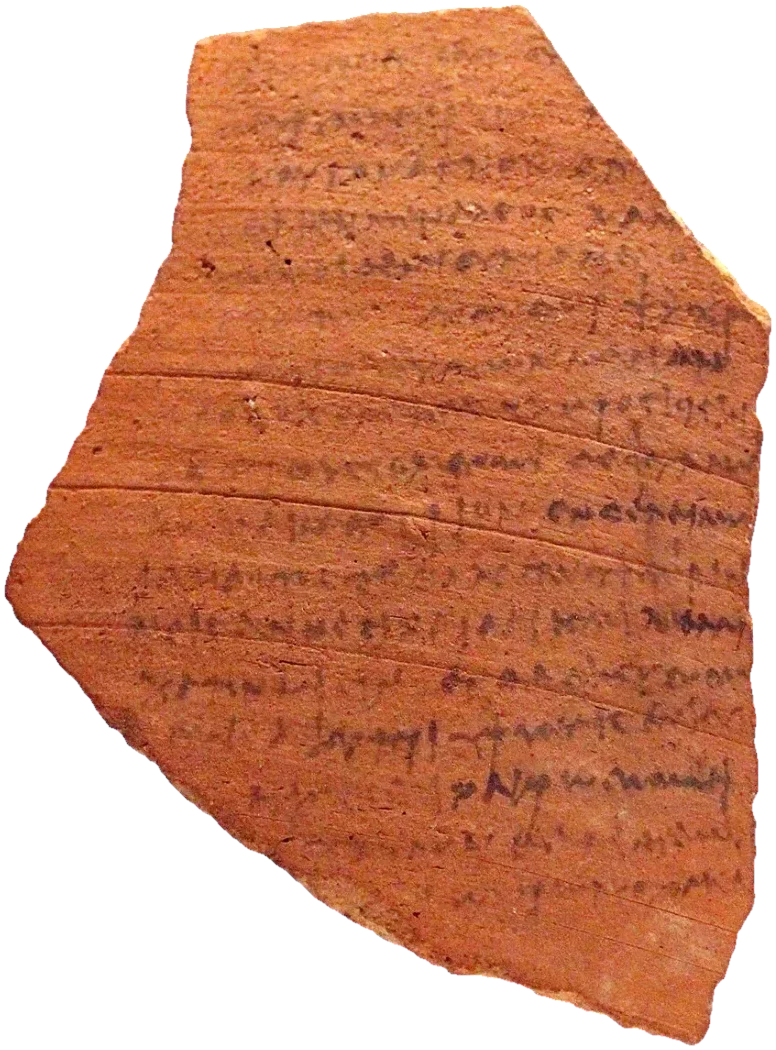
Text and translation
The uninterrupted Greek with its English translation, line by line.
Show text and translation
ἄγνον ὄππ[αι τοι] χάριεν μὲν ἄλσος
Sappho · fr. 2 · Book 1 of the Alexandrian edition · Sapphic stanzas, ll. 2–9 and 14–16 · Greek wording from the Bodard–Vierros corpus and Waddell/Dickinson
How to read each line
A guide to the Greek, syllables, pitch marks and quantities.
Show the reading key
- Above each line: the line as the edition prints it, each word placed over its own syllables. The main row: the same Greek divided into metrical syllables, each written as it is pronounced. A consonant that closes a syllable is written with it (λόθ | ρο); an elided word is closed up with the next vowel (ν’ἀ); a final consonant carried into the next word is set with a thin space (ς ἰ). Wider gaps mark word-ends.
- Above the syllables: the pitch of each syllable, from the accents. Under them: the quantity of each syllable as it falls in the line, then the transliteration, syllable by syllable, with accented syllables in capitals.
- Under each line: a line-for-line translation. In the right margin of the scansion: the line type, its scheme, and its analysis into cola.
Key to the labels
The names, patterns and symbols used beside this poem.
Show the labels and symbols
The labels in the right margin of the scansion below name the cola, the rhythmic units each line is built from (Voigt’s and West’s analysis). A caret before a name (∧hipp) means the colon has lost its first position (acephalous). × marks an anceps position, which takes a long or a short. ⏓ is an anceps that is usually long (West’s and Voigt’s sign). A click on any syllable highlights its colon, or, with the colon/foot switch, its foot in the traditional analysis. After the scheme, ‖ marks the end of a period and ||| the end of the strophe.[6] A line that ends without either runs on into the next line (synapheia): the two are one period, with no metrical break between them,[7] and the page sets them together and links them. The sources of the labels, with their page numbers, are given line by line under Prosody, line by line.
| Label | Name and shape | What it is |
|---|---|---|
| cr | Cretic— ⏑ — | The three positions that open every hendecasyllable. Voigt calls it a cretic (cr); West calls the same thing an acephalous iambic metron (∧ia). |
| ∧hipp | Acephalous hipponactean (∧hipp), West’s hagesichorean (hag)× — ⏑ ⏑ — ⏑ — × | An eight-position Aeolic colon with a pendant ending. Its core is the choriamb — ⏑ ⏑ — at positions 5–8. The first position is anceps, usually long. |
| ∧gl | Acephalous glyconic (∧gl), the telesillean× — ⏑ ⏑ — ⏑ — | The same colon as ∧hipp but with a blunt ending. It hands over at position 11 to the ∧pher that runs into the adonean. |
| ∧pher | Acephalous pherecratean (∧pher), the reizianum× — ⏑ ⏑ — × | Begins on the last position of the third line and is completed by the adonean, so there is no pause between them (synapheia). The adonean alone is — ⏑ ⏑ — ×. |
The traditional feet
| Foot and shape | Where |
|---|---|
| Trochee— ⏑ | Positions 1–2. The traditional foot analysis of the Sapphic line (Hephaestion; most school grammars) is trochee, spondee or trochee, dactyl, trochee, spondee or trochee. |
| Spondee or trochee— × | Positions 3–4: the second syllable is anceps, so this foot is a spondee (— —) when a long stands there and a trochee (— ⏑) when a short does. |
| Dactyl— ⏑ ⏑ | Positions 5–7: the one place in the line with two shorts in a row. With the following long it forms the choriamb that modern metrics treats as the real core of the line. |
| Trochee— ⏑ | Positions 8–9. |
| Spondee or trochee— × | Positions 10–11. At a period-end the last syllable is indifferent; where the third line runs on into the adonean it keeps its real length. |
| Dactyl— ⏑ ⏑ | Positions 1–3 of the adonean. |
| Spondee or trochee— × | Positions 4–5 of the adonean, the last syllable indifferent. |
Scansion
The lines of the summons to Aphrodite written on a potsherd that survive complete enough to scan, position by position: Greek in metrical syllables, the quantity and pitch of each syllable, a syllabified transliteration and a line-for-line translation. Voigt’s lines 1, 10–13 are corrupt or lost and are left out; every line keeps Voigt’s number (2.2 is fr. 2, line 2).
sacred, where [for you] there is a charming grove
of apples, and altars within, fragrant
with burning frankincense;
there chill water rushes murmuring through boughs
of apple-wood; and the whole spot
lies in the shade of roses, and from trembling leaves
a heavy drowsiness flows down;
there too a meadow, pasture for horses, is in flower
in cups of gold, delicately,
nectar blended into the feasting
pour out like wine.
Metre
- The stanza. Voigt heads the fragment “metrum: stropha Sapphica”, and her Conspectus metrorum (A 1, p. 15) sets the stanza out as cr ∧hipp ‖ cr ∧hipp ‖ cr ∧gl ∧pher |||. West[8] labels the first two periods ∧ia hag and sees the third as an enlarged version of them, which could be described as ∧ia hag ⁝ ad. Each stanza has three hendecasyllables and an adonean, and the third hendecasyllable runs on into the adonean without a pause.[9] Hephaestion describes the hendecasyllable and the adonean in Ench. 14.1.
- The text. The poem is written on an ostracon, a piece of broken pottery (PSI 1300), copied between about 225 and 150 BC, the only piece of Sappho’s poetry known in that medium.[10] Klinck[11] notes that the copy is full of errors, and parts of it are also quoted by later writers. It may be a school text, a pupil’s copy of a teacher’s dictation, but its many slips of spelling and few slips of dialect have also suggested a cultured amateur.[12] Voigt marks the line-ends of the potsherd with a vertical stroke; those strokes are not reproduced here. She numbers the first words on the sherd (..ανοθεν κατιου[σ-) as line 1a. Norsa and others assign them to an earlier stanza (Voigt’s apparatus), and Klinck takes them as probably part of a descriptive title.[13]
- Which lines are scanned. Line 1 is obelized by Voigt and partly lost. Line 10 is obelized and lacunose, line 11 breaks off, line 12 is lost and line 13 has an obelized word with a lost letter. These are left out. Page’s more restored text, which Giesecke reproduces,[14] and Campbell’s, which Natoli, Pitts and Hallett print,[15] make line 1 a regular hendecasyllable, δεῦρύ μ’ ἐκ Κρήτας ἐπ[ὶ τόνδ]ε ναῦον (— ⏑ — — — ⏑ ⏑ — ⏑ — ×); Voigt keeps the sherd’s letters between obeli. The Greek wording follows the licensed Bodard–Vierros sentence contexts, with Waddell’s κατέρρει at line 8. The opening supplement τοι at line 2 and the imperative at line 16 are included in the licensed texts. Line 8 now has the five syllables of an adonean. Every line keeps Voigt’s number, so the numbering passes over the lines left out.
- Position 4. In the first two lines of a stanza position 4 is long at ll. 2, 5 and 9 and short at ll. 6 and 14. In the third lines it is long at ll. 3 and 7 and short at l. 15.
- Synapheia. The third line of each stanza runs on into the adonean. At ll. 3–4 the participle θυμιάμε|νοι is divided between the lines. At ll. 15–16 νέκταρ ends the line and οἰνοχόαισον begins the next. Because there is no pause, the ρ of νέκταρ is pronounced with the οἰ- of the next line, and the last syllable of line 15 is open and short.
- Lesbian prosody. A stop followed by a liquid or nasal makes position in normal Lesbian lyric:[16] ἄγ|νον (l. 2; γν makes position in every kind of Greek verse, p. 16), ἄβ|ρως (l. 14). Lesbian avoids hiatus between words,[17] and here every meeting of vowels is resolved by elision: δ’ ἔνι, δι’ ὔσδων and ἐσκίαστ’ (for ἐσκίασται, an elided -αι of a passive ending, which West, p. 13, lists for Lesbian lyric).
Dialect and transliteration
- Psilosis. ὔδωρ, ὔσδων, ἰππόβοτος, ἄβρως and the article ὀ have smooth breathing.[18]
- σδ for ζ: ὔσδων (“branches”, Attic ὄζων). Voigt quotes an etymological dictionary that cites this line for the Aeolic form ὔσδος.
- βρόδοισι (“roses”) has βρ- where Attic has ῥ-. De Kreij (2022, ch. 10, pp. 147–148) notes that βρ- stands for an original ϝρ- in a number of words in the papyri and manuscripts of the Lesbian poets.
- παῖς is Lesbian for πᾶς, with the diphthong of the second compensatory lengthening;[19] one of Voigt’s testimonia quotes this phrase as evidence that the Aeolians said παῖς.
- Datives in -αισι(ν), -οισι and -εσσι(ν) (χρυσίαισιν, θαλίαισι, βρόδοισι, κυλίκεσσιν) are the Lesbian forms listed by de Kreij[18].
Prosody, line by line
Every syllable, with the reason for its length. Quantities are read from the vowel where the spelling shows it, from the consonants that follow (“position”), from the accent where it tells, and from the metre where nothing else does. Editors’ notes on the text follow in the boxed paragraphs.
- 2.2
Line 2.2 · ἄγνον ὄππαι τοι χάριεν μὲν ἄλσος
ἄγνον ὄππαι τοι χάριεν μὲν ἄλσος
ἄγνον ὄππ[αι][τοι]χάριενμὲν ἄλσοςThe label in the margin, with its sources: cr ∧hipp (Voigt A 1) = ∧ia hag (West p. 34).
- 1 —ἄγἄ is a vowel of unknown length; closed by γ before a nasal: stop + nasal makes position in Lesbian verse, so the syllable is long whatever the vowel.
- 2 ⏑νοο is short by nature.
- 3 —ν ὄπὄ is short by nature; closed by π: long by position; the first consonant belongs to the previous word and is carried over to this vowel.
- 4 —π[αι]αι is a diphthong, long by nature; the position is anceps (⏓: usually long).
- 5 —[τοι]οι is a diphthong, long by nature.
- 6 ⏑χάά is short by the metre (position 6 must be short).
- 7 ⏑ριι is short by the metre (position 7 must be short).
- 8 —ενε is short by nature; closed by ν: long by position.
- 9 ⏑μὲὲ is short by nature.
- 10 —ν ἄλἄ is a vowel of unknown length; closed by λ: long by position; the first consonant belongs to the previous word and is carried over to this vowel.
- 11 ×σοςο is short by nature; closed by ς: long by position; the position is anceps.
The supplement τοι, “for you”, follows the licensed corpus; it gives one long syllable. Voigt leaves the gap unfilled in her main text. In ἄγνον the γ closes the first syllable before ν: γν is one of the clusters that always make position.[20] In ἄγνον ὄππαι and μὲν ἄλσος the ν passes to the next vowel. ἄγνον (“holy”) belongs with the temple at the end of line 1, which is not scanned here. The line ends a period.
- 2.3
Line 2.3 · μαλίαν, βῶμοι δ’ ἔ⟨ν⟩ι θυμιάμε-
μαλίαν, βῶμοι δ’ ἔ⟨ν⟩ι θυμιάμε-
μαλί[αν],βῶμοιδ’ἔνιθυμιάμε-the period runs on into 2.4 (synapheia).
The label in the margin, with its sources: cr ∧gl ∧pher… (Voigt A 1); ⁀ West p. 34.
- 1 —μαα is long by the metre (position 1 must be long).
- 2 ⏑λίί is short by the metre (position 2 must be short).
- 3 —[αν],α is a vowel of unknown length; closed by ν: long by position.
- 4 —βῶῶ is long by nature; the position is anceps.
- 5 —μοιοι is a diphthong, long by nature.
- 6 ⏑δ’ἔἔ is short by nature; the apostrophe marks an elided vowel; the consonant before it joins this syllable.
- 7 ⏑νιι is short by the metre (position 7 must be short).
- 8 —θυυ is long by the metre (position 8 must be long).
- 9 ⏑μιι is short by the metre (position 9 must be short).
- 10 —άά is long by the metre (position 10 must be long).
- 11 ⏑με-ε is short by nature; the position is anceps; the line-end is not a period-end: the period runs on into the next line (synapheia), so this syllable keeps its own length, with no brevis in longo, and a word may run over into the next line.[21]
μαλί[αν] is Lobel’s supplement (reported by Schubart); Norsa proposed μάλι[νον] and Pfeiffer μαλί[δων]. Its first syllable is long, as the Lesbian μᾶλον (“apple”) is. The sherd has ΔΕΜΙ; Voigt prints Pfeiffer’s and Vogliano’s δ’ ἔ⟨ν⟩ι, and records Norsa’s δέ νυ θυμιάμενοι and δὲ τεθυμιάμενοι, the second approved by Lobel. βῶμοι has the Lesbian recessive accent. In θυμιάμε|νοι the α is long, as position 10 requires. The participle is divided across the line-end, so the line runs on into line 4 and its final syllable με counts as short.
Campbell chooses a different form of the verb; the two short syllables in the middle of the line scan the same.[22]
- 2.4
Line 2.4 · νοι λιβανώτω⟨ι⟩·
νοι λιβανώτω⟨ι⟩·
νοι[λι]βανώτωι·continues 2.3 · one period (synapheia).
The label in the margin, with its sources: end of ∧pher (Voigt A 1; West p. 34).
- 1 —νοιοι is a diphthong, long by nature.
- 2 ⏑[λι]ι is short by the metre (position 2 must be short).
- 3 ⏑βαα is short by the metre (position 3 must be short).
- 4 —νώώ is long by nature.
- 5 ×τωι·ωι is a diphthong, long by nature; the position is anceps.
[λι]βανώτω⟨ι⟩: Voigt brackets the first syllable, which the sherd does not preserve clearly (its letters are read ΔΙΑΝΩ or ΛΙΑΝΩ), and the iota of the dative is Turyn’s addition (Voigt’s apparatus). λι and βα fill the two shorts of the adonean, and νώ the long. The adonean completes the period and the stanza.
- 2.5
Line 2.5 · ἐν δ’ ὔδωρ ψῦχρο⌊ν⌋ κελάδει δι’ ὔσδων
ἐν δ’ ὔδωρ ψῦχρο⌊ν⌋ κελάδει δι’ ὔσδων
ἐνδ’ὔδωρψῦχρονκελάδειδι’ὔσδωνThe label in the margin, with its sources: cr ∧hipp (Voigt A 1) = ∧ia hag (West p. 34).
- 1 —ἐνἐ is short by nature; closed by ν: long by position.
- 2 ⏑δ’ὔὔ is short by the metre (position 2 must be short); the apostrophe marks an elided vowel; the consonant before it joins this syllable.
- 3 —δωρω is long by nature; closed by ρ: long by position.
- 4 —ψῦῦ carries a circumflex, so it is long; the position is anceps (⏓: usually long).
- 5 —χρονο is short by nature; closed by ν: long by position.
- 6 ⏑κεε is short by nature.
- 7 ⏑λάά is short by the metre (position 7 must be short).
- 8 —δειει is a diphthong, long by nature.
- 9 ⏑δι’ι is short by the metre (position 9 must be short); the apostrophe marks an elided vowel; the consonant before it joins this syllable.
- 10 —ὔσὔ is a vowel of unknown length; closed by σ: long by position.
- 11 ×δωνω is long by nature; closed by ν: long by position; the position is anceps.
The sherd has ἐν; the writers who quote the line have ἀμφὶ δέ. ψῦχρο⌊ν⌋: the half-brackets mark the ν, which the quotations give and the sherd lacks. ψῦ- is long by nature, so χρ goes with the next syllable, and χρον is closed by its ν before κ. δι’ is διά with its α elided; its ι stays a short syllable before ὔσδων. In ὔσδων the σδ (= ζ) closes the first syllable. The line ends a period.
- 2.6
Line 2.6 · μαλίνων, βρόδοισι δὲ παῖς ὀ χῶρος
μαλίνων, βρόδοισι δὲ παῖς ὀ χῶρος
μαλίνων,βρόδοισιδὲπαῖςὀχῶροςThe label in the margin, with its sources: cr ∧hipp (Voigt A 1) = ∧ia hag (West p. 34).
- 1 —μαα is long by the metre (position 1 must be long).
- 2 ⏑λίί is short by the metre (position 2 must be short).
- 3 —νων,ω is long by nature; closed by ν: long by position.
- 4 ⏑βρόό is short by nature; the position is anceps (⏓: usually long).
- 5 —δοιοι is a diphthong, long by nature.
- 6 ⏑σιι is short by the accent rule: acute on the antepenult requires a short final syllable.
- 7 ⏑δὲὲ is short by nature.
- 8 —παῖςαῖ is a diphthong, long by nature.
- 9 ⏑ὀὀ is short by nature.
- 10 —χῶῶ is long by nature.
- 11 ×ροςο is short by nature; closed by ς: long by position; the position is anceps.
μαλίνων (“of apple-wood”) is the reading of the quotations; the sherd has ΜΑΛΙΑΝ. Its first syllable is long. In μαλίνων βρόδοισι the ν closes νων before βρ, and βρό is an open short syllable at position 4. βρόδοισι (Norsa’s and Pfeiffer’s correction of the sherd’s ΒΡΟΤΟΙ-) has the Lesbian βρ- for ῥ-. παῖς (the sherd has ΠΕϹ) is Lesbian for πᾶς, and ὀ is the article without aspiration.
- 2.7
Line 2.7 · ἐσκίαστ’, αἰθυσσομένων δὲ φύλλων
ἐσκίαστ’, αἰθυσσομένων δὲ φύλλων
ἐσκίαστ’,αἰθυσσομένωνδὲφύλλωνthe period runs on into 2.8 (synapheia).
The label in the margin, with its sources: cr ∧gl ∧pher… (Voigt A 1); ⁀ West p. 34.
- 1 —ἐσἐ is short by nature; closed by σ: long by position.
- 2 ⏑κίί is short by the metre (position 2 must be short).
- 3 —ασα is a vowel of unknown length; closed by σ: long by position.
- 4 —τ’,αἰαἰ is a diphthong, long by nature; the apostrophe marks an elided vowel; the consonant before it joins this syllable; the position is anceps.
- 5 —θυσυ is a vowel of unknown length; closed by σ: long by position.
- 6 ⏑σοο is short by nature.
- 7 ⏑μέέ is short by nature.
- 8 —νωνω is long by nature; closed by ν: long by position.
- 9 ⏑δὲὲ is short by nature.
- 10 —φύλύ is a vowel of unknown length; closed by λ: long by position.
- 11 —λωνω is long by nature; closed by ν: long by position; the position is anceps; the line-end is not a period-end: the period runs on into the next line (synapheia), so this syllable keeps its own length, with no brevis in longo, and a word may run over into the next line.[21]
ἐσκίαστ’ (Norsa’s correction of the sherd’s ΚΙϹΚΙ) is ἐσκίασται (“is shaded”) with -αι elided, an elision in middle and passive endings that West[23] records for Lesbian lyric. αἰθυσσομένων (“quivering”) is the reading of the quotations, adopted by nearly all editors. The line runs on into the adonean; its last syllable is long in any case.
- 2.8
Line 2.8 · κῶμα κατέρρει·
κῶμα κατέρρει·
κῶμακατέρρει·continues 2.7 · one period (synapheia).
The label in the margin, with its sources: end of ∧pher (Voigt A 1; West p. 34).
- 1 —κῶῶ is long by nature.
- 2 ⏑μαα is short by the accent rule: circumflex on the penult requires a short final syllable.
- 3 ⏑καα is short by the metre (position 3 must be short).
- 4 —τέρέ is short by nature; closed by ρ: long by position.
- 5 ×ρει·ει is a diphthong, long by nature; the position is anceps.
κατέρρει, “flows down”, follows Waddell’s Dickinson text. Voigt records this correction by Sitzler but retains a corrupt form in her main text.[24] The corrected line has five syllables: κῶ-μα κα-τέρ-ρει, — ⏑ ⏑ — ×. The ρ closes τέρ before the second ρ; the final syllable ends the stanza. This replaces the six-syllable reading formerly displayed here.
- 2.9
Line 2.9 · ἐν δὲ λείμων ἰππόβοτος τέθαλε
ἐν δὲ λείμων ἰππόβοτος τέθαλε
ἐνδὲλείμωνἰππόβοτοςτέθαλεThe label in the margin, with its sources: cr ∧hipp (Voigt A 1) = ∧ia hag (West p. 34).
- 1 —ἐνἐ is short by nature; closed by ν: long by position.
- 2 ⏑δὲὲ is short by nature.
- 3 —λείεί is a diphthong, long by nature.
- 4 —μωνω is long by nature; the position is anceps (⏓: usually long).
- 5 —ἰπἰ is a vowel of unknown length; closed by π: long by position.
- 6 ⏑πόό is short by nature.
- 7 ⏑βοο is short by nature.
- 8 —τοςο is short by nature; closed by ς: long by position.
- 9 ⏑τέέ is short by nature.
- 10 —θαα is long by the metre (position 10 must be long).
- 11 ×λεε is short by nature; the position is anceps.
ἰππόβοτος is Pfeiffer’s reading of the sherd. In λείμων the ω is long by nature at position 4. τέθαλε (“is in bloom”) has a long ᾱ, as position 10 requires; it is the Lesbian form of the perfect that Attic writes τέθηλε. The line ends a period; Page’s text has τέθαλεν (Giesecke, p. 177), which scans the same.
Campbell prints τέθαλεν;[22] it scans the same.
- 2.14
Line 2.14 · χρυσίαισιν ἐν κυλίκεσσιν ἄβρως
χρυσίαισιν ἐν κυλίκεσσιν ἄβρως
χρυσίαισιν ἐνκυλίκεσσιν ἄβρωςThe label in the margin, with its sources: cr ∧hipp (Voigt A 1) = ∧ia hag (West p. 34).
- 1 —χρυυ is long by the metre (position 1 must be long).
- 2 ⏑σίί is short by the metre (position 2 must be short).
- 3 —αιαι is a diphthong, long by nature.
- 4 ⏑σιῐ is short (its length is not shown by the ordinary spelling); the position is anceps (⏓: usually long).
- 5 —ν ἐνἐ is short by nature; closed by ν: long by position; the first consonant belongs to the previous word and is carried over to this vowel.
- 6 ⏑κυυ is short by the metre (position 6 must be short).
- 7 ⏑λίί is short by the metre (position 7 must be short).
- 8 —κεσε is short by nature; closed by σ: long by position.
- 9 ⏑σιι is short by the accent rule: acute on the antepenult requires a short final syllable.
- 10 —ν ἄβἄ is a vowel of unknown length; closed by β before a liquid: stop + liquid makes position in Lesbian verse, so the syllable is long whatever the vowel; the first consonant belongs to the previous word and is carried over to this vowel.
- 11 ×ρωςω is long by nature; closed by ς: long by position; the position is anceps.
Line 13 (ἔνθα δὴ σὺ †συ.αν† ἔλοισα Κύπρι) is left out because a letter is lost inside its obelized word. χρυσίαισιν is Neue’s correction (the sherd has ΧΡΥϹΕΑΙϹ, Athenaeus χρυσείαισιν). Its final ι is short and is marked with a breve here, because position 4 is anceps; the ν passes to ἐν. κυλίκεσσιν has the Lesbian dative in -εσσι. ἄβρως is Bergk’s correction (the sherd has ΑΚΡΩϹ, Athenaeus ἁβροῖς); its β closes the syllable νἄβ before ρ, so position 10 is long. The line ends a period.
- 2.15
Line 2.15 · ⟨ὀ⟩μ⟨με⟩μείχμενον θαλίαισι νέκταρ
⟨ὀ⟩μ⟨με⟩μείχμενον θαλίαισι νέκταρ
ὀμμεμείχμενονθαλίαισινέκταthe period runs on into 2.16 (synapheia).
The label in the margin, with its sources: cr ∧gl ∧pher… (Voigt A 1); ⁀ West p. 34.
- 1 —ὀμὀ is short by nature; closed by μ: long by position.
- 2 ⏑μεε is short by nature.
- 3 —μείεί is a diphthong, long by nature.
- 4 ⏑χμεε is short by nature; the position is anceps.
- 5 —νονο is short by nature; closed by ν: long by position.
- 6 ⏑θαα is short by the metre (position 6 must be short).
- 7 ⏑λίί is short by the metre (position 7 must be short).
- 8 —αιαι is a diphthong, long by nature.
- 9 ⏑σιι is short by the accent rule: acute on the antepenult requires a short final syllable.
- 10 —νέκέ is short by nature; closed by κ: long by position.
- 11 ⏑ταᾰ is short (its length is not shown by the ordinary spelling); the position is anceps; the line-end is not a period-end: the period runs on into the next line (synapheia), so this syllable keeps its own length, with no brevis in longo, and a word may run over into the next line.[21]
⟨ὀ⟩μ⟨με⟩μείχμενον (“mixed”) is Lanata’s restoration, after Gallavotti, who read ΟΜ on the sherd; Norsa read ΕΜΜΕΙΧΜΕΝΟΝ, and Athenaeus quotes συνμεμιγμένον (Voigt’s apparatus). ὀμ- is the Lesbian form of ἀνα-, assimilated before μ, and its doubled μ closes the first syllable. θαλίαισι is a Lesbian dative plural. The line runs on into line 16. The ρ of νέκταρ is pronounced with οἰ- at the start of the next line, so τα is an open syllable, and its short α counts as short.
The ᾰ of νέκταρ is short (the metre: νέκταρ before a vowel has -τᾰ- in a short of the dactyl at Il. 4.3 and 19.38); the metre does not show it here, and the input marks it.
- 2.16
Line 2.16 · οἰνοχόαισον
οἰνοχόαισον
ρ οἰνοχόαισονcontinues 2.15 · one period (synapheia).
The label in the margin, with its sources: end of ∧pher (Voigt A 1; West p. 34).
- 1 —ρ οἰοἰ is a diphthong, long by nature; the first consonant belongs to the previous word and is carried over to this vowel.
- 2 ⏑νοο is short by nature.
- 3 ⏑χόό is short by nature.
- 4 —αιαι is a diphthong, long by nature.
- 5 ×σονο is short by nature; closed by ν: long by position; the position is anceps.
οἰνοχόαισον, “pour out like wine”, is the imperative in both the licensed corpus and Waddell’s Dickinson text. Its five syllables give — ⏑ ⏑ — ×: οἰ is a long diphthong, νο and χο are short, and αι is long. The adonean ends the stanza. Voigt instead prints a participle; the text and translation here follow the imperative.[24]
The poem
Klinck[25] reads fr. 2 as another prayer to Aphrodite. Giesecke[26] singles it out among the lyric poems for the depth of its spatial detail, and asks how far the sanctuary it describes was a real place. The singer calls the goddess to a sanctuary with an apple grove, smoking altars, cold water, roses and a flowering meadow, and asks her, as Cypris, to pour nectar into golden cups. Lardinois[27] lists the potsherd among the materials, besides papyrus and parchment, on which Sappho’s songs survive.
Notes
- ^ a b c Natoli et al. 2022, p. 32.
- ^ Ferrari 2021, p. 112.
- ^ Lardinois 2022, p. 264.
- ^ Finglass 2021b, pp. 234, 242.
- ^ Finglass 2021b, p. 244.
- ^ West 1987, p. 4.
- ^ West 1987, p. 3.
- ^ West 1987, p. 34.
- ^ Battezzato 2021, p. 127.
- ^ Finglass 2021, pp. 234, 242.
- ^ Klinck 2008, pp. 134–135.
- ^ Finglass 2021, p. 244.
- ^ Klinck 2008, p. 135.
- ^ Giesecke 2022, ch. 12, p. 176.
- ^ Natoli, Pitts and Hallett 2022, p. 30.
- ^ West 1987, p. 16 and n. 7.
- ^ West 1987, pp. 15–16.
- ^ a b de Kreij 2022, ch. 10, p. 148.
- ^ de Kreij 2022, ch. 10, p. 147.
- ^ West 1987, p. 16.
- ^ a b c West 1987, pp. 3–4.
- ^ a b Campbell 1982, p. 56.
- ^ West 1987, p. 13.
- ^ a b Voigt 1971, pp. 33–35.
- ^ Klinck 2008, p. 134.
- ^ Giesecke 2022, ch. 12, pp. 176–179.
- ^ Lardinois 2022, ch. 18, p. 266.
Text and sources
- Greek wording: Gabriel Bodard and Marja Vierros, Balbilla corpus, linguistic statistics, version 1.0 (2026), Sappho sentence contexts 9–12, CC BY 4.0. Line 8 follows Heather Waddell, Sappho 2, Dickinson College Commentaries, CC BY-SA 4.0. Accents, punctuation, bracket boundaries and line division normalized; corpus annotation artifacts and underdots omitted; teaching marks added. Teaching adaptation CC BY-SA 4.0.
- Textual comparison and metrical analysis: E.-M. Voigt, Sappho et Alcaeus: Fragmenta (Amsterdam 1971), pp. 33–35 and 15. The selection and line numbers follow her edition; its critical discussion is separate from the reusable wording sources above.
- M. L. West, Introduction to Greek Metre (Oxford 1987), pp. 13–17 (elision, hiatus, stop + liquid) and 32–35 (Lesbian lyric, the Sapphic stanza). Also West 1987, pp. 3–4 (synapheia and period-end).
- Hephaestion, Enchiridion 14.1 (the Sapphic hendecasyllable and the adonean), ed. M. Consbruch (Leipzig 1906); Greek text from First1KGreek, CC BY-SA 4.0.
- L. Battezzato, “Sappho’s Metres and Music”, and P. J. Finglass, “Sappho on the Papyri”, in P. J. Finglass and A. Kelly (eds.), The Cambridge Companion to Sappho (Cambridge 2021), pp. 127 and 234, 242, 244.
- L. Swift (ed.), A Companion to Greek Lyric (Wiley 2022): A. Giesecke, “Lyric Space: Sappho and Aphrodite’s Sanctuary” (ch. 12, pp. 176–179); M. de Kreij, “The Lyric Dialects” (ch. 10, pp. 147–148); A. Lardinois, “Sappho” (ch. 18, p. 266).
- B. A. Natoli, A. Pitts and J. P. Hallett, Ancient Women Writers of Greece and Rome (Routledge 2022), ch. 1, pp. 30–34.
- A. L. Klinck, Woman’s Songs in Ancient Greece (Montreal 2008), notes on fr. 2, pp. 134–135.
- D. A. Campbell, Greek Lyric I: Sappho and Alcaeus (Loeb Classical Library 142, Cambridge, MA 1982), fr. 2 (pp. 56–57), compared line by line: he prints the fuller text with ll. 1, 10–13 (see the notes for his readings in the lines shown here). Same fragment number as Voigt.
Quotations from copyrighted works are not covered by this page’s licence.
Fr. 16 (Οἰ μὲν ἰππήων…)
Fr. 16 — “Some say a host of horsemen”
Synopsis
The poem opens with a priamel. A priamel is a list that builds up to the item it stresses. Some say that a host of horsemen is the most beautiful thing on the black earth, others a host of foot-soldiers, others of ships. But the speaker says it is whatever one loves. Helen proves the point. She left the best of husbands, her child and her parents to sail to Troy. The thought then turns to the absent Anactoria. The speaker would rather see her lovely walk and shining face than the chariots and armed infantry of Lydia.[1] Kurke thinks the poem likely complete in twenty lines.[2] Lardinois takes its “I” as voicing the longing of the whole audience, whoever sang it.[3] Sappho worked on Lesbos around 600 BC, and the occasion is unknown.[4] The poem stood in Book 1. It survives on P.Oxy. 1231, a roll of the second century AD published in 1914.[5] Papyri published in 2014 add two words at the ends of lines 13 and 14.[6]
The lines that survive well enough, 1–11 and 15–20, are scanned below.
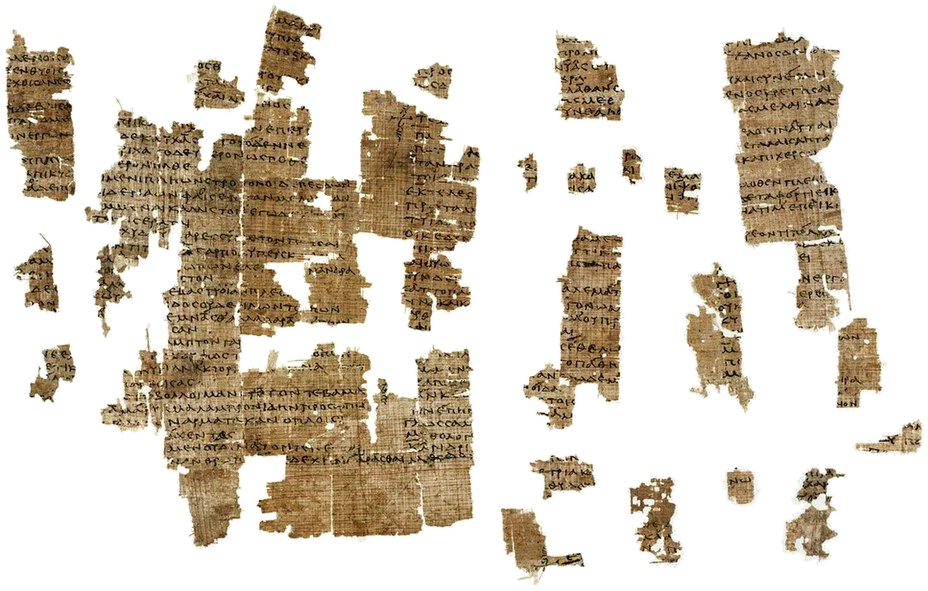
Text and translation
The uninterrupted Greek with its English translation, line by line.
Show text and translation
Ο]ἰ μὲν ἰππήων στρότον, οἰ δὲ πέσδων
Sappho · fr. 16 · Book 1 of the Alexandrian edition · Sapphic stanzas, ll. 1–11 and 15–20 · Greek wording from Waddell/Dickinson and the Bodard–Vierros corpus
How to read each line
A guide to the Greek, syllables, pitch marks and quantities.
Show the reading key
- Above each line: the line as the edition prints it, each word placed over its own syllables. The main row: the same Greek divided into metrical syllables, each written as it is pronounced. A consonant that closes a syllable is written with it (λόθ | ρο); an elided word is closed up with the next vowel (ν’ἀ); a final consonant carried into the next word is set with a thin space (ς ἰ). Wider gaps mark word-ends.
- Above the syllables: the pitch of each syllable, from the accents. Under them: the quantity of each syllable as it falls in the line, then the transliteration, syllable by syllable, with accented syllables in capitals.
- Under each line: a line-for-line translation. In the right margin of the scansion: the line type, its scheme, and its analysis into cola.
Key to the labels
The names, patterns and symbols used beside this poem.
Show the labels and symbols
The labels in the right margin of the scansion below name the cola, the rhythmic units each line is built from (Voigt’s and West’s analysis). A caret before a name (∧hipp) means the colon has lost its first position (acephalous). × marks an anceps position, which takes a long or a short. ⏓ is an anceps that is usually long (West’s and Voigt’s sign). A click on any syllable highlights its colon, or, with the colon/foot switch, its foot in the traditional analysis. After the scheme, ‖ marks the end of a period and ||| the end of the strophe.[7] A line that ends without either runs on into the next line (synapheia): the two are one period, with no metrical break between them,[8] and the page sets them together and links them. The sources of the labels, with their page numbers, are given line by line under Prosody, line by line.
| Label | Name and shape | What it is |
|---|---|---|
| cr | Cretic— ⏑ — | The three positions that open every hendecasyllable. Voigt calls it a cretic (cr); West calls the same thing an acephalous iambic metron (∧ia). |
| ∧hipp | Acephalous hipponactean (∧hipp), West’s hagesichorean (hag)× — ⏑ ⏑ — ⏑ — × | An eight-position Aeolic colon with a pendant ending. Its core is the choriamb — ⏑ ⏑ — at positions 5–8. The first position is anceps, usually long. |
| ∧gl | Acephalous glyconic (∧gl), the telesillean× — ⏑ ⏑ — ⏑ — | The same colon as ∧hipp but with a blunt ending. It hands over at position 11 to the ∧pher that runs into the adonean. |
| ∧pher | Acephalous pherecratean (∧pher), the reizianum× — ⏑ ⏑ — × | Begins on the last position of the third line and is completed by the adonean, so there is no pause between them (synapheia). The adonean alone is — ⏑ ⏑ — ×. |
The traditional feet
| Foot and shape | Where |
|---|---|
| Trochee— ⏑ | Positions 1–2. The traditional foot analysis of the Sapphic line (Hephaestion; most school grammars) is trochee, spondee or trochee, dactyl, trochee, spondee or trochee. |
| Spondee or trochee— × | Positions 3–4: the second syllable is anceps, so this foot is a spondee (— —) when a long stands there and a trochee (— ⏑) when a short does. |
| Dactyl— ⏑ ⏑ | Positions 5–7: the one place in the line with two shorts in a row. With the following long it forms the choriamb that modern metrics treats as the real core of the line. |
| Trochee— ⏑ | Positions 8–9. |
| Spondee or trochee— × | Positions 10–11. At a period-end the last syllable is indifferent; where the third line runs on into the adonean it keeps its real length. |
| Dactyl— ⏑ ⏑ | Positions 1–3 of the adonean. |
| Spondee or trochee— × | Positions 4–5 of the adonean, the last syllable indifferent. |
Scansion
The lines of the Anactoria poem that survive complete on the papyrus, scanned position by position: Greek in metrical syllables, the quantity and pitch of each syllable, a syllabified transliteration and a line-for-line translation. Lines 12–14 are too damaged to scan and are left out; every line keeps Voigt’s number (16.15 is fr. 16, line 15).
- line 16.19, position 9 (ὄπ): scans L but the scheme needs S
Some say a host of horsemen, some an army on foot,
and some a fleet of ships, upon the dark earth
is the most beautiful thing; for my part, I say it is that
which anyone loves.
And it is quite simple to make this plain
to all; for she who by far outdid
the human race in beauty, Helen, her husband,
[the noblest of all,]
abandoned, and went off sailing to Troy,
and for her child and her own dear parents
spared not a single thought, but [ … ] led her off course
[ … ] now has put me in mind of Anactoria,
who is not with us;
her lovely step I would sooner look on
and the bright flashing of her face
than Lydian chariots and men in full armour
[on foot] fighting.
Metre
- The stanza. Voigt heads the fragment “metrum: stropha Sapphica”, and her Conspectus metrorum (A 1, p. 15) sets the stanza out as cr ∧hipp ‖ cr ∧hipp ‖ cr ∧gl ∧pher |||. West[9] labels the first two periods ∧ia hag and treats the third as the same pattern drawn out to greater length, which could be described as ∧ia hag ⁝ ad. Each stanza is written as three hendecasyllables and an adonean, and the third hendecasyllable runs on into the adonean without a pause.[10] Hephaestion describes the hendecasyllable and the adonean in Ench. 14.1.
- Which lines are scanned. Voigt prints thirty-two lines. Lines 1–11, 15–16 and 17–20 survive complete or with short supplements and are scanned here. In line 8 Voigt leaves a gap of a few letters, and line 15 has lost its first two letters; both are filled with supplements also found in the licensed sources identified below.[11] Line 12 keeps only its last letters (]σαν) and lines 13–14 are scraps, so they cannot be scanned. Lines 21–32 are fragments; Milne and Snell took line 21 as the start of a new poem, Lattimore objected (Voigt’s apparatus), and Klinck[12] notes that line 20 seems to round the poem off. Every line keeps Voigt’s number, so the numbering passes over the lines left out. The stanza numbers follow Voigt’s stanzas.
- The papyri. The poem comes from P.Oxy. 1231 (second century AD), with the ends of ll. 31–32 also in PSI 123 (late first century AD) (Voigt’s testimonia)[13]. The wording is independently collated with Waddell’s openly licensed text, with the supplement at line 15 from the Bodard–Vierros corpus. P.GC inv. 105, published in 2014, adds to the poem, among other things two new words at the ends of ll. 13–14,[14] but its provenance is disputed (Lardinois, p. 270 n. 13), and Natoli, Pitts and Hallett print that text only in an appendix of disputed texts.[15]
- Position 4. In this poem the fourth position of the first two lines of a stanza is short as often as it is long: short at ll. 5, 9, 10 and 18, long at ll. 1, 2, 6 and 17. In the third lines it is long at ll. 3, 7, 11 and 19 and short at l. 15. Arukask[16] uses this poem to illustrate the two free positions of the hendecasyllable (position 4 and the line-end): l. 1 has both heavy, the commoner pattern; ll. 17 and 19 are heavy at position 4 and l. 18 at the line-end; l. 9 has both light, the least common type. Across all of Sappho’s analysable hendecasyllables she finds position 4 heavy in 68.24% of lines and the line-end in 80.79%.[17]
- Synapheia. The third line runs on into the adonean, and a word may be divided between them.[10] At ll. 3–4 the word ὄτ|τω is divided between them, and at ll. 15–16 the word ὀνέμναι|σ’. At ll. 7–8 (ἄνδρα | τὸν) and ll. 19–20 (ὄπλοισι | πεσδομάχεντας) the third line ends in a short open syllable, which counts as short because no pause follows. Line 11 ends a period on this page only because line 12, which completed the stanza, is lost.
- Lesbian prosody. A stop and a liquid normally make position in Lesbian lyric.[18] Line 19 breaks that rule as transmitted: ὄπλοισι must scan with a short first syllable. The scanner applies the Lesbian rule and reports the line; the note under it explains. Lesbian lyric avoids hiatus,[19] and here vowels that meet are elided (φαῖσ’, κῆν’, τοῦτ’, καλλίποισ’, παράγαγ’, ὀνέμναισ’) or run together: by crasis (κωὐδὲ, κἄμε, κἀμάρυχμα, κἀν), by prodelision (ἔβα ’ς), and by synecphonesis across words (ἐμνάσθη‿ἀλλὰ, l. 11), which West[20] says is tolerated outside the usual short words mainly in Sappho.
Dialect and transliteration
- Psilosis. Lesbian has lost initial aspiration, so οἰ, ἰππήων and ἀ (= ἡ) have smooth breathing and no h.[21]
- σδ is the spelling of ζ in the texts of the Lesbian poets; de Kreij cites πέσδων in l. 1 as his example.[22] The σ closes the syllable before δ (πέσ|δων, πεσ|δο|μά|χεν|τας).
- Long ᾱ is kept where Attic–Ionic has η: γᾶν, Ἐλένα, βολλοίμαν, ἀ (the relative), ἔβα, Ἀνακτορίας, and βᾶμα, which de Kreij uses as his example of retained ᾱ.[23]
- Other forms. ἔμμεναι is the Lesbian athematic infinitive in -μεναι, and ἴδην the infinitive in -ην.[21] κῆν’ (κῆνο) contracts εε to η.[23] προσώπω is the genitive in -ω, οἰ the nominative plural article.[24] καλλίποισ’ and the preverb of ὀνέμναισ’ (= ἀνέμνησε) show the Lesbian shortened forms of κατα- and ἀνα-.[24] στρότον is Lesbian for στρατόν, πόησαι for ποιῆσαι, βολλοίμαν for βουλοίμην.[25]
Prosody, line by line
Every syllable, with the reason for its length. Quantities are read from the vowel where the spelling shows it, from the consonants that follow (“position”), from the accent where it tells, and from the metre where nothing else does. Editors’ notes on the text follow in the boxed paragraphs.
- 16.1
Line 16.1 · Οἰ μὲν ἰππήων στρότον, οἰ δὲ πέσδων,
Οἰ μὲν ἰππήων στρότον, οἰ δὲ πέσδων,
[Ο]ἰμὲν ἰππήωνστρότο,ν οἰδὲπέσδων,The label in the margin, with its sources: cr ∧hipp (Voigt A 1) = ∧ia hag (West p. 34).
- 1 —[Ο]ἰΟἰ is a diphthong, long by nature.
- 2 ⏑μὲὲ is short by nature.
- 3 —ν ἰπἰ is a vowel of unknown length; closed by π: long by position; the first consonant belongs to the previous word and is carried over to this vowel.
- 4 —πήή is long by nature; the position is anceps (⏓: usually long).
- 5 —ωνω is long by nature; closed by ν: long by position.
- 6 ⏑στρόό is short by nature.
- 7 ⏑το,ο is short by nature.
- 8 —ν οἰοἰ is a diphthong, long by nature; the first consonant belongs to the previous word and is carried over to this vowel.
- 9 ⏑δὲὲ is short by nature.
- 10 —πέσέ is short by nature; closed by σ: long by position.
- 11 ×δων,ω is long by nature; closed by ν: long by position; the position is anceps.
Voigt supplies the first letter of [Ο]ἰ, the Lesbian article οἱ without aspiration. In μὲν ἰππήων and στρότον, οἰ the final ν passes to the next word, so μὲ and το are open short syllables. De Kreij (2022, ch. 10, p. 147) notes that a form like ἰππήων is regarded as epic influence. In πέσδων the σδ (= ζ) closes the syllable πέσ-. The line ends a period, so its last syllable is indifferent.
- 16.2
Line 16.2 · οἰ δὲ νάων φαῖσ’ ἐπὶ γᾶν μέλαιναν
οἰ δὲ νάων φαῖσ’ ἐπὶ γᾶν μέλαιναν
οἰδὲνάωνφαῖσ’ἐπ[ὶ]γᾶνμέλαι[ν]ανThe label in the margin, with its sources: cr ∧hipp (Voigt A 1) = ∧ia hag (West p. 34).
- 1 —οἰοἰ is a diphthong, long by nature.
- 2 ⏑δὲὲ is short by nature.
- 3 —νάά is long by the metre (position 3 must be long).
- 4 —ωνω is long by nature; closed by ν: long by position; the position is anceps (⏓: usually long).
- 5 —φαῖαῖ is a diphthong, long by nature.
- 6 ⏑σ’ἐἐ is short by nature; the apostrophe marks an elided vowel; the consonant before it joins this syllable.
- 7 ⏑π[ὶ]ὶ is short by the metre (position 7 must be short).
- 8 —γᾶνᾶ carries a circumflex, so it is long; closed by ν: long by position.
- 9 ⏑μέέ is short by nature.
- 10 —λαιαι is a diphthong, long by nature.
- 11 ×[ν]ανα is a vowel of unknown length; closed by ν: long by position; the position is anceps.
νάων (“of ships”) has long ᾱ, as position 3 requires. φαῖσ’ is φαῖσι (“they say”) with its final ι elided before ἐπ[ὶ]. γᾶν has the long ᾱ of the Lesbian form for γῆν. Voigt supplies the ι of ἐπ[ὶ] and the ν of μέλαι[ν]αν.
- 16.3
Line 16.3 · ἔμμεναι κάλλιστον, ἔγω δὲ κῆν’ ὄτ-
ἔμμεναι κάλλιστον, ἔγω δὲ κῆν’ ὄτ-
[ἔ]μμεναικάλλιστο,ν ἔγωδὲκῆν’ὄτ-the period runs on into 16.4 (synapheia).
The label in the margin, with its sources: cr ∧gl ∧pher… (Voigt A 1); ⁀ West p. 34.
- 1 —[ἔ]μἔ is short by nature; closed by μ: long by position.
- 2 ⏑μεε is short by nature.
- 3 —ναιαι is a diphthong, long by nature.
- 4 —κάλά is a vowel of unknown length; closed by λ: long by position; the position is anceps.
- 5 —λισι is a vowel of unknown length; closed by σ: long by position.
- 6 ⏑το,ο is short by nature.
- 7 ⏑ν ἔἔ is short by nature; the first consonant belongs to the previous word and is carried over to this vowel.
- 8 —γωω is long by nature.
- 9 ⏑δὲὲ is short by nature.
- 10 —κῆῆ is long by nature.
- 11 —ν’ὄτ-ὄ is short by nature; closed by τ: long by position; the apostrophe marks an elided vowel; the consonant before it joins this syllable; the position is anceps; the line-end is not a period-end: the period runs on into the next line (synapheia), so this syllable keeps its own length, with no brevis in longo, and a word may run over into the next line.[26]
[ἔ]μμεναι is the Lesbian infinitive in -μεναι;[21] its doubled μ closes the first syllable. κῆν’ is κῆνο (ἐκεῖνο) with its ο elided before ὄττω. The relative ὄτ|τω is divided between lines 3 and 4 (synapheia), so position 11 is closed by the first τ and long.
- 16.4
Line 16.4 · τω τις ἔραται·
τω τις ἔραται·
τωτις ἔραται·continues 16.3 · one period (synapheia).
The label in the margin, with its sources: end of ∧pher (Voigt A 1; West p. 34).
- 1 —τωω is long by nature.
- 2 ⏑τιι is short by the metre (position 2 must be short).
- 3 ⏑ς ἔἔ is short by nature; the first consonant belongs to the previous word and is carried over to this vowel.
- 4 —ραα is long by the metre (position 4 must be long).
- 5 ×ται·αι is a diphthong, long by nature; the position is anceps.
In τις ἔραται the ς passes to the next word, so τι is short. ἔραται must have a long ᾱ at position 4; Voigt’s apparatus records Bergk’s explanation of the form as a subjunctive, and LSJ (s.v. ἔραμαι) gives this line as the Aeolic subjunctive ἔρᾱται. Apollonius Dyscolus quotes lines 3–4 (Voigt’s testimonia).
- 16.5
Line 16.5 · πάγχυ δ’ εὔμαρες σύνετον πόησαι
πάγχυ δ’ εὔμαρες σύνετον πόησαι
[πά]γχυδ’εὔμαρεςσύνετονπόησαιThe label in the margin, with its sources: cr ∧hipp (Voigt A 1) = ∧ia hag (West p. 34).
- 1 —[πά]γά is a vowel of unknown length; closed by γ: long by position.
- 2 ⏑χυυ is short by the metre (position 2 must be short).
- 3 —δ’εὔεὔ is a diphthong, long by nature; the apostrophe marks an elided vowel; the consonant before it joins this syllable.
- 4 ⏑μαᾰ is short (its length is not shown by the ordinary spelling); the position is anceps (⏓: usually long).
- 5 —ρεςε is short by nature; closed by ς: long by position.
- 6 ⏑σύύ is short by the metre (position 6 must be short).
- 7 ⏑νεε is short by nature.
- 8 —τονο is short by nature; closed by ν: long by position.
- 9 ⏑πόό is short by nature.
- 10 —ηη is long by nature.
- 11 ×σαιαι is a diphthong, long by nature; the position is anceps.
- 16.6
Line 16.6 · πάντι τοῦτ’, ἀ γὰρ πόλυ περσκέθοισα
πάντι τοῦτ’, ἀ γὰρ πόλυ περσκέθοισα
[π]άντιτ[ο]ῦτ’,ἀγὰρπόλυπερσκέθοισαThe label in the margin, with its sources: cr ∧hipp (Voigt A 1) = ∧ia hag (West p. 34).
- 1 —[π]άνά is a vowel of unknown length; closed by ν: long by position.
- 2 ⏑τιι is short by the metre (position 2 must be short).
- 3 —τ[ο]ῦοῦ is a diphthong, long by nature.
- 4 —τ’,ἀᾱ̓ is long (its length is not shown by the ordinary spelling); the apostrophe marks an elided vowel; the consonant before it joins this syllable; the position is anceps (⏓: usually long).
- 5 —γὰρὰ is a vowel of unknown length; closed by ρ: long by position.
- 6 ⏑πόό is short by nature.
- 7 ⏑λυυ is short by the metre (position 7 must be short).
- 8 —περσε is short by nature; closed by ρσ: long by position.
- 9 ⏑κέέ is short by nature.
- 10 —θοιοι is a diphthong, long by nature.
- 11 ×σαα is short by the accent rule: acute on the antepenult requires a short final syllable; the position is anceps.
τοῦτ’ is τοῦτο elided before ἀ. ἀ is the Lesbian relative pronoun (Attic ἥ) with long ᾱ; the papyrus marks it long (Voigt’s apparatus), and it is marked with a macron here because position 4 is anceps. περσκέθοισα (“surpassing”, Powell’s reading, which Lobel and Page accepted with doubt) begins with περ-, a shortened form of περί; the ρ closes the syllable περσ-.
- 16.7
Line 16.7 · κάλλος ἀνθρώπων Ἐλένα τὸν ἄνδρα
κάλλος ἀνθρώπων Ἐλένα τὸν ἄνδρα
κάλλος [ἀν][θ]ρώπωνἘλένα[τὸ]ν ἄνδραthe period runs on into 16.8 (synapheia).
The label in the margin, with its sources: cr ∧gl ∧pher… (Voigt A 1); ⁀ West p. 34.
- 1 —κάλά is a vowel of unknown length; closed by λ: long by position.
- 2 ⏑λοο is short by nature.
- 3 —ς [ἀν]ἀ is a vowel of unknown length; closed by ν: long by position; the first consonant belongs to the previous word and is carried over to this vowel.
- 4 —[θ]ρώώ is long by nature; the position is anceps.
- 5 —πωνω is long by nature.
- 6 ⏑ἘἘ is short by nature.
- 7 ⏑λέέ is short by nature.
- 8 —ναα is long by the metre (position 8 must be long).
- 9 ⏑[τὸ]ὸ is short by nature.
- 10 —ν ἄνἄ is a vowel of unknown length; closed by ν: long by position; the first consonant belongs to the previous word and is carried over to this vowel.
- 11 ⏑δραᾰ is short (its length is not shown by the ordinary spelling); the position is anceps; the line-end is not a period-end: the period runs on into the next line (synapheia), so this syllable keeps its own length, with no brevis in longo, and a word may run over into the next line.[26]
Voigt supplies [ἀνθ]ρώπων and [τὸ]ν. In κάλλος ἀνθρώπων the ς passes to ἀν-, which is closed by ν; θρ goes with the next vowel. Ἐλένα has the Lesbian long ᾱ, as position 8 requires. In τὸν ἄνδρα the ν passes to ἄν-. The line runs on into line 8, so the short final -δρα counts as short. Voigt’s apparatus records Sitzler’s [ϝὸ]ν (“her own”), with the Lesbian digamma, which gives the same scansion.
The ᾰ of ἄνδρα is short;[28] the metre does not show it here, and the input marks it.
- 16.8
Line 16.8 · τὸν πανάριστον
τὸν πανάριστον
τὸν[πα][νά][ρ]ιστονcontinues 16.7 · one period (synapheia).
The label in the margin, with its sources: end of ∧pher (Voigt A 1; West p. 34).
- 1 —τὸνὸ is short by nature; closed by ν: long by position.
- 2 ⏑[πα]α is short by the metre (position 2 must be short).
- 3 ⏑[νά]ά is short by the metre (position 3 must be short).
- 4 —[ρ]ισι is a vowel of unknown length; closed by σ: long by position.
- 5 ×τονο is short by nature; closed by ν: long by position; the position is anceps.
Voigt prints τὸν [ ἀρ]ιστον, with a gap of a few letters. The supplement shown, [πανάρ]ιστον (“best of all”), is Page’s, which Voigt’s apparatus calls possible. Gallavotti’s [μέγ’ ἄρ]ιστον and Marzullo’s τόν [περ] ἄριστον are recorded too. Every proposal fills the gap with two short syllables, which is what the adonean (— ⏑ ⏑ — ×) requires.
- 16.9
Line 16.9 · καλλίποισ’ ἔβα ’ς Τροΐαν πλέοισα
καλλίποισ’ ἔβα ’ς Τροΐαν πλέοισα
καλλ[ί][ποι]σ’ἔβαςΤροΐανπλέοι[σα]The label in the margin, with its sources: cr ∧hipp (Voigt A 1) = ∧ia hag (West p. 34).
- 1 —καλα is a vowel of unknown length; closed by λ: long by position.
- 2 ⏑λ[ί]ί is short by the metre (position 2 must be short).
- 3 —[ποι]οι is a diphthong, long by nature.
- 4 ⏑σ’ἔἔ is short by nature; the apostrophe marks an elided vowel; the consonant before it joins this syllable; the position is anceps (⏓: usually long).
- 5 —βαςᾱ is long (its length is not shown by the ordinary spelling); the next word begins with ςΤ: the syllable is closed before it: long by position.
- 6 ⏑Τροο is short by nature.
- 7 ⏑ΐΐ is short by the metre (position 7 must be short).
- 8 —ανα is a vowel of unknown length; closed by ν: long by position.
- 9 ⏑πλέέ is short by nature.
- 10 —οιοι is a diphthong, long by nature.
- 11 ×[σα]α is short by the accent rule: acute on the antepenult requires a short final syllable; the position is anceps.
καλλ[ίποι]σ’ is καλλίποισα (“leaving”, with κατα- shortened and assimilated) with its final α elided; Voigt supplies the middle of the word. ἔβα is the Lesbian ἔβᾱ (Attic ἔβη)[29], marked with a macron in the input. After its long vowel ἐς loses its ε, the prodelision that West[20] describes, and the remaining ς closes the syllable βας before Τρ-. Τροΐαν has three syllables, Τρο-ΐ-αν, and its ι is short at position 7. Voigt supplies the last syllable of πλέοι[σα]. Both free positions (4 and 11) are light here, the least common type of hendecasyllable in Arukask’s count.[30]
- 16.10
Line 16.10 · κωὐδὲ παῖδος οὐδὲ φίλων τοκήων
κωὐδὲ παῖδος οὐδὲ φίλων τοκήων
κωὐδ[ὲ][πα]ῖδος οὐδὲφίλωντο[κ]ήωνThe label in the margin, with its sources: cr ∧hipp (Voigt A 1) = ∧ia hag (West p. 34).
- 1 —κωὐωὐ is a diphthong, long by nature.
- 2 ⏑δ[ὲ]ὲ is short by nature.
- 3 —[πα]ῖαῖ is a diphthong, long by nature.
- 4 ⏑δοο is short by nature; the position is anceps (⏓: usually long).
- 5 —ς οὐοὐ is a diphthong, long by nature; the first consonant belongs to the previous word and is carried over to this vowel.
- 6 ⏑δὲὲ is short by nature.
- 7 ⏑φίί is short by the metre (position 7 must be short).
- 8 —λωνω is long by nature; closed by ν: long by position.
- 9 ⏑τοο is short by nature.
- 10 —[κ]ήή is long by nature.
- 11 ×ωνω is long by nature; closed by ν: long by position; the position is anceps.
κωὐδ[ὲ] is καὶ οὐδέ joined by crasis into one long syllable;[20] the papyrus has ΚΩΥ. Voigt supplies [ὲ πα]: Hunt proposed οὐδὲ π-, Edmonds κοὐδὲ or κωὐδὲ (Voigt’s apparatus). In παῖδος οὐδὲ the ς passes to the next word, so δο is short at position 4. το[κ]ήων (“parents”) has its κ supplied. The line ends a period.
- 16.11
Line 16.11 · πάμπαν ἐμνάσθ⟨η⟩,‿ἀλλὰ παράγαγ’ αὔταν
πάμπαν ἐμνάσθ⟨η⟩,‿ἀλλὰ παράγαγ’ αὔταν
πά[μ][πα][ν] ἐμνάσθη,‿ἀλλὰπαράγαγ’αὔτανthe period runs on into the next line, which is not given here (synapheia).
The label in the margin, with its sources: cr ∧gl ∧pher… (Voigt A 1); ⁀ West p. 34.
- 1 —πά[μ]ά is a vowel of unknown length; closed by μ: long by position.
- 2 ⏑[πα]α is short by the metre (position 2 must be short).
- 3 —[ν] ἐμἐ is short by nature; closed by μ: long by position; the first consonant belongs to the previous word and is carried over to this vowel.
- 4 —νάσά is a vowel of unknown length; closed by σ: long by position; the position is anceps.
- 5 —θη,‿ἀληἀ is two vowels run together across the word-boundary into one long syllable (synecphonesis); closed by λ: long by position.
- 6 ⏑λὰὰ is short by the metre (position 6 must be short).
- 7 ⏑παα is short by the metre (position 7 must be short).
- 8 —ράᾱ́ is long (its length is not shown by the ordinary spelling).
- 9 ⏑γαα is short by the metre (position 9 must be short).
- 10 —γ’αὔαὔ is a diphthong, long by nature; the apostrophe marks an elided vowel; the consonant before it joins this syllable.
- 11 —τανα is a vowel of unknown length; closed by ν: long by position; the position is anceps; the line-end is not a period-end: the period runs on into the next line (synapheia), so this syllable keeps its own length, with no brevis in longo, and a word may run over into the next line.[26]
πά[μπαν] is Theander’s supplement. The papyrus writes ἐμνάσθ’ ἀλ-; Voigt restores ἐμνάσθ⟨η⟩ and joins its η to ἀλλὰ by synecphonesis, so θη‿ἀλ is one long syllable at position 5.[20] In παράγαγ’ the papyrus puts a long mark over the second α (Voigt’s apparatus), and the metre requires a long syllable at position 8; the macron in the text records that. The subject of παράγαγ’ (“led astray”) was in the lost line 12; Voigt’s apparatus suspects a mention of Aphrodite in the gap, and Klinck[12] names Paris, Cypris and Eros as possibilities. As printed here the line ends the period, because line 12 is lost.
Campbell does not mark the final vowel of the first verb as an addition; the wording otherwise agrees here.[31]
- 16.15
Line 16.15 · κἄμε νῦν Ἀνακτορίας ὀνέμναι-
κἄμε νῦν Ἀνακτορίας ὀνέμναι-
[κἄ]μενῦνἈνακτορί[ας][ὀ]νέμναιthe period runs on into 16.16 (synapheia).
The label in the margin, with its sources: cr ∧gl ∧pher… (Voigt A 1); ⁀ West p. 34.
- 1 —[κἄ]ἄ is long by crasis: the coronis marks two words contracted into one long vowel.
- 2 ⏑μεε is short by nature.
- 3 —νῦνῦ carries a circumflex, so it is long.
- 4 ⏑ἈᾸ̓ is short (its length is not shown by the ordinary spelling); the position is anceps.
- 5 —νακα is a vowel of unknown length; closed by κ: long by position.
- 6 ⏑τοο is short by nature.
- 7 ⏑ρίί is short by the metre (position 7 must be short).
- 8 —[ας]α is long by the metre (position 8 must be long).
- 9 ⏑[ὀ]ὀ is short by nature.
- 10 —νέμέ is short by nature; closed by μ: long by position.
- 11 —ναιαι is a diphthong, long by nature; the position is anceps; the line-end is not a period-end: the period runs on into the next line (synapheia), so this syllable keeps its own length, with no brevis in longo, and a word may run over into the next line.[26]
Voigt prints ..]με, with two letters lost. The supplement shown, [κἄ]με (“me too”, καὶ ἐμέ by crasis), is Lobel’s and is present in sentence 26 of the licensed Bodard–Vierros corpus; her apparatus also records ἄ] με, ὄς] με and ὤς] με. Each gives a long first syllable, which is what position 1 requires, so the choice does not change the scansion. The Ἀ- of Ἀνακτορίας stands at position 4, the anceps, and the genitive ending -ίᾱς is long at position 8. Ἀνακτορί[ας ὀ]νέμναι- is supplied as in Voigt (Wilamowitz’s supplement; the papyrus has ΜΝΑ in the text and ΜΝΑΙ in the margin). The word ὀνέμναι|σ’ (= ἀνέμνησε, “has reminded”) is divided between lines 15 and 16 (synapheia), and its last syllable is the diphthong αι, long at position 11.
Campbell leaves the opening gap unfilled in his text and discusses the supplement in his apparatus.[31]
The ᾰ of Ἀνακτορί[ας is short (the metre: ἀνακτορίη has it in a short of the dactyl at Od. 15.397 and A.R. 1.839, ἀνάκτορ’ in the short seventh position of the trimeter at E. Tro. 85)[32]; the metre does not show it here, and the input marks it.
- 16.16
Line 16.16 · σ’ οὐ παρεοίσας,
σ’ οὐ παρεοίσας,
[σ’οὐ]παρεοίσας,continues 16.15 · one period (synapheia).
The label in the margin, with its sources: end of ∧pher (Voigt A 1; West p. 34).
- 1 —[σ’οὐ]οὐ is a diphthong, long by nature; the apostrophe marks an elided vowel; the consonant before it joins this syllable.
- 2 ⏑παα is short by the metre (position 2 must be short).
- 3 ⏑ρεε is short by nature.
- 4 —οίοί is a diphthong, long by nature.
- 5 ×σας,α is a vowel of unknown length; closed by ς: long by position; the position is anceps.
[σ’ οὐ] is Agar’s supplement, printed by Voigt: σ’ is the elided end of ὀνέμναισε. παρεοίσας (“being present”) is the Lesbian participle in -οισα; οὐ παρεοίσας, “who is not here”. The adonean completes the period and the stanza.
- 16.17
Line 16.17 · τᾶς ⟨κ⟩ε βολλοίμαν ἔρατόν τε βᾶμα
τᾶς ⟨κ⟩ε βολλοίμαν ἔρατόν τε βᾶμα
[τᾶ]ςκεβολλοίμανἔρατόντεβᾶμαThe label in the margin, with its sources: cr ∧hipp (Voigt A 1) = ∧ia hag (West p. 34).
- 1 —[τᾶ]ςᾶ carries a circumflex, so it is long; closed by ς: long by position.
- 2 ⏑κεε is short by nature.
- 3 —βολο is short by nature; closed by λ: long by position.
- 4 —λοίοί is a diphthong, long by nature; the position is anceps (⏓: usually long).
- 5 —μανα is long by the metre (position 5 must be long).
- 6 ⏑ἔἔ is short by nature.
- 7 ⏑ραα is short by the metre (position 7 must be short).
- 8 —τόνό is short by nature; closed by ν: long by position.
- 9 ⏑τεε is short by nature.
- 10 —βᾶᾶ carries a circumflex, so it is long.
- 11 ×μαα is short by the accent rule: circumflex on the penult requires a short final syllable; the position is anceps.
[τᾶ]ς is closed by ς before ⟨κ⟩ε, which is Hunt’s correction of the papyrus’s τε. βολλοίμαν is Lesbian for βουλοίμην, with a doubled λ and the long ᾱ of the ending, as position 5 requires. In ἔρατον the α is short at position 7;[33] Voigt’s apparatus notes that the papyrus marks it long, in error. βᾶμα (“step, walk”) has the Lesbian long ᾱ.
- 16.18
Line 16.18 · κἀμάρυχμα λάμπρον ἴδην προσώπω
κἀμάρυχμα λάμπρον ἴδην προσώπω
κἀμάρυχμαλάμπρον ἴδηνπροσώπωThe label in the margin, with its sources: cr ∧hipp (Voigt A 1) = ∧ia hag (West p. 34).
- 1 —κἀἀ is long by crasis: the coronis marks two words contracted into one long vowel.
- 2 ⏑μάά is short by the metre (position 2 must be short).
- 3 —ρυχυ is a vowel of unknown length; closed by χ before a nasal: stop + nasal makes position in Lesbian verse, so the syllable is long whatever the vowel.
- 4 ⏑μαᾰ is short (its length is not shown by the ordinary spelling); the position is anceps (⏓: usually long).
- 5 —λάμά is a vowel of unknown length; closed by μ: long by position.
- 6 ⏑προο is short by nature.
- 7 ⏑ν ἴἴ is short by the metre (position 7 must be short); the first consonant belongs to the previous word and is carried over to this vowel.
- 8 —δηνη is long by nature; closed by ν: long by position.
- 9 ⏑προο is short by nature.
- 10 —σώώ is long by nature.
- 11 ×πωω is long by nature; the position is anceps.
κἀμάρυχμα is καὶ ἀμάρυχμα joined by crasis into a long first syllable; the papyrus marks the α long (Voigt’s apparatus). The final α of ἀμάρυχμα is short[34] and is marked with a breve here, because position 4 is anceps. In λάμπρον ἴδην the ν passes to the next word, so προ is short. In ἴδην προσώπω the ν closes δην, and πρ begins the next syllable, which is short.
- 16.19
Line 16.19 · ἢ τὰ Λύδων ἄρματα κἀν ὄπλοισι
ἢ τὰ Λύδων ἄρματα κἀν ὄπλοισι
ἢτὰΛύδωνἄρματακἀνὄπλοισιthe period runs on into 16.20 (synapheia).
The label in the margin, with its sources: cr ∧gl ∧pher… (Voigt A 1); ⁀ West p. 34.
- 1 —ἢἢ is long by nature.
- 2 ⏑τὰὰ is short by the metre (position 2 must be short).
- 3 —Λύύ is long by the metre (position 3 must be long).
- 4 —δωνω is long by nature; the position is anceps.
- 5 —ἄρἄ is a vowel of unknown length; closed by ρ: long by position.
- 6 ⏑μαα is short by the metre (position 6 must be short).
- 7 ⏑ταα is short by the accent rule: acute on the antepenult requires a short final syllable.
- 8 —κἀνἀ is long by crasis: the coronis marks two words contracted into one long vowel.
- 9 —ὄπὄ is short by nature; closed by π before a liquid: stop + liquid makes position in Lesbian verse, so the syllable is long whatever the vowel; but the scheme needs a short syllable in this position: the line does not scan as given and is listed under Scansion problems.
- 10 —λοιοι is a diphthong, long by nature.
- 11 ⏑σιι is short by the accent rule: acute on the antepenult requires a short final syllable; the position is anceps; the line-end is not a period-end: the period runs on into the next line (synapheia), so this syllable keeps its own length, with no brevis in longo, and a word may run over into the next line.[26]
⚠ line 16.19, position 9 (ὄπ): scans L but the scheme needs S
κἀν is καὶ ἐν by crasis. As transmitted the line needs a short syllable at position 9, the first syllable of ὄπλοισι, so the stop and liquid πλ must not make position here. Normal Lesbian lyric avoids that treatment,[18] and the scanner, which applies the Lesbian rule, reports a conflict at position 9. Hephaestion’s example of a syllable made “common” by a stop followed by a liquid is this word, ὅ-πλον.[35] Voigt’s apparatus records that most scholars accept ὀπλ- here as unusual but sound (she compares Alcaeus 332.1). It also records Gallavotti’s conjecture σπόλοισι and Lobel and Page’s suggestion that the papyrus’s ΚΑΝΟΠΛΟΙϹΙ stands for καὶ πανόπλοις, with an -ι added to make eleven syllables. That reading would avoid the short syllable: ἢ τὰ Λύδων ἄρματα καὶ πανόπλοις scans regularly, — ⏑ — — — ⏑ ⏑ — ⏑ — ×. Natoli, Pitts and Hallett[36] print ὄπλοισι, as Voigt does. The line runs on into the adonean, so its short final syllable counts as short.
- 16.20
Line 16.20 · πεσδομάχεντας.
πεσδομάχεντας.
[πεσ][δο][μ]άχεντας.continues 16.19 · one period (synapheia).
The label in the margin, with its sources: end of ∧pher (Voigt A 1; West p. 34).
- 1 —[πεσ]ε is short by nature; closed by σ: long by position.
- 2 ⏑[δο]ο is short by nature.
- 3 ⏑[μ]άά is short by the metre (position 3 must be short).
- 4 —χενε is short by nature; closed by ν: long by position.
- 5 ×τας.α is a vowel of unknown length; closed by ς: long by position; the position is anceps.
The supplement [πεσδομ]άχεντας (“fighting on foot”) is Rackham’s and Vogliano’s; Wilamowitz’s ἰππομ- seems too short for the gap (Voigt’s apparatus). The σδ (= ζ) closes the first syllable. The adonean completes the period begun in line 19 and ends the stanza.
The poem
The song opens with a list of what other people find most beautiful, horsemen, foot soldiers and ships, and sets against it the speaker’s own view (ll. 1–4); Natoli, Pitts and Hallett[15] describe the opening as a priamel. Klinck[12] reads it as a rejection of the values of epic in favour of more personal choices. Helen proves the point: she left the best of husbands for Troy. The speaker then turns to Anactoria, who is absent, and whose walk and bright face she would sooner see than Lydian chariots. Lardinois[37] groups fr. 16 with the songs about women who have left, in which the women are named, and suggests that the speaker who misses Anactoria speaks for the listeners and draws them into the same longing.
Notes
- ^ Natoli et al. 2022, pp. 35–36.
- ^ Kurke 2021, p. 98.
- ^ Lardinois 2022, p. 269.
- ^ Lardinois 2022, p. 264.
- ^ Natoli et al. 2022, p. 35; Finglass 2021b, p. 234.
- ^ Lardinois 2022, p. 271.
- ^ West 1987, p. 4.
- ^ West 1987, p. 3.
- ^ West 1987, p. 34.
- ^ a b Battezzato 2021, p. 127.
- ^ See the notes.
- ^ a b c Klinck 2008, p. 136.
- ^ Finglass 2021, pp. 234, 241–242.
- ^ Finglass 2021, p. 238; Lardinois 2022, ch. 18, pp. 270–271.
- ^ a b Natoli, Pitts and Hallett 2022, p. 36.
- ^ Arukask 2020, pp. 104–106.
- ^ Arukask 2020, p. 104.
- ^ a b West 1987, p. 16 and n. 7.
- ^ West 1987, pp. 15–16.
- ^ a b c d West 1987, p. 15.
- ^ a b c de Kreij 2022, ch. 10, p. 148.
- ^ de Kreij 2022, ch. 10, p. 147.
- ^ a b de Kreij 2022, p. 147.
- ^ a b de Kreij 2022, p. 148.
- ^ Natoli, Pitts and Hallett 2022, pp. 37–38.
- ^ a b c d e West 1987, pp. 3–4.
- ^ LSJ s.vv. μάρη, εὐμάρεια: ᾰ.
- ^ West 1987, p. 11: -ᾰ of the accusative singular.
- ^ West 1987, p. 11, gives the Doric ἔβᾱ among the exceptions to short -α- in aorists.
- ^ Arukask 2020, p. 106.
- ^ a b Campbell 1982, p. 66.
- ^ LSJ s.v. ἄναξ: [ᾰ].
- ^ LSJ s.v. ἐρατός: ᾰ.
- ^ West 1987, p. 11: the noun suffix -μα has a short vowel.
- ^ Hephaestion, Ench. 1.7.
- ^ Natoli, Pitts and Hallett 2022, p. 34.
- ^ Lardinois 2022, ch. 18, pp. 268–269.
Text and sources
- Greek wording: Heather Waddell, Sappho 16, Dickinson College Commentaries, CC BY-SA 4.0, for lines 1–11 and 15–20. The opening κἄμε at line 15 is supplied from the Sappho sentence 26 context in Gabriel Bodard and Marja Vierros’s Balbilla corpus, linguistic statistics, version 1.0 (2026), CC BY 4.0. Accents, punctuation and brackets are normalized; underdots omitted; quantity and synecphonesis marks added. This teaching adaptation is CC BY-SA 4.0.
- Textual comparison and metrical analysis: E.-M. Voigt, Sappho et Alcaeus: Fragmenta (Amsterdam 1971), pp. 42–44 and 15. The discussion of her apparatus is separate from the reusable wording sources above.
- M. L. West, Introduction to Greek Metre (Oxford 1987), pp. 11 (vowel length), 13–17 (elision, crasis, prodelision, synecphonesis, hiatus, stop + liquid) and 32–35 (Lesbian lyric, the Sapphic stanza). Also West 1987, pp. 3–4 (synapheia and period-end).
- Hephaestion, Enchiridion 1.7 (stop + liquid; the example ὅπλον) and 14.1 (the Sapphic hendecasyllable and the adonean), ed. M. Consbruch (Leipzig 1906); Greek text from First1KGreek, CC BY-SA 4.0.
- A. Arukask, “The Metrical Structure of the Sapphic Hendecasyllable and Sappho’s Aiolikon in Lesbian Poetry”, Studia Metrica et Poetica 7.1 (2020) 97–113, pp. 104–106.
- L. Battezzato, “Sappho’s Metres and Music”, and P. J. Finglass, “Sappho on the Papyri”, in P. J. Finglass and A. Kelly (eds.), The Cambridge Companion to Sappho (Cambridge 2021), pp. 127 and 234, 238, 241–242.
- M. de Kreij, “The Lyric Dialects”, in L. Swift (ed.), A Companion to Greek Lyric (Wiley 2022), ch. 10, pp. 147–148.
- A. Lardinois, “Sappho”, in Swift (ed.), A Companion to Greek Lyric (Wiley 2022), ch. 18, pp. 268–271.
- B. A. Natoli, A. Pitts and J. P. Hallett, Ancient Women Writers of Greece and Rome (Routledge 2022), ch. 1, pp. 34–38.
- A. L. Klinck, Woman’s Songs in Ancient Greece (Montreal 2008), notes on fr. 16, p. 136.
- LSJ (Perseus Digital Library, CC BY-SA), s.vv. ἔραμαι, ἐρατός, μάρη, εὐμάρεια.
- D. A. Campbell, Greek Lyric I: Sappho and Alcaeus (Loeb Classical Library 142, Cambridge, MA 1982), fr. 16 (pp. 66–67), compared line by line: same wording as Voigt in the lines scanned here, apart from ll. 11 and 15 (see the notes). Same fragment number as Voigt.
Quotations from copyrighted works are not covered by this page’s licence.
Fr. 31 (Φαίνεταί μοι…)
Fr. 31 — “He seems to me equal to the gods”
Synopsis
The speaker says that a man seems equal to the gods. He sits facing “you”, and listens to your sweet voice and lovely laughter. The sight of her sets off a cascade of symptoms. The heart flutters, the tongue breaks, and a thin fire runs under the skin. The eyes fail, the ears ring, sweat pours, and trembling seizes the body. The speaker grows pale and seems near to death.[1] Its purpose has long been argued. Some read it as jealousy, some as praise of the woman. Others read it as a wedding song for groom and bride: so Wilamowitz, Snell and Merkelbach, and recently Lardinois, who argues for choral performance. Kurke rejects that reading, because it ignores all but the first stanza.[2] Nothing fixes its date or occasion beyond Sappho’s Lesbos around 600 BC.[3] It survives because the treatise On the Sublime quotes it. The treatise is ascribed to Longinus, and is perhaps of the late first century AD. It quotes the poem as an example of choosing and combining the extremes of erotic frenzy.[4] Catullus imitated it.[5] The quotation breaks off after the first line of a fifth stanza.[1]
All seventeen lines are scanned below.
Text and translation
The uninterrupted Greek with its English translation, line by line.
Show text and translation
Φαίνεταί μοι κῆνος ἴσος θέοισιν
Sappho · fr. 31 · Book 1 of the Alexandrian edition · Sapphic stanzas, ll. 1–17 · Greek wording from licensed sentence contexts and Bergk 1882
How to read each line
A guide to the Greek, syllables, pitch marks and quantities.
Show the reading key
- Above each line: the line as the edition prints it, each word placed over its own syllables. The main row: the same Greek divided into metrical syllables, each written as it is pronounced. A consonant that closes a syllable is written with it (λόθ | ρο); an elided word is closed up with the next vowel (ν’ἀ); a final consonant carried into the next word is set with a thin space (ς ἰ). Wider gaps mark word-ends.
- Above the syllables: the pitch of each syllable, from the accents. Under them: the quantity of each syllable as it falls in the line, then the transliteration, syllable by syllable, with accented syllables in capitals.
- Under each line: a line-for-line translation. In the right margin of the scansion: the line type, its scheme, and its analysis into cola.
Key to the labels
The names, patterns and symbols used beside this poem.
Show the labels and symbols
The labels in the right margin of the scansion below name the cola, the rhythmic units each line is built from (Voigt’s and West’s analysis). A caret before a name (∧hipp) means the colon has lost its first position (acephalous). × marks an anceps position, which takes a long or a short. ⏓ is an anceps that is usually long (West’s and Voigt’s sign). A click on any syllable highlights its colon, or, with the colon/foot switch, its foot in the traditional analysis. After the scheme, ‖ marks the end of a period and ||| the end of the strophe.[6] A line that ends without either runs on into the next line (synapheia): the two are one period, with no metrical break between them,[7] and the page sets them together and links them. The sources of the labels, with their page numbers, are given line by line under Prosody, line by line.
| Label | Name and shape | What it is |
|---|---|---|
| cr | Cretic— ⏑ — | The three positions that open every hendecasyllable. Voigt calls it a cretic (cr); West calls the same thing an acephalous iambic metron (∧ia). |
| ∧hipp | Acephalous hipponactean (∧hipp), West’s hagesichorean (hag)× — ⏑ ⏑ — ⏑ — × | An eight-position Aeolic colon with a pendant ending. Its core is the choriamb — ⏑ ⏑ — at positions 5–8. The first position is anceps, usually long. |
| ∧gl | Acephalous glyconic (∧gl), the telesillean× — ⏑ ⏑ — ⏑ — | The same colon as ∧hipp but with a blunt ending. It hands over at position 11 to the ∧pher that runs into the adonean. |
| ∧pher | Acephalous pherecratean (∧pher), the reizianum× — ⏑ ⏑ — × | Begins on the last position of the third line and is completed by the adonean, so there is no pause between them (synapheia). The adonean alone is — ⏑ ⏑ — ×. |
The traditional feet
| Foot and shape | Where |
|---|---|
| Trochee— ⏑ | Positions 1–2. The traditional foot analysis of the Sapphic line (Hephaestion; most school grammars) is trochee, spondee or trochee, dactyl, trochee, spondee or trochee. |
| Spondee or trochee— × | Positions 3–4: the second syllable is anceps, so this foot is a spondee (— —) when a long stands there and a trochee (— ⏑) when a short does. |
| Dactyl— ⏑ ⏑ | Positions 5–7: the one place in the line with two shorts in a row. With the following long it forms the choriamb that modern metrics treats as the real core of the line. |
| Trochee— ⏑ | Positions 8–9. |
| Spondee or trochee— × | Positions 10–11. At a period-end the last syllable is indifferent; where the third line runs on into the adonean it keeps its real length. |
| Dactyl— ⏑ ⏑ | Positions 1–3 of the adonean. |
| Spondee or trochee— × | Positions 4–5 of the adonean, the last syllable indifferent. |
Scansion
The four complete Sapphic stanzas quoted by “Longinus”, On the Sublime 10, and the first line of a fifth, scanned position by position: Greek in metrical syllables, the quantity and pitch of each syllable, a syllabified transliteration and a line-for-line translation. Lines 13 and 17 carry Voigt’s obeli and do not scan as transmitted; the notes give the scansion the metre requires.
- line 31.13: 12 syllables but the scheme has 11 positions
- line 31.17: 12 syllables but the scheme has 11 positions
He seems to me equal to the gods,
the man who sits across from you
and from close by listens while you talk
so sweetly
and laugh so desirably; and that, truly,
has set my heart pounding in my chest.
For the moment I glance at you, I can
say nothing any more;
but my tongue [† … †] lies broken, a slender
flame at once has raced beneath my skin,
my eyes see nothing at all, my ears
are roaring,
[† … †] sweat streams over me, a shaking
takes hold of all of me, I am paler than the grass,
and I appear, to my own eyes, to be not far
from death.
Yet everything must be borne, since [† … †]
Metre
- The stanza. Voigt’s heading for the fragment is “metrum: stropha Sapphica”, and her Conspectus metrorum (A 1, p. 15) sets the stanza out as cr ∧hipp ‖ cr ∧hipp ‖ cr ∧gl ∧pher |||: two periods of eleven positions, then a third period in which the third hendecasyllable runs without a pause into the five-position adonean. West[8] labels the first two periods ∧ia hag; for the third he grants the label ∧ia hag ⁝ ad, but prefers to treat it as a lengthened version of the first two, which that label conceals. Hephaestion[9] describes the hendecasyllable as “epichoriambic”, with a free fourth syllable, and the fourth line as a choriambic penthemimer that coincides with a dactyl and a trochee.
- Fixed syllable count. Lesbian verse admits no resolution and no contraction, so every Sapphic hendecasyllable has exactly eleven syllables and every adonean five.[10] That is why lines 13 and 17, which have twelve syllables as transmitted, are certainly corrupt; Voigt marks the corrupt words with obeli (†…†).
- Position 4. In the first two lines of each stanza position 4 is long in every line that can be checked here (ll. 1, 2, 5, 6, 9, 10, 14), which fits Voigt’s ⏓ (at least eight long syllables in twelve). In the third lines it is short twice (ll. 7, 11) and long twice (ll. 3, 15), which fits her × at that place (no more than seven long syllables in twelve; Conspectus, p. 15 n. 1).
- Word-end after position 4. In the description of the speaker’s symptoms almost every hendecasyllable has a word-break after the fourth syllable, an unusual pattern for Sappho, who elsewhere uses word-end after the fourth and after the fifth about equally; the pattern is broken at the climax, τεθνάκην in l. 15.[11] On this page word-end follows position 4 in ll. 1, 2, 3, 5, 6, 9, 10, 11 and 14 (and l. 13 in Bergk’s reading ἀ δέ μ’), but not in l. 7 (⟨ἔς⟩ σ’ ἴδω) or l. 15. Battezzato also notes the enjambment that ties the first and second lines of a stanza together, as in ll. 13–14 τρόμος δὲ | παῖσαν ἄγρει.
- Synapheia. The third line of every stanza runs on into the adonean. Three times a word is divided across the join: φωνεί|σας (3–4), φώναι|σ’ (7–8) and ἐπιβρό|μεισι (11–12). Position 11 of the third line therefore keeps its real length: long at ll. 3, 7 and 15, short at l. 11. Battezzato[12] cites these places, with the elision φώναι|σ’ (ll. 7–8), as signs of the continuity between the third line and the adonean. Lines 1, 2, 5, 6, 9, 10, 13 and 14 end a period, so their last syllable is indifferent. At ll. 9–10 (λέπτον | δ’ αὔτικα) a word elided at the start of a line follows the period-end; Battezzato calls this episynaloephe and notes that it does not mean there is no pause.[12]
- Lesbian prosody. In normal Lesbian lyric a stop followed by a liquid or nasal makes position even at the start of a word:[13] the stop closes the syllable before it, as in νἄγ|ρει (l. 14), πιβ|ρό (l. 11) and, across a word-boundary, αὔτικα χρῶι (l. 10), where -κα is long. Hephaestion[14] calls such syllables “common”, because other poets may treat them as short. Hiatus between words is avoided altogether in Lesbian lyric,[15] so a final vowel before an initial vowel is normally elided.
- Elision in Lesbian. Lesbian elides more than Attic does.[16] Here it elides the -αι of the active infinitive (ἔμμεν’ for ἔμμεναι, l. 2; φώναισ’ for φώναισαι, ll. 7–8) and of the middle ending (φαίνομ’ for φαίνομαι, l. 16), and the -οι of ἔμοι before αὔται (ἔμ’ αὔτ[αι], l. 16), a case West names specifically. In βρόχε’ (l. 7) only the last of two final vowels is elided, and the ε before it keeps its value as a short syllable.
- Crasis and prodelision. ὤνηρ (l. 2) is ὀ ἀνήρ written as one word, and ὀλίγω ’πιδεύης (l. 15) shows prodelision, the loss of an initial ε- after a long final vowel, which West[17] notes is commonest with the augment and with ἐπι-.
Dialect and transliteration
- Psilosis. Lesbian has lost initial aspiration,[18] so ὐπακούει, ὐπαδεδρόμακεν and ἴδρως have smooth breathing and no h.
- σδ is the spelling of ζ in the texts of the Lesbian poets:[19] ἰσδάνει (l. 3) is ἰζάνει. It closes the syllable ἰσ|δά.
- Long ᾱ is kept where Attic–Ionic has η: πλάσιον (l. 3, Attic πλησίον), τεθνάκην (l. 15), χλωροτέρα (l. 14), and the genitives φωνείσας and γελαίσας (ll. 3–5). παῖσαν (l. 14) is Lesbian for πᾶσαν, with the diphthong that de Kreij lists as the second compensatory lengthening.[20]
- Double consonants. ἔμμεν’, ἔμμι, ὄττις, ὀππάτεσσι and ὄρημμ’ show the Lesbian doubled consonants; each double consonant closes the syllable before it. ὀππάτεσσι also has the Lesbian dative plural in -εσσι.[18]
- Accent. Lesbian draws the accent back as far as the rules allow, apart from prepositions and particles:[18] θέοισιν, ἆδυ, ὄρημμ’.
Prosody, line by line
Every syllable, with the reason for its length. Quantities are read from the vowel where the spelling shows it, from the consonants that follow (“position”), from the accent where it tells, and from the metre where nothing else does. Editors’ notes on the text follow in the boxed paragraphs.
- 31.1
Line 31.1 · Φαίνεταί μοι κῆνος ἴσος θέοισιν
Φαίνεταί μοι κῆνος ἴσος θέοισιν
Φαίνεταίμοικῆνος ἴσοςθέοισινThe label in the margin, with its sources: cr ∧hipp (Voigt A 1) = ∧ia hag (West p. 34).
- 1 —Φαίαί is a diphthong, long by nature.
- 2 ⏑νεε is short by nature.
- 3 —ταίαί is a diphthong, long by nature.
- 4 —μοιοι is a diphthong, long by nature; the position is anceps (⏓: usually long).
- 5 —κῆῆ is long by nature.
- 6 ⏑νοο is short by nature.
- 7 ⏑ς ἴἴ is short by the metre (position 7 must be short); the first consonant belongs to the previous word and is carried over to this vowel.
- 8 —σοςο is short by nature; closed by ς: long by position.
- 9 ⏑θέέ is short by nature.
- 10 —οιοι is a diphthong, long by nature.
- 11 ×σινι is a vowel of unknown length; closed by ν: long by position; the position is anceps.
κῆνος is Lesbian for ἐκεῖνος. Its final ς is pronounced with the next word, so νο is an open syllable with a short vowel and fills the short position 6. In ἴσος the ι is short, as position 7 requires. The fourth syllable, μοι, is a diphthong and so long, as at nearly every fourth position in this poem.
- 31.2
Line 31.2 · ἔμμεν’ ὤνηρ, ὄττις ἐνάντιός τοι
ἔμμεν’ ὤνηρ, ὄττις ἐνάντιός τοι
ἔμμεν’ὤνηρ,ὄττις ἐνάντιόςτοιThe label in the margin, with its sources: cr ∧hipp (Voigt A 1) = ∧ia hag (West p. 34).
- 1 —ἔμἔ is short by nature; closed by μ: long by position.
- 2 ⏑μεε is short by nature.
- 3 —ν’ὤὤ is long by nature; the apostrophe marks an elided vowel; the consonant before it joins this syllable.
- 4 —νηρ,η is long by nature; the position is anceps (⏓: usually long).
- 5 —ὄτὄ is short by nature; closed by τ: long by position.
- 6 ⏑τιι is short by the metre (position 6 must be short).
- 7 ⏑ς ἐἐ is short by nature; the first consonant belongs to the previous word and is carried over to this vowel.
- 8 —νάνά is a vowel of unknown length; closed by ν: long by position.
- 9 ⏑τιι is short by the metre (position 9 must be short).
- 10 —όςό is short by nature; closed by ς: long by position.
- 11 ×τοιοι is a diphthong, long by nature; the position is anceps.
ἔμμεν’ is the Lesbian infinitive ἔμμεναι with its final -αι elided, an elision that West[21] records for active infinitives in Lesbian lyric. ὤνηρ is ὀ ἀνήρ joined by crasis into one long syllable.[17] The line ends a period, so τοι may stand before the vowel that begins line 3; Voigt’s apparatus records Page’s proposed change to avoid this hiatus.
- 31.3
Line 31.3 · ἰσδάνει καὶ πλάσιον ἆδυ φωνεί-
ἰσδάνει καὶ πλάσιον ἆδυ φωνεί-
ἰσδάνεικαὶπλάσιον ἆδυφωνεί-the period runs on into 31.4 (synapheia).
The label in the margin, with its sources: cr ∧gl ∧pher… (Voigt A 1); ⁀ West p. 34.
- 1 —ἰσἰ is a vowel of unknown length; closed by σ: long by position.
- 2 ⏑δάά is short by the metre (position 2 must be short).
- 3 —νειει is a diphthong, long by nature.
- 4 —καὶαὶ is a diphthong, long by nature; the next word begins with πλ: the syllable is closed before it: long by position; the position is anceps.
- 5 —πλάά is long by the metre (position 5 must be long).
- 6 ⏑σιι is short by the metre (position 6 must be short).
- 7 ⏑οο is short by nature.
- 8 —ν ἆἆ carries a circumflex, so it is long; the first consonant belongs to the previous word and is carried over to this vowel.
- 9 ⏑δυυ is short by the accent rule: circumflex on the penult requires a short final syllable.
- 10 —φωω is long by nature.
- 11 —νεί-εί is a diphthong, long by nature; the position is anceps; the line-end is not a period-end: the period runs on into the next line (synapheia), so this syllable keeps its own length, with no brevis in longo, and a word may run over into the next line.[22]
ἰσδάνει is Toup’s correction of the manuscripts’ ἰζάνει. The σδ (= ζ) closes the first syllable ἰσ-. καὶ is a diphthong and so long at position 4. In πλάσιον the α is long (Attic πλησίον), and the metre requires it at position 5. ἆδυ φωνείσας is Neue’s restoration; the main manuscript has ἀδύφων· σαῖς (Voigt’s apparatus). The line runs on into line 4 (synapheia): the participle φωνεί|σας is divided between the two lines, so position 11 keeps its real length and is long.
- 31.4
Line 31.4 · σας ὐπακούει
σας ὐπακούει
σαςὐπακούειcontinues 31.3 · one period (synapheia).
The label in the margin, with its sources: end of ∧pher (Voigt A 1; West p. 34).
- 1 —σαςα is long by the metre (position 1 must be long).
- 2 ⏑ὐὐ is short by the metre (position 2 must be short).
- 3 ⏑παα is short by the metre (position 3 must be short).
- 4 —κούού is a diphthong, long by nature.
- 5 ×ειει is a diphthong, long by nature; the position is anceps.
The adonean completes the period begun in line 3. In σας ὐπακούει the ς passes to the next vowel, and the long ᾱ of the genitive φωνείσᾱς fills position 1. ὐπ- has smooth breathing (psilosis).
- 31.5
Line 31.5 · καὶ γελαίσας ἰμέροεν, τό μ’ ἦ μὰν
καὶ γελαίσας ἰμέροεν, τό μ’ ἦ μὰν
καὶγελαίσαςἰμέροεν,τόμ’ἦμὰνThe label in the margin, with its sources: cr ∧hipp (Voigt A 1) = ∧ia hag (West p. 34).
- 1 —καὶαὶ is a diphthong, long by nature.
- 2 ⏑γεε is short by nature.
- 3 —λαίαί is a diphthong, long by nature.
- 4 —σαςᾱ is long (its length is not shown by the ordinary spelling); the position is anceps (⏓: usually long).
- 5 —ἰἰ is long by the metre (position 5 must be long).
- 6 ⏑μέέ is short by nature.
- 7 ⏑ροο is short by nature.
- 8 —εν,ε is short by nature; closed by ν: long by position.
- 9 ⏑τόό is short by nature.
- 10 —μ’ἦἦ is long by nature; the apostrophe marks an elided vowel; the consonant before it joins this syllable.
- 11 ×μὰνὰ is a vowel of unknown length; closed by ν: long by position; the position is anceps.
γελαίσᾱς is Buttmann’s restoration of the corrupt γελᾶις of the main manuscript. Its final ᾱ is long (genitive feminine, Lesbian -ᾱς); the macron is added here because position 4 is anceps. τό μ’ ἦ μὰν is Lobel’s reading for the manuscript’s τὸ μὴ ἐμὰν. μ’ is the elided μοι, which West[21] notes the Lesbians elide.
- 31.6
Line 31.6 · καρδίαν ἐν στήθεσιν ἐπτόαισεν·
καρδίαν ἐν στήθεσιν ἐπτόαισεν·
καρδίανἐνστήθεσιν ἐπτόαισεν·The label in the margin, with its sources: cr ∧hipp (Voigt A 1) = ∧ia hag (West p. 34).
- 1 —καρα is a vowel of unknown length; closed by ρ: long by position.
- 2 ⏑δίί is short by the metre (position 2 must be short).
- 3 —ανα is long by the metre (position 3 must be long).
- 4 —ἐνἐ is short by nature; closed by ν: long by position; the position is anceps (⏓: usually long).
- 5 —στήή is long by nature.
- 6 ⏑θεε is short by nature.
- 7 ⏑σιι is short by the accent rule: acute on the antepenult requires a short final syllable.
- 8 —ν ἐπἐ is short by nature; closed by π: long by position; the first consonant belongs to the previous word and is carried over to this vowel.
- 9 ⏑τόό is short by nature.
- 10 —αιαι is a diphthong, long by nature.
- 11 ×σεν·ε is short by nature; closed by ν: long by position; the position is anceps.
In καρδίαν the ᾱ is long, as the metre requires at position 3; its final ν goes with ἐν, and ἐν is closed by the ν before στ-. ἐπτόαισεν is Hunt’s form, after fr. 22.14; the manuscripts have ἐπτόᾱσεν (Voigt’s apparatus). It has four syllables, ἐπ-τό-αι-σεν, because ο and αι do not form a diphthong.
- 31.7
Line 31.7 · ὠς γὰρ ⟨ἔς⟩ σ’ ἴδω βρόχε’ ὤς με φώναι-
ὠς γὰρ ⟨ἔς⟩ σ’ ἴδω βρόχε’ ὤς με φώναι-
ὠςγὰρ ἔςσ’ἴδωβρόχε’ὤςμεφώναιthe period runs on into 31.8 (synapheia).
The label in the margin, with its sources: cr ∧gl ∧pher… (Voigt A 1); ⁀ West p. 34.
- 1 —ὠςὠ is long by nature; closed by ς: long by position.
- 2 ⏑γὰὰ is short by the metre (position 2 must be short).
- 3 —ρ ἔςἔ is short by nature; closed by ς: long by position; the first consonant belongs to the previous word and is carried over to this vowel.
- 4 ⏑σ’ἴἴ̆ is short (its length is not shown by the ordinary spelling); the apostrophe marks an elided vowel; the consonant before it joins this syllable; the position is anceps.
- 5 —δωω is long by nature; the next word begins with βρ: the syllable is closed before it: long by position.
- 6 ⏑βρόό is short by nature.
- 7 ⏑χε’ε is short by nature; the apostrophe marks an elided vowel; the consonant before it joins this syllable.
- 8 —ὤςὤ is long by nature; closed by ς: long by position.
- 9 ⏑μεε is short by nature.
- 10 —φώώ is long by nature.
- 11 —ναιαι is a diphthong, long by nature; the position is anceps; the line-end is not a period-end: the period runs on into the next line (synapheia), so this syllable keeps its own length, with no brevis in longo, and a word may run over into the next line.[22]
The wording follows sentence 44 of the licensed Bodard–Vierros corpus. ⟨ἔς⟩ is an editorial supplement; βρόχε’ ὤς divides the transmitted letters into two words. φώναι|σ’ is Danielsson’s reading, also discussed by Battezzato;[12] it replaces the former infinitive spelling with η and gives the same long syllable. βρόχε’ is βρόχεα (“briefly”, Lesbian for βραχέα) with only its final α elided, so χε stays short before ὤς.[21] The ι of ἴδω is short; it is marked with a breve because position 4 is anceps. The line runs into line 8, dividing φώναι|σ’ between them.
- 31.8
Line 31.8 · σ’ οὐδὲν ἔτ’ εἴκει,
σ’ οὐδὲν ἔτ’ εἴκει,
σ’οὐδὲν ἔτ’εἴκει,continues 31.7 · one period (synapheia).
The label in the margin, with its sources: end of ∧pher (Voigt A 1; West p. 34).
- 1 —σ’οὐοὐ is a diphthong, long by nature; the apostrophe marks an elided vowel; the consonant before it joins this syllable.
- 2 ⏑δὲὲ is short by nature.
- 3 ⏑ν ἔἔ is short by nature; the first consonant belongs to the previous word and is carried over to this vowel.
- 4 —τ’εἴεἴ is a diphthong, long by nature; the apostrophe marks an elided vowel; the consonant before it joins this syllable.
- 5 ×κει,ει is a diphthong, long by nature; the position is anceps.
φώναισ’ is the aorist infinitive φώναισαι with -αι elided.[21] Its σ is pronounced with οὐ-, which is why the adonean begins σ’οὐ. In οὐδὲν ἔτ’ the ν passes to the next vowel, so δε is short; ἔτ’ is ἔτι elided. εἴκει is the reading of the main manuscript (P), which Voigt keeps.
- 31.9
Line 31.9 · ἀλλὰ †καμ† μὲν γλῶσσα †ἔαγε†, λέπτον
ἀλλὰ †καμ† μὲν γλῶσσα †ἔαγε†, λέπτον
ἀλλὰκαμμὲνγλῶσσαἔαγε,λέπτονThe label in the margin, with its sources: cr ∧hipp (Voigt A 1) = ∧ia hag (West p. 34).
- 1 —ἀλἀ is a vowel of unknown length; closed by λ: long by position.
- 2 ⏑λὰὰ is short by the metre (position 2 must be short).
- 3 —καμα is a vowel of unknown length; closed by μ: long by position.
- 4 —μὲνὲ is short by nature; closed by ν: long by position; the position is anceps (⏓: usually long).
- 5 —γλῶσῶ is long by nature; closed by σ: long by position.
- 6 ⏑σαα is short by the accent rule: circumflex on the penult requires a short final syllable.
- 7 ⏑ἔἔ is short by nature.
- 8 —αα is long by the metre (position 8 must be long).
- 9 ⏑γε,ε is short by nature.
- 10 —λέπέ is short by nature; closed by π: long by position.
- 11 ×τονο is short by nature; closed by ν: long by position; the position is anceps.
Voigt obelizes †καμ† and †ἔαγε†. The apparatus records the manuscripts’ κὰμ and κὰν and the readings κατὰ of other witnesses, and notes that Lobel and Page suspected a form of ἄγω under ἔαγε. As transmitted the line has eleven syllables and scans, but γλῶσσα ἔαγε leaves a final vowel in hiatus before an initial vowel, which Lesbian lyric avoids altogether.[23] The ᾱ of ἔᾱγε (“is broken”) is long, as position 8 requires.[24]
Campbell prints κὰμ μὲν γλῶσσα with Sitzler’s added μ’ before ἔαγε, which removes the hiatus.[25]
- 31.10
Line 31.10 · δ’ αὔτικα χρῶι πῦρ ὐπαδεδρόμακεν,
δ’ αὔτικα χρῶι πῦρ ὐπαδεδρόμακεν,
δ’αὔτικαχρῶιπῦρὐπαδεδρόμακεν,The label in the margin, with its sources: cr ∧hipp (Voigt A 1) = ∧ia hag (West p. 34).
- 1 —δ’αὔαὔ is a diphthong, long by nature; the apostrophe marks an elided vowel; the consonant before it joins this syllable.
- 2 ⏑τιι is short by the metre (position 2 must be short).
- 3 —καthe next word begins with χρ: the syllable is closed before it: long by position.
- 4 —χρῶιῶι is a diphthong, long by nature; the position is anceps (⏓: usually long).
- 5 —πῦρῦ carries a circumflex, so it is long.
- 6 ⏑ὐὐ is short by the metre (position 6 must be short).
- 7 ⏑παα is short by the metre (position 7 must be short).
- 8 —δεδε is short by nature; closed by δ before a liquid: stop + liquid makes position in Lesbian verse, so the syllable is long whatever the vowel.
- 9 ⏑ρόό is short by nature.
- 10 —μαα is long by the metre (position 10 must be long).
- 11 ×κεν,ε is short by nature; closed by ν: long by position; the position is anceps.
In αὔτικα χρῶι the cluster χρ begins the next word, but in Lesbian lyric a stop and a liquid always make position,[13] so -κα is long at position 3. The line begins with δ’, the end of λέπτον δέ elided across the line-end; one witness omits it, Maas once doubted it and Turyn deleted it (Voigt’s apparatus). χρῶι is the Lesbian dative with iota adscript (Voigt adopts it from one of the witnesses; the main manuscript has χρῶ). ὐπαδεδρόμακεν, the reading of the main manuscript, has the Lesbian long ᾱ in the perfect ending (Wilamowitz proposed the Attic-looking -μηκεν), and the metre requires a long syllable at position 10. δεδ- is closed by the δ before ρ.
Campbell prints ὐπαδεδρόμηκεν where Voigt has ὐπαδεδρόμακεν;[25] it scans the same.
- 31.11
Line 31.11 · ὀππάτεσσι δ’ οὐδὲν ὄρημμ’, ἐπιβρό-
ὀππάτεσσι δ’ οὐδὲν ὄρημμ’, ἐπιβρό-
ὀππάτεσσιδ’οὐδὲν ὄρημμ’,ἐπιβρό-the period runs on into 31.12 (synapheia).
The label in the margin, with its sources: cr ∧gl ∧pher… (Voigt A 1); ⁀ West p. 34.
- 1 —ὀπὀ is short by nature; closed by π: long by position.
- 2 ⏑πάά is short by the metre (position 2 must be short).
- 3 —τεσε is short by nature; closed by σ: long by position.
- 4 ⏑σιῐ is short (its length is not shown by the ordinary spelling); the position is anceps.
- 5 —δ’οὐοὐ is a diphthong, long by nature; the apostrophe marks an elided vowel; the consonant before it joins this syllable.
- 6 ⏑δὲὲ is short by nature.
- 7 ⏑ν ὄὄ is short by nature; the first consonant belongs to the previous word and is carried over to this vowel.
- 8 —ρημη is long by nature; closed by μ: long by position.
- 9 ⏑μ’,ἐἐ is short by nature; the apostrophe marks an elided vowel; the consonant before it joins this syllable.
- 10 —πιβι is a vowel of unknown length; closed by β before a liquid: stop + liquid makes position in Lesbian verse, so the syllable is long whatever the vowel.
- 11 ⏑ρό-ό is short by nature; the position is anceps; the line-end is not a period-end: the period runs on into the next line (synapheia), so this syllable keeps its own length, with no brevis in longo, and a word may run over into the next line.[22]
ὀππάτεσσι is a Lesbian dative plural in -εσσι with a doubled π. Its final ι is short, marked with a breve here because position 4 is anceps. ὄρημμ’ is Hoffmann’s spelling of the Lesbian verb ὄρημμι (“I see”) with its final ι elided. In ἐπιβρό- the β closes the syllable πιβ before ρ, so it is long at position 10. The word runs over into line 12 (synapheia), and the last syllable ρό stays short.
Campbell prints οὐδ’ ἒν and ἐπιρρόμ|βεισι, and gives Bergk’s ἐπιβρόμεισι, Voigt’s text, in his apparatus.[25] With ἐπιρρόμ- the ρρ makes position 10 long, so the scansion is the same.
- 31.12
Line 31.12 · μεισι δ’ ἄκουαι,
μεισι δ’ ἄκουαι,
μεισιδ’ἄκουαι,continues 31.11 · one period (synapheia).
The label in the margin, with its sources: end of ∧pher (Voigt A 1; West p. 34).
- 1 —μειει is a diphthong, long by nature.
- 2 ⏑σιι is short by the accent rule: acute on the antepenult requires a short final syllable.
- 3 ⏑δ’ἄἄ is short by the metre (position 3 must be short); the apostrophe marks an elided vowel; the consonant before it joins this syllable.
- 4 —κουου is a diphthong, long by nature.
- 5 ×αι,αι is a diphthong, long by nature; the position is anceps.
ἐπιβρόμεισι is Bergk’s reading for the manuscript’s ἐπιρρομβεῖσι. δ’ ἄκουαι: the elided δέ joins the next vowel. ἄκουαι (“ears”) is the reading of later copies; the main manuscript has ἄκουε.
- 31.13
Line 31.13 · †ἔκαδε† μ’ ἴδρως κακχέεται, τρόμος δὲ
†ἔκαδε† μ’ ἴδρως κακχέεται, τρόμος δὲ
ἔκαδεμ’ἴδρωςκακχέεται,τρόμοςδὲThe label in the margin, with its sources: cr ∧hipp (Voigt A 1) = ∧ia hag (West p. 34).
- 1 ⏑ἔἔ is short by nature; it could not be fitted into the scheme.
- 2 —καα is long by the metre (position 1 must be long).
- 3 ⏑δεε is short by nature.
- 4 —μ’ἴδἴ is a vowel of unknown length; closed by δ before a liquid: stop + liquid makes position in Lesbian verse, so the syllable is long whatever the vowel; the apostrophe marks an elided vowel; the consonant before it joins this syllable; the position is anceps (⏓: usually long).
- 5 —ρωςω is long by nature; closed by ς: long by position.
- 6 —κακα is a vowel of unknown length; closed by κ: long by position.
- 7 ⏑χέέ is short by nature.
- 8 ⏑εε is short by nature.
- 9 —ται,αι is a diphthong, long by nature; the next word begins with τρ: the syllable is closed before it: long by position.
- 10 ⏑τρόό is short by nature.
- 11 —μοςο is short by nature; closed by ς: long by position; the position is anceps.
- 12 ×δὲὲ is short by nature; the position is anceps.
⚠ line 31.13: 12 syllables but the scheme has 11 positions
Voigt prints †ἔκαδε† μ’, the reading of the main manuscript of “Longinus”, which has one syllable too many: the scanner reports twelve syllables for eleven positions, and the line cannot be aligned. The Epimerismi, quoted in Voigt’s apparatus, read ἀδεμ’, which Bergk divided ἀ δέ μ’; Schneidewin conjectured κὰδ δέ μ’, which Lobel and Page print with doubt. Either two-syllable opening gives a regular hendecasyllable:
ἀ δέ μ’ ἴδρως κακχέεται, τρόμος δὲ
— ⏑ — — — ⏑ ⏑ — ⏑ — ×In that scansion μ’ ἴδ- is long because δρ makes position, κακ- is closed by its double consonant, and χέ-ε-ται keeps ε and ε as two short syllables. The main manuscript also adds ψῦχρος after ἴδρως, which Spengel took for a gloss.
Campbell prints Schneidewin’s κὰδ δέ μ’ ἴδρως κακχέεται.[25]
- 31.14
Line 31.14 · παῖσαν ἄγρει, χλωροτ⌊έρα δὲ π⌋οίας
παῖσαν ἄγρει, χλωροτ⌊έρα δὲ π⌋οίας
παῖσαν ἄγρει,χλωροτέραδὲποίαςThe label in the margin, with its sources: cr ∧hipp (Voigt A 1) = ∧ia hag (West p. 34).
- 1 —παῖαῖ is a diphthong, long by nature.
- 2 ⏑σαα is short by the accent rule: circumflex on the penult requires a short final syllable.
- 3 —ν ἄγἄ is a vowel of unknown length; closed by γ before a liquid: stop + liquid makes position in Lesbian verse, so the syllable is long whatever the vowel; the first consonant belongs to the previous word and is carried over to this vowel.
- 4 —ρει,ει is a diphthong, long by nature; the next word begins with χλ: the syllable is closed before it: long by position; the position is anceps (⏓: usually long).
- 5 —χλωω is long by nature.
- 6 ⏑ροο is short by nature.
- 7 ⏑τέέ is short by nature.
- 8 —ραα is long by the metre (position 8 must be long).
- 9 ⏑δὲὲ is short by nature.
- 10 —ποίοί is a diphthong, long by nature.
- 11 ×αςα is a vowel of unknown length; closed by ς: long by position; the position is anceps.
παῖσαν, Lesbian for πᾶσαν, is Ahrens’s correction of the corrupt reading of the main manuscript. In ἄγρει the γ closes the syllable νἄγ- before ρ, so it is long.[23] χλωροτέρα has the long ᾱ of the feminine, as position 8 requires. Voigt’s half-brackets ⌊ ⌋ in lines 14–16 mark letters that the papyrus witness (PSI) lacks and the manuscripts supply.
- 31.15
Line 31.15 · ἔμμι, τεθ⌊νάκην δ’ ὀ⌋λίγω ’πιδε⌊ύης
ἔμμι, τεθ⌊νάκην δ’ ὀ⌋λίγω ’πιδε⌊ύης
ἔμμι,τεθνάκηνδ’ὀλίγωπιδεύηςthe period runs on into 31.16 (synapheia).
The label in the margin, with its sources: cr ∧gl ∧pher… (Voigt A 1); ⁀ West p. 34.
- 1 —ἔμἔ is short by nature; closed by μ: long by position.
- 2 ⏑μι,ι is short by the metre (position 2 must be short).
- 3 —τεθε is short by nature; closed by θ before a nasal: stop + nasal makes position in Lesbian verse, so the syllable is long whatever the vowel.
- 4 —νάᾱ́ is long (its length is not shown by the ordinary spelling); the position is anceps.
- 5 —κηνη is long by nature; closed by ν: long by position.
- 6 ⏑δ’ὀὀ is short by nature; the apostrophe marks an elided vowel; the consonant before it joins this syllable.
- 7 ⏑λίί is short by the metre (position 7 must be short).
- 8 —γωω is long by nature.
- 9 ⏑πιι is short by the metre (position 9 must be short).
- 10 —δεύεύ is a diphthong, long by nature.
- 11 —ηςη is long by nature; closed by ς: long by position; the position is anceps; the line-end is not a period-end: the period runs on into the next line (synapheia), so this syllable keeps its own length, with no brevis in longo, and a word may run over into the next line.[22]
τεθνάκην (“to be dead”) has the Lesbian long ᾱ, marked here because position 4 is anceps. Here, at the climax, the word runs over position 4 and the word-break falls after position 5, unlike the lines before.[26] ὀλίγω ’πιδεύης is Hermann’s reading: ἐπιδεύης loses its initial ε- after the long final ω of ὀλίγω, the prodelision that West[17] describes. In -δεύης the ευ is one long syllable. The line runs on into line 16, so its last syllable keeps its real length, which is long.
- 31.16
Line 31.16 · φα⌋ίνομ’ ἔμ’ αὔται.
φα⌋ίνομ’ ἔμ’ αὔται.
φαίνομ’ἔμ’αὔτ[αι].continues 31.15 · one period (synapheia).
The label in the margin, with its sources: end of ∧pher (Voigt A 1; West p. 34).
- 1 —φαίαί is a diphthong, long by nature.
- 2 ⏑νοο is short by nature.
- 3 ⏑μ’ἔἔ is short by nature; the apostrophe marks an elided vowel; the consonant before it joins this syllable.
- 4 —μ’αὔαὔ is a diphthong, long by nature; the apostrophe marks an elided vowel; the consonant before it joins this syllable.
- 5 ×τ[αι].αι is a diphthong, long by nature; the position is anceps.
- 31.17
Line 31.17 · ἀλλὰ πὰν τόλματον, ἐπεὶ †καὶ πένητα†
ἀλλὰ πὰν τόλματον, ἐπεὶ †καὶ πένητα†
ἀλλὰπὰντόλματο,ν ἐπεὶκαὶπένηταThe label in the margin, with its sources: cr ∧hipp (Voigt A 1) = ∧ia hag (West p. 34).
- 1 —ἀλἀ is a vowel of unknown length; closed by λ: long by position.
- 2 ⏑λὰὰ is short by the metre (position 2 must be short).
- 3 —πὰνὰ is a vowel of unknown length; closed by ν: long by position.
- 4 —τόλό is short by nature; closed by λ: long by position; the position is anceps (⏓: usually long).
- 5 —μαα is long by the metre (position 5 must be long).
- 6 ⏑το,ο is short by nature.
- 7 ⏑ν ἐἐ is short by nature; the first consonant belongs to the previous word and is carried over to this vowel.
- 8 —πεὶεὶ is a diphthong, long by nature; it could not be fitted into the scheme.
- 9 —καὶαὶ is a diphthong, long by nature.
- 10 ⏑πέέ is short by nature.
- 11 —νηη is long by nature; the position is anceps.
- 12 ×ταα is short by the accent rule: acute on the antepenult requires a short final syllable; the position is anceps.
⚠ line 31.17: 12 syllables but the scheme has 11 positions
The first line of a fifth stanza. ἀλλὰ πὰν τόλματον scans — ⏑ — — — ⏑ ⏑ — like the opening of any Sapphic hendecasyllable, with the long ᾱ of τόλμᾱτον (the Attic form is τολμητός). Voigt obelizes †καὶ πένητα†, which supplies one syllable too many and the wrong quantities for positions 9–11, so the scanner cannot align the line. Voigt’s apparatus notes that some editors ended the poem at line 16, but that the accent τόλ- in the main manuscript shows πὰν τόλματον to be Sappho’s words (Bergk). Klinck[28] takes the line as the start of a turn in the poem.
The poem
Fr. 31 survives because “Longinus” quotes it as an example of the sublime (On the Sublime 10; Voigt’s testimonia), and Catullus 51 translates it.[29] The man of the first stanza is a foil: from line 7 the poem describes, symptom by symptom, what the sight of the woman does to the speaker. Klinck[30] calls the man “merely the foil” for the speaker’s own predicament. Lardinois[31] groups it with fr. 1 as a song about a woman the speaker still desires, in which no one is named, so that it could be sung on more than one occasion.
Notes
- ^ a b Natoli et al. 2022, p. 40.
- ^ Kurke 2021, p. 98 and n. 15.
- ^ Lardinois 2022, p. 264.
- ^ Bowie 2021, p. 304.
- ^ Kurke 2021, p. 98.
- ^ West 1987, p. 4.
- ^ West 1987, p. 3.
- ^ West 1987, p. 34.
- ^ Hephaestion, Ench. 14.1.
- ^ West 1987, p. 32; Battezzato 2021, p. 121.
- ^ Battezzato 2021, p. 133, after Lidov.
- ^ a b c Battezzato 2021, p. 127.
- ^ a b West 1987, p. 16 and n. 7.
- ^ Hephaestion, Ench. 1.7.
- ^ West 1987, pp. 15–16.
- ^ West 1987, pp. 13–14.
- ^ a b c West 1987, p. 15.
- ^ a b c de Kreij 2022, ch. 10, p. 148.
- ^ de Kreij 2022, ch. 10, p. 147.
- ^ de Kreij 2022, p. 147.
- ^ a b c d e West 1987, p. 14.
- ^ a b c d West 1987, pp. 3–4.
- ^ a b West 1987, p. 16.
- ^ LSJ s.v. ἄγνυμι: perfect ἔᾱγα.
- ^ a b c d Campbell 1982, p. 80.
- ^ Battezzato 2021, p. 133.
- ^ West 1987, p. 13.
- ^ Klinck 2008, p. 138.
- ^ Klinck 2008, p. 137; Natoli, Pitts and Hallett 2022, p. 40.
- ^ Klinck 2008, p. 137.
- ^ Lardinois 2022, ch. 18, p. 268.
Text and sources
- Greek wording: Gabriel Bodard and Marja Vierros, Balbilla corpus, linguistic statistics, version 1.0 (2026), Sappho sentence 44, CC BY 4.0, for lines 1–8 and 14–16. Lines 9–13 and 17 follow readings independently verified in T. Bergk, Poetae lyrici Graeci, fourth edition, vol. III (1882), pp. 88–90, including the apparatus: public-domain scan. The corpus’s separated tokens οὐ -δ’ ἒν are represented by the equivalent οὐδὲν already printed in Bergk. Accents, punctuation, brackets and line division normalized; teaching marks and obeli retained; underdots omitted. This teaching adaptation is CC BY-SA 4.0.
- Textual comparison and metrical analysis: E.-M. Voigt, Sappho et Alcaeus: Fragmenta (Amsterdam 1971), pp. 57–60 and 15. The papyrus half-brackets and discussion of corrupt readings follow her analysis; they are separate from the reusable wording sources above.
- M. L. West, Introduction to Greek Metre (Oxford 1987), pp. 13–17 (elision, crasis, prodelision, hiatus, stop + liquid) and 32–35 (Lesbian lyric, the Sapphic stanza). Also West 1987, pp. 3–4 (synapheia and period-end).
- Hephaestion, Enchiridion 1.7 (stop + liquid) and 14.1 (the Sapphic hendecasyllable and the adonean), ed. M. Consbruch (Leipzig 1906); Greek text from First1KGreek, CC BY-SA 4.0.
- L. Battezzato, “Sappho’s Metres and Music”, in P. J. Finglass and A. Kelly (eds.), The Cambridge Companion to Sappho (Cambridge 2021), pp. 121, 127, 133.
- M. de Kreij, “The Lyric Dialects”, in L. Swift (ed.), A Companion to Greek Lyric (Wiley 2022), ch. 10, pp. 147–148.
- A. Lardinois, “Sappho”, in Swift (ed.), A Companion to Greek Lyric (Wiley 2022), ch. 18, p. 268.
- B. A. Natoli, A. Pitts and J. P. Hallett, Ancient Women Writers of Greece and Rome (Routledge 2022), ch. 1, pp. 39–40.
- A. L. Klinck, Woman’s Songs in Ancient Greece (Montreal 2008), notes on fr. 31, pp. 137–138.
- LSJ (Perseus Digital Library, CC BY-SA), s.v. ἄγνυμι.
- D. A. Campbell, Greek Lyric I: Sappho and Alcaeus (Loeb Classical Library 142, Cambridge, MA 1982), fr. 31 (pp. 78–81), compared line by line: his text differs from Voigt’s at ll. 7, 9–11 and 13 (see the notes). Same fragment number as Voigt.
Quotations from copyrighted works are not covered by this page’s licence.
Fr. 34 (Ἄστερες μὲν…)
Fr. 34 — “The stars around the lovely moon”
Synopsis
Four lines survive of a song in Sapphic stanzas, quoted for a single image. The stars around the moon hide their light whenever the moon is full. What the image was compared with in the poem is lost. Eustathius quotes the lines in his commentary on the Iliad, and so does a scholion on the passage of Iliad 8 where the stars shine around the bright moon.[1] The emperor Julian adds that Sappho called the moon “silver”.[1] The fragment belongs to the first book of the Alexandrian edition, the book of poems in Sapphic stanzas.[2] Voigt compares fr. 96, where a girl is likened to the moon in the same way.[1]
Scanned here is the whole fragment: three hendecasyllables and the first word of the adonean, which is completed by a modern supplement. A reading for LibriVox follows the text line by line.
Text and translation
The uninterrupted Greek with its English translation, line by line.
Show text and translation
ἄστερες μὲν ἀμφὶ κάλαν σελάνναν
Sappho · fr. 34 · Book 1 of the Alexandrian edition · one Sapphic stanza, incomplete
How to read each line
A guide to the Greek, syllables, pitch marks and quantities.
Show the reading key
- Above each line: the line as the edition prints it, each word placed over its own syllables. The main row: the same Greek divided into metrical syllables, each written as it is pronounced. A consonant that closes a syllable is written with it (λόθ | ρο); an elided word is closed up with the next vowel (ν’ἀ); a final consonant carried into the next word is set with a thin space (ς ἰ). Wider gaps mark word-ends.
- Above the syllables: the pitch of each syllable, from the accents. Under them: the quantity of each syllable as it falls in the line, then the transliteration, syllable by syllable, with accented syllables in capitals.
- Under each line: a line-for-line translation. In the right margin of the scansion: the line type, its scheme, and its analysis into cola.
Key to the labels
The names, patterns and symbols used beside this poem.
Show the labels and symbols
The labels in the right margin of the scansion below name the cola, the rhythmic units each line is built from (Voigt’s and West’s analysis). A caret before a name (∧hipp) means the colon has lost its first position (acephalous). × marks an anceps position, which takes a long or a short. ⏓ is an anceps that is usually long (West’s and Voigt’s sign). A click on any syllable highlights its colon, or, with the colon/foot switch, its foot in the traditional analysis. After the scheme, ‖ marks the end of a period and ||| the end of the strophe.[3] A line that ends without either runs on into the next line (synapheia): the two are one period, with no metrical break between them,[4] and the page sets them together and links them. The sources of the labels, with their page numbers, are given line by line under Prosody, line by line.
| Label | Name and shape | What it is |
|---|---|---|
| cr | Cretic— ⏑ — | The three positions that open every hendecasyllable. Voigt calls it a cretic (cr); West calls the same thing an acephalous iambic metron (∧ia). |
| ∧hipp | Acephalous hipponactean (∧hipp), West’s hagesichorean (hag)× — ⏑ ⏑ — ⏑ — × | An eight-position Aeolic colon with a pendant ending. Its core is the choriamb — ⏑ ⏑ — at positions 5–8. The first position is anceps, usually long. |
| ∧gl | Acephalous glyconic (∧gl), the telesillean× — ⏑ ⏑ — ⏑ — | The same colon as ∧hipp but with a blunt ending. It hands over at position 11 to the ∧pher that runs into the adonean. |
| ∧pher | Acephalous pherecratean (∧pher), the reizianum× — ⏑ ⏑ — × | Begins on the last position of the third line and is completed by the adonean, so there is no pause between them (synapheia). The adonean alone is — ⏑ ⏑ — ×. |
The traditional feet
| Foot and shape | Where |
|---|---|
| Trochee— ⏑ | Positions 1–2. The traditional foot analysis of the Sapphic line (Hephaestion; most school grammars) is trochee, spondee or trochee, dactyl, trochee, spondee or trochee. |
| Spondee or trochee— × | Positions 3–4: the second syllable is anceps, so this foot is a spondee (— —) when a long stands there and a trochee (— ⏑) when a short does. |
| Dactyl— ⏑ ⏑ | Positions 5–7: the one place in the line with two shorts in a row. With the following long it forms the choriamb that modern metrics treats as the real core of the line. |
| Trochee— ⏑ | Positions 8–9. |
| Spondee or trochee— × | Positions 10–11. At a period-end the last syllable is indifferent; where the third line runs on into the adonean it keeps its real length. |
| Dactyl— ⏑ ⏑ | Positions 1–3 of the adonean. |
| Spondee or trochee— × | Positions 4–5 of the adonean, the last syllable indifferent. |
Scansion
Three lines of a Sapphic stanza and the first word of its last line, quoted for the way the full moon outshines the stars. The last line is completed here with a modern supplement, which the recorded reading also follows.
Recording: Pier for LibriVox, 2019, public domain — about this recording
Pier reads for LibriVox, the volunteer project whose recordings are all in the public domain in the United States. The reading keeps the long and short syllables and pronounces the diphthongs as diphthongs; it is not in the Modern Greek pronunciation. After line 4 the reader adds ἀργυρία, “silver”, which Voigt prints apart from the stanza (26.0–27.1 s of the source; not highlighted). The highlight follows the recording line by line; within a line it moves at an even pace and is only approximate. Tap a line number to play from there.
The stars around the lovely moon
hide their shining form again
whenever she is full and shines her brightest
[upon all] the earth …
Metre
- The stanza. Voigt heads the fragment “metrum: stropha Sapphica”.[5] Her Conspectus sets the stanza out as cr ∧hipp ‖ cr ∧hipp ‖ cr ∧gl ∧pher |||, and names it the metre of the first book, frr. 1–42.[6] The stanza has two periods of eleven positions. A third period follows, in which a third hendecasyllable runs on into the five-position adonean.
- West’s analysis. West labels the first two periods ∧ia hag. The third could be labelled ∧ia hag ⁝ ad, but he regards it as a lengthened form of the first two.[7] In antiquity the third period was written on two lines, divided after its eleventh position, and that is how editions still print it.[8]
- A fixed number of syllables. Lesbian verse has no resolution and no contraction, so every line has a fixed number of syllables: eleven in each hendecasyllable, five in the adonean.[9]
- Position 4. In Voigt’s scheme the fourth position of the first two lines is ⏓: at least eight syllables in twelve are long there.[6] In line 1 it is short: μὲν passes its ν to the vowel of ἀμφί, and the syllable μὲ is left open. In line 2 it is long.
- Lesbian prosody. In normal Lesbian lyric a stop followed by a liquid makes position even at the start of a word.[10] So the last syllable of ὄπποτα is long before πλήθοισα in line 3. Hiatus is avoided in Lesbian verse, and vowels that meet are elided or run together;[11] there is no meeting of vowels in these lines.
- Synapheia. Line 3 runs on into the adonean without a pause, so its last syllable keeps its real length: λάμπη ends in a long vowel, long by nature.
Prosody, line by line
Every syllable, with the reason for its length. Quantities are read from the vowel where the spelling shows it, from the consonants that follow (“position”), from the accent where it tells, and from the metre where nothing else does. Editors’ notes on the text follow in the boxed paragraphs.
- 34.1
Line 34.1 · ἄστερες μὲν ἀμφὶ κάλαν σελάνναν
ἄστερες μὲν ἀμφὶ κάλαν σελάνναν
ἄστερεςμὲν ἀμφὶκάλανσελάννανThe label in the margin, with its sources: cr ∧hipp (Voigt A 1) = ∧ia hag (West p. 34).
- 1 —ἄσἄ is a vowel of unknown length; closed by σ: long by position.
- 2 ⏑τεε is short by nature.
- 3 —ρεςε is short by nature; closed by ς: long by position.
- 4 ⏑μὲὲ is short by nature; the position is anceps (⏓: usually long).
- 5 —ν ἀμἀ is a vowel of unknown length; closed by μ: long by position; the first consonant belongs to the previous word and is carried over to this vowel.
- 6 ⏑φὶὶ is short by the metre (position 6 must be short).
- 7 ⏑κάά is short by the metre (position 7 must be short).
- 8 —λανα is a vowel of unknown length; closed by ν: long by position.
- 9 ⏑σεε is short by nature.
- 10 —λάνά is a vowel of unknown length; closed by ν: long by position.
- 11 ×νανα is a vowel of unknown length; closed by ν: long by position; the position is anceps.
- 34.2
Line 34.2 · ἆψ ἀπυκρύπτοισι φάεννον εἶδος
ἆψ ἀπυκρύπτοισι φάεννον εἶδος
ἆψἀπυκρύπτοισιφάεννον εἶδοςThe label in the margin, with its sources: cr ∧hipp (Voigt A 1) = ∧ia hag (West p. 34).
- 1 —ἆψἆ carries a circumflex, so it is long; ψ is a double consonant (two sounds) and closes the syllable: long by position.
- 2 ⏑ἀἀ is short by the metre (position 2 must be short).
- 3 —πυκυ is a vowel of unknown length; closed by κ before a liquid: stop + liquid makes position in Lesbian verse, so the syllable is long whatever the vowel.
- 4 —ρύπύ is a vowel of unknown length; closed by π: long by position; the position is anceps (⏓: usually long).
- 5 —τοιοι is a diphthong, long by nature.
- 6 ⏑σιι is short by the accent rule: acute on the antepenult requires a short final syllable.
- 7 ⏑φάά is short by the metre (position 7 must be short).
- 8 —ενε is short by nature; closed by ν: long by position.
- 9 ⏑νοο is short by nature.
- 10 —ν εἶεἶ is a diphthong, long by nature; the first consonant belongs to the previous word and is carried over to this vowel.
- 11 ×δοςο is short by nature; closed by ς: long by position; the position is anceps.
ἆψ is Voigt’s accentuation: the Lesbian accent is recessive. ἀπυκρύπτοισι is the Lesbian form of ἀποκρύπτουσι, with ἀπύ for ἀπό[14] and -οι- where Attic has -ου-.[12] φάεννον, Attic φαεινόν, again has a doubled ν. In ἀπυκρύπτοισι the syllables πυκ and ρύπ are closed by the consonants that follow, so both are long.- 34.3
Line 34.3 · ὄπποτα πλήθοισα μάλιστα λάμπη
ὄπποτα πλήθοισα μάλιστα λάμπη
ὄπποταπλήθοισαμάλισταλάμπηthe period runs on into 34.4 (synapheia).
The label in the margin, with its sources: cr ∧gl ∧pher… (Voigt A 1); ⁀ West p. 34.
- 1 —ὄπὄ is short by nature; closed by π: long by position.
- 2 ⏑ποο is short by nature.
- 3 —ταthe next word begins with πλ: the syllable is closed before it: long by position.
- 4 —πλήή is long by nature; the position is anceps.
- 5 —θοιοι is a diphthong, long by nature.
- 6 ⏑σαα is short by the accent rule: acute on the antepenult requires a short final syllable.
- 7 ⏑μάά is short by the metre (position 7 must be short).
- 8 —λισι is a vowel of unknown length; closed by σ: long by position.
- 9 ⏑ταα is short by the accent rule: acute on the antepenult requires a short final syllable.
- 10 —λάμά is a vowel of unknown length; closed by μ: long by position.
- 11 —πηη is long by nature; the position is anceps; the line-end is not a period-end: the period runs on into the next line (synapheia), so this syllable keeps its own length, with no brevis in longo, and a word may run over into the next line.[15]
ὄπποτα is the Lesbian form of ὁπότε, with smooth breathing (Lesbian has lost the rough breathing) and -α for Attic -ε; πλήθοισα is the feminine participle, Attic πλήθουσα.[12] The last syllable of ὄπποτα is long before the πλ- of πλήθοισα. Voigt prints λάμπη; one of the sources of the quotation has λάμπει (Voigt’s apparatus).- 34.4
Line 34.4 · γᾶν ⟨ἐπὶ πᾶσαν⟩
γᾶν ⟨ἐπὶ πᾶσαν⟩
γᾶνἐπὶπᾶσανcontinues 34.3 · one period (synapheia).
The label in the margin, with its sources: end of ∧pher (Voigt A 1; West p. 34).
- 1 —γᾶνᾶ carries a circumflex, so it is long.
- 2 ⏑ἐἐ is short by nature.
- 3 ⏑πὶὶ is short by the metre (position 3 must be short).
- 4 —πᾶᾶ carries a circumflex, so it is long.
- 5 ×σανα is a vowel of unknown length; closed by ν: long by position; the position is anceps.
Only γᾶν survives of the last line. Voigt prints γᾶν followed by dots. The words ἐπὶ πᾶσαν, “upon all”, are a modern supplement: Voigt’s apparatus records that Holt Okes inserted them in 1810, and that Ahrens wrote the Lesbian form παῖσαν. They are printed here in angle brackets because the recorded reading includes them, and because they complete the adonean (— ⏑ ⏑ — ×) as the metre requires.
The text
The surviving words are available in Heather Waddell’s Dickinson text, licensed CC BY-SA 4.0. The display keeps the circumflex on ἆψ, where Dickinson prints ἂψ. The supplement ἐπὶ πᾶσαν is printed in Wharton’s public-domain edition;[16] angle brackets here distinguish it from the surviving words. Voigt remains the source of the scholarly discussion. Eustathius quotes the lines in his commentary on the Iliad, and so does a scholion on Iliad 8, where the stars shine around the bright moon.[5] The emperor Julian adds that Sappho called the moon ἀργυρία, “silver”, and that it therefore hides the sight of the other stars. Voigt prints ἀργυρία apart from the stanza, after a row of asterisks, because its place in the poem is not known.[5]
Voigt compares fr. 96, where a woman is likened to the moon in the same way.[5]
The recording
The reading is by Pier, a volunteer reader for LibriVox, recorded for a collection of short works in many languages in 2019. LibriVox recordings are in the public domain in the United States. The reader follows the text in H. T. Wharton’s Sappho (1885, public domain), which has the supplement ἐπὶ πᾶσαν, and adds ἀργυρία after the fourth line.
The reading was measured before it was used. The long syllables last on average about 1.7 times as long as the short ones. The diphthongs are pronounced as diphthongs, and οι is not reduced to [i] as in Modern Greek. η and ει are close vowels in this reading, nearer to [eː] than to the open [ɛː] of the classical pronunciation. The details are on the Sound lab’s Other readers tab.
Notes
- ^ a b c Voigt 1971, p. 61.
- ^ Voigt 1971, p. 15.
- ^ West 1987, p. 4.
- ^ West 1987, p. 3.
- ^ a b c d Voigt 1971, p. 61.
- ^ a b Voigt 1971, p. 15.
- ^ West 1987, p. 34.
- ^ West 1987, p. 35 n. 1.
- ^ West 1987, p. 32.
- ^ West 1987, p. 16 n. 7.
- ^ West 1987, p. 35 n. 2.
- ^ a b c Natoli et al. 2022, pp. 328–331.
- ^ See the Metre section.
- ^ West 1987, p. 13.
- ^ West 1987, pp. 3–4.
- ^ Wharton 1907, p. 71.
Text and sources
- Greek wording: Heather Waddell, Sappho 34, Dickinson College Commentaries, CC BY-SA 4.0; accentuation adapted as explained above. Supplement: H. T. Wharton, Sappho (New York and London 1907), p. 71, public domain. Both sources checked directly.
- Scholarly comparison: E.-M. Voigt, Sappho et Alcaeus: Fragmenta (Amsterdam 1971), fr. 34, p. 61 (text, testimonia, apparatus), read on the page image; Conspectus metrorum, p. 15 (A 1, the Sapphic stanza; the metre of Book 1). The supplement ἐπὶ πᾶσαν is Holt Okes’ (1810), as recorded in Voigt’s apparatus.
- M. L. West, Introduction to Greek Metre (Oxford 1987): p. 13 (Aeolic ἀπύ), p. 16 n. 7 (stop + liquid in Lesbian), p. 32 (no resolution or contraction in Lesbian verse), p. 34 (the Sapphic stanza), p. 35 nn. 1–2 (the third period written on two lines; vowels meeting in Lesbian verse); checked against the text of the page images. Cited as “West 1987”. Also West 1987, pp. 3–4 (synapheia and period-end).
- H. T. Wharton, Sappho: Memoir, Text, Selected Renderings and a Literal Translation (London 1885), fr. 3 (the text the recorded reader follows), Project Gutenberg ebook 57390, public domain.
- B. A. Natoli, A. Pitts and J. P. Hallett, Ancient Women Writers of Greece and Rome (Routledge 2022), App. A, pp. 328–331 (“Lesbian Aeolic: The Dialect of Sappho”).
- Translation: metrehelp.org, CC BY-SA 4.0 (our own).
- Audio: Pier, reader, Multilingual Short Works Collection 022 – Poetry & Prose, LibriVox, 2019, Internet Archive item multilingualshortcollection_022_1909_librivox, track 1; public domain (LibriVox). Cut, with the line timings added, by metrehelp.org (2026); the highlighting is per line, approximate within the line.
Quotations from copyrighted works are not covered by this page’s licence.
Fr. 44 (Ἔκτωρ καὶ συνέταιροι…)
Fr. 44 — the wedding of Hector and Andromache
Synopsis
A narrative song on the wedding of Hector and Andromache, in a dactylic metre and close to epic in language. The Trojan herald Idaeus announces that Hector and his bride are arriving by ship with rich bridal gifts. The news runs through Troy, and the people go out to meet them. The surviving text ends with the city’s celebration, with music, dancing and a paean to Apollo.[1] Some read it against the tragic scenes of Hector and Andromache in the Iliad. Spelman thinks it draws on wider Trojan legend and recalls the wedding of Paris and Helen. So Troy at its happiest also calls to mind its ruin.[1] The occasion is unknown. Sappho worked on Lesbos around 600 BC.[2] The poem survives on two Oxyrhynchus rolls, P.Oxy. 1232 (third century AD) and P.Oxy. 2076 (early second century AD).[3] It ended Book 2, as P.Oxy. 2076 and Athenaeus show.[1] But de Kreij argues that the papyri treat it as not a regular part of that book.[4]
The lines that survive well enough are scanned below: 5–14, 26 and 30–34.
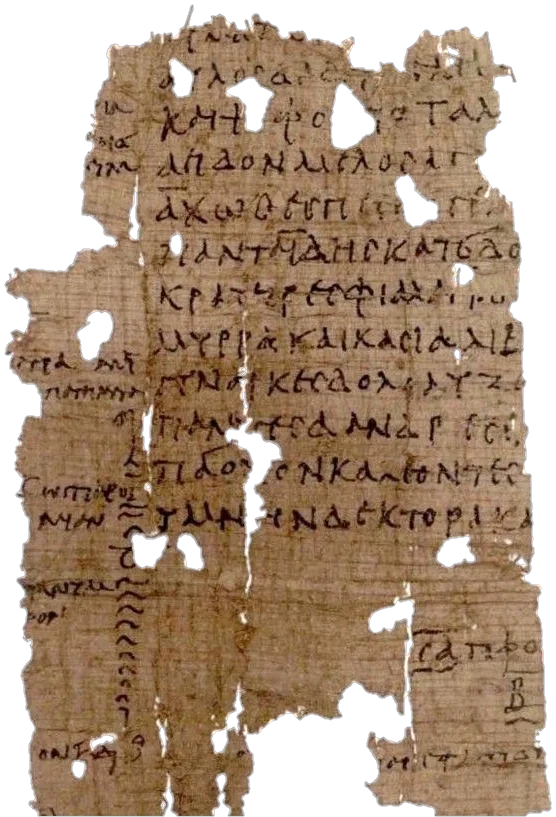
Text and translation
The uninterrupted Greek with its English translation, line by line.
Show text and translation
Ἔκτωρ καὶ συνέταιρ[ο]ι ἄγοισ’ ἐλικώπιδα
Sappho · fr. 44 · Book 2 of the Alexandrian edition · gl²ᵈ, line by line · ll. 5–14, 26, 30–34
How to read each line
A guide to the Greek, syllables, pitch marks and quantities.
Show the reading key
- Above each line: the line as the edition prints it, each word placed over its own syllables. The main row: the same Greek divided into metrical syllables, each written as it is pronounced. A consonant that closes a syllable is written with it (λόθ | ρο); an elided word is closed up with the next vowel (ν’ἀ); a final consonant carried into the next word is set with a thin space (ς ἰ). Wider gaps mark word-ends.
- Above the syllables: the pitch of each syllable, from the accents. Under them: the quantity of each syllable as it falls in the line, then the transliteration, syllable by syllable, with accented syllables in capitals.
- Under each line: a line-for-line translation. In the right margin of the scansion: the line type, its scheme, and its analysis into cola.
Key to the labels
The names, patterns and symbols used beside this poem.
Show the labels and symbols
The labels in the right margin of the scansion below name the cola, the rhythmic units each line is built from (Voigt’s and West’s analysis). A caret before a name (∧hipp) means the colon has lost its first position (acephalous). × marks an anceps position, which takes a long or a short. ⏓ is an anceps that is usually long (West’s and Voigt’s sign). A click on any syllable highlights its colon, or, with the colon/foot switch, its foot. The sources of the labels, with their page numbers, are given line by line under Prosody, line by line.
| Label | Name and shape | What it is |
|---|---|---|
| sa-gl2d | Glyconic with double dactylic expansion (gl²ᵈ)⏓ ⏓ — ⏑ ⏑ — ⏑ ⏑ — ⏑ ⏑ — ⏑ × | The metre of Sappho’s second book, used line by line (Voigt, Conspectus C 3 c: frr. 43–52). West gives gl²ᵈ as his example of dactylic expansion.[5] Hephaestion calls it the Sapphic fourteen-syllable, in which the whole of Sappho’s second book is written.[6] |
The feet
| Foot and shape | Where |
|---|---|
| First foot× × | Hephaestion says the first foot of the Aeolic dactylic line may be any disyllable: spondee, iamb, trochee or pyrrhic.[7] Modern metrists call these two positions the Aeolic base. |
| Dactyl— ⏑ ⏑ | Hephaestion: the middle feet of the Aeolic dactylic line are all dactyls.[7] Lesbian verse admits no contraction,[8] so they are never spondees. |
| Dactyl— ⏑ ⏑ | The second of the three dactyls.[7] |
| Dactyl— ⏑ ⏑ | The third dactyl. With the long that follows it forms the choriamb of the glyconic. |
| Final foot— ⏑ × | Hephaestion says the last foot is a dactyl, or a cretic because the final syllable is indifferent.[7] In the fourteen-syllable line it has the cretic shape — ⏑ ×. |
Scansion
The lines of Sappho’s narrative poem on Hector and Andromache that survive complete, scanned position by position: Greek in metrical syllables, the quantity and pitch of each syllable, a syllabified transliteration and a line-for-line translation. The poem is in the metre of Book 2 and admits the epic licences that West notes in it; every line keeps Voigt’s number (44.5 is fr. 44, line 5).
Hector and his friends are escorting a girl with sparkling eyes
from sacred Thebe and from Placia with its unfailing waters,
graceful Andromache, aboard their ships across the briny
deep; with them many golden bracelets and sashes
of purple, fragrant, and many-coloured ornaments,
and silver drinking-cups past counting, and ivory.”
Thus he spoke; his dear father sprang up swiftly,
and word ran through the city of broad dancing-floors to his friends.
Straight away the sons of Ilus, beneath the well-wheeled carriages,
set the mules, and the whole throng mounted
sang a pure song, and into the high air rose
myrrh and cassia and frankincense, mixed together;
the women, as many as were older, raised the ritual cry,
and all the men gave a lovely shout, high and clear,
invoking Paean, the Far-shooter of the beautiful lyre,
and hymned Hector and Andromache, who were like the gods.
Metre
- The line. Voigt heads the fragment “metrum: gl²ᵈ”, and her Conspectus metrorum (C 3 c, p. 18) gives the line as ⏓ ⏓ — ⏑ ⏑ — ⏑ ⏑ — ⏑ ⏑ — ⏑ × ‖, “metrum libri secundi”, frr. 43–52. It is a glyconic expanded from within by two dactyls; West[5] uses gl²ᵈ as his example of dactylic expansion. Hephaestion calls it the Sapphic fourteen-syllable and says that the whole of Sappho’s second book is written in it.[6] He analyses it as an Aeolic dactylic line: a first foot that may be any disyllable, dactyls in the middle, and a last foot that is a dactyl or, because the final syllable is indifferent, a cretic.[7] Battezzato[9] writes the same line as glyc 2da.
- Word-end and bridges. Neither Voigt (C 3 c) nor West[5] marks a regular word-end (⁝) or a bridge (⁀) in this line, so the margin scheme carries none.
- Line by line, or in pairs? West[10] describes the metre of the poem as “gl²ᵈ used stichically”, and Voigt lists the line among her versus Aeolici (C 3 c). Hephaestion already saw two ways of describing Books 2 and 3 (On Poems 1.2): the old copies mark off every song in pairs of lines and no song has an odd number of lines, so they may be called systems of two; but the two lines of each pair are alike, so they may equally be called line by line. Battezzato[11] sets Book 2 out as two-line strophes, glyc 2da ‖ glyc 2da |||, and notes[12] that in fr. 44 the syntax often runs on across the strophe-divide (ll. 8–9, 14–15, 26–27); de Kreij (2022, p. 605)[13] also treats the verses as distichs. Either way every line ends a period: its last syllable is indifferent, and no line runs on metrically into the next, though the sense often does. This page numbers the lines as Voigt does and does not group them in pairs.
- The base. Voigt marks both positions of the base ⏓, at least eight long syllables in twelve. In the lines scanned here the base is — — nine times, — ⏑ five times (ll. 9, 10, 13, 14, 33) and ⏑ — twice (ll. 26, 31). Where the length of a vowel in the base is not known (μύρρα, πάον’), the scanner shows it long, the commoner value.
- Epic licences. West[10] singles out fr. 44 as the only poem in an Aeolic metre that allows the irregularities of Sappho’s hexameters, contraction apart: a long final vowel or diphthong shortened before a vowel, and a short syllable before a stop and a liquid. He notes its heroic subject and narrative manner, and prints ll. 5–8 with both licences marked: συνέταιροῐ ἄγοισ’ (l. 5) and the χρ of χρύσια joined to the following vowel (l. 8). A further example, outside the lines he quotes, is ὄχλος (l. 14). Normal Lesbian verse avoids both: where vowels meet it elides or merges them,[14] and stop + liquid makes position.[15] Battezzato[16] also cites 44.5 for the shortening of a diphthong before a vowel. This page therefore scans the poem with the workbench’s epic prosody: the metre decides whether a stop + liquid makes position, and a final long vowel may be shortened before a vowel. Where the reasons in the prosody section say “as it usually does in epic”, they describe this setting.
- Which lines are scanned. Lines 1–4 (with the added line 3a) are lacunose, lines 15–20 break off, a number of lines are lost after line 20, and lines 21–25 and 27–29 are incomplete. Lines 5–14, 26 and 30–34 survive complete or with short supplements and are scanned here. Every line keeps Voigt’s number, as each passage heading does.
Dialect and transliteration
- Lesbian and epic forms side by side. Klinck[17] describes the poem as combining Homeric language with Sappho’s Aeolic dialect. Voigt’s apparatus marks as epic ἰέρας (l. 6), ἐνί (l. 7), ὀτραλέως and ἀν- (l. 11), κατά and πτόλιν (l. 12), ἐυ- (l. 13, “perhaps”), Περάμοιο (l. 16), ἴκανε and ἐς before a vowel (ll. 23, 26) and -καλέοντες (l. 33). Lesbian are ὀν- for ἀνα- (ll. 24, 30, 33)[18], the long ᾱ of φάμα, Θήβας, ἄβραν and Ἐκάβολον, the third person plural in -οισι (ἄγοισ’), σδ for ζ (ἐλέλυσδον), παῖς for πᾶς, and psilosis throughout.[19] De Kreij[20] cites the genitive in -οιο of l. 16 as archaic East Aeolic or epic. Tribulato[21] calls the poem one of Sappho’s most epicising pieces and contrasts its thematic participle ὀνκαλέοντες (l. 33) with the athematic πεσδομάχεντας of fr. 16.20; Voigt notes that the Lesbian -κάλεντες would not fit the metre.
- Augment. Voigt notes that ἀνόρουσε (l. 11), ἄειδον (l. 26) and ἐλέλυσδον (l. 31) lack the augment.
- Quantity marks on the papyri. P.Oxy. 1232 has accents and quantity marks throughout.[22] Voigt’s apparatus reports long marks on the α of κἄμματα (l. 8), the final α of πορφύρα (l. 9), the α of ἆγον (l. 14), the ι of ἴαχον (l. 32) and the α of εὐλύραν (l. 33); over the lost letters of l. 6 there is a long mark that is against the metre.
Prosody, line by line
Every syllable, with the reason for its length. Quantities are read from the vowel where the spelling shows it, from the consonants that follow (“position”), from the accent where it tells, and from the metre where nothing else does. Editors’ notes on the text follow in the boxed paragraphs.
- 44.5
Line 44.5 · Ἔκτωρ καὶ συνέταιροι ἄγοισ’ ἐλικώπιδα
Ἔκτωρ καὶ συνέταιροι ἄγοισ’ ἐλικώπιδα
Ἔκτωρκαὶσυνέταιρ[ο]ιἄγοισ’ἐλικώπιδαThe label in the margin, with its sources: gl²ᵈ (Voigt C 3 c; West pp. 34–35; Heph. 7.7).
- 1 —ἜκἜ is short by nature; closed by κ: long by position; the position is anceps (⏓: usually long).
- 2 —τωρω is long by nature; closed by ρ: long by position; the position is anceps (⏓: usually long).
- 3 —καὶαὶ is a diphthong, long by nature.
- 4 ⏑συυ is short by the metre (position 4 must be short).
- 5 ⏑νέέ is short by nature.
- 6 —ταιαι is a diphthong, long by nature.
- 7 ⏑ρ[ο]ιοι is a diphthong, long by nature; shortened before the vowel that begins the next word (epic correption), as the metre requires.
- 8 ⏑ἄἄ is short by the metre (position 8 must be short).
- 9 —γοιοι is a diphthong, long by nature.
- 10 ⏑σ’ἐἐ is short by nature; the apostrophe marks an elided vowel; the consonant before it joins this syllable.
- 11 ⏑λιι is short by the metre (position 11 must be short).
- 12 —κώώ is long by nature.
- 13 ⏑πιι is short by the metre (position 13 must be short).
- 14 ×δαα is short by the accent rule: acute on the antepenult requires a short final syllable; the position is anceps.
In συνέταιρ[ο]ι ἄγοισ’ the diphthong οι is shortened before the vowel of the next word (epic correption), as position 7 requires; this is the first of the licences West[10] marks in the lines he quotes, and Hephaestion counts a diphthong before a vowel among the “common” syllables.[23] ἄγοισ’ (“they bring”) is ἄγοισι elided, the Lesbian third person plural in -οισι.[20] ἐλικώπιδα (“with glancing eyes”) is a Homeric epithet; Voigt cites Iliad 1.98 ἑλικώπιδα κούρην. The ο of συνέταιρ[ο]ι is supplied in Voigt’s text.
- 44.6
Line 44.6 · Θήβας ἐξ ἰέρας Πλακίας τ’ ἀπ’ ἀϊν⟨ν⟩άω
Θήβας ἐξ ἰέρας Πλακίας τ’ ἀπ’ ἀϊν⟨ν⟩άω
ΘήβαςἐξἰέραςΠλακίαςτ’ἀπ’[ἀ][ϊ]ννάωThe label in the margin, with its sources: gl²ᵈ (Voigt C 3 c; West pp. 34–35; Heph. 7.7).
- 1 —Θήή is long by nature; the position is anceps (⏓: usually long).
- 2 —βαςᾱ is long (its length is not shown by the ordinary spelling); the position is anceps (⏓: usually long).
- 3 —ἐξἐ is short by nature; ξ is a double consonant (two sounds) and closes the syllable: long by position.
- 4 ⏑ἰἰ is short by the metre (position 4 must be short).
- 5 ⏑έέ is short by nature.
- 6 —ραςα is a vowel of unknown length; closed by ς: long by position.
- 7 ⏑Πλαα is short by the metre (position 7 must be short).
- 8 ⏑κίί is short by the metre (position 8 must be short).
- 9 —αςα is a vowel of unknown length; closed by ς: long by position.
- 10 ⏑τ’ἀἀ is short by the metre (position 10 must be short); the apostrophe marks an elided vowel; the consonant before it joins this syllable.
- 11 ⏑π’[ἀ]ἀ is short by the metre (position 11 must be short); the apostrophe marks an elided vowel; the consonant before it joins this syllable.
- 12 —[ϊ]νϊ is a vowel of unknown length; closed by ν: long by position.
- 13 ⏑νάά is short by the metre (position 13 must be short).
- 14 ×ωω is long by nature; the position is anceps.
Θήβας is a genitive with long ᾱ, marked with a macron here because position 2 is anceps; West[10] prints Θήβᾱς. The ξ of ἐξ is a double consonant and closes the syllable.[24] Voigt’s apparatus calls ἰέρας an epic form (for ἴρας); the papyrus writes α above its ε. In Πλακίας τ’ the ς closes the syllable before τ’. Jurenka took Placia to be a spring (Voigt). ἀπ’ [ἀϊ]ν⟨ν⟩άω (“ever-flowing”) is Hunt’s supplement and correction, comparing Hesiod’s αἰενάου (Op. 595); Lobel also considered [ἐϋ]ν⟨ν⟩άω. The doubled ν closes the syllable at position 12, which must be long. Voigt notes that the papyrus has a long mark over the lost letters, which is against the metre. LSJ (s.v. ἀέναος) gives the α of -ναος short, as position 13 requires.
- 44.7
Line 44.7 · ἄβραν Ἀνδρομάχαν ἐνὶ ναῦσιν ἐπ’ ἄλμυρον
ἄβραν Ἀνδρομάχαν ἐνὶ ναῦσιν ἐπ’ ἄλμυρον
ἄβρανἈνδρομάχανἐνὶναῦσιν ἐπ’ἄλμυρονThe label in the margin, with its sources: gl²ᵈ (Voigt C 3 c; West pp. 34–35; Heph. 7.7).
- 1 —ἄβἄ is a vowel of unknown length; closed by β before a liquid: stop + liquid makes position, as it usually does in epic; the position is anceps (⏓: usually long).
- 2 —ρανᾱ is long (its length is not shown by the ordinary spelling); the position is anceps (⏓: usually long).
- 3 —ἈνἈ is a vowel of unknown length; closed by ν: long by position.
- 4 ⏑δροο is short by nature.
- 5 ⏑μάά is short by the metre (position 5 must be short).
- 6 —χανα is long by the metre (position 6 must be long).
- 7 ⏑ἐἐ is short by nature.
- 8 ⏑νὶὶ is short by the metre (position 8 must be short).
- 9 —ναῦαῦ is a diphthong, long by nature.
- 10 ⏑σιι is short by the accent rule: circumflex on the penult requires a short final syllable.
- 11 ⏑ν ἐἐ is short by nature; the first consonant belongs to the previous word and is carried over to this vowel.
- 12 —π’ἄλἄ is a vowel of unknown length; closed by λ: long by position; the apostrophe marks an elided vowel; the consonant before it joins this syllable.
- 13 ⏑μυυ is short by the metre (position 13 must be short).
- 14 ×ρονο is short by nature; closed by ν: long by position; the position is anceps.
In ἄβραν the β closes the first syllable before ρ, so it is long; West[10] marks the division ἄβ|ρᾱν. The final ᾱ is long too and is marked because position 2 is anceps. In Ἀνδρομάχαν the ν closes Ἀν-, and δρ goes with the next vowel. ἐνί is an epic form (Voigt, who refers to Hamm for ναῦσιν). In ναῦσιν ἐπ’ the ν passes to the next word, and ἐπ’ is ἐπί elided.
- 44.8
Line 44.8 · πόντον· πόλλα δ’ ἐλίγματα χρύσια κἄμματα
πόντον· πόλλα δ’ ἐλίγματα χρύσια κἄμματα
πόντον·πόλλαδ’[ἐ][λί]γματαχρύσιακἄμματαThe label in the margin, with its sources: gl²ᵈ (Voigt C 3 c; West pp. 34–35; Heph. 7.7).
- 1 —πόνό is short by nature; closed by ν: long by position; the position is anceps (⏓: usually long).
- 2 —τον·ο is short by nature; closed by ν: long by position; the position is anceps (⏓: usually long).
- 3 —πόλό is short by nature; closed by λ: long by position.
- 4 ⏑λαα is short by the metre (position 4 must be short).
- 5 ⏑δ’[ἐ]ἐ is short by nature; the apostrophe marks an elided vowel; the consonant before it joins this syllable.
- 6 —[λί]γί is a vowel of unknown length; closed by γ: long by position; γμ is one of the four clusters (γμ, γν, δμ, δν) that never leave the syllable before them short.[25]
- 7 ⏑μαα is short by the metre (position 7 must be short).
- 8 ⏑ταα is short by the accent rule (the accent falls too far back for a long final syllable); the next word begins with χρ, a stop + liquid that does not make position here, so the syllable stays short.
- 9 —χρύύ is long by the metre (position 9 must be long).
- 10 ⏑σιι is short by the metre (position 10 must be short).
- 11 ⏑αα is short by the accent rule: acute on the antepenult requires a short final syllable.
- 12 —κἄμἄ is a vowel of unknown length; closed by μ: long by position.
- 13 ⏑μαα is short by the metre (position 13 must be short).
- 14 ×ταα is short by the accent rule: acute on the antepenult requires a short final syllable; the position is anceps.
The sentence runs on from line 7 (πόντον, “sea”), but the line is a period of its own. The supplement [ἐλί]γματα (“bracelets”) is Wilamowitz’s, reported by Hunt; Voigt cites Hesychius’ gloss ἐλίγματα · ψέλλια. In ἐλίγματα the γ closes λιγ- before μ. Its last syllable, τα, stays short before the χρ of χρύσια: a stop and a liquid that do not make position, the second licence West[10] marks here. κἄμματα is καὶ ἄμματα joined by crasis; Voigt reports that the papyrus marks its α long.
- 44.9
Line 44.9 · πορφύρα καταΰτμενα, ποίκιλ’ ἀθύρματα,
πορφύρα καταΰτμενα, ποίκιλ’ ἀθύρματα,
πορφύρ[α]καταΰτ[με]να,ποίκιλ’ἀθύρματα,The label in the margin, with its sources: gl²ᵈ (Voigt C 3 c; West pp. 34–35; Heph. 7.7).
- 1 —πορο is short by nature; closed by ρ: long by position; the position is anceps (⏓: usually long).
- 2 ⏑φύῠ́ is short (its length is not shown by the ordinary spelling); the position is anceps (⏓: usually long).
- 3 —ρ[α]α is long by the metre (position 3 must be long).
- 4 ⏑καα is short by the metre (position 4 must be short).
- 5 ⏑ταα is short by the metre (position 5 must be short).
- 6 —ΰτΰ is a vowel of unknown length; closed by τ before a nasal: stop + nasal makes position, as it usually does in epic.
- 7 ⏑[με]ε is short by nature.
- 8 ⏑να,α is short by the accent rule: acute on the antepenult requires a short final syllable.
- 9 —ποίοί is a diphthong, long by nature.
- 10 ⏑κιι is short by the metre (position 10 must be short).
- 11 ⏑λ’ἀἀ is short by the metre (position 11 must be short); the apostrophe marks an elided vowel; the consonant before it joins this syllable.
- 12 —θύρύ is a vowel of unknown length; closed by ρ: long by position.
- 13 ⏑μαα is short by the metre (position 13 must be short).
- 14 ×τα,α is short by the accent rule: acute on the antepenult requires a short final syllable; the position is anceps.
The υ of πορφύρα is short and is marked with a breve because position 2 is anceps. Its final α is long, as position 3 requires; Voigt reports a long mark over it on the papyrus and refers to Hamm § 52a. καταΰτ[με]να is Maas’s reading, which Voigt prints; the papyrus accents the letters ΚΆΤ ΑΎΤ, and Lobel read κὰτ ἀύτμενα. Theander and H. Fränkel interpret καταΰτμενα as “perfumed” (Voigt’s apparatus); Klinck[17] translates it so, from ἀϋτμή “breath, scent”, in preference to κατ’ ἀΰτμενα, “with the wind”. The τ closes ΰτ- before μ. ποίκιλ’ is ποίκιλα elided.
- 44.10
Line 44.10 · ἀργύρα τ’ ἀνάρ⌊ι⌋θμα ⌊ποτή⌋ρ⌊ια⌋ κἀλέφαις».
ἀργύρα τ’ ἀνάρ⌊ι⌋θμα ⌊ποτή⌋ρ⌊ια⌋ κἀλέφαις».
ἀργύρατ’ἀνάριθμαποτήριακἀλέφαις.The label in the margin, with its sources: gl²ᵈ (Voigt C 3 c; West pp. 34–35; Heph. 7.7).
- 1 —ἀρἀ is a vowel of unknown length; closed by ρ: long by position; the position is anceps (⏓: usually long).
- 2 ⏑γύῠ́ is short (its length is not shown by the ordinary spelling); the position is anceps (⏓: usually long).
- 3 —ραα is long by the metre (position 3 must be long).
- 4 ⏑τ’ἀἀ is short by the metre (position 4 must be short); the apostrophe marks an elided vowel; the consonant before it joins this syllable.
- 5 ⏑νάά is short by the metre (position 5 must be short).
- 6 —ριθι is a vowel of unknown length; closed by θ before a nasal: stop + nasal makes position, as it usually does in epic.
- 7 ⏑μαα is short by the accent rule: acute on the antepenult requires a short final syllable.
- 8 ⏑ποο is short by nature.
- 9 —τήή is long by nature.
- 10 ⏑ριι is short by the metre (position 10 must be short).
- 11 ⏑αα is short by the accent rule: acute on the antepenult requires a short final syllable.
- 12 —κἀἀ is long by crasis: the coronis marks two words contracted into one long vowel.
- 13 ⏑λέέ is short by nature.
- 14 ×φαις.αι is a diphthong, long by nature; closed by ς: long by position; the position is anceps.
Athenaeus (11.460d) quotes words of lines 8 and 10 together, πολλὰ δ’ ἀνάριθμα ποτήρια καλαιφις, as from Sappho’s second book; the letters in half-brackets are lacking in the papyrus and were supplied from Athenaeus by Wilamowitz, as Hunt reports (Voigt). The υ of ἀργύρα is short (breve), and its final ᾱ long at position 3; Bowra doubted ἀργύρα, and Voigt again refers to Hamm § 52a. In ἀνάριθμα the θ closes ριθ- before μ. κἀλέφαις is καὶ ἐλέφαις (“and ivory”) joined by crasis into one long syllable. The closing quotation mark ends the herald’s speech.
- 44.11
Line 44.11 · ὢς εἶπ’· ὀτραλέως δ’ ἀνόρουσε πάτηρ φίλος·
ὢς εἶπ’· ὀτραλέως δ’ ἀνόρουσε πάτηρ φίλος·
ὢςεἶπ’·ὀτραλέωςδ’ἀνόρουσεπάτ[η]ρφίλος·The label in the margin, with its sources: gl²ᵈ (Voigt C 3 c; West pp. 34–35; Heph. 7.7).
- 1 —ὢςὢ is long by nature; the position is anceps (⏓: usually long).
- 2 —εἶεἶ is a diphthong, long by nature; the position is anceps (⏓: usually long).
- 3 —π’·ὀτὀ is short by nature; closed by τ before a liquid: stop + liquid makes position, as it usually does in epic; the apostrophe marks an elided vowel; the consonant before it joins this syllable.
- 4 ⏑ραα is short by the metre (position 4 must be short).
- 5 ⏑λέέ is short by nature.
- 6 —ωςω is long by nature; closed by ς: long by position.
- 7 ⏑δ’ἀἀ is short by the metre (position 7 must be short); the apostrophe marks an elided vowel; the consonant before it joins this syllable.
- 8 ⏑νόό is short by nature.
- 9 —ρουου is a diphthong, long by nature.
- 10 ⏑σεε is short by nature.
- 11 ⏑πάά is short by the metre (position 11 must be short).
- 12 —τ[η]ρη is long by nature; closed by ρ: long by position.
- 13 ⏑φίί is short by the metre (position 13 must be short).
- 14 ×λος·ο is short by nature; closed by ς: long by position; the position is anceps.
ὀτραλέως (“quickly”) is an epic word (Voigt); in it the τ closes the first syllable before ρ, as position 3 requires. ἀνόρουσε has the epic preverb ἀν- instead of Lesbian ὀν- and no augment (Voigt). The η of πάτ[η]ρ is supplied in Voigt’s text. The line is a period, so the last syllable of φίλος is indifferent.
- 44.12
Line 44.12 · φάμα δ’ ἦλθε κατὰ πτόλιν εὐρύχορον φίλοις.
φάμα δ’ ἦλθε κατὰ πτόλιν εὐρύχορον φίλοις.
φάμαδ’ἦλθεκατὰπτόλιν εὐρύχορονφίλοις.The label in the margin, with its sources: gl²ᵈ (Voigt C 3 c; West pp. 34–35; Heph. 7.7).
- 1 —φάᾱ́ is long (its length is not shown by the ordinary spelling); the position is anceps (⏓: usually long).
- 2 —μαᾱ is long (its length is not shown by the ordinary spelling); the position is anceps (⏓: usually long).
- 3 —δ’ἦλἦ is long by nature; closed by λ: long by position; the apostrophe marks an elided vowel; the consonant before it joins this syllable.
- 4 ⏑θεε is short by nature.
- 5 ⏑καα is short by the metre (position 5 must be short).
- 6 —τὰthe next word begins with πτ: the syllable is closed before it: long by position.
- 7 ⏑πτόό is short by nature.
- 8 ⏑λιι is short by the metre (position 8 must be short).
- 9 —ν εὐεὐ is a diphthong, long by nature; the first consonant belongs to the previous word and is carried over to this vowel.
- 10 ⏑ρύύ is short by the metre (position 10 must be short).
- 11 ⏑χοο is short by nature.
- 12 —ρονο is short by nature; closed by ν: long by position.
- 13 ⏑φίί is short by the metre (position 13 must be short).
- 14 ×λοις.οι is a diphthong, long by nature; closed by ς: long by position; the position is anceps.
φάμα (“the news”) has the Lesbian long ᾱ for η of φήμη in both syllables;[26] they are marked with macrons because positions 1 and 2 are anceps. κατά and πτόλιν are epic forms (Voigt). The τὰ of κατὰ is long because πτ follows. φίλοις: most editors take it as a dative, formed in the epic manner (Voigt), and the translation follows them; Hunt took it as an accusative, the Lesbian accusative plural in -οις;[20] Wilamowitz and Sitzler thought it repeated in error from line 11 (Voigt’s apparatus).
- 44.13
Line 44.13 · αὔτικ’ Ἰλίαδαι σατίναις ὐπ’ ἐυτρόχοις
αὔτικ’ Ἰλίαδαι σατίναις ὐπ’ ἐυτρόχοις
αὔτικ’Ἰλίαδαισατίναι[ς]ὐπ’ἐυτρόχοιςThe label in the margin, with its sources: gl²ᵈ (Voigt C 3 c; West pp. 34–35; Heph. 7.7).
- 1 —αὔαὔ is a diphthong, long by nature; the position is anceps (⏓: usually long).
- 2 ⏑τιῐ is short (its length is not shown by the ordinary spelling); the position is anceps (⏓: usually long).
- 3 —κ’ἸἸ is long by the metre (position 3 must be long); the apostrophe marks an elided vowel; the consonant before it joins this syllable.
- 4 ⏑λίί is short by the metre (position 4 must be short).
- 5 ⏑αα is short by the metre (position 5 must be short).
- 6 —δαιαι is a diphthong, long by nature.
- 7 ⏑σαα is short by the metre (position 7 must be short).
- 8 ⏑τίί is short by the metre (position 8 must be short).
- 9 —ναι[ς]αι is a diphthong, long by nature.
- 10 ⏑ὐὐ is short by the metre (position 10 must be short).
- 11 ⏑π’ἐἐ is short by nature; the apostrophe marks an elided vowel; the consonant before it joins this syllable.
- 12 —υτυ is a vowel of unknown length; closed by τ before a liquid: stop + liquid makes position, as it usually does in epic.
- 13 ⏑ρόό is short by nature.
- 14 ×χοιςοι is a diphthong, long by nature; closed by ς: long by position; the position is anceps.
The ι of αὔτικ’ is short (breve). Ἰλίαδαι (“sons of Ilus”) has a long first syllable at position 3, which the metre requires. σατίναι[ς] (“carriages”) has its ς supplied, and it passes to ὐπ’. ἐυτρόχοις (“well-wheeled”): Voigt prints the breathing on the ε, so ε and υ are two vowels, not a diphthong, and calls ἐυ- perhaps epic. Its υ is closed by τ before ρ, so it is long at position 12.
- 44.14
Line 44.14 · ἆγον αἰμιόνοις, ἐπέβαινε δὲ παῖς ὄχλος
ἆγον αἰμιόνοις, ἐπέβαινε δὲ παῖς ὄχλος
ἆγον αἰμιόνοις,ἐπ[έ]βαινεδὲπαῖςὄχλοςThe label in the margin, with its sources: gl²ᵈ (Voigt C 3 c; West pp. 34–35; Heph. 7.7).
- 1 —ἆἆ carries a circumflex, so it is long; the position is anceps (⏓: usually long).
- 2 ⏑γοο is short by nature; the position is anceps (⏓: usually long).
- 3 —ν αἰαἰ is a diphthong, long by nature; the first consonant belongs to the previous word and is carried over to this vowel.
- 4 ⏑μιι is short by the metre (position 4 must be short).
- 5 ⏑όό is short by nature.
- 6 —νοις,οι is a diphthong, long by nature.
- 7 ⏑ἐἐ is short by nature.
- 8 ⏑π[έ]έ is short by nature.
- 9 —βαιαι is a diphthong, long by nature.
- 10 ⏑νεε is short by nature.
- 11 ⏑δὲὲ is short by nature.
- 12 —παῖςαῖ is a diphthong, long by nature.
- 13 ⏑ὄὄ is short by nature; χλ is carried whole into the next syllable, so this syllable stays open and short (correption before a stop + liquid cluster, as the metre needs).
- 14 ×χλοςο is short by nature; closed by ς: long by position; the position is anceps.
αἰμιόνοις is the Aeolic form of ἡμιόνοις (“mules”), as the Etymologicum quoted by Voigt states. In αἰμιόνοις ἐπ[έ]βαινε the ς passes to the next vowel. παῖς is Lesbian for πᾶς.[27] In ὄχλος the first syllable is short at position 13: the χλ is carried into the next syllable, the licence West notes, here outside the lines he quotes. The sense runs on into line 15, which is lacunose.
- 44.26
Line 44.26 · ⌊ἄειδον μέλος ἄγν⌋ον, ἴκανε δ’ ἐς αἴθερα
⌊ἄειδον μέλος ἄγν⌋ον, ἴκανε δ’ ἐς αἴθερα
ἄειδονμέλος ἄγν[ο],[ν ἴ][κα]νεδ’ἐς αἴθ[ε][ρα]The label in the margin, with its sources: gl²ᵈ (Voigt C 3 c; West pp. 34–35; Heph. 7.7).
- 1 ⏑ἄᾰ̓́ is short (its length is not shown by the ordinary spelling); the position is anceps (⏓: usually long).
- 2 —ειει is a diphthong, long by nature; the position is anceps (⏓: usually long).
- 3 —δονο is short by nature; closed by ν: long by position.
- 4 ⏑μέέ is short by nature.
- 5 ⏑λοο is short by nature.
- 6 —ς ἄγἄ is a vowel of unknown length; closed by γ: long by position; γν is one of the four clusters (γμ, γν, δμ, δν) that never leave the syllable before them short;[25] the first consonant belongs to the previous word and is carried over to this vowel.
- 7 ⏑ν[ο],ο is short by nature.
- 8 ⏑[ν ἴ]ἴ is short by the metre (position 8 must be short); the first consonant belongs to the previous word and is carried over to this vowel.
- 9 —[κα]α is long by the metre (position 9 must be long).
- 10 ⏑νεε is short by nature.
- 11 ⏑δ’ἐἐ is short by nature; the apostrophe marks an elided vowel; the consonant before it joins this syllable.
- 12 —ς αἴαἴ is a diphthong, long by nature; the first consonant belongs to the previous word and is carried over to this vowel.
- 13 ⏑θ[ε]ε is short by nature.
- 14 ×[ρα]α is short by the accent rule: acute on the antepenult requires a short final syllable; the position is anceps.
The half-brackets in lines 23–34 mark the text that a second papyrus, P.Oxy. 2076, preserves (Voigt). ἄειδον (“they sang”) has a short first syllable (breve) and no augment. In μέλος ἄγνον the ς passes to ἄγ-, which is closed by γ before ν. ἴκα]νε is Lobel’s supplement; Voigt calls ἴκανε and ἐς before a vowel epic forms. LSJ (s.v. ἱκάνω) gives ἱκᾱ- with long α, as position 9 requires. αἴθ[ερα] is supplied at the end, and Voigt’s apparatus again cites Lobel there. The subject of ἴκανε, “a wondrous sound” (ἄχω θεσπεσία), is in l. 27, which is not scanned; Battezzato[12] notes that Sappho divides this epic phrase across the strophe-divide.
- 44.30
Line 44.30 · ⌊μύρρα καὶ κασία λίβ⌋ανός τ’ ὀνεμείχνυτο
⌊μύρρα καὶ κασία λίβ⌋ανός τ’ ὀνεμείχνυτο
μύρρακαὶκασίαλίβανόςτ’ὀνεμείχνυτοThe label in the margin, with its sources: gl²ᵈ (Voigt C 3 c; West pp. 34–35; Heph. 7.7).
- 1 —μύρύ is a vowel of unknown length; closed by ρ: long by position; the position is anceps (⏓: usually long).
- 2 ○ραα is of unknown length; the position is anceps (⏓: usually long), so either scans.
- 3 —καὶαὶ is a diphthong, long by nature.
- 4 ⏑καα is short by the metre (position 4 must be short).
- 5 ⏑σίί is short by the metre (position 5 must be short).
- 6 —αα is long by the metre (position 6 must be long).
- 7 ⏑λίί is short by the metre (position 7 must be short).
- 8 ⏑βαα is short by the metre (position 8 must be short).
- 9 —νόςό is short by nature; closed by ς: long by position.
- 10 ⏑τ’ὀὀ is short by nature; the apostrophe marks an elided vowel; the consonant before it joins this syllable.
- 11 ⏑νεε is short by nature.
- 12 —μείεί is a diphthong, long by nature.
- 13 ⏑χνυυ is short by the metre (position 13 must be short).
- 14 ×τοο is short by nature; the position is anceps.
Athenaeus (15.688c) says that μύρρα is the Aeolic word for σμύρνα (“myrrh”), and Voigt quotes him; LSJ s.v. μύρρα cites this fragment. The length of its final α is not known; the scanner shows the anceps long. κασία (“cassia”) has a long final ᾱ, as position 6 requires. Voigt cites Herennius Philo, who says that Sappho in her second book calls frankincense λίβανος. ὀνεμείχνυτο (“were mingled”) has the Lesbian preverb ὀν- (= ἀνα-); τ’ is τε elided before it. Lobel had supplied the beginning of the line before P.Oxy. 2076 was joined to it (Voigt).
The final α of μύρρα is left ○: LSJ (s.v. μύρρα, the Aeolic form of σμύρνα) gives no length, and neither form occurs in the verse searched (Perseus: Homer, Hesiod, the Homeric Hymns, Apollonius, Theocritus, the dramatists).
- 44.31
Line 44.31 · ⌊γύναικες δ’ ἐλέλυσδο⌋ν ὄσαι προγενέστεραι
⌊γύναικες δ’ ἐλέλυσδο⌋ν ὄσαι προγενέστεραι
γύναικεςδ’ἐλέλυσδον ὄσαιπρογενέστερα[ι]The label in the margin, with its sources: gl²ᵈ (Voigt C 3 c; West pp. 34–35; Heph. 7.7).
- 1 ⏑γύῠ́ is short (its length is not shown by the ordinary spelling); the position is anceps (⏓: usually long).
- 2 —ναιαι is a diphthong, long by nature; the position is anceps (⏓: usually long).
- 3 —κεςε is short by nature; closed by ς: long by position.
- 4 ⏑δ’ἐἐ is short by nature; the apostrophe marks an elided vowel; the consonant before it joins this syllable.
- 5 ⏑λέέ is short by nature.
- 6 —λυσυ is a vowel of unknown length; closed by σ: long by position.
- 7 ⏑δοο is short by nature.
- 8 ⏑ν ὄὄ is short by nature; the first consonant belongs to the previous word and is carried over to this vowel.
- 9 —σαιαι is a diphthong, long by nature; the next word begins with πρ: the syllable is closed before it: long by position.
- 10 ⏑προο is short by nature.
- 11 ⏑γεε is short by nature.
- 12 —νέσέ is short by nature; closed by σ: long by position.
- 13 ⏑τεε is short by nature.
- 14 ×ρα[ι]αι is a diphthong, long by nature; the position is anceps.
The υ of γύναικες is short (breve); the accent is the Lesbian recessive one.[20] ἐλέλυσδον (“raised the cry”) has σδ for ζ and no augment; P.Oxy. 2076 has ὀλολυζο[ν] (Voigt). In ἐλέλυσδον ὄσαι the ν passes to ὄ-. The diphthong of ὄσαι is long, and προ- that follows is a short open syllable. The last letter of προγενέστερα[ι] (“older”), a Homeric word, is supplied in Voigt’s text.
- 44.32
Line 44.32 · ⌊πάντες δ’ ἄνδρες ἐπ⌋ήρατον ἴαχον ὄρθιον
⌊πάντες δ’ ἄνδρες ἐπ⌋ήρατον ἴαχον ὄρθιον
πάντεςδ’ἄνδρες ἐπήρατον ἴαχον ὄρθιονThe label in the margin, with its sources: gl²ᵈ (Voigt C 3 c; West pp. 34–35; Heph. 7.7).
- 1 —πάνά is a vowel of unknown length; closed by ν: long by position; the position is anceps (⏓: usually long).
- 2 —τεςε is short by nature; closed by ς: long by position; the position is anceps (⏓: usually long).
- 3 —δ’ἄνἄ is a vowel of unknown length; closed by ν: long by position; the apostrophe marks an elided vowel; the consonant before it joins this syllable.
- 4 ⏑δρεε is short by nature.
- 5 ⏑ς ἐἐ is short by nature; the first consonant belongs to the previous word and is carried over to this vowel.
- 6 —πήή is long by nature.
- 7 ⏑ραα is short by the metre (position 7 must be short).
- 8 ⏑τοο is short by nature.
- 9 —ν ἴἴ is long by the metre (position 9 must be long); the first consonant belongs to the previous word and is carried over to this vowel.
- 10 ⏑αα is short by the metre (position 10 must be short).
- 11 ⏑χοο is short by nature.
- 12 —ν ὄρὄ is short by nature; closed by ρ: long by position; the first consonant belongs to the previous word and is carried over to this vowel.
- 13 ⏑θιι is short by the metre (position 13 must be short).
- 14 ×ονο is short by nature; closed by ν: long by position; the position is anceps.
In ἄνδρες ἐπήρατον and ἐπήρατον ἴαχον the final consonant passes to the next vowel each time. ἴαχον (“shouted”) needs a long first syllable at position 9, and P.Oxy. 1232 marks its ι long (Voigt’s apparatus). LSJ (s.v. ἰάχω) quotes this line and gives the ι short where the digamma is observed in Homer, long in certain other places. ὄρθιον (“high-pitched”) closes the line; its last syllable is indifferent.
- 44.33
Line 44.33 · ⌊πάον’ ὀνκαλέοντες⌋ Ἐκάβολον εὐλύραν
⌊πάον’ ὀνκαλέοντες⌋ Ἐκάβολον εὐλύραν
πάον’ὀνκαλέοντες Ἐκάβολον εὐλύρανThe label in the margin, with its sources: gl²ᵈ (Voigt C 3 c; West pp. 34–35; Heph. 7.7).
- 1 ○πάά is of unknown length; the position is anceps (⏓: usually long), so either scans.
- 2 ⏑οο is short by nature; the position is anceps (⏓: usually long).
- 3 —ν’ὀνὀ is short by nature; closed by ν: long by position; the apostrophe marks an elided vowel; the consonant before it joins this syllable.
- 4 ⏑καα is short by the metre (position 4 must be short).
- 5 ⏑λέέ is short by nature.
- 6 —ονο is short by nature; closed by ν: long by position.
- 7 ⏑τεε is short by nature.
- 8 ⏑ς ἘἘ is short by nature; the first consonant belongs to the previous word and is carried over to this vowel.
- 9 —κάά is long by the metre (position 9 must be long).
- 10 ⏑βοο is short by nature.
- 11 ⏑λοο is short by nature.
- 12 —ν εὐεὐ is a diphthong, long by nature; the first consonant belongs to the previous word and is carried over to this vowel.
- 13 ⏑λύύ is short by the metre (position 13 must be short).
- 14 ×ρανα is a vowel of unknown length; closed by ν: long by position; the position is anceps.
πάον’ (“Paean”) is elided before ὀνκαλέοντες; LSJ (s.v. Παιάν) gives Πάων as the Aeolic form, citing this line, and Klinck[17] notes that Paean is a Homeric name for Apollo. ὀνκαλέοντες (“calling on”) has the Lesbian ὀν- (= ἀνα-) but the epic thematic ending -έοντες; the Lesbian -κάλεντες would not fit the metre (Voigt). Ἐκάβολον (“far-shooter”) is the Lesbian form of Homeric ἑκηβόλον, with ᾱ for η, as position 9 requires, and with psilosis. The length of the first vowel of πάον’ is not known; the scanner shows the anceps long.
The α of πάον’ is left ○: Πάων is the Aeolic form of Παιάν,[28] which gives no length for it, and no other Aeolic verse with the word was searched.
- 44.34
Line 44.34 · ⌊ὔμνην δ’ Ἔκτορα κ’Α⌋νδρομάχαν θεο⟨ε⟩ικέλοις.
⌊ὔμνην δ’ Ἔκτορα κ’Α⌋νδρομάχαν θεο⟨ε⟩ικέλοις.
ὔμνηνδ’ἜκτορακΑνδρομάχανθεοεικέλο[ις].The label in the margin, with its sources: gl²ᵈ (Voigt C 3 c; West pp. 34–35; Heph. 7.7).
- 1 —ὔμὔ is a vowel of unknown length; closed by μ: long by position; the position is anceps (⏓: usually long).
- 2 —νηνη is long by nature; closed by ν: long by position; the position is anceps (⏓: usually long).
- 3 —δ’ἜκἜ is short by nature; closed by κ: long by position; the apostrophe marks an elided vowel; the consonant before it joins this syllable.
- 4 ⏑τοο is short by nature.
- 5 ⏑ραα is short by the accent rule: acute on the antepenult requires a short final syllable.
- 6 —κΑνΑ is a vowel of unknown length; closed by ν: long by position.
- 7 ⏑δροο is short by nature.
- 8 ⏑μάά is short by the metre (position 8 must be short).
- 9 —χανα is a vowel of unknown length; closed by ν: long by position.
- 10 ⏑θεε is short by nature.
- 11 ⏑οο is short by nature.
- 12 —ειει is a diphthong, long by nature.
- 13 ⏑κέέ is short by nature.
- 14 ×λο[ις].οι is a diphthong, long by nature; closed by ς: long by position; the position is anceps.
The last line of the poem: both papyri have a coronis beside it, and the colophon below names Sappho’s songs, Book 2 (Voigt). Voigt prints κ’Α- without a breathing: καί is reduced to κ’ before the vowel, so that κ’Αν- is one syllable. ὔμνην is probably an imperfect, third person plural (Hunt and others), in which case ὔμνεν would be better; Terzaghi and Snell took it as an infinitive and deleted δ’ (Voigt). θεο⟨ε⟩ικέλο[ις] (“godlike”) has five syllables, θε-ο-ει-κέ-λοις; Voigt adds the ε that P.Oxy. 1232 omits, but notes that its θεοικελ- may be right (citing Leumann). The ending -[οις] is Hunt’s supplement (he also considered -ο[ν]); read as the Lesbian accusative plural in -οις,[20] it agrees with Hector and Andromache.
The poem
Fr. 44 tells how the herald Idaeus brings news to Troy that Hector is bringing Andromache home from Thebe with rich gifts, how the Trojans go out to meet them, and how the city celebrates the wedding with song and incense. Klinck[17] calls it unique among Sappho’s extant poems: heroic in style and narrated impersonally like epic, in a dactylic metre that is not the hexameter. She notes that some details, such as the carriages for women, the castanets and the myrrh, cassia and frankincense, look like customs of Sappho’s own Lesbos rather than the heroic age, and that quotations in Athenaeus confirm that the poem is Sappho’s. Lardinois[29] lists it as an “epic-like” fragment among the genres of Sappho’s songs.
Its place in the corpus has been argued over. Lobel doubted that it was Sappho’s, and Page discussed and dismissed his arguments;[30] Tribulato[31] takes Lobel’s classing of such poems as “abnormal” as typical of an older view of Sappho’s language. De Kreij (2022, pp. 609–617) argues from P.Oxy. 1232 and 2076 that the poem stood at the end of Book 2 but was not regarded in antiquity as a regular part of the book.
Notes
- ^ a b c Natoli et al. 2022, p. 45.
- ^ Lardinois 2022, p. 264.
- ^ Finglass 2021b, pp. 234, 240, 242.
- ^ de Kreij 2022a, p. 609.
- ^ a b c West 1987, p. 34.
- ^ a b Hephaestion, Ench. 7.7.
- ^ a b c d e Hephaestion, Ench. 7.5.
- ^ West 1987, p. 32.
- ^ Battezzato 2021, pp. 124–125.
- ^ a b c d e f West 1987, p. 35.
- ^ Battezzato 2021, pp. 127–128.
- ^ a b Battezzato 2021, p. 133.
- ^ de Kreij 2022, p. 613 n. 46.
- ^ West 1987, p. 35 n. 2.
- ^ West 1987, p. 16 with n. 7.
- ^ Battezzato 2021, p. 125 n. 16.
- ^ a b c d Klinck 2008, p. 139.
- ^ LSJ s.v. ἀνά.
- ^ de Kreij 2022, pp. 147–149.
- ^ a b c d e de Kreij 2022, p. 148.
- ^ Tribulato 2021, p. 141.
- ^ de Kreij 2022, p. 609.
- ^ Hephaestion, Ench. 1.4.
- ^ Hephaestion, Ench. 1.3.
- ^ a b West 1987, p. 16.
- ^ de Kreij 2022, p. 147.
- ^ de Kreij 2022, pp. 147, 149.
- ^ LSJ s.v. Παιάν.
- ^ Lardinois 2022, p. 266.
- ^ de Kreij 2022, p. 617 n. 55.
- ^ Tribulato 2021, p. 135.
Text and sources
- Greek wording: Heather Waddell, Sappho fr. 44, Dickinson College Commentaries, CC BY-SA 4.0. Collated line by line. Iota is written adscript; punctuation, capitalization, diacritics and editorial signs follow this page’s stated conventions; quantity and scansion marks are added. The translation is the site’s own.
- Metre and textual commentary: E.-M. Voigt, Sappho et Alcaeus: Fragmenta (Amsterdam 1971), fr. 44 with testimonia, parallels and apparatus (pp. 66–69) and Conspectus metrorum, Sappho C 3 c (p. 18), checked against the page images. Editorial signs and quantity marks follow the conventions explained in the line notes.
- The scheme is Voigt’s C 3 c (forms_d/sappho_stanzas.py, form gl2d-sappho44; the page uses its catalogue gl2d-sappho44-fr44), scanned with the workbench’s epic prosody because of the licences West notes in this poem.
- M. L. West, Introduction to Greek Metre (Oxford 1987), pp. 13–17 (prosody, correption, stop + liquid, with p. 16 n. 7), 32 (no resolution or contraction in Lesbian verse), 34 (gl²ᵈ) and 35 (the licences of fr. 44 and fr. 44.5–8; p. 35 n. 2), checked against the page images.
- Hephaestion, Enchiridion 1.3–4 (double consonants; a long vowel before a vowel) and 7.5, 7.7 (the Aeolic dactylic line and the Sapphic fourteen-syllable of Book 2), and On Poems 1.2 (Books 2 and 3 described both as systems of two lines and as line by line), ed. M. Consbruch (Leipzig 1906); Greek text from First1KGreek, CC BY-SA 4.0.
- L. Battezzato, “Sappho’s Metres and Music”, and O. Tribulato, “Sappho’s Dialect”, in P. J. Finglass and A. Kelly (eds), The Cambridge Companion to Sappho (Cambridge 2021), pp. 124–128, 133 and pp. 135, 141.
- M. de Kreij, “The Lyric Dialects”, in L. Swift (ed.), A Companion to Greek Lyric (Wiley 2022), ch. 10, pp. 147–149; M. de Kreij, “Sappho’s Second Book”, Classical Philology 117.4 (2022), pp. 603, 605, 609–617 (with p. 613 n. 46, p. 617 n. 55).
- A. Lardinois, “Sappho”, in Swift (ed.), A Companion to Greek Lyric (Wiley 2022), ch. 18, p. 266.
- A. L. Klinck, Woman’s Songs in Ancient Greece (Montreal 2008), notes on fr. 44, p. 139.
- LSJ (Perseus Digital Library), s.vv. ἀέναος, ἀνά, ἰάχω, ἱκάνω, μύρρα, Παιάν.
- D. A. Campbell, Greek Lyric I: Sappho and Alcaeus (Loeb Classical Library 142, Cambridge, MA 1982), fr. 44 (pp. 88–91), compared line by line: in ll. 5–14 and 30–34 his wording is the same as Voigt’s; among his testimonia is Athenaeus 11.460d, which cites the poem from Sappho’s second book (p. 90). Same fragment number as Voigt.
Quotations from copyrighted works are not covered by this page’s licence.
Fr. 94 (τεθνάκην δ’ ἀδόλως…)
Fr. 94 — “HonestlyI want to be dead”
Synopsis
A song of parting whose beginning is lost. A woman wept as she left. She said much, and among it that she was leaving against her will. The speaker, addressed as Sappho, answered “go happily and remember me”. She recalls what they shared: garlands of violets and roses, woven necklaces of flowers, perfume, soft bedding, and the shrines and groves they never missed.[1] Who speaks the first surviving line, “I want to be dead”, is disputed. Mueller gives it to the departing woman, and Ferrari to Sappho.[2] Rösler sees a situation Sappho met again and again: a girl leaving her circle at the end of her education, usually to marry.[3] Ferrari suggests perhaps a marriage in Lydia.[4] Sappho worked on Lesbos around 600 BC.[5] The poem survives on the Berlin parchment (P.Berol. inv. 9722), a codex from Egypt of the late sixth or early seventh century AD, published in 1902.[6] It is in the glyconic stanzas of Book 5.[7]
The legible lines, from the first surviving line to line 26, are scanned below.
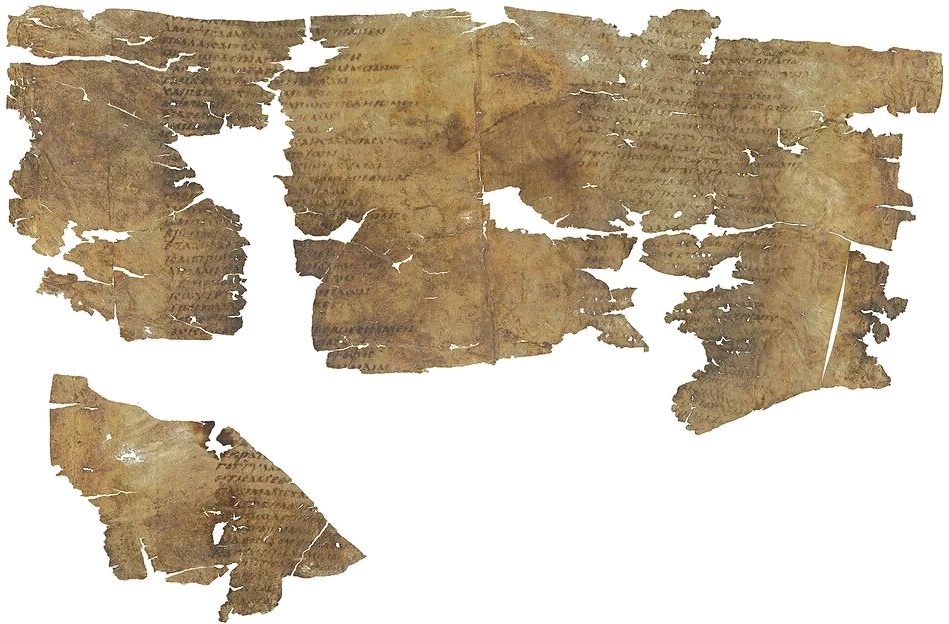
Text and translation
The uninterrupted Greek with its English translation, line by line.
Show text and translation
τεθνάκην δ’ ἀδόλως θέλω
Sappho · fr. 94 · three-line glyconic stanzas, gl ‖ gl ‖ glᵈ ||| · ll. 1–9, 12, 15–16, 20–21, 26
How to read each line
A guide to the Greek, syllables, pitch marks and quantities.
Show the reading key
- Above each line: the line as the edition prints it, each word placed over its own syllables. The main row: the same Greek divided into metrical syllables, each written as it is pronounced. A consonant that closes a syllable is written with it (λόθ | ρο); an elided word is closed up with the next vowel (ν’ἀ); a final consonant carried into the next word is set with a thin space (ς ἰ). Wider gaps mark word-ends.
- Above the syllables: the pitch of each syllable, from the accents. Under them: the quantity of each syllable as it falls in the line, then the transliteration, syllable by syllable, with accented syllables in capitals.
- Under each line: a line-for-line translation. In the right margin of the scansion: the line type, its scheme, and its analysis into cola.
Key to the labels
The names, patterns and symbols used beside this poem.
Show the labels and symbols
The labels in the right margin of the scansion below name the cola, the rhythmic units each line is built from (Voigt’s and West’s analysis). A caret before a name (∧hipp) means the colon has lost its first position (acephalous). × marks an anceps position, which takes a long or a short. ⏓ is an anceps that is usually long (West’s and Voigt’s sign). A click on any syllable highlights its colon, or, with the colon/foot switch, its foot. The sources of the labels, with their page numbers, are given line by line under Prosody, line by line.
| Label | Name and shape | What it is |
|---|---|---|
| sa-gl | Glyconic (gl)⏓ × — ⏑ ⏑ — ⏑ ⏓ | The basic Aeolic colon: the Aeolic base, the choriamb and the close ⏑ —.[8] Hephaestion calls it the antispastic dimeter acatalectic, named after Glycon.[9] In fr. 94 each glyconic is a period of its own,[10] so its last syllable is indifferent. Voigt’s ⏓ at positions 1 and 8 means that at least eight syllables in twelve are long there, and her ⁝ after position 3 that at least half the lines have word-end there (Conspectus A 2, key p. 15). |
| sa-gld | Glyconic with dactylic expansion (glᵈ)⏓ × — ⏑ ⏑ — ⏑ ⏑ — ⏑ ⏓ | A glyconic lengthened from within by one dactyl, which West calls dactylic expansion.[11] It closes each stanza of fr. 94. Voigt marks frequent word-end (⁝) after positions 2, 5 and 6 (Conspectus A 2). West quotes 94.6–8 as his example of a stanza whose third verse amplifies the first two. |
The feet
| Foot and shape | Where |
|---|---|
| Aeolic base× × | The two free positions that open the colon. In the Lesbians the first is more often long than short, and it is uncommon for both to be short.[8] |
| Choriamb— ⏑ ⏑ — | The core of the Aeolic colon, long, short, short, long.[8] |
| Close at period-end⏑ ⏓ | The short and the last position of a glyconic that ends a period. The last syllable is indifferent; Voigt marks it ⏓ because it is usually long. |
| Dactyl of the expansion— ⏑ ⏑ | An extra — ⏑ ⏑ before the choriamb. West calls this dactylic expansion.[11] |
Scansion
The farewell poem from the Berlin parchment, scanned position by position in the lines that survive complete: Greek in metrical syllables, the quantity and pitch of each syllable, a syllabified transliteration and a line-for-line translation. Lines 10–11, 13–14, 17–19, 22–25 and 27–29 are too damaged to scan and are left out; every line keeps Voigt’s number (94.12 is fr. 94, line 12).
Honestly, I want to be dead.
She was going away from me in tears,
and said much, and this [to me]:
“Ah, how cruelly we have suffered,
Sappho; I swear, it is not my wish to leave you.”
And I gave her this answer:
“Go with joy, and keep me
in mind, for you know how we looked after you.
But if not, yet I want you
since many [wreaths] of violets
and many garlands for the throat,
plaited, round your soft neck
you anointed yourself, and with royal [oil],
and on soft bedding
there was, that we kept away from,
Metre
- The stanza. Voigt heads the fragment “metrum: gl ‖ gl ‖ gld |||”, and her Conspectus metrorum (A 2, p. 15) gives the stanza as two glyconics, ⏓ × — ⁝ ⏑ ⏑ — ⏑ ⏓ ‖, and a glyconic with dactylic expansion, ⏓ × ⁝ — ⏑ ⏑ ⁝ — ⁝ ⏑ ⏑ — ⏑ ⏓ |||, listing fr. 94 and, as possible, fr. 101. West[11] quotes lines 6–8 of this poem with the same analysis, gl ‖ gl ‖ gld |||, as his example of a stanza whose third line enlarges the two before it, the aaA shape that he finds in the Sapphic and Alcaic stanzas as well. Battezzato[12] prints the same scheme, glyc ‖ glyc ‖ glyc da |||, as one of his examples of strophes (in Book 5 and other fragments) whose first or last line is longer, beside frr. 95, 96 and 98, citing the sequence on the Berlin parchment (P.Berol. 9722, frr. 94–96); he calls the three-line distribution with a longer third colon well balanced. Klinck[13] likewise takes the stanza as three glyconic lines.
- The glyconic. The glyconic is the basic Aeolic colon: an Aeolic base of two free positions, the choriamb — ⏑ ⏑ —, and the close ⏑ —.[14] Hephaestion calls it the antispastic dimeter acatalectic and names it after Glycon, who invented it.[9] In the expanded line a dactyl, — ⏑ ⏑, is inserted before the choriamb.[11]
- Every line a period. West prints ‖, period-end,[15] after each line of the stanza.[11] The last syllable of every line is therefore indifferent, and no line runs on into the next: this poem has no synapheia between lines, unlike the third and fourth lines of the Sapphic stanza. (Voigt’s ‖ means the end of a colon, key p. 15.)
- Voigt’s signs. ⏓ at the first and last positions: at least eight syllables in twelve are long there; × at the second: no more than seven in twelve; ⁝: word-end in at least half of the lines (key, p. 15). The margin scheme of each line carries her ⁝; West prints no word-end marks for this stanza. In the lines scanned here word-end follows position 3 of the glyconic in six of ten (ll. 1, 3, 6, 12, 15, 21), and in the expanded line it follows position 2 in four of five, position 5 in three and position 6 in four, as her ⁝ leads one to expect.
- The base. In the fifteen lines scanned here the first position is long every time, which fits Voigt’s ⏓. The second is long ten times and short five times (ll. 3, 6, 9, 20, 26), never with both positions short. West[8] observes that the Lesbian poets favour a long first syllable in the base and seldom let both syllables be short.
- Which lines are scanned. Voigt prints twenty-nine lines; the first preserved line is the second line of its stanza.[13] Only the lines that survive complete or with supplements printed by Voigt are scanned. Every line keeps Voigt’s number. The stanza numbers follow Voigt’s stanza divisions, counting the two lines before her first division as stanza 1, so that a stanza with no complete line keeps its number.
- Lesbian prosody. The period is divided into syllables without regard to word-division, and two consonants are divided between syllables; ζ ξ ψ count as two:[16] με ψισδομένα (l. 2), ἐξ|αλείψαο (l. 20). A stop followed by a liquid or nasal makes position:[17] τεθ|νάκην (l. 1), ἔπ|λετ’ (l. 26). Lesbian verse does not leave vowels in hiatus but elides or merges them:[18] vowels that meet are elided (τόδ’, ὤιμ’, Ψάπφ’, σ’, ἀέκοισ’, τάδ’, χαίροισ’, μέμναισ’, ἀμφ’, ἔπλετ’), joined by crasis (κἄμεθεν), or run together by synecphonesis (μή‿ἀλλά, l. 9). No position is resolved or contracted.[19]
Dialect and transliteration
- Psilosis. The relative ἄ (Attic ἥ), ὠς (l. 4), ὐπαθύμιδας and ἄμμες have smooth breathing.[20]
- σδ for ζ: ψισδομένα (“weeping”)[21]; de Kreij[22] thinks the spelling σδ most likely a later intrusion. Voigt cites Hesychius’ gloss ψιζομένη · κλαίουσα.
- Long ᾱ where Attic has η:[22] τεθνάκην, ἀμειβόμαν, ψισδομένα, στρώμναν, μολθάκαν, μάν.
- Prepositions. πεδήπομεν has the preverb πεδά, Aeolic for μετά.[23] ἀπυλιμπάνω has ἀπυ- for ἀπο-,[24] and ὐπαθύμιδας ὐπα- for ὑπο-.[25]
Prosody, line by line
Every syllable, with the reason for its length. Quantities are read from the vowel where the spelling shows it, from the consonants that follow (“position”), from the accent where it tells, and from the metre where nothing else does. Editors’ notes on the text follow in the boxed paragraphs.
- 94.1
Line 94.1 · τεθνάκην δ’ ἀδόλως θέλω·
τεθνάκην δ’ ἀδόλως θέλω·
τεθνάκηνδ’ἀδόλωςθέλω·The label in the margin, with its sources: gl (Voigt A 2; West p. 34).
- 1 —τεθε is short by nature; closed by θ before a nasal: stop + nasal makes position in Lesbian verse, so the syllable is long whatever the vowel; the position is anceps (⏓: usually long).
- 2 —νάᾱ́ is long (its length is not shown by the ordinary spelling); the position is anceps.
- 3 —κηνη is long by nature; closed by ν: long by position.
- 4 ⏑δ’ἀἀ is short by the metre (position 4 must be short); the apostrophe marks an elided vowel; the consonant before it joins this syllable.
- 5 ⏑δόό is short by nature.
- 6 —λωςω is long by nature; closed by ς: long by position.
- 7 ⏑θέέ is short by nature.
- 8 ×λω·ω is long by nature; the position is anceps (⏓: usually long).
The first preserved line, the second glyconic of its stanza. τεθνάκην (“to be dead”) has the Lesbian long ᾱ; it is marked with a macron here because position 2 is anceps. The θ of τεθ- closes the first syllable before ν.[26] Voigt’s apparatus records that Schubart could not decide whether the parchment has Δ’Α (δ’ ἀ-) or ΔΑ. With the opening lost, Klinck[27] observes, we cannot tell whether Sappho or the woman who is leaving speaks this line; she prefers the second. The line ends a period (West’s ‖, p. 34).
- 94.2
Line 94.2 · ἄ με ψισδομένα κατελίμπανεν
ἄ με ψισδομένα κατελίμπανεν
ἄμεψισδομένακατελίμπανενThe label in the margin, with its sources: glᵈ (Voigt A 2; West p. 34).
- 1 —ἄᾱ̓́ is long (its length is not shown by the ordinary spelling); the position is anceps (⏓: usually long).
- 2 —μεε is short by nature; the next word begins with the double consonant ψ: the syllable is closed before it: long by position; the position is anceps.
- 3 —ψισι is a vowel of unknown length; closed by σ: long by position.
- 4 ⏑δοο is short by nature.
- 5 ⏑μέέ is short by nature.
- 6 —ναα is long by the metre (position 6 must be long).
- 7 ⏑καα is short by the metre (position 7 must be short).
- 8 ⏑τεε is short by nature.
- 9 —λίμί is a vowel of unknown length; closed by μ: long by position.
- 10 ⏑παα is short by the metre (position 10 must be short).
- 11 ×νενε is short by nature; closed by ν: long by position; the position is anceps (⏓: usually long).
ἄ (“she who”) is the Lesbian relative, Attic ἥ, with the long ᾱ that Lesbian keeps where Attic has η.[22] The ψ of ψισδομένα counts as two consonants, so με is closed and long at position 2.[28] In ψισδομένα the σδ (= ζ) closes the syllable ψισ-, and the final ᾱ (Attic -μένη) is long at position 6. The dactyl of the expansion fills positions 3–5 (ψισ-δο-μέ), and the choriamb positions 6–9 (να κα τε λίμ). κατελίμπανεν is Schubart’s correction of the parchment’s -λιππ- (Voigt’s apparatus). Word-end follows positions 2 and 6, where Voigt marks ⁝. The expanded glyconic ends the stanza.
- 94.3
Line 94.3 · πόλλα καὶ τόδ’ ἔειπέ μοι·
πόλλα καὶ τόδ’ ἔειπέ μοι·
πόλλακαὶτόδ’ἔειπέ[μοι]·The label in the margin, with its sources: gl (Voigt A 2; West p. 34).
- 1 —πόλό is short by nature; closed by λ: long by position; the position is anceps (⏓: usually long).
- 2 ⏑λαᾰ is short (its length is not shown by the ordinary spelling); the position is anceps.
- 3 —καὶαὶ is a diphthong, long by nature.
- 4 ⏑τόό is short by nature.
- 5 ⏑δ’ἔἔ is short by nature; the apostrophe marks an elided vowel; the consonant before it joins this syllable.
- 6 —ειει is a diphthong, long by nature.
- 7 ⏑πέέ is short by nature.
- 8 ×[μοι]·οι is a diphthong, long by nature; the position is anceps (⏓: usually long).
The α of πόλλα (neuter plural) is short; it is marked with a breve here because position 2 is anceps. τόδ’ is τόδε elided before ἔειπε. Voigt prints Blass’s supplement [μοι] (her apparatus). The line ends a period.
- 94.4
Line 94.4 · ὤιμ’ ὠς δεῖνα πεπόνθαμεν,
ὤιμ’ ὠς δεῖνα πεπόνθαμεν,
ὤιμ’ὠςδεῖναπεπ[όν][θ]αμεν,The label in the margin, with its sources: gl (Voigt A 2; West p. 34).
- 1 —ὤιὤι is a diphthong, long by nature; the position is anceps (⏓: usually long).
- 2 —μ’ὠςὠ is long by nature; closed by ς: long by position; the apostrophe marks an elided vowel; the consonant before it joins this syllable; the position is anceps.
- 3 —δεῖεῖ is a diphthong, long by nature.
- 4 ⏑ναα is short by the accent rule: circumflex on the penult requires a short final syllable.
- 5 ⏑πεε is short by nature.
- 6 —π[όν]ό is short by nature; closed by ν: long by position.
- 7 ⏑[θ]αα is short by the metre (position 7 must be short).
- 8 ×μεν,ε is short by nature; closed by ν: long by position; the position is anceps (⏓: usually long).
ὤιμ’ is ὤιμοι with its final -οι elided before ὠς; West[29] notes that apparent elision of οἴμοι before ω in Attic is best treated as synecphonesis, and either way the two words make two syllables here. The ι after ω is written adscript and does not make a syllable of its own, so ὤι is one long syllable. The μ’ goes with ὠς, which is closed by ς before δ. Voigt prints the supplement πεπ[όνθ]αμεν (“we have suffered”) and compares Il. 22.431 αἰνὰ παθοῦσα (her parallels).
- 94.5
Line 94.5 · Ψάπφ’, ἦ μάν σ’ ἀέκοισ’ ἀπυλιμπάνω.
Ψάπφ’, ἦ μάν σ’ ἀέκοισ’ ἀπυλιμπάνω.
Ψάπφ’,ἦμάνσ’ἀέκοισ’ἀπυλιμπάνω.The label in the margin, with its sources: glᵈ (Voigt A 2; West p. 34).
- 1 —Ψάπά is a vowel of unknown length; closed by π: long by position; the position is anceps (⏓: usually long).
- 2 —φ’,ἦἦ is long by nature; the apostrophe marks an elided vowel; the consonant before it joins this syllable; the position is anceps.
- 3 —μάνά is a vowel of unknown length; closed by ν: long by position.
- 4 ⏑σ’ἀἀ is short by the metre (position 4 must be short); the apostrophe marks an elided vowel; the consonant before it joins this syllable.
- 5 ⏑έέ is short by nature.
- 6 —κοιοι is a diphthong, long by nature.
- 7 ⏑σ’ἀἀ is short by the metre (position 7 must be short); the apostrophe marks an elided vowel; the consonant before it joins this syllable.
- 8 ⏑πυυ is short by the metre (position 8 must be short).
- 9 —λιμι is a vowel of unknown length; closed by μ: long by position.
- 10 ⏑πάά is short by the metre (position 10 must be short).
- 11 ×νω.ω is long by nature; the position is anceps (⏓: usually long).
Ψάπφ’ is the vocative Ψάπφοι with -οι elided, an elision that West[29] names as Lesbian. ἦ μάν (“truly”) has the Lesbian long ᾱ and is closed by ν before σ’. ἀέκοισ’ is ἀέκοισα elided before ἀπυλιμπάνω. The syllables fall into base (Ψάπ φἦ), dactyl (μάν σἀ έ), choriamb (κοι σἀ πυ λιμ) and close (πά νω). The line ends the stanza.
- 94.6
Line 94.6 · τὰν δ’ ἔγω τάδ’ ἀμειβόμαν·
τὰν δ’ ἔγω τάδ’ ἀμειβόμαν·
τὰνδ’ἔγωτάδ’ἀμειβόμαν·The label in the margin, with its sources: gl (Voigt A 2; West p. 34).
- 1 —τὰνὰ is a vowel of unknown length; closed by ν: long by position; the position is anceps (⏓: usually long).
- 2 ⏑δ’ἔἔ is short by nature; the apostrophe marks an elided vowel; the consonant before it joins this syllable; the position is anceps.
- 3 —γωω is long by nature.
- 4 ⏑τάά is short by the metre (position 4 must be short).
- 5 ⏑δ’ἀἀ is short by the metre (position 5 must be short); the apostrophe marks an elided vowel; the consonant before it joins this syllable.
- 6 —μειει is a diphthong, long by nature.
- 7 ⏑βόό is short by nature.
- 8 ×μαν·α is a vowel of unknown length; closed by ν: long by position; the position is anceps (⏓: usually long).
τὰν δ’ ἔγω τάδ’ ἀμειβόμαν: δ’ and τάδ’ are elided before vowels. ἀμειβόμαν (“I answered”) has the Lesbian ending -μᾱν and no augment; Voigt’s apparatus reports Lobel’s conjecture ἀμειβόμα⟨ι⟩, made because the augment is missing. The second position of the base is short here (δ’ἔ). West[11] quotes this line and the next two as his example of the stanza.
- 94.7
Line 94.7 · χαίροισ’ ἔρχεο κἄμεθεν
χαίροισ’ ἔρχεο κἄμεθεν
χαίροισ’ἔρχεοκἄμεθενThe label in the margin, with its sources: gl (Voigt A 2; West p. 34).
- 1 —χαίαί is a diphthong, long by nature; the position is anceps (⏓: usually long).
- 2 —ροιοι is a diphthong, long by nature; the position is anceps.
- 3 —σ’ἔρἔ is short by nature; closed by ρ: long by position; the apostrophe marks an elided vowel; the consonant before it joins this syllable.
- 4 ⏑χεε is short by nature.
- 5 ⏑οο is short by nature.
- 6 —κἄἄ is long by crasis: the coronis marks two words contracted into one long vowel.
- 7 ⏑μεε is short by nature.
- 8 ×θενε is short by nature; closed by ν: long by position; the position is anceps (⏓: usually long).
χαίροισ’ is χαίροισα (“rejoicing, farewell”) elided before ἔρχεο. κἄμεθεν is καὶ ἔμεθεν (“and of me”) run together by crasis into one long syllable;[30] the metre requires a long at position 6, and West marks the vowel long.[11] Klinck[27] discusses whether χαίροισα is a mere formula of farewell here: Page denied that it is a call to be cheerful; Klinck reads it as an invitation to draw strength from remembering the happiness they shared.
- 94.8
Line 94.8 · μέμναισ’, οἶσθα γὰρ ὤς ⟨σ⟩ε πεδήπομεν·
μέμναισ’, οἶσθα γὰρ ὤς ⟨σ⟩ε πεδήπομεν·
μέμναισ’,οἶσθαγὰρ ὤςσεπεδήπομεν·The label in the margin, with its sources: glᵈ (Voigt A 2; West p. 34).
- 1 —μέμέ is short by nature; closed by μ: long by position; the position is anceps (⏓: usually long).
- 2 —ναιαι is a diphthong, long by nature; the position is anceps.
- 3 —σ’,οἶσοἶ is a diphthong, long by nature; closed by σ: long by position; the apostrophe marks an elided vowel; the consonant before it joins this syllable.
- 4 ⏑θαα is short by the accent rule: circumflex on the penult requires a short final syllable.
- 5 ⏑γὰὰ is short by the metre (position 5 must be short).
- 6 —ρ ὤςὤ is long by nature; closed by ς: long by position; the first consonant belongs to the previous word and is carried over to this vowel.
- 7 ⏑σεε is short by nature.
- 8 ⏑πεε is short by nature.
- 9 —δήή is long by nature.
- 10 ⏑ποο is short by nature.
- 11 ×μεν·ε is short by nature; closed by ν: long by position; the position is anceps (⏓: usually long).
μέμναισ’ (“remember”) is elided before οἶσθα. The parchment’s reading is uncertain (Schubart read ΝΑΙϹΘ’, Lobel ΝΑΙϹΟ), and Wilamowitz had already suspected an imperative (Voigt’s apparatus). The σ of οἶσθα closes the syllable οἶσ-. In γὰρ ὤς the ρ passes to ὤς, so γὰ is short at position 5. ⟨σ⟩ε is Schubart’s correction of the parchment’s ΩϹΕ, which has one σ for the two that ὤς σε needs; West prints ὤς σε.[11] πεδήπομεν (“we cared for”) has the Lesbian preverb πεδά (Attic μετά). Word-end follows positions 2, 5 and 6, all three places where Voigt marks ⁝.
Campbell prints ὤς σε without marking the added σ.[31]
- 94.9
Line 94.9 · αἰ δὲ μή,‿ἀλλά σ’ ἔγω θέλω
αἰ δὲ μή,‿ἀλλά σ’ ἔγω θέλω
αἰδὲμή,‿ἀλλάσ’ἔγωθέλωThe label in the margin, with its sources: gl (Voigt A 2; West p. 34).
- 1 —αἰαἰ is a diphthong, long by nature; the position is anceps (⏓: usually long).
- 2 ⏑δὲὲ is short by nature; the position is anceps.
- 3 —μή,‿ἀλήἀ is two vowels run together across the word-boundary into one long syllable (synecphonesis); closed by λ: long by position.
- 4 ⏑λάά is short by the metre (position 4 must be short).
- 5 ⏑σ’ἔἔ is short by nature; the apostrophe marks an elided vowel; the consonant before it joins this syllable.
- 6 —γωω is long by nature.
- 7 ⏑θέέ is short by nature.
- 8 ×λωω is long by nature; the position is anceps (⏓: usually long).
- 94.12
Line 94.12 · πόλλοις γὰρ στεφάνοις ἴων
πόλλοις γὰρ στεφάνοις ἴων
πό[λ][λοις][γὰρ][στε][φά][ν]οιςἴωνThe label in the margin, with its sources: gl (Voigt A 2; West p. 34).
- 1 —πό[λ]ό is short by nature; closed by λ: long by position; the position is anceps (⏓: usually long).
- 2 —[λοις]οι is a diphthong, long by nature; closed by ς: long by position; the position is anceps.
- 3 —[γὰρ]ὰ is a vowel of unknown length; closed by ρ: long by position.
- 4 ⏑[στε]ε is short by nature.
- 5 ⏑[φά]ά is short by the metre (position 5 must be short).
- 6 —[ν]οιςοι is a diphthong, long by nature.
- 7 ⏑ἴἴ is short by the metre (position 7 must be short).
- 8 ×ωνω is long by nature; closed by ν: long by position; the position is anceps (⏓: usually long).
Schubart read only Π[ at the start, Lobel and Zuntz ΠΟ[, and the parchment keeps ]οις ἴων at the end; the supplement πό[λλοις γὰρ στεφάν]οις is Wilamowitz’s, reported by Schubart and printed by Voigt (her apparatus). In γὰρ στεφάνοις the ρ closes γὰρ before στ. In -οις ἴων the ς passes to ἴων. Lines 13–14 are lacunose and are not scanned.
- 94.15
Line 94.15 · καὶ πό⌊λλαις ὐπα⌋θύμιδας
καὶ πό⌊λλαις ὐπα⌋θύμιδας
καὶπόλλαιςὐπαθύμιδαςThe label in the margin, with its sources: gl (Voigt A 2; West p. 34).
- 1 —καὶαὶ is a diphthong, long by nature; the position is anceps (⏓: usually long).
- 2 —πόλό is short by nature; closed by λ: long by position; the position is anceps.
- 3 —λαιςαι is a diphthong, long by nature.
- 4 ⏑ὐὐ is short by the metre (position 4 must be short).
- 5 ⏑παα is short by the metre (position 5 must be short).
- 6 —θύύ is long by the metre (position 6 must be long).
- 7 ⏑μιι is short by the metre (position 7 must be short).
- 8 ×δαςα is a vowel of unknown length; closed by ς: long by position; the position is anceps (⏓: usually long).
Lines 15–16 are also quoted by Athenaeus (Voigt’s testimonia); her half-brackets ⌊ ⌋ mark the letters that the parchment lacks and Athenaeus supplies. ὐπαθύμιδας (“garlands worn round the neck”)[32]: the parchment has -θύμιδας, which Hermann had already restored for the ὑποθυμιάδας of Athenaeus, and the Lesbian ὐπα- is Ahrens’s correction (Voigt’s apparatus). Its υ is long,[33] at position 6. In πόλλαις ὐπαθύμιδας the ς passes to the next vowel. Word-end follows position 3, where Voigt marks ⁝.
- 94.16
Line 94.16 · πλέκ⌊ταις ἀμφ’ ἀ⌋πάλαι δέραι
πλέκ⌊ταις ἀμφ’ ἀ⌋πάλαι δέραι
πλέκταιςἀμφ’ἀπάλαιδέραιThe label in the margin, with its sources: gl (Voigt A 2; West p. 34).
- 1 —πλέκέ is short by nature; closed by κ: long by position; the position is anceps (⏓: usually long).
- 2 —ταιςαι is a diphthong, long by nature; the position is anceps.
- 3 —ἀμἀ is a vowel of unknown length; closed by μ: long by position.
- 4 ⏑φ’ἀἀ is short by the metre (position 4 must be short); the apostrophe marks an elided vowel; the consonant before it joins this syllable.
- 5 ⏑πάά is short by the metre (position 5 must be short).
- 6 —λαιαι is a diphthong, long by nature.
- 7 ⏑δέέ is short by nature.
- 8 ×ραιαι is a diphthong, long by nature; the position is anceps (⏓: usually long).
πλέκταις (“woven”) is closed by κ before τ. ἀμφ’ ἀπάλαι is Voigt’s text: ἀμφί elided before ἀπάλαι. Athenaeus has αντια παλαι; ἀμφ’ is the correction of an 1806 reviewer in the Jena journal, and ἀπαλᾷ was recognised by Ursinus (Voigt’s apparatus). δέραι is the dative of δέρα, the Aeolic form of δειρή (“neck”)[34]. Line 17 is lacunose and is not scanned.
- 94.20
Line 94.20 · ἐξαλ⟨ε⟩ίψαο καὶ ⌊βασ⌋ιληΐωι
ἐξαλ⟨ε⟩ίψαο καὶ ⌊βασ⌋ιληΐωι
ἐξαλείψαοκα[ὶ][βα][σ]ιληΐωιThe label in the margin, with its sources: glᵈ (Voigt A 2; West p. 34).
- 1 —ἐἐ is short by nature; ξ is a double consonant (two sounds) and closes the syllable: long by position; the position is anceps (⏓: usually long).
- 2 ⏑ξαᾰ is short (its length is not shown by the ordinary spelling); the position is anceps.
- 3 —λείεί is a diphthong, long by nature; ψ is a double consonant (two sounds) and closes the syllable: long by position.
- 4 ⏑ψαα is short by the metre (position 4 must be short).
- 5 ⏑οο is short by nature.
- 6 —κα[ὶ]αὶ is a diphthong, long by nature.
- 7 ⏑[βα]α is short by the metre (position 7 must be short).
- 8 ⏑[σ]ιι is short by the metre (position 8 must be short).
- 9 —ληη is long by nature.
- 10 ⏑ΐΐ is short by the metre (position 10 must be short).
- 11 ×ωιωι is a diphthong, long by nature; the position is anceps (⏓: usually long).
ἐξαλ⟨ε⟩ίψαο (“you anointed yourself”) is Schubart’s correction of the parchment’s -λιψ-: the added ε makes the diphthong ει. The ξ counts as two consonants and closes ἐ-, which is long at position 1.[35] κα[ὶ ⌊βασ⌋]ιληΐωι: Athenaeus quotes βρενθείωι βασιληίωι (“with royal brenthium oil”) from this passage (Voigt’s testimonia), and Edmonds had restored the words from him before the new piece of parchment was found (her apparatus). Voigt prints βασιληίωι; the ι after η is a syllable of its own and is written here with a diaeresis (ΐ) so that the scanner reads it as such; the final ωι of the dative is one long syllable. Word-end follows positions 5 and 6, where Voigt marks ⁝. The line ends the stanza.
The ᾰ of ἐξαλ⟨ε⟩ίψαο is short (the metre: ἐξαλείψητ’ fills the short third position of the trimeter at E. Hipp. 1241, ἀλείψατο a short of the dactyl at Il. 14.171); the metre does not show it here, and the input marks it.
- 94.21
Line 94.21 · καὶ στρώμναν ἐπὶ μολθάκαν
καὶ στρώμναν ἐπὶ μολθάκαν
καὶστρώμν[αν][ἐ]πὶμολθάκανThe label in the margin, with its sources: gl (Voigt A 2; West p. 34).
- 1 —καὶαὶ is a diphthong, long by nature; the next word begins with στ: the syllable is closed before it: long by position; the position is anceps (⏓: usually long).
- 2 —στρώμώ is long by nature; closed by μ: long by position; the position is anceps.
- 3 —ν[αν]α is long by the metre (position 3 must be long).
- 4 ⏑[ἐ]ἐ is short by nature.
- 5 ⏑πὶὶ is short by the metre (position 5 must be short).
- 6 —μολο is short by nature; closed by λ: long by position.
- 7 ⏑θάά is short by the metre (position 7 must be short).
- 8 ×κανα is a vowel of unknown length; closed by ν: long by position; the position is anceps (⏓: usually long).
Voigt prints Schubart’s supplement καὶ στρώμν[αν ἐ]πὶ μολθάκαν (“on a soft bed”), reported by Lobel; Blass had already proposed μαλθάκας. στρώμναν has the Lesbian long ᾱ at position 3; its ν passes to ἐπὶ. Theander took στρώμναν as a genitive plural (Voigt’s apparatus). Lines 22–25 are lacunose and are not scanned.
- 94.26
Line 94.26 · ἔπλετ’ ὄπποθεν ἄμμες ἀπέσκομεν,
ἔπλετ’ ὄπποθεν ἄμμες ἀπέσκομεν,
ἔπλετ’ὄππ[ο][θε][ν ἄμ]μες ἀπέσκομεν,The label in the margin, with its sources: glᵈ (Voigt A 2; West p. 34).
- 1 —ἔπἔ is short by nature; closed by π before a liquid: stop + liquid makes position in Lesbian verse, so the syllable is long whatever the vowel; the position is anceps (⏓: usually long).
- 2 ⏑λεε is short by nature; the position is anceps.
- 3 —τ’ὄπὄ is short by nature; closed by π: long by position; the apostrophe marks an elided vowel; the consonant before it joins this syllable.
- 4 ⏑π[ο]ο is short by nature.
- 5 ⏑[θε]ε is short by nature.
- 6 —[ν ἄμ]ἄ is a vowel of unknown length; closed by μ: long by position; the first consonant belongs to the previous word and is carried over to this vowel.
- 7 ⏑μεε is short by nature.
- 8 ⏑ς ἀἀ is short by the metre (position 8 must be short); the first consonant belongs to the previous word and is carried over to this vowel.
- 9 —πέσέ is short by nature; closed by σ: long by position.
- 10 ⏑κοο is short by nature.
- 11 ×μεν,ε is short by nature; closed by ν: long by position; the position is anceps (⏓: usually long).
In ἔπλετ’ the π closes the first syllable before λ, because a stop with a liquid makes position in normal Lesbian verse.[17] ἔπλετ’ is ἔπλετο elided. The supplements ὄππ[οθεν] (Lobel) and [ἄμ]μες (Wilamowitz, reported by Lobel) are printed by Voigt (her apparatus). In ἄμμες ἀπέσκομεν the ς passes to the next vowel. The line ends a stanza.
The poem
The parchment preserves a farewell. A woman leaves in tears and tells Sappho that she goes against her will; Sappho answers by telling her to remember the past joys they shared. In the lines that survive these are garlands of violets and other flowers, perfume, soft beds, and (in lines too damaged to scan here) a shrine and a grove. Klinck[13] calls it one of the most important fragments and sums up those joys as adornment and ritual, and desire satisfied on soft beds. Lardinois[36] cites fr. 94 as one of the rare songs in which Sappho names herself as speaker,[37] lists it among the poems that survive on parchment,[38] and suggests that it may afford a view of what Sappho did together with the young women she looked after.[39]
Notes
- ^ Mueller 2021, p. 48; Ferrari 2021, pp. 111–112.
- ^ Mueller 2021, p. 48; Ferrari 2021, p. 111.
- ^ Rösler 2021, p. 67.
- ^ Ferrari 2021, p. 111.
- ^ Lardinois 2022, p. 264.
- ^ Finglass 2021b, pp. 233, 240.
- ^ Battezzato 2021, p. 128.
- ^ a b c d West 1987, p. 33.
- ^ a b Hephaestion, Ench. 10.2.
- ^ West 1987, p. 34, prints ‖ after each.
- ^ a b c d e f g h West 1987, p. 34.
- ^ Battezzato 2021, p. 128.
- ^ a b c Klinck 2008, p. 142.
- ^ West 1987, p. 33; Battezzato 2021, p. 123.
- ^ West 1987, p. ix.
- ^ West 1987, p. 12 and n. 1.
- ^ a b West 1987, p. 16 and n. 7.
- ^ West 1987, pp. 15–16; p. 35 n. 2.
- ^ West 1987, p. 32.
- ^ de Kreij 2022, p. 148.
- ^ LSJ s.v. ψίζομαι quotes this line.
- ^ a b c de Kreij 2022, p. 147.
- ^ LSJ s.v. πεδά; de Kreij 2022, p. 148.
- ^ West 1987, p. 13: Aeolic ἀπύ = ἀπό; LSJ s.v. ἀπό.
- ^ LSJ s.vv. ὑπό, ὑποθυμίς.
- ^ West 1987, p. 16.
- ^ a b Klinck 2008, p. 143.
- ^ West 1987, p. 12 n. 1; Hephaestion, Ench. 1.3.
- ^ a b West 1987, p. 14.
- ^ a b West 1987, p. 15.
- ^ Campbell 1982, p. 116.
- ^ LSJ s.v. ὑποθυμίς, which quotes this line.
- ^ LSJ.
- ^ LSJ s.v. δειρή, which quotes this line.
- ^ West 1987, p. 12 n. 1.
- ^ Lardinois 2022.
- ^ Lardinois 2022, p. 269.
- ^ Lardinois 2022, p. 266.
- ^ Lardinois 2022, p. 273.
Text and sources
- Greek wording: Heather Waddell, Sappho fr. 94, Dickinson College Commentaries, CC BY-SA 4.0. Collated line by line. Iota is written adscript; punctuation, capitalization, diacritics and editorial signs follow this page’s stated conventions; quantity and scansion marks are added. The translation is the site’s own.
- Metre and textual commentary: E.-M. Voigt, Sappho et Alcaeus: Fragmenta (Amsterdam 1971), fr. 94 with testimonia, parallels and apparatus (pp. 102–104) and Conspectus metrorum, Sappho A 2 and key (p. 15); checked against the page images. Editorial signs and quantity marks follow the conventions explained in the line notes.
- The form gl ‖ gl ‖ glᵈ ||| was added to the Sapphic Workbench for this poem (forms_d/sappho_stanzas.py, form gl3-sappho94; the page uses its catalogue gl3-sappho94-fr94), with Voigt’s scheme and word-end marks from Conspectus A 2.
- M. L. West, Introduction to Greek Metre (Oxford 1987), pp. ix (signs), 12–17 (syllables, elision, crasis, synecphonesis, hiatus, stop + liquid), 32–35 (Lesbian lyric, the Aeolic cola, the glyconic and its expansion, fr. 94.6–8 on p. 34; p. 35 n. 2); checked against the page images.
- Hephaestion, Enchiridion 1.3 (position) and 10.2 (the glyconic), ed. M. Consbruch (Leipzig 1906); Greek text from First1KGreek, CC BY-SA 4.0.
- L. Battezzato, “Sappho’s Metres and Music”, in P. J. Finglass and A. Kelly (eds), The Cambridge Companion to Sappho (Cambridge 2021), pp. 123, 128.
- M. de Kreij, “The Lyric Dialects”, in L. Swift (ed.), A Companion to Greek Lyric (Wiley 2022), ch. 10, pp. 147–148.
- A. Lardinois, “Sappho”, in Swift (ed.), A Companion to Greek Lyric (Wiley 2022), ch. 18, pp. 266, 269, 273.
- A. L. Klinck, Woman’s Songs in Ancient Greece (Montreal 2008), notes on fr. 94, pp. 142–143.
- LSJ (Perseus Digital Library, CC BY-SA), s.vv. ἀπό, δειρή, πεδά, ψίζομαι, ὑπό, ὑποθυμίς.
- D. A. Campbell, Greek Lyric I: Sappho and Alcaeus (Loeb Classical Library 142, Cambridge, MA 1982), fr. 94 (pp. 116–119), compared line by line: same wording as Voigt in the lines scanned here. Same fragment number as Voigt.
Quotations from copyrighted works are not covered by this page’s licence.
Fr. 96 (νῦν δὲ Λύδαισιν…)
Fr. 96 — the moon over Lydia
Synopsis
A woman who has left now stands out among the women of Lydia. She outshines them as the rosy-fingered moon, after sunset, outshines all the stars. Its light spreads over the salt sea and the flowering fields. The dew falls, and roses, cow parsley and clover bloom. Often, wandering to and fro, she remembers gentle Atthis with longing.[1] For Cazzato the moonlight joins the girl who has gone to those left behind.[2] Mueller speaks of a love between Atthis and the absent woman.[3] Rösler takes her for a former member of Sappho’s circle, now living at Sardis.[4] Sappho worked on Lesbos around 600 BC, and no occasion is known.[5] The poem survives on the Berlin parchment (P.Berol. inv. 9722), a codex from Egypt of the late sixth or early seventh century AD that also holds fr. 94.[6] It is in a three-line stanza of glyconic type.[7]
Its opening lines are damaged. Lines 6–16, the simile and the turn back to the absent woman, are scanned below.
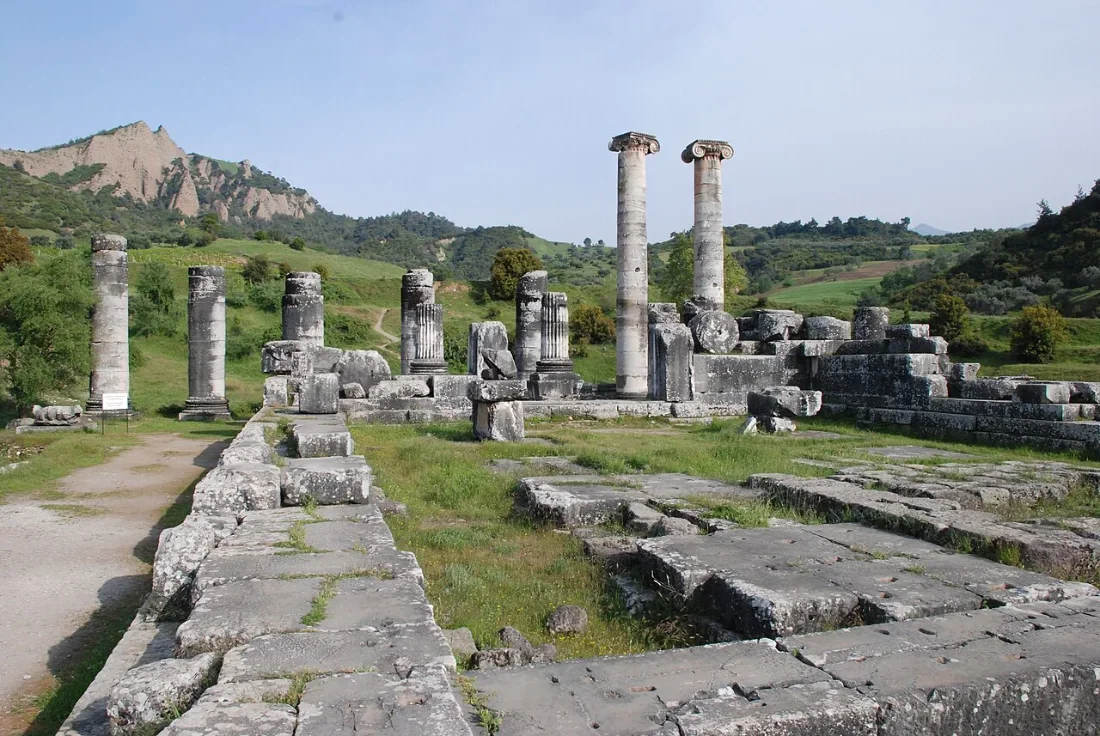
Text and translation
The uninterrupted Greek with its English translation, line by line.
Show text and translation
νῦν δὲ Λύδαισιν ἐμπρέπεται γυναί-
Sappho · fr. 96 · stanzas of one period, cr 3gl ba ||| · ll. 6–16
How to read each line
A guide to the Greek, syllables, pitch marks and quantities.
Show the reading key
- Above each line: the line as the edition prints it, each word placed over its own syllables. The main row: the same Greek divided into metrical syllables, each written as it is pronounced. A consonant that closes a syllable is written with it (λόθ | ρο); an elided word is closed up with the next vowel (ν’ἀ); a final consonant carried into the next word is set with a thin space (ς ἰ). Wider gaps mark word-ends.
- Above the syllables: the pitch of each syllable, from the accents. Under them: the quantity of each syllable as it falls in the line, then the transliteration, syllable by syllable, with accented syllables in capitals.
- Under each line: a line-for-line translation. In the right margin of the scansion: the line type, its scheme, and its analysis into cola.
Key to the labels
The names, patterns and symbols used beside this poem.
Show the labels and symbols
The labels in the right margin of the scansion below name the cola, the rhythmic units each line is built from (Voigt’s and West’s analysis). A caret before a name (∧hipp) means the colon has lost its first position (acephalous). × marks an anceps position, which takes a long or a short. ⏓ is an anceps that is usually long (West’s and Voigt’s sign). A click on any syllable highlights its colon, or, with the colon/foot switch, its foot. After the scheme, ‖ marks the end of a period and ||| the end of the strophe.[8] A line that ends without either runs on into the next line (synapheia): the two are one period, with no metrical break between them,[9] and the page sets them together and links them. The sources of the labels, with their page numbers, are given line by line under Prosody, line by line.
| Label | Name and shape | What it is |
|---|---|---|
| sa-cr | Cretic (cr)— ⏑ — | The three positions that open the period of fr. 96. Voigt calls them a cretic (Conspectus C 5); West writes the same three positions as an acephalous iambic metron, ∧ia.[10] |
| sa-gl96 | Glyconic (gl)× × — ⏑ ⏑ — ⏑ — | One of the three glyconics of Voigt’s cr 3gl ba (Conspectus C 5). The whole stanza is a single period,[10] so the last position of the glyconic is a true long and the next colon follows without a pause. |
| sa-gl96b | Glyconic (gl), the second of the period— ⏒ — ⏑ ⏒ ⏓ ⏑ — | Voigt prints this glyconic with its first position long, its second and fifth positions usually short (⏒) and its sixth usually long (⏓), instead of fixing them (Conspectus C 5). The marks at positions 5 and 6 allow for line 7, where — ⏑ — ⏑ — ⏑ ⏑ — stands for the glyconic. Voigt calls that line a choriambic dimeter and notes that it is found in place of a glyconic nowhere else, unless in fr. 95. West calls this shape the anaclastic glyconic, gl¨, which may respond with the standard form;[11] Battezzato calls it the wilamowitzian.[12] |
| sa-ba | Bacchiac close (ba)⏑ — ⏓ | The three positions that end the period after the third glyconic. Voigt calls them a bacchiac (ba); West writes them as a catalectic iambic metron, ia∧.[10] |
The feet
| Foot and shape | Where |
|---|---|
| Cretic— ⏑ — | The three positions that Voigt calls a cretic and West an acephalous iambic metron (∧ia). |
| Aeolic base× × | The two free positions that open the colon. In the Lesbians the first is more often long than short, and it is uncommon for both to be short.[11] |
| Choriamb— ⏑ ⏑ — | The core of the Aeolic colon, long, short, short, long.[11] |
| Close⏑ — | The short and the long that end the glyconic after its choriamb. Inside a period the long is a true long. |
| Bacchiac close⏑ — ⏓ | The three positions after the last glyconic that end the period (Voigt’s ba, West’s ia∧). |
Scansion
The simile of the moon from the Berlin parchment, scanned position by position: Greek in metrical syllables, the quantity and pitch of each syllable, a syllabified transliteration and a line-for-line translation. Each three-line stanza is a single period, so each line runs on into the next. Voigt’s lines 6–16 are scanned, each with her number (96.6 is fr. 96, line 6).
But now among the women of Lydia she is conspicuous,
as, once the sun
has gone down, the moon with fingers of rose
rises above every star; its light reaches
across the briny sea
and the fields thick with flowers equally;
the dew lies spread, lovely, and there flourish
roses, and soft chervil,
and melilot full of blossom.
And as she paces to and fro, often calling to mind
kind Atthis, with yearning,
Metre
- Not the stanza of fr. 94. Frr. 94 and 96 come from the same parchment, but Voigt does not give them the same metre. She heads fr. 96 “metrum: cr 3gl ba |||”, and in her Conspectus metrorum she lists it not among the stanzas (A, “strophae”; fr. 94 is A 2, gl ‖ gl ‖ gld |||) but among the Aeolic verses (C, “versus Aeolici”, p. 17), as C 5,[13] cr 3gl ba ‖, “S. 96, fort. S. 95”. She prints its thirty positions as one verse: — ⏑ — × × — ⏑ ⏑⁀— ⏑ — — ⏒ — ⏑ ⏒ ⏓ ⏑ — ⁝ ⏓ × ⁝ — ⏑ ⏑ — ⏑ — ⏑ — ⏓ ‖, with a tie (word-end never) between positions 8 and 9 and frequent word-end (⁝) after positions 19 and 21. This page therefore uses a form of its own (cr3glba-sappho96), built from Voigt’s C 5; the margin shows her signs line by line.
- One period in three lines. The thirty positions are a cretic (— ⏑ —), three glyconics (× × — ⏑ ⏑ — ⏑ —) and a bacchiac close (⏑ — ⏓), written as three lines of eleven, eight and eleven syllables. West[10] quotes lines 12–14 as his example of a strophe “formed from a single compound period” and labels the three lines ∧ia gl, gl, gl ia∧ |||. His ∧ia is Voigt’s cretic and his ia∧ her bacchiac. Battezzato[14] writes the strophe cr glyc / glyc / glyc ba |||, where / means that the line-end of the ancient layout cannot be a verse-end; he calls the one-verse strophe unusual, notes that some scholars object that thirty syllables cannot be sung without a metrical break, and answers with parallels: Alcaeus fr. 140 (twenty syllables), the nineteen-syllable third period of the Alcaic stanza, and periods of twenty-two and twenty-three positions in Pindar. Hephaestion describes the glyconic as the antispastic dimeter acatalectic.[15]
- No pause inside the stanza (synapheia). Because the whole stanza is one period, the end of the first and second lines is not a pause: each continues the line before it, and only the end of the third line is a period-end. Words run over the line-end five times: γυναί|κεσσιν (6–7), ἐπί|σχει (9–10), τεθά|λαισι (12–13), ἄν|θρυσκα (13–14) and ἐπι|μνάσθεισ’ (15–16); Battezzato[14] points to these split words as the evidence for the synapheia. The final ν of ἀλμύραν (l. 10) is pronounced with the ἴσως that begins l. 11, as a consonant carries over in synapheia.[16] The last position of the first two lines is therefore a true long and is long every time. Line 16 runs on into line 17, which is too damaged to scan.
- Voigt’s second glyconic. Voigt prints the second glyconic as — ⏒ — ⏑ ⏒ ⏓ ⏑ —: first position long, second and fifth usually short (⏒), sixth usually long (⏓), instead of fixing them. The marks allow for line 7, where — ⏑ — ⏑ — ⏑ ⏑ — stands in place of the glyconic. Voigt calls that line a choriambic dimeter and says that such a line occurs in place of a glyconic nowhere else, unless in fr. 95.9 if it is in the same metre (fr. 98b.8 being certainly corrupt). West[11] gives this shape, × × — × — ⏑ ⏑ —, as the anaclastic glyconic, gl¨, which can stand in responsion with the regular glyconic; Battezzato[17] calls it the wilamowitzian and cites 95.9 and 96.7 as substituted for the glyconic.
- The bases. The base of the first glyconic is — ⏑ in ll. 6 and 12, ⏑ — in ll. 9 and 15; that of the third is — ⏑ in ll. 8 and 14, ⏑ — in l. 11. Two shorts never stand together in a base here, which West[11] calls uncommon in the Lesbians. The second glyconic begins with a long in every stanza, as Voigt prints it.
- Which lines are scanned. Lines 1–3 are lacunose, and lines 4–5 are obelized by Voigt (†θεασικελαν ἀρι|γνωτα†). Line 17 is partly lacunose (κ[.]ρ…), and most of the rest is too damaged to scan. Lines 6–16 survive complete and are scanned here. Every line keeps Voigt’s number; the stanza numbers count Voigt’s stanza divisions from the two lines before her first one.
- Lesbian prosody. A stop and a liquid make position even across a word-boundary:[18] δὲ βρόδα (l. 13) has a long δὲ, and West marks it so (β'ρόδα, p. 35). Vowels that meet are elided (ποτ’, περρέχοισ’, δ’, ἐπ’, κἄπαλ’, ζαφοίταισ’, ἐπιμνάσθεισ’) or joined by crasis (κἄπαλ’ = καὶ ἄπαλα), never left in hiatus.[19] No position is resolved or contracted.[20]
Dialect and transliteration
- Psilosis. The article ἀ, ἀελίω and ἰμέρωι have smooth breathing.[21]
- Long ᾱ where Attic–Ionic has η:[22] ἀελίω (Ionic ἠελίου)[23], the ending of σελάννα, ἀλμύραν, ἐέρσα,[24] κάλα, τεθάλαισι,[25] ἀγάνας, and the article ἀ.
- Doubled consonants. σελάννα (Attic σελήνη)[26] has the Lesbian doubled consonant where Attic lengthens the vowel: de Kreij[22] gives the first compensatory lengthening in Lesbian as a doubling, e.g. κράννα for κρήνην; περρέχοισα is the Aeolic form of περιέχουσα,[27] glossed ὑπερέχειν, “to surpass”, by Hesychius (Voigt’s parallels). Each double consonant closes the syllable before it.
- βρόδα (“roses”) has βρ- for Attic ῥ-. De Kreij (2022, p. 148 with n. 11) explains βρ- as possibly a scribal spelling of the old ϝρ-, kept as an archaism, the main argument being that βρ- in a number of places makes position, as it does here (δὲ βρόδα, l. 13; ἀ βροδοδάκτυλος, l. 8). The genitive in -ω (ἀελίω) and the dative plural in -αισι(ν) (Λύδαισιν) are Lesbian.[21] τεθάλαισι (“are in bloom”) is a verb, from the Aeolic perfect τέθᾱλα,[28] not a dative.
Prosody, line by line
Every syllable, with the reason for its length. Quantities are read from the vowel where the spelling shows it, from the consonants that follow (“position”), from the accent where it tells, and from the metre where nothing else does. Editors’ notes on the text follow in the boxed paragraphs.
- 96.6
Line 96.6 · νῦν δὲ Λύδαισιν ἐμπρέπεται γυναί-
νῦν δὲ Λύδαισιν ἐμπρέπεται γυναί-
νῦνδὲΛύδαισιν ἐμπρέπεταιγυναί-the period runs on into 96.7 (synapheia).
The label in the margin, with its sources: cr gl (Voigt C 5) = ∧ia gl (West p. 35).
- 1 —νῦνῦ carries a circumflex, so it is long; closed by ν: long by position.
- 2 ⏑δὲὲ is short by nature.
- 3 —Λύύ is long by the metre (position 3 must be long).
- 4 —δαιαι is a diphthong, long by nature; the position is anceps.
- 5 ⏑σιῐ is short (its length is not shown by the ordinary spelling); the position is anceps.
- 6 —ν ἐμἐ is short by nature; closed by μ: long by position; the first consonant belongs to the previous word and is carried over to this vowel.
- 7 ⏑πρέέ is short by nature.
- 8 ⏑πεε is short by nature.
- 9 —ταιαι is a diphthong, long by nature.
- 10 ⏑γυυ is short by the metre (position 10 must be short).
- 11 —ναί-αί is a diphthong, long by nature; the line-end is not a period-end: the period runs on into the next line (synapheia), so this syllable keeps its own length, with no brevis in longo, and a word may run over into the next line.[29]
The cretic νῦν δὲ Λύ is followed by the first glyconic: base δαι σι, choriamb ἐμ πρέ πε ται, close γυ ναί. The ι of Λύδαισιν is short and is marked with a breve here, because position 5 is anceps; its ν passes to ἐμ-. Voigt’s apparatus notes that the parchment has ΕΝΠ, so that perhaps ἐν πρ- should be written, and that the middle voice of the verb is in any case unusual; LSJ s.v. ἐμπρέπω quotes this line as its example of the middle. γυναί|κεσσιν is divided between lines 6 and 7, so the period runs on, and ναί is long at the end of the line.
- 96.7
Line 96.7 · κεσσιν ὤς ποτ’ ἀελίω
κεσσιν ὤς ποτ’ ἀελίω
κεσσιν ὤςποτ’ἀελίωcontinues 96.6 · one period (synapheia); the period runs on into 96.8 (synapheia).
The label in the margin, with its sources: choriambic dimeter (Voigt) = gl¨ (West p. 33).
- 1 —κεσε is short by nature; closed by σ: long by position.
- 2 ⏑σιῐ is short (its length is not shown by the ordinary spelling); the position is anceps.
- 3 —ν ὤςὤ is long by nature; closed by ς: long by position; the first consonant belongs to the previous word and is carried over to this vowel.
- 4 ⏑ποο is short by nature.
- 5 —τ’ἀᾱ̓ is long (its length is not shown by the ordinary spelling); the apostrophe marks an elided vowel; the consonant before it joins this syllable; the position is anceps.
- 6 ⏑εε is short by nature; the position is anceps (⏓: usually long).
- 7 ⏑λίί is short by the metre (position 7 must be short).
- 8 —ωω is long by nature; the line-end is not a period-end: the period runs on into the next line (synapheia), so this syllable keeps its own length, with no brevis in longo, and a word may run over into the next line.[29]
In place of the glyconic this line has — ⏑ — ⏑ — ⏑ ⏑ —, which Voigt calls a choriambic dimeter and West the anaclastic glyconic.[11] The fifth syllable, the first of ἀελίω, is long: ἀέλιος is the Lesbian form of Ionic ἠέλιος,[30] and its ᾱ is marked with a macron here. ἀελίω is a genitive in -ω. ποτ’ is ποτε elided, as the parchment writes it (Voigt’s apparatus). The ι of -κεσσιν is short (marked with a breve); its ν passes to ὤς. Word-end follows the line, as Voigt’s ⁝ after position 19 leads one to expect. The period runs on into line 8.
- 96.8
Line 96.8 · δύντος ἀ βροδοδάκτυλος ⟨σελάννα⟩
δύντος ἀ βροδοδάκτυλος ⟨σελάννα⟩
δύντος ἀβροδοδάκτυλοςσελάνναcontinues 96.7 · one period (synapheia).
The label in the margin, with its sources: gl ba (Voigt C 5) = gl ia∧ (West p. 35).
- 1 —δύνύ is a vowel of unknown length; closed by ν: long by position; the position is anceps (⏓: usually long).
- 2 ⏑τοο is short by nature; the position is anceps.
- 3 —ς ἀthe next word begins with βρ: the syllable is closed before it: long by position; the first consonant belongs to the previous word and is carried over to this vowel.
- 4 ⏑βροο is short by nature.
- 5 ⏑δοο is short by nature.
- 6 —δάκά is a vowel of unknown length; closed by κ: long by position.
- 7 ⏑τυυ is short by the metre (position 7 must be short).
- 8 —λοςο is short by nature; closed by ς: long by position.
- 9 ⏑σεε is short by nature.
- 10 —λάνά is a vowel of unknown length; closed by ν: long by position.
- 11 ×ναα is of unknown length; the position is anceps (⏓: usually long), so either scans.
In δύντος ἀ the ς passes to the article ἀ, which is long; it is also closed by the βρ of the next word, which makes position in Lesbian verse. Voigt quotes Reinach’s remark that “rosy-fingered” is a strange thing to say of the moon. ⟨σελάννα⟩ is Schubart’s conjecture, made for the metre: the parchment has ΜΗΝΑ, which gives the period one syllable too few. Page objected to the conjecture (Voigt’s apparatus); LSJ s.v. βροδοδάκτυλος also prints μήνα with “leg. σελάννα”. The last syllable ends the period and the stanza, so it is indifferent.
Campbell prints σελάννα in his text.[31]
- 96.9
Line 96.9 · πάντα περ⟨ρ⟩έχοισ’ ἄστρα· φάος δ’ ἐπί-
πάντα περ⟨ρ⟩έχοισ’ ἄστρα· φάος δ’ ἐπί-
πάνταπερρέχοισ’ἄστρα·φάοςδ’ἐπίσ-the period runs on into 96.10 (synapheia).
The label in the margin, with its sources: cr gl (Voigt C 5) = ∧ia gl (West p. 35).
- 1 —πάνά is a vowel of unknown length; closed by ν: long by position.
- 2 ⏑ταα is short by the metre (position 2 must be short).
- 3 —περε is short by nature; closed by ρ: long by position.
- 4 ⏑ρέέ is short by nature; the position is anceps.
- 5 —χοιοι is a diphthong, long by nature; the position is anceps.
- 6 —σ’ἄσἄ is a vowel of unknown length; closed by σ: long by position; the apostrophe marks an elided vowel; the consonant before it joins this syllable.
- 7 ⏑τρα·α is short by the metre (position 7 must be short).
- 8 ⏑φάά is short by the metre (position 8 must be short).
- 9 —οςο is short by nature; closed by ς: long by position.
- 10 ⏑δ’ἐἐ is short by nature; the apostrophe marks an elided vowel; the consonant before it joins this syllable.
- 11 —πίσ-ί is a vowel of unknown length; closed by σ: long by position; the line-end is not a period-end: the period runs on into the next line (synapheia), so this syllable keeps its own length, with no brevis in longo, and a word may run over into the next line.[29]
περ⟨ρ⟩έχοισ’ is Schubart’s correction of the parchment’s ΠΕΡΕΧ- (Voigt’s apparatus): Lesbian περρέχοισα (= περιέχουσα, “surpassing”) with its final α elided before ἄστρα. In ἄστρα the σ closes ἀσ-, and τρα is short. φάος has two syllables. ἐπί|σχει runs over the line-end, and the σ closes the syllable πίσ, which is long at position 11; the line runs on into line 10.
Campbell prints περρέχοισ’.[31]
- 96.10
Line 96.10 · σχει θάλασσαν ἐπ’ ἀλμύραν
σχει θάλασσαν ἐπ’ ἀλμύραν
χειθάλασσαν ἐπ’ἀλμύραcontinues 96.9 · one period (synapheia); the period runs on into 96.11 (synapheia).
The label in the margin, with its sources: gl (Voigt C 5; West p. 35).
- 1 —χειει is a diphthong, long by nature.
- 2 ⏑θάᾰ́ is short (its length is not shown by the ordinary spelling); the position is anceps.
- 3 —λασα is a vowel of unknown length; closed by σ: long by position.
- 4 ⏑σαα is short by the accent rule: acute on the antepenult requires a short final syllable.
- 5 ⏑ν ἐἐ is short by nature; the first consonant belongs to the previous word and is carried over to this vowel; the position is anceps.
- 6 —π’ἀλἀ is a vowel of unknown length; closed by λ: long by position; the apostrophe marks an elided vowel; the consonant before it joins this syllable; the position is anceps (⏓: usually long).
- 7 ⏑μύύ is short by the metre (position 7 must be short).
- 8 —ραα is long by the metre (position 8 must be long); the line-end is not a period-end: the period runs on into the next line (synapheia), so this syllable keeps its own length, with no brevis in longo, and a word may run over into the next line.[29]
The α of θάλασσαν is short and is marked with a breve, because position 2 is one that Voigt marks ⏒. ἐπ’ is ἐπί elided. ἀλμύραν has the Lesbian long ᾱ in its last syllable. That syllable is open, because the ν is pronounced with the ἴσως at the start of line 11, and the metre requires a long there. The period runs on into line 11.
- 96.11
Line 96.11 · ἴσως καὶ πολυανθέμοις ἀρούραις·
ἴσως καὶ πολυανθέμοις ἀρούραις·
ν ἴσωςκαὶπολυανθέμοιςἀρούραις·continues 96.10 · one period (synapheia).
The label in the margin, with its sources: gl ba (Voigt C 5) = gl ia∧ (West p. 35).
- 1 ⏑ν ἴἴ̆ is short (its length is not shown by the ordinary spelling); the first consonant belongs to the previous word and is carried over to this vowel; the position is anceps (⏓: usually long).
- 2 —σωςω is long by nature; closed by ς: long by position; the position is anceps.
- 3 —καὶαὶ is a diphthong, long by nature.
- 4 ⏑ποο is short by nature.
- 5 ⏑λυυ is short by the metre (position 5 must be short).
- 6 —ανα is a vowel of unknown length; closed by ν: long by position.
- 7 ⏑θέέ is short by nature.
- 8 —μοιςοι is a diphthong, long by nature.
- 9 ⏑ἀἀ is short by the metre (position 9 must be short).
- 10 —ρούού is a diphthong, long by nature.
- 11 ×ραις·αι is a diphthong, long by nature; closed by ς: long by position; the position is anceps (⏓: usually long).
The ι of ἴσως (“equally”) is short, as in ἴσος at fr. 31.1, where the Sapphic line needs a short, and is marked with a breve because position 1 is anceps. The parchment has ΪϹ- (Voigt’s apparatus). In πολυανθέμοις (“rich in flowers”)[32] υ and α are separate syllables, and αν is closed by νθ. In πολυανθέμοις ἀρούραις the ς passes to ἀ-, and μοι is long as a diphthong. The bacchiac σἀ ρού ραις ends the period and the stanza.
- 96.12
Line 96.12 · ἀ δ’ ⟨ἐ⟩έρσα κάλα κέχυται, τεθά-
ἀ δ’ ⟨ἐ⟩έρσα κάλα κέχυται, τεθά-
ἀδ’ἐέρσακάλακέχυται,τεθά-the period runs on into 96.13 (synapheia).
The label in the margin, with its sources: cr gl (Voigt C 5) = ∧ia gl (West p. 35).
- 1 —ἀἀ is long by the metre (position 1 must be long).
- 2 ⏑δ’ἐἐ is short by nature; the apostrophe marks an elided vowel; the consonant before it joins this syllable.
- 3 —έρέ is short by nature; closed by ρ: long by position.
- 4 —σαᾱ is long (its length is not shown by the ordinary spelling); the position is anceps.
- 5 ⏑κάᾰ́ is short (its length is not shown by the ordinary spelling); the position is anceps.
- 6 —λαα is long by the metre (position 6 must be long).
- 7 ⏑κέέ is short by nature.
- 8 ⏑χυυ is short by the metre (position 8 must be short).
- 9 —ται,αι is a diphthong, long by nature.
- 10 ⏑τεε is short by nature.
- 11 —θά-ά is long by the metre (position 11 must be long); the line-end is not a period-end: the period runs on into the next line (synapheia), so this syllable keeps its own length, with no brevis in longo, and a word may run over into the next line.[29]
West[10] quotes lines 12–14 as his example of a strophe formed from a single period, and marks the long vowels of ἐέρσᾱ, κάλᾱ and τεθᾱ́-. ἀ δ’ ⟨ἐ⟩έρσα is Schubart’s correction of the parchment’s ΑΔΕΡ-; Page suggested κὰδ δ’ ἐέρσα (Voigt’s apparatus). The article ἀ is long. The final α of ἐέρσα is long (Ionic ἐέρση)[33], so the base of the glyconic, σᾱ κᾰ, is — ⏑; the first α of κάλα is short (as in κάλοι at fr. 1.9) and is marked with a breve. κάλα has a long final ᾱ (feminine), and τεθά- a long ᾱ (Aeolic perfect τέθᾱλα)[28], both required by the metre. Word-end is avoided between positions 8 and 9, as Voigt’s tie requires: κέ|χυ|ται is one word. τεθά|λαισι is divided between the lines, so the period runs on.
Campbell prints ἀ δ’ ἐέρσα.[31]
- 96.13
Line 96.13 · λαισι δὲ βρόδα κἄπαλ’ ἄν-
λαισι δὲ βρόδα κἄπαλ’ ἄν-
λαισιδὲβρόδακἄπαλ’ἄν-continues 96.12 · one period (synapheia); the period runs on into 96.14 (synapheia).
The label in the margin, with its sources: gl (Voigt C 5; West p. 35).
- 1 —λαιαι is a diphthong, long by nature.
- 2 ⏑σιῐ is short (its length is not shown by the ordinary spelling); the position is anceps.
- 3 —δὲὲ is short by nature; the next word begins with βρ: the syllable is closed before it: long by position.
- 4 ⏑βρόό is short by nature.
- 5 ⏑δαᾰ is short (its length is not shown by the ordinary spelling); the position is anceps.
- 6 —κἄᾱ̓́ is long (its length is not shown by the ordinary spelling); the position is anceps (⏓: usually long).
- 7 ⏑παα is short by the metre (position 7 must be short).
- 8 —λ’ἄν-ἄ is a vowel of unknown length; closed by ν: long by position; the apostrophe marks an elided vowel; the consonant before it joins this syllable; the line-end is not a period-end: the period runs on into the next line (synapheia), so this syllable keeps its own length, with no brevis in longo, and a word may run over into the next line.[29]
Schubart read the parchment as ΛΕΙϹΙ and corrected it to -λ⟨α⟩ισι; Lobel and Page thought -λαισι may be what is written (Voigt’s apparatus). Its final ι is short (breve). δὲ is long because the next word begins with βρ, and in Lesbian verse a stop and a liquid make position even across a word-boundary;[18] West marks the division β'ρόδα.[10] The α of βρόδα is short (breve). κἄπαλ’ (Blass read ΠΑΛ’ on the parchment) is καὶ ἄπαλα joined by crasis and then elided; its first syllable is long, as West marks it,[10] at a position that Voigt marks ⏓, usually long. ἄν|θρυσκα is divided between the lines, and ἄν is closed by νθ.
- 96.14
Line 96.14 · θρυσκα καὶ μελίλωτος ἀνθεμώδης·
θρυσκα καὶ μελίλωτος ἀνθεμώδης·
θρυσκακαὶμελίλωτος ἀνθεμώδης·continues 96.13 · one period (synapheia).
The label in the margin, with its sources: gl ba (Voigt C 5) = gl ia∧ (West p. 35).
- 1 —θρυσυ is a vowel of unknown length; closed by σ: long by position; the position is anceps (⏓: usually long).
- 2 ⏑καᾰ is short (its length is not shown by the ordinary spelling); the position is anceps.
- 3 —καὶαὶ is a diphthong, long by nature.
- 4 ⏑μεε is short by nature.
- 5 ⏑λίί is short by the metre (position 5 must be short).
- 6 —λωω is long by nature.
- 7 ⏑τοο is short by nature.
- 8 —ς ἀνἀ is a vowel of unknown length; closed by ν: long by position; the first consonant belongs to the previous word and is carried over to this vowel.
- 9 ⏑θεε is short by nature.
- 10 —μώώ is long by nature.
- 11 ×δης·η is long by nature; closed by ς: long by position; the position is anceps (⏓: usually long).
- 96.15
Line 96.15 · πόλλα δὲ ζαφοίταισ’ ἀγάνας ἐπι-
πόλλα δὲ ζαφοίταισ’ ἀγάνας ἐπι-
πόλλαδὲζαφοίταισ’ἀγάναςἐπιμ-the period runs on into 96.16 (synapheia).
The label in the margin, with its sources: cr gl (Voigt C 5) = ∧ia gl (West p. 35).
- 1 —πόλό is short by nature; closed by λ: long by position.
- 2 ⏑λαα is short by the metre (position 2 must be short).
- 3 —δὲὲ is short by nature; the next word begins with the double consonant ζ: the syllable is closed before it: long by position.
- 4 ⏑ζαᾰ is short (its length is not shown by the ordinary spelling); the position is anceps.
- 5 —φοίοί is a diphthong, long by nature; the position is anceps.
- 6 —ταιαι is a diphthong, long by nature.
- 7 ⏑σ’ἀἀ is short by the metre (position 7 must be short); the apostrophe marks an elided vowel; the consonant before it joins this syllable.
- 8 ⏑γάά is short by the metre (position 8 must be short).
- 9 —ναςα is long by the metre (position 9 must be long).
- 10 ⏑ἐἐ is short by nature.
- 11 —πιμ-ι is a vowel of unknown length; closed by μ: long by position; the line-end is not a period-end: the period runs on into the next line (synapheia), so this syllable keeps its own length, with no brevis in longo, and a word may run over into the next line.[29]
δὲ is long because ζ counts as two consonants.[36] ζαφοίταισ’ is Blass’s reading; ζα- is the Aeolic form of δια-,[37] and its α is marked with a breve. Voigt’s apparatus refers to Zuntz and to Hamm for the view that the form is a third-person singular. In ἀγάνας ἐπι- the ς passes to the next vowel, and the long ᾱ of the genitive ἀγάνᾱς fills position 9. ἐπι|μνάσθεισ’ runs over the line-end, and μ closes πιμ-.
- 96.16
Line 96.16 · μνάσθεισ’ Ἄτθιδος ἰμέρωι
μνάσθεισ’ Ἄτθιδος ἰμέρωι
νάσθεισ’Ἄτθιδος ἰμέρωιcontinues 96.15 · one period (synapheia); the period runs on into the next line, which is not given here (synapheia).
The label in the margin, with its sources: gl (Voigt C 5; West p. 35).
- 1 —νάσά is a vowel of unknown length; closed by σ: long by position.
- 2 —θειει is a diphthong, long by nature; the position is anceps.
- 3 —σ’ἌτἌ is a vowel of unknown length; closed by τ: long by position; the apostrophe marks an elided vowel; the consonant before it joins this syllable.
- 4 ⏑θιι is short by the metre (position 4 must be short).
- 5 ⏑δοο is short by nature; the position is anceps.
- 6 —ς ἰῑ̓ is long (its length is not shown by the ordinary spelling); the first consonant belongs to the previous word and is carried over to this vowel; the position is anceps (⏓: usually long).
- 7 ⏑μέέ is short by nature.
- 8 —ρωιωι is a diphthong, long by nature; the line-end is not a period-end: the period runs on into the next line (synapheia), so this syllable keeps its own length, with no brevis in longo, and a word may run over into the next line.[29]
ἐπιμνάσθεισ’ (“remembering”) is elided before Ἄτθιδος. In Ἄτθιδος the τ closes the first syllable before θ. ἰμέρωι has a long ι,[38] marked with a macron, at the position that Voigt marks ⏓, usually long. Schubart, Lobel and Zuntz read the parchment as -ΡΩ without the iota, which Blass read (Voigt’s apparatus). The period runs on into line 17, which is too damaged to scan; the page says so in the margin and treats the last syllable of line 16 as inside the period, where it is long in any case.
The poem
Someone who has left the singer’s circle is now among the women of Lydia; the speaker imagines her outshining them as the moon outshines the stars, and remembering Atthis with longing.[39] Klinck observes that a departure for marriage is commonly supposed, though the poem never says so. Lardinois[40] cites fr. 96, with frr. 21 and 22, as evidence that the women around Sappho also addressed songs to each other, and lists it among the poems preserved on parchment.[41]
Notes
- ^ Cazzato 2021, pp. 152–153.
- ^ Cazzato 2021, p. 153.
- ^ Mueller 2021, p. 50.
- ^ Rösler 2021, p. 66.
- ^ Lardinois 2022, p. 264.
- ^ Finglass 2021b, pp. 233, 240.
- ^ Battezzato 2021, p. 128.
- ^ West 1987, p. 4.
- ^ West 1987, p. 3.
- ^ a b c d e f g West 1987, p. 35.
- ^ a b c d e f West 1987, p. 33.
- ^ Battezzato 2021, p. 123.
- ^ Voigt 1971, p. 19.
- ^ a b Battezzato 2021, p. 128.
- ^ Hephaestion, Ench. 10.2.
- ^ West 1987, p. 12.
- ^ Battezzato 2021, pp. 123, 128.
- ^ a b West 1987, p. 16 and n. 7.
- ^ West 1987, pp. 15–16; p. 35 n. 2.
- ^ West 1987, p. 32.
- ^ a b de Kreij 2022, p. 148.
- ^ a b de Kreij 2022, p. 147.
- ^ LSJ s.v. ἥλιος, Aeolic ἀέλιος.
- ^ LSJ s.v. ἕρση: Aeolic ἐέρσᾱ, citing this line.
- ^ LSJ s.v. θάλλω: Aeolic perfect τέθᾱλα.
- ^ LSJ s.v. σελήνη.
- ^ LSJ s.v. περιέχω, citing this line.
- ^ a b LSJ s.v. θάλλω.
- ^ a b c d e f g h West 1987, pp. 3–4.
- ^ LSJ s.v. ἥλιος.
- ^ a b c Campbell 1982, p. 120.
- ^ LSJ s.v. πολυάνθεμος quotes this line.
- ^ LSJ s.v. ἕρση: Aeolic ἐέρσᾱ.
- ^ LSJ s.v. ἄνθρυσκον.
- ^ LSJ s.v. ἀνθεμώδης, citing this line.
- ^ West 1987, p. 12 n. 1; Hephaestion, Ench. 1.3.
- ^ LSJ s.v. ζά, where the α is short.
- ^ LSJ s.v. ἵμερος.
- ^ Klinck 2008, p. 143.
- ^ Lardinois 2022, p. 269.
- ^ Lardinois 2022, p. 266.
Text and sources
- Greek wording: Heather Waddell, Sappho fr. 96, Dickinson College Commentaries, CC BY-SA 4.0. Collated line by line. Iota is written adscript; punctuation, capitalization, diacritics and editorial signs follow this page’s stated conventions; quantity and scansion marks are added. The translation is the site’s own.
- Metre and textual commentary: E.-M. Voigt, Sappho et Alcaeus: Fragmenta (Amsterdam 1971), fr. 96 with testimonia, parallels and apparatus (pp. 106–108), Conspectus metrorum, Sappho C 5 (p. 19; section C p. 17) and A 2, with the key (p. 15); checked against the page images. Editorial signs and quantity marks follow the conventions explained in the line notes.
- The form cr 3gl ba ||| was added to the Sapphic Workbench for this poem (forms_d/sappho_stanzas.py, form cr3glba-sappho96; the page uses its catalogue cr3glba-sappho96-fr96), with Voigt’s scheme and marks from Conspectus C 5.
- M. L. West, Introduction to Greek Metre (Oxford 1987), pp. ix (signs), 12–17 (syllables, elision, crasis, hiatus, stop + liquid) and 32–35 (Lesbian lyric, the glyconic, the Aeolic base and the anaclastic glyconic p. 33; fr. 96.12–14 as a strophe of one period, p. 35; p. 35 n. 2); checked against the page images. Also West 1987, pp. 3–4 (synapheia and period-end).
- Hephaestion, Enchiridion 1.3 (position) and 10.2 (the glyconic), ed. M. Consbruch (Leipzig 1906); Greek text from First1KGreek, CC BY-SA 4.0.
- L. Battezzato, “Sappho’s Metres and Music”, in P. J. Finglass and A. Kelly (eds), The Cambridge Companion to Sappho (Cambridge 2021), pp. 123, 128.
- M. de Kreij, “The Lyric Dialects”, in L. Swift (ed.), A Companion to Greek Lyric (Wiley 2022), ch. 10, pp. 147–148.
- A. Lardinois, “Sappho”, in Swift (ed.), A Companion to Greek Lyric (Wiley 2022), ch. 18, pp. 266, 269.
- A. L. Klinck, Woman’s Songs in Ancient Greece (Montreal 2008), notes on fr. 96, p. 143.
- LSJ (Perseus Digital Library, CC BY-SA), s.vv. ἀνθεμώδης, ἄνθρυσκον, βροδοδάκτυλος, ἐμπρέπω, ζά, ἕρση, ἥλιος, θάλλω, ἵμερος, περιέχω, πολυάνθεμος, σελήνη.
- D. A. Campbell, Greek Lyric I: Sappho and Alcaeus (Loeb Classical Library 142, Cambridge, MA 1982), fr. 96 (pp. 120–121), compared line by line: same wording as Voigt in ll. 6–16, with Schubart’s corrections printed as plain text. Same fragment number as Voigt.
Quotations from copyrighted works are not covered by this page’s licence.


