Introduction to Greek metre
How syllable length shapes Greek verse, and how metrical signs describe its rhythm.
First steps for beginners, from rhythm to scanning a line; what metre is, how syllables are weighed, the notation and the rules of prosody; the Greek word accent; and how the texts reached us.
Introduction · 1 of 14
What Greek metre is
Greek metre measures syllables. It counts them, and to a large extent it also weighs them. Each syllable is given a relative duration, and this duration is called its quantity.[1] Each verse has a fixed count of syllables or positions. Add or remove one, and the verse no longer scans.[2] The pattern of long and short syllables that fills those positions is the rhythm.
Quantity, not stress. English verse is built from stressed and unstressed syllables. English speakers tend to space their stresses evenly, hurrying over runs of unstressed syllables.[3] Greek verse does not work like this. The classical Greek word accent was not a stress. It was a rise and fall in the pitch of the voice.[4] It played no part in the construction of verse.[2]
What the verse regulates is length. A long syllable was heard as taking twice as long as a short one, in the relation of a crotchet to a quaver.[5] An English line may look like a Greek colon when it is written in metrical signs. But English readers mark its rhythm by stress, over syllables of roughly equal length. Greek syllables had to keep their durations.[6]
The material. A syllable is long in two cases. Its vowel may be long or a diphthong. Or two or more consonants may stand between its vowel and the next.[7] Inside a verse the words run on as one stream of sound. They are cut into syllables across word-ends.[8] At the end of each verse that continuity breaks, whether or not the sense pauses there.[9] Here is the first line of the Iliad as a first taste. Each syllable stands over its sign, — long or ⏑ short, with its transliteration below:
μῆνιν ἄειδε θεὰ Πηληϊάδεω Ἀχιλῆος
Sing, goddess, the wrath of Achilles son of Peleus.
Homer, Iliad 1.1, divided into its six feet. Red: -δεω (-deō), two vowels sounded as one syllable.
David Chamberlain, Iliad 1.1 · CC BY 4.0
The -εω of Πηληϊάδεω is one syllable. The two vowels are run together, as often happens within a word when the first vowel is ε.[10] This running together is often called synizesis.[11]
Why it is like this: the Indo-European inheritance. Greek is an Indo-European language. Its metres can be compared with those of other Indo-European peoples, above all with the hymns of the Rigveda. West dates the Rigveda roughly 1200–1000 BC, and Battezzato no later than the thirteenth century BCE.[12] The comparison shows fairly clearly that Greek metre has Indo-European origins.[13] The features common to Greek and Vedic verse, and presumably inherited, are these:[2]
| Shared feature | What it means |
|---|---|
| Fixed syllable count | every verse has a set number of syllables or positions |
| Regulated cadence | the rhythm is regulated particularly towards the verse-end: the closing ⏑ — ⏑ × and its truncated form ⏑ — × |
| Quantity, not stress | rhythm is a pattern of long and short syllables |
| Continuity | the verse is a continuous stream, divided into syllables without regard to word-end |
| Verse boundary | between verses there is a break in continuity, even without a sense-pause |
| Stanzas | verses may be grouped into three- or four-line stanzas |
Three more shared features can be added to the list: a free beginning, called the “basis”; an indifferent final syllable; and a caesura near mid-verse.[14]
Greek regulated rhythm more thoroughly than the parent system did, and it used more patterns. Most Greek verse also admits resolution and contraction. The Aeolic metres of Sappho and Alcaeus admit neither. In the light of the Indian evidence they look relatively primitive, as Antoine Meillet pointed out in 1923.[15] They are probably the most conservative group of Greek metres, a judgement that also goes back to Meillet.[16]
By the eighth and seventh centuries there were at least three regional traditions, each with its own forms. They were the Ionian (epic, elegy, iambus), the Aeolian (the two Lesbian poets) and the Dorian (the Peloponnese and the western colonies).[17]
Kiparsky adds one more feature, which he regards as unique to Indo-European verse. This is the licensed equivalence of ⏑ — and — ⏑, which is called syncopation or anaclasis. In his view it weighs more than Meillet’s fixed syllable count, catalexis and fixed cadence, because those occur in many of the world’s metres.[18]
How the hexameter arose is disputed. It has been explained as a borrowing (Meister, Meillet; rejected by West 1997). It has also been explained as a fusion of lyric cola (West in 1973, Nagy in 1974, Berg in 1978, modified by Tichy in 1981), or as a pair of syncopated iambic dimeters (Kiparsky).[19] The Modern theory tab gives the details.
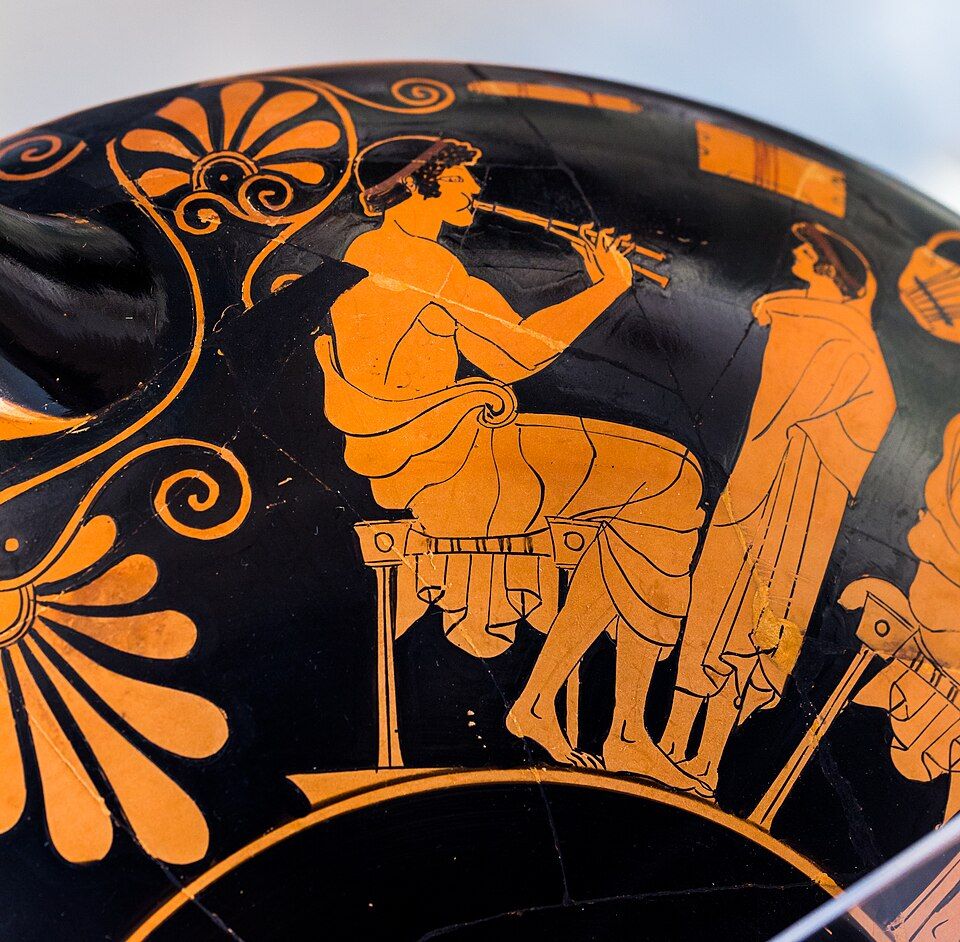
Metre and music. Most Greek lyric was composed to be sung, to the lyre, barbitos, kithara or aulos.[20] In song a long normally took the time of two shorts.[21] In some metres it took the time of three. In recitation the ratio was perhaps about 5:3.[22]
Aristotle distinguished metron from rhythmos. All verse has metron. Rhythmos belongs only to verse delivered to a fixed beat: lyric and drama, but not, in his day, epic.[23] The tab Rhythm and music says more.
Notes
- ^ West 1987, p. 10.
- ^ a b c West 1987, p. 2.
- ^ West 1987, p. 7; D’Angour 2022, p. 133.
- ^ West 1987, p. 2; Battezzato 2009, p. 143; D’Angour 2022, p. 132.
- ^ D’Angour 2022, p. 132; Natoli et al. 2022, p. 334.
- ^ D’Angour 2022, p. 133; see the Rhythm step of First steps, which sets the opening of Blake’s “The Tyger”, — ⏑ — ⏑ — ⏑ —, beside the first words of the Iliad.
- ^ West 1987, p. 2; Battezzato 2009, pp. 130–131.
- ^ West 1987, p. 2; Battezzato 2009, p. 130.
- ^ West 1987, p. 2; Battezzato 2009, p. 131.
- ^ West 1987, p. 15.
- ^ Battezzato 2009, p. 139 n. 14.
- ^ West 1987, p. 2; Battezzato 2009, p. 133.
- ^ West 1987, p. 1.
- ^ Battezzato 2009, p. 133.
- ^ West 1987, pp. 2–3.
- ^ Battezzato 2009, pp. 133–134.
- ^ West 1987, p. 3.
- ^ Kiparsky 2018, p. 102; Gunkel and Hackstein 2018, p. 1.
- ^ Kiparsky 2018, pp. 104–106 with nn. 24–25; Battezzato 2009, p. 140.
- ^ D’Angour 2022, p. 132.
- ^ West 1987, pp. 6–7; Battezzato 2009, p. 143.
- ^ West 1987, pp. 6–7.
- ^ Kiparsky 2018, p. 79 n. 3.
Introduction · 2 of 14
Syllable quantity
Every syllable in a verse is long or short. Deciding which rests on one distinction that must be kept clear: vowel length is not syllable length.[1]
Long and short vowels. ε and ο are short. η and ω are long, and so are all diphthongs. α, ι and υ vary from word to word, so their length has to be learned with each word.[2] On this site a long one may be marked ᾱ and a short one ᾰ. A few rules of thumb help:[3]
- A circumflexed vowel can only be long.
Example: πᾶσι (pāsi), “to all” (Homer, Iliad 1.5): the circumflex shows that its α is long. - An acute on the third syllable from the end (the antepenultimate), or a circumflex on the second from the end (the penultimate), means that the last vowel is short, unless it is αι or οι.
Examples: ἄλγεα (algea), “woes”, has its acute on the third syllable from the end, so its final -ᾰ is short. μῆνιν (mēnin), “wrath”, has a circumflex on the second syllable from the end, so its -ῐ- is short. - Vowels that arise from contraction are long.
Example: ἐτίμᾱ (etimā), “he honoured”, has a long final α, because it comes from -αε (-ae). - Certain endings are long. They include -ᾱς in masculine nominatives and in the genitive singular and accusative plural of the first declension, and -ᾱ in the dual.
Examples: νεανίᾱς (neaniās), “young man”, a masculine nominative; χώρᾱς (chōrās), “of the land”, a genitive singular. - Others are short. They include the -α of the neuter plural, final -ι and -υ in most words, and all prepositions, ἀνά, διά, σύν.
Examples: δῶρᾰ (dōra), “gifts”, a neuter plural; ἔτῐ (eti), “still”; διᾰ́ (dia), “through”.
From vowels to syllables. A period is divided into syllables without regard to word-division. (A period is a stretch of verse within which the words run on without a metrical break, often a single line)[4] The consonant immediately before a vowel begins its syllable. So ποδηγός (podēgos), “guide”, is cut πο-δη-γός, not by its etymology. A consonant after the vowel and not followed by another vowel stays with it and adds to its length. So two consonants together are normally divided between syllables.[5]
A syllable that ends in its vowel is called open. A syllable that ends in a consonant is called closed. A closed syllable is long, and so is any syllable with a long vowel or a diphthong. Only an open syllable with a short vowel is short.[6] The aspirate is not a consonant, and ζ, ξ, ψ each count as two.[7]
So in κρύπτω (kryptō), “I hide”, the υ is short, but the closed syllable κρυπ (kryp) is long, and that is what counts. In ῥίπτω (rhīptō), “I throw”, the ι is long by nature as well. For the same reason it is better not to say that a vowel is “lengthened by position”.[8]
In one line: a syllable is short only if it is open and its vowel is short; every other syllable is long.
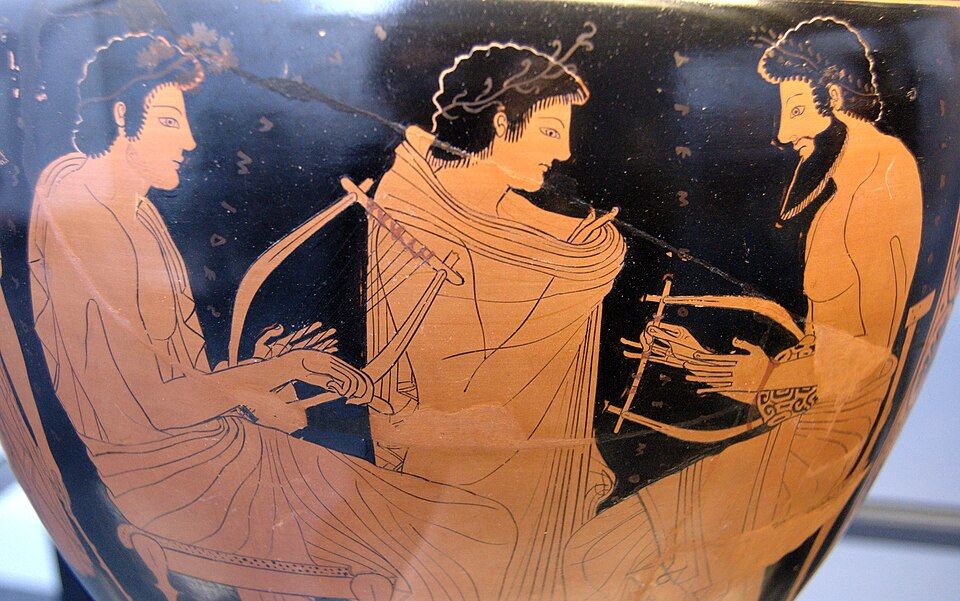
Hephaestion’s definitions. The ancient handbook puts the same rules in its own terms. A short syllable has a short vowel “not at the end of a word”, with at most one single consonant before the next vowel.[9] A long one has a long vowel or diphthong with a consonant after it, closing its own syllable or beginning the next. Without such a consonant the syllable is not outright long but “common” (1.2). Position he defines thus (1.3):
Θέσει μακραὶ γίνονται, ὅταν βραχέος ὄντος ἢ βραχυνομένου φωνήεντος σύμφωνα πίπτῃ μεταξὺ αὐτοῦ καὶ τοῦ τῆς ἑξῆς συλλαβῆς φωνήεντος πλείονα ἑνὸς ἁπλοῦ.
Syllables become long by position when the vowel is short, or treated as short, and more than one single consonant falls between it and the vowel of the next syllable.
He lists five ways it happens, from Τίρυνς and Ἕ-κτωρ to ἕξ and ἔξω (1.3). His “common” syllable (κοινή) arises in three ways. The first is a long vowel or diphthong before a vowel (ἄνδρα μοι ἔννεπε μοῦσα). The second is a short vowel before stop + liquid (ὅ-πλον, ἄ-κρον). The third is a word-final short syllable followed by at most one consonant (1.4, 1.7, 1.10). In modern terms these are correption, “mute and liquid” and lengthening.[10] Such syllables are called anceps syllables. They have nothing to do with anceps positions in a scheme.[11]
Muta cum liquida. A stop followed by a liquid or nasal may begin the next syllable. So τέκνα in tragedy is tek-na (— ⏑) or te-kna (⏑ ⏑).[12] Where the stop closes one syllable and the liquid opens the next, the syllable is outright long. Hephaestion cites Alcaeus’ ἔκ μ’ ἐλάσας.[13] The κ of ἐκ is never carried over. So ἐκ-λῦε “release from” must begin long, while ἔκλυε “he heard” may be — ⏑ ⏑ or ⏑ ⏑ ⏑.[14]
Final syllables. The last position of a period may always be long or short. A short syllable where the pattern wants a long one is called a brevis in longo. The missing time is made up by the pause.[15] Hephaestion says the same: Παντὸς μέτρου ἀδιάφορός ἐστιν ἡ τελευταία συλλαβή, “in every metre the final syllable is indifferent”. He cites Iliad 2.1–2, which end in long -ταί and short -νος.[16]
Worked examples. Syllables are cut as the metre cuts them, across word-ends.
| Text | Syllables | Quantities | Why |
|---|---|---|---|
| μῆνιν ἄειδε θεὰ (Il. 1.1) | μῆ-νι-νἄ-ει-δε-θε-ὰ | — ⏑ ⏑ — ⏑ ⏑ — | μῆ long vowel; νι short open; ν goes to the next syllable before ἄ; ει diphthong; the ᾱ of θεά long |
| ἄλγε’ ἔθηκε (Il. 1.2) | ἄλ-γε-ἔ-θη-κε | — ⏑ ⏑ — ⏑ | ἄλ closed; only the last vowel of ἄλγεα is elided, the ε before it is untouched;[17] θη long vowel |
| σκότος, ἐμὸν φάος (S. Aj. 394a) | sko-to-se-mom-pha-os ‖ | ⏑ ⏑ ⏑ — ⏑ — ‖ | the ς of σκότος opens the next syllable; the ν of ἐμόν closes mom before φ; at the pause the final ς closes os, so it is long[18] |
| ἔρεβος ὦ φαεννότατον, ὡς ἐμοί (S. Aj. 395) | e-re-bo-sō-pha-en-no-ta-to-nhō-se-moi ‖ | ⏑ ⏑ ⏑ — ⏑ — ⏑ ⏑ ⏑ — ⏑ — ‖ | en closed by the doubled ν; the aspirate is not a consonant, so the ν of -τον opens the syllable nhō and to stays short[19] |
| κρύπτω | κρυπ-τω | — — | υ short, syllable closed by π: long by position[8] |
| τὸ σκότος | τοσ-κο-… | — ⏑ … | the σ closes τοσ; it is the syllable τοσ, not το, that is long[8] |
Translations: “the wrath … goddess”; “laid woes”; “darkness, my light”; “Erebus, brightest for me”; “I hide”; “the darkness”.
The two Ajax lines are separate verses, so the ς of φάος closes its syllable at the pause. If the two lines ran on without a break (in synapheia), it would carry over: pha-o-se-re-bo- ⏑ ⏑ ⏑ ⏑ ⏑.[18]
Notes
- ^ West 1987, pp. 10, 13.
- ^ West 1987, p. 10; see Phonology › First steps, where each vowel can be heard long and short, and the diphthong and the δίχρονα, the vowels “of two lengths”, are explained.
- ^ West 1987, pp. 10–11.
- ^ West 1987, p. 3.
- ^ West 1987, p. 12; Battezzato 2009, p. 130.
- ^ West 1987, p. 12; Battezzato 2009, pp. 130–131.
- ^ West 1987, p. 12 n. 1.
- ^ a b c West 1987, p. 13.
- ^ Hephaestion, Ench. 1.1.
- ^ See Prosody.
- ^ West 1987, pp. 12–13.
- ^ West 1987, p. 16.
- ^ Hephaestion, Ench. 1.8.
- ^ West 1987, p. 17.
- ^ West 1987, p. 4; Battezzato 2009, p. 131.
- ^ Hephaestion, Ench. 4.5.
- ^ West 1987, p. 14.
- ^ a b West 1987, p. 12.
- ^ West 1987, p. 12 with n. 1.
Introduction · 3 of 14
Terms and analyses
A new name may describe a familiar part of a verse. It may also belong to a different analysis. West’s position and Maas’s element are equivalent terms. Their princeps and longum are another equivalent pair.[1] The divisions of a lyric line need more care: two analyses can agree on every quantity while grouping the syllables differently.
The table sets four approaches beside one another. The examples below explain each column.
| West | Maas | Dale | Hephaestion |
|---|---|---|---|
| Positions; the princeps and biceps within a dactylic foot. | Elements; longum is West’s princeps. | Letter patterns and names of cola in the analysis of a chorus. | Feet and their combinations in the analysis of a metre. |
| In the first foot of Iliad 1.1, μῆ is the princeps and νιν ἄ fills the biceps. | The same first long is the longum. His numbering counts the biceps as one element. | Medea 411 is s — dd in her notation; West writes e — D. | The Sapphic line divides into a trochaic pair, a choriamb and an iambic close. |
The position terms are documented in West’s glossary. The numerical use of element is illustrated in Maas’s hexameter rules. The two lyric analyses come from the passages examined below.[2]
Positions and syllables
A position belongs to the pattern. A syllable belongs to the spoken words that fill it.[3] In a hexameter foot, the first part is long. The second part can hold two shorts or one long. West calls these parts princeps and biceps.[4]
In the first foot below, μῆ (mē) fills the princeps. The text span νιν ἄ (nin a) fills the biceps with two shorts. In speech the n joins the following vowel: the grid displays νι (ni) and ν ἄ (na). The third foot has a contracted biceps: Πη (pē) is one long syllable. Contraction changes the syllables occupying that part of the pattern. It does not add or remove a foot.[5]
μῆνιν ἄειδε θεὰ Πηληϊάδεω Ἀχιλῆος
Sing, goddess, the wrath of Achilles son of Peleus.
Homer, Iliad 1.1. Red: the contracted foot. Dashed bar: the caesura.
David Chamberlain, Iliad 1.1 · CC BY 4.0
| Part of the pattern | First foot | Third foot |
|---|---|---|
| princeps / longum | μῆ (mē), — | -ὰ (-ā), — |
| biceps | νιν ἄ (nin a), ⏑ ⏑ | Πη- (pē-), — |
Maas’s “eighth element” is therefore the biceps of the fourth foot, not the eighth spoken syllable. His “monosyllabic” element is one filled by a single long. That distinction matters when reading a rule about where a word may end.[6]
Units in choral song
A letter can stand for a whole sequence of quantities. In West’s dactylo-epitrite notation, e means — ⏑ — and D means — ⏑ ⏑ — ⏑ ⏑ —.[7] The following example contains both:
ἄνω ποταμῶν ἱερῶν χωροῦσι παγαί,
καὶ δίκα καὶ πάντα πάλιν στρέφεται.
anō potamōn hierōn chōrousi pāgai, / kai dikā kai panta palin strephetai.
“Upward flow the springs of the sacred rivers, and justice and all things are turned backwards.”
In line 411, καὶ δίκα fills e, the next καὶ is the linking long, and πάντα πάλιν στρέφεται fills D.
Euripides, Medea 410–411
synthetic ∿
Take the second line, Medea 411. Its three groups are easy to locate:
| Greek | Transliteration | Quantities | West | Dale |
|---|---|---|---|---|
| καὶ δίκα | kai dikā | — ⏑ — | e | s |
| καὶ | kai | — | — | — |
| πάντα πάλιν στρέφεται | panta palin strephetai | — ⏑ ⏑ — ⏑ ⏑ — | D | dd |
For this line, e — D and s — dd describe the same quantities. The difference is the notation, not an alternative pronunciation of the Greek.[8] This comparison applies to the complete groups shown here. It is not a rule for replacing every d or D in every book.
The Sapphic line
A difference in grouping is more substantial than a change of letter. Hephaestion divides the Sapphic eleven-syllable line into a trochaic pair, a choriamb and an iambic close. The example shows that division:[9]
Ποικιλόθρον’ ἀθανάτ’ Ἀφρόδιτα,
Immortal Aphrodite of the intricate throne,
Sappho fr. 1.1. Hephaestion’s division: a trochaic pair, a choriamb (red) and an iambic close. The word divisions and the metrical divisions need not coincide.
synthetic ∿
West writes the line as ∧ia hag. His first group has three positions, — ⏑ —. The remaining eight form the hagesichorean, × — ⏑ ⏑ — ⏑ — —.[10] Both patterns below are shown with a long final position. A short syllable can fill that position at period-end, as -τα (ta) does here.[11] The divisions can be aligned:
| Analysis | First group | Second group | Close |
|---|---|---|---|
| Hephaestion | — ⏑ — × | — ⏑ ⏑ — | ⏑ — — |
| West | — ⏑ — | × — ⏑ ⏑ — ⏑ — — | included in the second group |
The fourth position belongs to Hephaestion’s first group but to West’s second. A shared scansion therefore does not imply a shared account of how the verse is built. The Published schemes guide shows how to keep quantities, groupings and line endings distinct.
Notes
- ^ West 1987, pp. 86, 88.
- ^ West 1987, pp. 86, 88; Maas 1962, p. 62; Dale 1971, p. 50; Hephaestion, Ench. 14.1.
- ^ West 1987, p. 5.
- ^ West 1987, p. 6.
- ^ West 1987, pp. 5–6.
- ^ Maas 1962, p. 62.
- ^ West 1987, pp. ix–x.
- ^ West 1987, p. 65; Dale 1971, p. 50.
- ^ Hephaestion, Ench. 14.1.
- ^ West 1987, pp. 34–35.
- ^ West 1987, p. 4.
Introduction · 4 of 14
Published schemes
A published scheme is a compact account of a poem’s pattern. The symbols describe quantities and boundaries. Letters such as D stand for longer groups. The words printed beneath the scheme show how a particular passage fills that pattern.[1]
A responding pair
The sign ~ means “in responsion with”. Thus Antigone 781 ~ 791 tells us to compare the first line of the strophe with the first line of the antistrophe. A strophe is a stanza whose metrical form recurs. Its answering stanza is the antistrophe.[2]
Here both lines contain eight syllables. Read down each column: the two syllables at that position have the same quantity. Then read across to hear the complete lines:
781 Ἔρως ἀνίκατε μάχαν,
791 σὺ καὶ δικαίων ἀδίκους
781: “Eros, unconquered in battle”; 791: “You wrench aside the minds even of the just …”
Sophocles, Antigone 781 (strophe) and 791 (antistrophe). Each position of the strophe is answered by a syllable of the same length in the antistrophe.
synthetic ∿
The scheme is shared; the words are not. The short Ἔ- (e-) of 781 answers short σύ (sy) in 791. Long -ρως (-rōs) answers long καί (kai). Responsion compares corresponding positions, not corresponding words.[3]
Cola and periods
A colon is a metrical phrase, usually no more than about twelve syllables. A period is a complete span of rhythm, and it may contain more than one colon.[4] The layout on the printed page need not give every colon a separate line. Conversely, a period may occupy more than one printed line.
In West’s notation, a single bar | marks word-end. A double bar ‖ marks period-end. Three bars ||| mark strophe-end.[5] These boundaries answer different questions: where a word stops, where the rhythmic span closes, and where the stanza ends.
The opening of the first stasimon of Medea supplies a worked example. D expands to seven quantity signs, — ⏑ ⏑ — ⏑ ⏑ —. The sign e expands to three, — ⏑ —. Single syllables link these groups:[6]
410 ἄνω ποταμῶν ἱερῶν χωροῦσι παγαί,
411 καὶ δίκα καὶ πάντα πάλιν στρέφεται. ‖
412–3 ἀνδράσι μὲν δόλιαι βουλαί, θεῶν
414 δ’ οὐκέτι πίστις ἄραρε·
The streams of the sacred rivers flow backwards, and justice and everything is turned around. Men’s counsels are treacherous, and faith in the gods is no longer firm.
Euripides, Medea 410–414. D is — ⏑ ⏑ — ⏑ ⏑ —, e is — ⏑ —; red: the single syllables that link them. Each colon ends with a word.
synthetic ∿
In line 411, καὶ δίκα (kai dikā) fills e. The next καί (kai) fills the linking long. The rest, πάντα πάλιν στρέφεται (panta palin strephetai), fills D. Expanding e — D therefore gives the eleven syllables shown in that row. The letters name groups, not individual syllables.
Lines 412–414 show why line division must be read separately from period division. Lourenço gives two successive groups, D — e and D —. Dale presents the whole passage from ἀνδράσι (andrasi) to ἄραρε (arare) as one period. The quantities agree; the way the analysis sets out the span differs.[7]
| Text span | Printed grouping in Lourenço | Period in Dale |
|---|---|---|
| ἀνδράσι … θεῶν (andrasi … theōn), 412–413 | D — e | continues |
| δ’ οὐκέτι … ἄραρε (d’ ouketi … arare), 414 | D — | ends after ἄραρε |
The two rows together are one continuous period in Dale’s analysis. A break on the printed page does not by itself establish period-end.
Editorial keys
An editor’s key establishes the local meaning of a sign. West’s ⏓ means “usually long”, and ⏒ means “usually short”. Voigt uses those signs with a stated threshold: at least eight of twelve occurrences have the indicated usual quantity.[8] These are summaries of a pattern across examples. They are not instructions to lengthen or shorten every syllable beneath the sign.
The first syllable of Medea 410 above is short ἄ- (a-). Dale’s responding scheme allows that opening even though its sign is ⏓, usually long. The short syllable remains short in this particular line.[9] This is the distinction between a general scheme and a particular scansion.
A work may also distinguish an author’s analysis from an editor’s addition. Dale’s posthumous Metrical Analyses prints certain descriptions in parentheses because Webster supplied them where her intended analysis was uncertain. Those parentheses are part of that book’s editorial practice.[10] They should not be assigned a metrical meaning borrowed from another book.
The Notation tables give the signs used here. The Terms and analyses comparison explains changes of terminology. For a variant Greek reading beneath the text, rather than a metrical scheme.[11]
Notes
Introduction · 5 of 14
Prosody: when vowels meet
The basic rule is that a syllable is long if it has a long vowel or if it is closed. This rule has two sets of exceptions. The first concerns what happens when vowels meet. The second concerns how consonants are treated.[1] The vowels come first. Each rule has one example.
Elision. A short final vowel is mostly dropped before a word beginning with a vowel, unless period-end intervenes. This dropping is called elision. Some final vowels cannot be elided. They are ἅ, τά; τί, τι; ὅτι (except perhaps in epic); ἄχρι, μέχρι; περί (except in Pindar); the -ι of the vocative and, outside epic, of the dative; ὅ, τό, πρό; -ᾱο and -οιο (except in Doric lyric); and -υ generally (but Aeolic ἀπύ). -αι and -οι are elided only within restricted limits. Of a word ending in two vowels, only the last is elided.[2] The elided vowel is replaced in writing by an apostrophe. The second line of the Iliad has two elisions, μυρί’ (myri’) for μυρία (myria) and ἄλγε’ (alge’) for ἄλγεα (algea):
οὐλομένην, ἣ μυρί’ Ἀχαιοῖς ἄλγε’ ἔθηκε
the accursed wrath, which laid countless woes on the Achaeans
Homer, Iliad 1.2. Red: μυρί’ (myri’) for μυρία and ἄλγε’ (alge’) for ἄλγεα, each with its final α elided before a vowel.
David Chamberlain, Iliad 1.2 · CC BY 4.0
Elision is rarer in the stricter styles of verse. In the iambic trimeter about one word-end in nine is elided in Semonides, and about one in seven in Sophocles.[3] In the surviving music an elided vowel is normally not written, and it gets no note of its own.[4]
The accent of an elided syllable is not lost. It moves back to the syllable before: πολλὰ ἔπαθον, “I suffered much”, becomes πόλλ᾽ ἔπαθον. Prepositions and conjunctions are the exception. They keep the accent where it was, or have none: παρ᾽ ἐμοῦ, “from me”, ἀλλ᾽ ἐγώ, “but I”.[5]
Epic correption. In epic, elegy and some lyric, a long vowel or diphthong at the end of a word normally counts as short when the next word starts with a vowel. This shortening is called correption. It happens almost only in double-short rhythm.[6] Hephaestion calls such syllables “common” and cites this very line:[7]
ἄνδρα μοι ἔννεπε, μοῦσα, πολύτροπον, ὃς μάλα πολλὰ
Muse, tell me of the man of many turns, who very many …
Homer, Odyssey 1.1. Red: μοι (moi), shortened before ἔννεπε; -ν ὃς (-n hos), long, because its ς closes the syllable before μ.
David Chamberlain, Odyssey 1.1 · CC BY 4.0
Correption also occurs inside a word. In Attic poets it is frequent with αι and οι (ποιεῖν ⏑ —). It is invariable with the vocalic endings of οὗτος, ἐκεῖνος and the like before the emphatic -ί (αὑτηΐ, τουτουΐ).[6]
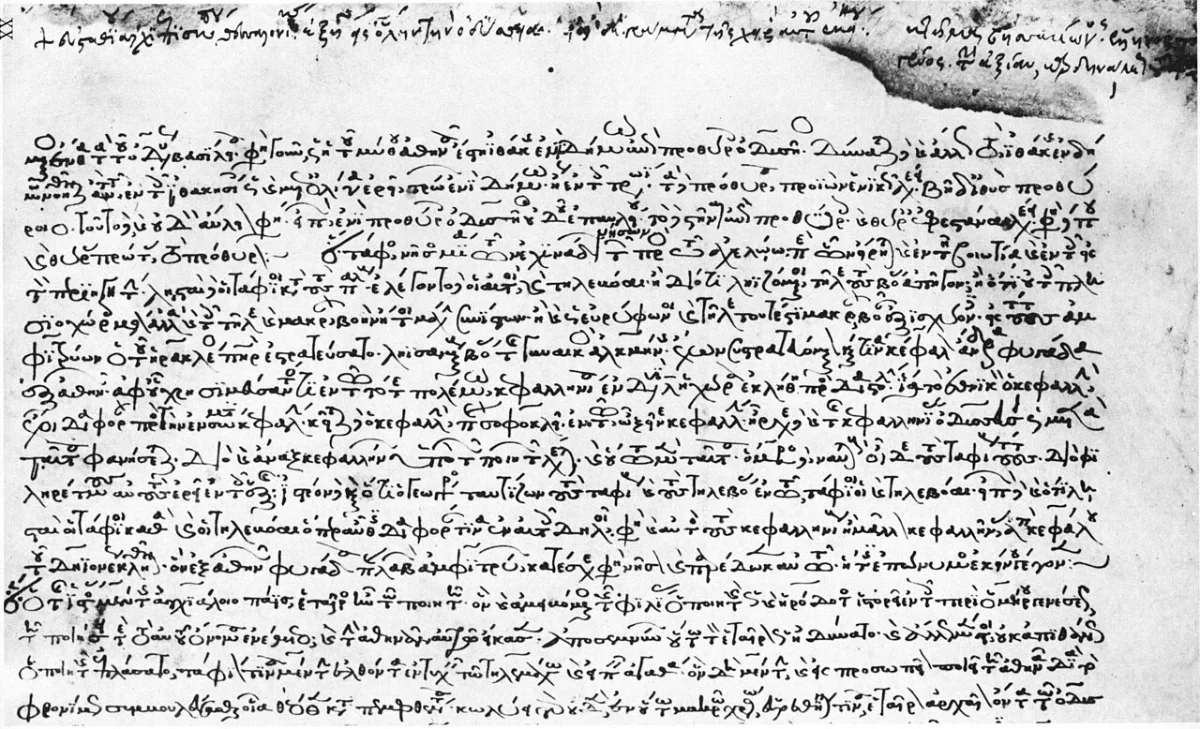
Synecphonesis. Adjacent vowels may be run together as one syllable. This is called synecphonesis. The names synizesis, synaloepha and crasis are used for the same thing, crasis especially when the merger is written.[8] Teaching books often keep synizesis for a merger inside a word and synecphonesis for one across word-end (so the Cambridge lecture handout, a teaching source). West does not distinguish them.
Hephaestion defines it like this: συνεκφώνησίς ἐστιν, ὁπόταν δύο συλλαβαὶ σύμφωνον μὴ ἔχουσαι μεταξὺ ἀλλήλων ἀντὶ μιᾶς παραληφθῶσι, “when two syllables with no consonant between them are taken as one”.[9] It is commonest after a monosyllable (especially the article or relative, καί, ἤ, δή, μή, ὦ) or after ἐγώ, ἐπεί. Between longer words it is tolerated mainly in Sappho, Hipponax and Old Comedy:[10]
εἰλαπίνη ἠὲ γάμος (Od. 1.226) — ⏑ ⏑ — ⏑ ⏑ — a feast or a wedding? (-η ἠ- one syllable)
In Sappho’s hymn the two vowels of ὠράνω αἴθερος (ōranō aitheros), “from heaven through the air”, are run together across the word-end. The line runs on into the next, so the second line is shown too:[10]
11 πύκνα δίννεντες πτέρ’ ἀπ’ ὠράνω‿αἴθε-
12 ρος διὰ μέσσω·
beating their wings thick and fast, down from heaven through the middle air.
Sappho, fr. 1.11–12. Red: -νω αἴ- (-nō ai-), two vowels run together as one long syllable across the word-end.
synthetic ∿
When the merger is written, it is called crasis. In the fifth line of the same hymn καὶ ἀτέρωτα (kai aterōta) is written κἀτέρωτα (katerōta):
ἀλλὰ τυίδ’ ἔλθ’, αἴ ποτα κἀτέρωτα
but come here, if ever at another time
Sappho, fr. 1.5. Red: κἀ- (kā-), καί (kai) and ἀ- merged in writing, which is called crasis.
synthetic ∿
Within a word it is frequent after ε (θεός as one syllable).[10] Other examples are ἐρέω and the -εω of Πηληϊάδεω.[11]
Crasis is limited to the most closely linked pairs of words. In Attic the article and the relative pronoun merge with a following vowel, but other small words elide instead. καί merges, as in κἀναθήματα, “and the offerings”, while ἀλλά elides, as in ἀλλ᾽ ἀνδρός, “but of a man”.[12] Crasis between two full words is rare outside set phrases such as τύχἀγαθῇ, “with good luck”.[13]
Prodelision (aphaeresis). Sometimes a long final vowel swallows a following short initial vowel. This is usually the ἐ- of an augment or of ἐπι-.[10] The augment is the ἐ- that marks a past tense, as in ἐκαλεῖτο (ekaleito), “he was called”. In this line of Sophocles it disappears after the long -η of Ἰόλη (Iolē), and is replaced in writing by an apostrophe:
Ἰόλη ’καλεῖτο, τῆς ἐκεῖνος οὐδαμὰ
she was called Iole, whom he never …
Sophocles, Trachiniae 381. Red: ’κα- (’ka-), for ἐκα-: the ἐ- of the augment swallowed by the long final vowel of Ἰόλη.
synthetic ∿
The opening ⏑ ⏑ — of this line is the first-foot anapaest that tragedy allows.[14]
Prodelision grows commoner as the style grows freer. There are about 4 cases in every 1,000 lines of Aeschylus, 13 in Sophocles and 23 in Aristophanes.[15]
Hiatus. Vowels that meet at word-juncture and keep their full value are said to be in hiatus. Epic and elegy allow hiatus, above all at certain points of the line, though many cases involve a lost initial ϝ. Doric lyric virtually restricts it to such cases. Ionic lyric and iambus restrict it to the pronoun ἕ, οἱ, ἑό and to the place after ἤ. Lesbian lyric avoids it altogether. Tragedy admits it only around exclamations, urgent imperatives and a few set phrases.[16] In this line of Homer, μοι (moi) stands in hiatus before ἔριδος (eridos) and keeps its length in the princeps, while καί (kai) before ἀρωγῆς is correpted:[17]
ἄστεος ἐξελάσειε· τί μοι ἔριδος καὶ ἀρωγῆς;
… drive them out of the city; what have I to do with strife and help?
Homer, Iliad 21.360. Red: μοι (moi) in hiatus before ἔριδος, kept long in the princeps; καί (kai) correpted. Dashed bar: the caesura.
David Chamberlain, Il. 21.360 · CC BY 3.0
Tragedy also avoids hiatus from one line to the next when the sentence runs on. In Euripides’ Medea about 3 pairs of lines in 100 have hiatus across the line-end in the middle of a phrase, against 17 in 100 where a new phrase begins. Comedy is much freer.[18]
Notes
- ^ West 1987, p. 13.
- ^ West 1987, pp. 13–14.
- ^ Devine and Stephens 1994, p. 261.
- ^ Devine and Stephens 1994, p. 260.
- ^ Devine and Stephens 1994, pp. 265, 360.
- ^ a b West 1987, p. 14.
- ^ Hephaestion, Ench. 1.4.
- ^ West 1987, pp. 14–15, 86.
- ^ Hephaestion, Ench. 2.1.
- ^ a b c d West 1987, p. 15.
- ^ Battezzato 2009, p. 139 n. 14.
- ^ Devine and Stephens 1994, p. 268.
- ^ Devine and Stephens 1994, p. 269.
- ^ West 1987, p. 26.
- ^ Devine and Stephens 1994, p. 270.
- ^ West 1987, pp. 15–16.
- ^ West 1987, p. 22.
- ^ Devine and Stephens 1994, p. 426.
Introduction · 6 of 14
Prosody: the treatment of consonants
How consonants decide the length of a syllable, beyond the basic rule that a closed syllable is long.[1]
Two kinds of consonant. The rules below depend on two kinds of consonant. A stop (also called a mute or plosive) is made by closing the mouth for a moment, so that the breath is checked: κ γ χ, τ δ θ, π β φ. A continuant is made with the mouth only partly closed, or through the nose, so that the breath keeps flowing. The continuants are the liquids λ ρ, the nasals μ ν, the fricative σ, and the semivowel ϝ. Because the breath keeps flowing, a continuant can be prolonged more readily than a stop.[2]
Position across word-end. A word-final consonant before a word-initial consonant closes its syllable and makes it long, as ὃς before μάλα in Odyssey 1.1. Before a vowel it joins the next syllable.[3]
Mute and liquid (muta cum liquida). A stop followed by a liquid or nasal is often taken as beginning the next syllable. A preceding short vowel is then left in an open, short syllable. So τέκνα (tekna), “children”, may be tek-na (— ⏑) or te-kna (⏑ ⏑).[4] Voiced stops and nasals resist this more.
τέκνα
τέκνα
children
The two possible divisions of τέκνα (tekna) in tragedy. Red: the first syllable, long in the first division and short in the second.
synthetic ∿
Early poetry admits the short scansion only at the beginning of a word (δειλοῖσι βροτοῖσι — — ⏑ ⏑ — ⏑) or in otherwise intractable words (Ἀφροδίτη ⏑ ⏑ — —). The iambi of Archilochus and Semonides and normal Lesbian lyric avoid even that. In Stesichorus it is the rule. Theognis, Solon and Pindar are freer. In Attic speech short syllables stayed short before these groups, and this is the normal scansion in comic dialogue. It is called Attic correption. Tragedy allows the long scansion within the word.[5] Hephaestion adds that a semivowel before the liquid (ἀμνός, ἑσμός) makes the syllable fully long.[6]
Lengthening by an initial continuant. In epic an initial λ, μ, ν, ρ, σ (and originally ϝ) could be held. It then closed the preceding syllable. This happens nearly always in the princeps. With ρ the effect stays common in iambus and lyric, and it is almost invariable in Attic dialogue. With the other consonants only isolated examples occur, in elegy and lyric:[7]
ἄνδρας δὲ λίσσεσθαι ἐπιπροέηκεν ἀρίστους
and sent the best men to entreat him
Homer, Iliad 9.520. Red: δὲ (de), a short vowel, made long before the λ- (l-) of λίσσεσθαι, in the princeps of the second foot.
David Chamberlain, Il. 9.520 · CC BY 4.0
Digamma. Many Homeric words once began with ϝ (w) and, especially in formulae, are scanned as if it were still there. Hiatus before them is not hiatus, and a preceding syllable may be lengthened. Among them are ἄναξ, ἄστυ, ἔπος, ἔργον, ἰδεῖν and οἶδα, ἴσος, and the pronoun ἕ, οἱ. In the pronoun the ϝ is almost always effective.[8]
Ἀτρεΐδης τε ἄναξ ἀνδρῶν καὶ δῖος Ἀχιλλεύς
the son of Atreus, lord of men, and godlike Achilles
Homer, Iliad 1.7. Red: τε (te) before ἄναξ (anax), once ϝάναξ (wanax): the hiatus is only apparent.
David Chamberlain, Iliad 1.7 · CC BY 4.0
Lengthening by a final continuant. In epic, elegy, Pindar and Bacchylides a final ν, ρ or ς is occasionally treated as closing its syllable although a vowel follows. In Attic drama this happens only with the abrupt interjection εἶεν, which in isolation is two long syllables.[9]
εἶεν, ἀκούω· ποδαπὸς ὁ ξένος; πόθεν;
Very well, I hear you; where is the stranger from, and whence?
Aeschylus, Choephori 657. Red: -εν (-en) of εἶεν, long before a vowel; ὁ (ho), long before ξ (x), which counts as two consonants.
synthetic ∿
Three regional practices. The rules of this tab and the last, side by side:
| Lesbian (Sappho, Alcaeus) | Dorian choral lyric | Attic drama | |
|---|---|---|---|
| Vowels meeting | hiatus avoided altogether; elision or synecphonesis is the rule; correption alien (one proverbial exception, Alc. 366) | hiatus virtually confined to ϝ-words; Pindar admits correption inside words | hiatus only at exclamations and set phrases; correption of αι, οι within words frequent |
| Stop + liquid | makes position in normal Lesbian verse; a short syllable before it is one of the epic licences of Sappho’s hexameters and of fr. 44 | short scansion the rule in Stesichorus; Pindar freer than epic | short (Attic correption) in comedy; tragedy allows either, long within the word |
| Initial ρ | — | — | lengthens a preceding short almost invariably in dialogue |
| Other | no resolution or contraction in normal Lesbian verse, so every line has a fixed number of syllables | one elision across period-end, ϝε at Alcman 1.40 | Porson’s Law: in tragedy a long third anceps must share a word with the next syllable, unless one of them is a monosyllable; ignored in comedy, which breaks it about once in five lines (Maas) |
Maas states the rule more generally. For him it is a ban on word-end after a long anceps. Tragedy and the early iambographers keep this ban, and comic dialogue breaks it on average about once in five lines.[10]
Notes
Introduction · 7 of 14
Feet, metra, cola, periods
Greek verse is built in layers. From the smallest unit up:
| Unit | Definition | Where |
|---|---|---|
| position | a slot in the abstract scheme, long, short or anceps, which takes a syllable of the right length | West 1987, p. 5 |
| foot | the ancient unit, built from syllables (Hephaestion: ἐκ τῶν συλλαβῶν εἰσιν οἱ πόδες, “feet are made from syllables”); in some rhythms identical with the metron, in iambic, trochaic and anapaestic verse half of one | Hephaestion, Ench. 3.1; West 1987, p. 5 |
| metron | the recurring unit of three to six syllables into which regular rhythms divide: iambic × — ⏑ —, trochaic — ⏑ — ×; a period is a dimeter, trimeter, tetrameter by its count | West 1987, p. 5 |
| colon | one metrical phrase, of twelve syllables at most or thereabouts; Greek poets drew on a shared repertoire of cola, recognisable wherever they recur | West 1987, p. 4; D’Angour 2022, p. 133 (usually five to eight syllables) |
| period (verse) | the stretch within which there is prosodic continuity, synapheia; it ends with a metrical break and cannot end mid-word; marked ‖ | West 1987, pp. 3–4 |
| strophe | one or more periods forming a unit that comes back in the same shape, normally matching a unit of the music; a single recurrence is the antistrophe; the agreement between them is responsion; marked ||| | West 1987, p. 4; Battezzato 2009, p. 132 |
| triad | strophe, antistrophe and a third stanza of different form, the epode, repeated as a set (Stesichorus, Ibycus and the later choral poets) | West 1987, pp. 36, 42; Battezzato 2009, pp. 132–133 |
One line, layer by layer. The first line of Sophocles’ Oedipus Tyrannus is an iambic trimeter. It has twelve positions. They make six feet of two positions each, or three metra of four, × — ⏑ —.[1] A regular word-end after the fifth position, the caesura, divides it into two cola.[2] The whole line is one period, which ends at ‖:
ὦ τέκνα, Κάδμου τοῦ πάλαι νέα τροφή,
My children, newest brood of Cadmus of old,
Sophocles, Oedipus Tyrannus 1, an iambic trimeter, taken apart layer by layer: twelve positions, six feet, three iambic metra (× — ⏑ —), two cola divided by the caesura after Κάδμου, one period.
synthetic ∿
Why “period” rather than “line”. A verse is defined by synapheia, not by the page. Sometimes the continuity runs over several written lines, as in the last two lines of a Sapphic stanza. There the neutral term period is preferred.[3] In the same way, a verse can be defined as a sequence between two metrical pauses. It is then different from the line written on the page. The division of a poem into lines is called colometry.[4]
Within a period the scansion of a word may be changed by the word after it. At period-end it cannot, and the last position is free.[5] Hephaestion says that every metre ends in a complete word, and that its last syllable is indifferent.[6] Some lines have halves that behave like separate periods. The ancients called such lines ἀσυνάρτητα, “disconnected”. They did not see that this is ordinary period-end.[7]
The first stanza of Sappho’s hymn to Aphrodite shows the difference between a line and a period. It is written in four lines, but it has only three periods:
1 Ποικιλόθρον’ ἀθανάτ’ Ἀφρόδιτα,
2 παῖ Δίος δολόπλοκε, λίσσομαί σε,
3 μή μ’ ἄσαισι μηδ’ ὀνίαισι δάμνα,
4 πότνια, θῦμον,
Periods: line 1 ‖ line 2 ‖ lines 3 and 4 together |||. Lines 1 and 2 end in a free last position (×); line 3 does not, because it runs straight on into line 4.
Immortal Aphrodite of the ornate throne, child of Zeus, weaver of wiles, I beg you: do not with pains and griefs crush my heart, lady.
Sappho, fr. 1.1–4, the first stanza of the hymn to Aphrodite.
synthetic ∿
Lines 1 and 2 are periods. Line 3 runs into line 4, so the stanza is three periods, not four.[8]
Caesura and diaeresis. A caesura is a place where word-end regularly falls inside a period. In the hexameter it normally falls at one of two places in the third foot. One is after the third princeps, — | ⏑ ⏑, and is called “masculine”. The other is after the following short, — ⏑ | ⏑, and is called “feminine”. The feminine caesura is commoner, by about 4:3. Occasionally a long word runs through the third foot to a caesura after the fourth princeps. The caesurae after the third and fourth principes are called penthemimeral and hephthemimeral.[9] The iambic trimeter has the same two options. Its caesura comes after the first position of the third foot or, failing that, of the fourth:[2]
1 ὦ τέκνα, Κάδμου τοῦ πάλαι νέα τροφή,
2 τίνας ποθ’ ἕδρας τάσδε μοι θοάζετε
3 ἱκτηρίοις κλάδοισιν ἐξεστεμμένοι;
Children, young brood of ancient Cadmus, why do you sit before me at these seats, crowned with suppliant branches?
Sophocles, Oedipus Tyrannus 1–3. Dashed bars: the caesura, after the fifth position in lines 1 and 2 (penthemimeral) and after the seventh in line 3 (hephthemimeral). Red: -τε (-te), a brevis in longo.
synthetic ∿
Line 1 has the penthemimeral caesura, and line 3 the hephthemimeral. Line 2 ends in a brevis in longo.[2]
Diaeresis is a common name for word-end that coincides with the end of a metron or colon.[10] Usage differs. West calls the fixed break between the pentameter’s two hemiepes a caesura.[11] Battezzato keeps “caesura” for word-end inside a metron and “diaeresis” for word-end between metra.[12]
The regular caesura shows that the hexameter is made of two cola. These cola, more than any six feet, are what it is built from, and many epic formulae fill one or the other.[9] The two commonest types of hexameter can likewise be built from two cola joined at the caesura: a hemiepes with a paroemiac, or a feminine hemiepes with an enoplion.[13] Cola may be set off by caesura and syntax. Or they may run together seamlessly, which is called synartesis.[14]
Bridges. A bridge (zeugma) is the opposite of a caesura. It is a point where poets avoid ending a word.[15]
Hermann’s Bridge is a bridge in the hexameter. Word-end between the two shorts of the fourth biceps is avoided. It is breached about once in 550 lines of Homer.[16] Maas places the same bridge after the “fourth trochee” and gives a different rate: a word ends there only about once in 390 lines.[17] Each figure is given here as its author states it.
Porson’s Law applies in early iambus and tragedy. The rhythm — — | — ⏑ — ‖ is avoided at line-end. That is, a long syllable in the third anceps of the trimeter must share a word with the syllable after it, unless either of the two is a monosyllable. Comedy ignores the law.[18] Havet’s Law is the corresponding rule for the opening of the trochaic tetrameter.[19]
Maas treats both as one general rule for verse containing the sequence × — ⏑ — ×. In such verse, apart from the central caesura, a word may not end after an anceps that is filled by a long syllable. In the trochaic tetrameter of the early iambographers and of tragedy he finds no exception. In their trimeter he finds only one, a Persian proper name at Aeschylus, Persians 321. The dialogue of comedy, by contrast, breaks the rule on average about once in five lines. This is one of the chief marks that set comic dialogue apart from tragic.[20] Prepositives count with the following word, and postpositives with the preceding one.[21]
Phrasing. Syntax need not match metre, but poets avoid serious clashes. As they approach a caesura or period-end, they let the sentence run to it or a little past it, rather than start a new one just before it. Prepositives are not placed immediately before the boundary, and postpositives are not placed immediately after it.[22] Tragedians occasionally break this at line-end. Sophocles and the comedians even elide across the line-break.[23]
The stricter the style, the more often sentence-end and line-end coincide. In Aeschylus and Sophocles about 34 full stops in 100 fall inside a line rather than at its end. In Euripides’ later plays the figure rises to about 40, and in his satyr play Cyclops it is 39.[24] The critic Dionysius of Halicarnassus already observed that phrasing which cuts across the verse makes the metre harder to hear.[25]
A postpositive is a small word that cannot begin a sentence. It leans on what comes before it. The particles ἄρα, αὖ, γάρ, μέν, δέ, δή, νυν, οὖν, τε, τοι and τοίνυν are postpositives. They usually stand after the first or second word of their sentence.[26] Greek can also split a phrase that belongs together and put another word, usually the verb, inside it, as in καινὸν ἀγγέλλεις ἔπος, “new is the word you bring” (Troades 55). This is called hyperbaton. It is common in verse but not confined to it, and the word put first is usually the one with the emphasis.[27]
How period-end is detected. In choral lyric, where the text is not laid out in obvious lines, period-end must be inferred from these signs:[28]
| Sign | What it shows |
|---|---|
| hiatus | vowels meeting across the break keep their value, because there is no synapheia |
| brevis in longo | a short syllable stands where the rhythm wants a long; the pause makes up the time |
| anceps iuxta anceps, anceps iuxta breve | if one colon ends in an anceps and the next begins with an anceps or a short, there must be a break between them |
| catalexis | the shortened last metron emphasises the pause at period-end: a pointer, not a proof |
| word-end | a period cannot end in the middle of a word, so a run-over word excludes period-end |
Period-end established at a point in one strophe holds at the corresponding place in all the others. In the same way, evidence from the others holds for it. Metre can also exclude period-end. An acatalectic dactylic tetrameter cannot be followed by period-end, since its last foot would then be — ⏑ × and not — ⏑ ⏑.[29] In tragedy no strophe occurs more than twice. There these signs show period-end only here and there, and corruption may leave the scheme uncertain.[30]
Brevis in longo suggests that a short syllable before a pause was drawn out in delivery. Speakers of many languages lengthen the last syllable before a pause. Some of the musical papyri mark the last syllable of a line with a sign for extra length.[31]
Notes
- ^ West 1987, p. 5.
- ^ a b c West 1987, p. 25.
- ^ West 1987, p. 3; D’Angour 2022, p. 136.
- ^ Battezzato 2009, pp. 131–132.
- ^ West 1987, pp. 3–4.
- ^ Hephaestion, Ench. 4.5–6.
- ^ West 1987, p. 32.
- ^ West 1987, p. 34.
- ^ a b West 1987, p. 19.
- ^ West 1987, p. 86.
- ^ West 1987, p. 24.
- ^ Battezzato 2009, p. 132.
- ^ Battezzato 2009, p. 138.
- ^ West 1987, pp. 4, 90.
- ^ West 1987, pp. 21, 90; Battezzato 2009, p. 132.
- ^ West 1987, p. 21.
- ^ Maas 1962, p. 60.
- ^ West 1987, p. 25; Battezzato 2009, p. 137.
- ^ West 1987, p. 28.
- ^ Maas 1962, pp. 34–35.
- ^ West 1987, pp. 9, 20–21.
- ^ West 1987, pp. 8–9.
- ^ West 1987, p. 27.
- ^ Devine and Stephens 1994, pp. 424–425.
- ^ Devine and Stephens 1994, p. 425.
- ^ Clyde 1857, p. 171.
- ^ Clyde 1857, p. 171; Devine and Stephens 1994, pp. 483–484.
- ^ West 1987, pp. 4–5, 36–37.
- ^ West 1987, pp. 36–37.
- ^ West 1987, pp. 51–52.
- ^ Devine and Stephens 1994, pp. 426–427.
Introduction · 8 of 14
Stanzas and responsion
Stichic. A stichic metre uses one verse-pattern over and over, line by line, without grouping lines into stanzas. Most Greek poetry is of this kind, above all the hexameter and the iambic trimeter.[1] The Iliad, for example, is hexameter after hexameter from beginning to end; the spoken scenes of a tragedy are trimeter after trimeter. Such use is also described as κατὰ στίχον (kata stichon), “line by line”.[2] The elegiac couplet is strictly strophic, but it behaves like a stichic metre.[3] The recited parts of drama are stichic, and the sung parts are normally strophic.[4]
Strophic. A strophic poem is built from stanzas. A strophe is a stanza of one or more periods which recurs in the same form. Its single recurrence is called the antistrophe. The metrical agreement between the two is called responsion.[5]
Responsion means that each position of the strophe is matched by a syllable of the same kind at the same place in the antistrophe. Here are the first lines of the strophe and antistrophe of the chorus’s song to Eros in Sophocles’ Antigone. The words are quite different, but the pattern of longs and shorts is the same, position by position:
781 Ἔρως ἀνίκατε μάχαν,
791 σὺ καὶ δικαίων ἀδίκους
781: “Eros, unconquered in battle”; 791: “You wrench aside the minds even of the just …”
Sophocles, Antigone 781 (strophe) and 791 (antistrophe). Each position of the strophe is answered by a syllable of the same length in the antistrophe.
synthetic ∿
The simplest strophes are the Ionian “epodes” of Archilochus and Hipponax. They have two or three periods. The first is usually a hexameter or trimeter, and the rest are shorter cola. In antiquity the shorter line was called the ἐπῳδός (epōidos).[6] The Lesbians composed nearly everything in strophes of two, three or four verses.[7] In the longer strophes one verse differs. This gives an aaA shape, in which the last verse amplifies the others, as in Sappho fr. 94.6–8:[8]
τὰν δ’ ἔγω τάδ’ ἀμειβόμαν· ‖χαίροισ’ ἔρχεο κἄμεθεν ‖μέμναισ’· οἶσθα γὰρ ὤς σε πεδήπομεν. |||— ⏑ — ⏑ ⏑ — ⏑ — ‖ · — — — ⏑ ⏑ — ⏑ — ‖ · — — — ⏑ ⏑ — ⏑ ⏑ — ⏑ — ||| (gl ‖ gl ‖ glᵈ |||)And I answered her thus: go, and fare well, and remember me; for you know how we cherished you.
synthetic ∿
The Sapphic and Alcaic stanzas have the same shape (D’Angour’s AAAB and AABC). Each served many poems and presumably went with a particular tune. Antiquity wrote their third period over two lines, which is why our editions print four.[9] Occasionally a whole strophe is one compound period. An example is Sappho fr. 96.12–14, ∧ia gl / gl / gl ia∧ |||, whose words run over the line-ends (scanned in Metres › Lyric stanzas and epodes, “Lesbian stanzas”).[10]
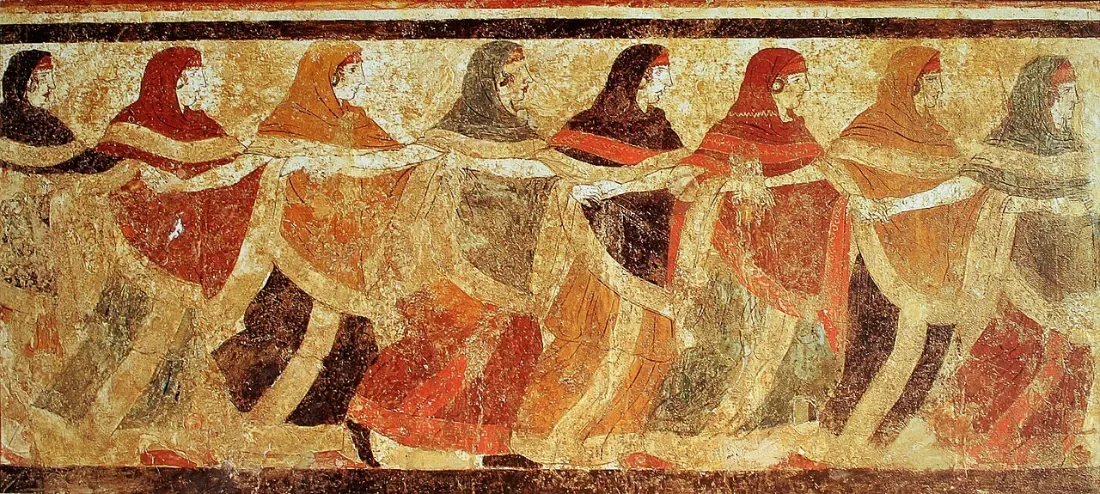
Dorian strophes and the triad. Each Dorian strophe, so far as we know, was a new creation for its song. It was built from familiar cola but was open to innovation.[11] The same holds for the strophes of the choral poets and of Pindar’s odes.[12]
Stesichorus and Ibycus used the triad. A triad is a strophe and antistrophe followed by a third stanza of different form. This third stanza is called the epode (ἡ ἐπῳδός, hē epōidos, sc. στροφή, strophē). The sequence was repeated as often as the poet wished.[11] Simonides, Bacchylides and Pindar mostly used it.[13] A poem may be one triad. Pindar goes up to five, except for the thirteen of Pythian 4, and Bacchylides to at least eight.[14]
Responsion as evidence. What is established at one point in a strophe holds at the corresponding point in all. West analyses the opening of the monostrophic Pythian 12 as — D — D ‖ D ⁝ — D |.[15] Strophe 2 answers strophe 1 exactly:
αἰτέω σε, φιλάγλαε, καλλίστα βροτεᾶν πολίων, ‖ (1)Φερσεφόνας ἕδος, ἅ τ’ ὄχθαις ἔπι μηλοβότου (2)τὸν παρθενίοις ὑπό τ’ ἀπλάτοις ὀφίων κεφαλαῖς ‖ (9)ἄϊε λειβόμενον δυσπενθέϊ σὺν καμάτῳ, (10)— — ⏑ ⏑ — ⏑ ⏑ — — — ⏑ ⏑ — ⏑ ⏑ — ‖ · — ⏑ ⏑ — ⏑ ⏑ — ⁝ — — ⏑ ⏑ — ⏑ ⏑ — |I beg you, lover of splendour, fairest of mortal cities, seat of Persephone, who on the banks of sheep-grazing [Acragas] ... (the dirge) which she heard pouring, with grievous toil, from the maidens’ dread snake-heads.
synthetic ∿
(αἰτέω is two syllables by synecphonesis, as West marks it.) There may be period-end after μηλοβότου, but nothing in any of the four strophes proves it.[15] Conversely, a single hiatus or brevis in longo settles the matter for every strophe. In Alcman’s Partheneion a brevis in longo in line 36 and hiatus in lines 38, 39 and 45 establish period-end at those places in all the strophes.[16]
Responsion allows for anceps and final positions, and for resolution and contraction. Some sequences respond to a cognate rather than an identical form.[2] Beyond that, responsion is usually exact, but not always. Alcman’s Partheneion ends some strophes ⏑ ⏑ — where the others end ⏑ — —, which is “without parallel”. Bacchylides 5 three times lets × — ⏑ — answer — ⏑ —. In Pindar’s dactylo-epitrite a resolution is more often a licence taken in one strophe than a feature recurring in all. In Bacchylides 17 there are eight places where syncopated iambics answer unsyncopated ones, and they prove the two equal in time.[17] Anaclastic aeolic cola may respond with the standard form.[18]
Drama. Sung parts run AA BB CC... . Sometimes there is a single closing epode. Occasionally a non-responding strophe stands before the pairs (proode) or among them (mesode).[19] A strophe divided between singers is almost always divided at the same points in the antistrophe. In the comic parabasis, strophe and antistrophe are each followed by sixteen or twenty trochaic tetrameters. This arrangement is called the epirrhematic syzygy.[20]
No tragic strophe recurs more than twice. So responsion helps the editor less, and corruption may leave no way of telling which of the pair keeps the true scheme.[21] Late Euripides and Timotheus gave up responsion for metrically free, monostrophic song.[22] Such poems are also called astrophic. An example is Timotheus’ Persians.[23]
Two ancient terms. Hephaestion’s ἀσυνάρτητα (asynartēta) are “two cola which cannot be fitted together nor form a unity, taken in place of a single line”.[24] For West the disconnection is simply period-end. On his view these are two short verses, written on one line by ancient convention.[25] Polyschematist (πολυσχημάτιστα, polyschēmatista, Ench. 16.1) is still used of aeolic cola that respond in several forms.[26]
Notes
- ^ West 1987, p. 19.
- ^ a b Battezzato 2009, p. 132.
- ^ West 1987, pp. 23–24.
- ^ West 1987, p. 48.
- ^ West 1987, p. 4; Battezzato 2009, p. 132.
- ^ West 1987, p. 31.
- ^ Battezzato 2009, p. 135.
- ^ West 1987, p. 34.
- ^ West 1987, pp. 34–35 with n. 1; D’Angour 2022, p. 136.
- ^ West 1987, p. 35.
- ^ a b West 1987, p. 36.
- ^ Battezzato 2009, p. 132; D’Angour 2022, p. 138.
- ^ Battezzato 2009, pp. 132–133.
- ^ West 1987, p. 42.
- ^ a b West 1987, p. 43.
- ^ West 1987, pp. 36–37.
- ^ West 1987, pp. 37, 43–44, 47.
- ^ West 1987, p. 33.
- ^ West 1987, p. 50.
- ^ West 1987, pp. 50–51.
- ^ West 1987, pp. 51–52.
- ^ D’Angour 2022, p. 138.
- ^ Battezzato 2009, p. 133.
- ^ Hephaestion, Ench. 15.1.
- ^ West 1987, p. 32.
- ^ West 1987, p. 89.
Introduction · 9 of 14
Glossary of terms
Here are the terms a learner meets, in alphabetical order. Each comes with the page of West 1987 on which it is defined or explained. His own glossary-index[1] and list of symbols[2] are the model, and the sigla in brackets are his. Where Battezzato, D’Angour, the ancient metricians or a teaching book use a word differently, the entry says so.
Schemes use these signs: — long, ⏑ short, × anceps, ⏓ usually long, ⏒ usually short, ⏔ biceps, contracted biceps, ⏕ resolvable long, ⏖ resolved long, ○ ○ two positions not both short, ⌊ and ⏗ trisemes, ⏘ tetraseme, ‖ period-end, ||| strophe-end, ∧ a suppressed position (catalexis, or syncopation in iambics).
Three groups of terms call for a warning. First, the names of feet (dactyl, iamb, spondee, cretic and the rest) are ancient. West keeps them for pointing to a place in a verse, but he analyses rhythm by metra and cola.[3] D’Angour goes further. He regards units smaller than the colon as largely artificial, devised for analysis rather than used by poets or singers.[4]
Second, several terms have an ancient sense and a modern one that do not match. They are asynarteton, system, prosodiac, enoplian, logaoedic and epode.
Third, the vocabulary of positions differs by school. West’s position is Maas’s element, and West’s princeps is Maas’s longum.[5] Battezzato writes in Maas’s terms and adds an indifferent element.[6]
| Term | Definition | Authority |
|---|---|---|
| acatalectic | a verse whose last metron is not shortened. Example: the iambic trimeter × — ⏑ — × — ⏑ — × — ⏑ —, whose three metra are all complete. | West p. 5 |
| acephalous | “headless”: missing the opening syllable, so that a telesillean, for instance, is a glyconic of this kind; also said of a hexameter that begins with a short in the first princeps. Battezzato uses it of an aeolic colon whose base is cut to one syllable | West p. 85; Battezzato 2009, p. 134 |
| adonean (ad) | — ⏑ ⏑ — ×, the catalectic dodrans; closes the Sapphic stanza. D’Angour derives the name from the lament ὦ τὸν Ἄδωνιν; Natoli et al. call it the “adonic” | West pp. ix, 33; D’Angour 2022, p. 136; Natoli et al. 2022, pp. 338–339 |
| aeolic base | two free positions opening certain aeolic verses, a relic of Indo-European freedom before the cadence; in the Lesbians × ×, the first more often long, both short uncommon; later ○ ○, in Pindar with the first resolvable. Battezzato: completely free in the Lesbians | West pp. 6, 33, 44; Battezzato 2009, p. 134 |
| amoibaion | a sung exchange between actor and chorus, or a dialogue mixing song and recited lines; Battezzato prefers it as the general term to Aristotle’s kommos (“lament”), which scholars use especially for shared lamentation. Example: Agamemnon 1136–55, where Cassandra sings and the chorus answers her. | Battezzato 2005, p. 152; Easterling 1997, p. 158 n. 14 |
| anaclasis | transposition of quantities at a fixed place in the colon, ⏑ — for — ⏑ or the reverse, e.g. ⏑ ⏑ — — ⏑ ⏑ — — becoming ⏑ ⏑ — ⏑ — ⏑ — —; marked ¨ (÷ in ionics). D’Angour describes it as long and short elements changing places within a colon; Kiparsky calls it “syncopation” in the musical sense | West pp. ix–x, 8; D’Angour 2022, p. 134; Kiparsky 2018, p. 97 |
| anacreontic (2io÷) | the colon ⏑ ⏑ — ⏒ — ⏑ — —, an ionic dimeter with anaclasis; the name also covers verse written mostly in it. D’Angour: Anacreon’s own variation on the ionic dimeter | West pp. x, 33, 85; D’Angour 2022, p. 137 |
| anapaest (an) | ⏑ ⏑ —; the anapaestic metron ⏔ ⏕ ⏔ ⏕; a “split anapaest” is one in the trimeter where a word beginning before the foot ends inside it | West pp. ix, 26, 29, 85; Battezzato 2009, p. 131 |
| anceps | a position that may take a long or a short, ×; an anceps syllable, one that can be scanned either way, is a different matter and has nothing to do with anceps positions; an anceps beside another anceps or beside a short (anceps iuxta anceps, iuxta breve) proves period-end. Battezzato adds that an anceps is very rarely two shorts | West pp. 5, 12–13, 37; Battezzato 2009, p. 131; D’Angour 2022, p. 133 |
| antistrophe | the single recurrence of a strophe. Example: Agamemnon 1146–55 repeats the metre of 1136–45. | West p. 4 |
| appositives | words that cannot stand alone: prepositives (article, prepositions, καί, ἀλλά and others) go with the next word, postpositives (enclitics, ἄρα, γάρ, δέ and others) with the one before | West p. 9 with n. 2 |
| archebulean | the verse ⏔ — ⏑ ⏑ — ⏑ ⏑ — ⏑ ⏑ — ⏑ — — | West p. 85 |
| aristophanean (ar) | — ⏑ ⏑ — ⏑ — — | West pp. ix, 33 |
| arsis | properly the up-beat, whose notes ancient musical texts mark with a dot above; the opposite of thesis. D’Angour reports Lynch’s view that arsis and thesis were tied to a change of pitch from low to high | West p. 85; D’Angour 2022, p. 139 with n. 6 |
| asclepiad | a glyconic with choriambic expansion, ○ ○ — ⏑ ⏑ — ⁝ — ⏑ ⏑ — ⏑ — (glᶜ); greater asclepiad gl²ᶜ. Battezzato: “lesser” and “greater asclepiadean”, glycᶜʰᵒ and glyc²ᶜʰᵒ | West p. 85; Battezzato 2009, p. 135 |
| asynarteton | Hephaestion: two cola that cannot be joined into a unity, used as one line; West: two periods written on one line, a term he notes many books still use. Example: Archilochus fr. 191.1, a dactylic tetrameter and an ithyphallic in one line (4da ¦ ith). | Hephaestion, Ench. 15.1; West p. 32 |
| baccheus | ⏑ — —, in lyric iambics the syncopated metron ia∧; Hephaestion’s five-time foot βακχεῖος (bakcheios). Battezzato (siglum ba) calls it the catalectic form of the iamb | West p. 52; Hephaestion, Ench. 3.2; Battezzato 2009, p. 134 |
| biceps | two short positions before a princeps, which may be contracted to one long, treated as a unit, ⏔ | West p. 6; Battezzato 2009, p. 131 |
| biceps/anceps | a position that takes either two shorts or a single syllable of either length, in Stesichorus and Bacchylides; West’s sign or | West pp. 37, 46 |
| blunt | an ending … ⏑ —; contrasted with pendant | West pp. 6, 38 |
| brevis in longo | a short syllable at period-end where the rhythm calls for a long; the pause supplies the time that is lacking. Example: Pindar, Pythian 12.3 ends ὦ ἄνα (ō ana), its last syllable -να short in a long position. | West p. 4 |
| bridge (zeugma) | a point where poets avoid ending a word, the opposite of a caesura, marked ⁀; Hermann’s Bridge, Porson’s Law, Havet’s Law. Example: in the hexameter — ⏔ / — ⏔ / — ⏔ / — ⏑⁀⏑ / — ⏑ ⏑ / — ×, no word ends between the two shorts of the fourth foot (Hermann’s Bridge). | West pp. ix, 21, 25, 28, 90; Battezzato 2009, p. 132 |
| bucolic caesura | word-end at the end of the hexameter’s fourth foot after an uncontracted biceps, where word-end is frequent. Example: Theocritus 1.1 Ἁδύ τι τὸ ψιθύρισμα καὶ ἁ πίτυς / αἰπόλε τήνα (Hady ti to psithyrisma kai ha pitys / aipole tēna). | West p. 21 |
| caesura | regular word-end inside a period; in the hexameter’s third foot masculine — | ⏑ ⏑ or feminine — ⏑ | ⏑ (about 4:3); penthemimeral and hephthemimeral, after the third and fourth princeps. Battezzato keeps the word for word-end inside a metron. Example: Iliad 1.1 μῆνιν ἄειδε θεὰ / Πηληϊάδεω Ἀχιλῆος (mēnin aeide theā / Pēlēïadeō Achilēos), a penthemimeral caesura after θεά. | West pp. 4, 19, 87–88; Battezzato 2009, p. 132 |
| catalexis | a last metron one or two syllables short of the full form, which marks the close of the period; Battezzato and D’Angour describe it as the loss of the final syllable; Hephaestion has catalectic, brachycatalectic and hypercatalectic closes (ἀποθέσεις, apotheseis). Example: the lekythion — ⏑ — × — ⏑ — is a trochaic dimeter with its last position cut off (2tr∧). | West p. 5; Battezzato 2009, p. 134; D’Angour 2022, pp. 134–135; Hephaestion, Ench. 4.1–4 |
| choliambic (scazon) | the “lame” or “limping” trimeter or trochaic tetrameter of Hipponax and Ananius, with the short penultimate position replaced by a long; “ischiorrhogic” (“broken-hipped”) when the fourth syllable from the end is long too. Example: Hipponax fr. 120 ends … τὸν ὀφθαλμόν (ton ophthalmon), with -θαλ- long in the next-to-last position. | West p. 30; Battezzato 2009, p. 137 |
| choriamb (ch) | — ⏑ ⏑ —; choriambic expansion repeats it inside an aeolic colon (glᶜ); the anaclastic glyconic ○ ○ — × — ⏑ ⏑ — commonly goes by the name “choriambic dimeter” | West pp. ix, 34, 86; D’Angour 2022, p. 137 |
| colarion | a small colon, such as the penthemimer | West pp. 86, 88 |
| colon | one metrical phrase of up to about twelve syllables, identified by its recurrence in other places; D’Angour: usually five to eight syllables. Example: the adonean — ⏑ ⏑ — × that closes each Sapphic stanza, as in Sappho 1.4 πότνια, θῦμον (potnia, thȳmon). | West p. 4; D’Angour 2022, p. 133 |
| contraction | one long syllable occupying two short positions before a princeps; absent from the Lesbians’ normal Aeolic metres (Sappho’s epic-style hexameters, fr. 105, admit it). Some teaching books call the dactyl’s two shorts becoming one long “resolution” (so Natoli et al.); West and Battezzato call that contraction. Example: in Iliad 1.7 … ἄναξ ἀνδρῶν (anax andrōn) the one long syllable ἀν- fills a biceps. | West pp. 2, 6, 32, 35; Battezzato 2009, p. 131; Natoli et al. 2022, p. 337 |
| correption | shortening of a final long vowel or diphthong before an initial vowel, in epic, elegy and some lyric (“epic correption”); “Attic correption” is the short scansion before stop + liquid | West pp. 14, 17; D’Angour 2022, p. 134 |
| crasis | vowels merged into one, the name used above all when the writing shows the merger, as κἀτέρωτα for καὶ ἀτέρωτα; one name for synecphonesis | West pp. 15, 86 |
| cratinean | the verse — ⏑ ⏑ — ⏒ — ⏑ — | ○ ○ — × — ⏑ — ‖, ¨gl | gl¨∧ | West p. 86 |
| cretic (cr) | the metron — ⏑ —, resolvable into the paeonic forms; distinct from the “spurious” cretic ⌊ ⏑ — (∧ia) of syncopated iambics | West pp. ix, 39, 52, 55; Battezzato 2009, p. 131 |
| cyclic foot | the ancient rhythmicians’ ⏑ ⏑ — of unrationalised rhythm, in which the long was shorter than the two shorts | West p. 38 |
| dactyl (da) | — ⏑ ⏑, named from δάκτυλος (daktylos), “finger”; verse is called dactylic if it divides into such metra or if cola of the form (×) — ⏑ ⏑ — ⏑ ⏑ — (×) are prominent in it; dactylic expansion repeats — ⏑ ⏑ inside an aeolic colon (gl²ᵈ) | West pp. ix, 34, 86; D’Angour 2022, p. 132 |
| dactylo-epitrite (D/e) | the metre built from d — ⏑ ⏑ —, D — ⏑ ⏑ — ⏑ ⏑ —, e — ⏑ —, E — ⏑ — × — ⏑ — and a usually long link-syllable. Battezzato: a nineteenth-century name, from ἐπίτριτος (epitritos) “four thirds”; the sigla are Maas’s | West p. 43; Battezzato 2009, p. 141 |
| diaeresis | word-end falling at the end of a metron or colon; Battezzato: word-end between two metra. Example: the fixed word-end in the middle of the elegiac pentameter, — ⏔ — ⏔ — / — ⏑ ⏑ — ⏑ ⏑ —, where the first hemiepes ends. | West p. 86; Battezzato 2009, p. 132 |
| dimeter, trimeter, tetrameter | a period of two, three or four metra | West p. 5; D’Angour 2022, p. 135 |
| dochmiac (δ) | ⏒ — — ⏒ —, basic rhythm ⏑ — — ⏑ —, any long resolvable and either short “dragged”; typical of tragedy, always urgent or emotional. D’Angour: from δόχμιος (dochmios), “askew”. Battezzato writes × — — ⏑ — | West pp. ix, 56; D’Angour 2022, p. 134; Battezzato 2009, p. 142 |
| dochmius kaibelianus (kδ) | × — ⏒ — ⏑ —, a rare variant of the dochmius | West pp. x, 46, 56 |
| dodrans (dod) | — ⏑ ⏑ — ⏑ —; the reversed dodrans (dod¨) is ○ ○ — ⏑ ⏑ —. Dale names the two dodrans A and dodrans B | West pp. ix, 33, 86 |
| dovetailing | joining two cola by a word that runs one syllable past the boundary, so that word-end comes one position late, marked ∫ | West pp. ix, 42, 86 |
| drag | a long syllable allowed in a position that is normally short, as in dochmiacs | West pp. 56, 86 |
| elegiambus (encomiologicum) | the sequence — ⏑ ⏑ — ⏑ ⏑ — × — ⏑ — ×, D × e × | West p. 86 |
| element | Maas’s term for what West calls a position; Battezzato uses it, with five kinds: long, short, anceps, biceps, indifferent | West p. 86; Battezzato 2009, p. 131 |
| elision | loss of a short final vowel before an initial vowel; Sophocles and comedy even elide across line-end. Example: Sappho 1.1 Ποικιλόθρον’ ἀθανάτ’ Ἀφρόδιτα (Poikilothron’ athanat’ Aphrodita), with two final vowels elided. | West pp. 13–14, 27 |
| enneasyllable (enn) | × — × — ⏑ ⏑ — ⏑ —, in effect a glyconic with one more syllable at the front | West pp. x, 87 |
| enoplian | used by ancient writers of rhythm built on the colon × — ⏑ ⏑ — ⏑ ⏑ — (×) and of cola of the form (… — ⏑ ⏑) — ⏑ ⏑ — ⏑ ⏑ — ⏑ — —; modern scholars give it no single meaning. Battezzato’s “enoplion” is × — ⏑ ⏑ — ⏑ ⏑ — ×, × D × | West p. 87; Battezzato 2009, pp. 137, 141 |
| epirrhematic syzygy | in the comic parabasis, strophe and antistrophe each followed by sixteen or twenty trochaic tetrameters. Example: the parabasis of Clouds, ode and antode at 563–74 ~ 595–606. | West p. 51 |
| epitrite | — ⏑ — —; Hephaestion has four epitrites, by the place of the short | West p. 87; Hephaestion, Ench. 3.3 |
| epode | (1) in Ionian epodic verse the shorter line after a longer one, ὁ ἐπῳδός; (2) in triadic composition the third stanza of different form, ἡ ἐπῳδός. D’Angour uses “epode” of the alternating structure itself | West pp. 31, 36; Battezzato 2009, p. 137; D’Angour 2022, p. 135 |
| eupolidean | the comic verse of Clouds 518–62 and many fragments: two anaclastic glyconics, the second catalectic, gl¨ ⁝ gl¨∧ ‖; the first position of each colon is usually long, and when it is resolved the second is always short | West p. 50 |
| falling, rising | a sequence beginning — ⏑ is falling; one beginning × — ⏑ or ⏑ ⏑ — is rising (not ⏑ — ×) | West p. 6 |
| foot | the ancient unit, built from syllables: Hephaestion counts four feet of two syllables, eight of three and sixteen of four, each with its number of time-units (χρόνοι); in iambic, trochaic and anapaestic verse two feet make a metron; West keeps foot-names for pointing to a place in the line, “the fifth foot”. Example: μῆνιν ἄ- (mēnin a-), — ⏑ ⏑, the first foot of the Iliad, a dactyl. | West p. 5; Hephaestion, Ench. 3.1–3 |
| glyconic (gl) | ○ ○ — ⏑ ⏑ — ⏑ — (in the Lesbians × ×), the central aeolic colon; anaclastic forms ¨gl and gl¨. The Alexandrians took ⏑ — — ⏑ ⏑ — ⏑ — as its basic form, hence Hephaestion’s filing of it under the antispastic metre | West pp. x, 33; Battezzato 2009, p. 134; Kiparsky 2018, p. 98; Hephaestion, Ench. 10.2 |
| hagesichorean (hag) | × — ⏑ ⏑ — ⏑ — —, one syllable longer than the telesillean | West pp. x, 33 |
| hemiepes (D) | — ⏑ ⏑ — ⏑ ⏑ —, each half of the pentameter; Battezzato glosses the name “half a hexameter” and writes the shorts as contractible, — ⏔ — ⏔ — | West pp. 24, 87; Battezzato 2009, p. 137 |
| hendecasyllable | an eleven-syllable line; Hephaestion’s “Sapphic hendecasyllable” is the first line of the Sapphic stanza, analysed by him as trochaic pair + choriamb + iambic close. Example: Sappho 1.1 Ποικιλόθρον’ ἀθανάτ’ Ἀφρόδιτα (Poikilothron’ athanat’ Aphrodita), eleven syllables, — ⏑ — × — ⏑ ⏑ — ⏑ — ×. | Hephaestion, Ench. 14.1; D’Angour 2022, p. 134 |
| hexameter (hex) | six dactylic metra, the last catalectic — ×; really two cola divided at the caesura | West pp. x, 19; Battezzato 2009, p. 138 |
| hiatus | vowels that meet across a word-break and keep their full value, with no elision, merger or shortening; a sign of period-end. Example: Pindar, Pythian 12.3 ὦ ἄνα (ō ana), where ὦ keeps its full length before a vowel. | West pp. 15, 36; Battezzato 2009, p. 131 |
| Hilberg’s Law | in the strict hexameter of Callimachus and Nonnus, no word-end after a contracted second biceps (Maas’s fourth element); first hinted at by J. Hilberg (1879); the companion of Naeke’s Law. Example: Iliad 2.484, ἔσπετε νῦν μοι, Μοῦσαι (espete nyn moi, Mousai), “tell me now, Muses”: the second foot νῦν μοι is — —, and a word ends with it. | Maas 1962, p. 62 |
| hipponactean (hi) | ○ ○ — ⏑ ⏑ — ⏑ — —, one syllable longer than the glyconic. Battezzato: hipp | West pp. x, 33; Battezzato 2009, p. 134 |
| hypercatalectic | one or two syllables longer than the norm. Example: Corinna’s ionic poem PMG 654 i, five dimeters ⏑ ⏑ — — ⏑ ⏑ — — and a hypercatalectic close. | West p. 5; Battezzato 2009, p. 134; Hephaestion, Ench. 4.4 |
| hypodochmius (hδ) | — ⏑ — ⏑ —, a variant of the dochmius | West pp. x, 46, 56 |
| iamb (ia) | ⏑ —; the iambic metron is × — ⏑ —; syncopated forms ∧ia, ia∧, ∧ia∧ | West pp. x, 5, 87; Battezzato 2009, p. 131; D’Angour 2022, p. 135 |
| iambelegus | the sequence × — ⏑ — × — ⏑ ⏑ — ⏑ ⏑ —, × e × D | West p. 87 |
| ibycean | dodᵈ, — ⏑ ⏑ — ⏑ ⏑ — ⏑ —, a colon prominent in Ibycus | West p. 38 |
| ictus | rarely used in Greek metrics today; West finds it harmless if it means no more than beat or thesis, but misleading if it implies that certain positions carried a stress strong enough to lengthen a short syllable | West pp. 87–88 |
| indifferent | Battezzato’s name for the final element before pause, long or short at will, which he distinguishes in principle from anceps; Hephaestion: the last syllable of every metre is ἀδιάφορος | Battezzato 2009, p. 131 with n. 2; Hephaestion, Ench. 4.5 |
| ionic (io) | the metron ⏑ ⏑ — — (Hephaestion’s ionic ἀπ’ ἐλάττονος, “a minore”); the ionic a maiore is — — ⏑ ⏑ | West pp. x, 33, 88; D’Angour 2022, p. 137; Hephaestion, Ench. 3.3 |
| ithyphallic (ith) | — ⏑ — ⏑ — —, which functions as the catalectic lekythion; Hephaestion: a brachycatalectic trochaic dimeter | West pp. x, 31, 52; Battezzato 2009, p. 139; Hephaestion, Ench. 6.3 |
| lekythion (lk) | — ⏑ — ⏒ — ⏑ —; Hephaestion: “Euripidean or lekythion”; D’Angour derives the name from the jest ληκύθιον ἀπώλεσεν in Aristophanes’ Frogs | West pp. x, 32, 52; Battezzato 2009, p. 137; Hephaestion, Ench. 6.2; D’Angour 2022, p. 133 |
| link-syllable | the usually long syllable before, between and after the units of dactylo-epitrite | West p. 43 |
| logaoedic | a label given in the nineteenth century to verse in asymmetric rhythm, no longer in use; Hephaestion’s λογαοιδικά are dactylic cola ending in a trochaic pair | West p. 88; Hephaestion, Ench. 7.8 |
| metron | a unit of three to six syllables, repeated in verse whose rhythm is regular enough to be divided this way | West p. 5 |
| molossus | — — —; a trisyllabic unit in some wholly long hymns | West pp. 40, 88; Battezzato 2009, p. 131 |
| mora | χρόνος (πρῶτος): the smallest unit of time in ancient rhythmic theory; a short syllable takes one, a long two | West pp. 7, 88 |
| Naeke’s Law | in the refined Hellenistic hexameter, no word-end after a contracted fourth biceps (Maas’s eighth element); found by A. F. Naeke (1835). West and Maas agree on the rule. Example: Iliad 1.2, μυρί’ Ἀχαιοῖς ἄλγε’ ἔθηκε (mūri’ Achaiois alge’ ethēke), “laid countless woes on the Achaeans”: the fourth foot -χαιοῖς is — —, and the word ends with it. | West p. 78; Maas 1962, p. 62 |
| paeon | the resolved cretic — ⏑ ⏖, the metricians’ “first paeon” (rarely ⏖ ⏑ —, Hephaestion’s fourth paeon), five morae; Hephaestion’s παιωνικόν covers cretic, bacchiac and palimbacchiac | West pp. 39, 55; Hephaestion, Ench. 3.3, 13.1 |
| palimbaccheus | — — ⏑ | West p. 88; Hephaestion, Ench. 3.2 |
| paroemiac | ⏔ — ⏔ — ⏑ ⏑ — —, the catalectic anapaestic dimeter; West marks its first biceps as admitting a single short too. Hephaestion doubted the name, since proverbs come in every metre | West pp. 75, 88; Battezzato 2009, p. 137; Hephaestion, Ench. 8.6 |
| pendant | an ending … ⏑ — ×; D’Angour: the final long is felt to “hang off” the one before | West pp. 6, 38; D’Angour 2022, p. 136 |
| pentameter | the elegiac line — ⏔ — ⏔ — | — ⏑ ⏑ — ⏑ ⏑ —, two hemiepes with caesura | West p. 24; Battezzato 2009, p. 138 |
| penthemimer (pe) | the colarion × — ⏑ — × | West pp. x, 31, 88; Battezzato 2009, p. 137 |
| period | the stretch of verse over which prosodic continuity holds; it never ends inside a word; marked ‖ | West pp. 3–4; Battezzato 2009, p. 131 |
| pherecratean (ph) | ○ ○ — ⏑ ⏑ — —, the catalectic glyconic. Battezzato: pher | West pp. x, 33; Battezzato 2009, p. 134 |
| pnigos | an extended period kept in one rhythm throughout; in Aristophanes runs of iambic or trochaic metra called systems or πνίγη, “breathlessnesses” | West pp. 49, 89 |
| polyschematist | “multiform”: said above all of aeolic cola and dicola whose responding lines take different shapes, through anaclasis or the free base; Hephaestion’s πολυσχημάτιστα | West p. 89; Hephaestion, Ench. 16.1 |
| position | a slot in the abstract scheme, long, short or anceps, filled by a syllable of suitable length; Maas’s “element”. Example: the iambic metron × — ⏑ — has four positions: anceps, long, short, long. | West pp. 5, 86 |
| praxillean | the verse — ⏑ ⏑ — ⏑ ⏑ — ⏑ ⏑ — ⏑ — — (Lourenço: prax) | West p. 89; Lourenço 2011, p. 15 |
| princeps | a long position (locus princeps); Maas’s “longum”. Example: each — in the hexameter — ⏔ — ⏔ — ⏔ — ⏔ — ⏑ ⏑ — × is a princeps. | West pp. 6, 88 |
| proceleusmatic | ⏑ ⏑ ⏖, a resolved anapaest | West pp. 61, 89 |
| prodelision (aphaeresis) | a final long vowel absorbing a following short initial vowel, as in Ἰόλη ’καλεῖτο | West p. 15 |
| proode, mesode, ephymnion | in drama, a non-responding stanza before the strophic pairs (proode) or among them (mesode); an ephymnion is a refrain recurring after a lyric section | West p. 50; Battezzato 2005, p. 152 |
| prosodiac | used in antiquity of a range of dactylic and aeolic cola and dicola, some of which were also called enoplian; modern usage varies. Battezzato’s prosodiac is × — ⏑ ⏑ — ⏑ ⏑ —, × D | West p. 89; Battezzato 2009, p. 141 |
| pyrrhic | ⏑ ⏑ (πυρρίχιος) | West p. 89 |
| recitative (παρακαταλογή) | in drama, recitation with music, between speech and song; recited parts are in stichic metres or long runs of uniform rhythm such as marching anapaests. Battezzato: it is not known whether it meant a special chanted delivery | West p. 48; Battezzato 2005, p. 151 |
| reizianum (r) | × — ⏑ ⏑ — ×, the catalectic telesillean | West pp. x, 33 |
| resolution | two short syllables filling a princeps, provided it is not the final princeps of the period | West p. 6; Battezzato 2009, p. 131; D’Angour 2022, p. 133 |
| responsion | the metrical agreement between strophes, allowing for anceps, final positions, resolution and contraction; “irregular responsion” when it is inexact. Example: Agamemnon 1136–45 ~ 1146–55. | West pp. 4, 37, 44, 89; Battezzato 2009, p. 132 |
| spondee | — —; σπονδεῖος from the libation hymns composed entirely of long syllables | West pp. 39, 89; Battezzato 2009, p. 131 |
| stichic | one verse-pattern used line after line, without stanzas (Battezzato: kata stichon) | West p. 19; Battezzato 2009, p. 132 |
| strophe (stanza) | a structure of one or more periods recurring in the same form; marked |||. Example: the Sapphic stanza, three hendecasyllables and an adonean, repeated seven times in Sappho 1. | West p. 4; Battezzato 2009, p. 132 |
| synapheia | the unbroken metrical and prosodic flow inside a period. Example: Sappho 1.11–12, where the word αἴθερος (aitheros) begins in one line and ends in the next. | West p. 3; D’Angour 2022, p. 136 |
| synartesis | running one colon into the next with no caesura between them | West p. 90 |
| syncopation | in Greek metrics, a metron with a position suppressed and its time added to a neighbouring long, which becomes a triseme (⌊ ⏑ — for × — ⏑ —); different from musical syncopation, which resembles anaclasis | West pp. 7–8, 52, 90 |
| synecphonesis, synizesis | adjacent vowels run together as one syllable; also called synaloepha or crasis, the last especially when written. Battezzato uses “synizesis” for vowels coalescing within a word (ἐρέω, Πηληϊάδεω) | West pp. 14–15, 86; Battezzato 2009, p. 139 n. 14; Hephaestion, Ench. 2.1 |
| system | in ancient usage, a grouping of different cola or verses into a larger whole; today mostly a sequence of cola in a single rhythm that makes up one period | West p. 90 |
| telesillean (tl) | × — ⏑ ⏑ — ⏑ —, one syllable shorter than the glyconic at the beginning | West pp. x, 33 |
| tetraseme | a position lasting as long as two normal longs (four morae), ⏘ | West pp. ix, 75, 90 |
| thesis | the down-beat, opposite of arsis | West p. 90 |
| triad | strophe, antistrophe and epode, repeated as a set. Example: Bacchylides 5, whose lines 93–95 close a strophe and line 96 opens the antistrophe. | West pp. 36, 42; Battezzato 2009, pp. 132–133 |
| tribrach | a foot filled by three shorts: ⏑ — or — ⏑ with the long resolved | West p. 90 |
| triseme | a long of three morae, in iambic and trochaic song; ⌊ (= ⏑ —) or ⏗ (= — ⏑) | West pp. ix, 7, 90 |
| trochee (tr) | — ⏑; the trochaic metron is — ⏑ — × | West pp. x, 5, 90; D’Angour 2022, p. 135 |
| verse | a technical term defined by synapheia, not a line on the page; Battezzato likewise distinguishes “verse” from “line” | West p. 3; Battezzato 2009, p. 132 |
| Wernicke’s Law | in the hexameter, words with a long penultimate syllable and a short final vowel are placed where they can scan … — ⏑, or at verse-end; so word-end after a contracted fourth biceps practically never follows a short open vowel. Maas uses the name differently, for a narrower rule about word-end in the contracted fourth biceps: a final syllable ending in a consonant is seldom lengthened by position there (F. A. Wernicke, 1819); that a final short vowel is never so lengthened there in Homer he credits to Hilberg (1879). The two definitions are given side by side | West p. 20; Maas 1962, p. 77 |
| wilamowitzianus | the anaclastic glyconic ○ ○ — × — ⏑ ⏑ —, also called “choriambic dimeter” (Battezzato: wil, cho dim) | West p. 90; Battezzato 2009, p. 136 |
Notes
Introduction · 10 of 14
The ancient metricians
“Dactyl”, “iamb”, “foot” and “colon” were coined as early as the fifth century BC.[1] Aristotle distinguished metron from rhythmos.[2] He judged iambics the metre closest to ordinary speech.[3]
Hephaestion’s Enchiridion. Hephaestion was a metrician of the second century AD.[4] He wrote the Ἐγχειρίδιον περὶ μέτρων (encheiridion peri metrōn), “Handbook on Metres”, which was edited by Consbruch (1906). Chapters 1–2 define short, long and “common” syllables and synecphonesis. Chapter 3 builds the feet from syllables. Chapter 4 lists the ways a metre may close: acatalectic, catalectic (one syllable short, or two where the foot is trisyllabic), brachycatalectic and hypercatalectic.
Καλοῦνται δὲ ταῦτα πάντα ἀποθέσεις.
All these are called “closes”.[5]
The word for these “closes” is ἀποθέσεις (apotheseis).
Chapter 4 ends with two rules. Every metre’s last syllable is indifferent, and every metre ends in a complete word (4.5–6). Chapters 5–13 treat nine basic metres: iambic, trochaic, dactylic, anapaestic, choriambic, antispastic, ionic a maiore, ionic a minore and paeonic. Each is defined by the feet it admits and the places where it admits them (e.g. 5.1, 7.1):
Τοσαῦτα περὶ τῶν ἐννέα τῶν μονοειδῶν καὶ ὁμοιοειδῶν.
So much for the nine single-form and uniform metres.[6]
The rest is derived. Chapter 14 mixes metra “by opposition” (κατ’ ἀντιπάθειαν, kat’ antipatheian). It makes the Sapphic eleven-syllable line a trochaic pair, a choriamb and an iambic close. It also notes that Alcaeus uses the line too, so that it is unclear which of the two invented it (14.1). Chapter 15 treats the ἀσυνάρτητα (asynartēta):
Ποικιλόθρον’ ἀθανάτ’ Ἀφρόδιτα,
Immortal Aphrodite of the intricate throne,
Sappho fr. 1.1, from the site’s scansion, divided as Hephaestion divides the Sapphic line:[7] a trochaic pair, a choriamb (red) and an iambic close.
synthetic ∿
Γίνεται δὲ καὶ ἀσυνάρτητα, ὁπόταν δύο κῶλα μὴ δυνάμενα ἀλλήλοις συναρτηθῆναι μηδὲ ἕνωσιν ἔχειν ἀντὶ ἑνὸς μόνου παραλαμβάνηται στίχου.
Disconnected verses also arise, when two cola that cannot be joined to one another or form a unity are used in place of a single line.[8]
Chapter 16 treats the πολυσχημάτιστα, “multiform” verses. It ends with a promise to speak next “on the poem” (περὶ δὲ ποιήματος ἑξῆς ῥητέον). A treatise On the Poem is cited from Consbruch’s edition.[9]
Hephaestion is no mere compiler. He reports rival names (6.2). He doubts the name “paroemiac”, since proverbs come in every metre (8.6). Of a claim of Heliodorus about prosody he says “we proved it false” (1.9). Heliodorus (c. 100 AD) had explained the unmetrical ἕως of Iliad 1.193 by a trochaic first foot. He justified it by a theory that West counts among Heliodorus’ fanciful ones. Another metrician, probably Hephaestion, rejected it.[10]
Rhythmicians and musical theorists. The rhythmicians measured verse in time. Their smallest unit is the mora (χρόνος πρῶτος). A long has two morae and a short one.[11] A long of three morae is called τρίσημος, and one of four τετράσημος.[12] The modern triseme signs are theirs.[13] They spoke of a “cyclic” foot ⏑ ⏑ — of unrationalised rhythm.[14]
The rhythmicians called the up-beat arsis and the down-beat thesis. Ancient musical texts put a dot over the notes of the arsis.[15] Such dots appear in the Orestes papyrus.[16]
Aristoxenus of Tarentum was a Peripatetic of the fourth century BC.[17] He is one of the ancient sources for an explanation of a puzzle in responsion, together with Aristides Quintilianus, Hephaestion and Dionysius of Halicarnassus. Iambic metra respond with choriambic and ionic ones, and these writers explain this by the temporal equivalence of ⏑ — and — ⏑ (Kiparsky, citing Barris 2011).[18] Aristides also recognised metres made wholly of long syllables, in which some longs last twice as long as others.[19]
Scholia and colometry. Before the second century BC lyric was mostly copied as prose. The division into cola is often ascribed to Aristophanes of Byzantium (c. 255–180 BC). From the second century BC, texts divided into stanzas and triads are the norm.[20] Some third-century papyri already show colometric arrangement. Aristophanes is credited with colometrised texts of Pindar. His successor Aristarchus edited Alcaeus and probably Anacreon, and commented on Alcman, Pindar and Bacchylides. The medieval scholia descend from such works and from the responses of Didymus, Aristonicus and Theon.[21] Hephaestion himself has scholia and a commentary by Choeroboscus.[22]
Kept and rejected. Modern metrics keeps the syllable rules, the final-syllable and complete-word rules, catalexis, the names of feet and cola (“first paeon”),[23] the time-units and the Alexandrian colometry. It rejects or recasts several things:
- The foot as the unit of analysis. The metron serves analysis better,[24] and units smaller than the colon can be treated as artificial aids to analysis.[25]
- The ἀσυνάρτητα, whose disconnection is ordinary period-end.[26]
- The derivation of aeolic lines from feet. Hephaestion’s “Aeolic” dactyls with a free first foot[27] and his trochee-plus-choriamb Sapphic become West’s aeolic cola: ∧ia hag for the Sapphic line, and gl²ᵈ for the Sapphic fourteen-syllable.[28]
- Hephaestion’s λογαοιδικά (7.8). The nineteenth-century “logaoedic” has also fallen out of use.[11]
- Prosodiac and enoplian, which moderns use in various senses.[29]
Hephaestion files the glyconic under the antispastic metre.[30] He does so because the Alexandrians took ⏑ — — ⏑ ⏑ — ⏑ — as its basic form.[31] D’Angour makes a wider complaint. In his view the mass of technical terms tends to cut the study of metre off from the music and rhythm it first existed to serve.[25]
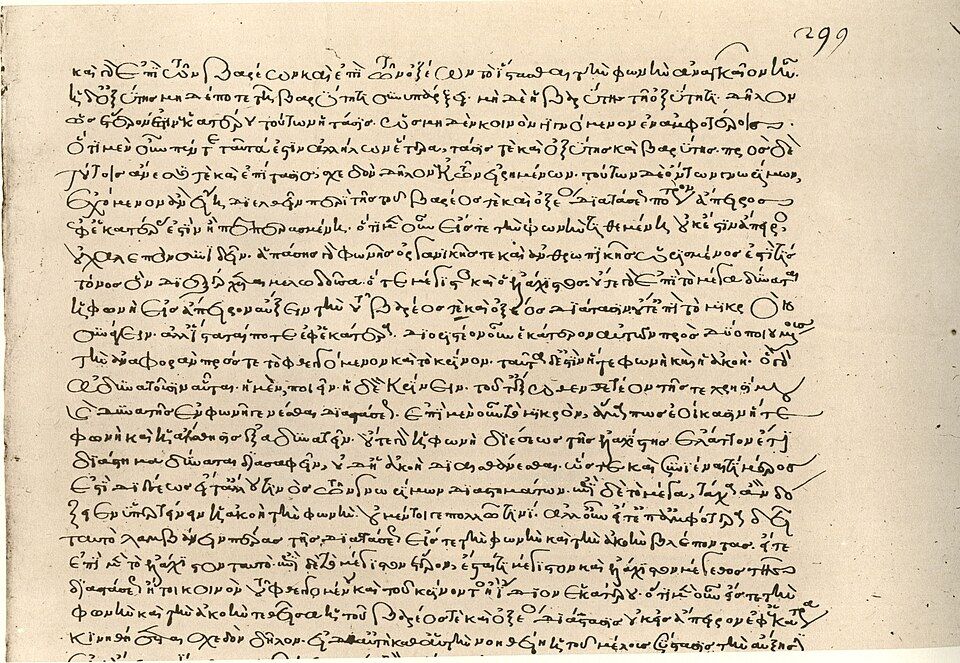
Notes
- ^ D’Angour 2022, p. 132.
- ^ Kiparsky 2018, p. 79 n. 3.
- ^ D’Angour 2022, p. 135.
- ^ Prauscello 2021, p. 221.
- ^ Hephaestion, Ench. 4.4.
- ^ Hephaestion, Ench. 13.8.
- ^ Hephaestion, Ench. 14.
- ^ Hephaestion, Ench. 15.1.
- ^ Battezzato 2009, p. 137 n. 12.
- ^ West 2018, p. 373 with n. 10.
- ^ a b West 1987, p. 88.
- ^ Battezzato 2009, p. 143.
- ^ West 1987, p. 7.
- ^ West 1987, p. 38.
- ^ West 1987, pp. 85, 90.
- ^ D’Angour 2022, p. 139.
- ^ Katz 2018, p. 59.
- ^ Kiparsky 2018, p. 97 n. 19.
- ^ West 1987, p. 40.
- ^ Sampson 2022, p. 114.
- ^ Phillips 2022, p. 120.
- ^ West 2018, p. 373 n. 10.
- ^ West 1987, p. 55.
- ^ West 1987, p. 5.
- ^ a b D’Angour 2022, p. 134.
- ^ West 1987, p. 32.
- ^ Hephaestion, Ench. 7.5–7.
- ^ West 1987, pp. 34–35.
- ^ West 1987, pp. 87, 89.
- ^ Hephaestion, Ench. 10.2.
- ^ Kiparsky 2018, p. 98.
Introduction · 11 of 14
Modern theory
From feet to rules. Modern work began from the Alexandrian colometry[1] and from Hephaestion’s feet. As late as 1711 Joshua Barnes explained an unmetrical ἕως in Homer as an amphibrach. In his view it stood in the first foot in place of a dactyl of equal value. J. H. Voss was the first to conclude that emendation was needed. Gottfried Hermann (1816) postulated an older *εἷος. Curtius (1846), who knew more historical linguistics, introduced the ἧος, τῆος that later editors adopted.[2]
Hermann had in 1805 observed the hexameter bridge named after him.[3] Porson discovered his law,[4] and also the one now called Havet’s.[5] The publications are these. Porson stated the rule for the end of the tragic trimeter in his notes to Euripides’ Hecuba (1797, on line 347) and Phoenissae (1799, on line 1464), and in the supplement to his Hecuba (1802). Hermann found it for the end of the trochaic tetrameter in his own Hecuba (1800). Snell extended it to the other metres it governs in his Bacchylides (1961). Hermann set out his bridge in his Orphica (1805).[6]
On the beginning of the tetrameter the two sources differ, and both are reported here. West says that Porson discovered this rule as well, although it goes by Havet’s name.[5] Maas credits the discovery to L. Havet himself, in his Cours élémentaire de métrique (1886).[7]
Nineteenth-century terms. “Logaoedic”, for verse in asymmetric rhythm, has dropped out of use.[8] “Ictus” is now rarely used. It is misleading if it implies a stress that could lengthen a short.[9] The term “syncopation” is Westphal’s. It means the omission of a short, with supposed compensatory lengthening of a neighbouring long.[10] It is still the conventional term in Greek metrics.[11]
Wilamowitz extended anaclasis to further metres (1886). In 1921 he made it a basic principle of metrics that iambs, trochees, ionics and the rest grew from one abstract four-syllable metron.[12] The anaclastic glyconic ○ ○ — × — ⏑ ⏑ — is sometimes called the wilamowitzianus after him.[13]
μῆνιν ἄειδε θεὰ Πηληϊάδε‿ω Ἀχιλῆος
Sing, goddess, of the wrath of Achilles, son of Peleus,
Iliad 1.1, from the site’s scansion. Two terms on one line. Red μῆ: the first long position, West’s princeps, Maas’s longum. Red ϊ-ά: the two shorts of the fourth foot lie inside one word, Πηληϊάδεω, as Hermann’s Bridge requires: no word-end between them.
David Chamberlain, Iliad 1.1 · CC BY 4.0
Maas, Dale, Snell, West. Paul Maas’s term for a position is element, and his long position is the longum. West calls them position and princeps.[14] Maas devised the dactylo-epitrite sigla D, e, E.[15] In these sigla an Archilochean line is written D | × E ‖.[16]
A. M. Dale analysed all of tragedy in Metrical Analyses of Tragic Choruses (1971–83). She discussed much of it in The Lyric Metres of Greek Drama (2nd edn 1968). West sends readers to her, to Dawe’s Teubner Sophocles and to modern commentaries, and he calls Jebb’s analyses “antiquated”.[17] Battezzato, for his part, calls Dale’s notation “idiosyncratic”.[18]
Bruno Snell’s Teubner Pindar and Bacchylides (revised by Maehler) analyse every poem. Snell aligned related sequences vertically, with bracketed sigla for mutant forms. This method rests on the principle of motif-development, which he was the first to grasp.[19]
West’s Greek Metre (1982) was abridged in the 1987 Introduction, whose footnotes fall from 458 to 42.[20] D’Angour calls Greek Metre the standard full-scale treatment, though hard for beginners. He finds Raven (1962) less forbidding.[21] Battezzato too calls West’s handbook fundamental. He also recommends Snell’s brief Griechische Metrik and Martinelli 1995.[22] Itsumi (1982) showed that Greek has no metres answering to the loose schema × × × × — ⏑ ⏑ —.[23]
The comparative approach. Meillet (1923) saw that the Lesbian metres look archaic beside Vedic verse. Only the Greek–Indian comparison brings the inherited principles out clearly.[24] The landmarks are Meillet 1923, Jakobson 1952, Watkins 1963 and West’s “Indo-European Metre” (1973).[25] Kiparsky adds syncopation to Meillet’s inherited features. He rates it higher than the others, since it seems unique to Indo-European.[26]
How the hexameter arose is disputed. Meister and Meillet thought it borrowed from a non-Greek Aegean people, which West (1997) refuted.[27] West (1973) derived it from a pherecratean and an expanded reizianum, or from a hemiepes and a paroemiac. Nagy (1974) derived it from a pherecratean expanded by three dactyls. Battezzato finds this view a priori likely, given an Aeolic phase in epic.[28] Berg (1978) derived it from a dimeter and a pherecratean, and Tichy (1981) modified his account. Kiparsky criticises West, Nagy and Berg. He derives the hexameter from a pair of iambic dimeters altered by syncopation.[29] Nagy also argues that metre is “diachronically generated by formula rather than vice versa”.[30] Kiparsky argues against this.[31]
Notes
- ^ Sampson 2022, p. 114; Phillips 2022, p. 120.
- ^ West 2018, p. 373 with nn. 11–12.
- ^ West 1987, p. 21.
- ^ West 1987, p. 25; Battezzato 2009, p. 137.
- ^ a b West 1987, p. 28.
- ^ Maas 1962, pp. 35, 60.
- ^ Maas 1962, p. 35.
- ^ West 1987, p. 88.
- ^ West 1987, pp. 87–88.
- ^ Kiparsky 2018, p. 97 n. 20.
- ^ West 1987, p. 7.
- ^ Kiparsky 2018, pp. 97, 103.
- ^ West 1987, p. 90.
- ^ West 1987, pp. 86, 88.
- ^ Battezzato 2009, p. 141.
- ^ Kiparsky 2018, p. 108.
- ^ West 1987, p. 52 with n. 5.
- ^ Battezzato 2009, p. 146.
- ^ West 1987, pp. 43, 45–46.
- ^ West 1987, Preface.
- ^ D’Angour 2022, p. 141.
- ^ Battezzato 2009, p. 145.
- ^ Kiparsky 2018, pp. 82–83.
- ^ West 1987, pp. 1–3.
- ^ Gunkel and Hackstein 2018, p. 3.
- ^ Kiparsky 2018, p. 102.
- ^ Kiparsky 2018, p. 104 n. 24.
- ^ Battezzato 2009, p. 140.
- ^ Kiparsky 2018, pp. 104–108, 122.
- ^ Nagy 1990, p. 29.
- ^ Gunkel and Hackstein 2018, p. 1.
Introduction · 12 of 14
Linguistic theories of Greek metre
Handbooks such as West’s describe Greek verse in its own terms: positions, metra and a stock of named cola. Linguists have also asked why Greek metre takes the shapes it does. They answer by relating it to the sound system of the language. Two such approaches are summarised here. Neither has replaced the descriptive notation used on this site.
Generative metrics. Kiparsky treats a metre as a “grammar” rather than a “dictionary” of patterns. On his view a metre is an abstract rhythmic template, plus constraints that match it to the text’s phonology. With Jakobson, he distinguishes the verse design, the verse instance (a text’s scansion) and the delivery instance (its performance).[1] The patterns then prove to be simple binary structures. Their variety comes from the correspondence rules. So acephaly and catalexis are licences at the verse edges, not parts of the pattern.[2] Gunkel and Hackstein open their volume with Brogan’s verdict that metrics still has nearly all of its work ahead of it.[3]
Two units and markedness: Golston and Riad. Golston and Riad (2005) argue that Greek lyric metre is built from only two basic units, a dactylic and a trochaic. These are the same units that run through epic and dramatic verse.[4] Each metrical position is a “moraic trochee”. This is a heavy syllable (H) or two lights (LL), and sometimes a single light. Each verse foot is two positions.[5] Word accent, which was pitch, plays no part.[6] The handbooks agree on this.[7]
Their claim about rhythm is the novel one. Every dactylic unit contains a stress “clash”, and every trochaic unit a “lapse”. So the units break constraints that keep ordinary speech rhythmic. A metre is then defined by which of these marked features it uses, and where.[8] Their tools are dactylic (D) and trochaic (T) units, extrametricality (their term for the aeolic base, s), catalexis (L) and “quantitative metathesis” (anaclasis). With these they reduce the aeolic cola to a few combinations:[9]
| Colon | West 1987 | Golston and Riad 2005 |
|---|---|---|
| adonean | — ⏑ ⏑ — × | DD |
| reizianum | × — ⏑ ⏑ — × | s DD |
| pherecratean | ○ ○ — ⏑ ⏑ — — | ss DD |
| aristophanean | — ⏑ ⏑ — ⏑ — — | DT |
| hagesichorean | × — ⏑ ⏑ — ⏑ — — | s DT |
| hipponactean | ○ ○ — ⏑ ⏑ — ⏑ — — | ss DT |
| dodrans | — ⏑ ⏑ — ⏑ — | DTL |
| telesillean | × — ⏑ ⏑ — ⏑ — | s DTL |
| glyconic | ○ ○ — ⏑ ⏑ — ⏑ — | ss DTL |
| ithyphallic | — ⏑ — ⏑ — — | TD |
| lekythion | — ⏑ — ⏒ — ⏑ — | TTL |
West’s schemes are from his list of symbols.[10] On this analysis the Sapphic stanza is TDT, TDT, TDTDD. The Alcaic is s TDTL, s TDTL, s TTDDT. So the two stanzas share their units.[11] West writes the first two Sapphic periods ∧ia hag. He allows that the third might be analysed as ∧ia hag ⁝ ad. But in his view that hides the main point: the third period is a stretched-out form of the first two.[12]
Ποικιλόθρον’ ἀθανάτ’ Ἀφρόδιτα,
Immortal Aphrodite of the intricate throne,
Sappho fr. 1.1, from the site’s scansion, read in Golston and Riad’s units: trochaic T, dactylic D (red), trochaic T, so TDT, the first period of the Sapphic stanza.[13]
synthetic ∿
Authorities differ. Golston and Riad reject Raven’s analysis of aeolic verse around a choriambic nucleus.[14] They judge the colon-based systems of Korzeniewski and of West’s Greek Metre (1982) to be either provisional or ad hoc. They give two reasons. Cola such as the adonean have no existence outside metre. And West allows two analyses of the last period of the Sapphic and Alcaic stanzas.[15] For West, by contrast, the cola are what Greek verse is actually built from, and they recur from one metre to another.[16] Golston and Riad’s treatment of the opening anceps of the iambic trimeter as an extrametrical “base”[17] is also their own. Their analysis is offered here as a linguist’s alternative, not as the received view.
Notes
- ^ Kiparsky 2018, pp. 77–79.
- ^ Kiparsky 2018, pp. 80–81.
- ^ Gunkel and Hackstein 2018, p. 1.
- ^ Golston and Riad 2005, pp. 77–78.
- ^ Golston and Riad 2005, p. 79.
- ^ Golston and Riad 2005, pp. 79–80.
- ^ West 1987, p. 2.
- ^ Golston and Riad 2005, pp. 77–78, 113.
- ^ Golston and Riad 2005, pp. 94–96.
- ^ West 1987, pp. ix–x.
- ^ Golston and Riad 2005, pp. 83–85.
- ^ West 1987, p. 34.
- ^ Golston and Riad 2005, pp. 83–85, 94–96.
- ^ Golston and Riad 2005, pp. 109–110.
- ^ Golston and Riad 2005, pp. 111–112.
- ^ West 1987, pp. 4, 19.
- ^ Golston and Riad 2005, pp. 88–89.
Introduction · 13 of 14
Rhythm and music
Time-values. In recitation a long was perhaps 5:3 to a short. So a long filling a biceps had to be drawn out slightly. In song the longs took a more exact relation to the shorts, normally 2:1, and in some metres 3:1.[1] The ancients counted in morae, two to a long and one to a short.[2]
The 3:1 long is called the triseme, written ⌊. It appears in iambic and trochaic song, where ⌊ ⏑ —, ⏑ — ⌊ or ⌊ ⌊ stands beside × — ⏑ —.[3] It is found already in Alcman’s syncopated clausulae.[4] In Bacchylides 17 such metra respond at eight places with unsyncopated ones, and this proves them equal in time.[5]
The tetraseme ⊔ is worth two longs. It belongs to slow hymns. The Berlin Paean (c. 160 AD) is preserved with notation. It is an anapaestic scheme sung at half speed, with all its syllables long and some tetrasemes.[6] Aristides Quintilianus knew several metres made wholly of long syllables, in which some longs were twice the length of others.[7] Authorities differ. Battezzato holds that in music a long normally equalled two shorts. In his view there is only sporadic evidence for three- or four-time longs, at the end of the classical era.[8]
Beat and ictus. Arsis is the up-beat and thesis the down-beat. Ancient notation puts a dot over the notes of the arsis.[9] The old idea of ictus was a stress that reinforced certain positions and could lengthen a short. West rejects it as misleading.[10] He also warns against reading the principes at equal intervals when the positions between them are unequal. English stress-habits tempt us to do this, but the asymmetry is what gives many metres their character.[3]
The dochmiac is a case in point. English speakers read the usual mnemonic for it in four beats with silent rests, and there is no Greek evidence for this. The little evidence there is suggests two main beats, on the second and fourth elements.[11]
The musical documents. The earliest extended notated melody on papyrus is a chorus of Euripides’ Orestes (338–45, 408 BC). It is in dochmiacs, accompanied by the aulos, and probably Euripides’ own setting. Some syllables carry stigmai, dots marking the arsis, on the first and third of the dochmiac’s five elements. This goes against the assumption that the beat always fell on the long elements.[12] The Greeks may not have assumed that the down-beat is stressed. Lynch (2016) links arsis and thesis with pitch.[13]
The melody shows the New Music. Its departures from traditional word-setting have been linked with the need for a notation. One of them is Euripides’ prolonged first syllable of εἱλίσσετε, mocked in Frogs 1314.[14] In archaic lyric each syllable probably had a single note. Battezzato states this outright, and he dates to the fifth century the division of a long between two notes.[8] Later he calls it probable, because classical writers criticised that newer practice.[15]
The other notated document discussed here is the Song of Seikilos. It is a quatrain inscribed with notation, perhaps in the first century AD. It is the only post-classical verse with syncopation, apart from the end of the Epidaurian Hymn to Pan:[16]
1 ὅσον ζῇς, φαίνου·
2 μηδὲν ὅλως σὺ λυποῦ·
3 πρὸς ὀλίγον ἐστὶ τὸ ζῆν·
4 τὸ τέλος ὁ χρόνος ἀπαιτεῖ.
While you live, shine; grieve for nothing at all; life lasts a little while; time demands its end.
The Song of Seikilos, by West’s analysis. Red: the long syllables marked ⌊, held for three time-units (trisemes) in the syncopated metra.
synthetic ∿
Melody and accent. Spoken Greek rose and fell in pitch. From the third century BC this was marked by the accents.[17] The documents show moderate conformity of melody to accent. In the Orestes it cannot be complete, since one melody served strophe and antistrophe. The melody seems instead to follow a mimetic principle. It has a falling cadence on κατολοφύρομαι “I lament”, and an upward leap on ἀναβακχεύει, of frenzied leaping.[18] Strophic song in general shows only partial correspondence. Some astrophic Hellenistic pieces with notation show close coherence.[8]
For early lyric the most plausible hypothesis remains this. The melody followed the natural pitches of the words within one harmonia of the seven-stringed lyre.[19] Simonides already stretched syllables mimetically, as in πῦρ for a flickering flame.[20]
Instruments and delivery. The main accompaniments were the lyre family (lyra, barbitos, kithara) and the aulos. The aulos was a reed instrument, more like an oboe than a flute. The accompaniment mostly doubled the singer’s line. Instruments were tuned to a mode (harmonia), and each mode had its own character.[21]
Drama used three kinds of delivery: recitation without music, recitation with music (παρακαταλογή, “recitative”) and singing.[22] Archilochus was said to have invented parakatalogē.[23]
Rhythms could also be given a character, an ethos, and here views differ. D’Angour holds that dochmiacs alone are tied to agitation or distress.[11] West’s index entry “ethos of particular rhythms” points to spondaics, dochmiacs, lyric anapaests and ionics.[24]
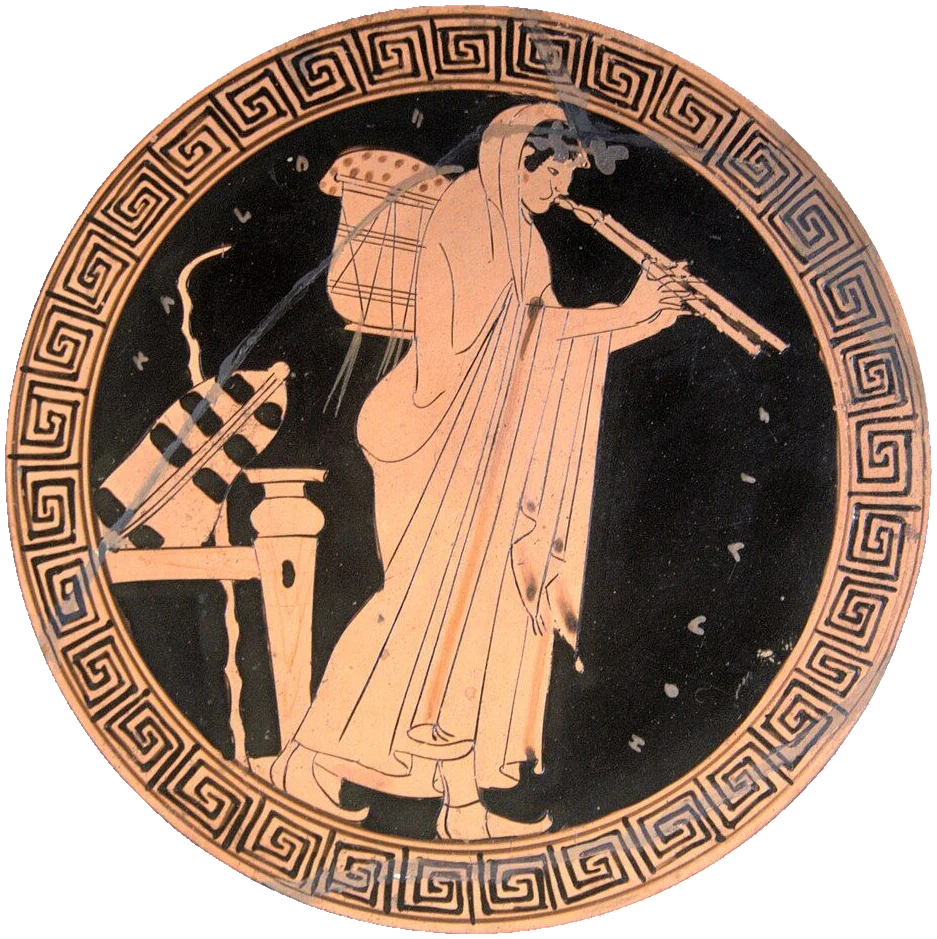
Notes
- ^ West 1987, pp. 6–7.
- ^ West 1987, pp. 7, 88.
- ^ a b West 1987, p. 7.
- ^ West 1987, p. 39.
- ^ West 1987, p. 47.
- ^ West 1987, p. 75.
- ^ West 1987, p. 40.
- ^ a b c Battezzato 2009, p. 143.
- ^ West 1987, pp. 85, 90; D’Angour 2022, p. 139.
- ^ West 1987, pp. 87–88.
- ^ a b D’Angour 2022, p. 138.
- ^ D’Angour 2022, p. 139.
- ^ D’Angour 2022, p. 139 n. 6.
- ^ D’Angour 2022, pp. 138–139 with nn. 4, 8.
- ^ Battezzato 2021, p. 131.
- ^ West 1987, p. 71.
- ^ D’Angour 2022, p. 132.
- ^ D’Angour 2022, p. 140.
- ^ D’Angour 2022, pp. 140–141 with n. 11.
- ^ D’Angour 2022, p. 140 n. 10.
- ^ Battezzato 2009, pp. 143–145.
- ^ West 1987, p. 48; see Speech and song.
- ^ D’Angour 2022, p. 134; Battezzato 2009, p. 143.
- ^ West 1987, pp. 40 n. 4, 56, 61–62, 87.
Introduction · 14 of 14
Speech, recitative and song in drama
In drama the metre tells you how a passage was delivered. There are three modes of delivery: recitation without music, recitation with music (παρακαταλογή (parakatalogē), commonly called “recitative”), and singing. The recited parts are in stichic metres, or in long periods of uniform rhythm that behave like them. The sung parts are normally non-stichic and mostly strophic.[1]
Seen from the audience’s side, the scheme is this. Lyric metres are used for song and dance by the chorus or a soloist. Other rhythms, above all anapaests, are used for recitative. Spoken iambics serve for most dialogue.[2]
| Mode | Typical metres | Accompaniment |
|---|---|---|
| speech | iambic trimeter | none; the trimeter comes near the rhythms of everyday speech, yet is far more ordered than plain speech[3] |
| recitative | marching anapaests, trochaic tetrameters | the aulos, it is generally held[4] |
| song | lyric metres, mostly in responding strophes; also lyric anapaests | the aulos[5] |
The borders are not sharp. Where one mode ends and the next begins is not always certain.[1] There may be several modes between full song and plain speech.[6] It is unknown whether parakatalogē meant a special chanted delivery.[4] Anapaests come in two kinds, marching (recited) and lyric (sung). They are told apart by their metrical features.[7]
How we know. The manuscripts do not mark which parts were sung. Editors decide by metre and by language. One sign is the “Doric” long α of tragic song, which the copyists often confused.[8] The lyric metres of tragedy continue the tradition of archaic choral song, the line of Pindar and Bacchylides.[9]
Tragic song went to the aulos, a pair of pipes with double reeds. The lyre was not the standard accompaniment, and it appears on stage only in special cases. So “tragic lyric” is, strictly, a misnomer.[10]
A worked example: Euripides, Medea 1–266:[11]
| Lines | Delivery |
|---|---|
| 1–95 | spoken iambics: the Nurse’s opening speech, then the two slaves in conversation |
| 96–130 | anapaests for alternating voices: Medea sings inside the house, the Nurse chants in recitative |
| 131–213 | the chorus enters singing, first in the same anapaestic metre, then in more varied lyrics; strophe 148–59 answers antistrophe 173–84; the Nurse keeps to recitative |
| 214–266 | spoken iambics: Medea comes out and makes an orderly speech |
All Medea’s utterances before 214 are sung. The Nurse only speaks and chants. This marks her as subordinate, while the shared anapaestic metre links her to Medea.[11] Who sings depends on dramatic prominence rather than on any fixed rule.[12] Slaves and other low-status characters are given anapaests or hexameters but not true songs, the Phrygian slave of Orestes excepted. Male heroes in their prime do not, as a rule, sing. Sophocles is the important exception: he gives his heroes song in extreme suffering.[13]
Strophes in drama. A tragic strophe is repeated only once, in its antistrophe. Sometimes an epode follows.[14] No lyric passage in tragedy is longer than the lament of Libation Bearers 306–478, which has eleven strophic pairs. Sophocles and Euripides never exceed three pairs and an epode.[15]
Change over the century. Choral song shrank as a share of the play, and actors’ solo songs grew. Some dramatists, following Agathon, used embolima. These were songs not written for one particular place in one play.[16] The New Music of the late fifth century spread one syllable over more than one note. It also gave up strophic responsion for freer patterns. Its influence is visible in Euripides from Trojan Women (415 BC) on.[17] The Orestes papyrus shows the first of these traits. But it dates from about 280 BC at the earliest, so whether its music is Euripides’ own remains an open question.[18]
Metre and mood. Euripides often uses the dochmiac where a character reacts in fear or despair to news. But in his late recognition scenes (Iphigenia among the Taurians, Ion, Helen) dochmiacs also carry joy.[19]
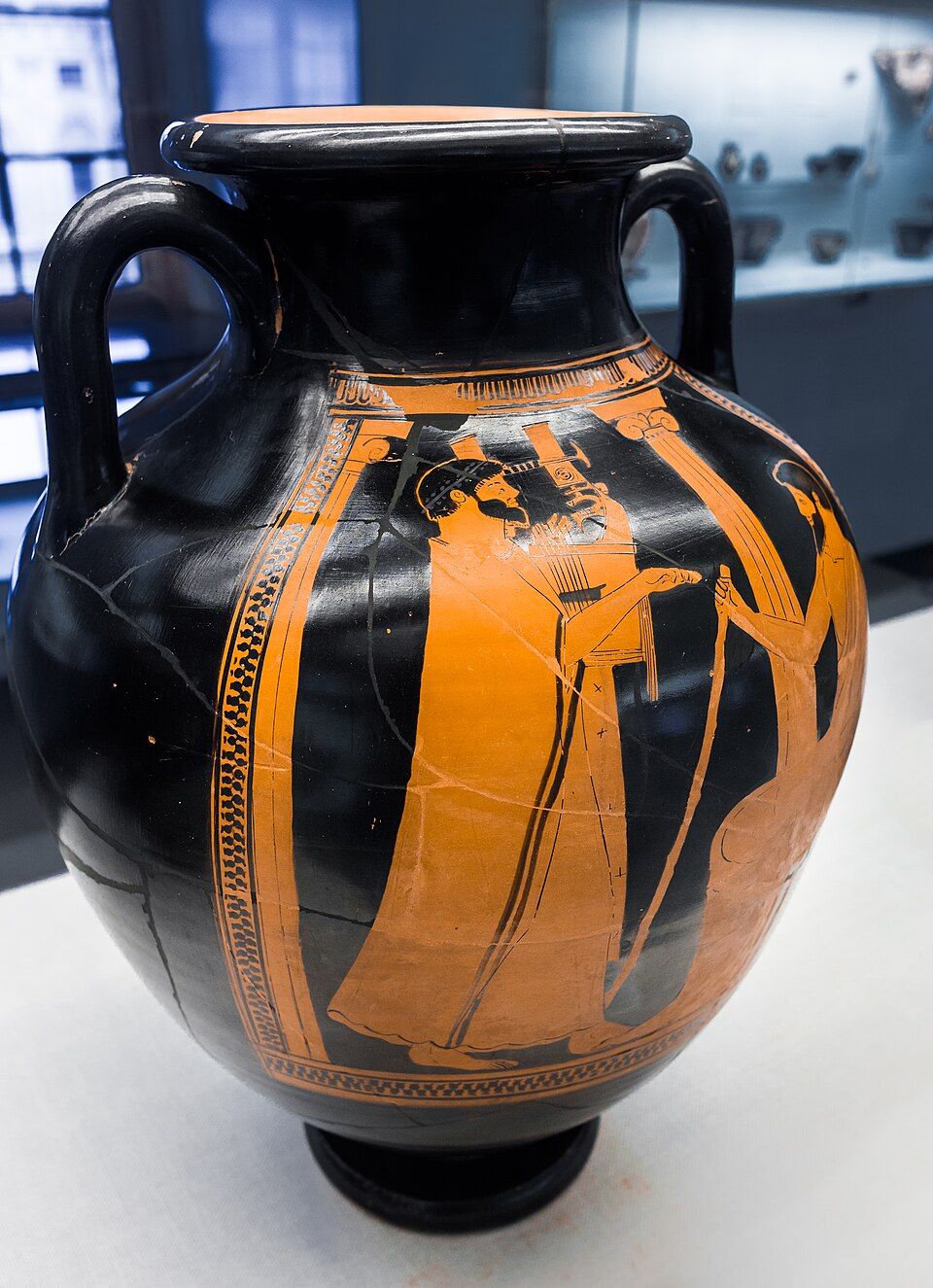
Notes
- ^ a b West 1987, p. 48.
- ^ Easterling 1997, p. 157.
- ^ Wilson 2005, pp. 184–185.
- ^ a b Battezzato 2005, p. 151.
- ^ Wilson 2005, p. 185.
- ^ Wilson 2005, p. 184.
- ^ West 1987, p. 48; Battezzato 2005, p. 151.
- ^ Battezzato 2005, pp. 150, 153.
- ^ Battezzato 2005, p. 149.
- ^ Wilson 2005, pp. 185–186; Battezzato 2005, p. 150.
- ^ a b Easterling 1997, pp. 159–160.
- ^ Easterling 1997, p. 159 n. 18.
- ^ Battezzato 2005, p. 156.
- ^ Battezzato 2005, p. 151; West 1987, p. 50.
- ^ Battezzato 2005, p. 152.
- ^ Easterling 1997, pp. 155–156.
- ^ Wilson 2005, p. 190.
- ^ Wilson 2005, p. 191; compare D’Angour’s view in Rhythm and music.
- ^ Battezzato 2005, p. 158.


