Verse formsStichic metres
Dactylic: the hexameter
The six-foot line of Greek epic: its rhythm, word breaks and changes from Homer to Nonnus.
The metrical families one by one: dactylic, iambic, trochaic, aeolic, ionic, anapaestic, dochmiac and the rest.
Dactylic · 1 of 5
The hexameter scheme
The dactylic hexameter is the metre of Homer and Hesiod and of all later epic and most didactic poetry. It also served for poems of other kinds, among them oracles and riddles, and until about 550 BC it was the usual metre of verse inscriptions. It is a stichic metre. That means the same verse-pattern is repeated line after line, with no strophic structure.[1]
The six feet
A foot is a short group of syllables that repeats to make up a line. In the hexameter the foot is the same as the metron (μέτρον, metron, “measure”), the unit of three to six syllables into which a regular rhythm divides.[2] Traditionally the line is thought of as six dactylic feet or metra, — ⏔. The last of them is catalectic. That means it is shorter than the others, — ×.[3] Here is West’s scheme, with the places where a caesura may fall marked ¦:
— ⏔ — ⏔ — ¦ ⏑ ¦ ⏑ — ¦ ⏔ — ⏔ — × ‖
synthetic ∿ · the rhythm: a long note for —, a short one for ⏑
| foot | 1 | 2 | 3 | 4 | 5 | 6 |
|---|---|---|---|---|---|---|
| scheme | — ⏔ | — ⏔ | — ¦ ⏑ ¦ ⏑ | — ¦ ⏔ | — ⏔ | — × ‖ |
One foot, two parts
Every foot of the hexameter is built in the same way, out of two parts. Take the first foot of the Iliad, the three syllables μῆ-νιν ἄ- (mē-nin a-).
The first part is a single long syllable, here μῆ (mē). This part is called the princeps. In the hexameter it is long.[4]
The second part is the pair of short syllables that follow, here νιν ἄ (nin a). This part is called the biceps. A foot made of one long and two shorts, — ⏑ ⏑, is a dactyl, δάκτυλος (daktylos), “finger”.[5]
The biceps can change. Its two short syllables may be replaced by a single long syllable. This replacement is called contraction.[4] A contracted foot has two long syllables, — —. It is called a spondee, σπονδεῖος (spondeios), the foot “of two longs”.[6] The third foot of the same line is one: in -ὰ Πη- (-ā pē-) the single long syllable Πη fills the whole biceps.
Because the biceps can be filled in either way, it has a sign of its own, ⏔: a long written over two shorts. Read it as “two shorts, or one long”.[7]
A whole line, foot by foot
Here is the first line of the Iliad divided into its six feet. Feet 1, 2, 4 and 5 are dactyls. Foot 3 is a spondee, because its biceps is contracted. Foot 6 is the shortened last foot, — ×:
μῆνιν ἄειδε θεὰ Πηληϊάδεω Ἀχιλῆος
Sing, goddess, the wrath of Achilles son of Peleus.
Homer, Iliad 1.1. Red: the contracted foot. Dashed bar: the caesura.
David Chamberlain, Iliad 1.1 · CC BY 4.0
Ancient metricians described the line in the same way. Hephaestion says that dactylic verse admits dactyls and spondees in every place except the last.[8] The second line of the Iliad has two spondees, in feet 2 and 4.
Why it matters. Unlike most other metres, the hexameter uses contraction freely. So two lines with the same scheme can sound quite different. It is this that varies an otherwise uniform rhythm.[9]
In one line: each of the first five feet is — ⏔, a long princeps followed by a biceps of two shorts or, contracted, of one long.
Details of the scheme
The third biceps too may be contracted. West writes it as two shorts only to show the feminine caesura that can divide them.
The biceps is a little longer than the princeps. In ordinary recitation a long syllable lasted about 5 units of time to a short’s 3. So the princeps took 5 units and the two shorts of the biceps 3 + 3 = 6: the biceps is longer by about 6:5. When a single long fills the biceps, it has to be stretched a little.[10]
The end of every hexameter is a period-end, the break marked ‖ in the scheme. The last position before it is free: it may hold a long or a short syllable, and it is written ×. A short syllable in this place is called a brevis in longo, “a short in a long position”. The missing length is made up by the pause that follows.[11] The second line of the Iliad ends in one:
ἄλγε’ ἔθηκε
laid woes
End of Homer, Iliad 1.2. Red: κε (ke), a short syllable in the last position.
David Chamberlain, Iliad 1.2 · CC BY 4.0
Hephaestion uses the first line of the Iliad to define the ἔπος (epos), the epic verse. He calls it the hexameter “catalectic in disyllabum”: its last foot, -λῆος (-lē-os), has two syllables where a dactyl has three.[12] In West’s notation it is — ×.
The fifth foot. Contraction is least common in the fifth foot, about once in twenty lines in Homer. Many of these cases arise from vowel contraction, as Ἠῶ for older Ἠόα at Od. 12.7.[13] Some Alexandrian poets affected a line in which a fourth-foot dactyl is followed by a four-syllable word scanning — — — ×. So the fifth biceps is contracted. Such a line is called σπονδειάζων (spondeiazōn), “spondaic”:[14]
ἐν δοιῆι μάλα θυμός, ἐπεὶ γένος ἀμφήριστον.
My heart is quite in doubt, since his birth is disputed.
Callimachus, Hymn 1.5. Red: the contracted fifth foot, inside the four-syllable word ἀμφήριστον (amphēriston). Dashed bar: the caesura.
synthetic ∿
Nonnus avoided contraction of the fifth biceps altogether.[15]
Caesurae
A hexameter is not one long run of syllables. Somewhere near its middle a word always ends, and the line breaks into two halves. This regular word-end is called a caesura.
There is always a caesura at one at least of the places marked ¦ in the scheme. It is normally at one of the two places in the third foot. Just occasionally a long word fills that whole foot, and the caesura falls after the fourth princeps instead.[1]
The two places in the third foot have names of their own. A word-end straight after the long princeps, — ¦ ⏔, is the “masculine” caesura. A word-end between the two shorts of the biceps, — ⏑ ¦ ⏑, is the “feminine” caesura. The feminine caesura is the commoner of the two, in the proportion 4:3. It is also more often presupposed by formulaic phrases.[1]
The first line of the Iliad has a masculine caesura, after θεὰ (thea). The second line has a feminine one, after μυρί’ (myri’):
οὐλομένην, ἣ μυρί’ Ἀχαιοῖς ἄλγε’ ἔθηκε,
the accursed wrath, which laid countless woes on the Achaeans
Homer, Iliad 1.2. Dashed bar: the feminine caesura, between the two shorts of the third foot. Red: the two contracted feet.
David Chamberlain, Iliad 1.2 · CC BY 4.0
This line also shows how freely contraction varies the rhythm. It has two spondees, in feet 2 and 4, where the first line had one, in foot 3.
Caesurae are also named by counting half-feet. A caesura after the third princeps comes after five half-feet, 2½ feet, and is called penthemimeral, from πενθημιμερής (penthēmimerēs), “of five halves”. One after the fourth princeps comes after seven half-feet, 3½ feet, and is called hephthemimeral, from ἑφθημιμερής (hephthēmimerēs), “of seven halves”.[16] So the masculine caesura of the third foot is the penthemimeral caesura.
A colon (κῶλον, kōlon, “limb”) is a single metrical phrase of not more than about twelve syllables.[17] Because of this regular word-break, West regards the hexameter as two cola. These cola also occur independently in other metres. They, not the notional “feet”, are the real structural units. Many repeated phrases of epic are designed to fill one or the other.[1] Two of the commonest types can be analysed in this way. A hemiepes followed by a paroemiac gives the masculine caesura. A hemiepes with an extra short, followed by an enoplion, gives the feminine:[9]
— ⏑ ⏑ — ⏑ ⏑ — ¦ ⏔ — ⏑ ⏑ — ⏑ ⏑ — × ‖— ⏑ ⏑ — ⏑ ⏑ — ⏑ ¦ ⏑ — ⏑ ⏑ — ⏑ ⏑ — × ‖
synthetic ∿ · the rhythm: a long note for —, a short one for ⏑
The first line of the Iliad is of the first type: μῆνιν ἄειδε θεὰ ¦ Πηληϊάδεω Ἀχιλῆος. The second line is of the second type: οὐλομένην, ἣ μυρί’ ¦ Ἀχαιοῖς ἄλγε’ ἔθηκε.
Bucolic caesura. Word-end at the end of the fourth foot after an uncontracted biceps is frequent. It comes in 47% of Homeric lines, and is known as the bucolic caesura.[18] West dismisses the alternative name, “bucolic diaeresis”, as modern pedantry.[19] Callimachus’ line has one: the word γένος (genos) ends with the fourth foot.
- Masculine caesura, after the third princeps. Also called penthemimeral.
- Feminine caesura, between the two shorts of the third biceps. The commoner of the two.
- Hephthemimeral caesura, after the fourth princeps.
- Hermann’s Bridge: no word-end between the two shorts of the fourth biceps.
- Bucolic caesura, after the fourth foot.
Bridges
A bridge is the converse of a caesura. It is a place where word-end is avoided. Word-end is avoided between the two shorts of the fourth biceps. Gottfried Hermann observed this in 1805, and the rule is called Hermann’s Bridge. Prepositives count with the following word, and postpositives with the preceding. Breaches occur about once in 550 lines in Homer.[20] The bridge can also be described as the avoidance of word-end after the “fourth trochee”.[21]
Maas uses the same expression, but gives a different rate. For him a word ends there about once in 390 lines. He names Hesiod, Theogony 319 among his examples, with Iliad 9.394, and dates Hermann’s discovery to his Orphica of 1805.[22] The two figures are reported here as each author gives them. West’s example of a breach is quoted without reference; it is Hesiod, Theogony 319:
ἣ δὲ Χίμαιραν ἔτικτε πνέουσαν ἀμαιμάκετον πῦρ
and she bore the Chimaera, breathing irresistible fire
Hesiod, Theogony 319. First dashed bar: the caesura. Second, in the red foot: the word-end between the two shorts of the fourth biceps, after πνέουσαν.
synthetic ∿
Here πνέουσαν (pneousan) ends after the first short of the fourth biceps. The syllable -τε (-te) also stays short before πν- (pn-), which West lists as exceptional in early poetry.[23]
The later poets added further avoidances. One of them is Naeke’s Law: no word-end after a contracted fourth biceps. Il. 1.2 breaks it at Ἀχαιοῖς.[24] The rule holds for Callimachus and Nonnus, and is credited to A. F. Naeke (1835). Its companion for the second biceps is Hilberg’s Law.[25]
Summary
| feature | rule | source |
|---|---|---|
| princeps | long; a short there is an anomaly, and a hexameter with a short first princeps is called “acephalous” | West 1987, pp. 23, 85 |
| biceps 1–4 | ⏑ ⏑ or — | West 1987, pp. 6, 19 |
| biceps 5 | least often contracted: about once in 20 lines in Homer, often by vowel contraction; a contracted fifth biceps before a final four-syllable word gives a σπονδειάζων | West 1987, pp. 20, 78; West 2018, p. 370 |
| word-end after a contracted biceps | frequent only in the first foot; in the fourth the word usually ends in a long vowel (Wernicke’s Law) | West 1987, p. 20 |
| last position | free (×); brevis in longo possible | West 1987, pp. 4, 19 |
| caesura | third foot, masculine or feminine (4:3 in favour of feminine), occasionally only after the fourth princeps | West 1987, p. 19 |
| Hermann’s Bridge | no word-end between the shorts of the fourth biceps; breached about once in 550 lines in Homer (West), about once in 390 lines (Maas) | West 1987, p. 21; Maas 1962, p. 60 |
| bucolic caesura | word-end after a dactylic fourth foot; 47% in Homer | West 1987, pp. 21, 78 |
Notes
- ^ a b c d West 1987, p. 19.
- ^ West 1987, p. 5; LSJ s.v. μέτρον.
- ^ West 1987, pp. 5, 19.
- ^ a b West 1987, p. 6.
- ^ West 1987, p. 86; D’Angour 2022, p. 132.
- ^ West 1987, p. 89; Hephaestion, Ench. 3.1.
- ^ West 1987, pp. ix, 6.
- ^ Hephaestion, Ench. 7.1.
- ^ a b Battezzato 2009, p. 138.
- ^ West 1987, pp. 6–7, 20.
- ^ West 1987, pp. 4, 19.
- ^ Hephaestion, Ench. 7.2.
- ^ West 1987, p. 20; cf. West 2018, p. 370.
- ^ West 1987, pp. 78, 89.
- ^ West 1987, p. 79.
- ^ West 1987, p. 19; Kiparsky 2018, p. 114; Battezzato 2009, p. 137; LSJ s.v. ἑφθημιμερής.
- ^ West 1987, p. 4; LSJ s.v. κῶλον.
- ^ West 1987, pp. 21, 78.
- ^ West 1987, p. 78 n. 8.
- ^ West 1987, p. 21.
- ^ Kiparsky 2018, p. 114.
- ^ Maas 1962, p. 60.
- ^ West 1987, p. 16 n. 6.
- ^ West 1987, p. 78.
- ^ Maas 1962, p. 62; see Development.
Dactylic · 2 of 5
The prosody of epic
Prosody is the set of rules that decide whether a syllable counts as long or short. A licence is a departure from those rules that a poet is allowed to make. Homeric verse shows a greater degree of prosodic licence than any other form of Greek poetry.[1] The general rules of prosody are on the Introduction page. Here are the licences that belong to the hexameter in particular, each with an example.
Most of them are largely restricted to the princeps, the long first part of each foot. The biceps is longer (about 6:5 against the princeps),[2] and so needs more to fill it. The length of these syllables was evidently felt to be too equivocal for it. The first biceps is the most tolerant of exceptions.[3] The same restriction can be put another way. A following stop + liquid, an initial liquid or nasal that was once a cluster, or a lost digamma can let a short syllable stand in the strong position of the foot, but not in the weak.[4]
Metrical lengthening. Some words cannot be fitted into a hexameter at all. A word of three short syllables, ⏑ ⏑ ⏑, is one: the line never has more than two shorts in a row, because every biceps is followed by a long princeps.[5] A word shaped ⏑ — — ⏑ is another. Words containing these sequences may be treated to “metrical lengthening” of one vowel, to let them into the hexameter. The word ὄνομα (onoma), “name”, is the simplest case:
ὄνομα
οὔνομα
name
Above: the ordinary form, ⏑ ⏑ ⏑, which has no place in the hexameter. Below: the epic form, with its first vowel lengthened (red).
synthetic ∿
In the same way ἀποδίωμαι and ἀνέρι scan with a long first α, κυάνεος and ὕδατι with a long first υ, and συβόσια with a long ι. ἀνεμόεις becomes ἠνεμόεις, ὄνομα οὔνομα, γενόμενος γεινόμενος, ἐν ἀγορῆι εἰν ἀγορῆι, Ὀλύμποιο Οὐλύμποιο. And Ἀπόλλωνα has its first α long. The lengthened ε and ο are written ει and ου in our texts.[1] In the same way, three shorts at the start of a line are metrically lengthened to — ⏑ ⏑.[6]
Correption. In epic a final long vowel or diphthong is usually shortened when the next word begins with a vowel, unless there is period-end. This shortening is called correption.[7] Hephaestion calls such syllables “common”, and illustrates them with the first line of the Odyssey.[8] There the diphthong of μοι (moi) is short, because ἔννεπε (ennepe) begins with a vowel:
ἄνδρα μοι ἔννεπε, Μοῦσα, πολύτροπον, ὃς μάλα πολλὰ
Tell me, Muse, of the man of many ways, who very much …
Homer, Odyssey 1.1. Red: μοι (moi), a diphthong made short before the vowel of ἔννεπε. Dashed bar: the caesura.
David Chamberlain, Odyssey 1.1 · CC BY 4.0
In West’s passage from Iliad 21, καί (kai) is correpted twice.
Hiatus. When a word ending in a vowel meets a word beginning with a vowel, and both vowels keep their full value, the result is called hiatus.[9] Hiatus where no original ϝ is involved is admitted with long vowels mostly in the princeps. With short vowels it is admitted especially at the feminine caesura or at the bucolic caesura.[1] The passage from Iliad 21 has an example: μοι ἔριδος (moi eridos), with μοι long in the princeps.
Lengthening by a consonant. A continuant is a consonant whose sound can be held: λ, μ, ν, ρ, σ, and originally ϝ. Lengthening by an initial continuant occurs nearly always in the princeps. So does lengthening by a final continuant (ν, ρ, ς before a vowel). The same applies to a final short syllable lengthened by a following stop + liquid.[10] In the third line of the Iliad, the short final syllable of Ἄϊδι (Aïdi) is made long by the πρ- (pr-) of the next word:
πολλὰς δ’ ἰφθίμους ψυχὰς Ἄϊδι προΐαψεν
and hurled many mighty souls down to Hades
Homer, Iliad 1.3. Red: the final -ι of Ἄϊδι (Aïdi), short by nature, counts long before πρ- (pr-), in the fifth princeps. Dashed bar: the caesura.
David Chamberlain, Iliad 1.3 · CC BY 4.0
Several licences together. West’s showpiece is Il. 21.359–368. Here are the first three lines, with his notes.[3] The caesura of 359 falls after the postpositive δέ (de), which belongs with Τρῶας:[11]
359 λῆγ’ ἔριδος, Τρῶας δὲ καὶ αὐτίκα δῖος Ἀχιλλεὺς
360 ἄστεος ἐξελάσειε· τί μοι ἔριδος καὶ ἀρωγῆς;
361 φῆ πυρὶ καιόμενος, ἀνὰ δ’ ἔφλυε καλὰ ῥέεθρα.
“Cease from strife, and let godlike Achilles drive the Trojans from the city at once; what have I to do with strife and help?” So he spoke, burning with fire, and his fair streams bubbled up.
Homer, Iliad 21.359–361. Red: 359 and 360, καί (kai) shortened before a vowel; 360, μοι (moi) left long before a vowel, in the princeps; 361, -νος (-nos) made long by its final ς before a vowel, in the princeps. Dashed bars: the caesurae.
synthetic ∿
359: correption of καί. 360: μοι in hiatus, in the princeps; correption of καί. 361: -μενος lengthened in the princeps by its final ς before the vowel.[3] Line 365 shows three licences at once:
ὣς τοῦ καλὰ ῥέεθρα πυρὶ φλέγετο, ζέε δ’ ὕδωρ·
so his fair streams burned with fire, and the water boiled.
Homer, Iliad 21.365. Red: three licences, each in a princeps. Dashed bar: the caesura.
synthetic ∿
(πυ)ρί (-ri) is lengthened in the princeps by initial stop + liquid, φλ-. (φλέγε)το is lengthened by the double consonant ζ-. And ὕδωρ has its υ long by metrical lengthening, on the analogy of ὕδατι.[12] In 368, πολλὰ λισσόμενος, (πολ)λά is lengthened by an initial continuant in the first biceps. West marks this exception with “(!)”.[3] It is a line that needs a special explanation.[4]
Digamma. Many words in the Homeric vocabulary originally began with the consonant w. It is written ϝ in the dialects that kept it. In most cases, especially in formulae, these words are still scanned as if it were there. Yet it was no longer pronounced when the poems were composed.[13] Hiatus before such a word is only apparent. In the seventh line of the Iliad, τε (te) stands before ἄναξ (anax), “lord”, which was once ϝάναξ (wanax):
Ἀτρεΐδης τε ἄναξ ἀνδρῶν καὶ δῖος Ἀχιλλεύς.
the son of Atreus, lord of men, and godlike Achilles
Homer, Iliad 1.7. Red: τε (te) before ἄναξ (anax), once ϝάναξ (wanax): the hiatus is only apparent. Dashed bar: the caesura.
David Chamberlain, Iliad 1.7 · CC BY 4.0
West’s list of words with initial ϝ includes the pronoun ἕ, οἱ (where the ϝ is almost always effective), ὅς “his own”, ἄγνυμι, ἁδεῖν, ἁλῶναι, ἄναξ, ἄστυ, ἕδνα, ἔθνος, εἶδος, εἴκοσι, εἴκω, ἕκαστος, ἑκών, ἔλδομαι, Ἑλένη, ἐλπίς/ἔλπομαι, ἕννυμι/εἷμα, ἕξ, ἔοικα and εἰκώς, ἔπος/εἰπεῖν, ἔργον/ἔρδω, ἐρέω, ἔρρω, ἐρύω, ἐσθής, ἕσπερος, ἔτης, ἡδύς, ἰάχω, ἰδεῖν and οἶδα (but not εἶδον, which is ἐ-ϝιδον), Ἴλιος, ἴον, Ἶρις, ἴς and ἶφι, ἶσος. For the full list he refers to Chantraine’s Grammaire homérique.[14]
Older forms replaced by newer. Other anomalies come from the replacement of older forms in the oral or written tradition. Examples are ἕως standing for older ἧος (Il. 1.193), or a genitive in -ου such as Αἰόλου (Od. 10.60) standing for older -οο.[15]
Residual anomalies. Occasionally no such explanation is available, especially where a syllable that ought to be short occupies the princeps. West’s examples are Il. 5.359, 23.2 and Od. 10.141.[15]
| licence | where tolerated | source |
|---|---|---|
| metrical lengthening | words otherwise unusable in the hexameter | West 1987, p. 21 |
| hiatus (no ϝ) | long vowels mostly in the princeps; short vowels especially at feminine or bucolic caesura | West 1987, p. 21 |
| lengthening by initial continuant | nearly always princeps | West 1987, p. 22 |
| lengthening by final continuant | nearly always princeps | West 1987, p. 22 |
| final short + initial stop + liquid | largely princeps | West 1987, p. 22 |
| digamma effects | in most cases, especially in formulae | West 1987, pp. 22–23 |
Notes
- ^ a b c West 1987, p. 21.
- ^ West 1987, p. 20.
- ^ a b c d West 1987, p. 22.
- ^ a b Kiparsky 2018, p. 116.
- ^ West 1987, p. 19.
- ^ Kiparsky 2018, p. 117.
- ^ West 1987, p. 14.
- ^ Hephaestion, Ench. 1.4.
- ^ West 1987, p. 15.
- ^ West 1987, pp. 17–18, 22.
- ^ West 1987, p. 9.
- ^ West 1987, pp. 21 n. 1, 22.
- ^ West 1987, pp. 22–23.
- ^ West 1987, p. 23 with n. 2.
- ^ a b West 1987, p. 23.
Dactylic · 3 of 5
Development: from Homer to Nonnus
Origins (disputed)
Greek metre has Indo-European origins.[1] But unlike several lyric metres, the hexameter has no obvious derivation from the inherited forms.[2] How it arose is disputed:[3]
| proposal | mechanism |
|---|---|
| Meister 1923, Meillet 1923 | borrowed from the poetry of some unidentified non-Greek people of the Aegean; Kiparsky objects that metres are rule-governed systems learned like languages, not borrowed like words, and cites West 1997 against the borrowing hypothesis |
| West 1973 | a pherecratean and an expanded reizianum welded together and regularised, or a hemiepes plus a paroemiac |
| Nagy 1974 | a pherecratean (catalectic glyconic) expanded by the insertion of three dactyls |
| Nagy 1990 | restates the view: the hexameter “is built from smaller inherited meters” and so can regularly hold two formulas or more; diachronically formula generates metre (formula shapes generated colon shapes, not the reverse), though synchronically the metre frames the formula[4] |
| Berg 1978 (modified by Tichy 1981) | an eight-syllable dimeter plus a pherecratean, the seam corresponding to the penthemimeral caesura. Berg objects to West’s and Nagy’s sources that catalectic cola like the pherecratean and reizianum typically end strophes and suit stichic use badly, and to Nagy’s that expansion by three dactyls is unlikely so early and would date the hexameter implausibly late for the archaic formulae it carries[5] |
| Kiparsky 2018 | two Indo-European iambic dimeters, ⏑ — ⏑ — ⏑ — ⏑ —, fused into a distich; syncopation (the licensed exchange of ⏑ — and — ⏑) turns each into — ⏑ ⏑ — ⏑ ⏑ — —, which is reanalysed as a left-headed ternary metre, and the equivalence of ⏑ ⏑ and — in the weak positions does the rest. He thinks it unlikely that formulas created the metre as Nagy proposed, since fixed formulas presuppose an existing metre and flexible formulas and themes are not metrically constrained[6] |
| Battezzato 2009 | finds an Aeolic origin, as Nagy argued, likely in principle, and places the hexameter where two related traditions meet: an Aeolic narrative verse like Sappho’s, and Ionic verses built by joining dactylic cola such as the hemiepes and the enoplion, varied by the contraction that suited the Ionic dialect[7] |
Whether formula or metre came first is also disputed.[8] Kiparsky finds Berg’s starting point plausible, but his intermediate stages unnatural. He argues that the mixed dactylic-iambic metres of early Ionic verse preserve stages on the way. One example is Archilochus’ hemiepes + iambic dimeter. Another is the first line of the eighth-century Nestor’s Cup inscription. This is an iambic line with a choriambic first foot, followed by two hexameters.[9]
The archaic and classical hexameter
By the eighth and seventh centuries there were at least three regional traditions. The hexameter belonged to the Ionian one, with elegy and iambus.[10] It was not confined to Ionia. Alcman used hexameters among his dactylic units.[11] Several of Sappho’s fragments are in hexameters on the Ionian model. They are not in Ionic dialect. But they have epic features that are alien to normal Lesbian poetry, such as contraction of the biceps and correption.[12]
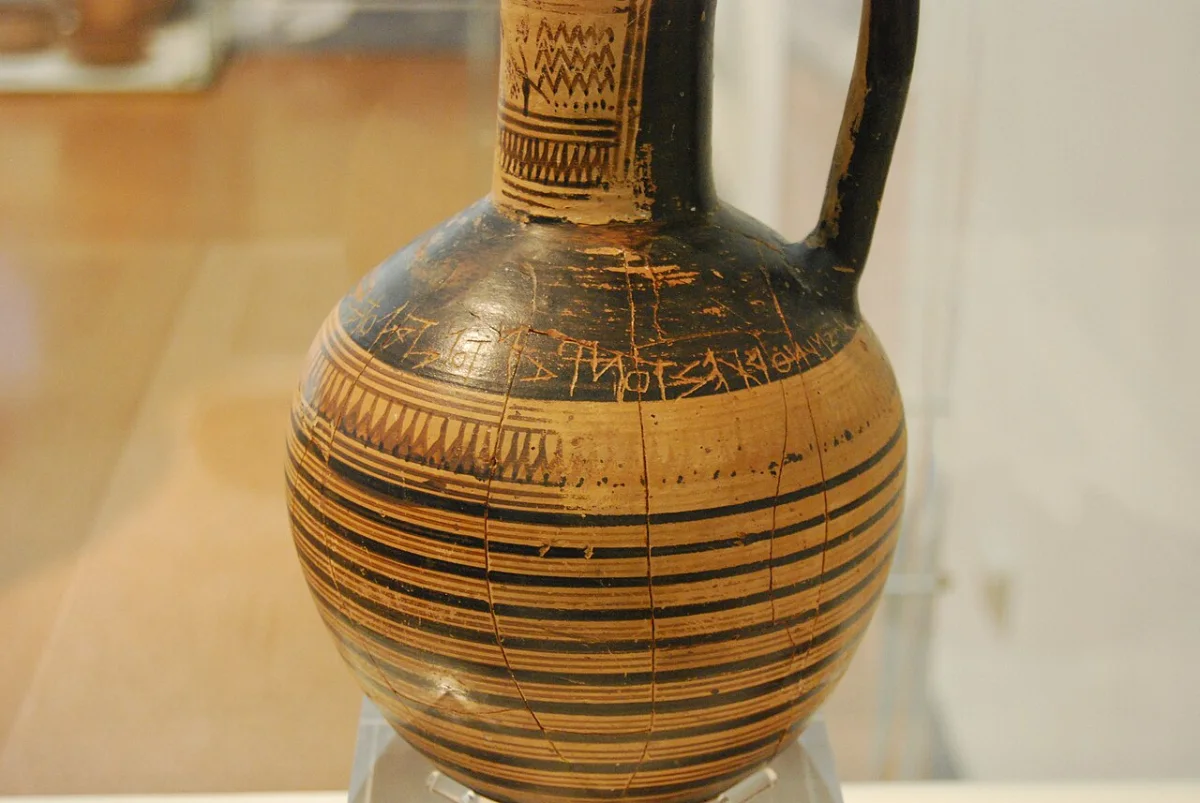
The Hellenistic hexameter
In the later centuries the hexameter increasingly dominates poetic literature, together with the elegiac couplet and, to a lesser extent, the iambic trimeter. It remains the usual medium of narrative, didactic and oracular verse, hymns, bucolic poetry, satire and laments.[13] From the early third century BC many poets strive for greater smoothness. They avoid unusual rhythms and too many short words, and they restrict licences such as hiatus. Callimachus represents the peak of refinement.[14] These are the main features of the Callimachean hexameter:[15]
- A high proportion of feminine caesurae; no line without a caesura in the third foot.
- Sense-pauses limited to a few positions in the line.
- A higher proportion of dactylic feet than in Homer, especially in the fourth foot. Word-end after a dactylic fourth foot is the bucolic caesura. It rises from 47% of lines in Homer to 63% in Callimachus and 74% in Theocritus’ bucolic poems.
1 Ζηνὸς ἔοι τί κεν ἄλλο παρὰ σπονδῆισιν ἀείδειν
2 λώιον ἢ θεὸν αὐτόν, ἀεὶ μέγαν, αἰὲν ἄνακτα,
3 Πηλαγόνων ἐλατῆρα, δικασπόλον οὐρανίδηισι;
4 πῶς καί μιν, Δικταῖον ἀείσομεν ἠὲ Λυκαῖον;
5 ἐν δοιῆι μάλα θυμός, ἐπεὶ γένος ἀμφήριστον.
At libations to Zeus what else were better to sing than the god himself, ever great, ever lord, router of the Pelagonians, dispenser of justice to the sons of Heaven? How shall we sing him, as Dictaean or Lycaean? My heart is quite in doubt, since his birth is disputed.
Callimachus, Hymn 1.1–5, by feet. Dashed bars: the caesura in the third foot.
synthetic ∿
Callimachus, Hymn 1.1–5, in the Perseus text; West prints the same lines, with νιν for μιν in line 4.[14]
Every line has the feminine caesura. Lines 2, 3, 4 and 5 have the bucolic caesura, and line 5 is a σπονδειάζων.[14] These are the rhythms Callimachus avoids:[15]
| avoided | known as |
|---|---|
| word-end between the shorts of the fourth biceps | Hermann’s Bridge |
| word-end after a contracted fourth biceps (as Il. 1.2 Ἀχαιοῖς ¦ ἄλγε’) | Naeke’s Law |
| a break inside the second foot (between its shorts) or straight after it, if the first foot has no break of its own (Il. 1.1 μῆνιν ἄειδε ¦ offends) | |
| word-end after the fifth princeps, unless the word scans ⏑ — ⏑ ⏑ — | |
| a word scanning — — (contracted third biceps + fourth princeps) ending in the fourth princeps, unless bucolic caesura follows |
Callimachus also avoids word-end after the third biceps, at the exact middle of the line. Such a break would split the line into two equal halves. He allows it only when the line also has a regular caesura and a bucolic caesura, and when one of these carries a stronger break in the sense. A Homeric line such as ἤδη γὰρ δηρὸν χρόνον ¦ ἀλλήλων ἀπέχονται (Iliad 14.206) would therefore not be written by Callimachus.[16]
Elision of nouns, adjectives and verbs is restricted: one instance in Callimachus H. 3.1–100 against nineteen in Il. 1.1–100.[17]
Nonnus and the accent
In the Imperial period the better poets kept up the Alexandrian refinement. In the fifth and sixth centuries Nonnus and his followers raised it further. In Nonnus (though with some exceptions) not more than one biceps is contracted before the caesura or after it. Contraction of the fifth biceps is avoided altogether. Elision is confined to indeclinable words. Hiatus, and lengthening of a short open final syllable by an initial liquid, are restricted to stereotyped expressions and borrowings from Homer or Apollonius. And words that naturally or potentially end — ⏑ are hardly ever placed so that the final syllable is lengthened.[17]
Behind this lies the change of the Greek accent from pitch to stress. With it came the loss of the quantitative opposition in speech.[18] Nonnus prefers accented long syllables in contracted bicipitia. He prefers a paroxytone word with a long final vowel before the masculine caesura. And he avoids proparoxytones at line-end.[19]
A curiosity of the later centuries is the myuric (“mouse-tailed”) hexameter, which has a short penultimate. The Homeric line Τρῶες δ’ ἐρρίγησαν ὅπως ἴδον αἰόλον ὄφιν (Il. 12.208), — — — — — ⏑ ⏑ — ⏑ ⏑ — ⏑ ⏑ ⏑ ×, “the Trojans shuddered when they saw the writhing snake”, was usually regarded as showing this anomaly. West adds that ὄφιν had probably been pronounced ὄπφιν. From at least the first century such lines were composed systematically, though not, so far as we know, for long or very serious poems.[20]
Notes
- ^ West 1987, pp. 1–2.
- ^ Kiparsky 2018, p. 104.
- ^ Kiparsky 2018, pp. 104–106; Gunkel and Hackstein 2018, pp. 1–2.
- ^ Nagy 1990, pp. 29, 31–32.
- ^ Kiparsky 2018, p. 105.
- ^ Kiparsky 2018, pp. 118, 121.
- ^ Battezzato 2009, pp. 138, 140.
- ^ See Homer, Formula and metre.
- ^ Kiparsky 2018, pp. 106–108.
- ^ West 1987, pp. 2–3.
- ^ West 1987, p. 36.
- ^ West 1987, p. 35; Battezzato 2021, p. 125.
- ^ West 1987, pp. 68, 77–78.
- ^ a b c West 1987, p. 78.
- ^ a b West 1987, pp. 78–79.
- ^ Devine and Stephens 1994, p. 427.
- ^ a b West 1987, p. 79.
- ^ West 1987, pp. 68–69.
- ^ West 1987, p. 80.
- ^ West 1987, p. 77 with n. 7.
Dactylic · 4 of 5
Worked example: Iliad 1.1–7
Here is the opening of the Iliad, scanned line by line. Under each line its syllables stand in columns, grouped by foot: the Greek syllable, its mark (— long, ⏑ short, × the free last position) and its transliteration. The caesura in the third foot is a dashed red bar. The bucolic caesura, where present, is a second bar after the fourth foot. The syllable discussed in the note under each line is red.
A syllable is long if it contains a long vowel or diphthong, or if it is closed (ends in a consonant). It is the syllable, not the vowel, that is long.[1] So in the first line νιν (nin) has a short vowel and would be closed by its ν; but the line is divided into syllables without regard to word-division, so the ν begins the next syllable, νι-ν ἄ (ni-n a), and both syllables are short.[2]
1 μῆνιν ἄειδε θεὰ Πηληϊάδεω Ἀχιλῆος
Sing, goddess, the wrath of Achilles son of Peleus,
Homer, Iliad 1.1. Red: -δεω (-deō), two vowels run together as one long syllable. Dashed bar: the caesura.
David Chamberlain, Iliad 1.1 · CC BY 4.0
Masculine (penthemimeral) caesura after θεά. Πηληϊάδεω runs from the contracted third biceps to the fifth princeps. Its -εω is run together as one long syllable. This is called synecphonesis, or synizesis as Battezzato calls it.[3] There is no bucolic caesura. This is Hephaestion’s example of the ἔπος, the hexameter “catalectic in disyllabum”. In -λῆος the last dactyl lacks a syllable.[4] Callimachus would not have written the line. Word-end at the end of the second foot (ἄειδε ¦), with no word-end at the end of the first, is one of the rhythms he avoids.[5]
2 οὐλομένην, ἣ μυρί’ Ἀχαιοῖς ἄλγε’ ἔθηκε,
the accursed wrath, which laid countless woes on the Achaeans,
Homer, Iliad 1.2. Red: -κε (-ke), a short syllable in the free last position. Dashed bar: the caesura.
David Chamberlain, Iliad 1.2 · CC BY 4.0
Feminine caesura, with elision of μυρία at the caesura. The hexameter admits this.[6] The fourth biceps is contracted (-οῖς) and followed by word-end. This is a breach of Naeke’s Law, which Callimachus observed and Homer did not.[7] The short final -κε of ἔθηκε stands in the free last position. It is a brevis in longo.[8]
3 πολλὰς δ’ ἰφθίμους ψυχὰς Ἄϊδι προΐαψεν
and hurled to Hades many mighty souls
Homer, Iliad 1.3. Red: -δι (-di), short by nature, long before πρ- (pr-). Dashed bar: the caesura.
David Chamberlain, Iliad 1.3 · CC BY 4.0
Three contracted bicipitia in a row give a heavy opening. Masculine caesura after ἰφθίμους. The final -ι of Ἄϊδι is short by nature. But the syllable stands in the fifth princeps, and is long before the stop + liquid πρ- that follows. This licence is largely restricted to the princeps.[9]
4 ἡρώων, αὐτοὺς δὲ ἑλώρια τεῦχε κύνεσσιν
of heroes, and made them prey for dogs
Homer, Iliad 1.4. Red: δὲ (de) in hiatus before ἑλώρια (helōria). Dashed bars: the caesura in foot 3 and, after foot 4, the bucolic caesura.
David Chamberlain, Iliad 1.4 · CC BY 4.0
Feminine caesura, after the postpositive δέ.[10] At the caesura the short vowel of δέ stands in hiatus before ἑλώρια. The feminine caesura is one of the places where Homer tolerates hiatus of a short vowel. Word-end after ἑλώρια, at the end of an uncontracted fourth foot, is a bucolic caesura.[11]
5 οἰωνοῖσί τε πᾶσι, Διὸς δ’ ἐτελείετο βουλή,
and for all birds, and the plan of Zeus was being accomplished,
Homer, Iliad 1.5. Red: -ὸς δ’ (-os d’), a closed syllable, long. Dashed bar: the caesura.
David Chamberlain, Iliad 1.5 · CC BY 4.0
Feminine caesura after πᾶσι. In the fourth princeps the syllable -ὸς δ’ is closed, and therefore long.[1]
6 ἐξ οὗ δὴ τὰ πρῶτα διαστήτην ἐρίσαντε
from the time when first the two stood apart in strife,
Homer, Iliad 1.6. Red: τὰ (ta), long before πρ- (pr-) in the second biceps; -τε (-te), short in the last position. Dashed bar: the caesura.
David Chamberlain, Iliad 1.6 · CC BY 4.0
Feminine caesura. τά, short by nature, makes a long syllable before πρ-. Here it stands in the second biceps. This is an exception to the rule that such lengthening is largely restricted to the princeps.[12] Within the word, the syllable δι-ασ- is closed and long.[2] The short final -τε of ἐρίσαντε is a brevis in longo.
7 Ἀτρεΐδης τε ἄναξ ἀνδρῶν καὶ δῖος Ἀχιλλεύς.
the son of Atreus, lord of men, and godlike Achilles.
Homer, Iliad 1.7. Red: τε (te), only apparent hiatus before (ϝ)άναξ ((w)anax); Ἀτ- (at-), long before τρ (tr). Dashed bar: the caesura.
David Chamberlain, Iliad 1.7 · CC BY 4.0
Masculine caesura. τε ἄναξ is only apparent hiatus. ἄναξ once began with ϝ, and the formula still scans as if it did.[13] Within the word Ἀτρεΐδης the stop + liquid τρ makes the first syllable long, as normally in early poetry.[14]
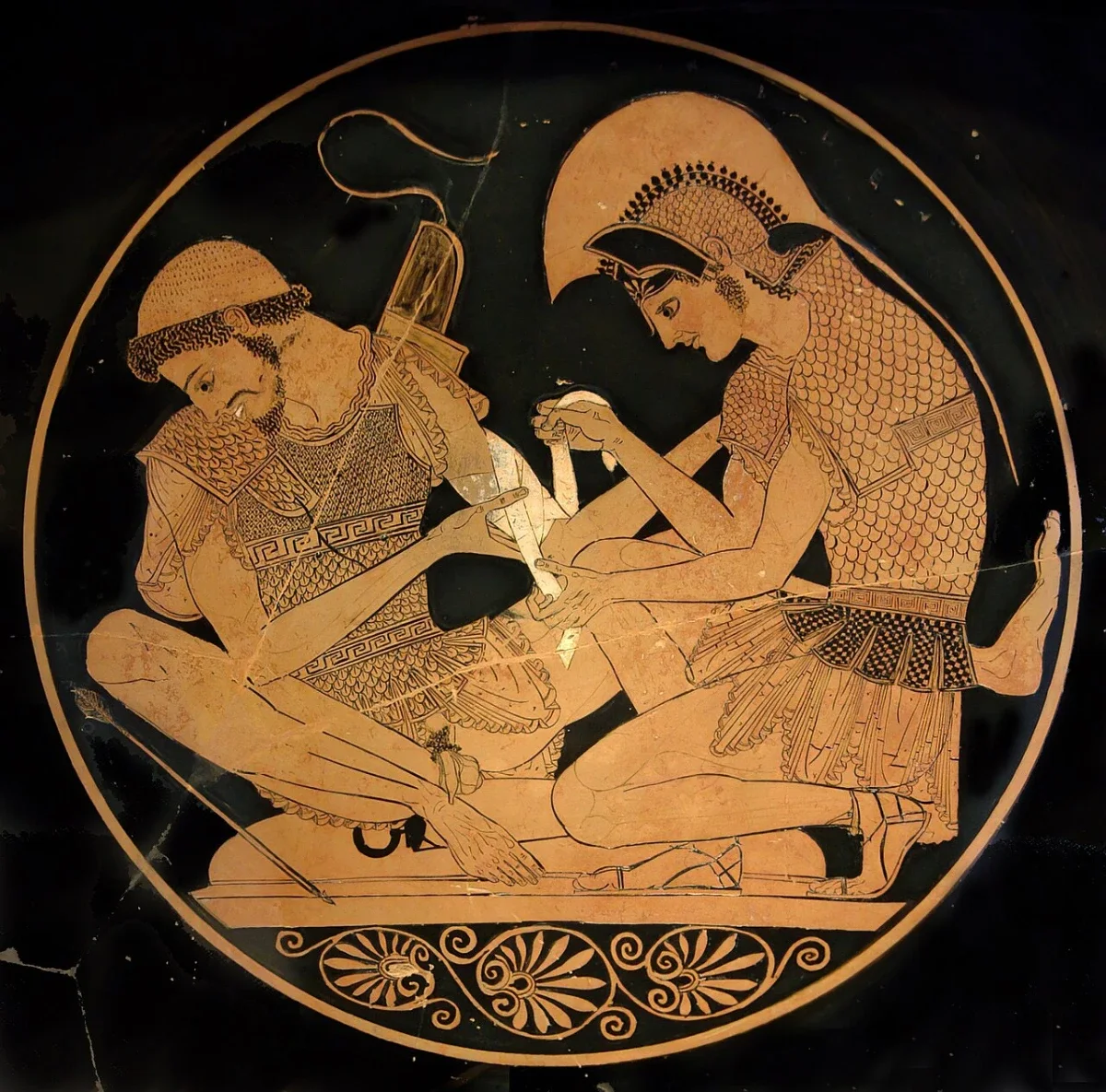
What the seven lines show
| feature | lines |
|---|---|
| masculine caesura | 1, 3, 7 |
| feminine caesura | 2, 4, 5, 6 (the proportion 4:3 is Homer’s overall ratio too)[15] |
| bucolic caesura | 4 (ἑλώρια ¦); West gives 47% for Homer as a whole[7] |
| contracted bicipitia | first: 3, 4, 5, 6; second: 2, 3, 4, 6; third: 1, 3, 7; fourth: 2, 6, 7; fifth: none (the fifth is the biceps least often contracted, about once in 20 lines in Homer)[16] |
| word-end after a contracted biceps | 3 (πολλὰς δ’, first foot, where it is frequent) and 2 (Ἀχαιοῖς, fourth foot, ending in a long diphthong, as West leads one to expect); in 2 (ἣ μυρί’), 6 (τὰ πρῶτα) and 7 (καὶ δῖος) the contracted biceps is a prepositive, which counts with the following word[17] |
| Hermann’s Bridge | observed in every line: no word-end falls between the shorts of the fourth biceps |
| lengthening before stop + liquid | 3 (Ἄϊδι προ-, in the princeps), 6 (τὰ πρῶτα, in the biceps) |
| digamma | 7 (τε ἄναξ) |
| elision | 2 (μυρί’, ἄλγε’) |
| hiatus | 4 (δὲ ἑλώρια, at the feminine caesura), 7 (τε ἄναξ, digamma) |
| brevis in longo | 2 (ἔθηκε), 6 (ἐρίσαντε) |
Line 2 illustrates West’s point. The regular word-break makes the hexameter two cola, — ⏑ ⏑ — ⏑ ⏑ — ⏑ ¦ ⏑ — ⏑ ⏑ — ⏑ ⏑ — ×, and many formulae are shaped to fill one colon.[15] Lines 1 and 2 divide into two dactylic cola at the caesura in the same way.[18] In line 2 the second half, Ἀχαιοῖς ἄλγε’ ἔθηκε, fills the second colon exactly.
Notes
- ^ a b West 1987, pp. 12–13.
- ^ a b West 1987, p. 12.
- ^ West 1987, p. 15; Battezzato 2009, p. 139 n. 14.
- ^ Hephaestion, Ench. 7.2.
- ^ West 1987, p. 79.
- ^ West 1987, pp. 13, 24.
- ^ a b West 1987, p. 78.
- ^ West 1987, p. 4.
- ^ West 1987, pp. 16, 22.
- ^ West 1987, p. 9.
- ^ West 1987, p. 21.
- ^ West 1987, p. 22.
- ^ West 1987, p. 23.
- ^ West 1987, p. 16.
- ^ a b West 1987, p. 19.
- ^ West 1987, p. 20.
- ^ West 1987, pp. 9 n. 2, 20.
- ^ Battezzato 2009, p. 139.
Dactylic · 5 of 5
Contraction and word-placement: a specimen, Iliad 1.215–222
West illustrates the Homeric hexameter with eight lines of the Iliad. In them Achilles, about to draw his sword on Agamemnon, obeys Athena. West marks the main caesura of each line. On the right he gives the feet whose biceps is contracted, that is, filled by one long syllable instead of two shorts.[1] Below, ¦ is West’s caesura and the figures are his.
215 τὴν δ’ ἀπαμειβόμενος ¦ προσέφη πόδας ὠκὺς Ἀχιλλεύς·— ⏑ ⏑ — ⏑ ⏑ — ¦ ⏑ ⏑ — ⏑ ⏑ — ⏑ ⏑ — ×216 χρὴ μὲν σφωΐτερόν γε ¦ θεὰ ἔπος εἰρύσσασθαι— — — ⏑ ⏑ — ⏑ ¦ ⏑ — ⏑ ⏑ — — — × (1, 5)217 καὶ μάλα περ θυμῷ ¦ κεχολωμένον· ὧς γὰρ ἄμεινον·— ⏑ ⏑ — — — ¦ ⏑ ⏑ — ⏑ ⏑ — ⏑ ⏑ — × (2)218 ὅς κε θεοῖς ἐπιπείθηται ¦ μάλα τ’ ἔκλυον αὐτοῦ.— ⏑ ⏑ — ⏑ ⏑ — — — ¦ ⏑ ⏑ — ⏑ ⏑ — × (3)219 ἦ καὶ ἐπ’ ἀργυρέῃ ¦ κώπῃ σχέθε χεῖρα βαρεῖαν,— ⏑ ⏑ — ⏑ ⏑ — ¦ — — ⏑ ⏑ — ⏑ ⏑ — × (3)220 ἂψ δ’ ἐς κουλεὸν ὦσε ¦ μέγα ξίφος, οὐδ’ ἀπίθησε— — — ⏑ ⏑ — ⏑ ¦ ⏑ — ⏑ ⏑ — ⏑ ⏑ — × (1)221 μύθῳ Ἀθηναίης· ¦ ἣ δ’ Οὔλυμπον δὲ βεβήκει— ⏑ ⏑ — — — ¦ — — — — ⏑ ⏑ — × (2, 3, 4)222 δώματ’ ἐς αἰγιόχοιο ¦ Διὸς μετὰ δαίμονας ἄλλους.— ⏑ ⏑ — ⏑ ⏑ — ⏑ ¦ ⏑ — ⏑ ⏑ — ⏑ ⏑ — ×Swift-footed Achilles answered her: “Goddess, a man must keep the word of you two, however angry he is at heart; that is better. Whoever obeys the gods, they surely listen to him.” He spoke, held his heavy hand on the silver hilt, thrust the great sword back into its sheath, and did not disobey Athena’s word; and she had gone to Olympus, to the house of aegis-bearing Zeus among the other gods.
synthetic ∿
At 216 there is hiatus before ἔπος, originally ϝέπος. 218 has a hephthemimeral caesura (ἐπιπείθηται runs across the whole third foot).[2] At 219 καί is correpted, and at 221 (μῦ)θῳ.[1] West prints iota adscript (θυμῶι), and at 221 reads Οὐλυμπόνδε for Monro’s Οὔλυμπον δὲ. The scansion is the same.
| line | main caesura | contracted feet |
|---|---|---|
| 215 | masculine | none |
| 216 | feminine | 1, 5 |
| 217 | masculine | 2 |
| 218 | hephthemimeral | 3 |
| 219 | masculine | 3 |
| 220 | feminine | 1 |
| 221 | masculine | 2, 3, 4 |
| 222 | feminine | none |
Contraction changes the syllable count. A hexameter has from seventeen syllables (215, 222) down to twelve, if all five bicipitia are contracted.[3]
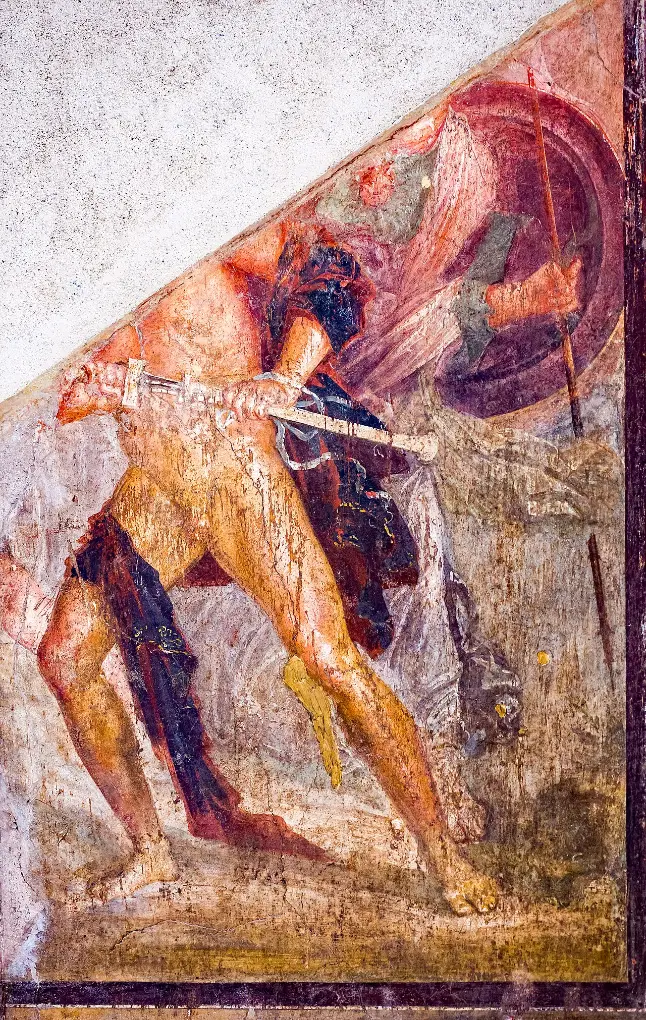
Why contraction is a strain
The biceps ⏑ ⏑ is longer than the princeps, in a ratio of about 6:5. The difference is small enough to allow one long for the two shorts. But it is “a slight strain on the rhythm”.[1] The ratio follows from West’s estimate that a long syllable in speech was worth about 5:3 of a short. So a long put into the biceps would have to be drawn out slightly.[4] For the same reason lengthening by a following consonant is largely restricted to the princeps. The biceps is the longer position, and needs more to fill it.[5]
Where words of several longs go
West writes a contracted biceps —̈.[6] Words with three consecutive long syllables are generally placed so that only one contraction is needed. So they scan — —̈ — (princeps, contracted biceps, princeps), or at verse-end —̈ — —, rather than —̈ — —̈. Words with four long syllables normally go at verse-end on the same principle, — —̈ — —, as εἰρύσσασθαι in 216.[1] Of 1,445 such words in the Iliad and Odyssey, over 95% stand at the end of the line. Aratus, Callimachus, Apollonius and Theocritus are stricter still.[7]
In the specimen ἐπιπείθηται (218) and Ἀθηναίης (221) end — —̈ —. In line 216 a dactylic fourth foot is followed by a four-syllable word, — — — ×. So it has the shape of the line that some Alexandrian poets affected, the σπονδειάζων.[8]
The fifth foot
Contraction is least common in the fifth foot, about once in twenty lines in Homer, and many of these cases arise from vowel contraction:[1]
ἔνθα δ’ ἀποβρίξαντες ἐμείναμεν Ἠῶ δῖαν.
There we slept and waited for bright Dawn.
Homer, Odyssey 12.7. Red: the contracted fifth foot, Ἠῶ (Ēō), from an older Ἠόα (Ēoa), — ⏑ ⏑.
synthetic ∿
Here Ἠῶ represents an earlier Ἠόα, — ⏑ ⏑. The second foot is contracted too. West prints ἀποβ’ρίξαντες, and inside a word stop + liquid normally makes the syllable before it long in early poetry.[9] West 2018 makes a similar point about lines ending — — | — —, citing the same phrase at Il. 11.723.[10]
Word-end after a contracted biceps: Wernicke’s Law
Word-division after a contracted biceps is frequent only in the first foot. In the fourth foot the word usually has a long vowel in its final syllable. It practically never ends in a short open vowel, as it does in Hesiod:[1]
Θείαν τε Ῥείαν τε Θέμιν τε Μνημοσύνην τε
Theia and Rhea and Themis and Mnemosyne
Hesiod, Theogony 135. Red: τε (te), a short vowel, ending a word in the contracted fourth biceps. Dashed bar: the caesura.
synthetic ∿
Θέμιν τε, with its postpositive, ends in the contracted fourth biceps. τε is long before Μν-. West marks -μιν and Μνη- as the fourth and fifth principes. The first τε is lengthened before Ῥ- in the second princeps.[11]
The second foot shows a similar but weaker tendency. Words with a long penultimate and a short vowel in the final syllable are placed for preference where they scan … — ⏑, or at verse-end. This is Wernicke’s Law. Prepositives count with the following word.[1]
A prepositive is a word that can only stand before another word: the article, a preposition, καί (kai) and most other conjunctions, and some particles. A postpositive can only stand after another word: every enclitic, and particles such as γάρ (gar), δέ (de) and μέν (men). In the rhythm of the sentence each leans on its neighbour, so for word-end it counts as part of it.[12] So this line is no exception:
μάντι κακῶν οὐ πώ ποτέ μοι τὸ κρήγυον εἶπας·
Prophet of evil, never yet have you said a good thing to me.
Homer, Iliad 1.106. Red: the article τό (to), which belongs with κρήγυον (krēgyon), filling the contracted fourth biceps.
David Chamberlain, Iliad 1.106 · CC BY 4.0
The article τό fills the contracted fourth biceps. West prints τὸ-κ’ρήγυον to join it to its noun. In the specimen the only word-end after a contracted biceps is in the first foot, χρὴ μὲν ¦ (216), with the postpositive μέν. At 220 the contracted biceps is the preposition ἐς, which counts with κουλεόν.[13] The Alexandrians went further, and avoided word-end after a contracted fourth biceps altogether (Naeke’s Law).[8] Nonnus avoided contracting the fifth.[14]
Maas’s version, and a difference of names. Maas comes to the same observation from prosody. A word whose last syllable is long only by position is often restricted in where it may stand. This holds above all for a word ending in a vowel after a long penultimate. In Homer such a syllable never fills the contracted fourth biceps, and seldom the contracted second. Maas credits this to Hilberg (1879). It agrees with the rarity West describes (Hesiod’s Θέμιν τε above is not Homer). Maas keeps the name Wernicke’s Law for a companion rule. A final syllable ending in a consonant is also seldom lengthened by position in the contracted fourth biceps (F. A. Wernicke, 1819). In the first biceps such lengthening is unrestricted.[15]
The two books therefore attach Wernicke’s name to different observations. West gives it to the placing of words that end … — ⏑. Maas gives it to final consonants in the contracted fourth biceps. Both are given here. For the Alexandrian rule Maas adds a companion to Naeke’s Law, Hilberg’s Law: no word-end after a contracted second biceps.[16]
Notes
- ^ a b c d e f g West 1987, p. 20.
- ^ West 1987, p. 19.
- ^ Kelly 2022, p. 41 n. 29.
- ^ West 1987, pp. 6–7.
- ^ West 1987, p. 22.
- ^ West 1987, pp. ix, 6.
- ^ Devine and Stephens 1994, pp. 105–106.
- ^ a b West 1987, p. 78.
- ^ West 1987, p. 16.
- ^ West 2018, p. 370.
- ^ West 1987, pp. 17, 22.
- ^ West 1987, p. 9 with n. 2.
- ^ West 1987, pp. 9 n. 2, 20.
- ^ West 1987, p. 79; see Development.
- ^ Maas 1962, p. 77.
- ^ Maas 1962, p. 62.


