Performance
Greek music at drinking parties, festivals, theatres and contests, from archaic to Roman times.
The music of Greek poetry: instruments, scales and notation, the surviving scores, and how melody and rhythm went with the words.
Performance · 1 of 7
Song at the symposium
The lyre, says Homer, is the companion of the feast. The bards Phemius and Demodocus sing to it after dinner.[1]
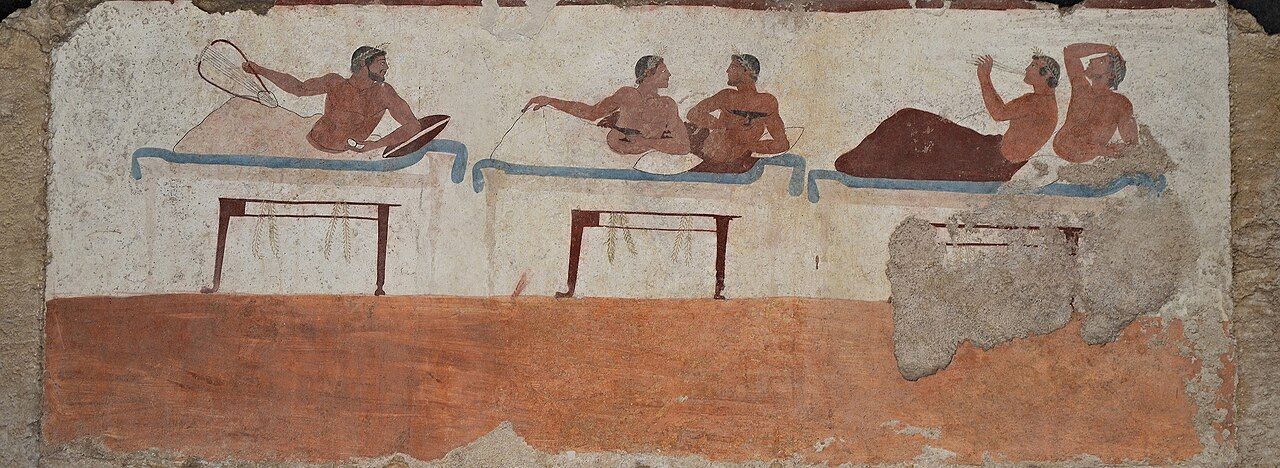
A Greek dinner was followed by a drinking party, the symposium. It was the home of a great part of the poetry on this site. Much of the elegiac and lyric verse of the seventh to fifth centuries was composed for it.[2]
How it went
The order of a classical symposium can be reconstructed from Dicaearchus and the comic poets. After the meal came the libations, with a paean sung at the third, to Zeus the Saviour. Then a branch of bay or myrtle was passed round. Each guest in turn sang or recited, and a hired piper, male or female, accompanied him. Then the skilled took the lyre and sang to it.[3]
Elegiacs were sung to the pipe. Lyric metres were sung by the singer to his own lyre or, less often, to a harp. Theognis speaks of lads with alto pipes.[2]
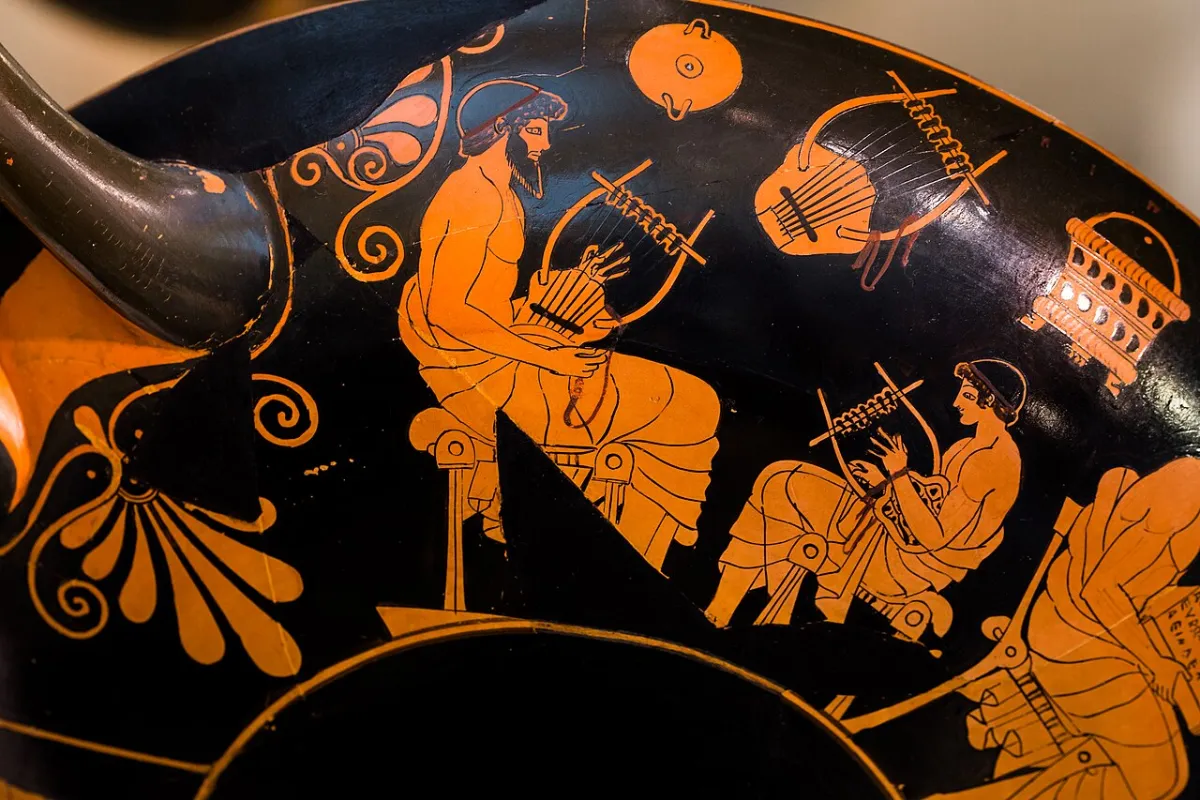
The instruments were the bowl lyres. One was the lyra. The other, from the late sixth century, was the long-armed barbitos. The barbitos belongs to the symposium and the revel, and it is the instrument the vase-painters give to Anacreon and to Sappho.[4]
The songs of the lyric poets were, by design, performable by an amateur on a seven-stringed lyre. That is what separates them from the professional music of the later fifth century.[5]
Skolion: A drinking song passed round the company. Athenian symposiasts of the fifth century sang the old poets, Alcaeus, Anacreon and Simonides, and the popular songs about Harmodius the tyrannicide.
What was sung
Fifth-century Athenians sang the classics at their parties: Alcman, Alcaeus, Stesichorus, Anacreon, Simonides, Phrynichus and Pindar. Their dialects were Atticised in the singing. They also sang the popular Harmodios songs.[6]
West calls the form of these songs the closed strophe. It has two to six lines of familiar verse, in patterns such as AAAB or AAB. The tune is one of statement and answer. It has half-cadences off the tonic, and a full cadence on the tonic or a fourth below.[7]
The Anacreontic vases of 520 to 460 show revellers in East Greek dress with a barbitos, and one of them is labelled Anacreon. They record the fashion the poet brought to Athens.[8]
Lyre-playing was part of a gentleman’s education. Themistocles was looked down on for not playing. In the 420s “he can’t play the lyre” meant “uneducated”.[3]
The end of the singing symposium
At the end of the fifth century the fashion changed. Each guest no longer sang. Instead the company heard speeches from the new dramas, or hired dancing-girls, acrobats and instrumentalists, or simply talked.[3] The change went with the rise of professional instruments, too elaborate for a citizen to own or play.[5]
Women had their own music, in their own quarters. In Plato, when the men decide to talk instead, Agathon sends the piper away to play to the women.[9]
In the Hellenistic age, professional singers supplied the lighter entertainment of the party. These were the hilarodes and the rest, singers of parody and mime. They performed to a harp, or to pipes of a particular kind.[10]
Notes
Performance · 2 of 7
Chorus and dance
Most Greek music that was not sung at a party was sung by a chorus, and a chorus danced. Choruses sang in processions at the great festivals, with a piper walking beside them. They sang at sacrifices, and at weddings, victories and funerals. And they sang the two great species of cultic song: the paean for Apollo, and the dithyramb for Dionysus.[1]
The dithyramb at Athens
At the City Dionysia each of the ten Athenian tribes entered a chorus of men and a chorus of boys, each fifty strong. They danced in a circle with the piper in the middle. So in a single festival a thousand citizens sang in competition, and other festivals had male choruses too.[2]
Landels gives the same numbers, with the tribes competing for the best composers and chorus-masters. But on one point he differs from West. The dithyrambic choirs, he thinks, stood in their circle, and did not dance as the choruses of drama did.[3]
Not all the members could sing. Some were drafted who kept silent, and they were put at the edges. A chorus depended on its leader in the middle.[4] One pair of pipes sufficed to lead fifty voices.[5] Men and boys singing together sang an octave apart, the only parallel the Greeks recognised. Otherwise a chorus sang in unison.[6]
Sizes varied:
- Alcman’s maiden-song had ten girls.
- Aeschylus’ tragic chorus had twelve, and the later one fifteen.
- The comic chorus had twenty-four, and the dithyrambic fifty.
- By the Hellenistic age, professional choruses of five or seven did the work.[7]
The conventional picture of choral lyric, as Landels sums it up, is a chorus of twelve to fifty singing on public occasions. It was usually of men, but sometimes of women or girls. It sang with a piper, or a kithara-player, or both.[8]
Choregos: At Athens, the citizen who paid for and equipped a chorus. In the Dorian states the word means the leader who trained and led it. Alcman’s girls had one, and later tradition made Sappho a chorus-trainer.
Girls’ choruses and Dorian training
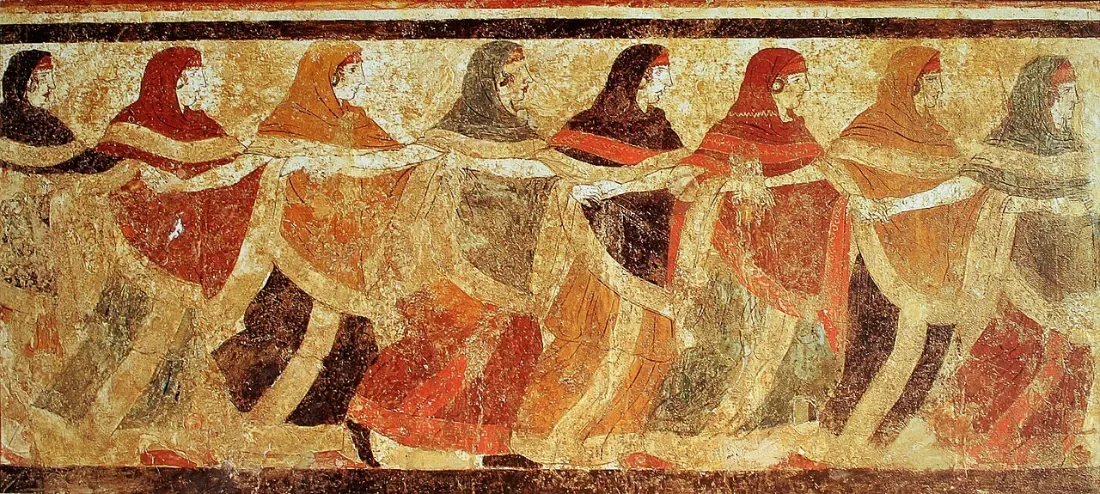
Choruses of girls were a feature of the Dorian cities. There were Alcman’s maiden-songs at Sparta in the late seventh century, and the Delian maidens of the Hymn to Apollo. There were choruses at Delphi and Thebes, and partheneia by Pindar, Simonides and Bacchylides.[9]
The Dorian states institutionalised choral training. Cretan “herds” of boys learned armed dances and paeans. Alcman’s girls had a chorus-leader. Later tradition made Sappho a music-teacher, and a leader of choruses in a “house of the Muses’ servants”.[10]
It was at Sparta, West suggests, that the larger strophes needed by a dancing chorus were developed. Thaletas enlarged Archilochus’ forms, and Alcman wrote strophes of fourteen lines.[11] Choral song was accompanied mainly by the kithara. But Alcman names pipes, and an early seventh-century Attic jar shows a piper and a lyre-player leading women.[12]
Triads and dance
The choral lyric of Stesichorus, Pindar and Bacchylides is built in triads. A triad is a strophe, an antistrophe and an epode: AAB. West takes the form to go with the dance. The open strophe of this poetry is made of periods never reused, so each poem is unique.[13]
Anderson, following Campbell, draws the same line. The long triad and its complex metres belong to the public voice of choral poetry. The short repeated stanza and the simpler metres belong to the solo singer at the symposium.[14]
Whether Pindar’s epinicians were sung by a chorus or by a soloist is disputed. Lefkowitz and Heath argue against Burnett and Carey, and West records the controversy without closing it.[15]
Landels takes the traditional side. Pindar seems to him to have used a chorus of young men, who sang and danced to kithara or pipe or both. The poet himself normally played and directed. An ode “despatched” to a distant city would be rehearsed there by local professionals.[16]
We do not know the dance figures or the beat of a single Pindaric ode. The names of the figures show how much is lost.[17] What a chorus did with its feet was part of the rhythm. Dancers clapped and stamped, and the piper’s clapper-shoe kept the time.[18]
Chanting
Between song and speech lay parakatalogē, “recitation alongside”. This was the delivery of verse to instrumental accompaniment, and tradition ascribed it to Archilochus. In drama it probably covered the marching anapaests of a chorus’s entry, hexameters and trimeters in a lyric context, and some tetrameter scenes. West thinks “chanted” the nearest English word.[19]
Landels reaches the same conclusion for the anapaests by another route. The speaking voice is far weaker than the singing voice, and the pipe was loud. So a chorus of twelve or fifteen speaking would have been drowned. The words were probably chanted on one note, or on a short repeating pattern.[20]
Notes
- ^ West 1992, pp. 14–17, 21–24.
- ^ West 1992, pp. 16–17.
- ^ Landels 1999, c. pp. 4–5.
- ^ West 1992, pp. 34, 46–47.
- ^ West 1992, p. 39.
- ^ West 1992, pp. 40–41.
- ^ West 1992, p. 41.
- ^ Landels 1999, c. pp. 12–13.
- ^ West 1992, pp. 17–18.
- ^ West 1992, pp. 36–37.
- ^ West 1992, pp. 335–336.
- ^ West 1992, p. 336.
- ^ West 1992, pp. 211–212.
- ^ Anderson 1994, p. 73.
- ^ West 1992, p. 346.
- ^ Landels 1999, c. p. 6.
- ^ Phillips 2018, pp. 79–81.
- ^ West 1992, pp. 122–124, 133–134.
- ^ West 1992, p. 40.
- ^ Landels 1999, c. pp. 16–17.
Performance · 3 of 7
Music in the theatre
Athenian drama was a musical form. The dramatic contests at the Lenaea and the City Dionysia consisted of choral song and dance, and lyric exchanges between chorus and actors. After Aeschylus they also had solo arias.
Phrynichus was remembered for the sweetness of his tunes. Aristophanes staged a quarrel over the music of Aeschylus and Euripides. And the Athenian prisoners at Syracuse in 413 were said to have been fed for singing Euripides.[1]
How a tragedy was made
The poet applied to the archon for a chorus. He was his own melodist, choreographer and chorus-trainer.[2] A play had five musical elements:[3]
- strophic choral songs;
- lyric exchanges between chorus and actors;
- from the middle of the fifth century, astrophic arias for a solo actor;
- recitation to accompaniment;
- instrumental interludes.
The chorus numbered twelve under Aeschylus, and fifteen later. There was one piper. The aulos was the theatre’s only instrument. When the words called for it, it stood in for the syrinx or the lyre.[4] Sophocles is said to have played the kithara himself in his Thamyras.[5]
Euripides’ Electra gives a measure of how much was sung. About a fifth of the first eleven hundred lines are accompanied, and about seven-tenths of the last two hundred.[6]
Monody: A solo aria for an actor, astrophic and emotional. It was the great innovation of the later fifth-century stage. Agathon kept his Hypodorian and Hypophrygian for monodies alone.
The tragedians’ music
The older tragedians composed in the enharmonic genus, or in enharmonic mixed with diatonic. Euripides or Agathon first brought in the chromatic. Euripides first used the full range of notes, where the older style was “gapped”.[7]
The Dorian and Mixolydian were the principal tragic modes, with the Ionian and slack Lydian. Sophocles added the Lydian and Phrygian. Agathon added the Hypodorian and Hypophrygian, for his monodies.[8]
Aristophanes parodied them all:
- Aeschylus’ songs run on in rolling dactyls, like a rope-maker’s.
- Sophocles widened the modes and rhythms, and was Aristophanes’ favourite.
- Euripides, in the Frogs, is accused of taking his tunes from tarts’ songs, Carian pipe-airs and dirges. He is mocked for the trill he wrote on a single syllable.[9]
We have two Euripidean scores, the Orestes papyrus among them. They are best read as enharmonic. The editors think the Orestes music is likely Euripides’ own.[10]
Csapo has argued that Euripides’ engagement with the New Music is datable before 420, and was no late dabbling. That engagement shows in his monodies and duets, and in astrophic choruses given to women and foreigners.[11] Agathon, who first won in 416, went further. He wrote chromatic, winding melodies, soft pipe music, and choral interludes unrelated to the play.[12]
Comedy was mainly choral, with a chorus of twenty-four and a piper. It had simpler rhythms, popular song forms such as the wedding hymns of the Peace and Birds, and more recitative.[13]
The New Music also found a use for quiet. The hushed lyric dialogues over sleepers in Euripides and Sophocles suggest dynamic restraint as a new resource.[14]
Afterlife
Old tragedies, Euripides’ above all, held the Hellenistic stage, and recitalists quarried them:
- The papyri that preserve Euripidean music are collections of lyric excerpts, not texts of plays.
- A piper at Delphi about 194 BC performed an arrangement from the Bacchae.
- Nero sang the heroes and heroines of tragedy in their masks.
- A papyrus of the first or second century AD lists a piper’s programme of songs from Hypsipyle, Medea and Antiope.[15]
Notes
- ^ West 1992, p. 17.
- ^ West 1992, pp. 350–351.
- ^ West 1992, p. 351.
- ^ West 1992, p. 351; Weiss 2018, pp. 140–144.
- ^ Weiss 2018, p. 141.
- ^ Thomas 2018, p. 99.
- ^ West 1992, pp. 164–165, 351–352.
- ^ West 1992, p. 352.
- ^ West 1992, pp. 352–354.
- ^ West 1992, pp. 353–354; Pöhlmann and West 2001, pp. 14, 16.
- ^ Thomas 2018, pp. 99–100.
- ^ West 1992, pp. 354–355.
- ^ West 1992, p. 355.
- ^ West 1992, pp. 44–45.
- ^ West 1992, pp. 376–378.
Performance · 4 of 7
Cult and competitions
Greek religion was sung. A festival opened with a procession and a singing chorus, usually with a piper. A sacrifice had a piper too, and Herodotus remarks on the Persians for doing without one.[1]
The Panathenaic procession had its pipers and kithara-players, two of each on the vases and four of each in sculpture. There were pipers at the many sacrifices. The music of such occasions was the paean and the processional song, the prosodion.[2]
The paean was sung on many occasions:
- after dinner, at the start of a symposium;
- in wedding processions;
- by soldiers going into battle, and in triumph;
- on any occasion of danger, from the plague in the first book of the Iliad to an eclipse or an earthquake.
It belonged mostly to Apollo. It could be choral or solo, with or without lyre or pipes. It was danced in procession, or on the spot.[3]
Music that heals
The Greeks believed in music’s power over the mind and the city. Terpander was summoned by an oracle to calm Sparta. Thaletas of Gortyn delivered it from plague. Pythagoras is said to have sobered a youth by changing the tune of a pipe.
None of this is history. But the Pythagoreans did practise a musical psychotherapy. And fringe medicine prescribed pipe music for fainting, epilepsy and sciatica.[4] The verb for bewitching someone was “to pipe on” them.[5]
Contests
Hesiod won a tripod singing at a funeral games. From about 525, relays of rhapsodes recited the whole Iliad and Odyssey at the Great Panathenaea. The Pythian festival at Delphi and the Karneia at Sparta had citharodes’ contests in the seventh century.[6]
The Pythian festival was reorganised in 586, with contests for singers to the pipe and for pipers. Sakadas of Argos won three times running with a programme piece. A contest for solo kithara was added in 558.[7]
The Pythian games were the musical games. Their most prestigious event was singing to the kithara, with one man as poet, composer, singer and his own accompanist. The aulodic pieces, said to have been funereal, were dropped from the programme about 578 BC, though Landels marks the report uncertain.[8]
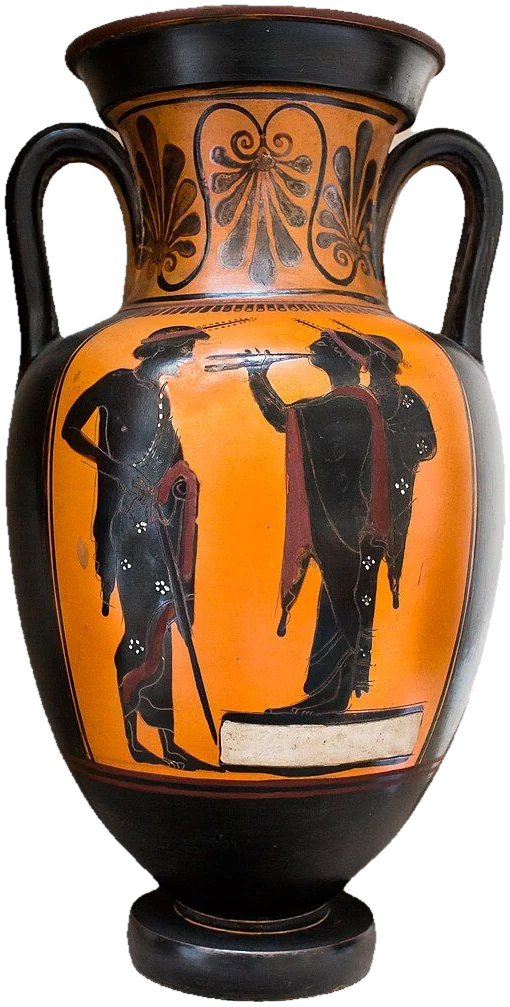
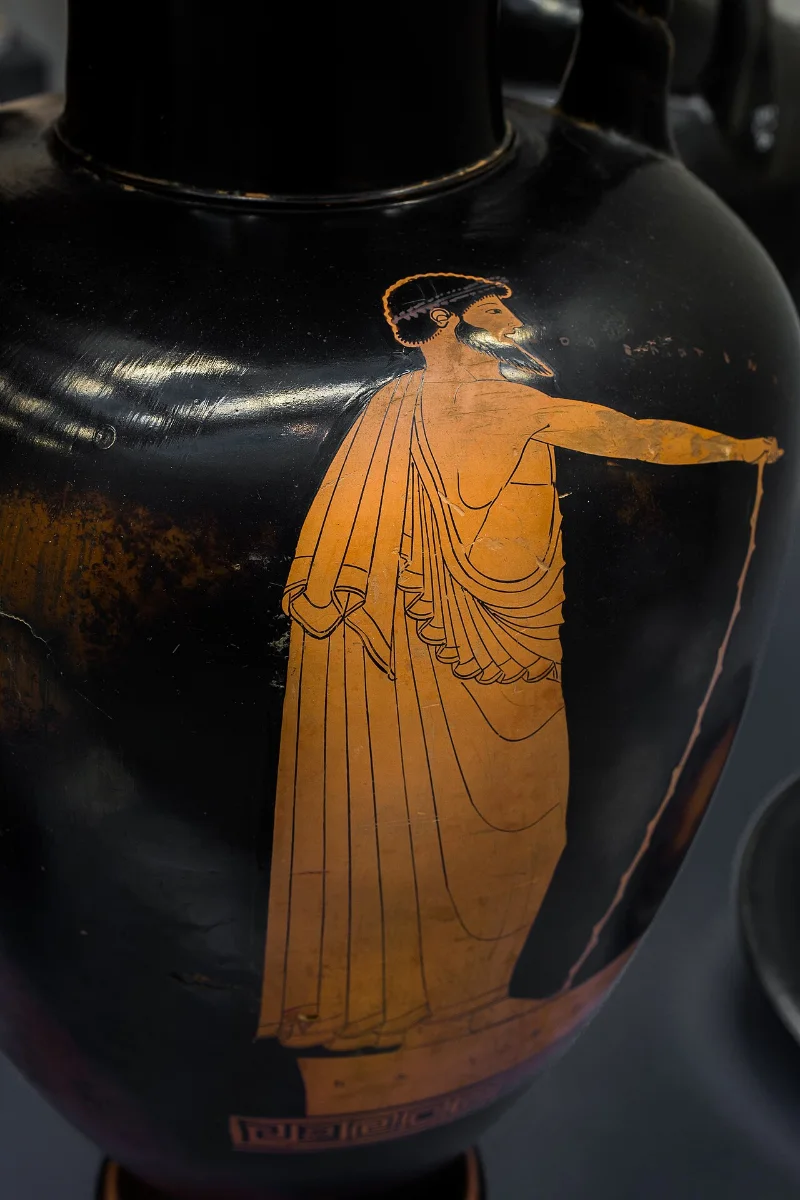
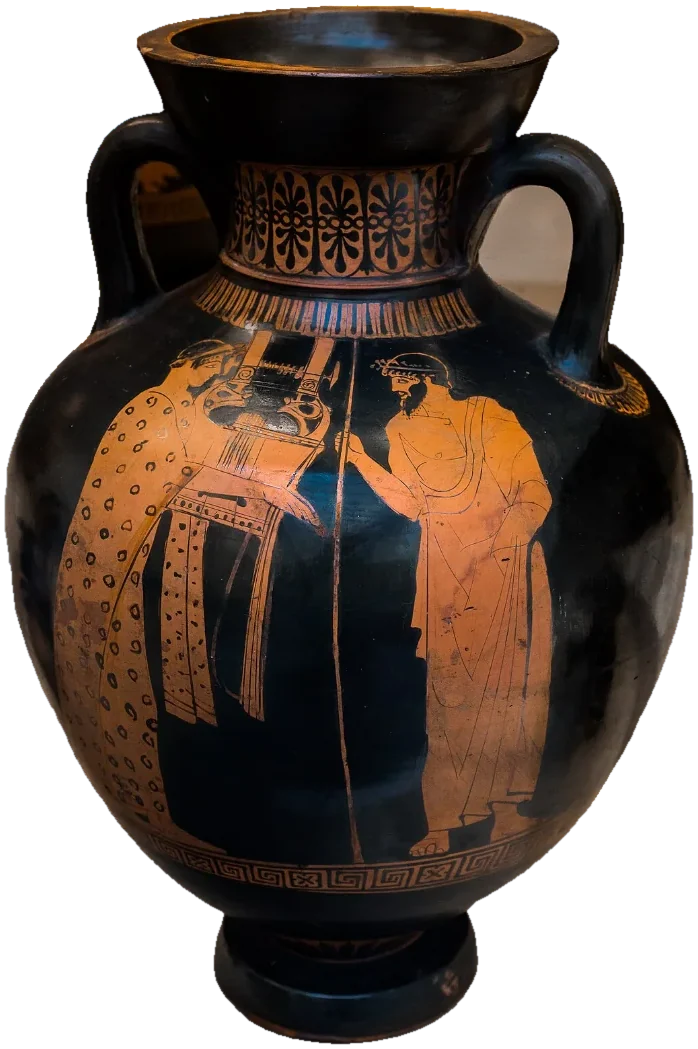
About 566 the Panathenaea were reorganised, with contests for citharodes, aulodes and auletes. They are shown on the vases performing on a podium before a seated judge.[9] The four titles mean different things:[10]
- A citharode sang to his own kithara.
- A citharist only played.
- An aulode sang to a piper.
- An aulete played.
The citharode’s instrument was the great concert kithara. Free men played it standing, in an ornamented ankle-length robe.[11]
The prizes were large. At the Panathenaea of the early fourth century the first citharode took a gold crown worth a thousand drachmas, and five hundred in cash. At Eretria about 340 the citharodes’ prizes ran to twice the rhapsodes’.[12]
Pythikos nomos: The pipers’ programme piece at the Pythian Games. It depicted Apollo’s fight with the serpent in five sections, with a “whistling” passage for the monster’s dying hisses. Sakadas won with it in 586, 582 and 578.
The nomos
The free, through-composed form that the New Music later exploited began in these instrumental contests. The Pythikos nomos told the story of Apollo and the serpent in five named sections: trial, challenge, the “iambic” with its trumpet-like notes, the libation, and the victory dance. Midas of Acragas, Pythian champion in 490, commissioned an ode from Pindar for his victory (the five-section piece as programme music also in Landels 1999, c. p. 5).[13]
The word nomos covered a particular named melody for a formal setting. It could be citharodic, citharistic, aulodic or auletic. Nomoi were named after gods, peoples, composers, occasions or features. At Athens the word came to mean the citharodes’ genre.[14]
A late witness is Proclus, as excerpted by Photius. He derives the nomos from the paean. He sets the two great genres apart by their scales and their temper. The nomos is orderly and Apolline, in the Lydian scale of the citharodes. The dithyramb is ecstatic, in Phrygian and Hypophrygian.[15]
The Hellenistic festival
The number of festivals and contests grew in the Hellenistic age. Musical contests were added to the Nemean and Isthmian games, and kings founded new festivals. Alexander’s wedding at Susa was entertained by rhapsodes, citharists, citharodes, aulodes, pipers, actors and a harpist.[16]
From about 290 the professionals organised themselves into guilds, the Artists of Dionysus. There were guilds at Athens, at the Isthmus and Nemea, and at Teos. They honoured the gods with hymns and paeans. They also supplied the choruses for the festivals, which were now of professionals.[17]
The Athenian guild went up to Delphi for the Pythais of 128 BC. It took thirty-nine singers to perform the paeans of Athenaios and Limenios, which were cut into the treasury wall.[18] An organist from Crete, Antipatros, so impressed Delphi in 90 BC with two days of playing that the city heaped him with honours.[19]
Notes
- ^ West 1992, pp. 14–15.
- ^ Landels 1999, c. pp. 2–3.
- ^ West 1992, pp. 15–16.
- ^ West 1992, pp. 31–33.
- ^ West 1992, p. 33.
- ^ West 1992, pp. 18–19.
- ^ West 1992, pp. 337–338.
- ^ Landels 1999, c. p. 5.
- ^ West 1992, p. 19.
- ^ West 1992, p. 18 n. 23.
- ^ Anderson 1994, pp. 176–177.
- ^ West 1992, p. 368.
- ^ West 1992, pp. 212–214, 35.
- ^ West 1992, pp. 216–217.
- ^ Nowacki 2020, p. 22.
- ^ West 1992, p. 373.
- ^ West 1992, pp. 374–375.
- ^ West 1992, p. 375.
- ^ West 1992, p. 380.
Performance · 5 of 7
Army and fleet: music at work and at war
Peace was the time of the pipe and the lyre. The poets deplore war and death alike as being “without the aulos”.[1] But the Greeks did not go to war in silence. Music kept soldiers and oarsmen in time, the trumpet gave orders, and the fleet sang as it rowed into battle.
In step and in time
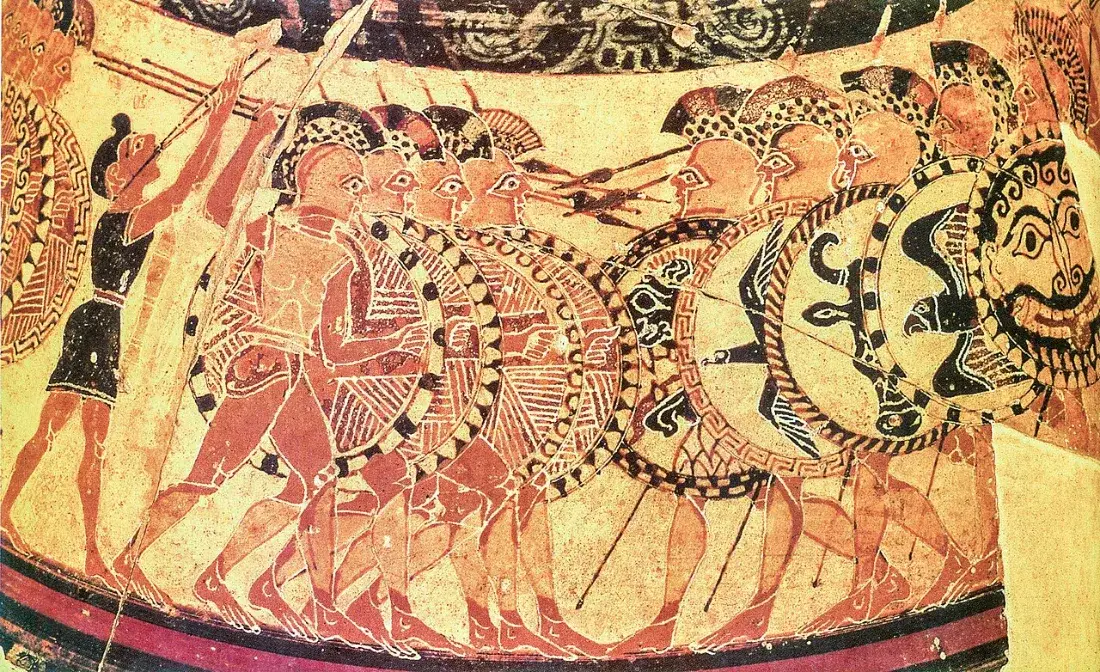
Whether Greek soldiers normally marched in step is not certain. A Corinthian vase of the late seventh century shows them doing so behind a piper. But the same painters give synchronised steps to huntsmen attacking a boar.[1]
The evidence is firmer for Sparta. Its army advanced to pipers so as to keep an even rhythm, as Thucydides explains, and not for any religious reason.[2]
At sea the point was practical. A trireme carried 170 rowers, who had to be kept strictly together. Besides the boatswain’s calls, percussion and sometimes a pipe set the stroke. When Alcibiades sailed home from exile in 408, a famous virtuoso, Chrysogonus, piped the time.[3]
The Greek fleet sang a paean as it rowed out at Salamis. The messenger in Aeschylus’ Persians (386–394) describes it echoing from the island rocks and dismaying the Persians. For Landels this is the plainest sign of how readily music came to a Greek, even in battle. He takes the chant to have been in cretic rhythm. He leaves it to naval experts whether the oar-strokes fitted its 2 + 3 or its 3 + 2.[4]
The trumpet’s notes
The salpinx was for signals, and was not counted a musical instrument.[5]
Landels works out what it could sound. A straight tube about a metre long has a fundamental near B♭, an octave and a tone below middle c. An instrument of this kind does not normally sound its fundamental. So the lowest usable note would be an octave up, about b♭ (228 Hz), with the next two or three harmonics above it. The calls, he concludes, must have been very like modern bugle-calls. There is some evidence of traditional calls for attack and retreat.[6] The drum had no part in Greek military music.[7]
The oldest score?
An epinētron is a piece of pottery shaped like half a flask. Landels thinks it was set on the knee to protect it while sewing. A black-figure epinētron found at Eleusis in 1883 carries battle scenes. On it an Amazon blows a trumpet, with the letters ΤΟΤΕ ΤΟΤΟΤΕ painted about her mouth.[8]
The letters were long taken for nonsense. Annie Bélis read them as a form of the solmisation syllables (ta, tē, tō and the rest). These are the syllables that Aristides Quintilianus and others assign to the notes of the tetrachord.
Landels accepts the reading. He calls the piece one of the most unusual scores to have come to light, and by far the oldest, and dates it to the sixth century. He notes that three or four syllables would suffice for the trumpet’s harmonics, though how they were assigned is unknown.[9]
The editors of the scores date the vase to the early fifth century, and give it to the Sappho Painter. They print it first in their collection. But they take the letters as onomatopoeia for the trumpeter’s tonguing, like Ennius’ taratantara. West elsewhere calls Bélis’ reading bold.[10]
Anderson allows that, if Bélis is right, it is the only notation securely datable to the fifth century. Hagel leaves it out of the notated documents altogether.[11] So the date and the reading are both disputed. The vase stands at the head of the catalogue of scores with a question mark.
Notes
- ^ a b Landels 1999, c. p. 8.
- ^ West 1992, pp. 29–30.
- ^ Landels 1999, c. p. 8; West 1992, p. 29.
- ^ Landels 1999, c. pp. 8–9, 121.
- ^ Landels 1999, c. p. 8; West 1992, p. 118.
- ^ Landels 1999, c. pp. 79–80.
- ^ Landels 1999, c. p. 81.
- ^ Landels 1999, c. p. 80; Pöhlmann and West 2001, pp. 8–9.
- ^ Landels 1999, c. p. 80.
- ^ Pöhlmann and West 2001, pp. 8–9; West 1992, pp. 120, 277.
- ^ Anderson 1994, pp. 203–204; Hagel 2009, p. 256 n. 1.
Performance · 6 of 7
The New Music
In Aristophanes’ Clouds the old-fashioned Argument remembers how boys used to sing the hymn to Athena in the tuning their fathers had used. They were thrashed for putting in “bends” in the manner of Phrynis.[1]
The bends were modulations. By the last quarter of the fifth century a generation of dithyrambists and citharodes had made modulation, extra notes and free form the sound of modern music. In Pherecrates’ comedy Chiron, the lady Music herself complains to Justice. She lists what Melanippides, Cinesias, Phrynis and Timotheus have done to her, with their “dozen strings”.[2]
The innovators
Melanippides of Melos was active from about 440. He replaced the antistrophes of the dithyramb with instrumental interludes. That made it through-composed, and let the melody follow the words. After him the piper in a dithyramb did more than accompany.[3]
Phrynis of Lesbos was a Panathenaic victor, probably in 446. He raised the kithara’s strings from seven to nine. He modulated, and he mixed hexameters with free verse in his nomes.[4]
Timotheus of Miletus beat him about 420, and boasted of it in song. His kithara had eleven strings. His Persians is several hundred lines on the battle of Salamis. It opens in hexameters and then runs free. It varies mode and voice to paint the surge of the sea, the drowning Persians, and a barbarian pleading in broken Greek.[5]
His dithyrambs were mimetic too. They depicted a storm at sea and the birth-pangs of Semele. In his Scylla the pipers made a show of grabbing at the chorus-leader.[6]
Philoxenus of Cythera changed mode, genus and rhythm within a song. His Mysians moved from Hypodorian through Hypophrygian and Phrygian to Dorian and Mixolydian. He wrote his Cyclops in the quarries of Syracuse, after he had trifled with the tyrant’s mistress. It was a dithyramb with two singing soloists, what West calls a chamber opera.[7]
Kampē: A “bend”: the comic poets’ word for a modulation out of the tuning a song began in. Phrynis was mocked for them. Timotheus went further, and Aristophanes compared Agathon’s melodies to the tracks of ants.
The star performers
The age belonged to the virtuoso:
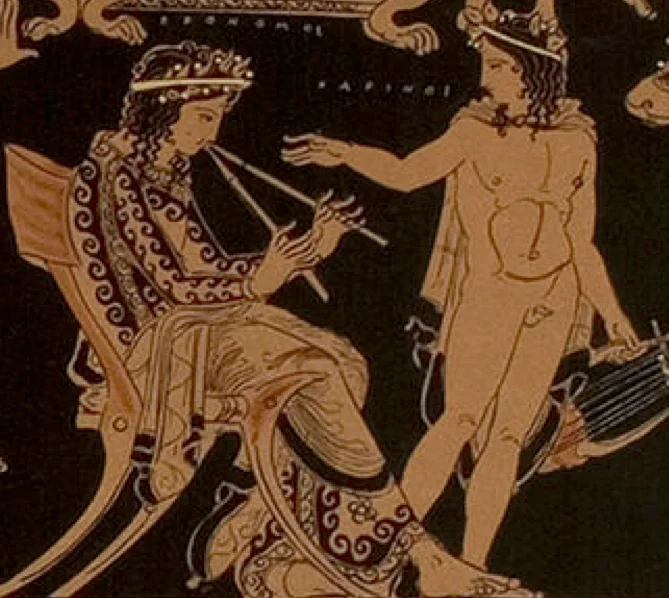
- Pronomus of Thebes is pictured on the vase that bears his name. He charmed his audience with his face and his whole body, and devised pipes that played several scales.
- Antigeneidas developed a “moulded” style of playing, which changed the season for cutting reeds.
- Stratonicus of Athens first played solo kithara on more than seven strings. He taught harmonics with a diagram.[8]
The victory inscriptions had named only the sponsor and the composer. In the fourth century they began to name the piper too, at first after the composer and later before him.[9]
The technical change can be summed up in five points. Music now had modulation, strings multiplied to eleven, and mechanical pipes. The old modes were turned into keys. And professional music was something the citizen could no longer play at his own table.[10]
D’Angour connects the same revolution with the need for notation. A song that broke the traditional patterns had to be written down, to be sung as its composer meant.[11]
Resistance
Not everyone followed. Some musicians kept to the old style of Simonides and Pindar. The piper Telephanes refused to let the new syrinx device be fitted to his pipes, and stayed away from the Pythian Games because of it.[12]
Plato, following Damon, banned the new music from his ideal city. It lived by imitation of women, slaves, animals, rivers and storms. In the Laws he describes composers who mixed dirges with hymns, and judged music by pleasure. In the end the audience, once silent, became vocal, and the theatre ruled: a “theatrocracy”.[13] Aristoxenus mourned a music that had gone over to the concert hall.[14]
West’s reply is to quote what nineteenth-century critics said of Beethoven. These composers extended music’s resources and freed it from conventional forms. The change is not unlike that from Classicism to Romanticism.[15]
The public agreed. Timotheus became a classic. His Persians was sung at Nemea in 205 BC, and his nomes were taught to Arcadian boys in Polybius’ day.[16]
Notes
- ^ West 1992, p. 356.
- ^ West 1992, pp. 356–357.
- ^ West 1992, pp. 357–358.
- ^ West 1992, p. 360.
- ^ West 1992, pp. 361–363.
- ^ West 1992, pp. 363–364; see the Timotheus page in the Poets section.
- ^ West 1992, pp. 364–366.
- ^ West 1992, pp. 366–368.
- ^ West 1992, p. 367.
- ^ Hagel 2009, pp. 444–445.
- ^ D’Angour 2018, pp. 58–59.
- ^ West 1992, p. 369.
- ^ West 1992, pp. 369–370.
- ^ West 1992, p. 370.
- ^ West 1992, p. 371.
- ^ West 1992, pp. 381–382.
Performance · 7 of 7
The later centuries and the Byzantine echo
After Aristoxenus the record of composers goes almost silent. For four hundred years we know the names of dozens of singers, pipers and actors, but of hardly any composers. The exceptions are those that chance has recorded on stone, like Athenaeus and Limenius at Delphi, and Mesomedes under Hadrian.[1]
The public cared for performers, and the performers for their repertory. Yet the documents show that the music itself went on changing.[2]
The Hellenistic world
The papyri of the third and second centuries BC are scraps of tragic lyric, copied for recitalists. They show modulation between chromatic and diatonic, and between conjunct and disjunct tetrachords. They mark key-changes with signatures, and they have ornamental notes outside the scale.[3]
The Delphic paeans of 128 BC have fifteen notes, a free form and a modal plan. In West’s view they are music still in the line of Timotheus.[4]
Old tragedy, Euripides especially, held the stage in excerpts. One Themison of Miletus was honoured in the second century AD as the first to set Euripides, Sophocles and Timotheus to music of his own.[5]
Lower down the scale were the entertainers:
- the hilarodes, who parodied tragic song;
- the magodes, with drums and cymbals, in women’s dress;
- the women lysiodes, with their boneless dancing.
Higher up were women citharodes, such as Glauce of Chios at the court of Ptolemy II.[6]
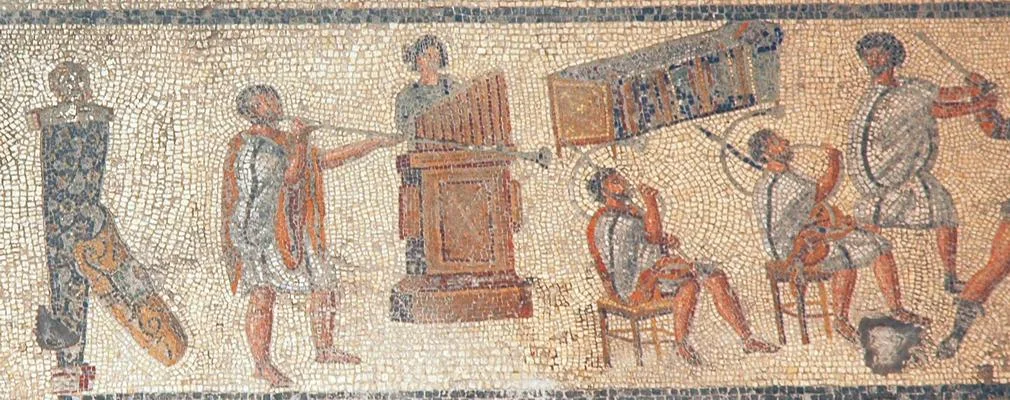
The instruments grew. There were lyres of up to eighteen strings, pipes specialised for chorus or solo, and harps on the public stage. And there was the organ, from Delphi in 90 BC to the gladiatorial arena.[7]
Under the emperors
Between about 100 BC and the first century AD the evidence fails. When it resumes, the style has changed.[8]
The imperial pieces are fully diatonic and less elaborate, with little modulation. The Hellenistic music had centred on mesē, in what West calls an E or A mode. The later pieces are in E, G or C modes. In place of the old tetrachordal thinking there is sometimes a clear sense of a major or minor triad, and of the interval of a third.[9]
Mesomedes is the only composer of this age whose name lasted. His work was transmitted into the Middle Ages with the treatises. West finds his music limited beside the paeans, whose composers left no echo.[10]
The papyri of the second and third centuries show a more florid style, with syllables divided among several notes. The latest piece in the ancient notation is the Christian hymn from Oxyrhynchus. It is the most developed of them, and beneath its ornaments lies a single plain diatonic scale.[11]
The Roman-period melodies gave up the old enharmonic keys for chromatic ones. The Iastian became the typical key of the pipers.[12]
Theatrocracy: Plato’s word for the rule of the audience over music. By the Roman period West sees its results: performers over composers, repertory over novelty, and a public that esteemed high notes and massed sound.
The end of the notation
The notation went out of practical use about the fourth century. Gaudentius implies it was no longer current, and the latest notated papyri are of the late third century.[13]
With it ended the old professionalism. In the sixth century the philosopher Olympiodorus could write that nothing of Hellenic music survived but the rumour of it.[14]
The Greeks did not stop singing. Popular song went on, and so did the music of the Church, and some threads must run from the music of the Roman period to that of Byzantium.[15]
Two threads did cross the gap. One is the accent. Byzantine imperial acclamations of the fifteenth century still shape their melody to the pitch of the words.[16]
The other is theory. Boethius handed the keys and species of Ptolemy to the Latin Middle Ages. A tenth-century treatise, the Alia musica, then moved the old ethnic names onto the octave species in the wrong order. So the “Dorian” and “Phrygian” of the church modes are not the Greek ones.[17]
Notes
- ^ West 1992, pp. 372–373.
- ^ West 1992, p. 373.
- ^ West 1992, p. 382.
- ^ West 1992, p. 383.
- ^ West 1992, pp. 376–378.
- ^ West 1992, pp. 378–379.
- ^ West 1992, pp. 379–381.
- ^ West 1992, p. 383; Hagel 2009, p. 450.
- ^ West 1992, p. 383; Hagel 2009, p. 451.
- ^ West 1992, pp. 383–384.
- ^ West 1992, p. 384; Pöhlmann and West 2001, p. 1.
- ^ Hagel 2009, pp. 450–451.
- ^ West 1992, pp. 272–273.
- ^ West 1992, p. 384.
- ^ West 1992, pp. 384–385.
- ^ West 1992, p. 200.
- ^ Hagel 2009, p. 452; Nowacki 2020, pp. 34–41.


