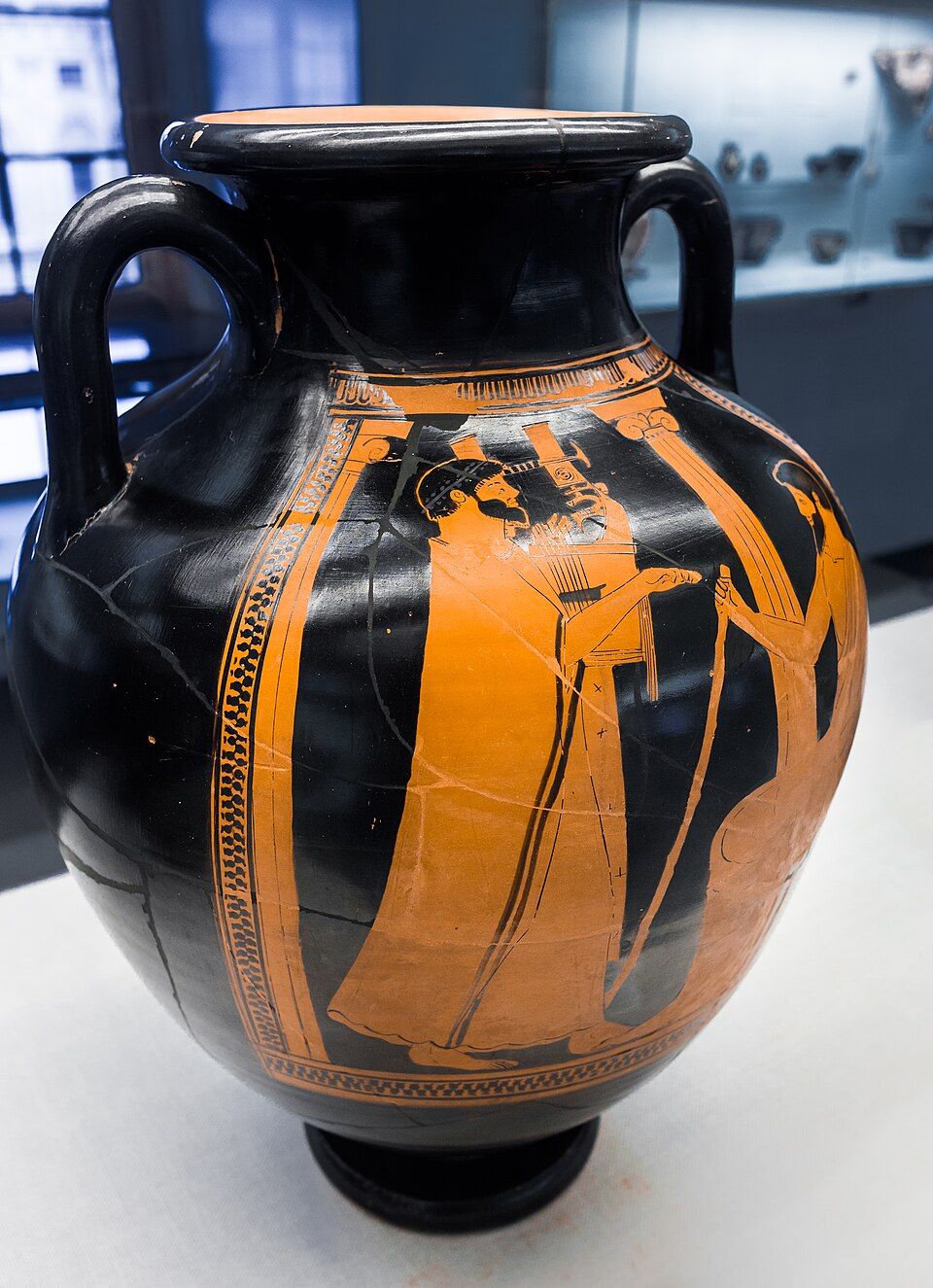
The music of Greek poetry: instruments, scales and notation, the surviving scores, and how melody and rhythm went with the words.
Melody · 1 of 5
Melody and the word accent: the rules
Classical Greek had a pitch accent. In every word one syllable was raised in tone. The Greek name for the accent, prosōidia, means “singing along”.[1] Aristoxenus says that speech has a kind of melody, made by its accents. It differs from song in not moving by definite intervals. Dionysius of Halicarnassus puts the rise at about a fifth.[2]
So a composer setting Greek words had a melody already latent in them. This page follows what he did with it. The Metre section treats the same question from the side of the language.[3]
Strophic and through-composed
The first thing the documents show is that the answer depends on the form of the song. In a strophic song the same tune serves every stanza. No composer ever tried to make the accents of a strophe match those of its antistrophe. In a through-composed piece, sung only once, the tune could follow the words.[4]
Dionysius describes a song in Euripides’ Orestes. His is the one ancient analysis of a particular melody. What it describes is a setting in which the words were subordinated to the melody.[5] The Orestes papyrus confirms it.[6]
Nearly every fragment earlier than the Delphic paeans shows no more agreement between melody and accent than chance would give. From the paeans of 128 BC to the Christian hymn of the third century AD, respect for the accent was the rule, in the non-strophic genres where it was possible. The grammarians and rhetoricians of the period describe the practice.[7]
Prosōidia: “Accompaniment in song”. This is the Greek word for the pitch accent, which Latin translated part for part as accentus. Aristoxenus treats the accents as the melody of speech.
The three principles
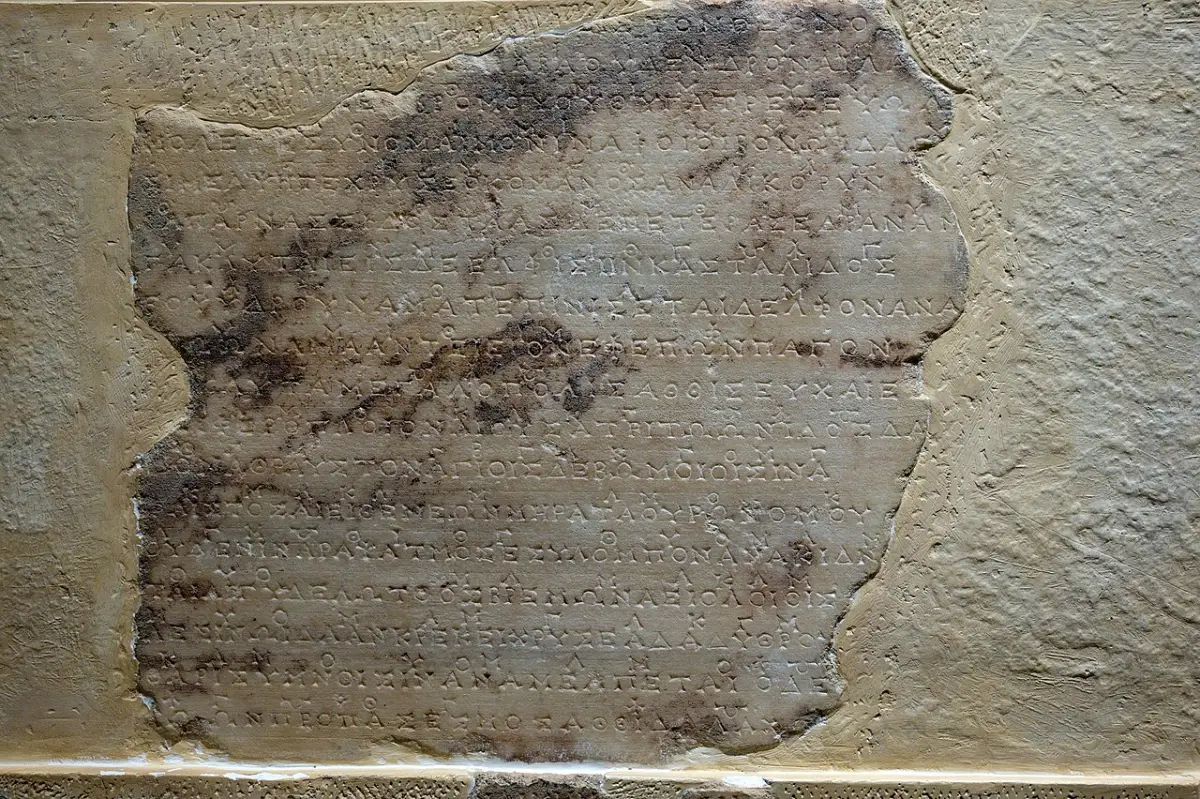
The later composers kept three principles:[8]
- The accent is the high point of its word.
The accented syllable is set at least as high as any other syllable of the word. It often forms the summit of a rise and fall.
Example: Seikilos, ὀλίγον (oligon, “a little while”): ὀ c♯′, λί e′, γον d′. The tune rises to the accented λί and falls after it. - A circumflex falls.
A syllable with a circumflex is often sung to two notes, the first one the higher. This imitates the rise and fall of the spoken contour.
Example: Athenaios’ paean, Φοῖβον (Phoibon, “Phoebus”): Φοῖ on d′ falling to c′, then βον on a♭. The stone writes the vowel twice, Φοιοῖβον, one letter for each note. - After a grave, no fall before the next accent.
Take a word with a final acute that stands before no pause, so that it is written with a grave. After it, the melody does not fall again until it has passed the next accent. This is the musical form of the grave.
Example: Seikilos, μηδὲν ὅλως (mēden holōs, “not at all”): μη c♯′, δὲν d′, ὅ e′, λως d′ c♯′. After the grave on δὲν the tune keeps rising to the accent of ὅλως, and only then falls.
The notes are those of the editions.[9]
The Delphic paeans keep these principles most consistently. In each hymn there is one word in which an unaccented syllable is set higher than the accented one, and one circumflex set to a rising pair.[10] Elsewhere the rules are kept more freely, and perhaps the later the freer.[8]
Put in terms for musicians, the rule of the Delphic hymns runs like this. A syllable with the acute is set on the highest note that occurs in its word. Other syllables may share that pitch, but none exceeds it. A circumflex syllable split over two notes has the second note lower. After a grave, the first syllable of the next word is normally higher, though the grave itself need not bring a fall.[11] In some scores the rule is plainly disregarded. Landels calls the explanation one of the hardest problems in the subject.[12]
What melody did besides
Following the accent was not the whole of melodic craft. Aristides, drawing on Aristoxenus, describes a melody under three heads:
- its agōgē, stepwise movement up or down;
- its plokē, “plaiting”, which is the leaps;
- its petteia: which notes are used, how often, and where the tune begins and ends.[13]
Some two thousand note-successions in the documents have been counted. Nearly half move to an adjacent degree, and a fifth move to the next degree but one. Big leaps of a sixth to a ninth are kept for effect: an upward leap at the start of a line, or a plunge at the end.[14] A number of pieces open with a rising fifth from the tonic, against the accent, the Seikilos song among them. West takes this as a conventional opening gesture.[15]
For Homer, Hagel’s statistics on the accents of the hexameter show a typical melodic contour for the line. It rises at the start, falls in the middle, rises again, and falls at the end. The shape is regular enough to argue for conscious artistry in the oral singer.[16]
Notes
- ^ West 1992, pp. 197–198.
- ^ West 1992, p. 198.
- ^ See the Melody tab of the Accent page there.
- ^ West 1992, pp. 198–199.
- ^ D’Angour 2018, pp. 47–48; Pöhlmann and West 2001, p. 17.
- ^ See the Orestes tab.
- ^ Pöhlmann and West 2001, pp. 1, 17.
- ^ a b West 1992, p. 199.
- ^ Pöhlmann and West 2001, pp. 62, 72, 88–91.
- ^ Pöhlmann and West 2001, p. 72.
- ^ Landels 1999, c. pp. 112–113.
- ^ Landels 1999, c. p. 113; see the Strophe and antistrophe tab.
- ^ West 1992, pp. 190–191.
- ^ West 1992, pp. 191–192.
- ^ West 1992, pp. 193, 200.
- ^ D’Angour 2018, pp. 51–52.
Melody · 2 of 5
Exceptions and disputes
The rules set out on this page are generalisations from a small body of texts. Nearly every one of them has been questioned. What follows sets out the exceptions, and the points on which the modern authorities disagree, with the parties named.
Breaches
Even the Delphic paeans, the most obedient texts, each contain one word set against its accent and one circumflex on a rising interval.[1]
The commonest systematic breach is the opening. The Seikilos song, the anonymous invocation of the Muse and Mesomedes’ invocation all begin with a leap of a fifth upwards from the tonic, on an unaccented syllable. West and the editors take this as a conventional gesture of beginning rather than a lapse.[2] A second apparent breach in Seikilos, on ἐστι, disappears if the word is read as the emphatic ἔστι, with its accent on the first syllable.[3]
Some of the later texts ignore the accent altogether. The Berlin lament of Ajax contradicts it almost consistently, which the editors explain by its being strophic.[4] West notes that several of the Hellenistic papyri are likewise unmatched, and were presumably sung to repeated tunes.[5] Sometimes a clash occurs in Mesomedes in a passage for which a single manuscript is the only witness. There the editors suspect the transmission rather than the composer.[6]
Did the practice loosen?
Winnington-Ingram observed that the rules are kept most strictly in the paeans of 128 BC, and more freely in the later documents. West connects the loosening with the change of the Greek accent from pitch to stress in the early centuries AD. He also notes that the tonal element never quite disappeared, since the accent still shapes the melody of Byzantine imperial acclamations of the fifteenth century.[7]
D’Angour draws the opposite conclusion from the same change. Horrocks dates a dynamic stress in spoken Greek early enough for the Seikilos song. If so, a stressed first syllable in ὅσον or ἄειδε could carry the prominence that a rise in pitch would otherwise give. Then the rising fifth is not a conventional incipit but a sign that the accent had become a stress.[8] The two readings are not reconcilable, and the site reports both.
Did Euripides follow the accents?
The Orestes papyrus sets a strophic chorus to a tune that fits the accents of neither strophe nor antistrophe better than chance. West and the editors conclude that the melody was composed without regard to them.[9] Feaver argued otherwise, and West records the dissent.[10]
D’Angour accepts that the accents are ignored. But he denies that the tune is therefore indifferent to the words. Its falling cadences and its one high note answer the sense of the strophe. And he doubts the editors’ inference that the same melody was repeated for the antistrophe.[11]
Thomas adds an ancient witness. Athenaeus describes a comedy by Callias whose chorus sang the letters of the alphabet to the same melody in responding stanzas, with no regard for the accents of the letter-names. Athenaeus reports that Euripides borrowed the tune for the Medea. If that is true, the Medea’s music was strophically repeated, and it ignored the accent.[12]
Did melody express meaning?
West finds word-painting in the classical poets, who stretch a significant word over extra notes. He finds it too in the Delphic paeans, where the twin peaks of Parnassus get two melodic summits. But he denies any correlation of melody with meaning in Mesomedes, whom he thinks “limited and uninspired”.[13]
Psaroudakes reads the same Hymn to the Sun, phrase by phrase, as a sustained piece of word-painting. The melody climbs phrase by phrase as the Sun’s chariot rises, leaps for the dancing stars, and sinks for the tired moon. On that reading Mesomedes painted his words throughout, as the Seikilos composer did.[14]
D’Angour makes a larger claim. From Homer to Seikilos, he argues, melody was used expressively: to heighten emotion, pattern themes and structure a song, in ways picked up later by Gregorian chant. This is the most optimistic reading of the evidence now in print.[15]
Notes
- ^ Pöhlmann and West 2001, p. 72.
- ^ West 1992, p. 200; Pöhlmann and West 2001, p. 90.
- ^ Pöhlmann and West 2001, p. 90.
- ^ Pöhlmann and West 2001, p. 17.
- ^ West 1992, p. 382.
- ^ Pöhlmann and West 2001, p. 114.
- ^ West 1992, pp. 199–200.
- ^ D’Angour 2018, pp. 66–67.
- ^ West 1992, pp. 198–199; Pöhlmann and West 2001, pp. 16–17.
- ^ West 1992, p. 199 n. 17.
- ^ D’Angour 2018, pp. 59–62.
- ^ Thomas 2018, pp. 101–104.
- ^ West 1992, pp. 200–201, 384.
- ^ Psaroudakes 2018, pp. 127–130.
- ^ D’Angour 2018, p. 72.
Melody · 3 of 5
Strophe and antistrophe: one tune for two sets of accents
A choral song in strophe and antistrophe repeats its rhythm exactly. It is natural to suppose that it repeated its melody too. But if the tune followed the accents of the strophe, it could not also follow those of the antistrophe, whose words rise and fall in different places.
West’s answer is categorical. In a strophic song, he says, no composer ever attempted to match the accents of both stanzas. The Orestes papyrus, whose tune fits neither, is the proof.[1] Landels approaches the question as a musician, and he keeps it open. His discussion is given here as a named alternative to the editors’.[2]
Three solutions
Landels sets out three possible answers to what he calls the serious problem:[3]
- The antistrophe had a different setting of its own.
- The antistrophe was sung to the same notes as the strophe, with the rises and falls in the “wrong” places.
- A compromise was made. The rises and falls were delayed or advanced, so that essentially the same melodic outline was fitted to the new words.
He thinks there is no sure way to decide. But the second answer, he thinks, is less improbable than it sounds. In some living languages with a pitch accent, Serbo-Croat among them as he was told, the speech pitches may be ignored in song, even where a wrong rise changes the meaning.[3]
Against that he puts an anecdote in the Frogs. An actor mispitched one word of Euripides’ Orestes and said “weasel” for “calm”, to the audience’s great merriment. So Athenians were sensitive to pitch. But the actor was speaking. Singers forced by a score to distort the pitch of a word may have enjoyed more indulgence.[4]
The Antigone test
To test the compromise, Landels lays out the two strophic pairs of the first stasimon of Sophocles’ Antigone (332–375, the ode on man) side by side, strophe against antistrophe. He marks the quantities, and draws arrows for the rises of pitch that the accents give.[5]
The responsion of quantities is almost exact. It differs only in final syllables and a few free positions, and he doubts that an audience would have noticed these differences. The phrasing and the sense-pauses also correspond. In the first pair, the first two printed lines of each stanza form one musical phrase. In the second pair, a four-syllable word followed by a three-syllable negative stands at the same place in both stanzas (pantoporos aporos against hypsipolis apolis). That echo must have been striking if the setting was the same.[6]
The correspondence of accents is less obvious, but, he says, it is there. Take the rule that an accented syllable stands on the highest note of its word, though other syllables may share it. With that rule, a single setting compatible with both stanzas could be devised for eleven of the lines. Five pairs of lines have exactly the same accent pattern.
Of the rest, 351 nearly reverses the pitch pattern of 341. It might be a bridge, in which the second pair modulated to a new tonal centre. 371 is the coda leading into the anapaests that bring Antigone on, and it may have had an independent line. Several of the remaining seven pairs could share a tune if some licence was allowed, and if no exact note-for-accent correspondence was demanded. That is what he believes.[7] The same twenty pairs of lines show twelve different rhythmic patterns. He contrasts this variety with the fixed choral lines of Milton and Swinburne.[8]
Where this leaves the question
Landels’ test is an argument from possibility, not from a surviving tune. It does not touch the Orestes papyrus, where the notes are known and fit neither stanza. The two positions are not quite the same question, however. West asks whether tragic composers followed the accents at all in strophic song. Landels asks whether, if they did, the antistrophe could have kept the outline.
Two further points bear on the same question, and they are set out on the Exceptions and dispute tab. One is D’Angour’s doubt that the Orestes melody was repeated for the antistrophe. The other is Thomas’s ancient witness: the alphabet chorus of Callias, sung to one tune in responding stanzas.[9] Landels writes on accent and quantity for musicians. The linguistic side of the question is on the Phonology section’s Pitch and prominence page.
Notes
- ^ West 1992, pp. 198–199; Pöhlmann and West 2001, pp. 16–17.
- ^ Landels 1999, c. pp. 125–128.
- ^ a b Landels 1999, c. p. 125.
- ^ Landels 1999, c. pp. 125–126.
- ^ Landels 1999, c. pp. 126–127.
- ^ Landels 1999, c. pp. 127–128.
- ^ Landels 1999, c. p. 128.
- ^ Landels 1999, c. pp. 128–129.
- ^ D’Angour 2018, pp. 59–62; Thomas 2018, pp. 101–104.
Melody · 4 of 5
The Orestes papyrus
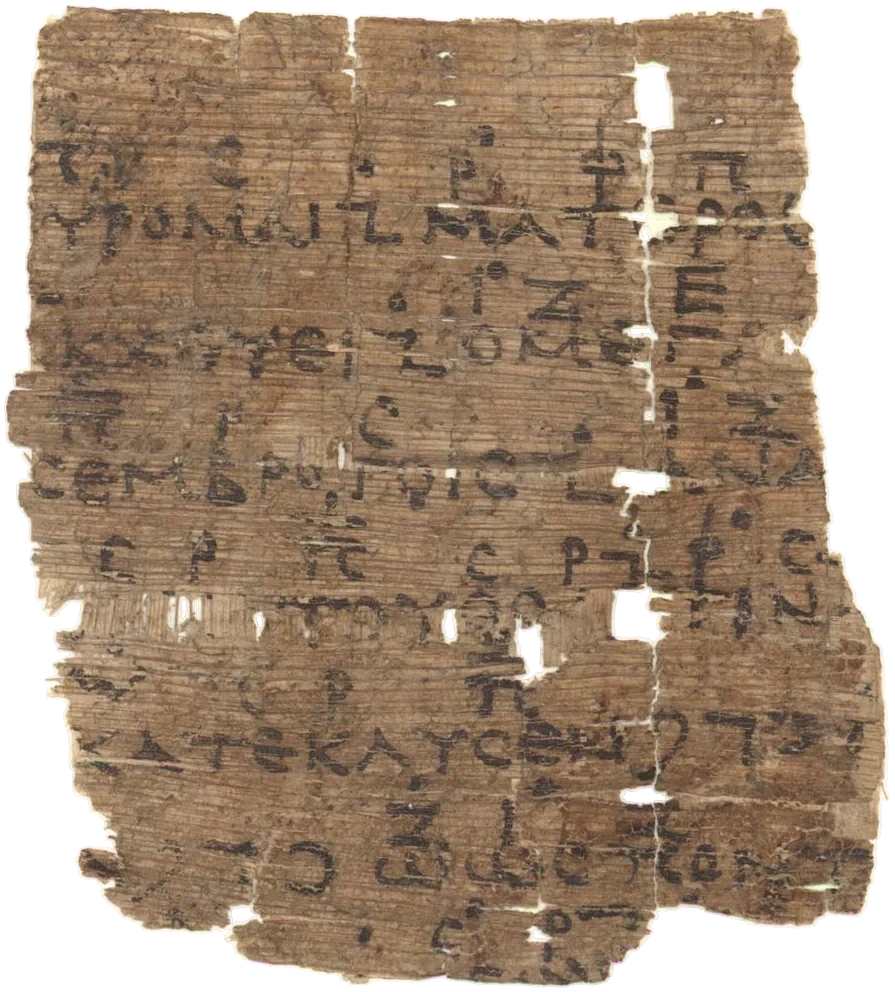
The oldest musical score we have is a strip of papyrus in Vienna. It was recovered from mummy cartonnage at Hermopolis in Egypt, and has been known since 1890. It carries seven lines of a chorus from Euripides’ Orestes of 408 BC, lines 338 to 344, with vocal and instrumental signs above the words.[1]
Its first editor put the copy in the Augustan age. Turner redated it to about 200 BC, and that, the editors remark, raises the likelihood that the music is Euripides’ own.[2] D’Angour reports the attribution as the general view, with Rocconi less confident.[3] West accepts the music as original. But he notes that it need not have been transmitted in writing from before 400. The music of popular plays was kept alive by ear for half a century and more.[4] The papyrus is not a text of the play but a performer’s excerpt, like the other Hellenistic papyri of tragic lyric.[5]
What is on it
The chorus is in dochmiacs. Between the dochmiacs stand instrumental signs, set off by a punctuation mark. One is a note a tone above the vocal e′. In line 343 a pair of signs frames a parenthetical exclamation.[6] Repeated notes are not written, and vowels sung to two notes are doubled, as in the Delphic paeans.[7]
The vocal notes fit the enharmonic or the chromatic form of the Lydian key, with one note belonging to the diatonic. Fifth-century tragedy used the enharmonic, so the editors prefer that reading, and D’Angour agrees.[8] The melody circles two centres a fifth apart.[9] The editors transcribe it twice. One version is plain. The other follows West’s arrangement, with the instrumental notes sounding together with the voice, and the dochmiacs barred in three and five quavers.[10]
Heterophony: An accompaniment that departs from the sung line with notes of its own. West reads the instrumental signs of this papyrus as sounding against the voice. Anderson holds that unison was the usual practice, and that a drone cannot be ruled out.
What it decides
It decides two things. First, the layout of the signs shows that the same melody served strophe and antistrophe. The instrumental sign stands at a point that fits the word-ends of the strophe, and not those of the antistrophe.[10]
Second, the tune agrees with the accents of the strophe at three or four points, and contradicts them as often. It does no better for the antistrophe. So the melody was composed without regard to accent and simply repeated. That is what Dionysius says of another song in the same play.[11]
What is disputed
The accompaniment. West holds that the instrumental notes sounded at the same time as the voice, perhaps as a drone. He reads the pair of signs in line 343 as the two pipes diverging to a fourth. With the vocal note, that gives one of the “paraphone” intervals, which Gaudentius says sound concordant in accompaniment.[12] Anderson surveys the evidence for aulos accompaniment. He concludes that unison, if not strict, was the norm. Fourths and fifths occurred occasionally, and a drone should not be dismissed.[13]
The expression. D’Angour grants that the accents are ignored. But he argues that the melody is through-composed on another principle. The falling cadence on “I beseech” in the strophe recurs on “I lament” in the antistrophe. The highest note falls on “blood” and on “leap in frenzy”. A swooping figure paints “stretching out” in the strophe, and is merely echoed in the antistrophe. From this he doubts the editors’ inference that strophic responsion of the melody was Euripides’ habit, since the fragment can only answer for itself.[14] To the modern ear a falling cadence sounds dejected. He takes that, with due caution, as evidence that Greek music is a true ancestor of the Western tradition.[15]
The beat. The points on the papyrus mark the up-beats of the dochmiac. D’Angour uses them to place the down-beats on the second and the last two positions of ⏑ – – ⏑ –. These coincide with the accents of two words.[16]
Notes
- ^ Pöhlmann and West 2001, pp. 12–14.
- ^ Pöhlmann and West 2001, p. 14.
- ^ D’Angour 2018, pp. 58–59.
- ^ West 1992, pp. 270–271.
- ^ West 1992, p. 376.
- ^ Pöhlmann and West 2001, pp. 14–15.
- ^ Pöhlmann and West 2001, p. 15.
- ^ Pöhlmann and West 2001, p. 16; West 1992, pp. 353–354; D’Angour 2018, p. 59.
- ^ West 1992, p. 212.
- ^ a b Pöhlmann and West 2001, p. 16.
- ^ Pöhlmann and West 2001, pp. 16–17.
- ^ West 1992, pp. 206–207.
- ^ Anderson 1994, p. 181.
- ^ D’Angour 2018, pp. 59–62.
- ^ D’Angour 2018, p. 62.
- ^ D’Angour 2018, pp. 63–64; see the Arsis and thesis tab of the Rhythm page.
Melody · 5 of 5
Mesomedes and the Seikilos song
The two best-known Greek tunes belong to the age in which composers followed the accent. Both show what following it sounded like. One is the tombstone song of Seikilos. The other is the group of hymns by Mesomedes.
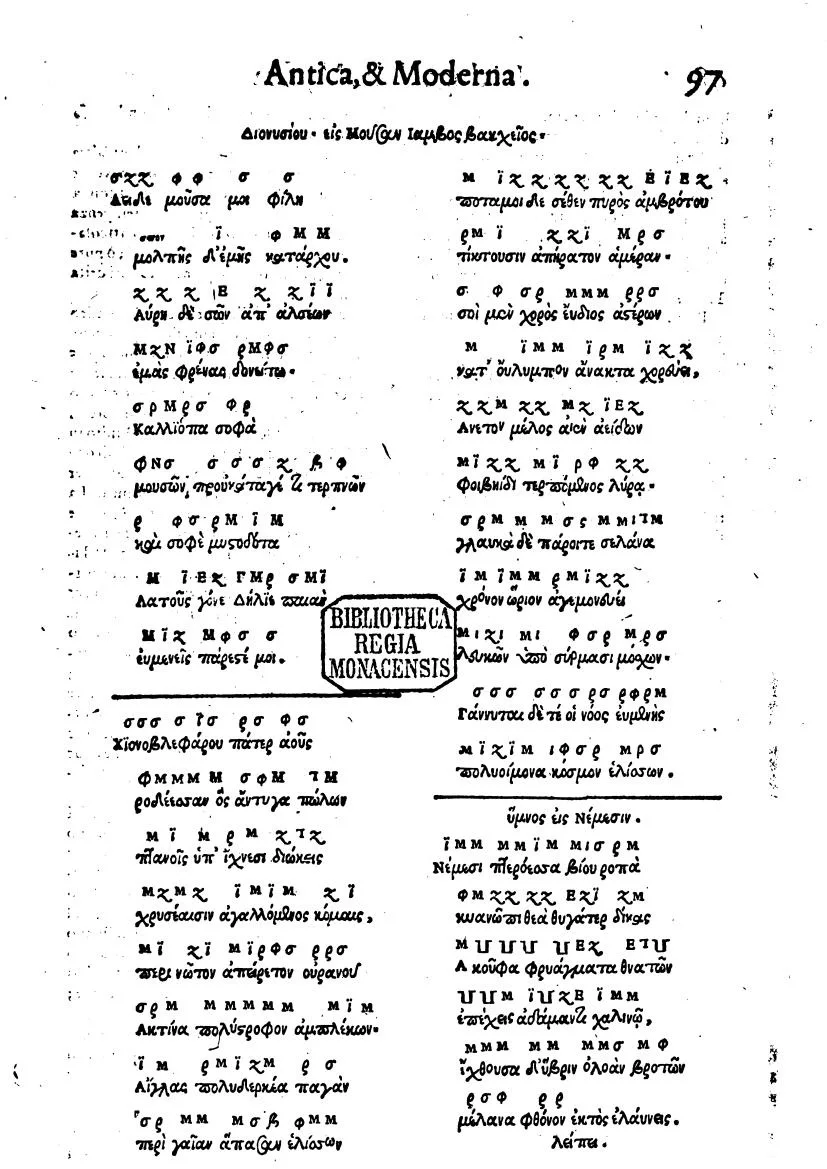
Mesomedes was a Cretan citharode, and a freedman of Hadrian. Caracalla honoured him with a cenotaph. Eusebius put his floruit at AD 141, and about AD 400 Synesius was still singing his songs to the lyre.[1]
How Mesomedes reached us
Mesomedes is the only ancient composer whose music came down in manuscript, rather than on stone or papyrus. Four pieces with notation travelled through the Middle Ages as an appendix to a treatise. They were printed by Vincenzo Galilei in 1581. One branch of the manuscripts carries the notes and another does not.[2]
Henderson argued in 1957 that the settings were Byzantine reconstructions. The editors reject this. The old scholia name the keys in which the poems were notated, which presupposes settings. And the melodies are free of accent clashes, apart from the opening rising fifth, which Seikilos shares. Where a single manuscript is the only witness and a clash occurs, the fault is more likely the copyist’s.[3]
On the editors’ reckoning, the settings are certain for the two invocations, for the hymns to the Sun, Nemesis and Isis, and for two lost poems.[4] Maas had suggested that the short invocations are older than Mesomedes, and the editors leave the first one anonymous.[5]
What the tunes do
West finds Mesomedes’ music “limited and uninspired” beside the Delphic paeans. Yet he grants that the melodies accord fully with the accents, and move in smooth ascents and descents. The invocation of the Muse alternates a rising fourth and a falling fifth, as if tuning a lyre.[6] He hears clichés, no true modulation, and no correlation of melody with sense.[7]
Nowacki uses the invocation to show the difference between key and mode. It is written in the Lydian key, but it moves in the Mixolydian species of the octave. It has one foreign note, which he explains as a passing modulation.[8]
Psaroudakes’ reading of the Hymn to the Sun is the counter-case. The scale is a Lydian diatonic octave. Its most frequent note is a tonal centre, where the hymn begins and ends. In the first section the melody climbs phrase by phrase to its summit at the word for the dome of the sky, painting the rising chariot. A swelling on a repeated high note resolves at the birth of day. The chorus of dancing stars gets a leaping, agitated passage. The tired moon gets a sinking cadence. And the closing “whirling” gets three quick notes that act as an end-signal.[9]
He concludes that the hymn is word-painting throughout. In method it is continuous with Seikilos and, more distantly, with the Orestes fragment.[10] It may have been a piece for recital rather than a priest’s solo at a ceremony, as Barker suggested.[11]
Tonal centre: The note a melody keeps returning to and ends on. In the later documents it is usually identifiable. West names the mode from it (an E, G or C mode), rather than from the key of the notation.
Seikilos
The song respects the accent at every word but two: the opening ὅσον, and ἐστι in the third line. Both can be explained away.[12]
D’Angour’s reading adds what the tune does with its freedom. Of its thirty-seven notes, only four fall below the central a, and none rises above e′. The opening fifth spans the word “as long as”. The first line ends on the note below the centre, as a half-cadence, and the second echoes it. “Little” is set to little quick notes. The last word, “demands”, drops to the lowest note of all, against the bright high start. So the closing fall of a fourth answers the opening rise of a fifth, and completes an octave around the central note.[13]
He also observes that the four line-ends rhyme in pairs when Greek is pronounced as it was in the second century. Such a scheme is foreign to classical verse.[14] Whether these are the composer’s intentions or the reader’s cannot be proved. What the stone proves is that a Greek of the Roman period could write a four-line tune in which every accent was honoured and every duration marked.
Notes
- ^ West 1992, pp. 280, 383–384; Psaroudakes 2018, pp. 121–122.
- ^ Pöhlmann and West 2001, pp. 5, 112.
- ^ Pöhlmann and West 2001, pp. 113–114.
- ^ Pöhlmann and West 2001, p. 114.
- ^ Pöhlmann and West 2001, pp. 92, 112.
- ^ West 1992, pp. 302–303, 384.
- ^ West 1992, p. 384.
- ^ Nowacki 2020, pp. 29, 48–50.
- ^ Psaroudakes 2018, pp. 127–129.
- ^ Psaroudakes 2018, pp. 129–130.
- ^ Psaroudakes 2018, p. 130.
- ^ Pöhlmann and West 2001, p. 90; see the Seikilos sign by sign tab of the Notation page.
- ^ D’Angour 2018, pp. 66–68, 72.
- ^ D’Angour 2018, p. 68.


