Overview
Ancient Greek music through surviving scores, instruments, images and theoretical writings.
The music of Greek poetry: instruments, scales and notation, the surviving scores, and how melody and rhythm went with the words.
Overview · 1 of 8
What survives, and how we know it
Greek poetry was sung far more often than it was spoken. Epic was chanted to a lyre. The lyric poets composed tunes as well as words. A tragedy was nearer to an opera than to a play. Nearly all of that music is lost. This section sets out the little that survives, and what can be reasoned from it.
Five kinds of evidence
The evidence falls under five heads.[1]
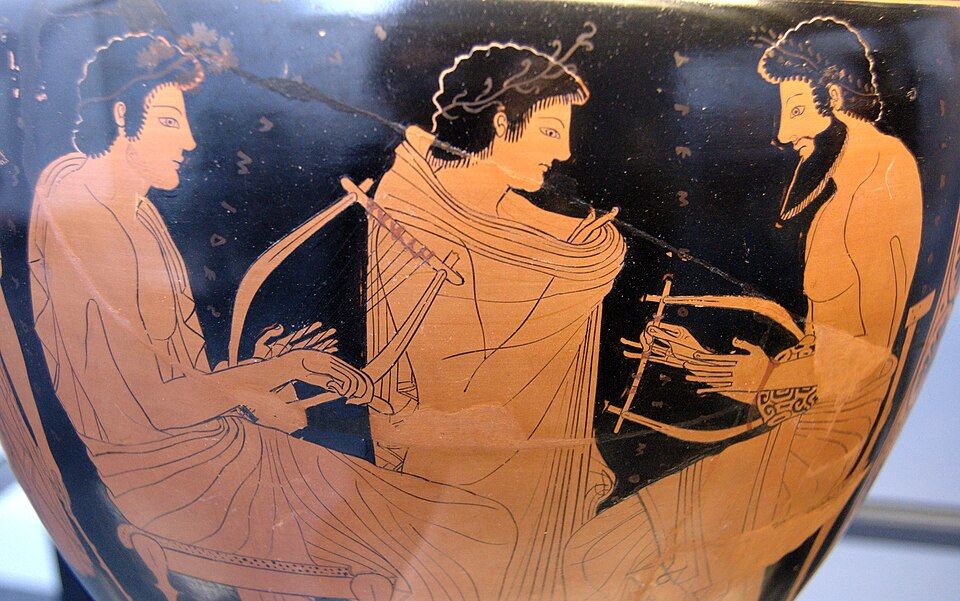
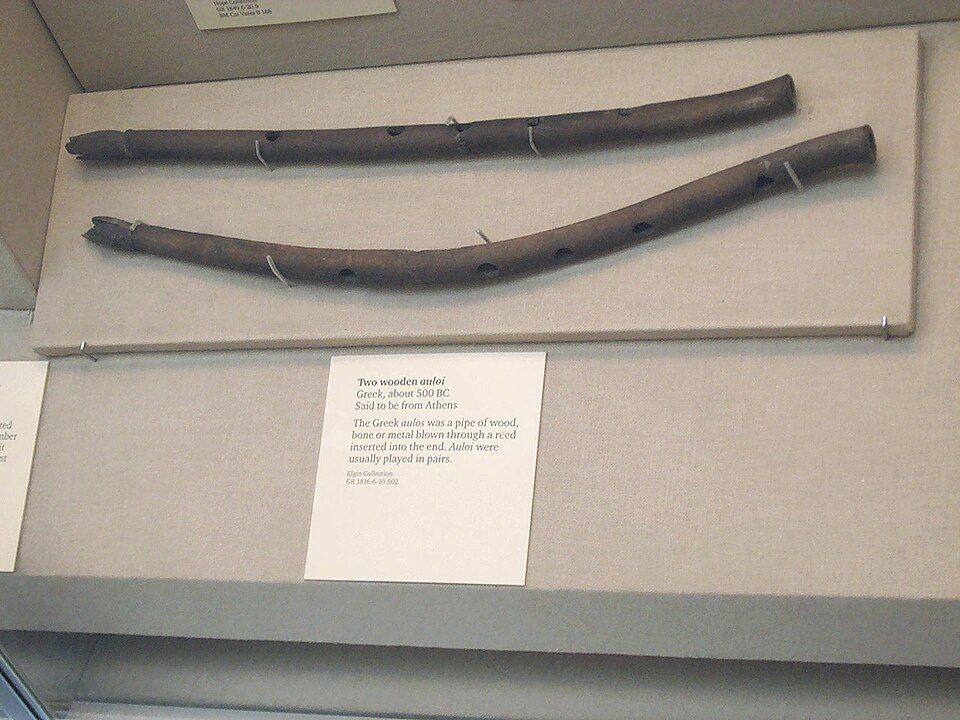
- Archaeology and art. There are the remains of instruments (mostly pipes), figurines and reliefs. Above all there are the vase-paintings of Athens in the sixth and fifth centuries and of South Italy in the fourth. They show who played what, how, and on what occasion.
- Literary references, from Homer onwards. The lyric poets name their instruments and tunings. The comic poets mock the fashionable composers. Late compilers such as Athenaeus and Pollux gather the terminology.
- Specialist writing. There are a few pages of Aristoxenus on rhythm and three books of his Harmonics. There are the handbooks of his followers from the second to the fifth century AD (Cleonides, Gaudentius, Bacchius, Alypius, Aristides Quintilianus), and the mathematical tradition from the Sectio Canonis to Ptolemy. There is also the essay On Music that goes under Plutarch’s name, which quotes lost historians of music back to the fourth century BC.[2]
- Inscriptions and papyri. These record the hiring of musicians, the prizes at contests and the subjects of a school curriculum.[3]
- The actual scores, the rarest kind of all.
Score: A text with musical signs written above its syllables. The ancient notation gave pitches by letters. Where needed, it gave durations by a few extra marks. It was known to few outside professional circles.
The scores
There were two parallel systems of notation, one for voices and one for instruments. They were in use from at least the fourth century BC. But they were a professional’s tool, and the poets’ texts were copied without them.[4]
What has come down with notes attached is a scatter of chance survivals. They were found in this order:[5]
- 1581: the songs of Mesomedes.
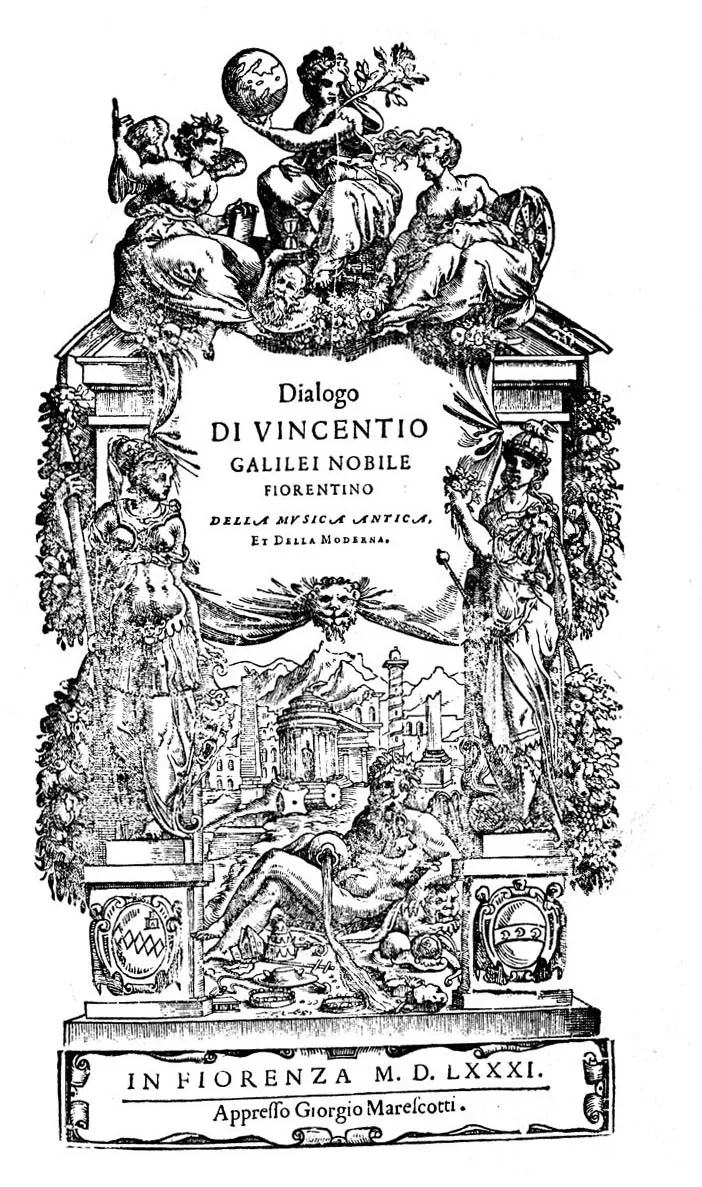
Four songs by a court musician of the emperor Hadrian, copied in medieval manuscripts at the end of a handbook on music. Vincenzo Galilei printed them at Florence.[6] - 1841: the Bellermann exercises.
Six short pieces for a beginner on an instrument, kept at the end of an anonymous collection of writings on music. Friedrich Bellermann printed them at Berlin.[7] - 1883: the Seikilos stone.
A marble grave-pillar from near Tralles in Asia Minor, with a four-line song and its notes.[8] - 1890: the Orestes papyrus.
A strip of papyrus from Egypt with seven lines of a chorus of Euripides and their notes, copied about 200 BC.[9] - 1893: the Delphic paeans.
Two long hymns to Apollo with notes, cut into the wall of the Athenian treasury at Delphi in 128 BC.[8] - 1918 onwards: the papyri.
Scraps of music on papyrus from Egypt, from Berlin, Cairo, Oslo, Oxyrhynchus, Michigan, Vienna and Leiden. The last is a Christian hymn of about AD 300.[10]
Pöhlmann’s collection of 1970 held thirty-five items. The edition he and West published in 2001 holds sixty-one, numbered in order of presumed date.[11]
Two of those sixty-one are claimed for the end of the fifth century BC, both from plays of Euripides. Everything else is Hellenistic or Roman. The latest, a Christian hymn on a papyrus of the third century AD, already belongs to another world.[12] Not a note survives from before the last decade of the fifth century.[13]
So the scores are very thin evidence for the music of Sappho, Pindar or Aeschylus. Their value is that they show the notation at work, and let us hear how a later Greek composer set words to a tune. In date order they show three changes. Rhythmic signs are added to the pitch signs. The enharmonic tuning gives way to the chromatic, and then to the diatonic. And from the late Hellenistic period, melodies follow the pitch accent of the words, where earlier ones ignored it.[14]
The limits
There are good reasons for caution. Most Greek music was composed for an occasion and passed on by ear. It was never meant to outlast its performance. The surviving fragments are late and few. And the fullest technical account of the old tunings, by Aristides Quintilianus, was written some seven hundred years after the music it describes.[15]
Almost no notation can be securely placed in the fifth century.[16] A reader should expect a great deal of theory, a few dozen tunes and a great many pictures, and should keep the three apart.
Notes
- ^ West 1992, pp. 4–8.
- ^ West 1992, pp. 5–6.
- ^ West 1992, p. 7.
- ^ West 1992, pp. 7, 270–271.
- ^ Pöhlmann and West 2001, pp. 5–6; West 1992, p. 7.
- ^ See the Scores in manuscripts tab.
- ^ See the Bellermann exercises tab.
- ^ a b See the Scores on stone tab.
- ^ See the Papyri before Rome tab.
- ^ See the Papyri of the Roman period tab.
- ^ Pöhlmann and West 2001, p. 6.
- ^ Pöhlmann and West 2001, p. 1; West 1992, p. 8.
- ^ West 1992, p. 129.
- ^ Pöhlmann and West 2001, p. 1.
- ^ Nowacki 2020, pp. 12–13.
- ^ Anderson 1994, p. 203.
Overview · 2 of 8
Mousikē: the Greek idea of music
The word music is Greek. So are melody, harmony, symphony, chorus, chord, tone, rhythm and most of the rest of the vocabulary.[1] But mousikē, the art of the Muses, meant more than music does now. It covered the whole of a sung performance: the words, the tune, the rhythm and the dance, as one thing.
Words, rhythm, harmonia
Plato defines a song (melos) as made of three elements. They are the words, the rhythm and the harmonia (Republic 398d).[2] The harmonia is the tuning, or pitch pattern. The order matters. The greater part of Greek music was song, solo or choral, and the instruments accompanied it. The texts were articulate poetry, with little repetition, meant to be heard and understood.[3]
Lasus of Hermione wrote the first book on the subject, late in the sixth century. He is possibly the man who coined the word mousikē, which first appears in Pindar and Epicharmus.[4]
The poet made the tune as well as the text. So Dale’s remark that every Greek poet was his own composer holds for the whole classical period.[5]
One distinction matters for everything on this site. The rhythm of a song was fixed by the quantities of its syllables. It was wholly in the poet’s hands, and it survives in the metre. The melody, by contrast, was passed on by ear. Before notation it would seldom have been felt to be fixed, or to belong to its author.[6] There is a story that Solon heard his nephew sing a song of Sappho, and asked to learn it before he died. The story treats words and music as one piece of mousikē.[7]
Melos: A song, or the melody of one. In Plato’s definition it is the compound of words, rhythm and harmonia. The adjective *melikos* gives our “melic” poetry, the sung lyric.
Music in a Greek life
Pindar’s Hyperboreans live among girls’ choruses, lyres and pipes. For the Greeks, song and dance, with sacrifice and games, are what a civilised community does at peace. War is “danceless, lyreless”.[8] Music meant celebration. A house in mourning, Sappho says, admits no lament, because it belongs to the Muses’ servants.[9]
Public festivals had processions with singing choruses and a piper. The paean and the dithyramb were the two great species of cultic song. The dramatic festivals at Athens were as much musical as theatrical, and the comic poets argued about the tunes of Aeschylus and Euripides.[10]
In private, the symposium ran on song. There was a paean at the third libation. Then each guest sang in turn, and then came the skilled singing to the lyre.[11] In the Athens of the 420s, to be unable to play the lyre was to be uneducated.[12]
Down to the fifth century, participation was high, and the line between amateur and professional was blurred. At Athens five hundred men and five hundred boys sang in the dithyrambic choruses each year. The symposium expected every guest to sing.[13]
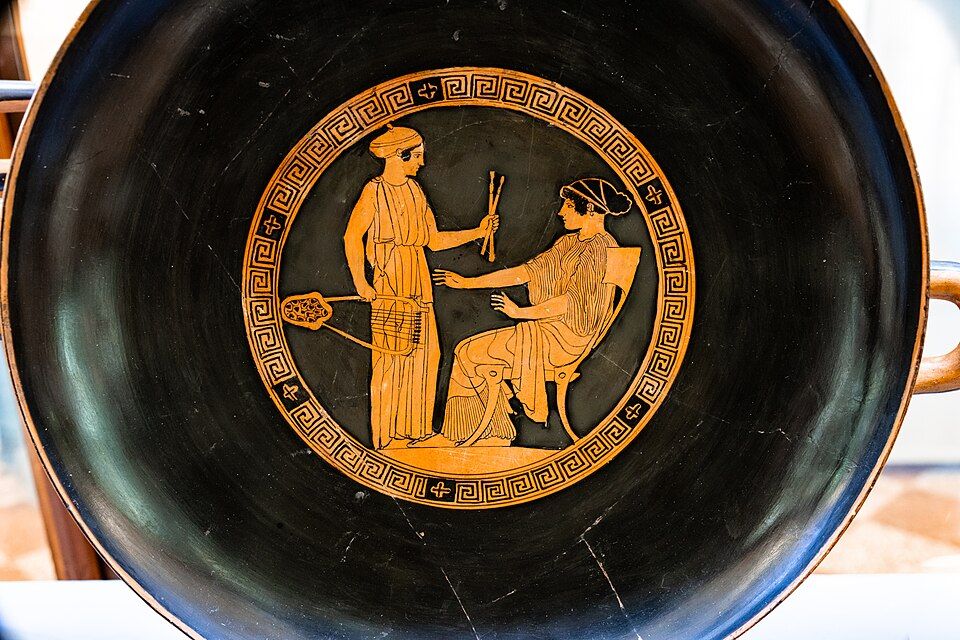
Boys went to the lyre-teacher (kitharistēs), as well as to the trainer and the letter-master. A cup by Douris of the 480s shows the lessons. Teacher and pupil hold lyres, a boy sings to the teacher’s pipes, and a papyrus roll shows a line of epic.[14]
The professionals were the festival citharodes and pipers, and poet-composers like Simonides and Pindar. By the late fifth century their novelties ran beyond what amateurs could follow, and private music-making declined.[15]
Music and character
The Greeks believed that music shaped the soul. The Pythagoreans sorted tunes into rousing and calming. Damon of Athens, Pericles’ associate, argued before the Areopagus that modes and rhythms are tied to ethical qualities, and that the state should regulate them. He gave Plato his line that a change in the style of music is a change in the laws of the city.[16]
Plato’s Republic keeps only the Dorian and Phrygian tunings. It banishes the rest as soft or mournful. Aristotle, more mildly, holds that melodies and rhythms contain likenesses of states of character.[17]
How much of this rests on musical knowledge, and how much on social stereotype, is disputed. Nowacki observes that Plato’s explicit citations of Damon concern rhythm, not tunings. For the actual scales of the fifth century, we look to Plato in vain.[18]
Notes
- ^ West 1992, p. 1.
- ^ Nowacki 2020, p. 16.
- ^ West 1992, pp. 39–40.
- ^ West 1992, p. 225.
- ^ West 1992, p. 130.
- ^ D’Angour 2018, pp. 49–50.
- ^ D’Angour 2018, p. 49.
- ^ West 1992, p. 13.
- ^ West 1992, p. 14.
- ^ West 1992, pp. 14–17.
- ^ West 1992, pp. 25–26.
- ^ West 1992, p. 26.
- ^ West 1992, p. 34.
- ^ West 1992, pp. 36–38.
- ^ West 1992, pp. 35–36.
- ^ West 1992, pp. 246–247.
- ^ West 1992, pp. 248–249.
- ^ Nowacki 2020, pp. 15–16.
Overview · 3 of 8
Scores that came down in manuscripts
Almost everything we know of ancient Greek literature came down to us in manuscripts, books copied by hand. For music this road almost never worked.[1] The scholars who edited the lyric poets in antiquity copied their words without the signs for the notes.[2]
Two small groups of pieces are the exceptions. Both survived because they had been bound into handbooks of music theory. One is a set of songs by Mesomedes. The other is a set of short exercises for instrumentalists.[1]
Manuscript: A book written by hand. The manuscripts that keep these pieces are Byzantine copies of the thirteenth century and later. Editors name each one by its library and shelf-mark, and give it a capital letter as a short name: V is a manuscript in Venice.[3]
The songs of Mesomedes
Mesomedes was a Cretan citharode. A citharode (κιθαρῳδός, kitharōidos) is a singer who accompanies himself on the kithara. He was a court musician of the emperor Hadrian, in the early second century AD.[4]
Fourteen or fifteen of his poems survive. Two were always known from the Greek Anthology, and these are the only two that carry his name. Five more come with notes, in manuscripts of the thirteenth to the seventeenth centuries. They are invocations of the Muse, of Calliope and Apollo, and of Phoebus, and hymns to the Sun and to Nemesis. Ancient writers quote the hymn to Nemesis as his, and that makes his authorship of the group almost certain.[5]
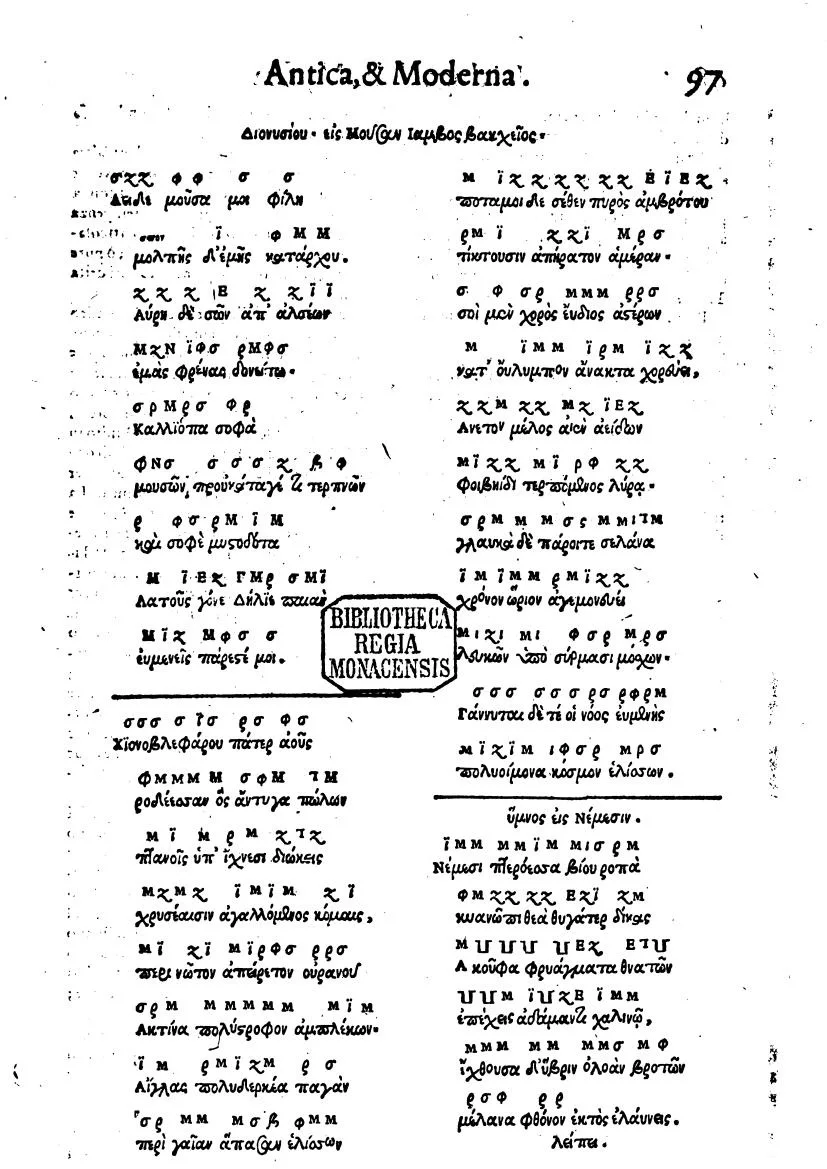
The songs travel as an appendix to a late treatise on music by one Dionysius. In the manuscripts it follows straight on from the treatise of Bacchius, without a title of its own.[5] Four manuscripts carry the hymns. The best is a Venice manuscript of the thirteenth or fourteenth century, now called V. It gives the notes as far as the middle of the hymn to the Sun. A Naples manuscript, N, gives them almost to the end of the hymn to Nemesis. A second Venice manuscript has the words without any notes.[6]
Some copyists left a blank page after the treatise of Dionysius, where the hymns should stand. They seem to have been waiting for a better copy of the difficult notation.[7] A lost manuscript in Wolfenbüttel, last heard of in an eighteenth-century catalogue, held “Greek hymns with the ancient musical notes of the Greeks”.[5]
Notes and accents in one line
All the copies descend from a single lost manuscript. In it the accents and breathings stood in the same line as the note-signs, above the words, and in the same ink.[8] So copyists confused them. An acute accent (´) has displaced the note-sign Ι six times.[9]
Example: the note-sign Ι (d′) and the accent mark ´ stood in the same line, above the same syllable. A copyist who saw the accent kept it, and lost the note.
Eight more poems turned up in 1903, in a manuscript of the late thirteenth century. Their style points to Mesomedes. They have no notes, but notes on them name the keys in which some were once set.[10]
Galilei’s printing of 1581
The first person to print the hymns was Vincenzo Galilei of Florence. He put them in his Dialogue on ancient and modern music, printed at Florence in 1581.[11] He had learned of them from Girolamo Mei.[12] Until 1841 these four short songs were the only ancient Greek music anyone knew.[13]
Their scarcity tempted people to invent. In 1650 Athanasius Kircher claimed to have found a setting of Pindar’s first Pythian ode in a Sicilian monastery. In 1724 Benedetto Marcello printed a Homeric Hymn with Greek notes. Neither is believed today.[14]
Notes
- ^ a b Pöhlmann and West 2001, p. 5.
- ^ Pöhlmann and West 2001, p. 1.
- ^ Pöhlmann and West 2001, pp. 105–106; West 1992, p. 6.
- ^ Pöhlmann and West 2001, p. 106; West 1992, pp. 280, 383–384.
- ^ a b c Pöhlmann and West 2001, p. 106.
- ^ Pöhlmann and West 2001, p. 105.
- ^ Pöhlmann and West 2001, p. 107.
- ^ Pöhlmann and West 2001, p. 108.
- ^ Pöhlmann and West 2001, p. 109.
- ^ Pöhlmann and West 2001, pp. 105–106; West 1992, p. 281.
- ^ Pöhlmann and West 2001, pp. 5, 106 n. 3.
- ^ Pöhlmann and West 2001, p. 106 n. 3.
- ^ West 1992, p. 7.
- ^ Pöhlmann and West 2001, p. 5; West 1992, p. 7 n. 11.
Overview · 4 of 8
The Anonymus Bellermanni: a late handbook of music
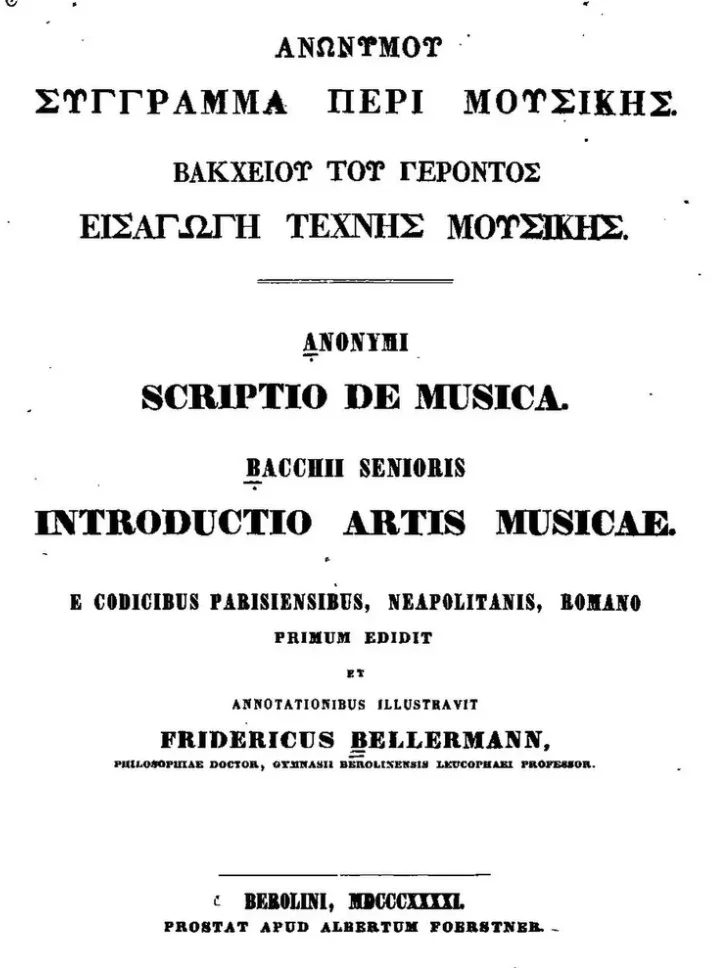
The second group of pieces that came down in manuscripts stands at the end of a collection of short writings on music. Their authors are unknown. The collection is called the Anonymus Bellermanni, “Bellermann’s anonymous writer”, after Friedrich Bellermann, who first printed it at Berlin in 1841.[1]
It is a scrappy compilation. Much of it is drawn from Aristoxenus and Aristides Quintilianus. But it keeps some matter found nowhere else, including half a dozen little instrumental tunes and exercises. Its latest editor divides it among three authors.[2] The melodies were added to the writings later.[3]
The manuscripts
Bellermann worked from six late manuscripts. Some of them lack the melodies. In 1847 A. J. H. Vincent argued from this that the melodies were later inventions, because the oldest manuscript he knew did not have them. The relations of the manuscripts are now clear. The melodies all go back to one Venice manuscript, V, the oldest of all, and the branch without them simply left out the last sections.[3] It is the same Venice manuscript that is the best witness for Mesomedes.[4]
The page of V with the exercises is crowded. The pieces stand in two columns among tables and later notes, not in their proper order.[5] The pieces themselves are set out, and played, in the next tab.
Melodic figures
The handbook gives short definitions of melodic figures, each with an example in the instrumental signs.[6]
- ἐκκρουσμός (ekkrousmos)
The same note taken twice, with a higher note between.
Example: g a g. - πρόληψις (prolēpsis)
A rising pair of notes, up to a fifth apart.
Example: e rising to a. - ἔκληψις (eklēpsis)
The same pair, falling.
Example: a falling to e. - κομπισμός (kompismos)
Two notes of the same pitch, or an octave apart.
Example: a a.
Two more figures, prokrousis and ekkrousis, are the rising and falling pairs made by dividing a short note. A sign for kompismos appears in two instrumental pieces on a Berlin papyrus.[7]
Instruments, voices and keys
Other sections divide instruments into blown, strung and “bare”, which takes in the voice.[8] One gives the compass of the human voice as three octaves.[9] Another says that citharodes used four keys, pipers seven and organists six.[10] The handbook links the Phrygian key with the aulos and the Lydian with the lyre.[11]
Notes
- ^ West 1992, p. 6.
- ^ West 1992, p. 6 and n. 10.
- ^ a b Pöhlmann and West 2001, p. 118.
- ^ Pöhlmann and West 2001, p. 105.
- ^ Pöhlmann and West 2001, pp. 118–119.
- ^ West 1992, p. 204.
- ^ West 1992, p. 204 with n. 32.
- ^ West 1992, p. 48 n. 2.
- ^ Hagel 2009, p. 71.
- ^ West 1992, p. 185 n. 98.
- ^ Hagel 2009, pp. 449–450.
Overview · 5 of 8
The Bellermann exercises: lessons for a beginner
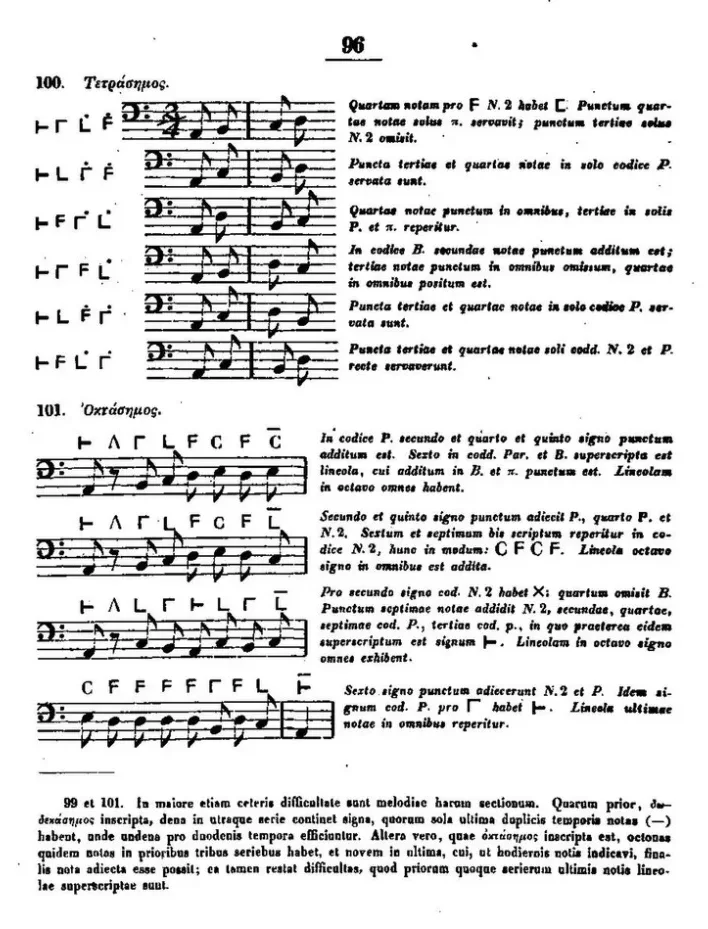
At the end of the Anonymus Bellermanni stand six short instrumental pieces. Their purpose was to show the rhythmic signs at work.[1] Three of them are not really music at all. They are drills, whose teaching purpose is plain.[2]
All six are written in the instrumental signs of the Lydian key.[3] Their date is uncertain. The editors suggest the third or fourth century AD, with a question mark.[4]
What the headings mean
Each piece has a heading that names its measure by the number of time-units it holds. A time-unit is the smallest duration in a piece. It is normally the length of a short syllable.[5]
-σημος (-sēmos): “Of … time-units”. A τετράσημος (tetrasēmos) measure lasts four units, an ἑξάσημος (hexasēmos) six, a δωδεκάσημος (dōdekasēmos) twelve and an ὀκτωκαιδεκάσημος (oktōkaidekasēmos) eighteen.
So the pieces are headed “a six-time colon”, “another six-time”, “four-time”, “twelve-time” and “eighteen-time”.[6] The same handbook lists the signs that lengthen a note, up to one of five units.[7]
The signs over the notes are of two kinds. A bar over a note-sign makes it two units long. A dot over it, the stigmē (στιγμή, “point”), marks the arsis (ἄρσις, “lifting”). Every Greek measure had two parts, an arsis and a thesis (θέσις, “placing”). The thesis is usually the longer, and it is left without a dot.[8] The scribe of the Venice manuscript was often unsure where the dots went.[2]
Example 1: four equal notes
The four-time piece is the simplest. It has six measures. Each has four notes of one unit, and each uses the same four notes, d e f g, starting from d. Only their order changes.[2] The dots stand over the third and fourth notes: the first half of each measure is the beat, the second half the arsis.[2]
There are exactly six ways to arrange e, f and g after d. The exercise works through all six. West takes it as a fingering exercise for a beginner on the aulos, the Greek reed pipe.[9]
Example 2: the same notes in six-time
The six-time piece takes the same six orders of d e f g, and changes only the rhythm.[2] Now the notes go short, long, short, long. Each measure lasts 1 + 2 + 1 + 2 = 6 units. The dot stands over the last note. This is the normal way of dividing an iambic measure into beat and arsis.[10]
The pair of exercises teaches one lesson. The pitches are the same, and only the signs above them change. A learner who played both would see what a bar and a dot do.
Example 3: a tune
The other six-time piece is a real melody, though a very small one. It runs over an octave, from f to f′, in five measures of six units, and closes on a note of three units.[11]
The remaining pieces are a scale, rising and falling, in twelve-time, and two more simple tunes in twelve-time and eighteen-time.[2] Like the Seikilos song, these tunes divide the fifth into two thirds.[12]
Why such dull pieces?
The permutations look mechanical, and they are. The same handbook has a purely melodic drill. The series d e f g d g and its inversion g f e d g d are written out twelve times, each time a step higher. Then the whole series of 144 notes is written out backwards.[2]
This was how Hellenistic schools taught. A child learning to write combined every letter with every other into syllables. A grammar pupil put a model sentence through every case, singular, dual and plural, whether it made sense or not. The Bellermann pieces apply the same method to music. So they are documents of musical education in antiquity.[2] They may also show what the beginner played on. Hagel connects them with a class of simple pipes for learners, like the ancient auloi now in the Louvre and in Berlin.[13]
Notes
- ^ Pöhlmann and West 2001, p. 118.
- ^ a b c d e f g h Pöhlmann and West 2001, p. 119.
- ^ Pöhlmann and West 2001, p. 118; West 1992, p. 310.
- ^ Pöhlmann and West 2001, p. 116.
- ^ West 1992, p. 245.
- ^ Pöhlmann and West 2001, pp. 116, 119.
- ^ West 1992, p. 156 n. 11.
- ^ West 1992, pp. 133–134, 268.
- ^ West 1992, p. 309.
- ^ Pöhlmann and West 2001, p. 119 n. 2.
- ^ Pöhlmann and West 2001, pp. 116–117.
- ^ West 1992, p. 310.
- ^ Hagel 2009, p. 325.
Overview · 6 of 8
Scores on stone: Seikilos, Delphi, Epidaurus
Inscriptions with musical notes are rare. Only a few have been found, from Asia Minor, Delphi and Epidaurus.[1] Two of them are the best-known pieces of Greek music: the song of Seikilos and the paeans of Delphi.
The Seikilos stone
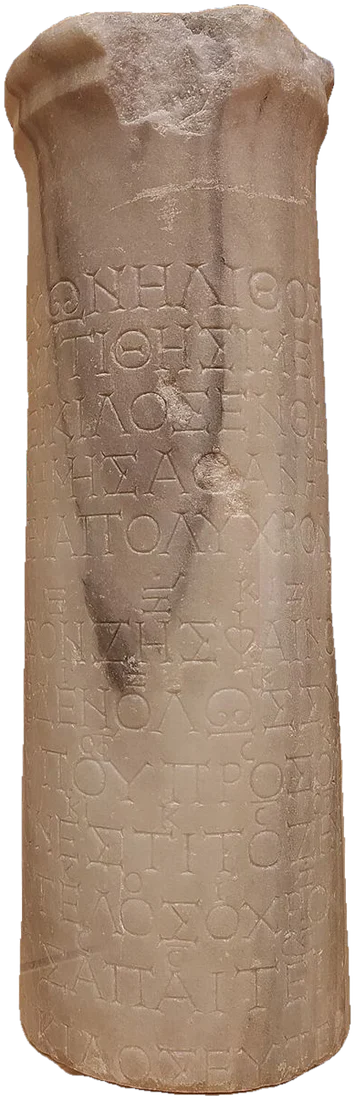
In 1883 Sir William Ramsay published a marble grave-pillar from Asia Minor. It carries two poems: an epigram in elegiac verse, and a short song with musical signs above it.[2] It had been found during the building of a railway near Aydın, the ancient Tralles. It passed into the collection of Edward Purser, the director of the building firm.[2]
The pillar was broken at the foot. So its base was sawn off straight, and it became a stand for Mrs Purser’s flowerpots. One line of text was lost in the sawing. It is known from a paper impression of the stone made before 1893.[2]
The stone stayed at Izmir until 1922. In the disorders of that year the Dutch consul took it into safe keeping. His son-in-law later brought it, by way of Istanbul and Stockholm, to The Hague. In 1966 the National Museum of Denmark in Copenhagen acquired it, and it is there now, inventory number 14897.[2]
What it says
The epigram is spoken by the stone itself:
Εἰκὼν ἡ λίθος εἰμί· τίθησί με Σεικίλος ἔνθα
μνήμης ἀθανάτου σῆμα πολυχρόνιον.
Eikōn hē lithos eimi; tithēsi me Seikilos entha / mnēmēs athanatou sēma polychronion.
“I, the stone, am an image. Seikilos sets me here, a long-lasting sign of deathless remembrance.”
synthetic ∿
Then comes the song, four short lines with their notes:[3]
Ὅσον ζῇς φαίνου,
μηδὲν ὅλως σὺ λυποῦ·
πρὸς ὀλίγον ἐστὶ τὸ ζῆν,
τὸ τέλος ὁ χρόνος ἀπαιτεῖ.
Hoson zēis phainou, mēden holōs sy lypou; pros oligon esti to zēn, to telos ho chronos apaitei.
“While you live, shine. Do not grieve at all. Life lasts only a little while, and time demands its end.”
synthetic ∿
Below it stand the words ΣΕΙΚΙΛΟΣ ΕΥΤΕΡ, and on the lost line ΖΗ. The first is “Seikilos son of Euter(pes)”, with the father’s name cut short. The second, ζῇ (zēi), means “is alive”. So Seikilos set up the stone in his own lifetime.[4]
The notes use eight pitches, e f♯ g a b c♯′ d′ e′, a stretch of the Ionian scale. The melody follows the word accents, except for the opening leap of a fifth on ὅσον. The stone also marks the rhythm, with signs for long notes and points for the arsis.[5]
When was it cut? The shapes of the letters, especially an unusual omega, point to the second century AD.[2] Others put it in the first century AD,[6] or about AD 150–200.[7]
The Music theory page plays the whole song from the stone’s signs,[8] and the Notation page reads it sign by sign.[9]
The Delphic paeans
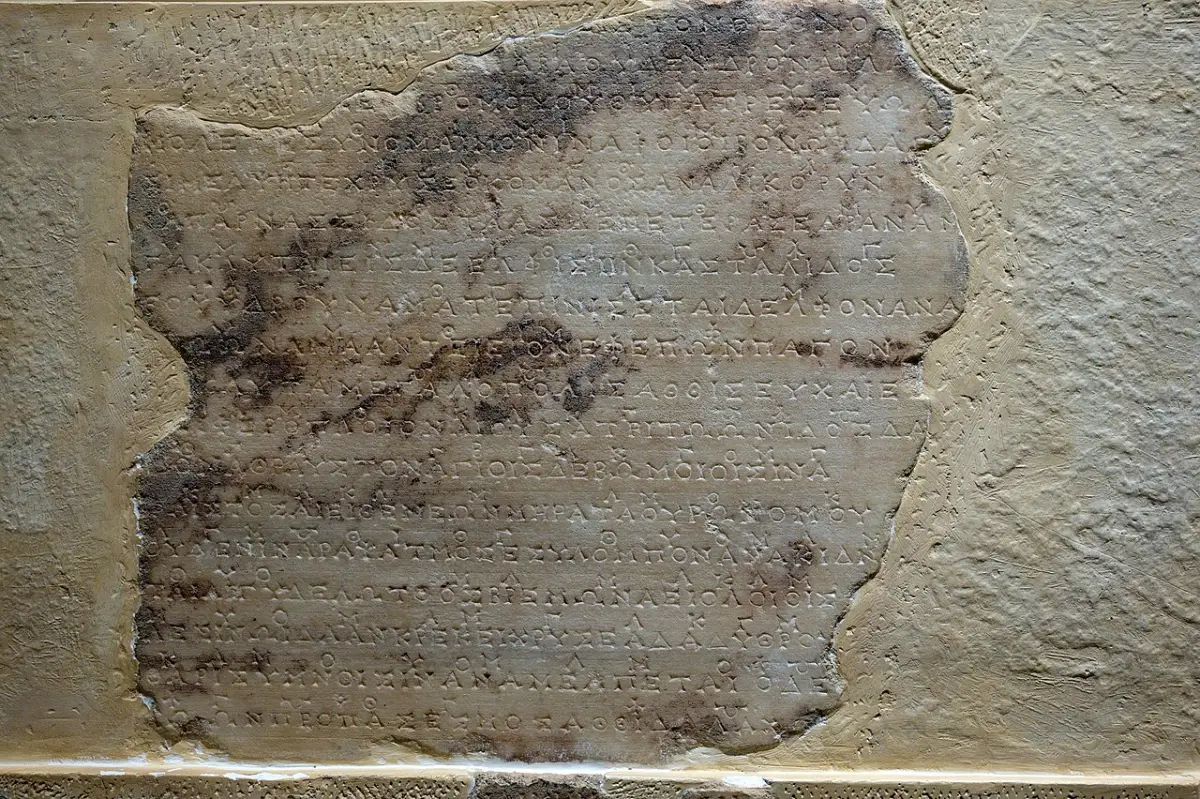
The longest scores are two hymns to Apollo from Delphi. They were cut into the south outer wall of the treasury of the Athenians, among the decrees for the Athenian sacred embassies to Delphi of 138, 128, 106 and 97 BC. They survive in sixteen fragments.[10] Henri Weil and Théodore Reinach published them in 1893–4.[11]
Paean: A paean (παιάν, paian) is a choral hymn, usually to Apollo. Its name comes from its cry, ἰὴ Παιάν (iē Paian).
The first paean is written in the singers’ signs, the second in the players’ signs. The first is by Athenaios son of Athenaios. The second is by Limenios son of Thoinos, an Athenian member of the guild of professional performers. Both were sung at the embassy of 128/7 BC.[12] A later date, 106/5 BC, has been proposed for Limenios.[13]
Both hymns follow the same plan. They call on the Muses, tell of Apollo’s coming, describe the sacrifice and the god’s deeds, among them the killing of the Python and the defeat of the Gauls in 279 BC, and end with prayers. Limenios’ hymn closes with a processional song in a different metre.[14]
Epidaurus and Sinuri
At Epidaurus, in the sanctuary of Asclepius, a hymn to the god in hexameters was published in 1980.[15] Only its first line carries notes. It was inscribed in the late third century AD, but the hymn may be centuries older.[16] The one melody must have served every line, whatever the accents of the words.[17]
The sanctuary of the god Sinuri near Mylasa, in Caria, has given blocks with musical notes, probably of the first century BC. Not one complete word survives on them.[18]
Notes
- ^ West 1992, pp. 279–280.
- ^ a b c d e Pöhlmann and West 2001, p. 90.
- ^ Pöhlmann and West 2001, pp. 88–89.
- ^ Pöhlmann and West 2001, p. 91.
- ^ Pöhlmann and West 2001, pp. 90–91.
- ^ West 1992, p. 280; Anderson 1994, p. 221.
- ^ D’Angour 2018, p. 65.
- ^ See the Notation tab of the Music theory page.
- ^ See the Seikilos sign by sign tab of the Notation page.
- ^ Pöhlmann and West 2001, p. 70.
- ^ Pöhlmann and West 2001, p. 5.
- ^ Pöhlmann and West 2001, pp. 71–72.
- ^ Pöhlmann and West 2001, p. 72.
- ^ Pöhlmann and West 2001, p. 85.
- ^ Pöhlmann and West 2001, p. 6.
- ^ West 1992, p. 279.
- ^ West 1992, p. 208.
- ^ West 1992, p. 280.
Overview · 7 of 8
Papyri before Rome: the oldest scores
Most of the surviving scores are on papyrus, and nearly all of them come from Egypt. Since 1918 papyri have brought more new music than any other source.[1]
A music papyrus does not look like a modern score. The words run in long lines across the sheet, like prose, without line-breaks for the verse. The notes stand above the syllables, and any rhythmic signs above the notes.[2] Most papyri are not copies of a whole work. They are anthologies of excerpts, for a performer’s programme or for lessons.[3]
The Orestes papyrus
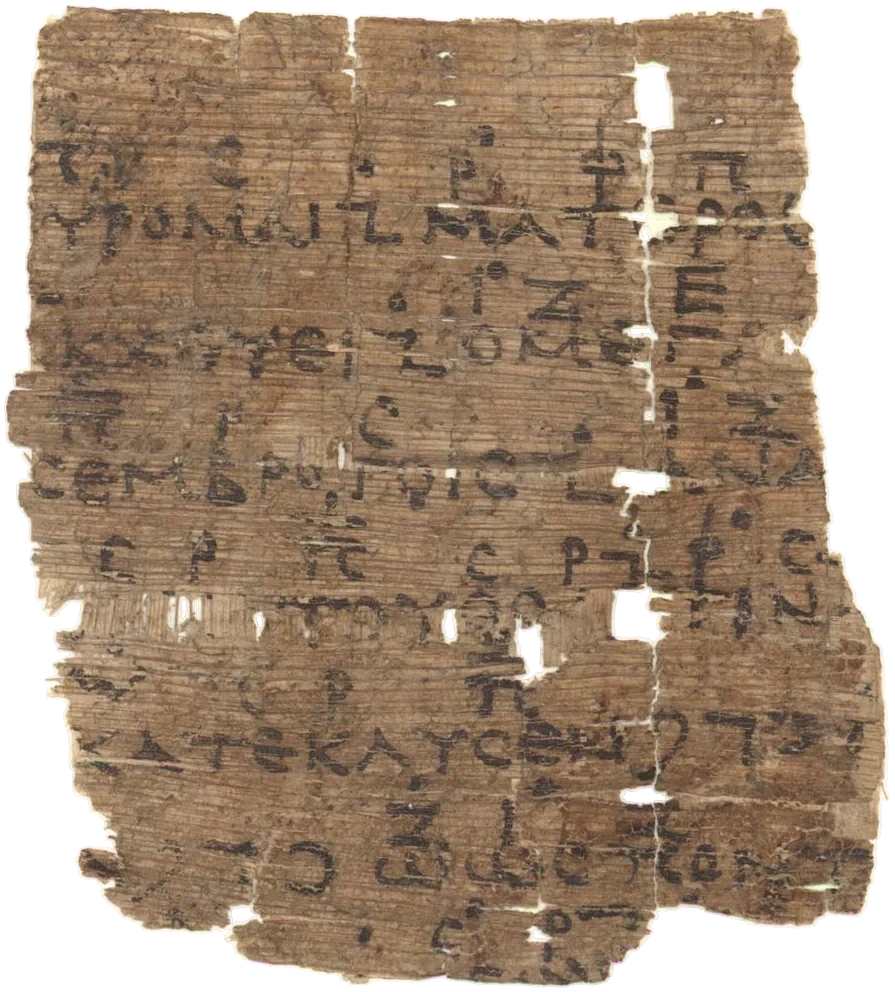
In 1890 C. Wessely published a scrap in Vienna with seven lines from a chorus of Euripides’ Orestes.[4] It had been recovered from the casing of a mummy (cartonnage) from Hermopolis. It was first dated to the age of Augustus. E. G. Turner later put it about 200 BC. That makes it the oldest musical score we have.[5]
The play was first performed in 408 BC.[6] The editors think the music may well be Euripides’ own, because the copy is so early.[7] The tunes of popular plays were kept alive by ear for generations.[8] Others doubt that any notated music goes back to the fifth century.[9]
The papyrus shows something no other source shows so clearly. The same melody served both stanzas of the chorus, the strophe and the antistrophe. So the tune could not follow the word accents of both, and it follows neither.[10] The Melody page reads it line by line.[11]
The Vienna fragments
The Vienna collection holds eight more scraps of the same date and kind, found with the Orestes papyrus. Wessely had mentioned them, but they were published only in 1962–70.[12] It is not clear how many pieces they come from.[13]
The Zenon papyrus
A fragment in Cairo was acquired together with a large group of papyri known as the Zenon archive. It dates from about 250 BC and was published in 1931. The syllables are spaced out, with their notes above them.[14] It seems to come from a chorus of a tragedy about a woman who has come as a suppliant. Its melody goes against the accents of three of its words, and so it was probably strophic like the Orestes chorus.[14]
The Leiden papyrus
The University of Leiden acquired a papyrus in 1971 with two passages from Euripides’ Iphigenia in Aulis, copied perhaps a little before 250 BC.[15] The two passages stand in the reverse of their order in the play. So the copy was made for a concert of favourite songs, not for a performance of the play. Both are songs of women, but the range of the notes, f to f♯′, needs a tenor. A man sang them.[15]
The play was staged in 405 BC, after Euripides’ death, by his son. So the son may have composed its music.[16] The signs are badly damaged. The editors read them in one key, the Hyperaeolian.[15] Hagel thinks nothing can be restored with certainty, and that the Hyperaeolian key did not yet exist when the papyrus was written.[17]
The Ashmolean and Hibeh papyri
Scraps from Oxford, taken from cartonnage of the third century BC, were published in 1999. Some may come from a tragedy, the Achilles of the younger Sophocles. Others may come from songs for the kithara.[18] Their melodies move in small steps and swing between two notes. Their long vowels sung to two notes are written twice.[19] They change key often. Hagel thinks their style is very close to that of Phrynis and Timotheus, the virtuosos of the late fifth century.[20]
The Hibeh scraps, of the mid third century BC, come from a treatise on music that gave its examples in notation.[21]
Notes
- ^ Pöhlmann and West 2001, pp. 5–6.
- ^ Pöhlmann and West 2001, p. 7.
- ^ West 1992, p. 7.
- ^ Pöhlmann and West 2001, p. 5.
- ^ Pöhlmann and West 2001, pp. 12–14.
- ^ D’Angour 2018, p. 58.
- ^ Pöhlmann and West 2001, p. 14.
- ^ West 1992, pp. 270–271.
- ^ Anderson 1994, p. 210.
- ^ Pöhlmann and West 2001, pp. 16–17.
- ^ See the Orestes tab of the Melody page.
- ^ Pöhlmann and West 2001, pp. 6, 53; West 1992, p. 279.
- ^ West 1992, p. 279.
- ^ a b Pöhlmann and West 2001, p. 42.
- ^ a b c Pöhlmann and West 2001, p. 20.
- ^ West 1992, p. 278.
- ^ Hagel 2009, pp. 257–258.
- ^ Pöhlmann and West 2001, pp. 6, 22.
- ^ Pöhlmann and West 2001, p. 39.
- ^ Hagel 2009, pp. 258, 325.
- ^ West 1992, p. 278; Pöhlmann and West 2001, p. 6.
Overview · 8 of 8
Reading a modern edition of the scores
Nobody reads the papyri and stones themselves to learn the tunes. One reads an edition. The standard edition prints all sixty-one documents in order of their presumed date, each with its text, a transcription into modern notes, a translation and a commentary.[1] Its conventions are worth knowing, because every transcription on this site follows them.
The Greek text
The originals have no spaces between words. So the edition prints the Greek from stones and papyri in small letters, run together, as the scribe wrote it. Texts from medieval manuscripts are printed normally, with spaces and accents.[2]
The notes are printed in capitals above their syllables. The rhythmic signs stand above the notes. The lines are laid out as on the original, not as verse.[2]
Example: the first line of the Seikilos song
Here is the first line of the song as the edition prints it, from the stone. The table then reads it line by line.
| Signs | C | Z | Z | K I Z | I |
|---|---|---|---|---|---|
| As written | ο | ϲον | ζηιϲ | φαι | νου |
| With accents | ὅ | σον | ζῇς | φαί | νου |
| Transliteration | ho | son | zēis | phai | nou |
| Notes | a | e′ | e′ | c♯′ d′ e′ | d′ |
| Units | 1 | 2 | 3 | 1 + 1 + 1 | 3 |
The line means “While you live, shine.” The syllable φαί is sung to three notes, c♯′ d′ e′. The other syllables have one note each.[3]
The transcription
The edition writes the Greek vocal sign C as the modern note a, the a below middle c. This is a convention first used by Friedrich Bellermann in the 1840s. It has the advantage that the Hypolydian key comes out with no sharps or flats.[4] The real pitch was about a minor third lower.[5]
Rhythm follows the syllables. A short syllable becomes a quaver, and a long one a crotchet, unless the signs say otherwise. A note whose pitch is known but not its length is printed without a tail. A note whose rhythm is known but not its pitch is printed without a head. Quarter-tones have signs of their own.[2]
The music is printed in the treble clef with a small 8 beneath it. That means it sounds an octave lower than written, in the range of a tenor.[6] Notes are named by octave: C to B in the lowest, then c to b, then c′ to b′, which starts at middle c.[6] A small arrow beside a note raises or lowers it by less than a semitone.[6] A wavy line marks a gap in the original.[7]
c′: Middle c. The a below it is the plain a of the editions (220 Hz), and the a above it is a′.
A dispute about pitch
Hagel argues that the convention puts the music in the wrong key as well as at the wrong height. He would take the Lydian key, not the Hypolydian, as the plain one. The central note of the Lydian is the commonest note in the documents. Every transcription would then come down a fourth, and would be within about a semitone of the real pitch.[8]
Example: the first note of the Seikilos song, the sign C.
Edition: a (220 Hz). Real pitch, about a minor third lower: near f♯. Hagel’s transcription: e.
synthetic ∿ · English
The score players on this site sound at the editions’ pitch, and offer a switch to play a minor third lower.
Further reading
- Pöhlmann, E. and West, M. L. 2001. Documents of Ancient Greek Music. The edition of all the scores, with transcriptions and commentary.
- West, M. L. 1992. Ancient Greek Music. A survey of the whole subject, from the instruments to the documents.
- Hagel, S. 2009. Ancient Greek Music: A New Technical History. The scales, keys and notation as a system.
- Anderson, W. D. 1994. Music and Musicians in Ancient Greece. The fifth century, with appendices on the instruments and on the scales and notation.[9]
- Nowacki, E. 2020. Greek and Latin Music Theory. Essays on the harmoniai, the tonoi and the notation.[10]
Notes
- ^ Pöhlmann and West 2001, p. 6.
- ^ a b c Pöhlmann and West 2001, p. 7.
- ^ Pöhlmann and West 2001, pp. 88–89.
- ^ Pöhlmann and West 2001, p. 7; Hagel 2009, p. 9.
- ^ Pöhlmann and West 2001, p. 7; West 1992, pp. 273–276.
- ^ a b c West 1992, p. 12.
- ^ West 1992, p. 283.
- ^ Hagel 2009, pp. 452–453.
- ^ Anderson 1994, pp. xi, 171, 198.
- ^ Nowacki 2020, pp. 1–3.


