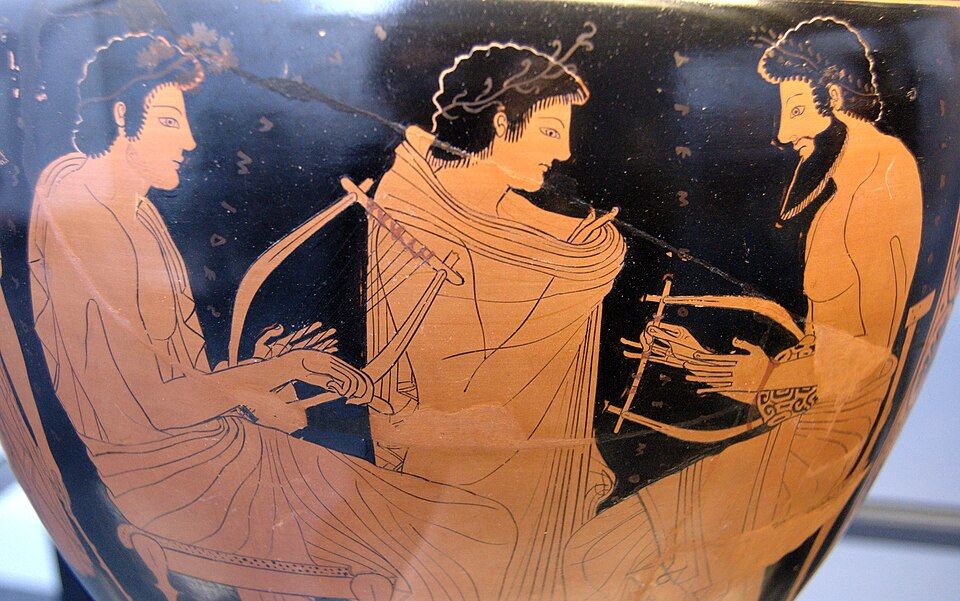
The music of Greek poetry: instruments, scales and notation, the surviving scores, and how melody and rhythm went with the words.
Notation · 1 of 6
Two sign systems
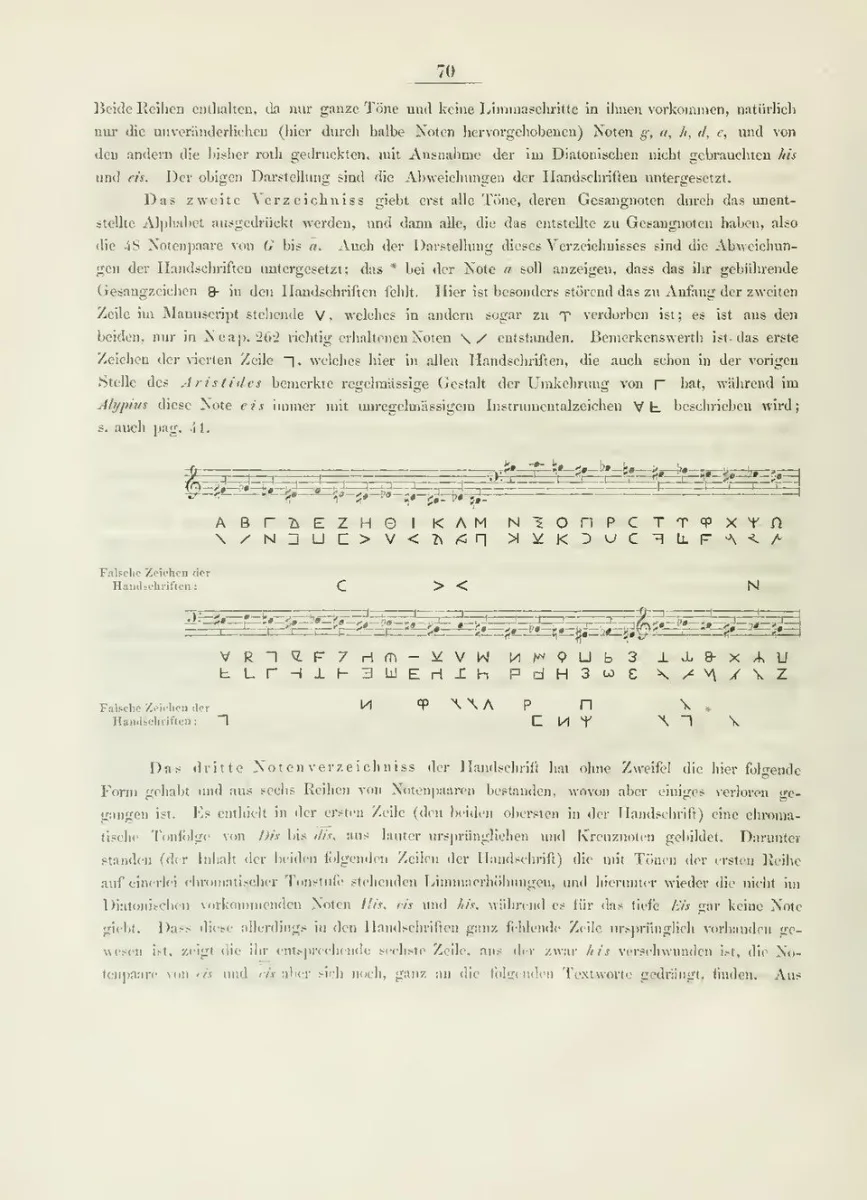
By the middle of the third century BC, the date of the first surviving scores, Greek professional musicians had an agreed way of writing pitch. They set letters above the syllables of the text.[1] The same system is found, consistent, in papyri and inscriptions down to the late third century AD. It is also found in the tables that the late handbook of Alypius gives for every key and genus. It is from those tables, above all, that the signs are understood.[2]
Vocal and instrumental
There are two series of signs, one for singers and one for players. The scores nearly always keep them apart.[2]
The vocal series is simply the twenty-four letters of the Ionic alphabet. They are assigned in descending order to the notes of the central octave: about f′ down to f in the modern equivalents, the average male singing register. Outside that octave the letters are repeated in altered forms. They may be inverted, turned on their side or marked with a stroke.[3]
The instrumental series is older and stranger. It is a set of letter-like symbols “in no intelligible order”. Following Westphal, West derives them from the local script of Argos. He would attribute them to a musician of the north-east Peloponnese, not much later than the mid fifth century.[4] Hagel accepts that many of the signs look like letters of local Greek scripts. But he finds that no meaningful series emerges, and he calls their origin a riddle still to be solved.[5]
A tablature is a notation that shows where to put the fingers, rather than which note sounds. Nowacki suggests that the instrumental set began as a tablature of fingerings.[6] Landels makes it specifically a piper’s fingering notation, a theory of his own.[7]
The vocal set was devised later, in the late fifth or the fourth century. It gave singers a series in a familiar order.[8]
Triads
Both series work in groups of three. In the instrumental set a basic sign stands for a natural, diatonic note. The same sign turned on its side is the “first sharp”, and the sign reversed is the “second sharp”. These lie a quarter-tone to a semitone above the natural, according to the genus.[9]
The vocal set hides the same structure under continuous lettering. The third letter of each group is the natural, and the two before it are the sharps. In the central octave the naturals Γ, Ζ, Ι, Μ, Ο, Ϲ, Φ, Ω stand for f′, e′, d′, c′, b, a, g, f. Α Β stand above Γ, Δ Ε above Ζ, and so on.[10]
A first sharp is used only for the lower of the two movable notes of a tetrachord. The upper one is written with a second sharp, or, in the diatonic, with the natural of the next group.[11]
There is no sign for lowering a note. Nowacki explains this from the instruments. A lyre string could be raised by stopping, and an aulos hole by part-uncovering, but neither could be lowered.[6] The signs do not distinguish the enharmonic from the chromatic genus, which share the same shape of tetrachord.[12]
Natural key: The Hypolydian key is written entirely with the basic, unturned signs. It is the “white-note” scale of the system, and the modern convention makes it A minor. Every other key needs sharps; the Dorian needs seven of them.[13]
Pitch
The modern letter-equivalents go back to Bellermann in the 1840s. He chose them to avoid sharps and flats. The editors agree that the true pitch was about a minor third lower.[14]
Hagel goes further. He argues that the Lydian key, not the Hypolydian, should be taken as the natural scale, because the central note of the Lydian is the note most often attested in the documents. That would bring every transcription down by a fourth.[15] On this site the conventional letters are kept, and the dispute is noted.
Who could read it
The notation was a professional’s tool. Aristoxenus dismissed it as no part of harmonic science. A written fourth, he said, looks the same whatever its place in the scale. And the man who writes out the notes of a Phrygian melody need not know what the Phrygian melody is.[16] The Alexandrian scholars never used it in their editions of the lyric poets.[17]
Dionysius of Halicarnassus describes a melody of Euripides laboriously in words, rather than citing the signs. By the fourth or fifth century AD, Gaudentius implies that the system was no longer current.[18]
Notes
- ^ West 1992, p. 254; Hagel 2009, p. 1.
- ^ a b West 1992, p. 254.
- ^ West 1992, pp. 259–260; Nowacki 2020, p. 44.
- ^ West 1992, pp. 260–261.
- ^ Hagel 2009, p. 2.
- ^ a b Nowacki 2020, p. 43.
- ^ Landels 1999, c. pp. 208–209; see the An aulos tablature? tab.
- ^ West 1992, p. 263.
- ^ West 1992, pp. 255, 262.
- ^ Nowacki 2020, p. 45.
- ^ West 1992, pp. 255–256.
- ^ West 1992, p. 255.
- ^ Hagel 2009, p. 9; Nowacki 2020, p. 44.
- ^ West 1992, p. 255; Anderson 1994, p. 204.
- ^ Hagel 2009, pp. 452–453.
- ^ West 1992, pp. 263–264, 271.
- ^ Pöhlmann and West 2001, p. 1.
- ^ West 1992, pp. 272–273.
Notation · 2 of 6
An aulos tablature? Landels' theory of the instrumental signs
Where the instrumental signs came from is, as the first tab says, unsettled. West derives their shapes from the script of Argos. Hagel calls their origin a riddle. Nowacki suggests a tablature of fingerings.[1]
John Landels built and played reconstructions of the instruments. He made the last idea specific. In his view the older notation was designed for aulos-players, and its triads are three positions of a finger on a hole.[2] The theory is set out here as his, against West’s and Hagel’s accounts.
The triad as a finger
Landels starts from Alypius’ tables. In them most instrumental signs are used in three positions: upright, “turned back” and “turned away”. Each triad is a pyknon: three notes, two small intervals apart. So the notation was made for the scales whose tetrachords began with such a cluster, the chromatic and the enharmonic.[3]
Curt Sachs had read the signs as a fingering for the lyre. Landels rejects this. In his own reading, the natural sign stood for a closed finger-hole. The second position stood for a slight lift of the finger, and the third for a further lift.[4]
On a five-holed pipe, raising the finger a little from the next hole above sharpened the note by a diesis. A diesis is a small interval, from a quarter-tone to a semitone. Raising the finger a little more gave a second diesis. So every natural note but the highest carried a pyknon above it.[5]
Diesis: “Leak”: the small interval, from a quarter-tone to a semitone, that a piper got by partly uncovering a hole. Landels notes that it is the one Greek interval-name derived from a wind technique. The rest come from strings.
What follows
Two consequences follow. First, the intervals inside a triad were not fixed. They could vary within limits from piece to piece and from player to player. So the notation was at first a fingering guide rather than an exact notation of pitch. The naturals denoted holes, which may or may not have had a standard pitch.[4]
Landels finds this in keeping with Plato’s gibe at pipers hunting for the pitch of each note. It fits, too, the several intonations of the chromatic and enharmonic that the theorists describe. He thinks pipers arrived at these by trial, and string-players then copied them.[2]
Second, the notation never had to give the size of a diesis. This explains a puzzling feature of Alypius’ tables. The note above a tetrachord’s natural base is always the next sign in the triad, whatever the genus. Yet it is a quarter-tone above in the enharmonic, a semitone or less in the chromatic, and a semitone in the diatonic.
For a piper, “one diesis up” was the same movement of the finger whatever its size. The sign was kept when the vocal alphabet was grafted on, though for a string-player it was inappropriate and sometimes misleading.[6] Landels rejects the alternative, that the pitch of that note never moved. The ancients always count both inner notes of the tetrachord as moving, and Ptolemy criticises Archytas on exactly this point.[7]
Aristotle’s twenty-four
A passage of the Metaphysics says that the interval from alpha to omega is the same as that on the aulos from its lowest note to its highest, that is, twenty-four. Landels explains the choice of instrument. A pipe of the kind Pronomus made had eight holes over an octave, with a vent. Each hole sounded three notes, so it could play any one of twenty-four. Eight instrumental signs in three positions cover an octave in the modern numbering.
The twenty-four vocal letters were then assigned to these triads from the top down, three to each. That is why alpha falls on a second sharp rather than on a natural.[8] Both systems use octave marks above a certain pitch. Landels connects them with harmonics on the kithara, and with small pipes that transposed up an octave.[9]
The Brauron pipe and the pitch standard
His appendix on the aulos from Brauron, of the late sixth century, supports the theory from the other side. No surviving pipe has holes close enough to give less than a tone. So semitones and dieses were made by the fingers, exactly as the triads indicate, and the open-hole notes are the naturals. Anderson reports the intervals Landels measured.[10]
Landels draws a conclusion for the system as a whole. For him the natural key of the tables is the Lydian; the first tab, after Hagel and Nowacki, gives that role to the Hypolydian. A scheme adequate for that key, he argues, was tinkered with to serve the rest. This implies a fairly rigid standard of pitch, probably embodied in the aulos, and scores pitched exactly, within a semitone, for the voices and instruments. The composer had a definite pitch in mind.[11] There are no flats in either system: every modified sign raises the pitch.[12]
Notes
- ^ West 1992, pp. 260–261; Hagel 2009, p. 2; Nowacki 2020, p. 43.
- ^ a b Landels 1999, c. pp. 208–209.
- ^ Landels 1999, c. pp. 207–208; West 1992, p. 255.
- ^ a b Landels 1999, c. p. 208.
- ^ Landels 1999, c. pp. 35–36.
- ^ Landels 1999, c. pp. 215–216.
- ^ Landels 1999, c. p. 215.
- ^ Landels 1999, c. pp. 209–210.
- ^ Landels 1999, c. pp. 212–213; see the Ranges and pitch tab of the Instruments page.
- ^ Landels 1999, c. pp. 272–273; Anderson 1994, p. 182.
- ^ Landels 1999, c. pp. 214, 217; Hagel 2009, p. 9.
- ^ Landels 1999, c. p. 215; Nowacki 2020, p. 43.
Notation · 3 of 6
How to read a line of score
A Greek score is a text with a row of letters above it. To read it, one needs to know four conventions, and then to identify which key the letters belong to.
Four conventions
- Each sign stands above the syllable it is sung to. Any rhythmic marks stand above the sign.[1]
- Repeated notes. In Hellenistic documents a note that is repeated on the following syllables is written once only, over the first. From about 100 BC the repeated note is written out each time.[2] The Delphic paeans of 128 BC still use the older practice. So a syllable with no sign over it takes the note before.[3]
- Two notes on one syllable. When a long syllable is sung to two notes, the older texts double its vowel, so that each note has a letter under it: Φοῖοῖβον for Φοῖβον. The later texts leave the spelling alone, and join the two notes with a slur beneath them.[4]
- Duration is mostly not written at all, because the metre gives it. A short syllable takes one time-unit and a long one two. The editors render these as a quaver and a crotchet.[5] Where the composer wanted something else, he added marks for it.[6]
C = a: The editions follow Bellermann’s convention. They write the vocal sign C as the note a (the a below middle C), so that the Hypolydian key comes out without sharps or flats. The true pitch was about a minor third lower; Hagel would put it a fourth lower.[1]
Finding the key
The letters only give pitches once one knows which of the fifteen keys (tonoi) they are drawn from. The same letter is a different note in each key. A practical method runs as follows:[7]
- Collect every sign in the piece, and arrange the pitches they give in order.
- Look for tetrachords built tone, tone, semitone downwards. This is the shape of a diatonic tetrachord.
- Find where two tetrachords are joined by a shared note. Such tetrachords are called conjunct. Find also where two are separated by a whole tone. These are called disjunct.
- The disjunction identifies the two notes mesē and paramesē, the fixed centre of the Greek scale. The key is named from where that centre falls.
For the Seikilos song the eight notes are e′ d′ c♯′ b a g f♯ e. They fall into tetrachords on b–f♯ and f♯–c♯, with the disjunction between c♯′ and b. That places the piece in the Iastian (Ionian) key.[7] Editors do this for every new fragment. Over half of the surviving pieces turn out to be in the Lydian or Hypolydian key, and over half of the rest in the Ionian.[8]
The whole apparatus can be pictured as a railway map. The two-octave system is laid out three times over, at the interval of a fourth. So the Hyper- and Hypo- keys supply the conjunct and disjunct alternatives at the fork above mesē.[9] A transcriber matched the scale of his melody against a segment of that map. He chose the key that put it at the right pitch, and kept its signs until a modulation or a chromatic note forced him to borrow from a neighbour.[10]
What the key does not tell you
The key is a notational fact, like a key signature. It fixes pitch, not character. Nowacki warns that in late antiquity the tonoi functioned as keys independent of the octave species. The Seikilos song is written in the Iastian key, but its melody moves in the Phrygian species of the octave. Mesomedes’ invocation of the Muse is in the Lydian key but the Mixolydian species.[11]
West makes the same point from the other side. There is no necessary correlation between the modality of a piece and the key of its notation, which was decided by pitch and instrument. On his analysis the Seikilos tune is in a G mode that no Greek name fits.[12] Reading the signs identifies the key. It says nothing of the piece’s mode or feeling, and nothing of its rhythm, which has signs of its own.[13]
Notes
- ^ a b Pöhlmann and West 2001, p. 7.
- ^ West 1992, p. 254.
- ^ Pöhlmann and West 2001, p. 72.
- ^ West 1992, p. 267; Pöhlmann and West 2001, p. 72.
- ^ West 1992, p. 254; Pöhlmann and West 2001, p. 7.
- ^ See the Rhythmic signs tab.
- ^ a b Nowacki 2020, p. 48.
- ^ West 1992, p. 259 with n. 9.
- ^ West 1992, p. 258.
- ^ West 1992, pp. 258–259.
- ^ Nowacki 2020, pp. 28–29.
- ^ West 1992, pp. 185–186.
- ^ Nowacki 2020, p. 50.
Notation · 4 of 6
The Seikilos song, sign by sign
The one complete ancient Greek song is cut on a small marble column. It was found during railway building near Aydın in western Turkey, the ancient Tralles. For a time it served as the pedestal of a flowerpot, which cost it its last line. It reached the National Museum in Copenhagen in 1966.[1]
Its date is disputed. Pöhlmann and West date it by the shapes of its letters to the second century AD.[2] West’s catalogue and Nowacki say the first century, and D’Angour about 150–200.[3]
The lines above the song say that the stone is an image, set up by Seikilos as a lasting memorial. The subscription names Seikilos son of Euterpes, a name that suggests a family of musicians. It adds that he was alive when the stone was set up.[4]
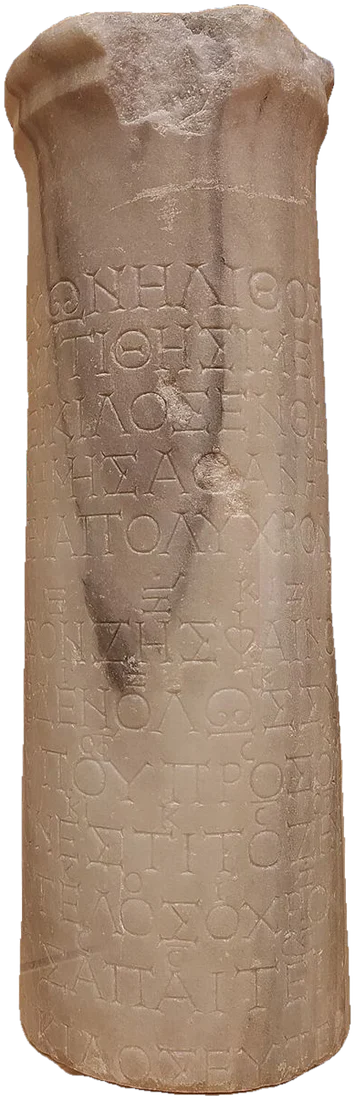
The signs
Eight vocal letters are used. Pöhlmann and West read them as a segment of the Ionian (Iastian) key.[5] With the conventional transcription they give the notes below.
| Sign | Note | Sign | Note |
|---|---|---|---|
| ⌝ | e (an instrumental sign) | C | a |
| X | f♯ | O | b |
| Φ | g | K | c♯′ |
| I | d′ | Z | e′ |
Above the letters stand three rhythmic marks:
- a bar for a note of two units, called a diseme;
- a bar with a tick down at its right for three units, called a triseme;
- a point, the stigmē, which marks the up-beat (arsis).
A slur under two or three letters, called the hyphen, binds them to one syllable.[6]
The song
The table follows the stone, whose lines 6 to 11 carry the song. The numbers on the left are the stone’s line numbers, and the heavy rules mark the four verses. Each verse adds up to twelve time-units.
| Line | Syllable | Signs | Notes | Units |
|---|---|---|---|---|
| 6 | ὅ | C | a | 1 |
| σον | Z | e′ | 2 | |
| ζῆις | Z | e′ | 3, arsis | |
| φαί | KIZ | c♯′ d′ e′ | 1 + 1 + 1 | |
| νου | I | d′ | 3, arsis | |
| 7 | μη | K | c♯′ | 2 |
| δὲν | I | d′ | 1 | |
| ὅ | Z | e′ | 1, arsis | |
| λως | I K | d′ c♯′ | 2, arsis | |
| σὺ | O | b | 1 | |
| 8 | λυ | C | a | 2 |
| ποῦ | O Φ | b g | 3, arsis | |
| πρὸς | C | a | 1 | |
| ὀ | K | c♯′ | 1 | |
| λί | Z | e′ | 1 | |
| 9 | γον | I | d′ | 1, arsis |
| ἐσ | KI | c♯′ d′ | 1 + 1, arsis | |
| τὶ | K | c♯′ | 1 | |
| τὸ | C | a | 2 | |
| ζῆν | O Φ | b g | 3, arsis | |
| 10 | τὸ | C | a | 1 |
| τέ | K | c♯′ | 1 | |
| λος | O | b | 1 | |
| ὁ | I | d′ | 1, arsis | |
| χρό | Z | e′ | 1, arsis | |
| 11 | νος | K | c♯′ | 1, arsis |
| ἀ | C | a | 1 | |
| παι | C | a | 2 | |
| τεῖ | C X ⌝ | a f♯ e | 3, arsis |
The pointing is not quite consistent on the stone. The editors note a superfluous point over the last note of line 6. They judge the point over the first I of line 7 an error, since that note is a down-beat. And the triseme over the two slurred notes in lines 8 and 9 shows that the sign could govern a pair of notes. Their time is divided quaver and crotchet, to suit the iambic rhythm.[5]
What it shows
Each verse is two iambic measures, differently filled. The rhythm is written out exactly where the metre alone would not give it.[7]
The melody is diatonic. West hears it in a G mode: the tonic is g at the true pitch, and a in the convention. The tune moves within the fifth above the tonic and the tone below it. Then the last syllable drops to the fourth below, in an old-sounding pentatonic cadence.[8]
The tune respects the word accents, with two exceptions. One is the rising fifth on ὅσον. Pöhlmann and West take this as a conventional opening gesture, paralleled in Mesomedes. The other is ἐστι in line 9, which would be no exception if the accent were on the first syllable.[5]
D’Angour hears it differently. In both places he hears a dynamic stress on the first syllable, standing in for a melodic rise. He points out that with Roman-period pronunciation the verse-ends rhyme in pairs: φαίνου with λυποῦ, and ζῆν with ἀπαιτεῖ. He also notes that on the stone the point over λυποῦ stands over the second letter of the diphthong; the editors moved it.[9] On his reading the closing fall of a fourth answers the opening rise of a fifth, and completes the octave around the central a.[10]
Notes
- ^ Pöhlmann and West 2001, pp. 88–90.
- ^ Pöhlmann and West 2001, p. 88.
- ^ West 1992, p. 280; Nowacki 2020, p. 29; D’Angour 2018, p. 65.
- ^ Pöhlmann and West 2001, pp. 90–91.
- ^ a b c Pöhlmann and West 2001, p. 90.
- ^ Pöhlmann and West 2001, pp. 88, 90.
- ^ West 1992, p. 301.
- ^ West 1992, pp. 301–302.
- ^ D’Angour 2018, pp. 66–68, 71.
- ^ D’Angour 2018, p. 72.
Notation · 5 of 6
A Delphic paean: one phrase worked
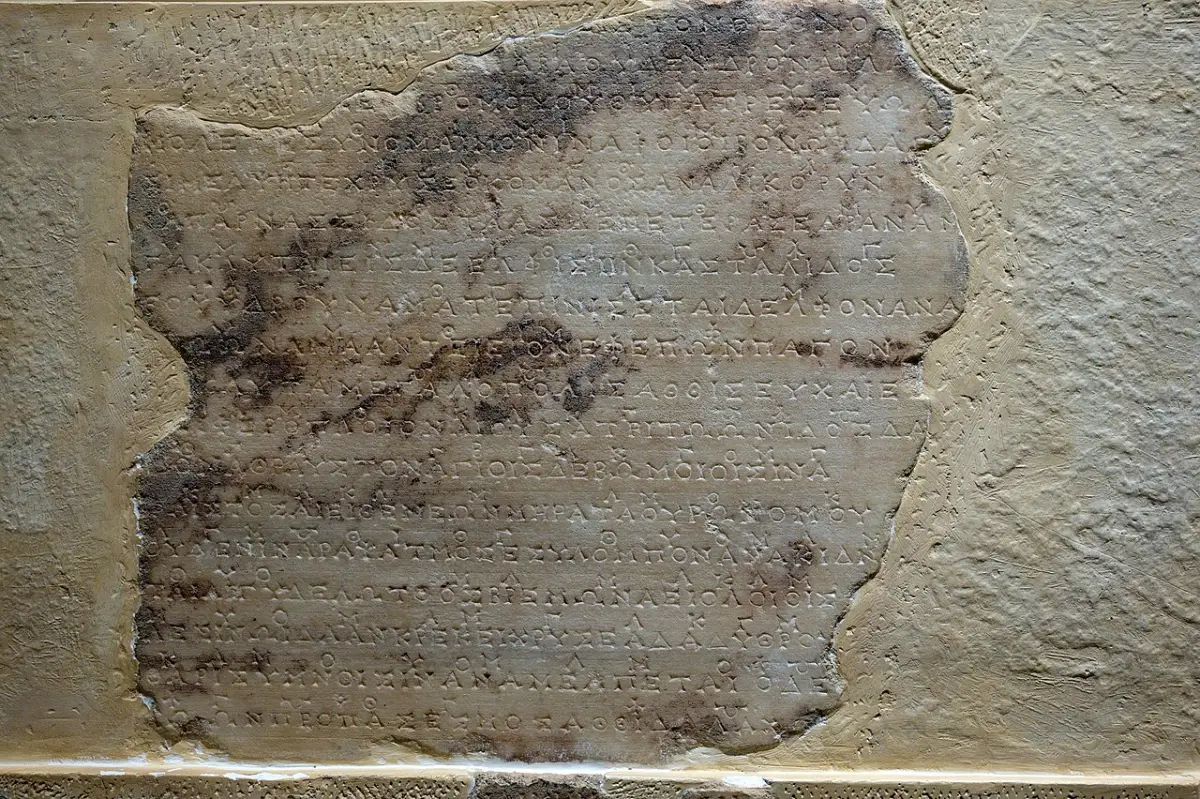
The longest ancient scores are two hymns to Apollo. They were cut into the south outer wall of the Athenian treasury at Delphi, among decrees for the Athenian Pythaids. These were the sacred delegations sent from Athens to Delphi in 138, 128, 106 and 97 BC.[1]
One hymn is written with vocal signs, the other with instrumental ones. Limenios was himself an instrumentalist, which would explain his choice.[2] The first hymn is now known, from Bélis’s reading of its heading and of the decree, to be the work of Athenaios son of Athenaios, an Athenian member of the artists’ guild. It was sung at the Pythais of 128/7 BC. The second, by Limenios son of Thoinos, was composed for the same occasion.[3] In that year fifty-eight artists went up from Athens. Thirty-nine of them were singers, and they formed the choir.[4]
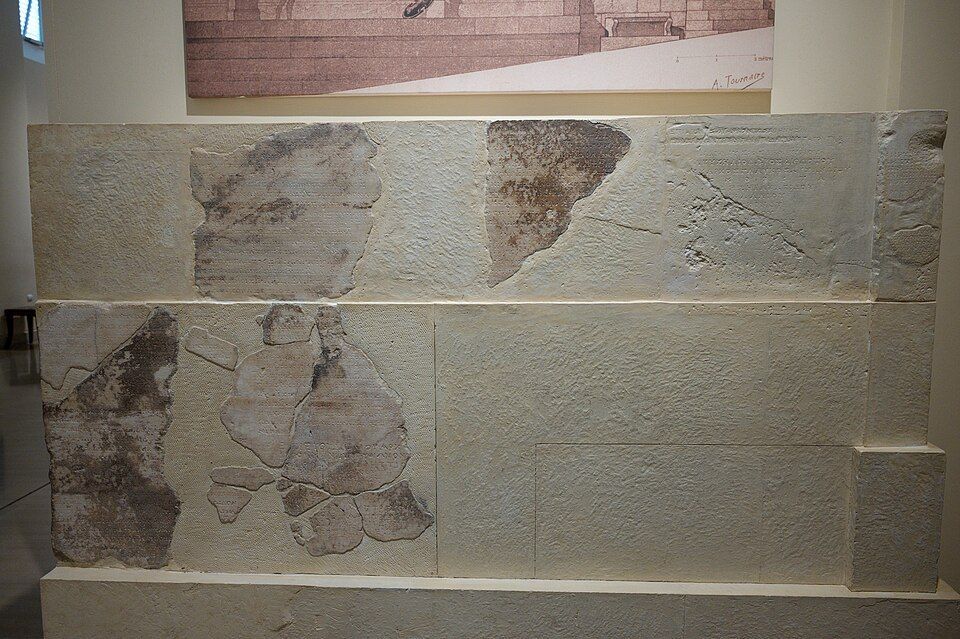
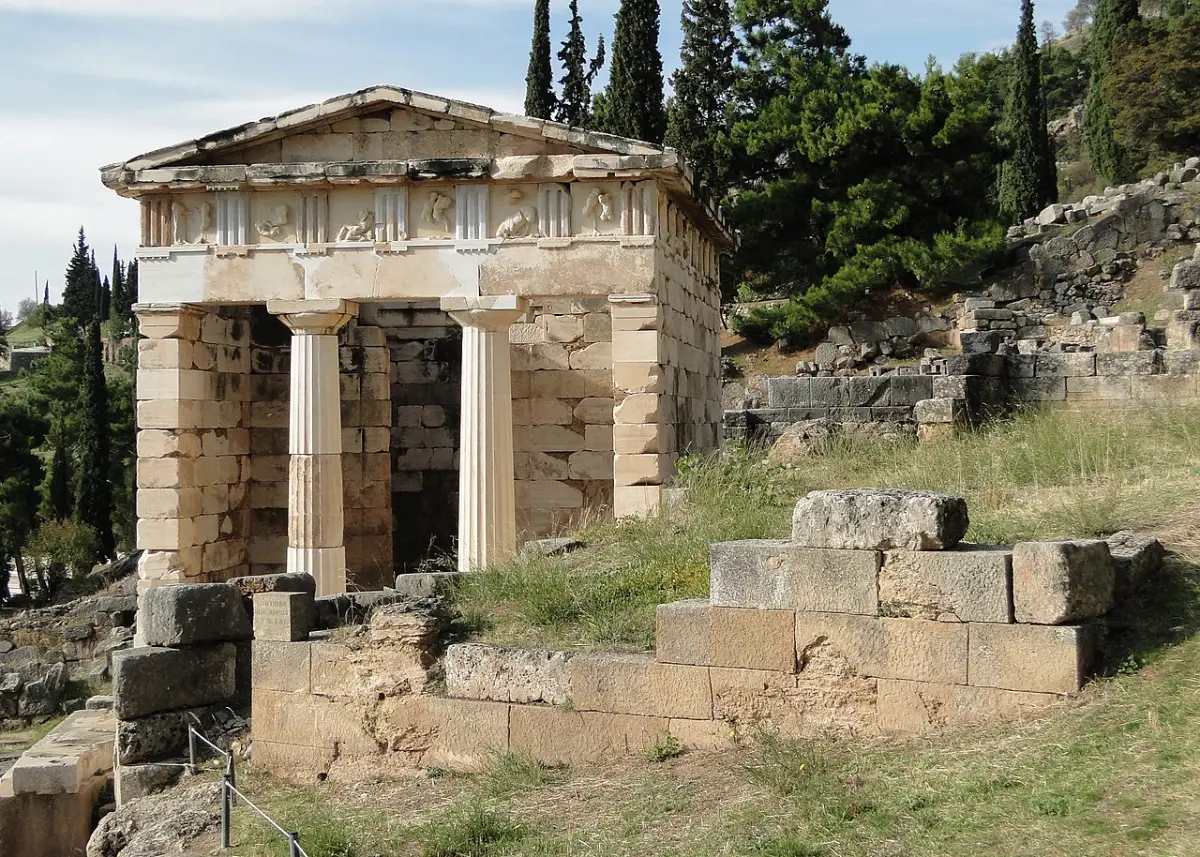
The conventions of 128 BC
Athenaios’ paean uses the older conventions. A syllable with no sign above it repeats the note of the one before. A long syllable sung to two notes has its vowel written twice, so that each note has a letter beneath it: Φοῖοῖβον, ὠιδαεῖσι.[5]
There are no rhythmic signs at all. The rhythm is simply the metre. The paean is in cretic-paeonic measures throughout. The editors convert each short into one unit and each long into two. There is no ground, they say, for the compound time that older transcriptions used.[6] Where a long is divided between two notes, each note takes a unit.
One phrase
Column i, line 3 of the stone: the Muses are told to come and celebrate Phoebus, their brother, in song. The signs are given below with the editors’ transcription, which has three flats. A dash means that the note is carried over from the previous syllable, without a sign.
| Stone | Syllable | Sign | Note | Units |
|---|---|---|---|---|
| 3 | ἵ | I | d′ | 1 |
| να | — | d′ | 1 | |
| Φοι | — | d′ | 1 | |
| οῖ | M | c′ | 1 | |
| βον | Y | a♭ | 1 | |
| ὠι | M | c′ | 2 | |
| δα | — | c′ | 1 | |
| εῖ | Y | a♭ | 1 | |
| σι | — | a♭ | 1 |
The two heavy rules mark two paeonic feet of five units each. ἵνα Φοῖβον is a cretic with its first long resolved (⏑ ⏑ – ⏑). ὠιδαῖσι is a cretic with its last long resolved (– – ⏑). The long syllable Φοῖ is sung to two notes, d′ falling to c′, and so is δαῖ. Each time, the stonecutter wrote the extra vowel.[7]
The melody follows the accents. Φοῖ, with its circumflex, takes a falling pair of notes. ὠι is higher than the syllables after it. The unaccented syllables sit at or below the level of the accented ones. In each paean only once is an unaccented syllable set higher than the accented syllable of its word. And only once is a circumflex set to a rising interval.[5]
The observation is an old one. The Delphic inscriptions show a tendency for melody and word accent to agree. The acute is sung on a higher note than any other syllable of its word, and the circumflex on two descending notes.[8] The word after a grave normally begins higher.[9] The accent was respected mainly in non-strophic music like this. It is respected in no surviving fragment earlier than the third century BC.[10]
The whole piece
Fourteen different notes occur, from e♭ to a′. The editors read them as the Phrygian key, with excursions into the Hyperphrygian.[11] In the two lowest tetrachords the second movable note is avoided altogether. This gives, they say, an archaic pentatonic effect. Above the central note the tune alternates between a chromatic conjunct tetrachord and a diatonic disjunct one. The changes of key go with the sections of the text, and the first section ends at line 8 with Parnassus.[11]
In lines 9–16 West hears “a little scree of semitones”, descending to the note below the tonic. He finds word-painting at the twin peaks of Parnassus, and at the “shimmering tunes” the Muses sing.[12] The Delphic paeans use up to fifteen notes, a free astrophic form, and a modal plan that moves from section to section. They show no sign that music had stood still since the New Music of the late fifth century.[13] Hagel finds both paeans centred on the functional mese. He hears in parts of them a deliberate archaising, an echo of older music otherwise lost.[14]
Notes
- ^ Pöhlmann and West 2001, p. 70.
- ^ Hagel 2009, pp. 1–2.
- ^ Pöhlmann and West 2001, pp. 71–72.
- ^ West 1992, p. 375.
- ^ a b Pöhlmann and West 2001, p. 72.
- ^ Pöhlmann and West 2001, p. 72; West 1992, pp. 141–142.
- ^ Pöhlmann and West 2001, pp. 62, 72.
- ^ Allen 1968, pp. 108–109; Allen 1973, pp. 232–234.
- ^ Landels 1999, c. p. 112.
- ^ Probert 2006, p. 48.
- ^ a b Pöhlmann and West 2001, p. 73.
- ^ West 1992, pp. 196–197, 200–201.
- ^ West 1992, p. 383.
- ^ Hagel 2009, p. 325.
Notation · 6 of 6
Duration, beat and rest: the rhythmic signs
Pitch letters alone leave the rhythm to the metre. For most of a Greek score that is enough: a short syllable is one unit, and a long one two.[1] But composers sometimes stretched a long, or divided one between two notes. They sometimes held a note through a pause, or wanted the beat marked. For these purposes a second set of signs grew up beside the letters. The treatise known as the Anonymus Bellermanni lists them. Pöhlmann later distilled the practice of the documents into ten principles.[2]
| Sign | Name | Meaning | Where found |
|---|---|---|---|
| C | diseme | a note of two units; also over a group of notes sharing two units | common, though vocal texts often leave a long unmarked |
| C | triseme | three units; may stand over two slurred notes | one or two papyri and the Seikilos stone |
| ⌊⏗ | tetraseme, pentaseme | four and five units | only in the treatise; the Berlin paean writes its double longs with disemes |
| C | stigmē | a point marking the arsis, the up-beat | Seikilos, the Orestes papyrus, later papyri; not in the Delphic paeans |
| Λ | leimma | a rest of one unit, or the prolongation of the note before it; with a diseme, two units | Mesomedes, the later papyri |
| C K | hyphen | a slur beneath notes sung to one syllable | post-Hellenistic texts; older ones double the vowel instead |
| : | double point | before notes on one syllable, with or instead of the slur | the Berlin papyrus, the Christian hymn |
| ⊃ | diastolē | a punctuation mark; in the Orestes papyrus it sets off instrumental notes | the Vienna papyri |
Duration
No sign exists for a single unit, because the short syllable is the unit. Aristoxenus called it the primary duration. This is the smallest indivisible time in a given piece. It is normally the short syllable, but it may be longer in a slow, spondaic tempo.[3]
The diseme bar is the common mark of a two-unit note. It is written above the letter or to its right. In vocal texts, though, a long syllable is often left unmarked, since the metre gives it.[4]
The triseme, a bar with a tick, prolongs a note to three units. It occurs in one or two papyri and on the Seikilos stone. There the editors show it standing over two notes joined by a slur, whose three units are shared as one and two.[5] Four- and five-unit signs are listed in the treatise but are not found in any score. The Berlin paean, in slow spondaic rhythm, writes its double longs with disemes.[4]
The leimma is a lambda-shaped sign, with a pointed or rounded top. It is a rest of one unit, and a diseme above it makes it two.[6] But a rest written after a note can also mean that the note is held through the time.
Mesomedes’ Hymn to the Sun makes a three-unit ending in three ways. It may use one triseme note. It may use a single note followed by a diseme written with a leimma. Or it may use three single notes. On this reading the leimma marks the stretching of the note it is attached to, by one unit.[7]
Beat
From the second half of the fifth century, each measure was thought of as divided into an up and a down, arsis and thesis. In the scores the arsis is marked by a point (stigmē) above the note.[8] The treatise is explicit. The thesis goes unpointed, and the arsis pointed. Where the arsis spans two or three notes, each is usually pointed.[9]
The Delphic paeans carry no points at all. And the transmission of the points is not always reliable: on the Seikilos stone one stands where the editors judge that a down-beat falls.[10] In the Orestes papyrus the points sit on the first and third positions of each dochmiac. They show where the down-beats fell: on the second and the last two positions of ⏑ – – ⏑ –.[11]
Arsis and thesis: Literally “lifting” and “placing”, from the dancer’s foot or the conductor’s hand. They are the up-beat and the down-beat of a measure. In the scores the up-beat carries the point.
Several notes to a syllable
The Hellenistic texts doubled the vowel of a long syllable sung to two notes. Later texts left the spelling alone. They put a slur (the hyphen) under the notes, with or without a diseme above, or a double point before them, or both. Three notes on one syllable took a double point with a diseme, and a slur joining the second and third.[12]
The treatise names some ornaments too. The kompismos is a cross set between repeated notes in the Berlin instrumental pieces. The melismos is marked with a chi. The third is the teretismos.[9]
Finally there are a few articulation marks. The diastolē is a sign of punctuation, which the Orestes papyrus places before and after a group of instrumental notes. Later papyri use oblique strokes for pauses of sense or changes of voice.[13]
Notes
- ^ Pöhlmann and West 2001, p. 7.
- ^ West 1992, p. 266; Anderson 1994, pp. 205–209.
- ^ West 1992, pp. 244–245, 266.
- ^ a b West 1992, p. 266.
- ^ West 1992, p. 266; Pöhlmann and West 2001, p. 90.
- ^ West 1992, pp. 266–267.
- ^ Psaroudakes 2018, pp. 125–126.
- ^ West 1992, pp. 133–134, 268.
- ^ a b West 1992, p. 268.
- ^ Pöhlmann and West 2001, pp. 72, 90.
- ^ D’Angour 2018, pp. 63–64.
- ^ West 1992, pp. 267–268.
- ^ West 1992, p. 269; Pöhlmann and West 2001, p. 15.


