Instruments
Lyres, pipes, harps and percussion: their construction, tuning and place in Greek performance.
The music of Greek poetry: instruments, scales and notation, the surviving scores, and how melody and rhythm went with the words.
Instruments · 1 of 5
Lyres: phorminx, kithara, lyra, barbitos
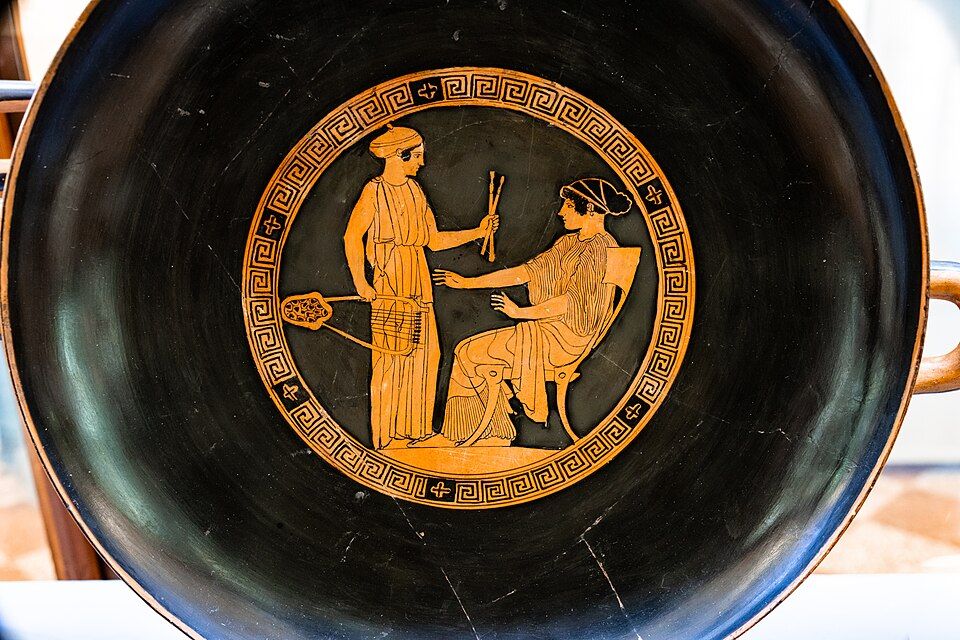
A lyre is any stringed instrument in which two arms rise from a sound-box and are joined by a crossbar. Its strings are of equal length, and run from the base over a bridge up to the bar.[1]
The Greeks had lyres from Minoan times, harps from at least the end of the seventh century, and lutes only from the later fourth. The lyre was the only stringed instrument in Minoan and Mycenaean art. It was the only one that an Olympian god regularly played, and it was the theorists’ instrument.[2]
Two families
The Greek lyres fall into two families. Box lyres have a wooden sound-chest. Bowl lyres have a tortoise-shell. The box lyres were elaborate and expensive: they were the professionals’ instruments. The bowl lyres were less powerful, and belonged to the home, the symposium and the schoolroom.[3]
The names overlap:
- Homer knows only phorminx and kitharis, probably a round-based box lyre.
- Lyra appears with Archilochus.
- The Hymn to Hermes uses all the words, and adds chelys, “tortoise”, for the shell lyre.
- Pindar calls his own instrument both phorminx and lyra.
- Only the fourth-century writers keep kithara, lyra and barbitos firmly apart.[4]
Phorminx: The epic singer’s lyre. It was probably a four-stringed, round-based box lyre, in general use in the eighth century. The tradition that Terpander raised four strings to seven belongs to the seventh.[5]
The kithara
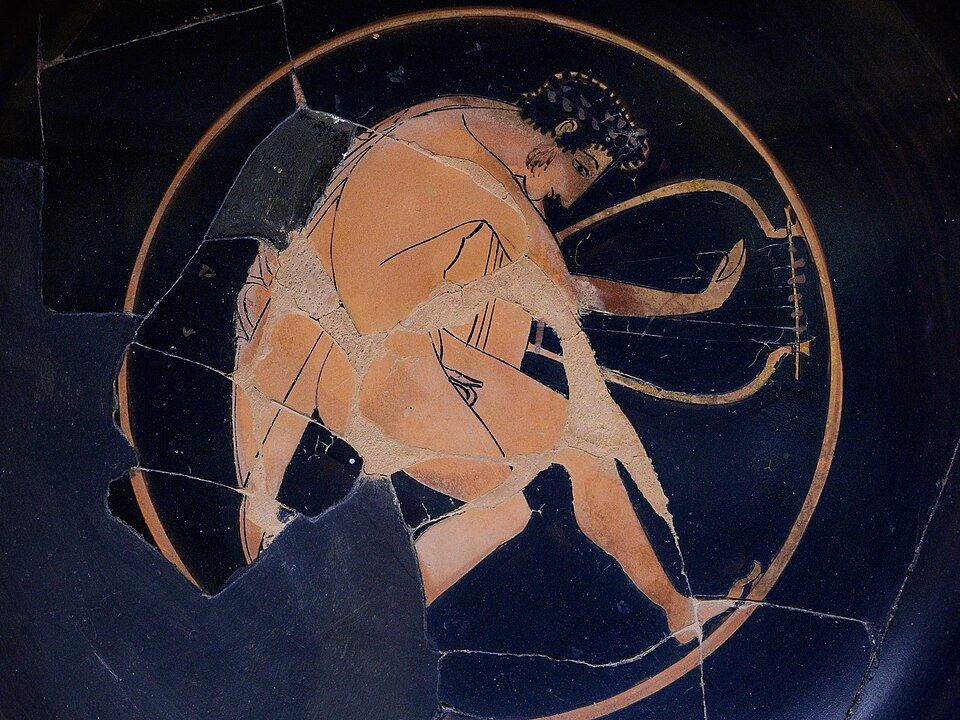
By the seventh century seven-stringed kitharas were regular. A flat-bottomed design with composite arms and volutes is engraved on bronze armour of the late seventh century. It is already close to the classical concert kithara.[6]
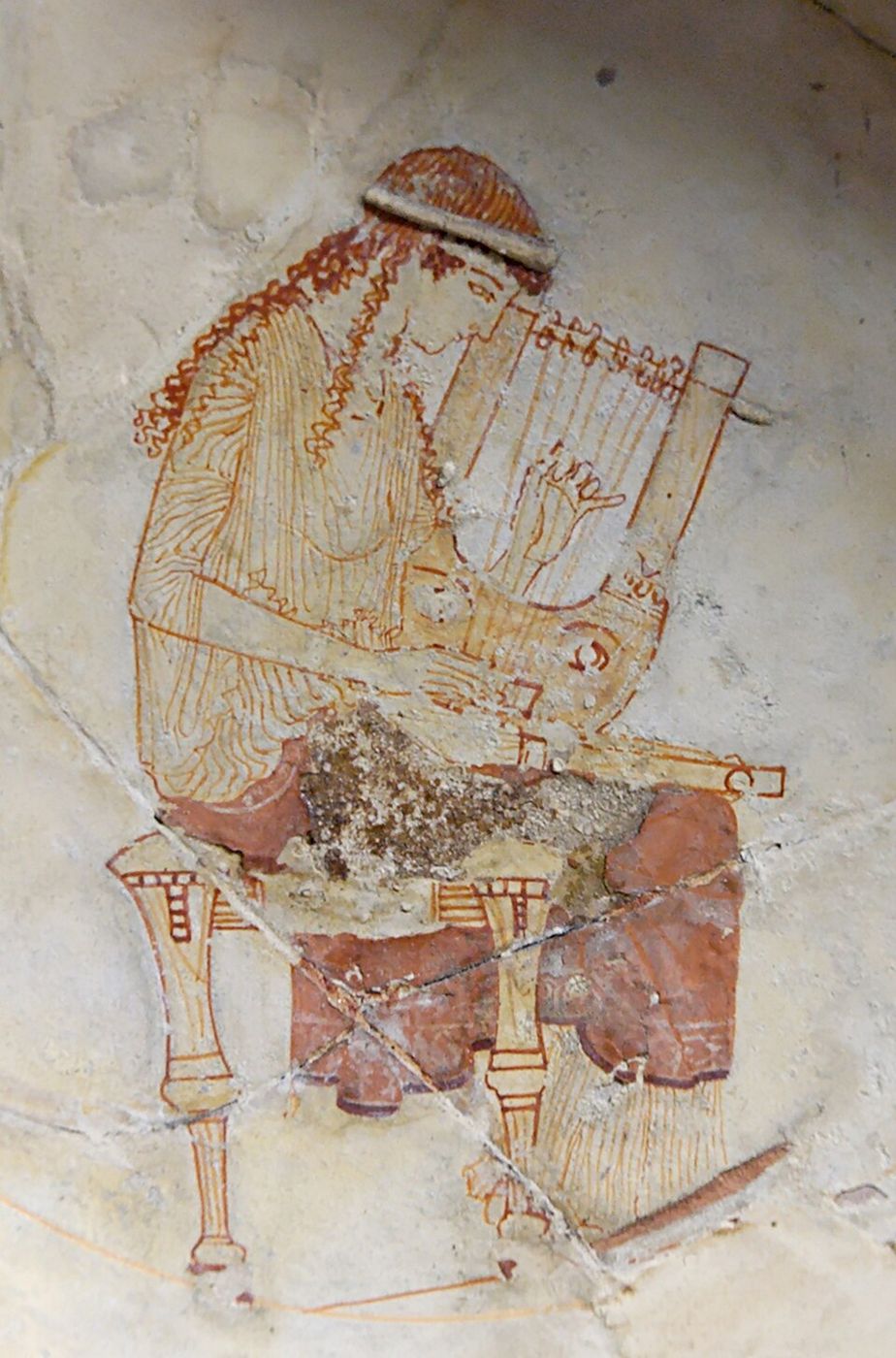
This square-based instrument has a sound-box that bulges behind, like the stern of a boat set on end. It was the citharode’s instrument at the Pythian and Panathenaic contests. Aristotle calls it a professional’s instrument, unfit for education.[7]
It was much larger and heavier than the lyra. It was made all of wood, with inlay of gold, silver and ivory. Its hollow arms extended the resonance, and its strings were under greater tension, normally seven of them. It was played by free men in a ceremonious ankle-length robe, and by goddesses, but not by mortal women.[8]
The round-based kithara of earlier art is often called the “cradle kithara”, though no ancient name for it is known. After 500 it passed to women and Muses, and it was gone by the fourth century.[9]
The lyra and the barbitos
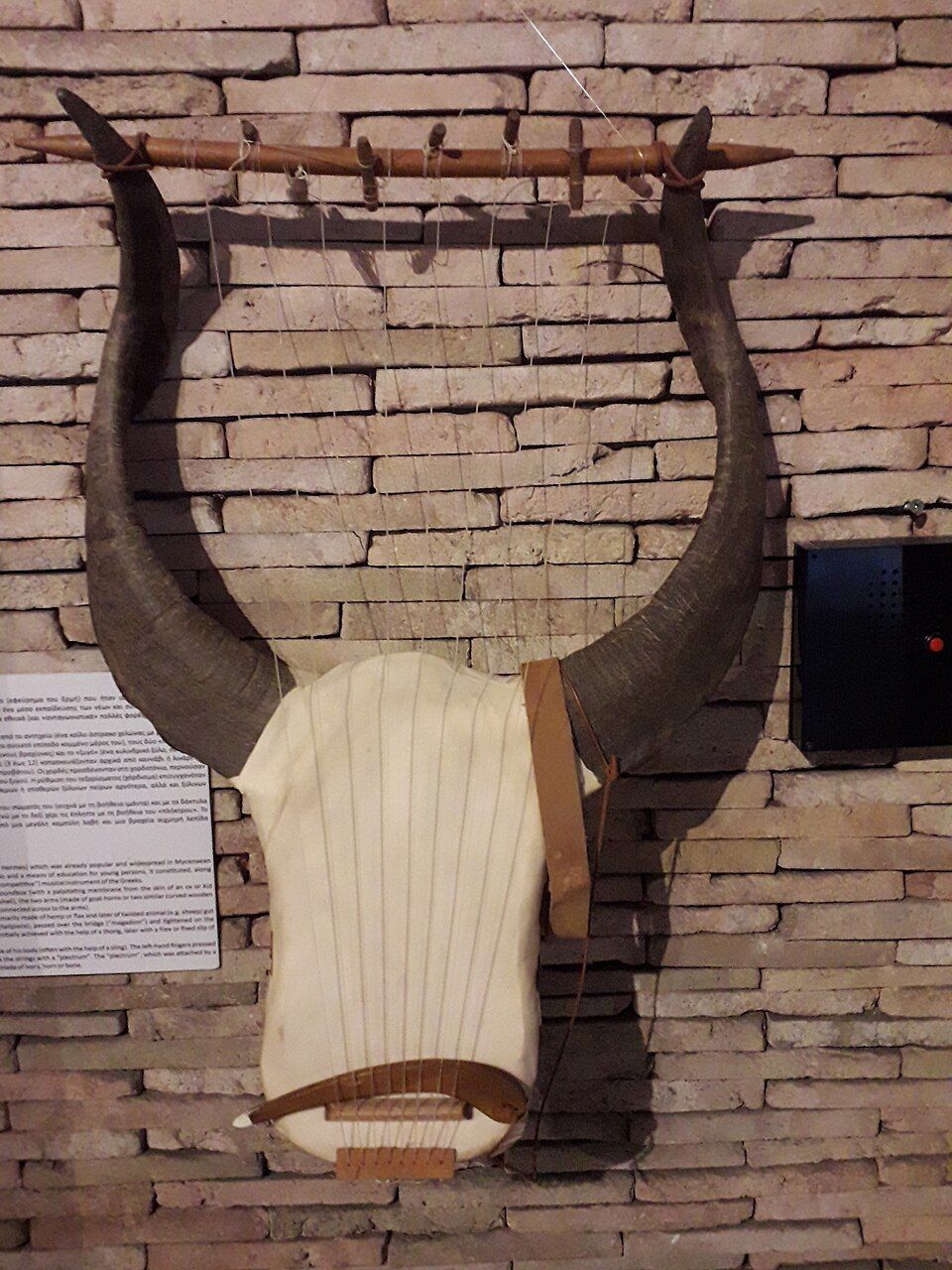
The Hymn to Hermes tells how the god made the first lyra. He used a scraped tortoise shell, cane spars, a hide, two arms, a crossbar and seven strings of sheep gut.[10]
The sound-chest was made from a mountain tortoise’s carapace. The arms were originally of horn. The yoke had a leather wrapping (kollops) round each string, into which a wooden peg might be pushed. There was a bridge, and the strings were of gut or sinew. The whole instrument was about a foot by two and a half.[11]
The lyra appears in art from about 700, and often from the sixth century. It is seen in dances, sacrifices, processions and symposia, at home, at school and in myth. Men, women and children play it. It was the non-professional’s ordinary instrument.[12]
The barbitos is a bowl lyre with long arms that bend inwards at the top. It is deeper in pitch and softer in tone, an octave or more below the lyra.[13] It is first named by Anacreon, and it appears suddenly in Attic art in the last quarter of the sixth century. It belongs to the symposium and the revel. It is the instrument the painters give Sappho, and it fades from the vases after about 440.[14]
Strings and playing
Seven strings were standard from the seventh century. They were named from “topmost” to “bottom” by their place on the tilted instrument. Virtuosi added strings from the mid-fifth century: Ion of Chios knew an eleven-stringed lyre by 422, and Timotheus boasted of eleven notes. But ordinary players kept to seven.[15]
Tension was adjusted by turning the bindings on the crossbar. Pegs of the modern kind arrive in the second century BC.[16] The player held the instrument against his left side. The right hand swept all the strings with a plectrum on a cord. The left hand plucked single strings. As most scholars hold, it also damped those not wanted, so that a strum sounded only the notes chosen.[17]
In accompanying a singer, the lyre’s basic task was to double the melody. The fingers picked out the tune, and the loud plectrum strums came where the voice paused.[18] Solo playing, “bare lyre-playing”, had its own Pythian contest from 558 BC. Plato thought it a tasteless stunt.[19]
Notes
- ^ West 1992, pp. 48–49.
- ^ West 1992, pp. 48–50.
- ^ West 1992, p. 50.
- ^ West 1992, pp. 50–51.
- ^ West 1992, pp. 52–53.
- ^ West 1992, p. 53.
- ^ West 1992, pp. 54–55.
- ^ Anderson 1994, pp. 176–177.
- ^ West 1992, p. 55 with n. 26.
- ^ West 1992, pp. 56–57.
- ^ Anderson 1994, pp. 171–175.
- ^ West 1992, p. 57.
- ^ West 1992, pp. 57–58; Anderson 1994, pp. 177–178.
- ^ West 1992, pp. 58–59.
- ^ West 1992, pp. 62–64; Hagel 2009, pp. 442, 445.
- ^ West 1992, pp. 61–62.
- ^ West 1992, pp. 64–66; Anderson 1994, pp. 175–176.
- ^ West 1992, pp. 67–68.
- ^ West 1992, pp. 69–70.
Instruments · 2 of 5
The aulos
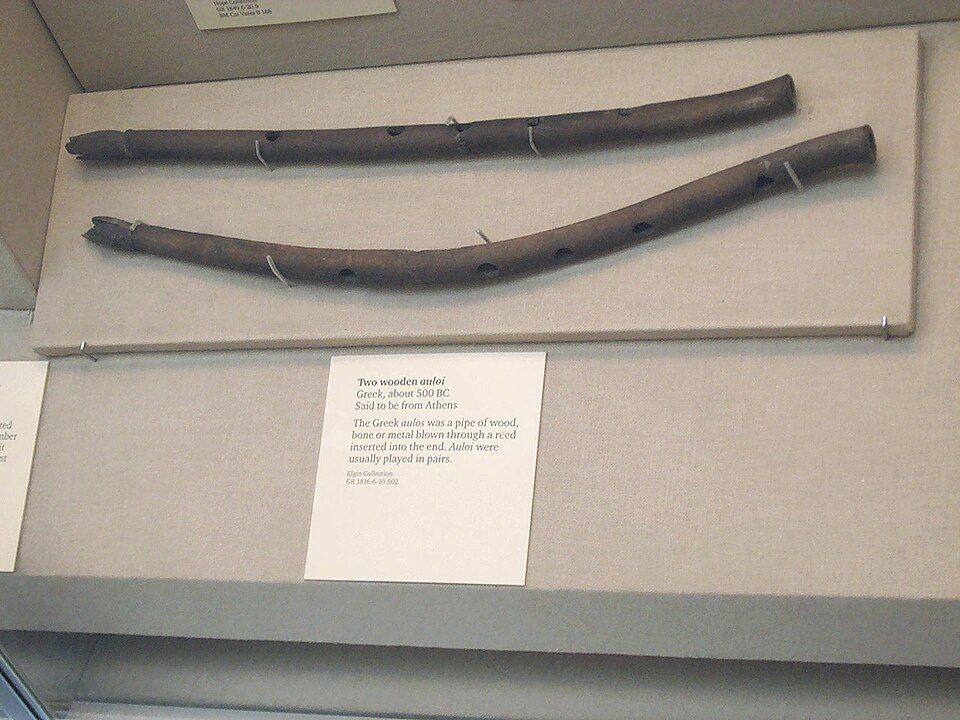
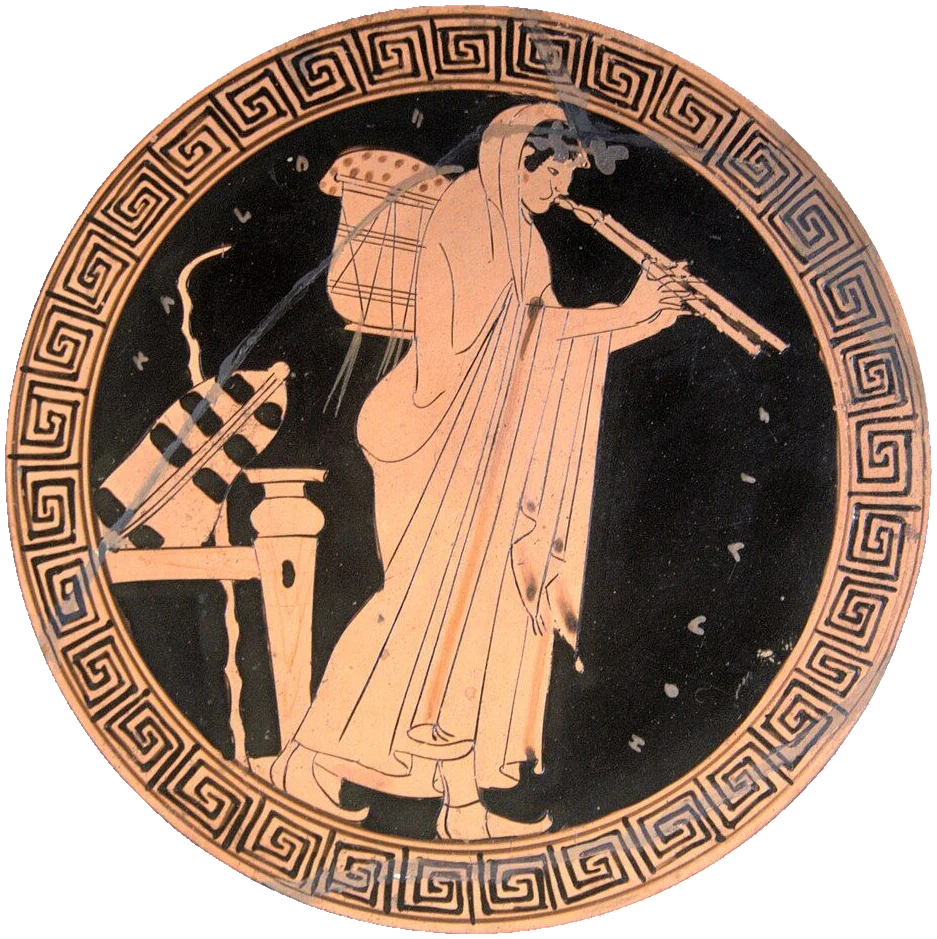
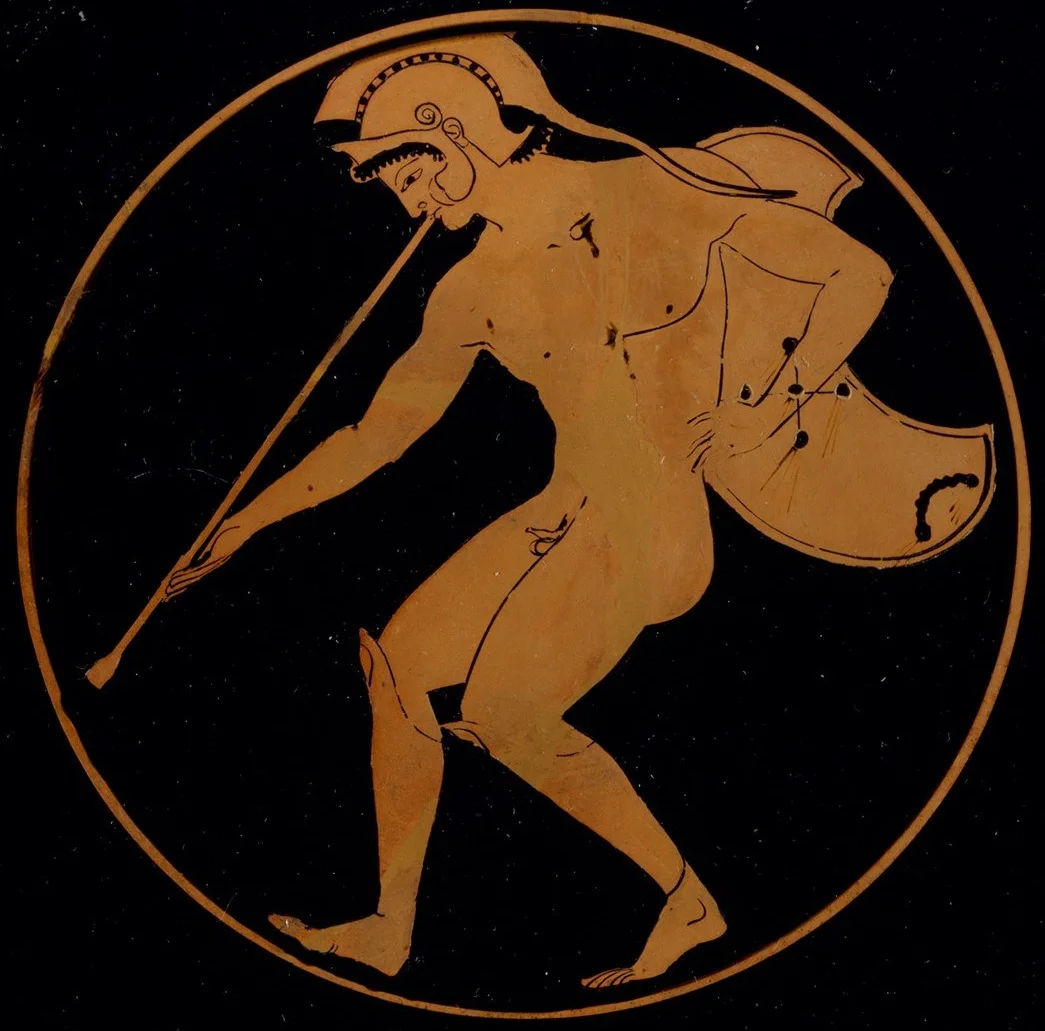
The aulos is not a flute. It is a reed-blown pipe. Yet “flute” stands in at least seventy articles of the standard Greek lexicon.[1] The word means simply “tube”. The instrument is a pipe with finger-holes and a reed mouthpiece, almost always played in pairs, one in each hand.[2] Paired pipes are universal in the ancient Near East, and the Greek evidence begins at the end of the eighth century. Homer names them only twice, and West suspects a late arrival from Asia Minor or Syria.[3]
Reed and body
The reed might have been single, like a clarinet’s, or double, like an oboe’s. The classical evidence points to the double reed. Vases show tapering tips, Theophrastus describes how the reeds were made, and players squeezed the reed with the lips.[4] In the Hornbostel-Sachs classification the aulos is therefore an oboe. West translates it in poetry as “pipe” or “shawm”.[5]
The reed sat in a bulbous section of one to three bulbs, with a cup before the first as a lip-rest. The main pipe was of reed, bone, ivory, wood or metal, in socketed sections. Its bore was eight to ten millimetres wide, and cylindrical. That is why overblowing gives a twelfth, and it was probably not part of normal technique.[6] The classical aulos had five finger-holes, the second a thumb-hole underneath, and sometimes a sixth vent.[7]
The names of the parts come from a reconstructed pipe of about 15 BC found at Meroe. The reed socket is the holmos, the bulb the hypholmion, the mouthpiece the syrinx, and its tongue the glōtta.[8] West takes the syrinx of the aulete’s art to be a different device, which bent the pitch. The conservative Telephanes refused to have it fitted to his pipes.[7]
Surviving pipes run from thirty centimetres upwards. Aristoxenus distinguished five sizes, from girls’ to “beyond complete”, with a compass of more than three octaves.[9] A leather halter, the phorbeia, passed across the mouth and round the head to support the lips and cheeks. Professionals wore it, and women hardly ever.[10]
About 400 BC Pronomus of Thebes is credited with pipes that could play several modal scales. Rotating collars opened and closed the holes. Late pipes from Meroe and Pompeii have up to twenty-four holes, with collars and levers.[11] This was the point at which the professional’s instrument passed beyond what a citizen could own or play.[12]
Aulos: A reed pipe with finger-holes, played in pairs. Translate “pipe” or “oboe”, never “flute”. The player is an aulētēs. A singer who accompanies himself on it is an aulōidos.
What scales the pipes played
Inferring notes from hole positions is hazardous. The reeds are lost. And the player could half-stop a hole, cross-finger, or shade with the lips, so that Proclus says each hole gives at least three notes.[13]
Fifteen archaic and classical pipes have been listed. The six-hole examples give a tone, then a fourth divided into three roughly equal steps smaller than a tone, then a tone. They span a major sixth. The Reading aulos spans an octave.[14] Landels measured the Brauron pipe. Its intervals are 231, 267, 151, 165 and 182 cents, with no step of the 204-cent tone of disjunction.[15] Hagel builds on exactly this. A pipe with evenly spaced holes gives tones and three-quarter-tones, and half-stopping produces the enharmonic quarter-tone.[16]
The two pipes together
In archaic and classical art the two pipes are of equal length, and the hands equally placed. So they played the same register, and largely the same melody.[17] The Orestes score has its instrumental notes mostly single, and twice a pair a fourth apart. West reads this as the pipes diverging.[18] Anderson holds that unison, if not strict, was usual. Fourths and fifths occurred occasionally, and a drone cannot be dismissed.[19]
The sound was penetrating. One pair sufficed for a chorus of fifty. Aristotle called the instrument orgiastic, fit for the cults that used drums.[20] Aulos and kithara were rarely played together. Anderson thinks the pipes would have overpowered the strings, and that they usually alternated.[21] In the theatre the aulos was the one instrument. It could stand in for others, the syrinx and the lyre, when the words called for them.[22]
Notes
- ^ West 1992, pp. 1–2.
- ^ West 1992, pp. 81–82.
- ^ West 1992, p. 82.
- ^ West 1992, pp. 83–85.
- ^ West 1992, p. 85.
- ^ West 1992, pp. 83, 85–86, 101–102.
- ^ a b West 1992, p. 86.
- ^ Anderson 1994, pp. 179–180.
- ^ West 1992, pp. 89–90.
- ^ West 1992, p. 89.
- ^ West 1992, p. 87.
- ^ Hagel 2009, pp. 444–445.
- ^ West 1992, pp. 95–96.
- ^ West 1992, pp. 97–100.
- ^ Anderson 1994, p. 182.
- ^ Hagel 2009, p. 443.
- ^ West 1992, p. 103.
- ^ West 1992, p. 104.
- ^ Anderson 1994, p. 181.
- ^ West 1992, pp. 105–106.
- ^ Anderson 1994, p. 183.
- ^ Weiss 2018, pp. 140–141.
Instruments · 3 of 5
Panpipe, trumpet, harps and the rest
Beside the lyre and the aulos the Greeks knew a dozen other instruments, most of them marginal to the music of poetry. Three deserve a page. They are the panpipe of the herdsman, the trumpet of the battlefield, and the harps that came from Lydia and belonged to women.
The syrinx
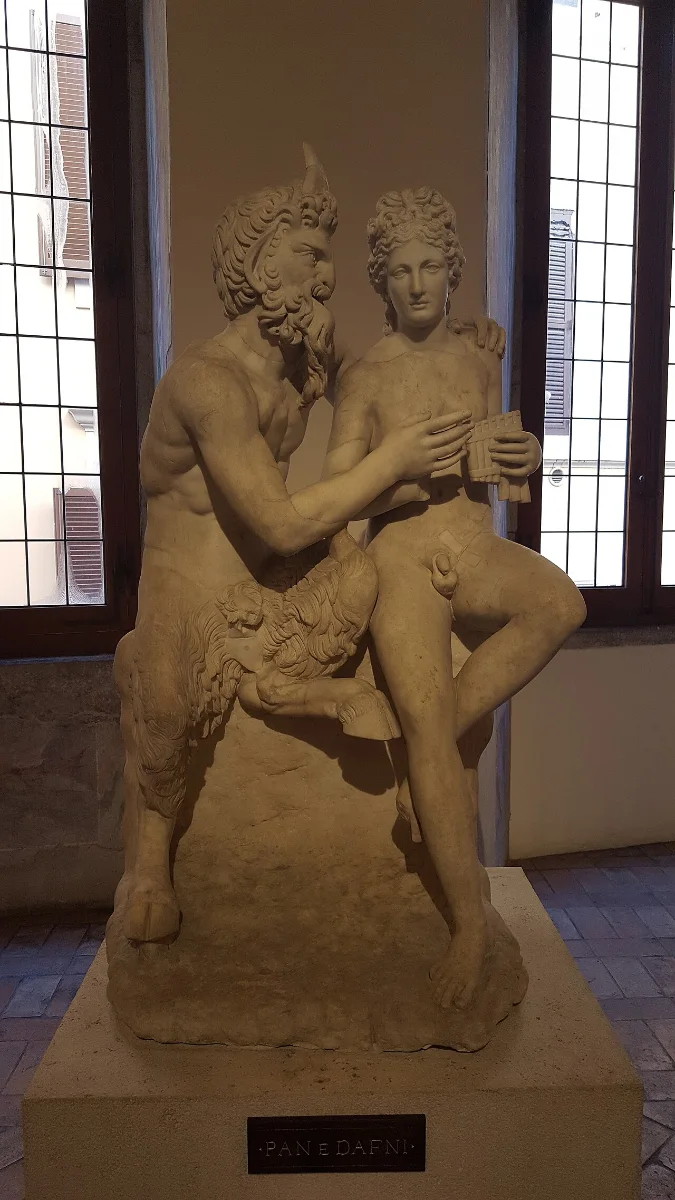
The panpipe (syrinx) is a row of tubes without finger-holes. The tubes are stopped at the bottom and blown across. It is older than the Greeks, and appears in Cycladic figurines of the third millennium. But it never entered the high civilisations of the Near East, and in Greece it stayed lowly.[1]
Homer gives it to cowherds, and to the Trojan camp-fires. Its players are herdsmen and their gods, Pan, Hermes and the Silens. It has almost no part in Athenian life, and it never appears in a real-life Attic scene.[2]
The classical Greek instrument was rectangular, with four to ten tubes. The tubes were of equal length, blocked with wax to the required depth. The familiar raked shape of graded tubes is later, and Hellenistic.[3] The panpipe was small and high. When it accompanied a singer, it did so an octave above. A contest for syristai is recorded at Magnesia in 196 BC.[4] The flute proper, blown across or at the end, is hardly attested in Greece before the Hellenistic age.[5]
The salpinx
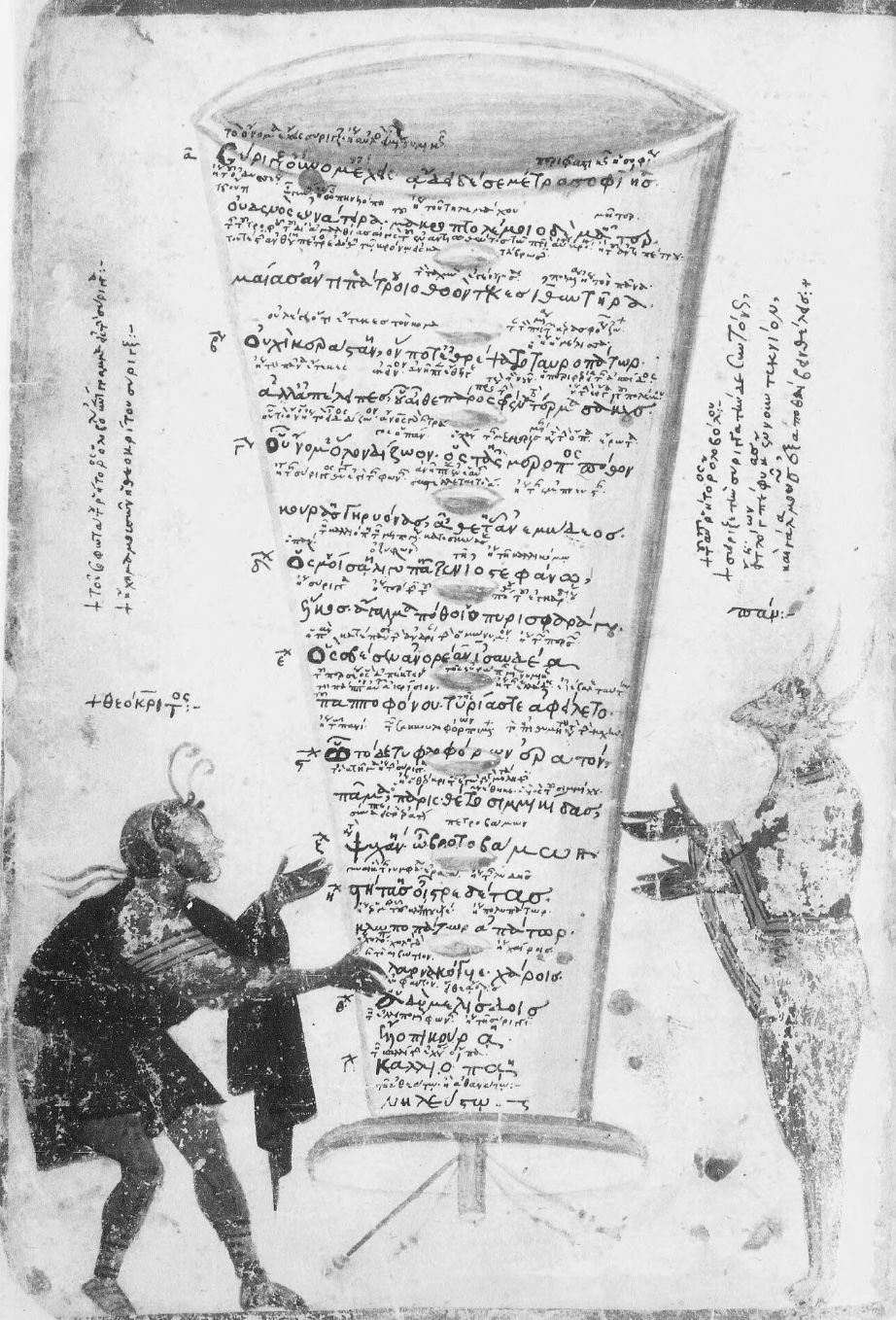
The trumpet was for signals, not music. It was a long straight bronze tube with a tulip bell and a bone mouthpiece, eighty to a hundred and twenty centimetres long on the vases. It was held in one hand, sometimes with the piper’s halter.[6] The Greeks thought it Etruscan. Homer’s heroes never use it, though a simile knows it.[7]
It called the assembly, started the chariot race, launched ships and signalled in battle. A sacred trumpeter served in cult, and the Argives summoned Dionysus from the marsh with trumpets.[7] The only “score” for it is a fanfare of syllables, ΤΟΤΕ ΤΟΤΟΤΕ. It is painted beside a trumpeting Amazon on an Eleusis vase of the early fifth century, and Bélis tried to read it as a call.[8] Landels accepts her reading, and dates the vase to the sixth century.[9]
From the fourth century there were trumpet contests. The champions could be heard, it was said, at fifty stades, and one of them won seventeen prizes.[10] The cow-horn was the poor man’s trumpet. The bull-roarer belonged to the mysteries.[11]
Pēktis: The many-stringed harp of Lydia, known to Sappho, Alcaeus and Anacreon. It sounded octave concords. Plato banned it for having too many notes. It is a harp, not a lyre or a zither.
Harps
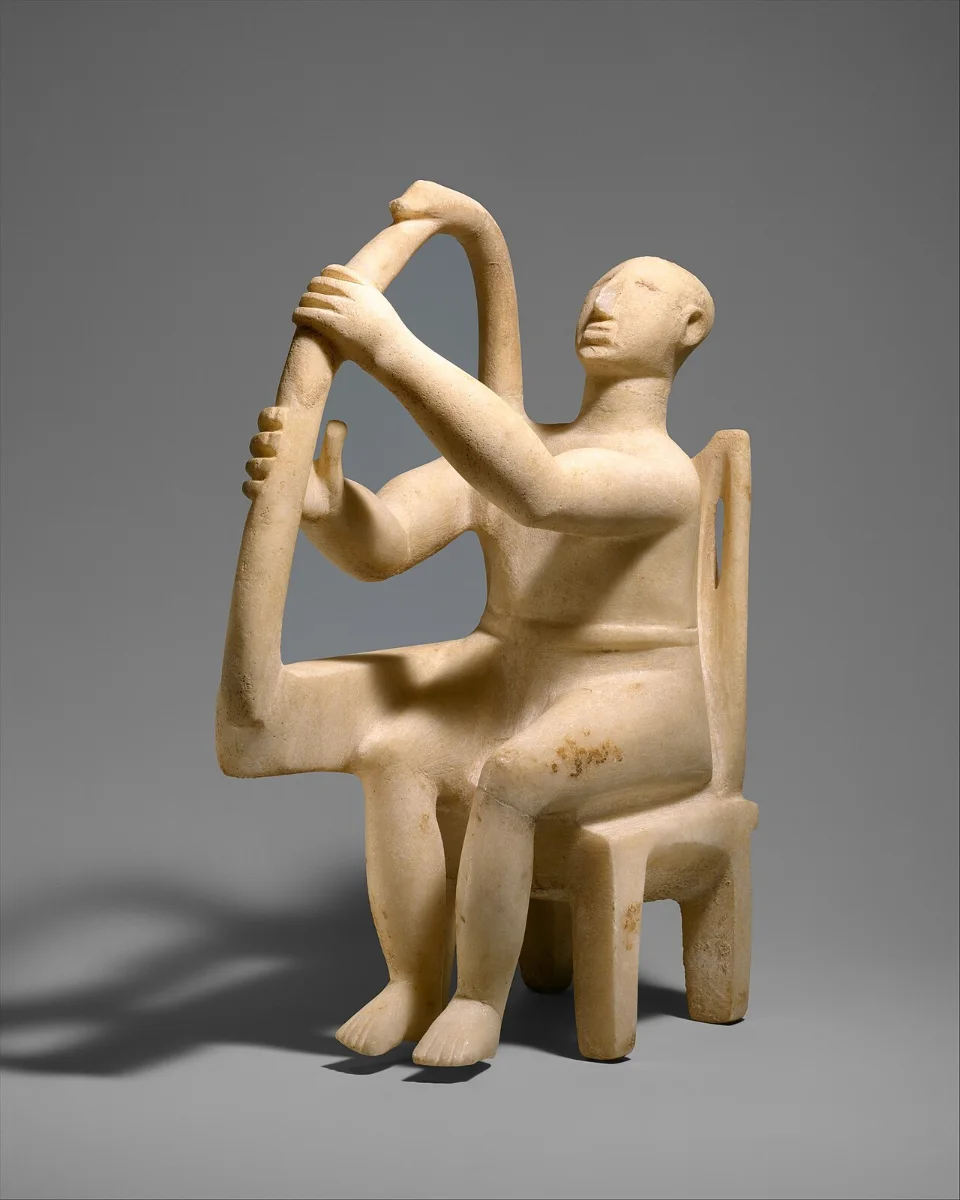
In a harp the strings are of different lengths, and set at an angle to the sound-box. Harps were Mesopotamian and Egyptian long before the Greeks, and the Cycladic marble harpists are the oldest frame harps known. Then there is a gap until the eighth century, and harps enter Greek art only in the second half of the fifth.[12]
But the archaic poets already know the pēktis. It was a plucked, many-stringed instrument, playing in octaves and strongly associated with Lydia. West identifies it as a harp. Sappho and Alcaeus had one akin to the Attic types.[13] After about 450, three designs of angular harp appear on Attic vases, nearly always in women’s hands. They include the triangular trigōnos.[13]
Magadis is often taken for an instrument. West derives the word from the word for bridge, and explains it as the octave concord that harps and some lyres produced.[14] Anderson gives the alternative views.[15]
Harps had nine to twenty strings, and were plucked with both hands. They were played by hired women (psaltriai), and the comic poets linked them with sensual song.[16] The sambykē had a boat-shaped box and a near-vertical neck. It is known from the Roman siege engine named after it, and its girl players were in Rome by 187 BC.[17] Plato condemned the harps, along with the many-noted aulos.[15]
Zithers, lutes, organ
The forty-stringed epigoneion and the thirty-five-stringed simikon were probably board zithers. They were built for the theorists’ study of quarter-tones, rather than for performance.[18] The lute, with a neck and stopped strings, reached Greece only well into the fourth century. It appears in a dozen Hellenistic terracottas, mostly of women.[19]
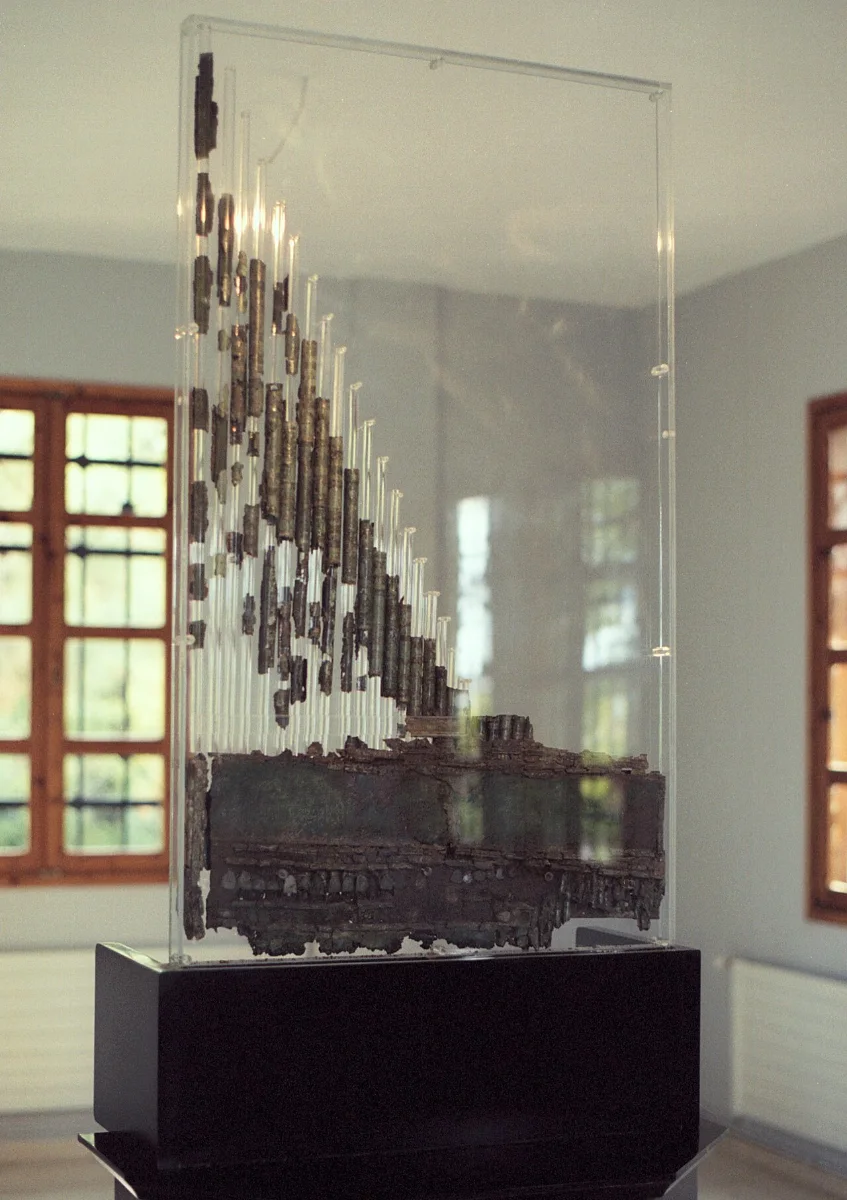
The organ was a Greek invention: Ctesibius’ hydraulis, made at Alexandria under Ptolemy II. Water steadied the wind pressure, and keys worked sliders. The organ gained currency from the first century BC, and great favour at Rome, where it accompanied gladiators.[20] A pitch pipe, the tonarion, served the chorus-trainer. Gaius Gracchus kept a slave with one behind him when he spoke.[21]
Notes
- ^ West 1992, pp. 109–110; Anderson 1994, p. 184.
- ^ West 1992, pp. 110–111; Anderson 1994, pp. 184–185.
- ^ West 1992, p. 111; Anderson 1994, p. 185.
- ^ West 1992, p. 112.
- ^ West 1992, pp. 112–113.
- ^ West 1992, pp. 118–119.
- ^ a b West 1992, p. 119.
- ^ West 1992, p. 120.
- ^ Landels 1999, c. p. 80; see the Army and fleet tab of the Performance page.
- ^ West 1992, pp. 120–121.
- ^ West 1992, pp. 121–122.
- ^ West 1992, pp. 70–71.
- ^ a b West 1992, pp. 71–72.
- ^ West 1992, pp. 72–73.
- ^ a b Anderson 1994, pp. 178–179.
- ^ West 1992, pp. 73–75.
- ^ West 1992, pp. 75–77.
- ^ West 1992, pp. 78–79.
- ^ West 1992, pp. 79–80.
- ^ West 1992, pp. 114–117, 381.
- ^ West 1992, pp. 113–114.
Instruments · 4 of 5
Percussion
Percussion played a slight part in Greek music. What there was falls into two classes. Clappers mark a definite rhythm, and support the lyre and the pipes. Noise-makers, the drums, cymbals and jingles, belong only to the orgiastic cults.[1]
The distinction matters for the music of poetry. A dancing chorus kept time with clapping and stamping, as Homer’s and Hesiod’s dancers do. So the poet’s metre was carried by the feet as much as by the pipe. The drum, by contrast, never accompanied a lyric poet, except where the poem itself goes to the rites of Dionysus or the Mother.[2]
Clappers
The krotala or krembala were castanets: two pieces of wood strung together, twelve to fifteen centimetres long. Men hold them on Late Geometric vases. Later it is mostly women who dance with them, a pair in each hand, to the lyre or the pipes.[3]
Sappho’s wedding song for Hector and Andromache has pipe, lyre and castanets together. Pindar describes drums and castanets in a dithyramb. Castanets belong to popular festive music, not to the theatre, the contests or formal cult.[4]
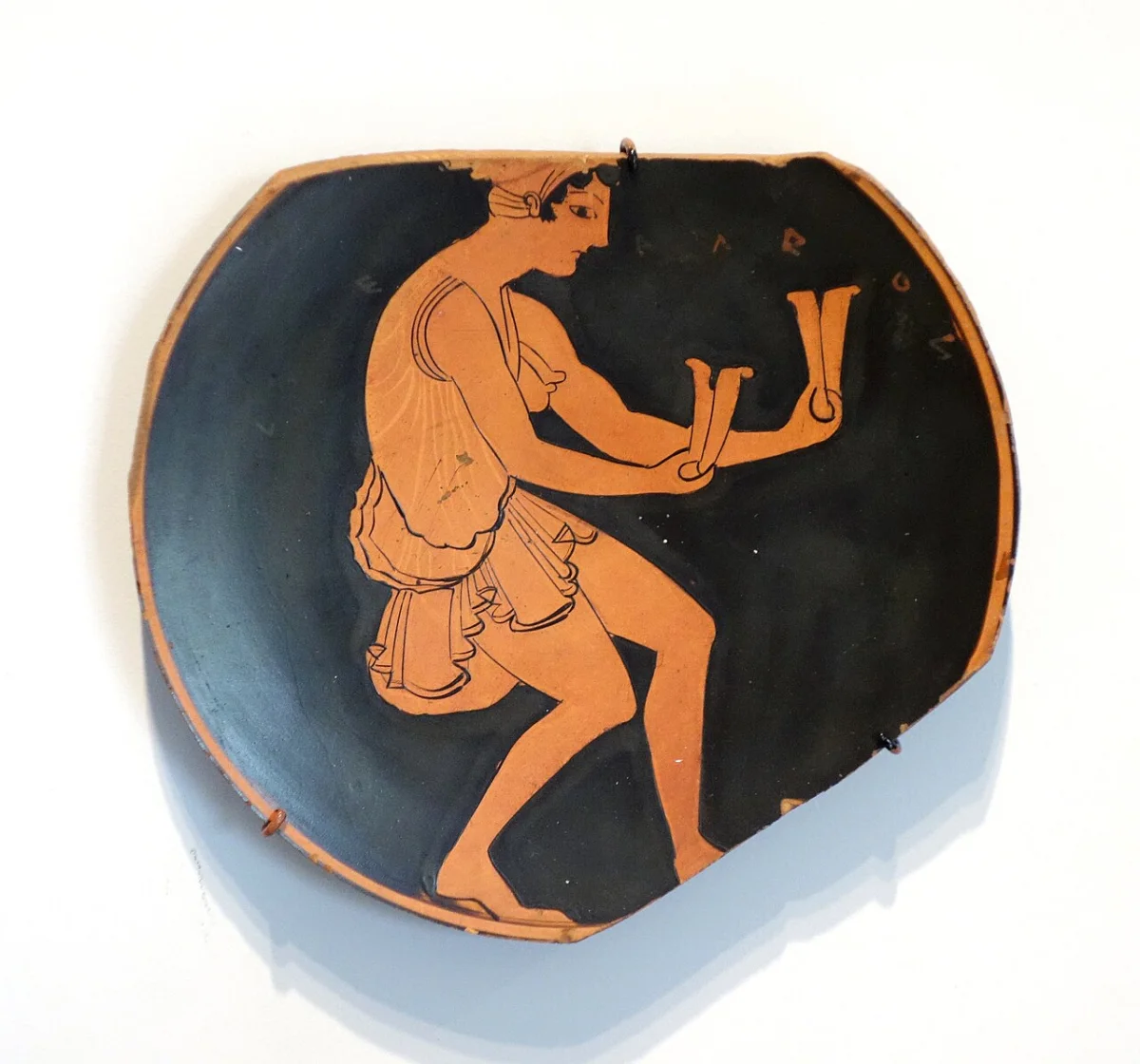
The piper who led a chorus wore the kroupeza, a clapper-shoe, to beat time with his foot.[5] Otherwise time was beaten by hand. People clapped, and in a lecture on music of about 390 BC the speaker taps on a little board.[6]
Kroupeza: The aulete’s clapper-shoe: a hinged sole that struck the ground to mark the beat for a chorus. The Greek beat was marked by the foot before it was marked by the stigmē on the page.
Drums and cymbals
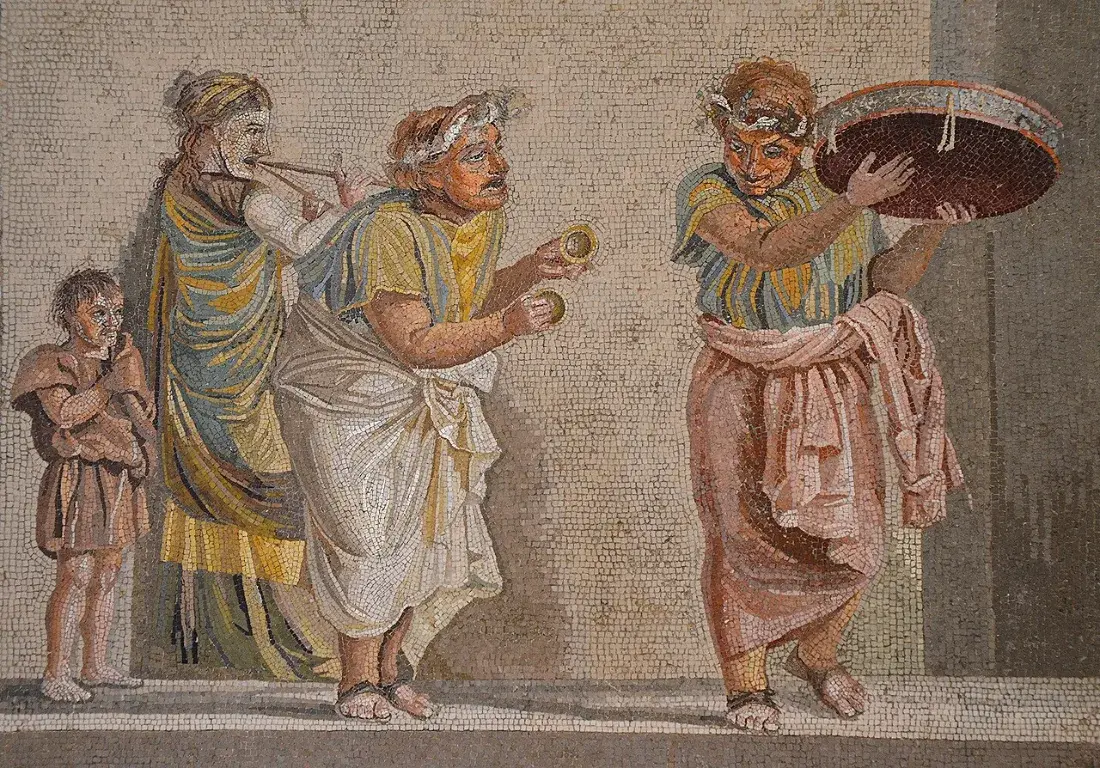
The tympanon was not a kettledrum but a shallow frame drum, thirty to fifty centimetres across. Hide was stretched over a wooden hoop. The drum was held upright in the left hand and struck with the fingers of the right. It is not attested before the fifth century, and was an oriental import.[7]
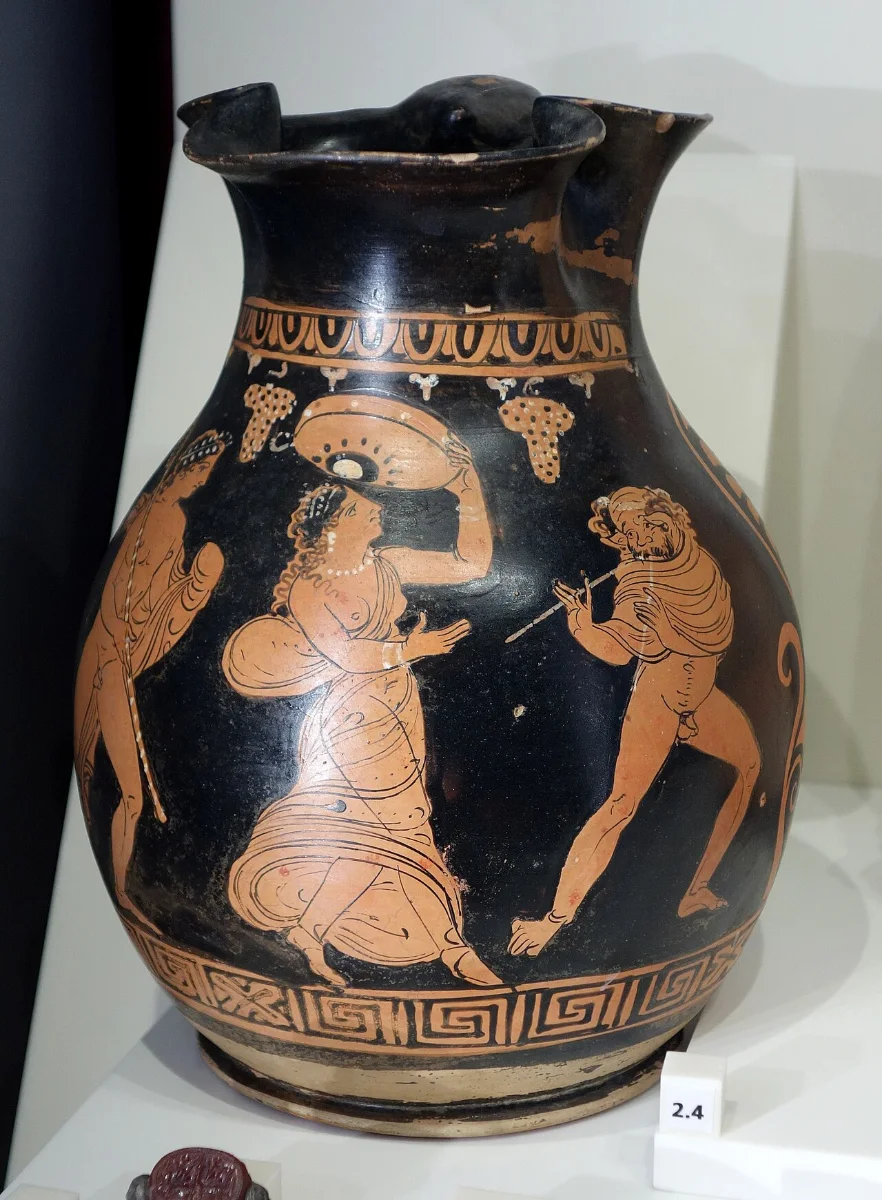
It was played almost only by women; a man with a drum was thought effeminate. It belonged to the cults of the Great Mother, of Dionysus and of Sabazius. On vases from the later fifth century it is in the hands of maenads.[8]
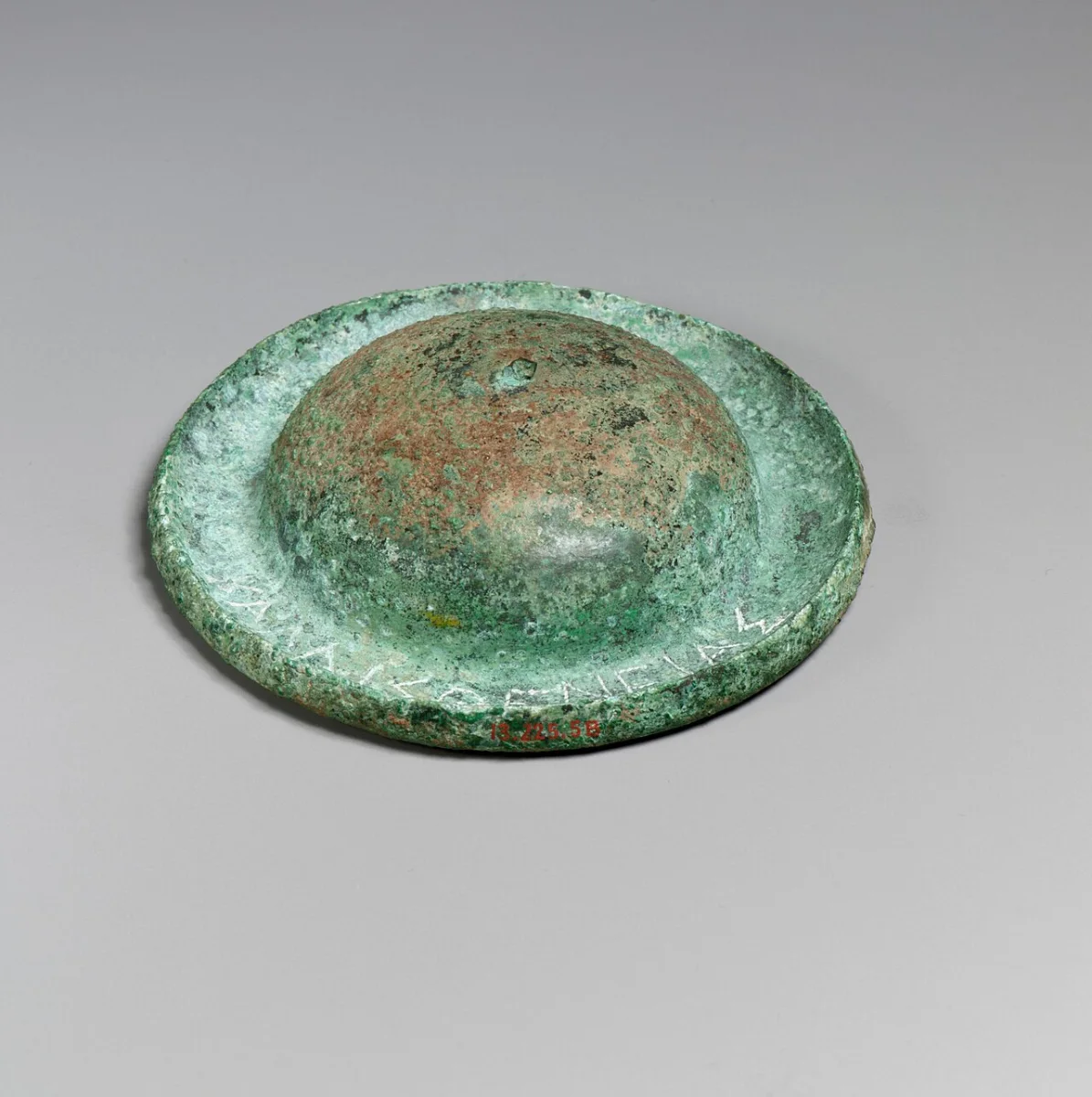
Cymbals (kymbala) were likewise oriental, and Minoan. They appear in Greek art from the seventh or sixth century. They were small bronze cups with a flat rim, not more than eighteen centimetres across, with a ring or thong for the finger. Again they were women’s instruments, and again they belonged to the Mother. The Corinthians knew them from the same cult when Paul wrote of a clanging cymbal.[9] Little cymbals could be fixed to the prongs of a split cane to make cymbal-clappers.[10]
Jingles and tuned metal
A ladder-like rattle appears on hundreds of Apulian vases from about 360, in the hands of women, Aphrodite and Eros. West identifies it with the psithyra that Pollux lists.[11]
Tuned bronze discs belong to the history of theory rather than performance. About 500 BC Hippasus of Metapontum used discs of different thickness to demonstrate the concords. Unlike the legend of Pythagoras and the hammers, this experiment would actually have worked.[12]
Notes
- ^ West 1992, p. 122.
- ^ West 1992, pp. 122–124.
- ^ West 1992, p. 123; Anderson 1994, p. 186.
- ^ West 1992, p. 123; Weiss 2018, pp. 140–141.
- ^ West 1992, pp. 123–124; Anderson 1994, p. 186.
- ^ West 1992, pp. 133–134.
- ^ West 1992, p. 124; Anderson 1994, pp. 185–186.
- ^ West 1992, p. 124; Anderson 1994, p. 186.
- ^ West 1992, pp. 125–126; Anderson 1994, p. 186.
- ^ West 1992, pp. 125–126.
- ^ West 1992, pp. 126–128.
- ^ West 1992, pp. 128, 234.
Instruments · 5 of 5
Ranges and pitch: how high and how low the instruments played
Absolute pitch cannot be fixed exactly for Greek music. West’s best guess puts many of the vocal pieces in the tenor range, judging from their compass against the male voice.[1]
Landels approaches the same question from the instruments. From their surviving dimensions, and from the physics of pipes and gut strings, he estimates what each could have played. He gives his estimates in hertz. They are his figures, offered as approximations, and they are reported here as such.[2]
The five auloi
Aristoxenus named five sizes of aulos, from the girls’ pipe to the “beyond complete”. Their joint compass was more than three octaves.[3] Landels puts a length and a lowest note to each:[4]
| Name | Meaning | Length | Lowest note (Landels’ estimate) |
|---|---|---|---|
| parthenikos | girl’s, “soprano” | about 25–30 cm | a fourth or fifth above middle c, about 356 Hz |
| paidikos | boy’s, “treble” | about the same | about the same |
| kitharistērios | “to go with the kithara” | about 35 cm | just below middle c, about 244 Hz |
| teleios | “complete”: the adult male range, or any six notes of the complete system | about 54 cm (the longest Pompeian pipe) | about e♭ below middle c, about 150 Hz, near a B♭ clarinet’s lowest note |
| hyperteleios | “beyond complete” | about 90 cm (a Herculaneum painting) | about G, an octave and a fourth below middle c, about 95 Hz |
The hyperteleios also had the bombyx, the “boomer”. This was the note of the whole pipe with every hole closed, a kind of pedal note a fifth lower still.[5] At any one setting a pipe gave only six notes, within the stretch of the fingers. So even when the complete system of two octaves existed, the instrument’s potential range of an octave and a half was never available at once.[6]
Kithara, lyre, barbitos
Seven strings tuned to a continuous scale give an octave, or at most a ninth. The strings were all of one length, and made of gut. A thin gut string of 30–40 cm, Landels argues, cannot be brought much above an octave over middle c, about 500 Hz. A thick one will not give a loud sustained note below about f under middle c, about 170 Hz. So the concert kithara lay roughly between f and a′.[7]
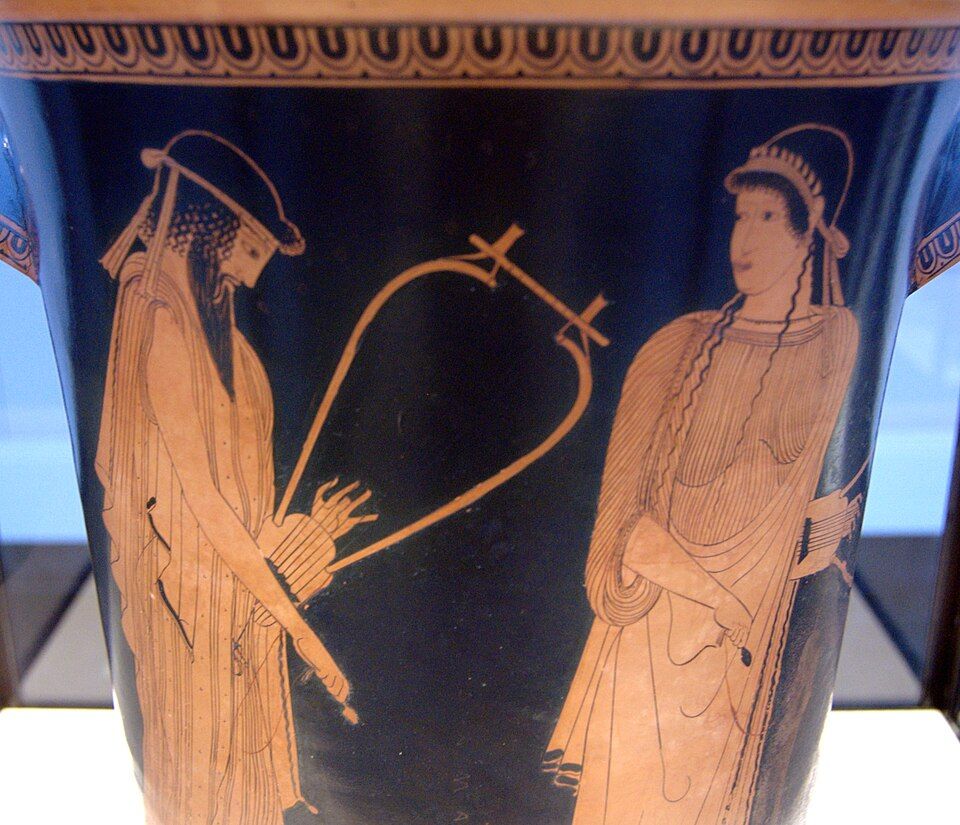
The lyre was lighter in build, and so less tightly strung. He guesses its range at an octave somewhere around a–a′, about 216–432 Hz.[8] The barbitos had strings about half as long again as the lyre’s, and a slighter frame. So its lowest note may have been about an octave below middle c, about 128 Hz. That suits a baritone voice, in the comfortable part of its range.[9] Anderson sets it an octave or more below the lyra, and West calls it deeper and softer. The three agree on the direction, and differ on the amount.[10]
A famous vase is witness to the barbitos. It is in Munich, and dates from about 480–470 BC (Antikensammlungen 2416). It shows Sappho and Alcaeus, named by the lettering, each singing to a barbitos. Nagy connects the picture with the exchange of verses between the two that Aristotle quotes.[11] Landels draws the musician’s conclusion: the painters imagined Sappho singing to a low instrument. He reports Winnington-Ingram’s joke that on this evidence Sappho sang contralto.[12]
Dialēpsis: “Division”: sounding the octave harmonic of a string by touching its midpoint lightly as it is struck, as a harpist does. Landels showed on a monochord, and Helen Roberts on reconstructed lyres, that the harmonics sound almost as cleanly as the open strings.[13]
More notes than strings: dialēpsis
Plato complains of florid passages on the seven-stringed kithara. How they were played has been answered in several ways, from Sachs’ tablature reading of the notation to Lawergren’s elastic frame. Landels finds none of these proven.[14]
The one technique he thinks demonstrably workable is dialēpsis, “division”. The player produces an octave harmonic by resting a finger of the left hand on the middle of the string at the moment the plectrum strikes. Landels’ own experiments on a monochord, and Roberts’s on reconstructions, gave harmonics almost as good in tone as the open string. That would double the range to fourteen notes, over two octaves or more.[13]
He adds a speculation that ties the instruments to the notation. Both sign systems use octave marks above a certain pitch. These may have been added when the technique became popular, while the treble aulos transposed up an octave of itself.[15] The voice, Aristoxenus says, spans two octaves and a fifth. But the first Delphic hymn, probably written for men, uses only an octave and a fourth.[16]
Notes
- ^ West 1992, p. 12.
- ^ Landels 1999, c. pp. 41–42, 58–59, 66–67.
- ^ West 1992, pp. 89–90.
- ^ Landels 1999, c. pp. 41–42.
- ^ Landels 1999, c. p. 42.
- ^ Landels 1999, c. p. 41.
- ^ Landels 1999, c. pp. 58–59.
- ^ Landels 1999, c. p. 66.
- ^ Landels 1999, c. pp. 66–67.
- ^ Anderson 1994, pp. 177–178; West 1992, pp. 58–59.
- ^ Nagy 2020, p. 103; West 1992, pp. 58–59.
- ^ Landels 1999, c. pp. 11–12, 66–67.
- ^ a b Landels 1999, c. pp. 61–62.
- ^ Landels 1999, c. pp. 58–61.
- ^ Landels 1999, c. pp. 62, 212–213; see the An aulos tablature? tab of the Notation page.
- ^ Landels 1999, c. pp. 86–87.


