Hearing it
Modern performances of surviving ancient scores, and the evidence behind their reconstruction.
The music of Greek poetry: instruments, scales and notation, the surviving scores, and how melody and rhythm went with the words.
Hearing it · 1 of 2
Hearing the surviving scores
Unlike the poems elsewhere on this site, the pieces on this page have a surviving melody. The Seikilos song, the Delphic paeans, the Orestes chorus and the hymns of Mesomedes come down with their notes. What a performer adds is the pitch, the tempo, the instrument, the voice and the accompaniment.
The performances below are by scholars and ensembles who read the notation and, in most cases, built the instruments. Each card says what is being played, and on what. They are modern readings of ancient scores, not recordings of ancient music. Where the sources disagree, as they do over absolute pitch, each performer has made a choice.
What the performer must decide
The editions transcribe the vocal sign C as the note a. This is a convention from the 1840s. The editors agree that the true pitch was about a minor third lower. Hagel would put it a fourth lower.[1]
The scores give durations only where the metre does not. They give no tempo and no dynamics. Except for a few instrumental notes in the Orestes papyrus, they give no accompaniment.[2]
West’s own guess at absolute pitch rests on the compass of the vocal pieces, set against the range of the male voice. He finds most of them lying in what we would call a tenor range.[3]
A listener comparing two performances of the same score will hear these choices. The differences between them are a fair measure of how much is known.
Listening order
A first-time listener might take the pieces in this order:
- the Seikilos song;[4]
- the Delphic paean;
- the Orestes chorus, whose enharmonic quarter-tones are the strangest sound here;
- the Oxford recital, which puts most of the repertory into one evening.
Modern performances
Modern performances of the surviving scores, and of a few reconstructed models where no score exists (each card says which). The notation fixes the notes and most of the rhythm; tempo, instruments, voice and ornament are the performers' choices, described under each.
Jump to Introduction 0:00 · Rhythm and melody 0:52 · Replicating the instruments 2:53 · Demonstration and performance 6:25 · The Delphic paean 10:39 · Final chorus 12:33
Jump to Second Delphic hymn 0:00 · P.Oxy. 4466 4:43 · On Seikilos 8:55 · On the Delphic hymns 9:18 · Yale papyrus 12:31 · Louvre papyrus 13:35
Notes
Hearing it · 2 of 2
The Seikilos song: a free recording
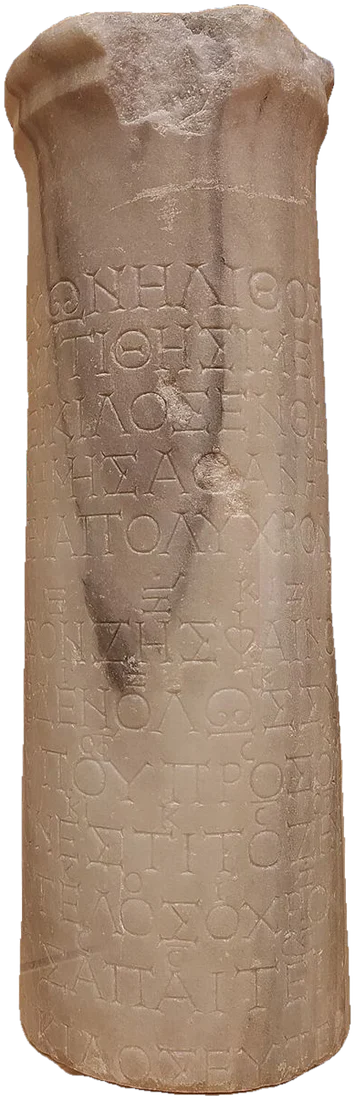
One recording of the Seikilos song is free to reuse. It was sung and uploaded to Wikimedia Commons in 2006 by Marcus Harvey. He describes it as a basic rendition of the score on the stone, in a Koine pronunciation. He notes that the first word, ὅσον, comes out as νόσον at the start. He released it under the Creative Commons Attribution-ShareAlike 2.5 licence (Wikimedia Commons, file page). It is fifty seconds long. A low plucked note accompanies the voice.
The file is now kept on this site. The original Ogg file is unchanged. An MP3 copy plays in browsers that cannot play Ogg; it was made by metrehelp.org and is shared under the same licence.
What to listen for
The song has four verses of twelve time-units each, and every value is written on the stone. The editors’ transcription, in two sharps, sets it around the note a. It rises a fifth on the first word, and sinks at the end to the fourth below.[1]
Follow the table of signs on the Notation page while listening.[2] Listen for:
- the long notes on σον and μη;
- the three-unit notes on ζῆις and νου;
- the two-note slurs on λως, ποῦ and ζῆν;
- the final three-note fall on ἀπαιτεῖ.
Whether the singer takes the pitch at the editors’ a or a minor third lower, the shape is the same.
A singer wanting to try it should know what the stone does not give. It gives no tempo, no instrument, and no indication of how the arsis was marked. And the text’s first word is itself a point of dispute.[3]

