Verse formsComposite forms
Verse in the magical papyri
Greek verse in spells, hymns and oracles from the magical papyri of Roman Egypt.
The metrical families one by one: dactylic, iambic, trochaic, aeolic, ionic, anapaestic, dochmiac and the rest.
Magical papyri · 1 of 5
What the magical papyri say about verse
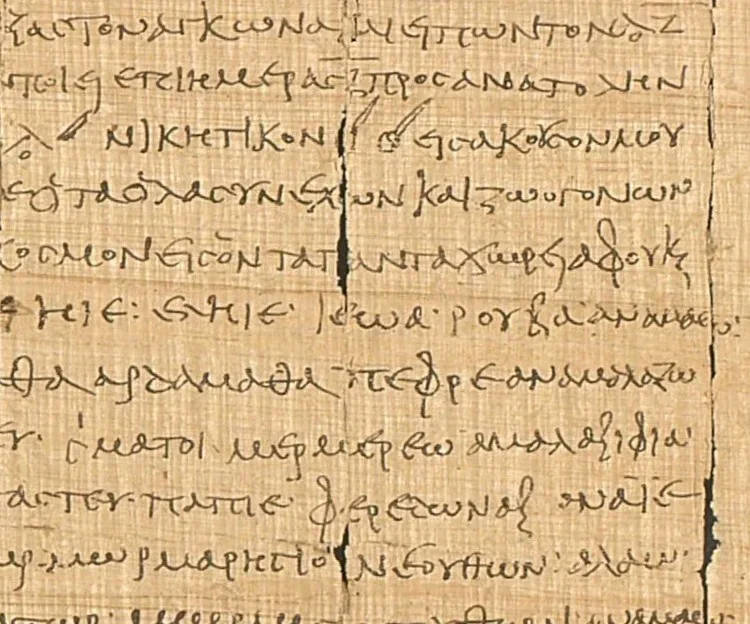
The Greek magical papyri (PGM, Papyri Graecae Magicae) are handbooks and single spells on papyri from Egypt. Most of them are of the Roman period (the London roll PGM VII is of the third century AD, PGM IX of the fourth or fifth).[1] Karl Preisendanz collected them in two volumes (1928, 1931). They have no treatise on metre, and they never name a foot or a metre except once. But they talk about verse all the time. They tell the user to sing or write verses, they use lines of Homer as charms, and they contain some thirty hymns in hexameters and iambics.
The vocabulary. The words are about verse as such, not about technique.
| PGM | Term or description | What it says |
|---|---|---|
| IV 165 | στίχος (stichos), verse | in bowl divination the god’s voice comes “in verses”[2] |
| IV 725–731 | στίχος (stichos), verse | the god speaks the oracle “through verses”; you will remember it even if it runs to countless verses[3] |
| IV 2145 | three-verse assistant | “Homer’s three-verse assistant”, three lines of Iliad 10 used as a spell[4] |
| I 328 | epic composition | among the things a daimon can tell you: divination by epic verse[5] |
| VII 148a | ἔπος (epos), epic verse | “here end the verses of the Homer oracle”[6] |
| XXIIa 7, 15 | στίχος (stichos), verse | “write this verse as well”; “write this verse”, each before a line of Homer[7] |
| XX; XXIII 4 | ἐπαοιδή (epaoidē), incantation | the charm calls itself an incantation, a “perfect incantation” in XX[8] |
“In hexameter measure”. The one metrical term comes in PGM III, about line 436: the instruction to say a formula seven times “in hexameter measure”.[9] Only the phrase ἐν ἑξαμέτρῳ τόνῳ (en hexametrōi tonōi) is preserved. The surrounding instruction contains editorial supplements; Preisendanz marked his German rendering with a query. The Greek phrase displayed here is independently attested in Herodotus’ description of an oracle given in verse (Hdt. 1.47).[10]
Written and spoken verse. Several spells care how the verse looks on the papyrus. The lines of the “three-verse assistant” in PGM IV are written much larger than the rest. Homeric lines elsewhere in that roll are separated by paragraph marks.[11] In PGM XXIIa, a collection of Homeric lines for healing, one verse is to be written on new papyrus. Another is to be written and given to the patient to wear.[12] Before the hexameter invocation of PGM XXIII the papyrus says the instruction “what must be sung over it” (in the apparatus).[13] There the papyrus line-ends fall at the verse-ends.[13]
What the papyri do not say. In vol. I of Preisendanz and in Betz’s translation of the whole corpus the research for this page found no name of a foot or metre other than the hexameter of PGM III. It found nothing about caesura or quantity, and no instruction about how to scan. The papyri know that a verse is a unit with power of its own. They do not teach how one is built.
Notes
- ^ Preisendanz 1931, pp. 1, 50.
- ^ Preisendanz 1928, pp. 76–77.
- ^ Preisendanz 1928, pp. 96–99; Betz 1986, p. 52.
- ^ Preisendanz 1928, pp. 138–139.
- ^ Betz 1986, p. 11.
- ^ Preisendanz 1931, p. 6.
- ^ Preisendanz 1931, p. 147.
- ^ Preisendanz 1931, pp. 145, 151.
- ^ Preisendanz 1928, pp. 50–51; Betz 1986, pp. 29–30.
- ^ LSJ s.v. ἑξάμετρος.
- ^ Preisendanz 1928, pp. 88, 138–139; Betz 1986, n. 263.
- ^ Preisendanz 1931, pp. 146–147.
- ^ a b Preisendanz 1931, p. 150.
Magical papyri · 2 of 5
Homer's verses as charm and oracle
For the magicians the Homeric hexameter was a ready-made unit of power. A single line, lifted out of its context, could heal, bind, protect or answer a question. The papyri treat such a line as a στίχος, a verse, and the magical use depends on its being a whole line.
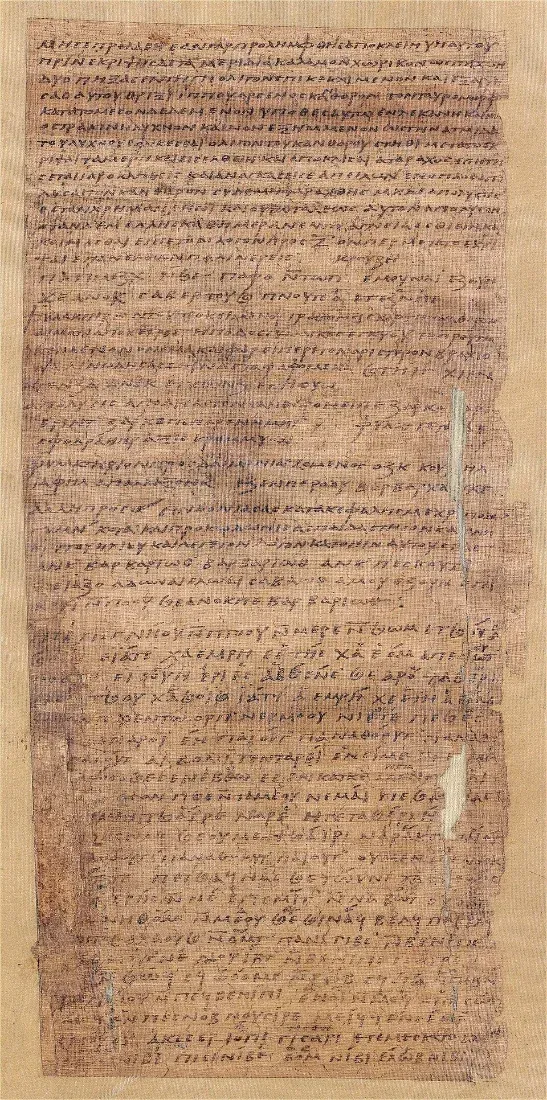
The Homer oracle (PGM VII 1–148). The London roll PGM VII, of the third century AD, opened with a dice oracle written over its first six columns.[1] Preisendanz explains the method. Three dice were thrown, or one die three times. The result was one of the number triplets at the start of each line, from ααα, ααβ … up to ϛϛϛ, and each triplet is followed by a verse of Homer. Six to the power of three gives 216 answers. Martín Hernández counts 216 Homeric verses, each an isolated line rather than a passage, with the same verses in the same order in two other copies (so Martín Hernández 2013, in §§ 2, 17 and 22 of his article). Preisendanz numbers the first two, fragmentary, columns 1*–66*, and the rest 1–148. Under the last verse come a snake-line and the words the colophon meaning “here end the verses of the Homer oracle: good luck”.[2] One answer near the end is Iliad 10.383. The diagram gives the Homeric text from the licensed Perseus edition; the papyrus’s damaged letter is not supplied as a new papyrus transcription:
θάρσει, μηδέ τί τοι θάνατος καταθύμιος ἔστω.
Take heart, and let death be nothing on your mind.
Homer, Iliad 10.383. Greek: Monro–Allen / Perseus, CC BY-SA 4.0. Recording © David Chamberlain · original track · CC BY 4.0; excerpt cut at the reader’s estimated line boundaries, pitch and speed unchanged.
The line is Homer’s, word for word, and scans as he wrote it. Where the scribe’s copy does not scan, the editor mends it from Homer. At line 133 the participle corresponding to Iliad 5.413 needs correction and an added vowel. At 143 and 148 he adds letters the copy lacks, all recorded in his apparatus.[2] The answers are verse only because Homer’s lines are.
Single lines as spells. PGM IV gives “Homer’s three-verse assistant”, Iliad 10.564, 10.521 and 10.572, written very large in the papyrus. It also gives other single Homeric lines under headings such as “to restrain anger” and “for friends”, each separated by paragraph marks.[3] PGM XXIIa, two leaves from a notebook from Hermopolis of the fourth or fifth century, is a collection of such lines for healing.[4] Against bleeding there are Τρώων ἐξ ἐνοπῆς θάνατον καὶ κῆρα φύγωμεν (Iliad 17.714) and μῆνιν Ἀπόλλωνος ἑκατηβελέταο ἄνακτος (Iliad 1.75), the second “spoken over the blood”. For the breasts and womb there is θρέψε Διὸς θυγάτηρ, τέκε δὲ ζείδωρος ἄρουρα (Iliad 2.548). Others are Iliad 1.96, 3.40 and 4.141. Twice the text calls the line it prescribes a στίχος, to be written.
Homer extended. PGM XXIII is a page of Julius Africanus’ Kestoi (book 18, finished about AD 225). In it a necromantic prayer has been worked into Odysseus’ consultation of the dead. Preisendanz says that its first 13 verses correspond to Odyssey 11.34–50, and that 27 new verses follow. The closing invocation, which he prints, comes in his view from a third hand that added fourteen gods of the syncretism of the Hellenistic East.[5] Here Homer’s hexameter is continued by someone composing new verse in it, and the gods’ names have to be fitted into the line.
Notes
Magical papyri · 3 of 5
The hymns of the magical papyri and their metre
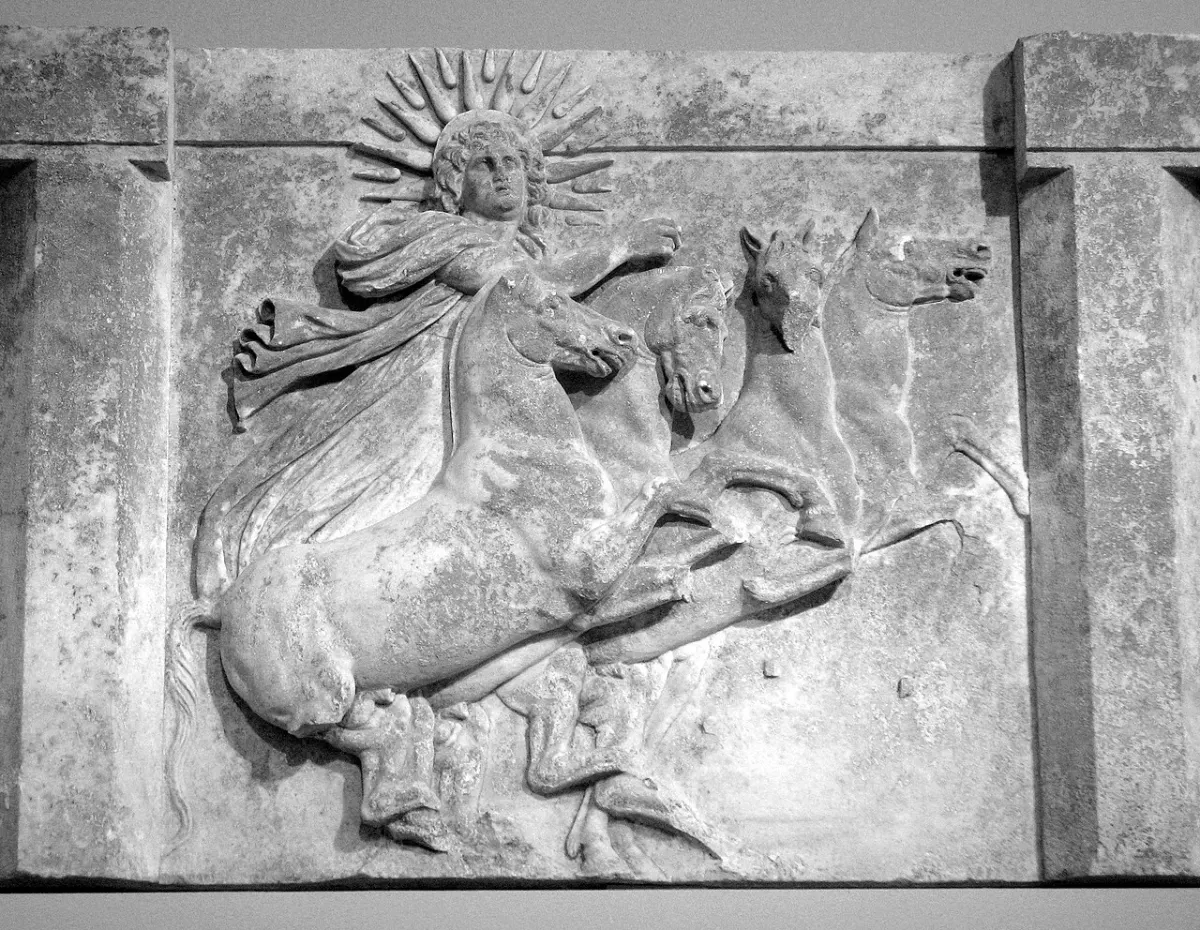
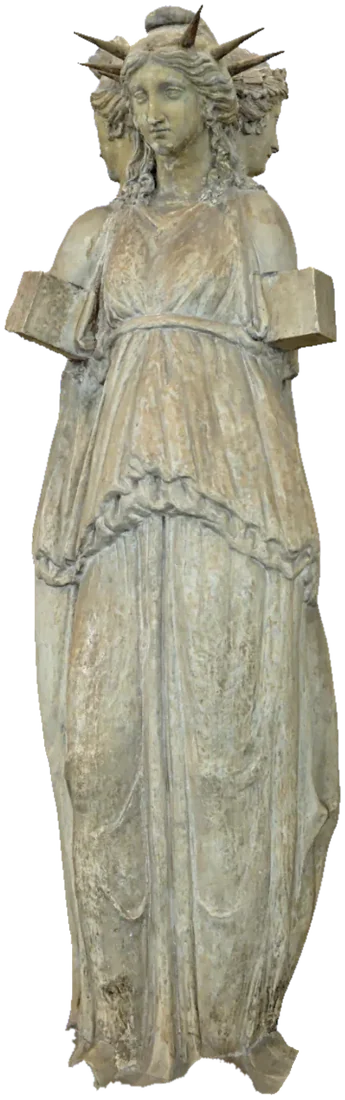
Inside the instructions of the magical handbooks stand hymns. They are prayers to Helios, Apollo, Hermes, Hecate-Selene and others, in verse. The 1974 edition of Preisendanz’s PGM collected thirty of them, reconstructed as verse, at the end of its second volume. E. N. O’Neil, who translated them for Betz’s English edition, notes the metre of each.[1]
Which metres. Most are dactylic hexameters, the metre of Homer and of the older hymns. Four are iambic trimeters, the spoken verse of drama: PGM IV 179–201, IV 2242 ff., part of IV 1390–1495, and IX (O’Neil’s notes in Betz 1986: on PGM IV 154–285, n. 48; IV 1390–1495, n. 185; IX 1–14, n. 2). One passage, preserved in two versions in PGM IV 2574–2610 and 2643–2674, is in iambic tetrameters (O’Neil’s note 320 there). The iambic pieces belong to a wider tradition. The hexameter was the commoner vehicle for protective incantations, but iambic trimeters, and sometimes trochaic tetrameters, were used in the same way.[2] The short song for a good voyage, PGM XXIX, is printed by Preisendanz in short lines.[3] It has a metre nobody has explained. Grenfell thought it accentual, Schmidt a mixture of trochees and cretics (O’Neil’s note in Betz 1986, on PGM XXIX).
An iambic charm: PGM IX. The papyrus is a formulary for a spell of subjection, copied in the fourth or fifth century. Preisendanz prints it as prose. But his apparatus marks the opening words “iambic rhythm”, and E. Diehl’s note quoted at the end calls them “the introductory trimeter”.[4] Its meaning is “I shall stop you from wrath and soften you from bile”. The following comparison from tragedy shows the same metrical framework:
1 Εἴθ’ ὤφελ’ Ἀργοῦς μὴ διαπτάσθαι σκάφος
If only the hull of the Argo had never flown through …
Euripides, Medea 1, ed. Murray / Perseus, CC BY-SA 4.0. This familiar tragic line shows the trimeter’s three metra; it is a comparison, not a line from a magical papyrus.
synthetic ∿
The charm’s opening is a clean trimeter (scheme × — ⏑ — × — ⏑ — × — ⏑ —, with penthemimeral caesura after the verb meaning “I shall stop”).[5] The α of πραΰνω is long.[6] The papyrus gives the spoken “prologue” a second time at line 12. There the line is followed by an instruction to come and take control silently. That continuation does not scan as written: its second syllable is short where the trimeter needs a long. Faraone keeps the first verse as secure, since it appears twice in fully metrical form. He treats the following lines as modern reconstructions, metrically clumsy.[7]
How the verse breaks. O’Neil’s notes describe the same faults again and again. Hexameters are “not always metrically correct” (PGM II 1–64 n. 2). Lines are broken off by magical words (voces magicae) and short pieces of prose (PGM II 64–183 n. 25). σέ is counted as long for the metre’s sake, against classical usage (PGM IV 286–95 n. 60). And trimeters can be saved only by rearranging and dropping words (PGM IV 1390–1495 n. 190). Betz’s explanation is that the practitioners recited hymns that had once been metrical but no longer heard the metre. They spoiled it when they added their own material.[8]
Herrero Valdés finds the 31 hexameters of the Helios hymn in PGM III well made. The exceptions are one line, the lines with magical words or names, and the corrupt ones (Herrero Valdés 2019, at pp. 261 and 264 of her article). Elsewhere she notes a hymn closed by a line of magical words that is not metrical at all (Herrero Valdés 2023–2024, at p. 30). Already in 1931 Preisendanz quotes, on a passage of PGM XII, Bücheler’s phrase barbara barbare mutilata metra, “foreign verses foreignly mutilated” (in the apparatus).[9]
Verse and prose. Two further examples show the pattern. In the Africanus invocation (PGM XXIII) eleven of fourteen lines scan, Egyptian names included. The verse fails exactly where a list of divine names takes over. In the headache charm (PGM XX) six lines scan, with Homeric licences. The command to the pain in the middle is prose, and Preisendanz suspects a lost verse.[10]
Notes
Magical papyri · 4 of 5
Editing the magical hymns: from the first editions to the latest
The hymns of the magical papyri reach most readers in a form no papyrus has. They appear as verse, line by line, with the magical words and prose instructions taken out and the metre repaired. That form is the work of a century of editors.
Dieterich and Wünsch. Albrecht Dieterich had already printed some of the hymns with attempts at metrical reconstruction in his Abraxas (1891). When the collection was planned, he was to edit the hymns and metrical pieces himself. But he died in 1908. Richard Wünsch took over the metrical part. He had some of the hymns treated as “hymns to the gods” in his Königsberg seminar of 1909/10. Bruno Kuster’s dissertation on three poems of the Paris magical papyrus (1911) came out of it (Preisendanz’s preface of 1928, pp. VIII–IX). Wünsch’s supplements are still all over the apparatus. The invocation of PGM XXIII, for example, is restored partly from his proposals.[1]
Preisendanz’s promise. In vol. I (1928) Preisendanz printed the hymns as the papyrus has them, with the papyrus line-ends marked. He announced that a metrical edition of the hymnic pieces would close the collection, and his apparatus sends the reader again and again to that appendix (Preisendanz’s preface of 1928, p. XI, and his apparatus). Vol. II (1931) keeps the promise open. Where the same hymn recurs, he cross-refers the versions (the hymn of PGM VIII 74–81 is also in IV 436–446 and 1957–1968).[2] At PGM XII 244–252, after listing earlier metrical treatments, he writes Vgl. den Hymn. in Bd. III, “compare the hymn in vol. III”.[3] Some verse he prints as prose and discusses as verse in the apparatus. An example is the headache charm PGM XX, where he suspects a missing hexameter.[4]
The lost third volume. Vol. III, with the indices and the hymns, never appeared. Its plates were destroyed in the bombing of Leipzig in 1943, and only proofs survive. When A. Henrichs produced the second edition (1973–1974), he reprinted the texts. He added, at the end of vol. II, a collection of the hymns based on E. Heitsch’s edition in Die griechischen Dichterfragmente der römischen Kaiserzeit (1963), pp. 179 ff. (Valladolid thesis, p. 3 n. 1; research log). O’Neil’s notes in Betz likewise credit several reconstructions to Heitsch. They choose between Heitsch’s, Preisendanz’s and Wünsch’s emendations by which one restores the metre (research log).[5] Herrero Valdés, on the other hand, says that Preisendanz made his own reconstruction of the hexameters (Herrero Valdés 2023–2024, at p. 21). How far the 1974 Hymnen are Heitsch’s and how far Preisendanz’s is disputed between these sources. This site has not been able to check the 1974 pages themselves, since the copy of vol. II available to it is the first edition of 1931, which has no hymn section.
Against the “original”. Recent work turns away from restoring a lost, purely Greek original. Blanco Cesteros observes that the older editions tend to rebuild an “original text”, rather than give what the papyrus transmits. She calls Preisendanz’s edition not always rigorous by present papyrological standards (Blanco Cesteros 2017, at p. 4 and n. 14). She defines the magical hymn as verse composition in hexameter or iambic trimeter (at p. i). L. M. Bortolani’s edition of fifteen hymns prints them as verse, but marks the papyrus line-ends. It sets in bold the metrical sections within the description of the spell.[6] Her reviewer reports that she does not try to rebuild a “pure” form of the hymns. She treats the magical stage of their history, with its inserted voces magicae that seldom fit the rhythm, as part of the text.[7]
Notes
Magical papyri · 5 of 5
Worked example: Homeric hexameters and a healing charm
A Homeric line could be taken whole and used as a spell. In the Homer oracle, PGM VII 132, the answer is Iliad 10.383: “Take heart, and let death be nothing on your mind”.[1] The example below uses the Homeric text from Perseus, with its six feet. It is not a transcription of the damaged papyrus.
θάρσει, μηδέ τί τοι θάνατος καταθύμιος ἔστω.
Take heart, and let death be nothing on your mind.
Homer, Iliad 10.383. Greek: Monro–Allen / Perseus, CC BY-SA 4.0. Recording © David Chamberlain · original track · CC BY 4.0; excerpt cut at the reader’s estimated line boundaries, pitch and speed unchanged.
The headache charm PGM XX provides a second kind of evidence. It tells of seven maidens bringing water to quench a fire, then turns directly to the pain and sickness before the verse resumes. Preisendanz prints it as prose, recognises hexameters in his apparatus, and suspects a lost verse.[2] The comparison below separates the metrical lessons from the editorial restoration of that damaged charm.
Step by step
1. Syllables and quantities. Divide the Homeric line across word-ends before marking the syllables long or short.[3] Quantity belongs to the syllable, not just its vowel. A closed syllable can be heavy while its vowel remains short.[4] In θάρσει (tharsei), the group ρσ closes the first syllable. In θάνατος (thanatos), the first two syllables fill the two short places in foot 3. The final -τος is long by position before the κ of καταθύμιος (katathymios). The diagram shows why the same word contains both short and long syllables.
2. The feet and the caesura. The first foot is a spondee, — —. Feet 2–5 are dactyls, — ⏑ ⏑. The closing foot is — ×. There is a word-end after τοι (toi), the long position of the third foot: the penthemimeral place.[5] A word-end inside a foot does not divide that foot into two. The caesura and the feet describe different features of the line.[6]
3. Homeric licences. The headache charm uses stock epic expressions and epic freedoms. The endings “unwearied fire”, “dark-blue eyebrows” and “single-hoofed horses” have Homeric comparisons. Here are the actual Homeric lines rather than restored wording from the charm:
δαῖέ οἱ ἐκ κόρυθός τε καὶ ἀσπίδος ἀκάματον πῦρ
From his helmet and shield she kindled an unwearied fire.
Homer, Iliad 5.4. Greek: Monro–Allen / Perseus, CC BY-SA 4.0. Recording © David Chamberlain · original track · CC BY 4.0; excerpt cut at the reader’s estimated line boundaries, pitch and speed unchanged.
The first syllable of ἀκάματον (akamaton) is long in foot 5. This is metrical lengthening: a word with a run of short syllables is adapted to the hexameter.[7] The phrase also closes Iliad 15.731. In foot 3, καὶ (kai) is short before the initial vowel of ἀσπίδος (aspidos). This is correption, the shortening of a long vowel or diphthong before a vowel.[8] Allen explains the diphthong’s second element as becoming a consonantal glide.[9]
χείλεσιν, οὐδὲ μέτωπον ἐπʼ ὀφρύσι κυανέῃσιν
… on her lips, but not her forehead above her dark-blue eyebrows …
Homer, Iliad 15.102. Greek: Monro–Allen / Perseus, CC BY-SA 4.0. Recording © David Chamberlain · original track · CC BY 3.0; excerpt cut at the reader’s estimated line boundaries, pitch and speed unchanged.
Here κυανέῃσιν (kyaneēisin) fills the last two feet. Its first syllable is metrically lengthened, κῡ-, followed by two shorts. West uses the same adjective to illustrate this licence.[7]
ὅσσά μοι ἠνείκαντο ἀέθλια μώνυχες ἵπποι.
As many prizes as my single-hoofed horses have won me.
Homer, Iliad 9.127. Greek: Monro–Allen / Perseus, CC BY-SA 4.0. Recording © David Chamberlain · original track · CC BY 4.0; excerpt cut at the reader’s estimated line boundaries, pitch and speed unchanged.
The final phrase μώνυχες ἵπποι (mōnyches hippoi), “single-hoofed horses”, occupies feet 5–6. Its shape can be reused in another hexameter without changing the words’ quantities.
The headache charm also leaves καί unshortened before a vowel. That is a different choice from the correption in Iliad 5.4. West calls hiatus after καί rare,[10] though hiatus more generally is common in Homer.[11] The fourth-foot word breaks in the charm can also be compared with Homer’s normal division of a line and Hermann’s Bridge.[7]
4. Where verse stops. The direct command to the headache in PGM XX is prose between hexameters. When the verse resumes, an expression about fleeing animals ends with the Homeric phrase for horses. The two occurrences of the verb for “flee” need different treatment of movable ν: one closes a long syllable, while the other would spoil the two shorts of a biceps. Preisendanz deletes that second ν.[2] A metrical pattern can reveal the problem, but it does not make an editor’s supplied letters part of the surviving papyrus.
What makes this verse what it is
The charm’s diction and licences belong to Homeric hexameter. Metre does not distinguish an ancient poet’s line from a later reuse by itself. The Homer-oracle example shows a whole line reused. The headache charm shows Homeric diction mixed with prose and editorial reconstruction. Keeping those textual layers separate lets the same six-foot pattern explain both cases.


