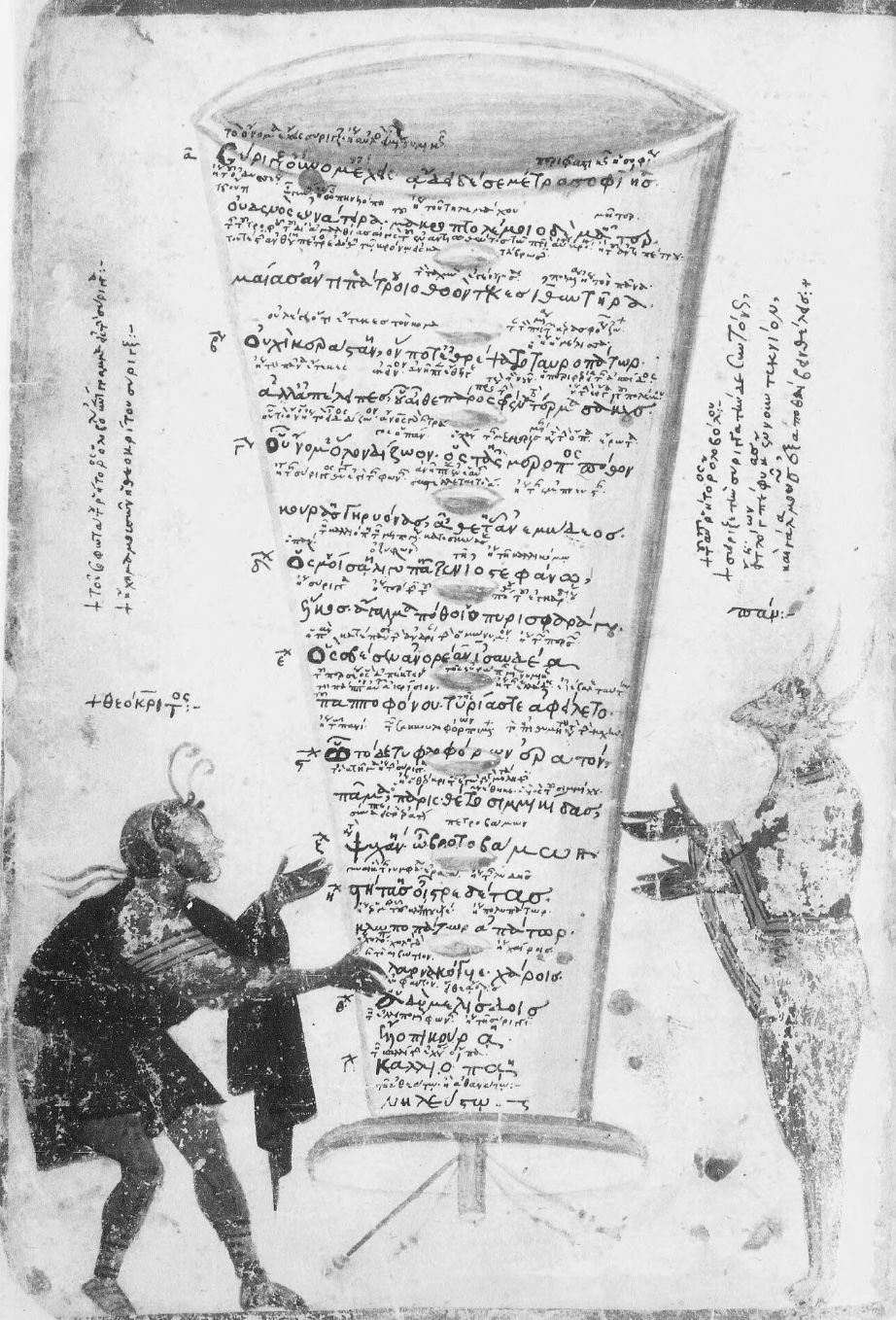
Verse formsComposite forms
Later and Hellenistic metres
Greek metres in Hellenistic and later poetry, and the change from quantity to stress.
The metrical families one by one: dactylic, iambic, trochaic, aeolic, ionic, anapaestic, dochmiac and the rest.
Later metres · 1 of 4
Hellenistic book lyric and the Alexandrians
Once the lyric metres of drama and of Pindar are understood, the metre of the next thousand years is, by comparison, easy to follow. New metres are rare, and the few that arise fit readily into the old categories. The overall trend is towards a simpler, narrower range. Some forms become stereotyped. Others, such as dactylic lyric and dochmiac, fall into disuse. And more and more of poetry is written in three stichic metres: the hexameter, the elegiac couplet and, less often, the iambic trimeter.[1] What remained of lyric is the subject here. The next treats the stichic metres.
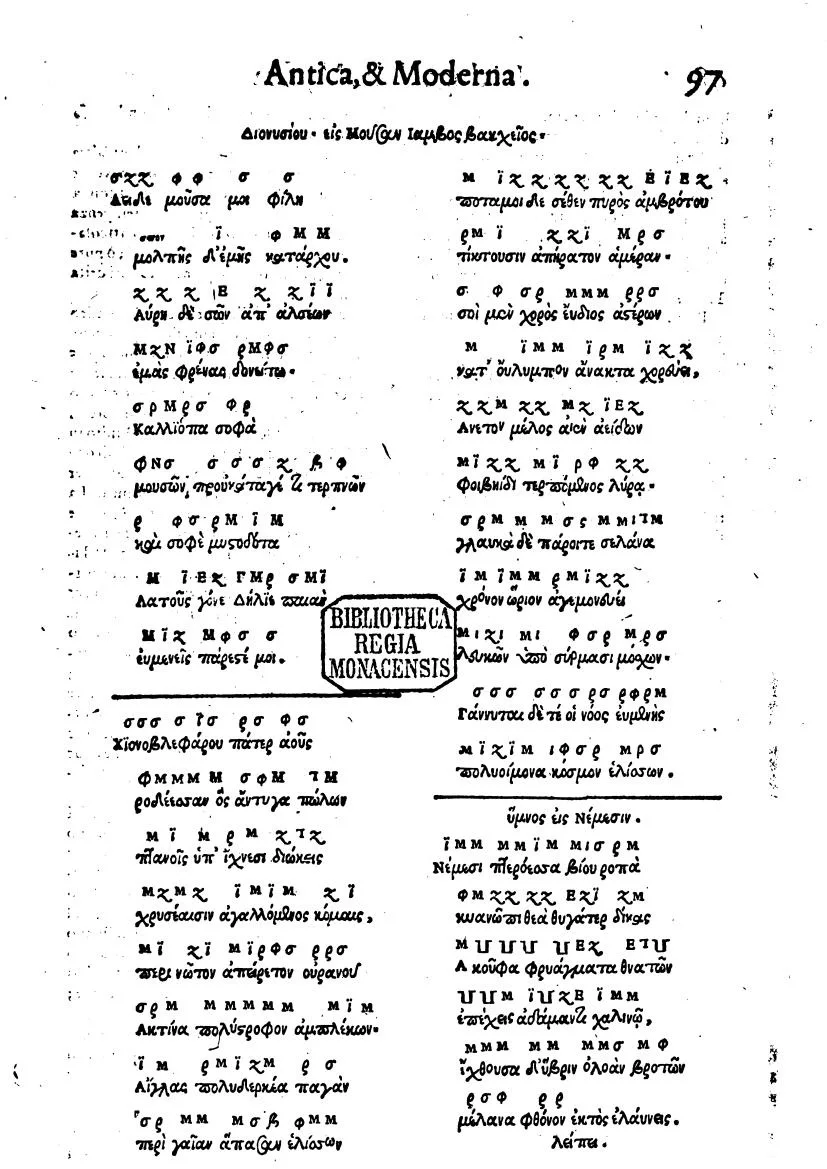
Book lyric. Hellenistic poets writing for the book, especially in the third century, tried out many verse-forms taken from archaic monody. For the most part they were not trying to imitate song, strophic or astrophic. They wanted to enlarge the stock of stichic and distichic metres that written poetry could use.[2] Learned Hellenistic poets did not reproduce the old strophic structures, but reused lyric metres line by line or in epodic pairs.[3] Sometimes the metre reflects an avowed model. Theocritus in poems 28–31 uses the Lesbian metres gl²ᶜ and gl²ᵈ for poems in Lesbian dialect (so too Barbantani 2009, p. 307, on Aeolic metre and dialect in Id. 28–31). From 29.39 onwards he even affects the old double-short form of the aeolic base, generally abandoned since the fifth century.[2] Here is the opening of 28, the poem on the distaff:
1 Γλαύκας ὦ φιλέριθ’ ἀλακάτα δῶρον Ἀθανάας
2 γύναιξιν, νόος οἰκωφελίας αἷσιν ἐπάβολος,
3 θέρσεισ’ ἄμμιν ὑμάρτη πόλιν ἐς Νείλεος ἀγλάαν,
4 ὅπᾳ Κύπριδος ἶρον καλάμω χλῶρον ὑπαπάλω.
Distaff, friend of wool-workers, gift of grey-eyed Athena to women whose mind is set on good housekeeping: come boldly with us to the splendid city of Neileus, where the shrine of Cypris is green under soft reed.
Theocritus 28.1–4: each line a glyconic with two choriambs inserted, base, ch, ch, — ⏑ ⏑ — ⏑ —.
synthetic ∿
Each line is gl²ᶜ, a glyconic with two added choriambs. Where a verse is expanded with choriambs, word-end often falls between them.[4] Here it falls after the second choriamb in every line (¦), and after the first only in line 1. The scansion follows West’s quantity marks: φιλέρῑθ’, ᾱ̓λακάτᾱ, ἐπᾱ́βολος, Κύπ|ριδος, and ᾱ̓πάλω in line 4, where West prints ὄππᾱ … ὑπ’ ἀπάλω for Perseus’ ὅπᾳ … ὑπαπάλω.[2]
Callimachus’ Iamboi take over metres of the early iambographers, such as the choliambic and the catalectic trochaic trimeter. They add two epodic pairings of his own.[2] In using lyric metres stichically or in epodes, Callimachus brought lyric close to iambus, where stichic metres such as Hipponax’s choliamb were at home.[5] Quite a range of aeolic and iambic verses was used stichically. Some of them were novel, like the catalectic iambic octameter of Boiscus (SH 233, as West prints it):[2]
Βοΐσκος ἀπὸ Κυζικοῦ, καινοῦ γραφεὺς ποιήματος,
τὸν ὀκτάπουν εὑρὼν στίχον Φοίβωι τίθησι δῶρον.
(second line) ⏑ — ⏑ — — — ⏑ — — — ⏑ — ⏑ — — (ia ia ia ia∧)
Boiscus of Cyzicus, writer of a new poem, having invented the eight-foot line, gives it to Phoebus as a gift.
The verse has 31 syllables: eight iambic metra less one position, with the catalectic last metron ⏑ — — that West describes for catalectic iambic verses.[6] The second line scans without difficulty as three iambic metra and the catalectic close. In the first half West marks the α of ἀπό long, filling the fourth position. The quantity of the υ of Κυζικοῦ, which stands in the sixth (long) position, is not marked. So the first half is not scanned here. Boiscus’ evident pride in having invented the line shows how these poets regarded their work.[2] Few of these metres lasted. Two that continued into the Roman period were the phalaecian, gl ia∧, the metre of Catullus’ hendecasyllables, and the priapean, gl ¦ ph.[7] The phalaecian runs — × — ⏑ ⏑ — ⏑ — ⏑ — —: a glyconic followed by a catalectic iambic metron.
Song that survived. Beside the book-poets, real singing went on in cult and at parties. Its metres are those of the archaic repertory, simplified:[8]
| Metre | Later use | West |
|---|---|---|
| dactylo-epitrite | the lyric of the educated middle class in the fourth and third centuries, astrophic, smooth; fades after c. 190 BC | p. 70 |
| iambic, iambo-choriambic | ritual chants, children’s games, the carmina popularia; Mesomedes’ dimeters; syncopation only in the close of the Epidaurian Hymn to Pan and in the Seikilos song | pp. 70–71 |
| hemiambic × — ⏑ — ⏑ — — | many of the Anacreontea, sometimes in four-line stanzas, with occasional anaclasis (ar, ph); later poems mix in iambic dimeters and anacreontics and avoid proparoxytone line-ends | p. 71 |
| cretic-paeonic | Delphic paeans of 127 BC; Mesomedes’ hymn to Isis; nothing later | pp. 71–72 |
| aeolic | festival compositions, usually glyconics in short strophes with a pherecratean close; the anaclastic glyconic increasingly frequent, as in Corinna; stichic glyconics in Corinna’s prefatory poem and the closing prayer of Limenius’ paean | pp. 72–73 |
| ionic | Isyllus’ paean, the Dictaean hymn, Corinna’s strict ionic strophes; the sotadean, for low entertainment and moralising; the galliambic of Cybele’s cult; the anacreontic, the most widely used and longest-lived ionic verse, written into Byzantine times | pp. 73–74 |
| anapaestic | little used in the Hellenistic period, commoner under the Empire for hymns, including Christian ones; Synesius’ 734 anapaestic monometers; the apokroton alternating with the paroemiac | pp. 75–76 |
Two ionic schemes. Here are West’s schemes of the two ionic verses of low and cultic song.[9] The sotadean is named after Sotades (early third century BC). It is a catalectic ionic tetrameter whose metra are broken up into many shapes. It takes one form from each column and ends — — ‖ (⏕ a long or two shorts; ⏔ two shorts or a long; ⏒ usually short, sometimes long):[10]
| First metron | Second metron | Third metron |
|---|---|---|
| ⏕ — ⏔ | ⏕ — ⏔ | ⏕ — ⏑ ⏑ |
| — — ⏑ — | — — ⏑ — | |
| ⏕ ⏕ — ⏑ | — — — ⏑ | — ⏕ — ⏑ |
| ⏕ ⏑ ⏕ ⏒ | — ⏑ ⏕ ⏒ | ⏕ ⏑ ⏕ ⏑ |
The galliambic, the metre especially of Cybele’s cult (Catullus 63 is in it), combines a dimeter with a catalectic dimeter: ⏔ — ⏕ ⏑ ⏑ — — | ⏑ ⏑ — ⏕ ⏑ ⏑ — ‖.[9]
Two features of this later song deserve notice. First, synapheia weakens. Synesius’ monometers may each end with hiatus or brevis in longo. The hymns of the Empire lean towards short metrical units that stand on their own, without synapheia.[11] Second, the accent begins to count. In the later Anacreontea the line avoids ending with a proparoxytone word, and paroxytones are most favoured. Byzantine anacreontics clearly favour an accented syllable in position four and, still more, in position seven.[12] West contrasts the “Protean” sotadean with Corinna’s unvarying ionic dimeters.[9] The contrast is a reminder that strictness and freedom coexisted throughout the period.
Notes
Later metres · 2 of 4
Stichic refinement: Callimachus and after
For the metrician, what matters in the later centuries is the technical polish of their best poets.[1] From the early third century BC many poets strove for greater smoothness. They avoided unusual rhythms and too many short words, and restricted licences such as hiatus. In many ways Callimachus marks the high point of this refinement.[2]
The Callimachean hexameter. It has three main features:[2]
- A high proportion of feminine caesurae. Every line has its caesura in the third foot.
- Sense-pauses kept, as a rule, to a few places: after the first foot, after the second princeps, at the masculine and feminine caesurae, after the fourth-foot dactyl and at line-end.
- A higher proportion of dactylic (uncontracted) feet than in Homer, especially in the fourth foot. Word-end after a dactylic fourth foot is called the bucolic caesura. It is already quite frequent in Homer (47% of lines), and rises to 63% in Callimachus and 74% in Theocritus’ bucolic poems.
The opening of the Hymn to Zeus shows all three:
1 Ζηνὸς ἔοι τί κεν ἄλλο παρὰ σπονδῇσιν ἀείδειν
2 λώιον ἢ θεὸν αὐτόν, ἀεὶ μέγαν, αἰὲν ἄνακτα,
3 Πηλαγόνων ἐλατῆρα, δικασπόλον οὐρανίδῃσι;
4 πῶς καί μιν, Δικταῖον ἀείσομεν ἠὲ Λυκαῖον;
5 ἐν δοιῇ μάλα θυμός, ἐπεὶ γένος ἀμφήριστον.
At libations to Zeus, what else should be sung than the god himself, ever great, ever lord, router of the Pelagonians, dispenser of justice to the sons of Heaven? How shall we sing him, as Dictaean or Lycaean? My heart is in great doubt, for his birth is disputed.
Callimachus, Hymn 1.1–5, by feet. Dashed bars: the caesura in the third foot and, where there is one, word-end after the fourth foot.
synthetic ∿
Every line has the feminine caesura, and lines 2–5 the bucolic. Line 5 is a σπονδειάζων. This is the type affected by some Alexandrian poets, in which the fourth-foot dactyl is followed by a tetrasyllabic word scanning — — — ×.[2]
Callimachus avoids several rhythms.[3] He avoids offences against Hermann’s Bridge (word-end between the shorts of the fourth biceps). He avoids word-end after a contracted fourth biceps, Naeke’s Law, as in Homer’s οὐλομένην, ἣ μυρί’ Ἀχαιοῖς | ἄλγε’ ἔθηκεν. He avoids word-end between the shorts of the second foot, or at its end, when there is none at the end of the first foot, which μῆνιν ἄειδε | θεά would break. He avoids word-end after the fifth princeps, except when the word scans ⏑ — ⏑ ⏑ —. And he avoids a spondaic word (contracted third biceps and fourth princeps) ending in the fourth princeps, unless bucolic caesura follows. Elision of nouns, adjectives and verbs is restricted: one instance in the first hundred lines of Hymn 3, against nineteen in Iliad 1.1–100.[4] The two bridges hold for the Hymns (except the fifth) and the Hecale. There Hermann’s Bridge is always kept, and no word ends after a contracted fourth biceps. No word ends after a contracted second biceps either (Hilberg’s Law). Callimachus’ practice differs in the fifth Hymn, the Aetia, the elegies and the epigrams.[5]
The elegiac couplet. Epigram is normally in elegiacs, and up to the first century AD longer poems often use them too. Hellenistic versification is stricter here than in hexameter poets. Hiatus is restricted, and correption used less. The word before the feminine caesura normally ends — ⏑ by nature. After the late third century BC the syllable at the pentameter’s caesura tends to be long by nature rather than by position. And more and more the pentameter is kept from ending on an accented syllable.[6] The same trend runs away from oxytone and perispomenon endings towards paroxytones.[7] After about AD 50 standards grow laxer, with hiatus or brevis in longo at the pentameter caesura in the third and fourth centuries. The sixth-century poets of Agathias’ Cycle return to a stricter technique.[8]
The trimeter. The trochaic tetrameter survives only in gnomic verse, mainly in the manner of Epicharmus. The iambic trimeter remains in regular use, and from the fourth century AD also for hymns, encomia and narrative.[9] Hellenistic tragedy, epigram and Lycophron’s Alexandra treat it strictly, with only occasional resolution. A short final syllable lengthened by initial stop + liquid in the Gyges drama papyrus is one reason for thinking it post-classical.[9] The trimeter in general use in late antiquity is basically the comic kind, and the distinction was no longer well understood. Lucian’s Podagra and the makeshift ending of Iphigenia in Aulis admit anapaests and breaches of Porson’s Law (on the IA ending).[10]
The choliambic. Hipponax’s “limping” trimeter has a long penultimate position. It came back in the late fourth century BC for poems meant to continue the spirit of Ionian iambus: Callimachus’ Iambi 1–4 and 13, and Herondas. A pure iambic close no longer occurs, except perhaps once in Phoenix of Colophon. The ischiorrhogic (“broken-hipped”) close — — — — ‖ has a long fourth syllable from the end. It comes about once in 24 lines in Herondas, and never in Callimachus, who also shuns anapaestic feet and resolves sparingly.[11] The three Hellenistic choliambists are Callimachus, Herodas and Phoenix.[12]
Babrius wrote his Aesopic fables in the metre in the first century AD. He lets anapaests stand freely in the first foot but seldom elsewhere, and has no ischiorrhogics. He always accents the penultimate syllable, which usually has a long vowel or diphthong, as the final syllable nearly always does. By his standards Hipponax’s ischiorrhogic line πάλαι γὰρ αὐτοὺς προσδέκονται χάσκοντες (fr. 9.1) fails four times over: the ischiorrhogic close, the proparoxytone ending, and short vowels in both of the last two syllables.[13] The figures confirm Babrius’ practice. A long vowel stands in the penultimate syllable of 92.55% of his lines, and in the final syllable of 97.33%. His endings are paroxytone almost without exception.[14]
Notes
- ^ West 1987, p. 68.
- ^ a b c West 1987, p. 78.
- ^ West 1987, pp. 78–79.
- ^ West 1987, p. 79.
- ^ Maas 1962, pp. 61–62.
- ^ West 1987, p. 80.
- ^ Devine and Stephens 1994, p. 83.
- ^ West 1987, pp. 80–81.
- ^ a b West 1987, p. 81.
- ^ West 1987, pp. 81–82; Kovacs 2005, p. 389.
- ^ West 1987, pp. 30, 82.
- ^ Lennartz 2022, p. 219; Morrison 2022, p. 396.
- ^ West 1987, pp. 30, 82–83.
- ^ Devine and Stephens 1994, pp. 83–84.
Later metres · 3 of 4
Worked example: Nonnus, Dionysiaca 1.1–5
Here is the opening of Nonnus’ Dionysiaca, written in the fifth century AD. It is scanned line by line, and then checked against the rules of the strictest hexameter ever written. The method is the one for any hexameter: divide into syllables, mark the quantities, find the six feet and the caesura. What makes Nonnus’ line “later” is not the scheme, which is Homer’s, but the list of things he will not do. The passage is the first five lines of the 33 scanned on the Nonnus page.
1 εἰπέ, θεά, Κρονίδαο διάκτορον αἴθοπος αὐγῆς,
2 νυμφιδίῳ σπινθῆρι μογοστόκον ἄσθμα κεραυνοῦ,
3 καὶ στεροπὴν Σεμέλης θαλαμηπόλον· εἰπὲ δὲ φύτλην
4 Βάκχου δισσοτόκοιο, τὸν ἐκ πυρὸς ὑγρὸν ἀείρας
5 Ζεὺς βρέφος ἡμιτέλεστον ἀμαιεύτοιο τεκούσης,
Tell, goddess, of the minister of the son of Cronos’ blazing light, the birth-pang breath of the thunderbolt with its bridal spark, and the lightning that attended Semele’s chamber; tell of the birth of Bacchus twice born, whom Zeus lifted wet from the fire, a half-finished babe, from a mother who bore him with no midwife …
Nonnus, Dionysiaca 1.1–5, by feet. Dashed bars: the caesura in the third foot and word-end after the fourth foot.
synthetic ∿
Step by step
1. Syllables and quantities. Syllables run across word-ends. So the ν of διάκτορον and the ς of αἴθοπος begin the next syllables, and a short open syllable stays short.[1] Inside a word a stop + liquid makes position, as normally in epic:[2] φύτ|λην (3), ὑγ|ρὸν (4). In 2 μογοστόκον has -γοσ- closed by στ. In 5 the diphthongs of ἀμαιεύτοιο give three longs in a row.
2. The feet. Lines 1 and 3 are five dactyls and a final — —. Line 2 contracts the second biceps (-ῳ σπιν-, a spondee), line 4 the first (Βάκχου), and line 5 the fourth (-μαι-εύ-, inside ἀμαιεύτοιο). Twenty-two of the twenty-five biceps positions in these five lines are uncontracted. Two of the five lines have no spondee before the sixth foot. Alexandrian and later poets favour dactylic feet more than Homer does.[3]
3. Caesura and diaeresis. Every line has its caesura in the third foot.[4] It is feminine (after the third trochee) in 1, 2, 4 and 5, and masculine (after the third princeps, Σεμέλης) in 3. Lines 1–4 also have word-end after a dactylic fourth foot. This is the bucolic caesura, which rises from 47% of lines in Homer to 63% in Callimachus.[3] In 4 τὸν ἐκ πυρὸς is one word-group, since prepositives count with what follows.[5]
The rules, checked
Nonnus keeps the Callimachean restrictions and adds his own, not all without exception.[6] The Dionysiaca, about 25,000 lines, stands beside Callimachus’ Hymns and Hecale as the strict form of the line.[7] In these five lines:
| Rule | Source | Dionysiaca 1.1–5 |
|---|---|---|
| no word-end between the two shorts of the fourth biceps (Hermann’s Bridge) | West 1987, pp. 21, 78; Maas 1962, p. 62 | kept: the fourth foot is inside διάκτορον, μογοστόκον, θαλαμηπόλον, ends with πυρὸς, or is contracted |
| no word-end after a contracted fourth biceps (Naeke’s Law) | West 1987, p. 78; Maas 1962, p. 62 | kept: the contracted fourth biceps of 5 is inside ἀμαιεύτοιο |
| no word-end after a contracted second biceps (Hilberg’s Law) | Maas 1962, p. 62 | kept: σπιν- (2) is inside σπινθῆρι |
| at most one contracted biceps before the caesura and one after; never the fifth | West 1987, p. 79 | kept: one each in 2 and 4 (before), 5 (after); the fifth is always ⏑ ⏑ |
| elision only of indeclinable words; hiatus rare | West 1987, p. 79 | no elision and no hiatus at all |
| before a masculine caesura, a paroxytone with a long final vowel | West 1987, p. 80 | Σεμέλης (3) |
| no oxytone before a feminine caesura | West 1987, p. 80 | Κρονίδαο, σπινθῆρι, δισσοτόκοιο, ἡμιτέλεστον: none oxytone |
| no proparoxytone at line-end | West 1987, p. 80; Allen 1968, p. 120, and Allen 1973, p. 268, read the rule as the first sure sign of a stress accent in the hexameter | αὐγῆς, κεραυνοῦ, φύτλην, ἀείρας, τεκούσης |
Two of the habits are tendencies, not rules. When Nonnus contracts a biceps he leans towards an accented long syllable.[8] In these lines only -εύ- of ἀμαιεύτοιο (5) carries the accent. σπιν- and -χου do not. The Nonnus page counts 18 of 30 contracted bicipitia accented over all 33 lines of the proem. And words that end — ⏑, such as πολλά or ἄλλος, are hardly ever placed so that a consonant lengthens their final syllable.[6] In these lines no final syllable is lengthened by position at all, except the closed monosyllable ἐκ before πυρὸς.
What makes this hexameter late
The scheme and the prosody are Homer’s. What has changed is the weight of the restrictions. Homer breaks Hermann’s Bridge about once in 550 lines.[5] Maas counts about one word-end after the fourth trochee in 390 lines.[9] Nonnus keeps the bridge always.[10] Homer elides nouns, adjectives and verbs nineteen times in Iliad 1.1–100, and Callimachus once in the first hundred lines of his third Hymn.[6] Nonnus elides only words that do not inflect. And the rules about accent at the caesura and at line-end show the language changing underneath the verse. The pitch accent had been acquiring an element of stress since the Hellenistic period.[11] Words like ἄλλος had lost the length of their last syllable in speech.[8]
Notes
Later metres · 4 of 4
Accentual verse
The Imperial prosody tab describes the change from pitch to stress and the loss of vowel-length distinctions. Here are two ways verse could work in that changed language. The first counts twelve syllables and fixes the final word’s stress. The second matches syllable counts and stresses across corresponding hymn lines.
The numbered diagrams count syllables. They do not use — and ⏑: those signs mark quantity. The recordings are synthetic Modern Greek stress illustrations, spoken rather than sung. The transliteration follows the written Greek; the recordings use Modern Greek sounds.
The Byzantine dodecasyllable
A dodecasyllable is a twelve-syllable line. Its usual internal division is after syllable five or seven, and its final word is stressed on the next-to-last syllable. That makes the final stress fall on syllable eleven.[1]
A scribe uses this line of thanks at the end of a manuscript copied in 1279/80.[2] The same formula occurs in many books, with a 5+7 division.[3]
Τῷ συντελεστῇ τῶν καλῶν θεῷ χάρις.
Thanks to God, who brings good things to completion.
Sinai gr. 1029.
Modern Greek stress illustration ∿
Count five syllables through συντελεστῇ, then seven more. The last word, χάρις, has two syllables: χά-ρις. Its stress therefore lands on eleven. This does not give the line an alternating weak–strong beat: the rule fixes the ending, not every other syllable.
These rules do not mean that every Byzantine poet abandoned quantity. Many dodecasyllables keep the old quantity pattern as well as the syllable-count and stress constraints. The numbered diagram isolates the count and final stress so that they can be heard and understood separately.[4]
The manuscript spelling has been normalized for reading: Τῶ and συντελεστῆ gain their iota subscripts, Θ(ε)ῶ is expanded to θεῷ, and the punctuation is simplified. The words are unchanged.[2]
Romanos’ Nativity hymn
Romanos’ Nativity hymn opens with these two lines. Each has fifteen syllables. In both, the prominent word stresses fall on syllables 3, 5, 11 and 14. The printed stress scheme matches the accents in the Greek: corresponding stressed places can contain different classical quantities.[5]
Ἡ παρθένος σήμερον τὸν ὑπερούσιον τίκτει
Today the Virgin bears the one beyond being;
Romanos, Nativity 1.
Modern Greek stress illustration ∿
Καὶ ἡ γῆ τὸ σπήλαιον τῷ ἀπροσίτῳ προσάγει
and the earth offers the cave to the unapproachable one.
Romanos, Nativity 2.
Modern Greek stress illustration ∿
Compare θέ with γῆ, the third syllable of each line. The first contains short ε in classical Greek; the second contains long η. Here they occupy the same accented place. The four highlighted numbers match even though the words and their old quantities differ.
The smaller groups follow the divisions printed by Krumbacher: 4+3+8 in the first line, 3+4+8 in the second. He notes uncertainty about this division into shorter lines. The full lines match in count and stress; the word groups need not have identical lengths. This hymn continues with lines of other lengths, so fifteen syllables is not a rule for all its lines.[5]
Quantity and stress
| Example | What its pattern controls |
|---|---|
| Euripides, Medea 2 | The quantitative trimeter can resolve a long position into two shorts. This line has thirteen syllables. |
| Nonnus, Dionysiaca 1.1–5 | The six-foot quantity pattern remains; additional restrictions govern where word accents may fall. |
| The book epigram above | Twelve syllables, a 5+7 division, and stress on syllable eleven. |
| Romanos’ opening pair | Fifteen syllables and matching stress positions in these two lines; short and long classical vowels can occupy corresponding stressed places. |
The trimeter examples and Nonnus analysis show the quantitative scansions and their recordings. The contrast is between the features each form requires: syllable quantity, syllable count, word stress, or a combination of them.


