Poets and playwrightsWomen poets
Erinna
Erinna’s Distaff and epigrams: lament, friendship and remembrance.
About · 1 of 2
Who Erinna was, and when
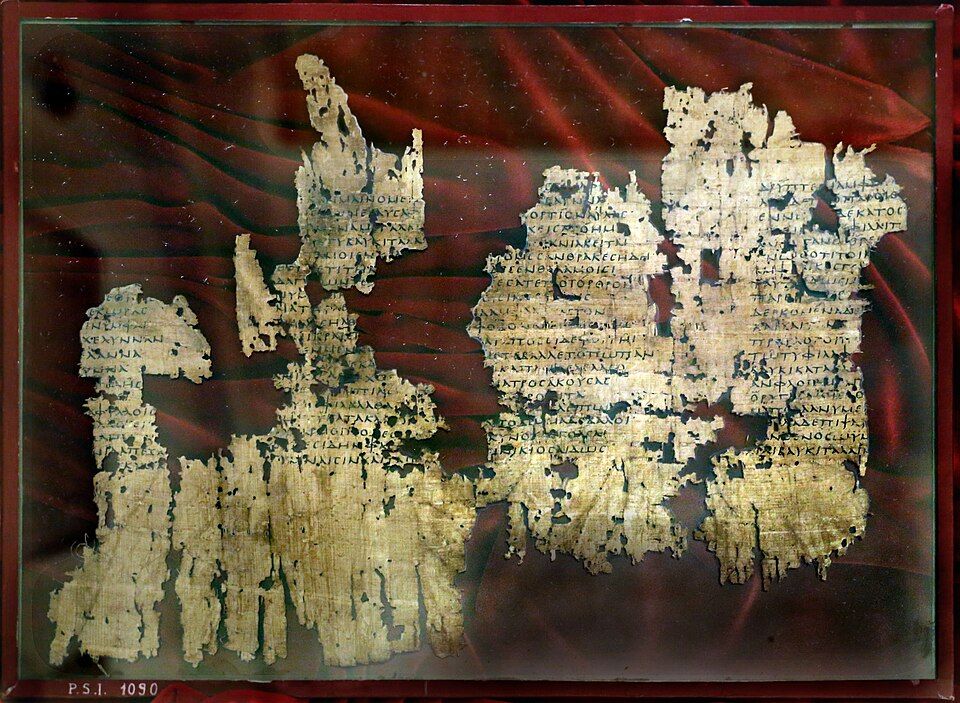
Erinna is known for one poem and a reputation. The poem is the Distaff (Ἠλακάτη, Ēlakatē, in her Doric ἀλακάτα, alakatā). It is a lament in hexameters for her childhood friend Baucis, who died soon after her wedding. About fifty-four damaged lines survive on a papyrus.[1] Three epigrams in the Greek Anthology also carry her name.[2]
Everything else comes from what later poets and lexicographers said about her. That may itself be drawn from the poems, where a poet may adopt a persona.[3]
What antiquity said. Hellenistic epigrammatists made her a figure of their own taste for small, finished work. Her poem was short, three hundred verses, but better than the work of many others, even a match for Homer (Asclepiades, A.P. 7.11; anonymous, A.P. 9.190).[4] She is a “parthenos” and a “honey-bee”, and her voice is swan-like (A.P. 7.12, 7.13). Meleager wove into his Garland “the sweet maiden-skinned crocus of Erinna” (A.P. 4.1.12). The anonymous epigram calls her book “the Lesbian honeycomb of Erinna”. It ends with a comparison that bears directly on metre (A.P. 9.190.7–8):
Σαπφὼ δ’ Ἠρίννης ὅσσον μελέεσσιν ἀμείνων,
Ἤριννα Σαπφοῦς τόσσον ἐν ἑξαμέτροις.
Sapphō d’ Ērinnēs hosson meleessin ameinōn, / Ērinna Sapphous tosson en hexametrois.
As much as Sappho is better than Erinna in lyric songs, so much is Erinna better than Sappho in hexameters.
The Suda’s Erinna. The Suda is a Byzantine lexicon. It says that Erinna came from Tenos, Lesbos, Telos or Rhodes, and that she was a companion and contemporary of Sappho. It says she wrote the Distaff, three hundred hexameters “in Aeolic and Doric”, and epigrams. And it says she died a parthenos, unmarried, at nineteen.[5] Page’s Loeb introduction to the papyrus likewise reports the three hundred hexameters on the Suda’s authority, and the story that she died at nineteen.[6]
Lesbos was probably inferred from the “Lesbian honeycomb” epigram.[3] The age comes from the poem. The word “nineteenth” (ἐννεα[και]δέκατος, ennea[kai]dekatos) stands in a damaged line just before the poet names herself. But it may refer to the narrator, to the time of writing, or to Baucis.[7] Natoli et al. place her in the Doric-speaking island of Telos.[8]
Her date (disputed).
| View | Who |
|---|---|
| A contemporary and companion of Sappho, about 600 BCE | the Suda; most scholars reject the claim as legend[3] |
| Fourth century BCE | most scholars: “perhaps 400–350 BCE”, the dates proposed by Levin 1962;[9] “? late fourth century bc”;[10] “fourth-century”[11] |
Did Erinna write the Distaff? (disputed). West (1977) argued that the poem’s sophistication was beyond a girl of nineteen kept at her wool-work. For him it was an anonymous imitation by a male poet of Cos or Rhodes, at the end of the fourth or the beginning of the third century. Pomeroy (1978) and Arthur (Katz) (1980) answered him at once. The general consensus now gives the poem to Erinna.[12] West’s argument rested partly on his own supplements to the papyrus.[13]
What the poem is about. Where the text becomes legible, the narrator recalls a game of tag played by girls (the “tortoise”), dolls, and the bogey Mormo. Then comes Baucis’ marriage, after which she forgot the things of childhood. Then comes the narrator’s own present: shame keeps her from leaving the house to see the body and mourn with the women. The last legible lines invoke the wedding-god Hymenaeus and Baucis.[14] It is a poem about memory and loss, full of echoes of Sappho, and much admired in the Hellenistic period.[10]
Notes
- ^ Natoli et al. 2022, pp. 86–87; Hunter 2021, p. 283.
- ^ Natoli et al. 2022, pp. 87–88.
- ^ a b c Natoli et al. 2022, p. 88.
- ^ Natoli et al. 2022, p. 86.
- ^ Natoli et al. 2022, pp. 86, 88.
- ^ Page 1941, p. 487.
- ^ Natoli et al. 2022, pp. 87, 98; p. 106 n. 10.
- ^ Natoli et al. 2022, p. 328.
- ^ Natoli et al. 2022, p. 88 with n. 6.
- ^ a b Hunter 2021, p. 283.
- ^ Morrison 2022, p. 400.
- ^ Natoli et al. 2022, pp. 87, 92–93.
- ^ Natoli et al. 2022, p. 93.
- ^ Natoli et al. 2022, pp. 87, 93.
About · 2 of 2
A lament in hexameters, epigrams in elegiacs
A lament in a recitative metre. The Distaff is in dactylic hexameters.[1] That is itself a choice of genre. A lament, a thrênos, belonged to sung lyric. Erinna’s poem transposed it into a spoken, recitative metre. It is an early case, in the fourth century BCE, of the blending of genres that later became characteristic of Hellenistic poetry.[2] The Distaff stands close both to the sung lament and to elegy.[3] Ancient readers felt the contrast. The epigram quoted on the Life tab sets Sappho’s songs against Erinna’s hexameters (A.P. 9.190.7–8).
The hexameter. The hexameter has six feet. Its scheme is — ⏔ — ⏔ — ⏔ — ⏔ — ⏔ — × ‖. The biceps, the pair of shorts in each of the first five feet, may be contracted to one long, least often in the fifth foot. A caesura is a word-end at a fixed place inside a foot. In the hexameter it normally falls in the third foot. It may come after the third foot’s long (the penthemimeral caesura), or after its first short (the “feminine” caesura). Otherwise it comes after the fourth long (the hephthemimeral caesura).[4]
Battezzato gives the same six-foot scheme.[5] One of the few complete lines of the papyrus is line 46:[6]
πραϋλόγοι πολιαί, ταὶ γήραος ἄνθεα θνατοῖς.
prāülogoi poliai, tai gēraos anthea thnātois.
“grey hairs, gentle of speech, which are the flowers of old age for mortals”
Red: πρᾱ-, long by nature; -α of ἄνθεα, left short before θν-; θνᾱ-, Doric long ᾱ for Attic η. Caesurae after πολιαί (penthemimeral) and after γήραος (bucolic).
Erinna, Distaff 46: Bergk 1882 III p. 143, with πραϋλόγοι from the licensed Perseus LSJ entry; translation ours
synthetic ∿
The first syllable is long because the α of πραϋλόγος is long.[7] The diaeresis on υ keeps α and υ apart, so πρᾱ-ϋ-λό- gives the first dactyl. Word-end after πολιαί falls after the third long: this is the penthemimeral caesura. The third foot is a spondee (-αί ταί). Word-end after the dactyl γήραος, at the end of the fourth foot, is the “bucolic caesura”.[8]
The final α of ἄνθεα stays short before the θν of θνατοῖς. A stop followed by a liquid or nasal may leave a short syllable short. Early poetry normally admits this at the beginning of a word.[9] θνατοῖς has the Doric long ᾱ where Attic has η.[10]
The epigrams. All three epigrams are in elegiac couplets.[11] The couplet is a hexameter followed by a “pentameter”. The pentameter is two hemiepes cola, — ⏔ — ⏔ — | — ⏑ ⏑ — ⏑ ⏑ — ‖. A hemiepes is the first half of a hexameter, up to the penthemimeral caesura. The two halves are always divided by word-end, and contraction is allowed only in the first half.[12]
From the middle of the sixth century the couplet became increasingly popular for verse inscriptions.[13] Until about 550 BC the hexameter had been usual for them.[14] The couplet is the standard metre for epigram in the Hellenistic period. Its versification is then generally stricter than in the hexameter poets. Hiatus is restricted, and correption is used less.[15] Here is the end of the second Baucis epigram (A.P. 7.712.7–8, Paton’s text):
καὶ σὺ μέν, ὦ Ὑμέναιε, γάμων μολπαῖον ἀοιδὰν
ἐς θρήνων γοερὸν φθέγμα μεθηρμόσαο.
kai sy men, ō Hymenaie, gamōn molpaion aoidan / es thrēnōn goeron phthegma methērmosao.
“And you, Hymenaeus, changed the tuneful song of the wedding into the mournful voice of dirges.”
Red: ὦ keeps its length before Ὑμέναιε (hiatus); the feminine caesura follows Ὑμέναιε. In the pentameter the spondee ἐς θρή- stands in the first half, the only place it is allowed; γοερόν ends that half.
Erinna, A.P. 7.712.7–8, Paton’s text
synthetic ∿
In the hexameter the ν of μέν is carried over to ὦ. The ὦ keeps its length before Ὑμέναιε. A vowel left standing before another vowel like this is called hiatus, and epic and elegiac poets admit it.[16] Word-end after Ὑμέναιε, after the first short of the third foot, is the feminine caesura.
In the pentameter the first half has a spondee (ἐς θρή-), which is allowed only there. Word-end after γοερόν marks the obligatory division between the two halves, shown ¦.[17] Natoli et al. print Gow and Page’s μεθαρμόσαο, which scans the same.[18]
All three epigrams are scanned line by line on the works page.
Notes
- ^ Natoli et al. 2022, pp. 87, 91.
- ^ Barbantani 2009, p. 304.
- ^ Morrison 2022, p. 400.
- ^ West 1987, pp. 19–20.
- ^ Battezzato 2009, p. 138.
- ^ Natoli et al. 2022, p. 91.
- ^ LSJ s.v. πραϋλόγος.
- ^ West 1987, pp. 19, 21.
- ^ West 1987, p. 16.
- ^ Natoli et al. 2022, p. 332.
- ^ Natoli et al. 2022, pp. 99, 101, 103, 337.
- ^ West 1987, p. 24; Aloni 2009, p. 168.
- ^ West 1987, p. 24; Aloni 2009, p. 170.
- ^ West 1987, p. 19.
- ^ West 1987, p. 80.
- ^ West 1987, p. 15.
- ^ West 1987, p. 24.
- ^ Natoli et al. 2022, p. 101.
Erinna, the three epigrams (A.P. 7.710, 7.712, 6.352)
Synopsis
Erinna’s fame rested on the Distaff, a short hexameter lament for her childhood friend Baucis, who died soon after her wedding. Three epigrams in the Greek Anthology also carry her name.[1] Little is known of her life. The Suda makes her a companion and contemporary of Sappho, who died unmarried at nineteen. Most scholars reject the link with Sappho and date her work to the fourth century BCE, perhaps 400–350. Hunter suggests the late fourth century.[2] The Suda names Tenos, Lesbos, Telos or Rhodes as her home. Natoli and his co-authors place her on the Doric island of Telos.[3] Two of the epigrams are set at Baucis’ tomb. Whether either was ever inscribed on a real monument is unclear.[4]
Three poems are scanned below. In the first, Baucis speaks from her grave. She asks her stele, its Sirens and her urn to tell passers-by that she died a bride and came from Tenos, and that her companion Erinna engraved these words (A.P. 7.710). In the second, her tomb laments that the torches of her wedding lit her funeral pyre (A.P. 7.712). The third praises a lifelike painting of a girl, Agatharchis (A.P. 6.352).[5]
Text and translation
The uninterrupted Greek with its English translation, line by line.
Show text and translation
Στᾶλαι, καὶ Σειρῆνες ἐμαί, καὶ πένθιμε κρωσσέ
Erinna · Greek Anthology 7.710, 7.712, 6.352 (Gow–Page 1–3) · elegiac couplets · text of Paton (1917), via the Perseus Digital Library
How to read each line
A guide to the Greek, syllables, pitch marks and quantities.
Show the reading key
- Above each line: the line as the edition prints it, each word placed over its own syllables. The main row: the same Greek divided into metrical syllables, each written as it is pronounced. A consonant that closes a syllable is written with it (λόθ | ρο); an elided word is closed up with the next vowel (ν’ἀ); a final consonant carried into the next word is set with a thin space (ς ἰ). Wider gaps mark word-ends.
- Above the syllables: the pitch of each syllable, from the accents. Under them: the quantity of each syllable as it falls in the line, then the transliteration, syllable by syllable, with accented syllables in capitals.
- Under each line: a line-for-line translation. In the right margin of the scansion: the line type, its scheme, and its analysis into cola.
Key to the labels
The names, patterns and symbols used beside this poem.
Show the labels and symbols
The labels in the right margin of the scansion below name the line, its scheme, the feet as the line realises them, and the caesurae and diaereses (the named word-ends) that fall in it. In the scheme ⏔ is a biceps, two shorts that may be contracted to one long; ⏕ is a long that may be resolved into two shorts; × is an anceps, long or short. A click on any syllable highlights its metron or colon, or, with the switch, its foot.
| Label | Name and shape | What it is |
|---|---|---|
| hem1 | First hemiepes— ⏔ — ⏔ — | The first two and a half feet of the hexameter, up to the penthemimeral caesura; in the pentameter, its whole first half. |
| hem2 | Second half of the hexameter⏔ — ⏔ — ⏑ ⏑ — × | From the penthemimeral caesura to the line-end: the fifth foot is nearly always a dactyl, the sixth is — ×. |
| hemp | Second hemiepes— ⏑ ⏑ — ⏑ ⏑ × | The second half of the pentameter: two dactyls and a single syllable, with no contraction allowed. |
The traditional feet
| Foot and shape | Where |
|---|---|
| First foot: dactyl or spondee— ⏔ | Scheme positions 1–2. The biceps (⏑ ⏑) may be contracted to a single long, making a spondee. |
| Second foot: dactyl or spondee— ⏔ | Scheme positions 3–4. |
| Third foot: dactyl or spondee— ⏔ | Scheme positions 5–6. The penthemimeral caesura falls after its first syllable, the “trochaic” caesura after its second. |
| Fourth foot: dactyl or spondee— ⏔ | Scheme positions 7–8. Word-end at the end of this foot, when it is a dactyl, is the bucolic diaeresis (West’s “bucolic caesura”: word-end at the end of the fourth foot after an uncontracted biceps)[6]. |
| Fifth foot: dactyl— ⏑ ⏑ | Scheme positions 9–10. A spondee here (a “spondaic line”) is rare. |
| Sixth foot— × | Scheme positions 11–12: a long and the indifferent final syllable. |
| First foot: dactyl or spondee— ⏔ | Scheme positions 1–2 of the pentameter. |
| Second foot: dactyl or spondee— ⏔ | Scheme positions 3–4. |
| Half-foot before the diaeresis— | Scheme position 5: the long that closes the first hemiepes; word-end must follow. |
| Fourth foot: dactyl— ⏑ ⏑ | Scheme positions 6–8: no contraction after the diaeresis. |
| Fifth foot: dactyl— ⏑ ⏑ | Scheme positions 9–11. |
| Final syllable× | Scheme position 12. |
Scansion
The two epigrams for Baucis' tomb and the epigram on a girl's portrait, scanned foot by foot: the hexameter with its caesurae, the pentameter with its fixed division, and the long ᾱ of literary Doric.
Grave-pillars, Sirens of mine, and urn of mourning,
you who keep the scant ash that belongs to Hades,
bid good day to all who walk past my burial mound,
be they people of this town or of some other city;
tell them too that this tomb holds me as a young bride,
and that Baucis was the name my father gave me, and that my family
came from Tenos, so that they know it; and that Erinna,
my friend and companion, cut these letters on my grave.
I belong to Baucis the bride; as you walk by the pillar
so often wept over, speak these words to Hades under the ground:
“Hades, you begrudge us.” To you who look at them, the fine letters
will make known the most savage fate of Baucis:
how her husband’s father lit the girl’s funeral pyre
with the same pine-torches that had lit the wedding song;
and you, god of weddings, changed the music of the marriage-song
into the wailing sound of laments.
This picture is the work of delicate hands. Prometheus, best of craftsmen,
there are humans too who match your skill.
Certainly, had the painter who drew this girl so faithfully
given her a voice as well, she would be Agatharchis complete.
Metre
- The couplet. All three epigrams are in elegiac couplets.[7] A hexameter, with less prosodic licence than in stichic epic, alternates with a “pentameter”, — ⏔ — ⏔ — | — ⏑ ⏑ — ⏑ ⏑ — ‖, two hemiepes cola always divided by word-end; contraction is limited to the first half, elision at the division is admitted, and the last position, at period-end, may hold a short syllable.[8] Epigram was normally composed in this metre.[9]
- The poet’s date and the stricter style. Erinna is usually dated to the fourth century BCE,[10] so these poems stand just before the Hellenistic period, a period in which, according to West, elegiac poets were on the whole stricter than the writers of hexameters: they allowed hiatus less often, made less use of correption, and before the hexameter’s feminine caesura generally put a word whose own shape is — ⏑.[9] In these twenty lines there is one hiatus, after the exclamation ὦ (7.712.7), and four shortenings of a long final vowel or diphthong before a vowel (epic correption)[11]: Τηνίᾱ, καί and μοι in 7.710.7 and καί in 6.352.2. Every word before a feminine caesura ends — ⏑ by nature (Σειρῆνες, ἐρχομένοισι, εὖσαν, εἰδῶντι, ἐμμί, Ὑμέναιος, Ὑμέναιε).
- The pentameter’s division. West notes that after the late third century BC poets favour, at the pentameter’s division, a syllable with a long vowel or diphthong over one whose length depends on the next word.[9] Erinna is earlier, but nine of her ten pentameters already have one there (Ἀΐδᾱ, τελέθωντ’, ἐκάλει, τύμβῳ, γᾶς, Βαυκοῦς, καδεστᾱ́ς, ἄνθρωποι, ποτέθηκ’); only γοερόν in 7.712.8 depends on the φθ that follows. Two pentameters have elision at the division (7.710.4 τελέθωντ’, 6.352.4 ποτέθηκ’), which West admits.[8]
- Doric long ᾱ. The epigrams are in literary Doric, which has long ᾱ where Attic has η (Natoli et al. 2022, App. A, p. 332); Natoli et al. gloss Στάλα, τὰν ὀλίγαν, ἁ, νύμφας, στάλαν, γᾶς, σάμαθ’, τὰν παῖδ’, καδεστάς and Προμαθεῦ with their Attic forms in η.[12] Where such an α stands in an open syllable that the metre needs long, the input marks it with a macron so that the reason given on the page is the true one (τᾱ́ν, νύμφᾱν, ᾱ̔, στᾱ́λαν, σᾱ́μαθ’, κᾱδεστᾱ́ς, Προμᾱθεῦ, and the feminine ending of Τηνίᾱ); the marks are not shown on the page.
- Prosody. As in epic: inside a word a stop + liquid makes position (πολυκ-λαύταν, ἔφ-λεγε), while at the beginning of a word it may leave a short syllable short (πένθιμε κρωσσέ, τάδε γράμματα, λῷστε Προμαθεῦ); short scansion before a stop + liquid inside a word, as in ἔγραψεν (6.352.3), is the treatment of Attic speech, which early poetry normally admits only at word-beginning.[13]
- The text. Paton’s text (Loeb, 1917) from the Perseus Digital Library, compared letter by letter with the XML. Natoli et al. print Gow and Page’s text, which differs in a number of readings, none of which changes the scansion: 7.710.1 Στάλα (Paton Στᾶλαι), 7.710.4 ἑτεροπτόλιες (ἑτέρας πόλιος), 7.712.1 εἰμί (ἐμμί), 7.712.6 τᾶσδ’ … πυρκαϊᾶς (ταῖσδ’ … πυρκαϊᾷ), 7.712.8 μεθαρμόσαο (μεθηρμόσαο), 6.352.1 ἀταλᾶν (ἁπαλᾶν), 6.352.4 ἧς (ἦς).[7] The input adds a diaeresis where ι is a syllable of its own (Ἀΐδα), as the workbench requires; the Perseus file has no full stop at the end of 7.712 (a comma), and none after 7.712.6, where this page prints a raised point. Paton’s direct speech in 7.712.3 (βάσκανός ἐσσ’, Ἀΐδᾱ) is given without quotation marks in the Greek row and with them in the translation.
Prosody, line by line
Every syllable, with the reason for its length. Quantities are read from the vowel where the spelling shows it, from the consonants that follow (“position”), from the accent where it tells, and from the metre where nothing else does. Editors’ notes on the text follow in the boxed paragraphs.
- 7.710.1
Line 7.710.1 · Στᾶλαι, καὶ Σειρῆνες ἐμαί, καὶ πένθιμε κρωσσέ,
Στᾶλαι, καὶ Σειρῆνες ἐμαί, καὶ πένθιμε κρωσσέ,
Στᾶλαι,καὶΣειρῆνες ἐμαί,καὶπένθιμεκρωσσέ,spondee, spondee, dactyl, spondee, dactyl, — ×; caesura after the third trochee; hephthemimeral caesura; word-end after a spondaic fourth foot.
- 1 —Στᾶᾶ carries a circumflex, so it is long.
- 2 —λαι,αι is a diphthong, long by nature; a single long contracts the two shorts of the biceps at position 2.
- 3 —καὶαὶ is a diphthong, long by nature.
- 4 —Σειει is a diphthong, long by nature; a single long contracts the two shorts of the biceps at position 4.
- 5 —ρῆῆ is long by nature.
- 6 ⏑νεε is short by nature; one of the two shorts of the biceps at position 6.
- 7 ⏑ς ἐἐ is short by nature; the first consonant belongs to the previous word and is carried over to this vowel; one of the two shorts of the biceps at position 6.
- 8 —μαί,αί is a diphthong, long by nature.
- 9 —καὶαὶ is a diphthong, long by nature; a single long contracts the two shorts of the biceps at position 8.
- 10 —πένέ is short by nature; closed by ν: long by position.
- 11 ⏑θιι is short by the metre (position 10 must be short); one of the two shorts of the biceps at position 10.
- 12 ⏑μεε is short by nature; the next word begins with κρ, a stop + liquid that does not make position here, so the syllable stays short; one of the two shorts of the biceps at position 10.
- 13 —κρωσω is long by nature; closed by σ: long by position.
- 14 ×σέ,έ is short by nature; the position is anceps.
Two spondees open the line (Στᾶ λαι, καὶ Σει). Feminine caesura after Σειρῆνες, whose ς is carried over to ἐμαί;[14] hephthemimeral caesura after ἐμαί. The fourth foot is a spondee (μαί καὶ); the word-end the page reports after it falls after καί, a prepositive, which counts with the word that follows,[6] so the line has no true word-end after a contracted fourth foot. πένθιμε keeps its final ε short before the κρ of κρωσσέ.[13] Paton prints the plural Στᾶλαι; Gow and Page have the singular Στάλα,[15] which also gives a long syllable.
- 7.710.2
Line 7.710.2 · ὅστις ἔχεις Ἀΐδα τὰν ὀλίγαν σποδιάν,
ὅστις ἔχεις Ἀΐδα τὰν ὀλίγαν σποδιάν,
ὅστις ἔχειςἈΐδατὰνὀλίγανσποδιάν,dactyl, dactyl, —, dactyl, dactyl, ×; diaeresis after the first hemiepes.
- 1 —ὅσὅ is short by nature; closed by σ: long by position.
- 2 ⏑τιι is short by the metre (position 2 must be short); one of the two shorts of the biceps at position 2.
- 3 ⏑ς ἔἔ is short by nature; the first consonant belongs to the previous word and is carried over to this vowel; one of the two shorts of the biceps at position 2.
- 4 —χειςει is a diphthong, long by nature.
- 5 ⏑ἈἈ is short by the metre (position 4 must be short); one of the two shorts of the biceps at position 4.
- 6 ⏑ΐΐ is short by the metre (position 4 must be short); one of the two shorts of the biceps at position 4.
- 7 —δαᾱ is long (its length is not shown by the ordinary spelling).
- 8 —τὰνᾱ̀ is long (its length is not shown by the ordinary spelling).
- 9 ⏑ὀὀ is short by nature.
- 10 ⏑λίί is short by the metre (position 8 must be short).
- 11 —γανα is a vowel of unknown length; closed by ν: long by position.
- 12 ⏑σποο is short by nature.
- 13 ⏑διι is short by the metre (position 11 must be short).
- 14 ×άν,ά is a vowel of unknown length; closed by ν: long by position; the position is anceps.
Two dactyls before the division. Ἀΐδᾱ fills the last position of the first half, which must be long: Gow and Page take the word as a genitive, “Hades’ (ash)”,[16] and the Doric genitive ends in long ᾱ. In τᾱ̀ν ὀλίγαν the article has the long ᾱ of Doric (Attic τὴν ὀλίγην)[16]; its ν is carried over to ὀλίγαν, so its syllable is long by nature, not by position. The second half is pure, as it must be.[8]
- 7.710.3
Line 7.710.3 · τοῖς ἐμὸν ἐρχομένοισι παρ’ ἠρίον εἴπατε χαίρειν,
τοῖς ἐμὸν ἐρχομένοισι παρ’ ἠρίον εἴπατε χαίρειν,
τοῖςἐμὸν ἐρχομένοισιπαρ’ἠρίον εἴπατεχαίρειν,dactyl, dactyl, dactyl, dactyl, dactyl, — ×; caesura after the third trochee; bucolic diaeresis.
- 1 —τοῖςοῖ is a diphthong, long by nature.
- 2 ⏑ἐἐ is short by nature; one of the two shorts of the biceps at position 2.
- 3 ⏑μὸὸ is short by nature; one of the two shorts of the biceps at position 2.
- 4 —ν ἐρἐ is short by nature; closed by ρ: long by position; the first consonant belongs to the previous word and is carried over to this vowel.
- 5 ⏑χοο is short by nature; one of the two shorts of the biceps at position 4.
- 6 ⏑μέέ is short by nature; one of the two shorts of the biceps at position 4.
- 7 —νοιοι is a diphthong, long by nature.
- 8 ⏑σιι is short by the accent rule: acute on the antepenult requires a short final syllable; one of the two shorts of the biceps at position 6.
- 9 ⏑παα is short by the metre (position 6 must be short); one of the two shorts of the biceps at position 6.
- 10 —ρ’ἠἠ is long by nature; the apostrophe marks an elided vowel; the consonant before it joins this syllable.
- 11 ⏑ρίί is short by the metre (position 8 must be short); one of the two shorts of the biceps at position 8.
- 12 ⏑οο is short by nature; one of the two shorts of the biceps at position 8.
- 13 —ν εἴεἴ is a diphthong, long by nature; the first consonant belongs to the previous word and is carried over to this vowel.
- 14 ⏑παα is short by the metre (position 10 must be short); one of the two shorts of the biceps at position 10.
- 15 ⏑τεε is short by nature; one of the two shorts of the biceps at position 10.
- 16 —χαίαί is a diphthong, long by nature.
- 17 ×ρειν,ει is a diphthong, long by nature; closed by ν: long by position; the position is anceps.
- 7.710.4
Line 7.710.4 · αἴτ’ ἀστοὶ τελέθωντ’, αἴθ’ ἑτέρας πόλιος·
αἴτ’ ἀστοὶ τελέθωντ’, αἴθ’ ἑτέρας πόλιος·
αἴτ’ἀστοὶτελέθωντ’,αἴθ’ἑτέραςπόλιος·spondee, dactyl, —, dactyl, dactyl, ×; diaeresis after the first hemiepes (with elision).
- 1 —αἴαἴ is a diphthong, long by nature.
- 2 —τ’ἀσἀ is a vowel of unknown length; closed by σ: long by position; the apostrophe marks an elided vowel; the consonant before it joins this syllable; a single long contracts the two shorts of the biceps at position 2.
- 3 —τοὶοὶ is a diphthong, long by nature.
- 4 ⏑τεε is short by nature; one of the two shorts of the biceps at position 4.
- 5 ⏑λέέ is short by nature; one of the two shorts of the biceps at position 4.
- 6 —θωνω is long by nature; closed by ν: long by position.
- 7 —τ’,αἴαἴ is a diphthong, long by nature; the apostrophe marks an elided vowel; the consonant before it joins this syllable.
- 8 ⏑θ’ἑἑ is short by nature; the apostrophe marks an elided vowel; the consonant before it joins this syllable.
- 9 ⏑τέέ is short by nature.
- 10 —ραςα is a vowel of unknown length; closed by ς: long by position.
- 11 ⏑πόό is short by nature.
- 12 ⏑λιι is short by the metre (position 11 must be short).
- 13 ×ος·ο is short by nature; closed by ς: long by position; the position is anceps.
The first foot is a spondee (αἴ τ’ἀσ, with τ’ elided before ἀστοί). The division of the pentameter falls after τελέθωντ’, whose final vowel is elided: elision at the division is admitted.[8] After the division the two dactyls are pure. πόλιος ends the period; its last syllable is closed by ς and scans as it would before a consonant.[18] Gow and Page read αἴθ’ ἑτεροπτόλιες, which scans the same.[15]
- 7.710.5
Line 7.710.5 · χὤτι με νύμφαν εὖσαν ἔχει τάφος, εἴπατε καὶ τό·
χὤτι με νύμφαν εὖσαν ἔχει τάφος, εἴπατε καὶ τό·
χὤτιμενύμφανεὖσαν ἔχειτάφο,ς εἴπατεκαὶτό·dactyl, spondee, dactyl, dactyl, dactyl, — ×; caesura after the third trochee; hephthemimeral caesura; bucolic diaeresis.
- 1 —χὤὤ is long by nature.
- 2 ⏑τιι is short by the metre (position 2 must be short); one of the two shorts of the biceps at position 2.
- 3 ⏑μεε is short by nature; one of the two shorts of the biceps at position 2.
- 4 —νύμύ is a vowel of unknown length; closed by μ: long by position.
- 5 —φανᾱ is long (its length is not shown by the ordinary spelling); a single long contracts the two shorts of the biceps at position 4.
- 6 —εὖεὖ is a diphthong, long by nature.
- 7 ⏑σαα is short by the accent rule: circumflex on the penult requires a short final syllable; one of the two shorts of the biceps at position 6.
- 8 ⏑ν ἔἔ is short by nature; the first consonant belongs to the previous word and is carried over to this vowel; one of the two shorts of the biceps at position 6.
- 9 —χειει is a diphthong, long by nature.
- 10 ⏑τάά is short by the metre (position 8 must be short); one of the two shorts of the biceps at position 8.
- 11 ⏑φο,ο is short by nature; one of the two shorts of the biceps at position 8.
- 12 —ς εἴεἴ is a diphthong, long by nature; the first consonant belongs to the previous word and is carried over to this vowel.
- 13 ⏑παα is short by the metre (position 10 must be short); one of the two shorts of the biceps at position 10.
- 14 ⏑τεε is short by nature; one of the two shorts of the biceps at position 10.
- 15 —καὶαὶ is a diphthong, long by nature.
- 16 ×τό·ό is short by nature; the position is anceps.
χὤτι is καὶ ὅτι run together into one long syllable (crasis)[19]. The second foot is a spondee: νύμφᾱν has the long ᾱ of Doric (Attic νύμφην; cf. νύμφας = νύμφης)[20], and its ν is carried over to εὖσαν. Feminine caesura after εὖσαν (the Doric participle, Attic οὖσαν)[16]; hephthemimeral caesura after ἔχει; bucolic diaeresis after τάφος.
- 7.710.6
Line 7.710.6 · χὤτι πατήρ μ’ ἐκάλει Βαυκίδα, χὤτι γένος
χὤτι πατήρ μ’ ἐκάλει Βαυκίδα, χὤτι γένος
χὤτιπατήρμ’ἐκάλειΒαυκίδα,χὤτιγένοςdactyl, dactyl, —, dactyl, dactyl, ×; diaeresis after the first hemiepes.
- 1 —χὤὤ is long by nature.
- 2 ⏑τιι is short by the metre (position 2 must be short); one of the two shorts of the biceps at position 2.
- 3 ⏑παα is short by the metre (position 2 must be short); one of the two shorts of the biceps at position 2.
- 4 —τήρή is long by nature; closed by ρ: long by position.
- 5 ⏑μ’ἐἐ is short by nature; the apostrophe marks an elided vowel; the consonant before it joins this syllable; one of the two shorts of the biceps at position 4.
- 6 ⏑κάά is short by the metre (position 4 must be short); one of the two shorts of the biceps at position 4.
- 7 —λειει is a diphthong, long by nature.
- 8 —Βαυαυ is a diphthong, long by nature.
- 9 ⏑κίί is short by the metre (position 7 must be short).
- 10 ⏑δα,α is short by the metre (position 8 must be short).
- 11 —χὤὤ is long by nature.
- 12 ⏑τιι is short by the metre (position 10 must be short).
- 13 ⏑γέέ is short by nature.
- 14 ×νοςο is short by nature; closed by ς: long by position; the position is anceps.
Crasis again in χὤτι, twice.[19] μ’ is elided before ἐκάλει. The division follows ἐκάλει, whose diphthong fills the last position of the first half. Βαυκίδα has a short final α (accusative), in the biceps after the division.
- 7.710.7
Line 7.710.7 · Τηνία, ὡς εἰδῶντι· καὶ ὅττι μοι ἁ συνεταιρὶς
Τηνία, ὡς εἰδῶντι· καὶ ὅττι μοι ἁ συνεταιρὶς
Τηνία,ὡςεἰδῶντι·καὶὅττιμοιἁσυνεταιρὶςdactyl, spondee, dactyl, dactyl, dactyl, — ×; caesura after the third trochee; bucolic diaeresis.
- 1 —Τηη is long by nature.
- 2 ⏑νίί is short by the metre (position 2 must be short); one of the two shorts of the biceps at position 2.
- 3 ⏑α,ᾱ is long (its length is not shown by the ordinary spelling); shortened before the vowel that begins the next word (epic correption), as the metre requires; one of the two shorts of the biceps at position 2.
- 4 —ὡςὡ is long by nature.
- 5 —εἰεἰ is a diphthong, long by nature; a single long contracts the two shorts of the biceps at position 4.
- 6 —δῶνῶ is long by nature; closed by ν: long by position.
- 7 ⏑τι·ι is short by the accent rule: circumflex on the penult requires a short final syllable; one of the two shorts of the biceps at position 6.
- 8 ⏑καὶαὶ is a diphthong, long by nature; shortened before the vowel that begins the next word (epic correption), as the metre requires; one of the two shorts of the biceps at position 6.
- 9 —ὅτὅ is short by nature; closed by τ: long by position.
- 10 ⏑τιι is short by the metre (position 8 must be short); one of the two shorts of the biceps at position 8.
- 11 ⏑μοιοι is a diphthong, long by nature; shortened before the vowel that begins the next word (epic correption), as the metre requires; one of the two shorts of the biceps at position 8.
- 12 —ἁᾱ̔ is long (its length is not shown by the ordinary spelling).
- 13 ⏑συυ is short by the metre (position 10 must be short); one of the two shorts of the biceps at position 10.
- 14 ⏑νεε is short by nature; one of the two shorts of the biceps at position 10.
- 15 —ταιαι is a diphthong, long by nature.
- 16 ×ρὶςὶ is a vowel of unknown length; closed by ς: long by position; the position is anceps.
Three long syllables are shortened before a vowel (epic correption)[11]: the final α of Τηνίᾱ before ὡς (the feminine of Τήνιος, with the long ᾱ that Doric has for Ionic η; the rough breathing of ὡς is no consonant), καί before ὅττι, and μοι before ἁ. Feminine caesura after εἰδῶντι, at a sense-pause; bucolic diaeresis after μοι. μοι is an enclitic and counts with ὅττι,[6] so there is no word-end between the two shorts of the fourth foot (Hermann’s bridge)[6]. The article ἁ has the long ᾱ of Doric (Attic ἡ)[21].
- 7.710.8
Line 7.710.8 · Ἤρινν’ ἐν τύμβῳ γράμμ’ ἐχάραξε τόδε.
Ἤρινν’ ἐν τύμβῳ γράμμ’ ἐχάραξε τόδε.
Ἤρινν’ἐντύμβῳγράμμ’ἐχάραξετόδε.spondee, spondee, —, dactyl, dactyl, ×; diaeresis after the first hemiepes.
- 1 —ἬἬ is long by nature.
- 2 —ρινι is a vowel of unknown length; closed by ν: long by position; a single long contracts the two shorts of the biceps at position 2.
- 3 —ν’ἐνἐ is short by nature; closed by ν: long by position; the apostrophe marks an elided vowel; the consonant before it joins this syllable.
- 4 —τύμύ is a vowel of unknown length; closed by μ: long by position; a single long contracts the two shorts of the biceps at position 4.
- 5 —βῳῳ is long by nature; the next word begins with γρ: the syllable is closed before it: long by position.
- 6 —γράμά is a vowel of unknown length; closed by μ: long by position.
- 7 ⏑μ’ἐἐ is short by nature; the apostrophe marks an elided vowel; the consonant before it joins this syllable.
- 8 ⏑χάά is short by the metre (position 8 must be short).
- 9 —ραξ is a double consonant (two sounds) and closes the syllable: long by position.
- 10 ⏑ξεε is short by nature.
- 11 ⏑τόό is short by nature.
- 12 ×δε.ε is short by nature; the position is anceps.
Two spondees before the division (Ἤ ριν, ν’ἐν τύμ): Ἤριννα has a double ν, which closes its second syllable; the elided Ἤριννʼ carries its last ν on to ἐν. The division follows τύμβῳ. In the second half γράμμ’ is elided, and ρα of ἐχάραξε is long because ξ counts as two consonants.[22] The poet names herself in the last line, a signature or sphragis; whether the epigram was ever inscribed is unclear.[21]
- 7.712.1
Line 7.712.1 · νύμφας Βαυκίδος ἐμμί· πολυκλαύταν δὲ παρέρπων
νύμφας Βαυκίδος ἐμμί· πολυκλαύταν δὲ παρέρπων
νύμφαςΒαυκίδος ἐμμί·πολυκλαύτανδὲπαρέρπωνspondee, dactyl, dactyl, spondee, dactyl, — ×; caesura after the third trochee.
- 1 —νύμύ is a vowel of unknown length; closed by μ: long by position.
- 2 —φαςα is a vowel of unknown length; closed by ς: long by position; a single long contracts the two shorts of the biceps at position 2.
- 3 —Βαυαυ is a diphthong, long by nature.
- 4 ⏑κίί is short by the metre (position 4 must be short); one of the two shorts of the biceps at position 4.
- 5 ⏑δοο is short by nature; one of the two shorts of the biceps at position 4.
- 6 —ς ἐμἐ is short by nature; closed by μ: long by position; the first consonant belongs to the previous word and is carried over to this vowel.
- 7 ⏑μί·ί is short by the metre (position 6 must be short); one of the two shorts of the biceps at position 6.
- 8 ⏑ποο is short by nature; one of the two shorts of the biceps at position 6.
- 9 —λυκυ is a vowel of unknown length; closed by κ before a liquid: stop + liquid makes position, as it usually does in epic.
- 10 —λαύαύ is a diphthong, long by nature; a single long contracts the two shorts of the biceps at position 8.
- 11 —τανα is a vowel of unknown length; closed by ν: long by position.
- 12 ⏑δὲὲ is short by nature; one of the two shorts of the biceps at position 10.
- 13 ⏑παα is short by the metre (position 10 must be short); one of the two shorts of the biceps at position 10.
- 14 —ρέρέ is short by nature; closed by ρ: long by position.
- 15 ×πωνω is long by nature; closed by ν: long by position; the position is anceps.
A spondee in the first foot (νύμ φας) and in the fourth (λυκ λαύ). Feminine caesura after ἐμμί, at a sense-pause. In πολυκλαύταν the stop + liquid κλ inside the word makes position, as it normally does in epic,[13] so λυ is long and fills the fourth princeps; there is no word-end after the contracted fourth foot. Paton prints ἐμμί; Gow and Page have εἰμί,[21] with the same quantities.
- 7.712.2
Line 7.712.2 · στάλαν τῷ κατὰ γᾶς τοῦτο λέγοις Ἀΐδᾳ·
στάλαν τῷ κατὰ γᾶς τοῦτο λέγοις Ἀΐδᾳ·
στάλαντῷκατὰγᾶςτοῦτολέγοιςἈΐδᾳ·spondee, dactyl, —, dactyl, dactyl, ×; diaeresis after the first hemiepes.
- 1 —στάᾱ́ is long (its length is not shown by the ordinary spelling).
- 2 —λανα is a vowel of unknown length; closed by ν: long by position; a single long contracts the two shorts of the biceps at position 2.
- 3 —τῷῷ is long by nature.
- 4 ⏑καα is short by the metre (position 4 must be short); one of the two shorts of the biceps at position 4.
- 5 ⏑τὰὰ is short by the metre (position 4 must be short); one of the two shorts of the biceps at position 4.
- 6 —γᾶςᾶ carries a circumflex, so it is long; closed by ς: long by position.
- 7 —τοῦοῦ is a diphthong, long by nature.
- 8 ⏑τοο is short by nature.
- 9 ⏑λέέ is short by nature.
- 10 —γοιςοι is a diphthong, long by nature.
- 11 ⏑ἈἈ is short by the metre (position 10 must be short).
- 12 ⏑ΐΐ is short by the metre (position 11 must be short).
- 13 ×δᾳ·ᾳ is long by nature; the position is anceps.
The first foot is a spondee: στᾱ́λαν has the long ᾱ of Doric (Attic στήλην)[20]. The division follows γᾶς (Attic γῆς). In the second half the ς of λέγοις is carried over to Ἀΐδᾳ, whose first two syllables are short.
- 7.712.3
Line 7.712.3 · βάσκανός ἐσσ’, Ἀΐδα· τὰ δέ τοι καλὰ σάμαθ’ ὁρῶντι
βάσκανός ἐσσ’, Ἀΐδα· τὰ δέ τοι καλὰ σάμαθ’ ὁρῶντι
βάσκανός ἐσσ’,Ἀΐδα·τὰδέτοικαλὰσάμαθ’ὁρῶντιdactyl, dactyl, dactyl, dactyl, dactyl, — ×; penthemimeral caesura; caesura after the third trochee; hephthemimeral caesura; bucolic diaeresis.
- 1 —βάσά is a vowel of unknown length; closed by σ: long by position.
- 2 ⏑καα is short by the metre (position 2 must be short); one of the two shorts of the biceps at position 2.
- 3 ⏑νόό is short by nature; one of the two shorts of the biceps at position 2.
- 4 —ς ἐσἐ is short by nature; closed by σ: long by position; the first consonant belongs to the previous word and is carried over to this vowel.
- 5 ⏑σ’,ἈἈ is short by the metre (position 4 must be short); the apostrophe marks an elided vowel; the consonant before it joins this syllable; one of the two shorts of the biceps at position 4.
- 6 ⏑ΐΐ is short by the metre (position 4 must be short); one of the two shorts of the biceps at position 4.
- 7 —δα·ᾱ is long (its length is not shown by the ordinary spelling).
- 8 ⏑τὰὰ is short by the metre (position 6 must be short); one of the two shorts of the biceps at position 6.
- 9 ⏑δέέ is short by nature; one of the two shorts of the biceps at position 6.
- 10 —τοιοι is a diphthong, long by nature.
- 11 ⏑καα is short by the metre (position 8 must be short); one of the two shorts of the biceps at position 8.
- 12 ⏑λὰὰ is short by the metre (position 8 must be short); one of the two shorts of the biceps at position 8.
- 13 —σάᾱ́ is long (its length is not shown by the ordinary spelling).
- 14 ⏑μαα is short by the metre (position 10 must be short); one of the two shorts of the biceps at position 10.
- 15 ⏑θ’ὁὁ is short by nature; the apostrophe marks an elided vowel; the consonant before it joins this syllable; one of the two shorts of the biceps at position 10.
- 16 —ρῶνῶ is long by nature; closed by ν: long by position.
- 17 ×τιι is short by the accent rule: circumflex on the penult requires a short final syllable; the position is anceps.
Five dactyls. The words of the tomb, βάσκανός ἐσσ’, Ἀΐδᾱ, end at the penthemimeral caesura, where the final ᾱ of the vocative fills the third princeps and must be long; Meleager quotes them in his own epigram on Erinna (A.P. 7.13.4). The word-end the page reports after τὰ is not a caesura: the article is a prepositive and counts with the next word;[6] the word-group τὰ δέ τοι ends at the hephthemimeral position. Bucolic diaeresis after καλά, whose α is short here: in elegy and epigram the α of καλός may be short or long.[23] σᾱ́μαθ’ (Attic σήματα)[20] has the long ᾱ of Doric and is elided before ὁρῶντι.
- 7.712.4
Line 7.712.4 · ὠμοτάταν Βαυκοῦς ἀγγελέοντι τύχαν,
ὠμοτάταν Βαυκοῦς ἀγγελέοντι τύχαν,
ὠμοτάτανΒαυκοῦςἀγγελέοντιτύχαν,dactyl, spondee, —, dactyl, dactyl, ×; diaeresis after the first hemiepes.
- 1 —ὠὠ is long by nature.
- 2 ⏑μοο is short by nature; one of the two shorts of the biceps at position 2.
- 3 ⏑τάά is short by the metre (position 2 must be short); one of the two shorts of the biceps at position 2.
- 4 —τανα is a vowel of unknown length; closed by ν: long by position.
- 5 —Βαυαυ is a diphthong, long by nature; a single long contracts the two shorts of the biceps at position 4.
- 6 —κοῦςοῦ is a diphthong, long by nature.
- 7 —ἀγἀ is a vowel of unknown length; closed by γ: long by position.
- 8 ⏑γεε is short by nature.
- 9 ⏑λέέ is short by nature.
- 10 —ονο is short by nature; closed by ν: long by position.
- 11 ⏑τιι is short by the accent rule: acute on the antepenult requires a short final syllable.
- 12 ⏑τύύ is short by the metre (position 11 must be short).
- 13 ×χαν,α is a vowel of unknown length; closed by ν: long by position; the position is anceps.
The second foot is a spondee (ταν Βαυ). The division follows Βαυκοῦς. ἀγγελέοντι, “they will announce”, has the Doric ending -ντι (compare ἔντι, Attic εἰσίν)[24]; its ον is closed by ν + τ and fills the first position of the second half.
- 7.712.5
Line 7.712.5 · ὡς τὰν παῖδ’, Ὑμέναιος ἐφ’ αἷς ἀείδετο πεύκαις,
ὡς τὰν παῖδ’, Ὑμέναιος ἐφ’ αἷς ἀείδετο πεύκαις,
ὡςτὰνπαῖδ’,Ὑμέναιος ἐφ’αἷςἀείδετοπεύκαις,spondee, dactyl, dactyl, spondee, dactyl, — ×; caesura after the third trochee; hephthemimeral caesura.
- 1 —ὡςὡ is long by nature; closed by ς: long by position.
- 2 —τὰνὰ is a vowel of unknown length; closed by ν: long by position; a single long contracts the two shorts of the biceps at position 2.
- 3 —παῖαῖ is a diphthong, long by nature.
- 4 ⏑δ’,ὙὙ is short by the metre (position 4 must be short); the apostrophe marks an elided vowel; the consonant before it joins this syllable; one of the two shorts of the biceps at position 4.
- 5 ⏑μέέ is short by nature; one of the two shorts of the biceps at position 4.
- 6 —ναιαι is a diphthong, long by nature.
- 7 ⏑οο is short by nature; one of the two shorts of the biceps at position 6.
- 8 ⏑ς ἐἐ is short by nature; the first consonant belongs to the previous word and is carried over to this vowel; one of the two shorts of the biceps at position 6.
- 9 —φ’αἷςαἷ is a diphthong, long by nature; the apostrophe marks an elided vowel; the consonant before it joins this syllable.
- 10 —ἀᾱ̓ is long (its length is not shown by the ordinary spelling); a single long contracts the two shorts of the biceps at position 8.
- 11 —είεί is a diphthong, long by nature.
- 12 ⏑δεε is short by nature; one of the two shorts of the biceps at position 10.
- 13 ⏑τοο is short by nature; one of the two shorts of the biceps at position 10.
- 14 —πεύεύ is a diphthong, long by nature.
- 15 ×καις,αι is a diphthong, long by nature; closed by ς: long by position; the position is anceps.
The fourth foot is a spondee (φ’αἷς ᾱ), and the α that contracts it is long: ᾱ̓είδετο is the imperfect with its augment, which Ionic writes η (ἤειδον)[25] and Doric ᾱ (Natoli et al. 2022, App. A, p. 332); with a short α the line would not scan. Feminine caesura after Ὑμέναιος; hephthemimeral caesura after αἷς. In Ὑμέναιος the diphthong αι before ο stays long in the princeps. ἐφ’ is elided before αἷς.
- 7.712.6
Line 7.712.6 · ταῖσδ’ ἐπὶ καδεστὰς ἔφλεγε πυρκαϊᾷ·
ταῖσδ’ ἐπὶ καδεστὰς ἔφλεγε πυρκαϊᾷ·
ταῖσδ’ἐπὶκαδεστὰςἔφλεγεπυρκαϊᾷ·dactyl, spondee, —, dactyl, dactyl, ×; diaeresis after the first hemiepes.
- 1 —ταῖσαῖ is a diphthong, long by nature; closed by σ: long by position.
- 2 ⏑δ’ἐἐ is short by nature; the apostrophe marks an elided vowel; the consonant before it joins this syllable; one of the two shorts of the biceps at position 2.
- 3 ⏑πὶὶ is short by the metre (position 2 must be short); one of the two shorts of the biceps at position 2.
- 4 —καᾱ is long (its length is not shown by the ordinary spelling).
- 5 —δεσε is short by nature; closed by σ: long by position; a single long contracts the two shorts of the biceps at position 4.
- 6 —τὰςᾱ̀ is long (its length is not shown by the ordinary spelling).
- 7 —ἔφἔ is short by nature; closed by φ before a liquid: stop + liquid makes position, as it usually does in epic.
- 8 ⏑λεε is short by nature.
- 9 ⏑γεε is short by nature.
- 10 —πυρυ is a vowel of unknown length; closed by ρ: long by position.
- 11 ⏑καα is short by the metre (position 10 must be short).
- 12 ⏑ϊϊ is short by the metre (position 11 must be short).
- 13 ×ᾷ·ᾷ is long by nature; the position is anceps.
The first half ends with κᾱδεστᾱ́ς, “father-in-law” (Attic κηδεστής)[20], both of whose α are long in Doric; the second fills the last position of the first half, and the ς is carried over to ἔφλεγε. In ἔφλεγε the φλ inside the word makes position (ἔφ-λε-γε), the normal epic treatment.[13] ταῖσδ’ is elided before ἐπί. Gow and Page read τᾶσδ’ … πυρκαϊᾶς,[21] with the same scansion.
- 7.712.7
Line 7.712.7 · καὶ σὺ μέν, ὦ Ὑμέναιε, γάμων μολπαῖον ἀοιδὰν
καὶ σὺ μέν, ὦ Ὑμέναιε, γάμων μολπαῖον ἀοιδὰν
καὶσὺμέ,ν ὦὙμέναιε,γάμωνμολπαῖον ἀοιδὰνdactyl, dactyl, dactyl, spondee, dactyl, — ×; caesura after the third trochee; hephthemimeral caesura.
- 1 —καὶαὶ is a diphthong, long by nature.
- 2 ⏑σὺὺ is short by the metre (position 2 must be short); one of the two shorts of the biceps at position 2.
- 3 ⏑μέ,έ is short by nature; one of the two shorts of the biceps at position 2.
- 4 —ν ὦὦ is long by nature; the first consonant belongs to the previous word and is carried over to this vowel; the next word begins with a vowel and nothing is elided: hiatus.
- 5 ⏑ὙὙ is short by the metre (position 4 must be short); one of the two shorts of the biceps at position 4.
- 6 ⏑μέέ is short by nature; one of the two shorts of the biceps at position 4.
- 7 —ναιαι is a diphthong, long by nature.
- 8 ⏑ε,ε is short by nature; one of the two shorts of the biceps at position 6.
- 9 ⏑γάά is short by the metre (position 6 must be short); one of the two shorts of the biceps at position 6.
- 10 —μωνω is long by nature; closed by ν: long by position.
- 11 —μολο is short by nature; closed by λ: long by position; a single long contracts the two shorts of the biceps at position 8.
- 12 —παῖαῖ is a diphthong, long by nature.
- 13 ⏑οο is short by nature; one of the two shorts of the biceps at position 10.
- 14 ⏑ν ἀἀ is short by the metre (position 10 must be short); the first consonant belongs to the previous word and is carried over to this vowel; one of the two shorts of the biceps at position 10.
- 15 —οιοι is a diphthong, long by nature.
- 16 ×δὰνὰ is a vowel of unknown length; closed by ν: long by position; the position is anceps.
The ν of μέν is carried over to ὦ, which keeps its length before Ὑμέναιε: hiatus, which epic and elegiac poets admit[26] and which is the usual treatment after an exclamation even in tragedy.[13] Feminine caesura after Ὑμέναιε; hephthemimeral caesura after γάμων. The fourth foot is a spondee (μων μολ) with no word-end after it. ἀοιδάν has a short first α.
- 7.712.8
Line 7.712.8 · ἐς θρήνων γοερὸν φθέγμα μεθηρμόσαο.
ἐς θρήνων γοερὸν φθέγμα μεθηρμόσαο.
ἐςθρήνωνγοερὸνφθέγμαμεθηρμόσαο.spondee, dactyl, —, dactyl, dactyl, ×; diaeresis after the first hemiepes.
- 1 —ἐςἐ is short by nature; closed by ς: long by position.
- 2 —θρήή is long by nature; a single long contracts the two shorts of the biceps at position 2.
- 3 —νωνω is long by nature; closed by ν: long by position.
- 4 ⏑γοο is short by nature; one of the two shorts of the biceps at position 4.
- 5 ⏑εε is short by nature; one of the two shorts of the biceps at position 4.
- 6 —ρὸνὸ is short by nature; closed by ν: long by position.
- 7 —φθέγέ is short by nature; closed by γ: long by position; γμ is one of the four clusters (γμ, γν, δμ, δν) that never leave the syllable before them short.[13]
- 8 ⏑μαα is short by the metre (position 7 must be short).
- 9 ⏑μεε is short by nature.
- 10 —θηρη is long by nature; closed by ρ: long by position.
- 11 ⏑μόό is short by nature.
- 12 ⏑σαα is short by the metre (position 11 must be short).
- 13 ×ο.ο is short by nature; the position is anceps.
A spondee in the first half (ἐς θρή-), allowed only there;[8] ἐς is long before the θρ of θρήνων. The division follows γοερόν, whose final syllable is long only because φθ follows. μεθηρμόσαο, the aorist middle with its augment, “you changed (the mode)”; Gow and Page print the unaugmented μεθαρμόσαο.[21] The short final syllable at period-end is admitted.[27]
- 6.352.1
Line 6.352.1 · ἐξ ἁπαλᾶν χειρῶν τάδε γράμματα· λῷστε Προμαθεῦ,
ἐξ ἁπαλᾶν χειρῶν τάδε γράμματα· λῷστε Προμαθεῦ,
ἐξἁπαλᾶνχειρῶντάδεγράμματα·λῷστεΠρομαθεῦ,dactyl, spondee, dactyl, dactyl, dactyl, — ×; penthemimeral caesura; bucolic diaeresis.
- 1 —ἐξἐ is short by nature; ξ is a double consonant (two sounds) and closes the syllable: long by position.
- 2 ⏑ἁἁ is short by the metre (position 2 must be short); one of the two shorts of the biceps at position 2.
- 3 ⏑παα is short by the metre (position 2 must be short); one of the two shorts of the biceps at position 2.
- 4 —λᾶνᾶ carries a circumflex, so it is long; closed by ν: long by position.
- 5 —χειει is a diphthong, long by nature; a single long contracts the two shorts of the biceps at position 4.
- 6 —ρῶνῶ is long by nature; closed by ν: long by position.
- 7 ⏑τάά is short by the metre (position 6 must be short); one of the two shorts of the biceps at position 6.
- 8 ⏑δεε is short by nature; the next word begins with γρ, a stop + liquid that does not make position here, so the syllable stays short; one of the two shorts of the biceps at position 6.
- 9 —γράμά is a vowel of unknown length; closed by μ: long by position.
- 10 ⏑μαα is short by the metre (position 8 must be short); one of the two shorts of the biceps at position 8.
- 11 ⏑τα·α is short by the accent rule: acute on the antepenult requires a short final syllable; one of the two shorts of the biceps at position 8.
- 12 —λῷσῷ is long by nature; closed by σ: long by position.
- 13 ⏑τεε is short by nature; the next word begins with Πρ, a stop + liquid that does not make position here, so the syllable stays short; one of the two shorts of the biceps at position 10.
- 14 ⏑Προο is short by nature; one of the two shorts of the biceps at position 10.
- 15 —μαᾱ is long (its length is not shown by the ordinary spelling).
- 16 ×θεῦ,εῦ is a diphthong, long by nature; the position is anceps.
Penthemimeral caesura after χειρῶν; bucolic diaeresis after γράμματα, at a sense-pause. The second foot is a spondee (λᾶν χει). The ε of τάδε stays short before the γρ of γράμματα, and the ε of λῷστε before the Πρ of Προμᾱθεῦ.[13] Προμᾱθεῦ has the long ᾱ of Doric (Attic Προμηθεῦ)[28]. Gow and Page read ἀταλᾶν for Paton’s ἁπαλᾶν;[28] both mean “tender” and scan alike.
- 6.352.2
Line 6.352.2 · ἔντι καὶ ἄνθρωποι τὶν ὁμαλοὶ σοφίαν.
ἔντι καὶ ἄνθρωποι τὶν ὁμαλοὶ σοφίαν.
ἔντικαὶἄνθρωποιτὶνὁμαλοὶσοφίαν.dactyl, spondee, —, dactyl, dactyl, ×; diaeresis after the first hemiepes.
- 1 —ἔνἔ is short by nature; closed by ν: long by position.
- 2 ⏑τιι is short by the metre (position 2 must be short); one of the two shorts of the biceps at position 2.
- 3 ⏑καὶαὶ is a diphthong, long by nature; shortened before the vowel that begins the next word (epic correption), as the metre requires; one of the two shorts of the biceps at position 2.
- 4 —ἄνἄ is a vowel of unknown length; closed by ν: long by position.
- 5 —θρωω is long by nature; a single long contracts the two shorts of the biceps at position 4.
- 6 —ποιοι is a diphthong, long by nature.
- 7 —τὶνῑ̀ is long (its length is not shown by the ordinary spelling).
- 8 ⏑ὁὁ is short by nature.
- 9 ⏑μαα is short by the metre (position 8 must be short).
- 10 —λοὶοὶ is a diphthong, long by nature.
- 11 ⏑σοο is short by nature.
- 12 ⏑φίί is short by the metre (position 11 must be short).
- 13 ×αν.α is a vowel of unknown length; closed by ν: long by position; the position is anceps.
καί is shortened before ἄνθρωποι (epic correption; on καί before a vowel, p. 16)[11]. The second foot is a spondee (θρω ποι), and the division follows ἄνθρωποι. τῑ́ν, the Doric dative of σύ, opens the second half with a long ι: LSJ records τίν with short ι in some poets and with long ι in others (s.v. σύ), and the position requires it long here; its ν is carried over to ὁμαλοί.
- 6.352.3
Line 6.352.3 · ταύταν γοῦν ἐτύμως τὰν παρθένον ὅστις ἔγραψεν,
ταύταν γοῦν ἐτύμως τὰν παρθένον ὅστις ἔγραψεν,
ταύτανγοῦνἐτύμωςτὰνπαρθένον ὅστις ἔγραψεν,spondee, dactyl, spondee, dactyl, dactyl, — ×; penthemimeral caesura; bucolic diaeresis.
- 1 —ταύαύ is a diphthong, long by nature.
- 2 —τανα is a vowel of unknown length; closed by ν: long by position; a single long contracts the two shorts of the biceps at position 2.
- 3 —γοῦνοῦ is a diphthong, long by nature.
- 4 ⏑ἐἐ is short by nature; one of the two shorts of the biceps at position 4.
- 5 ⏑τύύ is short by the metre (position 4 must be short); one of the two shorts of the biceps at position 4.
- 6 —μωςω is long by nature; closed by ς: long by position.
- 7 —τὰνὰ is a vowel of unknown length; closed by ν: long by position; a single long contracts the two shorts of the biceps at position 6.
- 8 —παρα is a vowel of unknown length; closed by ρ: long by position.
- 9 ⏑θέέ is short by nature; one of the two shorts of the biceps at position 8.
- 10 ⏑νοο is short by nature; one of the two shorts of the biceps at position 8.
- 11 —ν ὅσὅ is short by nature; closed by σ: long by position; the first consonant belongs to the previous word and is carried over to this vowel.
- 12 ⏑τιι is short by the metre (position 10 must be short); one of the two shorts of the biceps at position 10.
- 13 ⏑ς ἔἔ is short by nature; γρ is carried whole into the next syllable, so this syllable stays open and short (correption before a stop + liquid cluster, as the metre needs); the first consonant belongs to the previous word and is carried over to this vowel; one of the two shorts of the biceps at position 10.
- 14 —γραψ is a double consonant (two sounds) and closes the syllable: long by position.
- 15 ×ψεν,ε is short by nature; closed by ν: long by position; the position is anceps.
Spondees in the first and third feet. Penthemimeral caesura after ἐτύμως; bucolic diaeresis after παρθένον, whose ν is carried over to ὅστις. The article τὰν is a prepositive.[6] In ἔγραψεν the ἔ stays short before γρ inside the word, the treatment usual in Attic speech that early poetry normally admits only at the beginning of a word;[13] ρα is long before ψ.
- 6.352.4
Line 6.352.4 · αἰ καὐδὰν ποτέθηκ’, ἦς κ’ Ἀγαθαρχὶς ὅλα.
αἰ καὐδὰν ποτέθηκ’, ἦς κ’ Ἀγαθαρχὶς ὅλα.
αἰκαὐδὰνποτέθηκ’,ἦςκ’Ἀγαθαρχὶς ὅλα.spondee, dactyl, —, dactyl, dactyl, ×; diaeresis after the first hemiepes (with elision).
- 1 —αἰαἰ is a diphthong, long by nature.
- 2 —καὐαὐ is a diphthong, long by nature; a single long contracts the two shorts of the biceps at position 2.
- 3 —δὰνὰ is a vowel of unknown length; closed by ν: long by position.
- 4 ⏑ποο is short by nature; one of the two shorts of the biceps at position 4.
- 5 ⏑τέέ is short by nature; one of the two shorts of the biceps at position 4.
- 6 —θηη is long by nature.
- 7 —κ’,ἦςἦ is long by nature; closed by ς: long by position; the apostrophe marks an elided vowel; the consonant before it joins this syllable.
- 8 ⏑κ’ἈἈ is short by the metre (position 7 must be short); the apostrophe marks an elided vowel; the consonant before it joins this syllable.
- 9 ⏑γαα is short by the metre (position 8 must be short).
- 10 —θαρα is a vowel of unknown length; closed by ρ: long by position.
- 11 ⏑χὶὶ is short by the metre (position 10 must be short).
- 12 ⏑ς ὅὅ is short by nature; the first consonant belongs to the previous word and is carried over to this vowel.
- 13 ×λα.α is of unknown length; the position is anceps, so either scans.
καὐδάν is καὶ αὐδάν run together (crasis)[29], one long syllable that contracts the second foot. The division follows ποτέθηκ’, elided before ἦς.[8] With κ’, the particle Attic writes ἄν, ἦς gives the conclusion of an unreal condition, “she would be Agatharchis entire”;[24] Gow and Page print ἧς.[28] ὅλα ends the period, where any quantity is admitted.[27]
Notes
- ^ Natoli et al. 2022, pp. 86–87.
- ^ Natoli et al. 2022, pp. 87–88; Hunter 2021, p. 283.
- ^ Natoli et al. 2022, pp. 88, 328.
- ^ Natoli et al. 2022, pp. 87–88, 101.
- ^ Natoli et al. 2022, pp. 87–88, 99–103.
- ^ a b c d e f g West 1987, p. 21.
- ^ a b Natoli et al. 2022, pp. 99, 101, 103.
- ^ a b c d e f West 1987, p. 24.
- ^ a b c West 1987, p. 80.
- ^ Natoli et al. 2022, p. 88.
- ^ a b c West 1987, p. 14.
- ^ Natoli et al. 2022, pp. 100–103.
- ^ a b c d e f g h West 1987, p. 16.
- ^ a b West 1987, p. 12.
- ^ a b Natoli et al. 2022, p. 99.
- ^ a b c Natoli et al. 2022, p. 100.
- ^ West 1987, p. 13.
- ^ West 1987, pp. 3–4.
- ^ a b West 1987, pp. 14–15.
- ^ a b c d Natoli et al. 2022, p. 102.
- ^ a b c d e Natoli et al. 2022, p. 101.
- ^ West 1987, p. 12 n. 1.
- ^ LSJ s.v. καλός, “Quantity”.
- ^ a b Natoli et al. 2022, p. 104.
- ^ LSJ s.v. ἀείδω.
- ^ West 1987, p. 15.
- ^ a b West 1987, pp. 4, 24.
- ^ a b c Natoli et al. 2022, p. 103.
- ^ Natoli et al. 2022, p. 104; West 1987, pp. 14–15.
Text and sources
- Text: The Greek Anthology, ed. W. R. Paton (Loeb Classical Library, London 1917), vols. I–II, from the Perseus Digital Library (urn:cts:greekLit:tlg7000.tlg001.perseus-grc6, -grc7), licensed CC BY-SA 4.0 as stated in the TEI header; changes as listed under Metre.
- Readings of Gow and Page, notes and glosses: B. A. Natoli, A. Pitts and J. P. Hallett, Ancient Women Writers of Greece and Rome (Routledge 2022), ch. 3, pp. 88, 99–104; App. A, p. 332.
- Rules: M. L. West, Introduction to Greek Metre (Oxford 1987), pp. 3–4, 12–16 (prosody), 19–21 (hexameter, caesurae, Hermann’s bridge, prepositives), 24 (the elegiac couplet), 80 (Hellenistic elegiacs), checked against the page images.
- Quantities: LSJ (Perseus Digital Library, CC BY-SA), s.vv. ἀείδω, καλός, σύ.
Quotations from copyrighted works are not covered by this page’s licence.


