Poets and playwrightsChoral lyric
Alcman
Alcman of Sparta: maiden-songs, Laconian Doric and the Louvre Partheneion.
About · 1 of 5
Who Alcman was
Date. Alcman was active in Sparta in the later seventh century BC. He probably came a little after Tyrtaeus and Archilochus, and a little before Sappho and Alcaeus.[1] Other accounts likewise give the late seventh century.[2]
No Greek choral poetry older than his fragments survives. Monody is song for a single voice, and his fragments may hold the oldest monody too.[1] He stands first among the poets of the Dorian tradition. So far as we know, each of their strophes was a new creation for the particular song.[3]
Lydian or Laconian? (disputed). Ancient biography was largely taken up with this question, and the debate was perhaps begun by Aristotle. A partheneion is a “maiden-song”, sung by a chorus of girls. The debate turned on lines of a partheneion (fr. 16) that describe a man who was no rustic but “from lofty Sardis”.[4]
Power thinks the passage dubious as evidence. Elsewhere, when Alcman speaks of himself in the third person, he names himself; and “was” suits a dead man better. Yet a Lydian origin has some appeal, since seventh-century Sparta was outward-looking and drew foreign poets and luxury goods.[5] A tradition said that he came from Sardis, just as Terpander had come from Lesbos some fifty years earlier.[6] The dispute arose from a claim in a poem, not from his language.[7]
By the Hellenistic period the controversy was a literary topos. Antipater of Thessalonica makes Alcman’s birthplace, Sparta or Lydia, a quarrel between two continents (AP 7.18.5).[8]
Sparta’s musical life. Alcman joined an existing tradition. Terpander of Lesbos won the first lyre-singing contest at the Carneia in the 670s. He is credited with the first organisation of Spartan music. Aulodes sang to the music of the aulos. The second organisation belongs to Thaletas of Gortyn, Xenodamus of Cythera and Xenocritus of Locri, with the aulodes Polymnestus and Sacadas.[9] Alcman named Polymnestus in a song (fr. 145).[10] Finds from Spartan sanctuaries include dancing figurines. They also include the earliest surviving fragment of an aulos in the Greek world, from about 650 BC.[11]
Poet and trainer. A papyrus commentary calls Alcman a “poet-trainer” (διδάσκαλος, didaskalos) for the ancestral choruses of the Spartans’ daughters and young men.[12] Like most composers of choral song, he composed songs for choruses of girls, trained them, and accompanied them. Sappho may have done the same.[13]
Partheneia filled two of the six Alexandrian books, the first and the second. So he seems to have specialised in maiden-song. But he also wrote for other occasions. Some fragments mention couches, tables and soup, and they suggest songs for the men’s common meals, perhaps sung solo.[14] Unlike later choral poets, he apparently stayed within Laconia, though his poetry looks beyond it.[15] How he was paid is unknown: by prizes, by the state, or by the families of his dancers.[16]
Reputation. The citharode Arion was said to have been his pupil (Suda). Plutarch reports that the helots were forbidden to sing the works of Terpander and Alcman.[17] Chamaeleon, a Peripatetic contemporary of Aristotle, wrote on Alcman.[18] Citing the musicologist Archytas, he made Alcman a “leader in erotic songs”. He read fragments of partheneia as the poet’s own love poetry.[19] In antiquity Alcman was famous for erotic poetry, and for his poems on nature and cult.[20]
Notes
- ^ a b Power 2022, p. 245.
- ^ Krummen 2009, p. 190; Budelmann 2009, p. 386.
- ^ West 1987, pp. 3, 35–36.
- ^ Power 2022, p. 249.
- ^ Power 2022, pp. 249–250.
- ^ Krummen 2009, p. 189.
- ^ de Kreij 2022, p. 144.
- ^ Phillips 2022, p. 121.
- ^ Power 2022, pp. 250, 252–253; Krummen 2009, p. 190.
- ^ Power 2022, p. 253.
- ^ Krummen 2009, p. 190 with n. 3.
- ^ Power 2022, p. 250.
- ^ Lardinois 2022, p. 272.
- ^ Power 2022, pp. 250–253.
- ^ Power 2022, pp. 250, 258.
- ^ Power 2022, p. 258.
- ^ Power 2022, p. 254.
- ^ Phillips 2022, p. 120.
- ^ Power 2022, p. 252.
- ^ Krummen 2009, pp. 193–194.
About · 2 of 5
The maiden-songs and their language
Two partheneia. The most continuous texts come from two songs for choruses of unmarried girls (parthenoi). The Louvre or First Partheneion (fr. 1) was found in Egypt in 1855 and published in 1863. The much shorter Second Partheneion (fr. 3) was published in 1957.[1] Both ran to more than a hundred lines, in metrically identical stanzas. They may have shared a shape: sections about the performance framing a myth.[1] The name partheneion for the genre is not securely attested before the end of the fifth century.[2]
The Louvre Partheneion. What survives begins in the middle of a myth: the killing of the sons of Hippocoon by the Tyndarids. This is a founding story of Sparta’s kings.[3] A gnome is a general maxim. Gnomic lines close the myth (“there is a vengeance from the gods”, 36), and the song turns to the present. The chorus sings the beauty of two leading girls, Agido and the chorus-leader Hagesichora, in images of the sun, a prize-winning horse and the stars.[4] The chorus brings a robe to a goddess, Orthria. She is probably the same as the Aotis whom it wishes to please.[5]
The Peleiades (disputed). In lines 60–63 the “Peleiades” rise like Sirius and “fight” the chorus. Some scholars have taken them for a rival chorus. More now take them as the stars themselves or, as the ancient scholiasts did, as Agido and Hagesichora.[6] Krummen reads them as Agido and Hagesichora set against the other girls, in an image of dawn.[7]
Occasion (disputed). Calame’s influential reading makes the partheneia songs of initiation, for girls passing into adulthood. Stehle places them at public festivals, where they presented the girls to the community as future wives.[8] Their imagery is the imagery of praise, and it anticipates the victory odes of Simonides, Pindar and Bacchylides.[9]
Language (disputed). Alcman’s text is heavily marked with features of the local Laconian dialect, with a few Aeolic forms. Page defended them as an older Laconian preserved only in Alcman. Since Risch (1954), scholars have seen the mixture as partly a product of transmission. Risch’s own extreme view, that Alexandrian scholars imposed the Doric of Cyrene, is no longer commonly followed.[10]
De Kreij’s “most economical hypothesis” has two parts. The early Aeolic poets who worked at Sparta left their mark on Alcman. And his songs were written down with Doric spellings, used inconsistently, as “signals” that the text was to be performed with a Doric sound.[10]
Power adds that Hellenistic editors, or earlier Spartan re-performers, brought in anachronistic Laconian features, such as σ for θ (παρσένος (parsenos) for παρθένος (parthenos), “maiden”). In his view Alcman’s language was probably closer to the later choral idiom: a Doric base with Lesbian and epic overlays. Maslov warns against assimilating it too far to a delocalised koinē.[11] The dialect can be described as Doric with local Laconian influences.[12]
The digamma, ϝ, was the letter for the sound [w]. One detail bears on scansion. Initial digamma is felt in about half the certain cases (τε ϝάνακτα (te wanakta), 1.6) and ignored in the rest (ἐς ὠρανόν (es ōranon), 1.16, with ἐς short). So the text does not reflect the Spartan speech of his day, in which initial digamma was still present.[13] At 1.63 the spelling ἀυειρομέναι (aweiromenai) (⏑ — ⏑ ⏑ —, a-wei-) has υ written for a digamma between vowels.[14]
“and the lord” · “to the sky”
Left: ϝ is written and counts as a consonant. Right: ὠρανόν once began with ϝ too, but the ς of ἐς passes over to it, ἐ-σὠ-, and ἐς stays short.
Alcman, PMGF 1.6 and 1.16
“maiden”
The Laconian σ for θ, which Power takes as a later feature brought into the text.[15]
Beyond the partheneia. Alcman also wrote love poetry. In fr. 59a Eros, at Cypris’ bidding, once again warms the heart. In fr. 26 the old poet wishes to be a sea-bird flying with the halcyons. Fr. 89 is the sleeping landscape, and fr. 56 a night festival on the mountain-tops. There are also myths of Helen and Paris, Odysseus and Circe, Ajax, and Peleus and Thetis.[16]
Notes
- ^ a b Power 2022, p. 246.
- ^ Power 2022, p. 246 n. 3.
- ^ Power 2022, p. 246; Krummen 2009, p. 191.
- ^ Power 2022, p. 247; Krummen 2009, pp. 191–192.
- ^ Power 2022, pp. 247–248.
- ^ Power 2022, p. 248.
- ^ Krummen 2009, p. 192.
- ^ Power 2022, p. 249.
- ^ Krummen 2009, p. 191.
- ^ a b de Kreij 2022, p. 144.
- ^ Power 2022, p. 258 with n. 23.
- ^ Krummen 2009, p. 189.
- ^ de Kreij 2022, p. 145.
- ^ West 1987, p. 15.
- ^ Power 2022, p. 258.
- ^ Krummen 2009, pp. 193–194; Power 2022, pp. 254–255.
About · 3 of 5
How Alcman reaches us
How much survives. Alcman is among the least well preserved of the nine canonical lyric poets. On one estimate (Hinge) we have about three per cent of the Alexandrian edition, and no complete poem.[1] Most fragments are quotations in prose authors who wrote centuries later, and none of these is longer than eight lines (frr. 14–157). The rest come from Roman-period papyri (frr. 1–13 and S1–5). Most of these are scraps, and many are quotations inside ancient commentaries.[1]
Early circulation (disputed). A copy of the Homeric Hymn to Apollo was kept on Delos. On that analogy it has been suggested that an “edition” of Alcman was preserved at Sparta (Phillips, citing Carey).[2] Carey argues that the songs circulated early beyond Sparta, both orally and in writing. Hinge holds that the choral songs stayed local and oral, re-performed only in Laconian cults, until their Hellenistic “discovery”.[3] Fr. 98 was known outside Sparta by the mid-fourth century, when Ephorus quoted it (ibid.). At Athens, a character in Eupolis’ Helots already calls it old-fashioned to sing Stesichorus, Alcman and Simonides.[4]
Alexandria. Alcman was one of the nine poets whose works the Alexandrians gathered, ordered and normalised in spelling.[5] Their edition had six books, and the first two contained partheneia. The Louvre Partheneion probably stood in Book 1. A scholion claims that fr. 3 was misplaced in Book 5. A papyrus shows fr. 4a ending Book 6. A work called Kolumbōsai is of doubtful authenticity.[6]
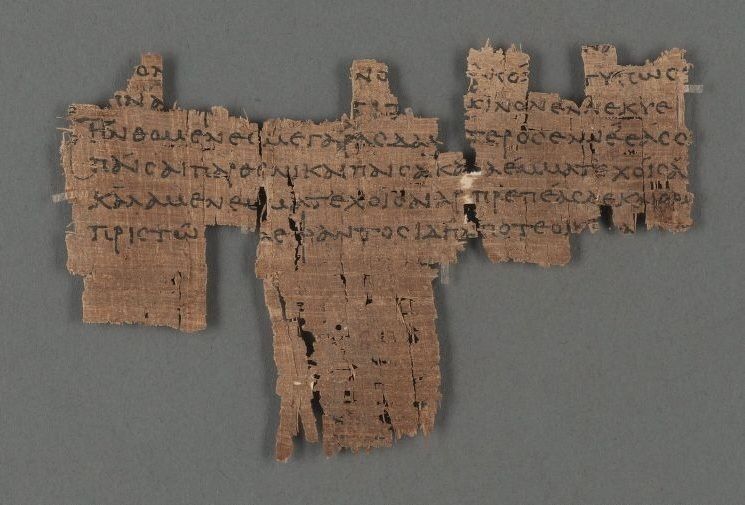
Aristarchus wrote commentaries on Alcman, Pindar and Bacchylides. These, with later scholarship, are the source of the notes that survive in the margins of the papyri.[7] The papyrus of the Louvre Partheneion was found in Egypt in 1855. It carries scholia and references to Hellenistic scholars, which show learned reading in Egyptian towns in the second century AD. A second papyrus preserves another set of scholia.[8] The ancient scholarship on Alcman preserved on papyrus is published in the Commentaria et lexica Graeca in papyris reperta.[9]
In the papyri his text shows Doric accentuation, e.g. γεραιτάτοι (1.14). The secondary tradition is the text as later authors quote it. Where it has a third-person plural in -ουσι(ν), this may be later normalisation. Or it may reflect the different shapes his songs took in performance.[10]
Quotation. A quoted fragment serves the quoter’s purposes, and it may be Atticised in transmission.[5] Fr. 89 is an example. It is a night landscape in which mountain peaks, ravines, creeping things, wild beasts, bees, sea-creatures and long-winged birds all sleep. It survives because Apollonius the Sophist quoted it in his Homeric lexicon, to show that poets other than Homer used several words for animals. He quoted two lines more than his point required, drawn by the passage’s ring-composed, lullaby-like completeness. Its original context is unknown: an epiphany, a night ritual, or the far-northern mountains.[11]
The metrician Hephaestion quotes Alcman for several forms. He quotes him for the dactylic hephthemimer and for whole strophes in dactylic tetrameters,[12] and for spondees in the anapaestic “Archebulean” verse (8.9). He also quotes a whole song in ionics a minore (12.2), a hexameter made entirely of cretics (13.6), and an “epionic” trimeter (14.6). These lines are scanned on the Metres tabs.
Editions. Power and de Kreij cite Alcman from PMGF, Davies’ edition of 1991.[13] Calame’s commentary of 1983 is the standard commentary on all the fragments.[14] West cites PMG numbers (PMG 1 for the Partheneion; Alcman 58 and 174). For frr. 1 and 58 these coincide with the PMGF numbers Power uses.[15]
Notes
- ^ a b Power 2022, p. 245.
- ^ Phillips 2022, p. 119.
- ^ Power 2022, p. 251 n. 7.
- ^ Finglass 2022, p. 241.
- ^ a b de Kreij 2022, p. 143.
- ^ Power 2022, pp. 246 n. 3, 250, 252–253 nn. 11–12; Krummen 2009, p. 190.
- ^ Phillips 2022, p. 120.
- ^ Power 2022, p. 246; Krummen 2009, p. 190 n. 5; Phillips 2022, p. 122.
- ^ Sampson 2022, p. 110.
- ^ de Kreij 2022, p. 146.
- ^ Phillips 2022, pp. 126–127.
- ^ Hephaestion, Ench. 7.3–4.
- ^ Power 2022, p. 245 n. 2; de Kreij 2022, p. 144; Budelmann 2009, p. 388.
- ^ Power 2022, p. 260.
- ^ West 1987, pp. 36, 39; Power 2022, pp. 246, 251.
About · 4 of 5
His metres: the Partheneion strophe
Alcman’s verse belongs to the Dorian tradition. This tradition makes extensive use of dactylic and other symmetrical cola beside aeolic ones. It builds longer periods and longer, more complex strophes. So far as we know, each strophe was a new creation for the particular song.[1]
His units. Alcman uses a variety of dactylic cola. There is (×) — ⏑ ⏑ — ⏑ ⏑ — (—), that is, D or × D, with or without a following long. There is (×) — ⏑ ⏑ — ⏑ ⏑ — ⏑ ⏑ — (D², × D²). There are dactylic tetrameters, acatalectic and catalectic, and there are hexameters. An acatalectic tetrameter has four full dactyls, — ⏑ ⏑ — ⏑ ⏑ — ⏑ ⏑ — ⏑ ⏑; a catalectic one cuts the last foot short, … — ⏑ ⏑ — ×. Line 48 of the Partheneion, below, is an acatalectic tetrameter; ταῦτα μὲν ὡς ἂν ὁ δῆμος ἅπας (tauta men hōs an ho dēmos hapas), “these things, as the whole people would …”, is a D², — ⏑ ⏑ — ⏑ ⏑ — ⏑ ⏑ —. After the dactyls, the cola met most often in the fragments are dimeters, trochaic and iambic. Ionics, hipponacteans and pherecrateans occur too, with a few rarer shapes.[2]
Hephaestion confirms the picture from the other side. Alcman wrote whole strophes in the dactylic tetrameter, and he used the dactylic hephthemimer, a run of seven half-feet, — ⏑ ⏑ — ⏑ ⏑ — ⏑ ⏑ —.[3] He composed whole songs in ionics a minore.[4] He admitted spondees in the middle of the anapaestic “Archebulean” verse, where those who wrote it stichically kept pure anapaests.[5] And he built a catalectic hexameter out of nothing but cretics.[6]
The Partheneion strophe
Both partheneia ran to more than a hundred lines, in metrically identical stanzas.[7] In a triadic system a strophe and its antistrophe are followed by an epode, a third stanza in a different metre. The sources differ on whether Alcman used it. West prints one such stanza, and he speaks of the triadic system in connection with Stesichorus and Ibycus, not Alcman.[2] Krummen, by contrast, writes that all three poets used the triadic structure, though Alcman’s is only an early version of it.[8]
Hexameters were also part of his repertoire. Some, such as fr. 26, have been argued to come from preludes sung to the lyre before a choral song (Power, citing Bowra, Vestrheim and Kousoulini).[9]
West prints PMG 1.36–49 as one strophe of fourteen lines.[2] Here is his text, with his cola; the scansion line gives the quantities as they fall.
| Line | Text | Scansion | Colon |
|---|---|---|---|
| 36 | ἔστι τις θιῶν τίσις· esti tis thiōn tisis; |
— ⏑ — ⏑ — ⏑ ⏑ ‖ | lk (-σις: brevis in longo) |
| 37 | ὃ δ’ ὄλβιος, ὅστις εὔφρων ho d’ olbios, hostis euphrōn |
⏑ — ⏑ ⏑ — ⏑ — — ‖ | hag |
| 38 | ἀμέραν [δι]απλέκει āmerān [di]aplekei |
— ⏑ — ⏑ — ⏑ — ‖ | lk |
| 39 | ἄκλαυτος. ἐγὼν δ’ ἀείδω aklautos. egōn d’ aeidō |
— — ⏑ ⏑ — ⏑ — — ‖ | hag |
| 40 | Ἀγιδῶς τὸ φῶς· ὁρῶ ϝ’ Āgidōs to phōs; horō w’ |
— ⏑ — ⏑ — ⏑ — ‖ | lk |
| 41 | ὥτ’ ἄλιον, ὅνπερ ἁμίν hōt’ ālion, honper hāmin |
— — ⏑ ⏑ — ⏑ — — ‖ | hag |
| 42 | Ἀγιδὼ μαρτύρεται Āgidō martȳretai |
— ⏑ — — — ⏑ — ‖ | lk |
| 43 | φαίνην· ἐμὲ δ’ οὔτ’ ἐπαινῆν phainēn; eme d’ out’ epainēn |
— — ⏑ ⏑ — ⏑ — — ‖ | hag |
| 44 | οὔτε μωμήσθαι νιν ἁ κλεννὰ χοραγός oute mōmēsthai nin hā klennā chorāgos |
— ⏑ — — — ⏑ — — — ⏑ — — ‖ | 3tr |
| 45 | οὐδαμῶς ἐῆι· δοκεῖ γὰρ ἤμεν αὐτά oudamōs eēi; dokei gar ēmen autā |
— ⏑ — ⏑ — ⏑ — ⏑ — ⏑ — — ‖ | 3tr |
| 46 | ἐκπρεπὴς τὼς ὥπερ αἴ τις ekprepēs tōs hōper ai tis |
— ⏑ — — — ⏑ — ⏑ ‖ | 2tr |
| 47 | ἐν βοτοῖς στάσειεν ἵππον en botois stāseien hippon |
— ⏑ — — — ⏑ — — ‖ | 2tr |
| 48 | παγὸν ἀεθλοφόρον καναχάποδα pāgon aethlophoron kanachāpoda |
— ⏑ ⏑ — ⏑ ⏑ — ⏑ ⏑ — ⏑ ⏑ ¦ | 4da |
| 49 | τῶν ὑποπετριδίων ὀνείρων. tōn hypopetridiōn oneirōn. |
— ⏑ ⏑ — ⏑ ⏑ — ⏑ — — ||| | arᵈ |
There is a vengeance from the gods; blessed is he who, glad of heart, weaves his day to its end unweeping. As for me, I sing Agido’s radiance: I behold her as the sun, whom Agido summons to shine on us as our witness. Yet the renowned leader of the chorus will not let me praise Agido or find fault with her at all; for she herself is plainly pre-eminent, as if someone were to set among a grazing herd a horse, strong, a winner of prizes, thunder-hoofed, a horse of the dreams that dwell under the rock.
Four points of method come out of this strophe.[10]
Brevis in longo is a short syllable in the last, long position of a period; it shows that the period ends there. Period-end is established at 36 by brevis in longo, and at 38, 39 and 45 by hiatus. Once a period-end is established in one strophe, it must be assumed at the corresponding place in all the others, and conversely.
ἔστι τις θιῶν τίσις·
ὃ δ’ ὄλβιος, ὅστις εὔφρων
esti tis thiōn tisis; / ho d’ olbios, hostis euphrōn
“There is a vengeance from the gods; blessed is he who, glad of heart, …”
Line 36 is a lekythion, — ⏑ — × — ⏑ —. Its last position is long, but -σις (red) is short: brevis in longo, the sign that a period ends here. Line 37 is a hagesichorean, × — ⏑ ⏑ — ⏑ — —.
Alcman, PMGF 1.36–37, Greek from Smyth 1900 p. 5; West’s cola and metrical analysis[2]
synthetic ∿
Another sign is anceps iuxta anceps or iuxta breve, “anceps beside anceps” or “beside a short”. If one colon ends in an anceps and the next begins with an anceps or a short, there must be period-end between them. The elision of ϝε at period-end at 40 is noteworthy (West prints the elided ϝ’ at the end of line 40).
A dactylic tetrameter acatalectic, as at 48, cannot be followed by period-end. If it were, its last foot would be — ⏑ × rather than — ⏑ ⏑. At 46 word-end after ⏑ — — is avoided in the trochaic cola, but τώς is evidently felt to be closely linked with ὥπερ. At 49 some strophes end with D² (…⏑ ⏑ —) instead of arᵈ (…⏑ — —). No parallel is known for this small irregularity of responsion.
παγὸν ἀεθλοφόρον καναχάποδα
τῶν ὑποπετριδίων ὀνείρων.
pāgon aethlophoron kanachāpoda / tōn hypopetridiōn oneirōn.
“strong, a winner of prizes, thunder-hoofed, a horse of the dreams that dwell under the rock”
Line 48 is a full dactylic tetrameter. It ends — ⏑ ⏑ (red), so it cannot close a period: a closing foot would be — ⏑ ×. Line 49 is arᵈ, the aristophanean with an extra dactyl. Inside the word, stop + liquid makes -πετ- (red) long, and -εθ- too.
Alcman, PMGF 1.48–49: Greek from Smyth 1900 p. 5; metrical analysis[10]
synthetic ∿
These quantities make the lines scan. The ᾱ is long in ἀμέραν (both), Ἀγιδώ, ἄλιον, ἁμίν, the article ἁ, κλεννά, χοραγός, αὐτά, στάσειεν, παγόν and καναχάποδα. The ῡ is long in μαρτύρεται. A syllable before stop + liquid inside the word is long in [δι]απλέκει, ἀεθλοφόρον and ὑποπετριδίων.[2] That is the normal treatment of stop + liquid inside a word in early poetry.[11] So the first syllable of ἄκλαυτος (39) is long as well.
The cretics, ionics and syncopated endings are on the next tab.
Notes
About · 5 of 5
Cretics, ionics and heavy endings
Beside the dactylic and trochaic cola of the Partheneion, Alcman’s fragments show cretics and ionics. They also show the heavy “syncopated” period-end of the early Dorian poets.[1] Most of the lines quoted here come from the metrician Hephaestion, who cited them as examples of particular metres.
Cretics
Amphimacer is another name for the cretic. Hephaestion quotes Alcman 58 as a catalectic hexameter “of amphimacers alone”.[2] It is made of cretic metra, — ⏑ —, with a closing catalectic metron — —:[3]
Ἀφροδίτα μὲν οὐκ ἔστι, μάργος δ’ Ἔρως οἷα ⟨παῖς⟩ παίσδει,
ἄκρ’ ἐπ’ ἄνθη καβαίνων, ἃ μή μοι θίγηις, τῶ κυπαιρίσκω.
Aphrodita men ouk esti, margos d’ Erōs hoia ⟨pais⟩ paisdei, / akr’ ep’ anthē kabainōn, ha mē moi thigēis, tō kypairiskō.
“Aphrodite is not here; it is wild Eros, playing like a child, stepping down over the flower-tips — do not touch them, please — of the galingale.”
Each line: five cretics, — ⏑ — ¦ — ⏑ — ¦ — ⏑ — ¦ — ⏑ — ¦ — ⏑ —, and a closing — —. Ἀφ- (red) is long before φρ.
Alcman fr. 58, quoted by Hephaestion, Ench. 13.6
synthetic ∿
A mora is a unit of syllable length: a short syllable has one, a long syllable two. Later poets admit resolution in the cretic. This gives — ⏑ ⏖ or ⏖ ⏑ —, the “paeonic” feet, or sometimes ⏖ ⏑ ⏖. These resolutions show a metron of five morae, distinct from the “spurious” cretic of later iambic lyric.[3]
Here the first syllable of Ἀφροδίτα (Aphrodita) is long before -φρ-:[3] Ἀφ-ρο-δί-τα, — ⏑ — —. Elsewhere in early poetry the word can be scanned ⏑ ⏑ — —, Ἀ-φρο-δί-τη. In early poetry the short treatment of stop + liquid inside a word is admitted only in words that the verse would not otherwise admit, and Ἀφροδίτη (Aphroditē) is the example.[4]
Fr. 58 uses the language of the erotic monody of Sappho and Anacreon. But the partheneia themselves use erotic language, so it cannot be certain that fr. 58 is monody.[5]
Other lines from Hephaestion
Three more lines that Hephaestion quotes show Alcman’s dactyls and ionics.
Μῶσ’ ἄγε Καλλιόπα, θύγατερ Διός,
Mōs’ age Kalliopa, thygater Dios,
“Come, Muse Calliope, daughter of Zeus”
A dactylic tetrameter, 4da: four feet — ⏑ ⏑. Alcman wrote “whole strophes” in this metre.[6] The line opens a choral invocation of the Muse.[7]
Alcman fr. 27 PMGF, quoted by Hephaestion, Ench. 7.4
synthetic ∿
Ἑκατὸν μὲν Διὸς υἱὸν τάδε Μῶσαι κροκόπεπλοι
Hekaton men Dios hyion tade Mōsai krokopeploi
“The Far-Shooter, son of Zeus, … these things the saffron-robed Muses …”
Four ionics a minore, 4io: ⏑ ⏑ — — four times. Alcman composed “whole songs” in them.[8]
Alcman, quoted by Hephaestion, Ench. 12.2
synthetic ∿
ταῦτα μὲν ὡς ἂν ὁ δῆμος ἅπας
tauta men hōs an ho dēmos hapas
“These things, as the whole people would …”
D², three dactyls and a closing long: Hephaestion’s dactylic hephthemimer.
Alcman, quoted by Hephaestion, Ench. 7.3
synthetic ∿
Syncopated clausulae
Now and then Alcman, like the other Dorian poets, ends a period heavily, on three longs. The last two of these appear to stand in for an iambic metron.[3] Alcman 174 is an example:
ἄγ’ αὖτ’ ἐς οἶκον τὸν Κλεησίππω
ag’ aut’ es oikon ton Kleēsippō
“Come, back to the house of Kleesippus.”
2ia ∧ia∧ ‖: two iambic metra, then two longs (red) standing for a third.
Alcman fr. 174: Hephaestion 4.3, Consbruch/First1KGreek, CC BY-SA 4.0
synthetic ∿
A triseme is a long held for three morae, the length of — ⏑. One or both of the last two positions are trisemes.[9] Either ⌞ ⌞ stands for an iambic metron ⏑ — ⏑ —, or ⌞ — stands for ⏑ — —.[3]
Notes
Louvre Partheneion, fr. 1.36–49
Synopsis
Alcman’s First or Louvre Partheneion is a song for a chorus of unmarried girls (parthenoi) to sing at a festival in Sparta. The papyrus was found in Egypt in 1855 and is now in the Louvre. It keeps about a hundred lines, with notes in the margins; the opening stanzas are lost.[1] The song probably stood in the first book of the Alexandrian edition.[2] It began with myth: Castor and Polydeuces defeat the sons of Hippocoon. The story affirmed Sparta’s ideal of good order, with warnings against overstepping limits.[3] Then comes the maxim that he is blessed who weaves through the day without weeping (37–39). After it the song turns to its own performance. The chorus praises Agido and its leader Hagesichora in equal measure. It brings a robe to the goddess Orthria, perhaps at dawn, and it names its members.[4] Calame read the song as part of a rite of passage. Stehle read it as public festival song that presented the girls as future wives.[5] Alcman was active at Sparta in the later seventh century BC.[6]
Lines 36–49 are given below: one fourteen-line strophe. They span the turn from myth to the present.[7]
Text and translation
The uninterrupted Greek with its English translation, line by line.
Show text and translation
ἔστι τις θιῶν τίσις·
Alcman · Louvre Partheneion (PMG 1), lines 36–49 · one strophe · Greek wording from public-domain editions
How to read each line
A guide to the Greek, syllables, pitch marks and quantities.
Show the reading key
- Above each line: the line as the edition prints it, each word placed over its own syllables. The main row: the same Greek divided into metrical syllables, each written as it is pronounced. A consonant that closes a syllable is written with it (λόθ | ρο); an elided word is closed up with the next vowel (ν’ἀ); a final consonant carried into the next word is set with a thin space (ς ἰ). Wider gaps mark word-ends.
- Above the syllables: the pitch of each syllable, from the accents. Under them: the quantity of each syllable as it falls in the line, then the transliteration, syllable by syllable, with accented syllables in capitals.
- Under each line: a line-for-line translation. In the right margin of the scansion: the line type, its scheme, and its analysis into cola.
Key to the labels
The names, patterns and symbols used beside this poem.
Show the labels and symbols
The labels in the right margin of the scansion below give the line’s analysis as the scheme file states it, then its scheme and, where the analysis notes them, the period-end, a brevis in longo or a hiatus. ‖ marks the end of a period, ||| the end of the stanza; a line without a period-end runs on into the next (synapheia). × is an anceps, long or short; the last position of every period is indifferent. A click on any syllable highlights the colon it belongs to and explains it. The sources of the labels, with their page numbers, are given line by line under Prosody, line by line.
| Label | Name and shape | What it is |
|---|---|---|
| lk | Lekythion (lk)— ⏑ — ⏒ — ⏑ — | West’s lekythion, — ⏑ — ⏒ — ⏑ —.[8] In this strophe it alternates with the hagesichorean in the first eight lines.[9] Its fourth position is an anceps, short in lines 36, 38 and 40 and long in line 42. |
| hag | Hagesichorean (hag)× — ⏑ ⏑ — ⏑ — — | West’s hagesichorean, × — ⏑ ⏑ — ⏑ — —.[8] The name comes from Hagesichora, the chorus-leader of this very poem. In lines 37–43 it follows each lekythion, and every one of these lines ends a period.[9] |
| tr3 | Trochaic trimeter (3tr)— ⏑ — × — ⏑ — × — ⏑ — × | Three trochaic metra, each — ⏑ — ×.[10] West prints 3tr at lines 44 and 45.[9] |
| tr2 | Trochaic dimeter (2tr)— ⏑ — × — ⏑ — × | Two trochaic metra.[8] West notes that in these trochaic cola word-end after ⏑ — — is avoided.[11] |
| da4 | Dactylic tetrameter (4da)— ⏑ ⏑ — ⏑ ⏑ — ⏑ ⏑ — ⏑ ⏑ | Four dactyls.[12] West observes that an acatalectic dactylic tetrameter cannot be followed by period-end, or its last foot would be — ⏑ × instead of — ⏑ ⏑.[11] So line 48 runs on into line 49. |
| ard | Aristophanean with dactylic expansion (arᵈ)— ⏑ ⏑ — ⏑ ⏑ — ⏑ — — | The aristophanean — ⏑ ⏑ — ⏑ — —[13] with one more dactyl (superior d, p. x). It closes the strophe. West notes that some strophes have D² (… ⏑ ⏑ —) here instead, “a little irregularity of responsion without parallel”.[11] |
The feet
Scansion
The one strophe of Alcman that West prints and analyses in full: fourteen lines in eight short periods of lekythion and hagesichorean, then trochaic and dactylic cola, scanned position by position against his scheme, with the hiatus and brevis in longo that prove his period-ends.
The gods do take revenge;
and happy is the one who, glad of heart,
plaits the day to its close
with no weeping. And I, I sing
Agido’s radiance: I look on her
as on the sun, which, for our sake,
Agido summons
to shine. But to applaud her
or to fault her, the famed leader of our chorus
in no way lets me; for she herself appears
pre-eminent, just as if a person
among grazing herds should put a horse,
a strong one, a prize-taker, with ringing hooves,
a horse from the winged world of dreams.
Metre
- West’s analysis. West prints this strophe, PMG 1.36–49, as his example of Alcman’s verse and labels every line in the margin: lk ‖ hag ‖ lk ‖ hag ‖ lk ‖ hag ‖ lk ‖ hag ‖ 3tr ‖ 3tr ‖ 2tr ‖ 2tr ‖ 4da | arᵈ |||.[9] The right margin of this page reproduces his labels line by line. In his key the lekythion (lk) is — ⏑ — ⏒ — ⏑ —, the hagesichorean (hag) × — ⏑ ⏑ — ⏑ — —, the trochaic metron (tr) — ⏑ — ×, and arᵈ the aristophanean — ⏑ ⏑ — ⏑ — — with a dactylic expansion.[14]
- Alcman’s units. West lists the cola of Alcman’s fragments: dactylic units of the forms (×) — ⏑ ⏑ — ⏑ ⏑ — (—) and (×) — ⏑ ⏑ — ⏑ ⏑ — ⏑ ⏑ — (D², × D²), dactylic tetrameters acatalectic or catalectic, and hexameters; after the dactyls he finds trochaic and iambic dimeters most frequent, along with ionics, hipponacteans, pherecrateans and a few unusual shapes;[9] Battezzato[15] also describes Alcman’s strophes as mixing trochaic with dactylic and “enoplian” rhythm. This strophe shows several of them: trochaic dimeters and trimeters, a dactylic tetrameter, and two aeolic shapes, the hagesichorean and the expanded aristophanean.
- The Dorian strophe. West sets Alcman at the head of the Dorian tradition, in which, so far as we can tell, every song had a strophe of its own, put together freely from well-known cola and open to new combinations.[16] Both of Alcman’s partheneia ran to more than a hundred lines in metrically identical stanzas;[17] this page shows one of them.
- Proving a period-end. West draws his method from this strophe.[18] A period-end is proved by brevis in longo, as at 36, or by hiatus, as at 38, 39 and 45. A period-end shown in any one strophe holds for the same place in every strophe, so the other strophes supply evidence for this one. A further sign is anceps iuxta anceps or anceps iuxta breve: two cola cannot run on where an anceps at the end of the first meets an anceps or a short at the start of the second, so a period-end must fall between them. West marks a period-end after every line except 48, where a dactylic tetrameter acatalectic cannot end a period.[11] At a period-end the last position may hold a long or a short syllable,[19] so the margin shows it as ×.
- Prosody. The page scans Doric choral lyric with the epic rules of prosody. A stop + liquid inside a word normally makes position in early poetry:[20] it does so in ἄκλαυτος (39), [δι]απλέκει (38), ἀεθλοφόρον (48) and ὑποπετριδίων (49). West marks the syllable division in the last three with a syllable-marker (απ'λέκει, ἀεθ'λοφόρον, ὑποπετ'ριδίων), the device he describes on p. 17. In Doric lyric, hiatus occurs almost only before words that had once begun with digamma;[21] in this strophe vowels meet without elision only across the period-ends at 38/39, 39/40 and 45/46.
- Marked quantities. West marks the vowels whose length the spelling does not show and the metre needs: long ᾱ in ἀμέραν (both), Ἀγιδῶς and Ἀγιδώ, ἄλιον, ἁμίν, the article ἁ, κλεννά, χοραγός, αὐτά, στάσειεν, παγόν and καναχάποδα, long ῡ in μαρτύρεται, and short ῐ in the final syllable of τίσις.[9] The input carries the same marks, and adds a breve on two short vowels that stand in the anceps of a lekythion, the ι of θιῶν (36) and of [δι]- (38). The marks are not shown on the page.
- Dialect. Alcman’s language is Doric with Aeolic influences and some epic forms.[22] Forms in this strophe that de Kreij lists are the retained long ᾱ (ἀμέραν, ἄλιον, χοραγός), the Doric ἐγών (39), νιν (44) and ἁμίν (41), the doubled consonant of κλεννά (44), an East Aeolic feature, and the Doric athematic infinitive ἤμεν (45).[23] θιῶν (36) shows the change of ε to ι before a vowel that de Kreij lists as strict Doric.[24]
Prosody, line by line
Every syllable, with the reason for its length. Quantities are read from the vowel where the spelling shows it, from the consonants that follow (“position”), from the accent where it tells, and from the metre where nothing else does. Editors’ notes on the text follow in the boxed paragraphs.
- 1.36
Line 1.36 · ἔστι τις θιῶν τίσις·
ἔστι τις θιῶν τίσις·
ἔστιτιςθιῶντίσις·The label in the margin, with its sources: lekythion; period-end shown by brevis in longo (West 1987, p. 36).
- 1 —ἔσἔ is short by nature; closed by σ: long by position.
- 2 ⏑τιι is short by the metre (position 2 must be short).
- 3 —τιςι is a vowel of unknown length; closed by ς: long by position.
- 4 ⏑θιῐ is short (its length is not shown by the ordinary spelling); the position is anceps.
- 5 —ῶνῶ is long by nature; closed by ν: long by position.
- 6 ⏑τίί is short by the metre (position 6 must be short).
- 7 ×σις·ῐ is short, and West marks it so (τίσῐς); the final ς does not make the syllable long here: this is the last position of the period, where a long is expected and a short syllable stands, which West counts as brevis in longo and as the proof of the period-end.[25]
West prints lk ‖.[9] θιῶν is the Laconian form of θεῶν, with ι for ε before a vowel;[24] its ι is short and fills the anceps of the lekythion. The ς of τις closes its syllable before θ, so τις is long. The final syllable of τίσις is short, and West marks it with a breve: this is brevis in longo, the short syllable in a final position where the rhythm leads us to expect a long, and it proves the period-end here.[25] Campbell prints σιῶν;[26] the scansion is the same.- 1.37
Line 1.37 · ὃ δ’ ὄλβιος, ὅστις εὔφρων
ὃ δ’ ὄλβιος, ὅστις εὔφρων
ὃδ’ὄλβιο,ς ὅστις εὔφρων- 1 ⏑ὃὃ is short by nature; the position is anceps.
- 2 —δ’ὄλὄ is short by nature; closed by λ: long by position; the apostrophe marks an elided vowel; the consonant before it joins this syllable.
- 3 ⏑βιι is short by the metre (position 3 must be short).
- 4 ⏑ο,ο is short by nature.
- 5 —ς ὅσὅ is short by nature; closed by σ: long by position; the first consonant belongs to the previous word and is carried over to this vowel.
- 6 ⏑τιι is short by the metre (position 6 must be short).
- 7 —ς εὔεὔ is a diphthong, long by nature; the first consonant belongs to the previous word and is carried over to this vowel.
- 8 ×φρωνω is long by nature; closed by ν: long by position; the last position of the period is indifferent.
West prints hag ‖.[9] The opening anceps is filled by ὃ, a short syllable. δ’ is elided before ὄλβιος, and its δ is joined to the next syllable. The ς of ὄλβιος and of ὅστις passes to the following vowel, so -ος and τις are short, as the biceps and the short of the colon require. Lines 37–39 are a maxim, that whoever passes the day in good spirits and without tears is fortunate; Power notes that it turns the song from myth to the present occasion.[27]- 1.38
Line 1.38 · ἀμέραν διαπλέκει
ἀμέραν διαπλέκει
ἀμέραν[δι]απλέκει- 1 —ἀᾱ̓ is long (its length is not shown by the ordinary spelling).
- 2 ⏑μέέ is short by nature.
- 3 —ρανᾱ is long (its length is not shown by the ordinary spelling); closed by ν: long by position.
- 4 ⏑[δι]ῐ is short (its length is not shown by the ordinary spelling); the position is anceps.
- 5 —απα is a vowel of unknown length; closed by π before a liquid: stop + liquid makes position, as it usually does in epic.
- 6 ⏑λέέ is short by nature.
- 7 ×κειει is a diphthong, long by nature; the last position of the period is indifferent.
West prints lk ‖.[9] The ᾱ of ἀμέραν (Attic ἡμέραν) is long in both syllables, as West marks them; the long ᾱ is Doric.[22] The letters [δι] are supplied by the editors, and the ι of δια- is short in the anceps. The α of -απ- is long because π and λ belong to different syllables: West prints a syllable-marker between them (απ'λέκει), the device by which an editor shows that stop + liquid makes position.[28] The vowels of -κει and ἄκλαυτος meet across the line-end without elision: this hiatus proves the period-end.[9]- 1.39
Line 1.39 · ἄκλαυτος. ἐγὼν δ’ ἀείδω
ἄκλαυτος. ἐγὼν δ’ ἀείδω
ἄκλαυτο.ς ἐγὼνδ’ἀείδω- 1 —ἄκἄ is a vowel of unknown length; closed by κ before a liquid: stop + liquid makes position, as it usually does in epic; the position is anceps.
- 2 —λαυαυ is a diphthong, long by nature.
- 3 ⏑το.ο is short by nature.
- 4 ⏑ς ἐἐ is short by nature; the first consonant belongs to the previous word and is carried over to this vowel.
- 5 —γὼνὼ is long by nature; closed by ν: long by position.
- 6 ⏑δ’ἀἀ is short by the metre (position 6 must be short); the apostrophe marks an elided vowel; the consonant before it joins this syllable.
- 7 —είεί is a diphthong, long by nature.
- 8 ×δωω is long by nature; the last position of the period is indifferent.
West prints hag ‖.[9] The first syllable of ἄκλαυτος is long by position before κλ, the normal treatment of stop + liquid inside a word in early poetry;[20] the position is an anceps, so the metre would allow either length. ἐγών is the Doric form of ἐγώ.[29] δ’ is elided before ἀείδω. The hiatus between ἀείδω and Ἀγιδῶς at the line-end proves the period-end.[9]- 1.40
Line 1.40 · Ἀγιδῶς τὸ φῶς· ὁρῶ ϝ’
Ἀγιδῶς τὸ φῶς· ὁρῶ ϝ’
Ἀγιδῶςτὸφῶς·ὁρῶ ϝ’The label in the margin, with its sources: lekythion; ϝ’ elided at period-end (West 1987, p. 37).
- 1 —ἈᾹ̓ is long (its length is not shown by the ordinary spelling).
- 2 ⏑γιι is short by the metre (position 2 must be short).
- 3 —δῶςῶ is long by nature; closed by ς: long by position.
- 4 ⏑τὸὸ is short by nature; the position is anceps.
- 5 —φῶς·ῶ is long by nature.
- 6 ⏑ὁὁ is short by nature.
- 7 ×ρῶ ϝ’ῶ is long by nature; closed by ϝ: long by position; the elided ϝ’ at the end of the line is joined in speech to the first syllable of the next line (elision over the line-break)[30]; the last position of the period is indifferent.
West prints lk ‖.[9] The Ἀ- of Ἀγιδῶς is long, as West marks it, and τό fills the anceps with a short syllable. The line ends with ϝ’, the elided pronoun ϝε (“her”), written with its digamma. West calls the elision of ϝε at period-end noteworthy and compares the elision over the line-break that the dramatists occasionally admit.[31] Before this pronoun Greek poets otherwise seldom have anything but hiatus.[20] Campbell ends l. 40 at ὁρῶ and begins l. 41 with ϝ’.[26]- 1.41
Line 1.41 · ὥτ’ ἄλιον, ὅνπερ ἁμίν
ὥτ’ ἄλιον, ὅνπερ ἁμίν
ὥτ’ἄλιο,ν ὅνπερ ἁμίν- 1 —ὥὥ is long by nature; the position is anceps.
- 2 —τ’ἄᾱ̓́ is long (its length is not shown by the ordinary spelling); the apostrophe marks an elided vowel; the consonant before it joins this syllable.
- 3 ⏑λιι is short by the metre (position 3 must be short).
- 4 ⏑ο,ο is short by nature.
- 5 —ν ὅνὅ is short by nature; closed by ν: long by position; the first consonant belongs to the previous word and is carried over to this vowel.
- 6 ⏑πεε is short by nature.
- 7 —ρ ἁᾱ̔ is long (its length is not shown by the ordinary spelling); the first consonant belongs to the previous word and is carried over to this vowel.
- 8 ×μίνί is a vowel of unknown length; closed by ν: long by position; the last position of the period is indifferent.
West prints hag ‖.[9] ὥτ’ is elided before ἄλιον, whose ᾱ is long, as West marks it; ἄλιος is the Doric form of ἥλιος, “sun”, with the retained long ᾱ.[22] The ν of ἄλιον and the ρ of ὅνπερ pass to the following vowels, so the second syllable of ἄλιον and -περ are short. ἁμίν, “for us”, is Doric,[29] and its ᾱ is long, as West marks it.- 1.42
Line 1.42 · Ἀγιδὼ μαρτύρεται
Ἀγιδὼ μαρτύρεται
Ἀγιδὼμαρτύρεται- 1 —ἈᾹ̓ is long (its length is not shown by the ordinary spelling).
- 2 ⏑γιι is short by the metre (position 2 must be short).
- 3 —δὼὼ is long by nature.
- 4 —μαρα is a vowel of unknown length; closed by ρ: long by position; the position is anceps.
- 5 —τύῡ́ is long (its length is not shown by the ordinary spelling).
- 6 ⏑ρεε is short by nature.
- 7 ×ταιαι is a diphthong, long by nature; the last position of the period is indifferent.
- 1.43
Line 1.43 · φαίνην· ἐμὲ δ’ οὔτ’ ἐπαινῆν
φαίνην· ἐμὲ δ’ οὔτ’ ἐπαινῆν
φαίνην·ἐμὲδ’οὔτ’ἐπαινῆν- 1 —φαίαί is a diphthong, long by nature; the position is anceps.
- 2 —νην·η is long by nature.
- 3 ⏑ἐἐ is short by nature.
- 4 ⏑μὲὲ is short by nature.
- 5 —δ’οὔοὔ is a diphthong, long by nature; the apostrophe marks an elided vowel; the consonant before it joins this syllable.
- 6 ⏑τ’ἐἐ is short by nature; the apostrophe marks an elided vowel; the consonant before it joins this syllable.
- 7 —παιαι is a diphthong, long by nature.
- 8 ×νῆνῆ is long by nature; closed by ν: long by position; the last position of the period is indifferent.
West prints hag ‖.[9] The infinitive φαίνην ends in -ην before a vowel, the form de Kreij lists for Alcman’s thematic infinitive in that position.[29] ἐπαινῆν is the contracted infinitive of ἐπαινέω, with εε contracted to η.[24] δ’ and οὔτ’ are elided. ἐμέ fills the double short of the choriamb with two short syllables.- 1.44
Line 1.44 · οὔτε μωμήσθαι νιν ἁ κλεννὰ χοραγός
οὔτε μωμήσθαι νιν ἁ κλεννὰ χοραγός
οὔτεμωμήσθαινιν ἁκλεννὰχοραγός- 1 —οὔοὔ is a diphthong, long by nature.
- 2 ⏑τεε is short by nature.
- 3 —μωω is long by nature.
- 4 —μήσή is long by nature; closed by σ: long by position; the position is anceps.
- 5 —θαιαι is a diphthong, long by nature.
- 6 ⏑νιι is short by the metre (position 6 must be short).
- 7 —ν ἁᾱ̔ is long (its length is not shown by the ordinary spelling); the next word begins with κλ: the syllable is closed before it: long by position; the first consonant belongs to the previous word and is carried over to this vowel.
- 8 —κλενε is short by nature; closed by ν: long by position; the position is anceps.
- 9 —νὰᾱ̀ is long (its length is not shown by the ordinary spelling).
- 10 ⏑χοο is short by nature.
- 11 —ραᾱ is long (its length is not shown by the ordinary spelling).
- 12 ×γόςό is short by nature; closed by ς: long by position; the last position of the period is indifferent.
West prints 3tr ‖.[9] μωμήσθαι, “to find fault with”, is the contracted infinitive of μωμέομαι. νιν is the Doric pronoun “her”,[29] and its ν passes to the article ἁ, so νι- is short. ἁ, κλεννά and χοραγός all have long ᾱ, as West marks them. The doubled ν of κλεννά (Attic κλεινή) is an East Aeolic feature.[24] The χοραγός, “chorus-leader”, is named as Hagesichora later in the poem.[27]- 1.45
Line 1.45 · οὐδαμῶς ἐῆι· δοκεῖ γὰρ ἤμεν αὐτά
οὐδαμῶς ἐῆι· δοκεῖ γὰρ ἤμεν αὐτά
οὐδαμῶςἐῆι·δοκεῖγὰρ ἤμεν αὐτά- 1 —οὐοὐ is a diphthong, long by nature.
- 2 ⏑δαα is short by the metre (position 2 must be short).
- 3 —μῶςῶ is long by nature.
- 4 ⏑ἐἐ is short by nature; the position is anceps.
- 5 —ῆι·ῆι is a diphthong, long by nature.
- 6 ⏑δοο is short by nature.
- 7 —κεῖεῖ is a diphthong, long by nature.
- 8 ⏑γὰᾰ̀ is short (its length is not shown by the ordinary spelling); the position is anceps.
- 9 —ρ ἤἤ is long by nature; the first consonant belongs to the previous word and is carried over to this vowel.
- 10 ⏑μεε is short by nature.
- 11 —ν αὐαὐ is a diphthong, long by nature; the first consonant belongs to the previous word and is carried over to this vowel.
- 12 ×τάᾱ́ is long (its length is not shown by the ordinary spelling); the last position of the period is indifferent.
West prints 3tr ‖.[9] ἐῆι is a form of ἐάω, “allow”, rendered “in no way allows” by Power[27]. ἤμεν is the Doric athematic infinitive of εἰμί.[33] The ρ of γάρ passes to ἤμεν, so γα- is an open syllable in the anceps; West marks no quantity on it, and since an anceps admits either length the page draws it ○, length not shown. The final ᾱ of αὐτά is long, as West marks it. The hiatus between αὐτά and ἐκπρεπής at the line-end proves the period-end.[9] Campbell prints οὐδ’ ἁμῶς and αὔτα.[26] The ᾰ of γὰρ is short (the metre: γάρ fills a position that must be short in OT 62 and Medea 17, both on this site); the metre does not show it here, and the input marks it.- 1.46
Line 1.46 · ἐκπρεπὴς τὼς ὥπερ αἴ τις
ἐκπρεπὴς τὼς ὥπερ αἴ τις
ἐκπρεπὴςτὼςὥπερ αἴτιςThe label in the margin, with its sources: trochaic dimeter; τὼς ὥπερ (West 1987, p. 37).
- 1 —ἐκἐ is short by nature; closed by κ: long by position.
- 2 ⏑πρεε is short by nature.
- 3 —πὴςὴ is long by nature; closed by ς: long by position.
- 4 —τὼςὼ is long by nature; the position is anceps.
- 5 —ὥὥ is long by nature.
- 6 ⏑πεε is short by nature.
- 7 —ρ αἴαἴ is a diphthong, long by nature; the first consonant belongs to the previous word and is carried over to this vowel.
- 8 ×τιςι is a vowel of unknown length; closed by ς: long by position; the last position of the period is indifferent.
West prints 2tr ‖.[9] In the trochaic cola Alcman avoids word-end after ⏑ — —, but here there is word-end after τώς, which closes such a sequence (-πρε-πὴς τὼς). τώς is the demonstrative adverb “so”,[34] and West explains the exception: τώς plainly belongs closely with the ὥπερ that follows.[11] The ρ of ὥπερ passes to αἴ, so -περ is short. Campbell writes αἴτις as one word.[26]- 1.47
Line 1.47 · ἐν βοτοῖς στάσειεν ἵππον
ἐν βοτοῖς στάσειεν ἵππον
ἐνβοτοῖςστάσειεν ἵππον- 1 —ἐνἐ is short by nature; closed by ν: long by position.
- 2 ⏑βοο is short by nature.
- 3 —τοῖςοῖ is a diphthong, long by nature; closed by ς: long by position.
- 4 —στάᾱ́ is long (its length is not shown by the ordinary spelling); the position is anceps.
- 5 —σειει is a diphthong, long by nature.
- 6 ⏑εε is short by nature.
- 7 —ν ἵπἵ is a vowel of unknown length; closed by π: long by position; the first consonant belongs to the previous word and is carried over to this vowel.
- 8 ×πονο is short by nature; closed by ν: long by position; the last position of the period is indifferent.
West prints 2tr ‖.[9] The anceps is filled by the long ᾱ of στάσειεν, as West marks it. The ν of στάσειεν passes to ἵππον, so the syllable before it is short.- 1.48
Line 1.48 · παγὸν ἀεθλοφόρον καναχάποδα
παγὸν ἀεθλοφόρον καναχάποδα
παγὸν ἀεθλοφόρονκαναχάποδαthe period runs on into 1.49 (synapheia).
The label in the margin, with its sources: dactylic tetrameter acatalectic; no period-end (West 1987, p. 37).
- 1 —παᾱ is long (its length is not shown by the ordinary spelling).
- 2 ⏑γὸὸ is short by nature.
- 3 ⏑ν ἀἀ is short by the metre (position 3 must be short); the first consonant belongs to the previous word and is carried over to this vowel.
- 4 —εθε is short by nature; closed by θ before a liquid: stop + liquid makes position, as it usually does in epic.
- 5 ⏑λοο is short by nature.
- 6 ⏑φόό is short by nature.
- 7 —ρονο is short by nature; closed by ν: long by position.
- 8 ⏑καα is short by the metre (position 8 must be short).
- 9 ⏑ναα is short by the metre (position 9 must be short).
- 10 —χάᾱ́ is long (its length is not shown by the ordinary spelling).
- 11 ⏑ποο is short by nature.
- 12 ⏑δαα is short by the accent rule: acute on the antepenult requires a short final syllable; the line-end is not a period-end: the period runs on into the next line (synapheia), so this syllable keeps its own length, with no brevis in longo, and a word may run over into the next line.[35]
West prints 4da |.[9] The ᾱ of παγόν and of καναχάποδα is long, as West marks it. παγός is the Doric form of πηγός, “well put together, solid, strong”, and LSJ sets this line beside the Homeric ἵππους πηγοὺς ἀθλοφόρους, “strong prize-winning horses” (Il. 9.124)[36]. ἀεθλοφόρον, “prize-winning”, has its second syllable long by position before θλ: West prints the syllable-marker ἀεθ'λοφόρον.[37] The ν of παγόν passes to ἀεθ-, and the ν of -φόρον closes its syllable before κ. All four dactyls are pure. West does not let an acatalectic dactylic tetrameter close a period, since its final foot would then become — ⏑ × instead of — ⏑ ⏑,[11] so the line runs on into the next.- 1.49
Line 1.49 · τῶν ὑποπετριδίων ὀνείρων.
τῶν ὑποπετριδίων ὀνείρων.
τῶνὑποπετριδίωνὀνείρων.continues 1.48 · one period (synapheia).
- 1 —τῶνῶ is long by nature.
- 2 ⏑ὑὑ is short by the metre (position 2 must be short).
- 3 ⏑ποο is short by nature.
- 4 —πετε is short by nature; closed by τ before a liquid: stop + liquid makes position, as it usually does in epic.
- 5 ⏑ριι is short by the metre (position 5 must be short).
- 6 ⏑δίί is short by the metre (position 6 must be short).
- 7 —ωνω is long by nature.
- 8 ⏑ὀὀ is short by nature.
- 9 —νείεί is a diphthong, long by nature.
- 10 ×ρων.ω is long by nature; closed by ν: long by position; the last position of the period is indifferent.
West prints arᵈ |||.[9] LSJ glosses ὑποπετρίδιος as “winged”, citing only this line.[38] The τ of ὑποπετριδίων closes its syllable before ρ, as West’s syllable-marker shows (ὑποπετ'ριδίων), so -πετ- is long.[28] The ν of τῶν passes to ὑ-, and the ν of -δίων to ὀνείρων; τῶ- and -ων are long by nature. At this place some strophes of the poem have D², with … ⏑ ⏑ — at the end instead of … ⏑ — —, a small irregularity of responsion for which West knows no parallel.[11] The last position is the end of the strophe. Campbell’s translation takes the word in the sense “under the rocks”.[39]
The poem and this passage
The Louvre Partheneion, Alcman fr. 1, is the first of two extended fragments from songs that Alcman composed for choruses of unmarried girls to sing at festivals in Sparta; the papyrus came to light in Egypt in 1855 and was first published in 1863, and it also preserves marginal comments on the text.[17] The opening stanzas are lost. The surviving text tells of the defeat of the sons of Hippocoon by Castor and Pollux, then reflects on transgression and divine punishment: “the gods do take revenge” (36). The maxim of 37–39 turns the song from the mythical past to the present occasion, where it stays for the rest of the fragment.[40] From line 39 the chorus sings of Agido and of its chorus-leader, named in line 53 as Hagesichora.[27]
The text
The Greek wording follows the old teaching edition,[41] with two readings already recorded in the earlier critical apparatus, in volume III: ἄκλαυτος at 39 and οὐδαμῶς at 45.[42] Square brackets mark supplied letters. Accents, breathings, iota presentation and punctuation are normalized: in particular, this page has smooth breathing in ἀμέραν and ἄλιον, ὃ rather than ὁ at 37, and ἐῆι with iota adscript. The elided pronoun ϝ’ is placed at the end of 40 rather than the beginning of 41. The scansion follows the modern analysis, including its quantity marks and syllable divisions; the line numbers are those of PMG.[18]
Notes
- ^ Power 2022, p. 246.
- ^ Power 2022, p. 246 n. 3.
- ^ Power 2022, pp. 246–247.
- ^ Power 2022, pp. 247–248.
- ^ Power 2022, p. 249.
- ^ Power 2022, p. 245; Budelmann 2009, p. 386.
- ^ West 1987, p. 36.
- ^ a b c d West 1987, p. x.
- ^ a b c d e f g h i j k l m n o p q r s t u v w West 1987, p. 36.
- ^ West 1987, p. x, “tr”.
- ^ a b c d e f g West 1987, p. 37.
- ^ West 1987, p. x, “da”.
- ^ a b West 1987, p. ix.
- ^ West 1987, pp. ix–x.
- ^ Battezzato 2009, p. 140.
- ^ West 1987, pp. 35–36.
- ^ a b Power 2022, p. 246.
- ^ a b West 1987, pp. 36–37.
- ^ West 1987, p. 4.
- ^ a b c West 1987, p. 16.
- ^ West 1987, p. 15.
- ^ a b c de Kreij 2022, p. 144.
- ^ de Kreij 2022, pp. 144–146.
- ^ a b c d de Kreij 2022, p. 145.
- ^ a b West 1987, pp. 4, 36.
- ^ a b c d Campbell 1988, p. 364.
- ^ a b c d Power 2022, p. 247.
- ^ a b West 1987, pp. 16–17.
- ^ a b c d de Kreij 2022, p. 146.
- ^ West 1987, p. 27.
- ^ West 1987, pp. 27, 37.
- ^ Athanassaki 2022, p. 10.
- ^ de Kreij 2022, pp. 145–146.
- ^ LSJ s.v. τώς.
- ^ West 1987, pp. 3–4.
- ^ LSJ s.v. πηγός.
- ^ West 1987, pp. 16–17, 36.
- ^ LSJ s.v.
- ^ Campbell 1988, p. 365.
- ^ Power 2022, pp. 246–247.
- ^ Smyth 1900, p. 5.
- ^ Bergk 1882, pp. 38–39.
Text and sources
- Greek wording: H. W. Smyth, Greek Melic Poets (London 1900), p. 5; T. Bergk, Poetae lyrici Graeci, fourth edition, vol. III (Leipzig 1882), pp. 38–39 apparatus. Public domain; selected readings and normalization explained above.
- Metrical analysis: M. L. West, Introduction to Greek Metre (Oxford 1987), p. 36 (Alcman, PMG 1.36–49, with the metrical labels), p. 37 (notes on lines 40, 46, 48 and 49; the criteria for period-end); also pp. ix–x (symbols), 3–4 (period, brevis in longo), 15–17 (hiatus, stop + liquid, syllable-markers), 27 (elision over a period-end), 35–36 (the Dorian tradition; Alcman’s units). All checked against the page images; p. 36 at 800 dpi. Also West 1987, p. 34 (the third period of the Sapphic and Alcaic stanzas, divided between two lines of writing in antiquity).
- T. Power, ‘Alcman’, in L. Swift (ed.), A Companion to Greek Lyric (Wiley 2022), ch. 17, pp. 246–247.
- M. de Kreij, ‘The Lyric Dialects’, ibid., ch. 10, pp. 144–146.
- L. Athanassaki, ‘The Lyric Chorus’, ibid., ch. 1, p. 10.
- L. Battezzato, ‘Metre and music’, in F. Budelmann (ed.), The Cambridge Companion to Greek Lyric (Cambridge 2009), p. 140.
- LSJ (Perseus Digital Library, CC BY-SA), s.vv. πηγός, τώς, ὑποπετρίδιος.
- Translation: metrehelp.org, CC BY-SA 4.0.
- D. A. Campbell, Greek Lyric II: Anacreon, Anacreontea, Choral Lyric from Olympus to Alcman (Loeb Classical Library 143, Cambridge, MA 1988), Alcman fr. 1.36–49 (pp. 364–365), compared line by line: his number is that of PMG, and his line numbers are the same as West’s. Differences in the notes to ll. 36, 40–41, 45–46.
Quotations from copyrighted works are not covered by this page’s licence.
Hephaestion's quotations
Alcman in Hephaestion
Synopsis
Not one poem but six short quotations of Alcman. The metrician Hephaestion, of the second century AD,[1] gives them in his handbook as examples of metres. Most of Alcman survives in this way. The quotations come in prose works written centuries later, none is longer than eight lines, and they seldom say anything reliable about their context.[2] Alcman worked at Sparta in the later seventh century BC, above all for choruses of girls at festivals.[3] Fr. 27 invokes the Muse Calliope to begin the song and make the chorus graceful; it is the model for the openings of Alcman’s songs. Fr. 58 shows Eros playing like a child over the flowers. Its erotic language recalls the solo songs of Sappho and Anacreon, though it may come from a maiden-song.[4] The others are a call to go home to the house of Cleesippus (Alcman’s in West, anonymous in Hephaestion), a dactylic phrase, a line on Apollo from a song that Hephaestion says was wholly in ionics, and lines naming Lycean Apollo and Ino, queen of the sea.[5]
The ten lines are scanned below, in the order of Hephaestion’s chapters.
Text and translation
The uninterrupted Greek with its English translation, line by line.
Show text and translation
Μῶσ’ ἄγε Καλλιόπα, θύγατερ Διός
Alcman · the lines Hephaestion quotes as examples of metres · Greek text: Hephaestion, Enchiridion, ed. Consbruch 1906 (First1KGreek)
How to read each line
A guide to the Greek, syllables, pitch marks and quantities.
Show the reading key
- Above each line: the line as the edition prints it, each word placed over its own syllables. The main row: the same Greek divided into metrical syllables, each written as it is pronounced. A consonant that closes a syllable is written with it (λόθ | ρο); an elided word is closed up with the next vowel (ν’ἀ); a final consonant carried into the next word is set with a thin space (ς ἰ). Wider gaps mark word-ends.
- Above the syllables: the pitch of each syllable, from the accents. Under them: the quantity of each syllable as it falls in the line, then the transliteration, syllable by syllable, with accented syllables in capitals.
- Under each line: a line-for-line translation. In the right margin of the scansion: the line type, its scheme, and its analysis into cola.
Key to the labels
The names, patterns and symbols used beside this poem.
Show the labels and symbols
The labels in the right margin of the scansion below give the line’s analysis as the scheme file states it, then its scheme and, where the analysis notes them, the period-end, a brevis in longo or a hiatus. ‖ marks the end of a period, ||| the end of the stanza; a line without a period-end runs on into the next (synapheia). × is an anceps, long or short; the last position of every period is indifferent. A click on any syllable highlights the colon it belongs to and explains it. The sources of the labels, with their page numbers, are given line by line under Prosody, line by line.
| Label | Name and shape | What it is |
|---|---|---|
| ia2s | Iambic dimeter and syncopated metron (2ia ∧ia∧)× — ⏑ — × — ⏑ — — — | Two iambic metra, × — ⏑ — each,[6] and a syncopated metron: “a heavy ending in three long syllables, the last two of which seem to take the place of an iambic metron (perhaps catalectic)”.[7] West reads one or both of the last two positions as trisemes, longs of three time-units.[8] Hephaestion calls the line brachycatalectic: its last foot stands for a whole iambic dipody.[9] |
| D2 | Dactylic hephthemimer (D²)— ⏑ ⏑ — ⏑ ⏑ — ⏑ ⏑ — | Three dactyls and a long. Hephaestion calls it the dactylic hephthemimer, catalectic in a syllable, and gives this line of Alcman as his example.[10] West writes the shape D²[11] and lists it among Alcman’s dactylic units.[12] |
| da4 | Dactylic tetrameter (4da)— ⏔ — ⏔ — ⏔ — ⏑ ⏑ | Four dactyls. Any of the first three may be a spondee, the last may not.[13] Hephaestion says that Alcman composed whole strophes in this metre,[14] and West lists the dactylic tetrameter among Alcman’s units.[12] West adds that a dactylic tetrameter acatalectic cannot be followed by period-end, or its last foot would be — ⏑ × and not — ⏑ ⏑.[15] |
| io4 | Four ionic metra (4io)⏑ ⏑ — — ⏑ ⏑ — — ⏑ ⏑ — — ⏑ ⏑ — — | Four ionic metra a minore, each ⏑ ⏑ — — (a numeral gives the number of metra)[16]. Hephaestion says that whole songs were written in ionics, “as by Alcman”, and quotes this line.[17] |
| cr5 | Cretic hexameter catalectic— ⏑ — — ⏑ — — ⏑ — — ⏑ — — ⏑ — — — | Five cretics, — ⏑ —, and a closing catalectic metron — —.[7] Hephaestion calls the line “the catalectic hexameter of Alcman, of amphimacers alone”, amphimacer being his name for the cretic.[18] |
| epio | Epionic trimeter acatalectic× — ⏑ — ⏑ ⏑ — — ⏑ ⏑ — — | Hephaestion’s “epionic trimeter acatalectic” a minore, found in Alcman: a first metron that is iambic, of six or seven time-units (⏑ — ⏑ — or — — ⏑ —), and then two pure ionics of six time-units, ⏑ ⏑ — —.[19] He gives its pattern for each of his two examples. |
The feet
| Foot and shape | Where |
|---|---|
| Iambic metron× — ⏑ — | One iambic metron.[6] |
| Syncopated metron— — | Two longs in place of an iambic metron.[7] |
| Dactyl— ⏑ ⏑ | One dactyl.[11] |
| Long— | The single long that closes the colon. |
| Ionic metron⏑ ⏑ — — | One ionic metron a minore.[6] |
| Cretic— ⏑ — | One cretic, Hephaestion’s amphimacer.[20] |
| Catalectic metron— — | The closing catalectic metron of the cretic line.[7] |
Scansion
Six short quotations, each kept by the metrician Hephaestion because it shows a metre: a heavy iambic close, a dactylic colon, three run-on dactylic tetrameters, a line of pure ionics, two lines made of nothing but cretics, and two epionic trimeters. Each is scanned against the scheme Hephaestion describes, in West’s notation.
Come, home again to the house of Cleesippus.
These things, as the whole people would …
Come, Calliope, Muse, daughter of Zeus,
start the delightful verses, and put longing
into the hymn, and make the dancing lovely.
The Far-shooter, son of Zeus, these saffron-robed Muses …
Aphrodite is not here, but frantic Eros, frolicking like a child,
treading down the flower-heads — hands off them, please! — of the galingale.
… too much. For if Lycean Apollo …
Ino, ruler of the sea, whom from her breasts …
Metre
- Why these lines survive. Hephaestion’s handbook of metre quotes poets to illustrate each metre, and several fragments of Alcman survive only there. He says that Alcman composed whole strophes in the dactylic tetrameter and used the dactylic hephthemimer,[21] that whole songs were written in ionics, as by Alcman (12.2), that Alcman made a catalectic hexameter out of nothing but cretics (13.6), and that the epionic trimeter is found in Alcman (14.6). He also notes that Alcman admits spondees in the middle of the anapaestic Archebulean, where those who wrote it stichically kept pure anapaests (8.9); he quotes no line of Alcman’s for that.
- West’s view of Alcman. West lists Alcman’s dactylic units, among them D², and the dactylic tetrameter, and observes that, dactyls aside, Alcman mostly uses trochaic and iambic dimeters, together with ionics, hipponacteans, pherecrateans and a few less usual cola.[12] Battezzato[22] likewise has Alcman joining trochaic to dactylic and “enoplian” rhythm in long strophes. He prints two of these quotations himself: the line of Ench. 4.3, as Alcman 174, and the cretic lines, as Alcman 58.[7]
- The schemes. Each line is scanned against the scheme Hephaestion describes for it, written in West’s signs: — long, ⏑ short, × anceps, ⏔ a biceps that may be contracted;[11] da the dactyl, D² — ⏑ ⏑ — ⏑ ⏑ — ⏑ ⏑ —, cr the cretic — ⏑ —, ia the iambic metron × — ⏑ —, io the ionic metron ⏑ ⏑ — —, a numeral giving the number of metra.[23]
- The ends of the quotations. Hephaestion quotes a line or two and stops. This page marks a period-end, ‖, where each quotation ends, and treats each group as a quotation, not as a strophe. The ‖ says only that the quotation, and with it the verse Hephaestion is illustrating, ends there; it is not evidence of where Alcman’s periods ended. For the three dactylic tetrameters of Ench. 7.4 the sources differ on this point.[24]
- Prosody. Syllables are divided without regard to word-division, a final consonant going with a following vowel,[25] and short final vowels are elided before a vowel:[26] ἄγ’, αὖτ’ (1), Μῶσ’, ἄρχ’, δ’ (3–4), δ’ (7), ἄκρ’, ἐπ’ (8), σαλασσομέδοισ’ (10). There is no hiatus and no correption. Where the spelling does not show the length of α, ι or υ, the vowel takes the length the scheme requires; the notes name the cases where a source fixes it.
- Dialect. De Kreij describes Alcman’s language as Doric with Aeolic influences and some epic forms.[27] These lines show the retained long α (Καλλιόπα, Ἀφροδίτα), Μῶσα with its long ω (Μῶσ’, Μῶσαι), σδ for ζ (παίσδει, μάσδων), σ for θ (σαλασσομέδοισ’), the Aeolic feminine participle in -οισα (σαλασσομέδοισ’), and the Doric conditional αἰ.[28]
Prosody, line by line
Every syllable, with the reason for its length. Quantities are read from the vowel where the spelling shows it, from the consonants that follow (“position”), from the accent where it tells, and from the metre where nothing else does. Editors’ notes on the text follow in the boxed paragraphs.
- 1
Line 1 · ἄγ’ αὖτ’ ἐς οἶκον τὸν Κλεησίππω·
ἄγ’ αὖτ’ ἐς οἶκον τὸν Κλεησίππω·
ἄγ’αὖτ’ἐς οἶκοντὸνΚλεησίππω·The label in the margin, with its sources: Ench. 4.3; West: Alcman 174.
- 1 ⏑ἄἄγε has a short α.[29] Its ε is elided before αὖτ’,[26] so ἄ- is an open short syllable; it fills the first anceps of the iambic metron.
- 2 —γ’αὖαὖ is a diphthong, long by nature; the apostrophe marks an elided vowel; the consonant before it joins this syllable.
- 3 ⏑τ’ἐἐ is short by nature; the apostrophe marks an elided vowel; the consonant before it joins this syllable.
- 4 —ς οἶοἶ is a diphthong, long by nature; the first consonant belongs to the previous word and is carried over to this vowel.
- 5 —κονο is short by nature; closed by ν: long by position; the position is anceps.
- 6 —τὸνὸ is short by nature; closed by ν: long by position.
- 7 ⏑Κλεε is short by nature.
- 8 —ηη is long by nature.
- 9 —σίπί is a vowel of unknown length; closed by π: long by position.
- 10 ×πω·ω is long by nature; the last position of the period is indifferent.
West: 2ia ∧ia∧, a period that ends in three longs, the last two apparently standing in for a whole iambic metron, perhaps a catalectic one; one or both of the last two positions are trisemes, longs of three time-units.[8] Hephaestion quotes the line as brachycatalectic: “here the foot -σιππω stands for a whole iambic dipody”.[9] West gives it as Alcman 174; Consbruch’s text lists it as an anonymous lyric fragment (fr. lyr. adesp. 45). ἄγε and αὖτε are elided,[26] and the ς of ἐς goes with οἶ-,[25] so τ’ἐ- is short. The two longs of -σίππω, σίπ and πω, are the syncopated metron; the page shows them as plain longs, since its signs have no triseme.- 2
Line 2 · ταῦτα μὲν ὡς ἂν ὁ δῆμος ἅπας.
ταῦτα μὲν ὡς ἂν ὁ δῆμος ἅπας.
ταῦταμὲν ὡςἂν ὁδῆμος ἅπας.- 1 —ταῦαῦ is a diphthong, long by nature.
- 2 ⏑ταα is short by the accent rule: circumflex on the penult requires a short final syllable.
- 3 ⏑μὲὲ is short by nature.
- 4 —ν ὡςὡ is long by nature; the first consonant belongs to the previous word and is carried over to this vowel.
- 5 ⏑ἂἂ is short by the metre (position 5 must be short).
- 6 ⏑ν ὁὁ is short by nature; the first consonant belongs to the previous word and is carried over to this vowel.
- 7 —δῆῆ is long by nature.
- 8 ⏑μοο is short by nature.
- 9 ⏑ς ἅἅ is short by the metre (position 9 must be short); the first consonant belongs to the previous word and is carried over to this vowel.
- 10 ×πας.α is a vowel of unknown length; closed by ς: long by position; the last position of the period is indifferent.
D², three dactyls and a long: Hephaestion’s dactylic hephthemimer catalectic in a syllable, quoted from Alcman,[10] the shape West writes D²[11] and lists among Alcman’s units.[12] The ν of μὲν goes with ὡς and the ν of ἂν with ὁ, so μὲ- and ἂ- are short, and the ς of δῆμος goes with ἅ-. The sentence breaks off: the quotation gives only the line.- 3
Line 3 · Μῶσ’ ἄγε Καλλιόπα, θύγατερ Διός,
Μῶσ’ ἄγε Καλλιόπα, θύγατερ Διός,
Μῶσ’ἄγεΚαλλιόπα,θύγατερΔιό,the period runs on into l. 4 (synapheia).
The label in the margin, with its sources: Ench. 7.4 (and 4.1); runs on (West 1987, p. 37).
- 1 —Μῶῶ is long by nature.
- 2 ⏑σ’ἄἄ is short by the metre (position 2 must be short); the apostrophe marks an elided vowel; the consonant before it joins this syllable; one of the two shorts of the biceps at position 2.
- 3 ⏑γεε is short by nature; one of the two shorts of the biceps at position 2.
- 4 —Καλα is a vowel of unknown length; closed by λ: long by position.
- 5 ⏑λιι is short by the metre (position 4 must be short); one of the two shorts of the biceps at position 4.
- 6 ⏑όό is short by nature; one of the two shorts of the biceps at position 4.
- 7 —πα,α is long by the metre (position 5 must be long).
- 8 ⏑θύύ is short by the metre (position 6 must be short); one of the two shorts of the biceps at position 6.
- 9 ⏑γαα is short by the metre (position 6 must be short); one of the two shorts of the biceps at position 6.
- 10 —τερε is short by nature; closed by ρ: long by position.
- 11 ⏑Διι is short by the metre (position 8 must be short).
- 12 ⏑ό,ό is short by nature; the line-end is not a period-end: the period runs on into the next line (synapheia), so this syllable keeps its own length, with no brevis in longo, and a word may run over into the next line.[30]
4da, the first of three dactylic tetrameters that Hephaestion quotes for the strophes Alcman composed in this metre;[14] he also uses this line alone as his example of an acatalectic verse, one whose last foot is complete.[31] Μῶσα, “Muse”, is the strict Doric form, with long ω where Attic has Μοῦσα.[32] Its α is elided before ἄγε.[26] Καλλιόπα has the retained long α.[27] The three lines run on: the ς of Διός goes with ἄρχ’ at the beginning of the next line, so -ός is the short that ends the fourth dactyl,[25] and West notes that an acatalectic dactylic tetrameter cannot end a period, since its last foot would then be — ⏑ × and not — ⏑ ⏑.[15]- 4
Line 4 · ἄρχ’ ἐρατῶν ἐπέων, ἐπὶ δ’ ἵμερον
ἄρχ’ ἐρατῶν ἐπέων, ἐπὶ δ’ ἵμερον
ς ἄρχ’ἐρατῶνἐπέων,ἐπὶδ’ἵμεροcontinues l. 3 · one period (synapheia); the period runs on into l. 5 (synapheia).
- 1 —ς ἄρἄ is a vowel of unknown length; closed by ρ: long by position; the first consonant belongs to the previous word and is carried over to this vowel.
- 2 ⏑χ’ἐἐ is short by nature; the apostrophe marks an elided vowel; the consonant before it joins this syllable; one of the two shorts of the biceps at position 2.
- 3 ⏑ραα is short by the metre (position 2 must be short); one of the two shorts of the biceps at position 2.
- 4 —τῶνῶ is long by nature.
- 5 ⏑ἐἐ is short by nature; one of the two shorts of the biceps at position 4.
- 6 ⏑πέέ is short by nature; one of the two shorts of the biceps at position 4.
- 7 —ων,ω is long by nature.
- 8 ⏑ἐἐ is short by nature; one of the two shorts of the biceps at position 6.
- 9 ⏑πὶὶ is short by the metre (position 6 must be short); one of the two shorts of the biceps at position 6.
- 10 —δ’ἵἵ is long by the metre (position 7 must be long); the apostrophe marks an elided vowel; the consonant before it joins this syllable.
- 11 ⏑μεε is short by nature.
- 12 ⏑ροο is short by nature; the line-end is not a period-end: the period runs on into the next line (synapheia), so this syllable keeps its own length, with no brevis in longo, and a word may run over into the next line.[30]
4da, running on. ἄρχε is elided before ἐρατῶν. All the bicipitia are double shorts. δέ is elided before ἵμερον, “longing”, whose ι is long[33] and fills the fourth princeps. The ν of ἵμερον goes with ὕμ- in the next line, so -ρο- is short.- 5
Line 5 · ὕμνῳ καὶ χαρίεντα τίθει χορόν.
ὕμνῳ καὶ χαρίεντα τίθει χορόν.
ν ὕμνῳκαὶχαρίεντατίθειχορόν.continues l. 4 · one period (synapheia).
- 1 —ν ὕμὕ is a vowel of unknown length; closed by μ: long by position; the first consonant belongs to the previous word and is carried over to this vowel.
- 2 —νῳῳ is long by nature; a single long contracts the two shorts of the biceps at position 2.
- 3 —καὶαὶ is a diphthong, long by nature.
- 4 ⏑χαα is short by the metre (position 4 must be short); one of the two shorts of the biceps at position 4.
- 5 ⏑ρίί is short by the metre (position 4 must be short); one of the two shorts of the biceps at position 4.
- 6 —ενε is short by nature; closed by ν: long by position.
- 7 ⏑ταα is short by the accent rule: acute on the antepenult requires a short final syllable; one of the two shorts of the biceps at position 6.
- 8 ⏑τίί is short by the metre (position 6 must be short); one of the two shorts of the biceps at position 6.
- 9 —θειει is a diphthong, long by nature.
- 10 ⏑χοο is short by nature.
- 11 ×ρόν.ό is short by nature; closed by ν: long by position; the last position of the period is indifferent.
4da. The first biceps is contracted: ὕμ- νῳ καὶ is — — —, a spondee followed by the next princeps; Hephaestion admits a spondee in every place of the dactylic verse but the last.[13] The quotation ends with χορόν, whose final syllable is closed by ν and long, where a dactyl would end in a short. The sources differ on what that means. Hephaestion allows the last foot of an acatalectic dactylic verse to be a dactyl “or, because of the indifferent [last syllable], a cretic”, — ⏑ —;[13] on his account the line is complete. West, arguing from the Partheneion, holds that in Alcman an acatalectic dactylic tetrameter cannot close a period:[15] on his account the strophe went on, and the next line, which Hephaestion does not quote, must have begun so that χορόν ended in a short syllable. The page shows the last position as × because the quotation ends here.- 6
Line 6 · Ἑκατὸν μὲν Διὸς υἱὸν τάδε Μῶσαι κροκόπεπλοι,
Ἑκατὸν μὲν Διὸς υἱὸν τάδε Μῶσαι κροκόπεπλοι,
ἙκατὸνμὲνΔιὸς υἱὸντάδεΜῶσαικροκόπεπλοι,- 1 ⏑ἙἙ is short by nature.
- 2 ⏑καα is short by the metre (position 2 must be short).
- 3 —τὸνὸ is short by nature; closed by ν: long by position.
- 4 —μὲνὲ is short by nature; closed by ν: long by position.
- 5 ⏑Διι is short by the metre (position 5 must be short).
- 6 ⏑ὸὸ is short by nature.
- 7 —ς υἱυἱ is a diphthong, long by nature; the first consonant belongs to the previous word and is carried over to this vowel.
- 8 —ὸνὸ is short by nature; closed by ν: long by position.
- 9 ⏑τάά is short by the metre (position 9 must be short).
- 10 ⏑δεε is short by nature.
- 11 —Μῶῶ is long by nature.
- 12 —σαιαι is a diphthong, long by nature; the next word begins with κρ: the syllable is closed before it: long by position.
- 13 ⏑κροο is short by nature.
- 14 ⏑κόό is short by nature.
- 15 —πεπε is short by nature; closed by π before a liquid: stop + liquid makes position, as it usually does in epic.
- 16 ×λοι,οι is a diphthong, long by nature; the last position of the period is indifferent.
Four ionic metra a minore, ⏑ ⏑ — — each,[6] Hephaestion’s example of a whole song in ionics, “as by Alcman”.[17] Ἑκατόν is the Far-shooter, an epithet of Apollo,[34] and κροκόπεπλοι, “saffron-robed”, is said of the Muses in this line.[35] The ν of Ἑκατὸν and of μὲν close their syllables before consonants. The ς of Διὸς goes with υἱ-, so Δι- and -ὸ- are the double short of the second metron; the diphthong υἱ- is long. κρο- after Μῶσαι is short before the initial κρ-, and -πεπ- is closed by π before λ.- 7
Line 7 · Ἀφροδίτα μὲν οὐκ ἔστι, μάργος δ’ Ἔρως οἷα 〈παῖς〉 παίσδει
Ἀφροδίτα μὲν οὐκ ἔστι, μάργος δ’ Ἔρως οἷα 〈παῖς〉 παίσδει
Ἀφροδίταμὲν οὐκἔστι,μάργοςδ’ἜρωςοἷαπαῖςπαίσδειThe label in the margin, with its sources: Ench. 13.6; Alcman 58 (West 1987, p. 39).
- 1 —ἈφἈ is a vowel of unknown length; closed by φ before a liquid: stop + liquid makes position, as it usually does in epic.
- 2 ⏑ροο is short by nature.
- 3 —δίί is long by the metre (position 3 must be long).
- 4 —ταα is long by the metre (position 4 must be long).
- 5 ⏑μὲὲ is short by nature.
- 6 —ν οὐκοὐ is a diphthong, long by nature; the first consonant belongs to the previous word and is carried over to this vowel.
- 7 —ἔσἔ is short by nature; closed by σ: long by position.
- 8 ⏑τι,ι is short by the metre (position 8 must be short).
- 9 —μάρά is a vowel of unknown length; closed by ρ: long by position.
- 10 —γοςο is short by nature; closed by ς: long by position.
- 11 ⏑δ’ἜἜ is short by nature; the apostrophe marks an elided vowel; the consonant before it joins this syllable.
- 12 —ρωςω is long by nature.
- 13 —οἷοἷ is a diphthong, long by nature.
- 14 ⏑αα is short by the accent rule: circumflex on the penult requires a short final syllable.
- 15 —παῖςαῖ is a diphthong, long by nature; closed by ς: long by position.
- 16 —παίσαί is a diphthong, long by nature; closed by σ: long by position.
- 17 ×δειει is a diphthong, long by nature; the last position of the period is indifferent.
The first of two lines composed of cretics, — ⏑ —, with a closing catalectic metron — —;[7] Hephaestion calls the line “the catalectic hexameter of Alcman, of amphimacers alone”.[18] West prints the two lines as Alcman 58 with a syllable-marker after Ἀ-, Ἀ’φροδίτα:[7] φ closes the first syllable, which is long, and ρο- is short.[36] West marks the ι and the final α of Ἀφροδίτα long, as the scheme requires here; long α is retained in Alcman.[27] The ν of μὲν goes with οὐκ. μάργος, “mad”.[37] δέ is elided before Ἔρως. 〈παῖς〉 is an editor’s supplement, in angle brackets. παίσδει is παίζει, “plays”, with σδ for ζ.[38] The line ends with the catalectic metron — —; the quotation runs on into the next line, which Hephaestion quotes with it, and the page marks ‖ after each line, as after each verse of a stichic metre.- 8
Line 8 · ἄκρ’ ἐπ’ ἄνθη καβαίνων, ἃ μή μοι θίγῃς, τῶ κυπαιρίσκω.
ἄκρ’ ἐπ’ ἄνθη καβαίνων, ἃ μή μοι θίγῃς, τῶ κυπαιρίσκω.
ἄκρ’ἐπ’ἄνθηκαβαίνων,ἃμήμοιθίγῃς,τῶκυπαιρίσκω.- 1 —ἄκἄ is a vowel of unknown length; closed by κ before a liquid: stop + liquid makes position, as it usually does in epic.
- 2 ⏑ρ’ἐἐ is short by nature; the apostrophe marks an elided vowel; the consonant before it joins this syllable.
- 3 —π’ἄνἄ is a vowel of unknown length; closed by ν: long by position; the apostrophe marks an elided vowel; the consonant before it joins this syllable.
- 4 —θηη is long by nature.
- 5 ⏑καα is short by the metre (position 5 must be short).
- 6 —βαίαί is a diphthong, long by nature.
- 7 —νων,ω is long by nature.
- 8 ⏑ἃἃ is short by the metre (position 8 must be short).
- 9 —μήή is long by nature.
- 10 —μοιοι is a diphthong, long by nature.
- 11 ⏑θίί is short by the metre (position 11 must be short).
- 12 —γῃς,ῃ is long by nature; closed by ς: long by position.
- 13 —τῶῶ is long by nature.
- 14 ⏑κυυ is short by the metre (position 14 must be short).
- 15 —παιαι is a diphthong, long by nature.
- 16 —ρίσί is a vowel of unknown length; closed by σ: long by position.
- 17 ×κω.ω is long by nature; the last position of the period is indifferent.
The second cretic line.[7] West again marks the syllable division ἀ’κρ’, so κ closes ἄκ- and the syllable is long; ἄκρα and ἐπί are elided.[26] καβαίνων, “stepping down”. ἃ μή μοι θίγῃς: “don’t touch them, please”, with short ἃ; West prints θίγηις with the iota adscript. τῶ κυπαιρίσκω, “of the galingale”, is the diminutive of κύπαιρος, the Doric form of κύπειρος, with a short υ.[39] The closing catalectic metron — — is -ρίσ- -κω.- 9
Line 9 · περισσόν. αἳ γὰρ Ἀπόλλων ὁ Λύκηος
περισσόν. αἳ γὰρ Ἀπόλλων ὁ Λύκηος
περισσό.ν αἳγὰρ ἈπόλλωνὁΛύκηος- 1 ⏑πεε is short by nature; the position is anceps.
- 2 —ρισι is a vowel of unknown length; closed by σ: long by position.
- 3 ⏑σό.ό is short by nature.
- 4 —ν αἳαἳ is a diphthong, long by nature; the first consonant belongs to the previous word and is carried over to this vowel.
- 5 ⏑γὰὰ is short by the metre (position 5 must be short).
- 6 ⏑ρ ἈἈ is short by the metre (position 6 must be short); the first consonant belongs to the previous word and is carried over to this vowel.
- 7 —πόλό is short by nature; closed by λ: long by position.
- 8 —λωνω is long by nature.
- 9 ⏑ὁὁ is short by nature.
- 10 ⏑Λύύ is short by the metre (position 10 must be short).
- 11 —κηη is long by nature.
- 12 ×οςο is short by nature; closed by ς: long by position; the last position of the period is indifferent.
Hephaestion’s epionic trimeter acatalectic a minore: an iambic first metron, then two pure ionics, ⏑ ⏑ — —.[19] He gives the pattern of this line as αβαβ ααββ ααββ, α standing for a short syllable and β for a long: ⏑ — ⏑ — | ⏑ ⏑ — — | ⏑ ⏑ — —. The ν of περισσόν goes with αἳ, so -σό- is short and -ναἳ long. αἰ, “if”, is the Doric form.[40] The ρ of γὰρ goes with Ἀ-, so γὰ- and ρἈ- are the first ionic’s double short. Λύκηος is Apollo’s epithet Λύκειος, with a short υ.[41]- 10
Line 10 · Ἰνὼ σαλασσομέδοισ’ ἅν ἀπὸ μάσδων.
Ἰνὼ σαλασσομέδοισ’ ἅν ἀπὸ μάσδων.
Ἰνὼσαλασσομέδοισ’ἅνἀπὸμάσδων.- 1 —ἸἸνώ has a long ι,[42] and Hephaestion’s pattern for this line begins ββαβ, long, long, short, long:[19] the first metron is the seven-unit form — — ⏑ —. The syllable is open and long by nature; it fills the first, anceps position of the iambic metron.
- 2 —νὼὼ is long by nature.
- 3 ⏑σαα is short by the metre (position 3 must be short).
- 4 —λασα is a vowel of unknown length; closed by σ: long by position.
- 5 ⏑σοο is short by nature.
- 6 ⏑μέέ is short by nature.
- 7 —δοιοι is a diphthong, long by nature.
- 8 —σ’ἅνἅ is long by the metre (position 8 must be long); the apostrophe marks an elided vowel; the consonant before it joins this syllable.
- 9 ⏑ἀἀ is short by the metre (position 9 must be short).
- 10 ⏑πὸὸ is short by nature.
- 11 —μάσά is a vowel of unknown length; closed by σ: long by position.
- 12 ×δων.ω is long by nature; closed by ν: long by position; the last position of the period is indifferent.
The second example of the epionic trimeter, with the pattern ββαβ ααββ ααββ:[19] its first metron is the seven-unit form — — ⏑ —. Ἰνώ, Ino, worshipped as a sea-goddess, has a long ι,[43] which fills the first, anceps position. σαλασσομέδοισα is the Laconian feminine of θαλασσομέδων, “ruler of the sea”,[44] with σ for θ and the participle ending -οισα;[45] its α is elided before ἅν. ἅν, “whom”, fills the last long of the first ionic; μάσδων, “breasts”,[46] has σδ for ζ.[45]
Hephaestion and Alcman
Hephaestion’s Enchiridion is a handbook of metre, and it quotes each line only as far as it shows the metre in question. The quotations are therefore single lines or pairs of lines without context, and some break off in mid-sentence. Beside the strophe of the Louvre Partheneion on the first tab, which uses lekythia, hagesichoreans, trochaic and dactylic cola,[12] they add metres that strophe does not contain: pure ionics, cretics and epionics.[47]
The text
The Greek is Hephaestion’s, as edited by Consbruch (Leipzig 1906), from the First1KGreek text, compared letter by letter with the XML. The line numbers on this page are running numbers; the quotations are named by Hephaestion’s chapter and section. West prints the lines of Ench. 4.3 and 13.6 with the same words;[7] in the cretic lines he adds syllable-markers after Ἀ- and ἀ- and quantity marks on Ἀφροδῑ́τᾱ, and writes θίγηις with iota adscript where Consbruch has θίγῃς. None of these differences changes the scansion.
Notes
- ^ Bowie 2021, p. 303.
- ^ Power 2022, p. 245.
- ^ Power 2022, pp. 245–246, 250.
- ^ Power 2022, pp. 251–252, 256.
- ^ Hephaestion, Ench. 4.3, 7.3, 12.2, 14.6; West 1987, p. 39.
- ^ a b c d West 1987, p. x.
- ^ a b c d e f g h i West 1987, p. 39.
- ^ a b West 1987, pp. 7, 39.
- ^ a b Hephaestion, Ench. 4.3.
- ^ a b Hephaestion, Ench. 7.3.
- ^ a b c d West 1987, p. ix.
- ^ a b c d e West 1987, p. 36.
- ^ a b c Hephaestion, Ench. 7.1.
- ^ a b Hephaestion, Ench. 7.4.
- ^ a b c West 1987, p. 37.
- ^ West 1987, p. x, “io”.
- ^ a b Hephaestion, Ench. 12.2.
- ^ a b Hephaestion, Ench. 13.6.
- ^ a b c d Hephaestion, Ench. 14.6.
- ^ West 1987, pp. ix, 39.
- ^ Hephaestion, Ench. 7.3–4.
- ^ Battezzato 2009, p. 140.
- ^ West 1987, pp. ix–x.
- ^ See the note on line 5.
- ^ a b c West 1987, p. 12.
- ^ a b c d e West 1987, p. 13.
- ^ a b c de Kreij 2022, p. 144.
- ^ de Kreij 2022, pp. 144–146; see the notes on lines 3, 7, 9 and 10.
- ^ LSJ s.v. ἄγω.
- ^ a b West 1987, pp. 3–4.
- ^ Hephaestion, Ench. 4.1.
- ^ de Kreij 2022, p. 145 with n. 3.
- ^ LSJ s.v. ἵμερος.
- ^ LSJ s.v. ἑκατός.
- ^ LSJ s.v. κροκόπεπλος, citing it.
- ^ On the marker see West 1987, p. 17.
- ^ LSJ s.v. μάργος.
- ^ de Kreij 2022, p. 145; LSJ s.v. παίζω gives Doric παίσδω.
- ^ LSJ s.vv. κύπαιρος, κύπειρον, citing Alcman.
- ^ de Kreij 2022, p. 146.
- ^ LSJ s.v. Λύκειος.
- ^ LSJ s.v. Ἰνώ, which cites this line.
- ^ LSJ s.v. Ἰνώ, citing this line.
- ^ LSJ s.v. θαλασσομέδων, citing this line.
- ^ a b de Kreij 2022, p. 145.
- ^ LSJ s.v. μαζός.
- ^ Hephaestion, Ench. 12.2, 13.6, 14.6; West 1987, pp. 36, 39.
Text and sources
- Text: Hephaestion, Enchiridion 4.1, 4.3, 7.1, 7.3–4, 8.9, 12.2, 13.6, 14.6, ed. M. Consbruch (Leipzig 1906), via First1KGreek (tlg1402.tlg001), CC BY-SA 4.0. The text is in the public domain.
- M. L. West, Introduction to Greek Metre (Oxford 1987), pp. ix–x (symbols), 7 (trisemes), 12–13 (syllables; elision), 17 (syllable-markers), 36 (Alcman’s units), 37 (the dactylic tetrameter acatalectic), 39 (Alcman 174 and 58). All checked against the page images; p. 39 at 800 and 1600 dpi. Also West 1987, pp. 3–4 (synapheia and period-end); pp. 34 and 35 n. 1 (the third period of the Sapphic and Alcaic stanzas, divided between two lines of writing in antiquity).
- M. de Kreij, ‘The Lyric Dialects’, in L. Swift (ed.), A Companion to Greek Lyric (Wiley 2022), ch. 10, pp. 144–146.
- L. Battezzato, ‘Metre and music’, in F. Budelmann (ed.), The Cambridge Companion to Greek Lyric (Cambridge 2009), p. 140.
- LSJ (Perseus Digital Library, CC BY-SA), s.vv. ἄγω, ἑκατός, ἵμερος, Ἰνώ, κροκόπεπλος, κύπαιρος, κύπειρον, Λύκειος, μάργος, μαζός, παίζω, θαλασσομέδων.
- Translation: metrehelp.org, CC BY-SA 4.0.
Quotations from copyrighted works are not covered by this page’s licence.


