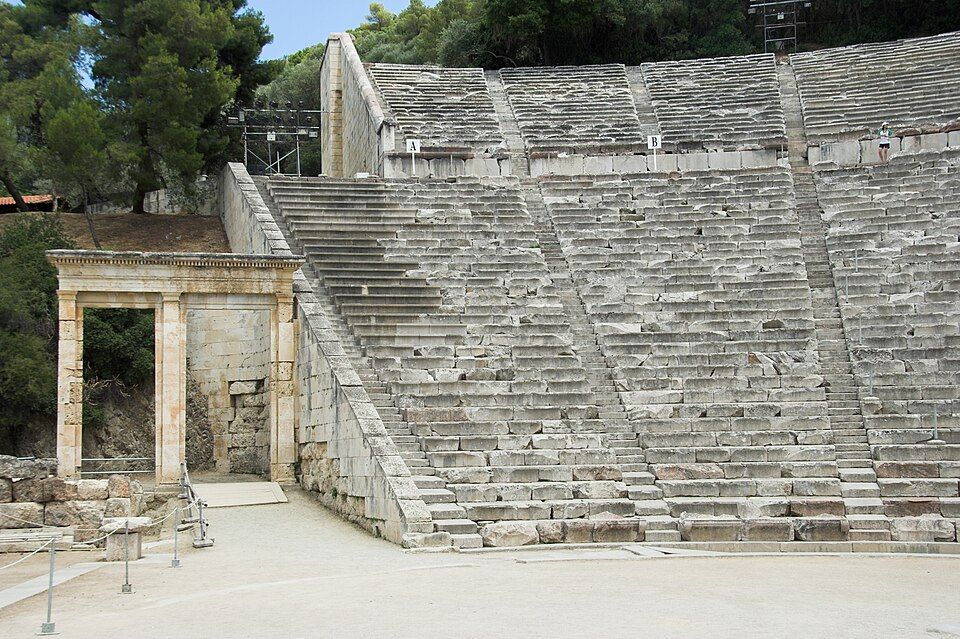
Poets and playwrightsTragedy
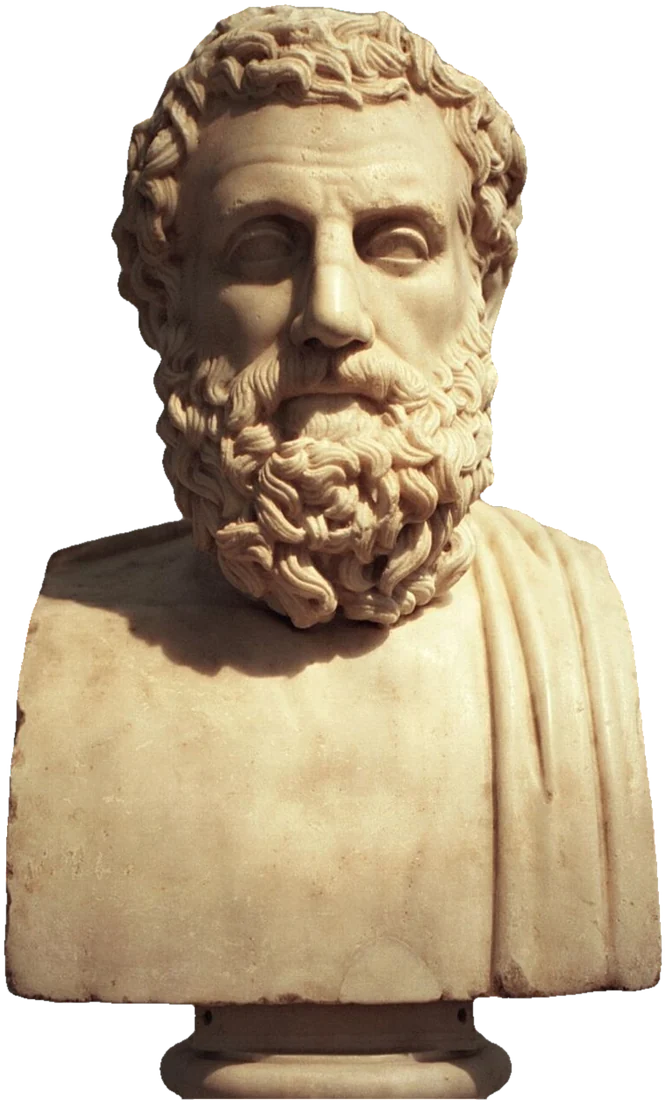
Aeschylus
Aeschylus’ tragedies: spoken trimeters, choral song and their metrical forms.
Works
- Synopsis
- Text and translation
- How to read each line
- Key to the labels
- Scansion
- Metre
- Prosody, line by line
- How this page was scanned
- Notes
- Synopsis
- Text and translation
- How to read each line
- Key to the labels
- Scansion
- Metre
- Prosody, line by line
- Strophe and antistrophe
- Notes
- Synopsis
- Text and translation
- How to read each line
- Key to the labels
- Scansion
- Metre
- Prosody, line by line
- Strophe and antistrophe
- Notes
- Synopsis
- Text and translation
- How to read each line
- Key to the labels
- Scansion
- Metre
- Prosody, line by line
- Strophe and antistrophe
- Notes
About · 1 of 6
Aeschylus and his plays
Three Athenian tragedians have plays that survive: Aeschylus, Sophocles and Euripides. When their metrical practice is compared, Aeschylus is again and again the strictest or the earliest of the three.[1]
His life is known only roughly. The ancient Life of Aeschylus was built on anecdotes collected by Ion of Chios and on the caricatures of the comic poets, and it “contains few reliable facts”.[2]
Dates. He was born in 525/4 BC, though the date is uncertain, and he died in 456.[3] He produced his first play in 498 and won his first victory in 484. His rivals were Choerilus, Pratinas, Phrynichus and, at the end of his life, Sophocles.[4] The surviving plays that can be dated run from the Persians of 472 to the Oresteia of 458.[5]
The fixed points come from official records. The Parian Marble is an inscription from Paros, carved in the middle of the third century BC, that lists dated events from 1581 to 264. It says that Aeschylus fought at Marathon in 490 at the age of thirty-five, and that he died at Gela at sixty-nine. The birth in 525/4 and the death in 456/5 are worked out from those ages. The Suda says he first competed at twenty-five, and its entry on Pratinas puts that contest in the years 500–496.[6]
Output and success. The ancient figures for the number of his plays disagree. They range from seventy-three to ninety.[7] One source gives seventy tragedies and “around five” satyr-plays. Another gives ninety plays, and ninety is “the more plausible” figure.[8] About sixty titles of his tragedies are known.[9]
He won thirteen victories in his lifetime and more after his death. This may explain the Suda’s figure of twenty-eight.[7] After his death the Athenians voted that anyone who wished to put on one of his plays should be granted a chorus.[10] Centuries later, Quintilian says that “revised” versions of his plays won prizes.[11]
The Life and the Suda agree on thirteen first prizes at the Great Dionysia. Between seventy and ninety plays is as close as the evidence allows. If he competed about every other year, his thirteen wins came from some twenty attempts.[12]
Soldier and guest of Hiero. The epitaph preserved in the Life remembers him as a soldier at Marathon, not as a poet. He is also said to have fought at Salamis and Plataea.[13] Hiero of Syracuse invited him to compose plays for festivals under his patronage.[14] A tradition says that he, like Pindar, “ate tyrannical bread” in Sicily, but the biographical tradition may not deserve our trust.[15]
He went to Sicily at least twice, and he died there. For Hiero’s founding of the city of Aetna in 476/5 he wrote the Women of Aetna.[16] Later sources give hostile reasons for his leaving Athens, such as defeat by the young Sophocles. But Simonides and Pindar were also honoured by Hiero, so the visits are better read as a sign of his fame abroad. The people of Gela gave him a rich burial and honoured him as a hero.[17]
Like Pindar, he seems to have been given the status of a classic early, perhaps in his lifetime.[18] One source says that Anacreon lived long enough to know his early tragedies.[19]
Among the lyric poets. Aeschylus is said to have called his plays “slices” from the great banquets of Homer (Athenaeus 347e).[20] Yet much of his material and manner came from lyric. His Oresteia owes a great deal to Stesichorus. An ancient commentator noted this debt in the recognition by a lock of hair.[21] He also imitated some characteristic rhythms of Anacreon, such as the mixture of glyconics and pherecrateans.[22]
In the Hellenistic period, collections of epigrams went under his name, as they did under Anacreon’s and Simonides’. Their attributions are hard to trust.[23] Later still, Timotheus’ Persians quotes him in its monodies.[24]
Where he stands. Stesichorus, Simonides and Pindar began to mix different metres in one song. In the fifth century the choral songs of Attic tragedy carried this mixing a stage further.[25] Four measures of style show where Aeschylus stands:
| Feature | Aeschylus | Later practice | Source |
|---|---|---|---|
| Resolution in spoken trimeters | sparing: on average one resolved line in ten at most, as in early iambus and in Sophocles | rises steadily in Euripides after 428 BC | West 1987, p. 25; Halleran 2005, p. 170 |
| Trochaic tetrameters in tragedy | used chiefly by him | none certain between 458 and 415; taken up again in late Euripides | West 1987, p. 28; Halleran 2005, p. 170 |
| Lyric iambics | especially prominent; strong preference for short anceps | Sophocles admits long anceps somewhat more often than Aeschylus (or Euripides) | West 1987, pp. 52–53 |
| Ionics | commonest in Aeschylus | occasional in Sophocles and Euripides (especially Bacchae) | West 1987, pp. 61–62 |
The plays, their dates and the dispute over Prometheus Bound are on the Plays tab; how his texts reached us is on the Transmission and Manuscripts tabs.
Notes
- ^ West 1987, pp. 25, 52–53, 61.
- ^ Saïd 2005, p. 216.
- ^ Easterling 1997, Chronology, p. 352.
- ^ Saïd 2005, p. 215; Easterling 1997, Chronology, p. 352.
- ^ See the Plays tab.
- ^ Burian 2023, p. 6.
- ^ a b Saïd 2005, p. 215.
- ^ Kovacs 2005, p. 386.
- ^ Cropp 2005, p. 274.
- ^ Saïd 2005, p. 231; Kovacs 2005, p. 380; Wilson 2005, p. 192.
- ^ Kovacs 2005, p. 380.
- ^ Burian 2023, p. 5.
- ^ Saïd 2005, p. 217.
- ^ Easterling 1997, p. 213.
- ^ Hornblower 2009, p. 42.
- ^ Burian 2023, pp. 4, 7.
- ^ Burian 2023, pp. 4–5.
- ^ Pelliccia 2009, p. 256.
- ^ Cingano 2022, p. 297 n. 21.
- ^ Graziosi and Haubold 2009, p. 112; Saïd 2005, p. 220.
- ^ Finglass 2022, p. 242.
- ^ Budelmann 2009, p. 231 with n. 18.
- ^ Aloni 2009, p. 182.
- ^ Csapo and Wilson 2009, p. 289.
- ^ D’Angour 2022, ch. 9, §’Classical Lyric Meters’.
About · 2 of 6
The plays and their dates
Seven tragedies survive under Aeschylus’ name, out of some seventy to ninety plays.[1] The text quoted on this site is the Perseus Digital Library’s digitisation of Herbert Weir Smyth’s Loeb edition (1922–1926). Five of the seven are dated by the production records: the Persians, the Seven and the three plays of the Oresteia. A papyrus fixes the decade of a sixth.
| Play | Date | Production | Source |
|---|---|---|---|
| Persians (Πέρσαι, Persai) | 472 | first prize; with Phineus, Glaucus of Potniae and Prometheus Fire-Kindler, apparently unconnected plays | Easterling 1997, Chronology, p. 352; Saïd 2005, p. 215; Cropp 2005, p. 274 |
| Seven against Thebes (Ἑπτὰ ἐπὶ Θήβας, Hepta epi Thēbas) | 467 | first prize; third play of a trilogy with Laius and Oedipus; satyr-play Sphinx | Easterling 1997, Chronology, p. 352; Saïd 2005, p. 216 |
| Suppliant Maidens (Ἱκέτιδες, Hiketides) | 460s | first prize, against Sophocles; first or second play of the Danaid trilogy | Easterling 1997, pp. 151, 352; Saïd 2005, p. 216 |
| Agamemnon, Libation Bearers (Χοηφόροι, Choēphoroi), Eumenides | 458 | first prize; the Oresteia, with the satyr-play Proteus | Easterling 1997, Chronology, p. 352; Saïd 2005, p. 215 |
| Prometheus Bound (Προμηθεὺς δεσμώτης, Promētheus desmōtēs) | undated | authorship disputed[2] | Saïd 2005, p. 216; Battezzato 2005, p. 165 n. 1 |
The earliest surviving plays open the second third of the fifth century.[3] The Eumenides belongs to 458.[4]
A papyrus redates a play. The Suppliant Maidens has a chorus of Danaids. It used to be read as the earliest surviving tragedy, a “primitive” piece of the 490s. A hypothesis is an ancient summary of a play, often with a note on its first production. In 1952 a scrap of the hypothesis to this play was published (P.Oxy. 2256 fr. 3). It showed that the play was produced in competition with Sophocles. So it belongs in the 460s, late in Aeschylus’ career.[5] Hall puts it in “the later 460s”.[6]
Sophocles first competed in 468, so the play cannot be earlier than that. The papyrus also has the letters ἐπὶ Ἀρ[. If they begin the name of the archon Archedemides, the year is 463.[7]
The lost Egyptians belonged to the same trilogy. Whether it came first or second is disputed. Del Grande and Sommerstein put it first. Winnington-Ingram, Garvie, Herington and, Saïd says, most scholars put it second.[8]
Trilogies. The Oresteia is the only surviving trilogy. The trilogy itself was most likely Aeschylus’ own invention.[9] A tetralogy is a set of three tragedies and a satyr-play, performed together. Aeschylus’ connected tetralogies certainly include the Theban one of 467, the Danaid one, the Oresteia and an undated Lycurgus group. The plays of 472 seem to have been unconnected.[10]
The Persians is the only surviving tragedy on recent history. Its subject is the Persian defeat at Salamis eight years before.[11] Phrynichus’ Phoenician Women was apparently its model.[12] Its ionic lyrics are commonly thought to be designed to sound exotic. Its trochaic tetrameters (226–229) are a typical specimen of that metre in tragedy.[13] The ionics of 65–114 are among the orientalizing uses of the metre.[14]
Actors and chorus. Aristotle credits Aeschylus with the second actor (Poetics 1449a15–16). The third actor was Sophocles’ innovation, but Aeschylus used it in the Oresteia.[15] The ancient Life (5) gives him the third actor as well.[16]
The tragic chorus had twelve members at first, and fifteen from the mid-fifth century.[17] Hammond and Taplin argue for fifteen in the Agamemnon. Their evidence is the three single lines and twelve couplets of 1344–1371.[18] The Persians and Suppliant Maidens are the only extant fifth-century tragedies that open with the entry of the chorus.[10]
Prometheus Bound. The ancient sources unanimously attribute the play to Aeschylus, but its authenticity is disputed. Schmid (1929), Griffith (1977) and West (1979, 1990) deny it, chiefly on grounds of style and metre. Herington (1970, 1986), Saïd (1985) and Pattoni (1987) defend it.[19] Battezzato dates it between the Oresteia and Euripides’ Medea.[20]
Two metrical facts set the play apart. Dactylo-epitrite never appears in the undisputed plays, but it appears several times in Prometheus.[21] Choral lyric fills only 13% of its lines, against 35–55% in the other plays.[22] It is among the plays “now widely believed” to be by someone other than their nominal author.[23] This site records the dispute and does not decide it.
The play has no recorded date. Most scholars today do not think it is Aeschylus’ work, and a growing number would give it to his son Euphorion. The strongest case for authenticity is Herington’s, who places it at the very end of Aeschylus’ career, in Sicily.[24]
The end of the Seven. Lines 1005–1078 bring in the ban on burying Polynices. Many scholars think them spurious, among them Winnington-Ingram, Herington and Sommerstein.[25] Kovacs explains them as an addition made to fit the plot of Sophocles’ Antigone.[26]
Notes
- ^ Kovacs 2005, pp. 379, 386.
- ^ See below.
- ^ Pelliccia 2009, p. 240.
- ^ Hornblower 2009, p. 55.
- ^ Easterling 1997, pp. 151–152; Saïd 2005, p. 216.
- ^ Hall 2022, p. 87.
- ^ Burian 2023, p. 6.
- ^ Saïd 2005, p. 216.
- ^ Saïd 2005, p. 215.
- ^ a b Cropp 2005, p. 274.
- ^ Saïd 2005, pp. 215, 221.
- ^ Cropp 2005, p. 273.
- ^ West 1987, pp. 28, 62.
- ^ Battezzato 2005, p. 164.
- ^ Saïd 2005, pp. 218–219.
- ^ Easterling 1997, p. 153 n. 4.
- ^ Easterling 1997, p. 157.
- ^ Saïd 2005, p. 219.
- ^ Saïd 2005, p. 216; Battezzato 2005, p. 165 n. 1.
- ^ Battezzato 2005, p. 165 n. 1.
- ^ West 1987, p. 65.
- ^ Battezzato 2005, p. 160.
- ^ Kovacs 2005, p. 387.
- ^ Burian 2023, p. 7.
- ^ Saïd 2005, p. 220.
- ^ Kovacs 2005, p. 382.
About · 3 of 6
The text in antiquity
Aeschylus’ text is followed here from the poet’s script to the Alexandrian edition. The late-antique selection, the Byzantine manuscripts and the modern editions are on the Manuscripts tab.
Scripts for performance. Aeschylus wrote for actors and chorus. Late in the century Sophocles and Euripides may have had readers in mind as well, but Aeschylus did not.[1] The earliest dramatic papyri suggest what such scripts looked like. They gave the words only, without stage directions and probably without the speakers’ names. A change of speaker was marked by a stroke in the margin.[2] Lyric was written out as if it were prose, without metrical division.[3]
Revivals and revisions. A law passed shortly after his death allowed anyone who wished to produce his plays to be granted a chorus. Quintilian says that “revised plays” of his won prizes. At some point the Seven was given a new ending, which alludes to the burial edict of Sophocles’ Antigone. This may have happened at a fifth-century revival.[4]
From 386 one “old” tragedy was revived each year at the City Dionysia. The revivals were mostly of Euripides and sometimes of Sophocles. On the surviving records, a play of Aeschylus was never chosen.[5]
An official copy. Pseudo-Plutarch credits the orator Lycurgus (c. 390–324 BC) with an official copy of the three tragedians. Actors were not to depart from it.[6] The measure is dated to 330.[7]
Whether official copies existed before Lycurgus is disputed. Reynolds and Wilson think it likely that copies were kept at the theatre or the record office. Griffith and Mastronarde doubt it. Kovacs argues that Pseudo-Plutarch’s phrase means a single combined copy, not the first copy ever deposited.[8]
Galen tells a story about the Athenian copy. A Ptolemy (Ptolemy III, in Kovacs’s account) borrowed it against a deposit of fifteen talents. He sent back a fine copy instead of the original and forfeited the deposit.[9]
Alexandria. Under Ptolemy Philadelphus, Alexander of Aetolia is said to have edited the tragedies, but not one of his readings survives.[10] The text of tragedy was probably established by reference to the Athenian copy.[11] The Alexandrians had two plays called Women of Aetna under Aeschylus’ name, and they judged one of them spurious.[12]
Colometry. Lyric verse is made of short metrical units called cola. A manuscript sets out each colon on its own line, and this division of the text is called its colometry. The colometry of the lyric texts is usually credited to Aristophanes of Byzantium (c. 257–180 BC).[13]
Whether his was the only ancient colometry is disputed. A papyrus of Stesichorus (P.Lille 76a + 73) is older than his career, and it is already divided into cola. The medieval manuscripts agree in easy metres such as anapaests and dochmiacs, but they differ widely in harder ones. So Kovacs does not rule out several different ancient colometries.[14]
The music. After Lycurgus’ decree, copies were stored in Athens. They may have kept the musical notation and reached Alexandria with the books. Whether the Alexandrian editors still had the music is disputed. Fleming and Kopff argue that musical and metrical knowledge was handed down to them. Parker and Prauscello argue that it was lost.[15] Wilson thinks it “may well be” that knowledge of the music went to Alexandria with the texts.[16]
The metrician’s view. The text is often corrupt. A strophe and its antistrophe should match in metre, line for line; this match is called responsion. Where corruption breaks it, we may have no means of telling which of the two keeps the true scheme, or whether either does. No strophe in tragedy recurs more than twice, so the signs that mark the end of a period appear only now and then.[17]
There are a handful of seeming exceptions to Porson’s Law in tragedy, and most of them are suspect on textual grounds.[18] The language can show how a passage was delivered. At Agamemnon 1136–1145 Cassandra speaks trimeters among the dochmiacs, and these trimeters keep the Attic vocalisation. This may be a sign that for a moment she falls into speech.[19]
Notes
- ^ Kovacs 2005, p. 379.
- ^ Kovacs 2005, p. 380; Reynolds and Wilson 1991, p. 4.
- ^ Reynolds and Wilson 1991, p. 4; Sampson 2022, ch. 7, §’Dialect and Meter’.
- ^ Kovacs 2005, pp. 380–381; see the Plays tab.
- ^ Kovacs 2005, p. 381; Easterling 1997, p. 213.
- ^ Reynolds and Wilson 1991, p. 5; Kovacs 2005, p. 382.
- ^ LeVen 2022, p. 365.
- ^ Reynolds and Wilson 1991, p. 5; Kovacs 2005, pp. 381–382.
- ^ Reynolds and Wilson 1991, p. 7; Kovacs 2005, pp. 383–384.
- ^ Kovacs 2005, p. 384.
- ^ Reynolds and Wilson 1991, p. 14.
- ^ Kovacs 2005, p. 386.
- ^ Reynolds and Wilson 1991, pp. 4–5.
- ^ Reynolds and Wilson 1991, p. 14; Kovacs 2005, pp. 385–386.
- ^ Barbantani 2009, p. 301.
- ^ Wilson 2005, p. 192.
- ^ West 1987, pp. 51–52.
- ^ West 1987, p. 25.
- ^ West 1987, p. 57.
About · 4 of 6
Manuscripts and editions
The Transmission tab ends with the Alexandrian edition. Here the seven plays are followed through late antiquity and Byzantium to the printed editions. The general history is on How the texts reached us.
A narrowed corpus. Until about AD 250, writers quote from many of the roughly three hundred plays of the three tragedians. After that, they quote only seven plays each of Aeschylus and Sophocles and ten of Euripides.[1]
How this came about is disputed. Wilamowitz supposed that an influential schoolmaster fixed a syllabus in the second or third century. Reynolds and Wilson find the theory too neat. No such schoolmaster can be named, though Eugenius, who wrote on the colometry of fifteen plays in the fifth century, is one possible candidate. Texts outside the syllabus were still being read in late antiquity. So they would abandon the idea that one person’s conscious choice decided what survived.[2]
Kovacs leaves the question open. The selection may have been deliberate, perhaps for teaching. Or it may have been the chance result of popularity and of the commentaries available. A book could once be a roll, a long strip wound on itself, or a codex, a book of bound leaves like ours. The change from roll to codex may have helped, since one codex could hold seven or ten plays.[3] The move to the codex was “the first major bottle-neck” through which classical literature passed.[4]
Byzantium. Learning revived in the ninth century, and the plays were then recopied in the new minuscule script. Nearly all Greek texts depend on such ninth-century transliterations.[5] The ancient commentaries were cut down to fit the margins. Notes written in the margins of a manuscript are called scholia. The scholia vetera (“old scholia”) are remnants of ancient scholarship; the scholia recentiora (“more recent scholia”) were written for medieval readers.[3] Copious marginal scholia are not common before the ninth century.[6]
In the ninth century Photius had read the Prometheus as a school text.[7] Only one medieval manuscript contains all seven plays. It is Laur. 32.9 in Florence, written in the tenth century, and it is fundamental for Sophocles too.[8]
The triad. By the late thirteenth century, and perhaps earlier, schools read three plays of each tragedian. These three are called the “triad”, and most later manuscripts contain only them.[9] For Aeschylus the three were the Persians, Seven against Thebes and Prometheus Bound.[10] So there are many more copies of these three than of the other four. The other four survived just long enough to be taken to Italy by Renaissance collectors.[11]
Triclinius and metre. Demetrius Triclinius was a schoolmaster at Thessalonica c. 1305–1320. He worked on the poets of the school curriculum, which included the tragic triads. He was the first Byzantine to grasp classical metre and to use it. He learnt it from Hephaestion’s handbook. He knew that the lyrics of tragedy and comedy should respond exactly, and he emended the text to restore responsion. Some of his emendations have had lasting success; many were only stopgap words. He also wrote separate metrical commentaries on many plays.[12]
Printed editions. The first printed editions of tragedy appeared at the end of the fifteenth century.[13] The early editions of Aeschylus left out lines 323–1050 of the Agamemnon. The first to print the whole play was the edition of Pier Vettori and Henri Estienne.[14] The sixteenth-century editions are described on Printing.
The modern texts are D. Page’s Oxford text (1972) and M. L. West’s Teubner (1990). West’s Studies in Aeschylus (1990) discusses the text, and S. Radt’s Tragicorum Graecorum Fragmenta vol. 3 (1985) collects the fragments.[15] West’s edition has a metrical appendix.[16] Dawe (1964) studies the manuscript tradition.[17] A. M. Dale analyses the lyrics in Metrical Analyses of Tragic Choruses (1971–1983) and Lyric Metres of Greek Drama (2nd ed., 1968).[18]
This site quotes Smyth’s Loeb text (1922–1926), because the Perseus Digital Library makes it available under an open licence. Where West prints a different reading, the Metres tabs say so.
Notes
- ^ Kovacs 2005, pp. 379, 387.
- ^ Reynolds and Wilson 1991, pp. 53–54.
- ^ a b Kovacs 2005, p. 387.
- ^ Reynolds and Wilson 1991, pp. 34–35.
- ^ Kovacs 2005, p. 387; Reynolds and Wilson 1991, pp. 59–60.
- ^ Reynolds and Wilson 1991, pp. 52–53.
- ^ Reynolds and Wilson 1991, p. 63.
- ^ Reynolds and Wilson 1991, p. 66.
- ^ Reynolds and Wilson 1991, p. 78; Kovacs 2005, p. 387.
- ^ Gregory 2005, p. 255.
- ^ Kovacs 2005, p. 387; Reynolds and Wilson 1991, p. 78.
- ^ Reynolds and Wilson 1991, pp. 75–78.
- ^ Kovacs 2005, p. 388.
- ^ Reynolds and Wilson 1991, p. 166.
- ^ Easterling 1997, p. 355.
- ^ Battezzato 2005, p. 165.
- ^ Kovacs 2005, p. 393.
- ^ West 1987, p. 52.
About · 5 of 6
His metres: speech and recitative
Drama used three modes of delivery: speech without music, recitative (παρακαταλογή, parakatalogē), and song. A stichic metre repeats the same line again and again. The recited parts are always in stichic metres, or in long runs of one uniform rhythm.[1]
Landels divides the delivery of tragedy in the same way. He argues that its marching anapaests must have been chanted, since twelve or fifteen men speaking together would have been drowned by the pipe.[2] The spoken trimeter and the recited metres are described on this page; song is on the next tab.
The spoken trimeter
Dialogue is in the iambic trimeter, × — ⏑ — × — ⏑ — × — ⏑ —. A caesura is a regular word-end inside the line. The trimeter usually has its caesura after the first position of the third foot; this is the penthemimeral caesura. Failing that, the caesura comes after the first position of the fourth foot; this is the hephthemimeral caesura.[3] Here is the opening of the Agamemnon:
θεοὺς μὲν αἰτῶ τῶνδʼ ἀπαλλαγὴν πόνων
φρουρᾶς ἐτείας μῆκος, ἣν κοιμώμενος
στέγαις Ἀτρειδῶν ἄγκαθεν, κυνὸς δίκην,
ἄστρων κάτοιδα νυκτέρων ὁμήγυριν,
theous men aitō tōnd’ apallagēn ponōn / phrourās eteias mēkos, hēn koimōmenos / stegais Atreidōn ankathen, kynos dikēn, / astrōn katoida nykterōn homēgyrin,
“I ask the gods for release from these toils, from the length of a year-long watch, through which, lying on the roof of the Atreidae, propped on my elbows like a dog, I have come to know the gathering of the stars of night.”
Twelve syllables for twelve positions in every line: no resolution. A word ends after the fifth position in all four lines, the penthemimeral caesura. Ἀ- of Ἀτρειδῶν (red) is short before τρ.
Aeschylus, Agamemnon 1–4
synthetic ∿
All four lines have the penthemimeral caesura and no resolution. In line 3 the first syllable of Ἀτρειδῶν is short before τρ. This is the usual Attic treatment of a stop followed by a liquid.[4]
Resolution is the replacement of a long position by two short syllables. Aeschylus uses it sparingly. In early iambus and in Aeschylus and Sophocles there is on average no more than one resolved line in every ten.[5]
An anceps is a position that may be filled by a long or a short syllable. Porson’s Law holds in Aeschylus’ trimeters. Under this law a long anceps in the third metron is not followed by word-end, unless one of the two syllables is a monosyllable.[6]
The law holds for the trimeter and the tetrameter of tragedy alike, with a single exception: a Persian name at Persians 321. Comedy breaks it about once in five lines. Allen explains the law by stress. A heavy syllable at the end of a word would carry stress, and here that stress would fall in the weak half of the foot. The monosyllables that are allowed are proclitics and postpositives, which lean on their neighbours.[7]
Aeschylus’ trimeters show some rarer features too. Sometimes the caesura falls at the end of the third foot, nearly always with elision (Ag. 20). At Sept. 488 the first metron has the form of a choriamb, to fit the name Ἱππομέδοντος (Hippomedontos), whose first four syllables, Ἱπ-πο-μέ-δον-, make — ⏑ ⏑ —; this licence occurs only three or four times in tragedy. At Eum. 238 f. a prepositive is left at line-end. At Cho. 181 a postpositive stands immediately after the caesura.[8]
The trochaic tetrameter
The trochaic tetrameter catalectic runs — ⏑ — × — ⏑ — × | — ⏑ — × — ⏑ — ‖. In tragedy it belongs chiefly to Aeschylus and to Euripides’ late plays.[9] Persians 226–229 is a typical example. In tragedy Porson’s Law holds for the end of the line, and Havet’s Law (also discovered by Porson) for the beginning. Persians 165 is one of only two tragic lines without the normal caesura.[10] The chorus greets the queen in this metre ten lines earlier.
ὦ βαθυζώνων ἄνασσα Περσίδων ὑπερτάτη,
μῆτερ ἡ Ξέρξου γεραιά, χαῖρε, Δαρείου γύναι·
ō bathyzōnōn anassa Persidōn hypertatē, / mēter hē Xerxou geraia, chaire, Dareiou gynai;
“O queen, highest of the deep-girdled women of Persia, aged mother of Xerxes, hail, wife of Darius!”
— ⏑ — × — ⏑ — × ¦ — ⏑ — × — ⏑ —: fifteen positions, with word-end after the eighth (ἄνασσα, γεραιά) in both lines.
Aeschylus, Persians 155–156
synthetic ∿
Marching anapaests
An anapaestic metron runs ⏔ — ⏔ —. In marching anapaests the metra run on in stretches of varying length. Each stretch is a period, and it closes with catalexis: its last metron is cut short. Editors print the metra in pairs, as dimeters. Yet the whole period is metrically continuous until the catalexis; this continuity is called synapheia.
Word-end normally follows every metron except the one before the catalexis. Where it does not, it comes after the first short of the next biceps.[1] Here is Ag. 60–67:[11]
οὕτω δʼ Ἀτρέως παῖδας ὁ κρείσσων
ἐπʼ Ἀλεξάνδρῳ πέμπει ξένιος
Ζεὺς πολυάνορος ἀμφὶ γυναικὸς
πολλὰ παλαίσματα καὶ γυιοβαρῆ
houtō d’ Atreōs paidas ho kreissōn / ep’ Alexandrōi pempei xenios / Zeus polyanoros amphi gynaikos / polla palaismata kai gyiobarē
“So the mightier one, Zeus, guardian of guests, sends the sons of Atreus against Alexander, for a woman of many husbands, to bring many limb-wearying bouts of wrestling, …”
Anapaestic dimeters, each metron ⏔ — ⏔ —; the two shorts may be contracted into one long (οὕτω, Ζεὺς).
Aeschylus, Agamemnon 60–63[11]
synthetic ∿
γόνατος κονίαισιν ἐρειδομένου
διακναιομένης τʼ ἐν προτελείοις
κάμακος θήσων Δαναοῖσι
Τρωσί θʼ ὁμοίως.
gonatos koniaisin ereidomenou / diaknaiomenēs t’ en proteleiois / kamakos thēsōn Danaoisi / Trōsi th’ homoiōs.
“… the knee pressed into the dust and the spear-shaft shattered in the first rites, on Danaans and Trojans alike.”
In 64 the word-end comes one short later than usual, inside the biceps (red). Line 66 is the paroemiac, the catalectic dimeter ⏔ — ⏔ — — that closes the period; the sense runs on into 67.
Aeschylus, Agamemnon 64–67[12]
synthetic ∿
In lines 62 and 63 both the first and the second princeps are resolved (— ⏖ — ⏖). In 64 the caesura comes one short later than usual. At the end of 66 the period ends, although the sense runs on.[12]
Line 66 is the catalectic dimeter that closes the period. This line is called the paroemiac. In these schemes ⏖ is a resolved princeps, and ⏑ ⏑ is an uncontracted biceps. A metron with resolution normally has the form — ⏖ — —.[13] West prints Δαναοῖσιν in 66 where Smyth has Δαναοῖσι; the scansion is the same.
Notes
- ^ a b West 1987, p. 48.
- ^ Landels 1999, c. pp. 16–17.
- ^ West 1987, pp. 24–25.
- ^ West 1987, p. 16.
- ^ West 1987, p. 25; Halleran 2005, p. 170.
- ^ West 1987, p. 25.
- ^ Maas 1962, pp. 34–35; Devine and Stephens 1994, p. 105; Allen 1973, pp. 304–313.
- ^ West 1987, pp. 25–27.
- ^ West 1987, p. 28; Halleran 2005, p. 170.
- ^ West 1987, p. 28.
- ^ a b West 1987, pp. 48–49.
- ^ a b West 1987, p. 49.
- ^ West 1987, p. 30.
About · 6 of 6
His metres: song
The lyric cola of Aeschylus are set out below, with analyses of two passages. How much of each play is sung, and by whom, is on the Chorus and song tab.
Iambics. Lyric iambics play an especially large part in Aeschylus. They are made of syncopated and unsyncopated metra, mostly grouped in dimeters and trimeters. Ag. 184–191 is an example. Aeschylus prefers to fill every anceps but the last with a short syllable. Where the strophe has a long anceps, the antistrophe usually has one too. The opening of the same song shows the lekythion, the syncopated iambic colon that runs through it.
τὸν φρονεῖν βροτοὺς ὁδώ-
σαντα, τὸν πάθει μάθος
θέντα κυρίως ἔχειν.
ton phronein brotous hodō- / santa, ton pathei mathos / thenta kyriōs echein.
“him who set mortals on the road to wisdom, who laid down that learning by suffering should hold good.”
Three lekythia, — ⏑ — × — ⏑ —, a syncopated iambic colon: a cretic and an iambic metron. Every anceps here is short, as Aeschylus prefers.
Aeschylus, Agamemnon 176–178, as on this site’s Agamemnon 176–191 tab
synthetic ∿
Resolution is rare in his lyric iambics. The exceptions are some unsyncopated dimeters and trimeters (Eum. 385 ~ 393, Sept. 850). In these, resolution goes much further than he permits in his spoken trimeters.
In the last verse but one of a strophe he likes to change the rhythm. He does so with a dochmiac or dactylic colon, or with a choriamb or two. The final colon is often an aristophanean, — ⏑ ⏑ — ⏑ — —, or sometimes a pherecratean. Sophocles does not close his strophes in these ways.[1]
Dochmiacs. The basic rhythm of the dochmiac is ⏑ — — ⏑ —. Any of its three longs may be resolved. Either of its shorts may be replaced by a long, and this is called “drag”. The dochmiac is the characteristically tragic metre. Every surviving tragedy has some, and they always carry urgency or strong feeling.[2]
The dochmiac is the quintessential metre of dramatic lyric. Its rapid, stuttering movement has been heard as a rhythm made for scenes of high excitement.[3] Aeschylus seems to have invented the dochmiac, or at least to have been the first to use it in the theatre. It is brief in the Persians (472) and frequent from the Seven (467) on.[4] Here is an example, Sept. 79–82:
μεθεῖται στρατός· στρατόπεδον λιπὼν
ῥεῖ πολὺς ὅδε λεὼς πρόδρομος ἱππότας·
αἰθερία κόνις με πείθει φανεῖσʼ,
ἄναυδος σαφὴς ἔτυμος ἄγγελος.
metheitai stratos; stratopedon lipōn / rhei polys hode leōs prodromos hippotas; / aitheria konis me peithei phaneis’, / anaudos saphēs etymos angelos.
“The army is let loose; leaving its camp, this great host streams on, the horsemen running ahead; the dust in the air, appearing, persuades me, a voiceless, clear, true messenger.”
Two dochmiacs in each line, on the basic shape ⏑ — — ⏑ —. In the first dochmiac of 80 two longs are resolved (red): — ⏖ ⏖ ⏑ —. In 79 -δον is long, closed by the λ of λιπών; in 80 πρό- is short before δρ.
Aeschylus, Seven against Thebes 79–82[5]
synthetic ∿
The first metron of 80 has two resolutions, — ⏖ ⏖ ⏑ —. The forms ⏑ ⏖ — ⏑ — and — ⏖ — ⏑ — are among the commonest. Metron-end coincides with word-end throughout.[5] In 79 -δον is long because it is closed by the λ of λιπών. In 80 the first syllable of πρόδρομος is short before δρ.[6]
These lines come from the entrance-song of the Seven (78–107). Its dochmiacs, its many resolutions and its lack, at first, of any strophic structure all convey the women’s panic as the Argive army approaches. Eteocles’ spoken reply, urging calm, stands in sharp contrast. In the Agamemnon the roles are reversed. Cassandra sings her prophecies in a mostly dochmiac rhythm (1072–1177). The elders first answer in spoken iambic trimeters, then are drawn into dochmiacs of their own. At the end Cassandra drops song and speaks in trimeters.[7]
Ionics are commonest in Aeschylus. The ionic metron is ⏑ ⏑ — —. Straight ionics are more frequent than anaclastic ones. Quite often a short metron, ⏑ ⏑ — (io∧), stands in place of ⏑ ⏑ — —. But io∧ cannot respond with io.
Many have heard an exotic, Asiatic colouring in the ionic songs of the Persians.[8] The passage (65–114) is one of the orientalizing uses of the metre.[9] Here is Pers. 68–72, set out in West’s three cola (Smyth divides the same words into five lines, 68–72):
λινοδέσμῳ σχεδίᾳ πορθμὸν ἀμείψας
Ἀθαμαντίδος Ἕλλας,
πολύγομφον ὅδισμα ζυγὸν ἀμφιβαλὼν αὐχένι πόντου.
linodesmōi schediāi porthmon ameipsas / Athamantidos Hellās, / polygomphon hodisma zygon amphibalōn aucheni pontou.
“… having crossed the strait of Helle, daughter of Athamas, on a flax-bound raft, throwing a many-bolted roadway as a yoke on the neck of the sea.”
3io ‖ io∧ io ‖ io∧ io io∧ 2io |||: ionic metra, ⏑ ⏑ — —, with the short metron io∧, ⏑ ⏑ — (red), in place of some of them. The ᾱ is long in σχεδίᾳ, ἀμείψας and Ἕλλας.
Aeschylus, Persians 68–72, in West’s three cola[10]
synthetic ∿
The ᾱ is long in σχεδίᾳ, ἀμείψας and Ἕλλας.[10]
Other rhythms. The only wholly cretic strophe in tragedy is Supp. 418–422 ~ 423–427.[11] Pure aeolic strophes are uncommon in Aeschylus.[12]
In the Furies’ Binding Song, Eum. 372–375 run in a “tripping” paeonic rhythm: each line is ⏑ ⏑ ⏑ — ⏑ ⏑ ⏑ —, three shorts and a long, twice over. The chorus sing of leaping high and bringing the foot down. The three quick shorts and the heavy long seem to act out the leap and the stamp.[13] In the Libation Bearers the chorus describe beating themselves in lament (423–428). Their resolved iambics, with a marked increase in short syllables, match the blows.[7] A fragment of the lost Bassarids seems to preserve part of a song by Orpheus, in bacchiacs, ⏑ — — (fr. 23 Radt).[14]
In Aeschylus’ dactylic strophes the dactyls mostly run from four to seven metra. Unlike Homer, he stresses contractions by placing word-end after them. Ag. 104–121 ~ 122–139 is an example.[15] In this song the spondees change the rhythm so much that dactyl and spondee rarely fail to respond. The refrain αἴλινον αἴλινον εἰπέ (ailinon ailinon eipe), “cry sorrow, sorrow”, ends in a double spondee. At 109 an iambic metron is welded to the dactyls as a “base”: ὅπως Ἀχαι|ῶν δίθρονον κράτος (hopōs Achai|ōn dithronon kratos).[16]
κύριός εἰμι θροεῖν ὅδιον κράτος αἴσιον ἀνδρῶν
ὅπως Ἀχαιῶν δίθρονον κράτος, Ἑλλάδος ἥβας
kyrios eimi throein hodion kratos aision andrōn / hopōs Achaiōn dithronon kratos, Hellados hēbās
“I have the authority to proclaim the power, met on the road, the auspicious power of men … how the two-throned power of the Achaeans, of the youth of Hellas …”
Line 104: six dactyls, the last cut short (6da∧). Line 109: an iambic metron (red) welded to four dactyls as a “base”.
Aeschylus, Agamemnon 104 and 109, as on this site’s Agamemnon 104–139 tab
synthetic ∿
Long dactylic periods like these, above all in the parodos of the Agamemnon, seem to call up the solemnity of prophecy and of heroic deeds. They show the influence of the epic hexameter and of the dactylic cola of Stesichorus. In the Frogs, “Euripides” mocks Aeschylus’ lyrics as overwhelmingly dactylic.[17]
Dactylo-epitrite is absent from the genuine plays.[18] In lyric anapaests, a pair of tribrach words, each proparoxytone, can take the place of an anapaestic metron. This happens at Pers. 985 ἔλιπες ἔλιπες (elipes elipes), “you left, you left”, ~ 1000 ἔταφον ἔταφον (etaphon etaphon): ⏑ ⏑ ⏑ ⏑ ⏑ ⏑ in place of ⏔ — ⏔ —.[19]
Notes
- ^ West 1987, pp. 52–53.
- ^ West 1987, p. 56; Battezzato 2005, p. 158.
- ^ Lourenço 2011, p. 53; Landels 1999, c. pp. 121–122.
- ^ Weiss 2023, p. 244.
- ^ a b West 1987, p. 56.
- ^ West 1987, p. 16.
- ^ a b Weiss 2023, p. 246.
- ^ West 1987, pp. 61–62.
- ^ Battezzato 2005, p. 164.
- ^ a b West 1987, p. 62.
- ^ West 1987, p. 55.
- ^ West 1987, p. 58.
- ^ Weiss 2023, p. 247.
- ^ Weiss 2023, p. 250.
- ^ West 1987, pp. 63–64.
- ^ Dale 1968, pp. 44–45.
- ^ Weiss 2023, p. 245.
- ^ West 1987, p. 65.
- ^ West 1987, p. 61.
Agamemnon 1–39 — the Watchman
Synopsis
The Agamemnon is the first play of the Oresteia, the only trilogy of Greek tragedy that survives. It was followed by the Libation Bearers and the Eumenides. With the satyr-play Proteus, the trilogy won Aeschylus first prize at Athens in 458 BC.[1] Agamemnon comes home to Argos victorious after ten years at Troy. His victory is announced first by a beacon and then by a herald. His wife Clytemnestra persuades him to walk into the palace over its delicate tapestries. There she kills him, and with him his captive, the Trojan prophetess Cassandra.[2] She avenges their daughter Iphigenia, whom he sacrificed at Aulis so that the fleet could sail. Aegisthus plotted the murder with her but left the deed to her. He avenges his brothers, who were killed by Agamemnon’s father Atreus.[3]
These lines are the prologue. A watchman on the palace roof complains of his long vigil for the signal fires. Then he sights the beacon that announces the fall of Troy, and he ends with dark hints about the state of the house.[4]
Text and translation
The uninterrupted Greek with its English translation, line by line.
Show text and translation
θεοὺς μὲν αἰτῶ τῶνδ’ ἀπαλλαγὴν πόνων
Aeschylus · Agamemnon 1–39 · iambic trimeters · text of Smyth (Loeb, via Perseus)
How to read each line
A guide to the Greek, syllables, pitch marks and quantities.
Show the reading key
- Above each line: the line as the edition prints it, each word placed over its own syllables. The main row: the same Greek divided into metrical syllables, each written as it is pronounced. A consonant that closes a syllable is written with it (λόθ | ρο); an elided word is closed up with the next vowel (ν’ἀ); a final consonant carried into the next word is set with a thin space (ς ἰ). Wider gaps mark word-ends.
- Above the syllables: the pitch of each syllable, from the accents. Under them: the quantity of each syllable as it falls in the line, then the transliteration, syllable by syllable, with accented syllables in capitals.
- Under each line: a line-for-line translation. In the right margin of the scansion: the line type, its scheme, and its analysis into cola.
Key to the labels
The names, patterns and symbols used beside this poem.
Show the labels and symbols
The labels in the right margin of the scansion below name the line, its scheme, the feet as the line realises them, and the caesurae and diaereses (the named word-ends) that fall in it. In the scheme — is a long position, ⏑ a short one and × an anceps, long or short; the descriptions below say where a long may be resolved into two shorts and where two shorts may stand in place of an anceps or a short.[5] A click on any syllable highlights its metron or colon, or, with the switch, its foot.
| Label | Name and shape | What it is |
|---|---|---|
| im1 | First iambic metron× — ⏑ — | Positions 1–4. The anceps may be long or short, and in the first foot it may be replaced by two shorts, which makes the foot an anapaest (⏑ ⏑ —). Either long may be resolved into two shorts. |
| im2 | Second iambic metron× — ⏑ — | Positions 5–8. The main caesura falls inside it, after position 5 (penthemimeral) or 7 (hephthemimeral). Either long may be resolved into two shorts. Outside the first foot tragedy admits an anapaest only for a proper name. |
| im3 | Third iambic metron× — ⏑ × | Positions 9–12, the last syllable indifferent (period-end). Porson’s law: when the anceps at 9 is long, it and the following syllable belong to the same word, unless one of them is a monosyllable. The long at 10 may be resolved only when the anceps at 9 is short. |
| xm | Extra metrum× × × × | An exclamation that the edition prints as a line of its own. It stands outside the verse, so no metrical scheme applies. Its syllables are shown with their natural quantities. |
Scansion
The Watchman on the palace roof, from his year-long vigil to the beacon that announces the fall of Troy. Each trimeter is scanned metron by metron, with its caesura, the third anceps checked against Porson’s law, and every resolution, anapaest and prosodic licence named; the cry ἰοὺ ἰού (25) stands outside the metre.
I ask the gods for release from these labours,
from a year-long watch, through which, lying
on the roof of the sons of Atreus, on my elbows, like a dog,
I have come to know the gathering of the stars of night,
and those that bring winter and summer to mortals,
the bright lords, conspicuous in the sky,
the stars, when they wane, and their risings.
And now I am watching for the sign of the torch,
the gleam of fire that brings word from Troy
and news of its capture; for so commands
a woman's hopeful heart, that counsels like a man.
And when I keep my night-wandering, dew-wet
bed, not visited by dreams,
mine (for fear stands by me instead of sleep,
so that I cannot close my eyelids fast in sleep),
and when I think of singing or humming,
cutting this remedy of song against sleep,
then I weep, lamenting the misfortune of this house,
not managed for the best, as it was before.
But now may there be a happy release from labours,
when the fire of good news has shone out in the dark.
O welcome, light in the night, showing
a daylight, and the setting up of many dances
in Argos, in thanks for this event!
Hurrah! Hurrah!
To Agamemnon's wife I give a clear signal
to rise from her bed as fast as she can and in the house
to raise a cry of triumph in good omen
for this torch, if indeed the city of Ilium
has been taken, as the beacon plainly announces;
and I myself will dance the prelude.
For I shall count my masters' throw as fallen well,
now that this beacon has thrown me triple six.
Well, may it be that the beloved hand, when he comes,
of the lord of the house I hold in this hand of mine.
The rest I keep silent: a great ox has stepped
on my tongue; the house itself, if it could find a voice,
would say it most plainly; for I, of my own will,
speak to those who know, and for those who do not, I forget.
Metre
- The line. Three iambic metra, × — ⏑ — | × — ⏑ — | × — ⏑ —, with period-end at the end of each line.[6] Smyth prints the exclamation ἰοὺ ἰού as a line of its own (25); it belongs to no metron and is shown with its natural quantities only.
- Caesura. Word-end after position 5 (penthemimeral) or else after position 7 (hephthemimeral).[7] Lines 7, 9, 11, 12, 17, 19, 21, 26, 27, 28, 34 and 38 have only the hephthemimeral word-end. Line 20 has neither: it divides after the third foot, after the elided γένοιτ’, and it is the very line West quotes for this rarer caesura, which he finds in only a small share of tragic trimeters, and then almost always after an elided word.[7] In line 30 the word before the penthemimeral place is the article ὁ, a prepositive, and the effective division is the hephthemimeral one after φρυκτός.[8]
- Porson’s law. Every long syllable at position 9 stands inside a word.[9]
- Resolution and anapaests. Aeschylus resolves sparingly, on average in no more than one line out of ten:[10] here three times in 38 trimeters, the first princeps in line 7 (ἀστέρας), the third in line 15 (βλέφαρα), the fourth in line 19 (διαπονουμένου), each inside one word. The first foot is an anapaest in lines 26 (Ἀγαμέμνονος), 28 (ὀλολυγμόν) and 30 (ἑάλωκεν), which tragedy admits freely.[11]
- Prosody. Attic correption before a stop + liquid inside the word (Ἀτρειδῶν 3, νυκτίπλαγκτον 12, ὕπνου 14 and 17, ὕπνῳ 15) and at the start of the next word (τὰ πρόσθ’ 19, ὁ φρυκτός 30, ἔγωγε φροίμιον 31).[12] In line 36 the metre needs ἐπὶ γλώσσῃ with the -πι long before γλ, a cluster that rarely leaves a short syllable short.[13] γμ makes position in ὀλολυγμόν (28) as it always does;[13] the κ of ἐκ closes its own syllable before Τροίας (9).[14] Crasis in κοὐ (39); hiatus in the exclamation ἰοὺ ἰού.[13]
- A deleted line. Smyth prints line 7 in square brackets as an interpolation. It is scanned here as transmitted; its resolution (ἀστέρας) is one of the three in the passage.
- Sommerstein’s text. Smyth’s text of 1926 has been compared with A. H. Sommerstein’s Loeb edition of 2009. The line numbers are the same, ἰοὺ ἰού counting as line 25. Sommerstein also keeps line 7, but with ἀστέρας marked corrupt; the other differences are of spelling and punctuation (7, 8, 22)[15]. Only at 8 does a difference touch the scansion, and only at an anceps.[16]
Prosody, line by line
Every syllable, with the reason for its length. Quantities are read from the vowel where the spelling shows it, from the consonants that follow (“position”), from the accent where it tells, and from the metre where nothing else does. Editors’ notes on the text follow in the boxed paragraphs.
- 1
Line 1 · θεοὺς μὲν αἰτῶ τῶνδ’ ἀπαλλαγὴν πόνων
θεοὺς μὲν αἰτῶ τῶνδ’ ἀπαλλαγὴν πόνων
θεοὺςμὲν αἰτῶτῶνδ’ἀπαλλαγὴνπόνωνpenthemimeral caesura.
- 1 ⏑θεε is short by nature; the position is anceps.
- 2 —οὺςοὺ is a diphthong, long by nature; closed by ς: long by position.
- 3 ⏑μὲὲ is short by nature.
- 4 —ν αἰαἰ is a diphthong, long by nature; the first consonant belongs to the previous word and is carried over to this vowel.
- 5 —τῶῶ is long by nature; the position is anceps.
- 6 —τῶνῶ is long by nature; closed by ν: long by position.
- 7 ⏑δ’ἀἀ is short by the metre (position 7 must be short); the apostrophe marks an elided vowel; the consonant before it joins this syllable.
- 8 —παλα is a vowel of unknown length; closed by λ: long by position.
- 9 ⏑λαᾰ is short (its length is not shown by the ordinary spelling); the position is anceps.
- 10 —γὴνὴ is long by nature; closed by ν: long by position.
- 11 ⏑πόό is short by nature.
- 12 ×νωνω is long by nature; closed by ν: long by position; the last position of the line is indifferent (period-end).
The Watchman speaks from the roof of the palace. θεούς is two syllables here, θε-ούς, with no synizesis. Sommerstein’s stage direction likewise puts him alone on the palace roof.[17] The α of ἀπαλλαγὴν is short.[18] Position 9 is anceps, so the metre does not show it; the input marks it short. Penthemimeral caesura after αἰτῶ (word-end after position 5)[7]. Elision: τῶνδ’ loses its final vowel before the vowel that begins the next word.[19]
- 2
Line 2 · φρουρᾶς ἐτείας μῆκος, ἣν κοιμώμενος
φρουρᾶς ἐτείας μῆκος, ἣν κοιμώμενος
φρουρᾶςἐτείαςμῆκο,ς ἣνκοιμώμενοςpenthemimeral caesura; hephthemimeral caesura.
- 1 —φρουου is a diphthong, long by nature; the position is anceps.
- 2 —ρᾶςᾶ carries a circumflex, so it is long.
- 3 ⏑ἐἐ is short by nature.
- 4 —τείεί is a diphthong, long by nature.
- 5 —αςα is a vowel of unknown length; closed by ς: long by position; the position is anceps.
- 6 —μῆῆ is long by nature.
- 7 ⏑κο,ο is short by nature.
- 8 —ς ἣνἣ is long by nature; closed by ν: long by position; the first consonant belongs to the previous word and is carried over to this vowel.
- 9 —κοιοι is a diphthong, long by nature; the position is anceps.
- 10 —μώώ is long by nature.
- 11 ⏑μεε is short by nature.
- 12 ×νοςο is short by nature; closed by ς: long by position; the last position of the line is indifferent (period-end).
Penthemimeral caesura after ἐτείας (word-end after position 5)[7]; a word also ends at the hephthemimeral place, after μῆκος. The anceps at position 9 is long (κοι) and inside the word κοιμώμενος, as Porson’s law requires.[7]
- 3
Line 3 · στέγαις Ἀτρειδῶν ἄγκαθεν, κυνὸς δίκην,
στέγαις Ἀτρειδῶν ἄγκαθεν, κυνὸς δίκην,
στέγαιςἈτρειδῶνἄγκαθεν,κυνὸςδίκην,penthemimeral caesura.
- 1 ⏑στέέ is short by nature; the position is anceps.
- 2 —γαιςαι is a diphthong, long by nature.
- 3 ⏑ἈἈ is a vowel of unknown length; τρ is carried whole into the next syllable, so this syllable stays open and short (Attic correption of a stop + liquid cluster).
- 4 —τρειει is a diphthong, long by nature.
- 5 —δῶνῶ is long by nature; the position is anceps.
- 6 —ἄγἄ is a vowel of unknown length; closed by γ: long by position.
- 7 ⏑καα is short by the metre (position 7 must be short).
- 8 —θεν,ε is short by nature; closed by ν: long by position.
- 9 ⏑κυῠ is short (its length is not shown by the ordinary spelling); the position is anceps.
- 10 —νὸςὸ is short by nature; closed by ς: long by position.
- 11 ⏑δίί is short by the metre (position 11 must be short).
- 12 ×κην,η is long by nature; closed by ν: long by position; the last position of the line is indifferent (period-end).
The υ of κυνὸς is short (the metre: κυνῶν fills the short third position of the trimeter at E. El. 568 and a short of the dactyl at A.R. 3.749). Position 9 is anceps, so the metre does not show it; the input marks it short. Penthemimeral caesura after Ἀτρειδῶν (word-end after position 5)[7]. In Ἀτρειδῶν the τρ goes whole with the next syllable, so Ἀ stays short (Attic correption)[20].
- 4
Line 4 · ἄστρων κάτοιδα νυκτέρων ὁμήγυριν,
ἄστρων κάτοιδα νυκτέρων ὁμήγυριν,
ἄστρωνκάτοιδανυκτέρωνὁμήγυριν,penthemimeral caesura.
- 1 —ἄσἄ is a vowel of unknown length; closed by σ: long by position; the position is anceps.
- 2 —τρωνω is long by nature; closed by ν: long by position.
- 3 ⏑κάά is short by the metre (position 3 must be short).
- 4 —τοιοι is a diphthong, long by nature.
- 5 ⏑δαα is short by the accent rule: acute on the antepenult requires a short final syllable; the position is anceps.
- 6 —νυκυ is a vowel of unknown length; closed by κ: long by position.
- 7 ⏑τέέ is short by nature.
- 8 —ρωνω is long by nature.
- 9 ⏑ὁὁ is short by nature; the position is anceps.
- 10 —μήή is long by nature.
- 11 ⏑γυυ is short by the metre (position 11 must be short).
- 12 ×ριν,ι is a vowel of unknown length; closed by ν: long by position; the last position of the line is indifferent (period-end).
Penthemimeral caesura after κάτοιδα (word-end after position 5)[7]. The anceps at position 9 is short (ὁ).
- 5
Line 5 · καὶ τοὺς φέροντας χεῖμα καὶ θέρος βροτοῖς
καὶ τοὺς φέροντας χεῖμα καὶ θέρος βροτοῖς
καὶτοὺςφέρονταςχεῖμακαὶθέροςβροτοῖςpenthemimeral caesura; hephthemimeral caesura.
- 1 —καὶαὶ is a diphthong, long by nature; the position is anceps.
- 2 —τοὺςοὺ is a diphthong, long by nature; closed by ς: long by position.
- 3 ⏑φέέ is short by nature.
- 4 —ρονο is short by nature; closed by ν: long by position.
- 5 —ταςα is a vowel of unknown length; closed by ς: long by position; the position is anceps.
- 6 —χεῖεῖ is a diphthong, long by nature.
- 7 ⏑μαα is short by the accent rule: circumflex on the penult requires a short final syllable.
- 8 —καὶαὶ is a diphthong, long by nature.
- 9 ⏑θέέ is short by nature; the position is anceps.
- 10 —ροςο is short by nature; closed by ς: long by position.
- 11 ⏑βροο is short by nature.
- 12 ×τοῖςοῖ is a diphthong, long by nature; closed by ς: long by position; the last position of the line is indifferent (period-end).
Penthemimeral caesura after φέροντας (word-end after position 5)[7]; a word also ends at the hephthemimeral place, after χεῖμα. The anceps at position 9 is short (θέ).
- 6
Line 6 · λαμπροὺς δυνάστας, ἐμπρέποντας αἰθέρι
λαμπροὺς δυνάστας, ἐμπρέποντας αἰθέρι
λαμπροὺςδυνάστας,ἐμπρέποντας αἰθέριpenthemimeral caesura.
- 1 —λαμα is a vowel of unknown length; closed by μ: long by position; the position is anceps.
- 2 —προὺςοὺ is a diphthong, long by nature; closed by ς: long by position.
- 3 ⏑δυυ is short by the metre (position 3 must be short).
- 4 —νάσά is a vowel of unknown length; closed by σ: long by position.
- 5 —τας,ᾱ is long (its length is not shown by the ordinary spelling); the position is anceps.
- 6 —ἐμἐ is short by nature; closed by μ: long by position.
- 7 ⏑πρέέ is short by nature.
- 8 —πονο is short by nature; closed by ν: long by position.
- 9 ⏑ταα is short by the accent rule: acute on the antepenult requires a short final syllable; the position is anceps.
- 10 —ς αἰαἰ is a diphthong, long by nature; the first consonant belongs to the previous word and is carried over to this vowel.
- 11 ⏑θέέ is short by nature.
- 12 ×ριι is of unknown length; the last position of the line is indifferent (period-end).
- 7
Line 7 · ἀστέρας, ὅταν φθίνωσιν, ἀντολάς τε τῶν.
ἀστέρας, ὅταν φθίνωσιν, ἀντολάς τε τῶν.
ἀστέρα,ς ὅτανφθίνωσι,ν ἀντολάςτετῶν.hephthemimeral caesura.
- 1 —ἀσἀ is a vowel of unknown length; closed by σ: long by position; the position is anceps.
- 2 ⏑τέέ is short by nature; with its neighbour it resolves the long of position 2 into two shorts.
- 3 ⏑ρα,α is short by the metre (position 2 must be short); with its neighbour it resolves the long of position 2 into two shorts.
- 4 ⏑ς ὅὅ is short by nature; the first consonant belongs to the previous word and is carried over to this vowel.
- 5 —τανα is a vowel of unknown length; closed by ν: long by position.
- 6 ⏑φθίῐ́ is short (its length is not shown by the ordinary spelling); the position is anceps.
- 7 —νωω is long by nature.
- 8 ⏑σι,ι is short by the accent rule: acute on the antepenult requires a short final syllable.
- 9 —ν ἀνἀ is a vowel of unknown length; closed by ν: long by position; the first consonant belongs to the previous word and is carried over to this vowel.
- 10 ⏑τοο is short by nature; the position is anceps.
- 11 —λάςά is a vowel of unknown length; closed by ς: long by position.
- 12 ⏑τεε is short by nature.
- 13 ×τῶν.ῶ is long by nature; closed by ν: long by position; the last position of the line is indifferent (period-end).
Smyth prints this line in square brackets as an interpolation; it is scanned as transmitted. Its first foot is a long anceps, ἀσ-, followed by the resolved first princeps. Sommerstein keeps the line but marks ἀστέρας as corrupt between daggers; his apparatus records A. Y. Campbell’s conjecture τηρῶν (“watching”) in its place. With τηρῶν the line opens — — | ⏑ —, a long anceps and an unresolved first princeps, and has twelve syllables, with no resolution.[22] The ι of φθίνωσιν is short.[23] Position 5 is anceps, so the metre does not show it; the input marks it short. No word ends after position 5, so the caesura is hephthemimeral, after φθίνωσιν (word-end after position 7)[7]. The anceps at position 9 is short (το). The first princeps (position 2) is resolved into two shorts, τέ–ρα, both in the word ἀστέρας, a word of three or more syllables, as is usual;[11] the first foot is a dactyl (— ⏑ ⏑).
- 8
Line 8 · καὶ νῦν φυλάσσω λαμπάδος τὸ σύμβολον,
καὶ νῦν φυλάσσω λαμπάδος τὸ σύμβολον,
καὶνῦνφυλάσσωλαμπάδοςτὸσύμβολον,penthemimeral caesura.
- 1 —καὶαὶ is a diphthong, long by nature; the position is anceps.
- 2 —νῦνῦ carries a circumflex, so it is long; closed by ν: long by position.
- 3 ⏑φυυ is short by the metre (position 3 must be short).
- 4 —λάσά is a vowel of unknown length; closed by σ: long by position.
- 5 —σωω is long by nature; the position is anceps.
- 6 —λαμα is a vowel of unknown length; closed by μ: long by position.
- 7 ⏑πάά is short by the metre (position 7 must be short).
- 8 —δοςο is short by nature; closed by ς: long by position.
- 9 ⏑τὸὸ is short by nature; the position is anceps.
- 10 —σύμύ is a vowel of unknown length; closed by μ: long by position.
- 11 ⏑βοο is short by nature.
- 12 ×λον,ο is short by nature; closed by ν: long by position; the last position of the line is indifferent (period-end).
The Perseus file has τό with an acute accent, a slip of transcription for Smyth’s τὸ; it is corrected here. Sommerstein prints the Attic spelling ξύμβολον: before ξ the ο of τὸ stands in a closed syllable, so the ninth position, an anceps, is long in his text and short in Smyth’s.[22] Penthemimeral caesura after φυλάσσω (word-end after position 5)[7]. The anceps at position 9 is short (τὸ).
- 9
Line 9 · αὐγὴν πυρὸς φέρουσαν ἐκ Τροίας φάτιν
αὐγὴν πυρὸς φέρουσαν ἐκ Τροίας φάτιν
αὐγὴνπυρὸςφέρουσαν ἐκΤροίαςφάτινhephthemimeral caesura.
- 1 —αὐαὐ is a diphthong, long by nature; the position is anceps.
- 2 —γὴνὴ is long by nature; closed by ν: long by position.
- 3 ⏑πυυ is short by the metre (position 3 must be short).
- 4 —ρὸςὸ is short by nature; closed by ς: long by position.
- 5 ⏑φέέ is short by nature; the position is anceps.
- 6 —ρουου is a diphthong, long by nature.
- 7 ⏑σαα is short by the accent rule: acute on the antepenult requires a short final syllable.
- 8 —ν ἐκἐ is short by nature; closed by κ: long by position; the first consonant belongs to the previous word and is carried over to this vowel.
- 9 —Τροίοί is a diphthong, long by nature; the position is anceps.
- 10 —αςα is a vowel of unknown length; closed by ς: long by position.
- 11 ⏑φάά is short by the metre (position 11 must be short).
- 12 ×τινι is a vowel of unknown length; closed by ν: long by position; the last position of the line is indifferent (period-end).
- 10
Line 10 · ἁλώσιμόν τε βάξιν· ὧδε γὰρ κρατεῖ
ἁλώσιμόν τε βάξιν· ὧδε γὰρ κρατεῖ
ἁλώσιμόντεβάξι·ν ὧδεγὰρκρατεῖpenthemimeral caesura; hephthemimeral caesura.
- 1 ⏑ἁᾰ̔ is short (its length is not shown by the ordinary spelling); the position is anceps.
- 2 —λώώ is long by nature.
- 3 ⏑σιι is short by the metre (position 3 must be short).
- 4 —μόνό is short by nature; closed by ν: long by position.
- 5 ⏑τεε is short by nature; the position is anceps.
- 6 —βάξ is a double consonant (two sounds) and closes the syllable: long by position.
- 7 ⏑ξι·ι is short by the metre (position 7 must be short).
- 8 —ν ὧὧ is long by nature; the first consonant belongs to the previous word and is carried over to this vowel.
- 9 ⏑δεε is short by nature; the position is anceps.
- 10 —γὰρὰ is a vowel of unknown length; closed by ρ: long by position.
- 11 ⏑κραα is short by the metre (position 11 must be short).
- 12 ×τεῖεῖ is a diphthong, long by nature; the last position of the line is indifferent (period-end).
The α of ἁλώσιμόν is short (the metre: ἁλῶναι has the ἁ in a short of the dactyl at Il. 12.172 and in the short third position of the trimeter at S. Phil. 1341). Position 1 is anceps, so the metre does not show it; the input marks it short. Penthemimeral caesura after τε (word-end after position 5)[7]; a word also ends at the hephthemimeral place, after βάξιν. The anceps at position 9 is short (δε).
- 11
Line 11 · γυναικὸς ἀνδρόβουλον ἐλπίζον κέαρ.
γυναικὸς ἀνδρόβουλον ἐλπίζον κέαρ.
γυναικὸς ἀνδρόβουλον ἐλπίζονκέαρ.hephthemimeral caesura.
- 1 ⏑γυῠ is short (its length is not shown by the ordinary spelling); the position is anceps.
- 2 —ναιαι is a diphthong, long by nature.
- 3 ⏑κὸὸ is short by nature.
- 4 —ς ἀνἀ is a vowel of unknown length; closed by ν: long by position; the first consonant belongs to the previous word and is carried over to this vowel.
- 5 ⏑δρόό is short by nature; the position is anceps.
- 6 —βουου is a diphthong, long by nature.
- 7 ⏑λοο is short by nature.
- 8 —ν ἐλἐ is short by nature; closed by λ: long by position; the first consonant belongs to the previous word and is carried over to this vowel.
- 9 —πίζ is a double consonant (two sounds) and closes the syllable: long by position; the position is anceps.
- 10 —ζονο is short by nature; closed by ν: long by position.
- 11 ⏑κέέ is short by nature.
- 12 ×αρ.α is a vowel of unknown length; closed by ρ: long by position; the last position of the line is indifferent (period-end).
The υ of γυναικὸς is short.[24] Position 1 is anceps, so the metre does not show it; the input marks it short. No word ends after position 5, so the caesura is hephthemimeral, after ἀνδρόβουλον (word-end after position 7)[7]. The anceps at position 9 is long (πί) and inside the word ἐλπίζον, as Porson’s law requires.[7]
- 12
Line 12 · εὖτ’ ἂν δὲ νυκτίπλαγκτον ἔνδροσόν τ’ ἔχω
εὖτ’ ἂν δὲ νυκτίπλαγκτον ἔνδροσόν τ’ ἔχω
εὖτ’ἂνδὲνυκτίπλαγκτον ἔνδροσόντ’ἔχωhephthemimeral caesura.
- 1 —εὖεὖ is a diphthong, long by nature; the position is anceps.
- 2 —τ’ἂνἂ is a vowel of unknown length; closed by ν: long by position; the apostrophe marks an elided vowel; the consonant before it joins this syllable.
- 3 ⏑δὲὲ is short by nature.
- 4 —νυκυ is a vowel of unknown length; closed by κ: long by position.
- 5 ⏑τίῐ́ is short (its length is not shown by the ordinary spelling); πλ is carried whole into the next syllable, so this syllable stays open and short (Attic correption of a stop + liquid cluster); the position is anceps.
- 6 —πλαγκα is a vowel of unknown length; closed by γκ: long by position.
- 7 ⏑τοο is short by nature.
- 8 —ν ἔνἔ is short by nature; closed by ν: long by position; the first consonant belongs to the previous word and is carried over to this vowel.
- 9 ⏑δροο is short by nature; the position is anceps.
- 10 —σόνό is short by nature; closed by ν: long by position.
- 11 ⏑τ’ἔἔ is short by nature; the apostrophe marks an elided vowel; the consonant before it joins this syllable.
- 12 ×χωω is long by nature; the last position of the line is indifferent (period-end).
The ι of νυκτίπλαγκτον is short.[25] Position 5 is anceps, so the metre does not show it; the input marks it short. No word ends after position 5, so the caesura is hephthemimeral, after νυκτίπλαγκτον (word-end after position 7)[7]. The anceps at position 9 is short (δρο). In νυκτίπλαγκτον the πλ goes whole with the next syllable, so τί stays short (Attic correption)[20]. Position 5 is anceps, so the metre does not decide here, and tragedy would allow the syllable to be long by position inside the word.[14] Elision: εὖτ’, τ’ lose their final vowel before the vowel that begins the next word.[19]
- 13
Line 13 · εὐνὴν ὀνείροις οὐκ ἐπισκοπουμένην
εὐνὴν ὀνείροις οὐκ ἐπισκοπουμένην
εὐνὴνὀνείροιςοὐκἐπισκοπουμένηνpenthemimeral caesura.
- 1 —εὐεὐ is a diphthong, long by nature; the position is anceps.
- 2 —νὴνὴ is long by nature.
- 3 ⏑ὀὀ is short by nature.
- 4 —νείεί is a diphthong, long by nature.
- 5 —ροιςοι is a diphthong, long by nature; the position is anceps.
- 6 —οὐκοὐ is a diphthong, long by nature.
- 7 ⏑ἐἐ is short by nature.
- 8 —πισι is a vowel of unknown length; closed by σ: long by position.
- 9 ⏑κοο is short by nature; the position is anceps.
- 10 —πουου is a diphthong, long by nature.
- 11 ⏑μέέ is short by nature.
- 12 ×νηνη is long by nature; closed by ν: long by position; the last position of the line is indifferent (period-end).
Penthemimeral caesura after ὀνείροις (word-end after position 5)[7]. The anceps at position 9 is short (κο).
- 14
Line 14 · ἐμήν· φόβος γὰρ ἀνθ’ ὕπνου παραστατεῖ,
ἐμήν· φόβος γὰρ ἀνθ’ ὕπνου παραστατεῖ,
ἐμήν·φόβοςγὰρ ἀνθ’ὕπνουπαραστατεῖ,penthemimeral caesura.
- 1 ⏑ἐἐ is short by nature; the position is anceps.
- 2 —μήν·ή is long by nature; closed by ν: long by position.
- 3 ⏑φόό is short by nature.
- 4 —βοςο is short by nature; closed by ς: long by position.
- 5 ⏑γὰᾰ̀ is short (its length is not shown by the ordinary spelling); the position is anceps.
- 6 —ρ ἀνἀ is a vowel of unknown length; closed by ν: long by position; the first consonant belongs to the previous word and is carried over to this vowel.
- 7 ⏑θ’ὕὕ is a vowel of unknown length; πν is carried whole into the next syllable, so this syllable stays open and short (Attic correption of a stop + nasal cluster); the apostrophe marks an elided vowel; the consonant before it joins this syllable.
- 8 —πνουου is a diphthong, long by nature.
- 9 ⏑παᾰ is short (its length is not shown by the ordinary spelling); the position is anceps.
- 10 —ρασα is a vowel of unknown length; closed by σ: long by position.
- 11 ⏑ταα is short by the metre (position 11 must be short).
- 12 ×τεῖ,εῖ is a diphthong, long by nature; the last position of the line is indifferent (period-end).
The α of γὰρ is short (the metre: γάρ fills a position that must be short in OT 62 and Medea 17, both on this site). Position 5 is anceps, so the metre does not show it; the input marks it short. The α of παραστατεῖ is short.[26] Position 9 is anceps, so the metre does not show it; the input marks it short. Penthemimeral caesura after γὰρ (word-end after position 5)[7]. In ὕπνου the πν goes whole with the next syllable, so θ’ὕ stays short (Attic correption)[20]. Elision: ἀνθ’ loses its final vowel before the vowel that begins the next word.[19]
- 15
Line 15 · τὸ μὴ βεβαίως βλέφαρα συμβαλεῖν ὕπνῳ·
τὸ μὴ βεβαίως βλέφαρα συμβαλεῖν ὕπνῳ·
τὸμὴβεβαίωςβλέφαρασυμβαλεῖνὕπνῳ·penthemimeral caesura; hephthemimeral caesura.
- 1 ⏑τὸὸ is short by nature; the position is anceps.
- 2 —μὴὴ is long by nature.
- 3 ⏑βεε is short by nature.
- 4 —βαίαί is a diphthong, long by nature.
- 5 —ωςω is long by nature; closed by ς: long by position; the position is anceps.
- 6 ⏑βλέέ is short by nature; with its neighbour it resolves the long of position 6 into two shorts.
- 7 ⏑φαα is short by the metre (position 6 must be short); with its neighbour it resolves the long of position 6 into two shorts.
- 8 ⏑ραα is short by the accent rule: acute on the antepenult requires a short final syllable.
- 9 —συμυ is a vowel of unknown length; closed by μ: long by position.
- 10 ⏑βαᾰ is short (its length is not shown by the ordinary spelling); the position is anceps.
- 11 —λεῖνεῖ is a diphthong, long by nature.
- 12 ⏑ὕὕ is a vowel of unknown length; πν is carried whole into the next syllable, so this syllable stays open and short (Attic correption of a stop + nasal cluster).
- 13 ×πνῳ·ῳ is long by nature; the last position of the line is indifferent (period-end).
The α of συμβαλεῖν is short (the metre: ἐκβαλεῖν fills the short seventh position of the trimeter at E. Cyc. 644, βαλεῖν a short of the dactyl at A.R. 1.596). Position 9 is anceps, so the metre does not show it; the input marks it short. Penthemimeral caesura after βεβαίως (word-end after position 5)[7]; a word also ends at the hephthemimeral place, after βλέφαρα. The third princeps (position 6) is resolved into two shorts, βλέ–φα, both in the word βλέφαρα, a word of three or more syllables, as is usual;[11] the third foot is a dactyl (— ⏑ ⏑). In ὕπνῳ the πν goes whole with the next syllable, so ὕ stays short (Attic correption)[20].
- 16
Line 16 · ὅταν δ’ ἀείδειν ἢ μινύρεσθαι δοκῶ,
ὅταν δ’ ἀείδειν ἢ μινύρεσθαι δοκῶ,
ὅτανδ’ἀείδεινἢμινύρεσθαιδοκῶ,penthemimeral caesura.
- 1 ⏑ὅὅ is short by nature; the position is anceps.
- 2 —τανα is a vowel of unknown length; closed by ν: long by position.
- 3 ⏑δ’ἀἀ is short by the metre (position 3 must be short); the apostrophe marks an elided vowel; the consonant before it joins this syllable.
- 4 —είεί is a diphthong, long by nature.
- 5 —δεινει is a diphthong, long by nature; the position is anceps.
- 6 —ἢἢ is long by nature.
- 7 ⏑μιι is short by the metre (position 7 must be short).
- 8 —νύύ is long by the metre (position 8 must be long).
- 9 —ρεσε is short by nature; closed by σ: long by position; the position is anceps.
- 10 —θαιαι is a diphthong, long by nature.
- 11 ⏑δοο is short by nature.
- 12 ×κῶ,ῶ is long by nature; the last position of the line is indifferent (period-end).
- 17
Line 17 · ὕπνου τόδ’ ἀντίμολπον ἐντέμνων ἄκος,
ὕπνου τόδ’ ἀντίμολπον ἐντέμνων ἄκος,
ὕπνουτόδ’ἀντίμολπον ἐντέμνωνἄκος,hephthemimeral caesura.
- 1 ⏑ὕῠ̔́ is short (its length is not shown by the ordinary spelling); πν is carried whole into the next syllable, so this syllable stays open and short (Attic correption of a stop + nasal cluster); the position is anceps.
- 2 —πνουου is a diphthong, long by nature.
- 3 ⏑τόό is short by nature.
- 4 —δ’ἀνἀ is a vowel of unknown length; closed by ν: long by position; the apostrophe marks an elided vowel; the consonant before it joins this syllable.
- 5 ⏑τίῐ́ is short (its length is not shown by the ordinary spelling); the position is anceps.
- 6 —μολο is short by nature; closed by λ: long by position.
- 7 ⏑ποο is short by nature.
- 8 —ν ἐνἐ is short by nature; closed by ν: long by position; the first consonant belongs to the previous word and is carried over to this vowel.
- 9 —τέμέ is short by nature; closed by μ: long by position; the position is anceps.
- 10 —νωνω is long by nature.
- 11 ⏑ἄἄ is short by the metre (position 11 must be short).
- 12 ×κος,ο is short by nature; closed by ς: long by position; the last position of the line is indifferent (period-end).
The υ of ὕπνου is short.[27] Position 1 is anceps, so the metre does not show it; the input marks it short. The ι of ἀντίμολπον is short.[28] Position 5 is anceps, so the metre does not show it; the input marks it short. No word ends after position 5, so the caesura is hephthemimeral, after ἀντίμολπον (word-end after position 7)[7]. The anceps at position 9 is long (τέμ) and inside the word ἐντέμνων, as Porson’s law requires.[7] In ὕπνου the πν goes whole with the next syllable, so ὕ stays short (Attic correption)[20]. Position 1 is anceps, so the metre does not decide here, and tragedy would allow the syllable to be long by position inside the word.[14] Elision: τόδ’ loses its final vowel before the vowel that begins the next word.[19]
- 18
Line 18 · κλαίω τότ’ οἴκου τοῦδε συμφορὰν στένων
κλαίω τότ’ οἴκου τοῦδε συμφορὰν στένων
κλαίωτότ’οἴκουτοῦδεσυμφορὰνστένωνpenthemimeral caesura; hephthemimeral caesura.
- 1 —κλαίαί is a diphthong, long by nature; the position is anceps.
- 2 —ωω is long by nature.
- 3 ⏑τόό is short by nature.
- 4 —τ’οἴοἴ is a diphthong, long by nature; the apostrophe marks an elided vowel; the consonant before it joins this syllable.
- 5 —κουου is a diphthong, long by nature; the position is anceps.
- 6 —τοῦοῦ is a diphthong, long by nature.
- 7 ⏑δεε is short by nature.
- 8 —συμυ is a vowel of unknown length; closed by μ: long by position.
- 9 ⏑φοο is short by nature; the position is anceps.
- 10 —ρὰνὰ is a vowel of unknown length; closed by ν: long by position.
- 11 ⏑στέέ is short by nature.
- 12 ×νωνω is long by nature; closed by ν: long by position; the last position of the line is indifferent (period-end).
- 19
Line 19 · οὐχ ὡς τὰ πρόσθ’ ἄριστα διαπονουμένου.
οὐχ ὡς τὰ πρόσθ’ ἄριστα διαπονουμένου.
οὐχὡςτὰπρόσθ’ἄρισταδιαπονουμένου.hephthemimeral caesura.
- 1 —οὐχοὐ is a diphthong, long by nature; the position is anceps.
- 2 —ὡςὡ is long by nature; closed by ς: long by position.
- 3 ⏑τὰὰ is a vowel of unknown length; the next word begins with πρ, a stop + liquid that does not make position here, so the syllable stays short.
- 4 —πρόσό is short by nature; closed by σ: long by position.
- 5 ⏑θ’ἄᾰ̓́ is short (its length is not shown by the ordinary spelling); the apostrophe marks an elided vowel; the consonant before it joins this syllable; the position is anceps.
- 6 —ρισι is a vowel of unknown length; closed by σ: long by position.
- 7 ⏑ταα is short by the accent rule: acute on the antepenult requires a short final syllable.
- 8 ⏑διι is short by the metre (position 8 must be short); with its neighbour it resolves the long of position 8 into two shorts.
- 9 ⏑αα is short by the metre (position 8 must be short); with its neighbour it resolves the long of position 8 into two shorts.
- 10 ⏑ποο is short by nature; the position is anceps.
- 11 —νουου is a diphthong, long by nature.
- 12 ⏑μέέ is short by nature.
- 13 ×νου.ου is a diphthong, long by nature; the last position of the line is indifferent (period-end).
The α of ἄριστα is short.[29] Position 5 is anceps, so the metre does not show it; the input marks it short. No word ends after position 5, so the caesura is hephthemimeral, after ἄριστα (word-end after position 7)[7]. The anceps at position 9 is short (πο). The fourth princeps (position 8) is resolved into two shorts, δι–α, both in the word διαπονουμένου, a word of three or more syllables, as is usual;[11] the fourth foot is a tribrach (⏑ ⏑ ⏑). The short monosyllable τὰ stays short before the πρ that begins πρόσθ’ (Attic correption)[20]. Elision: πρόσθ’ loses its final vowel before the vowel that begins the next word.[19]
- 20
Line 20 · νῦν δ’ εὐτυχὴς γένοιτ’ ἀπαλλαγὴ πόνων
νῦν δ’ εὐτυχὴς γένοιτ’ ἀπαλλαγὴ πόνων
νῦνδ’εὐτυχὴςγένοιτ’ἀπαλλαγὴπόνωνcaesura after the third foot (medial) (with elision).
- 1 —νῦνῦ carries a circumflex, so it is long; closed by ν: long by position; the position is anceps.
- 2 —δ’εὐεὐ is a diphthong, long by nature; the apostrophe marks an elided vowel; the consonant before it joins this syllable.
- 3 ⏑τυυ is short by the metre (position 3 must be short).
- 4 —χὴςὴ is long by nature; closed by ς: long by position.
- 5 ⏑γέέ is short by nature; the position is anceps.
- 6 —νοιοι is a diphthong, long by nature.
- 7 ⏑τ’ἀἀ is short by the metre (position 7 must be short); the apostrophe marks an elided vowel; the consonant before it joins this syllable.
- 8 —παλα is a vowel of unknown length; closed by λ: long by position.
- 9 ⏑λαᾰ is short (its length is not shown by the ordinary spelling); the position is anceps.
- 10 —γὴὴ is long by nature.
- 11 ⏑πόό is short by nature.
- 12 ×νωνω is long by nature; closed by ν: long by position; the last position of the line is indifferent (period-end).
West 1987, p. 25 quotes this line as his example of the caesura at the end of the third foot with elision (νῦν δ’ εὐτυχὴς γένοιτ’ ‖ ἀπαλλαγὴ πόνων). The α of ἀπαλλαγὴ is short.[18] Position 9 is anceps, so the metre does not show it; the input marks it short. There is no word-end after position 5 or 7; the line divides after the third foot, after the elided γένοιτ’. West 1987, p. 25 notes this caesura in a small percentage of tragic lines, nearly always with elision, as here. Elision: δ’, γένοιτ’ lose their final vowel before the vowel that begins the next word.[19]
- 21
Line 21 · εὐαγγέλου φανέντος ὀρφναίου πυρός.
εὐαγγέλου φανέντος ὀρφναίου πυρός.
εὐαγγέλουφανέντος ὀρφναίουπυρός.hephthemimeral caesura.
- 1 —εὐεὐ is a diphthong, long by nature; the position is anceps.
- 2 —αγα is a vowel of unknown length; closed by γ: long by position.
- 3 ⏑γέέ is short by nature.
- 4 —λουου is a diphthong, long by nature.
- 5 ⏑φαᾰ is short (its length is not shown by the ordinary spelling); the position is anceps.
- 6 —νένέ is short by nature; closed by ν: long by position.
- 7 ⏑τοο is short by nature.
- 8 —ς ὀρὀ is short by nature; closed by ρ: long by position; the first consonant belongs to the previous word and is carried over to this vowel.
- 9 —φναίαί is a diphthong, long by nature; the position is anceps.
- 10 —ουου is a diphthong, long by nature.
- 11 ⏑πυυ is short by the metre (position 11 must be short).
- 12 ×ρός.ό is short by nature; closed by ς: long by position; the last position of the line is indifferent (period-end).
The α of φανέντος is short.[30] Position 5 is anceps, so the metre does not show it; the input marks it short. No word ends after position 5, so the caesura is hephthemimeral, after φανέντος (word-end after position 7)[7]. The anceps at position 9 is long (φναί) and inside the word ὀρφναίου, as Porson’s law requires.[7]
- 22
Line 22 · ὦ χαῖρε λαμπτὴρ νυκτός, ἡμερήσιον
ὦ χαῖρε λαμπτὴρ νυκτός, ἡμερήσιον
ὦχαῖρελαμπτὴρνυκτό,ς ἡμερήσιονpenthemimeral caesura; hephthemimeral caesura.
- 1 —ὦὦ is long by nature; the position is anceps.
- 2 —χαῖαῖ is a diphthong, long by nature.
- 3 ⏑ρεε is short by nature.
- 4 —λαμπα is a vowel of unknown length; closed by μπ: long by position.
- 5 —τὴρὴ is long by nature; closed by ρ: long by position; the position is anceps.
- 6 —νυκυ is a vowel of unknown length; closed by κ: long by position.
- 7 ⏑τό,ό is short by nature.
- 8 —ς ἡἡ is long by nature; the first consonant belongs to the previous word and is carried over to this vowel.
- 9 ⏑μεε is short by nature; the position is anceps.
- 10 —ρήή is long by nature.
- 11 ⏑σιι is short by the metre (position 11 must be short).
- 12 ×ονο is short by nature; closed by ν: long by position; the last position of the line is indifferent (period-end).
Sommerstein punctuates ὦ χαῖρε, λαμπτήρ, νυκτὸς ἡμερήσιον | φάος πιφαύσκων, taking “of night” with the daylight the beacon shows; the words and the scansion are the same.[31] Penthemimeral caesura after λαμπτὴρ (word-end after position 5)[7]; a word also ends at the hephthemimeral place, after νυκτός. The anceps at position 9 is short (με).
- 23
Line 23 · φάος πιφαύσκων καὶ χορῶν κατάστασιν
φάος πιφαύσκων καὶ χορῶν κατάστασιν
φάοςπιφαύσκωνκαὶχορῶνκατάστασινpenthemimeral caesura.
- 1 ⏑φάᾰ́ is short (its length is not shown by the ordinary spelling); the position is anceps.
- 2 —οςο is short by nature; closed by ς: long by position.
- 3 ⏑πιι is short by the metre (position 3 must be short).
- 4 —φαύσαύ is a diphthong, long by nature; closed by σ: long by position.
- 5 —κωνω is long by nature; closed by ν: long by position; the position is anceps.
- 6 —καὶαὶ is a diphthong, long by nature.
- 7 ⏑χοο is short by nature.
- 8 —ρῶνῶ is long by nature; closed by ν: long by position.
- 9 ⏑καᾰ is short (its length is not shown by the ordinary spelling); the position is anceps.
- 10 —τάσά is a vowel of unknown length; closed by σ: long by position.
- 11 ⏑ταα is short by the metre (position 11 must be short).
- 12 ×σινι is a vowel of unknown length; closed by ν: long by position; the last position of the line is indifferent (period-end).
- 24
Line 24 · πολλῶν ἐν Ἄργει, τῆσδε συμφορᾶς χάριν.
πολλῶν ἐν Ἄργει, τῆσδε συμφορᾶς χάριν.
πολλῶνἐν Ἄργει,τῆσδεσυμφορᾶςχάριν.penthemimeral caesura; hephthemimeral caesura.
- 1 —πολο is short by nature; closed by λ: long by position; the position is anceps.
- 2 —λῶνῶ is long by nature.
- 3 ⏑ἐἐ is short by nature.
- 4 —ν ἌρἌ is a vowel of unknown length; closed by ρ: long by position; the first consonant belongs to the previous word and is carried over to this vowel.
- 5 —γει,ει is a diphthong, long by nature; the position is anceps.
- 6 —τῆσῆ is long by nature; closed by σ: long by position.
- 7 ⏑δεε is short by nature.
- 8 —συμυ is a vowel of unknown length; closed by μ: long by position.
- 9 ⏑φοο is short by nature; the position is anceps.
- 10 —ρᾶςᾶ carries a circumflex, so it is long; closed by ς: long by position.
- 11 ⏑χάά is short by the metre (position 11 must be short).
- 12 ×ριν.ι is a vowel of unknown length; closed by ν: long by position; the last position of the line is indifferent (period-end).
Penthemimeral caesura after Ἄργει (word-end after position 5)[7]; a word also ends at the hephthemimeral place, after τῆσδε. The anceps at position 9 is short (φο).
- 25
Line 25 · ἰοὺ ἰού.
ἰοὺ ἰού.
ἰοὺἰού.exclamation outside the metre (extra metrum).
- 1 ⏑ἰῐ̓ is short (its length is not shown by the ordinary spelling); the position is anceps.
- 2 —οὺοὺ is a diphthong, long by nature; the next word begins with a vowel and nothing is elided: hiatus; the position is anceps.
- 3 ⏑ἰῐ̓ is short (its length is not shown by the ordinary spelling); the position is anceps.
- 4 ×ού.ού is a diphthong, long by nature; the position is anceps.
The exclamation ἰοὺ ἰού is printed by Smyth as a line of its own and stands outside the metre, as LSJ notes it sometimes does in the Attic poets, citing this line and Ar. Nub. 1 (s.v. ἰού). -ού is long; the length of the ι is not shown by the spelling and no source used here gives it, so it is drawn ○. The hiatus between the two words is the hiatus after exclamations that tragedy admits.[13] The ι of ἰοὺ is short (the metre: when ἰοὺ ἰού stands inside a trimeter its second ι fills the short third position, S. OT 1071 and 1182, Phil. 38). Position 1 is anceps, so the metre does not show it; the input marks it short. The ι of ἰού is short (the metre: when ἰοὺ ἰού stands inside a trimeter its second ι fills the short third position, S. OT 1071 and 1182, Phil. 38). Position 3 is anceps, so the metre does not show it; the input marks it short.
- 26
Line 26 · Ἀγαμέμνονος γυναικὶ σημαίνω τορῶς
Ἀγαμέμνονος γυναικὶ σημαίνω τορῶς
Ἀγαμέμνονοςγυναικὶσημαίνωτορῶςhephthemimeral caesura.
- 1 ⏑ἈἈ is short by the metre (position 1 must be short); with its neighbour it fills the anceps of position 1 with two shorts, making an anapaest (⏑ ⏑ —) of the foot.
- 2 ⏑γαα is short by the metre (position 1 must be short); with its neighbour it fills the anceps of position 1 with two shorts, making an anapaest (⏑ ⏑ —) of the foot.
- 3 —μέμέ is short by nature; closed by μ: long by position.
- 4 ⏑νοο is short by nature.
- 5 —νοςο is short by nature; closed by ς: long by position.
- 6 ⏑γυῠ is short (its length is not shown by the ordinary spelling); the position is anceps.
- 7 —ναιαι is a diphthong, long by nature.
- 8 ⏑κὶὶ is short by the metre (position 7 must be short).
- 9 —σηη is long by nature.
- 10 —μαίαί is a diphthong, long by nature; the position is anceps.
- 11 —νωω is long by nature.
- 12 ⏑τοο is short by nature.
- 13 ×ρῶςῶ is long by nature; closed by ς: long by position; the last position of the line is indifferent (period-end).
The υ of γυναικὶ is short.[24] Position 5 is anceps, so the metre does not show it; the input marks it short. No word ends after position 5, so the caesura is hephthemimeral, after γυναικὶ (word-end after position 7)[7]. The anceps at position 9 is long (μαί) and inside the word σημαίνω, as Porson’s law requires.[7] The first foot is an anapaest (⏑ ⏑ —): the anceps (position 1) is filled by two shorts, Ἀ–γα, in Ἀγαμέμνονος; in tragedy the anapaest is admitted in the first foot without the restriction to proper names that applies in the other feet, and here its three syllables lie within one word.[11]
- 27
Line 27 · εὐνῆς ἐπαντείλασαν ὡς τάχος δόμοις
εὐνῆς ἐπαντείλασαν ὡς τάχος δόμοις
εὐνῆςἐπαντείλασαν ὡςτάχοςδόμοιςhephthemimeral caesura.
- 1 —εὐεὐ is a diphthong, long by nature; the position is anceps.
- 2 —νῆςῆ is long by nature.
- 3 ⏑ἐἐ is short by nature.
- 4 —πανα is a vowel of unknown length; closed by ν: long by position.
- 5 —τείεί is a diphthong, long by nature; the position is anceps.
- 6 —λαα is long by the metre (position 6 must be long).
- 7 ⏑σαα is short by the accent rule: acute on the antepenult requires a short final syllable.
- 8 —ν ὡςὡ is long by nature; closed by ς: long by position; the first consonant belongs to the previous word and is carried over to this vowel.
- 9 ⏑τάᾰ́ is short (its length is not shown by the ordinary spelling); the position is anceps.
- 10 —χοςο is short by nature; closed by ς: long by position.
- 11 ⏑δόό is short by nature.
- 12 ×μοιςοι is a diphthong, long by nature; closed by ς: long by position; the last position of the line is indifferent (period-end).
- 28
Line 28 · ὀλολυγμὸν εὐφημοῦντα τῇδε λαμπάδι
ὀλολυγμὸν εὐφημοῦντα τῇδε λαμπάδι
ὀλολυγμὸν εὐφημοῦντατῇδελαμπάδιhephthemimeral caesura.
- 1 ⏑ὀὀ is short by nature; with its neighbour it fills the anceps of position 1 with two shorts, making an anapaest (⏑ ⏑ —) of the foot.
- 2 ⏑λοο is short by nature; with its neighbour it fills the anceps of position 1 with two shorts, making an anapaest (⏑ ⏑ —) of the foot.
- 3 —λυγυ is a vowel of unknown length; closed by γ: long by position; γμ is one of the four clusters (γμ, γν, δμ, δν) that never leave the syllable before them short.[13]
- 4 ⏑μὸὸ is short by nature.
- 5 —ν εὐεὐ is a diphthong, long by nature; the first consonant belongs to the previous word and is carried over to this vowel.
- 6 —φηη is long by nature; the position is anceps.
- 7 —μοῦνοῦ is a diphthong, long by nature; closed by ν: long by position.
- 8 ⏑ταα is short by the accent rule: circumflex on the penult requires a short final syllable.
- 9 —τῇῇ is long by nature.
- 10 ⏑δεε is short by nature; the position is anceps.
- 11 —λαμα is a vowel of unknown length; closed by μ: long by position.
- 12 ⏑πάά is short by the metre (position 11 must be short).
- 13 ×διι is of unknown length; the last position of the line is indifferent (period-end).
No word ends after position 5, so the caesura is hephthemimeral, after εὐφημοῦντα (word-end after position 7)[7]. The anceps at position 9 is short (δε). The first foot is an anapaest (⏑ ⏑ —): the anceps (position 1) is filled by two shorts, ὀ–λο, in ὀλολυγμὸν; in tragedy the anapaest is admitted in the first foot without the restriction to proper names that applies in the other feet, and here its three syllables lie within one word.[11] In ὀλολυγμὸν the γμ makes position, as γμ, γν, δμ, δν always do.[13]
- 29
Line 29 · ἐπορθιάζειν, εἴπερ Ἰλίου πόλις
ἐπορθιάζειν, εἴπερ Ἰλίου πόλις
ἐπορθιάζειν,εἴπερ Ἰλίουπόλιςpenthemimeral caesura; hephthemimeral caesura.
- 1 ⏑ἐἐ is short by nature; the position is anceps.
- 2 —πορο is short by nature; closed by ρ: long by position.
- 3 ⏑θιι is short by the metre (position 3 must be short).
- 4 —άζ is a double consonant (two sounds) and closes the syllable: long by position.
- 5 —ζειν,ει is a diphthong, long by nature; the position is anceps.
- 6 —εἴεἴ is a diphthong, long by nature.
- 7 ⏑πεε is short by nature.
- 8 —ρ ἸἸ is long by the metre (position 8 must be long); the first consonant belongs to the previous word and is carried over to this vowel.
- 9 ⏑λίῐ́ is short (its length is not shown by the ordinary spelling); the position is anceps.
- 10 —ουου is a diphthong, long by nature.
- 11 ⏑πόό is short by nature.
- 12 ×λιςι is a vowel of unknown length; closed by ς: long by position; the last position of the line is indifferent (period-end).
The ι of Ἰλίου is long, as position 8 requires. The ι of Ἰλίου is short (the metre: Ἰλίου fills the short seventh position of the trimeter at E. Hec. 11 and 239, and a short of the dactyl at Il. 2.133). Position 9 is anceps, so the metre does not show it; the input marks it short. Penthemimeral caesura after ἐπορθιάζειν (word-end after position 5)[7]; a word also ends at the hephthemimeral place, after εἴπερ.
- 30
Line 30 · ἑάλωκεν, ὡς ὁ φρυκτὸς ἀγγέλλων πρέπει·
ἑάλωκεν, ὡς ὁ φρυκτὸς ἀγγέλλων πρέπει·
ἑάλωκε,ν ὡςὁφρυκτὸς ἀγγέλλωνπρέπει·penthemimeral caesura; hephthemimeral caesura.
- 1 ⏑ἑἑ is short by nature; with its neighbour it fills the anceps of position 1 with two shorts, making an anapaest (⏑ ⏑ —) of the foot.
- 2 ⏑άά is short by the metre (position 1 must be short); with its neighbour it fills the anceps of position 1 with two shorts, making an anapaest (⏑ ⏑ —) of the foot.
- 3 —λωω is long by nature.
- 4 ⏑κε,ε is short by nature.
- 5 —ν ὡςὡ is long by nature; the first consonant belongs to the previous word and is carried over to this vowel.
- 6 ⏑ὁὁ is short by nature; the next word begins with φρ, a stop + liquid that does not make position here, so the syllable stays short; the position is anceps.
- 7 —φρυκυ is a vowel of unknown length; closed by κ: long by position.
- 8 ⏑τὸὸ is short by nature.
- 9 —ς ἀγἀ is a vowel of unknown length; closed by γ: long by position; the first consonant belongs to the previous word and is carried over to this vowel.
- 10 —γέλέ is short by nature; closed by λ: long by position; the position is anceps.
- 11 —λωνω is long by nature; closed by ν: long by position.
- 12 ⏑πρέέ is short by nature.
- 13 ×πει·ει is a diphthong, long by nature; the last position of the line is indifferent (period-end).
Instead of the anapaest described below, the ε and α of ἑάλωκεν could be run together by synizesis into one long syllable, which is frequent within the word where the first vowel is ε;[35] the line scans either way. A word ends after position 5, but the word is the article ὁ, a prepositive,[36] and West 1987, p. 27 calls a single monosyllabic prepositive before the caesura exceptional; the effective division is the hephthemimeral caesura after φρυκτός (word-end after position 7)[7]. The anceps at position 9 is long (γέλ) and inside the word ἀγγέλλων, as Porson’s law requires.[7] The first foot is an anapaest (⏑ ⏑ —): the anceps (position 1) is filled by two shorts, ἑ–ά, in ἑάλωκεν; in tragedy the anapaest is admitted in the first foot without the restriction to proper names that applies in the other feet, and here its three syllables lie within one word.[11] The short monosyllable ὁ stays short before the φρ that begins φρυκτὸς (Attic correption)[20].
- 31
Line 31 · αὐτός τ’ ἔγωγε φροίμιον χορεύσομαι.
αὐτός τ’ ἔγωγε φροίμιον χορεύσομαι.
αὐτόςτ’ἔγωγεφροίμιονχορεύσομαι.penthemimeral caesura.
- 1 —αὐαὐ is a diphthong, long by nature; the position is anceps.
- 2 —τόςό is short by nature; closed by ς: long by position.
- 3 ⏑τ’ἔἔ is short by nature; the apostrophe marks an elided vowel; the consonant before it joins this syllable.
- 4 —γωω is long by nature.
- 5 ⏑γεε is short by nature; the next word begins with φρ, a stop + liquid that does not make position here, so the syllable stays short; the position is anceps.
- 6 —φροίοί is a diphthong, long by nature.
- 7 ⏑μιι is short by the metre (position 7 must be short).
- 8 —ονο is short by nature; closed by ν: long by position.
- 9 ⏑χοο is short by nature; the position is anceps.
- 10 —ρεύεύ is a diphthong, long by nature.
- 11 ⏑σοο is short by nature.
- 12 ×μαι.αι is a diphthong, long by nature; the last position of the line is indifferent (period-end).
- 32
Line 32 · τὰ δεσποτῶν γὰρ εὖ πεσόντα θήσομαι
τὰ δεσποτῶν γὰρ εὖ πεσόντα θήσομαι
τὰδεσποτῶνγὰρ εὖπεσόνταθήσομαιpenthemimeral caesura.
- 1 ⏑τὰᾰ̀ is short (its length is not shown by the ordinary spelling); the position is anceps.
- 2 —δεσε is short by nature; closed by σ: long by position.
- 3 ⏑ποο is short by nature.
- 4 —τῶνῶ is long by nature; closed by ν: long by position.
- 5 ⏑γὰᾰ̀ is short (its length is not shown by the ordinary spelling); the position is anceps.
- 6 —ρ εὖεὖ is a diphthong, long by nature; the first consonant belongs to the previous word and is carried over to this vowel.
- 7 ⏑πεε is short by nature.
- 8 —σόνό is short by nature; closed by ν: long by position.
- 9 ⏑ταᾰ is short (its length is not shown by the ordinary spelling); the position is anceps.
- 10 —θήή is long by nature.
- 11 ⏑σοο is short by nature.
- 12 ×μαιαι is a diphthong, long by nature; the last position of the line is indifferent (period-end).
The α of τὰ is short.[37] Position 1 is anceps, so the metre does not show it; the input marks it short. The α of γὰρ is short (the metre: γάρ fills a position that must be short in OT 62 and Medea 17, both on this site). Position 5 is anceps, so the metre does not show it; the input marks it short. The α of πεσόντα is short.[38] Position 9 is anceps, so the metre does not show it; the input marks it short. Penthemimeral caesura after γὰρ (word-end after position 5)[7].
- 33
Line 33 · τρὶς ἓξ βαλούσης τῆσδέ μοι φρυκτωρίας.
τρὶς ἓξ βαλούσης τῆσδέ μοι φρυκτωρίας.
τρὶς ἓξβαλούσηςτῆσδέμοιφρυκτωρίας.penthemimeral caesura; hephthemimeral caesura.
- 1 ⏑τρὶῐ̀ is short (its length is not shown by the ordinary spelling); the position is anceps.
- 2 —ς ἓξἓ is short by nature; closed by ξ: long by position; the first consonant belongs to the previous word and is carried over to this vowel.
- 3 ⏑βαα is short by the metre (position 3 must be short).
- 4 —λούού is a diphthong, long by nature.
- 5 —σηςη is long by nature; closed by ς: long by position; the position is anceps.
- 6 —τῆσῆ is long by nature; closed by σ: long by position.
- 7 ⏑δέέ is short by nature.
- 8 —μοιοι is a diphthong, long by nature.
- 9 —φρυκυ is a vowel of unknown length; closed by κ: long by position; the position is anceps.
- 10 —τωω is long by nature.
- 11 ⏑ρίί is short by the metre (position 11 must be short).
- 12 ×ας.α is a vowel of unknown length; closed by ς: long by position; the last position of the line is indifferent (period-end).
The ι of τρὶς is short.[39] Position 1 is anceps, so the metre does not show it; the input marks it short. Penthemimeral caesura after βαλούσης (word-end after position 5)[7]; a word also ends at the hephthemimeral place, after τῆσδέ. The anceps at position 9 is long (φρυκ) and inside the word φρυκτωρίας, as Porson’s law requires.[7]
- 34
Line 34 · γένοιτο δ’ οὖν μολόντος εὐφιλῆ χέρα
γένοιτο δ’ οὖν μολόντος εὐφιλῆ χέρα
γένοιτοδ’οὖνμολόντος εὐφιλῆχέραhephthemimeral caesura.
- 1 ⏑γέέ is short by nature; the position is anceps.
- 2 —νοιοι is a diphthong, long by nature.
- 3 ⏑τοο is short by nature.
- 4 —δ’οὖνοὖ is a diphthong, long by nature; closed by ν: long by position; the apostrophe marks an elided vowel; the consonant before it joins this syllable.
- 5 ⏑μοο is short by nature; the position is anceps.
- 6 —λόνό is short by nature; closed by ν: long by position.
- 7 ⏑τοο is short by nature.
- 8 —ς εὐεὐ is a diphthong, long by nature; the first consonant belongs to the previous word and is carried over to this vowel.
- 9 ⏑φιῐ is short (its length is not shown by the ordinary spelling); the position is anceps.
- 10 —λῆῆ is long by nature.
- 11 ⏑χέέ is short by nature.
- 12 ×ραα is of unknown length; the last position of the line is indifferent (period-end).
The ι of εὐφιλῆ is short.[40] Position 9 is anceps, so the metre does not show it; the input marks it short. No word ends after position 5, so the caesura is hephthemimeral, after μολόντος (word-end after position 7)[7]. Elision: δ’ loses its final vowel before the vowel that begins the next word.[19]
- 35
Line 35 · ἄνακτος οἴκων τῇδε βαστάσαι χερί.
ἄνακτος οἴκων τῇδε βαστάσαι χερί.
ἄνακτος οἴκωντῇδεβαστάσαιχερί.penthemimeral caesura; hephthemimeral caesura.
- 1 ⏑ἄᾰ̓́ is short (its length is not shown by the ordinary spelling); the position is anceps.
- 2 —νακα is a vowel of unknown length; closed by κ: long by position.
- 3 ⏑τοο is short by nature.
- 4 —ς οἴοἴ is a diphthong, long by nature; the first consonant belongs to the previous word and is carried over to this vowel.
- 5 —κωνω is long by nature; closed by ν: long by position; the position is anceps.
- 6 —τῇῇ is long by nature.
- 7 ⏑δεε is short by nature.
- 8 —βασα is a vowel of unknown length; closed by σ: long by position.
- 9 ⏑τάᾰ́ is short (its length is not shown by the ordinary spelling); the position is anceps.
- 10 —σαιαι is a diphthong, long by nature.
- 11 ⏑χεε is short by nature.
- 12 ×ρί.ῐ́ is short (its length is not shown by the ordinary spelling); the last position of the line is indifferent (period-end): a short syllable here is brevis in longo.[41]
The α of ἄνακτος is short.[42] Position 1 is anceps, so the metre does not show it; the input marks it short. The α of βαστάσαι is short.[43] Position 9 is anceps, so the metre does not show it; the input marks it short. The ι of χερί is short.[44] It stands in the last position of the line, where the metre does not show its length; the input marks it short. Penthemimeral caesura after οἴκων (word-end after position 5)[7]; a word also ends at the hephthemimeral place, after τῇδε. The last syllable, ρί, is short: brevis in longo, allowed at the period-end that closes every line.[41]
- 36
Line 36 · τὰ δ’ ἄλλα σιγῶ· βοῦς ἐπὶ γλώσσῃ μέγας
τὰ δ’ ἄλλα σιγῶ· βοῦς ἐπὶ γλώσσῃ μέγας
τὰδ’ἄλλασιγῶ·βοῦςἐπὶγλώσσῃμέγαςpenthemimeral caesura.
- 1 ⏑τὰᾰ̀ is short (its length is not shown by the ordinary spelling); the position is anceps.
- 2 —δ’ἄλἄ is a vowel of unknown length; closed by λ: long by position; the apostrophe marks an elided vowel; the consonant before it joins this syllable.
- 3 ⏑λαα is short by the metre (position 3 must be short).
- 4 —σιι is long by the metre (position 4 must be long).
- 5 —γῶ·ῶ is long by nature; the position is anceps.
- 6 —βοῦςοῦ is a diphthong, long by nature.
- 7 ⏑ἐἐ is short by nature.
- 8 —πὶῐ̀ is short (its length is not shown by the ordinary spelling); the next word begins with γλ: the syllable is closed before it: long by position; γλ makes position as a rule, correption before it being rare.[13]
- 9 —γλώσώ is long by nature; closed by σ: long by position; the position is anceps.
- 10 —σῃῃ is long by nature.
- 11 ⏑μέέ is short by nature.
- 12 ×γαςα is a vowel of unknown length; closed by ς: long by position; the last position of the line is indifferent (period-end).
The metre needs position 8 long: the final -πι of ἐπί, whose ι is short as in all prepositions (marked with a breve in the input)[45], makes a long syllable before the γλ that begins γλώσσῃ. West 1987, p. 16 notes that the voiced stops resist the syllable-releasing treatment of stop + liquid and that correption before γλ is found only from the fifth century and then rarely; before such a cluster the position here is normal, although lengthening before an initial stop + liquid is otherwise at best exceptional in dialogue.[46] The ι of σιγῶ is long, as position 4 requires. The α of τὰ is short.[37] Position 1 is anceps, so the metre does not show it; the input marks it short. Penthemimeral caesura after σιγῶ (word-end after position 5)[7]. The anceps at position 9 is long (γλώσ) and inside the word γλώσσῃ, as Porson’s law requires.[7] Elision: δ’ loses its final vowel before the vowel that begins the next word.[19]
- 37
Line 37 · βέβηκεν· οἶκος δ’ αὐτός, εἰ φθογγὴν λάβοι,
βέβηκεν· οἶκος δ’ αὐτός, εἰ φθογγὴν λάβοι,
βέβηκε·ν οἶκοςδ’αὐτό,ς εἰφθογγὴνλάβοι,penthemimeral caesura; hephthemimeral caesura.
- 1 ⏑βέέ is short by nature; the position is anceps.
- 2 —βηη is long by nature.
- 3 ⏑κε·ε is short by nature.
- 4 —ν οἶοἶ is a diphthong, long by nature; the first consonant belongs to the previous word and is carried over to this vowel.
- 5 —κοςο is short by nature; closed by ς: long by position; the position is anceps.
- 6 —δ’αὐαὐ is a diphthong, long by nature; the apostrophe marks an elided vowel; the consonant before it joins this syllable.
- 7 ⏑τό,ό is short by nature.
- 8 —ς εἰεἰ is a diphthong, long by nature; the next word begins with φθ: the syllable is closed before it: long by position; the first consonant belongs to the previous word and is carried over to this vowel.
- 9 —φθογο is short by nature; closed by γ: long by position; the position is anceps.
- 10 —γὴνὴ is long by nature; closed by ν: long by position.
- 11 ⏑λάά is short by the metre (position 11 must be short).
- 12 ×βοι,οι is a diphthong, long by nature; the last position of the line is indifferent (period-end).
Penthemimeral caesura after οἶκος (word-end after position 5)[7]; a word also ends at the hephthemimeral place, after αὐτός. The anceps at position 9 is long (φθογ) and inside the word φθογγὴν, as Porson’s law requires.[7] Elision: δ’ loses its final vowel before the vowel that begins the next word.[19]
- 38
Line 38 · σαφέστατ’ ἂν λέξειεν· ὡς ἑκὼν ἐγὼ
σαφέστατ’ ἂν λέξειεν· ὡς ἑκὼν ἐγὼ
σαφέστατ’ἂνλέξειε·ν ὡςἑκὼνἐγὼhephthemimeral caesura.
- 1 ⏑σαᾰ is short (its length is not shown by the ordinary spelling); the position is anceps.
- 2 —φέσέ is short by nature; closed by σ: long by position.
- 3 ⏑ταα is short by the metre (position 3 must be short).
- 4 —τ’ἂνἂ is a vowel of unknown length; closed by ν: long by position; the apostrophe marks an elided vowel; the consonant before it joins this syllable.
- 5 —λέέ is short by nature; ξ is a double consonant (two sounds) and closes the syllable: long by position; the position is anceps.
- 6 —ξειει is a diphthong, long by nature.
- 7 ⏑ε·ε is short by nature.
- 8 —ν ὡςὡ is long by nature; the first consonant belongs to the previous word and is carried over to this vowel.
- 9 ⏑ἑἑ is short by nature; the position is anceps.
- 10 —κὼνὼ is long by nature.
- 11 ⏑ἐἐ is short by nature.
- 12 ×γὼὼ is long by nature; the last position of the line is indifferent (period-end).
The α of σαφέστατ’ is short.[47] Position 1 is anceps, so the metre does not show it; the input marks it short. No word ends after position 5, so the caesura is hephthemimeral, after λέξειεν (word-end after position 7)[7]. The anceps at position 9 is short (ἑ). Elision: σαφέστατ’ loses its final vowel before the vowel that begins the next word.[19]
- 39
Line 39 · μαθοῦσιν αὐδῶ κοὐ μαθοῦσι λήθομαι.
μαθοῦσιν αὐδῶ κοὐ μαθοῦσι λήθομαι.
μαθοῦσιν αὐδῶκοὐμαθοῦσιλήθομαι.penthemimeral caesura.
- 1 ⏑μαᾰ is short (its length is not shown by the ordinary spelling); the position is anceps.
- 2 —θοῦοῦ is a diphthong, long by nature.
- 3 ⏑σιι is short by the accent rule: circumflex on the penult requires a short final syllable.
- 4 —ν αὐαὐ is a diphthong, long by nature; the first consonant belongs to the previous word and is carried over to this vowel.
- 5 —δῶῶ is long by nature; the position is anceps.
- 6 —κοὐοὐ is a diphthong, long by nature.
- 7 ⏑μαα is short by the metre (position 7 must be short).
- 8 —θοῦοῦ is a diphthong, long by nature.
- 9 ⏑σιι is short by the accent rule: circumflex on the penult requires a short final syllable; the position is anceps.
- 10 —λήή is long by nature.
- 11 ⏑θοο is short by nature.
- 12 ×μαι.αι is a diphthong, long by nature; the last position of the line is indifferent (period-end).
The α of μαθοῦσιν is short (the metre: the same word fills the short seventh position later in this line; μαθοῦσαν the seventh at E. Med. 239). Position 1 is anceps, so the metre does not show it; the input marks it short. Penthemimeral caesura after αὐδῶ (word-end after position 5)[7]. The anceps at position 9 is short (σι). Crasis: κοὐ is καὶ οὐ run together into one word, the merged vowel long.[48]
How this page was scanned
Built with the Sapphic Workbench through the wrapper dram_build.py; scanner and wrapper apply these rules of West 1987: γμ, γν, δμ, δν always make position, and βλ, γλ make position where the metre leaves a choice;[13] a long vowel or diphthong before a word beginning with a stop + liquid is long by nature, not by position; a word ending in a consonant carried into the next syllable, or in an elided vowel, still ends there, so that caesurae and Porson’s law are judged correctly;[49] and an anceps filled by two shorts is named an anapaest.[11] The form is a catalogue (trimeter-ag1-39 in forms_d/dramatists.py): every line is the tragic trimeter except line 25, the exclamation outside the metre. Open α, ι, υ take their length from the metre or, at an anceps, are left undetermined.
Notes
- ^ Saïd 2005, pp. 215–216; Easterling 1997, Chronology, p. 352.
- ^ Saïd 2005, pp. 216, 219, 225; Halleran 2005, p. 172.
- ^ Saïd 2005, pp. 221, 223, 225; Roberts 2005, p. 140.
- ^ Roberts 2005, pp. 138, 140.
- ^ West 1987, pp. 24–27.
- ^ West 1987, pp. 4, 24–25.
- ^ a b c d e f g h i j k l m n o p q r s t u v w x y z aa ab ac ad ae af ag ah ai aj ak al am an ao ap aq ar as at au av aw ax West 1987, p. 25.
- ^ West 1987, p. 27.
- ^ West 1987, p. 25; Battezzato 2009, p. 137; Kovacs 2005, pp. 388–389.
- ^ West 1987, p. 25; Halleran 2005, p. 170, likewise finds relatively little resolution in Aeschylus and Sophocles.
- ^ a b c d e f g h West 1987, p. 26.
- ^ West 1987, pp. 16–17; Devine and Stephens 1994, p. 34, on the stop + liquid inside the word.
- ^ a b c d e f g h West 1987, p. 16.
- ^ a b c West 1987, p. 17.
- ^ See the notes.
- ^ Sommerstein 2009b, pp. 4–7.
- ^ Sommerstein 2009b, p. 3.
- ^ a b LSJ s.v. ἀπαλλαγή: ἀπαλλᾰγή.
- ^ a b c d e f g h i j k l m West 1987, p. 13.
- ^ a b c d e f g h West 1987, pp. 16–17.
- ^ West 1987, p. 11: -ᾱς in the acc. pl. of the first declension.
- ^ a b Sommerstein 2009b, p. 4.
- ^ LSJ s.v. φθίνω: φθῐ́νω.
- ^ a b LSJ s.v. γυνή: γῠνή.
- ^ LSJ s.v. νυκτίπλαγκτος: νυκτῐ-.
- ^ West 1987, p. 11: all prepositions have short vowels, here παρά.
- ^ LSJ s.v. ὕπνος: [ῠ by nature, citing Ag. 14].
- ^ West 1987, p. 11: all prepositions have short vowels, here ἀντί.
- ^ LSJ s.v. ἄριστος: [ᾰ].
- ^ LSJ s.v. φαίνω: aor. 2 ἐφάνην [ᾰ].
- ^ Sommerstein 2009b, p. 6.
- ^ LSJ s.v. φάος: ᾰ regularly.
- ^ West 1987, p. 11: all prepositions have short vowels, here κατά.
- ^ LSJ s.v. τάχος: [ᾰ].
- ^ West 1987, p. 15.
- ^ West 1987, p. 9 n. 2.
- ^ a b West 1987, p. 11: -ᾰ of the neuter plural.
- ^ West 1987, p. 11: -ᾰ of the accusative singular.
- ^ LSJ s.v. τρίς: [ῐ].
- ^ LSJ s.v. εὐφιλής: εὐφῐλής.
- ^ a b West 1987, pp. 4, 25, 27.
- ^ LSJ s.v. ἄναξ: [ᾰ].
- ^ West 1987, p. 11: -ᾰ- of aorist endings.
- ^ West 1987, p. 11: final -ῐ in most words.
- ^ West 1987, p. 11.
- ^ West 1987, p. 17 n. 8.
- ^ LSJ s.v. σαφής: σᾰφής.
- ^ West 1987, pp. 10, 14–15.
- ^ West 1987, pp. 25, 27.
Text and sources
- Text: Aeschylus, Aeschylus, vol. 2, ed. H. W. Smyth (Loeb Classical Library, London and New York 1926), from the Perseus Digital Library (urn:cts:greekLit:tlg0085.tlg005.perseus-grc2), licensed CC BY-SA 4.0 (the licence of the Perseus repository; the file’s TEI header states none). Line 7, bracketed by Smyth, is printed without the brackets.
- Rules: M. L. West, Introduction to Greek Metre (Oxford 1987), pp. 4 (brevis in longo), 9 (prepositives), 10–17 (prosody), 24–27 (the iambic trimeter), 81 (lengthening before initial stop + liquid in later tragedy).
- The trimeter’s caesura and Porson’s law: L. Battezzato, ‘Metre and music’, in F. Budelmann (ed.), The Cambridge Companion to Greek Lyric (Cambridge 2009), ch. 7, pp. 136–137.
- D. Kovacs, ‘Text and Transmission’, in J. Gregory (ed.), A Companion to Greek Tragedy (Blackwell 2005), ch. 24, pp. 388–389 (Porson’s law and its exception for monosyllables).
- A. M. Devine and L. D. Stephens, The Prosody of Greek Speech (New York and Oxford 1994), pp. 34–35 (stop + liquid within the word in tragedy and comedy).
- M. R. Halleran, ‘Episodes’, in J. Gregory (ed.), A Companion to Greek Tragedy (Blackwell 2005), ch. 11, p. 170 (resolution in Aeschylus and Sophocles).
- Translation: © metrehelp.org, CC BY-SA 4.0.
- Liddell–Scott–Jones, Greek–English Lexicon, Perseus Digital Library, CC BY-SA 4.0 (the licence of the Perseus lexica repository), s.v. ἰού (extra versum, A. Ag. 25).
- Compared with: A. H. Sommerstein (ed. and trans.), Aeschylus II: Oresteia (Loeb Classical Library 146, Cambridge, MA 2009), pp. 3–7.
Quotations from copyrighted works are not covered by this page’s licence.
Agamemnon 104–39 — the parodos: first strophic pair (dactylic)
Synopsis
The Agamemnon is the first play of the Oresteia, the only trilogy of Greek tragedy that survives. It was followed by the Libation Bearers and the Eumenides. With the satyr-play Proteus, the trilogy won Aeschylus first prize at Athens in 458 BC.[1] Agamemnon comes home to Argos victorious after ten years at Troy. His victory is announced first by a beacon and then by a herald. His wife Clytemnestra persuades him to walk into the palace over its delicate tapestries. There she kills him, and with him his captive, the Trojan prophetess Cassandra.[2] She avenges their daughter Iphigenia, whom he sacrificed at Aulis so that the fleet could sail. Aegisthus plotted the murder with her but left the deed to her. He avenges his brothers, who were killed by Agamemnon’s father Atreus.[3]
After the watchman leaves, the old men of Argos enter chanting anapaests (40–103). In this first strophic pair of their song they recall the portent seen as the expedition set out: two birds of Zeus feasting on a hare. They also recall how the prophet Calchas read it.[4]
Text and translation
The uninterrupted Greek with its English translation, line by line.
Show text and translation
κύριός εἰμι θροεῖν ὅδιον κράτος αἴσιον ἀνδρῶν
Aeschylus · Agamemnon · parodos, the entrance song of the old men of Argos · strophe α′ and antistrophe α′ · dactylic, with iambic elements · Smyth’s text (Perseus), West’s analysis (1987, p. 63)
How to read each line
A guide to the Greek, syllables, pitch marks and quantities.
Show the reading key
- Above each line: the line as the edition prints it, each word placed over its own syllables. The main row: the same Greek divided into metrical syllables, each written as it is pronounced. A consonant that closes a syllable is written with it (λόθ | ρο); an elided word is closed up with the next vowel (ν’ἀ); a final consonant carried into the next word is set with a thin space (ς ἰ). Wider gaps mark word-ends.
- Above the syllables: the pitch of each syllable, from the accents. Under them: the quantity of each syllable as it falls in the line, then the transliteration, syllable by syllable, with accented syllables in capitals.
- Under each line: a line-for-line translation. In the right margin of the scansion: the line type, its scheme, and its analysis into cola.
Key to the labels
The names, patterns and symbols used beside this poem.
Show the labels and symbols
The labels in the right margin of the scansion below give the line’s analysis as the scheme file states it, then its scheme and, where the analysis notes them, the period-end, a brevis in longo or a hiatus. ‖ marks the end of a period, ||| the end of the stanza; a line without a period-end runs on into the next (synapheia). × is an anceps, long or short; the last position of every period is indifferent. A click on any syllable highlights the colon it belongs to and explains it. The sources of the labels, with their page numbers, are given line by line under Prosody, line by line.
| Label | Name and shape | What it is |
|---|---|---|
| da6c | Dactylic hexameter, catalectic (6da∧)— ⏔ — ⏔ — ⏔ — ⏔ — ⏔ — — | Six dactylic metra, the last cut short to a single long.[5] The caret marks the catalexis. |
| da5c | Dactylic pentameter, catalectic (5da∧)— ⏔ — ⏔ — ⏔ — ⏔ — — | Five dactylic metra with catalexis.[5] |
| ia | Iambic metron (ia)× — ⏑ — | One iambic metron. West writes ia ∫ 4da∧: the iambic metron is dovetailed with the dactyls that follow.[6] Dactylic strophes usually contain some iambic elements.[7] |
| da4c | Dactylic tetrameter, catalectic (4da∧)— ⏔ — ⏔ — ⏔ — — | Four dactylic metra with catalexis.[5] |
| da2c | Dactylic dimeter, catalectic (2da∧)— ⏔ — × | Two dactylic metra with catalexis.[7] Its last position is indifferent at period-end. |
| da4 | Dactylic tetrameter (4da)— ⏔ — ⏔ — ⏔ — ⏔ | Four complete dactylic metra.[5] |
| da8c | Dactylic octameter, catalectic (8da∧)— ⏔ … — — | Eight dactylic metra with catalexis, one of the long dactylic runs of this strophe; West prints it over two rows.[7] |
| da3c | Dactylic trimeter, catalectic (3da∧)— ⏔ — ⏔ — — | Three dactylic metra with catalexis. West adds that the colon can also be described as D – , a hemiepes with a long after it.[7] |
| ia2 | Iambic dimeter (2ia)× — ⏑ — × — ⏑ — | Two iambic metra.[8] |
The feet
| Foot and shape | Where |
|---|---|
| Dactyl— ⏑ ⏑ | A dactylic metron, — ⏑ ⏑; its biceps ⏑ ⏑ may be contracted to one long.[6] |
| Last metron (catalectic)— — | The closing metron of a catalectic dactylic colon, cut short.[9] |
| Iambic metron× — ⏑ — | An iambic metron.[10] |
Scansion
The first strophic pair of the Agamemnon parodos, set out verse by verse as M. L. West analyses it, with strophe and antistrophe scanned against one scheme: where the two stanzas end their words together, where a biceps is contracted in one stanza and not in the other, and how Aeschylus lets whole words fill contracted dactyls, which Homer does not do.
I have the authority to proclaim the power, met on the road, the auspicious power of men
in their prime; for still, from the gods, the life that has grown up with me breathes into me
persuasion, the strength of songs:
how the two-throned power of the Achaeans, of the youth of Hellas
the like-minded command,
is sent, with spear and avenging hand,
by a furious bird to the Teucrian land:
the lord of birds to the lords of the ships,
the black one, and the one white behind,
appearing near the palace, on the spear-hand side,
on seats seen by all,
feeding on the hare's offspring, big with the young she carried,
cut off from her last runnings.
Cry sorrow, sorrow; but may the good prevail.
And the careful seer of the army, seeing the two sons of Atreus, two in temper,
the warlike ones, knew them for the hare-devourers,
the leaders of the expedition; and thus he spoke, interpreting the sign:
'In time this expedition takes the city of Priam,
and all
the herds before its towers, the people's store,
Fate will plunder by force;
only may no jealousy from the gods darken
the great curb on Troy, struck in advance,
assembled as a host. For holy Artemis, in pity, bears a grudge
against her father's winged hounds,
who sacrifice the wretched cowering hare, young and all, before her lying-in;
and she loathes the eagles' feast.'
Cry sorrow, sorrow; but may the good prevail.
Metre
- The song. After their entrance in marching anapaests the old men of Argos begin to sing. Battezzato describes the parodos of the Agamemnon as six strophic pairs with an anapaestic introduction and an epode;[11] this is its first strophe and antistrophe, which Perseus marks strophe 1 and antistrophe 1 (lines 104–21 ~ 122–39). The opening words are a claim to authority, κύριός εἰμι θροεῖν, “I have the right to tell”: Easterling observes that the elders assert their right to tell how the army set out for Troy, yet keep confessing that they are at a loss and fall back on the vocabulary of reading omens.[12] The last verse is a refrain: the same words close the strophe, the antistrophe and (159 in Perseus) the epode that follows. Battezzato’s term for a refrain of this kind, sung again after a lyric section, is ephymnion.[11] LSJ cites this very line for αἴλινος, “cry of anguish, dirge”, with Sophocles, Ajax 627.[13]
- Whose analysis. West prints this pair as his specimen of a dactylic strophe, one scheme for both stanzas: “A. Ag. 104–21 ~ 122–39”.[7] He gives no Greek, only the signs, so the text here is Smyth’s (Perseus), re-divided into West’s twelve verses; two of them (4 and 7) run over two printed rows, and the page keeps his rows as separate lines, in synapheia. The right margin gives West’s label for each line; each line note opens with his row of signs, which also records where the words end. The syllables and their lengths are the workbench’s own scansion of Smyth’s Greek against that scheme. It scans without a single conflict.
- West’s signs. His list of symbols is on pp. ix–x. — long, ⏑ short, × anceps; ⏔ is a biceps that may be contracted (two shorts or one long), and one that is contracted; | is word-end and ⁝ frequent word-end; ∫ is dovetailing, where the word runs on one position past the boundary; ‖ is period-end and ||| strophe-end; ~ marks responsion.[14] da is a dactyl, — ⏑ ⏑, and da∧ a run of dactyls cut short by catalexis, ending … — ×; ia is an iambic metron, × — ⏑ —; a numeral in front gives the number of metra, so that 5da∧ is five dactylic metra, the last cut short.[9] West’s rows show the quantities the two stanzas actually have, with ⏔ where they differ: the second anceps of verse 11, for instance, is printed ⏑ because both stanzas have a short there. In the drawn scheme in the margin every biceps, contracted or not, is written ⏔; the syllables show which are contracted.
- A dactylic strophe. West observes that strophes of this kind generally mix in a few iambic elements, and that their dactylic cola, which can be as short as 2da∧, are most often four to seven metra long.[7] Here the dactylic cola run from 2da∧ (110, 112) to the 8da∧ of 113–15, and the iambic elements are the iambic metron that opens verses 4 and 8 (108–9, 116–17) and the iambic dimeter of verse 11 (120)[15].
- Word-end and contraction. West draws attention to two features: strophe and antistrophe often end their words at the same places, which his word-end signs record; and contracted dactyls are marked off by word-end (— | — | — |), a thing Homer does not do and Sophocles avoids.[16] The bracketed pattern is verse 3 (106–7 ~ 124–5): πειθὼ | μολπᾶν | ἀλκὰν | ~ πομπούς τʼ | ἀρχάς· | οὕτω |, three contracted dactyls, each a word or word-group of its own. In Homer word-end after a contracted biceps is common only in the first foot.[17] His ⁝ (frequent word-end) stands only in verse 1, at the two places where one stanza or the other ends a word; at every | of his scheme both stanzas end a word, as the line notes show.
- Responsion. The antistrophe repeats the metrical units of the strophe, not its words.[18] In this pair the two stanzas agree syllable for syllable except at two places, and West marks exactly these with ⏔: the biceps at the second position of verse 1 (κύρῐος, two shorts, ~ κεδνός, one long) and the last biceps of verse 5 (πράκτορι ~ δημιοπληθῆ). Everywhere else a biceps is either two shorts in both stanzas or contracted in both (). The table under the poem sets the two stanzas side by side.
- Periods. West marks period-end (‖) after verses 3, 7, 9 and 10, and strophe-end (|||) after 12. In drama a period-end shows itself only now and then, by hiatus, brevis in longo or two ancipitia side by side;[19] with only two stanzas to compare, such signs are often too few to show where the periods fall.[20] None of these four places has such proof in either stanza; the page follows West’s marks. After verse 6 he writes ‖? (a possible period-end, queried): the page runs that verse on into the next.[21] The last position of a period is indifferent,[22] and the page draws it ×.
- Prosody. The workbench uses the Attic rules (README). A stop with a liquid or nasal usually leaves the syllable before it short in Attic (“Attic correption”), but inside a word tragedy may also count the syllable long.[23] Short here: εἰμι θροεῖν (104), δίθρονον (108–9), μελάθρων (116–17), ἐν ἕδραισιν (118), δημιοπληθῆ (129), μέγα Τροίας (132). Long, inside a word, where West’s scheme needs a long: Ἀτρεΐδας (123), ἀγρεῖ (126), πατρός (136). The κ of ἐκ always closes its own syllable.[24]
- Doric α. The language of tragic song has a Doric colouring.[25] Where it has ᾱ for the η of Attic-Ionic it is the inherited long ᾱ, which Ionic changed and Attic changed in part, while the other dialects kept it:[26] μολπᾶν, ἀλκάν (106–7), ἥβας (108–9), ἀργᾶς (115), λαγίναν (119), ἅδε (126–7), ἄγα (131), πτανοῖσιν (136), μογεράν (137).
- Vowel lengths. Where the spelling does not show the length of an α, ι or υ, the length the metre gives it has been checked in LSJ or against West’s list of long and short endings and suffixes;[27] the line notes give the source. The notes explain four vowel lengths at anceps or final positions, where the metre cannot decide (βλᾰβέντα, στῠγεῖ, αἶᾰν, Τροίᾱς; ἕδραισῐν and θυομένοισῐν are period-final); each note says why.
- Dale’s analysis. Dale’s account agrees with West’s wherever she touches this strophe. She takes 109 (verse 4 here) and 116 (verse 8) as an iambic metron welded by word-overlap onto four dactyls, the type Hephaestion calls ‘synartete’: ὅπως Ἀχαιῶν, set off by diaeresis, makes an iambic colarion × — ⏑ — — whose last syllable is always long. That is West’s ia ∫ 4da∧, where ∫ marks the word running over.[28] She calls this use of an iambic ‘base’ before dactyls characteristic of Aeschylus.[28] On contraction she notes that dactyl and spondee almost always answer strictly in strophe and antistrophe, Ag. 104 = 122 being one of the rare exceptions (West’s ⏔ in verse 1); that 106 = 125 has three spondees running (West’s verse 3, contracted in both stanzas); and that the refrain αἴλινον αἴλινον εἰπέ has a double spondee.[29] She calls 125 a pentameter (West’s 5da∧) and cites it as a rhythm that would be impossible in stichic hexameters.[30]
- Sommerstein’s text. Smyth’s text has been compared with A. H. Sommerstein’s Loeb edition of 2009. Most differences are of spelling or of where a verse ends (105, 106–9, 111, 116–17, 124–5, 130); one touches the responsion: Sommerstein’s δημιοπληθέα at 129 makes the last biceps of verse 5 answer πράκτορι exactly.[31] He numbers the antistrophe’s eleventh verse 135, where Smyth has 136.[32]
Prosody, line by line
Every syllable, with the reason for its length. Quantities are read from the vowel where the spelling shows it, from the consonants that follow (“position”), from the accent where it tells, and from the metre where nothing else does. Editors’ notes on the text follow in the boxed paragraphs.
- 104
Line 104 · κύριός εἰμι θροεῖν ὅδιον κράτος αἴσιον ἀνδρῶν
κύριός εἰμι θροεῖν ὅδιον κράτος αἴσιον ἀνδρῶν
κύριός εἰμιθροεῖνὅδιονκράτος αἴσιον ἀνδρῶthe period runs on into l. 105 (synapheia).
The label in the margin, with its sources: West 1987, p. 63.
- 1 —κύύ is long by the metre (position 1 must be long).
- 2 ⏑ριι is short by the metre (position 2 must be short); one of the two shorts of the biceps at position 2.
- 3 ⏑όό is short by nature; one of the two shorts of the biceps at position 2.
- 4 —ς εἰεἰ is a diphthong, long by nature; the first consonant belongs to the previous word and is carried over to this vowel.
- 5 ⏑μιι is a vowel of unknown length; the next word begins with θρ, a stop + liquid that does not make position here, so the syllable stays short.
- 6 ⏑θροο is short by nature.
- 7 —εῖνεῖ is a diphthong, long by nature.
- 8 ⏑ὅὅ is short by nature.
- 9 ⏑διι is short by the metre (position 8 must be short).
- 10 —ονο is short by nature; closed by ν: long by position.
- 11 ⏑κράά is short by the metre (position 10 must be short).
- 12 ⏑τοο is short by nature.
- 13 —ς αἴαἴ is a diphthong, long by nature; the first consonant belongs to the previous word and is carried over to this vowel.
- 14 ⏑σιι is short by the metre (position 13 must be short).
- 15 ⏑οο is short by nature.
- 16 —ν ἀνἀ is a vowel of unknown length; closed by ν: long by position; the first consonant belongs to the previous word and is carried over to this vowel.
- 17 —δρῶῶ is long by nature; the line-end is not a period-end: the period runs on into the next line (synapheia), so this syllable keeps its own length, with no brevis in longo, and a word may run over into the next line.[33]
West’s row: — ⏔ — ⏑ ⏑ — ⁝ ⏑ ⁝ ⏑ — ⏑ ⏑ | — ⏑ ⏑ — — |, 6da∧ |.[7] The ⏔ at position 2 marks the biceps that differs between the stanzas: two shorts here (κύ-ρι-ος), one long in the antistrophe (κεδ-νὸς, 122). The two ⁝ (frequent word-end, p. ix) stand after positions 6 and 7: the strophe has word-end after 6 (θροεῖν), the antistrophe after 7 (στρατόμαντις). Both stanzas have word-end after 11 (κράτος | ~ δύο |). The ι of εἰμι stays short before the θρ of θροεῖν;[34] the ον of ὅδιον is long, closed by ν. Vowel lengths: κῡ́ριος;[35] the -ῐος of κύριος, ὅδιος and αἴσιος;[36] κρᾰ́τος, short at position 10. LSJ cites this line for ὅδιον κράτος αἴσιον (s.v. ὅδιος, “belonging to a way or journey”).- 105
Line 105 · ἐκτελέων· ἔτι γὰρ θεόθεν καταπνεύει
ἐκτελέων· ἔτι γὰρ θεόθεν καταπνεύει
ν ἐκτελέων·ἔτιγὰρθεόθενκαταπνεύειcontinues l. 104 · one period (synapheia); the period runs on into l. 106–7 (synapheia).
The label in the margin, with its sources: West 1987, p. 63.
- 1 —ν ἐκἐ is short by nature; closed by κ: long by position; the first consonant belongs to the previous word and is carried over to this vowel.
- 2 ⏑τεε is short by nature.
- 3 ⏑λέέ is short by nature.
- 4 —ων·ω is long by nature.
- 5 ⏑ἔἔ is short by nature.
- 6 ⏑τιι is short by the metre (position 6 must be short).
- 7 —γὰρὰ is a vowel of unknown length; closed by ρ: long by position.
- 8 ⏑θεε is short by nature.
- 9 ⏑όό is short by nature.
- 10 —θενε is short by nature; closed by ν: long by position.
- 11 ⏑καα is short by the metre (position 11 must be short).
- 12 ⏑ταα is a vowel of unknown length; πν is carried whole into the next syllable, so this syllable stays open and short (Attic correption of a stop + nasal cluster).
- 13 —πνεύεύ is a diphthong, long by nature.
- 14 —ειει is a diphthong, long by nature; the line-end is not a period-end: the period runs on into the next line (synapheia), so this syllable keeps its own length, with no brevis in longo, and a word may run over into the next line.[33]
West’s row: — ⏑ ⏑ — | ⏑ ⏑ — | ⏑ ⏑ — | ⏑ ⏑ — — |, 5da∧ |.[7] Both stanzas end a word after the long of the second, third and fourth metra (ἐκτελέων | ἔτι γὰρ | θεόθεν | ~ Ἀτρεΐδας | μαχίμους | ἐδάη |). The verse runs on from 104: the ν of ἀνδρῶν passes to ἐκτελέων. LSJ s.v. ἐκτελής (“brought to an end, perfect”) lists this line among its uses of persons, with the caution s.v.l., “if the reading is right”. The ι of ἔτι is short (final -ι)[27]; κατα- is a preposition, short,[27] and stays short before πν. Sommerstein prints ἐντελέων (Auratus’ conjecture) for ἐκτελέων and καταπνείει for καταπνεύει; the quantities are the same.[37]- 106–7
Line 106–7 · πειθὼ μολπᾶν ἀλκὰν σύμφυτος αἰών·
πειθὼ μολπᾶν ἀλκὰν σύμφυτος αἰών·
πειθὼμολπᾶνἀλκὰνσύμφυτος αἰών·continues l. 105 · one period (synapheia).
The label in the margin, with its sources: West 1987, p. 63.
- 1 —πειει is a diphthong, long by nature.
- 2 —θὼὼ is long by nature; a single long contracts the two shorts of the biceps at position 2.
- 3 —μολο is short by nature; closed by λ: long by position.
- 4 —πᾶνᾶ carries a circumflex, so it is long; a single long contracts the two shorts of the biceps at position 4.
- 5 —ἀλἀ is a vowel of unknown length; closed by λ: long by position.
- 6 —κὰνὰ is a vowel of unknown length; closed by ν: long by position; a single long contracts the two shorts of the biceps at position 6.
- 7 —σύμύ is a vowel of unknown length; closed by μ: long by position.
- 8 ⏑φυυ is short by the metre (position 8 must be short).
- 9 ⏑τοο is short by nature.
- 10 —ς αἰαἰ is a diphthong, long by nature; the first consonant belongs to the previous word and is carried over to this vowel.
- 11 ×ών·ώ is long by nature; closed by ν: long by position; the last position of the period is indifferent.
West’s row: — | — | — | — ⏑ ⏑ — — ‖, 5da∧ ‖.[7] This is the pattern West singles out: three contracted dactyls, each ended by word-end in both stanzas (πειθὼ | μολπᾶν | ἀλκὰν | ~ πομπούς τʼ | ἀρχάς· | οὕτω |), a thing Homer does not do and Sophocles avoids (Homer, p. 20)[38]. Smyth divides the verse into two lines, 106 πειθὼ μολπᾶν and 107 ἀλκὰν σύμφυτος αἰών. μολπᾶν (Attic μολπῶν) and ἀλκάν (Attic ἀλκήν) have the Doric long ᾱ.[26] The υ of σύμφυτος is short.[39] Period-end (‖) as West marks it; the sentence ends here. Sommerstein sets ὅπως at the end of this verse, not at the head of the next as West’s analysis has it; the words and quantities are the same.[37]- 108–9
Line 108–9 · ὅπως Ἀχαιῶν δίθρονον κράτος, Ἑλλάδος ἥβας
ὅπως Ἀχαιῶν δίθρονον κράτος, Ἑλλάδος ἥβας
ὅπωςἈχαιῶνδίθρονονκράτο,ς Ἑλλάδος ἥβαςthe period runs on into l. 110 (synapheia).
The label in the margin, with its sources: West 1987, p. 63.
- 1 ⏑ὅὅ is short by nature.
- 2 —πωςω is long by nature.
- 3 ⏑ἈἈ is short by the metre (position 3 must be short).
- 4 —χαιαι is a diphthong, long by nature.
- 5 —ῶνῶ is long by nature; closed by ν: long by position.
- 6 ⏑δίί is a vowel of unknown length; θρ is carried whole into the next syllable, so this syllable stays open and short (Attic correption of a stop + liquid cluster).
- 7 ⏑θροο is short by nature.
- 8 —νονο is short by nature; closed by ν: long by position.
- 9 ⏑κράά is short by the metre (position 9 must be short).
- 10 ⏑το,ο is short by nature.
- 11 —ς ἙλἙ is short by nature; closed by λ: long by position; the first consonant belongs to the previous word and is carried over to this vowel.
- 12 ⏑λάά is short by the metre (position 12 must be short).
- 13 ⏑δοο is short by nature.
- 14 —ς ἥἥ is long by nature; the first consonant belongs to the previous word and is carried over to this vowel.
- 15 —βαςα is a vowel of unknown length; closed by ς: long by position; the line-end is not a period-end: the period runs on into the next line (synapheia), so this syllable keeps its own length, with no brevis in longo, and a word may run over into the next line.[33]
West’s row: ⏑ — ⏑ — — | ⏑ ⏑ — | ⏑ ⏑ | — ⏑ ⏑ — — |, the first colon of his verse 4, ia ∫ 4da∧.[7] The verse opens with an iambic metron, ὅπως Ἀχαι- ~ χρόνῳ μὲν ἀ-, and West’s ∫ (dovetailing, p. ix) says that the word does not end with the metron but one position later, after the first long of the dactyls: Ἀχαιῶν | ~ ἀγρεῖ |. Both stanzas then end words after positions 8 and 10 (δίθρονον | κράτος | ~ Πριάμου | πόλιν |). Smyth prints ὅπως Ἀχαι- (108) and ῶν δίθρονον … ἥβας (109) as two lines. The ι of δίθρονον stays short before θρ.[40] The α of Ἀχαιῶν and Ἑλλάδος and the ᾰ of κράτος are short, as the metre requires. ἥβας has the Doric long ᾱ.[26]- 110
Line 110 · ξύμφρονα ταγάν,
ξύμφρονα ταγάν,
ξύμφροναταγάν,continues l. 108–9 · one period (synapheia); the period runs on into l. 111 (synapheia).
The label in the margin, with its sources: West 1987, p. 63.
- 1 —ξύμύ is a vowel of unknown length; closed by μ: long by position.
- 2 ⏑φροο is short by nature.
- 3 ⏑ναα is short by the accent rule: acute on the antepenult requires a short final syllable.
- 4 —ταα is long by the metre (position 4 must be long).
- 5 —γάν,ά is a vowel of unknown length; closed by ν: long by position; the line-end is not a period-end: the period runs on into the next line (synapheia), so this syllable keeps its own length, with no brevis in longo, and a word may run over into the next line.[33]
West’s row: — ⏑ ⏑ — — |, 2da∧ |, the second row and second colon of his verse 4, whose label is ia ∫ 4da∧ | 2da∧ |.[7] The metre needs the first syllable of ταγάν long. LSJ gives ταγός, “commander”, a long ᾱ and thinks ξύμφρονε ταγώ, “the two like-minded commanders”, the probable reading here; its ταγή, “line of battle, command”, has a short α.[41] Smyth’s ταγάν is scanned with the long ᾱ of ταγός, as West’s scheme requires; none of our sources discusses Smyth’s form, and the translation follows his text.- 111
Line 111 · πέμπει σὺν δορὶ καὶ χερὶ πράκτορι
πέμπει σὺν δορὶ καὶ χερὶ πράκτορι
πέμπεισὺνδορὶκαὶχερὶπράκτοριcontinues l. 110 · one period (synapheia); the period runs on into l. 112 (synapheia).
The label in the margin, with its sources: West 1987, p. 63.
- 1 —πέμέ is short by nature; closed by μ: long by position.
- 2 —πειει is a diphthong, long by nature; a single long contracts the two shorts of the biceps at position 2.
- 3 —σὺνὺ is a vowel of unknown length; closed by ν: long by position.
- 4 ⏑δοο is short by nature.
- 5 ⏑ρὶὶ is short by the metre (position 5 must be short).
- 6 —καὶαὶ is a diphthong, long by nature.
- 7 ⏑χεε is short by nature.
- 8 ⏑ρὶὶ is a vowel of unknown length; the next word begins with πρ, a stop + liquid that does not make position here, so the syllable stays short.
- 9 —πράκά is a vowel of unknown length; closed by κ: long by position.
- 10 ⏑τοο is short by nature; one of the two shorts of the biceps at position 10.
- 11 ⏑ριι is short by the accent rule: acute on the antepenult requires a short final syllable; one of the two shorts of the biceps at position 10; the line-end is not a period-end: the period runs on into the next line (synapheia), so this syllable keeps its own length, with no brevis in longo, and a word may run over into the next line.[33]
West’s row: — | — ⏑ ⏑ | — ⏑ ⏑ — ⏔ |, 4da |.[7] The final ⏔ marks the second place where the stanzas differ: two shorts in πράκτορι, one long in δημιοπληθῆ (129). Again a contracted dactyl is followed by word-end in both stanzas (πέμπει | ~ κτήνη |), and both end a word after position 5 (δορὶ | ~ τὰ |). The ι of δορί and χερί is short (final -ι)[27]. Sommerstein prints ξύν for σύν; the syllable is long either way.[37]- 112
Line 112 · θούριος ὄρνις Τευκρίδʼ ἐπʼ αἶαν,
θούριος ὄρνις Τευκρίδʼ ἐπʼ αἶαν,
θούριος ὄρνιςΤευκρίδ’ἐπ’αἶα,continues l. 111 · one period (synapheia); the period runs on into l. 113–15 (synapheia).
The label in the margin, with its sources: West 1987, p. 63.
- 1 —θούού is a diphthong, long by nature.
- 2 ⏑ριι is short by the metre (position 2 must be short).
- 3 ⏑οο is short by nature.
- 4 —ς ὄρὄ is short by nature; closed by ρ: long by position; the first consonant belongs to the previous word and is carried over to this vowel.
- 5 —νιςι is a vowel of unknown length; closed by ς: long by position.
- 6 —Τευευ is a diphthong, long by nature.
- 7 ⏑κρίί is short by the metre (position 7 must be short).
- 8 ⏑δ’ἐἐ is short by nature; the apostrophe marks an elided vowel; the consonant before it joins this syllable.
- 9 —π’αἶαἶ is a diphthong, long by nature; the apostrophe marks an elided vowel; the consonant before it joins this syllable.
- 10 ⏑α,ᾰ is short (its length is not shown by the ordinary spelling); the line-end is not a period-end: the period runs on into the next line (synapheia), so this syllable keeps its own length, with no brevis in longo, and a word may run over into the next line.[33]
West’s row: — ⏑ ⏑ — — | — ⏑ ⏑ — ⏑ |, 2da∧ | 2da∧ ‖?.[7] West queries a period-end after this verse. The page runs it on into the next verse (synapheia), so that the ν of αἶαν passes to οἰωνῶν (and in 130 that of βίαιον to οἶον) and the last syllable is short in both stanzas, as West’s ⏑ shows. αἶαν is marked short in the input, following West’s ⏑. The ι of Τευκρίδʼ is short at position 7, as the metre requires (the word has no entry in LSJ). θούριος has the short -ῐος of West’s list.[27]- 113–15
Line 113–15 · οἰωνῶν βασιλεὺς βασιλεῦσι νεῶν
οἰωνῶν βασιλεὺς βασιλεῦσι νεῶν
ν οἰωνῶνβασιλεὺςβασιλεῦσινεῶcontinues l. 112 · one period (synapheia); the period runs on into l. 115 (synapheia).
The label in the margin, with its sources: West 1987, p. 63.
- 1 —ν οἰοἰ is a diphthong, long by nature; the first consonant belongs to the previous word and is carried over to this vowel.
- 2 —ωω is long by nature; a single long contracts the two shorts of the biceps at position 2.
- 3 —νῶνῶ is long by nature; closed by ν: long by position.
- 4 ⏑βαα is short by the metre (position 4 must be short).
- 5 ⏑σιι is short by the metre (position 5 must be short).
- 6 —λεὺςεὺ is a diphthong, long by nature; closed by ς: long by position.
- 7 ⏑βαα is short by the metre (position 7 must be short).
- 8 ⏑σιι is short by the metre (position 8 must be short).
- 9 —λεῦεῦ is a diphthong, long by nature.
- 10 ⏑σιι is short by the accent rule: circumflex on the penult requires a short final syllable.
- 11 ⏑νεε is short by nature.
- 12 —ῶῶ is long by nature; the line-end is not a period-end: the period runs on into the next line (synapheia), so this syllable keeps its own length, with no brevis in longo, and a word may run over into the next line.[33]
West’s row: — — ⏑ ⏑ — | ⏑ ⏑ — ⏑ ⏑ — |, the first of the two rows over which he prints the 8da∧ of verse 7;[7] the page keeps his rows, in synapheia. Word-end after positions 6 and 12 in both stanzas (βασιλεὺς | … νεῶν | ~ ἄγα | … κνεφάσῃ |). Smyth’s line 113 ends with νε-, and -ῶν opens his 115 (there is no line 114 in Smyth’s numbering); West’s row ends with νεῶν. The α and ι of βασιλεύς, βασιλεῦσι are short, as the metre requires.- 115
Line 115 · ὁ κελαινός, ὅ τʼ ἐξόπιν ἀργᾶς,
ὁ κελαινός, ὅ τʼ ἐξόπιν ἀργᾶς,
ν ὁκελαινό,ς ὅτ’ἐξόπιν ἀργᾶς,continues l. 113–15 · one period (synapheia).
The label in the margin, with its sources: West 1987, p. 63.
- 1 ⏑ν ὁὁ is short by nature; the first consonant belongs to the previous word and is carried over to this vowel.
- 2 ⏑κεε is short by nature.
- 3 —λαιαι is a diphthong, long by nature.
- 4 ⏑νό,ό is short by nature.
- 5 ⏑ς ὅὅ is short by nature; the first consonant belongs to the previous word and is carried over to this vowel.
- 6 —τ’ἐἐ is short by nature; ξ is a double consonant (two sounds) and closes the syllable: long by position; the apostrophe marks an elided vowel; the consonant before it joins this syllable.
- 7 ⏑ξόό is short by nature.
- 8 ⏑πιι is short by the metre (position 8 must be short).
- 9 —ν ἀρἀ is a vowel of unknown length; closed by ρ: long by position; the first consonant belongs to the previous word and is carried over to this vowel.
- 10 ×γᾶς,ᾶ carries a circumflex, so it is long; closed by ς: long by position; the last position of the period is indifferent.
- 116–17
Line 116–17 · φανέντες ἴκταρ μελάθρων χερὸς ἐκ δοριπάλτου
φανέντες ἴκταρ μελάθρων χερὸς ἐκ δοριπάλτου
φανέντες ἴκταρμελάθρωνχερὸς ἐκδοριπάλτουthe period runs on into l. 118 (synapheia).
The label in the margin, with its sources: West 1987, p. 63.
- 1 ⏑φαα is short by the metre (position 1 must be short).
- 2 —νένέ is short by nature; closed by ν: long by position.
- 3 ⏑τεε is short by nature.
- 4 —ς ἴκἴ is a vowel of unknown length; closed by κ: long by position; the first consonant belongs to the previous word and is carried over to this vowel.
- 5 —ταρα is a vowel of unknown length; closed by ρ: long by position.
- 6 ⏑μεε is short by nature.
- 7 ⏑λάά is a vowel of unknown length; θρ is carried whole into the next syllable, so this syllable stays open and short (Attic correption of a stop + liquid cluster).
- 8 —θρωνω is long by nature; closed by ν: long by position.
- 9 ⏑χεε is short by nature.
- 10 ⏑ρὸὸ is short by nature.
- 11 —ς ἐκἐ is short by nature; closed by κ: long by position; the first consonant belongs to the previous word and is carried over to this vowel.
- 12 ⏑δοο is short by nature.
- 13 ⏑ριι is short by the metre (position 13 must be short).
- 14 —πάλά is a vowel of unknown length; closed by λ: long by position.
- 15 —τουου is a diphthong, long by nature; the line-end is not a period-end: the period runs on into the next line (synapheia), so this syllable keeps its own length, with no brevis in longo, and a word may run over into the next line.[33]
West’s row: ⏑ — ⏑ — — | ⏑ ⏑ — ⏑ ⏑ | — ⏑ ⏑ — — |, ia ∫ 4da∧ |, the same shape as verse 4.[7] Once more the word-end comes one position after the iambic metron (ἴκταρ | ~ οἴκτῳ |), and both stanzas end a word after position 10 (χερὸς | ~ ἐπίφθονος |). The first anceps is short in both stanzas (φα-, στρα-), as in verse 4 (ὅ-, χρό-): Aeschylus generally prefers a short syllable in every anceps position except the last.[19] The λα of μελάθρων stays short before θρ;[34] the κ of ἐκ closes its own syllable.[24] LSJ cites ἐκ χερὸς δοριπάλτου, “on the right hand”, from this line;[42] its ι is short. Smyth divides φανέντες ἴ- (116) | κταρ … (117). Sommerstein spells the last word δορυπάλτου; the υ is short like the ι of δοριπάλτου.[37]- 118
Line 118 · παμπρέπτοις ἐν ἕδραισιν,
παμπρέπτοις ἐν ἕδραισιν,
παμπρέπτοιςἐν ἕδραισιν,continues l. 116–17 · one period (synapheia).
The label in the margin, with its sources: West 1987, p. 63.
- 1 —παμα is a vowel of unknown length; closed by μ: long by position.
- 2 —πρέπέ is short by nature; closed by π: long by position; a single long contracts the two shorts of the biceps at position 2.
- 3 —τοιςοι is a diphthong, long by nature.
- 4 ⏑ἐἐ is short by nature.
- 5 ⏑ν ἕἕ is short by nature; δρ is carried whole into the next syllable, so this syllable stays open and short (Attic correption of a stop + liquid cluster); the first consonant belongs to the previous word and is carried over to this vowel.
- 6 —δραιαι is a diphthong, long by nature.
- 7 ×σιν,ῐ is short (its length is not shown by the ordinary spelling); closed by ν: long by position; the last position of the period is indifferent.
West’s row: — — | ⏑ ⏑ — — ‖. West’s label column prints 3da∧ ||| (D – ‖):[7] the strophe-end sign there disagrees with the ‖ of his row, and the strophe continues for three more verses, so the page follows the row and treats this as a period-end. The bracketed alternative describes the same shape as D –, the dactylo-epitrite unit — ⏑ ⏑ — ⏑ ⏑ — followed by a long (D)[14], here with its first biceps contracted. The ν of ἐν passes to ἕδραισιν, and its ἕ stays short before δρ.[34] The last syllable is marked short in the input: final -ι is short.[27]- 119
Line 119 · βοσκόμενοι λαγίναν, ἐρικύμονα φέρματι γένναν,
βοσκόμενοι λαγίναν, ἐρικύμονα φέρματι γένναν,
βοσκόμενοιλαγίναν,ἐρικύμοναφέρματιγένναν,The label in the margin, with its sources: West 1987, p. 63.
- 1 —βοσο is short by nature; closed by σ: long by position.
- 2 ⏑κόό is short by nature.
- 3 ⏑μεε is short by nature.
- 4 —νοιοι is a diphthong, long by nature.
- 5 ⏑λαα is short by the metre (position 5 must be short).
- 6 ⏑γίί is short by the metre (position 6 must be short).
- 7 —ναν,α is long by the metre (position 7 must be long).
- 8 ⏑ἐἐ is short by nature.
- 9 ⏑ριι is short by the metre (position 9 must be short).
- 10 —κύύ is long by the metre (position 10 must be long).
- 11 ⏑μοο is short by nature.
- 12 ⏑ναα is short by the accent rule: acute on the antepenult requires a short final syllable.
- 13 —φέρέ is short by nature; closed by ρ: long by position.
- 14 ⏑μαα is short by the metre (position 14 must be short).
- 15 ⏑τιι is short by the accent rule: acute on the antepenult requires a short final syllable.
- 16 —γένέ is short by nature; closed by ν: long by position.
- 17 ×ναν,α is a vowel of unknown length; closed by ν: long by position; the last position of the period is indifferent.
West’s row: — ⏑ ⏑ — | ⏑ ⏑ — | ⏑ ⏑ — ⏑ ⏑ | — ⏑ ⏑ — — ‖, 6da∧ ‖.[7] Word-end after positions 4, 7 and 12 in both stanzas (βοσκόμενοι | λαγίναν, | ἐρικύμονα | ~ αὐτότοκον | πρὸ λόχου | μογερὰν πτάκα |). LSJ has λάγῐνος, “of the hare”, citing this line, with the ι short (and accented on the first syllable, where Smyth prints λαγίναν); -ῐνος is in West’s list of short suffixes.[27] Its accusative ending has the Doric long ᾱ,[26] which the metre needs at position 7, since the ν passes to ἐρικύμονα. ἐρικύμων has a long υ;[35] LSJ cites this line and records the Medicean manuscript’s ἐρικύματα. φέρματι has the short noun suffix -μᾰ and a short final ι.[27]- 120
Line 120 · βλαβέντα λοισθίων δρόμων.
βλαβέντα λοισθίων δρόμων.
βλαβένταλοισθίωνδρόμω.the period runs on into l. 121 (synapheia).
The label in the margin, with its sources: West 1987, p. 63.
- 1 ⏑βλαᾰ is short (its length is not shown by the ordinary spelling); the position is anceps.
- 2 —βένέ is short by nature; closed by ν: long by position.
- 3 ⏑ταα is short by the metre (position 3 must be short).
- 4 —λοισοι is a diphthong, long by nature; closed by σ: long by position.
- 5 ⏑θίί is short by the metre (position 5 must be short).
- 6 —ωνω is long by nature; closed by ν: long by position.
- 7 ⏑δρόό is short by nature.
- 8 —μω.ω is long by nature; the line-end is not a period-end: the period runs on into the next line (synapheia), so this syllable keeps its own length, with no brevis in longo, and a word may run over into the next line.[33]
West’s row: × — ⏑ — ⏑ — ⏑ — |, 2ia |,[7] the iambic dimeter among the dactyls. Both anceps positions are short in both stanzas.[43] The α of βλαβέντα is marked short in the input: LSJ s.v. βλάπτω gives the aorist ἐβλάβην [ᾰ] and cites this line for its participle, βλᾰβείς. λοισθίων has the short -ῐος of West’s list;[27] LSJ cites this line for λοίσθιος.- 121
Line 121 · αἴλινον αἴλινον εἰπέ, τὸ δʼ εὖ νικάτω.
αἴλινον αἴλινον εἰπέ, τὸ δʼ εὖ νικάτω.
ν αἴλινον αἴλινον εἰπέ,τὸδ’εὖνικάτω.continues l. 120 · one period (synapheia).
The label in the margin, with its sources: West 1987, p. 63.
- 1 —ν αἴαἴ is a diphthong, long by nature; the first consonant belongs to the previous word and is carried over to this vowel.
- 2 ⏑λιι is short by the metre (position 2 must be short).
- 3 ⏑νοο is short by nature.
- 4 —ν αἴαἴ is a diphthong, long by nature; the first consonant belongs to the previous word and is carried over to this vowel.
- 5 ⏑λιι is short by the metre (position 5 must be short).
- 6 ⏑νοο is short by nature.
- 7 —ν εἰεἰ is a diphthong, long by nature; the first consonant belongs to the previous word and is carried over to this vowel.
- 8 ⏑πέ,έ is short by nature.
- 9 ⏑τὸὸ is short by nature.
- 10 —δ’εὖεὖ is a diphthong, long by nature; the apostrophe marks an elided vowel; the consonant before it joins this syllable.
- 11 —νιι is long by the metre (position 11 must be long); a single long contracts the two shorts of the biceps at position 11.
- 12 —κάά is long by the metre (position 12 must be long).
- 13 ×τω.ω is long by nature; the last position of the period is indifferent.
West’s row: — ⏑ ⏑ — ⏑ ⏑ — ⏑ | ⏑ — — — |||, 5da∧ |||.[7] The refrain: the same words close the antistrophe (139) and, in Perseus, the epode (159). LSJ s.v. αἴλινος: “cry of anguish, dirge”, αἴλῐνον αἴλινον εἰπέ, citing this line. Word-end after position 8 (εἰπέ |) in both stanzas, since the words are the same. The ι of νικάτω is long[44] and fills the contracted biceps; its ᾱ comes from contraction and is long.[45]- 122
Line 122 · κεδνὸς δὲ στρατόμαντις ἰδὼν δύο λήμασι δισσοὺς
κεδνὸς δὲ στρατόμαντις ἰδὼν δύο λήμασι δισσοὺς
κεδνὸςδὲστρατόμαντις ἰδὼνδύολήμασιδισσοὺthe period runs on into l. 123 (synapheia).
The label in the margin, with its sources: West 1987, p. 63.
- 1 —κεδε is short by nature; closed by δ: long by position; δν is one of the four clusters (γμ, γν, δμ, δν) that never leave the syllable before them short.[46]
- 2 —νὸςὸ is short by nature; closed by ς: long by position; a single long contracts the two shorts of the biceps at position 2.
- 3 —δὲὲ is short by nature; the next word begins with στ: the syllable is closed before it: long by position.
- 4 ⏑στραα is short by the metre (position 4 must be short).
- 5 ⏑τόό is short by nature.
- 6 —μανα is a vowel of unknown length; closed by ν: long by position.
- 7 ⏑τιι is short by the accent rule: acute on the antepenult requires a short final syllable.
- 8 ⏑ς ἰἰ is short by the metre (position 8 must be short); the first consonant belongs to the previous word and is carried over to this vowel.
- 9 —δὼνὼ is long by nature; closed by ν: long by position.
- 10 ⏑δύύ is short by the metre (position 10 must be short).
- 11 ⏑οο is short by nature.
- 12 —λήή is long by nature.
- 13 ⏑μαα is short by the metre (position 13 must be short).
- 14 ⏑σιι is short by the accent rule: acute on the antepenult requires a short final syllable.
- 15 —δισι is a vowel of unknown length; closed by σ: long by position.
- 16 —σοὺοὺ is a diphthong, long by nature; the line-end is not a period-end: the period runs on into the next line (synapheia), so this syllable keeps its own length, with no brevis in longo, and a word may run over into the next line.[33]
Antistrophe, verse 1 (West’s row in the note on 104). κεδνός fills with one long the biceps that is two shorts in 104: West’s ⏔. The δὲ before στρατόμαντις is long, closed by the σ of στρ-. Word-end after position 7 (στρατόμαντις), where the strophe has it after 6: West’s two ⁝. LSJ s.v. στρατόμαντις, “prophet to the army”, cites this line (στρᾰτο-). The ι of ἰδών and the υ of δύο are short at positions 8 and 10, as the metre requires.- 123
Line 123 · Ἀτρεΐδας μαχίμους ἐδάη λαγοδαίτας
Ἀτρεΐδας μαχίμους ἐδάη λαγοδαίτας
ς Ἀτρεΐδαςμαχίμουςἐδάηλαγοδαίταςcontinues l. 122 · one period (synapheia); the period runs on into l. 124–5 (synapheia).
The label in the margin, with its sources: West 1987, p. 63.
- 1 —ς ἈτἈ is a vowel of unknown length; closed by τ before a liquid: the stop + liquid cluster makes position here, as the metre requires (tragedy allows either); the first consonant belongs to the previous word and is carried over to this vowel.
- 2 ⏑ρεε is short by nature.
- 3 ⏑ΐΐ is short by the metre (position 3 must be short).
- 4 —δαςα is a vowel of unknown length; closed by ς: long by position.
- 5 ⏑μαα is short by the metre (position 5 must be short).
- 6 ⏑χίί is short by the metre (position 6 must be short).
- 7 —μουςου is a diphthong, long by nature.
- 8 ⏑ἐἐ is short by nature.
- 9 ⏑δάά is short by the metre (position 9 must be short).
- 10 —ηη is long by nature.
- 11 ⏑λαα is short by the metre (position 11 must be short).
- 12 ⏑γοο is short by nature.
- 13 —δαίαί is a diphthong, long by nature.
- 14 —ταςα is a vowel of unknown length; closed by ς: long by position; the line-end is not a period-end: the period runs on into the next line (synapheia), so this syllable keeps its own length, with no brevis in longo, and a word may run over into the next line.[33]
Antistrophe, verse 2 (row in the note on 105). The ς of δισσοὺς passes to Ἀτρεΐδας, and its Ἀ- is long before τρ, a lengthening tragedy allows within the word.[24] Ἀτρεΐδᾱς and λαγοδαίτᾱς are accusative plurals of the first declension, with long -ᾱς;[27] the ῐ of -ΐδας is short (-ῐ́δης, p. 11). μάχιμος has short α and ι;[47] the α of ἐδάη is short.[48] LSJ s.v. λαγοδαίτης, “hare-devourer”, cites this line.- 124–5
Line 124–5 · πομπούς τʼ ἀρχάς· οὕτω δʼ εἶπε τερᾴζων·
πομπούς τʼ ἀρχάς· οὕτω δʼ εἶπε τερᾴζων·
πομπούςτ’ἀρχάς·οὕτωδ’εἶπετερᾴζων·continues l. 123 · one period (synapheia).
The label in the margin, with its sources: West 1987, p. 63.
- 1 —πομο is short by nature; closed by μ: long by position.
- 2 —πούςού is a diphthong, long by nature; closed by ς: long by position; a single long contracts the two shorts of the biceps at position 2.
- 3 —τ’ἀρἀ is a vowel of unknown length; closed by ρ: long by position; the apostrophe marks an elided vowel; the consonant before it joins this syllable.
- 4 —χάς·ά is long by the metre (position 4 must be long); a single long contracts the two shorts of the biceps at position 4.
- 5 —οὕοὕ is a diphthong, long by nature.
- 6 —τωω is long by nature; a single long contracts the two shorts of the biceps at position 6.
- 7 —δ’εἶεἶ is a diphthong, long by nature; the apostrophe marks an elided vowel; the consonant before it joins this syllable.
- 8 ⏑πεε is short by nature.
- 9 ⏑τεε is short by nature.
- 10 —ρᾴᾴ is long by nature; ζ is a double consonant (two sounds) and closes the syllable: long by position.
- 11 ×ζων·ω is long by nature; closed by ν: long by position; the last position of the period is indifferent.
Antistrophe, verse 3: the contracted dactyls with word-end, πομπούς τʼ | ἀρχάς· | οὕτω |.[49] ἀρχάς is an accusative plural with long -ᾱς.[27] LSJ s.v. τεράζω, “interpret portents”, cites this line. Smyth divides πομπούς τʼ ἀρχάς· (124) | οὕτω … (125). Sommerstein prints Thiersch’s πομποὺς ἀρχᾶς, “escorts of the command”, for the transmitted πομπούς τ’ ἀρχάς. The four syllables are long in both, and the words end at the same places.[50]- 126–7
Line 126–7 · χρόνῳ μὲν ἀγρεῖ Πριάμου πόλιν ἅδε κέλευθος,
χρόνῳ μὲν ἀγρεῖ Πριάμου πόλιν ἅδε κέλευθος,
χρόνῳμὲν ἀγρεῖΠριάμουπόλιν ἅδεκέλευθος,the period runs on into l. 128 (synapheia).
The label in the margin, with its sources: West 1987, p. 63.
- 1 ⏑χρόό is short by nature.
- 2 —νῳῳ is long by nature.
- 3 ⏑μὲὲ is short by nature.
- 4 —ν ἀγἀ is a vowel of unknown length; closed by γ before a liquid: the stop + liquid cluster makes position here, as the metre requires (tragedy allows either); the first consonant belongs to the previous word and is carried over to this vowel.
- 5 —ρεῖεῖ is a diphthong, long by nature.
- 6 ⏑Πριι is short by the metre (position 6 must be short).
- 7 ⏑άά is short by the metre (position 7 must be short).
- 8 —μουου is a diphthong, long by nature.
- 9 ⏑πόό is short by nature.
- 10 ⏑λιι is short by the metre (position 10 must be short).
- 11 —ν ἅἅ is long by the metre (position 11 must be long); the first consonant belongs to the previous word and is carried over to this vowel.
- 12 ⏑δεε is short by nature.
- 13 ⏑κέέ is short by nature.
- 14 —λευευ is a diphthong, long by nature.
- 15 —θος,ο is short by nature; closed by ς: long by position; the line-end is not a period-end: the period runs on into the next line (synapheia), so this syllable keeps its own length, with no brevis in longo, and a word may run over into the next line.[33]
Antistrophe, verse 4 (row in the note on 108–9). The ν of μέν passes to ἀγρεῖ, whose ἀ is long before γρ inside the word,[24] as the scheme needs at position 4. The word ends one position after the iambic metron (ἀγρεῖ |), West’s ∫. Πρίαμος has short ι and α;[51] the final ι of πόλιν is short.[27] ἅδε has the Doric long ᾱ (= ἥδε)[26], which the metre needs at position 11. Smyth divides χρόνῳ μὲν ἀγρεῖ (126) | Πριάμου … (127).- 128
Line 128 · πάντα δὲ πύργων
πάντα δὲ πύργων
πάνταδὲπύργωνcontinues l. 126–7 · one period (synapheia); the period runs on into l. 129 (synapheia).
The label in the margin, with its sources: West 1987, p. 63.
- 1 —πάνά is a vowel of unknown length; closed by ν: long by position.
- 2 ⏑ταα is short by the metre (position 2 must be short).
- 3 ⏑δὲὲ is short by nature.
- 4 —πύρύ is a vowel of unknown length; closed by ρ: long by position.
- 5 —γωνω is long by nature; closed by ν: long by position; the line-end is not a period-end: the period runs on into the next line (synapheia), so this syllable keeps its own length, with no brevis in longo, and a word may run over into the next line.[33]
Antistrophe: the 2da∧ that ends verse 4 (row in the note on 110). The neuter plural πάντα has a short final α.[27]- 129
Line 129 · κτήνη πρόσθε τὰ δημιοπληθῆ
κτήνη πρόσθε τὰ δημιοπληθῆ
κτήνηπρόσθετὰδημιοπληθῆcontinues l. 128 · one period (synapheia); the period runs on into l. 130 (synapheia).
The label in the margin, with its sources: West 1987, p. 63.
- 1 —κτήή is long by nature.
- 2 —νηη is long by nature; a single long contracts the two shorts of the biceps at position 2.
- 3 —πρόσό is short by nature; closed by σ: long by position.
- 4 ⏑θεε is short by nature.
- 5 ⏑τὰὰ is short by the metre (position 5 must be short).
- 6 —δηη is long by nature.
- 7 ⏑μιι is short by the metre (position 7 must be short).
- 8 ⏑οο is short by nature; πλ is carried whole into the next syllable, so this syllable stays open and short (Attic correption of a stop + liquid cluster).
- 9 —πληη is long by nature.
- 10 —θῆῆ is long by nature; a single long contracts the two shorts of the biceps at position 10; the line-end is not a period-end: the period runs on into the next line (synapheia), so this syllable keeps its own length, with no brevis in longo, and a word may run over into the next line.[33]
Antistrophe, verse 5 (row in the note on 111). δημιοπληθῆ fills with one long the last biceps, two shorts in the strophe (πράκτορι): West’s ⏔. Its ο stays short before πλ.[34] LSJ s.v. δημιοπληθής: κτήνη δ., “cattle of which the people have large store”, citing this line. Sommerstein prints δημιοπληθέα. Its last two syllables are short (ε, and the -ᾰ of the neuter plural)[27], so the final biceps is ⏑ ⏑, as πράκτορι in the strophe (111): with this reading the two stanzas answer exactly here, and one of West’s two ⏔ is not needed.[50]- 130
Line 130 · Μοῖρʼ ἀλαπάξει πρὸς τὸ βίαιον·
Μοῖρʼ ἀλαπάξει πρὸς τὸ βίαιον·
Μοῖρ’ἀλαπάξειπρὸςτὸβίαιο·continues l. 129 · one period (synapheia); the period runs on into l. 131–2 (synapheia).
The label in the margin, with its sources: West 1987, p. 63.
- 1 —Μοῖοῖ is a diphthong, long by nature.
- 2 ⏑ρ’ἀἀ is short by the metre (position 2 must be short); the apostrophe marks an elided vowel; the consonant before it joins this syllable.
- 3 ⏑λαα is short by the metre (position 3 must be short).
- 4 —πάξ is a double consonant (two sounds) and closes the syllable: long by position.
- 5 —ξειει is a diphthong, long by nature.
- 6 —πρὸςὸ is short by nature; closed by ς: long by position.
- 7 ⏑τὸὸ is short by nature.
- 8 ⏑βίί is short by the metre (position 8 must be short).
- 9 —αιαι is a diphthong, long by nature.
- 10 ⏑ο·ο is short by nature; the line-end is not a period-end: the period runs on into the next line (synapheia), so this syllable keeps its own length, with no brevis in longo, and a word may run over into the next line.[33]
Antistrophe, verse 6 (row in the note on 112). The ν of βίαιον passes to οἶον in the next verse, so the last syllable is short, as in the strophe. ἀλαπάζω has a short first α;[52] βίαιος a short ι.[53] Sommerstein prints Μοῖρα λαπάξει for Μοῖρ’ ἀλαπάξει; the syllables are the same (the ἀ- of ἀλαπάξει is short)[54].[50]- 131–2
Line 131–2 · οἶον μή τις ἄγα θεόθεν κνεφάσῃ
οἶον μή τις ἄγα θεόθεν κνεφάσῃ
ν οἶονμήτις ἄγαθεόθενκνεφάσῃcontinues l. 130 · one period (synapheia); the period runs on into l. 132 (synapheia).
The label in the margin, with its sources: West 1987, p. 63.
- 1 —ν οἶοἶ is a diphthong, long by nature; the first consonant belongs to the previous word and is carried over to this vowel.
- 2 —ονο is short by nature; closed by ν: long by position; a single long contracts the two shorts of the biceps at position 2.
- 3 —μήή is long by nature.
- 4 ⏑τιι is short by the metre (position 4 must be short).
- 5 ⏑ς ἄἄ is short by the metre (position 5 must be short); the first consonant belongs to the previous word and is carried over to this vowel.
- 6 —γαα is long by the metre (position 6 must be long).
- 7 ⏑θεε is short by nature.
- 8 ⏑όό is short by nature.
- 9 —θενε is short by nature; closed by ν: long by position.
- 10 ⏑κνεε is short by nature.
- 11 ⏑φάά is short by the metre (position 11 must be short).
- 12 —σῃῃ is long by nature; the line-end is not a period-end: the period runs on into the next line (synapheia), so this syllable keeps its own length, with no brevis in longo, and a word may run over into the next line.[33]
Antistrophe, verse 7, first row (row in the note on 113–15). LSJ s.v. ἄγη: “Dor. ἄγᾱ [ᾰγ] … of the gods, jealousy, μή τις ἄγα θεόθεν κνεφάσῃ”, citing this line: so ἄ- is short (position 5) and -γα long (position 6). The θεν of θεόθεν is closed by the κ of κνεφάσῃ. LSJ s.v. κνεφάζω, “cloud over, obscure”, cites this line. Smyth divides κνεφά-|σῃ between 131 and 132.- 132
Line 132 · προτυπὲν στόμιον μέγα Τροίας
προτυπὲν στόμιον μέγα Τροίας
προτυπὲνστόμιονμέγαΤροίαςcontinues l. 131–2 · one period (synapheia).
The label in the margin, with its sources: West 1987, p. 63.
- 1 ⏑προο is short by nature.
- 2 ⏑τυυ is short by the metre (position 2 must be short).
- 3 —πὲνὲ is short by nature; closed by ν: long by position.
- 4 ⏑στόό is short by nature.
- 5 ⏑μιι is short by the metre (position 5 must be short).
- 6 —ονο is short by nature; closed by ν: long by position.
- 7 ⏑μέέ is short by nature.
- 8 ⏑γαα is a vowel of unknown length; the next word begins with Τρ, a stop + liquid that does not make position here, so the syllable stays short.
- 9 —Τροίοί is a diphthong, long by nature.
- 10 ×αςᾱ is long (its length is not shown by the ordinary spelling); closed by ς: long by position; the last position of the period is indifferent.
- 133–5
Line 133–5 · στρατωθέν. οἴκτῳ γὰρ ἐπίφθονος Ἄρτεμις ἁγνὰ
στρατωθέν. οἴκτῳ γὰρ ἐπίφθονος Ἄρτεμις ἁγνὰ
στρατωθέ.ν οἴκτῳγὰρ ἐπίφθονος Ἄρτεμις ἁγνὰthe period runs on into l. 136 (synapheia).
The label in the margin, with its sources: West 1987, p. 63.
- 1 ⏑στραα is short by the metre (position 1 must be short).
- 2 —τωω is long by nature.
- 3 ⏑θέ.έ is short by nature.
- 4 —ν οἴκοἴ is a diphthong, long by nature; closed by κ: long by position; the first consonant belongs to the previous word and is carried over to this vowel.
- 5 —τῳῳ is long by nature.
- 6 ⏑γὰὰ is short by the metre (position 6 must be short).
- 7 ⏑ρ ἐἐ is short by nature; the first consonant belongs to the previous word and is carried over to this vowel.
- 8 —πίφί is a vowel of unknown length; closed by φ: long by position.
- 9 ⏑θοο is short by nature.
- 10 ⏑νοο is short by nature.
- 11 —ς ἌρἌ is a vowel of unknown length; closed by ρ: long by position; the first consonant belongs to the previous word and is carried over to this vowel.
- 12 ⏑τεε is short by nature.
- 13 ⏑μιι is short by the accent rule: acute on the antepenult requires a short final syllable.
- 14 —ς ἁγἁ is a vowel of unknown length; closed by γ: long by position; γν is one of the four clusters (γμ, γν, δμ, δν) that never leave the syllable before them short;[46] the first consonant belongs to the previous word and is carried over to this vowel.
- 15 —νὰthe next word begins with πτ: the syllable is closed before it: long by position; the line-end is not a period-end: the period runs on into the next line (synapheia), so this syllable keeps its own length, with no brevis in longo, and a word may run over into the next line.[33]
Antistrophe, verse 8 (row in the note on 116–17). Perseus prints στρατωθέν.οἴκτῳ without a space; the space is restored here. στρατόω has a short α,[55] at the first anceps, which is short in both stanzas. The ρ of γάρ passes to ἐπίφθονος, so γα- is short. Word-end one position after the iambic metron (οἴκτῳ |), as in the strophe. Smyth divides ἐπί-|φθονος between 133 and 135 (there is no 134).- 136
Line 136 · πτανοῖσιν κυσὶ πατρὸς
πτανοῖσιν κυσὶ πατρὸς
πτανοῖσινκυσὶπατρὸςcontinues l. 133–5 · one period (synapheia).
The label in the margin, with its sources: West 1987, p. 63.
- 1 —πταα is long by the metre (position 1 must be long).
- 2 —νοῖοῖ is a diphthong, long by nature; a single long contracts the two shorts of the biceps at position 2.
- 3 —σινι is a vowel of unknown length; closed by ν: long by position.
- 4 ⏑κυυ is short by the metre (position 4 must be short).
- 5 ⏑σὶὶ is short by the metre (position 5 must be short).
- 6 —πατα is a vowel of unknown length; closed by τ before a liquid: the stop + liquid cluster makes position here, as the metre requires (tragedy allows either).
- 7 ×ρὸςὸ is short by nature; closed by ς: long by position; the last position of the period is indifferent.
Antistrophe, verse 9 (row in the note on 118). πτανοῖσιν is the Doric form of πτηνοῖσιν,[56] with long ᾱ (West prints πτᾱνοῖς at Sophocles, Philoctetes 711, p. 59)[26]. κυσί has a short υ.[57] The πα of πατρός is long before τρ inside the word,[24] as the scheme needs at position 6. Sommerstein numbers this verse 135 and puts οἴκτῳ in line 134 (Smyth: 136 and 133).[50]- 137
Line 137 · αὐτότοκον πρὸ λόχου μογερὰν πτάκα θυομένοισιν
αὐτότοκον πρὸ λόχου μογερὰν πτάκα θυομένοισιν
αὐτότοκονπρὸλόχουμογερὰνπτάκαθυομένοισινThe label in the margin, with its sources: West 1987, p. 63.
- 1 —αὐαὐ is a diphthong, long by nature.
- 2 ⏑τόό is short by nature.
- 3 ⏑τοο is short by nature.
- 4 —κονο is short by nature; closed by ν: long by position.
- 5 ⏑πρὸὸ is short by nature.
- 6 ⏑λόό is short by nature.
- 7 —χουου is a diphthong, long by nature.
- 8 ⏑μοο is short by nature.
- 9 ⏑γεε is short by nature.
- 10 —ρὰνὰ is a vowel of unknown length; closed by ν: long by position.
- 11 ⏑πτάά is short by the metre (position 11 must be short).
- 12 ⏑καα is short by the metre (position 12 must be short).
- 13 —θυυ is long by the metre (position 13 must be long).
- 14 ⏑οο is short by nature.
- 15 ⏑μέέ is short by nature.
- 16 —νοιοι is a diphthong, long by nature.
- 17 ×σινῐ is short (its length is not shown by the ordinary spelling); closed by ν: long by position; the last position of the period is indifferent.
Antistrophe, verse 10 (row in the note on 119). LSJ s.v. πτάξ (gen. πτᾰκός), “= πτώξ”, a cowering animal, the hare, cites this line. The υ of θυομένοισιν is long: LSJ s.v. θύω (A) gives ῡ generally in the present, except in trisyllabic forms of the participle. The final ι is short[27] and is marked so in the input; it is the last syllable of the period.- 138
Line 138 · στυγεῖ δὲ δεῖπνον αἰετῶν.
στυγεῖ δὲ δεῖπνον αἰετῶν.
στυγεῖδὲδεῖπνον αἰετῶ.the period runs on into l. 139 (synapheia).
The label in the margin, with its sources: West 1987, p. 63.
- 1 ⏑στυῠ is short (its length is not shown by the ordinary spelling); the position is anceps.
- 2 —γεῖεῖ is a diphthong, long by nature.
- 3 ⏑δὲὲ is short by nature.
- 4 —δεῖεῖ is a diphthong, long by nature.
- 5 ⏑πνοο is short by nature.
- 6 —ν αἰαἰ is a diphthong, long by nature; the first consonant belongs to the previous word and is carried over to this vowel.
- 7 ⏑εε is short by nature.
- 8 —τῶ.ῶ is long by nature; the line-end is not a period-end: the period runs on into the next line (synapheia), so this syllable keeps its own length, with no brevis in longo, and a word may run over into the next line.[33]
Antistrophe, verse 11, the iambic dimeter (row in the note on 120). The υ of στυγεῖ is marked short in the input.[58] The ν of δεῖπνον passes to αἰετῶν, so -πνο- is short at the second anceps, as in the strophe.- 139
Line 139 · αἴλινον αἴλινον εἰπέ, τὸ δʼ εὖ νικάτω.
αἴλινον αἴλινον εἰπέ, τὸ δʼ εὖ νικάτω.
ν αἴλινον αἴλινον εἰπέ,τὸδ’εὖνικάτω.continues l. 138 · one period (synapheia).
The label in the margin, with its sources: West 1987, p. 63.
- 1 —ν αἴαἴ is a diphthong, long by nature; the first consonant belongs to the previous word and is carried over to this vowel.
- 2 ⏑λιι is short by the metre (position 2 must be short).
- 3 ⏑νοο is short by nature.
- 4 —ν αἴαἴ is a diphthong, long by nature; the first consonant belongs to the previous word and is carried over to this vowel.
- 5 ⏑λιι is short by the metre (position 5 must be short).
- 6 ⏑νοο is short by nature.
- 7 —ν εἰεἰ is a diphthong, long by nature; the first consonant belongs to the previous word and is carried over to this vowel.
- 8 ⏑πέ,έ is short by nature.
- 9 ⏑τὸὸ is short by nature.
- 10 —δ’εὖεὖ is a diphthong, long by nature; the apostrophe marks an elided vowel; the consonant before it joins this syllable.
- 11 —νιι is long by the metre (position 11 must be long); a single long contracts the two shorts of the biceps at position 11.
- 12 —κάά is long by the metre (position 12 must be long).
- 13 ×τω.ω is long by nature; the last position of the period is indifferent.
The refrain again.[59]
Strophe and antistrophe
West prints one scheme for the pair.[7] The table sets the two stanzas side by side, colon by colon, with the realisation of every position: ⏑ ⏑ is a biceps filled by two shorts, a biceps contracted to one long, | a word-end. A sign printed in the accent colour differs from its partner. The stanzas differ only in the two bicipitia that West marks ⏔ (verse 1, position 2; verse 5, position 10); the word-ends that West’s | marks fall in both.
| West’s label | Strophe α′ (104–21) | Antistrophe α′ (122–39) | ||
|---|---|---|---|---|
| 6da∧ | | 104 | — ⏑ ⏑ | — ⏑ | ⏑ — | ⏑ ⏑ — | ⏑ ⏑ | — ⏑ ⏑ | — — | 122 | — | — | ⏑ ⏑ — ⏑ | ⏑ — | ⏑ ⏑ | — ⏑ ⏑ | — — |
| 5da∧ | | 105 | — ⏑ ⏑ — | ⏑ ⏑ | — | ⏑ ⏑ — | ⏑ ⏑ — — | 123 | — ⏑ ⏑ — | ⏑ ⏑ — | ⏑ ⏑ — | ⏑ ⏑ — — |
| 5da∧ ‖ | 106–7 | — | — | — | — ⏑ ⏑ | — — | 124–5 | — | — | — | — ⏑ | ⏑ — — |
| ia ∫ 4da∧ | | 108–9 | ⏑ — | ⏑ — — | ⏑ ⏑ — | ⏑ ⏑ | — ⏑ ⏑ | — — | 126–7 | ⏑ — | ⏑ | — — | ⏑ ⏑ — | ⏑ ⏑ | — ⏑ | ⏑ — — |
| 2da∧ | | 110 | — ⏑ ⏑ | — — | 128 | — ⏑ | ⏑ | — — |
| 4da | | 111 | — | — | ⏑ ⏑ | — | ⏑ ⏑ | — ⏑ ⏑ | 129 | — | — ⏑ | ⏑ | — ⏑ ⏑ — |
| 2da∧ | 2da∧ ‖? | 112 | — ⏑ ⏑ | — — | — ⏑ | ⏑ | — ⏑ | 130 | — | ⏑ ⏑ — — | — | ⏑ | ⏑ — ⏑ |
| 8da∧ (first row) | 113–15 | — — | ⏑ ⏑ — | ⏑ ⏑ — ⏑ | ⏑ — | 131–2 | — | — | ⏑ | ⏑ — | ⏑ ⏑ — | ⏑ ⏑ — |
| 8da∧ ‖ | 115 | ⏑ | ⏑ — ⏑ | ⏑ | — ⏑ ⏑ | — — | 132 | ⏑ ⏑ — | ⏑ ⏑ — | ⏑ ⏑ | — — |
| ia ∫ 4da∧ | | 116–17 | ⏑ — ⏑ | — — | ⏑ ⏑ — | ⏑ ⏑ | — | ⏑ ⏑ — — | 133–5 | ⏑ — ⏑ | — — | ⏑ | ⏑ — ⏑ ⏑ | — ⏑ ⏑ | — — |
| 3da∧ ||| (D – ‖) | 118 | — — | ⏑ | ⏑ — — | 136 | — — | ⏑ ⏑ | — — |
| 6da∧ ‖ | 119 | — ⏑ ⏑ — | ⏑ ⏑ — | ⏑ ⏑ — ⏑ ⏑ | — ⏑ ⏑ | — — | 137 | — ⏑ ⏑ — | ⏑ | ⏑ — | ⏑ ⏑ — | ⏑ ⏑ | — ⏑ ⏑ — — |
| 2ia | | 120 | ⏑ — ⏑ | — ⏑ — | ⏑ — | 138 | ⏑ — | ⏑ | — ⏑ | — ⏑ — |
| 5da∧ ||| | 121 | — ⏑ ⏑ | — ⏑ ⏑ | — ⏑ | ⏑ | — | — — | 139 | — ⏑ ⏑ | — ⏑ ⏑ | — ⏑ | ⏑ | — | — — |
Notes
- ^ Saïd 2005, pp. 215–216; Easterling 1997, Chronology, p. 352.
- ^ Saïd 2005, pp. 216, 219, 225; Halleran 2005, p. 172.
- ^ Saïd 2005, pp. 221, 223, 225; Roberts 2005, p. 140.
- ^ Roberts 2005, p. 140; Saïd 2005, p. 225.
- ^ a b c d West 1987, pp. ix–x, 63.
- ^ a b West 1987, pp. ix, 63.
- ^ a b c d e f g h i j k l m n o p q r s t u West 1987, p. 63.
- ^ West 1987, pp. x, 63.
- ^ a b West 1987, pp. ix–x.
- ^ West 1987, p. x.
- ^ a b Battezzato 2005, p. 152.
- ^ Easterling 1997, p. 164.
- ^ LSJ s.v. αἴλινος; see the Ajax tab on the Sophocles page.
- ^ a b West 1987, p. ix.
- ^ See the Dactylic family page, which discusses the same passage of West.
- ^ West 1987, pp. 63–64.
- ^ West 1987, p. 20.
- ^ Battezzato 2005, p. 151; West 1987, p. 4.
- ^ a b West 1987, p. 52.
- ^ Lourenço 2011, p. 20 with n. 5, on Euripides.
- ^ See the note on 112.
- ^ West 1987, p. 4.
- ^ West 1987, pp. 16–17; Devine and Stephens 1994, pp. 34–35.
- ^ a b c d e West 1987, p. 17.
- ^ Battezzato 2005, p. 149; Goldhill 1997, p. 128.
- ^ a b c d e f g D’Alessio 2009, p. 122.
- ^ a b c d e f g h i j k l m n o p q West 1987, p. 11.
- ^ a b Dale 1968, p. 45.
- ^ Dale 1968, p. 44.
- ^ Dale 1968, p. 32.
- ^ See the notes.
- ^ Sommerstein 2009b, pp. 14–17.
- ^ a b c d e f g h i j k l m n o p q r West 1987, pp. 3–4.
- ^ a b c d e West 1987, pp. 16–17.
- ^ a b LSJ [ῡ].
- ^ West 1987, p. 11, adjectival -ῐος.
- ^ a b c d Sommerstein 2009b, p. 14.
- ^ West 1987, p. 64.
- ^ LSJ σύμφῠτος.
- ^ West 1987, pp. 16–17; LSJ δῐ́θρονος, “the two-throned might of the Achaeans, i.e. the brother-kings”, citing this line.
- ^ LSJ s.vv. ταγός, ταγή.
- ^ LSJ s.v. δορίπαλτος, δορῐ́-.
- ^ West 1987, p. 52, Aeschylus’ preference for short anceps.
- ^ LSJ νῑκάω.
- ^ West 1987, p. 10.
- ^ a b West 1987, p. 16.
- ^ LSJ μᾰ́χῐμος.
- ^ LSJ δάω [ᾰ].
- ^ See the note on 106–7.
- ^ a b c d Sommerstein 2009b, p. 16.
- ^ LSJ Πρῐ́ᾰμος.
- ^ LSJ [ᾰλ].
- ^ LSJ [ῐ].
- ^ LSJ s.v. ἀλαπάζω.
- ^ LSJ στρᾰτόω, citing this line: στρατωθέν, “assembled as a host”.
- ^ LSJ s.v. πτηνός: Dor. πτανός.
- ^ LSJ κύων [ῠ].
- ^ LSJ στῠγέω.
- ^ See the note on 121.
Text and sources
- Text: Aeschylus, Agamemnon 104–39, ed. H. W. Smyth, Aeschylus vol. 2 (Loeb Classical Library, 1926), from the Perseus Digital Library (tlg0085.tlg005.perseus-grc2), CC BY-SA 4.0. Lines re-divided into West’s verses; Perseus’s missing space in στρατωθέν.οἴκτῳ (133) restored. Macrons and breves are editorial aids to the scansion and are not shown on the page.
- Metrical analysis: M. L. West, Introduction to Greek Metre (Oxford 1987), p. 63 (the scheme of Ag. 104–21 ~ 122–39, transcribed from the page image at high resolution) and p. 64 (comment); also pp. ix–x (symbols), 4 (period, strophe, responsion), 10–11 (vowel lengths), 16–17 (stop + liquid; ἐκ), 20 (contraction and word-division in Homer), 52 (period-end in drama; Aeschylus’ short anceps); checked against the page images. Also West 1987, p. 3 (synapheia and period-end); pp. 34 and 35 n. 1 (the third period of the Sapphic and Alcaic stanzas, divided between two lines of writing in antiquity).
- Period-end in tragic lyric: F. Lourenço, The Lyric Metres of Euripidean Drama (Coimbra 2011), p. 20 with n. 5. Stop + liquid: A. M. Devine and L. D. Stephens, The Prosody of Greek Speech (New York and Oxford 1994), pp. 34–35.
- Context: L. Battezzato, ‘Lyric’, in J. Gregory (ed.), A Companion to Greek Tragedy (Oxford 2005), pp. 149, 151–152; P. E. Easterling, ‘Form and performance’, in P. E. Easterling (ed.), The Cambridge Companion to Greek Tragedy (Cambridge 1997), p. 164; S. Goldhill, ‘The language of tragedy: rhetoric and communication’, ibid., p. 128; G. B. D’Alessio, ‘Language and pragmatics’, in F. Budelmann (ed.), The Cambridge Companion to Greek Lyric (Cambridge 2009), p. 122.
- Vowel lengths: Liddell–Scott–Jones, Greek–English Lexicon, Perseus Digital Library edition, CC BY-SA 4.0 (s.vv. κύριος, ὅδιος, ἐκτελής, σύμφυτος, δίθρονος, ταγός, ταγή, ἐξόπιν, δορίπαλτος, λάγινος, ἐρικύμων, βλάπτω, λοίσθιος, αἴλινος, νικάω, στρατόμαντις, μάχιμος, δάω, λαγοδαίτης, τεράζω, Πρίαμος, δημιοπληθής, ἀλαπάζω, βίαιος, ἄγη, κνεφάζω, στρατόω, πτηνός, κύων, πτάξ, θύω, στυγέω).
- Translation: metrehelp.org, CC BY-SA 4.0.
- Comparison: A. M. Dale, The Lyric Metres of Greek Drama, 2nd edn (Cambridge 1968), pp. 32, 44–45 (Ag. 104 = 122, 106 = 125, 109, 116, 121, 125), read from the page images (archive.org).
- Compared with: A. H. Sommerstein (ed. and trans.), Aeschylus II: Oresteia (Loeb Classical Library 146, Cambridge, MA 2009), pp. 14–17.
Quotations from copyrighted works are not covered by this page’s licence.
Agamemnon 160–75 — the Hymn to Zeus: lekythia and a dactylic pentameter
Synopsis
The Agamemnon is the first play of the Oresteia, the only trilogy of Greek tragedy that survives. It was followed by the Libation Bearers and the Eumenides. With the satyr-play Proteus, the trilogy won Aeschylus first prize at Athens in 458 BC.[1] Agamemnon comes home to Argos victorious after ten years at Troy. His victory is announced first by a beacon and then by a herald. His wife Clytemnestra persuades him to walk into the palace over its delicate tapestries. There she kills him, and with him his captive, the Trojan prophetess Cassandra.[2] She avenges their daughter Iphigenia, whom he sacrificed at Aulis so that the fleet could sail. Aegisthus plotted the murder with her but left the deed to her. He avenges his brothers, who were killed by Agamemnon’s father Atreus.[3]
Here the old men break off their story of the omen at Aulis, which led to the sacrifice of Iphigenia. Instead they call on Zeus, whoever he may be. These lines open the Hymn to Zeus in the parodos, the chorus’s entrance song.[4]
Text and translation
The uninterrupted Greek with its English translation, line by line.
Show text and translation
Ζεύς, ὅστις ποτʼ ἐστίν, εἰ τόδʼ αὐτῷ φίλον κεκλημένῳ
Aeschylus · Agamemnon · parodos, the old men of Argos · strophe β′ and antistrophe β′ (Perseus numbering) · lyric iambics: lekythia, with a dactylic pentameter as penultimate colon · Smyth’s text (Perseus), Dale’s description (1968, p. 84)
How to read each line
A guide to the Greek, syllables, pitch marks and quantities.
Show the reading key
- Above each line: the line as the edition prints it, each word placed over its own syllables. The main row: the same Greek divided into metrical syllables, each written as it is pronounced. A consonant that closes a syllable is written with it (λόθ | ρο); an elided word is closed up with the next vowel (ν’ἀ); a final consonant carried into the next word is set with a thin space (ς ἰ). Wider gaps mark word-ends.
- Above the syllables: the pitch of each syllable, from the accents. Under them: the quantity of each syllable as it falls in the line, then the transliteration, syllable by syllable, with accented syllables in capitals.
- Under each line: a line-for-line translation. In the right margin of the scansion: the line type, its scheme, and its analysis into cola.
Key to the labels
The names, patterns and symbols used beside this poem.
Show the labels and symbols
The labels in the right margin of the scansion below give the line’s analysis as the scheme file states it, then its scheme and, where the analysis notes them, the period-end, a brevis in longo or a hiatus. ‖ marks the end of a period, ||| the end of the stanza; a line without a period-end runs on into the next (synapheia). × is an anceps, long or short; the last position of every period is indifferent. A click on any syllable highlights the colon it belongs to and explains it. The sources of the labels, with their page numbers, are given line by line under Prosody, line by line.
| Label | Name and shape | What it is |
|---|---|---|
| ia_ss | Syncopated iambic metron (∧ia∧)— — | An iambic metron with its first and its third position suppressed, written ∧ia∧; West notes that it is sometimes called a spondee.[5] |
| lk | Lekythion (lk)— ⏑ — ⏒ — ⏑ — | West’s lekythion, — ⏑ — ⏒ — ⏑ —.[6] It is a syncopated iambic metron followed by a full one, ∧ia + ia.[7] West’s ⏒ is an anceps that is usually short.[8] Dale notes that Aeschylus, unlike the younger poets, often ends a stanza with a lekythion.[9] |
| da5 | Dactylic pentameter (5da)— ⏑⏑ — ⏑⏑ — ⏑⏑ — ⏑⏑ — — | Five dactylic metra, the last reduced to two longs. Dale calls Ag. 165 a dactylic pentameter, the penultimate phrase in another metre that sets off the final lekythion.[10] |
The feet
Scansion
The opening of the Hymn to Zeus. The old men break off the story of the omen at Aulis to call on Zeus, whoever he may be. Each stanza is a run of lekythia, the lyric iambic colon Aeschylus favours, broken just before the end by a long dactylic line, so that the final lekythion stands out. The stanza that follows, 176–91 (“learning by suffering”), is the next tab.
Zeus, whoever he is, if this name
is dear to him when he is called by it,
by this name I address him.
I have nothing to compare with him,
though I weigh all things in the scales,
except Zeus, if the useless burden is to be thrown from the mind
in truth.
Nor will he who was once great,
bursting with boldness for every fight,
be spoken of at all, as one who used to be;
and he who was born after has met
his victor in the third fall, and is gone.
But one who with a willing heart shouts the victory cry to Zeus
will hit the mark of wisdom entirely,
Metre
- The song. In Perseus’s division of the parodos this is the second strophic pair (strophe 2, 160–66; antistrophe 2, 167–75). Sommerstein marks it the same way, as στρ. β and ἀντ. β.[12] With the next pair, 176–91, it forms the passage usually called the Hymn to Zeus. Woodruff takes 160–83 as his test case for translating the choral odes of the Agamemnon.[13] Allan compares the strophe with the Zeus-centred cosmos of Aeschylus’ fr. 70.[14] The antistrophe alludes to the succession myth: an older power, once great, will not even be named, and his successor met his master in the third fall of a wrestling bout.[15]
- Whose analysis. West 1987 does not analyse these stanzas. A. M. Dale describes them in a sentence: in Aeschylus’ iambic stanzas a penultimate phrase in another metre often comes between the lekythia and the last lekythion, and her first example is the dactylic pentameter of 165.[10] On the same page she notes that Aeschylus, more than his successors, ends a stanza with a lekythion.[9] Elsewhere she cites 165 among the penultimate cola that are a favourite place for a single dactylic piece,[16] and 160 ff. for Aeschylus’ mixture of dactylic and trochaic cola.[17] Lourenço reports that Diggle cites the two pentameters, 165 and its partner in the antistrophe, among dactylic pentameters of this shape.[18] The scheme on this page writes this description out colon by colon, in West’s sigla;[19] the labels are this page’s, not a published analysis. Both stanzas scan with no conflict.
- West’s sigla. lk is the lekythion, — ⏑ — ⏒ — ⏑ —; ∧ia∧ is the iambic metron with its first and third positions suppressed, — —; da is the dactylic metron, — ⏑ ⏑.[6] ⏒ is an anceps that is usually short, ‖ period-end and ||| strophe-end.[8] A lekythion is a syncopated metron followed by a full one, ∧ia + ia.[7] The first line has the shape — — | — ⏑ — ⏒ — ⏑ —, which West labels ∧ia∧ lk when it occurs in 187 of the next pair.[7]
- Aeschylus’ habits. Aeschylus fills his ancipitia with short syllables wherever he can, puts a long anceps in the antistrophe where the strophe has one, and resolves very little.[7] Here every lekythion has a short anceps: in 161 κε- stands before κλ, which may leave the syllable open,[20] and the workbench takes it short like its partner θρᾰ- in 168. There is no resolution, and the syncopations fall in the same places in both stanzas.[21]
- Period-end. The hiatus between προσεννέπω and οὐκ (162–3) shows a period-end after the third line;[11] the antistrophe has a pause in the sense at the same place (ὤν·, 170). In the rest of the stanza no hiatus, brevis in longo or anceps beside anceps marks a period-end, so the lines are printed in synapheia. As West says, such proof turns up only now and then in the lyric of drama.[7] The word αὐ-|τῷ runs over the end of 160, and τρια-|κτῆρος over the end of 171.
- Prosody. The workbench uses the Attic rules (README). Before a stop with a liquid or nasal the syllable may stay short:[20] ἀπὸ φροντίδος (165), τις προφρόνως (173: προ- short, as the dactyl needs), ἐπισταθμώμενος (164), κεκλημένῳ (161). Lines 165 and 173 need no lengthening of this kind; nor does any other line.
- Vowel lengths. The metre decides every α ι υ whose length the spelling does not show; each was checked in LSJ or in West’s list of endings.[22] Three vowel lengths are explained in the line notes: ἐστῐ́ν (160), θρᾰ́σει (168) and ἔφῡ (171)[23].
- Sommerstein’s text and numbering. Compared with A. H. Sommerstein’s Loeb edition of 2009.[12] Two readings differ: οὔθ’ (Prien) for οὐδ’ at the start of the antistrophe, and ὅς τ’ (Haupt) for ὃς δ’ in 171; neither changes the scansion. Sommerstein, like the Oxford text, counts each dactylic pentameter as two lines (165–6 and 173–4), so from 166 his strophe numbers run one higher than Smyth’s: Smyth’s 166, 167 and 168 are his 167, 168 and 169. Smyth has no 169 and no 174; the two numberings meet again at 170 and at 175. LSJ (s.v. βρύω, citing βρύων at Ag. 169) and Lourenço (2011, p. 67 n. 137, “Ag. 165~174”) use the Oxford numbers.
Prosody, line by line
Every syllable, with the reason for its length. Quantities are read from the vowel where the spelling shows it, from the consonants that follow (“position”), from the accent where it tells, and from the metre where nothing else does. Editors’ notes on the text follow in the boxed paragraphs.
- 160
Line 160 · Ζεύς, ὅστις ποτʼ ἐστίν, εἰ τόδʼ αὐ-
Ζεύς, ὅστις ποτʼ ἐστίν, εἰ τόδʼ αὐ-
Ζεύς,ὅστιςποτ’ἐστί,ν εἰτόδ’αὐ-the period runs on into l. 161 (synapheia).
The label in the margin, with its sources: shape of West’s ∧ia∧ lk (1987, p. 52).
- 1 —Ζεύς,εύ is a diphthong, long by nature.
- 2 —ὅσὅ is short by nature; closed by σ: long by position.
- 3 —τιςι is a vowel of unknown length; closed by ς: long by position.
- 4 ⏑ποο is short by nature.
- 5 —τ’ἐσἐ is short by nature; closed by σ: long by position; the apostrophe marks an elided vowel; the consonant before it joins this syllable.
- 6 ⏑τί,ῐ́ is short (its length is not shown by the ordinary spelling); the position is anceps.
- 7 —ν εἰεἰ is a diphthong, long by nature; the first consonant belongs to the previous word and is carried over to this vowel.
- 8 ⏑τόό is short by nature.
- 9 —δ’αὐ-αὐ is a diphthong, long by nature; the apostrophe marks an elided vowel; the consonant before it joins this syllable; the line-end is not a period-end: the period runs on into the next line (synapheia), so this syllable keeps its own length, with no brevis in longo, and a word may run over into the next line.[24]
∧ia∧ lk: — — | — ⏑ — ⏒ — ⏑ —, the shape West labels so in 187.[7] Ζεύς and ὅσ- fill the syncopated metron — —. The ι of ἐστίν is short, as final -ι is in most words,[22] at the anceps (position 6). The word αὐ-|τῷ runs over into the next line.- 161
Line 161 · τῷ φίλον κεκλημένῳ,
τῷ φίλον κεκλημένῳ,
τῷφίλονκεκλημένῳ,continues l. 160 · one period (synapheia); the period runs on into l. 162 (synapheia).
- 1 —τῷῷ is long by nature.
- 2 ⏑φίί is short by the metre (position 2 must be short).
- 3 —λονο is short by nature; closed by ν: long by position.
- 4 ⏑κεε is short by nature; κλ is carried whole into the next syllable, so this syllable stays open and short (Attic correption of a stop + liquid cluster); the position is anceps.
- 5 —κληη is long by nature.
- 6 ⏑μέέ is short by nature.
- 7 —νῳ,ῳ is long by nature; the line-end is not a period-end: the period runs on into the next line (synapheia), so this syllable keeps its own length, with no brevis in longo, and a word may run over into the next line.[24]
- 162
Line 162 · τοῦτό νιν προσεννέπω.
τοῦτό νιν προσεννέπω.
τοῦτόνινπροσεννέπω.continues l. 161 · one period (synapheia).
- 1 —τοῦοῦ is a diphthong, long by nature.
- 2 ⏑τόό is short by nature.
- 3 —νινι is a vowel of unknown length; closed by ν: long by position.
- 4 ⏑προο is short by nature; the position is anceps.
- 5 —σενε is short by nature; closed by ν: long by position.
- 6 ⏑νέέ is short by nature.
- 7 ×πω.ω is long by nature; the last position of the period is indifferent.
- 163
Line 163 · οὐκ ἔχω προσεικάσαι
οὐκ ἔχω προσεικάσαι
οὐκἔχωπροσεικάσαιthe period runs on into l. 164 (synapheia).
- 1 —οὐκοὐ is a diphthong, long by nature.
- 2 ⏑ἔἔ is short by nature.
- 3 —χωω is long by nature.
- 4 ⏑προο is short by nature; the position is anceps.
- 5 —σειει is a diphthong, long by nature.
- 6 ⏑κάά is short by the metre (position 6 must be short).
- 7 —σαιαι is a diphthong, long by nature; the line-end is not a period-end: the period runs on into the next line (synapheia), so this syllable keeps its own length, with no brevis in longo, and a word may run over into the next line.[24]
lk. The α of προσεικάσαι is short (aorist ending -ᾰσ-)[22], at position 6.- 164
Line 164 · πάντʼ ἐπισταθμώμενος
πάντʼ ἐπισταθμώμενος
πάντ’ἐπισταθμώμενοςcontinues l. 163 · one period (synapheia); the period runs on into l. 165 (synapheia).
- 1 —πάνά is a vowel of unknown length; closed by ν: long by position.
- 2 ⏑τ’ἐἐ is short by nature; the apostrophe marks an elided vowel; the consonant before it joins this syllable.
- 3 —πισι is a vowel of unknown length; closed by σ: long by position.
- 4 ⏑ταᾰ is short (its length is not shown by the ordinary spelling); θμ is carried whole into the next syllable, so this syllable stays open and short (Attic correption of a stop + nasal cluster); the position is anceps.
- 5 —θμώώ is long by nature.
- 6 ⏑μεε is short by nature.
- 7 —νοςο is short by nature; closed by ς: long by position; the line-end is not a period-end: the period runs on into the next line (synapheia), so this syllable keeps its own length, with no brevis in longo, and a word may run over into the next line.[24]
lk. ἐπισταθμώμενος: the α of -σταθ- stands at the anceps; θμ is a stop with a nasal, and the workbench leaves the syllable short.[20] The ᾰ of ἐπισταθμώμενος is short (the metre: σταθμήσας is a short syllable in the third position of the trimeter at E. HF 1137); the metre does not show it here, and the input marks it.- 165
Line 165 · πλὴν Διός, εἰ τὸ μάταν ἀπὸ φροντίδος ἄχθος
πλὴν Διός, εἰ τὸ μάταν ἀπὸ φροντίδος ἄχθος
πλὴνΔιό,ς εἰτὸμάτανἀπὸφροντίδος ἄχθοςcontinues l. 164 · one period (synapheia); the period runs on into l. 166 (synapheia).
The label in the margin, with its sources: Dale 1968, p. 84.
- 1 —πλὴνὴ is long by nature; closed by ν: long by position.
- 2 ⏑Διι is short by the metre (position 2 must be short).
- 3 ⏑ό,ό is short by nature.
- 4 —ς εἰεἰ is a diphthong, long by nature; the first consonant belongs to the previous word and is carried over to this vowel.
- 5 ⏑τὸὸ is short by nature.
- 6 ⏑μάᾰ́ is short (its length is not shown by the ordinary spelling).
- 7 —τανα is long by the metre (position 7 must be long).
- 8 ⏑ἀἀ is short by the metre (position 8 must be short).
- 9 ⏑πὸὸ is short by nature; the next word begins with φρ, a stop + liquid that does not make position here, so the syllable stays short.
- 10 —φρονο is short by nature; closed by ν: long by position.
- 11 ⏑τίί is short by the metre (position 11 must be short).
- 12 ⏑δοο is short by nature.
- 13 —ς ἄχἄ is a vowel of unknown length; closed by χ: long by position; the first consonant belongs to the previous word and is carried over to this vowel.
- 14 —θοςο is short by nature; closed by ς: long by position; the line-end is not a period-end: the period runs on into the next line (synapheia), so this syllable keeps its own length, with no brevis in longo, and a word may run over into the next line.[24]
5da, the dactylic pentameter that Dale names as the penultimate colon of the stanza:[10] — ⏑ ⏑ — ⏑ ⏑ — ⏑ ⏑ — ⏑ ⏑ — —. LSJ s.v. μάτην, Doric μάτᾱν with a short first α, cites this line: τὸ μάταν ἄχθος, “the fruitless burden”. The ο of ἀπό stays short before φρ, as the dactyl requires.[20] Διός has a short ι, at position 2. Sommerstein prints τό with Pauw; the manuscripts have τόδε or γε.[26] Smyth’s text is the same as Sommerstein’s here. Sommerstein counts this verse as 165–6.- 166
Line 166 · χρὴ βαλεῖν ἐτητύμως.
χρὴ βαλεῖν ἐτητύμως.
χρὴβαλεῖνἐτητύμως.continues l. 165 · one period (synapheia).
- 1 —χρὴὴ is long by nature.
- 2 ⏑βαα is short by the metre (position 2 must be short).
- 3 —λεῖνεῖ is a diphthong, long by nature.
- 4 ⏑ἐἐ is short by nature; the position is anceps.
- 5 —τηη is long by nature.
- 6 ⏑τύύ is short by the metre (position 6 must be short).
- 7 ×μως.ω is long by nature; closed by ς: long by position; the last position of the period is indifferent.
lk |||. ἐτήτυμος has a short υ,[27] at position 6. The final lekythion follows the dactylic pentameter, as Dale describes.[10] Sommerstein’s 167.- 167
Line 167 · οὐδʼ ὅστις πάροιθεν ἦν μέγας,
οὐδʼ ὅστις πάροιθεν ἦν μέγας,
οὐδ’ὅστιςπάροιθεν ἦνμέγας,the period runs on into l. 168 (synapheia).
The label in the margin, with its sources: shape of West’s ∧ia∧ lk (1987, p. 52).
- 1 —οὐοὐ is a diphthong, long by nature.
- 2 —δ’ὅσὅ is short by nature; closed by σ: long by position; the apostrophe marks an elided vowel; the consonant before it joins this syllable.
- 3 —τιςι is a vowel of unknown length; closed by ς: long by position.
- 4 ⏑πάά is short by the metre (position 4 must be short).
- 5 —ροιοι is a diphthong, long by nature.
- 6 ⏑θεε is short by nature; the position is anceps.
- 7 —ν ἦνἦ is long by nature; closed by ν: long by position; the first consonant belongs to the previous word and is carried over to this vowel.
- 8 ⏑μέέ is short by nature.
- 9 —γας,α is a vowel of unknown length; closed by ς: long by position; the line-end is not a period-end: the period runs on into the next line (synapheia), so this syllable keeps its own length, with no brevis in longo, and a word may run over into the next line.[24]
∧ia∧ lk, the same shape as 160. The ς of ὅστις and the π of πάροιθεν make -τις long; θεν before ἦν is open, so -θε- is short at the anceps (position 6). Sommerstein reads οὔθ’ (Prien) for οὐδ’:[26] the same quantities. Sommerstein’s 168.- 168
Line 168 · παμμάχῳ θράσει βρύων,
παμμάχῳ θράσει βρύων,
παμμάχῳθράσειβρύω,continues l. 167 · one period (synapheia); the period runs on into l. 170 (synapheia).
- 1 —παμα is a vowel of unknown length; closed by μ: long by position.
- 2 ⏑μάά is short by the metre (position 2 must be short).
- 3 —χῳῳ is long by nature.
- 4 ⏑θράᾰ́ is short (its length is not shown by the ordinary spelling); the position is anceps.
- 5 —σειει is a diphthong, long by nature.
- 6 ⏑βρύύ is short by the metre (position 6 must be short).
- 7 —ω,ω is long by nature; the line-end is not a period-end: the period runs on into the next line (synapheia), so this syllable keeps its own length, with no brevis in longo, and a word may run over into the next line.[24]
- 170
Line 170 · οὐδὲ λέξεται πρὶν ὤν·
οὐδὲ λέξεται πρὶν ὤν·
ν οὐδὲλέξεταιπρὶν ὤν·continues l. 168 · one period (synapheia).
- 1 —ν οὐοὐ is a diphthong, long by nature; the first consonant belongs to the previous word and is carried over to this vowel.
- 2 ⏑δὲὲ is short by nature.
- 3 —λέέ is short by nature; ξ is a double consonant (two sounds) and closes the syllable: long by position.
- 4 ⏑ξεε is short by nature; the position is anceps.
- 5 —ταιαι is a diphthong, long by nature.
- 6 ⏑πρὶὶ is short by the metre (position 6 must be short).
- 7 ×ν ὤν·ὤ is long by nature; closed by ν: long by position; the first consonant belongs to the previous word and is carried over to this vowel; the last position of the period is indifferent.
- 171
Line 171 · ὃς δʼ ἔπειτʼ ἔφυ, τρια-
ὃς δʼ ἔπειτʼ ἔφυ, τρια-
ὃςδ’ἔπειτ’ἔφυ,τριακ-the period runs on into l. 172 (synapheia).
- 1 —ὃςὃ is short by nature; closed by ς: long by position.
- 2 ⏑δ’ἔἔ is short by nature; the apostrophe marks an elided vowel; the consonant before it joins this syllable.
- 3 —πειει is a diphthong, long by nature.
- 4 ⏑τ’ἔἔ is short by nature; the apostrophe marks an elided vowel; the consonant before it joins this syllable; the position is anceps.
- 5 —φυ,ῡ is long (its length is not shown by the ordinary spelling).
- 6 ⏑τριι is short by the metre (position 6 must be short).
- 7 —ακ-α is a vowel of unknown length; closed by κ: long by position; the line-end is not a period-end: the period runs on into the next line (synapheia), so this syllable keeps its own length, with no brevis in longo, and a word may run over into the next line.[24]
- 172
Line 172 · κτῆρος οἴχεται τυχών.
κτῆρος οἴχεται τυχών.
τῆρος οἴχεταιτυχών.continues l. 171 · one period (synapheia); the period runs on into l. 173 (synapheia).
- 1 —τῆῆ is long by nature.
- 2 ⏑ροο is short by nature.
- 3 —ς οἴοἴ is a diphthong, long by nature; the first consonant belongs to the previous word and is carried over to this vowel.
- 4 ⏑χεε is short by nature; the position is anceps.
- 5 —ταιαι is a diphthong, long by nature.
- 6 ⏑τυυ is short by the metre (position 6 must be short).
- 7 —χών.ώ is long by nature; closed by ν: long by position; the line-end is not a period-end: the period runs on into the next line (synapheia), so this syllable keeps its own length, with no brevis in longo, and a word may run over into the next line.[24]
lk. τυχών has the short υ of τυχ-, as in τύχη,[32] at position 6.- 173
Line 173 · Ζῆνα δέ τις προφρόνως ἐπινίκια κλάζων
Ζῆνα δέ τις προφρόνως ἐπινίκια κλάζων
Ζῆναδέτιςπροφρόνωςἐπινίκιακλάζωνcontinues l. 172 · one period (synapheia); the period runs on into l. 175 (synapheia).
The label in the margin, with its sources: Dale 1968, p. 84.
- 1 —Ζῆῆ is long by nature.
- 2 ⏑ναα is short by the accent rule: circumflex on the penult requires a short final syllable.
- 3 ⏑δέέ is short by nature.
- 4 —τιςι is a vowel of unknown length; closed by ς: long by position.
- 5 ⏑προο is short by nature; φρ is carried whole into the next syllable, so this syllable stays open and short (Attic correption of a stop + liquid cluster).
- 6 ⏑φρόό is short by nature.
- 7 —νωςω is long by nature.
- 8 ⏑ἐἐ is short by nature.
- 9 ⏑πιι is short by the metre (position 9 must be short).
- 10 —νίί is long by the metre (position 10 must be long).
- 11 ⏑κιι is short by the metre (position 11 must be short).
- 12 ⏑αα is short by the accent rule (the accent falls too far back for a long final syllable); the next word begins with κλ, a stop + liquid that does not make position here, so the syllable stays short.
- 13 —κλάζ is a double consonant (two sounds) and closes the syllable: long by position.
- 14 —ζωνω is long by nature; closed by ν: long by position; the line-end is not a period-end: the period runs on into the next line (synapheia), so this syllable keeps its own length, with no brevis in longo, and a word may run over into the next line.[24]
- 175
Line 175 · τεύξεται φρενῶν τὸ πᾶν·
τεύξεται φρενῶν τὸ πᾶν·
τεύξεταιφρενῶντὸπᾶν·continues l. 173 · one period (synapheia).
- 1 —τεύεύ is a diphthong, long by nature; ξ is a double consonant (two sounds) and closes the syllable: long by position.
- 2 ⏑ξεε is short by nature.
- 3 —ταιαι is a diphthong, long by nature.
- 4 ⏑φρεε is short by nature; the position is anceps.
- 5 —νῶνῶ is long by nature; closed by ν: long by position.
- 6 ⏑τὸὸ is short by nature.
- 7 ×πᾶν·ᾶ carries a circumflex, so it is long; closed by ν: long by position; the last position of the period is indifferent.
Strophe and antistrophe
The two stanzas side by side, colon by colon, with the realisation of every position and the word-ends (|). Nothing differs: every anceps is short in both stanzas (κε- in 161 is left open before κλ), there is no resolution, and the syncopations fall in the same places.
| West’s label | Strophe β′ (160–66) | Antistrophe β′ (167–75) | ||
|---|---|---|---|---|
| ∧ia∧ lk | 160 | — | — — | ⏑ | — ⏑ | — | ⏑ | — | 167 | — | — — | ⏑ — ⏑ | — | ⏑ — |
| lk | 161 | — | ⏑ — | ⏑ — ⏑ — | 168 | — ⏑ — | ⏑ — | ⏑ — |
| lk ‖ | 162 | — ⏑ | — | ⏑ — ⏑ — | 170 | — ⏑ | — ⏑ — | ⏑ | — |
| lk | 163 | — | ⏑ — | ⏑ — ⏑ — | 171 | — | ⏑ — | ⏑ — | ⏑ — |
| lk | 164 | — | ⏑ — ⏑ — ⏑ — | 172 | — ⏑ | — ⏑ — | ⏑ — |
| 5da | 165 | — | ⏑ ⏑ | — | ⏑ | ⏑ — | ⏑ ⏑ | — ⏑ ⏑ | — — | 173 | — ⏑ | ⏑ | — | ⏑ ⏑ — | ⏑ ⏑ — ⏑ ⏑ | — — |
| lk ||| | 166 | — | ⏑ — | ⏑ — ⏑ — | 175 | — ⏑ — | ⏑ — | ⏑ | — |
Notes
- ^ Saïd 2005, pp. 215–216; Easterling 1997, Chronology, p. 352.
- ^ Saïd 2005, pp. 216, 219, 225; Halleran 2005, p. 172.
- ^ Saïd 2005, pp. 221, 223, 225; Roberts 2005, p. 140.
- ^ Roberts 2005, p. 140; Woodruff 2005, p. 502.
- ^ West 1987, pp. x, 52.
- ^ a b c d e West 1987, p. x.
- ^ a b c d e f West 1987, p. 52.
- ^ a b West 1987, p. ix.
- ^ a b Dale 1968, p. 83.
- ^ a b c d e Dale 1968, p. 84.
- ^ a b c West 1987, p. 4.
- ^ a b Sommerstein 2009b, pp. 18–21.
- ^ Woodruff 2005, p. 502.
- ^ Allan 2005, p. 75.
- ^ LSJ s.v. τριακτήρ, “victor”, citing this line.
- ^ Dale 1968, p. 39 n. 1.
- ^ Dale 1968, p. 44 n. 1.
- ^ Lourenço 2011, p. 67 n. 137.
- ^ West 1987, pp. ix–x.
- ^ a b c d e f West 1987, pp. 16–17.
- ^ West 1987, p. 7.
- ^ a b c d West 1987, p. 11.
- ^ See the line notes.
- ^ a b c d e f g h i j West 1987, pp. 3–4.
- ^ LSJ φίλος [ῐ].
- ^ a b c d Sommerstein 2009b, p. 20.
- ^ LSJ ἐτήτῠμος.
- ^ LSJ θρᾰ́σος.
- ^ LSJ βρύω [ῠ], citing βρύων from this line as Ag. 169.
- ^ LSJ πρίν: “Trag. and Com. always πρῐν”.
- ^ LSJ φύω: aor. 2 ἔφῡν.
- ^ LSJ τύχη [ῠ].
- ^ LSJ νίκη [ῑ].
- ^ See the next tab.
Text and sources
- Text: Aeschylus, Agamemnon 160–75, ed. H. W. Smyth, Aeschylus vol. 2 (Loeb Classical Library, 1926), from the Perseus Digital Library (tlg0085.tlg005.perseus-grc2), CC BY-SA 4.0. Smyth’s lines and line numbers. Breve on ἐστῐ́ν (160), μᾰ́ταν (165), θρᾰ́σει (168) and macron on ἔφῡ (171) are editorial aids to the scansion and are not shown on the page; the line notes give the sources.
- Metrical description: A. M. Dale, The Lyric Metres of Greek Drama, 2nd edn (Cambridge 1968), pp. 83–84 (lekythion as Aeschylus’ final colon; Ag. 165 a dactylic pentameter before the final lekythion), p. 39 n. 1, p. 44 n. 1, read from the page images; F. Lourenço, The Lyric Metres of Euripidean Drama (Coimbra 2011), p. 67 n. 137.
- Sigla and prosody: M. L. West, Introduction to Greek Metre (Oxford 1987), pp. ix–x (symbols and sigla), 4 (period-end; hiatus), 7 (syncopation in strophe and antistrophe), 11 (vowel lengths), 16–17 (stop + liquid), 52 (lyric iambics; Ag. 187 ∧ia∧ lk; Aeschylus’ anceps and resolution). Also West 1987, p. 3 (synapheia and period-end); pp. 34 and 35 n. 1 (the third period of the Sapphic and Alcaic stanzas, divided between two lines of writing in antiquity).
- Context: W. Allan, ‘Tragedy and the Early Greek Philosophical Tradition’, in J. Gregory (ed.), A Companion to Greek Tragedy (Oxford 2005), p. 75; P. Woodruff, ‘Justice in Translation: Rendering Ancient Greek Tragedy’, ibid., p. 502.
- Vowel lengths: Liddell–Scott–Jones, Greek–English Lexicon, Perseus Digital Library edition, CC BY-SA 4.0 (s.vv. μάτην, θράσος, βρύω, ἐτήτυμος, πρίν, φύω, νίκη, τύχη, φίλος, τριακτήρ).
- Translation: metrehelp.org, CC BY-SA 4.0.
- Compared with: A. H. Sommerstein (ed. and trans.), Aeschylus II: Oresteia (Loeb Classical Library 146, Cambridge, MA 2009), pp. 18–21.
Quotations from copyrighted works are not covered by this page’s licence.
Agamemnon 176–91 — “learning by suffering”: lekythia
Synopsis
The Agamemnon is the first play of the Oresteia, the only trilogy of Greek tragedy that survives. It was followed by the Libation Bearers and the Eumenides. With the satyr-play Proteus, the trilogy won Aeschylus first prize at Athens in 458 BC.[1] Agamemnon comes home to Argos victorious after ten years at Troy. His victory is announced first by a beacon and then by a herald. His wife Clytemnestra persuades him to walk into the palace over its delicate tapestries. There she kills him, and with him his captive, the Trojan prophetess Cassandra.[2] She avenges their daughter Iphigenia, whom he sacrificed at Aulis so that the fleet could sail. Aegisthus plotted the murder with her but left the deed to her. He avenges his brothers, who were killed by Agamemnon’s father Atreus.[3]
This pair ends the Hymn to Zeus in the parodos, with the famous “learning by suffering” (pathei mathos). The antistrophe returns to the story: the fleet is held at Aulis by contrary winds, before the sacrifice of Iphigenia.[4]
Text and translation
The uninterrupted Greek with its English translation, line by line.
Show text and translation
τὸν φρονεῖν βροτοὺς ὁδώσαντα, τὸν πάθει μάθος
Aeschylus · Agamemnon · parodos, the old men of Argos · strophe γ′ and antistrophe γ′ (Perseus numbering) · lyric iambics: lekythia and syncopated metra · Smyth’s text (Perseus), West’s analysis (1987, p. 52)
How to read each line
A guide to the Greek, syllables, pitch marks and quantities.
Show the reading key
- Above each line: the line as the edition prints it, each word placed over its own syllables. The main row: the same Greek divided into metrical syllables, each written as it is pronounced. A consonant that closes a syllable is written with it (λόθ | ρο); an elided word is closed up with the next vowel (ν’ἀ); a final consonant carried into the next word is set with a thin space (ς ἰ). Wider gaps mark word-ends.
- Above the syllables: the pitch of each syllable, from the accents. Under them: the quantity of each syllable as it falls in the line, then the transliteration, syllable by syllable, with accented syllables in capitals.
- Under each line: a line-for-line translation. In the right margin of the scansion: the line type, its scheme, and its analysis into cola.
Key to the labels
The names, patterns and symbols used beside this poem.
Show the labels and symbols
The labels in the right margin of the scansion below give the line’s analysis as the scheme file states it, then its scheme and, where the analysis notes them, the period-end, a brevis in longo or a hiatus. ‖ marks the end of a period, ||| the end of the stanza; a line without a period-end runs on into the next (synapheia). × is an anceps, long or short; the last position of every period is indifferent. A click on any syllable highlights the colon it belongs to and explains it. The sources of the labels, with their page numbers, are given line by line under Prosody, line by line.
| Label | Name and shape | What it is |
|---|---|---|
| lk | Lekythion (lk)— ⏑ — ⏒ — ⏑ — | West’s lekythion, — ⏑ — ⏒ — ⏑ —.[5] It is a syncopated iambic metron followed by a full one, ∧ia + ia, and the ithyphallic functions as its catalectic.[6] West’s ⏒ is an anceps that is usually short;[7] in this pair it is short every time. |
| ia_ss | Syncopated iambic metron (∧ia∧)— — | An iambic metron with its first and its third position suppressed, written ∧ia∧; West notes that it is sometimes called a spondee.[8] |
| ia_s | Syncopated iambic metron (∧ia)— ⏑ — | An iambic metron × — ⏑ — with its first position suppressed, written ∧ia.[5] West notes that such forms are sometimes called cretic.[6] |
| ia_e | Syncopated iambic metron (ia∧)⏑ — — | An iambic metron with its third position suppressed, written ia∧; West notes that it is sometimes called a baccheus.[8] |
The feet
Scansion
The strophe that ends the Hymn to Zeus, with its “learning by suffering”, and the antistrophe that turns to the fleet becalmed at Aulis: the antistrophe is West’s example of lyric iambics, almost all lekythia, and the strophe is scanned here against his analysis of it. Not one resolution, not one long anceps, and the same syncopations in both stanzas. The first strophic pair of the Hymn to Zeus is on the 160–75 tab.
him who set mortals on the road
to wisdom, who laid down that learning by suffering
should hold good.
And in sleep, before the heart, there drips
the painful memory of woe; and to the unwilling too
good sense has come.
And the grace of the gods, I think,
is violent, the gods who sit on the august bench of the helm.
And then the elder leader
of the Achaean ships,
blaming no seer,
breathing in time with the sudden blows of fortune,
when, in a calm at sea that bred famine, the Achaean host
was hard pressed,
holding the shore across from Chalcis
in the region of Aulis with its roaring tides,
Metre
- The song. These two stanzas are the third strophic pair of the parodos in Perseus’s division (strophe 3, 176–83; antistrophe 3, 184–91); the Agamemnon’s parodos has six strophic pairs with an anapaestic introduction and an epode.[9] The strophe closes the chorus’s address to Zeus. The first strophic pair of the Hymn to Zeus, 160–75, is on the Agamemnon 160–75 tab. Woodruff counts the opening choral ode of the Agamemnon among the hardest Greek a translator can face, and tests his approach on the lines that hold the famous pathei mathos, ‘learning by suffering’ (160–83).[10] Gregory cites 176–83 for a theme that keeps returning in tragedy, learning from experience that comes too late,[11] and Mastronarde likens the gods’ contradictory part in the departure for Troy to the paradox of the ‘violent grace’ (charis biaios) of line 182.[12] The antistrophe takes up the story of Aulis again.
- Whose analysis. West prints the antistrophe, 184–91, with a label for each line, as his example of lyric iambics;[6] the analysis is lk⁀ | lk ‖ lk ‖ ∧ia∧ lk ‖ ∧ia ∧ia ∧ia⁀ lk ‖ lk | ia∧ lk |||. He gives sigla, not a row of signs, so each colon is written out here from his definitions of the sigla,[5] and the strophe, which West does not quote, is scanned against the same scheme. The Greek of both stanzas is Smyth’s (Perseus), divided into the lines of West’s quotation; the right margin gives West’s label for each line. Both stanzas scan without a conflict.
- West’s sigla. lk is the lekythion, — ⏑ — ⏒ — ⏑ —; ia is the iambic metron, × — ⏑ —, and ∧ia, ia∧, ∧ia∧ are syncopated iambic metra, — ⏑ —, ⏑ — —, — —.[5] ⏒ is an anceps that is usually short, ⁀ a bridge (a place where word-end is avoided), ‖ period-end and ||| strophe-end.[7] The anceps ⏒ is written × in the drawn scheme in the margin.
- Lyric iambics. Sung iambics combine full and syncopated metra, usually in twos and threes (dimeters and trimeters), and Aeschylus uses them more than anyone.[6] The syncopated forms are sometimes called cretic (— ⏑ —, ∧ia), baccheus (⏑ — —, ia∧) and spondee (— —, ∧ia∧). A syncopated metron followed by a full one, ∧ia + ia, is a lekythion; ∧ia + ia∧ is an ithyphallic, which serves as the lekythion’s catalectic form.[13] So each lekythion here is a dimeter whose first metron has lost its anceps. West suggests that in sung iambics a long could count for three units, a triseme, so that the syncopated metra could be read as ⏑ —, ⏑ — and , equivalent to a full metron; as a rule, strophe and antistrophe have their syncopations in the same places.[14] They do here, colon for colon.[15]
- Aeschylus’ habits. Aeschylus fills his ancipitia, the last one apart, with short syllables wherever he can; where the strophe has a long anceps, the antistrophe usually has one too; and he resolves very little, except at times in unsyncopated dimeters and trimeters.[6] In this pair every anceps (the fourth position of each lekythion) is short in both stanzas, and there is no resolution at all.
- Periods. West marks period-end after lines 2, 3, 4 and 6 (‖) and strophe-end after 8 (|||). His bridges (⁀) after lines 1 and 5 mean that a word runs over the line-end in his text: πρέσ-|βυς, βαρῡ-|νοντʼ; in the strophe the same places have ὁδώ-|σαντα and ἄ-|κοντας. Lines 1–2 and 5–6 are therefore printed in synapheia. As in his other analyses, the period-ends rest on West’s judgement: in the lyric of drama the proof of a period-end (hiatus, brevis in longo, an anceps next to an anceps) turns up only occasionally,[16] and none of these appears here. The last position of a period is indifferent,[17] drawn ×.
- West’s text and Smyth’s. West divides πρέσ-|βυς (Smyth πρέ-|σβυς), prints Ἀχαιϊκῶν, Ἀχαιϊκός with a diaeresis (Smyth Ἀχαιικῶν, Ἀχαιικός), writes ἀπλοίᾱι (Smyth ἀπλοίᾳ), and marks the long vowels in ἀπλοίᾱι, βαρῡ-, πέρᾱν, as he marks long α ι υ throughout his book.[18] His last line is παλιρρόχθοις … τόποις entire, where Smyth divides παλιρρόχ-|θοις. None of this changes the scansion. Smyth’s lines are kept, re-divided to West’s lines; the strophe is divided at the corresponding points.
- Prosody. The workbench uses the Attic rules (README). Before a stop with a liquid or nasal the syllable stays short (“Attic correption”)[19]: τὸν φρονεῖν (176), βροτούς, θʼ ὕπνῳ (179), ὁ πρέσβυς (184), τʼ ἀπλοίᾳ (188). ψ counts as two consonants,[20] so -να before ψέγων is long (186). Nothing here needs the lengthening before stop + liquid that tragedy allows.
- Vowel lengths. The metre decides every α ι υ whose length the spelling does not show; each was checked in LSJ or in West’s list of endings and suffixes,[18] and agrees.[21] No vowel needed a mark in the input.
- Sommerstein’s text. Compared with A. H. Sommerstein’s Loeb edition of 2009: one difference of reading, at 179, which does not change the scansion, and two of line division (182–3, 190–1). The line numbers agree.[22]
Prosody, line by line
Every syllable, with the reason for its length. Quantities are read from the vowel where the spelling shows it, from the consonants that follow (“position”), from the accent where it tells, and from the metre where nothing else does. Editors’ notes on the text follow in the boxed paragraphs.
- 176
Line 176 · τὸν φρονεῖν βροτοὺς ὁδώ-
τὸν φρονεῖν βροτοὺς ὁδώ-
τὸνφρονεῖνβροτοὺςὁδώ-the period runs on into l. 177 (synapheia).
The label in the margin, with its sources: West 1987, p. 52.
- 1 —τὸνὸ is short by nature; closed by ν: long by position.
- 2 ⏑φροο is short by nature.
- 3 —νεῖνεῖ is a diphthong, long by nature; closed by ν: long by position.
- 4 ⏑βροο is short by nature; the position is anceps.
- 5 —τοὺςοὺ is a diphthong, long by nature.
- 6 ⏑ὁὁ is short by nature.
- 7 —δώ-ώ is long by nature; the line-end is not a period-end: the period runs on into the next line (synapheia), so this syllable keeps its own length, with no brevis in longo, and a word may run over into the next line.[23]
lk ⁀:[24] — ⏑ — ⏒ — ⏑ —. The word ὁδώ-|σαντα runs over into the next line, as πρέσ-|βυς does in the antistrophe: West’s bridge. τόν is long, closed by its ν before φρ; φρο- and βρο- are short (positions 2 and 4), their vowels left open before the stop + liquid that follows.[19] τόν refers back to Zeus, Ζῆνα in Perseus 173.- 177
Line 177 · σαντα, τὸν πάθει μάθος
σαντα, τὸν πάθει μάθος
σαντα,τὸνπάθειμάθοςcontinues l. 176 · one period (synapheia).
The label in the margin, with its sources: West 1987, p. 52.
- 1 —σανα is a vowel of unknown length; closed by ν: long by position.
- 2 ⏑τα,α is short by the accent rule: acute on the antepenult requires a short final syllable.
- 3 —τὸνὸ is short by nature; closed by ν: long by position.
- 4 ⏑πάᾰ́ is short (its length is not shown by the ordinary spelling); the position is anceps.
- 5 —θειει is a diphthong, long by nature.
- 6 ⏑μάά is short by the metre (position 6 must be short).
- 7 ×θοςο is short by nature; closed by ς: long by position; the last position of the period is indifferent.
- 178
Line 178 · θέντα κυρίως ἔχειν.
θέντα κυρίως ἔχειν.
θέντακυρίωςἔχειν.The label in the margin, with its sources: West 1987, p. 52.
- 1 —θένέ is short by nature; closed by ν: long by position.
- 2 ⏑ταα is short by the metre (position 2 must be short).
- 3 —κυυ is long by the metre (position 3 must be long).
- 4 ⏑ρίῐ́ is short (its length is not shown by the ordinary spelling); the position is anceps.
- 5 —ωςω is long by nature.
- 6 ⏑ἔἔ is short by nature.
- 7 ×χειν.ει is a diphthong, long by nature; closed by ν: long by position; the last position of the period is indifferent.
- 179
Line 179 · στάζει δʼ ἔν θʼ ὕπνῳ πρὸ καρδίας
στάζει δʼ ἔν θʼ ὕπνῳ πρὸ καρδίας
στάζειδ’ἔνθ’ὕπνῳπρὸκαρδίαςThe label in the margin, with its sources: West 1987, p. 52.
- 1 —στάζ is a double consonant (two sounds) and closes the syllable: long by position.
- 2 —ζειει is a diphthong, long by nature.
- 3 —δ’ἔνἔ is short by nature; closed by ν: long by position; the apostrophe marks an elided vowel; the consonant before it joins this syllable.
- 4 ⏑θ’ὕὕ is a vowel of unknown length; πν is carried whole into the next syllable, so this syllable stays open and short (Attic correption of a stop + nasal cluster); the apostrophe marks an elided vowel; the consonant before it joins this syllable.
- 5 —πνῳῳ is long by nature.
- 6 ⏑πρὸὸ is short by nature; the position is anceps.
- 7 —καρα is a vowel of unknown length; closed by ρ: long by position.
- 8 ⏑δίί is short by the metre (position 8 must be short).
- 9 ×αςα is a vowel of unknown length; closed by ς: long by position; the last position of the period is indifferent.
∧ia∧ lk ‖:[6] — — | — ⏑ — ⏒ — ⏑ —. στάζει fills the syncopated metron — —. In θʼ ὕπνῳ the ὑ stays short before πν,[19] at the anceps of the lekythion. καρδίας has West’s noun suffix -ῐᾱ, with a short ι;[18] its last syllable, closed by ς before μ, is the final position. Sommerstein prints Emperius’ ἀνθ’ ὕπνου, “instead of sleep”, for ἔν θ’ ὕπνῳ. The scansion is the same: ἀνθ’ is a closed syllable like ἐν θ’, and θυ- stays short before πν.[27]- 180
Line 180 · μνησιπήμων πόνος· καὶ παρʼ ἄ-
μνησιπήμων πόνος· καὶ παρʼ ἄ-
μνησιπήμωνπόνος·καὶπαρ’ἄ-the period runs on into l. 181 (synapheia).
The label in the margin, with its sources: West 1987, p. 52.
- 1 —μνηη is long by nature.
- 2 ⏑σιι is short by the metre (position 2 must be short).
- 3 —πήή is long by nature.
- 4 —μωνω is long by nature; closed by ν: long by position.
- 5 ⏑πόό is short by nature.
- 6 —νος·ο is short by nature; closed by ς: long by position.
- 7 —καὶαὶ is a diphthong, long by nature.
- 8 ⏑παα is short by the metre (position 8 must be short).
- 9 —ρ’ἄ-ἄ is long by the metre (position 9 must be long); the apostrophe marks an elided vowel; the consonant before it joins this syllable; the line-end is not a period-end: the period runs on into the next line (synapheia), so this syllable keeps its own length, with no brevis in longo, and a word may run over into the next line.[23]
∧ia ∧ia ∧ia ⁀:[6] three syncopated metra, — ⏑ — | — ⏑ — | — ⏑ —, and a word, ἄ-|κοντας, running over into the next line. LSJ s.v. μνησιπήμων (μνησῐ-), citing this line: μ. πόνος, “the painful memory of woe”. The α of παρά is short (prepositions)[18]. ἄκοντας is the contracted form of ἀέκοντας, with a long ᾱ;[28] its first syllable ἀ- is open (the κ begins the next syllable), and its long vowel fills the long ninth position.- 181
Line 181 · κοντας ἦλθε σωφρονεῖν.
κοντας ἦλθε σωφρονεῖν.
κοντας ἦλθεσωφρονεῖν.continues l. 180 · one period (synapheia).
The label in the margin, with its sources: West 1987, p. 52.
- 1 —κονο is short by nature; closed by ν: long by position.
- 2 ⏑ταα is short by the accent rule: acute on the antepenult requires a short final syllable.
- 3 —ς ἦλἦ is long by nature; closed by λ: long by position; the first consonant belongs to the previous word and is carried over to this vowel.
- 4 ⏑θεε is short by nature; the position is anceps.
- 5 —σωω is long by nature.
- 6 ⏑φροο is short by nature.
- 7 ×νεῖν.εῖ is a diphthong, long by nature; closed by ν: long by position; the last position of the period is indifferent.
lk ‖.[6] The ς of ἄκοντας passes to ἦλθε. Period-end as West marks it; the sentence ends here.- 182
Line 182 · δαιμόνων δέ που χάρις
δαιμόνων δέ που χάρις
δαιμόνωνδέπουχάριςthe period runs on into l. 182–3 (synapheia).
The label in the margin, with its sources: West 1987, p. 52.
- 1 —δαιαι is a diphthong, long by nature.
- 2 ⏑μόό is short by nature.
- 3 —νωνω is long by nature; closed by ν: long by position.
- 4 ⏑δέέ is short by nature; the position is anceps.
- 5 —πουου is a diphthong, long by nature.
- 6 ⏑χάά is short by the metre (position 6 must be short).
- 7 —ριςι is a vowel of unknown length; closed by ς: long by position; the line-end is not a period-end: the period runs on into the next line (synapheia), so this syllable keeps its own length, with no brevis in longo, and a word may run over into the next line.[23]
- 182–3
Line 182–3 · βίαιος σέλμα σεμνὸν ἡμένων.
βίαιος σέλμα σεμνὸν ἡμένων.
βίαιοςσέλμασεμνὸν ἡμένων.continues l. 182 · one period (synapheia).
The label in the margin, with its sources: West 1987, p. 52.
- 1 ⏑βίί is short by the metre (position 1 must be short).
- 2 —αιαι is a diphthong, long by nature.
- 3 —οςο is short by nature; closed by ς: long by position.
- 4 —σέλέ is short by nature; closed by λ: long by position.
- 5 ⏑μαα is short by the metre (position 5 must be short).
- 6 —σεμε is short by nature; closed by μ: long by position.
- 7 ⏑νὸὸ is short by nature; the position is anceps.
- 8 —ν ἡἡ is long by nature; the first consonant belongs to the previous word and is carried over to this vowel.
- 9 ⏑μέέ is short by nature.
- 10 ×νων.ω is long by nature; closed by ν: long by position; the last position of the period is indifferent.
- 184
Line 184 · καὶ τόθʼ ἡγεμὼν ὁ πρέσ-
καὶ τόθʼ ἡγεμὼν ὁ πρέσ-
καὶτόθ’ἡγεμὼνὁπρέσ-the period runs on into l. 185 (synapheia).
The label in the margin, with its sources: West 1987, p. 52.
- 1 —καὶαὶ is a diphthong, long by nature.
- 2 ⏑τόό is short by nature.
- 3 —θ’ἡἡ is long by nature; the apostrophe marks an elided vowel; the consonant before it joins this syllable.
- 4 ⏑γεε is short by nature; the position is anceps.
- 5 —μὼνὼ is long by nature.
- 6 ⏑ὁὁ is short by nature; the next word begins with πρ, a stop + liquid that does not make position here, so the syllable stays short.
- 7 —πρέσ-έ is short by nature; closed by σ: long by position; the line-end is not a period-end: the period runs on into the next line (synapheia), so this syllable keeps its own length, with no brevis in longo, and a word may run over into the next line.[23]
- 185
Line 185 · βυς νεῶν Ἀχαιικῶν,
βυς νεῶν Ἀχαιικῶν,
βυςνεῶνἈχαιικῶν,continues l. 184 · one period (synapheia).
The label in the margin, with its sources: West 1987, p. 52.
- 1 —βυςυ is a vowel of unknown length; closed by ς: long by position.
- 2 ⏑νεε is short by nature.
- 3 —ῶνῶ is long by nature.
- 4 ⏑ἈᾸ̓ is short (its length is not shown by the ordinary spelling); the position is anceps.
- 5 —χαιαι is a diphthong, long by nature.
- 6 ⏑ιι is short by the metre (position 6 must be short).
- 7 ×κῶν,ῶ is long by nature; closed by ν: long by position; the last position of the period is indifferent.
lk ‖.[6] West prints Ἀχαιϊκῶν with a diaeresis; LSJ s.v. Ἀχαιικός spells it as Smyth does and cites this line. Its first α stands at the anceps (position 4), where the metre cannot show its length. It is short: West, who marks every long α ι υ in his book,[18] prints it without a long mark.[6] It is marked short in the input. The ι of -ῐκός is short,[18] at position 6, as the metre requires.- 186
Line 186 · μάντιν οὔτινα ψέγων,
μάντιν οὔτινα ψέγων,
μάντιν οὔτιναψέγων,The label in the margin, with its sources: West 1987, p. 52.
- 1 —μάνά is a vowel of unknown length; closed by ν: long by position.
- 2 ⏑τιι is short by the metre (position 2 must be short).
- 3 —ν οὔοὔ is a diphthong, long by nature; the first consonant belongs to the previous word and is carried over to this vowel.
- 4 ⏑τιῐ is short (its length is not shown by the ordinary spelling); the position is anceps.
- 5 —ναthe next word begins with the double consonant ψ: the syllable is closed before it: long by position.
- 6 ⏑ψέέ is short by nature.
- 7 ×γων,ω is long by nature; closed by ν: long by position; the last position of the period is indifferent.
lk ‖.[6] The ν of μάντιν passes to οὔτινα; the -τι- of μάντιν is short,[32] at position 2. The -τι- of οὔτινα stands at the anceps (position 4). It is short: West, who marks every long α ι υ in his book,[18] prints it without a long mark.[6] It is marked short in the input. The syllable -να of οὔτινα is long before ψ, which counts as two consonants.[20]- 187
Line 187 · ἐμπαίοις τύχαισι συμπνέων,
ἐμπαίοις τύχαισι συμπνέων,
ἐμπαίοιςτύχαισισυμπνέων,The label in the margin, with its sources: West 1987, p. 52.
- 1 —ἐμἐ is short by nature; closed by μ: long by position.
- 2 —παίαί is a diphthong, long by nature.
- 3 —οιςοι is a diphthong, long by nature; closed by ς: long by position.
- 4 ⏑τύύ is short by the metre (position 4 must be short).
- 5 —χαιαι is a diphthong, long by nature.
- 6 ⏑σιι is short by the accent rule: acute on the antepenult requires a short final syllable; the position is anceps.
- 7 —συμυ is a vowel of unknown length; closed by μ: long by position.
- 8 ⏑πνέέ is short by nature.
- 9 ×ων,ω is long by nature; closed by ν: long by position; the last position of the period is indifferent.
- 188
Line 188 · εὖτʼ ἀπλοίᾳ κεναγγεῖ βαρύ-
εὖτʼ ἀπλοίᾳ κεναγγεῖ βαρύ-
εὖτ’ἀπλοίᾳκεναγγεῖβαρύ-the period runs on into l. 189 (synapheia).
The label in the margin, with its sources: West 1987, p. 52.
- 1 —εὖεὖ is a diphthong, long by nature.
- 2 ⏑τ’ἀἀ is a vowel of unknown length; πλ is carried whole into the next syllable, so this syllable stays open and short (Attic correption of a stop + liquid cluster); the apostrophe marks an elided vowel; the consonant before it joins this syllable.
- 3 —πλοίοί is a diphthong, long by nature.
- 4 —ᾳᾳ is long by nature.
- 5 ⏑κεε is short by nature.
- 6 —ναγα is a vowel of unknown length; closed by γ: long by position.
- 7 —γεῖεῖ is a diphthong, long by nature.
- 8 ⏑βαα is short by the metre (position 8 must be short).
- 9 —ρύ-ύ is long by the metre (position 9 must be long); the line-end is not a period-end: the period runs on into the next line (synapheia), so this syllable keeps its own length, with no brevis in longo, and a word may run over into the next line.[23]
- 189
Line 189 · νοντʼ Ἀχαιικὸς λεώς,
νοντʼ Ἀχαιικὸς λεώς,
νοντ’Ἀχαιικὸςλεώς,continues l. 188 · one period (synapheia).
The label in the margin, with its sources: West 1987, p. 52.
- 1 —νονο is short by nature; closed by ν: long by position.
- 2 ⏑τ’ἈἈ is short by the metre (position 2 must be short); the apostrophe marks an elided vowel; the consonant before it joins this syllable.
- 3 —χαιαι is a diphthong, long by nature.
- 4 ⏑ιῐ is short (its length is not shown by the ordinary spelling); the position is anceps.
- 5 —κὸςὸ is short by nature; closed by ς: long by position.
- 6 ⏑λεε is short by nature.
- 7 ×ώς,ώ is long by nature; closed by ς: long by position; the last position of the period is indifferent.
- 190
Line 190 · Χαλκίδος πέραν ἔχων
Χαλκίδος πέραν ἔχων
Χαλκίδοςπέρανἔχωνthe period runs on into l. 190–1 (synapheia).
The label in the margin, with its sources: West 1987, p. 52.
- 1 —Χαλα is a vowel of unknown length; closed by λ: long by position.
- 2 ⏑κίί is short by the metre (position 2 must be short).
- 3 —δοςο is short by nature; closed by ς: long by position.
- 4 ⏑πέέ is short by nature; the position is anceps.
- 5 —ρανα is long by the metre (position 5 must be long).
- 6 ⏑ἔἔ is short by nature.
- 7 —χωνω is long by nature; closed by ν: long by position; the line-end is not a period-end: the period runs on into the next line (synapheia), so this syllable keeps its own length, with no brevis in longo, and a word may run over into the next line.[23]
- 190–1
Line 190–1 · παλιρρόχθοις ἐν Αὐλίδος τόποις·
παλιρρόχθοις ἐν Αὐλίδος τόποις·
παλιρρόχθοιςἐν Αὐλίδοςτόποις·continues l. 190 · one period (synapheia).
The label in the margin, with its sources: West 1987, p. 52.
- 1 ⏑παα is short by the metre (position 1 must be short).
- 2 —λιρι is a vowel of unknown length; closed by ρ: long by position.
- 3 —ρόχό is short by nature; closed by χ: long by position.
- 4 —θοιςοι is a diphthong, long by nature.
- 5 ⏑ἐἐ is short by nature.
- 6 —ν ΑὐΑὐ is a diphthong, long by nature; the first consonant belongs to the previous word and is carried over to this vowel.
- 7 ⏑λίῐ́ is short (its length is not shown by the ordinary spelling); the position is anceps.
- 8 —δοςο is short by nature; closed by ς: long by position.
- 9 ⏑τόό is short by nature.
- 10 ×ποις·οι is a diphthong, long by nature; closed by ς: long by position; the last position of the period is indifferent.
ia∧ lk |||.[6] παλιρρόχθοις fills the baccheus and the first position of the lekythion. LSJ s.v. παλίρροχθος, “roaring with ebb and flow, of Aulis”, says the form is “prob.” right here and was “restd. metri gr.”, restored for the sake of the metre, “for παλιρρόθοις”: with παλιρρόθοις the third syllable, -ρό- before a single θ, would be short, where West’s analysis needs a long (the second position of the baccheus ⏑ — —). The ν of ἐν passes to Αὐλίδος, so ἐ- is short. The ι of Αὐλίδος stands at the anceps of the lekythion (position 7). It is short: West, who marks every long α ι υ in his book,[18] prints it without a long mark.[6] It is marked short in the input.
Strophe and antistrophe
The two stanzas side by side, colon by colon, with the realisation of every position and the word-ends (|). Nothing differs: every syllable of the strophe has the length of its partner in the antistrophe, the syncopations fall in the same places, and the anceps of every lekythion is short in both.
| West’s label | Strophe γ′ (176–83) | Antistrophe γ′ (184–91) | ||
|---|---|---|---|---|
| lk ⁀ | 176 | — | ⏑ — | ⏑ — | ⏑ — | 184 | — | ⏑ | — ⏑ — | ⏑ | — |
| lk ‖ | 177 | — ⏑ | — | ⏑ — | ⏑ — | 185 | — | ⏑ — | ⏑ — ⏑ — |
| lk ‖ | 178 | — ⏑ | — ⏑ — | ⏑ — | 186 | — ⏑ | — ⏑ — | ⏑ — |
| ∧ia∧ lk ‖ | 179 | — — | — | ⏑ — | ⏑ | — ⏑ — | 187 | — — — | ⏑ — ⏑ | — ⏑ — |
| ∧ia ∧ia ∧ia ⁀ | 180 | — ⏑ — — | ⏑ — | — | ⏑ | — | 188 | — | ⏑ — — | ⏑ — — | ⏑ — |
| lk ‖ | 181 | — ⏑ | — ⏑ | — ⏑ — | 189 | — | ⏑ — ⏑ — | ⏑ — |
| lk | | 182 | — ⏑ — | ⏑ | — | ⏑ — | 190 | — ⏑ — | ⏑ — | ⏑ — |
| ia∧ lk ||| | 182–3 | ⏑ — — | — ⏑ | — ⏑ | — ⏑ — | 190–1 | ⏑ — — — | ⏑ | — ⏑ — | ⏑ — |
Notes
- ^ Saïd 2005, pp. 215–216; Easterling 1997, Chronology, p. 352.
- ^ Saïd 2005, pp. 216, 219, 225; Halleran 2005, p. 172.
- ^ Saïd 2005, pp. 221, 223, 225; Roberts 2005, p. 140.
- ^ Woodruff 2005, p. 502; Roberts 2005, p. 140.
- ^ a b c d e f g h West 1987, p. x.
- ^ a b c d e f g h i j k l m n o p q r s t u v w x West 1987, p. 52.
- ^ a b West 1987, p. ix.
- ^ a b West 1987, pp. x, 52.
- ^ Battezzato 2005, p. 152.
- ^ Woodruff 2005, p. 502.
- ^ Gregory 2005, p. 267.
- ^ a b Mastronarde 2005, p. 324.
- ^ West 1987, p. 52; on the lekythion, — ⏑ — × — ⏑ —, see also Battezzato 2009, p. 137, and D’Angour 2022, p. 133.
- ^ West 1987, p. 7.
- ^ See also the Dramatic lyric family page, which quotes 184–87.
- ^ West 1987, p. 52; compare Lourenço 2011, p. 20 with n. 5.
- ^ West 1987, p. 4.
- ^ a b c d e f g h i j West 1987, p. 11.
- ^ a b c d e West 1987, pp. 16–17.
- ^ a b West 1987, p. 12 n. 1.
- ^ See the line notes.
- ^ Sommerstein 2009b, pp. 20–23.
- ^ a b c d e f West 1987, pp. 3–4.
- ^ West 1987, p. 52, for the antistrophe.
- ^ LSJ μᾰ́θος, πᾰ́θος.
- ^ LSJ κύριος [ῡ].
- ^ Sommerstein 2009b, p. 20.
- ^ LSJ ἄκων (B) [ᾱ].
- ^ LSJ χᾰ́ρις.
- ^ a b Sommerstein 2009b, p. 22.
- ^ LSJ βῐ́αιος.
- ^ LSJ μάντῐς.
- ^ LSJ τῠ́χη.
- ^ LSJ πέρᾱν.
Text and sources
- Text: Aeschylus, Agamemnon 176–91, ed. H. W. Smyth, Aeschylus vol. 2 (Loeb Classical Library, 1926), from the Perseus Digital Library (tlg0085.tlg005.perseus-grc2), CC BY-SA 4.0. Lines re-divided to the colometry of West’s quotation of 184–91. Breves on πᾰ́θει (177), κυρῐ́ως (178), Ᾰ̓χαιικῶν (185), οὔτῐνα (186), Ἀχαιῐκός (189) and Αὐλῐ́δος (191), all at anceps positions, are editorial aids to the scansion and are not shown on the page; the line notes give the sources.
- Metrical analysis: M. L. West, Introduction to Greek Metre (Oxford 1987), p. 52 (Ag. 184–91 with sigla, read from the page image at 400 and 900 dpi; lyric iambics; syncopated metra; Aeschylus’ anceps and resolution); also pp. ix–x (symbols and sigla), 4 (period-end), 7 (triseme; syncopation in strophe and antistrophe), 11 (vowel lengths; West’s long marks), 12 n. 1 (ζ, ξ, ψ count as two consonants), 16–17 (stop + liquid); checked against the page images. Also West 1987, p. 3 (synapheia and period-end); pp. 34 and 35 n. 1 (the third period of the Sapphic and Alcaic stanzas, divided between two lines of writing in antiquity).
- Context: L. Battezzato, ‘Lyric’, in J. Gregory (ed.), A Companion to Greek Tragedy (Oxford 2005), p. 152; J. Gregory, ‘Euripidean Tragedy’, ibid., p. 267; D. J. Mastronarde, ‘The Gods’, ibid., p. 324; P. Woodruff, ‘Justice in Translation: Rendering Ancient Greek Tragedy’, ibid., p. 502.
- Lekythion: L. Battezzato, ‘Metre and music’, in F. Budelmann (ed.), The Cambridge Companion to Greek Lyric (Cambridge 2009), ch. 7, p. 137; A. D’Angour, ‘Meter and Music’, in L. Swift (ed.), A Companion to Greek Lyric (Wiley 2022), ch. 9, p. 133. Period-end: F. Lourenço, The Lyric Metres of Euripidean Drama (Coimbra 2011), p. 20 with n. 5.
- Vowel lengths and readings: Liddell–Scott–Jones, Greek–English Lexicon, Perseus Digital Library edition, CC BY-SA 4.0 (s.vv. μάθος, πάθος, κύριος, μνησιπήμων, ἄκων (B), χάρις, βίαιος, Ἀχαιικός, ἐμπαῖος (B), τύχη, κεναγγής, πέραν, παλίρροχθος).
- Translation: metrehelp.org, CC BY-SA 4.0.
- Compared with: A. H. Sommerstein (ed. and trans.), Aeschylus II: Oresteia (Loeb Classical Library 146, Cambridge, MA 2009), pp. 20–23.
Quotations from copyrighted works are not covered by this page’s licence.
Agamemnon 1136–55 — Cassandra and the chorus: dochmiacs
Synopsis
The Agamemnon is the first play of the Oresteia, the only trilogy of Greek tragedy that survives. It was followed by the Libation Bearers and the Eumenides. With the satyr-play Proteus, the trilogy won Aeschylus first prize at Athens in 458 BC.[1] Agamemnon comes home to Argos victorious after ten years at Troy. His victory is announced first by a beacon and then by a herald. His wife Clytemnestra persuades him to walk into the palace over its delicate tapestries. There she kills him, and with him his captive, the Trojan prophetess Cassandra.[2] She avenges their daughter Iphigenia, whom he sacrificed at Aulis so that the fleet could sail. Aegisthus plotted the murder with her but left the deed to her. He avenges his brothers, who were killed by Agamemnon’s father Atreus.[3]
Cassandra stayed silent while Agamemnon went in. She has refused Clytemnestra’s order to follow, and at last she breaks into cries. In this lyric exchange with the chorus she laments her own coming death. It is part of a dialogue, not a solo song.[4]
Text and translation
The uninterrupted Greek with its English translation, line by line.
Show text and translation
ἰὼ ἰὼ ταλαίνας κακόποτμοι τύχαι
Aeschylus · Agamemnon · Cassandra’s lyric exchange with the chorus · strophe and antistrophe (Perseus strophe 6, antistrophe 6) · dochmiacs with cretics and iambic trimeters · Smyth’s text (Perseus), West’s analysis (1987, p. 57)
How to read each line
A guide to the Greek, syllables, pitch marks and quantities.
Show the reading key
- Above each line: the line as the edition prints it, each word placed over its own syllables. The main row: the same Greek divided into metrical syllables, each written as it is pronounced. A consonant that closes a syllable is written with it (λόθ | ρο); an elided word is closed up with the next vowel (ν’ἀ); a final consonant carried into the next word is set with a thin space (ς ἰ). Wider gaps mark word-ends.
- Above the syllables: the pitch of each syllable, from the accents. Under them: the quantity of each syllable as it falls in the line, then the transliteration, syllable by syllable, with accented syllables in capitals.
- Under each line: a line-for-line translation. In the right margin of the scansion: the line type, its scheme, and its analysis into cola.
Key to the labels
The names, patterns and symbols used beside this poem.
Show the labels and symbols
The labels in the right margin of the scansion below give the line’s analysis as the scheme file states it, then its scheme and, where the analysis notes them, the period-end, a brevis in longo or a hiatus. ‖ marks the end of a period, ||| the end of the stanza; a line without a period-end runs on into the next (synapheia). × is an anceps, long or short; the last position of every period is indifferent. A click on any syllable highlights the colon it belongs to and explains it. The sources of the labels, with their page numbers, are given line by line under Prosody, line by line.
| Label | Name and shape | What it is |
|---|---|---|
| dochm | Dochmius (δ)⏒ — — ⏒ — | The dochmius, in its basic shape ⏑ — — ⏑ —. Each long can be split into two shorts, and each short can be replaced by a long, a ‘drag’.[5] The two most frequent variants are ⏑ ⏖ — ⏑ — and — ⏖ — ⏑ —.[6] A word usually ends with the metron, and strophe and antistrophe usually have the same form at the same place.[6] |
| cr_r | Cretic with its last long resolved (cr⏖)— ⏑ ⏖ | A cretic whose last position is resolved, written with a superior ⏖ after the siglum.[7] |
| cr | Cretic (cr)— ⏑ — | The cretic, — ⏑ —.[8] Dochmiacs often appear with iambic units, especially cretics and bacchei.[6] |
| tri | Iambic trimeter (3ia)× — ⏑ — × — ⏑ — × — ⏑ — | Three iambic metra, the verse of spoken dialogue.[9] Here Cassandra’s two trimeters each make a period of their own.[10] |
| cr_rr | Cretic with both longs resolved (⏖cr⏖)⏖ ⏑ ⏖ | A cretic resolved at both ends; West takes this cretic, resolved throughout, as a sign that the cretics here are true cretics and not syncopated iambics.[10] |
| ia_ss | Syncopated iambic metron (∧ia∧)— — | An iambic metron with its first and its third position suppressed.[7] |
The feet
Scansion
West’s example of dochmiacs combined with iambic units: Cassandra laments her fate and the chorus answers in dochmii, with a cretic so completely resolved that West takes it to prove that the cretics here are cretics in their own right. Strophe and antistrophe are scanned against his analysis, form for form; they differ only at four anceps positions of Cassandra’s trimeters.
Cassandra: Oh, oh, the ill-fated fortunes of my wretched self!
For it is my own suffering I cry out, pouring it in on top.
Why ever did you bring me here, wretched as I am?
For nothing, unless to die with him. For what else?
Chorus: You are frenzied in mind, possessed by a god, and over yourself you cry
a strain that is no strain, like some quick-voiced bird,
never sated with crying — alas — that with a grieving heart
laments 'Itys, Itys' through a life luxuriant in sorrows, the nightingale.
Cassandra: Oh, oh, the fate of the clear-voiced nightingale!
For the gods put about her a winged form
and a sweet life, without weeping;
but for me there waits a cleaving with a two-edged blade.
Chorus: From where do you have these sudden, god-sent, vain agonies,
and why do you set these terrors, with an unutterable cry,
to music, together with high-pitched strains?
From where do you take the bounds of your path of prophecy, words of ill omen?
Metre
- The song. Cassandra, the captive prophetess brought home by Agamemnon, has broken her silence in a long lyric exchange with the chorus of old men; this is the sixth strophic pair of it in Perseus’s division. In each stanza she sings two lines and speaks (or half-speaks) two trimeters, and the chorus answers. Battezzato notes that in Aeschylus no actor sings a self-contained monody: Cassandra’s long lyric passage is part of a dialogue with the chorus, who also have spoken lines;[11] song suits women and barbarians rather than male heroes in their prime.[12] Easterling observes that in this scene the old men cannot keep up with Cassandra as she interprets what she sees.[13]
- Whose analysis. West quotes the strophe, 1136–45, with sigla for each line and the speakers marked, to show how closely dochmiacs keep company with iambic units: trimeters, dimeters, lekythia and, above all, cretics and bacchei.[14] The analysis is δ cr⏖ cr | δ | δ ‖ 3ia ‖ 3ia ‖ δ | δ δ | ⏖cr⏖ | cr | ∧ia∧ ‖ δ | 2cr ‖ δ | δ | δ |||. He prints sigla, not signs; each dochmius and cretic is written out here in the form that both stanzas actually have, which is the same form in both every time. The Greek is Smyth’s (Perseus), in West’s lines, except that West’s two two-row verses (1140–1, 1144–5) are printed as one line each. Both stanzas scan without a conflict.
- The dochmius. Its basic shape is ⏑ — — ⏑ —. Each of its three longs can be split into two shorts, and each of its two shorts can be replaced by a long (‘drag’), so the colon takes many forms; but two are far more frequent than the others, ⏑ ⏖ — ⏑ — and — ⏖ — ⏑ —.[15] Both occur here, and the basic form too: ⏑ ⏖ — ⏑ — seven times in each stanza, ⏑ — — ⏑ — twice (1140–1, 1144–5, the last dochmius of each), — ⏖ — ⏑ — once (1144–5). A word usually ends where a dochmiac metron ends, and the antistrophe usually repeats the strophe’s form of each dochmius:[6] West’s bars mark the word-ends, and here the responsion is exact in every dochmius. West writes the dochmius ⏒ — — ⏒ —, marking the short positions as usually short.[16]
- Cretics and trimeters. The cretic is — ⏑ —;[8] a superior ⏖ after or before the siglum means that its last or first position is resolved.[7] West points to the cretic that is resolved in both its longs (1142, νόμον ἄνομον, ⏖ ⏑ ⏖), “which shows that these are ‘genuine’ cretics, not syncopated iambics”.[10] He also takes the Attic vowels of the trimeters (ἤγαγες, -μένην) as a sign that Cassandra drops for a moment into speech.[10] Battezzato cites 1147–48, the antistrophe’s first trimeter continuing her sung sentence, as an example of a speaker moving between sung lines and spoken trimeters within one sentence.[11]
- Speakers and responsion. Where the strophe is shared between singers, or between a singer and the chorus, the antistrophe is almost always divided at the same places.[17] Here Cassandra has the first four lines and the chorus the last four in both stanzas. The only differences between the stanzas are in the anceps positions of Cassandra’s trimeters.[18]
- Periods. West marks period-end after 1137, after each trimeter, after 1142 and 1143, and strophe-end after 1144–5. Two of these places carry the kind of proof West mentions:[19] hiatus between ξουθὰ and ἀκόρετος (1142–3), and brevis in longo in δορί, a short ι in the long final position of the trimeter (1149). The last position of a period is indifferent,[20] drawn ×.
- Prosody. The workbench uses the Attic rules (README), with one addition for this passage: a long final vowel may be shortened before a vowel where the metre requires it (correption)[21]. This happens once, in the cry ἰὼ ἰώ that opens each stanza.[22] Before a stop with a liquid or nasal the syllable stays short:[23] κακόποτμοι (1136), αἰῶνα before κλαυμάτων (1148). Doric ᾱ marks the sung lines: ταλαίνᾱς (1136; Attic ταλαίνης), αὑτᾶς (1140–1), ξουθά (1142), κλαγγᾷ (1152).[24]
- West’s text and Smyth’s. At 1137 West prints ἐπεγχέαι, Smyth ἐπεγχύδαν; both give the same dochmius, ⏑ ⏖ — ⏑ —. West has a comma after εἶ (1140), prints ξουθᾶ́ with its long ᾱ marked, and writes ταλαίνᾱς with the same mark. The page follows Smyth.
- Vowel lengths. Every α ι υ whose length the metre decides was checked in LSJ or against West’s list of endings.[25] Three vowel lengths cannot be established from the metre: the final ι of δορί (1149), short;[26] the α of κλαυμάτων (1148), short;[26] and the final ᾱ of ξουθά (1142), long, as West marks it.[10]
- Dale’s analysis. Dale quotes 1140–2 as her first example of resolved cretics inserted among dochmiacs: φρενομανής τις εἶ θεοφόρητος, ἀμ-|φὶ δ’ αὑτᾶς θροεῖς | νόμον ἄνομον, ⏑ ⏑ ⏑ — ⏑ — | ⏑ ⏑ ⏑ — ⏑ — | ⏑ — — ⏑ — | ⏖ ⏑ ⏖.[27] This is West’s analysis: three dochmii (δ | δ δ), then νόμον ἄνομον as a cretic with both longs resolved (⏖cr⏖), with the quantities scanned here. Only the layout differs: Dale breaks her rows inside ἀμ|φί.
- Sommerstein’s text. Compared with A. H. Sommerstein’s Loeb edition of 2009: differences at 1143, 1145–1146 (Page’s exchange of μόρον and βίος) and 1150; none changes the scansion. The line numbers agree.[28]
Prosody, line by line
Every syllable, with the reason for its length. Quantities are read from the vowel where the spelling shows it, from the consonants that follow (“position”), from the accent where it tells, and from the metre where nothing else does. Editors’ notes on the text follow in the boxed paragraphs.
- 1136
Line 1136 · ἰὼ ἰὼ ταλαίνας κακόποτμοι τύχαι·
ἰὼ ἰὼ ταλαίνας κακόποτμοι τύχαι·
ἰὼἰὼταλαίναςκακόποτμοιτύχαι·the period runs on into l. 1137 (synapheia).
The label in the margin, with its sources: West 1987, p. 57.
- 1 ⏑ἰἰ is short by the metre (position 1 must be short).
- 2 ⏑ὼὼ is long by nature; shortened before the vowel that begins the next word (correption, which West 1987, p. 14, finds in epic, elegy and some lyric), as the metre requires; with its neighbour it resolves the long of position 2 into two shorts.
- 3 ⏑ἰἰ is short by the metre (position 2 must be short); with its neighbour it resolves the long of position 2 into two shorts.
- 4 —ὼὼ is long by nature.
- 5 ⏑ταα is short by the metre (position 4 must be short).
- 6 —λαίαί is a diphthong, long by nature.
- 7 —ναςα is a vowel of unknown length; closed by ς: long by position.
- 8 ⏑καα is short by the metre (position 7 must be short).
- 9 ⏑κόό is short by nature; with its neighbour it resolves the long of position 8 into two shorts.
- 10 ⏑ποο is short by nature; τμ is carried whole into the next syllable, so this syllable stays open and short (Attic correption of a stop + nasal cluster); with its neighbour it resolves the long of position 8 into two shorts.
- 11 —τμοιοι is a diphthong, long by nature.
- 12 ⏑τύύ is short by the metre (position 10 must be short).
- 13 —χαι·αι is a diphthong, long by nature; the line-end is not a period-end: the period runs on into the next line (synapheia), so this syllable keeps its own length, with no brevis in longo, and a word may run over into the next line.[29]
Cassandra. δ cr⏖ cr |:[10] ⏑ ⏖ — ⏑ — | — ⏑ ⏖ | — ⏑ —. The exclamation ἰὼ ἰώ with ταλαί- makes the dochmius: the first ὼ stands in hiatus before the second ἰώ, which tragedy admits around exclamations,[30] and is shortened (correption)[21], so that ὼ ἰ- together fill its resolved first long. West does not comment on the scansion; the shortening is the only way the syllables fit his δ. The ᾱ of ταλαίνᾱς is the Doric genitive (Attic ταλαίνης)[31], long at position 6. κακόποτμοι: the ο before τμ stays short,[23] and κό-πο fill the resolved last long of the first cretic.- 1137
Line 1137 · τὸ γὰρ ἐμὸν θροῶ πάθος ἐπεγχύδαν.
τὸ γὰρ ἐμὸν θροῶ πάθος ἐπεγχύδαν.
τὸγὰρ ἐμὸνθροῶπάθος ἐπεγχύδαν.continues l. 1136 · one period (synapheia).
The label in the margin, with its sources: West 1987, p. 57.
- 1 ⏑τὸὸ is short by nature.
- 2 ⏑γὰὰ is short by the metre (position 2 must be short); with its neighbour it resolves the long of position 2 into two shorts.
- 3 ⏑ρ ἐἐ is short by nature; the first consonant belongs to the previous word and is carried over to this vowel; with its neighbour it resolves the long of position 2 into two shorts.
- 4 —μὸνὸ is short by nature; closed by ν: long by position.
- 5 ⏑θροο is short by nature.
- 6 —ῶῶ is long by nature.
- 7 ⏑πάά is short by the metre (position 6 must be short).
- 8 ⏑θοο is short by nature; with its neighbour it resolves the long of position 7 into two shorts.
- 9 ⏑ς ἐἐ is short by nature; the first consonant belongs to the previous word and is carried over to this vowel; with its neighbour it resolves the long of position 7 into two shorts.
- 10 —πεγε is short by nature; closed by γ: long by position.
- 11 ⏑χύύ is short by the metre (position 9 must be short).
- 12 ×δαν.α is a vowel of unknown length; closed by ν: long by position; the last position of the period is indifferent.
- 1138
Line 1138 · ποῖ δή με δεῦρο τὴν τάλαιναν ἤγαγες;
ποῖ δή με δεῦρο τὴν τάλαιναν ἤγαγες;
ποῖδήμεδεῦροτὴντάλαιναν ἤγαγες;The label in the margin, with its sources: West 1987, p. 57.
- 1 —ποῖοῖ is a diphthong, long by nature; the position is anceps.
- 2 —δήή is long by nature.
- 3 ⏑μεε is short by nature.
- 4 —δεῦεῦ is a diphthong, long by nature.
- 5 ⏑ροο is short by nature; the position is anceps.
- 6 —τὴνὴ is long by nature; closed by ν: long by position.
- 7 ⏑τάά is short by the metre (position 7 must be short).
- 8 —λαιαι is a diphthong, long by nature.
- 9 ⏑ναα is short by the accent rule: acute on the antepenult requires a short final syllable; the position is anceps.
- 10 —ν ἤἤ is long by nature; the first consonant belongs to the previous word and is carried over to this vowel.
- 11 ⏑γαα is short by the metre (position 11 must be short).
- 12 ×γες;ε is short by nature; closed by ς: long by position; the last position of the period is indifferent.
- 1139
Line 1139 · οὐδέν ποτʼ εἰ μὴ ξυνθανουμένην. τί γάρ;
οὐδέν ποτʼ εἰ μὴ ξυνθανουμένην. τί γάρ;
οὐδένποτ’εἰμὴξυνθανουμένην.τίγάρ;The label in the margin, with its sources: West 1987, p. 57.
- 1 —οὐοὐ is a diphthong, long by nature; the position is anceps.
- 2 —δένέ is short by nature; closed by ν: long by position.
- 3 ⏑ποο is short by nature.
- 4 —τ’εἰεἰ is a diphthong, long by nature; the apostrophe marks an elided vowel; the consonant before it joins this syllable.
- 5 —μὴὴ is long by nature; the next word begins with the double consonant ξ: the syllable is closed before it: long by position; the position is anceps.
- 6 —ξυνυ is a vowel of unknown length; closed by ν: long by position.
- 7 ⏑θαα is short by the metre (position 7 must be short).
- 8 —νουου is a diphthong, long by nature.
- 9 ⏑μέέ is short by nature; the position is anceps.
- 10 —νην.η is long by nature; closed by ν: long by position.
- 11 ⏑τίί is short by the metre (position 11 must be short).
- 12 ×γάρ;ά is a vowel of unknown length; closed by ρ: long by position; the last position of the period is indifferent.
- 1140–1
Line 1140–1 · φρενομανής τις εἶ θεοφόρητος, ἀμφὶ δʼ αὑτᾶς θροεῖς
φρενομανής τις εἶ θεοφόρητος, ἀμφὶ δʼ αὑτᾶς θροεῖς
φρενομανήςτις εἶθεοφόρητο,ς ἀμφὶδ’αὑτᾶςθροεῖςthe period runs on into l. 1142 (synapheia).
The label in the margin, with its sources: West 1987, p. 57.
- 1 ⏑φρεε is short by nature.
- 2 ⏑νοο is short by nature; with its neighbour it resolves the long of position 2 into two shorts.
- 3 ⏑μαα is short by the metre (position 2 must be short); with its neighbour it resolves the long of position 2 into two shorts.
- 4 —νήςή is long by nature; closed by ς: long by position.
- 5 ⏑τιι is short by the metre (position 4 must be short).
- 6 —ς εἶεἶ is a diphthong, long by nature; the first consonant belongs to the previous word and is carried over to this vowel.
- 7 ⏑θεε is short by nature.
- 8 ⏑οο is short by nature; with its neighbour it resolves the long of position 7 into two shorts.
- 9 ⏑φόό is short by nature; with its neighbour it resolves the long of position 7 into two shorts.
- 10 —ρηη is long by nature.
- 11 ⏑το,ο is short by nature.
- 12 —ς ἀμἀ is a vowel of unknown length; closed by μ: long by position; the first consonant belongs to the previous word and is carried over to this vowel.
- 13 ⏑φὶὶ is short by the metre (position 11 must be short).
- 14 —δ’αὑαὑ is a diphthong, long by nature; the apostrophe marks an elided vowel; the consonant before it joins this syllable.
- 15 —τᾶςᾶ carries a circumflex, so it is long; closed by ς: long by position.
- 16 ⏑θροο is short by nature.
- 17 —εῖςεῖ is a diphthong, long by nature; closed by ς: long by position; the line-end is not a period-end: the period runs on into the next line (synapheia), so this syllable keeps its own length, with no brevis in longo, and a word may run over into the next line.[29]
Chorus. δ | δ δ |,[10] printed by West over two rows (φρενομανής … ἀμφὶ δʼ / αὑτᾶς θροεῖς): ⏑ ⏖ — ⏑ — | ⏑ ⏖ — ⏑ — ⏑ — — ⏑ —. LSJ cites this line for φρενομανής (φρενομᾰνής), “distracted, maddened”, and θεοφόρητος, “possessed by a god”. The third dochmius, ἀμφὶ δʼ αὑτᾶς θροεῖς, has the basic form. αὑτᾶς is Doric for αὑτῆς. Dale: ⏑ ⏑ ⏑ — ⏑ — | ⏑ ⏑ ⏑ — ⏑ — | ⏑ — — ⏑ —, three dochmii.[27]- 1142
Line 1142 · νόμον ἄνομον, οἷά τις ξουθὰ
νόμον ἄνομον, οἷά τις ξουθὰ
νόμον ἄνομο,ν οἷάτιςξουθὰcontinues l. 1140–1 · one period (synapheia).
The label in the margin, with its sources: West 1987, p. 57.
- 1 ⏑νόό is short by nature; with its neighbour it resolves the long of position 1 into two shorts.
- 2 ⏑μοο is short by nature; with its neighbour it resolves the long of position 1 into two shorts.
- 3 ⏑ν ἄἄ is short by the metre (position 2 must be short); the first consonant belongs to the previous word and is carried over to this vowel.
- 4 ⏑νοο is short by nature; with its neighbour it resolves the long of position 3 into two shorts.
- 5 ⏑μο,ο is short by nature; with its neighbour it resolves the long of position 3 into two shorts.
- 6 —ν οἷοἷ is a diphthong, long by nature; the first consonant belongs to the previous word and is carried over to this vowel.
- 7 ⏑άά is short by the accent rule: circumflex on the penult requires a short final syllable.
- 8 —τιςι is a vowel of unknown length; closed by ς: long by position.
- 9 —ξουου is a diphthong, long by nature.
- 10 ×θὰᾱ̀ is long (its length is not shown by the ordinary spelling); the last position of the period is indifferent.
Chorus. ⏖cr⏖ | cr | ∧ia∧ ‖:[10] ⏖ ⏑ ⏖ | — ⏑ — | — —. νόμον ἄνομον, “a strain that is no strain”, is the cretic with both longs resolved, which West takes as proof that these are true cretics. West marks the ᾱ of ξουθᾶ́, Doric for ξουθή; it ends the period. The next line begins with a vowel (ἀκόρετος): the hiatus confirms the period-end in this stanza. Dale: νόμον ἄνομον ⏖ ⏑ ⏖, a resolved cretic inserted among dochmiacs.[27]- 1143
Line 1143 · ἀκόρετος βοᾶς, φεῦ, ταλαίναις φρεσίν
ἀκόρετος βοᾶς, φεῦ, ταλαίναις φρεσίν
ἀκόρετοςβοᾶς,φεῦ,ταλαίναιςφρεσίνThe label in the margin, with its sources: West 1987, p. 57.
- 1 ⏑ἀἀ is short by the metre (position 1 must be short).
- 2 ⏑κόό is short by nature; with its neighbour it resolves the long of position 2 into two shorts.
- 3 ⏑ρεε is short by nature; with its neighbour it resolves the long of position 2 into two shorts.
- 4 —τοςο is short by nature; closed by ς: long by position.
- 5 ⏑βοο is short by nature.
- 6 —ᾶς,ᾶ carries a circumflex, so it is long; closed by ς: long by position.
- 7 —φεῦ,εῦ is a diphthong, long by nature.
- 8 ⏑ταα is short by the metre (position 7 must be short).
- 9 —λαίαί is a diphthong, long by nature.
- 10 —ναιςαι is a diphthong, long by nature; closed by ς: long by position.
- 11 ⏑φρεε is short by nature.
- 12 ×σίνί is a vowel of unknown length; closed by ν: long by position; the last position of the period is indifferent.
Chorus. δ | 2cr ‖.[10] LSJ: ἀκόρετος is “used in Trag. (metri gr.) for ἀκόρεστος”, citing this line: the form without σ gives the short syllable -ρε- that the resolved long of the dochmius needs. τάλαινα has a short first α.[32] Sommerstein prints φιλοίκτοις φρεσίν (“with a heart fond of grieving”) for ταλαίναις φρεσίν; both are ⏑ — —.[33]- 1144–5
Line 1144–5 · Ἴτυν Ἴτυν στένουσʼ ἀμφιθαλῆ κακοῖς ἀηδὼν βίον.
Ἴτυν Ἴτυν στένουσʼ ἀμφιθαλῆ κακοῖς ἀηδὼν βίον.
Ἴτυν Ἴτυνστένουσ’ἀμφιθαλῆκακοῖςἀηδὼνβίον.The label in the margin, with its sources: West 1987, p. 57.
- 1 ⏑ἼἼ is short by the metre (position 1 must be short).
- 2 ⏑τυυ is short by the metre (position 2 must be short); with its neighbour it resolves the long of position 2 into two shorts.
- 3 ⏑ν ἼἼ is short by the metre (position 2 must be short); the first consonant belongs to the previous word and is carried over to this vowel; with its neighbour it resolves the long of position 2 into two shorts.
- 4 —τυνυ is a vowel of unknown length; closed by ν: long by position.
- 5 ⏑στέέ is short by nature.
- 6 —νουου is a diphthong, long by nature.
- 7 —σ’ἀμἀ is a vowel of unknown length; closed by μ: long by position; the apostrophe marks an elided vowel; the consonant before it joins this syllable.
- 8 ⏑φιι is short by the metre (position 7 must be short); with its neighbour it resolves the long of position 7 into two shorts.
- 9 ⏑θαα is short by the metre (position 7 must be short); with its neighbour it resolves the long of position 7 into two shorts.
- 10 —λῆῆ is long by nature.
- 11 ⏑καα is short by the metre (position 9 must be short).
- 12 —κοῖςοῖ is a diphthong, long by nature.
- 13 ⏑ἀἀ is short by the metre (position 11 must be short).
- 14 —ηη is long by nature.
- 15 —δὼνὼ is long by nature; closed by ν: long by position.
- 16 ⏑βίί is short by the metre (position 14 must be short).
- 17 ×ον.ο is short by nature; closed by ν: long by position; the last position of the period is indifferent.
Chorus. δ | δ | δ |||,[10] printed by West over two rows (Ἴτυν … ἀμφιθαλῆ / κακοῖς …): ⏑ ⏖ — ⏑ — | — ⏖ — ⏑ — | ⏑ — — ⏑ —. The second dochmius has its first short dragged and its first long resolved, the second of West’s commonest forms. Itys is the son of Tereus and Procne, mourned by the nightingale;[34] its ι and υ are short.[35] ἀμφιθαλής has a short α,[36] “lit. blooming on both sides”: a life luxuriant in sorrows. The ἀ of ἀηδών is short at the first position of the last dochmius, as in 1146; LSJ marks no quantity for it. Sommerstein, with Page, prints μόρον here and βίος in 1146, exchanging the two nouns; μόρον scans like βίον, ⏑ —.[33]- 1146
Line 1146 · ἰὼ ἰὼ λιγείας μόρον ἀηδόνος·
ἰὼ ἰὼ λιγείας μόρον ἀηδόνος·
ἰὼἰὼλιγείαςμόρον ἀηδόνος·the period runs on into l. 1147 (synapheia).
The label in the margin, with its sources: West 1987, p. 57.
- 1 ⏑ἰἰ is short by the metre (position 1 must be short).
- 2 ⏑ὼὼ is long by nature; shortened before the vowel that begins the next word (correption, which West 1987, p. 14, finds in epic, elegy and some lyric), as the metre requires; with its neighbour it resolves the long of position 2 into two shorts.
- 3 ⏑ἰἰ is short by the metre (position 2 must be short); with its neighbour it resolves the long of position 2 into two shorts.
- 4 —ὼὼ is long by nature.
- 5 ⏑λιι is short by the metre (position 4 must be short).
- 6 —γείεί is a diphthong, long by nature.
- 7 —αςα is a vowel of unknown length; closed by ς: long by position.
- 8 ⏑μόό is short by nature.
- 9 ⏑ροο is short by nature; with its neighbour it resolves the long of position 8 into two shorts.
- 10 ⏑ν ἀἀ is short by the metre (position 8 must be short); the first consonant belongs to the previous word and is carried over to this vowel; with its neighbour it resolves the long of position 8 into two shorts.
- 11 —ηη is long by nature.
- 12 ⏑δόό is short by nature.
- 13 —νος·ο is short by nature; closed by ς: long by position; the line-end is not a period-end: the period runs on into the next line (synapheia), so this syllable keeps its own length, with no brevis in longo, and a word may run over into the next line.[29]
Cassandra. δ cr⏖ cr | (row in the note on 1136): ἰὼ ἰώ again with correption of the first ὼ. λιγύς has a short ι;[37] λιγείας is a feminine genitive with long -ᾱς,[26] at position 6. The ν of μόρον passes to ἀηδόνος, whose ἀ- is short: ρο-νἀ fill the resolved last long of the first cretic. Sommerstein prints λιγείας βίος ἀηδόνος:[38] before ἀη- both βίος and μόρον give two shorts.[33]- 1147
Line 1147 · περέβαλον γάρ οἱ πτεροφόρον δέμας
περέβαλον γάρ οἱ πτεροφόρον δέμας
περέβαλονγάρ οἱπτεροφόρονδέμαςcontinues l. 1146 · one period (synapheia).
The label in the margin, with its sources: West 1987, p. 57.
- 1 ⏑πεε is short by nature.
- 2 ⏑ρέέ is short by nature; with its neighbour it resolves the long of position 2 into two shorts.
- 3 ⏑βαα is short by the metre (position 2 must be short); with its neighbour it resolves the long of position 2 into two shorts.
- 4 —λονο is short by nature; closed by ν: long by position.
- 5 ⏑γάά is short by the metre (position 4 must be short).
- 6 —ρ οἱοἱ is a diphthong, long by nature; the next word begins with πτ: the syllable is closed before it: long by position; the first consonant belongs to the previous word and is carried over to this vowel.
- 7 ⏑πτεε is short by nature.
- 8 ⏑ροο is short by nature; with its neighbour it resolves the long of position 7 into two shorts.
- 9 ⏑φόό is short by nature; with its neighbour it resolves the long of position 7 into two shorts.
- 10 —ρονο is short by nature; closed by ν: long by position.
- 11 ⏑δέέ is short by nature.
- 12 ×μαςα is a vowel of unknown length; closed by ς: long by position; the last position of the period is indifferent.
Cassandra. δ | δ ‖ (row in the note on 1137). The ρ of γάρ passes to οἱ. LSJ s.v. πτεροφόρος, “feathered, winged”, cites δέμας from this line. Battezzato cites 1147–48 for a sentence that runs from sung lines into a spoken trimeter.[11]- 1148
Line 1148 · θεοὶ γλυκύν τʼ αἰῶνα κλαυμάτων ἄτερ·
θεοὶ γλυκύν τʼ αἰῶνα κλαυμάτων ἄτερ·
θεοὶγλυκύντ’αἰῶνακλαυμάτωνἄτερ·The label in the margin, with its sources: West 1987, p. 57.
- 1 ⏑θεε is short by nature; the position is anceps.
- 2 —οὶοὶ is a diphthong, long by nature.
- 3 ⏑γλυυ is short by the metre (position 3 must be short).
- 4 —κύνύ is a vowel of unknown length; closed by ν: long by position.
- 5 —τ’αἰαἰ is a diphthong, long by nature; the apostrophe marks an elided vowel; the consonant before it joins this syllable; the position is anceps.
- 6 —ῶῶ is long by nature.
- 7 ⏑ναα is short by the accent rule (the accent falls too far back for a long final syllable); the next word begins with κλ, a stop + liquid that does not make position here, so the syllable stays short.
- 8 —κλαυαυ is a diphthong, long by nature.
- 9 ⏑μάᾰ́ is short (its length is not shown by the ordinary spelling); the position is anceps.
- 10 —τωνω is long by nature.
- 11 ⏑ἄἄ is short by the metre (position 11 must be short).
- 12 ×τερ·ε is short by nature; closed by ρ: long by position; the last position of the period is indifferent.
Cassandra. 3ia ‖ (row in the note on 1138). θεοί is two syllables, ⏑ —. γλυκύς has a short first υ.[39] The final α of αἰῶνα stays short before the κλ of κλαυμάτων.[23] The α of κλαυμάτων, at the anceps (position 9), belongs to the noun suffix -μα, which West lists among the short vowels;[26] it is marked short in the input.- 1149
Line 1149 · ἐμοὶ δὲ μίμνει σχισμὸς ἀμφήκει δορί.
ἐμοὶ δὲ μίμνει σχισμὸς ἀμφήκει δορί.
ἐμοὶδὲμίμνεισχισμὸς ἀμφήκειδορί.brevis in longo at period-end (a short in the final long position).
The label in the margin, with its sources: West 1987, p. 57.
- 1 ⏑ἐἐ is short by nature; the position is anceps.
- 2 —μοὶοὶ is a diphthong, long by nature.
- 3 ⏑δὲὲ is short by nature.
- 4 —μίμί is a vowel of unknown length; closed by μ: long by position.
- 5 —νειει is a diphthong, long by nature; the next word begins with σχ: the syllable is closed before it: long by position; the position is anceps.
- 6 —σχισι is a vowel of unknown length; closed by σ: long by position.
- 7 ⏑μὸὸ is short by nature.
- 8 —ς ἀμἀ is a vowel of unknown length; closed by μ: long by position; the first consonant belongs to the previous word and is carried over to this vowel.
- 9 —φήή is long by nature; the position is anceps.
- 10 —κειει is a diphthong, long by nature.
- 11 ⏑δοο is short by nature.
- 12 ×ρί.ῐ́ is short (its length is not shown by the ordinary spelling); the last position of the period is indifferent; a short here is brevis in longo.
- 1150–1
Line 1150–1 · πόθεν ἐπισσύτους θεοφόρους τʼ ἔχεις ματαίους δύας,
πόθεν ἐπισσύτους θεοφόρους τʼ ἔχεις ματαίους δύας,
πόθεν ἐπισσύτουςθεοφόρουςτ’ἔχειςματαίουςδύας,the period runs on into l. 1152 (synapheia).
The label in the margin, with its sources: West 1987, p. 57.
- 1 ⏑πόό is short by nature.
- 2 ⏑θεε is short by nature; with its neighbour it resolves the long of position 2 into two shorts.
- 3 ⏑ν ἐἐ is short by nature; the first consonant belongs to the previous word and is carried over to this vowel; with its neighbour it resolves the long of position 2 into two shorts.
- 4 —πισι is a vowel of unknown length; closed by σ: long by position.
- 5 ⏑σύύ is short by the metre (position 4 must be short).
- 6 —τουςου is a diphthong, long by nature; closed by ς: long by position.
- 7 ⏑θεε is short by nature.
- 8 ⏑οο is short by nature; with its neighbour it resolves the long of position 7 into two shorts.
- 9 ⏑φόό is short by nature; with its neighbour it resolves the long of position 7 into two shorts.
- 10 —ρουςου is a diphthong, long by nature; closed by ς: long by position.
- 11 ⏑τ’ἔἔ is short by nature; the apostrophe marks an elided vowel; the consonant before it joins this syllable.
- 12 —χειςει is a diphthong, long by nature; closed by ς: long by position.
- 13 ⏑μαα is short by the metre (position 11 must be short).
- 14 —ταίαί is a diphthong, long by nature.
- 15 —ουςου is a diphthong, long by nature; closed by ς: long by position.
- 16 ⏑δύύ is short by the metre (position 14 must be short).
- 17 —ας,α is a vowel of unknown length; closed by ς: long by position; the line-end is not a period-end: the period runs on into the next line (synapheia), so this syllable keeps its own length, with no brevis in longo, and a word may run over into the next line.[29]
Chorus. δ | δ δ | (row in the note on 1140–1). Smyth divides after ἔχεις, where West’s strophe has ἀμφὶ δʼ / αὑτᾶς; the line is printed whole. LSJ s.v. ἐπίσσυτος (ἐπίσσῠτος) gives “violent, sudden” for δύαι here; μάταιος has a short first α[41] and δύη a short υ.[42] Sommerstein prints Hermann’s ἔχεις without τ’; the quantities are the same (-ρου σἔ- for -ρους τἔ-).[33]- 1152
Line 1152 · τὰ δʼ ἐπίφοβα δυσφάτῳ κλαγγᾷ
τὰ δʼ ἐπίφοβα δυσφάτῳ κλαγγᾷ
τὰδ’ἐπίφοβαδυσφάτῳκλαγγᾷcontinues l. 1150–1 · one period (synapheia).
The label in the margin, with its sources: West 1987, p. 57.
- 1 ⏑τὰὰ is short by the metre (position 1 must be short); with its neighbour it resolves the long of position 1 into two shorts.
- 2 ⏑δ’ἐἐ is short by nature; the apostrophe marks an elided vowel; the consonant before it joins this syllable; with its neighbour it resolves the long of position 1 into two shorts.
- 3 ⏑πίί is short by the metre (position 2 must be short).
- 4 ⏑φοο is short by nature; with its neighbour it resolves the long of position 3 into two shorts.
- 5 ⏑βαα is short by the accent rule: acute on the antepenult requires a short final syllable; with its neighbour it resolves the long of position 3 into two shorts.
- 6 —δυσυ is a vowel of unknown length; closed by σ: long by position.
- 7 ⏑φάά is short by the metre (position 5 must be short).
- 8 —τῳῳ is long by nature.
- 9 —κλαγα is a vowel of unknown length; closed by γ: long by position.
- 10 ×γᾷᾷ is long by nature; the last position of the period is indifferent.
Chorus. ⏖cr⏖ | cr | ∧ia∧ ‖ (row in the note on 1142): τὰ δʼ ἐ- and -φο-βα fill the two resolved longs of the cretic, exactly as in the strophe. LSJ cites this line for ἐπίφοβος, “frightful”, and δύσφατος (δύσφᾰτος), “unutterable”. κλαγγᾷ is Doric for κλαγγῇ.- 1153
Line 1153 · μελοτυπεῖς ὁμοῦ τʼ ὀρθίοις ἐν νόμοις;
μελοτυπεῖς ὁμοῦ τʼ ὀρθίοις ἐν νόμοις;
μελοτυπεῖςὁμοῦτ’ὀρθίοιςἐννόμοις;The label in the margin, with its sources: West 1987, p. 57.
- 1 ⏑μεε is short by nature.
- 2 ⏑λοο is short by nature; with its neighbour it resolves the long of position 2 into two shorts.
- 3 ⏑τυυ is short by the metre (position 2 must be short); with its neighbour it resolves the long of position 2 into two shorts.
- 4 —πεῖςεῖ is a diphthong, long by nature.
- 5 ⏑ὁὁ is short by nature.
- 6 —μοῦοῦ is a diphthong, long by nature.
- 7 —τ’ὀρὀ is short by nature; closed by ρ: long by position; the apostrophe marks an elided vowel; the consonant before it joins this syllable.
- 8 ⏑θίί is short by the metre (position 7 must be short).
- 9 —οιςοι is a diphthong, long by nature.
- 10 —ἐνἐ is short by nature; closed by ν: long by position.
- 11 ⏑νόό is short by nature.
- 12 ×μοις;οι is a diphthong, long by nature; closed by ς: long by position; the last position of the period is indifferent.
Chorus. δ | 2cr ‖ (row in the note on 1143). LSJ s.v. μελοτυπέω (μελοτῠπέω), “strike up a strain, chant”, cites this line. The ι of ὀρθίοις is short at the middle of the cretic, as the metre requires.- 1154–5
Line 1154–5 · πόθεν ὅρους ἔχεις θεσπεσίας ὁδοῦ κακορρήμονας;
πόθεν ὅρους ἔχεις θεσπεσίας ὁδοῦ κακορρήμονας;
πόθεν ὅρουςἔχειςθεσπεσίαςὁδοῦκακορρήμονας;The label in the margin, with its sources: West 1987, p. 57.
- 1 ⏑πόό is short by nature.
- 2 ⏑θεε is short by nature; with its neighbour it resolves the long of position 2 into two shorts.
- 3 ⏑ν ὅὅ is short by nature; the first consonant belongs to the previous word and is carried over to this vowel; with its neighbour it resolves the long of position 2 into two shorts.
- 4 —ρουςου is a diphthong, long by nature.
- 5 ⏑ἔἔ is short by nature.
- 6 —χειςει is a diphthong, long by nature; closed by ς: long by position.
- 7 —θεσε is short by nature; closed by σ: long by position.
- 8 ⏑πεε is short by nature; with its neighbour it resolves the long of position 7 into two shorts.
- 9 ⏑σίί is short by the metre (position 7 must be short); with its neighbour it resolves the long of position 7 into two shorts.
- 10 —αςα is long by the metre (position 8 must be long).
- 11 ⏑ὁὁ is short by nature.
- 12 —δοῦοῦ is a diphthong, long by nature.
- 13 ⏑καα is short by the metre (position 11 must be short).
- 14 —κορο is short by nature; closed by ρ: long by position.
- 15 —ρήή is long by nature.
- 16 ⏑μοο is short by nature.
- 17 ×νας;α is a vowel of unknown length; closed by ς: long by position; the last position of the period is indifferent.
Chorus. δ | δ | δ ||| (row in the note on 1144–5), with the same three forms as the strophe: θεσπεσίας has its first syllable dragged (θεσ-, long by position) and -πε-σί- in the resolved long, exactly as ἀμφιθαλῆ in 1144. θεσπεσίᾱς is a feminine genitive with long -ᾱς.[26] LSJ s.v. κακορρήμων (κᾰκο-), “ill-omened”, cites 1155.
Strophe and antistrophe
The two stanzas side by side, line by line, with the realisation of every position (⏖ is a long resolved into two shorts) and the word-ends (|). Every dochmius and every cretic has the same form in both stanzas, resolution for resolution. The only differences are four anceps positions in Cassandra’s trimeters, where the iambic metron allows either length: long ποῖ against short θε- and short -ρο against long τʼ αἰ- (1138 ~ 1148), long οὐ- against short ἐ- and short μέ- against long -φή- (1139 ~ 1149).
| West’s label | Strophe (1136–45) | Antistrophe (1146–55) | ||
|---|---|---|---|---|
| δ cr⏖ cr | | 1136 | ⏑ ⏖ — | ⏑ — — | ⏑ ⏖ — | ⏑ — | 1146 | ⏑ ⏖ — | ⏑ — — | ⏑ ⏖ — ⏑ — |
| δ | δ ‖ | 1137 | ⏑ | ⏖ — | ⏑ — | ⏑ ⏖ — ⏑ — | 1147 | ⏑ ⏖ — | ⏑ | — | ⏑ ⏖ — | ⏑ — |
| 3ia ‖ | 1138 | — | — | ⏑ | — ⏑ | — | ⏑ — ⏑ | — ⏑ — | 1148 | ⏑ — | ⏑ — | — — ⏑ | — ⏑ — | ⏑ — |
| 3ia ‖ | 1139 | — — | ⏑ | — | — | — ⏑ — ⏑ — | ⏑ | — | 1149 | ⏑ — | ⏑ | — — | — ⏑ | — — — | ⏑ ⏑ |
| δ | δ δ | | 1140–1 | ⏑ ⏖ — | ⏑ | — | ⏑ ⏖ — ⏑ | — ⏑ | — — | ⏑ — | 1150–1 | ⏑ ⏖ — ⏑ — | ⏑ ⏖ — | ⏑ — | ⏑ — — | ⏑ — |
| ⏖cr⏖ | cr | ∧ia∧ ‖ | 1142 | ⏖ | ⏑ ⏖ | — ⏑ | — | — — | 1152 | ⏖ ⏑ ⏖ | — ⏑ — | — — |
| δ | 2cr ‖ | 1143 | ⏑ ⏖ — | ⏑ — | — | ⏑ — — | ⏑ — | 1153 | ⏑ ⏖ — | ⏑ — | — ⏑ — | — | ⏑ — |
| δ | δ | δ ||| | 1144–5 | ⏑ ⏖ — | ⏑ — | — ⏖ — | ⏑ — | ⏑ — — | ⏑ — | 1154–5 | ⏑ ⏖ — | ⏑ — | — ⏖ — | ⏑ — | ⏑ — — ⏑ — |
Notes
- ^ Saïd 2005, pp. 215–216; Easterling 1997, Chronology, p. 352.
- ^ Saïd 2005, pp. 216, 219, 225; Halleran 2005, p. 172.
- ^ Saïd 2005, pp. 221, 223, 225; Roberts 2005, p. 140.
- ^ Halleran 2005, p. 172; Battezzato 2005, p. 153; Saïd 2005, p. 226.
- ^ West 1987, pp. ix, 56; D’Angour 2022, pp. 138–139.
- ^ a b c d e West 1987, p. 56.
- ^ a b c d e West 1987, p. x.
- ^ a b c West 1987, p. ix.
- ^ West 1987, pp. x, 24.
- ^ a b c d e f g h i j k l m n o West 1987, p. 57.
- ^ a b c Battezzato 2005, p. 153.
- ^ Battezzato 2005, p. 156; Swift 2022, p. 384.
- ^ Easterling 1997, p. 164; on the dochmius as the metre of fear and extreme emotion see Battezzato 2005, p. 158.
- ^ West 1987, pp. 56–57.
- ^ West 1987, p. 56; D’Angour 2022, pp. 138–139, gives the same basic form and the same two freedoms.
- ^ West 1987, p. ix; see the Dochmiac family page, which cites this passage, and the worked example of Septem 78–82.
- ^ West 1987, pp. 50–51; also Battezzato 2005, p. 151.
- ^ See the table.
- ^ West 1987, p. 52.
- ^ West 1987, p. 4.
- ^ a b West 1987, p. 14.
- ^ See the note on 1136.
- ^ a b c West 1987, pp. 16–17.
- ^ Battezzato 2005, pp. 149, 153; D’Alessio 2009, p. 122.
- ^ West 1987, p. 11; see the line notes.
- ^ a b c d e f g West 1987, p. 11.
- ^ a b c Dale 1968, p. 109.
- ^ Sommerstein 2009b, pp. 134–139.
- ^ a b c d West 1987, pp. 3–4.
- ^ West 1987, p. 16.
- ^ D’Alessio 2009, p. 122.
- ^ LSJ τάλας, gen. -ᾰνος.
- ^ a b c d Sommerstein 2009b, p. 136.
- ^ LSJ s.v. Ἴτυς, citing this line.
- ^ LSJ [ῐτῠ-].
- ^ LSJ ἀμφιθᾰλής.
- ^ LSJ λῐγύς.
- ^ See 1144–5.
- ^ LSJ γλῠκύς.
- ^ West 1987, pp. 4, 52.
- ^ LSJ μᾰ́ταιος.
- ^ LSJ δῠ́η.
Text and sources
- Text: Aeschylus, Agamemnon 1136–55, ed. H. W. Smyth, Aeschylus vol. 2 (Loeb Classical Library, 1926), from the Perseus Digital Library (tlg0085.tlg005.perseus-grc2), CC BY-SA 4.0. 1140–1, 1144–5, 1150–1 and 1154–5 printed as single lines. Breves on δορῐ́ (1149) and κλαυμᾰ́των (1148) and the macron on ξουθᾱ̀ (1142) are editorial aids to the scansion, not shown on the page.
- Metrical analysis: M. L. West, Introduction to Greek Metre (Oxford 1987), pp. 56–57 (dochmiac; Ag. 1136–45 with sigla, read from the page image at 900 dpi); also pp. ix–x (symbols and sigla), 4, 10–11, 14 (correption), 16–17 (hiatus; stop + liquid), 24 (the iambic trimeter, the metre of dialogue), 50–51 (divided strophes), 52 (period-end in drama); checked against the page images. Also West 1987, p. 3 (synapheia and period-end); pp. 34 and 35 n. 1 (the third period of the Sapphic and Alcaic stanzas, divided between two lines of writing in antiquity).
- Context: L. Battezzato, ‘Lyric’, in J. Gregory (ed.), A Companion to Greek Tragedy (Oxford 2005), pp. 149, 151, 153, 156, 158; P. E. Easterling, ‘Form and performance’, in P. E. Easterling (ed.), The Cambridge Companion to Greek Tragedy (Cambridge 1997), p. 164; L. Swift, ‘Dramatic Lyric’, in L. Swift (ed.), A Companion to Greek Lyric (Wiley 2022), ch. 26, p. 384; G. B. D’Alessio, ‘Language and pragmatics’, in F. Budelmann (ed.), The Cambridge Companion to Greek Lyric (Cambridge 2009), p. 122.
- The dochmius: A. D’Angour, ‘Meter and Music’, in L. Swift (ed.), A Companion to Greek Lyric (Wiley 2022), ch. 9, pp. 138–139.
- Vowel lengths: Liddell–Scott–Jones, Greek–English Lexicon, Perseus Digital Library edition, CC BY-SA 4.0 (s.vv. τάλας, φρενομανής, θεοφόρητος, ἀκόρετος, Ἴτυς, ἀμφιθαλής, ἀηδών, λιγύς, πτεροφόρος, γλυκύς, σχισμός, ἐπίσσυτος, μάταιος, δύη, ἐπίφοβος, δύσφατος, μελοτυπέω, κακορρήμων).
- Translation: metrehelp.org, CC BY-SA 4.0.
- Comparison: A. M. Dale, The Lyric Metres of Greek Drama, 2nd edn (Cambridge 1968), p. 109 (Ag. 1140–1), read from the page images (archive.org).
- Compared with: A. H. Sommerstein (ed. and trans.), Aeschylus II: Oresteia (Loeb Classical Library 146, Cambridge, MA 2009), pp. 134–139.
Quotations from copyrighted works are not covered by this page’s licence.
Persians 155–175 — the Queen and the elders
Synopsis
The Persians is the earliest surviving Greek tragedy. It is also the only one on recent history: the defeat of Xerxes’ fleet by the Greeks at Salamis in 480 BC, eight years before.[1] The scene is the Persian court at Susa, and every character is Persian. The chorus of elders and the Queen, Xerxes’ mother, wait for news. A messenger reports the disaster. The ghost of the dead king Darius rises. He sets the defeat against Persia’s past successes and foretells more defeats. At last Xerxes arrives alone, in torn robes, to lament with the chorus.[2] Aeschylus produced the play in 472 BC with three unconnected plays, Phineus, Glaucus of Potniae and Prometheus Fire-Kindler, and won first prize. The young Pericles was the choregos: he paid for the production.[3]
The play opens with the chorus’s entrance.[4] At the end of their song the Queen appears, and the elders greet her in trochaic tetrameters. She tells them of her fears for the wealth of Darius’ house. This is the first hint of the disaster, which her dream and an omen will foreshadow.[5]
Text and translation
The uninterrupted Greek with its English translation, line by line.
Show text and translation
ὦ βαθυζώνων ἄνασσα Περσίδων ὑπερτάτη
Aeschylus · Persians 155–175 · trochaic tetrameters catalectic · text of Smyth (Loeb, via Perseus)
How to read each line
A guide to the Greek, syllables, pitch marks and quantities.
Show the reading key
- Above each line: the line as the edition prints it, each word placed over its own syllables. The main row: the same Greek divided into metrical syllables, each written as it is pronounced. A consonant that closes a syllable is written with it (λόθ | ρο); an elided word is closed up with the next vowel (ν’ἀ); a final consonant carried into the next word is set with a thin space (ς ἰ). Wider gaps mark word-ends.
- Above the syllables: the pitch of each syllable, from the accents. Under them: the quantity of each syllable as it falls in the line, then the transliteration, syllable by syllable, with accented syllables in capitals.
- Under each line: a line-for-line translation. In the right margin of the scansion: the line type, its scheme, and its analysis into cola.
Key to the labels
The names, patterns and symbols used beside this poem.
Show the labels and symbols
The labels in the right margin of the scansion below name the line, its scheme, the feet as the line realises them, and the caesurae and diaereses (the named word-ends) that fall in it. In the scheme — is a long position, ⏑ a short one and × an anceps, long or short; the descriptions below say where a long may be resolved into two shorts and where two shorts may stand in place of an anceps or a short.[6] A click on any syllable highlights its metron or colon, or, with the switch, its foot.
| Label | Name and shape | What it is |
|---|---|---|
| tm1 | First trochaic metron— ⏑ — × | Positions 1–4. The longs may be resolved into two shorts. Havet’s law: tragedy avoids the rhythm — ⏑ — — with word-end after it in the first metron, so a long anceps at 4 does not end a word. |
| tm2 | Second trochaic metron— ⏑ — × | Positions 5–8. The longs may be resolved. The normal caesura of the tetrameter is a diaeresis, word-end after position 8, which divides the line in two. |
| tm3 | Third trochaic metron— ⏑ — × | Positions 9–12. The longs may be resolved. Porson’s law: in tragedy, when the anceps at 12 is long, it and the following syllable belong to the same word, unless one of them is a monosyllable. |
| tmc | Catalectic metron— ⏑ × | Positions 13–15: the last metron lacks its final syllable, and its last position is indifferent (period-end). In tragedy the long at 13 may be resolved only when the anceps at 12 is short. |
Scansion
The chorus of Persian elders greets the Queen, and she tells them of her fears for the wealth of Darius’ house. The scene is in trochaic tetrameters: each line is scanned metron by metron, with its diaeresis, the first and last anceps checked against Havet’s and Porson’s laws, and every resolution and licence named.
O queen, highest of the deep-girdled women of Persia,
aged mother of Xerxes, hail, wife of Darius!
You were the bedfellow of the Persians' god, and you are a god's mother too,
unless the old fortune has now turned away from the army.
That is why I have come, leaving the gold-furnished palace
and the bedchamber that Darius and I shared.
Anxiety tears at my heart too; and to you, friends, I will speak
a word, being by no means free of fear myself,
that great wealth, raising the dust from the ground, may overturn with its foot
the prosperity that Darius raised up, not without the help of some god.
Therefore there is a double care in my mind, one I can put into words:
that a mass of wealth without men is not to be held in honour,
nor does light shine on men without wealth as far as their strength deserves.
For our wealth is beyond reproach, but there is fear for the eye;
for I hold the master's presence to be the eye of the house.
In view of this, since things stand so, in this matter
be my counsellors, Persians, my aged and trusted ones;
for all the sound counsels I have rest with you.
Know this well, queen of this land: you need not tell us twice
any word or deed in which our power is willing to guide you;
for you call us, who wish you well, to be your counsellors in this.
Metre
- The line. The trochaic tetrameter catalectic is — ⏑ — × | — ⏑ — × ‖ — ⏑ — × | — ⏑ ×: put a cretic, — ⏑ —, in front of an iambic trimeter and the result has this shape;[7] the two lines also end alike.[8] In tragedy it is used mainly by Aeschylus and in the later plays of Euripides, and West quotes his specimen from this play (Persians 226–9)[7]; between the Oresteia of 458 BC and the Trojan Women of 415 no surviving tragedy has an undisputed example.[9]
- Diaeresis. The normal caesura is word-end after the second metron, after position 8.[10] Every line of Smyth’s text has it. West cites line 165 as one of the only two tragic tetrameters without it, reading μέριμν’ ἄφραστος, with word-end one position earlier; Smyth prints μέριμνα φραστός, which has the diaeresis.[11]
- Porson’s and Havet’s laws. In tragedy Porson’s law holds for the end of the line, at the anceps of the third metron (position 12), and Havet’s law for the beginning, at the anceps of the first (position 4): when either is long, it does not end a word unless the word is a monosyllable.[12] Both are kept in every line; at position 4 of line 174 the long syllable is what remains of the elided μήτ’.
- Resolution. Resolution is possible in any of the first six princeps positions:[7] here only twice, the sixth princeps in γηραλέα (171) and the fifth in δύναμις (174), each inside one word.
- Prosody. Synizesis of θεοῦ as one long syllable, twice in line 157, which the input marks with a tie.[13] Attic correption before a stop + liquid (διπλῆ, μέριμνα φραστός 165; μήτε χρημάτων 166; μήτ’ ἀχρημάτοισι 167);[14] δν always makes position (κέδν’ 172).[15] Crasis in κἀμόν (160) and κἀμέ (161).[16]
- Sommerstein’s text. Smyth’s text has been compared with A. H. Sommerstein’s Loeb edition of 2009. The numbering is the same. Sommerstein’s text differs at 161, 162 (a gap in the text), 165 (Porson’s transposition, which gives the line its diaeresis) and in the order of 166–167; none of these changes a quantity.[17]
Prosody, line by line
Every syllable, with the reason for its length. Quantities are read from the vowel where the spelling shows it, from the consonants that follow (“position”), from the accent where it tells, and from the metre where nothing else does. Editors’ notes on the text follow in the boxed paragraphs.
- 155
Line 155 · ὦ βαθυζώνων ἄνασσα Περσίδων ὑπερτάτη,
ὦ βαθυζώνων ἄνασσα Περσίδων ὑπερτάτη,
ὦβαθυζώνωνἄνασσαΠερσίδωνὑπερτάτη,diaeresis after the second metron.
- 1 —ὦὦ is long by nature.
- 2 ⏑βαα is short by the metre (position 2 must be short).
- 3 —θυζ is a double consonant (two sounds) and closes the syllable: long by position.
- 4 —ζώώ is long by nature; the position is anceps.
- 5 —νωνω is long by nature.
- 6 ⏑ἄἄ is short by the metre (position 6 must be short).
- 7 —νασα is a vowel of unknown length; closed by σ: long by position.
- 8 ⏑σαα is short by the accent rule: acute on the antepenult requires a short final syllable; the position is anceps.
- 9 —Περε is short by nature; closed by ρ: long by position.
- 10 ⏑σίί is short by the metre (position 10 must be short).
- 11 —δωνω is long by nature.
- 12 ⏑ὑῠ̔ is short (its length is not shown by the ordinary spelling); the position is anceps.
- 13 —περε is short by nature; closed by ρ: long by position.
- 14 ⏑τάά is short by the metre (position 14 must be short).
- 15 ×τη,η is long by nature; the last position of the line is indifferent (period-end).
The Chorus of Persian elders speaks (lines 155–158). The anceps of the first metron (position 4) is long (ζώ) and inside the word βαθυζώνων, as Havet’s law requires.[7] Sommerstein too gives 155–158 to the chorus.[18] The υ of ὑπερτάτη is short.[19] Position 12 is anceps, so the metre does not show it; the input marks it short. Diaeresis after the second metron, after ἄνασσα (word-end after position 8), the normal caesura of the tetrameter.[7]
- 156
Line 156 · μῆτερ ἡ Ξέρξου γεραιά, χαῖρε, Δαρείου γύναι·
μῆτερ ἡ Ξέρξου γεραιά, χαῖρε, Δαρείου γύναι·
μῆτερ ἡΞέρξουγεραιά,χαῖρε,Δαρείουγύναι·diaeresis after the second metron.
- 1 —μῆῆ is long by nature.
- 2 ⏑τεε is short by nature.
- 3 —ρ ἡἡ is long by nature; the next word begins with the double consonant Ξ: the syllable is closed before it: long by position; the first consonant belongs to the previous word and is carried over to this vowel.
- 4 —Ξέρέ is short by nature; closed by ρ: long by position; the position is anceps.
- 5 —ξουου is a diphthong, long by nature.
- 6 ⏑γεε is short by nature.
- 7 —ραιαι is a diphthong, long by nature.
- 8 —ά,ᾱ́ is long (its length is not shown by the ordinary spelling); the position is anceps.
- 9 —χαῖαῖ is a diphthong, long by nature.
- 10 ⏑ρε,ε is short by nature.
- 11 —Δαᾱ is long (its length is not shown by the ordinary spelling).
- 12 —ρείεί is a diphthong, long by nature; the position is anceps.
- 13 —ουου is a diphthong, long by nature.
- 14 ⏑γύύ is short by the metre (position 14 must be short).
- 15 ×ναι·αι is a diphthong, long by nature; the last position of the line is indifferent (period-end).
The α of γεραιά is long (Smyth §§ 217 a and 287: after ι the feminine keeps ᾱ throughout the singular, as in ἀξίᾱ; the Ionic form has η (Smyth § 287 D), γεραιή at A.R. 1.311. The trimeters searched always have it in an anceps). Position 8 is anceps, so the metre does not show it; the input marks it long. The α of Δαρείου is long.[20] The metre agrees (position 11 must be long); the input marks it long. Diaeresis after the second metron, after γεραιά (word-end after position 8), the normal caesura of the tetrameter.[7] The anceps at position 12 is long (ρεί) and inside the word Δαρείου, as Porson’s law requires.[7] The anceps of the first metron (position 4) is long (Ξέρ) and inside the word Ξέρξου, as Havet’s law requires.[7]
- 157
Line 157 · θε‿οῦ μὲν εὐνάτειρα Περσῶν, θε‿οῦ δὲ καὶ μήτηρ ἔφυς,
θε‿οῦ μὲν εὐνάτειρα Περσῶν, θε‿οῦ δὲ καὶ μήτηρ ἔφυς,
θε‿οῦμὲν εὐνάτειραΠερσῶν,θε‿οῦδὲκαὶμήτηρἔφυς,diaeresis after the second metron.
- 1 —θε‿οῦεοῦ is two vowels of one word pronounced together as one long syllable (synizesis).
- 2 ⏑μὲὲ is short by nature.
- 3 —ν εὐεὐ is a diphthong, long by nature; the first consonant belongs to the previous word and is carried over to this vowel.
- 4 —νάᾱ́ is long (its length is not shown by the ordinary spelling); the position is anceps.
- 5 —τειει is a diphthong, long by nature.
- 6 ⏑ραα is short by the accent rule: acute on the antepenult requires a short final syllable.
- 7 —Περε is short by nature; closed by ρ: long by position.
- 8 —σῶν,ῶ is long by nature; closed by ν: long by position; the position is anceps.
- 9 —θε‿οῦεοῦ is two vowels of one word pronounced together as one long syllable (synizesis).
- 10 ⏑δὲὲ is short by nature.
- 11 —καὶαὶ is a diphthong, long by nature.
- 12 —μήή is long by nature; the position is anceps.
- 13 —τηρη is long by nature.
- 14 ⏑ἔἔ is short by nature.
- 15 ×φυς,υ is a vowel of unknown length; closed by ς: long by position; the last position of the line is indifferent (period-end).
The anceps at position 12 is long (μή) and inside the word μήτηρ, as Porson’s law requires.[7] The α of εὐνάτειρα is long (Doric keeps the original ᾱ where Attic and Ionic have η, Smyth § 30)[21]. Position 4 is anceps, so the metre does not show it; the input marks it long. Diaeresis after the second metron, after Περσῶν (word-end after position 8), the normal caesura of the tetrameter.[7] Synizesis, twice in this line: in θεοῦ two vowels are pronounced as one long syllable, θεοῦ, as is frequent within the word when the first vowel is ε.[13]
- 158
Line 158 · εἴ τι μὴ δαίμων παλαιὸς νῦν μεθέστηκε στρατῷ.
εἴ τι μὴ δαίμων παλαιὸς νῦν μεθέστηκε στρατῷ.
εἴτιμὴδαίμωνπαλαιὸςνῦνμεθέστηκεστρατῷ.diaeresis after the second metron.
- 1 —εἴεἴ is a diphthong, long by nature.
- 2 ⏑τιι is short by the metre (position 2 must be short).
- 3 —μὴὴ is long by nature.
- 4 —δαίαί is a diphthong, long by nature; the position is anceps.
- 5 —μωνω is long by nature; closed by ν: long by position.
- 6 ⏑παα is short by the metre (position 6 must be short).
- 7 —λαιαι is a diphthong, long by nature.
- 8 —ὸςὸ is short by nature; closed by ς: long by position; the position is anceps.
- 9 —νῦνῦ carries a circumflex, so it is long; closed by ν: long by position.
- 10 ⏑μεε is short by nature.
- 11 —θέσέ is short by nature; closed by σ: long by position.
- 12 —τηη is long by nature; the position is anceps.
- 13 —κεε is short by nature; the next word begins with στ: the syllable is closed before it: long by position.
- 14 ⏑στραα is short by the metre (position 14 must be short).
- 15 ×τῷ.ῷ is long by nature; the last position of the line is indifferent (period-end).
Diaeresis after the second metron, after παλαιὸς (word-end after position 8), the normal caesura of the tetrameter.[7] The anceps at position 12 is long (τη) and inside the word μεθέστηκε, as Porson’s law requires.[7] The anceps of the first metron (position 4) is long (δαί) and inside the word δαίμων, as Havet’s law requires.[7]
- 159
Line 159 · ταῦτα δὴ λιποῦσ’ ἱκάνω χρυσεοστόλμους δόμους
ταῦτα δὴ λιποῦσ’ ἱκάνω χρυσεοστόλμους δόμους
ταῦταδὴλιποῦσ’ἱκάνωχρυσεοστόλμουςδόμουςdiaeresis after the second metron.
- 1 —ταῦαῦ is a diphthong, long by nature.
- 2 ⏑ταα is short by the accent rule: circumflex on the penult requires a short final syllable.
- 3 —δὴὴ is long by nature.
- 4 ⏑λιῐ is short (its length is not shown by the ordinary spelling); the position is anceps.
- 5 —ποῦοῦ is a diphthong, long by nature.
- 6 ⏑σ’ἱἱ is short by the metre (position 6 must be short); the apostrophe marks an elided vowel; the consonant before it joins this syllable.
- 7 —κάά is long by the metre (position 7 must be long).
- 8 —νωω is long by nature; the position is anceps.
- 9 —χρυυ is long by the metre (position 9 must be long).
- 10 ⏑σεε is short by nature.
- 11 —οσο is short by nature; closed by σ: long by position.
- 12 —τόλό is short by nature; closed by λ: long by position; the position is anceps.
- 13 —μουςου is a diphthong, long by nature; closed by ς: long by position.
- 14 ⏑δόό is short by nature.
- 15 ×μουςου is a diphthong, long by nature; closed by ς: long by position; the last position of the line is indifferent (period-end).
The Queen speaks (lines 159–172). The anceps at position 12 is long (τόλ) and inside the word χρυσεοστόλμους, as Porson’s law requires.[7] Sommerstein marks the Queen’s first words here.[22] The ι of λιποῦσ’ is short (the metre: λιποῦσα fills the short third position of the trimeter at E. Cyc. 186, ἐκλιπών the seventh at Cyc. 4). Position 4 is anceps, so the metre does not show it; the input marks it short. Diaeresis after the second metron, after ἱκάνω (word-end after position 8), the normal caesura of the tetrameter.[7] Elision: λιποῦσ’ loses its final vowel before the vowel that begins the next word.[23]
- 160
Line 160 · καὶ τὸ Δαρείου τε κἀμὸν κοινὸν εὐνατήριον.
καὶ τὸ Δαρείου τε κἀμὸν κοινὸν εὐνατήριον.
καὶτὸΔαρείουτεκἀμὸνκοινὸν εὐνατήριον.diaeresis after the second metron.
- 1 —καὶαὶ is a diphthong, long by nature.
- 2 ⏑τὸὸ is short by nature.
- 3 —Δαᾱ is long (its length is not shown by the ordinary spelling).
- 4 —ρείεί is a diphthong, long by nature; the position is anceps.
- 5 —ουου is a diphthong, long by nature.
- 6 ⏑τεε is short by nature.
- 7 —κἀἀ is long by crasis: the coronis marks two words contracted into one long vowel.
- 8 —μὸνὸ is short by nature; closed by ν: long by position; the position is anceps.
- 9 —κοιοι is a diphthong, long by nature.
- 10 ⏑νὸὸ is short by nature.
- 11 —ν εὐεὐ is a diphthong, long by nature; the first consonant belongs to the previous word and is carried over to this vowel.
- 12 —ναᾱ is long (its length is not shown by the ordinary spelling); the position is anceps.
- 13 —τήή is long by nature.
- 14 ⏑ριι is short by the metre (position 14 must be short).
- 15 ×ον.ο is short by nature; closed by ν: long by position; the last position of the line is indifferent (period-end).
The anceps of the first metron (position 4) is long (ρεί) and inside the word Δαρείου, as Havet’s law requires.[7] The α of εὐνατήριον is long.[24] Position 12 is anceps, so the metre does not show it; the input marks it long. The α of Δαρείου is long.[20] The metre agrees (position 3 must be long); the input marks it long. Diaeresis after the second metron, after κἀμὸν (word-end after position 8), the normal caesura of the tetrameter.[7] Crasis: κἀμὸν is two words run together, the merged vowel long.[25]
- 161
Line 161 · κἀμὲ καρδίαν ἀμύσσει φροντίς· ἐς δ’ ὑμᾶς ἐρῶ
κἀμὲ καρδίαν ἀμύσσει φροντίς· ἐς δ’ ὑμᾶς ἐρῶ
κἀμὲκαρδίανἀμύσσειφροντί·ς ἐςδ’ὑμᾶςἐρῶdiaeresis after the second metron.
- 1 —κἀἀ is long by crasis: the coronis marks two words contracted into one long vowel.
- 2 ⏑μὲὲ is short by nature.
- 3 —καρα is a vowel of unknown length; closed by ρ: long by position.
- 4 ⏑δίῐ́ is short (its length is not shown by the ordinary spelling); the position is anceps.
- 5 —ανα is long by the metre (position 5 must be long).
- 6 ⏑ἀἀ is short by the metre (position 6 must be short).
- 7 —μύσύ is a vowel of unknown length; closed by σ: long by position.
- 8 —σειει is a diphthong, long by nature; the position is anceps.
- 9 —φρονο is short by nature; closed by ν: long by position.
- 10 ⏑τί·ί is short by the metre (position 10 must be short).
- 11 —ς ἐςἐ is short by nature; closed by ς: long by position; the first consonant belongs to the previous word and is carried over to this vowel.
- 12 —δ’ὑῡ̔ is long (its length is not shown by the ordinary spelling); the apostrophe marks an elided vowel; the consonant before it joins this syllable; the position is anceps.
- 13 —μᾶςᾶ carries a circumflex, so it is long.
- 14 ⏑ἐἐ is short by nature.
- 15 ×ρῶῶ is long by nature; the last position of the line is indifferent (period-end).
Sommerstein prints καί με for κἀμὲ and εἰς for ἐς. The scansion is unchanged: καί is long like the κᾱ- of the crasis, and εἰς, like ἐς before δ’, is a long syllable.[22] The ι of καρδίαν is short.[26] Position 4 is anceps, so the metre does not show it; the input marks it short. The υ of ὑμᾶς is long.[27] Position 12 is anceps, so the metre does not show it; the input marks it long. Diaeresis after the second metron, after ἀμύσσει (word-end after position 8), the normal caesura of the tetrameter.[7] Elision: δ’ loses its final vowel before the vowel that begins the next word.[23] Crasis: κἀμὲ is καὶ ἐμέ run together into one word, the merged vowel long.[25]
- 162
Line 162 · μῦθον οὐδαμῶς ἐμαυτῆς οὖσ’ ἀδείμαντος, φίλοι,
μῦθον οὐδαμῶς ἐμαυτῆς οὖσ’ ἀδείμαντος, φίλοι,
μῦθον οὐδαμῶςἐμαυτῆςοὖσ’ἀδείμαντος,φίλοι,diaeresis after the second metron.
- 1 —μῦῦ carries a circumflex, so it is long.
- 2 ⏑θοο is short by nature.
- 3 —ν οὐοὐ is a diphthong, long by nature; the first consonant belongs to the previous word and is carried over to this vowel.
- 4 ⏑δαᾰ is short (its length is not shown by the ordinary spelling); the position is anceps.
- 5 —μῶςῶ is long by nature.
- 6 ⏑ἐἐ is short by nature.
- 7 —μαυαυ is a diphthong, long by nature.
- 8 —τῆςῆ is long by nature; the position is anceps.
- 9 —οὖοὖ is a diphthong, long by nature.
- 10 ⏑σ’ἀἀ is short by the metre (position 10 must be short); the apostrophe marks an elided vowel; the consonant before it joins this syllable.
- 11 —δείεί is a diphthong, long by nature.
- 12 —μανα is a vowel of unknown length; closed by ν: long by position; the position is anceps.
- 13 —τος,ο is short by nature; closed by ς: long by position.
- 14 ⏑φίί is short by the metre (position 14 must be short).
- 15 ×λοι,οι is a diphthong, long by nature; the last position of the line is indifferent (period-end).
The anceps at position 12 is long (μαν) and inside the word ἀδείμαντος, as Porson’s law requires.[7] Sommerstein marks a gap after ἐμαυτῆς, where words have been lost, and reads οὐκ (the reading of the scholia) for οὖσ’. Before ἀδείμαντος οὐκ is a long syllable, as οὖσ’ is, so the words that survive scan as here.[22] The α of οὐδαμῶς is short.[28] Position 4 is anceps, so the metre does not show it; the input marks it short. Diaeresis after the second metron, after ἐμαυτῆς (word-end after position 8), the normal caesura of the tetrameter.[7] Elision: οὖσ’ loses its final vowel before the vowel that begins the next word.[23]
- 163
Line 163 · μὴ μέγας πλοῦτος κονίσας οὖδας ἀντρέψῃ ποδὶ
μὴ μέγας πλοῦτος κονίσας οὖδας ἀντρέψῃ ποδὶ
μὴμέγαςπλοῦτοςκονίσας οὖδας ἀντρέψῃποδὶdiaeresis after the second metron.
- 1 —μὴὴ is long by nature.
- 2 ⏑μέέ is short by nature.
- 3 —γαςα is a vowel of unknown length; closed by ς: long by position.
- 4 —πλοῦοῦ is a diphthong, long by nature; the position is anceps.
- 5 —τοςο is short by nature; closed by ς: long by position.
- 6 ⏑κοο is short by nature.
- 7 —νίί is long by the metre (position 7 must be long).
- 8 ⏑σαᾰ is short (its length is not shown by the ordinary spelling); the position is anceps.
- 9 —ς οὖοὖ is a diphthong, long by nature; the first consonant belongs to the previous word and is carried over to this vowel.
- 10 ⏑δαα is short by the accent rule: circumflex on the penult requires a short final syllable.
- 11 —ς ἀνἀ is a vowel of unknown length; closed by ν: long by position; the first consonant belongs to the previous word and is carried over to this vowel.
- 12 —τρέέ is short by nature; ψ is a double consonant (two sounds) and closes the syllable: long by position; the position is anceps.
- 13 —ψῃῃ is long by nature.
- 14 ⏑ποο is short by nature.
- 15 ×δὶὶ is of unknown length; the last position of the line is indifferent (period-end).
The α of κονίσας is short.[29] Position 8 is anceps, so the metre does not show it; the input marks it short. Diaeresis after the second metron, after κονίσας (word-end after position 8), the normal caesura of the tetrameter.[7] The anceps at position 12 is long (τρέ) and inside the word ἀντρέψῃ, as Porson’s law requires.[7] The anceps of the first metron (position 4) is long (πλοῦ) and inside the word πλοῦτος, as Havet’s law requires.[7]
- 164
Line 164 · ὄλβον, ὃν Δαρεῖος ἦρεν οὐκ ἄνευ θεῶν τινος.
ὄλβον, ὃν Δαρεῖος ἦρεν οὐκ ἄνευ θεῶν τινος.
ὄλβο,ν ὃνΔαρεῖος ἦρεν οὐκἄνευθεῶντινος.diaeresis after the second metron.
- 1 —ὄλὄ is short by nature; closed by λ: long by position.
- 2 ⏑βο,ο is short by nature.
- 3 —ν ὃνὃ is short by nature; closed by ν: long by position; the first consonant belongs to the previous word and is carried over to this vowel.
- 4 —Δαᾱ is long (its length is not shown by the ordinary spelling); the position is anceps.
- 5 —ρεῖεῖ is a diphthong, long by nature.
- 6 ⏑οο is short by nature.
- 7 —ς ἦἦ is long by nature; the first consonant belongs to the previous word and is carried over to this vowel.
- 8 ⏑ρεε is short by nature; the position is anceps.
- 9 —ν οὐκοὐ is a diphthong, long by nature; the first consonant belongs to the previous word and is carried over to this vowel.
- 10 ⏑ἄἄ is short by the metre (position 10 must be short).
- 11 —νευευ is a diphthong, long by nature.
- 12 ⏑θεε is short by nature; the position is anceps.
- 13 —ῶνῶ is long by nature; closed by ν: long by position.
- 14 ⏑τιι is short by the metre (position 14 must be short).
- 15 ×νος.ο is short by nature; closed by ς: long by position; the last position of the line is indifferent (period-end).
The α of Δαρεῖος is long.[20] Position 4 is anceps, so the metre does not show it; the input marks it long. Diaeresis after the second metron, after ἦρεν (word-end after position 8), the normal caesura of the tetrameter.[7] The anceps at position 12 is short (θε). The anceps of the first metron (position 4) is long (Δα) and inside the word Δαρεῖος, as Havet’s law requires.[7]
- 165
Line 165 · ταῦτά μοι διπλῆ μέριμνα φραστός ἐστιν ἐν φρεσίν,
ταῦτά μοι διπλῆ μέριμνα φραστός ἐστιν ἐν φρεσίν,
ταῦτάμοιδιπλῆμέριμναφραστός ἐστιν ἐνφρεσίν,diaeresis after the second metron.
- 1 —ταῦαῦ is a diphthong, long by nature.
- 2 ⏑τάά is short by the accent rule: circumflex on the penult requires a short final syllable.
- 3 —μοιοι is a diphthong, long by nature.
- 4 ⏑διῐ is short (its length is not shown by the ordinary spelling); πλ is carried whole into the next syllable, so this syllable stays open and short (Attic correption of a stop + liquid cluster); the position is anceps.
- 5 —πλῆῆ is long by nature.
- 6 ⏑μέέ is short by nature.
- 7 —ριμι is a vowel of unknown length; closed by μ: long by position.
- 8 ⏑ναα is short by the accent rule (the accent falls too far back for a long final syllable); the next word begins with φρ, a stop + liquid that does not make position here, so the syllable stays short; the position is anceps.
- 9 —φρασα is a vowel of unknown length; closed by σ: long by position.
- 10 ⏑τόό is short by nature.
- 11 —ς ἐσἐ is short by nature; closed by σ: long by position; the first consonant belongs to the previous word and is carried over to this vowel.
- 12 ⏑τιῐ is short (its length is not shown by the ordinary spelling); the position is anceps.
- 13 —ν ἐνἐ is short by nature; closed by ν: long by position; the first consonant belongs to the previous word and is carried over to this vowel.
- 14 ⏑φρεε is short by nature.
- 15 ×σίν,ί is a vowel of unknown length; closed by ν: long by position; the last position of the line is indifferent (period-end).
Smyth prints μέριμνα φραστός, and with that reading a word ends after position 8, the normal diaeresis. West 1987, p. 28 quotes this line as μέριμν’ ἄφραστος and names it one of the two tetrameters in tragedy that lack the diaeresis: with the elided μέριμν’ the word-end falls one position earlier, after position 7, the place where West says such lines usually have it. The scansion is the same either way; only the word-division differs. The anceps of the first metron (position 4) is short (δι). Sommerstein prints ταῦτά μοι μέριμν’ ἄφραστός ἐστιν ἐν φρεσὶν διπλῆ: ἄφραστος (“beyond words”) for φραστός, and διπλῆ moved to the end of the line, a transposition his apparatus credits to Porson. The quantities are the same, — ⏑ — ⏑ | — ⏑ — ⏑ | — ⏑ — ⏑ | — ⏑ —, but ἄφραστός now ends after position 8, so in his text the line has the usual diaeresis, which the transmitted order quoted by West lacks.[30] The ι of διπλῆ is short (the metre: διπλοῦν is a short syllable in the third position of the trimeter at E. Heracl. 1043 and Supp. 333). Position 4 is anceps, so the metre does not show it; the input marks it short. The ι of ἐστιν is short.[31] Position 12 is anceps, so the metre does not show it; the input marks it short. In διπλῆ the πλ goes whole with the next syllable, so δι stays short (Attic correption)[14]. Position 4 is anceps, so the metre does not decide here, and tragedy would allow the syllable to be long by position inside the word.[32] The final να of μέριμνα stays short before the φρ that begins φραστός (Attic correption)[14].
- 166
Line 166 · μήτε χρημάτων ἀνάνδρων πλῆθος ἐν τιμῇ σέβειν
μήτε χρημάτων ἀνάνδρων πλῆθος ἐν τιμῇ σέβειν
μήτεχρημάτωνἀνάνδρωνπλῆθος ἐντιμῇσέβεινdiaeresis after the second metron.
- 1 —μήή is long by nature.
- 2 ⏑τεε is short by nature; the next word begins with χρ, a stop + liquid that does not make position here, so the syllable stays short.
- 3 —χρηη is long by nature.
- 4 ⏑μάᾰ́ is short (its length is not shown by the ordinary spelling); the position is anceps.
- 5 —τωνω is long by nature.
- 6 ⏑ἀἀ is short by the metre (position 6 must be short).
- 7 —νάνά is a vowel of unknown length; closed by ν: long by position.
- 8 —δρωνω is long by nature; closed by ν: long by position; the position is anceps.
- 9 —πλῆῆ is long by nature.
- 10 ⏑θοο is short by nature.
- 11 —ς ἐνἐ is short by nature; closed by ν: long by position; the first consonant belongs to the previous word and is carried over to this vowel.
- 12 —τιῑ is long (its length is not shown by the ordinary spelling); the position is anceps.
- 13 —μῇῇ is long by nature.
- 14 ⏑σέέ is short by nature.
- 15 ×βεινει is a diphthong, long by nature; closed by ν: long by position; the last position of the line is indifferent (period-end).
Sommerstein, following Ludwig, prints 167 before 166.[33] The α of χρημάτων is short.[34] Position 4 is anceps, so the metre does not show it; the input marks it short. The ι of τιμῇ is long.[35] Position 12 is anceps, so the metre does not show it; the input marks it long. Diaeresis after the second metron, after ἀνάνδρων (word-end after position 8), the normal caesura of the tetrameter.[7] The final τε of μήτε stays short before the χρ that begins χρημάτων (Attic correption)[14].
- 167
Line 167 · μήτ’ ἀχρημάτοισι λάμπειν φῶς ὅσον σθένος πάρα.
μήτ’ ἀχρημάτοισι λάμπειν φῶς ὅσον σθένος πάρα.
μήτ’ἀχρημάτοισιλάμπεινφῶςὅσονσθένοςπάρα.diaeresis after the second metron.
- 1 —μήή is long by nature.
- 2 ⏑τ’ἀἀ is a vowel of unknown length; χρ is carried whole into the next syllable, so this syllable stays open and short (Attic correption of a stop + liquid cluster); the apostrophe marks an elided vowel; the consonant before it joins this syllable.
- 3 —χρηη is long by nature.
- 4 ⏑μάᾰ́ is short (its length is not shown by the ordinary spelling); the position is anceps.
- 5 —τοιοι is a diphthong, long by nature.
- 6 ⏑σιι is short by the accent rule: acute on the antepenult requires a short final syllable.
- 7 —λάμά is a vowel of unknown length; closed by μ: long by position.
- 8 —πεινει is a diphthong, long by nature; closed by ν: long by position; the position is anceps.
- 9 —φῶςῶ is long by nature.
- 10 ⏑ὅὅ is short by nature.
- 11 —σονο is short by nature; closed by ν: long by position.
- 12 ⏑σθέέ is short by nature; the position is anceps.
- 13 —νοςο is short by nature; closed by ς: long by position.
- 14 ⏑πάά is short by the metre (position 14 must be short).
- 15 ×ρα.α is of unknown length; the last position of the line is indifferent (period-end).
The anceps at position 12 is short (σθέ). The α of ἀχρημάτοισι is short.[34] Position 4 is anceps, so the metre does not show it; the input marks it short. Diaeresis after the second metron, after λάμπειν (word-end after position 8), the normal caesura of the tetrameter.[7] In ἀχρημάτοισι the χρ goes whole with the next syllable, so τ’ἀ stays short (Attic correption)[14]. Elision: μήτ’ loses its final vowel before the vowel that begins the next word.[23]
- 168
Line 168 · ἔστι γὰρ πλοῦτός γ’ ἀμεμφής, ἀμφὶ δ’ ὀφθαλμῷ φόβος·
ἔστι γὰρ πλοῦτός γ’ ἀμεμφής, ἀμφὶ δ’ ὀφθαλμῷ φόβος·
ἔστιγὰρπλοῦτόςγ’ἀμεμφής,ἀμφὶδ’ὀφθαλμῷφόβος·diaeresis after the second metron.
- 1 —ἔσἔ is short by nature; closed by σ: long by position.
- 2 ⏑τιι is short by the metre (position 2 must be short).
- 3 —γὰρὰ is a vowel of unknown length; closed by ρ: long by position.
- 4 —πλοῦοῦ is a diphthong, long by nature; the position is anceps.
- 5 —τόςό is short by nature; closed by ς: long by position.
- 6 ⏑γ’ἀἀ is short by the metre (position 6 must be short); the apostrophe marks an elided vowel; the consonant before it joins this syllable.
- 7 —μεμε is short by nature; closed by μ: long by position.
- 8 —φής,ή is long by nature; the position is anceps.
- 9 —ἀμἀ is a vowel of unknown length; closed by μ: long by position.
- 10 ⏑φὶὶ is short by the metre (position 10 must be short).
- 11 —δ’ὀφὀ is short by nature; closed by φ: long by position; the apostrophe marks an elided vowel; the consonant before it joins this syllable.
- 12 —θαλα is a vowel of unknown length; closed by λ: long by position; the position is anceps.
- 13 —μῷῷ is long by nature.
- 14 ⏑φόό is short by nature.
- 15 ×βος·ο is short by nature; closed by ς: long by position; the last position of the line is indifferent (period-end).
Diaeresis after the second metron, after ἀμεμφής (word-end after position 8), the normal caesura of the tetrameter.[7] The anceps at position 12 is long (θαλ) and inside the word ὀφθαλμῷ, as Porson’s law requires.[7] The anceps of the first metron (position 4) is long (πλοῦ) and inside the word πλοῦτός, as Havet’s law requires.[7] Elision: γ’, δ’ lose their final vowel before the vowel that begins the next word.[23]
- 169
Line 169 · ὄμμα γὰρ δόμων νομίζω δεσπότου παρουσίαν.
ὄμμα γὰρ δόμων νομίζω δεσπότου παρουσίαν.
ὄμμαγὰρδόμωννομίζωδεσπότουπαρουσίαν.diaeresis after the second metron.
- 1 —ὄμὄ is short by nature; closed by μ: long by position.
- 2 ⏑μαα is short by the metre (position 2 must be short).
- 3 —γὰρὰ is a vowel of unknown length; closed by ρ: long by position.
- 4 ⏑δόό is short by nature; the position is anceps.
- 5 —μωνω is long by nature; closed by ν: long by position.
- 6 ⏑νοο is short by nature.
- 7 —μίζ is a double consonant (two sounds) and closes the syllable: long by position.
- 8 —ζωω is long by nature; the position is anceps.
- 9 —δεσε is short by nature; closed by σ: long by position.
- 10 ⏑πόό is short by nature.
- 11 —τουου is a diphthong, long by nature.
- 12 ⏑παᾰ is short (its length is not shown by the ordinary spelling); the position is anceps.
- 13 —ρουου is a diphthong, long by nature.
- 14 ⏑σίί is short by the metre (position 14 must be short).
- 15 ×αν.α is a vowel of unknown length; closed by ν: long by position; the last position of the line is indifferent (period-end).
- 170
Line 170 · πρὸς τάδ’ ὡς οὕτως ἐχόντων τῶνδε, σύμβουλοι λόγου
πρὸς τάδ’ ὡς οὕτως ἐχόντων τῶνδε, σύμβουλοι λόγου
πρὸςτάδ’ὡςοὕτωςἐχόντωντῶνδε,σύμβουλοιλόγουdiaeresis after the second metron.
- 1 —πρὸςὸ is short by nature; closed by ς: long by position.
- 2 ⏑τάά is short by the metre (position 2 must be short).
- 3 —δ’ὡςὡ is long by nature; the apostrophe marks an elided vowel; the consonant before it joins this syllable.
- 4 —οὕοὕ is a diphthong, long by nature; the position is anceps.
- 5 —τωςω is long by nature.
- 6 ⏑ἐἐ is short by nature.
- 7 —χόνό is short by nature; closed by ν: long by position.
- 8 —τωνω is long by nature; closed by ν: long by position; the position is anceps.
- 9 —τῶνῶ is long by nature; closed by ν: long by position.
- 10 ⏑δε,ε is short by nature.
- 11 —σύμύ is a vowel of unknown length; closed by μ: long by position.
- 12 —βουου is a diphthong, long by nature; the position is anceps.
- 13 —λοιοι is a diphthong, long by nature.
- 14 ⏑λόό is short by nature.
- 15 ×γουου is a diphthong, long by nature; the last position of the line is indifferent (period-end).
Diaeresis after the second metron, after ἐχόντων (word-end after position 8), the normal caesura of the tetrameter.[7] The anceps at position 12 is long (βου) and inside the word σύμβουλοι, as Porson’s law requires.[7] The anceps of the first metron (position 4) is long (οὕ) and inside the word οὕτως, as Havet’s law requires.[7] Elision: τάδ’ loses its final vowel before the vowel that begins the next word.[23]
- 171
Line 171 · τοῦδέ μοι γένεσθε, Πέρσαι, γηραλέα πιστώματα·
τοῦδέ μοι γένεσθε, Πέρσαι, γηραλέα πιστώματα·
τοῦδέμοιγένεσθε,Πέρσαι,γηραλέαπιστώματα·diaeresis after the second metron.
- 1 —τοῦοῦ is a diphthong, long by nature.
- 2 ⏑δέέ is short by nature.
- 3 —μοιοι is a diphthong, long by nature.
- 4 ⏑γέέ is short by nature; the position is anceps.
- 5 —νεσε is short by nature; closed by σ: long by position.
- 6 ⏑θε,ε is short by nature.
- 7 —Πέρέ is short by nature; closed by ρ: long by position.
- 8 —σαι,αι is a diphthong, long by nature; the position is anceps.
- 9 —γηη is long by nature.
- 10 ⏑ραα is short by the metre (position 10 must be short).
- 11 ⏑λέέ is short by nature; with its neighbour it resolves the long of position 11 into two shorts.
- 12 ⏑αα is short by the metre (position 11 must be short); with its neighbour it resolves the long of position 11 into two shorts.
- 13 —πισι is a vowel of unknown length; closed by σ: long by position; the position is anceps.
- 14 —τώώ is long by nature.
- 15 ⏑μαα is short by the metre (position 14 must be short).
- 16 ×τα·α is short by the accent rule: acute on the antepenult requires a short final syllable; the last position of the line is indifferent (period-end): a short syllable here is brevis in longo.[37]
Diaeresis after the second metron, after Πέρσαι (word-end after position 8), the normal caesura of the tetrameter.[7] The anceps at position 12 is long (πισ) and inside the word πιστώματα, as Porson’s law requires.[7] The anceps of the first metron (position 4) is short (γέ). The sixth princeps (position 11) is resolved into two shorts, λέ–α, both in the word γηραλέα, a word of three or more syllables, as is usual.[38] The last syllable, τα, is short: brevis in longo, allowed at the period-end that closes every line.[37]
- 172
Line 172 · πάντα γὰρ τὰ κέδν’ ἐν ὑμῖν ἐστί μοι βουλεύματα.
πάντα γὰρ τὰ κέδν’ ἐν ὑμῖν ἐστί μοι βουλεύματα.
πάνταγὰρτὰκέδν’ἐν ὑμῖνἐστίμοιβουλεύματα.diaeresis after the second metron.
- 1 —πάνά is a vowel of unknown length; closed by ν: long by position.
- 2 ⏑ταα is short by the metre (position 2 must be short).
- 3 —γὰρὰ is a vowel of unknown length; closed by ρ: long by position.
- 4 ⏑τὰᾰ̀ is short (its length is not shown by the ordinary spelling); the position is anceps.
- 5 —κέδέ is short by nature; closed by δ: long by position; δν is one of the four clusters (γμ, γν, δμ, δν) that never leave the syllable before them short.[15]
- 6 ⏑ν’ἐἐ is short by nature; the apostrophe marks an elided vowel; the consonant before it joins this syllable.
- 7 —ν ὑὑ is long by the metre (position 7 must be long); the first consonant belongs to the previous word and is carried over to this vowel.
- 8 —μῖνῖ carries a circumflex, so it is long; the position is anceps.
- 9 —ἐσἐ is short by nature; closed by σ: long by position.
- 10 ⏑τίί is short by the metre (position 10 must be short).
- 11 —μοιοι is a diphthong, long by nature.
- 12 —βουου is a diphthong, long by nature; the position is anceps.
- 13 —λεύεύ is a diphthong, long by nature.
- 14 ⏑μαα is short by the metre (position 14 must be short).
- 15 ×τα.α is short by the accent rule: acute on the antepenult requires a short final syllable; the last position of the line is indifferent (period-end): a short syllable here is brevis in longo.[37]
The anceps at position 12 is long (βου) and inside the word βουλεύματα, as Porson’s law requires.[7] The α of τὰ is short.[39] Position 4 is anceps, so the metre does not show it; the input marks it short. Diaeresis after the second metron, after ὑμῖν (word-end after position 8), the normal caesura of the tetrameter.[7] In κέδν’ the δν makes position, as γμ, γν, δμ, δν always do.[15] Elision: κέδν’ loses its final vowel before the vowel that begins the next word.[23] The last syllable, τα, is short: brevis in longo, allowed at the period-end that closes every line.[37]
- 173
Line 173 · εὖ τόδ’ ἴσθι, γῆς ἄνασσα τῆσδε, μή σε δὶς φράσαι
εὖ τόδ’ ἴσθι, γῆς ἄνασσα τῆσδε, μή σε δὶς φράσαι
εὖτόδ’ἴσθι,γῆςἄνασσατῆσδε,μήσεδὶςφράσαιdiaeresis after the second metron.
- 1 —εὖεὖ is a diphthong, long by nature.
- 2 ⏑τόό is short by nature.
- 3 —δ’ἴσἴ is a vowel of unknown length; closed by σ: long by position; the apostrophe marks an elided vowel; the consonant before it joins this syllable.
- 4 ⏑θι,ῐ is short (its length is not shown by the ordinary spelling); the position is anceps.
- 5 —γῆςῆ is long by nature.
- 6 ⏑ἄἄ is short by the metre (position 6 must be short).
- 7 —νασα is a vowel of unknown length; closed by σ: long by position.
- 8 ⏑σαα is short by the accent rule: acute on the antepenult requires a short final syllable; the position is anceps.
- 9 —τῆσῆ is long by nature; closed by σ: long by position.
- 10 ⏑δε,ε is short by nature.
- 11 —μήή is long by nature.
- 12 ⏑σεε is short by nature; the position is anceps.
- 13 —δὶςὶ is a vowel of unknown length; closed by ς: long by position.
- 14 ⏑φράά is short by the metre (position 14 must be short).
- 15 ×σαιαι is a diphthong, long by nature; the last position of the line is indifferent (period-end).
The Chorus answers (lines 173–175). The anceps at position 12 is short (σε). Sommerstein also gives 173–175 to the chorus.[33] The ι of ἴσθι is short.[31] Position 4 is anceps, so the metre does not show it; the input marks it short. Diaeresis after the second metron, after ἄνασσα (word-end after position 8), the normal caesura of the tetrameter.[7] Elision: τόδ’ loses its final vowel before the vowel that begins the next word.[23]
- 174
Line 174 · μήτ’ ἔπος μήτ’ ἔργον ὧν ἂν δύναμις ἡγεῖσθαι θέλῃ·
μήτ’ ἔπος μήτ’ ἔργον ὧν ἂν δύναμις ἡγεῖσθαι θέλῃ·
μήτ’ἔποςμήτ’ἔργον ὧνἂνδύναμις ἡγεῖσθαιθέλῃ·diaeresis after the second metron; Havet’s law: the long anceps at position 4 ends a word only by elision.
- 1 —μήή is long by nature.
- 2 ⏑τ’ἔἔ is short by nature; the apostrophe marks an elided vowel; the consonant before it joins this syllable.
- 3 —ποςο is short by nature; closed by ς: long by position.
- 4 —μήή is long by nature; the position is anceps.
- 5 —τ’ἔρἔ is short by nature; closed by ρ: long by position; the apostrophe marks an elided vowel; the consonant before it joins this syllable.
- 6 ⏑γοο is short by nature.
- 7 —ν ὧνὧ is long by nature; the first consonant belongs to the previous word and is carried over to this vowel.
- 8 —ἂνἂ is a vowel of unknown length; closed by ν: long by position; the position is anceps.
- 9 ⏑δύύ is short by the metre (position 9 must be short); with its neighbour it resolves the long of position 9 into two shorts.
- 10 ⏑ναα is short by the metre (position 9 must be short); with its neighbour it resolves the long of position 9 into two shorts.
- 11 ⏑μιι is short by the accent rule: acute on the antepenult requires a short final syllable.
- 12 —ς ἡἡ is long by nature; the first consonant belongs to the previous word and is carried over to this vowel.
- 13 —γεῖσεῖ is a diphthong, long by nature; closed by σ: long by position; the position is anceps.
- 14 —θαιαι is a diphthong, long by nature.
- 15 ⏑θέέ is short by nature.
- 16 ×λῃ·ῃ is long by nature; the last position of the line is indifferent (period-end).
Diaeresis after the second metron, after ἂν (word-end after position 8), the normal caesura of the tetrameter.[7] The anceps at position 12 is long (γεῖσ) and inside the word ἡγεῖσθαι, as Porson’s law requires.[7] The anceps of the first metron (position 4) is long (μή) and is the last syllable left of the elided μήτ’, so the word ends there only by elision; West 1987, p. 28 does not say how such words stand under Havet’s law. The fifth princeps (position 9) is resolved into two shorts, δύ–να, both in the word δύναμις, a word of three or more syllables, as is usual.[38] Elision: μήτ’ (twice) loses its final vowel each time before the vowel that begins the next word.[23]
- 175
Line 175 · εὐμενεῖς γὰρ ὄντας ἡμᾶς τῶνδε συμβούλους καλεῖς.
εὐμενεῖς γὰρ ὄντας ἡμᾶς τῶνδε συμβούλους καλεῖς.
εὐμενεῖςγὰρ ὄντας ἡμᾶςτῶνδεσυμβούλουςκαλεῖς.diaeresis after the second metron.
- 1 —εὐεὐ is a diphthong, long by nature.
- 2 ⏑μεε is short by nature.
- 3 —νεῖςεῖ is a diphthong, long by nature; closed by ς: long by position.
- 4 ⏑γὰᾰ̀ is short (its length is not shown by the ordinary spelling); the position is anceps.
- 5 —ρ ὄνὄ is short by nature; closed by ν: long by position; the first consonant belongs to the previous word and is carried over to this vowel.
- 6 ⏑ταα is short by the metre (position 6 must be short).
- 7 —ς ἡἡ is long by nature; the first consonant belongs to the previous word and is carried over to this vowel.
- 8 —μᾶςᾶ carries a circumflex, so it is long; closed by ς: long by position; the position is anceps.
- 9 —τῶνῶ is long by nature; closed by ν: long by position.
- 10 ⏑δεε is short by nature.
- 11 —συμυ is a vowel of unknown length; closed by μ: long by position.
- 12 —βούού is a diphthong, long by nature; the position is anceps.
- 13 —λουςου is a diphthong, long by nature; closed by ς: long by position.
- 14 ⏑καα is short by the metre (position 14 must be short).
- 15 ×λεῖς.εῖ is a diphthong, long by nature; closed by ς: long by position; the last position of the line is indifferent (period-end).
The anceps at position 12 is long (βού) and inside the word συμβούλους, as Porson’s law requires.[7] The α of γὰρ is short (the metre: γάρ fills a position that must be short in OT 62 and Medea 17, both on this site). Position 4 is anceps, so the metre does not show it; the input marks it short. Diaeresis after the second metron, after ἡμᾶς (word-end after position 8), the normal caesura of the tetrameter.[7]
How this page was scanned
The lines are numbered as in the play. The scansion follows these rules of West 1987: γμ, γν, δμ, δν always make position;[15] a word ending in a consonant carried into the next syllable, or in an elided vowel, still ends there; and Porson’s law at position 12 and Havet’s law at position 4 of the tragic tetrameter.[7] The ᾱ of Δᾱρεῖος is long: positions 11 of line 156 and 3 of line 160 require that length, which is retained in line 164 too, where the position is anceps. θεοῦ is read as one syllable by synizesis (θε‿οῦ) in line 157. Open α, ι, υ otherwise take their length from the metre or, at an anceps, are left undetermined.
Notes
- ^ Saïd 2005, pp. 215, 221; Ebbott 2005, p. 372; Cartledge 1997, p. 25.
- ^ Ebbott 2005, pp. 372–373; Saïd 2005, pp. 217, 219, 226.
- ^ Easterling 1997, Chronology, p. 352; Cropp 2005, p. 274; Cartledge 1997, p. 25.
- ^ Cropp 2005, p. 274.
- ^ Saïd 2005, p. 217.
- ^ West 1987, pp. 28–29.
- ^ a b c d e f g h i j k l m n o p q r s t u v w x y z aa ab ac ad ae af ag ah ai aj ak al am an ao ap aq ar West 1987, p. 28.
- ^ Battezzato 2009, pp. 136–137.
- ^ Halleran 2005, p. 170.
- ^ West 1987, p. 28; Battezzato 2009, p. 137.
- ^ See the note on that line.
- ^ West 1987, pp. 25, 28; Battezzato 2009, p. 137, notes that Porson’s law holds in the tetrameters of tragedy too.
- ^ a b West 1987, p. 15.
- ^ a b c d e West 1987, pp. 16–17.
- ^ a b c d West 1987, p. 16.
- ^ West 1987, pp. 14–15.
- ^ See the notes; Sommerstein 2009a, pp. 30–33.
- ^ Sommerstein 2009a, pp. 30–31.
- ^ West 1987, p. 11: all prepositions have short vowels, here ὑπέρ.
- ^ a b c LSJ s.v. Δαρεικός: Δᾱρεικός, the coin named from Δαρεῖος.
- ^ LSJ s.v. εὐνατήρ: εὐνᾱτήρ, εὐνάτειρα, the Doric forms of εὐνητήρ, εὐνήτειρα.
- ^ a b c Sommerstein 2009a, p. 30.
- ^ a b c d e f g h i West 1987, p. 13.
- ^ LSJ s.v. εὐνατήριον: εὐνᾱτήριον.
- ^ a b West 1987, pp. 10, 14–15.
- ^ West 1987, p. 11: noun suffix -ῐᾱ.
- ^ LSJ s.v. ὑμέτερος: [ῡ].
- ^ LSJ s.v. οὐδαμῶς: οὐδᾰμῶς.
- ^ West 1987, p. 11: -ᾰ- of aorist endings.
- ^ Sommerstein 2009a, p. 32; West 1987, p. 28.
- ^ a b West 1987, p. 11: final -ῐ, -ῠ.
- ^ West 1987, p. 17.
- ^ a b Sommerstein 2009a, p. 32.
- ^ a b West 1987, p. 11: noun suffix -μᾰ.
- ^ LSJ s.v. τιμή: τῑμή.
- ^ West 1987, p. 11: all prepositions have short vowels, here παρά.
- ^ a b c d West 1987, pp. 4, 28.
- ^ a b West 1987, p. 26.
- ^ West 1987, p. 11: -ᾰ of the neuter plural.
Text and sources
- Text: Aeschylus, Aeschylus, vol. 1, ed. H. W. Smyth (Loeb Classical Library, London and New York 1922), from the Perseus Digital Library (urn:cts:greekLit:tlg0085.tlg002.perseus-grc2), licensed CC BY-SA 4.0 (the licence of the Perseus repository; the file’s TEI header states none).
- Rules: M. L. West, Introduction to Greek Metre (Oxford 1987), pp. 4 (brevis in longo), 10–17 (prosody), 25–26 (Porson’s law; resolution, its word-shapes), 28–29 (the trochaic tetrameter: diaeresis, Persians 165, Porson’s and Havet’s laws, resolution).
- L. Battezzato, ‘Metre and music’, in F. Budelmann (ed.), The Cambridge Companion to Greek Lyric (Cambridge 2009), ch. 7, pp. 136–137 (the trochaic tetrameter beside the trimeter; its diaeresis; Porson’s law).
- M. R. Halleran, ‘Episodes’, in J. Gregory (ed.), A Companion to Greek Tragedy (Blackwell 2005), ch. 11, p. 170 (the trochaic tetrameter in tragedy).
- Translation: © metrehelp.org, CC BY-SA 4.0.
- Quantities: Liddell–Scott–Jones, Greek–English Lexicon, Perseus Digital Library, CC BY-SA 4.0 (the licence of the Perseus lexica repository), s.v. Δαρεικός (Δᾱρεικός, from Δαρεῖος).
- Compared with: A. H. Sommerstein (ed. and trans.), Aeschylus I: Persians, Seven against Thebes, Suppliants, Prometheus Bound (Loeb Classical Library 145, Cambridge, MA 2009), pp. 30–33.
Quotations from copyrighted works are not covered by this page’s licence.


