Verse formsStichic metres
Iambic
The trimeter of Greek dialogue, its variations and the related metres of lyric.
The metrical families one by one: dactylic, iambic, trochaic, aeolic, ionic, anapaestic, dochmiac and the rest.
Iambic · 1 of 4
The iambic trimeter
The early Ionian iambographers, Archilochus and Semonides of Amorgos, wrote iambic trimeters, as did Solon at Athens. The line then became the normal metre of dialogue in drama, and inscriptions use it now and then.[1] Archilochus’ trimeters (frr. 18–87 W) are early evidence for the metre.[2] Aristotle characterised iambics as the metre nearest to ordinary speech. They were heard as more steadily paced than trochees.[3]
The scheme
An iamb, ἴαμβος (iambos), is the foot ⏑ —, a short followed by a long.[4] Iambic verse, however, is best measured not in single iambs but in metra of two feet. The basic form of the iambic metron is × — ⏑ —: an anceps, a long, a short and a long. The trimeter is made up of three metra, or six feet:[5]
| metron | 1 | 2 | 3 |
|---|---|---|---|
| positions | × — ⏑ — | × ¦ — ⏑ ¦ — | × — ⏑ — ‖ |
| foot | 1 · 2 | 3 · 4 | 5 · 6 |
Hephaestion analyses the same line by feet, and lists the feet each place admits. The odd places (first, third, fifth) admit iamb, tribrach, spondee, dactyl and anapaest. The even places (second, fourth, sixth) admit iamb, tribrach and anapaest, the anapaest “continually in the comic poets, less often in the iambic poets and the tragedians” (our rendering). When the line is acatalectic, the last foot is an iamb or, because of the indifferent final syllable, a pyrrhic.[6] In modern terms his spondee in odd places is the long anceps, and his tribrach a resolved princeps. His dactyl is a long anceps with a resolved princeps, and his anapaest the licence described below.
The metron, not the foot, is the better unit. All iambic periods contain an even number of feet, and the anceps recurs with every second foot, × — ⏑ —, never ⏑ — ⏑ — or × — × —.[7]
The first line of Euripides’ Medea shows both ways of reading the line. Read by feet, it has a spondee in each odd place and an iamb in each even one. Read by metra, each of those “spondees” is simply a long syllable in the anceps position:
Εἴθ’ ὤφελ’ Ἀργοῦς μὴ διαπτάσθαι σκάφος
If only the hull of the Argo had never flown through
Euripides, Medea 1, read two ways: as six feet, the ancient way (spondees in the odd places, iambs in the even), and as three metra, × — ⏑ —, in which each “spondee” is simply a long syllable in the anceps position.
synthetic ∿
Caesurae
There is usually a penthemimeral caesura, after the first position of the third foot. Failing that there is a hephthemimeral, after the first position of the fourth, as in the hexameter.[8] So word-end after the fifth element is the trimeter’s usual caesura.[2] The opening of Sophocles’ Oedipus Tyrannus has both kinds:[8]
1 ὦ τέκνα, Κάδμου τοῦ πάλαι νέα τροφή,
2 τίνας ποθ’ ἕδρας τάσδε μοι θοάζετε
3 ἱκτηρίοις κλάδοισιν ἐξεστεμμένοι;
Children, young brood of ancient Cadmus, why do you sit before me at these seats, crowned with suppliant branches?
Sophocles, Oedipus Tyrannus 1–3. Dashed bars: the caesura, after the fifth position in lines 1 and 2 (penthemimeral) and after the seventh in line 3 (hephthemimeral). Red: -τε (-te), a brevis in longo.
synthetic ∿
Line 2 ends in a brevis in longo. Line 3 has the hephthemimeral caesura (West also marks the quantities: κλα- in κλάδοισιν is short).[8] A few per cent of tragic lines have the caesura after the third foot instead, and then almost always with elision, as A. Ag. 20. Comedy has many lines with this caesura, and many with no caesura whatever.[8] Elision at the caesura is fairly frequent. A postpositive may stand straight after it, and a pair of prepositives before it. But a single monosyllabic prepositive before it is exceptional.[9]
Porson’s Law
In early iambus and in tragedy the rhythm — — ⏑ — ‖ with word-end after the first long is avoided at the end of the line. Put another way: if the third metron’s anceps is filled by a long syllable, that syllable and the next must be in one word, unless one of the two is a monosyllable.[8] The rule holds for the trimeters and tetrameters of tragedy, and for archaic iambus too. Archilochus, Semonides, Solon and the tragedians keep it.[10] Kovacs takes the monosyllable clause as an example of a rule refined by studying its exceptions.[11]
A line like E. Andr. 230, ending τῶν κακῶν γὰρ μητέρων, is tolerated, although γάρ adheres to κακῶν rather than μητέρων. But a line like Ar. Eq. 129 is not. Tragedy has only a handful of apparent breaches, and the text is suspect in most of them. Satyr-play is perhaps a little laxer. Comedy takes no notice of the rule.[8] The law also holds for the end of the trochaic tetrameter, and the iambic dimeters of Archilochus’ epodes appear to obey it.[12]
Two line-ends show the difference. In the tragic line the long third anceps and the syllable after it are inside one word. In the comic line a long word ends on the third anceps, which tragedy avoids:
tragedy Εἴθ’ ὤφελ’ Ἀργοῦς μὴ διαπτάσθαι σκάφος
comedy στένω κέχηνα σκορδινῶμαι πέρδομαι,
Tragedy: “If only the hull of the Argo had never flown through” Comedy: “I groan, I yawn, I stretch, I fart,”
Above, Euripides, Medea 1: the long third anceps -τάσ- (-tas-) and the next syllable -θαι (-thai) belong to one word, as Porson’s Law requires. Below, Aristophanes, Acharnians 30: σκορδινῶμαι (skordinōmai) ends on the long third anceps, which tragedy avoids and comedy allows.
synthetic ∿
Resolution and anapaests in brief
Resolution is very rare in early iambus.[2] Any of the first four principes may be resolved (× ⏕ ⏑ ⏕ …). Drama resolves the fifth as well, though tragedy only when the anceps beside it is short, … ⏑ ⏖ ⏑ — ‖. The pair of shorts in a resolved position normally lies inside a word of three syllables or more. When they are split between words, the first word is usually a monosyllable, or at most a disyllable bound closely to what follows.[13] In the second line of the Medea the long position of the second metron is resolved, inside the word κυανέας (kyaneas), “dark”:
Κόλχων ἐς αἶαν κυανέας Συμπληγάδας,
the dark Clashing Rocks to the land of the Colchians,
Euripides, Medea 2. Red: κυα- (kya-), two shorts filling the long position of the second metron, inside the four-syllable word κυανέας (kyaneas).
synthetic ∿
In drama any of the first five feet may, in certain circumstances, take the form of an anapaest ⏑ ⏑ —. In tragedy this is restricted, outside the first foot, to proper names, and the syllables scanning ⏑ ⏑ — must all belong to the same word.[14] The frequencies and the comic licences are on the Tragedy and comedy tab.
| feature | early iambus and tragedy | comedy |
|---|---|---|
| caesura | penthemimeral or hephthemimeral; rarely at the end of the third foot, with elision | often at the end of the third foot, or none |
| Porson’s Law | observed | ignored |
| resolution | sparing in early iambus, Aeschylus, Sophocles; rising in Euripides | more frequent |
| anapaests | first foot, or proper names | freely |
Notes
- ^ West 1987, p. 24.
- ^ a b c Battezzato 2009, p. 136.
- ^ D’Angour 2022, ch. 9, §’Archaic Lyric Meters’; Swift 2022, p. 378.
- ^ Hephaestion, Ench. 3.1.
- ^ West 1987, pp. 5, 24.
- ^ Hephaestion, Ench. 5.1.
- ^ West 1987, p. 5.
- ^ a b c d e f West 1987, p. 25.
- ^ West 1987, p. 27.
- ^ Battezzato 2009, p. 137; Devine and Stephens 1994, p. 105.
- ^ Kovacs 2005, pp. 388–389.
- ^ West 1987, pp. 28, 32.
- ^ West 1987, pp. 25–26.
- ^ West 1987, p. 26.
Iambic · 2 of 4
Tragedy and comedy
Whatever in drama was recited rather than sung is in stichic metres, or in long periods of one unchanging rhythm.[1] The trimeter became the usual metre of dramatic dialogue.[2] Tragedy and comedy handle it differently, in ways that can be counted.
Resolution
The first four principes may be resolved, and in drama also the fifth, though in tragedy only when the adjacent anceps is short.[3] A resolved position is a long position taken by two shorts, ⏑ ⏑ in place of —. Here are the frequencies:[4]
| author | resolution |
|---|---|
| early iambus, Aeschylus, Sophocles | sparing: not more than once in ten lines on average |
| Euripides after the Hippolytus (428 BC) | rises steadily |
| Euripides, Orestes (408 BC) | some 35% of trimeters show resolution, some of them two or three |
| comedy | still more frequent; one fragment has five resolutions in one line, the maximum possible |
Ba. 8 τυφόμενα Δίου πυρὸς ἔτι ζῶσαν φλόγα,
smouldering with the still living flame of the fire of Zeus,
Ba. 2 Διόνυσος, ὃν τίκτει ποθ’ ἡ Κάδμου κόρη
Dionysus, whom once the daughter of Cadmus bore,
Euripides, Bacchae 8 and 2 (406 BC), from the site’s scansion. Red in line 8: two resolutions, each long position taken by two shorts inside one word (-φόμε-, πυρο-). Red in line 2: the name Διόνυσος opens the line with an anapaest, ⏑ ⏑ —, the first foot, where tragedy allows one.
synthetic ∿
So where no external evidence survives, the rate of resolution is a useful guide to the date of a Euripidean play.[5] Resolution is rare in the strictest styles of the trimeter, and its growth across the styles of tragedy is exponential.[6] Kiparsky frames the same gradient as three grades of rule: strict ⏑ — in early lyric, resolution in tragedy, and resolution plus “split” weak positions in satyric drama and comedy.[7]
Word-shape. The two shorts of a resolved position normally lie inside a word of three syllables or more. If they are split between words, the first word is usually a monosyllable, or at most a disyllable bound closely to the next, as E. Or. 2 οὐδὲ πάθος, οὐδὲ ξυμφορὰ θεήλατος. Comedy admits exceptions in the first foot (even with change of speaker), with elision, in the fixed phrases ἀκούετε λεώι and αὐτίκα μάλα, and exceptionally elsewhere.[5]
Anapaests
In drama any of the first five feet may in certain circumstances be an anapaest ⏑ ⏑ —. Tragedy allows this, outside the first foot, only for proper names. The whole ⏑ ⏑ — sequence must then lie within one word (in Euripides the first syllable or two may be a prepositive). Satyric drama and comedy are free of these restrictions, though satyric drama admits such feet only occasionally. New Comedy avoids “split anapaests”. In a split anapaest a word beginning before the anapaestic foot ends within it, as Ar. Ach. 6 τοῖς πέντε ταλάντοις οἷς Κλέων ἐξήμεσεν.[8] Rarer, three or four times in tragedy, is a choriambic first metron — ⏑ ⏑ — to accommodate a name, as A. Sept. 488.[5]
τοῖς πέντε ταλάντοις οἷς Κλέων ἐξήμεσεν.
the five talents that Cleon vomited up.
Aristophanes, Acharnians 6, West’s example of a split anapaest, from the site’s scansion. The second foot is an anapaest, ⏑ ⏑ — (red the two shorts), and the word πέντε, which began in the first foot, ends inside it. New Comedy avoids this; Old Comedy does not.
synthetic ∿
Period-end
Each line ends with period-end. But the dramatists occasionally disregard its constraints. They may put a prepositive in final position (A. Eum. 238, S. Ant. 171), or a postpositive at the beginning of a line (S. OT 1084). And (in Sophocles and comedy) they may elide over the line-break, when both the last position of one line and the first of the next are long. The elided word is usually δ’, τ’ or μ’.[9]
The comic trimeter
These are the features that differentiate the comic trimeter from the tragic:[9]
| comic trimeter | |
|---|---|
| 1 | the caesura may be missing |
| 2 | anapaestic feet freely allowed |
| 3 | Porson’s Law ignored |
| 4 | in the fifth foot a resolved princeps may stand next to a long anceps, and usually does |
| 5 | more frequent resolution |
| 6 | stop + liquid does not lengthen a preceding syllable with a short vowel, except in parody of tragedy |
The last point is the “Attic correption” of ordinary speech. Tragedy allows the long scansion within the word.[10] Comedy varies its stylistic level, sometimes in parody of tragedy. Only close attention to the metre lets one notice and enjoy this side of the comic poet’s craft.[11] Comedy alone admits the word-end that Porson’s Law forbids.[12]
ἀλλ’ οὐ δύναμαι δείλαιος εὕδειν δακνόμενος
But I can't sleep, poor wretch, bitten
Aristophanes, Clouds 12, from the site’s scansion. Three marks of the comic trimeter at once (red): an anapaest inside δύναμαι (feature 2); in the fifth foot the resolved long δακνο- next to the long anceps δειν (feature 4); and δα- short before κν, a stop and a nasal, which comic speech treats as it treats stop + liquid (feature 6).[13]
synthetic ∿
After the fifth century
Hellenistic tragedy, epigram and Lycophron’s Alexandra treat the metre rather strictly, with only occasional resolution. But a short final syllable is sometimes lengthened by initial stop + liquid. This is one of several reasons for dating the papyrus drama about Gyges after the classical period.[14] The trimeter of late antiquity is essentially the comic type. Lucian’s Podagra and the stopgap ending of Euripides’ Iphigeneia in Aulis (1578–629) admit anapaests, breaches of Porson’s Law, lines without caesura and false quantities.[15] In lines 1578–1614 of that ending Porson’s Law and many other rules of tragic metre are repeatedly broken, and scholars diagnose later interpolation.[16]
From the first century BC there developed a tendency to avoid an accented final syllable. In the time of George Pisides (early seventh century) the paroxytone ending became standard.[17] Long before his time correct prosody had become something the schools demanded but the ear could no longer hear. The metre became in effect × × × × × ¦ × × ¦ × × × × × with the accent on the penultimate. It was an iambic trimeter in name only, now the Byzantine dodecasyllable: 5 + 7 or 7 + 5 syllables, with a cadence marked by accent. After Pisides resolution scarcely occurs.[18]
Notes
- ^ West 1987, p. 48.
- ^ West 1987, p. 24.
- ^ West 1987, p. 25.
- ^ West 1987, pp. 25–26.
- ^ a b c West 1987, p. 26.
- ^ Devine and Stephens 1994, p. 107.
- ^ Kiparsky 2018, pp. 85–86.
- ^ West 1987, p. 26 with n. 3.
- ^ a b West 1987, p. 27.
- ^ West 1987, pp. 16–17.
- ^ West 1987, p. 27 n. 4.
- ^ Devine and Stephens 1994, p. 105.
- ^ West 1987, p. 16.
- ^ West 1987, p. 81.
- ^ West 1987, pp. 81–82.
- ^ Kovacs 2005, p. 389.
- ^ West 1987, p. 82 with n. 9.
- ^ West 1987, p. 83.
Iambic · 3 of 4
The choliamb and other iambic forms
The choliamb
Hipponax and another archaic iambographer, the obscure Ananius, wrote oddly altered forms of the iambic trimeter and the trochaic tetrameter. These are called choliambic (from χωλός, chōlos, “lame”) or scazon (“limping”). In most lines, though not every one, a long syllable takes the place of the short penultimate. So the line ends with a jolt that sounds deliberately wrong.[1] The rhythm is reversed at the end of both verses:[2]
| scheme | note | |
|---|---|---|
| iambic trimeter | × — ⏑ — × — ⏑ — × — ⏑ — | |
| choliambic trimeter | × — ⏑ — × — ⏑ — × — — — | penultimate long; the fourth syllable from the end usually short |
West’s examples are Hipponax 79.17–20 (trimeters) and 120–121 (tetrameters). He underlines the long penultimate position, and notes that the first trimeter is a normal one.[1] Compare the end of each line: the normal trimeter closes ⏑ ×, the choliambs — ×:
17 ὁ δ’ αὐτίκ’ ἐλθὼν σὺν τριοῖσι μάρτυσιν
18 ὅκου τὸν ἔρπιν ὁ σκότος καπηλεύει
19 ἄνθρωπον εὗρε τὴν στέγην ὀφέλλοντα—
20 οὐ γὰρ παρῆν ὄφελμα—πυθμένι στοιβῆς.
He came at once with three witnesses to where the “Darkness” sells his wine, and found the fellow sweeping the place (for there was no broom) with the stump of a thorn-bush.
Hipponax, fr. 79.17–20, text as West prints it. Line 17 is a normal trimeter, ending ⏑ ×. Red: the long penultimate of the choliambs in lines 18–20, where a normal trimeter has a short.
synthetic ∿
λάβετέ μου θαἰμάτια, κόψω Βουπάλωι τὸν ὀφθαλμόν·⏖ ⏑ — — ⏖ ⏑ — — — ⏑ — ⏑ — — —ἀμφιδέξιος γάρ εἰμι κοὐκ ἁμαρτάνω κόπτων.— ⏑ — ⏑ — ⏑ — ⏑ — ⏑ — ⏑ — — —Hold my cloak, I’ll hit Bupalus in the eye: I’m ambidextrous, and I don’t miss when I punch.(Hippon. 120–121)
In the tetrameters the long penultimate replaces the short of the trochaic tetrameter, — ⏑ — × — ⏑ — × — ⏑ — × — ⏑ —. The first line has two resolutions.[1] Here the Greek follows Bergk’s contracted pronoun μου and aspirated crasis θαἰμάτια, with the dative Βουπάλῳ from his apparatus written Βουπάλωι.[3] West marks the first syllable of πυθμένι long (θμ divided) and ὁ long before σκ-.
Hephaestion gives the same account, and reports the dispute over its inventor: “some call it an invention of Hipponax, others of Ananius” (our rendering). It differs from the straight trimeter in having a spondee or trochee as its last foot. It does not admit trisyllabic feet (dactyl, tribrach, anapaest) in the penultimate place. There it has mostly an iamb, “when it is also seemly”, and sometimes a spondee, “when it becomes rougher”.[4] His example of the seemly kind is a line of Callimachus:
ἀκούσαθ’ Ἱππώνακτος· οὐ γὰρ ἀλλ’ ἥκω[5]⏑ — ⏑ — — — ⏑ — ⏑ — — —Hear Hipponax: yes, here I am.(our translation)
synthetic ∿
Resolution is allowed, and a trimeter now and then has an anapaestic foot. As a rule the fourth syllable from the end is short. If it is long, the verse is called ischiorrhogic, “broken-hipped”.[1] This is what Hephaestion’s rougher spondee describes:
πάλαι γὰρ αὐτοὺς προσδέκονται χάσκοντες (Hippon. 9.1)[6]⏑ — ⏑ — — — ⏑ — — — — —for they have long been waiting for them open-mouthed
synthetic ∿
The revival. In the late fourth century BC the limping trimeter came back into use. It was linked with Hipponax in particular, and served both for poems that continued the manner of Ionian iambus (Callimachus, Iambi 1–4 and 13; Herondas) and for other purposes. A pure iambic close is no longer found, except perhaps once in Phoenix of Colophon. Herondas has the ischiorrhogic close only about once in 24 lines, and Callimachus never. Callimachus also shuns anapaests and resolves very seldom. Babrius took the metre over for his Aesopic fables in the first century AD. In his lines anapaests are free in the first foot but rare elsewhere, ischiorrhogics are absent, and the penultimate syllable is always accented. That syllable usually has a long vowel or diphthong, and the final syllable almost always.[7]
The Hellenistic choliambists are Callimachus (Iambi 1–4, 13), Herodas and Phoenix.[8] The counts bear out Babrius’ habits. A long vowel stands in the penultimate syllable of 92.55% of his lines, and in the final syllable of 97.33%, against about 60% in Hipponax. His line-ends are paroxytone almost without exception.[9] Judged by Babrius’ rules, the Hipponax line above fails in four respects. It is ischiorrhogic, it ends in a proparoxytone, and the vowels of its last two syllables are short.[10]
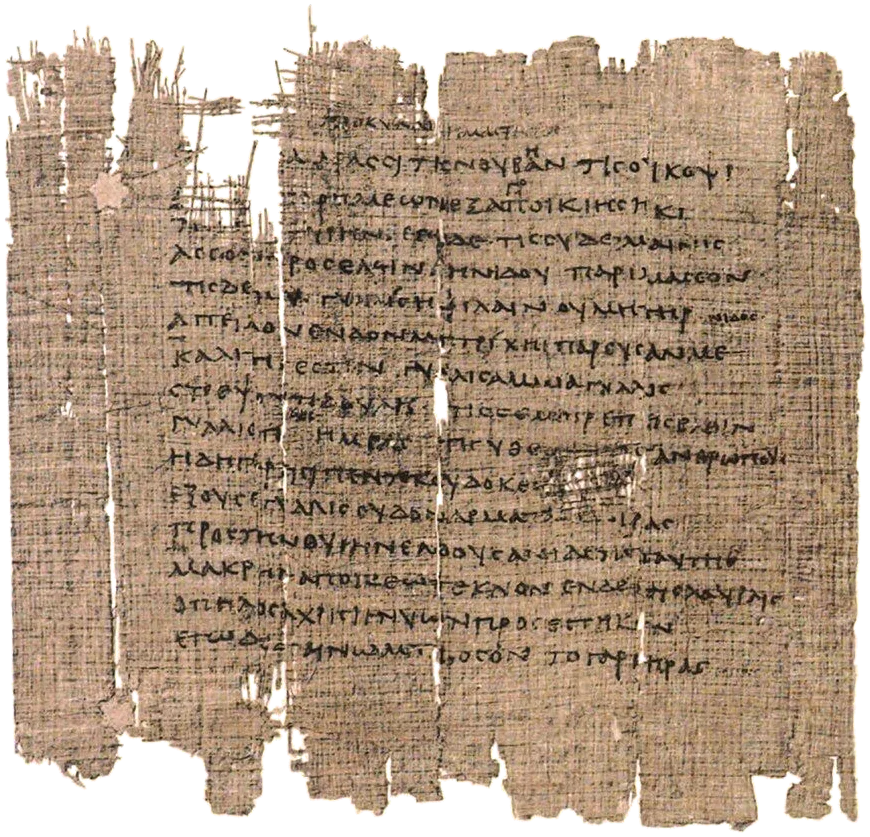
The iambic tetrameter catalectic
This light-hearted metre was used by Hipponax and is common in comedy, especially Old Comedy, mainly for entries and exits of the chorus and in contest scenes:[11]
× — ⏑ — × — ⏑ — ¦ × ¦ — ⏑ — ⏑ — — ‖
synthetic ∿ · the rhythm: a long note for —, a short one for ⏑
The catalectic last metron begins with a short, not an anceps, as catalectic iambic lines generally do.[12] In Old Comedy about three lines in four have the caesura at the end of the second metron (the first ¦). Most of the rest have it one position later (the second). In Menander the two are about equal. The first six principes may be resolved, most often the second and sixth. In Old and Middle Comedy any of the first six feet may be an anapaest.[11] Hephaestion’s example, from Hipponax, is on the Archilochus and the iambographers tab.
The shorter cola
| colon | scheme | names and notes |
|---|---|---|
| iambic dimeter | × — ⏑ — × — ⏑ — | in the epodes as a separate period after a hexameter or trimeter;[13] Hephaestion’s example is Anacreon’s ἐρῶ τε δηῦτε κοὐκ ἐρῶ / καὶ μαίνομαι κοὐ μαίνομαι, ⏑ — ⏑ — ⏑ — ⏑ — / — — ⏑ — — — ⏑ —, “I love again and love not, and I am mad and not mad”, whole songs being written in it[14] |
| iambic dimeter catalectic | × — ⏑ — ⏑ — — | Hephaestion’s “Anacreontean”, ὁ μὲν θέλων μάχεσθαι, ⏑ — ⏑ — ⏑ — —[15] |
| lekythion | — ⏑ — × — ⏑ — | West: the syncopated dimeter ∧ia + ia;[16] Hephaestion: the trochaic dimeter catalectic, “called Euripidean or lekythion”, νῦν δέ μοι πρὸ τειχέων / θούριος μολὼν Ἄρης, — ⏑ — ⏑ — ⏑ — (E. Phoen. 239–40, ap. Ench. 6.2) |
| ithyphallic | — ⏑ — ⏑ — — | West: ∧ia + ia∧, the catalectic of the lekythion;[17] Hephaestion: trochaic dimeter brachycatalectic, first used by Archilochus after a dactylic tetrameter;[18] κάρφεται γὰρ ἤδη |
| penthemimer | × — ⏑ — × | pe; with ith in Archil. 188.2[13] |
| syncopated metra | — ⏑ — (“cretic”, ∧ia), ⏑ — — (“baccheus”, ia∧), — — (∧ia∧) | the building blocks of lyric iambics, grouped mostly in dimeters and trimeters, prominent in Aeschylus[17] |
Here the authorities differ in name rather than substance. What Hephaestion classes under the trochaic (lekythion, ithyphallic), West derives from the iambic metron by syncopation. So lekythion = ∧ia ia, and ithyphallic = ∧ia ia∧.[19]
Runs. In Aristophanes a heated exchange in iambic or trochaic tetrameters may end in a long rush of metra in the same rhythm, anywhere between ten and sixty. They are linked in synapheia all the way to the catalexis at the close. These are known as systems or πνίγη, “breathlessnesses”, and are conventionally set out as dimeters.[20]
Notes
- ^ a b c d West 1987, p. 30.
- ^ Battezzato 2009, p. 137; Lennartz 2022, p. 208.
- ^ Bergk 1882, p. 489.
- ^ Hephaestion, Ench. 5.4.
- ^ Callim., ap. Heph. 5.4.
- ^ West 1987, pp. 30, 82.
- ^ West 1987, pp. 82–83.
- ^ Lennartz 2022, p. 219; Morrison 2022, p. 396.
- ^ Devine and Stephens 1994, pp. 83–84.
- ^ West 1987, p. 83.
- ^ a b West 1987, p. 29.
- ^ West 1987, p. 29; cf. the dimeter catalectic × — ⏑ — ⏑ — —: West 1987, p. 5.
- ^ a b West 1987, p. 31.
- ^ Hephaestion, Ench. 5.2.
- ^ Hephaestion, Ench. 5.3; West 1987, p. 5.
- ^ West 1987, pp. 32, 52.
- ^ a b West 1987, p. 52.
- ^ Hephaestion, Ench. 6.3.
- ^ West 1987, p. 52; Heph. Ench. 6.2–3.
- ^ West 1987, p. 49.
Iambic · 4 of 4
Worked example: Sophocles, Oedipus Tyrannus 1–5
The play opens with a speech of Oedipus to the suppliants. These are its first five lines. West uses lines 1–3 to illustrate the caesurae of the trimeter.[1] The scheme is × — ⏑ — ¦ × — ⏑ — ¦ × — ⏑ — ‖, with the caesura marked ¦ where it falls. The positions are numbered 1–12 in the notes. In each line below the syllables stand in columns over their signs, grouped in the three metra; the three anceps positions (1, 5 and 9) are red, and the caesura is a dashed bar.
1 ὦ τέκνα, Κάδμου τοῦ πάλαι νέα τροφή,
Children, young brood of ancient Cadmus,
Sophocles, Oedipus Tyrannus 1. Red: the three anceps positions. Dashed bar: the caesura.
synthetic ∿
Penthemimeral caesura after position 5 (Κάδμου). The ancipitia: 1 ὦ long, 5 -μου long, 9 νέ- short. West marks τεκ- long (κν divided) and the α of νέα long. Porson’s Law is satisfied trivially, the third anceps being short.[1]
2 τίνας ποθ’ ἕδρας τάσδε μοι θοάζετε
why do you sit before me at these seats,
Sophocles, Oedipus Tyrannus 2. Red: the three anceps positions. Dashed bar: the caesura.
synthetic ∿
Penthemimeral caesura. Position 4, the syllable ἑδ-, is long. West prints ἕδ'ρας, with δρ divided between syllables, as tragedy allows within a word.[2] The final -τε is short. It is a brevis in longo in the last position, which is at period-end.[3]
3 ἱκτηρίοις κλάδοισιν ἐξεστεμμένοι;
wreathed with suppliant branches?
Sophocles, Oedipus Tyrannus 3. Red: the three anceps positions. Dashed bar: the caesura.
synthetic ∿
No word-end at position 5 (κλάδοισιν runs over it), so the caesura is hephthemimeral, after position 7.[1] Ancipitia 1 and 9 are long, and 5 is short: West marks the κλα- of κλάδοισιν short. ἐξ- counts as ἐκ-σ-, so position 8 is ἐκ-, and the third anceps, position 9, is the long syllable -σεσ-. The syllable after it, -τεμ-, belongs to the same word, so Porson’s Law is observed.[4]
4 πόλις δ’ ὁμοῦ μὲν θυμιαμάτων γέμει,
and the city is full at once of incense,
Sophocles, Oedipus Tyrannus 4. Red: the three anceps positions. Dashed bar: the caesura.
synthetic ∿
Penthemimeral caesura after μέν, a postpositive that counts with the preceding ὁμοῦ.[5] The syllables -λισ- (before δ’) and μὲν (before θ-) are closed, and so long.[6] θυμιαμάτων fills positions 6–10 with — ⏑ — ⏑ —. The long υ of θῡμίαμα supplies the sixth.
5 ὁμοῦ δὲ παιάνων τε καὶ στεναγμάτων·
at once of paeans and of groans.
Sophocles, Oedipus Tyrannus 5. Red: the three anceps positions. Dashed bar: the caesura.
synthetic ∿
Hephthemimeral caesura after τε, which as a postpositive belongs with παιάνων. There is no word-end at position 5, inside παιάνων. The third anceps (στε-) is short, so Porson’s Law does not come into play. -ναγ- is long before μ.
What the five lines show
| feature | lines |
|---|---|
| penthemimeral caesura | 1, 2, 4 |
| hephthemimeral caesura | 3, 5 |
| long first anceps | 1, 3 |
| long second anceps | 1, 2, 4, 5 |
| long third anceps | 3 (with Porson’s Law kept) |
| resolution | none: Sophocles resolves not more than once in ten lines on average[1] |
| anapaests | none |
| brevis in longo | 2 |
| postpositive at the caesura | 4 (μέν, before it), 5 (τε, before it) |
Five consecutive lines without a single resolution or anapaest are typical of Sophoclean dialogue. In Euripides’ Orestes of 408 BC some 35% of trimeters show resolution.[7] Every line has its caesura in one of the two normal places, three of them in the commoner one, after position 5.[8] The one line whose third anceps is long keeps Porson’s Law. A comic poet would have been bound by none of these.[9]