Poets and playwrightsWomen poets
Praxilla
Praxilla of Sicyon: hymns, dithyrambs and the surviving fragments of her songs.
About
Works
- Synopsis
- Text and translation
- How to read each line
- Key to the labels
- Scansion
- Metre
- Prosody, line by line
- Notes
- Synopsis
- Text and translation
- How to read each line
- Key to the labels
- Scansion
- Metre
- Prosody, line by line
- Notes
About · 1 of 3
Who Praxilla was
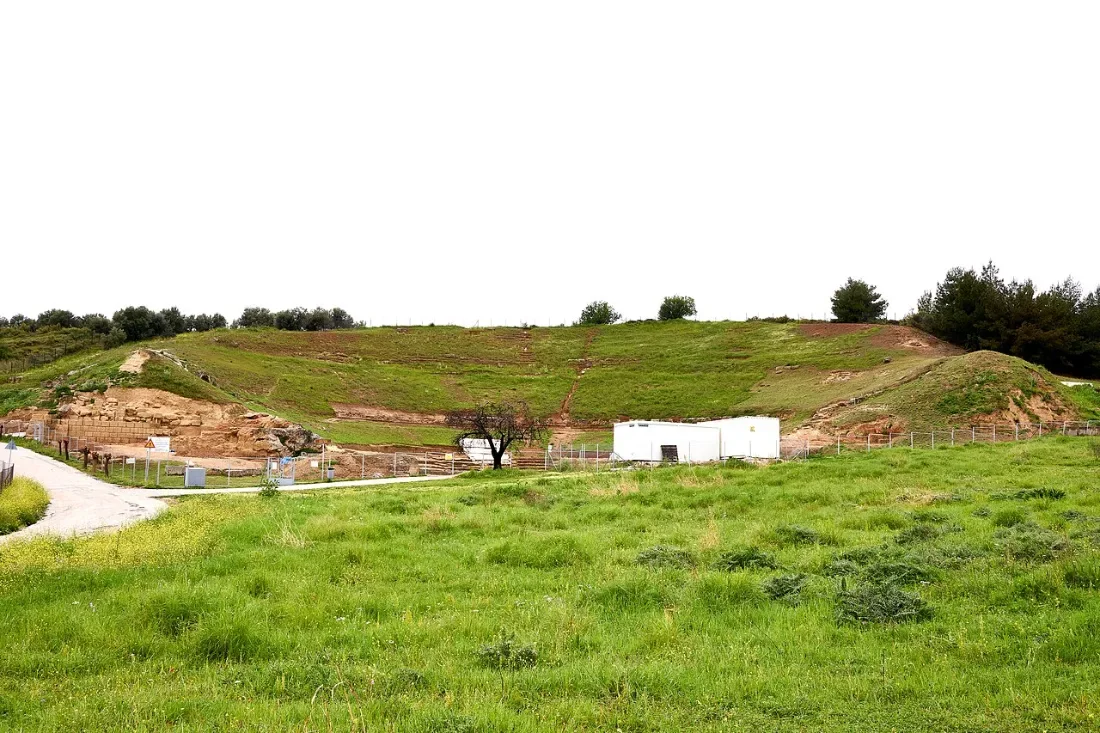
Praxilla came from Sicyon in the Peloponnese, about eleven miles north-west of Corinth. The city was later famous for its painters and sculptors.[1] Eusebius’ Chronicle puts her in the middle of the fifth century BCE, under Olympiad 82.2.[2] The Cambridge Companion’s chronology gives “mid-5th cent.”.[3] Nothing else is known of her life.[1]
A testimonium is an ancient statement about a poet. Three testimonia survive for Praxilla. They are Eusebius’ entry under Olympiad 82.2 (451/450 BC), Athenaeus on her drinking-songs, and Antipater’s canon of nine women poets. The Loeb edition gives the same three, and places her among the women poets of the fifth century.[4]
A versatile composer. Her fame rested on drinking-songs, called skolia, on dithyrambs for Dionysus, and on other hymns.[5] Athenaeus says that Praxilla of Sicyon was admired for her skolia. He then explains what a skolion was. It was the song sung last at a symposium. Not everyone sang in turn, but only the cleverest guests, wherever they lay. So the order of singers went “crooked” (Athenaeus 15.694a, as summarised by Natoli et al.).[6]
Praxilla, Myrtis and Telesilla are among the women poets of the classical period who probably composed choral poetry. Of their work “almost nothing survives”.[7]
Was she a courtesan? (disputed). Respectable women are thought not to have attended symposia. So some modern scholars inferred that a writer of skolia must have been a hetaira. A hetaira was a courtesan. Wilamowitz argued so without other evidence. Halporn read her two lines on a girl at a window (PMG 754) as describing a courtesan (after Snyder).[8]
More recent work rejects this, in several ways:[9]
- No ancient author calls her a hetaira (Snyder).
- Plant suggests she was a professional musician, who composed skolia on commission and perhaps performed them.
- Cazzato argues that the window poem is a wedding song, that the skolia were wrongly ascribed to her, and that her work was mostly songs for civic ritual.
- Jones argues that skolia ascribed to named poets often came from a shared, anonymous repertoire of the symposium.
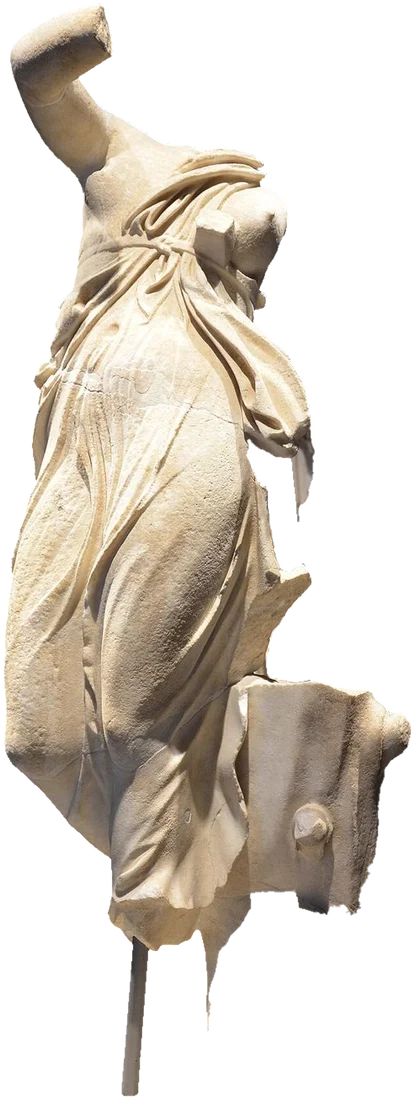
Her reputation. Antipater of Thessalonica puts her first in his canon of nine women poets, the earthly counterparts of the nine Muses (A.P. 9.26.3). But the epigram says nothing about her poetry.[10] The sculptor Lysippus, a fourth-century Sicyonian, made a bronze statue of her. Tatian, in the second century CE, claims to have seen it in Rome. He adds that nothing she said in her poems was of any use. The statue may have stood in the Portico of Pompey.[11]
Her name also became proverbial: “sillier than Praxilla’s Adonis”. A collector of proverbs is called a paroemiographer. One of them, Zenobius, explains the saying from her hymn to Adonis. In the hymn the dead youth is asked what was most beautiful in the world he had left. He names the sun, the stars and the moon, and then ripe cucumbers, apples and pears (Zenobius 4.21).[12] Cazzato suggests that the fruits may be a play on Sicyon (σίκυος, sikyos, “cucumber” or “snake-melon”) and double entendres.[12]
Her surviving lines, and where they come from, are on the Transmission tab; their metres, including the verse named after her, on the Metres tab.
Notes
- ^ a b Natoli et al. 2022, p. 179.
- ^ Natoli et al. 2022, p. 179 with n. 9.
- ^ Budelmann 2009, p. 387.
- ^ Campbell 1992, p. 370.
- ^ Natoli et al. 2022, p. 176.
- ^ Natoli et al. 2022, p. 177.
- ^ Stehle 2009, p. 65.
- ^ Natoli et al. 2022, pp. 177–178.
- ^ Natoli et al. 2022, pp. 177–178 with n. 7.
- ^ Natoli et al. 2022, pp. 178–179.
- ^ Natoli et al. 2022, p. 179 with n. 11.
- ^ a b Natoli et al. 2022, p. 181.
About · 2 of 3
Eight fragments, all quoted by others
No papyrus, no anthology. Unlike Sappho, Corinna and Erinna, Praxilla has not turned up on papyrus. Unlike the epigrammatists, she was not preserved in the Greek Anthology. Everything we have comes from later writers. They either quoted her, or reported what she said about a myth.[1] There are eight fragments in Page’s Poetae Melici Graeci (PMG): five quotations and three reports.[1]
The loss is great. Myrtis, Praxilla and Telesilla were classical women poets who probably composed choral poetry, and of their work “almost nothing survives”.[2] Praxilla’s name lived on in lists rather than texts. In the twelfth century Eustathius still names her with Corinna and Erinna, the women poets of Antipater’s canon.[3]
The three reports (PMG 751–753) say three things:[4]
- Praxilla made Aphrodite, not Semele, the mother of Dionysus.
- Zeus, not Laius, carried off Chrysippus (Athenaeus).
- The Spartan festival of the Carneia was named after Carneius, a son of Zeus and Europa brought up by Apollo and Leto (Pausanias 3.13.3–5).
The five quotations:[5]
| PMG | Quoted by | Poem | Lines |
|---|---|---|---|
| 747 | Zenobius 4.21, explaining the proverb “sillier than Praxilla’s Adonis” | hymn to Adonis | 3 hexameters |
| 748 | Hephaestion, Ench. 2.3 | the dithyramb Achilles | 1 hexameter |
| 749 | scholiast on Aristophanes, Wasps 1238; also among the anonymous skolia in Athenaeus 15.695c | a skolion: “friend, take to heart the tale of Admetus …” (our translation) | 2 lines |
| 750 | scholiast on Aristophanes, Thesmophoriazusae 529–530 | a skolion: “under every stone, my friend, watch out for a scorpion” (our translation) | 1 line |
| 754 | Hephaestion, Ench. 7.8 | to a girl looking out of a window | 2 praxilleia |
Natoli et al. print the window poem as “Praxilla 3 = PMG 749”.[6] That is the number they also give the Admetus skolion. The studies of the window poem in their own bibliography cite it as fr. 8, PMG 754 (Halporn, Renehan, Cazzato).[7] This site uses that number.
How secure are they? (disputed). Cazzato (2016) argues that the two skolia, PMG 749 and 750, are false attributions. The scholiast on the Wasps himself reports that some gave 749 to Alcaeus and others to Sappho. Its speaker is a man addressing a male companion. And 750 is a “widespread generic sentiment”, with a close parallel among the anonymous skolia (PMG 903). On her view only three fragments are securely Praxilla’s own words.[8]
Four words scratched on a fifth-century kylix in the British Museum match the opening of the window poem. Cazzato doubts that they come from Praxilla. She also doubts that Aristophanes parodied her (Wasps 1238, Thesmophoriazusae 528). If she is right, there is less evidence that Athenian audiences knew her poetry.[9] Halporn takes the vase as showing that the phrase was proverbial and popular.[10]
Cazzato’s own chapter sets out the case in detail. The cup is a crude imitation of the style of the painter Douris. It may be Athenian or Boeotian, and it dates from the first half of the fifth century BC. The words were added after firing. They read ΟΔΙΑΤΗΣΘΥΡΙΔΟΣ (o dia tēs thyridos), “O through the window”, in the singular, where Hephaestion has the plural τῶν θυρίδων (tōn thyridōn), “the windows”.[11] Some editors, Campbell among them, have changed Hephaestion’s text to the singular to match the cup. Cazzato argues that the plural is sound, and that the phrase on the cup was a common sympotic catchword rather than a quotation.[12]
Praxilla’s date is itself insecure. It rests only on an entry in Eusebius’ chronicle for 452/1 BC, which groups her with poets of quite different dates.[13] The ascription of the window couplet to her rests entirely on Hephaestion, who quotes it as his example of the praxilleion.[14]
A wedding song? (disputed). Cazzato proposes that the couplet comes from a wedding song. It would have been sung at the groom’s house on the morning after the wedding night, during the festivities called the epaulia. The address to a woman at the window, and the stress on her change from maiden, παρθένος (parthenos), to bride, νύμφη (nymphē), fit what is known of such songs.[15] Theocritus’ marriage song for Helen, Aeschylus’ Danaids and Sappho’s dialogue between a bride and her maidenhood (fr. 114 Voigt) offer parallels.[16] Teasing and sexual jokes were normal in wedding songs, so the slightly risqué tone would not be out of place.[17]
What Hephaestion preserves. Hephaestion wrote a handbook of metre in the second century CE. He is the source of two of the fragments, and he quotes both for their metre. In his chapter on synecphonesis he cites a hexameter “in the dithyrambs, in the ode entitled Achilles”.[18] Synecphonesis is the running together of two vowels into one syllable. In his chapter on dactylic verse he gives the window couplet as the example of the verse “called Praxilleion”.[19] Both are scanned on the Metres tab and on the works page.
Notes
- ^ a b Natoli et al. 2022, p. 176.
- ^ Stehle 2009, p. 65.
- ^ Pontani 2021, p. 328.
- ^ Natoli et al. 2022, p. 176; pp. 185–186 nn. 1–2.
- ^ Natoli et al. 2022, pp. 180–184.
- ^ Natoli et al. 2022, p. 182.
- ^ Natoli et al. 2022, pp. 179–180.
- ^ Natoli et al. 2022, pp. 176, 183–184; p. 186 n. 3.
- ^ Natoli et al. 2022, pp. 176–177, 182.
- ^ Natoli et al. 2022, pp. 182–183.
- ^ Cazzato 2016, pp. 186–190.
- ^ Cazzato 2016, pp. 186–188.
- ^ Cazzato 2016, pp. 190–191.
- ^ Cazzato 2016, p. 195.
- ^ Cazzato 2016, pp. 197–198.
- ^ Cazzato 2016, pp. 198–200.
- ^ Cazzato 2016, p. 200.
- ^ Hephaestion, Ench. 2.3.
- ^ Hephaestion, Ench. 7.8.
About · 3 of 3
Hexameters, the praxilleion and a skolion
Hexameters in a hymn and a dithyramb. The three lines from the hymn to Adonis (PMG 747) are dactylic hexameters.[1] So is the line Hephaestion quotes from the dithyramb Achilles (PMG 748). Hephaestion quotes it for a licence. Two short vowels run together into one short syllable. He says that this is found in other metres, but rarely in epic verse. Praxilla’s line, like Corinna’s, is his instance:[2]
ἀλλὰ τεὸν οὔ ποτε θυμὸν ἐνὶ στήθεσσιν ἔπειθον
alla teon ou pote thȳmon eni stēthessin epeithon
“yet the heart within your breast they [or I] could never win over”
Dactylic hexameter: — ⏑ ⏑ | — ⏑ ⏑ | — ⏑ ⏑ | — — | — ⏑ ⏑ | — ×. Red: τε‿ὸ-, the two short vowels of τεόν run together into one short syllable, with the ν carried on to οὔ.
Praxilla, PMG 748, quoted by Hephaestion, Ench. 2.3 (Consbruch’s text, First1KGreek); translation ours
synthetic ∿
Here τεὸν (teon, “your”) must be one short syllable, τε‿ο- (te‿o-), with its ν (n) carried on to οὔ (ou, “not”). Read as two shorts, it would leave three shorts in a row, which is impossible in the hexameter.[3]
The running together of two vowels into one syllable is called synecphonesis. Within a word it is frequent where the first vowel is ε, as here. In the normal case two short vowels merge into one long.[4] A single short syllable, the result in Praxilla’s line, is the rarity Hephaestion points out.
The praxilleion. In his chapter on dactylic verse Hephaestion describes “logaoedic” dactylics. They have dactyls in every place but the last, which is a trochaic pair. With two dactyls this is the “Alcaic decasyllable”. With three it is the verse “called Praxilleion”, and he quotes Praxilla:[5]
ὦ διὰ τῶν θυρίδων καλὸν ἐμβλέποισα
παρθένε τὰν κεφάλαν, τὰ δ’ ἔνερθε νύμφα.
ō dia tōn thyridōn kalon emblepoisa / parthene tan kephalān, ta d’ enerthe nymphā.
“You who gaze out, lovely, through the window: a maiden from the head up, a bride beneath.”
Praxilleion: three dactyls and a trochaic close, — ⏑ ⏑ — ⏑ ⏑ — ⏑ ⏑ — ⏑ — ×, the same in both lines. Red: κα- of καλόν, short.
Praxilla, PMG 754, quoted by Hephaestion, Ench. 7.8 (Consbruch’s text, First1KGreek); translation ours
synthetic ∿
West’s glossary defines the “Praxillean” as — ⏑ ⏑ — ⏑ ⏑ — ⏑ ⏑ — ⏑ — —.[6] Natoli et al. give — ⏑ ⏑ — ⏑ ⏑ — ⏑ ⏑ — ⏑ — ×.[7] Tradition credits Praxilla with inventing it.[8] The three agree on the shape. Only the last syllable is written differently, and at line-end it is indifferent: it may be long or short.
In the first line κα- (ka-) of καλόν (kalon, “beautifully”) is short, the normal quantity in lyric.[9] Hephaestion’s text has the Aeolic accent κεφάλαν (kephalān, “head”). Natoli et al. print κεφαλὰν.[10]
A second “Praxilleion”. The name is not unique. In his chapter on the ionic a maiore Hephaestion gives the name “Praxilleia” to a different verse. It is a trimeter shortened at the end. Its first metron is ionic, and its second is trochaic. His example is Sappho’s, πλήρης μὲν ἐφαίνετ’ ἀ σελάνα, plērēs men ephainet’ a selanā, “the moon shone full”.[11] West’s glossary uses the name only for the dactylic verse of Ench. 7.8.
The Admetus skolion. The ascription of PMG 749 to Praxilla is doubted.[12] Natoli et al. label it “greater asclepiad”.[13] The label fits. Its second line, as they print it, scans as West’s gl²ᶜ. This is a glyconic with double choriambic expansion. West prints it × × — ⏑ ⏑ — ⁝ — ⏑ ⏑ — ⁝ — ⏑ ⏑ — ⏑ —. The ⁝ marks the caesura often found between choriambs (the base here is — —):[14]
Ἀδμήτου λόγον, ὦ ἑταῖρε, μαθὼν τοὺς ἀγαθοὺς φίλει,
τῶν δειλῶν δ’ ἀπέχου γνοὺς ὅτι δειλῶν ὀλίγα χάρις.
Admētou logon, ō hetaire, mathōn tous agathous philei, / tōn deilōn d’ apechou gnous hoti deilōn oligā charis.
“Friend, take to heart the tale of Admetus and love the good; and keep away from cowards, knowing that cowards have little gratitude.”
Glyconic with double choriambic expansion, gl²ᶜ: × × — ⏑ ⏑ — ⁝ — ⏑ ⏑ — ⁝ — ⏑ ⏑ — ⏑ —, here with the base — —. Red: ὦ‿ἑ-, two vowels run together into one long syllable; -γα of ὀλίγα, long ᾱ where Attic has ὀλίγη.
PMG 749: Greek from Bergk 1882 III p. 567, with ὦ ’ταῖρε expanded; translation ours
synthetic ∿
ὀλίγα (oligā, “little”) has the long ᾱ (ā) that Aeolic and Doric have where Attic has η (ē) (ὀλίγη, oligē).[15] In the first line the vowels of ὦ ἑταῖρε (ō hetaire, “O friend”) must be run together into one syllable, so that the line fits the same scheme. Synecphonesis of this kind is commonest after a monosyllable such as ὦ.[4]
Both Hephaestion fragments, and the Adonis hexameters, are scanned line by line on the works page.
Notes
- ^ Natoli et al. 2022, p. 180.
- ^ Hephaestion, Ench. 2.3.
- ^ West 1987, p. 19.
- ^ a b West 1987, p. 15.
- ^ Hephaestion, Ench. 7.8.
- ^ West 1987, p. 89.
- ^ Natoli et al. 2022, p. 339.
- ^ Natoli et al. 2022, p. 177.
- ^ LSJ s.v. καλός, kalos.
- ^ Natoli et al. 2022, p. 182.
- ^ Hephaestion, Ench. 11.3; see the ionic page on this site.
- ^ See the Transmission tab.
- ^ Natoli et al. 2022, p. 183.
- ^ West 1987, p. 34.
- ^ Natoli et al. 2022, pp. 329, 332.
Praxilla, hexameters from the hymn to Adonis and the Achilles (frr. 747, 748)
Synopsis
Two pieces of Praxilla of Sicyon in dactylic hexameters. Eusebius dates her to the mid-fifth century BC (451/450). She was famous for skolia, dithyrambs and hymns. But no papyrus of her survives, and only five quotations are attributed to her directly.[1] She, Myrtis and Telesilla are classical women poets, probably composers of choral song, of whom almost nothing survives.[2] PMG 747 comes from a Hymn to Adonis. Adonis is asked in the Underworld what was the most beautiful thing he had left behind. He names the sunlight, the stars and the moon, and ripe cucumbers, apples and pears. Zenobius, a collector of proverbs of the 2nd century AD, quotes the three lines to explain the proverb “sillier than Praxilla’s Adonis”.[3] Cazzato suggests that the lines lived on through reperformance at symposia, and that “cucumbers” may pun on Sicyon.[4] PMG 748 is a single line, “but never did they persuade your heart in your breast”. It is preserved by the metrician Hephaestion, who says it comes from her dithyramb Achilles.[5]
Both pieces, four lines in all, are scanned below.
Text and translation
The uninterrupted Greek with its English translation, line by line.
Show text and translation
κάλλιστον μὲν ἐγὼ λείπω φάος ἠελίοιο
Praxilla · PMG 747 (hymn to Adonis), 748 (dithyramb Achilles) · dactylic hexameters · PMG 747 from Bergk 1882, p. 566; PMG 748 from Hephaestion, ed. Consbruch (First1KGreek)
How to read each line
A guide to the Greek, syllables, pitch marks and quantities.
Show the reading key
- Above each line: the line as the edition prints it, each word placed over its own syllables. The main row: the same Greek divided into metrical syllables, each written as it is pronounced. A consonant that closes a syllable is written with it (λόθ | ρο); an elided word is closed up with the next vowel (ν’ἀ); a final consonant carried into the next word is set with a thin space (ς ἰ). Wider gaps mark word-ends.
- Above the syllables: the pitch of each syllable, from the accents. Under them: the quantity of each syllable as it falls in the line, then the transliteration, syllable by syllable, with accented syllables in capitals.
- Under each line: a line-for-line translation. In the right margin of the scansion: the line type, its scheme, and its analysis into cola.
Key to the labels
The names, patterns and symbols used beside this poem.
Show the labels and symbols
The labels in the right margin of the scansion below name the line, its scheme, the feet as the line realises them, and the caesurae and diaereses (the named word-ends) that fall in it. In the scheme ⏔ is a biceps, two shorts that may be contracted to one long; ⏕ is a long that may be resolved into two shorts; × is an anceps, long or short. A click on any syllable highlights its metron or colon, or, with the switch, its foot.
| Label | Name and shape | What it is |
|---|---|---|
| hem1 | First hemiepes— ⏔ — ⏔ — | The first two and a half feet of the hexameter, up to the penthemimeral caesura; in the pentameter, its whole first half. |
| hem2 | Second half of the hexameter⏔ — ⏔ — ⏑ ⏑ — × | From the penthemimeral caesura to the line-end: the fifth foot is nearly always a dactyl, the sixth is — ×. |
The traditional feet
| Foot and shape | Where |
|---|---|
| First foot: dactyl or spondee— ⏔ | Scheme positions 1–2. The biceps (⏑ ⏑) may be contracted to a single long, making a spondee. |
| Second foot: dactyl or spondee— ⏔ | Scheme positions 3–4. |
| Third foot: dactyl or spondee— ⏔ | Scheme positions 5–6. The penthemimeral caesura falls after its first syllable, the “trochaic” caesura after its second. |
| Fourth foot: dactyl or spondee— ⏔ | Scheme positions 7–8. Word-end at the end of this foot, when it is a dactyl, is the bucolic diaeresis (West’s “bucolic caesura”: word-end at the end of the fourth foot after an uncontracted biceps)[6]. |
| Fifth foot: dactyl— ⏑ ⏑ | Scheme positions 9–10. A spondee here (a “spondaic line”) is rare. |
| Sixth foot— × | Scheme positions 11–12: a long and the indifferent final syllable. |
Scansion
Adonis in the underworld names the most beautiful things he has left, from the sun to the pears; and a single line that Hephaestion quotes for a licence rare in epic verse, two short vowels run together into one short syllable.
Fairest of all that I am leaving is the sunlight;
next come the bright stars and the moon’s face,
and cucumbers in their season, and apples, and pears.
but I [or: they] could never win over the heart within your breast.
Metre
- The metre. Both fragments are dactylic hexameters:[8] — ⏔ — ⏔ — ⏔ — ⏔ — ⏑ ⏑ — ×, with a caesura in the third foot, either after its princeps (penthemimeral) or between its two shorts (“feminine”), occasionally after the fourth princeps (hephthemimeral) instead.[9] It is the metre of epic and also of shorter poems of other kinds;[10] here it serves a hymn to Adonis and a dithyramb, a choral song for Dionysus usually performed at festivals.[11]
- Epic language, epic prosody. The words are those of epic: ἠελίοιο and σεληναίης for Attic ἡλίου and σελήνης,[12] τεόν, the epic possessive for σόν.[13] The Workbench scans them with the rules of epic: correption of a final diphthong before a vowel,[14] and a short syllable before stop + liquid at the beginning of a word.[15]
- Two shorts as one short. Hephaestion quotes line 4 in his chapter on synecphonesis. Besides the usual results (a long and a short, or two shorts, becoming one long), he lists two shorts becoming one short, “which is found in the other metres, but rarely in epic verse”; his examples in hexameters are a line of Corinna and this line of Praxilla, “in the dithyrambs, in the ode entitled Achilles”.[7] In τε‿όν the ε and ο are sung as one short syllable; LSJ notes “τεός as one short syll.” in this fragment, “cited by Heph. for this reason” (s.v. τεός). West gives the ordinary case: two short vowels run together make one long syllable.[16] The input marks the exception with a breve on the ο after the tie (not shown on the page), so the Workbench scans the tied syllable short, as Hephaestion describes it, and line 4 scans as a regular hexameter.
- The text. PMG 747 follows the public-domain text in Bergk’s fourth edition (1882, vol. III, p. 566), including the rough breathing of ὡραίους. Capitalization and punctuation are normalized; quantity marks are added for scansion. PMG 748 follows Hephaestion, ed. Consbruch (1906), via First1KGreek, with οὔ ποτε as two words.
Prosody, line by line
Every syllable, with the reason for its length. Quantities are read from the vowel where the spelling shows it, from the consonants that follow (“position”), from the accent where it tells, and from the metre where nothing else does. Editors’ notes on the text follow in the boxed paragraphs.
- 747.1
Line 747.1 · κάλλιστον μὲν ἐγὼ λείπω φάος ἠελίοιο,
κάλλιστον μὲν ἐγὼ λείπω φάος ἠελίοιο,
κάλλιστονμὲν ἐγὼλείπωφάος ἠελίοιο,spondee, dactyl, spondee, dactyl, dactyl, — ×; penthemimeral caesura; hephthemimeral caesura; bucolic diaeresis.
- 1 —κάλά is a vowel of unknown length; closed by λ: long by position.
- 2 —λισι is a vowel of unknown length; closed by σ: long by position; a single long contracts the two shorts of the biceps at position 2.
- 3 —τονο is short by nature; closed by ν: long by position.
- 4 ⏑μὲὲ is short by nature; one of the two shorts of the biceps at position 4.
- 5 ⏑ν ἐἐ is short by nature; the first consonant belongs to the previous word and is carried over to this vowel; one of the two shorts of the biceps at position 4.
- 6 —γὼὼ is long by nature.
- 7 —λείεί is a diphthong, long by nature; a single long contracts the two shorts of the biceps at position 6.
- 8 —πωω is long by nature.
- 9 ⏑φάά is short by the metre (position 8 must be short); one of the two shorts of the biceps at position 8.
- 10 ⏑οο is short by nature; one of the two shorts of the biceps at position 8.
- 11 —ς ἠἠ is long by nature; the first consonant belongs to the previous word and is carried over to this vowel.
- 12 ⏑εε is short by nature; one of the two shorts of the biceps at position 10.
- 13 ⏑λίί is short by the metre (position 10 must be short); one of the two shorts of the biceps at position 10.
- 14 —οιοι is a diphthong, long by nature.
- 15 ×ο,ο is short by nature; the position is anceps.
The first foot is a spondee: κάλ- is closed by the first λ, and -λισ- by the σ of στ, since two consonants are divided between the syllables.[17] The ν of μέν is carried over to ἐγώ,[17] leaving μὲ short. Penthemimeral caesura after ἐγώ, hephthemimeral caesura after λείπω;[10] the third foot is a spondee (γὼ λεί). Word-end after φάος falls at the end of the fourth foot after an uncontracted biceps, the place West calls the “bucolic caesura”.[6] ἠελίοιο is the epic form, Attic ἡλίου,[18] with the old genitive in -οιο filling the end of the line.
- 747.2
Line 747.2 · δεύτερον ἄστρα φαεινὰ σεληναίης τε πρόσωπον
δεύτερον ἄστρα φαεινὰ σεληναίης τε πρόσωπον
δεύτερον ἄστραφαεινὰσεληναίηςτεπρόσωπονdactyl, dactyl, dactyl, spondee, dactyl, — ×; caesura after the third trochee.
- 1 —δεύεύ is a diphthong, long by nature.
- 2 ⏑τεε is short by nature; one of the two shorts of the biceps at position 2.
- 3 ⏑ροο is short by nature; one of the two shorts of the biceps at position 2.
- 4 —ν ἄσἄ is a vowel of unknown length; closed by σ: long by position; the first consonant belongs to the previous word and is carried over to this vowel.
- 5 ⏑τραα is short by the metre (position 4 must be short); one of the two shorts of the biceps at position 4.
- 6 ⏑φαα is short by the metre (position 4 must be short); one of the two shorts of the biceps at position 4.
- 7 —ειει is a diphthong, long by nature.
- 8 ⏑νὰὰ is short by the metre (position 6 must be short); one of the two shorts of the biceps at position 6.
- 9 ⏑σεε is short by nature; one of the two shorts of the biceps at position 6.
- 10 —ληη is long by nature.
- 11 —ναίαί is a diphthong, long by nature; a single long contracts the two shorts of the biceps at position 8.
- 12 —ηςη is long by nature; closed by ς: long by position.
- 13 ⏑τεε is short by nature; the next word begins with πρ, a stop + liquid that does not make position here, so the syllable stays short; one of the two shorts of the biceps at position 10.
- 14 ⏑πρόό is short by nature; one of the two shorts of the biceps at position 10.
- 15 —σωω is long by nature.
- 16 ×πονο is short by nature; closed by ν: long by position; the position is anceps.
The ν of δεύτερον is carried over to ἄστρα; in ἄστρα the σ closes the first syllable and τρ begins the second, which is short before φ.[19] Feminine caesura after φαεινά.[10] The fourth foot is a spondee (λη ναί): the diphthong of σεληναίης keeps its length before the vowel that follows inside the word. τε stays short before the πρ of πρόσωπον: a stop and liquid at the beginning of a word are the case in which early poetry normally lets the syllable before them remain short.[15]
- 747.3
Line 747.3 · ἠδὲ καὶ ὡραίους σικύους καὶ μῆλα καὶ ὄγχνας·
ἠδὲ καὶ ὡραίους σικύους καὶ μῆλα καὶ ὄγχνας·
ἠδὲκαὶὡραίουςσικύουςκαὶμῆλακαὶὄγχνας·dactyl, spondee, dactyl, spondee, dactyl, — ×; penthemimeral caesura; hephthemimeral caesura; word-end after a spondaic fourth foot.
- 1 —ἠἠ is long by nature.
- 2 ⏑δὲὲ is short by nature; one of the two shorts of the biceps at position 2.
- 3 ⏑καὶαὶ is a diphthong, long by nature; shortened before the vowel that begins the next word (epic correption), as the metre requires; one of the two shorts of the biceps at position 2.
- 4 —ὡὡ is long by nature.
- 5 —ραίαί is a diphthong, long by nature; a single long contracts the two shorts of the biceps at position 4.
- 6 —ουςου is a diphthong, long by nature; closed by ς: long by position.
- 7 ⏑σιῐ is short (its length is not shown by the ordinary spelling); one of the two shorts of the biceps at position 6.
- 8 ⏑κύῠ́ is short (its length is not shown by the ordinary spelling); one of the two shorts of the biceps at position 6.
- 9 —ουςου is a diphthong, long by nature; closed by ς: long by position.
- 10 —καὶαὶ is a diphthong, long by nature; a single long contracts the two shorts of the biceps at position 8.
- 11 —μῆῆ is long by nature.
- 12 ⏑λαα is short by the accent rule: circumflex on the penult requires a short final syllable; one of the two shorts of the biceps at position 10.
- 13 ⏑καὶαὶ is a diphthong, long by nature; shortened before the vowel that begins the next word (epic correption), as the metre requires; one of the two shorts of the biceps at position 10.
- 14 —ὄγὄ is short by nature; closed by γ: long by position.
- 15 ×χνας·α is a vowel of unknown length; closed by ς: long by position; the position is anceps.
καί is shortened twice before a vowel, before ὡραίους and before ὄγχνας (epic correption)[14]; West notes that before a vowel καί was as a rule either shortened or run together with it.[15] Before μῆλα it is long. The diphthong of ὡραίους keeps its length before the vowel that follows inside the word, and the second foot is a spondee (ὡ ραί). σικύους has both its ι and its υ short (the input marks them, and the marks are not shown on the page)[20]; Natoli et al. report the view that the σίκυος is a snake-melon rather than a cucumber, and Cazzato’s suggestion of a pun on Praxilla’s city, Sicyon.[21] Penthemimeral caesura after ὡραίους, hephthemimeral caesura after σικύους. The fourth foot is a spondee (ους καί); the word-end the Workbench reports after it follows καί, a prepositive, which counts with the following word,[6] so the line has no real word-division after its contracted fourth biceps, which West says is frequent only in the first foot.[22] ὄγχνας is closed by the γ before χν; LSJ s.v. ὄγχνη.
The final noun follows Schneidewin’s correction, already printed by Bergk[23]. Campbell discusses the manuscript’s different ending.[24]
- 748
Line 748 · ἀλλὰ τε‿ὸν οὔ ποτε θυμὸν ἐνὶ στήθεσσιν ἔπειθον.
ἀλλὰ τε‿ὸν οὔ ποτε θυμὸν ἐνὶ στήθεσσιν ἔπειθον.
ἀλλὰτε‿ὸν οὔποτεθυμὸν ἐνὶστήθεσσιν ἔπειθον.dactyl, dactyl, dactyl, spondee, dactyl, — ×; caesura after the third trochee; hephthemimeral caesura.
- 1 —ἀλἀ is a vowel of unknown length; closed by λ: long by position.
- 2 ⏑λὰὰ is short by the metre (position 2 must be short); one of the two shorts of the biceps at position 2.
- 3 ⏑τε‿ὸεὸ̆ is two short vowels of one word pronounced together as one short syllable: “two shorts into one short”, which Hephaestion lists among the kinds of synecphonesis, rare in hexameters;[7] one of the two shorts of the biceps at position 2.
- 4 —ν οὔοὔ is a diphthong, long by nature; the first consonant belongs to the previous word and is carried over to this vowel.
- 5 ⏑ποο is short by nature; one of the two shorts of the biceps at position 4.
- 6 ⏑τεε is short by nature; one of the two shorts of the biceps at position 4.
- 7 —θυῡ is long (its length is not shown by the ordinary spelling).
- 8 ⏑μὸὸ is short by nature; one of the two shorts of the biceps at position 6.
- 9 ⏑ν ἐἐ is short by nature; the first consonant belongs to the previous word and is carried over to this vowel; one of the two shorts of the biceps at position 6.
- 10 —νὶthe next word begins with στ: the syllable is closed before it: long by position.
- 11 —στήή is long by nature; a single long contracts the two shorts of the biceps at position 8.
- 12 —θεσε is short by nature; closed by σ: long by position.
- 13 ⏑σιι is short by the accent rule: acute on the antepenult requires a short final syllable; one of the two shorts of the biceps at position 10.
- 14 ⏑ν ἔἔ is short by nature; the first consonant belongs to the previous word and is carried over to this vowel; one of the two shorts of the biceps at position 10.
- 15 —πειει is a diphthong, long by nature.
- 16 ×θον.ο is short by nature; closed by ν: long by position; the position is anceps.
Hephaestion’s example of two short vowels run together into one short syllable.[25] The first foot is ἀλ λὰ τε‿ο-, a dactyl: read as two shorts, τε ο would leave three shorts in a row, which the hexameter cannot take.[10] The ν of τεόν begins the next syllable, νοὔ,[17] so the tied syllable stays open and short. Feminine caesura after θυμόν,[10] which has a long υ.[26] The hephthemimeral caesura the Workbench reports falls after ἐνί, a prepositive that counts with the following word,[6] so it is not a true caesura. The fourth foot is a spondee: νὶ is closed by the σ of στήθεσσιν.[17] ἔπειθον may be first person singular or third person plural, “I (or they)” in the translation of Natoli et al..[27]
Campbell prints the line as fr. 748, writing οὔποτε as one word.[28]
Notes
- ^ Natoli et al. 2022, pp. 176, 179.
- ^ Stehle 2009, p. 65.
- ^ Natoli et al. 2022, pp. 180–181.
- ^ Natoli et al. 2022, p. 181.
- ^ Natoli et al. 2022, pp. 181–182; Hephaestion, Ench. 2.3.
- ^ a b c d West 1987, p. 21.
- ^ a b c Hephaestion, Ench. 2.3.
- ^ Natoli et al. 2022, p. 180; Hephaestion, Ench. 2.3.
- ^ West 1987, p. 19; Battezzato 2009, p. 138, on the masculine and feminine types.
- ^ a b c d e West 1987, p. 19.
- ^ Natoli et al. 2022, pp. 181–182.
- ^ Natoli et al. 2022, p. 181; LSJ s.vv. ἥλιος, σεληναίη.
- ^ Natoli et al. 2022, p. 182; LSJ s.v. τεός.
- ^ a b West 1987, p. 14.
- ^ a b c West 1987, p. 16.
- ^ West 1987, p. 15.
- ^ a b c d West 1987, p. 12.
- ^ Natoli et al. 2022, p. 181; LSJ s.v. ἥλιος.
- ^ West 1987, pp. 12, 16.
- ^ LSJ s.v. σίκυος.
- ^ Natoli et al. 2022, p. 181.
- ^ West 1987, p. 20.
- ^ Bergk 1882, p. 566.
- ^ Campbell 1992, p. 374.
- ^ Hephaestion, Ench. 2.3; see Metre above.
- ^ LSJ s.v. θυμός.
- ^ Natoli et al. 2022, p. 185.
- ^ Campbell 1992, p. 376.
Text and sources
- L. Battezzato, ‘Metre and music’, in F. Budelmann (ed.), The Cambridge Companion to Greek Lyric (Cambridge 2009), ch. 7, p. 138 (the caesurae of the hexameter).
- Text of PMG 747: T. Bergk, Poetae lyrici Graeci, 4th ed., vol. III (Leipzig 1882), p. 566, public domain; Greek collated against the page image. Text of PMG 748: Hephaestion, Enchiridion 2.3, ed. M. Consbruch (Leipzig 1906), public domain, via First1KGreek (CC BY-SA 4.0).
- Zenobius 4.21: Corpus Paroemiographorum Graecorum, ed. E. von Leutsch and F. W. Schneidewin, vol. 1 (Göttingen 1839), via First1KGreek (tlg0098.tlg001), CC BY-SA 4.0.
- Notes and glosses: Natoli et al. 2022, pp. 180–182, 185.
- Rules: M. L. West, Introduction to Greek Metre (Oxford 1987), pp. 12, 14–16 (prosody), 19–21 (the hexameter; p. 20 from a photograph), checked against the page images; Hephaestion, Ench. 2.3.
- Quantities and forms: LSJ (Perseus Digital Library, CC BY-SA), s.vv. ἥλιος, θυμός, ὄγχνη, σεληναίη, σίκυος, τεός, ὡραῖος.
- D. A. Campbell, Greek Lyric IV: Bacchylides, Corinna, and Others (Loeb Classical Library 461, Cambridge, MA 1992), Praxilla frr. 747 (Zenobius, pp. 374–375) and 748 (Hephaestion 2.3, pp. 376–377); same numbers as PMG, same words. He places her among the women poets of the fifth century: Eusebius names her under Olympiad 82.2, 451/450 BC (test. 1, p. 370).
Quotations from copyrighted works are not covered by this page’s licence.
Praxilleia and skolion
Praxilla, the window couplet and the Admetus skolion (frr. 754, 749)
Synopsis
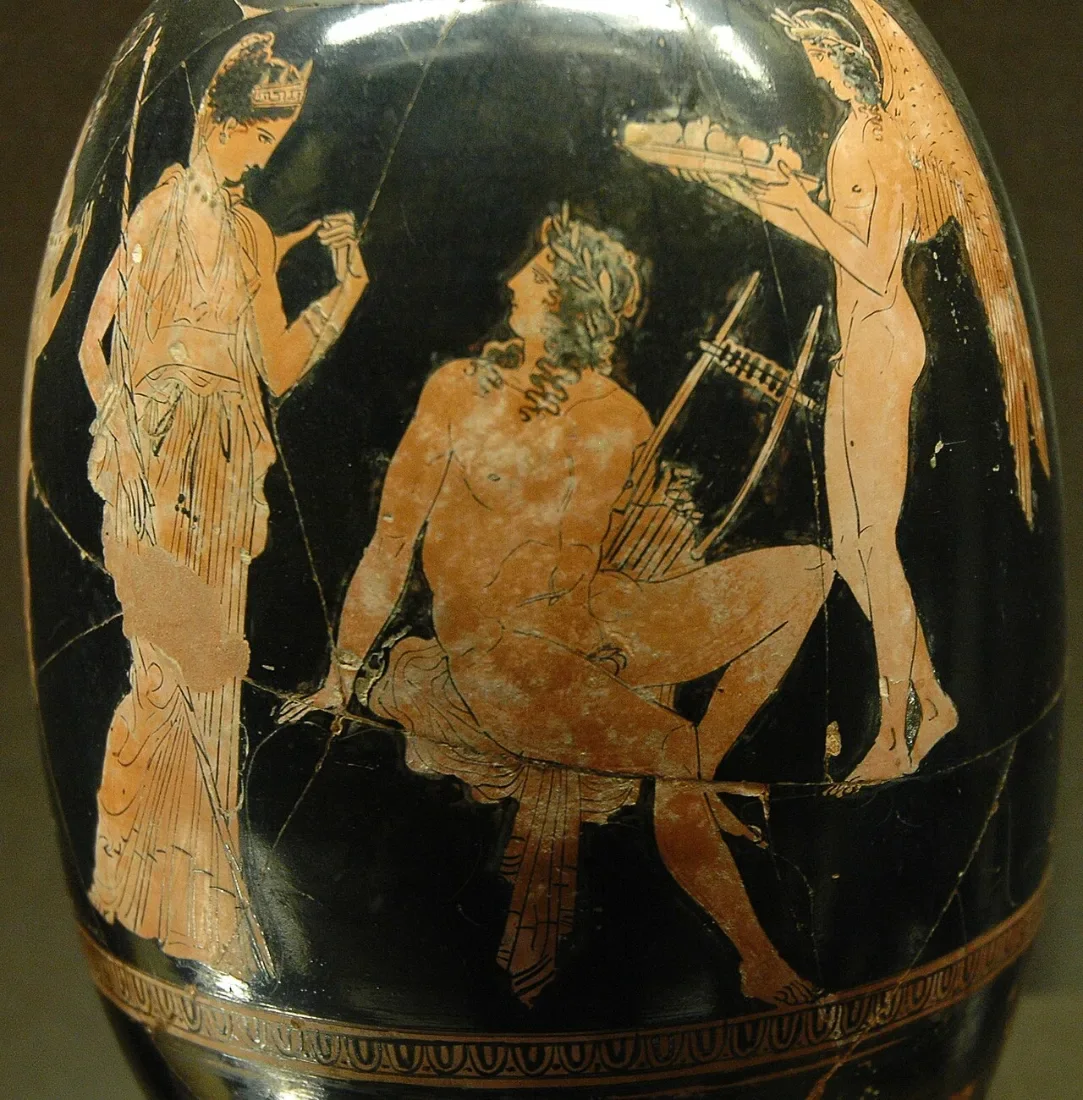
Two couplets connected with Praxilla of Sicyon. Eusebius dates her to the mid-fifth century BC.[1] She, Myrtis and Telesilla are classical women poets, probably of choral song, of whom almost nothing survives.[2] PMG 754 is preserved by Hephaestion as a drinking song. It addresses a girl gazing through the windows, “a maiden in your head, a bride below”. It was long read as a jibe at a courtesan, and used to make Praxilla one. Cazzato reads it instead as a wedding song, sung at the groom’s house after the wedding night. She also doubts that the four words on a fifth-century kylix in London quote it.[3] PMG 749, “learn the story of Admetus, friend, and love the good”, is quoted in Aristophanes’ Wasps (1238). There Bdelycleon teaches his father to cap skolia. A scholiast gives it to Praxilla, noting that others name Alcaeus or Sappho. It appears again among Athenaeus’ anonymous skolia. That, with its male speaker, leads Cazzato to doubt the attribution.[4] PMG 754 is in the metre called the praxilleion, said to be her invention.[5]
Both couplets, four lines in all, are scanned below.
Text and translation
The uninterrupted Greek with its English translation, line by line.
Show text and translation
ὦ διὰ τῶν θυρίδων καλὸν ἐμβλέποισα
Praxilla · PMG 754, 749 · praxilleia and greater asclepiads · PMG 754 from Hephaestion, Ench. 7.8, ed. Consbruch (First1KGreek); PMG 749 from the scholia to Aristophanes, Wasps 1238, from Bergk 1882, p. 567
How to read each line
A guide to the Greek, syllables, pitch marks and quantities.
Show the reading key
- Above each line: the line as the edition prints it, each word placed over its own syllables. The main row: the same Greek divided into metrical syllables, each written as it is pronounced. A consonant that closes a syllable is written with it (λόθ | ρο); an elided word is closed up with the next vowel (ν’ἀ); a final consonant carried into the next word is set with a thin space (ς ἰ). Wider gaps mark word-ends.
- Above the syllables: the pitch of each syllable, from the accents. Under them: the quantity of each syllable as it falls in the line, then the transliteration, syllable by syllable, with accented syllables in capitals.
- Under each line: a line-for-line translation. In the right margin of the scansion: the line type, its scheme, and its analysis into cola.
Key to the labels
The names, patterns and symbols used beside this poem.
Show the labels and symbols
The labels in the right margin of the scansion below name the cola, the rhythmic units each line is built from (Voigt’s and West’s analysis). A caret before a name (∧hipp) means the colon has lost its first position (acephalous). × marks an anceps position, which takes a long or a short. A click on any syllable highlights its colon, or, with the colon/foot switch, its foot. The sources of the labels, with their page numbers, are given line by line under Prosody, line by line.
| Label | Name and shape | What it is |
|---|---|---|
| prax | Praxilleion— ⏑ ⏑ — ⏑ ⏑ — ⏑ ⏑ — ⏑ — × | Hephaestion counts it among the logaoedic dactylic verses, which have dactyls in every place but the last and a trochaic pair at the end. With three dactyls before the trochaic pair the verse is called Praxilleion.[6] West gives the Praxillean as — ⏑ ⏑ — ⏑ ⏑ — ⏑ ⏑ — ⏑ — —;[7] at period-end the last position is indifferent. |
| gl2c | Glyconic with double choriambic expansion× × — ⏑ ⏑ — ⁝ — ⏑ ⏑ — ⁝ — ⏑ ⏑ — ⏑ — | The metre in which the whole of Sappho’s third book and many songs of Alcaeus were written, the “Sapphic sixteen-syllable”.[8] West prints it with frequent word-end between the choriambs.[9] |
The feet
| Foot and shape | Where |
|---|---|
| Dactyl— ⏑ ⏑ | Positions 1–3 of the Praxilleion. |
| Dactyl— ⏑ ⏑ | Positions 4–6. |
| Dactyl— ⏑ ⏑ | Positions 7–9. |
| Trochaic pair— ⏑ — × | Positions 10–13: the trochaic pair (τροχαϊκὴ συζυγία) with which Hephaestion says these verses end.[6] The last position is indifferent at period-end. |
| Aeolic base○ ○ | Two free positions, not both short.[10] |
| Choriamb— ⏑ ⏑ — | |
| Choriamb— ⏑ ⏑ — | |
| Choriamb— ⏑ ⏑ — | |
| Close⏑ — |
Scansion
The two lines that gave their name to the praxilleion, a run of three dactyls closed by a trochaic pair; and a drinking-song in glyconics with double choriambic expansion, whose ascription to Praxilla is doubted.
You who peep in so sweetly through the window,
a girl from the face up, a married woman below.
Take Admetus’ story to heart, comrade, and keep good men as friends;
stay clear of the base, aware that base men give back small thanks.
Metre
- The praxilleion. Hephaestion describes “so-called logaoedic dactylics”, which have dactyls in every place but the last, where they have a trochaic pair (τροχαϊκὴ συζυγία). With two dactyls before the pair the verse is the “Alcaic decasyllable”; with three, it is the one “called Praxilleion”, and he quotes these two lines.[6] West’s glossary gives the Praxillean as — ⏑ ⏑ — ⏑ ⏑ — ⏑ ⏑ — ⏑ — —;[7] Natoli et al. label the fragment “Meter: Praxilleion”.[11] Each line is printed here as a period of its own, so its last position is indifferent (×).
- The greater asclepiad. Natoli et al. give the meter of PMG 749 as “Greater Asclepiad”.[12] In West’s notation it is a glyconic, × × — ⏑ ⏑ — ⏑ —, expanded from within by two further choriambs (gl²ᶜ); such lines often have a caesura where one choriamb meets the next, × × — ⏑ ⏑ — ⁝ — ⏑ ⏑ — ⁝ — ⏑ ⏑ — ⏑ —.[13] The first two positions are the aeolic base;[14] both lines here fill them with two longs. Line 3 has word-end after its second choriamb (μαθών), line 4 after its first (ἀπέχου) and its third (ὀλίγα).
- Who wrote it? (disputed) The scholiast on Wasps 1238 gives the skolion to Praxilla of Sicyon, while reporting that some ascribe it to Alcaeus and others to Sappho; Cazzato argues that the attribution to Praxilla is mistaken.[15] The song also appears, in nearly the same form, among the anonymous skolia in Athenaeus 15.695c.[16] Gulick’s text there (Perseus) has the same metre, with δειλοῖς ὀλίγη χάρις, “cowards earn small thanks”, in the last three words.
- The text. PMG 754 as Hephaestion’s text prints it (ed. Consbruch, First1KGreek). Natoli et al. print κεφαλὰν τὰ δ’ without a comma.[11] PMG 749 follows Bergk’s public-domain text (1882, vol. III, p. 567). His elided ὦ ’ταῖρε is expanded here as ὦ‿ἑταῖρε to show the vowel junction; the metre still has one syllable at the junction. Punctuation is normalized and teaching quantity marks are added. In Wasps 1238 Aristophanes’ Bdelycleon sings the first line, written there ᾿Αδμήτου λόγον ὦταῖρε μαθὼν τοὺς ἀγαθοὺς φίλει (ed. Hall and Geldart, Perseus Digital Library).
Prosody, line by line
Every syllable, with the reason for its length. Quantities are read from the vowel where the spelling shows it, from the consonants that follow (“position”), from the accent where it tells, and from the metre where nothing else does. Editors’ notes on the text follow in the boxed paragraphs.
- 754.1
Line 754.1 · ὦ διὰ τῶν θυρίδων καλὸν ἐμβλέποισα
ὦ διὰ τῶν θυρίδων καλὸν ἐμβλέποισα
ὦδιὰτῶνθυρίδωνκαλὸν ἐμβλέποισαThe label in the margin, with its sources: Praxilleion (Heph. 7.8; West p. 89).
- 1 —ὦὦ is long by nature.
- 2 ⏑διι is short by the metre (position 2 must be short).
- 3 ⏑ὰὰ is short by the metre (position 3 must be short).
- 4 —τῶνῶ is long by nature; closed by ν: long by position.
- 5 ⏑θυυ is short by the metre (position 5 must be short).
- 6 ⏑ρίί is short by the metre (position 6 must be short).
- 7 —δωνω is long by nature; closed by ν: long by position.
- 8 ⏑καᾰ is short (its length is not shown by the ordinary spelling).
- 9 ⏑λὸὸ is short by nature.
- 10 —ν ἐμἐ is short by nature; closed by μ: long by position; the first consonant belongs to the previous word and is carried over to this vowel.
- 11 ⏑βλέέ is short by nature.
- 12 —ποιοι is a diphthong, long by nature.
- 13 ×σαα is short by the accent rule: acute on the antepenult requires a short final syllable; the position is anceps.
The verse is three dactyls and a trochaic pair.[6] Both vowels of διά are short, and so is the υ of θυρίδων.[17] The κα of καλόν is short, its normal quantity in lyric;[18] the ν of καλόν is carried over to ἐμβλέποισα,[19] whose first syllable is closed by μ. ἐμβλέποισα has the feminine participle in -οισα where Attic has -ουσα,[12] a form of Aeolic and of Doric alike (App. A, pp. 330, 332). Its final α ends the period.
Campbell adopts Renehan’s singular “window” instead of the manuscript plural printed here. The singular ending before the following consonant scans in the same position as the plural.[20]
- 754.2
Line 754.2 · παρθένε τὰν κεφάλαν, τὰ δ’ ἔνερθε νύμφα.
παρθένε τὰν κεφάλαν, τὰ δ’ ἔνερθε νύμφα.
παρθένετὰνκεφάλαν,τὰδ’ἔνερθενύμφα.The label in the margin, with its sources: Praxilleion (Heph. 7.8; West p. 89).
- 1 —παρα is a vowel of unknown length; closed by ρ: long by position.
- 2 ⏑θέέ is short by nature.
- 3 ⏑νεε is short by nature.
- 4 —τὰνὰ is a vowel of unknown length; closed by ν: long by position.
- 5 ⏑κεε is short by nature.
- 6 ⏑φάά is short by the metre (position 6 must be short).
- 7 —λαν,α is a vowel of unknown length; closed by ν: long by position.
- 8 ⏑τὰὰ is short by the metre (position 8 must be short).
- 9 ⏑δ’ἔἔ is short by nature; the apostrophe marks an elided vowel; the consonant before it joins this syllable.
- 10 —νερε is short by nature; closed by ρ: long by position.
- 11 ⏑θεε is short by nature.
- 12 —νύμύ is a vowel of unknown length; closed by μ: long by position.
- 13 ×φα.α is of unknown length; the position is anceps, so either scans.
παρθένε and νύμφα are both vocatives; τὰν κεφάλαν (in respect of your head) and τὰ δ’ ἔνερθε (in respect of what lies beneath) are accusatives of respect.[12] τάν and κεφάλαν have ᾱ where Attic has η (τὴν κεφαλήν, p. 183; App. A, pp. 329, 332); both syllables are closed by ν before a consonant, so the metre does not show the length of the vowel. δέ is elided before ἔνερθε.[21] The short final α of νύμφα stands in the last, indifferent position.
Campbell accents κεφαλὰν.[20]
- 749.1
Line 749.1 · Ἀδμήτου λόγον, ὦ‿ἑταῖρε, μαθὼν τοὺς ἀγαθοὺς φίλει,
Ἀδμήτου λόγον, ὦ‿ἑταῖρε, μαθὼν τοὺς ἀγαθοὺς φίλει,
Ἀδμήτουλόγο,ν ὦ‿ἑταῖρε,μαθὼντοὺςἀγαθοὺςφίλει,The label in the margin, with its sources: gl²ᶜ (West pp. 33–34).
- 1 —ἈδἈ is a vowel of unknown length; closed by δ: long by position; δμ is one of the four clusters (γμ, γν, δμ, δν) that never leave the syllable before them short;[22] the position is anceps.
- 2 —μήή is long by nature; the position is anceps.
- 3 —τουου is a diphthong, long by nature.
- 4 ⏑λόό is short by nature.
- 5 ⏑γο,ο is short by nature.
- 6 —ν ὦ‿ἑὦἑ is two vowels run together across the word-boundary into one long syllable (synecphonesis); the first consonant belongs to the previous word and is carried over to this vowel.
- 7 —ταῖαῖ is a diphthong, long by nature.
- 8 ⏑ρε,ε is short by nature.
- 9 ⏑μαα is short by the metre (position 9 must be short).
- 10 —θὼνὼ is long by nature; closed by ν: long by position.
- 11 —τοὺςοὺ is a diphthong, long by nature.
- 12 ⏑ἀἀ is short by the metre (position 12 must be short).
- 13 ⏑γαα is short by the metre (position 13 must be short).
- 14 —θοὺςοὺ is a diphthong, long by nature; closed by ς: long by position.
- 15 ⏑φίί is short by the metre (position 15 must be short).
- 16 ×λει,ει is a diphthong, long by nature; the position is anceps.
The vowels of ὦ ἑταῖρε run together into one long syllable, ὦ‿ἑ, a synecphonesis that West finds most often where the first word is a monosyllable, here ὦ;[23] Aristophanes’ text, quoting the line, writes the two words as one, ὦταῖρε (Wasps 1238). Without it the line would have a syllable too many. The ν of λόγον is carried over to ὦ, leaving γο short.[19] The base is Ἀδ μή, two longs; the three choriambs are -του λόγον ὦ‿ἑ-, -ταῖρε μαθών and τοὺς ἀγαθούς; φίλει, the imperative,[16] ends the period.
Campbell prints the skolion as fr. 749, from the Wasps and its scholia, with the same words; the scholiast reports that some gave it to Alcaeus, some to Sappho.[24]
- 749.2
Line 749.2 · τῶν δειλῶν δ’ ἀπέχου γνοὺς ὅτι δειλῶν ὀλίγα χάρις.
τῶν δειλῶν δ’ ἀπέχου γνοὺς ὅτι δειλῶν ὀλίγα χάρις.
τῶνδειλῶνδ’ἀπέχουγνοὺςὅτιδειλῶνὀλίγαχάρις.The label in the margin, with its sources: gl²ᶜ (West pp. 33–34).
- 1 —τῶνῶ is long by nature; closed by ν: long by position; the position is anceps.
- 2 —δειει is a diphthong, long by nature; the position is anceps.
- 3 —λῶνῶ is long by nature; closed by ν: long by position.
- 4 ⏑δ’ἀἀ is short by the metre (position 4 must be short); the apostrophe marks an elided vowel; the consonant before it joins this syllable.
- 5 ⏑πέέ is short by nature.
- 6 —χουου is a diphthong, long by nature; the next word begins with γν: the syllable is closed before it: long by position.
- 7 —γνοὺςοὺ is a diphthong, long by nature.
- 8 ⏑ὅὅ is short by nature.
- 9 ⏑τιι is short by the metre (position 9 must be short).
- 10 —δειει is a diphthong, long by nature.
- 11 —λῶνῶ is long by nature.
- 12 ⏑ὀὀ is short by nature.
- 13 ⏑λίί is short by the metre (position 13 must be short).
- 14 —γαᾱ is long (its length is not shown by the ordinary spelling).
- 15 ⏑χάά is short by the metre (position 15 must be short).
- 16 ×ρις.ι is a vowel of unknown length; closed by ς: long by position; the position is anceps.
δέ is elided before ἀπέχου.[21] The last syllable of ἀπέχου is a diphthong, long by nature, and closed besides by the γν of γνούς. In ὅτι the ι is short before δ, an open syllable. ὀλίγα has the long ᾱ that Aeolic and Doric have where Attic-Ionic has η (ὀλίγη; Natoli et al. 2022, App. A, pp. 329, 332); the position needs a long, and the input marks the vowel long. Its ι is short.[25] The verse ends with χάρις; Athenaeus’ version, δειλοῖς ὀλίγη χάρις, scans the same.
Notes
- ^ Natoli et al. 2022, p. 179.
- ^ Stehle 2009, p. 65.
- ^ Natoli et al. 2022, pp. 177–178, 182–183; Hephaestion, Ench. 7.8.
- ^ Natoli et al. 2022, pp. 183–184.
- ^ Natoli et al. 2022, p. 177.
- ^ a b c d Hephaestion, Ench. 7.8.
- ^ a b West 1987, p. 89.
- ^ Hephaestion, Ench. 10.6.
- ^ West 1987, p. 34.
- ^ West 1987, pp. ix, 33.
- ^ a b Natoli et al. 2022, p. 182.
- ^ a b c Natoli et al. 2022, p. 183.
- ^ West 1987, pp. 33–34.
- ^ West 1987, p. 33.
- ^ Natoli et al. 2022, pp. 183–184; p. 186 n. 3.
- ^ a b Natoli et al. 2022, p. 184.
- ^ LSJ s.v. θυρίς, which cites this fragment for the word.
- ^ LSJ s.v. καλός, “Quantity”.
- ^ a b West 1987, p. 12.
- ^ a b Campbell 1992, p. 380.
- ^ a b West 1987, p. 13.
- ^ West 1987, p. 16.
- ^ West 1987, p. 15.
- ^ Campbell 1992, pp. 376–377.
- ^ LSJ s.v. ὀλίγος.
Text and sources
- Text of PMG 754: Hephaestion, Enchiridion 7.8, ed. M. Consbruch (Leipzig 1906), public domain, via First1KGreek (CC BY-SA 4.0). Text of PMG 749: T. Bergk, Poetae lyrici Graeci, 4th ed., vol. III (Leipzig 1882), p. 567, public domain; Greek collated against the page image, with the elision expanded as explained above.
- Aristophanes, Wasps 1238, ed. F. W. Hall and W. M. Geldart, and Athenaeus 15.695c, ed. C. B. Gulick (Loeb), both via the Perseus Digital Library, CC BY-SA 4.0 (TEI headers).
- Notes, glosses and the dispute over PMG 749: Natoli et al. 2022, pp. 182–184, 186 n. 3; App. A, pp. 329–330, 332.
- Rules: M. L. West, Introduction to Greek Metre (Oxford 1987), pp. ix (○ ○), 12–13, 15–16 (prosody), 33–34 (aeolic base, choriambic expansion), 89 (Praxillean), checked against the page images; Hephaestion, Ench. 7.8.
- Quantities: LSJ (Perseus Digital Library, CC BY-SA), s.vv. θυρίς, καλός, ὀλίγος.
- D. A. Campbell, Greek Lyric IV: Bacchylides, Corinna, and Others (Loeb Classical Library 461, Cambridge, MA 1992), Praxilla frr. 754 (Hephaestion 7.8, pp. 380–381) and 749 (pp. 376–377); same numbers as PMG.
Quotations from copyrighted works are not covered by this page’s licence.
Attic skolia (anonymous)
Attic skolia (frr. 884, 886, 887, 901)
Synopsis
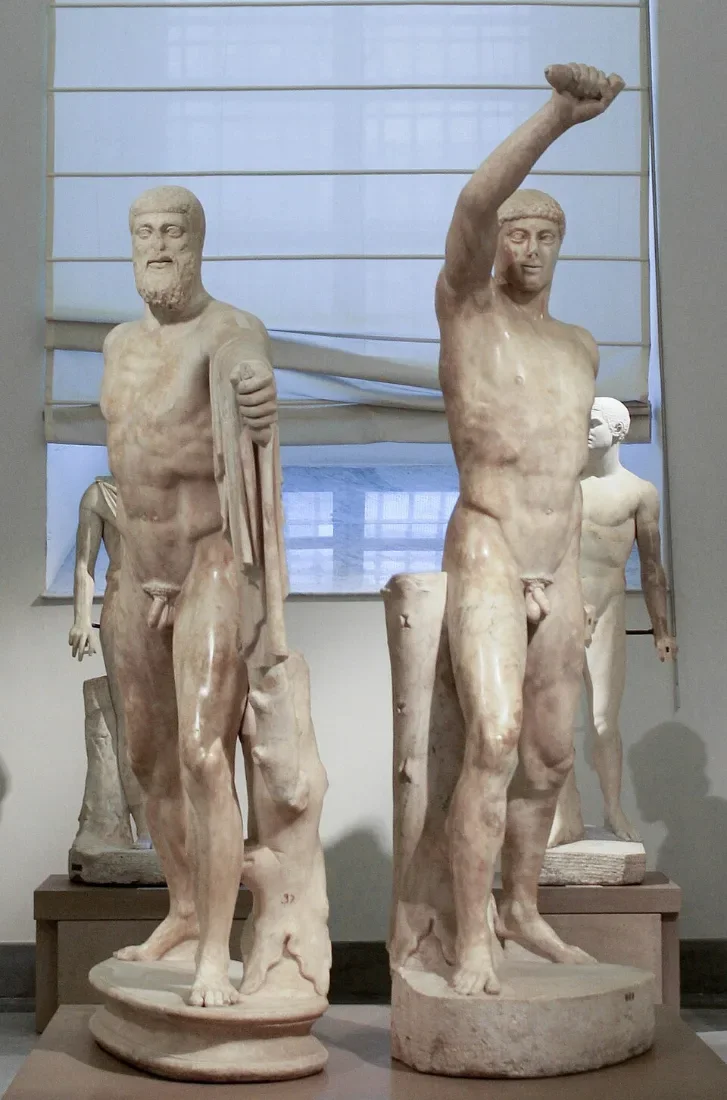
Skolia were short songs sung at symposia. They are conventionally called “drinking songs”. The earliest use of the word is in Pindar. Skolia have often been taken as an aristocratic art of the late sixth and fifth centuries BC. Yatromanolakis argues instead that their elite origins are hard to establish, and that they were also sung at state dinners, ritual banquets and wedding feasts.[1] Athenaeus praises Praxilla of Sicyon for her skolia. He describes three ways of singing at a drinking party, and gives a catalogue of twenty-five anonymous skolia. They range from hymns to the gods to maxims, myths and invitations to drink. One of them repeats a couplet that a scholiast attributes to Praxilla.[2] Later sources describe the genre as gnomic and “relaxed” in mode.[3]
Four of the skolia in Athenaeus’ collection (15.694a–695f) are scanned below, none by a named poet. Three are prayers: to Athena for the city (884), to Apollo and Artemis born on Delos (886), and to Pan (887). The fourth is the wish to become a piece of gold worn by a fine woman (901). Together they show the forms the Attic skolion takes.[4]
Text and translation
The uninterrupted Greek with its English translation, line by line.
Show text and translation
Παλλὰς Τριτογένει᾽, ἄνασσ’ Ἀθηνᾶ
Anonymous · Attic drinking songs (carmina convivialia) quoted by Athenaeus 15.694c–695f · three four-verse hymns and one two-verse song · text of Kaibel (Perseus), analysis of West 1987
How to read each line
A guide to the Greek, syllables, pitch marks and quantities.
Show the reading key
- Above each line: the line as the edition prints it, each word placed over its own syllables. The main row: the same Greek divided into metrical syllables, each written as it is pronounced. A consonant that closes a syllable is written with it (λόθ | ρο); an elided word is closed up with the next vowel (ν’ἀ); a final consonant carried into the next word is set with a thin space (ς ἰ). Wider gaps mark word-ends.
- Above the syllables: the pitch of each syllable, from the accents. Under them: the quantity of each syllable as it falls in the line, then the transliteration, syllable by syllable, with accented syllables in capitals.
- Under each line: a line-for-line translation. In the right margin of the scansion: the line type, its scheme, and its analysis into cola.
Key to the labels
The names, patterns and symbols used beside this poem.
Show the labels and symbols
The labels in the right margin of the scansion below give the line’s analysis as the scheme file states it, then its scheme and, where the analysis notes them, the period-end, a brevis in longo or a hiatus. ‖ marks the end of a period, ||| the end of the stanza; a line without a period-end runs on into the next (synapheia). × is an anceps, long or short; the last position of every period is indifferent. A click on any syllable highlights the colon it belongs to and explains it. The sources of the labels, with their page numbers, are given line by line under Prosody, line by line.
| Label | Name and shape | What it is |
|---|---|---|
| gl | Glyconic (gl)○ ○ — ⏑ ⏑ — ⏑ — | The glyconic: two positions of which at least one is long, a choriamb and ⏑ —.[5] It opens the first two verses of the four-verse skolion.[6] |
| iac | Catalectic iambic metron (ia∧)⏑ — — | The iambic metron without its last position.[5] In the skolion it follows the glyconic.[6] |
| v3 | Third verse⏑ ⏑ — ⏑ — — ⏑ ⏑ — | West says this verse resists all standard nomenclature, and gives it no label.[6] |
| dod | Dodrans (dod)— ⏑ ⏑ — ⏑ — | A choriamb followed by ⏑ —.[7] Two of them close the four-verse skolion, dovetailed: word-end comes one position after the end of the first, as West’s ∫ shows.[8] |
| glan | Anaclastic glyconic (¨gl)— ⏑ ⏑ — ⏑ — ⏑ — | The glyconic with its choriamb at the start.[9] |
| dodd | Dodrans with dactylic expansion (dodᵈ)— ⏑ ⏑ — ⏑ ⏑ — ⏑ — | The dodrans expanded by one more double short.[10] |
Scansion
Short songs that Athenian guests sang in turn after dinner. Many were sung to the same tunes, so a dozen of them share one four-verse stanza, and a few others a two-verse form: West analyses both, and three hymns and one wish-song are set here against his schemes.
Pallas Trito-born, lady Athena,
keep this city and its citizens upright,
without sufferings and factions
and deaths before their time, you and your father.
In Delos once Leto bore her children,
Phoebus of the golden hair, lord Apollo,
and the wild one who shoots the deer,
Artemis, whose power over women is great.
O Pan, lord of glorious Arcadia,
dancer, companion of the Bromian Nymphs,
may you laugh, O Pan, at these
cheerful songs of mine, and take delight in them.
If only I could become a great piece of gold, fine and untouched by fire,
and a fine woman would wear me, with her mind made pure.
Metre
- The collection. Athenaeus has his diners recite a series of the Attic skolia, which he praises for their antiquity and simplicity; he mentions that Praxilla of Sicyon was admired for composing skolia, and explains the name from the order of singing: in the third kind of after-dinner song only the guests reputed clever sang, wherever they lay, in no fixed sequence, and the song was called “crooked” for that reason (Athenaeus 15.694a–c, Kaibel)[11]. His list runs from short hymns to gods (884–887) to gnomic sayings, myth and invitations to drink.[11] West notes that “skolion” means only a song or excerpt performed as a party piece after dinner, and names no form of composition.[12]
- Genre. Yatromanolakis argues that the skolia need not all come from elite symposia, and that later sources describe them as tending towards maxims and proverbs, in a “relaxed” mode; some draw on proverbs, stories and fables.[13]
- The four-verse stanza. West observes that many skolia were sung to the same tunes, and that a dozen have this form: two verses gl ia∧, then ⏑ ⏑ — ⏑ — — ⏑ ⏑ —, a verse that, he says, resists all standard nomenclature, and finally dod ∫ dod, two dodrantes dovetailed, with word-end one position later than the end of the first (for ∫, p. ix)[6]. PMG 884, 886 and 887 follow it position for position here.
- The two-verse form. PMG 898–901 all have the form ¨gl ∫ dod ‖ ¨gl ∫ dodᵈ |||: an anaclastic glyconic dovetailed into a dodrans, and in the second verse into a dodrans with dactylic expansion.[6] PMG 901 is set here. In PMG 898 and 900 Kaibel’s text does not give West’s form without change (898 needs Τροΐαν in four syllables, as Campbell prints it, where Kaibel has Τροίαν; in 900 λύρα gives a short in the fourth position), so they are not set.[14]
- Periods. West marks period-end after every verse (‖, |||),[6] so the last position of each line is indifferent.
- Prosody. The workbench scans with the Attic rules, the metre deciding where stop + liquid may close a syllable or leave it open.[15] Macrons in the input are editorial aids and are not shown on the page.
- Text. Kaibel’s Athenaeus from Perseus. In 884.3 Kaibel deletes the τε of the manuscripts, as Campbell does (after Jacobs and Hermann), so the verse has West’s nine positions.[16] In 887 Campbell prints μεδέων (1), which gives the verse one syllable more than Kaibel’s μέδων, and εὐφροσύναις, ἀοιδᾷ (4, Page) where Kaibel prints Wilamowitz’s εὔφροσι ταῖσδ’ ἀοιδαῖς, with the same quantities.[17]
Prosody, line by line
Every syllable, with the reason for its length. Quantities are read from the vowel where the spelling shows it, from the consonants that follow (“position”), from the accent where it tells, and from the metre where nothing else does. Editors’ notes on the text follow in the boxed paragraphs.
- 884.1
Line 884.1 · Παλλὰς Τριτογένει᾽, ἄνασσ’ Ἀθηνᾶ,
Παλλὰς Τριτογένει᾽, ἄνασσ’ Ἀθηνᾶ,
ΠαλλὰςΤριτογένει’ἄνασσ’Ἀθηνᾶ,The label in the margin, with its sources: West 1987, p. 42.
- 1 —Παλα is a vowel of unknown length; closed by λ: long by position; the position is anceps.
- 2 —λὰςὰ is a vowel of unknown length; closed by ς: long by position; the position is anceps.
- 3 —Τριῑ is long (its length is not shown by the ordinary spelling).
- 4 ⏑τοο is short by nature.
- 5 ⏑γέέ is short by nature.
- 6 —νει’ει is a diphthong, long by nature; the apostrophe marks an elided vowel; the consonant before it joins this syllable.
- 7 ⏑ἄἄ is short by the metre (position 7 must be short).
- 8 —νασα is a vowel of unknown length; closed by σ: long by position.
- 9 ⏑σ’ἈἈ is short by the metre (position 9 must be short); the apostrophe marks an elided vowel; the consonant before it joins this syllable.
- 10 —θηη is long by nature.
- 11 ×νᾶ,ᾶ carries a circumflex, so it is long; the last position of the period is indifferent.
- 884.2
Line 884.2 · ὄρθου τήνδε πόλιν τε καὶ πολίτας,
ὄρθου τήνδε πόλιν τε καὶ πολίτας,
ὄρθουτήνδεπόλιντεκαὶπολίτας,The label in the margin, with its sources: West 1987, p. 42.
- 1 —ὄρὄ is short by nature; closed by ρ: long by position; the position is anceps.
- 2 —θουου is a diphthong, long by nature; the position is anceps.
- 3 —τήνή is long by nature; closed by ν: long by position.
- 4 ⏑δεε is short by nature.
- 5 ⏑πόό is short by nature.
- 6 —λινι is a vowel of unknown length; closed by ν: long by position.
- 7 ⏑τεε is short by nature.
- 8 —καὶαὶ is a diphthong, long by nature.
- 9 ⏑ποο is short by nature.
- 10 —λίί is long by the metre (position 10 must be long).
- 11 ×τας,α is a vowel of unknown length; closed by ς: long by position; the last position of the period is indifferent.
gl ia∧. ὄρθου τήν-: the base is again two longs. πολίτας has a long ι,[20] which fills the last long of the ia∧.- 884.3
Line 884.3 · ἄτερ ἀλγέων καὶ στάσεων
ἄτερ ἀλγέων καὶ στάσεων
ἄτερ ἀλγέωνκαὶστάσεωνThe label in the margin, with its sources: West 1987, p. 42 (no label).
- 1 ⏑ἄἄ is short by the metre (position 1 must be short).
- 2 ⏑τεε is short by nature.
- 3 —ρ ἀλἀ is a vowel of unknown length; closed by λ: long by position; the first consonant belongs to the previous word and is carried over to this vowel.
- 4 ⏑γέέ is short by nature.
- 5 —ωνω is long by nature; closed by ν: long by position.
- 6 —καὶαὶ is a diphthong, long by nature; the next word begins with στ: the syllable is closed before it: long by position.
- 7 ⏑στάά is short by the metre (position 7 must be short).
- 8 ⏑σεε is short by nature.
- 9 ×ωνω is long by nature; closed by ν: long by position; the last position of the period is indifferent.
⏑ ⏑ — ⏑ — — ⏑ ⏑ —, the verse West leaves unnamed.[6] Kaibel and Campbell delete the τε of the manuscripts after ἀλγέων.[16] The ρ of ἄτερ passes to ἀλγέων.- 884.4
Line 884.4 · καὶ θανάτων ἀώρων σύ τε καὶ πατήρ.
καὶ θανάτων ἀώρων σύ τε καὶ πατήρ.
καὶθανάτωνἀώρωνσύτεκαὶπατήρ.The label in the margin, with its sources: West 1987, p. 42.
- 1 —καὶαὶ is a diphthong, long by nature.
- 2 ⏑θαα is short by the metre (position 2 must be short).
- 3 ⏑νάά is short by the metre (position 3 must be short).
- 4 —τωνω is long by nature.
- 5 ⏑ἀἀ is short by the metre (position 5 must be short).
- 6 —ώώ is long by nature.
- 7 —ρωνω is long by nature; closed by ν: long by position.
- 8 ⏑σύύ is short by the metre (position 8 must be short).
- 9 ⏑τεε is short by nature.
- 10 —καὶαὶ is a diphthong, long by nature.
- 11 ⏑παα is short by the metre (position 11 must be short).
- 12 ×τήρ.ή is long by nature; closed by ρ: long by position; the last position of the period is indifferent.
- 886.1
Line 886.1 · ἐν Δήλῳ ποτ’ ἔτικτε τέκνα Λατώ,
ἐν Δήλῳ ποτ’ ἔτικτε τέκνα Λατώ,
ἐνΔήλῳποτ’ἔτικτετέκναΛατώ,The label in the margin, with its sources: West 1987, p. 42.
- 1 —ἐνἐ is short by nature; closed by ν: long by position; the position is anceps.
- 2 —Δήή is long by nature; the position is anceps.
- 3 —λῳῳ is long by nature.
- 4 ⏑ποο is short by nature.
- 5 ⏑τ’ἔἔ is short by nature; the apostrophe marks an elided vowel; the consonant before it joins this syllable.
- 6 —τικι is a vowel of unknown length; closed by κ: long by position.
- 7 ⏑τεε is short by nature.
- 8 —τέκέ is short by nature; closed by κ before a nasal: the stop + nasal cluster makes position here, as the metre requires (tragedy allows either).
- 9 ⏑ναα is short by the metre (position 9 must be short).
- 10 —Λαα is long by the metre (position 10 must be long).
- 11 ×τώ,ώ is long by nature; the last position of the period is indifferent.
gl ia∧. τέκνα: κν closes τέκ-. Λᾱτώ is the Doric form.[22]- 886.2
Line 886.2 · Φοῖβον χρυσοκόμαν, ἄνακτ’ Ἀπόλλω,
Φοῖβον χρυσοκόμαν, ἄνακτ’ Ἀπόλλω,
Φοῖβονχρυσοκόμαν,ἄνακτ’Ἀπόλλω,The label in the margin, with its sources: West 1987, p. 42.
- 1 —Φοῖοῖ is a diphthong, long by nature; the position is anceps.
- 2 —βονο is short by nature; closed by ν: long by position; the position is anceps.
- 3 —χρυῡ is long (its length is not shown by the ordinary spelling).
- 4 ⏑σοο is short by nature.
- 5 ⏑κόό is short by nature.
- 6 —μαν,α is long by the metre (position 6 must be long).
- 7 ⏑ἄἄ is short by the metre (position 7 must be short).
- 8 —νακα is a vowel of unknown length; closed by κ: long by position.
- 9 ⏑τ’ἈἈ is short by the metre (position 9 must be short); the apostrophe marks an elided vowel; the consonant before it joins this syllable.
- 10 —πόλό is short by nature; closed by λ: long by position.
- 11 ×λω,ω is long by nature; the last position of the period is indifferent.
gl ia∧. χρῡσοκόμαν, Doric accusative with long ᾱ, has a long υ.[23] ἄνακτ’ is elided.- 886.3
Line 886.3 · ἐλαφηβόλον τ’ ἀγροτέραν
ἐλαφηβόλον τ’ ἀγροτέραν
ἐλαφηβόλοντ’ἀγροτέρανThe label in the margin, with its sources: West 1987, p. 42 (no label).
- 1 ⏑ἐἐ is short by nature.
- 2 ⏑λαα is short by the metre (position 2 must be short).
- 3 —φηη is long by nature.
- 4 ⏑βόό is short by nature.
- 5 —λονο is short by nature; closed by ν: long by position.
- 6 —τ’ἀγἀ is a vowel of unknown length; closed by γ before a liquid: the stop + liquid cluster makes position here, as the metre requires (tragedy allows either); the apostrophe marks an elided vowel; the consonant before it joins this syllable.
- 7 ⏑ροο is short by nature.
- 8 ⏑τέέ is short by nature.
- 9 ×ρανα is a vowel of unknown length; closed by ν: long by position; the last position of the period is indifferent.
- 886.4
Line 886.4 · Ἄρτεμιν, ἃ γυναικῶν μέγ’ ἔχει κράτος.
Ἄρτεμιν, ἃ γυναικῶν μέγ’ ἔχει κράτος.
Ἄρτεμι,ν ἃγυναικῶνμέγ’ἔχεικράτος.The label in the margin, with its sources: West 1987, p. 42.
- 1 —ἌρἌ is a vowel of unknown length; closed by ρ: long by position.
- 2 ⏑τεε is short by nature.
- 3 ⏑μι,ι is short by the accent rule: acute on the antepenult requires a short final syllable.
- 4 —ν ἃἃ is long by the metre (position 4 must be long); the first consonant belongs to the previous word and is carried over to this vowel.
- 5 ⏑γυυ is short by the metre (position 5 must be short).
- 6 —ναιαι is a diphthong, long by nature.
- 7 —κῶνῶ is long by nature; closed by ν: long by position.
- 8 ⏑μέέ is short by nature.
- 9 ⏑γ’ἔἔ is short by nature; the apostrophe marks an elided vowel; the consonant before it joins this syllable.
- 10 —χειει is a diphthong, long by nature.
- 11 ⏑κράά is short by the metre (position 11 must be short).
- 12 ×τος.ο is short by nature; closed by ς: long by position; the last position of the period is indifferent.
dod ∫ dod: Ἄρτεμιν, ἃ γυναι- | -κῶν, word-end one position after the first dodrans. μέγ’ is elided.- 887.1
Line 887.1 · ὦ Πάν, Ἀρκαδίας μέδων κλεεννᾶς,
ὦ Πάν, Ἀρκαδίας μέδων κλεεννᾶς,
ὦΠάν,Ἀρκαδίαςμέδωνκλεεννᾶς,The label in the margin, with its sources: West 1987, p. 42.
- 1 —ὦὦ is long by nature; the position is anceps.
- 2 —Πάν,ᾱ́ is long (its length is not shown by the ordinary spelling); the position is anceps.
- 3 —ἈρἈ is a vowel of unknown length; closed by ρ: long by position.
- 4 ⏑καα is short by the metre (position 4 must be short).
- 5 ⏑δίί is short by the metre (position 5 must be short).
- 6 —αςα is a vowel of unknown length; closed by ς: long by position.
- 7 ⏑μέέ is short by nature.
- 8 —δωνω is long by nature; closed by ν: long by position.
- 9 ⏑κλεε is short by nature.
- 10 —ενε is short by nature; closed by ν: long by position.
- 11 ×νᾶς,ᾶ carries a circumflex, so it is long; closed by ς: long by position; the last position of the period is indifferent.
- 887.2
Line 887.2 · ὀρχηστὰ Βρομίαις ὀπαδὲ Νύμφαις,
ὀρχηστὰ Βρομίαις ὀπαδὲ Νύμφαις,
ὀρχηστὰΒρομίαιςὀπαδὲΝύμφαις,The label in the margin, with its sources: West 1987, p. 42.
- 1 —ὀρὀ is short by nature; closed by ρ: long by position; the position is anceps.
- 2 —χηση is long by nature; closed by σ: long by position; the position is anceps.
- 3 —τὰὰ is a vowel of unknown length; the next word begins with Βρ: the syllable is closed before it: long by position.
- 4 ⏑Βροο is short by nature.
- 5 ⏑μίί is short by the metre (position 5 must be short).
- 6 —αιςαι is a diphthong, long by nature.
- 7 ⏑ὀὀ is short by nature.
- 8 —παα is long by the metre (position 8 must be long).
- 9 ⏑δὲὲ is short by nature.
- 10 —Νύμύ is a vowel of unknown length; closed by μ: long by position.
- 11 ×φαις,αι is a diphthong, long by nature; closed by ς: long by position; the last position of the period is indifferent.
- 887.3
Line 887.3 · γελάσειας, ὦ Πάν, ἐπ’ ἐμαῖς
γελάσειας, ὦ Πάν, ἐπ’ ἐμαῖς
γελάσεια,ς ὦΠάν,ἐπ’ἐμαῖςThe label in the margin, with its sources: West 1987, p. 42 (no label).
- 1 ⏑γεε is short by nature.
- 2 ⏑λάά is short by the metre (position 2 must be short).
- 3 —σειει is a diphthong, long by nature.
- 4 ⏑α,α is short by the accent rule: acute on the antepenult requires a short final syllable.
- 5 —ς ὦὦ is long by nature; the first consonant belongs to the previous word and is carried over to this vowel.
- 6 —Πάν,ᾱ́ is long (its length is not shown by the ordinary spelling).
- 7 ⏑ἐἐ is short by nature.
- 8 ⏑π’ἐἐ is short by nature; the apostrophe marks an elided vowel; the consonant before it joins this syllable.
- 9 ×μαῖςαῖ is a diphthong, long by nature; closed by ς: long by position; the last position of the period is indifferent.
The unnamed verse: γελάσειας, ὦ Πᾶν, ἐπ’ ἐμαῖς. The ς of γελάσειας passes to ὦ; ἐπ’ is elided.- 887.4
Line 887.4 · εὔφροσι ταῖσδ’ ἀοιδαῖς κεχαρημένος.
εὔφροσι ταῖσδ’ ἀοιδαῖς κεχαρημένος.
εὔφροσιταῖσδ’ἀοιδαῖςκεχαρημένος.The label in the margin, with its sources: West 1987, p. 42.
- 1 —εὔεὔ is a diphthong, long by nature.
- 2 ⏑φροο is short by nature.
- 3 ⏑σιι is short by the accent rule: acute on the antepenult requires a short final syllable.
- 4 —ταῖσαῖ is a diphthong, long by nature; closed by σ: long by position.
- 5 ⏑δ’ἀἀ is short by the metre (position 5 must be short); the apostrophe marks an elided vowel; the consonant before it joins this syllable.
- 6 —οιοι is a diphthong, long by nature.
- 7 —δαῖςαῖ is a diphthong, long by nature; closed by ς: long by position.
- 8 ⏑κεε is short by nature.
- 9 ⏑χαα is short by the metre (position 9 must be short).
- 10 —ρηη is long by nature.
- 11 ⏑μέέ is short by nature.
- 12 ×νος.ο is short by nature; closed by ς: long by position; the last position of the period is indifferent.
dod ∫ dod: εὔφροσι ταῖσδ’ ἀοι- | -δαῖς. Kaibel prints Wilamowitz’s text; Campbell has Page’s εὐφροσύναις, ἀοιδᾷ, with the same quantities.[17]- 901.1
Line 901.1 · εἴθ’ ἄπυρον καλὸν γενοίμην μέγα χρυσίον
εἴθ’ ἄπυρον καλὸν γενοίμην μέγα χρυσίον
εἴθ’ἄπυρονκαλὸνγενοίμηνμέγαχρυσίονThe label in the margin, with its sources: West 1987, p. 42 (PMG 898-901).
- 1 —εἴεἴ is a diphthong, long by nature.
- 2 ⏑θ’ἄἄ is short by the metre (position 2 must be short); the apostrophe marks an elided vowel; the consonant before it joins this syllable.
- 3 ⏑πυυ is short by the metre (position 3 must be short).
- 4 —ρονο is short by nature; closed by ν: long by position.
- 5 ⏑καα is short by the metre (position 5 must be short).
- 6 —λὸνὸ is short by nature; closed by ν: long by position.
- 7 ⏑γεε is short by nature.
- 8 —νοίοί is a diphthong, long by nature.
- 9 —μηνη is long by nature; closed by ν: long by position.
- 10 ⏑μέέ is short by nature.
- 11 ⏑γαα is a vowel of unknown length; the next word begins with χρ, a stop + liquid that does not make position here, so the syllable stays short.
- 12 —χρυῡ is long (its length is not shown by the ordinary spelling).
- 13 ⏑σίί is short by the metre (position 13 must be short).
- 14 ×ονο is short by nature; closed by ν: long by position; the last position of the period is indifferent.
- 901.2
Line 901.2 · καί με καλὴ γυνὴ φοροίη καθαρὸν θεμένη νόον.
καί με καλὴ γυνὴ φοροίη καθαρὸν θεμένη νόον.
καίμεκαλὴγυνὴφοροίηκαθαρὸνθεμένηνόον.The label in the margin, with its sources: West 1987, p. 42 (PMG 898-901).
- 1 —καίαί is a diphthong, long by nature.
- 2 ⏑μεε is short by nature.
- 3 ⏑καα is short by the metre (position 3 must be short).
- 4 —λὴὴ is long by nature.
- 5 ⏑γυυ is short by the metre (position 5 must be short).
- 6 —νὴὴ is long by nature.
- 7 ⏑φοο is short by nature.
- 8 —ροίοί is a diphthong, long by nature.
- 9 —ηη is long by nature.
- 10 ⏑καα is short by the metre (position 10 must be short).
- 11 ⏑θαα is short by the metre (position 11 must be short).
- 12 —ρὸνὸ is short by nature; closed by ν: long by position.
- 13 ⏑θεε is short by nature.
- 14 ⏑μέέ is short by nature.
- 15 —νηη is long by nature.
- 16 ⏑νόό is short by nature.
- 17 ×ον.ο is short by nature; closed by ν: long by position; the last position of the period is indifferent.
Notes
- ^ Yatromanolakis 2009, pp. 271–273.
- ^ Natoli et al. 2022, p. 177.
- ^ Yatromanolakis 2009, p. 273.
- ^ West 1987, p. 42 n. 6.
- ^ a b West 1987, p. x.
- ^ a b c d e f g h i j West 1987, p. 42.
- ^ West 1987, p. ix.
- ^ a b West 1987, pp. ix, 42.
- ^ West 1987, pp. x, 42.
- ^ West 1987, pp. x, 34, 42.
- ^ a b Natoli et al. 2022, p. 177.
- ^ West 1987, p. 42 n. 6.
- ^ Yatromanolakis 2009, pp. 271–273.
- ^ Campbell 1993, p. 288.
- ^ a b c West 1987, pp. 16–17.
- ^ a b Campbell 1993, p. 278.
- ^ a b c Campbell 1993, p. 280.
- ^ LSJ s.v. Τριτογένεια.
- ^ West 1987, p. 13.
- ^ LSJ s.v. πολίτης.
- ^ LSJ s.v. ἄωρος.
- ^ LSJ s.v. Λητώ.
- ^ LSJ s.v. χρυσοκόμης.
- ^ a b c LSJ s.v.
- ^ LSJ s.v. Πάν.
- ^ LSJ s.v. κλεεννός.
- ^ LSJ s.v. βρόμιος.
- ^ LSJ s.v. ὀπηδός.
- ^ West 1987, p. 34.
Text and sources
- Text: Athenaeus, Deipnosophistae 15.694c–695f (= 15.50 Kaibel), ed. G. Kaibel (Teubner, 1887–1890), from the Perseus Digital Library (urn:cts:greekLit:tlg0008.tlg001.perseus-grc3), CC BY-SA 4.0; Kaibel’s edition is in the public domain.
- M. L. West, Introduction to Greek Metre (Oxford 1987), p. 42 with n. 6 (the forms of the Attic skolia), pp. ix–x, 13, 16–17, 34; p. 42 checked on the page image at 400 dpi.
- B. A. Natoli, A. Pitts and J. P. Hallett, Ancient Women Writers of Greece and Rome (Routledge 2022), ch. 7 ‘Praxilla’, p. 177.
- D. Yatromanolakis, ‘Ancient Greek popular song’, in F. Budelmann (ed.), The Cambridge Companion to Greek Lyric (Cambridge 2009), pp. 271–273.
- Vowel quantities: Liddell–Scott–Jones (Perseus Digital Library, CC BY-SA), s.vv. Τριτογένεια, Λητώ, χρυσοκόμης, Πάν, κλεεννός, ἄπυρος, χρυσίον, ἄωρος, ἐλαφηβόλος, βρόμιος, πολίτης, ὀπηδός.
- D. A. Campbell, Greek Lyric V (Loeb Classical Library 144, Cambridge, MA 1993), pp. 278–281, 288–289 (PMG 884–888, 898–901), compared line by line.
- Translation: metrehelp.org, CC BY-SA 4.0.
Quotations from copyrighted works are not covered by this page’s licence.
The scorpion skolion (PMG 750)
Synopsis
A friend receives a warning: a scorpion may lie beneath any stone. A scholiast on Aristophanes attributes this single line to Praxilla. A related two-line song survives among the anonymous skolia, with different wording. The attribution to Praxilla is disputed.[1]
The one surviving line is scanned below. Its greater asclepiad contains three choriambs, each long–short–short–long, between the opening pair of syllables and the close.[2]
Text and translation
The uninterrupted Greek with its English translation, line by line.
Show text and translation
Ὑπὸ παντὶ λίθῳ σκορπίον, ὦ ’ταῖρε, φυλάσσεο.
Attributed to Praxilla · a proverbial drinking-song · one greater asclepiad
How to read each line
A guide to the Greek, syllables, pitch marks and quantities.
Show the reading key
- Above each line: the line as the edition prints it, each word placed over its own syllables. The main row: the same Greek divided into metrical syllables, each written as it is pronounced. A consonant that closes a syllable is written with it (λόθ | ρο); an elided word is closed up with the next vowel (ν’ἀ); a final consonant carried into the next word is set with a thin space (ς ἰ). Wider gaps mark word-ends.
- Above the syllables: the pitch of each syllable, from the accents. Under them: the quantity of each syllable as it falls in the line, then the transliteration, syllable by syllable, with accented syllables in capitals.
- Under each line: a line-for-line translation. In the right margin of the scansion: the line type, its scheme, and its analysis into cola.
Key to the labels
The names, patterns and symbols used beside this poem.
Show the labels and symbols
The labels in the right margin of the scansion below give the line’s analysis as the scheme file states it, then its scheme and, where the analysis notes them, the period-end, a brevis in longo or a hiatus. ‖ marks the end of a period, ||| the end of the stanza; a line without a period-end runs on into the next (synapheia). × is an anceps, long or short; the last position of every period is indifferent. A click on any syllable highlights the colon it belongs to and explains it. The sources of the labels, with their page numbers, are given line by line under Prosody, line by line.
Scansion
A warning to a friend: the sixteen syllables of this proverbial line contain three choriambs. Its attribution to Praxilla is disputed.
Watch for a scorpion under every stone, my friend.
Metre
The verse warns a friend to watch for hidden danger. It survives in the scholia to Aristophanes’ Thesmophoriazusae, attributed to Praxilla. A related anonymous drinking-song has a different ending and a second line. The attribution is disputed; the present text preserves the single line with φυλάσσεο, “watch out”, rather than importing words from that other version.[4]
A choriamb has the pattern — ⏑ ⏑ —: long, short, short, long. This line has three choriambs between its two opening syllables and its two-syllable close. That makes it a greater asclepiad. It is a glyconic expanded by two extra choriambs.[5]
The scheme is × × | — ⏑ ⏑ — | — ⏑ ⏑ — | — ⏑ ⏑ — | ⏑ ×. The first two positions form the aeolic base. Both are short here, in Ὑ-πὸ. A cross, ×, means that the position admits either quantity. The final -ο is short, but closes the verse in an indifferent position.[6]
The three choriambs are παν-τὶ λί-θῳ, σκορ-πί-ον ὦ, and ταῖ-ρε φυ-λάσ-. The last one crosses a word boundary and ends inside φυλάσσεο. Metrical groups need not match whole words. The closing -σε-ο has two separate syllables.
Reading the line. The recording is a synthetic pronunciation model of the displayed Greek. It follows the sixteen scanned syllables; it is not an ancient tune or a human performance.
∿ The scorpion skolion, synthetic
Basis of the scan. The edition explicitly connects the rhythm of this fragment with that of the Admetus skolion. Its printed scheme for the latter supplies the pattern used here. The nearby scheme for the window poem belongs to a different fragment and a different metre.[3]
Prosody, line by line
Every syllable, with the reason for its length. Quantities are read from the vowel where the spelling shows it, from the consonants that follow (“position”), from the accent where it tells, and from the metre where nothing else does. Editors’ notes on the text follow in the boxed paragraphs.
- 750
Line 750 · Ὑπὸ παντὶ λίθῳ σκορπίον, ὦ ’ταῖρε, φυλάσσεο.
Ὑπὸ παντὶ λίθῳ σκορπίον, ὦ ’ταῖρε, φυλάσσεο.
Ὑπὸπαντὶλίθῳσκορπίο,ν ὦταῖρε,φυλάσσεο.The label in the margin, with its sources: Bergk 1882, pp. 567, 650.
- 1 ⏑ὙὙ̆ is short (its length is not shown by the ordinary spelling); the position is anceps.
- 2 ⏑πὸὸ is short by nature; the position is anceps.
- 3 —πανα is a vowel of unknown length; closed by ν: long by position.
- 4 ⏑τὶὶ is short by the metre (position 4 must be short).
- 5 ⏑λίί is short by the metre (position 5 must be short).
- 6 —θῳῳ is long by nature; the next word begins with σκ: the syllable is closed before it: long by position.
- 7 —σκορο is short by nature; closed by ρ: long by position.
- 8 ⏑πίί is short by the metre (position 8 must be short).
- 9 ⏑ο,ο is short by nature.
- 10 —ν ὦὦ is long by nature; the first consonant belongs to the previous word and is carried over to this vowel.
- 11 —ταῖαῖ is a diphthong, long by nature.
- 12 ⏑ρε,ε is short by nature.
- 13 ⏑φυυ is short by the metre (position 13 must be short).
- 14 —λάσά is a vowel of unknown length; closed by σ: long by position.
- 15 ⏑σεε is short by nature.
- 16 ×ο.ο is short by nature; the last position of the period is indifferent; a short here is brevis in longo.
Ὑπὸ supplies the two short opening syllables; the υ is short.[7] In παντί, ν closes the first syllable before τ. In σκορπίον, ρ closes σκορ- before π. At σκορπίον ὦ, the single final ν is carried to the following vowel, leaving -ο- short. The syllable row shows that join.[8]
ὦ ’ταῖρε has three syllables. The apostrophe marks the missing opening vowel of ἑταῖρε, “friend”. The printed form already shows this loss; no further vowel fusion is needed. The ω and αι are long. The double σ in φυλάσσεο closes λάσ-, making that syllable heavy. Its ε and final ο remain separate.[9]
Notes
- ^ Bergk 1882, pp. 567, 650; Cazzato 2016, p. 193.
- ^ Bergk 1882, pp. 567, 650; West 1987, pp. 33–34.
- ^ a b c Bergk 1882, pp. 567, 650.
- ^ Bergk 1882, pp. 567, 650; Cazzato 2016, p. 193.
- ^ West 1987, pp. 33–34.
- ^ Bergk 1882, pp. 567, 650; West 1987, pp. 33–34.
- ^ LSJ s.v. ὑπό.
- ^ West 1987, p. 12.
- ^ Bergk 1882, p. 567; West 1987, p. 12.
Text and sources
- Greek and metrical basis: T. Bergk (ed.), Poetae Lyrici Graeci, ed. 4, vol. III (Leipzig: Teubner, 1882), p. 567, Praxilla fr. 4; p. 650, skolia 21–23. Public-domain edition, transcribed from the scanned page images at the Internet Archive. Greek letters, accents and punctuation follow p. 567.
- Metrical terminology and syllable weight: M. L. West, Introduction to Greek Metre (Oxford 1987), pp. 12, 33–34.
- Attribution: V. Cazzato, “‘Glancing Seductively through Windows’: The Look of Praxilla fr. 8 (PMG 754)”, in V. Cazzato and A. Lardinois (eds), The Look of Lyric (Leiden: Brill, 2016), p. 193. The discussion includes PMG 750 and its relation to the anonymous skolion PMG 903.
- Vowel quantity: LSJ, s.v. ὑπό, Scaife ATLAS, Perseus Digital Library.
- Translation, commentary and synthetic pronunciation model: metrehelp.org, CC BY-SA 4.0. Audio generated from this Greek and scan with the existing acc_core formant/Praat model; no ancient melody is claimed.
Quotations from copyrighted works are not covered by this page’s licence.


