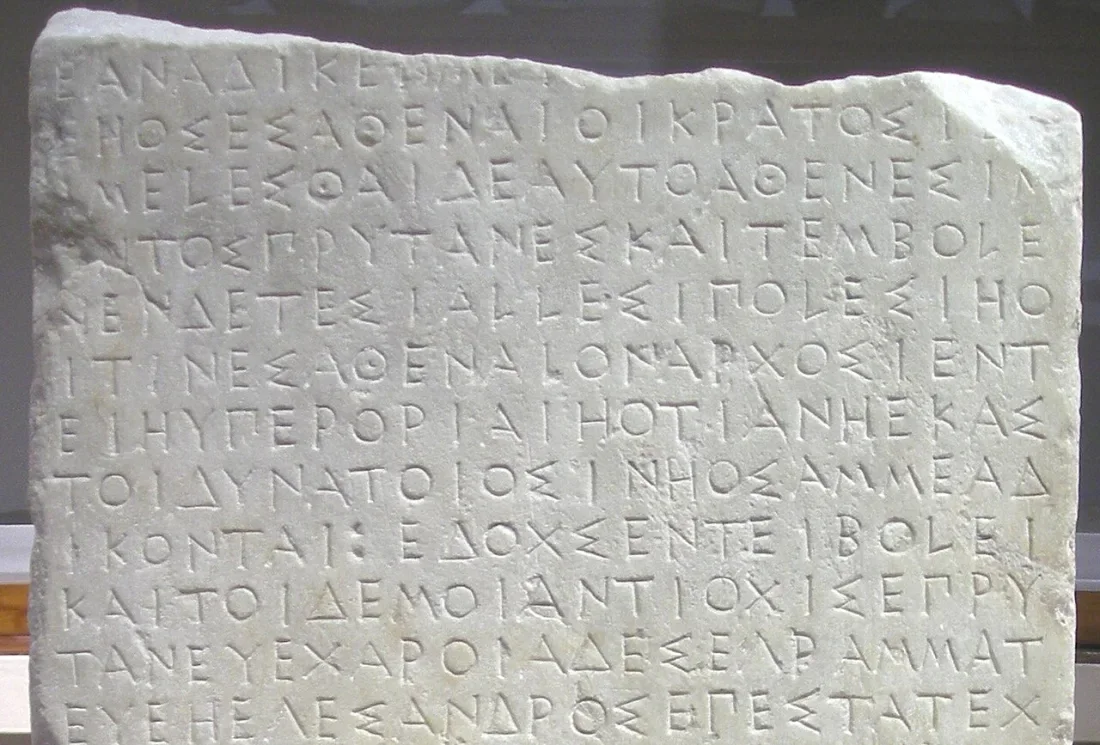
Sounds
The vowels, consonants and syllables of classical Greek, and how we reconstruct their sounds.
2. Sounds · 1 of 7
The vowels of classical Attic
A reconstructed pronunciation has to choose a time and a place. The usual choice is the Attic of the fifth century BC. The Attic of the fourth century differs from it very little, so both can go under the name “classical Greek”. The poets of other dialects and other ages are then read roughly as an Athenian of the fifth century would have read them.[1] The English words given as models below are in standard southern British English.[2] Their IPA follows the standard description of that accent; the French, German and Italian words follow the Association’s descriptions of those languages.[3]
Twelve vowels
Here length means how long a vowel is held; quality means which vowel sound it is. The table describes the position of the tongue and lips.[4] A close vowel is made with the tongue high in the mouth, and an open vowel with the tongue low. A mid vowel lies between them. Close-mid and open-mid are two steps of mid, the first a little higher than the second. A front vowel is made with the tongue pushed forward, and a back vowel with it drawn back. A rounded vowel is made with the lips rounded. The Mouth and vowels tab places all these vowels on the IPA’s vowel chart.
Classical Attic had five short vowels and seven long ones. A short vowel and a long vowel were not, it seems, very different in quality: Greek shows no sign that its short vowels were much more open or much closer than its long ones, as they were in Latin.[5] The seven long vowels were ι, ει, η, ᾱ, ω, ου and υ, which in the IPA are [iː eː ɛː aː ɔː uː yː].[6] Two of them, ει and ου, are written with two letters. The Diphthongs and digraphs tab explains why.
The table gives each vowel with its sound in the IPA, a short description, and the nearest sound in a modern language.[7] Press a sound to hear it. The short and the long clip of one vowel differ only in length.
| Letter | Sound | Description | Like | Hear | In a word |
|---|---|---|---|---|---|
| ᾰ | [a] | short open a | first a of Italian amare [aˈmaːre]; roughly English cup [kʌp], not cap [kæp] | ἄναξ anax [ánaks] “lord” | |
| ᾱ | [aː] | the same, long | second a of Italian amare; roughly English father [ˈfɑːðə] | πᾶσι pāsi [pâːsi] “to all” | |
| ε | [e] | short mid front | English pet [pet] | τέκε teke [téke] “bore (a child)” | |
| ο | [o] | short mid back | German Gott [ɡɔt]; roughly English pot [pɒt] | ὄρσε orse [órse] “stirred up” | |
| ῐ | [i] | short close front | French vite [vit], closer than English bit [bɪt] | Διὸς Dios [diòs] “of Zeus” | |
| ῑ | [iː] | the same, long | French vive [viv]; roughly English bead [biːd] | δῖος dīos [dîːos] “godlike” | |
| ῠ | [y] | short close front rounded | French lune [lyn] | κύνεσσιν kynessin [kýnessin] “for the dogs” | |
| ῡ | [yː] | the same, long | French ruse [ʁyz], the vowel held longer | κλῦθί klȳthi [klŷːtʰí][klŷːθí] “hear!” | |
| η | [ɛː] | long open-mid front | French tête [tɛt], the vowel held longer | ἥρως hērōs [hɛ́ːrɔːs] “hero” | |
| ει | [eː] | long close-mid front | German Beet [beːt] | ἄειδε aeide [áeːde] “sing!” | |
| ω | [ɔː] | long open-mid back | English saw [sɔː] | ὠκὺς ōkys [ɔːkỳs] “swift” | |
| ου | [uː] | long close back | English pool [puːl], French rouge [ʁuʒ] | βουλή boulē [buːlɛ́ː] “plan, will” |
Pairs to compare
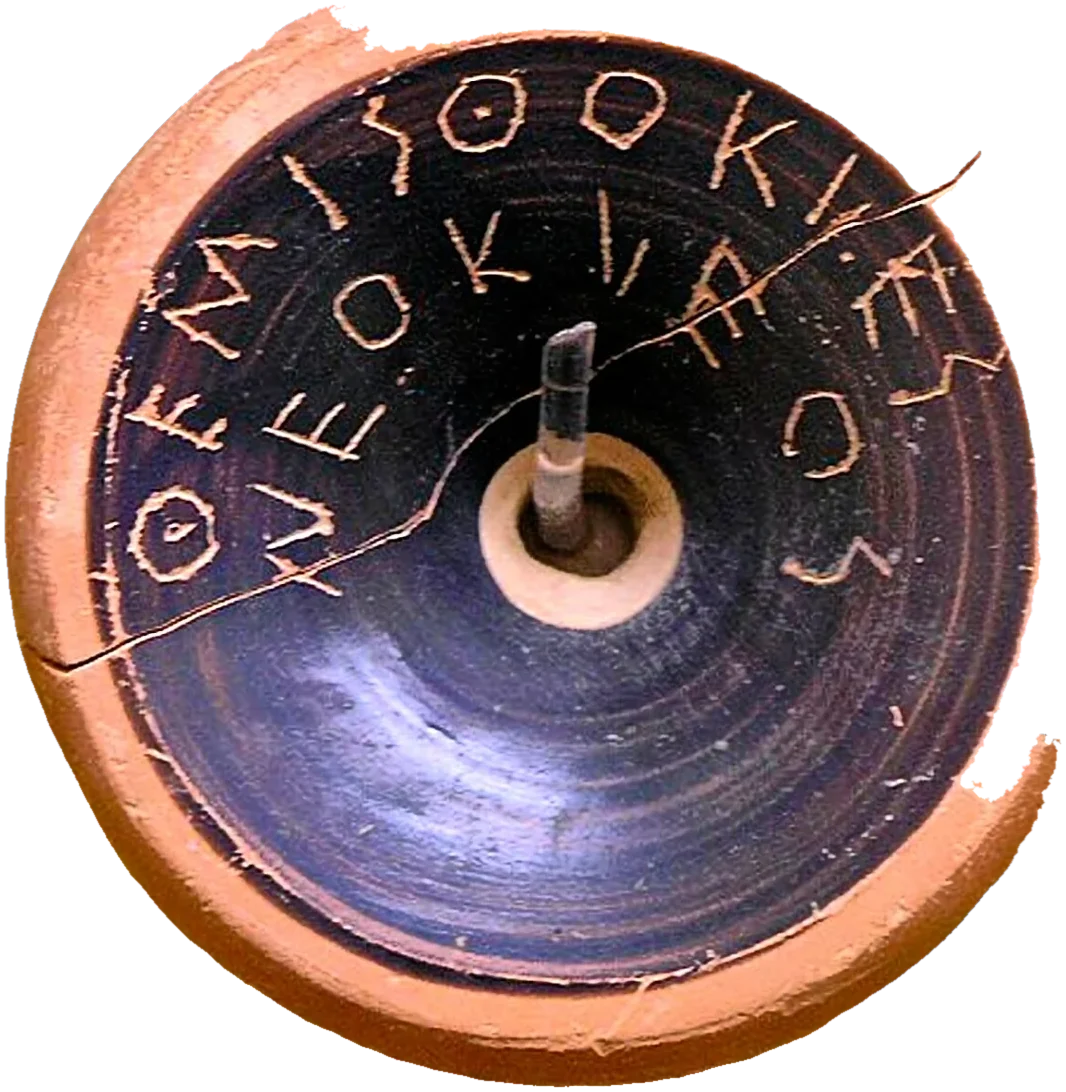
Some vowels that English speakers tend to merge were distinct in Attic. η and ει were both long front vowels, but η was open-mid [ɛː] and ει close-mid [eː]. ω and ου were both long back vowels, but ω was open-mid [ɔː] and ου close [uː]. The short vowels also differ from the long ones in length. Press each pair one after the other.
| Pair | First | Second | The difference | In words |
|---|---|---|---|---|
| η / ει | open-mid against close-mid | ἥρως hērōs [hɛ́ːrɔːs] “hero” ἄειδε aeide [áeːde] “sing!” | ||
| ω / ου | open-mid against close | ὠκὺς ōkys [ɔːkỳs] “swift” βουλή boulē [buːlɛ́ː] “plan, will” | ||
| ε / ει | short against long | τέκε teke [téke] “bore (a child)” ἄειδε aeide [áeːde] “sing!” | ||
| ο / ω | short close-mid against long open-mid | ὄρσε orse [órse] “stirred up” ὠκὺς ōkys [ɔːkỳs] “swift” | ||
| α / ᾱ | short against long | ἄναξ anax [ánaks] “lord” πᾶσι pāsi [pâːsi] “to all” | ||
| ι / ῑ | short against long | Διὸς Dios [diòs] “of Zeus” δῖος dīos [dîːos] “godlike” | ||
| υ / ῡ | short against long | κύνεσσιν kynessin [kýnessin] “for the dogs” κλῦθί klȳthi [klŷːtʰí][klŷːθí] “hear!” |
Notes on the letters
α had the same quality whether it was long or short. Latin wrote both with a.[8]
ε and ο were ordinary mid vowels. They were not specially close.[9] ε is not the short partner of η. In Attic a lengthened ε gives ει, as φανείς beside φανέντες shows. There is no good reason to pair ε with either η or ει.[10]
υ was once [u], as related words in other languages show: ζυγόν “yoke” matches Latin iugum. In Attic and Ionic the vowel moved forward early to [y], the vowel of French lune [lyn].[11] When the Boeotians took over the Attic alphabet, about 350 BC, they could not use υ for their own [u], and wrote ου instead.[12]
The movement of υ was the last step of a chain of changes. When ει and ου became single long vowels, the back of the mouth had one long vowel too many. Long ου rose towards [uː], and the old long [uː] was pushed forward to [yː].[13] A word that begins with υ always has the rough breathing.[14]
η and ει were both long mid front vowels, and η was the more open of the two.[15] In fragments of Attic comedy a sheep says βῆ βῆ.[16] Later ει closed further, to [iː]. Spellings that confuse it with ι begin in the late fourth century BC.[17] The change was complete only in later Roman times.[18] η stayed a mid vowel for centuries after that.[19]
ω and ου were the matching pair at the back of the mouth.[20] ου had probably become [uː] by the middle of the fourth century BC, and perhaps long before. The date cannot be fixed. So it is best to give ου one value, [uː], for every author, rather than give some authors a sound they may never have heard.[21]
Long or short?
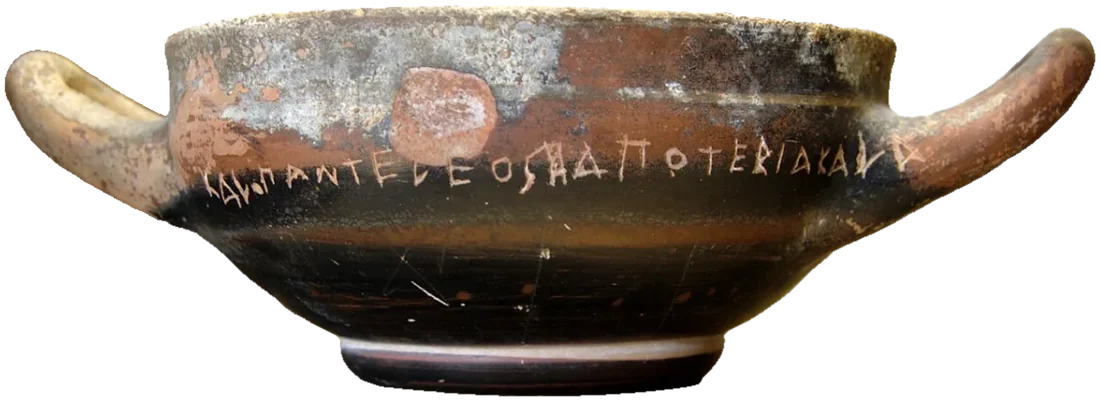
The Ionic alphabet shows the length of the mid vowels. ε, η and ει are distinct letters, and so are ο, ω and ου. It does not show the length of α, ι and υ, the δίχρονα (dichrona) that First steps introduces.[10] The Alexandrian scholars had marks for length, ¯ for long and ˘ for short. They appear now and then in papyri but never became part of normal spelling.[22]
In an open syllable the metre shows the length of α, ι and υ. A closed syllable counts as heavy whatever its vowel, so there the metre cannot help, and the length is said to be “hidden”.[22] Hidden lengths are recovered from other evidence:[23]
- later spellings with ει for a long ι;
- Attic ᾱ where Ionic has η, as in πράττω beside πρήσσω;
- related words, such as ῥίπτω beside ῥιπή;
- the accent, since a circumflex stands only on a long vowel: θᾶττον and μᾶλλον have a long α, while κῆρυξ and φοῖνιξ show a short final υ and ι;
- the ancient grammarians, Herodian above all.
Two words of this kind, made by the synthetic voice: the circumflex of μᾶλλον shows a long α, and the circumflex of κῆρυξ shows that its final υ is short.
The accent is the most useful of these guides for a reader.[24]
Notes
- ^ Allen 1968, p. viii.
- ^ Allen 1968, p. 9.
- ^ Roach 2004, pp. 240, 243; Fougeron and Smith 1993, p. 73; Kohler 1990, p. 49; Rogers and D’Arcangeli 2004, p. 119.
- ^ Allen 1968, p. 4.
- ^ Allen 1968, p. 59.
- ^ Horrocks 2010, pp. xviii–xix, 161.
- ^ Allen 1968, pp. 59–75, 155–157; Thompson 1902, p. 4.
- ^ Allen 1968, pp. 59–60.
- ^ Allen 1968, p. 60.
- ^ a b Allen 1968, pp. 84–85.
- ^ Allen 1968, pp. 62–63; Fougeron and Smith 1993, p. 73.
- ^ Allen 1968, pp. 65–66.
- ^ Horrocks 2010, p. 161.
- ^ Allen 1968, p. 65.
- ^ Allen 1968, pp. 66–67.
- ^ Allen 1968, p. 67.
- ^ Allen 1968, p. 66.
- ^ Horrocks 2010, pp. 118, 161–162.
- ^ Allen 1968, p. 71.
- ^ Allen 1968, pp. 71–72.
- ^ Allen 1968, p. 73.
- ^ a b Allen 1968, p. 86.
- ^ Allen 1968, pp. 86–88.
- ^ West 1987, p. 10.
2. Sounds · 2 of 7
Diphthongs and digraphs
First steps explains what a diphthong and a digraph are and gives the English models. This tab looks at the Greek diphthongs one by one: how each was said, how long they lasted, and what happened to them before a vowel. Then it turns to the digraphs ει and ου, which look like diphthongs but were single vowels. The voice moves from the first vowel to the second without a break between them.[1]
The second letter of a Greek diphthong, ι or υ, works almost like a consonant, much as the y of English yes [jes] or the w of wet [wet].[2] A glide is the name for such a vowel-like sound used as a consonant.
Diphthongs
Classical Attic had four common diphthongs, written αι, αυ, ευ and οι.[3] In the IPA they are [ai au eu oi].[4] A fifth, υι, was rarer, and occurs only before a vowel, as in υἱός.[5] The table gives the models usually recommended.[6] Press a sound to hear it. Each sound is David Chamberlain’s, the diphthong cut out of a word of his reading of Homer: καί, αὐτούς, τεῦχε, τοῖσι and υἱόν.
| Spelling | Sound | Like | Hear | In a word |
|---|---|---|---|---|
| αι | [ai] | English high [haɪ] | καὶ kai [kaì] “and” | |
| αυ | [au] | English how [haʊ] | αὐτοὺς autous [autùːs] “themselves” | |
| ευ | [eu] | no English model; a glide from [e] to [u] | τεῦχε teuche [têukʰe][têuxe] “made” | |
| οι | [oi] | English boy [bɔɪ], coin [kɔɪn] | οἰωνοῖσί oiōnoisi [oiɔːnôisí] “for the birds” | |
| υι | [yi] | no English model; [y] gliding to [i] | υἱός hyios [hyiós] “son” |
Two of them need care. ευ is a real glide from [e] to [u]. It is not the “you” sound that English speakers often give it, as in neuter [ˈnjuːtə].[7] In αυ and ευ the second part kept its old back sound, [u]. It did not move forward to [y] as the vowel υ did.[8]
The diphthongs lasted long. Latin spellings show that αι was still a diphthong in Roman times, in palaestra and Caesar. Its later change to a simple e-vowel shows in spellings from about AD 100.[3] οι may have been fronted to something like [øi]. That would explain the confusion Thucydides reports between λοιμός “plague” and λιμός “famine” (Thucydides 2.54). There is no direct evidence for it in Attic.[9]
Before a vowel
Before another vowel, the second part of a diphthong behaved like a consonant that was said twice, once at the end of its own syllable and once at the start of the next. So αι, αυ, οι, υι and ευ before a vowel were probably [ajj], [aww], [ojj], [yjj] and [eww]. English high yield [haɪ jiːld], bow-wave [ˈbəʊweɪv] and toy yacht [tɔɪ jɒt] give the effect: the glide of the diphthong runs straight into a [j] or [w].[10] The syllable that holds the diphthong is then heavy.
Sometimes the doubled glide was cut to a single one, and the syllable became light. Attic verse can scan the middle syllable of γεραιός and δείλαιος as light, in the lyrics of tragedy and in comedy. It can scan the first syllable of ποιῶ and τοιοῦτος as light too.[11] This shortening of αι and οι inside a word is frequent in the Attic poets.[12] ει before a vowel was probably [ejj] in classical times.[13]
The same thing happens at the end of a word in epic verse. When a word ends in a diphthong and the next word begins with a vowel, the second part of the diphthong becomes a glide before that vowel. The syllable is then light. This shortening is called epic correption:[14]
ἄνδρα μοι ἔννεπε, μοῦσα, πολύτροπον, ὃς μάλα πολλὰ— ⏑ ⏑ — ⏑ ⏑ — ⏑ ⏑ — ⏑ ⏑ — ⏑ ⏑ — ×Muse, tell me of the man of many turns, who very many … (Homer, Odyssey 1.1, ed. Murray; μοι ἔν- is read [-oje-])
line 1: David Chamberlain, Odyssey 1.1 · CC BY 4.0line 2: synthetic ∿
Both kinds can be heard in David Chamberlain’s reading of Homer. In Ἀχαιοί the diphthong stands inside the word before a vowel, and its syllable stays heavy. In ἄνδρα μοι ἔννεπε it stands at the end of a word, and the syllable is light.[5]
A long simple vowel can be shortened before a vowel in the same way, as in πλάγχθη ἐπεί. That is a different process, because a single vowel has no glide to lose.[15]
Long diphthongs: ᾳ, ῃ, ῳ
Some diphthongs began with a long vowel: ᾱι, ηι and ωι. Today they are written with the ι under the letter, as ᾳ, ῃ, ῳ. This small ι is called iota subscript, and it is a Byzantine habit. With capital letters the ι is written beside the letter, as in Ἅιδης.[16] In antiquity the ι always stood on the line. Editors kept writing it, under the letter, after the sound had been lost, out of respect for the old spelling.[17]
For the accent, every diphthong counts as two units of time, like a long vowel. So a long and a short diphthong could differ only in where the glide fell, and the difference was hard to keep.[18] In some words ηι had already become ει by the early fourth century, so κλῄς became κλεῖς.[18] By the second century BC the ι was silent. Dionysius Thrax says so of βοᾷς. Latin borrowed tragoedus and comoedus with the diphthong, but later rhapsodus and melodus without it.[19] Scribes of papyri drop the ι from the middle of the second century BC. It comes back in writing only at the end of the second century AD, when writers imitated classical Attic.[20]
The usual advice is to say ᾳ, ῃ, ῳ as plain ᾱ, η, ω. That anticipates a change by two or three centuries. So Ἅιδης begins [haː-], not [hai-]. ᾱυ and ηυ may be said like αυ and ευ, and ωυ roughly like English owe [əʊ].[21] The table lets you hear the classical sounds as well. In the readings of Homer used on this site, David Chamberlain keeps the glide of ᾳ and ῃ, and his δαμᾷ and τριπλῇ give those two sounds. He says ηυ as a diphthong too, in ηὔδα. But he says ῳ as a plain long vowel, in θεῷ, θυμῷ, σκήπτρῳ and τῷ, and ᾱυ and ωυ do not occur in the readings. Those three sounds are made by computer from two recordings joined together, and are marked ∿.
| Spelling | Classical sound | Read today | Hear the classical sound | In a word |
|---|---|---|---|---|
| ᾳ, ῃ, ῳ | long vowel + [i] glide | as ᾱ, η, ω: [aː ɛː ɔː] | δαμᾷ damāi [damâːi] “subdues” Φθίῃ Phthiēi [pʰtʰíɛːi][fθíɛːi] “in Phthia” θεῷ theōi [tʰeɔ̂ːi][θeɔ̂ːi] “to the god” | |
| ᾱυ, ηυ | long vowel + [u] glide | as αυ, ευ: [au eu] | ταὐτό tauto [taːutó] “the same” νηυσὶ nēusi [nɛːusì] “by the ships” | |
| ωυ | long [ɔː] + [u] glide | as English owe [əʊ] | πρωὐδᾶν prōudān [prɔːudâːn] “to proclaim (Aristophanes, Birds 556)” |
Digraphs: ει and ου, the “spurious diphthongs”
A diphthong, as this tab has shown, is a glide from one vowel to another within one syllable. The written pairs ει and ου look like diphthongs, and some of them once were. Words such as τεῖχος and σπουδή had true diphthongs, [ei] and [ou]. In other words the same letters stand for a long vowel that arose when two vowels contracted or a vowel was lengthened. μισθοῦντα, from μισθόοντα, is one of these.[22]
Before the Ionic alphabet came into use at Athens, the second kind was written simply E and O. Early Attic inscriptions spell them so until the end of the fifth century.[23] The true diphthongs had become single long vowels much earlier, probably in the eighth or early seventh century BC.[24] So by the fifth century both kinds sounded alike, and in the Ionic alphabet both are spelt alike.[22]
Grammars call these ει and ου “spurious diphthongs”. The name is misleading. In classical times neither kind was a diphthong at all. Each pair of letters was a digraph, two letters for one sound, and the name mixes up spelling with sound.[25]
Hear them in words from Homer, read by David Chamberlain. His ου is a steady single vowel, as in βουλή. His ει starts closer than his η, as δεινή shows, but it glides a little towards [i] at its end; for the classical single vowel [eː], press [eː] in the table on the Vowels tab.
Notes
- ^ Allen 1968, pp. 4–5.
- ^ Thompson 1902, p. 5; Roach 2004, p. 240.
- ^ a b Allen 1968, p. 75.
- ^ Horrocks 2010, p. xix.
- ^ a b Allen 1968, pp. 78–79.
- ^ Allen 1968, pp. 75–77, 155–156.
- ^ Allen 1968, p. 76; Roach 2004, p. 243.
- ^ Allen 1968, p. 76.
- ^ Allen 1968, p. 77.
- ^ Allen 1968, pp. 77–79; Roach 2004, pp. 240, 243.
- ^ Allen 1968, p. 78.
- ^ West 1987, p. 14.
- ^ Allen 1968, p. 79.
- ^ Allen 1968, pp. 78, 91; Allen 1973, p. 207.
- ^ Allen 1968, p. 91.
- ^ Allen 1968, pp. 80, 83.
- ^ Horrocks 2010, p. xx n. 1, p. 175.
- ^ a b Allen 1968, p. 81.
- ^ Allen 1968, pp. 81–82.
- ^ Horrocks 2010, pp. 163, 175.
- ^ Allen 1968, pp. 82–83, 155–157; Roach 2004, p. 243.
- ^ a b Allen 1968, pp. 67–68, 72–73.
- ^ Thompson 1902, p. 5 n. 1.
- ^ Horrocks 2010, p. 161.
- ^ Allen 1968, p. 68.
2. Sounds · 3 of 7
The consonants: stops, nasals, liquids, σ, the double letters and the breathing
This tab takes the consonants of classical Attic one kind at a time: the stops, the nasals, the liquids, the sibilant σ, the double consonants ζ, ξ and ψ, doubled consonants, and the breathing [h]. First steps gives the short version for beginners. Here are the details and the evidence.
Kinds of consonant
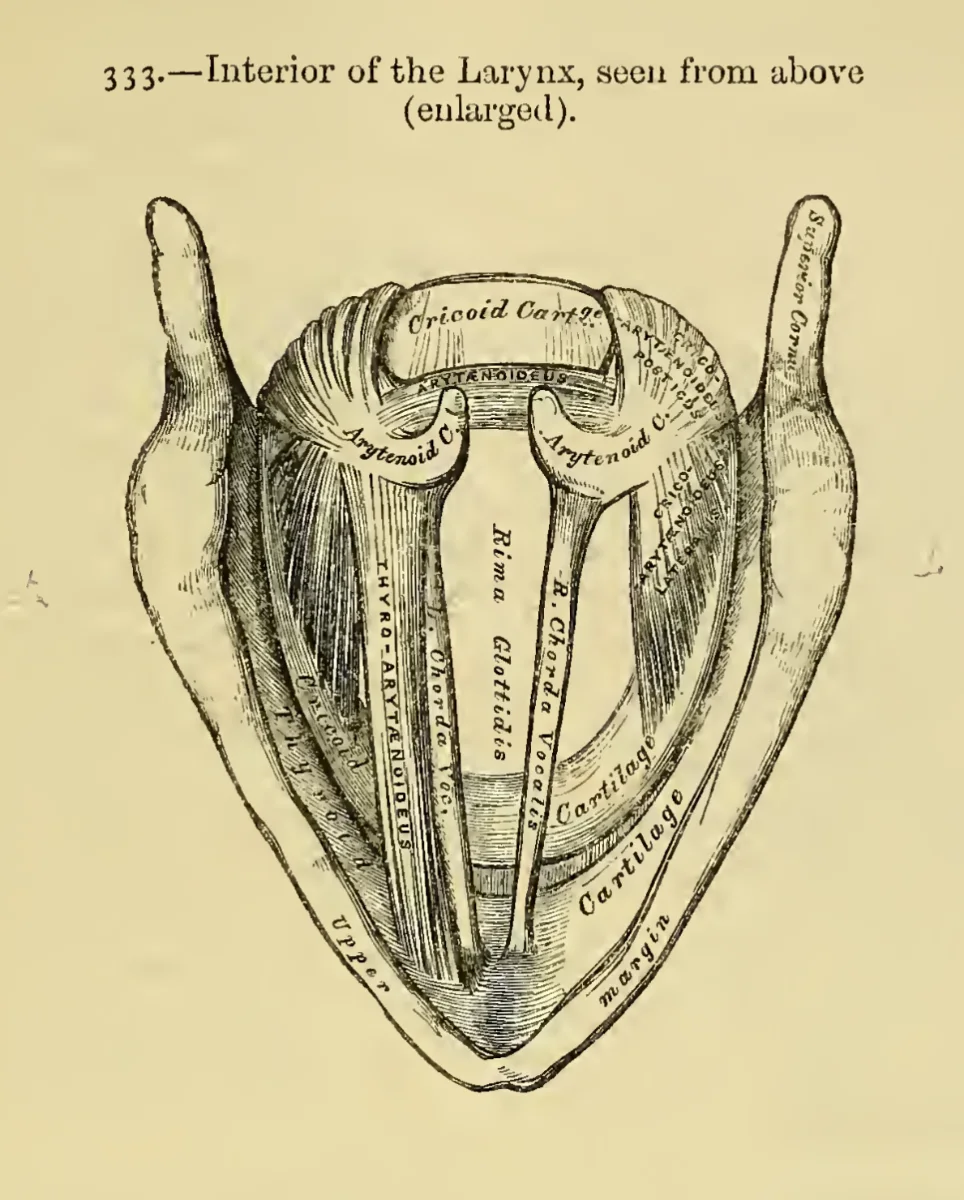
A nasal is a consonant made with the mouth closed while the breath goes out through the nose, like English m and n. A liquid is a smooth, flowing consonant such as l or r. A fricative is a consonant made by squeezing the breath through a narrow gap, like English s.[1]
The table gathers the consonants that are not stops with their usual models (the stops have a table of their own below).[2] Press a sound to hear it, or a word to hear it in a word. The single sounds are recordings where one exists. The words are cut from David Chamberlain’s readings of Homer where they occur there; the others are synthetic and marked ∿.
| Letter | Sound | Like | Hear | In a word |
|---|---|---|---|---|
| λ | clear l in every position | French l; English l before a vowel, as in led [led] | λόγος logos [lóɡos] “word” | |
| μ | nasal | English m, as in map [mæp] | μῆνιν mēnin [mɛ̂ːnin] “wrath” | |
| ν | nasal | English n, as in nap [næp] | νόστον noston [nóston] “homecoming” | |
| γ before γ κ χ ξ | velar nasal | English ink [ɪŋk], song [sɒŋ] | ἄγκυρα agkyra [áŋkyra] “anchor” | |
| ρ | trilled with the tongue tip | Italian or Scots r, [r] | ὄρος oros [óros] “mountain” | |
| ῥ, ρρ | the trill without voice | no English model | ὄρρος orros [órros] “rump” | |
| σ, ς | hissing fricative | English s in sing [sɪŋ], ss in less [les] | σοφός sophos [sopʰós][sofós] “wise” | |
| σ before β γ δ μ | voiced | English z, as in zip [zɪp] | κόσμος kosmos [kózmos] “order, ornament” | |
| ῾ | the rough breathing | English h, as in hat [hæt] | ὅρος horos [hóros] “boundary” | |
| ζ | two consonants, [z] + [d] | English wisdom [ˈwɪzdəm] | Ἀθήναζε Athēnaze [atʰɛ́ːnaːzde][aθɛ́ːnaːzde] “to Athens” | |
| ξ | two consonants, [k] + [s] | English box [bɒks] | ξένος xenos [ksénos] “stranger” | |
| ψ | two consonants, [p] + [s] | English lapse [læps] | ψυχή psychē [psyːkʰɛ́ː][psyːxɛ́ː] “soul” | |
| ππ, ρρ, ττ … | a doubled, held consonant | English hip-pocket [ˌhɪpˈpɒkɪt] | [pː] | ἵππος hippos [híppos] “horse” |
Stops
A stop is a consonant made by closing the mouth completely for a moment, so that the breath is held back and then released.[1] Greek had nine stops. They were made at three places: the lips, the teeth and the soft palate. At each place there were three kinds of stop.
A plain stop is voiceless and is released without a puff of breath, as π, τ and κ were. An aspirated stop is voiceless and is released with a puff of breath, as φ, θ and χ were. A voiced stop is made with the vocal folds vibrating, as β, δ and γ were.[3]
The ancient grammarians had a name for each kind. They called the plain stops ψιλά, “smooth”, and the aspirated stops δασέα, “rough”. The voiced stops they called μέσα, “middle”, because they seemed to stand between the other two.[4]
| plain | aspirated | voiced | |
|---|---|---|---|
| lips | π | φ | β |
| teeth | τ | θ | δ |
| soft palate | κ | χ | γ |
Plain and aspirated in a pair of words:
The pair of words under the table shows that plain and aspirated stops were different sounds in Greek. πόρος “passage” and φόρος “tribute” differ only in the first consonant.[5] The words are synthetic, so they illustrate the difference rather than prove it.
Plain: π, τ, κ
These were unaspirated: they had no puff of breath after them. They sounded like French p, t, k, or like the t of English stop [stɒp], which follows an s. They were not like the breathy t at the start of English top [tʰɒp].[6] English lets a puff of breath follow p, t and k before a vowel, but not after s.[7]
Words from Homer, read by David Chamberlain:
Two kinds of evidence point this way. Ancient writers describe these sounds as made without a puff of breath. And a rule of Greek, known as Grassmann’s Law, treats τ as the plain partner of θ. By this rule the first of two aspirated sounds in a word loses its aspiration. So ἔχω stands beside ἕξω, and τριχός beside θριξί.[8]
τ, δ and θ were probably dental, made with the tongue against the upper teeth as in French. Indian coins of the Greek kings write them with the Indian dental letters, not with the letters that later render English t and d.[9] There is no ancient evidence that κ was said differently before ε and ι, as it is in Modern Greek.[10]
Aspirated: φ, θ, χ
In classical Attic these were aspirated stops. Each was a p, t or k followed by a puff of breath, like the p, t, k at the start of an emphatic English pot [pʰɒt], top [tʰɒp] or cat [kʰæt]. They were not the fricatives of Modern Greek: not [f], not the [θ] of thin [θɪn], and not the [x] of Scottish loch.[11] In the IPA they are [pʰ tʰ kʰ].[12]
Grammars for English schools already taught this in 1902. They called φ, θ, χ “real aspirates” and gave as models the p-h of up-hill, the t-h of mast-head and the k-h of work-house, although schools then said them as fricatives.[13] The evidence all points the same way:[14]
- The grammarians class φ, θ, χ with π, τ, κ, β, δ, γ as “mutes” (ἄφωνα), not with the continuous σ.
- A stop before a rough breathing becomes an aspirate. So κατά + ἡμέραν gives καθ’ ἡμέραν, and in crasis we find θἠμέρᾳ.
- A repeated first syllable puts a plain stop before an aspirate, as in πέφευγα, τίθημι and κέχυμαι. Emphatic doubling gives πφ, τθ and κχ, as in ἀπφῦς, τίτθη and κακχάζω. Both are natural only if φ, θ, χ were stops.
- ν before φ, θ, χ is kept or changed as it is before π, τ, κ. It is not lost, as it is before σ.
- Before φ, θ, χ + a liquid, a short vowel may stay in a light syllable, as it may before π, τ, κ + a liquid (Sophocles, Oedipus at Colonus 354–355).
- Latin wrote φ first as p and then as ph, but never as f in classical times.
The first clear signs of a fricative φ are spellings at Pompeii from the first century AD, such as Dafne. The fricative sounds were general only in Byzantine times.[15] The evidence from papyri and inscriptions is thin. It suggests that the change began in parts of the Greek world in the Hellenistic age, after Alexander, and was widely, though not everywhere, complete by the end of the fourth century AD.[16] Laconian, the dialect of Sparta, had a fricative θ much earlier, in the fifth century BC. Aristophanes’ Spartans say σιός for θεός.[17]
The groups φθ and χθ were two aspirated stops in a row. They are perfectly possible to pronounce.[18]
One sound, not two. Each of φ, θ, χ counts as a single consonant in verse, as the σοφός example on First steps shows.[19] In all of Greek literature there are only five exceptions. One of them is ὄφις, scanned with a heavy first syllable once in Homer and once in Hipponax.[20] The Homeric line is usually read with ὄ- light. It then has a light syllable in its second-last place, which is called a “mouse-tailed” or myuric line. ὄφιν was probably pronounced ὄπφιν here:[21]
Τρῶες δ’ ἐρρίγησαν ὅπως ἴδον αἰόλον ὄφιν— — — — — ⏑ ⏑ — ⏑ ⏑ — ⏑ ⏑ ⏑ ×The Trojans shuddered when they saw the writhing snake.(Homer, Iliad 12.208, ed. Monro and Allen; scanned with ὄ- short)
synthetic ∿synthetic ∿ · φ θ χ as [f θ x]
Ancient authorities already disagreed about this line. One put a long ὀ- down to the aspiration, one to a doubled φ, and one read the syllable as short and the line as myuric on purpose.[20]
Two systems today. First steps explains why φ, θ and χ are said in two ways today, the classical aspirates [pʰ tʰ kʰ] and the later fricatives [f θ x], and why the fricatives are accepted in teaching only with χ as [x]. One detail belongs here. Most English speakers find the difference between plain and aspirated stops hard to hear and to make, and the English school pronunciation, though it uses [f] and [θ], often says χ as [k].[22] The switch at the top of this tab lets you hear every example both ways. The recordings of Homer, and the synthetic clips in the classical values, use [pʰ tʰ kʰ]. The versions with [f θ x] are synthetic, and their sound line says so.
Voiced: β, δ, γ
These were voiced stops, like English b, d and g in bee [biː], doe [dəʊ] and go [ɡəʊ].[23] They were made at the same places as π, τ and κ.[24] They became the fricatives of Modern Greek much later.
Words from Homer, read by David Chamberlain:
Three things show that they were still stops in classical times. No philosopher or grammarian classes them with the continuous sounds. Plato speaks of the tongue pressing and closing for δ, as for τ. And a short vowel before β, δ, γ + ρ may stand in a light syllable, as it may before π, τ, κ + ρ.[25] The date of the change cannot be fixed, but it had not happened in classical times.[26]
γ became a fricative first, then β, then δ. The change was complete for most literate speakers by the fourth century AD. After a nasal the stops survived, as they still do in Modern Greek.[27] What γ became before γ, κ, χ, ξ and μ is taken up under Nasals below.
Nasals: μ, ν and [ŋ]
μ and ν were [m] and [n]. A final ν in a closely joined group of words changed to match the next consonant, and inscriptions spell it so: ἐμ πόλει, ἐγ κύκλῳ, τὸλ λόγον. So the article τὸν before π was said τὸμ. A true [n] was heard only before τ, δ, θ and ν.[28]
Words from Homer, read by David Chamberlain:
γ before γ, κ, χ and ξ
First steps gives the rule that γ before γ, κ, χ or ξ is the nasal [ŋ], with an example of each spelling. Here is why, and what follows from it. [ŋ] is made at the back of the mouth, at the soft palate.[23] The tongue is already in place for the velar consonant that follows, so the nasal is made there too.[29] ξ counts because it begins with [k]. So ἔγχος and ἐγγύς have [ŋ] as well.[30]
In γγ only the first γ is nasal, and the second is an ordinary [ɡ].[31] A ν before the same four letters became [ŋ] as well, and is then written γ: ἐν + καλέω gives ἐγκαλέω.[32] The table gives a word for each spelling, said on its own, and a word from Homer, read by David Chamberlain.
| Spelling | Sounds | In a word | In Homer, read by David Chamberlain |
|---|---|---|---|
| γγ | [ŋ] + [ɡ] | ἄγγελος aggelos [áŋɡelos] “messenger” | κλαγγὴ klaggē [klaŋɡɛ̀ː] “clang” |
| γκ | [ŋ] + [k] | ἄγκυρα agkyra [áŋkyra] “anchor” | ἀνάγκη anagkē [anáŋkɛː] “necessity” |
| γχ | [ŋ] + [kʰ][x] | τυγχάνω tygchanō [tyŋkʰánɔː][tyŋxánɔː] “I happen (to be)” ἔγχος egchos [éŋkʰos][éŋxos] “spear” | πλάγχθη planchthē [pláŋkʰtʰɛː][pláŋxθɛː] “he was driven off course” |
| γξ | [ŋ] + [ks] | σφίγξ sphinx [spʰíŋks][sfíŋks] “sphinx” λάρυγξ larynx [láryŋks] “throat” | ἔκλαγξαν eklagxan [éklaŋksan] “they rang out” |
γ was probably [ŋ] before μ too, and [ŋm] is recommended in every γμ, as in πρᾶγμα and ἔφθεγμαι. The common English [ɡm] need not be condemned outright.[33] There is no good evidence for [ŋn] in γν.[33]
Liquids: λ and ρ
λ
λ was a “clear” l in every position, as in French. English has a clear l before a vowel, as in led [led]. λ was never the “dark” l of English full [fʊɫ], which is made with the back of the tongue raised.[34]
Words from Homer, read by David Chamberlain:
ρ
ρ was a trill. In a trill the tip of the tongue vibrates rapidly against the ridge behind the teeth, as in Italian or Scots r, [r]. It was not the weak r of southern English, the approximant [ɹ] of red [ɹed].[35] Plato calls the tongue “least at rest and most vibrant” when it makes ρ.[36] At the start of a word, after φ, θ and χ, and in the second half of ρρ, the trill was voiceless. That is why texts write ῥ, and why Latin wrote rhetor and Pyrrhus. The change was automatic, so a voiced r everywhere causes no confusion.[37]
In Homer, read by David Chamberlain: ἡρώων has the voiced trill, and ῥάκος begins with the voiceless one.
In Attic dialogue an initial ρ after a short final vowel was held double. The short syllable before it then became heavy, as in τίνι ῥυθμῷ (Euripides, Electra 772) and τὰ ῥήματα (Aristophanes, Frogs 1059). In epic this was optional, and it sometimes happened with λ, μ and ν as well.[38]
The sibilant σ
σ was the only fricative of classical Attic. It was a hissing [s], like English s in sip [sɪp].[39] Before a voiced consonant it became voiced, [z]. So Ἀθήναζε “to Athens” is Ἀθήνας + -δε, written with ζ, which stood for [zd].[40]
In Homer, read by David Chamberlain: [s] in νοῦσον and σκῆπτρον, and [z] before the voiced μ in κοσμήτορε.
Between vowels and at the end of a word σ stayed [s]. So βασιλεύς, μοῦσα and πῶς do not have the [z] of English Basil [ˈbæzəl], muse [mjuːz] and pose [pəʊz]. κόσμος and Λέσβος are said like English cosmic [ˈkɒzmɪk] and lesbian [ˈlezbiən], with [z] before the voiced consonant.[41]
Double consonants: ζ, ξ, ψ
ζ
Each of these letters stands for two consonants. ζ was [zd], as in English wisdom [ˈwɪzdəm], not the [dz] often heard.[42] Several facts show it. The ancient grammarians say so. Ἀθήναζε is -ας + -δε. ν is lost before ζ as before σ, so σύζυξ stands beside σύνδεσμος. And Plato writes Ὠρομάζης for the Persian name Auramazda.[43] The sound had once been [dz], and its two parts changed places early: ζυγόν matches Latin iugum.[44]
Words from Homer, read by David Chamberlain:
In the fourth century BC ζ became [z]. After a short vowel it was held double, so that the syllable before it stayed heavy.[45] The [zd] first became [zz] and was then simplified to [z], which made [z] a separate sound of the language.[46]
The texts of the Lesbian poets write σδ for ζ, as in ὔσδος for ὄζος. That spelling is absent from early Lesbian inscriptions. It may show that Lesbian kept [zd] after other dialects had [z].[45] It may instead be a later spelling, made when ζ no longer meant [zd].[47]
ξ and ψ
ξ and ψ were [ks] and [ps], as in English box [bɒks] and lapse [læps].[48] All three letters count as two consonants in verse, and make the syllable before them heavy.[49]
Words from Homer, read by David Chamberlain:
Doubled consonants: ππ, ττ, σσ …
A written double consonant stood for a long, doubled sound. The first syllable of ἵππος or ἐννέα is heavy, although its vowel is short. ὄρρος “rump” differed from ὄρος “mountain”.[50] English doubles a consonant only where two parts of a compound meet, as in hip-pocket [ˌhɪpˈpɒkɪt] and unnamed [ʌnˈneɪmd]. Those are the best models.[51]
Words from Homer, read by David Chamberlain:
Doubled consonants were later simplified. The change shows in the spelling of less educated writers from the third century BC.[46]
Where other dialects have σσ, pure Attic has ττ, as in γλῶττα and τέτταρες. Tragedy, and prose down to Thucydides, use the Ionic σσ instead, perhaps because ττ sounded provincial.[52] Both spellings mean what they say: a doubled t or a doubled s.[53]
The breathing: [h]
The rough breathing stood for [h], much like English h in hat [hæt].[7] Before 403 BC it was written with the letter H. Later it was marked with the sign ῾. Aristotle distinguishes ὅρος “boundary” from ὄρος “mountain”.[54]
Words from Homer, read by David Chamberlain:
[h] did not count as a consonant. Elision is the dropping of a short vowel at the end of a word before a word that begins with a vowel, and crasis is the merging of two such vowels into one. Neither was stopped by an [h]. Nor did [h] make a syllable heavy. That is why the grammarians classed it with the accents as a “prosody”.[55] The smooth breathing marks only the absence of [h]. It is not a catch in the throat.[56]
[h] at the start of a word was lost by about the second century AD.[57] The loss was gradual. It began in popular speech, since several old dialects had long been without [h], and it reached the most educated speakers only in late Roman or Byzantine times.[46]
Notes
- ^ a b Allen 1968, p. 2.
- ^ Allen 1968, pp. 10, 12, 31–44, 50–57, 155–157.
- ^ Allen 1968, pp. 2, 12.
- ^ Allen 1968, pp. 12, 27.
- ^ Allen 1968, p. 12.
- ^ Allen 1968, pp. 12–13, 155–156.
- ^ a b Roach 2004, p. 240.
- ^ Allen 1968, p. 13.
- ^ Allen 1968, p. 14.
- ^ Allen 1968, p. 15.
- ^ Allen 1968, pp. 16, 26, 155–156; Roach 2004, p. 240.
- ^ Horrocks 2010, pp. xviii–xix.
- ^ Thompson 1902, p. 6.
- ^ Allen 1968, pp. 16–20.
- ^ Allen 1968, pp. 21, 23.
- ^ Horrocks 2010, pp. 170–171.
- ^ Horrocks 2010, pp. 170–171; Allen 1968, p. 24.
- ^ Allen 1968, p. 25.
- ^ Allen 1968, p. 26.
- ^ a b Allen 1968, p. 26 n. 2.
- ^ West 1987, p. 77 with n. 7.
- ^ Allen 1968, pp. 27, 125, 133–134.
- ^ a b Roach 2004, pp. 240, 243.
- ^ Allen 1968, p. 28; Horrocks 2010, pp. xviii–xix.
- ^ Allen 1968, pp. 29–30.
- ^ Allen 1968, p. 30.
- ^ Horrocks 2010, p. 170.
- ^ Allen 1968, pp. 31–32.
- ^ Allen 1968, p. 33.
- ^ Allen 1968, p. 33; Smyth 1920, p. 11.
- ^ Smyth 1920, p. 25.
- ^ Smyth 1920, p. 27.
- ^ a b Allen 1968, p. 35.
- ^ Allen 1968, p. 38; Roach 2004, p. 241.
- ^ Roach 2004, p. 241.
- ^ Allen 1968, p. 39.
- ^ Allen 1968, pp. 39–41.
- ^ Allen 1968, p. 42; West 1987, p. 17.
- ^ Allen 1968, p. 43; Roach 2004, p. 240.
- ^ Allen 1968, pp. 43–44; Thompson 1902, p. 6.
- ^ Allen 1968, p. 44; Roach 2004, pp. 240, 243.
- ^ Allen 1968, pp. 53–55; Horrocks 2010, pp. xviii, 10; Thompson 1902, p. 6.
- ^ Allen 1968, pp. 53–55.
- ^ Horrocks 2010, p. 10.
- ^ a b Allen 1968, p. 56.
- ^ a b c Horrocks 2010, p. 171.
- ^ de Kreij 2022, p. 147.
- ^ Allen 1968, pp. 56–57; Horrocks 2010, p. xix; Thompson 1902, p. 6.
- ^ West 1987, p. 12 n. 1.
- ^ Allen 1968, p. 10.
- ^ Allen 1968, p. 10; Roach 2004, pp. 240, 243.
- ^ Allen 1968, pp. 10–11.
- ^ Allen 1968, p. 58.
- ^ Allen 1968, pp. 50–51.
- ^ Allen 1968, pp. 51–52; West 1987, p. 12 n. 1.
- ^ Allen 1968, p. 53.
- ^ Allen 1968, p. 51.
2. Sounds · 4 of 7
Syllables, weight and morae
A syllable is one beat of speech, built round a vowel or a diphthong.[1] Greek verse is made of patterns of syllables, so it matters how a word divides into syllables and how much each syllable weighs. This tab gives the rules first. Then it shows every kind of syllable, with the Greek large and its weight marked. Last, it breaks the syllables down into morae, the units of time that both the metre and the accent count.
Two pairs of words are kept apart here. Long and short describe vowels. Heavy and light describe syllables.[2] A short vowel can stand in a heavy syllable, and the vowel does not become long there.[3] The Metre pages call a heavy syllable “long” and a light one “short”, as most books on metre do. The meaning is the same.
The rules
Nine rules decide how Greek divides into syllables and how much each syllable weighs. Each rule below is followed by what it means and by an example from Greek. The example shows the word divided into its syllables, with the weight of the syllable in colour marked above it: ⏑ light, — heavy, × either. Under it are the transliteration, the sound in the IPA, a translation and a button to hear it. The examples from Homer are cut from David Chamberlain’s reading; the others, marked ∿, are synthetic.
Every syllable has one vowel or diphthong at its centre.
A word has as many syllables as it has vowels and diphthongs. The consonants group themselves round these centres.[1]
μῆνινmē-nin [mɛ̂ːnin] “wrath” two vowels, η and ι: two syllablesοἰωνοῖσίoi-ō-noi-si [oiɔːnôisí] “for the birds” two diphthongs and two vowels: four syllablesA single consonant between two vowels begins the second syllable.
The consonant goes with the vowel after it, so the syllable before it ends in its vowel. So λέ-γω and λή-γω divide before the γ.[4]
⏑ἄναξa-nax “lord”in Attic [ánaks] in Homer’s metre [wánaks] ν goes with the second vowel; ἄ- ends in its short vowel⏑τε⏑ϝάναξte wanax [te wánaks] “and lord” Iliad 1.7: τε keeps its vowel and stays light before the [w]ἄναξ once began with the consonant [w]. Early Greek wrote it with the letter digamma, ϝ: ϝάναξ (wanax). Attic and Ionic lost the sound, and the manuscripts of Homer never write it.[5]
Homer’s verse still counts the [w]. A short vowel before another vowel is normally elided. But in Iliad 1.7, Ἀτρεΐδης τε ἄναξ ἀνδρῶν, τε keeps its vowel and stays light, as it would before any consonant. The metre treats ἄναξ as a word that begins with [w].[6] Whether the poets still said the [w] is disputed. Smyth held that it was still spoken when the poems were composed; West, that it had gone from speech and the verse keeps the older form.[7]
David Chamberlain says the [w] in this line: listen for it between τε and ἄναξ. Allen advised readers not to restore the digamma when reading Homer aloud.[8]
When two or more consonants stand between vowels, at least the first one ends the syllable before.
So the words divide λεκ-τός, ἄρκ-τος and ἄλ-λος. A doubled consonant is two consonants, so ἵππος divides ἵπ-πος.[9]
—ἄλλοιal-loi [álloi] “others” λλ is two consonants: the first closes ἄλ-ζ, ξ and ψ count as two consonants, and φ, θ, χ as one. The rough breathing does not count at all.
ζ, ξ and ψ each write two sounds, [zd], [ks] and [ps]. φ, θ and χ each write one aspirated stop.[10]
ἄ—νακσανδρῶνa-nax an-drōn [ánaks andrɔ̂ːn] “lord of men” ξ = [ks]: the [k] closes -νακ-⏑σοφόςso-phos [sopʰós][sofós] “wise” φ is one consonant: σο- stays open and lightThe division runs on across the ends of words.
In verse a whole passage is divided as if it were one long word. A final consonant goes with the next word if that word begins with a vowel. It stays with its own word if the next word begins with a consonant.[11]
—μῆ⏑νι⏑νἄ—ει⏑δεmēnin aeide [mɛ̂ːnin áeːde] “sing of the wrath” the ν of μῆνιν goes over to ἄ-, so νι- is open and lightἠΰκο—μοστέκεēykomos teke [ɛːýkomos téke] “the fair-haired one bore” before τ the σ stays and closes -μοςAn open syllable ends in its vowel, and a closed syllable ends in a consonant.
Open and closed say only how a syllable ends, not how long its vowel is.[11]
λέγωle-gō [léɡɔː] “I say” λέ- is openλεπτόςlep-tos [leptós] “thin” λεπ- is closed by πA syllable is heavy if it has a long vowel or a diphthong, or if it is closed. Otherwise it is light.
An open syllable with a short vowel is the only light kind.[12]
—οἰ—ω—νοῖ⏑σί⏑τεoiōnoisi te [oiɔːnôisí te] “and for the birds” diphthong, long vowel, diphthong: heavy; two open short syllables: lightA stop followed by a liquid or nasal may either divide or stay together.
A stop is π, τ, κ, β, δ, γ, φ, θ or χ, and the liquids and nasals are λ, ρ, μ and ν. If the pair divides, the syllable before it is closed and heavy. If the pair stays together, the syllable before it can be open and light.[13]
⏑πατρόςpa-tros [patrós] “of a father” together: πα- open and light—πατρόςpat-ros [patrós] “of a father” divided: πατ- closed and heavy, as Chamberlain reads Iliad 6.446The last syllable of a verse counts as heavy or light, whatever it is.
The end of the line is a pause, and the last position of most verse takes either kind of syllable.[14]
⏑Ἀ⏑χι—λῆ×οςAchilēos [akʰilɛ̂ːos][axilɛ̂ːos] “of Achilles” the last syllable of Iliad 1.1: light, but it fills the last place of the line
The grammarians had another rule: any group of consonants that can begin a word goes whole to the next syllable. By that rule τίκτω would divide τί-κτω, because κτ begins κτῆμα. That is a rule of spelling. The spoken division was τίκ-τω, and its first syllable is heavy.[15]
Every kind of syllable
Each card shows a word or a short phrase divided into its syllables. The syllable in colour is the example, with its weight marked above it: ⏑ for light, — for heavy, and × for a syllable that may be either. Under the syllables come the transliteration and the sound in the IPA. Press the word to hear it. The words marked ∿ are synthetic. The words and phrases from Homer are cut from David Chamberlain’s reading, with the line number beside them.
The two cards on the last row show one word in two settings. The last syllable of ἄνθρωπος is light before a vowel and heavy before a consonant.[16]
Open, with a short vowel
⏑λέγωle-gō [léɡɔː]
“I say”
λέ ends in its vowel, and ε is short. The syllable is light.
Open, with a long vowel
—λήγωlē-gō [lɛ́ːɡɔː]
“I cease”
λή also ends in its vowel, but η is long. The syllable is heavy.
With a diphthong
—οἶκοςoi-kos [ôikos]
“house”
οἶ holds the diphthong οι. A diphthong counts as long, so the syllable is heavy.
Closed, with a short vowel
—λεπτόςlep-tos [leptós]
“thin”
Two consonants, π and τ, stand between the vowels. The π closes the first syllable. Its vowel ε stays short, but the syllable is heavy.
Closed, with a long vowel
—ῥῑπτωrhip-tō [r̥íːptɔː]
“I throw”
The ι of ῥίπτω is long and the syllable is also closed. Compare κρύπ-τω, whose υ is short: both first syllables are heavy.
Closed by a doubled consonant
—ἵπποςhip-pos [híppos]
“horse”
ππ is one long, held [pː]. Its first half closes the syllable ἵπ-.
Closed by a double letter
—τόκσονto-xon [tókson]
“bow”
ξ stands for two consonants, [ks]. The [k] closes the first syllable, so τό- in τόξον is heavy.
A double letter across words
ἄ—νακσανδρῶνanax andrōn [ánaks andrɔ̂ːn]
“lord of men”
ξ splits even before a vowel. In ἄναξ ἀνδρῶν the [s] goes to the next word, and -νακ- is heavy.
Closed across a word boundary
ἠΰκο—μοστέκεēykomos teke [ɛːýkomos téke]
“the fair-haired one bore”
A final consonant goes with its own word when the next word begins with a consonant. In ἠΰκομος τέκε the σ closes -μος, and the syllable is heavy.
Two consonants across words
ἀ—νὰστρατὸνana straton [anà stratòn]
“through the army”
ἀνά ends in a short vowel, but στρ- begins the next word. The σ goes back to close -νά-, and the syllable is heavy.
Stop and liquid together: light
⏑πατρόςpa-tros [patrós]
“of a father”
A stop followed by ρ, λ, μ or ν may stay together at the start of the next syllable. Then πα- is open and light. This is the usual scansion in Attic speech and comedy.
Stop and liquid divided: heavy
—πατρόςpat-ros [patrós]
“of a father”
The same pair may also divide, like any two consonants. Then πατ- is closed and heavy. Tragedy allows both scansions inside a word. Chamberlain’s reading of Iliad 6.446 has it so.
Stop and liquid in Homer
—δὲκλαγγὴde klangē [dè klaŋɡɛ̀ː]
“and a clang”
Early epic usually divides the pair. In Iliad 1.49 δὲ before κλ- is heavy.
The last syllable of a line
Ἀχιλῆ×οςAchilēos [akʰilɛ̂ːos][axilɛ̂ːos]
“of Achilles”
At the end of a verse the last syllable counts as heavy or light, whatever it is. The final -ος of Iliad 1.1 fills the last place of the line.
Final syllable before a consonant
ἄνθρω—ποςπάρεστιan-thrō-pos pa-res-ti [ántʰrɔːpos páresti][ánθrɔːpos páresti]
“a human being is here”
Before a consonant the σ of ἄνθρωπος stays in its syllable and closes it. The last syllable of ἄνθρωπος is then heavy.
Final syllable before a vowel
ἄνθρω⏑ποσἔρχεταιan-thrō-pos er-che-tai [ántʰrɔːpos érkʰetai][ánθrɔːpos érxetai]
“a human being comes”
Before a vowel the same σ goes over to begin the next syllable. The last syllable of ἄνθρωπος is then open and light.
Grammar shows the two kinds of heavy syllable working alike. Comparatives end in -ώτερος after a light syllable and in -ότερος after a heavy one: σοφός, σοφώτερος, but ὠμός, ὠμότερος. λεπτός has a short vowel in its first syllable, but the syllable is closed, so it too takes λεπτότερος.[17]
Stop and liquid in more detail
A liquid or a nasal is more open than a stop, so a stop and a liquid can begin a syllable together. That is why a short syllable before such a pair may stay light.[18] The grammarians called such a syllable κοινή, “common”, because it could be either.[18] Sophocles has both in one line of the Antigone (1240): νεκ-ρὸς with a heavy first syllable, and νε-κρῷ with a light one.[13]
Not every pair behaves alike. Voiced stops and nasals resist the light scansion more than the others. βλ and γλ allow it only rarely, and γμ, γν, δμ and δν never.[19]
Where the stop belongs to a prefix or to the end of a word, it always closes its own syllable. So ἐκ-λύε “releases” has a heavy first syllable. ἔκλυε “heard” may be scanned either way.[20] Where the pair begins the next word, a short final vowel before it may stay light, as in δειλοῖσι βροτοῖσι.[21]
Early poetry usually divides the pair. Homer allows the light scansion mainly at the start of a word, or where the metre would not otherwise admit the word.[21] In Attic speech the pair usually stayed together, and the comic poets scan the syllable light. This light scansion is called Attic correption.[22] In counts made in 1908 of syllables with a short vowel before such a pair, not at the end of a word, Aristophanes’ spoken verse has 1,262 light against 196 heavy, about six to one. The tragic poets use the heavy scansion more often: the ratio is 3.25 to 1 in Aeschylus, 2.3 to 1 in Sophocles and 2.25 to 1 in Euripides.[23]
Morae
A mora is a unit of time in the measuring of syllables and vowels. The Greek name was χρόνος πρῶτος, “the first time”, meaning the smallest unit. The Latin word mora, “delay”, was first used in this sense by the German scholar Gottfried Hermann.[24] Morae are counted in two different ways, and they must be kept apart.
For the metre, the morae of a syllable depend on its weight. A light syllable has one mora and a heavy syllable two. The metricians based this on resolution, where two light syllables can stand in the place of one heavy one.[25] By this count λεπ- in λεπτός has two morae, although its vowel is short.
For the accent, only the vowel counts. A short vowel has one mora, and a long vowel or a diphthong has two. Consonants after the vowel add nothing.[26] φοῖνιξ shows why the difference matters. Its last syllable, -νιξ, is heavy for the metre, because ξ closes it. For the accent it counts as short, because its vowel ι is short. That is why φοῖνιξ can have a circumflex on its first syllable, which needs a short last vowel.[27] The page Accent and morae explains how the accent uses the morae.
The diagram puts the two counts side by side. Each column is one syllable. The top row of boxes is the metre’s count, and the bottom row is the accent’s count. An arrow runs from each vowel to the boxes it fills, and from a closing consonant to the box it adds for the metre. Over the accent’s boxes a small stroke shows the pitch of the voice: it rises on the high mora, rises and falls over the two morae of a circumflex, and stays level on the others.
a mora of the vowela mora made by a closing consonant (metre only)ε vowelπ closing consonant
Over the accent’s boxes, the pitch:high: the voice rises on this moracircumflex: up and down on one long vowellevel, low
The rule in one line: for the metre, count the syllable; for the accent, count only its vowel. The table breaks more syllables down both ways.
| Syllable | Its vowel | Vowel morae (for the accent) | Weight | Time-units (for the metre) |
|---|---|---|---|---|
| λέ | ε, short | 1 | light | 1 |
| λή | η, long | 2 | heavy | 2 |
| οἶ | οι, a diphthong | 2 | heavy | 2 |
| λεπ | ε, short | 1 | heavy (closed) | 2 |
| ῥῑπ | ι, long | 2 | heavy | 2 |
| πα- (πα-τρός) | α, short | 1 | light | 1 |
| πατ- (πατ-ρός) | α, short | 1 | heavy (closed) | 2 |
| φοῖ- (φοῖνιξ) | οι, a diphthong | 2 | heavy | 2 |
| -νιξ (φοῖνιξ) | ι, short | 1 | heavy (closed by ξ) | 2 |
Hear the last pair:
Heavy is not simply longer
A heavy syllable is not always longer in time than a light one by a fixed amount. Dionysius of Halicarnassus noticed that heavy syllables differ in length. σπλήν takes longer to say than ἦ, though both are heavy. The light first syllable of ὁδός is shorter than the light first syllable of στρόφος.[28] The ancient writers on rhythm, who cared about time in music, counted a consonant as half a short vowel. The metricians and grammarians simply gave a light syllable one unit and a heavy syllable two.[25]
So weight is better thought of as a matter of how a syllable ends. A light syllable is left open on its short vowel. A heavy syllable is cut off, by a long vowel, a consonant or both.[29] It would be naive to explain the equal value of one heavy and two light syllables by length of time alone.[29] The theory that a stress rhythm lies behind it is set out on the page Stress and ictus.
Notes
- ^ a b Allen 1968, p. 1.
- ^ Allen 1968, pp. 97–98.
- ^ Allen 1968, p. 98; West 1987, p. 13.
- ^ Allen 1968, p. 98; West 1987, p. 12.
- ^ Smyth 1920, pp. 8, 31; Allen 1968, p. 46.
- ^ West 1987, pp. 22–23; Allen 1968, p. 46.
- ^ Smyth 1920, p. 8; West 1987, p. 23.
- ^ Allen 1968, p. 47.
- ^ Allen 1968, pp. 10, 98.
- ^ West 1987, p. 12 n. 1; Allen 1968, p. 26.
- ^ a b West 1987, p. 12.
- ^ Allen 1968, pp. 97–98; West 1987, p. 12.
- ^ a b Allen 1968, pp. 100–101; West 1987, p. 16.
- ^ Allen 1968, pp. 122–123.
- ^ Allen 1968, pp. 98–99.
- ^ Allen 1968, p. 122.
- ^ Allen 1968, p. 98.
- ^ a b Allen 1968, p. 101.
- ^ West 1987, p. 16; Allen 1968, pp. 102–103.
- ^ West 1987, p. 17; Allen 1968, p. 101.
- ^ a b West 1987, p. 16.
- ^ West 1987, pp. 16–17.
- ^ Allen 1968, pp. 102–103.
- ^ Allen 1968, p. 100; West 1987, pp. 7, 88.
- ^ a b Allen 1968, pp. 99–100.
- ^ Allen 1968, pp. 106–107; Devine and Stephens 1994, p. 102.
- ^ Allen 1968, pp. 106–107.
- ^ Allen 1968, p. 99.
- ^ a b Allen 1968, p. 100.
2. Sounds · 5 of 7
Reading Greek aloud
From Byzantium to the “Erasmian” reform
Greek returned to western Europe in the fifteenth century with Byzantine teachers, and they taught it in their own pronunciation. In that pronunciation β, δ, γ and φ, θ, χ were fricatives. αυ and ευ were [av] and [ev], and αι was [e]. ι, η, υ, ει, οι and υι were all [i].[1]
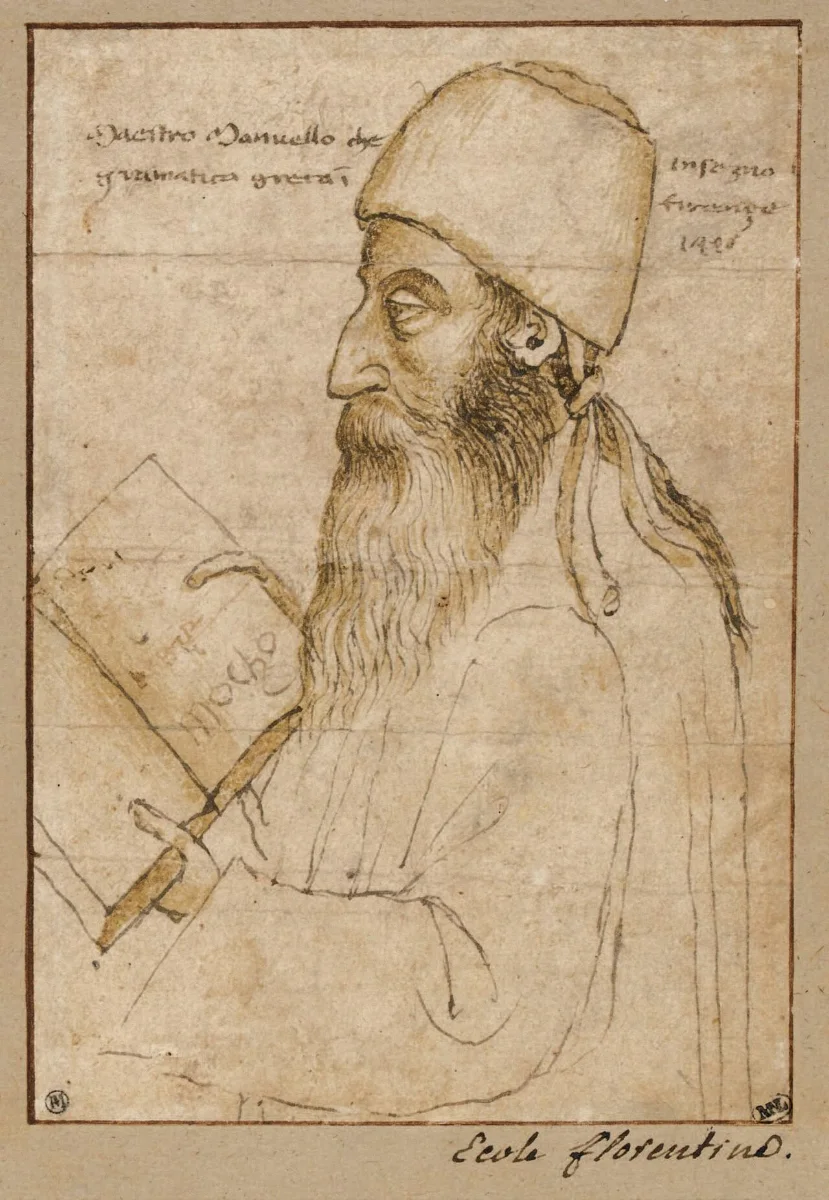
Scholars soon began to doubt that this was how the ancients had spoken. Antonio of Lebrija (Nebrija) raised the question from 1486. Aldus Manutius was the first to cite the sheep’s cry βῆ βῆ as evidence that η was not [i].[2] Erasmus’ dialogue On the right pronunciation of Latin and Greek, of 1528, gave the reformed sounds their name, though he did not use them himself. In England two Cambridge professors, John Cheke and Thomas Smith, put them into practice from 1540.[3]
The “Erasmian” pronunciation then spread across Europe. In England, however, the sounds of English itself were changing. A shift in the English long vowels soon carried the English way of saying Greek far from the classical sounds.[4] A new reform was published in 1895: The Restored Pronunciation of Greek and Latin, by E. V. Arnold and R. S. Conway (4th edn 1908). By the 1960s it was the basis of what English schools and universities taught.[5] The history is told more fully on the Erasmian tab of the Pronunciation systems page.
Where to put the accent
The written accent had a history of its own. Byzantine readers put a stress on the syllable that carries the written accent, and most of Europe followed them. Modern Greek still does so, for all three accent marks.[6]
The Erasmian reform changed the vowels and consonants but left the accent alone. About 150 years after Erasmus, the vowels and consonants had been reformed across most of Europe, but the accent was still said as before.[7] The reformers could hardly have brought in an unfamiliar melodic accent in practice, even had they understood it in theory.[8]
In 1673 Isaac Vossius argued that the accent marks had nothing to do with ancient pronunciation. About eleven years later Henning (Henninius) proposed to accent Greek by the Latin rule. By that rule the stress falls on the second-last syllable if it is heavy, and otherwise on the third-last.[9] This “Henninian” accent became the norm in the Netherlands, in Britain and in the Commonwealth. Germany, Italy, the Slavonic countries, Scandinavia and Hungary kept the Byzantine habit. The United States used the Henninian accent until the early nineteenth century and then followed German practice.[10] Hennin’s theory is the reason why Greek is still mis-accented in Britain, the Netherlands and their former colonies.[11]
The difference can be heard in three words. English and Dutch readers stress λανθάνει, ἄνθρωπος and τελαμών on the first, second and first syllables. German and American readers stress them on the second, first and last.[12] In 1926 a committee of the Classical Association voted, by 8 to 3, that it could not recommend teaching any spoken value for the written accents, either by pitch or by stress.[13]
The Latin accent has no real advantage for Greek. It agrees with the beat of iambic verse no better than the written accent does. In a hundred random iambic lines, each falls on the beat less than half the time on average. In a sample of hexameters the Latin accent manages only about sixty per cent.[14] Nor is it truer to the length of the vowels. An English speaker can stress a short vowel and leave a long one unstressed, as in increase [ˈɪnkriːs] (the noun) or audition [ɔːˈdɪʃən].[15]
Practical advice
The reconstruction on this page is W. Sidney Allen’s, in his book Vox Graeca (1968). He ended it with practical advice for readers. His advice is given first under each head; where this site’s own advice differs, it follows, marked as ours.
- Sounds. Use the sounds set out on the earlier tabs. They are summed up in a table of English, French, German and Italian model words.[16] If the difference between plain and aspirated stops is too hard, fricatives for φ, θ, χ are an acceptable teaching device, with χ as [x], the ch of Scottish loch.[17]
- Pitch. The pitch accent was one of the most characteristic sounds of ancient Greek, and the written accents record it faithfully. But too little is known of how the pitch of words combined in connected speech. Allen had heard no convincing reading with the pitch accent, and advised “not to strive for a tonal rendering”.[18] Our advice, not Allen’s: to read Greek for its meaning, a stress accent serves perfectly well; to recite poetry, or to come as close as you can to the ancient sound, aim to master the pitch accent and keep the vowel lengths. The Practising the tune tab sets out both choices and the steps.
- Stress. Put a stress on the syllable with the written accent, as Byzantine and Modern Greek do, while keeping the lengths of the vowels. The accent is then learned as part of each word, as it is in learning Russian.[19] Our advice: this is a good habit only while you read with a stress. If you work on the pitch accent, you will need to unlearn it: keep the accented syllable no louder and no longer than its neighbours, and let the pitch and the vowel lengths do the work.[20]
- Verse. Read verse in its metrical rhythm. If his theory of a stress rhythm is right, verse rhythm and speech rhythm seldom clash. A rhythmical reading then cannot be wrong by more than a small fraction.[21] The theory is set out on the page Stress and ictus.
The transliteration on this site
The scanned passages on this site carry a line of Greek written in Latin letters. This transliteration is a spelling, not a guide to sound. It writes η and ω as ē and ō, ει and ου as ei and ou, and υ as y. It writes φ, θ, χ as ph, th, ch, ζ as z, and γ before γ, κ, ξ, χ as n. It puts a macron on a long vowel, but not where a syllable is heavy only because it is closed (Sapphic Workbench, greek.py and README).
In the sounds of classical Attic, ei is a single long close-mid vowel, [eː], and ou the vowel of pool, [uː]. y is the French u, [y]. ph, th, ch are aspirated stops, [pʰ tʰ kʰ], not f, the th of thin and the ch of loch. z is [zd]. An α, ι or υ without a macron may still be long in a closed syllable, where the metre cannot show its length.[22]
Notes
- ^ Allen 1968, p. 125.
- ^ Allen 1968, pp. 126–127; Reynolds and Wilson 1991, p. 159.
- ^ Allen 1968, pp. 127–128.
- ^ Allen 1968, pp. 130–131.
- ^ Allen 1968, pp. 133–134.
- ^ Horrocks 2010, p. xx.
- ^ Probert 2006, p. 100.
- ^ Allen 1973, pp. 271–272.
- ^ Allen 1968, p. 135.
- ^ Allen 1968, p. 136; Allen 1973, pp. 272–273.
- ^ Probert 2006, pp. 100–101 with n. 3.
- ^ Allen 1968, p. 136.
- ^ Allen 1968, p. 142.
- ^ Allen 1968, pp. 137–138; Allen 1973, p. 281.
- ^ Allen 1968, pp. 139–141; Roach 2004, p. 243.
- ^ Allen 1968, pp. 155–157.
- ^ Allen 1968, p. 27.
- ^ Allen 1968, pp. 118–119.
- ^ Allen 1968, pp. 143–144.
- ^ See If you learned Greek with a stress.
- ^ Allen 1968, p. 123.
- ^ Allen 1968, pp. 16, 53, 62–67, 73, 86.
2. Sounds · 6 of 7
The IPA chart, with the sounds
The International Phonetic Alphabet (IPA) is a set of signs for writing down sounds. It gives one sign to each sound that a language can use to tell words apart. By convention a sound written in the IPA stands in square brackets. So [p] is a sound, while π is a letter of the Greek alphabet.
The chart below is the International Phonetic Association’s own chart, in the form revised in 2015 and reprinted unchanged in 2018 and 2020. Press any sign to hear it. Most of the recordings were made by the phonetician Peter Isotalo and shared on Wikimedia Commons; every file is credited at the foot of this tab.
Consonants made with air from the lungs
The consonants are set out as a grid. The columns say where in the mouth a sound is made, from the lips at the left to the throat at the right. This is called the sound’s place of articulation. The rows say how the air is held back: stopped completely, sent through the nose, set trembling, or squeezed through a narrow gap. This is called the sound’s manner of articulation.
Where a cell holds two signs, the left one is voiceless and the right one voiced. A voiced sound is made with the vocal folds vibrating. A voiceless sound is made without that vibration. The grey cells are articulations that the Association judges impossible. A dashed sign has no freely licensed recording, and the ∿ mark means a clip made by a synthesiser for this site.
The sounds of classical Attic are boxed in bronze. They are the twenty-three consonants and vowels of Athens in the fifth century BC as they are usually reconstructed.[1] Hold the pointer over a bronze sign to see the Greek letter that wrote it.
classical Attic judged impossible no free recording ∿ synthetic
| Bilabial | Labiodental | Dental | Alveolar | Postalveolar | Retroflex | Palatal | Velar | Uvular | Pharyngeal | Glottal | |
|---|---|---|---|---|---|---|---|---|---|---|---|
| Plosive | |||||||||||
| Nasal | |||||||||||
| Trill | |||||||||||
| Tap or flap | |||||||||||
| Fricative | |||||||||||
| Lateral fricative | |||||||||||
| Approximant | |||||||||||
| Lateral approximant |
The Attic aspirates φ θ χ:
The chart has no cells of its own for the Attic aspirates φ, θ and χ. Each of them was a plain stop, [p], [t] or [k], let go with a puff of breath, and the IPA writes them [pʰ tʰ kʰ].[2] No freely licensed recording of them exists, so the three clips above are synthetic.
Classical Attic had the plain stops [p t k] and the voiced stops [b d ɡ]. It had the nasals [m] and [n], and also [ŋ], the sound of γ before γ, κ, χ or ξ, as in ἄγγελος, ἄγκυρα, τυγχάνω and σφίγξ.[3] Its ρ was a trilled [r], without voice when written ῥ. Its λ was a clear [l]. Its only fricative was [s], which became [z] before a voiced consonant. The rough breathing was [h]. The letter ζ stood for the pair [zd], and ξ and ψ for the pairs [ks] and [ps].[4] Nothing in the postalveolar, retroflex, uvular or pharyngeal columns belongs to it.
Other consonants and symbols
Clicks, implosives and ejectives are made with air moved by the tongue or the larynx rather than the lungs. None of them is Greek. The “other symbols” are sounds made at two places at once, or sounds that do not fit the grid.
Classical Attic used two of them as glides. A glide is a vowel-like sound that acts as a consonant, like the y of English yes [jes] or the w of wet [wet].[5] Before a vowel, the second half of a diphthong such as αι or αυ was such a glide, [j] or [w]. The letter ϝ, digamma, stood for [w] in the dialects that kept it.[6]
voiceless labial-velar fricative voiced labial-velar approximant ɥ labial-palatal approximant voiceless epiglottal fricative voiced epiglottal fricative epiglottal plosive voiceless alveolo-palatal fricative voiced alveolo-palatal fricative ɺ alveolar lateral flap sj-sound
Vowels
The vowel chart is drawn as a trapezium. The top of the chart is a close vowel, made with the tongue high in the mouth. The bottom is an open vowel, made with the tongue low and the mouth open. The left side is the front of the mouth, and the right side the back. Where two signs stand beside one dot, the left one is said with spread lips and the right one with rounded lips. The Mouth and vowels tab shows the same chart again with only the vowels of classical Attic on it, and the Greek letters beside them.
Recording credits: the 108 sound files, each with its author and licence
Every recording is from Wikimedia Commons; the file page and its licence were read on 18 October 2026, and the files were re-encoded as MP3 with leading and trailing silence trimmed. Clips marked ∿ are synthetic: made for this site with the espeak-ng formant synthesiser or piper-tts, or a recording resynthesised in Praat, and not plain recordings of a speaker. On the comparison table and the Sounds tabs the vowel clips are cut from these recordings to a short or a long length, and the diphthongs are two of them joined; each button's line says which.
- Alveolar approximant: Alveolar approximant.ogg, Erutuon, CC BY-SA 3.0
- Alveolar ejective fricative: Alveolar ejective fricative.ogg, Peter Isotalo (uploaded as Karmosin), CC BY-SA 3.0
- Alveolar ejective plosive: Alveolar ejective plosive.ogg, Peter Isotalo (uploaded as Karmosin), CC BY-SA 3.0
- Alveolar lateral approximant: Alveolar lateral approximant.ogg, Peter Isotalo (uploaded as Karmosin), CC BY-SA 3.0
- Alveolar lateral click: Alveolar lateral click.ogg, Peter Isotalo (uploaded as Karmosin), CC BY-SA 3.0
- Alveolar nasal: Alveolar nasal.ogg, Pmx, CC BY-SA 3.0
- Alveolar tap: Alveolar tap.ogg, Peter Isotalo (uploaded as Karmosin), CC BY-SA 3.0
- Alveolar trill: Alveolar trill.ogg, Peter Isotalo (uploaded as Karmosin), CC BY-SA 3.0
- Bilabial click: Bilabial click.ogg, Peter Isotalo, CC BY-SA 3.0
- Bilabial ejective plosive: Bilabial ejective plosive.ogg, Peter Isotalo (uploaded as Karmosin), CC BY-SA 3.0
- Bilabial nasal: Bilabial nasal.ogg, Peter Isotalo (uploaded as Karmosin), CC BY-SA 3.0
- Bilabial trill: Bilabial trill.ogg, Peter Isotalo (uploaded as Karmosin), CC BY-SA 3.0
- Close back rounded vowel: Close back rounded vowel.ogg, Denelson83, CC BY-SA 3.0
- Close back unrounded vowel: Close back unrounded vowel.ogg, Denelson83, CC BY-SA 3.0
- Close central rounded vowel: Close central rounded vowel.ogg, Denelson83, CC BY-SA 3.0
- Close central unrounded vowel: Close central unrounded vowel.ogg, Denelson83, CC BY-SA 3.0
- Close front rounded vowel: Close front rounded vowel.ogg, Denelson83, CC BY-SA 3.0
- Close front unrounded vowel: Close front unrounded vowel.ogg, Denelson83, CC BY-SA 3.0
- Close-mid back rounded vowel: Close-mid back rounded vowel.ogg, Denelson83, CC BY-SA 3.0
- Close-mid back unrounded vowel: Close-mid back unrounded vowel.ogg, Denelson83, CC BY-SA 3.0
- Close-mid central rounded vowel: Close-mid central rounded vowel.ogg, Denelson83, CC BY-SA 3.0
- Close-mid central unrounded vowel: Close-mid central unrounded vowel.ogg, Denelson83, CC BY-SA 3.0
- Close-mid front rounded vowel: Close-mid front rounded vowel.ogg, Denelson83, CC BY-SA 3.0
- Close-mid front unrounded vowel: Close-mid front unrounded vowel.ogg, Denelson83, CC BY-SA 3.0
- Dental click: Dental click.ogg, Peter Isotalo (uploaded as Karmosin), CC BY-SA 3.0
- Epiglottal stop: Epiglottal stop.ogg, Adamsa123, CC BY-SA 3.0
- Glottal stop: Glottal stop.ogg, Peter Isotalo, CC BY-SA 3.0
- Labiodental approximant: Labiodental approximant.ogg, Peter Isotalo (uploaded as Karmosin), CC BY-SA 3.0
- Labiodental flap: Labiodental flap.ogg, Peter Isotalo, CC BY-SA 3.0
- Labiodental nasal: Labiodental nasal.ogg, Peter Isotalo (uploaded as Karmosin), CC BY-SA 3.0
- Mid-central vowel: Mid-central vowel.ogg, Denelson83, CC BY-SA 3.0
- Near-close near-back rounded vowel: Near-close near-back rounded vowel.ogg, Denelson83, CC BY-SA 3.0
- Near-close near-front rounded vowel: Near-close near-front rounded vowel.ogg, Denelson83, CC BY-SA 3.0
- Near-close near-front unrounded vowel: Near-close near-front unrounded vowel.ogg, Denelson83, CC BY-SA 3.0
- Near-open central vowel: Near-open central vowel.ogg, Denelson83, CC BY-SA 3.0
- Near-open front unrounded vowel: Near-open front unrounded vowel.ogg, Denelson83, CC BY-SA 3.0
- Open back rounded vowel: Open back rounded vowel.ogg, Denelson83, CC BY-SA 3.0
- Open back unrounded vowel: Open back unrounded vowel.ogg, Denelson83, CC BY-SA 3.0
- Open front rounded vowel: Open front rounded vowel.ogg, Denelson83, CC BY-SA 3.0
- Open front unrounded vowel: Open front unrounded vowel.ogg, Denelson83, CC BY-SA 3.0
- Open-mid back rounded vowel: Open-mid back rounded vowel.ogg, Denelson83, CC BY-SA 3.0
- Open-mid back unrounded vowel: Open-mid back unrounded vowel.ogg, Denelson83, CC BY-SA 3.0
- Open-mid central rounded vowel: Open-mid central rounded vowel.ogg, Denelson83, CC BY-SA 3.0
- Open-mid central unrounded vowel: Open-mid central unrounded vowel.ogg, Denelson83, CC BY-SA 3.0
- Open-mid front rounded vowel: Open-mid front rounded vowel.ogg, JøMa, CC BY-SA 3.0
- Open-mid front unrounded vowel: Open-mid front unrounded vowel.ogg, Denelson83, CC BY-SA 3.0
- Palatal approximant: Palatal approximant.ogg, Peter Isotalo (uploaded as Karmosin), CC BY-SA 3.0
- Palatal lateral approximant: Palatal lateral approximant.ogg, Peter Isotalo (uploaded as Karmosin), CC BY-SA 3.0
- Palatal nasal: Palatal nasal.ogg, Peter Isotalo (uploaded as Karmosin), CC BY-SA 3.0
- Postalveolar click: Postalveolar click.ogg, Peter Isotalo (uploaded as Karmosin), CC BY-SA 3.0
- Retroflex approximant: Retroflex approximant.ogg, Peter Isotalo (uploaded as Karmosin), CC BY-SA 3.0
- Retroflex flap: Retroflex flap.ogg, Peter Isotalo (uploaded as Karmosin), CC BY-SA 3.0
- Retroflex lateral approximant: Retroflex lateral approximant.ogg, Peter Isotalo (uploaded as Karmosin), CC BY-SA 3.0
- Retroflex nasal: Retroflex nasal.ogg, Peter Isotalo (uploaded as Karmosin), CC BY-SA 3.0
- Uvular nasal: Uvular nasal.ogg, Peter Isotalo (uploaded as Karmosin), CC BY-SA 3.0
- Uvular trill: Uvular trill.ogg, Peter Isotalo (uploaded as Karmosin), CC BY-SA 3.0
- Velar ejective plosive: Velar ejective plosive.ogg, Peter Isotalo (uploaded as Karmosin), CC BY-SA 3.0
- Velar lateral approximant: Velar lateral approximant.ogg, Pmx, CC BY-SA 3.0
- Velar nasal: Velar nasal.ogg, Peter Isotalo (uploaded as Karmosin), CC BY-SA 3.0
- Voiced alveolar implosive: Voiced alveolar implosive.ogg, Peter Isotalo, CC BY-SA 3.0
- Voiced alveolar lateral fricative: Voiced alveolar lateral fricative.ogg, Adamsa123, CC BY-SA 3.0
- Voiced alveolar plosive: Voiced alveolar plosive.ogg, Peter Isotalo (uploaded as Karmosin), CC BY-SA 3.0
- Voiced alveolar sibilant: Voiced alveolar sibilant.ogg, Peter Isotalo (uploaded as Karmosin), CC BY-SA 3.0
- Voiced alveolo-palatal fricative: Voiced alveolo-palatal fricative.ogg, Peter Isotalo, CC BY-SA 3.0
- Voiced bilabial fricative: Voiced bilabial fricative.ogg, Peter Isotalo (uploaded as Karmosin), CC BY-SA 3.0
- Voiced bilabial implosive: Voiced bilabial implosive.ogg, Peter Isotalo, CC BY-SA 3.0
- Voiced bilabial plosive: Voiced bilabial plosive.ogg, Peter Isotalo (uploaded as Karmosin), CC BY-SA 3.0
- Voiced dental fricative: Voiced dental fricative.ogg, Peter Isotalo (uploaded as Karmosin), CC BY-SA 3.0
- Voiced epiglottal fricative: Voiced epiglottal fricative.ogg, Adamsa123, CC BY-SA 4.0
- Voiced glottal fricative: Voiced glottal fricative.ogg, Peter Isotalo (uploaded as Karmosin), CC BY-SA 3.0
- Voiced labio-velar approximant: Voiced labio-velar approximant.ogg, Peter Isotalo (uploaded as Karmosin), CC BY-SA 3.0
- Voiced labiodental fricative: Voiced labiodental fricative.ogg, Peter Isotalo (uploaded as Karmosin), CC BY-SA 3.0
- Voiced palatal fricative: Voiced palatal fricative.ogg, Peter Isotalo (uploaded as Karmosin), CC BY-SA 3.0
- Voiced palatal implosive: Voiced palatal implosive.ogg, Peter Isotalo (uploaded as Karmosin), CC BY-SA 3.0
- Voiced palatal plosive: Voiced palatal plosive.ogg, Peter Isotalo (uploaded as Karmosin), CC BY-SA 3.0
- Voiced pharyngeal fricative: Voiced pharyngeal fricative.ogg, Peter Isotalo, CC BY-SA 3.0
- Voiced postalveolar fricative: Voiced postalveolar fricative.ogg, Peter Isotalo, CC BY-SA 3.0
- Voiced retroflex plosive: Voiced retroflex plosive.ogg, Peter Isotalo (uploaded as Karmosin), CC BY-SA 3.0
- Voiced retroflex sibilant: Voiced retroflex sibilant.ogg, Peter Isotalo, CC BY-SA 3.0
- Voiced uvular fricative: Voiced uvular fricative.ogg, Peter Isotalo (uploaded as Karmosin), CC BY-SA 3.0
- Voiced uvular implosive: Voiced uvular implosive.ogg, Peter Isotalo (uploaded as Karmosin), CC BY-SA 3.0
- Voiced uvular plosive: Voiced uvular plosive.ogg, Peter Isotalo (uploaded as Karmosin), CC BY-SA 3.0
- Voiced velar approximant: Voiced velar approximant.ogg, Peter Isotalo (uploaded as Karmosin), CC BY-SA 3.0
- Voiced velar fricative: Voiced velar fricative.ogg, Peter Isotalo (uploaded as Karmosin), CC BY-SA 3.0
- Voiced velar implosive: Voiced velar implosive.ogg, Peter Isotalo (uploaded as Karmosin), CC BY-SA 3.0
- Voiced velar plosive: Voiced velar plosive.ogg, Peter Isotalo (uploaded as Karmosin), CC BY-SA 3.0
- Voiceless alveolar lateral fricative: Voiceless alveolar lateral fricative.ogg, tFighterPilot, CC BY-SA 3.0
- Voiceless alveolar plosive: Voiceless alveolar plosive.ogg, Peter Isotalo (uploaded as Karmosin), CC BY-SA 3.0
- Voiceless alveolar sibilant: Voiceless alveolar sibilant.ogg, Peter Isotalo, CC BY-SA 3.0
- Voiceless alveolo-palatal fricative: Voiceless alveolo-palatal fricative.ogg, Peter Isotalo (uploaded as Karmosin), CC BY-SA 3.0
- Voiceless bilabial fricative: Voiceless bilabial fricative.ogg, Peter Isotalo (uploaded as Karmosin), CC BY-SA 3.0
- Voiceless bilabial plosive: Voiceless bilabial plosive.ogg, Peter Isotalo (uploaded as Karmosin), CC BY-SA 3.0
- Voiceless dental fricative: Voiceless dental fricative.ogg, Peter Isotalo (uploaded as Karmosin), CC BY-SA 3.0
- Voiceless dorso-palatal velar fricative: Voiceless dorso-palatal velar fricative.ogg, Peter Isotalo, CC BY-SA 3.0
- Voiceless epiglottal fricative: Voiceless epiglottal fricative.ogg, Adamsa123, CC BY-SA 4.0
- Voiceless glottal fricative: Voiceless glottal fricative.ogg, Peter Isotalo (uploaded as Karmosin), CC BY-SA 3.0
- Voiceless labio-velar fricative: Voiceless labio-velar fricative.ogg, Peter Isotalo (uploaded as Karmosin), CC BY-SA 3.0
- Voiceless labiodental fricative: Voiceless labiodental fricative.ogg, Peter Isotalo (uploaded as Karmosin), CC BY-SA 3.0
- Voiceless palatal fricative: Voiceless palatal fricative.ogg, Peter Isotalo (uploaded as Karmosin), CC BY-SA 3.0
- Voiceless palatal plosive: Voiceless palatal plosive.ogg, Peter Isotalo, CC BY-SA 3.0
- Voiceless pharyngeal fricative: Voiceless pharyngeal fricative.ogg, Peter Isotalo (uploaded as Karmosin), CC BY-SA 3.0
- Voiceless postalveolar fricative: Voiceless postalveolar fricative.ogg, Peter Isotalo, CC BY-SA 3.0
- Voiceless retroflex plosive: Voiceless retroflex plosive.ogg, Peter Isotalo, CC BY-SA 3.0
- Voiceless retroflex sibilant: Voiceless retroflex sibilant.ogg, Peter Isotalo, CC BY-SA 3.0
- Voiceless uvular fricative: Voiceless uvular fricative.ogg, Peter Isotalo (uploaded as Karmosin), CC BY-SA 3.0
- Voiceless uvular plosive: Voiceless uvular plosive.ogg, Peter Isotalo (uploaded as Karmosin), CC BY-SA 3.0
- Voiceless velar fricative: Voiceless velar fricative.ogg, Peter Isotalo (uploaded as Karmosin), CC BY-SA 3.0
- Voiceless velar plosive: Voiceless velar plosive.ogg, Peter Isotalo (uploaded as Karmosin), CC BY-SA 3.0
Notes
2. Sounds · 7 of 7
The mouth and the vowel space
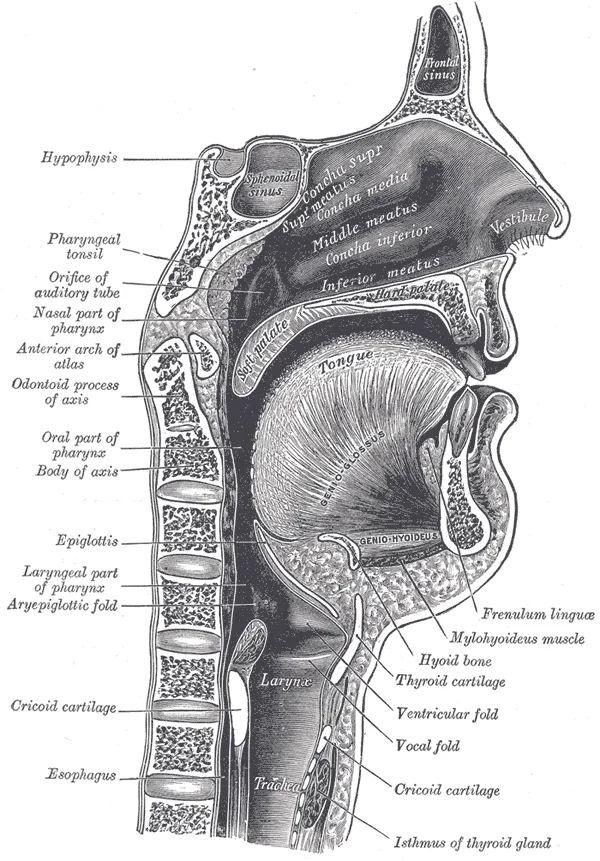
Every consonant is made by bringing one part of the mouth against another, or close to it. The place where this happens is the sound’s place of articulation. The way the air is held back there, stopped or squeezed or sent through the nose, is its manner of articulation.[1]
The drawing is a section through the head, seen from the left, with the face to the right. Press a place to see which Greek sounds were made there and to hear them. The bronze marks are the places that classical Attic used.
Three things stand out. First, the consonants of Attic cluster at the front of the mouth: the lips, the teeth, the ridge behind them, and the soft palate. The hard palate was used only for the glide [j], and the uvula and the pharynx not at all.[2]
Second, the aspirates φ, θ and χ were made at the same places as π, τ and κ. They differed only in the puff of breath after the release.[3] The Modern Greek fricatives [f θ x] in those places are a change in the manner of articulation, not in the place.[4]
Third, the rough breathing is not made in the mouth at all. It is breath passing the open vocal folds in the larynx.[5] τ, δ and θ were probably true dentals, made against the teeth as in French.[6] The palatal κ, γ and χ of Modern Greek, and of the Lucian system, are later developments.[7]
The vowel space
A vowel is placed by two things. The first is where the highest point of the tongue lies, high or low and front or back. The second is whether the lips are rounded.[8] The IPA draws this space as a trapezium. Close vowels, with the tongue high, are at the top. Open vowels, with the tongue low and the jaw dropped, are at the bottom. Front vowels are at the left and back vowels at the right. Beside each dot, the left sign is said with spread lips and the right sign with rounded lips.
The full IPA vowel chart
Press a sign to hear it. These are recordings of each vowel held steady, so they do not show length.
The vowels of classical Attic
Classical Attic used eight of these qualities. The chart below shows only those, with the Greek letters that wrote each one beside it. Press an IPA sign to hear the recorded vowel. Press a Greek letter to hear that letter’s own sound, short or long.
Short and long α, ι and υ differed in length, not in quality, so each pair stands at one point.[9] η and ω were long open-mid vowels, [ɛː] and [ɔː]. ει was a long close-mid vowel, [eː], higher than η. ου began as the matching long close-mid [oː], marked with a dashed outline, and rose to [uː] by the fourth century BC.[10] υ is the front rounded [y], the vowel of French lune [lyn].[11] The lips are rounded as for [u], while the tongue stays forward as for [i].[12]
Hear them in words
The words below are cut from a real reading of the opening of the Iliad, by David Chamberlain, who reads in a restored pronunciation. The IPA column gives the classical Attic values. A reader’s vowels are his own, and in some sounds he differs from the reconstruction. His η is more open than his ει, as it should be: listen to δεινή, which has both. His ω is a little closer than [ɔː]. Each word is cut from a line of continuous speech, so it may begin or end with a trace of its neighbour.
| Greek | Sound (IPA) | Meaning | Listen for | Chamberlain, Iliad 1 |
|---|---|---|---|---|
| ἄναξ anax | [ánaks] | lord | short [a] | |
| πᾶσι pāsi | [pâːsi] | to all | long [aː] | |
| θεά thea | [tʰeáː][θeáː] | goddess | [tʰ][θ]; long [aː] | |
| τέκε teke | [téke] | bore (a child) | short [e] | |
| βῆ bē | [bɛ̂ː] | went | long open-mid [ɛː] | |
| δεινὴ deinē | [deːnɛ̀ː] | terrible | [eː] (ει), then [ɛː] (η) | |
| ἄειδε aeide | [áeːde] | sing! | [eː] written ει | |
| Λητώ Lētō | [lɛːtɔ́ː] | Leto | [ɛː] (η) and [ɔː] (ω) | |
| Διὸς Dios | [diòs] | of Zeus | short [i] and [o] | |
| δῖος dīos | [dîːos] | godlike | long [iː] | |
| κύνεσσιν kynessin | [kýnessin] | for the dogs | short [y]; double [ss] | |
| κλῦθί klȳthi | [klŷːtʰí][klŷːθí] | hear! | long [yː]; [tʰ][θ] | |
| ἡρώων hērōōn | [hɛːrɔ́ːɔːn] | of heroes | [h]; [ɛː]; [ɔː] twice | |
| βουλή boulē | [buːlɛ́ː] | plan, will | [uː] written ου | |
| καὶ kai | [kaì] | and | diphthong [ai] | |
| αὐτοὺς autous | [autùːs] | themselves | diphthong [au]; [uː] | |
| τεῦχε teuche | [têukʰe][têuxe] | made | diphthong [eu]; [kʰ][x] | |
| οἰωνοῖσι oiōnoisi | [oiɔːnôisi] | for the birds | diphthong [oi] twice; [ɔː] | |
| Ἀχιλῆος Achilēos | [akʰilɛ̂ːos][axilɛ̂ːos] | of Achilles | [kʰ][x]; [ɛː] |
Notes
- ^ Allen 1968, pp. 1–4.
- ^ Allen 1968, pp. 12–58.
- ^ Allen 1968, pp. 16–26.
- ^ Horrocks 2010, pp. 170–171.
- ^ Allen 1968, pp. 50–53.
- ^ Allen 1968, p. 14.
- ^ Horrocks 2010, p. 172; Ranieri 2021, pp. 21–23.
- ^ Allen 1968, pp. 3–4.
- ^ Allen 1968, p. 59.
- ^ Allen 1968, pp. 66–75; Horrocks 2010, p. 161.
- ^ Fougeron and Smith 1993, p. 73.
- ^ Allen 1968, pp. 62–65.


