Epic Ionic
The traditional Ionic language of epic, elegy and iambus, and its metrical freedoms.
The literary dialects and the genres that go with them: epic, Lesbian song, Doric choral lyric, Attic drama.
Epic Ionic · 1 of 3
The language of epic
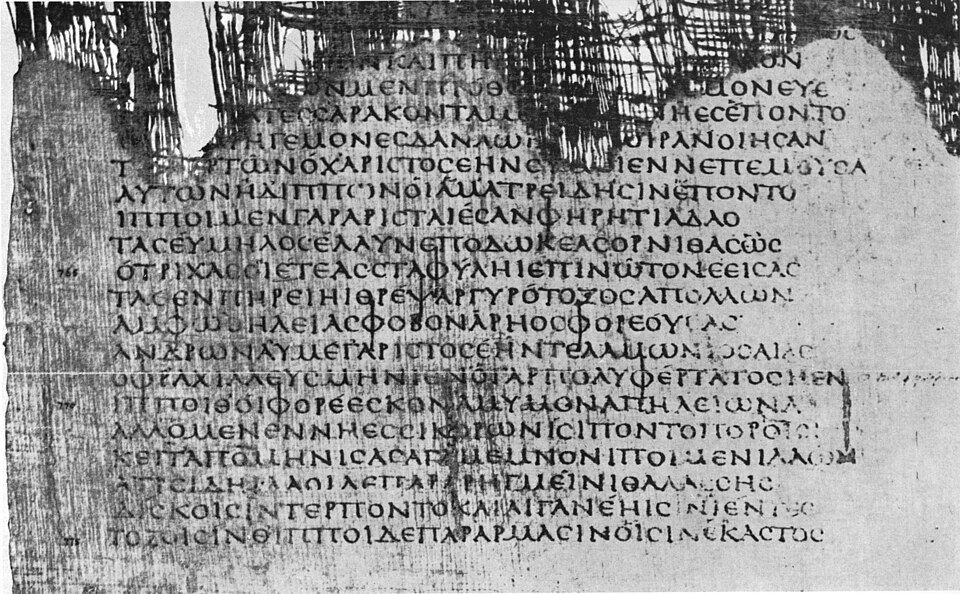
Epic was the oldest and most widely known of the three poetic traditions. The Ionian tradition takes in the epic, elegiac and iambic poets.[1] The language of the early elegists is very close to the latest stage of archaic epic diction, which is mainly Ionic.[2]
The language of epic is not the Ionic of any one city. It is an inherited poetic idiom. Because Homer was known everywhere, every lyric poet admits Homeric forms, both Ionic and East Aeolic, wherever he came from.[3] The features that matter for metre are these.
Hesiod uses the same mixture. He was a Boeotian, yet his language is basically Homeric, with an even larger Ionic share. He ignores the lost [w] more often than Homer, and he has more contracted forms.[4] Only one certain Boeotian form has been found in his poems, the name Φῖκ’ for the Sphinx (Th. 326).[5]
Ionic vowels
The core of the Homeric language is Ionic. Its hallmarks are the same as those of Anacreon’s Ionic:
- Original ᾱ has become η in all positions.
- In all three compensatory lengthenings the vowel is lengthened, as in χεῖρας, πεσοῦσα, ξείνοισιν. The consonant is not doubled, and no diphthong is formed.
- In genitives ᾱω > ηω > εω.
- ε does not contract before ο, ω or α (μεο, χρύσεα), and εο occasionally becomes ευ.
- εε > ει, and οο and οε > ου.
- The third person plural ends in -ουσι(ν).
- Infinitives end in -ειν and -ναι.
- Dative plurals end in -ηισι(ν) and -οισι(ν).[6]
The table gives one example of each hallmark, all of them words of Anacreon:[7]
| Ionic feature | Example | meaning |
|---|---|---|
| old ᾱ has become η everywhere | σφαίρηιsphairēi | “with a ball” (Attic σφαίρᾳ) |
| a lost consonant leaves a longer vowel | χεῖρας · πεσοῦσα · ξείνοισινcheiras · pesousa · xeinoisin | “hands” · “having fallen” · “for strangers” |
| genitive ᾱω → ηω → εω | σατινέωνsatineōn | “of carriages” |
| ε left uncontracted before ο, ω, α | μεο · χρύσεαmeo · chrysea | “of me” · “golden” |
| εε → ει; οο, οε → ου | ἀτιτάλλειν · γουνοῦμαιatitallein · gounoumai | “to rear” · “I beseech” |
| third person plural -ουσι(ν) | συμπαίζουσινsympaizousin | “they play together” |
| thematic infinitive -ειν | ἀτιτάλλεινatitallein | “to rear” |
| dative plurals -ηισι(ν), -οισι(ν) | πλευρῆισι · ξείνοισινpleurēisi · xeinoisin | “for the sides” · “for strangers” |
Homer’s first line shows the uncontracted genitives. The -εω of Πηληϊάδεω is run together as one syllable. This synecphonesis is especially common when ε comes first:[8]
μῆνιν ἄειδε θεὰ Πηληϊάδεω Ἀχιλῆος
mēnin aeide theā Pēlēïadeō Achilēos
“Sing, goddess, the wrath of Peleus’ son Achilles”
-δεω is one long syllable, not two.
Homer, Iliad 1.1
David Chamberlain, Iliad 1.1 · CC BY 4.0
The Aeolic layer and the old forms
Beside the Ionic stand forms that other dialects supply. The Homeric language is Ionic with East Aeolic forms.[3] The Aeolic dative -εσσι(ν) in Alcman, for example, may come from epic.[9] Sappho’s ἰππήων, with a lengthened vowel, is usually put down to epic too.[10]
Disputed: Tribulato treats ἰππήων as genuine East Aeolic. In that dialect, stems in -ευ- keep the long vowel (βασίληος, τόκηας). On her view the shortened forms in names (Νηρεΐδων) are the epic ones.[11]
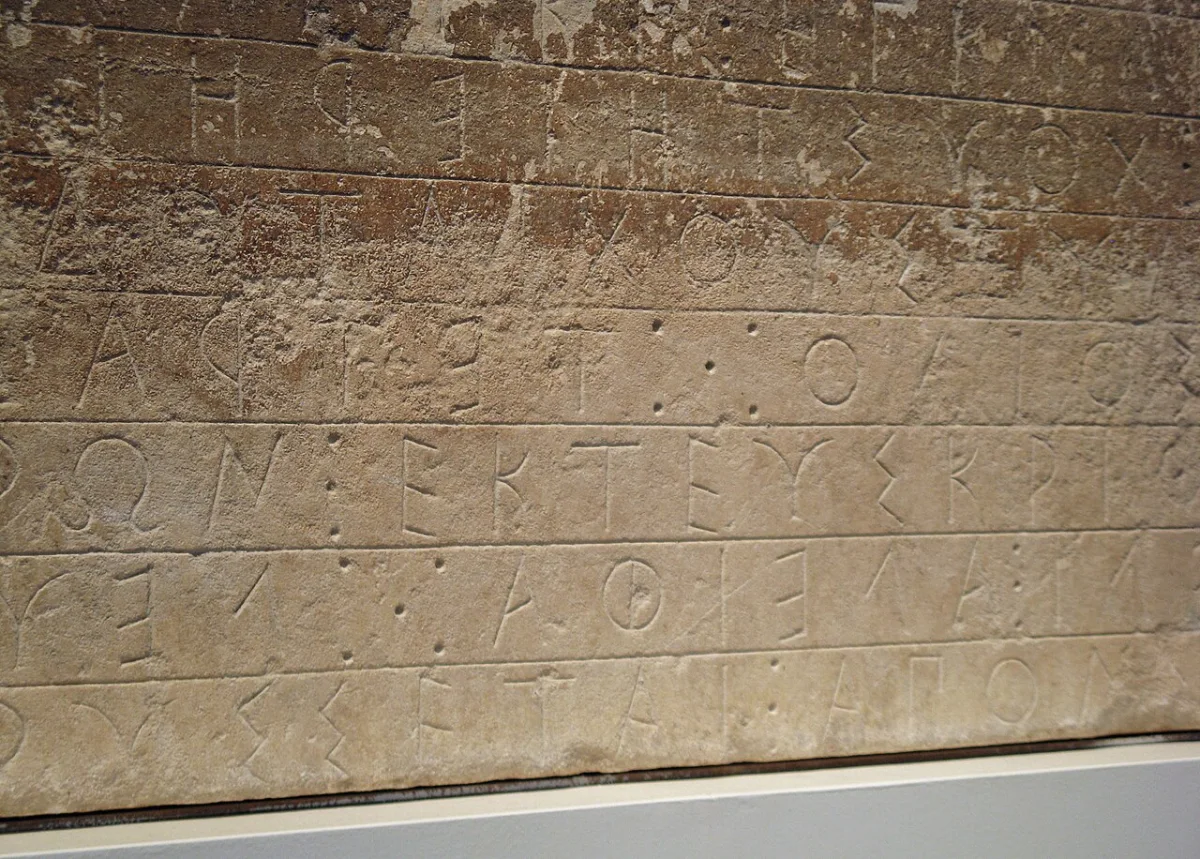
Some forms are older still. Many words once began with the consonant ϝ, pronounced [w]. The letter is written in the dialects that kept the sound into historical times. In Homer, above all in formulae, such words are scanned as if the consonant were still there. Yet it was no longer pronounced when the poems were composed.[12] A word that once began with digamma is one of the things that can let a light syllable stand in a long position in Homer.[13]
Here are five common words that once began with ϝ, as Homer’s text spells them and with the lost letter put back:[14]
| Homer’s spelling | with the lost ϝ | meaning |
|---|---|---|
| ἄναξanax | ϝάναξwanax | “lord” |
| ἔποςepos | ϝέποςwepos | “word” |
| ἔργονergon | ϝέργονwergon | “work” |
| οἶκοςoikos | ϝοῖκοςwoikos | “house” |
| οἶνοςoinos | ϝοῖνοςwoinos | “wine” |
In a line the lost ϝ still counts. Before (ϝ)ἄναξ, for example, a final short vowel stands without elision, because the next word once began with a consonant.
A few Iliadic forms go back to a stage at which the sound [r] could itself serve as the vowel of a syllable. ἀνδροτῆτα, for example, must be read as if it were the older *a-nr̥-tā-ta (⏑ ⏑ — ⏑).[15]
“manhood”
The written form would make the first syllable long. The older form, with [r] as the vowel of the second syllable, gives the two shorts the line requires.
Movable ν
Endings such as -σι(ν) and -ε(ν) take an optional ν. Metrically it matters only before a consonant. There the final consonant closes its syllable and makes it long. Before a vowel the consonant simply begins the next syllable.[16] In Il. 1.14 χερσὶν stands before a vowel, and its last syllable stays short:
στέμματʼ ἔχων ἐν χερσὶν ἑκηβόλου Ἀπόλλωνος
stemmat’ echōn en chersin hekēbolou Apollōnos
“holding in his hands the fillets of far-shooting Apollo”
The ν of χερσίν goes over to the next word, so -σὶ stays short. -λου is shortened before Ἀ-. Ἀ- itself is lengthened, one of the licences described in the next section.
Homer, Iliad 1.14
David Chamberlain, Iliad 1.14 · CC BY 4.0
The rule in one line: movable ν makes a long syllable only before a consonant.
Metrical lengthening
Words shaped ⏑ ⏑ ⏑ or ⏑ — — ⏑ cannot enter a hexameter at all. Epic admits them by lengthening one vowel:
- ἀποδίωμαι and κυάνεος, with long ῑ or ῡ;
- ἀνέρι and ὕδατι, with long ᾱ and ῡ (and hence ἀνήρ and ὕδωρ, by analogy);
- Ἀπόλλωνα, with long initial ᾱ;
- οὔνομα, γεινόμενος, ὑπεὶρ ἅλα, εἰν ἀγορῇ and Οὐλύμποιο. In these words our text writes the lengthened ε and ο as ει and ου.[17]
The table puts some of these words beside their plain forms. The lengthened vowel is in red. Three shorts in a row, ⏑ ⏑ ⏑, become — ⏑ ⏑, the shape of a dactyl, and ⏑ — — ⏑ becomes — — — ⏑:
| plain word | shape | in epic | shape | meaning |
|---|---|---|---|---|
| ὕδατιhydati | ⏑ ⏑ ⏑ | ῡ̔́δατιhȳdati | — ⏑ ⏑ | “with water” |
| ἀνέριaneri | ⏑ ⏑ ⏑ | ᾱ̓νέριāneri | — ⏑ ⏑ | “for a man” |
| ὄνομαonoma | ⏑ ⏑ ⏑ | οὔνομαounoma | — ⏑ ⏑ | “name” |
| ἈπόλλωναApollōna | ⏑ — — ⏑ | Ᾱ̓πόλλωναĀpollōna | — — — ⏑ | “Apollo” (object) |
The rule in one line: epic lengthens one short vowel when a word could not otherwise fit the hexameter.
Homer also has a few iambic first feet (ἐπεὶ δή…). They are explained by lengthening ⏑ — to — —. This parallels the lengthening of ⏑ ⏑ ⏑ to — ⏑ ⏑ in διὰ μὲν ἀσπίδος:[18]
διὰ μὲν ἀσπίδος ἦλθε φαεινῆς ὄβριμον ἔγχος
dīa men aspidos ēlthe phaeinēs obrimon enchos
“through the shining shield went the heavy spear”
δι- is lengthened to δῑ-, so the three shorts of διὰ μέν open the line as — ⏑ ⏑.
Homer, Iliad 3.357
David Chamberlain, Il. 3.357 · CC BY 4.0
Stretched forms
Karl Meister made a catalogue of artificially stretched words, called Streckformen. Their odd morphology gives them away. In several lines they replaced the normal genitives γαστρός and μητρός and the aorist ὦρτο. On Kiparsky’s theory of the hexameter’s origin, these words betray trochaic fourth feet. The feet were later “dactylized” in transmission by the addition of a syllable.[18] This explanation is part of his larger, contested reconstruction.[19]
| Feature | Example | Metrical effect |
|---|---|---|
| η for ᾱ | καρδίην, σφρηγίς | none on quantity (both long) |
| Uncontracted vowels | μεο, χρύσεα, νόος | extra syllable, or synecphonesis |
| Digamma | (ϝ)ἄναξ, (ϝ)ἔπος | apparent hiatus; preceding syllable may be lengthened |
| Metrical lengthening | ὕδωρ, Οὐλύμποιο, Ἀπόλλων | admits intractable words |
| Movable ν | χερσί(ν) | long before a consonant only |
Sources for the table: West 1987, pp. 12, 15, 21–23; de Kreij 2022, p. 152.
Notes
- ^ West 1987, pp. 2–3.
- ^ D’Alessio 2009, p. 120.
- ^ a b de Kreij 2022, p. 143.
- ^ Cassio 2009, pp. 192–193.
- ^ Cassio 2009, p. 193.
- ^ de Kreij 2022, p. 152.
- ^ de Kreij 2022, pp. 151–152.
- ^ West 1987, p. 15; Battezzato 2009, p. 139 n. 14.
- ^ de Kreij 2022, p. 146.
- ^ de Kreij 2022, p. 147.
- ^ Tribulato 2021, p. 139.
- ^ West 1987, pp. 22–23.
- ^ Kiparsky 2018, p. 116.
- ^ West 1987, p. 23.
- ^ West 1987, p. 17.
- ^ West 1987, p. 12.
- ^ West 1987, p. 21.
- ^ a b Kiparsky 2018, p. 117.
- ^ See the Metrical consequences tab.
Epic Ionic · 2 of 3
Metrical consequences
No other kind of Greek poetry allows itself as many prosodic licences as Homeric verse.[1] Most of the licences are the dialect at work. Old forms are kept for the sake of the verse, and the verse is built to accommodate them.
Epic correption
In epic, elegy and some lyric, a long vowel or diphthong at the end of a word is normally shortened before a word beginning with a vowel. This shortening is called epic correption. It does not happen when period-end comes between the two words. The licence belongs almost entirely to double-short rhythm.[2]
Hephaestion makes the same observation in other words. A syllable is “common” (κοινή, koinē), he says, when a long vowel or diphthong is followed by a vowel. He cites the first lines of the Odyssey for it.[3]
ἄνδρα μοι ἔννεπε, μοῦσα, πολύτροπον, ὃς μάλα πολλὰ
andra moi ennepe, mousa, polytropon, hos mala polla
“Tell me, Muse, of the man of many turns, who very many …”
μοι ends in a diphthong, which is long by nature. Before ἔννεπε it is shortened, and the line runs on in dactyls.
Homer, Odyssey 1.1
David Chamberlain, Odyssey 1.1 · CC BY 4.0
The rule in one line: in epic, a long vowel or diphthong at word-end usually turns short before a vowel.
Correption within the word is a tendency found all over Greek, and it is strongest in Ionic. The spelling often hides it: Τρωΐα becomes Τροΐα, and νῆες becomes νέες.[2]
Hiatus and the digamma
Epic admits hiatus, especially at certain places in the line. But in many cases the second word once began with the consonant ϝ.[4] Where the lost consonant stood, the vowels do not really meet. More strikingly still, a preceding short syllable can even be lengthened, as in Il. 3.172 φίλε (σϝ)εκυρέ:[5]
Ἀτρεΐδης τε ἄναξ ἀνδρῶν καὶ δῖος Ἀχιλλεύς
Atreïdēs te anax andrōn kai dios Achilleus
“the son of Atreus, lord of men, and godlike Achilles”
τε stands before ἄναξ without elision, because ἄναξ was once ϝάναξ (wanax): τε (ϝ)άναξ.
Homer, Iliad 1.7
David Chamberlain, Iliad 1.7 · CC BY 4.0
The commonest ϝ-words are the enclitic pronoun ἕ; οἱ, where the ϝ nearly always counts; ὅς = suus; and ἄναξ, ἄστυ, ἔπος/εἰπεῖν, ἔργον, οἶκος, οἶνος, ἰδεῖν, ἑκών, ἕκαστος, ἐλπίς, ἔννυμι, ἴσος and others.[5]
Homer has a few lines with a trochaic first foot. They survive mostly where something can be taken to make up the missing weight. That may be a following consonant + liquid, or an initial liquid or nasal that comes from sr- or sn-. It may also be a word that now begins with a vowel but once began with digamma.[6]
Lengthening in the princeps
Each foot of the hexameter has two parts. The princeps is its first position, which is always long (—). The biceps is the second, which holds two shorts (⏑ ⏑) or one long.[7] Three further licences cluster in the princeps. The princeps needs more filling, because the biceps beside it is longer.[8] The three licences are:
- hiatus, with a long vowel kept long;
- lengthening of a short final syllable by an initial continuant (λ, μ, ν, ρ, σ, originally ϝ), as in Il. 9.520 δὲ λίσσεσθαι;
- lengthening by a final continuant (ν, ρ, ς) before a vowel.[9]
A continuant is a consonant whose sound can be held, like [l] or [s], because the breath is never fully stopped.[10] Here is one line for each licence, in the same order:[8]
ἄστεος ἐξελάσειε· τί μοι ἔριδος καὶ ἀρωγῆς;
asteos exelaseie; ti moi eridos kai arōgēs?
“should drive them from the city. What are strife and rescue to me?”
Hiatus: μοι stands before a vowel, yet it stays long, because it fills a princeps. καί, in a biceps, is shortened in the usual way.
Homer, Iliad 21.360
David Chamberlain, Il. 21.360 · CC BY 3.0
ἄνδρας δὲ λίσσεσθαι ἐπιπροέηκεν ἀρίστους
andras de lissesthai epiproeēken aristous
“and he has sent the best men to plead with you”
Initial continuant: δέ ends in a short vowel, but the λ that begins λίσσεσθαι lengthens it in the princeps.
Homer, Iliad 9.520
David Chamberlain, Il. 9.520 · CC BY 4.0
φῆ πυρὶ καιόμενος, ἀνὰ δʼ ἔφλυε καλὰ ῥέεθρα
phē pyri kaiomenos, ana d’ ephlye kāla rheethra
“so he spoke, burning with fire, and the fair streams bubbled up”
Final continuant: -νος ends in a consonant and stands before a vowel, so it ought to be short. In the princeps its final ς lengthens it.
Homer, Iliad 21.361
synthetic ∿
Metrical lengthening of the word itself belongs here too:
ὣς τοῦ καλὰ ῥέεθρα πυρὶ φλέγετο, ζέε δʼ ὕδωρ
hōs tou kāla rheethra pyri phlegeto, zee d’ hydōr
“so his fair streams burned with fire, and the water boiled”
πυρί is long before φλ-, and -το is long before ζ-. ὕδωρ has a long first syllable on the analogy of ὕδατι.[8]
Homer, Iliad 21.365
synthetic ∿
The rule in one line: Homer’s extra lengthenings nearly always fall on the princeps, the long first position of the foot.
Doublets chosen for metre
The epic language keeps older and newer forms side by side, and the verse chooses between them: ἐν or εἰν, Ὀλύμποιο or Οὐλύμποιο, ὄνομα or οὔνομα.[1]
| short form | shape | long form | shape | meaning |
|---|---|---|---|---|
| ἐνen | ⏑ before a vowel | εἰνein | — | “in” |
| ὈλύμποιοOlympoio | ⏑ — — ⏑ | ΟὐλύμποιοOulympoio | — — — ⏑ | “of Olympus” |
| ὄνομαonoma | ⏑ ⏑ ⏑ | οὔνομαounoma | — ⏑ ⏑ | “name” |
The poet takes whichever form the place in the line needs.
Sometimes a newer form has displaced an older one that the metre still presupposes. At Il. 1.193 ἕως scans as the older ἧος. At Od. 10.60 Αἰόλου κλυτά stands for Αἰόλοο κλυτά. At Il. 7.166 ἀνδρειφόντῃ looks like an abnormal synecphonesis, but the word was originally *anr̥-gʷhontāi.[5] A few anomalies have no such explanation. They are chiefly syllables that should be short but stand in the princeps (ibid.).
Formulas behave the same way. Stock phrases such as πολύμητις Ὀδυσσεύς and κορυθαίολος Ἕκτωρ, and the generic epithets, are made to fit the hexameter. They could not become fixed until a suitable metre existed. Flexible formulas and themes, on the other hand, adapt to new metres. So Archilochus recasts the Homeric phrase κατ’ ὀφθαλμῶν … ἀχλύς in iambic rhythm in one of his epodes.[11]
Here the authorities disagree. Kiparsky concludes that formulas presuppose the metre rather than creating it.[12] Nagy argues the reverse: looked at historically, formula gives rise to metre.[13]
Disputed. How the hexameter itself arose is not settled. Kiparsky derives it from a distich of two Indo-European eight-syllable iambic lines, by stages of syncopation. He argues against the earlier theories of Berg and Nagy.[14] West treats the features that Greek verse shares with Vedic as inherited, but in those pages he does not discuss the hexameter’s origin.[15]
Later epic tightens the rules
From the third century BC the Alexandrians, Callimachus above all, restricted these licences. Hiatus is limited. Elision of nouns, adjectives and verbs becomes rare: there is one instance in Call. H. 3.1–100, against nineteen in Il. 1.1–100. Word-end is avoided after a contracted fourth biceps (Naeke’s Law) and at certain other places.[16]
The same strict hexameter appears in Callimachus’ Hymns (all but the fifth) and Hecale, and in Nonnus’ Dionysiaca. There Hermann’s Bridge is always kept. A word never ends after a contracted fourth biceps (Naeke’s Law) or after a contracted second biceps (Hilberg’s Law).[17] The dialect of Homer stayed; its freedom did not.
Notes
- ^ a b West 1987, p. 21.
- ^ a b West 1987, p. 14.
- ^ Hephaestion, Ench. 1.4.
- ^ West 1987, p. 15.
- ^ a b c West 1987, p. 23.
- ^ Kiparsky 2018, p. 116.
- ^ West 1987, p. 6.
- ^ a b c West 1987, p. 22.
- ^ West 1987, pp. 17–18, 22.
- ^ West 1987, p. 11.
- ^ Kiparsky 2018, pp. 118–120.
- ^ Kiparsky 2018, p. 121.
- ^ Nagy 1990, p. 31.
- ^ Kiparsky 2018, pp. 116–121.
- ^ West 1987, pp. 1–3.
- ^ West 1987, pp. 78–79.
- ^ Maas 1962, pp. 61–62.
Epic Ionic · 3 of 3
Elegy and iambus: what the metre guarantees
Elegy and iambus are written in Ionic wherever their poets came from.[1] How far can that Ionic be trusted? Some of it is guaranteed by the metre. Some of it could have been added in transmission. And a few non-Ionic forms survive because the metre protects them.
The Ionic of elegy
Elegy was composed in a language very near to epic’s, and it broadly shared epic’s metrical patterns too. Its earliest poets, Callinus, Mimnermus and Archilochus, were native Ionians. Their language stands very near the last stage of archaic epic diction, which is mainly Ionic.[2]
One local East Ionic form is foreign to epic. This is κότε, with [k], for πότε (from *kʷote). It is the rule in Callinus of Ephesus. It occurs now and then in Mimnermus and Archilochus, and it is missing from the transmitted text of later poets.[3] κότε and πότε weigh the same (⏑ ⏑), so the metre cannot tell which form a poet sang.
“when”
Both come from an older *kʷote. Same weight, different sound: the metre cannot choose between them.
Tyrtaeus, Theognis, Solon
The mainland elegists show the same broadly Ionic features. They are Tyrtaeus at Sparta and Theognis at Megara, both living among Doric speakers, and the Athenian Solon.[3] Tyrtaeus adopted a form of Ionic that was bound up with the genre and its metre.[4]
For Tyrtaeus it has been argued that the Ionic came in during transmission. Yet the metre guarantees some of it. It guarantees the movable ν of verbal endings, and the particles ἄν and ἤν, which are foreign to both West Greek and Aeolic.[3] His η for original ᾱ might be a later replacement, since the quantity is the same. But that explanation fails in the many places where the digamma has no effect on the scansion, for Laconian kept the digamma long after Tyrtaeus.[3]
The metre also protects a few non-Ionic forms in Tyrtaeus:
- three short accusative plurals in -ᾰς, and no metrically certain long one. The feature is shared with the Hesiodic poems, some Homeric Hymns, Stesichorus and perhaps Alcman. Explaining it as a feature of the mainland dialects raises difficulties;[5]
- the “Doric” future ἀλοιήσευ[μεν (19.12 W), guaranteed by the metre. Its contracted -σευ- is one long syllable. No other elegist uses that future.[6]
The short accusatives have a history of their own. The old ending -ανς gave a long syllable before a vowel and a short one before a consonant, and Homer keeps the long form before a vowel. Mainland singers seem to have taken the short form out of formulae where a consonant followed, and used it before vowels too.[7] The result is an uneven set: short -ᾰς in the first declension beside long -ους in the second. It turns up in texts linked with the Doric world, among them Tyrtaeus, Alcman, Stesichorus and Epicharmus. Papyri of archaic lyric mark -ᾰς as short even before a consonant. Cassio concludes that the feature belongs to a poetic tradition, not to everyday speech, and that it is not very old.[8]
The diagram traces the two outcomes of the old ending:[7]
One ending, two weights. The mainland poetic tradition generalised the short one.
Theognis has a few “Doric” forms. They are νιν for epic μιν (364), ἦμεν (with the variant εἶμεν) for epic ἔμμεν (960), and perhaps λῆι (299) and μῶσθαι (771). Pairs such as ἦμεν (— ⏑) and ἔμμεν (— ⏑) weigh the same, so here the metre does not decide. The metre does not guarantee every Attic feature in Solon and the Theognidea. Some of them may come from transmission rather than composition.[9]
| Theognis | epic | shape | meaning |
|---|---|---|---|
| νινnin | μινmin | ⏑ or —, the same for both | “him, her” |
| ἦμενēmen | ἔμμενemmen | — ⏑ both | “to be” |
Xenophanes has a short infinitive ὑμνέν (1.13 W), which also breaks Hermann’s Bridge. It is a manuscript reading that is easy to emend.[10] Hermann’s Bridge forbids word-end between the two shorts of the fourth biceps.[11] In the scheme below the bridge is marked ⁀, the sign for a place where word-end is avoided:
— ⏔ | — ⏔ | — ⏔ | — ⏑⁀⏑ | — ⏑ ⏑ | — ×
the hexameter, with Hermann’s Bridge in the fourth foot
A word may end after the fourth princeps, or after both shorts, but not between them.
The sources put the rarity of a breach differently. West counts about one in 550 lines of Homer.[11] Maas counts about one in 390 lines.[12]
Contrast. Archaic elegiac inscriptions from the mainland are also heavily epic in diction. Yet they keep long ᾱ outside the Ionic-Attic areas. The transmitted text of the elegists, by contrast, has been made Ionic far more uniformly. The differences lie mostly on the surface. Underneath, the inscriptions could readily be turned into the language of ionicised epic.[13]
The Ionic of iambus
Iambus was composed first by Ionians who also wrote elegy, Archilochus and Semonides. Later it was composed by Ananius, Hipponax, Solon and Anacreon, all from Ionic or Attic areas. Its metre, and to a degree its content, set it apart from epic and elegy. Its dialect is Ionic, and it seems to admit much more of the spoken language. It has fewer of the epic elements that were felt as non-Ionic, such as the genitive in -οιο. The eastern poets again prefer κότε.[13]
Anacreon uses essentially the same dialect in his solo songs.[13] It is a literary Ionic in the tradition of iambus and elegy.[14] That is why the dialect pages treat him with iambus.[1]
| Form | Poet | Metrically guaranteed? | D’Alessio 2009 |
|---|---|---|---|
| movable ν; ἄν, ἤν | Tyrtaeus | yes | p. 122 |
| η for ᾱ | Tyrtaeus | no (same quantity) | p. 122 |
| short acc. pl. -ᾰς | Tyrtaeus | yes, three times | p. 122 |
| future ἀλοιήσευ[μεν | Tyrtaeus | yes | p. 122 n. 30 |
| κότε for πότε | Callinus, Mimnermus, Archilochus | no (same quantity) | p. 122 |
| νιν, ἦμεν | Theognis | no (same quantity as μιν, ἔμμεν) | p. 122 |
Notes
- ^ a b See tab 3.
- ^ D’Alessio 2009, p. 120.
- ^ a b c d D’Alessio 2009, p. 122.
- ^ Battezzato 2009, p. 138.
- ^ D’Alessio 2009, p. 122 with n. 29.
- ^ D’Alessio 2009, p. 122 with n. 30.
- ^ a b Cassio 2009, pp. 187–189.
- ^ Cassio 2009, pp. 200–201.
- ^ D’Alessio 2009, pp. 122–123.
- ^ D’Alessio 2009, p. 123 n. 31.
- ^ a b West 1987, p. 21.
- ^ Maas 1962, p. 60.
- ^ a b c D’Alessio 2009, p. 123.
- ^ de Kreij 2022, p. 151.


