Doric of choral lyric
The Doric language of choral song, its mixed forms and their metrical effects.
The literary dialects and the genres that go with them: epic, Lesbian song, Doric choral lyric, Attic drama.
Doric · 1 of 7
The Doric of choral lyric
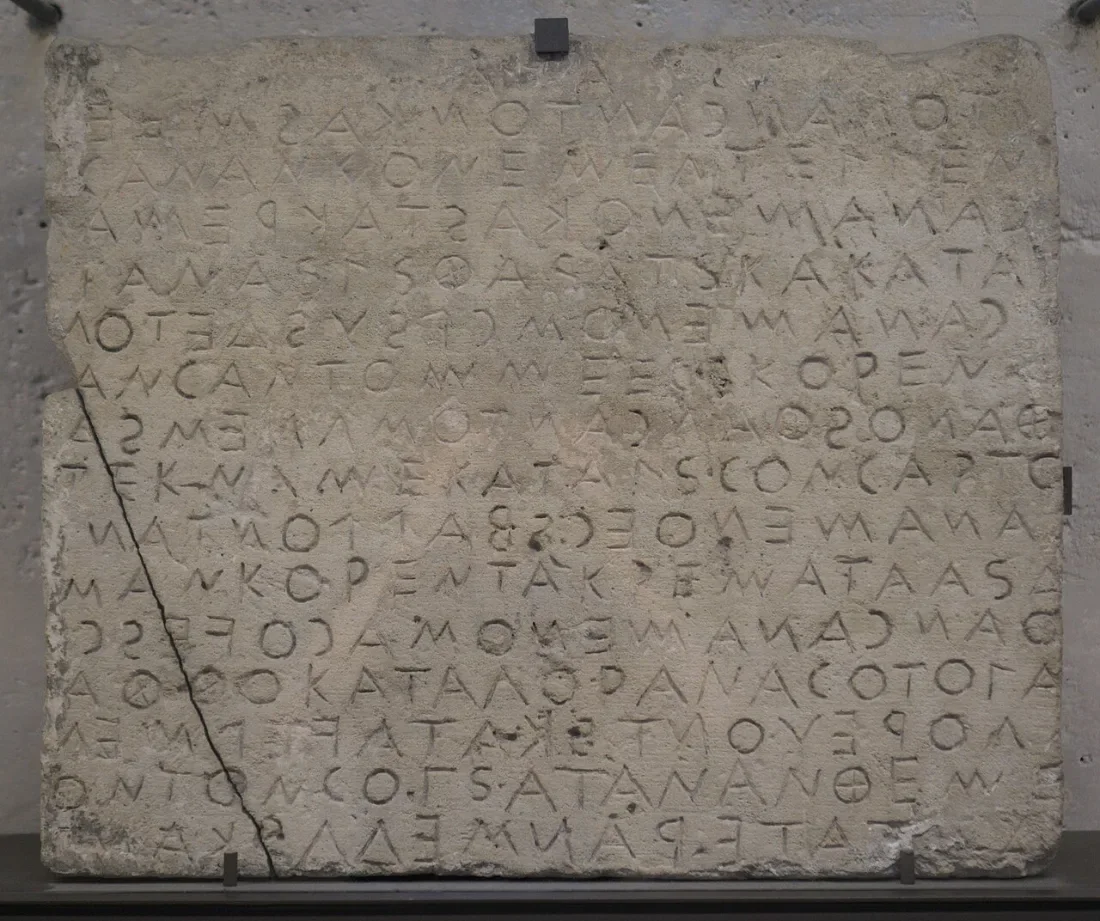
Choral lyric emerged on the Greek mainland, perhaps first at Corinth with Eumelus. It first flourished at Sparta.[1] Its base is Doric. But from the start it was a mixture, and the mixture is what the learner must recognise.
Alcman: a strong Laconian with Aeolic in it
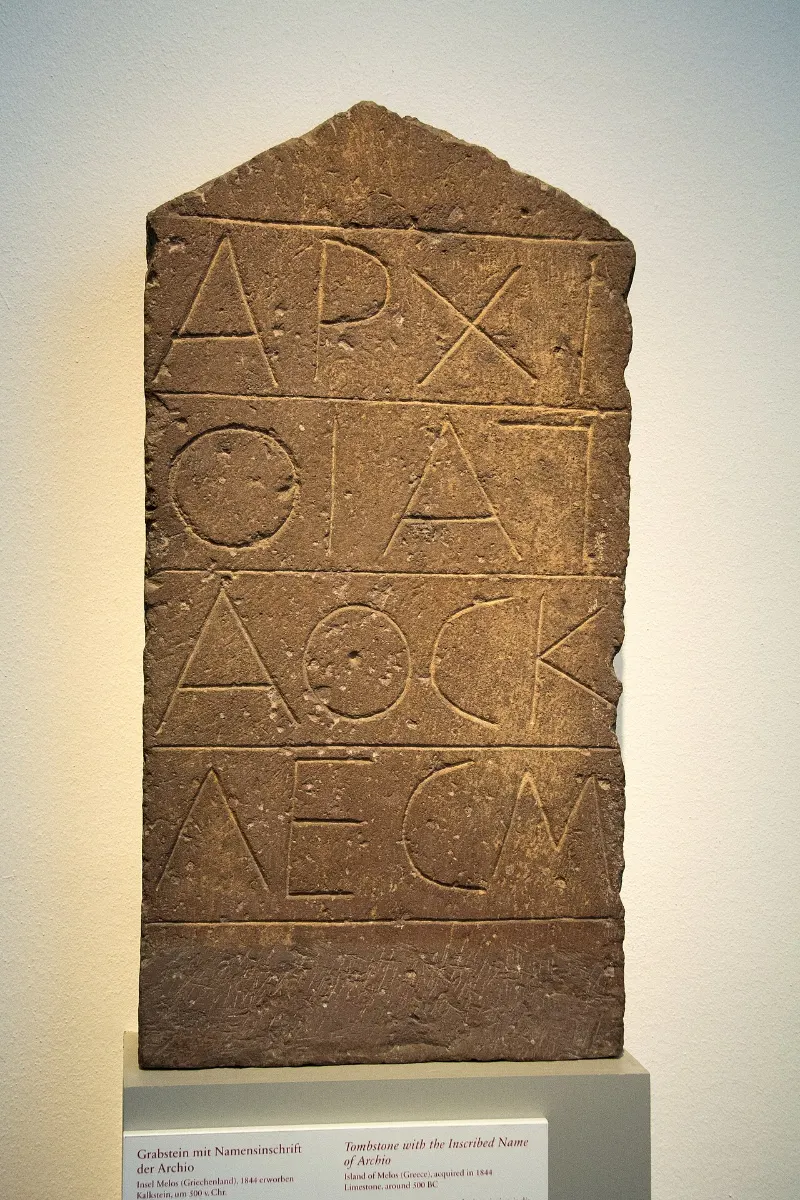
Alcman worked in Sparta in the seventh century. His texts are strongly marked by features that partly match the local Laconian dialect. They also have a few typically Aeolic forms.[2]
The first exponents of the genre at Sparta, Arion and Terpander, both came from Lesbos. This meeting of Lesbian and Laconian may be where the language of choral lyric began. That language is the shifting, many-sided mixture called the lyric koinē.[2] The popularity of Lesbian singers such as Terpander and Arion probably explains the Aeolic features of later choral lyric.[3]
The simplest explanation runs as follows. Alcman was influenced by the early Aeolic poets at Sparta. His songs were then written down with inconsistent Doric spellings. These spellings served as “signals” for a Doric-sounding recitation.[4]
The main marks of Alcman’s dialect are these (edition PMGF):[5]
- Long ᾱ is kept (1.15 ἀλκά).
- The first compensatory lengthening gives an open long vowel: ὠρανόν (1.16), ἤμεν (1.45). Beside these stand Aeolic doubled consonants, in κλεννά (1.44) and γέννατο (8.10).
- The second compensatory lengthening gives Μώσαι (8.9). Beside it stand Aeolic -οισα (3 fr. 3.65 ἔχοισα) and a few forms in -οισιν.
- In contraction, ᾱο/ᾱω > ᾱ (1.82 τᾶν), ᾱε > η (1.16 ποτήσθω), and εε > η (1.88 ἁνδάνην).
- The third person plural ends in -ντι (38.3 αἰνέοντι), beside Aeolic -οισι(ν).
- Infinitives end in -ην/-εν and -μεν, beside Aeolic -μεναι.
- The first person plural ends in -μες, and the article has the form ταί.
- Among the small words are γα, ποτί, πεδά, ἐγών, τύ, τίν, νιν, ἁμίν/ὑμίν, αἰ, κε(ν) and ὅκα/πόκα. γλεφ- stands for βλεφ-.
Two oddities are generally thought to have entered the text later. They are σ for θ (1.71 σιειδής) and σδ for ζ.[6]
The table sets Alcman’s forms beside the Attic ones:[7]
| Alcman | Attic | meaning |
|---|---|---|
| ἀλκάalkā | ἀλκήalkē | “strength” (1.15): long ᾱ kept |
| ὠρανόνōranon | οὐρανόνouranon | “heaven” (1.16): open long ω |
| ἤμενēmen | εἶναιeinai | “to be” (1.45): open long η |
| κλεννάklennā | κλεινήkleinē | “famous” (1.44): Aeolic doubled ν |
| ΜώσαιMōsai | ΜοῦσαιMousai | “Muses” (8.9) |
| ἔχοισαechoisa | ἔχουσαechousa | “having” (3 fr. 3.65): Aeolic -οισα |
| τᾶνtān | τῶνtōn | “of the” (1.82): ᾱο/ᾱω contracted to ᾱ |
| ἁνδάνηνhandanēn | ἁνδάνεινhandanein | “to please” (1.88): εε contracted to η |
| αἰνέοντιaineonti | αἰνοῦσιainousi | “they praise” (38.3): -ντι |
| ποτίpoti | πρόςpros | “towards” |
Two lines of the Partheneion as West prints them carry both layers:[8]
οὔτε μωμήσθαι νιν ἁ κλεννὰ χοραγός
οὐδαμῶς ἐῆι· δοκεῖ γὰρ ἤμεν αὐτά
oute mōmēsthai nin hā klennā chorāgos / oudamōs eēi; dokei gar ēmen autā
“… nor to find fault with her: the famous chorus-leader by no means allows it; for she herself seems to be …”
Each line is three trochaic metra (3tr), and each ends a period (‖).
Alcman 1.44–45: Smyth 1900 p. 5, with οὐδαμῶς from Bergk 1882 III p. 39
synthetic ∿
The Doric forms are νιν, ἤμεν (= εἶναι), and the long ᾱ that West marks in ἁ, χοραγός and αὐτά. κλεννά has the Aeolic double ν. The hiatus before 46 ἐκπρεπής marks period-end.[8] γάρ is short before ἤμεν.
Disputed. Page (1951) defended the transmitted forms as a genuine older Laconian. Since Risch (1954), scholars have regarded the mix as at least partly a product of transmission. Risch’s extreme view now has few followers, however. He held that Alexandrian scholars imposed the Doric of Cyrene on Alcman.[9]
Several of the apparently local traits are attested in Laconia only later. They may have come in during transmission, and most of them are not guaranteed by the metre.[10] Initial digamma counts in about half the certain cases and is ignored in the rest. So the text, against Page, is no direct record of the local dialect of Alcman’s Sparta.[11]
The lyric koinē: a scale from Doric to Aeolic
Every later lyric poet takes two reference points for his language. One is Alcman’s Doric. The other is the East Aeolic of Sappho and Alcaeus.[12]
After Alcman, Stesichorus and, less strongly, Ibycus are the most Doric, although both had Ionic as a mother tongue. Simonides and then Bacchylides show more of their native Ionic. Anacreon is Ionic. Pindar comes last, at the high point of the koinē. Some of his forms are more Aeolic than any poet’s outside Lesbos, and he avoids the Ionic forms of the Cean poets.[12] Of Pindar’s native Boeotian little can be seen.[13]
| Feature | Alcman | Stesichorus | Pindar | Bacchylides |
|---|---|---|---|---|
| ᾱ | kept | kept | kept | typically kept, not consistently |
| εε | η (strict Doric) | ει (mild Doric) | ει (mild Doric) | ει |
| Second lengthening | open ω (Μώσαι); fem. participle -οισα | fem. participle -οισα; else mild Doric (δόμους) | fem. participle -οισα, sometimes aorist participle; else mild Doric (ἀλκίμους) | Ionic (ἔχουσιν, ἀγκλαύσασα); exceptions λαχοῖσαν and, uncertain, ἐπαθρήσαις |
| 3 pl. | -ντι, also -οισι | -οντι | -οντι, also -οισι | -ουσι; -οντι after -σσ-, -ξ- |
| Dat. pl. 3rd decl. | -εσσι twice | -σι; -εσσι (epic) | -σι or -εσσι | -σι; occasionally -εσσι |
| Pronouns | νιν, τύ, ἐγών | νιν, τύ, ἐγών | μιν and νιν; ἐγώ; σ- and τ- | νιν (once μιν); σ- |
Sources for the table: de Kreij 2022, pp. 144–146, 150–151, 157–159. “Strict” and “mild” Doric name the two kinds of result that lengthening and contraction can give. Strict Doric has the open vowels η and ω. Mild Doric has the closed ει and ου.
| what happens | strict Doric | mild Doric |
|---|---|---|
| ε + ε contract | ἁνδάνηνhandanēn (Alcman) | ἁνδάνεινhandanein |
| ο lengthened when ν is lost | ΜῶσαιMōsai (Alcman) | ἀλκίμουςalkimous (Pindar) |
Both results are long, so the choice between them never changes the scansion.
Bacchylides shows the layers within four lines of ode 5. There is Doric προσέφα (93), uncontracted νόον (95) and Aeolic -εσσιν (96).[14] Lines 93–95 close the strophe as –D – D E |||, and 96 opens the antistrophe with – D:[15]
δακρυόεις· χαλεπὸν
ἄνδρεσσιν ἐπιχθονίοις
dakryoeis; chalepon / andressin epichthoniois
“(Meleager answered) weeping: ‘It is hard (to turn aside the mind of the gods) for men upon the earth.’”
ἄνδρεσσιν has the Aeolic dative ending -εσσιν. Line 94 is D (— ⏑ ⏑ — ⏑ ⏑ —); line 96 is – D.
Bacchylides 5.94 and 5.96
synthetic ∿
Disputed. Whether this choral language is “Doric” at all is contested. Pavese and Maslov derive it from an old northern poetic language, a continental Aeolic. Gallavotti and Trümpy derive it from a Mycenaean one. Neither view is generally accepted. For de Kreij, though, Maslov’s article shows that the question is still open.[12]
For Stesichorus, Colvin and Willi see Doric with epic influence. Russo and Silk see essentially epic Ionic with a Doric colouring.[16] How Bacchylides’ language relates to Pindar’s is also disputed.[17]
Notes
- ^ de Kreij 2022, p. 144; D’Alessio 2009, p. 124.
- ^ a b de Kreij 2022, p. 144.
- ^ D’Alessio 2009, pp. 123–124.
- ^ After Willi 2012; de Kreij 2022, p. 144.
- ^ de Kreij 2022, pp. 144–146.
- ^ de Kreij 2022, p. 145 with n. 5.
- ^ de Kreij 2022, pp. 144–146; Natoli et al. 2022, p. 332.
- ^ a b West 1987, p. 36.
- ^ de Kreij 2022, p. 144 with n. 1.
- ^ D’Alessio 2009, pp. 124–125.
- ^ de Kreij 2022, p. 145.
- ^ a b c de Kreij 2022, p. 149.
- ^ de Kreij 2022, p. 156.
- ^ de Kreij 2022, p. 159.
- ^ Maehler 2004, pp. 38–39.
- ^ de Kreij 2022, p. 150 n. 21.
- ^ See the Bacchylides tab.
Doric · 2 of 7
Metrical consequences
The Dorian tradition tended to build long and complicated strophes.[1] It built them out of dactylic and other symmetrical cola as well as aeolic ones.[2] Stesichorus, Simonides, Pindar and Bacchylides built more complex strophes than the monodists, and each strophe was used for one poem only.[3]
The language of this tradition was a mixture of Doric, Aeolic and epic. It gave the poets a choice of forms, and the choice is often made by the metre.
Doublets that differ in quantity
The clearest case is the third compensatory lengthening. It happened after the loss of a digamma next to a liquid or a nasal. One set of forms lengthens the vowel: μοῦνος, ξεῖνος, κούρα, δούρατι. The other set does not: μόνος, ξένος, κόρα. So the first syllable is long in one set and short in the other, and the choral poets use both:
| lengthened | shape | not lengthened | shape | meaning |
|---|---|---|---|---|
| μοῦνοςmounos | — ⏑ | μόνοςmonos | ⏑ ⏑ | “alone” |
| ξεῖνοςxeinos | — ⏑ | ξένοςxenos | ⏑ ⏑ | “stranger” |
| κούραkourā | — — | κόραkorā | ⏑ — | “girl” |
The poets’ own choices run as follows:[4]
- Alcman mostly lengthens (1.61 φᾶρος, 3 fr. 11.2 πήρατα), but not in four of fourteen cases. Laconian normally had the short forms. So Hinge takes the long ones as a licence of poetic language in general.[5]
- Ibycus has ξειναπάταν beside κόραν.[6]
- Simonides has δούρατι beside μόνος.[7]
- Pindar has μούναν and ξεινίαις, but more often κόρᾳ, ξένου.[8]
In Bacchylides the metre often fixes which of two dialect forms stands in the text.[9] It tells us which form the poet wrote.
Disputed: which form is “Doric”? De Kreij treats the lengthened forms as Doric and epic (Ionic in Bacchylides). He calls the short ones East Aeolic or local.[10] Maehler, describing the same alternation in Bacchylides, calls the short forms Doric. For him the long ones are epic, used when they suited the metre (“epic lengthening”: κόρα/κούρα, μόνος/μοῦνος, νόσος/νοῦσος, ξένος/ξεῖνος).[11] Both agree that the choice is metrical.
The Doric accusative plural -ᾰς is the other form that changes the quantity. In Stesichorus 97.217 θανόντᾰς the metre guarantees the short ending. The Alcman papyrus marks γλυκείᾰς short.[12]
Contraction and synizesis
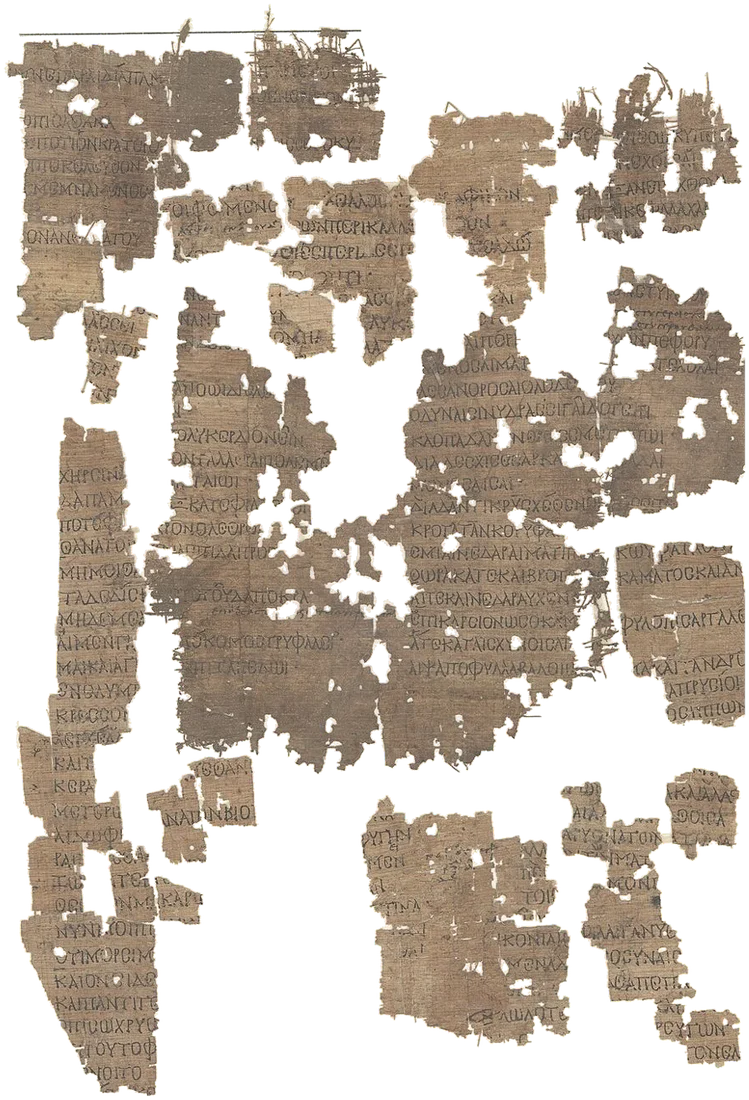
The koinē keeps many vowels uncontracted, above all ε before ο, ω and α (Alcman 38.3 αἰνέοντι, 103 κάδεα; Stesichorus 97.233 νείκεος; Pindar Ol. 1.116 ἐόντα; Bacchylides 5.95 νόον).[13] Where the verse needs one syllable, the vowels are run together. This is called synecphonesis. Inside a word it is common above all when the first vowel is ε.[14] Pindar’s twelfth Pythian opens in this way (analysis and marks as West prints them):[15]
αἰτέω σε, φιλάγλαε, καλλίστα βροτεᾶν πολίων
aiteō se, philaglae, kallistā broteān poliōn
“I ask you, lover of splendour, fairest of mortal cities”
The scheme is – D – D.
Pindar, Pythian 12.1
synthetic ∿
-τέω is one long syllable; West ties the ε and the ω. φιλά- is long because γλ makes position. καλλίστᾱ has the Doric long ᾱ, where Attic has -η. It is long by nature, as West marks it.
Where the dialect does contract, the strict and the mild results are both long: η or ει, ω or ου. So no quantity is at stake, and Pindar’s text varies freely (Ol. 1.2 πλούτου beside fr. 333.6 Πυταγγέλω; Pyth. 10.68 νόος uncontracted).[8]
Hiatus and the digamma
In Doric lyric hiatus occurs almost only before words that once began with ϝ.[14] In Alcman the digamma is observed in roughly half the certain cases (1.6 τε ϝάνακτα). It is ignored in the rest, as in 1.16 ἐς ὠρανόν (⏑ — ⏑ —), where the preposition scans short.[16] Alcman even elides the written pronoun ϝε at period-end:[17]
Ἀγιδῶς τὸ φῶς· ὁρῶ ϝ’ ‖
Āgidōs to phōs; horō w’
“… the light of Agido: I see her …”
ϝ’ is the pronoun ϝε, “her”, elided at period-end. West marks Ἀ- long. The colon is a lekythion (lk).
Alcman 1.40: Smyth 1900 p. 5, with digamma moved from the start of 41 to the end of 40
synthetic ∿
Pindar keeps a hiatus before (ϝ)ἄνα at the end of a dactylo-epitrite period. The final -νᾰ stands short in a long position:[18]
ναίεις Ἀκράγαντος ἐΰδματον κολώναν, ὦ ἄνα
naieis Akragantos eÿdmāton kolōnān, ō ana
“you who dwell on the well-built hill of Acragas, O queen”
Ἀ- is short, because κρ goes whole to the next syllable. ἐΰδμᾱτον and κολώνᾱν have long ᾱ. ὦ is not shortened before (ϝ)ἄνα, because ἄνα once began with ϝ. The final -να is short in a long position at the end of the period (brevis in longo). The scheme is – D – E.
Pindar, Pythian 12.3
synthetic ∿
Bacchylides treats the digamma inconsistently. In 9.45 πολυζήλωτε (ϝ)ἄναξ the final -ε stays unelided before the old digamma. But in 3.76 δ’ ἄναξ the vowel is elided.[19]
Notes
- ^ West 1987, p. 3.
- ^ West 1987, p. 35.
- ^ Battezzato 2009, p. 132.
- ^ de Kreij 2022, pp. 145, 154, 155, 157.
- ^ de Kreij 2022, p. 145 with n. 4.
- ^ de Kreij 2022, pp. 153–154.
- ^ de Kreij 2022, p. 155.
- ^ a b de Kreij 2022, p. 157.
- ^ de Kreij 2022, p. 158.
- ^ de Kreij 2022, pp. 154, 157, 159.
- ^ Maehler 2004, p. 13.
- ^ de Kreij 2022, pp. 151, 146.
- ^ de Kreij 2022, pp. 145, 150, 157, 159.
- ^ a b West 1987, p. 15.
- ^ West 1987, p. 43.
- ^ de Kreij 2022, p. 145.
- ^ West 1987, p. 37.
- ^ West 1987, p. 43, note on l. 3.
- ^ de Kreij 2022, p. 159; for Maehler’s list see the Bacchylides tab.
Doric · 3 of 7
Dactylic style and Pindar's freedoms
The choral poets before Simonides worked largely in dactyls, and dactyls bring epic prosody with them. Pindar, at the end of the tradition, adds freedoms of his own. Both are described below.
The dactylic base of Alcman, Stesichorus and Ibycus
D is West’s sign for the hemiepes, the dactylic run — ⏑ ⏑ — ⏑ ⏑ —.[1] Alcman uses a variety of dactylic units. There are D and D², each with or without a preceding anceps, and there are dactylic tetrameters and hexameters. Apart from dactyls, his commonest cola are trochaic and iambic dimeters, with ionics, hipponacteans and pherecrateans.[2] His strophes combine trochaic with enoplian and dactylic rhythms.[3]
All of Stesichorus’ poems were largely dactylic.[4] His narrative poems use dactylic and iambo-trochaic cola, and so they recall epic in metre as well as in subject.[5]
In one group of his poems (the Iliou Persis, Oresteia, Palinode) the dactylic sequences are built mainly from the cola D, × D and × D –. There are iambo-trochaic elements at period-ends, and the anceps before D is sometimes replaced by a biceps.[4]
The wholly dactylic poems, such as the Geryoneis, follow stricter rules. Contraction comes mostly after word-end. The last biceps of a colon or period is never contracted, and two successive bicipitia are never both contracted. Resolution does not occur.[6]
Ibycus adds asymmetrical cola, especially the “ibycean” dodᵈ:[6]
ἦρι μὲν αἵ τε Κυδώνιαι
μαλίδες ἀρδόμεναι ῥοᾶν
ēri men hai te Kydōniai / mālides ardomenai rhoān
“In spring the Cydonian apple-trees, watered from the streams …”
Each line is the “ibycean” dodᵈ, — ⏑ ⏑ — ⏑ ⏑ — ⏑ —, and each ends a period (‖).
Ibycus PMG 286.1–2: Bergk 1882 III p. 235, public domain
synthetic ∿
West marks the first α of μᾱλίδες long. This is the Doric form of μηλίδες. ῥοᾶν is a Doric genitive plural in -ᾶν. In 286.1 μέν is short before αἵ, because the ν goes with the next syllable. In 286.2 -δες is short for the same reason.
The dactylo-epitrite of Simonides, Bacchylides and Pindar grew out of something already present in Stesichorus.[7] Pindar and Bacchylides took the metre over from the Dorian tradition of Stesichorus.[8]
Epic prosody in the choral poets
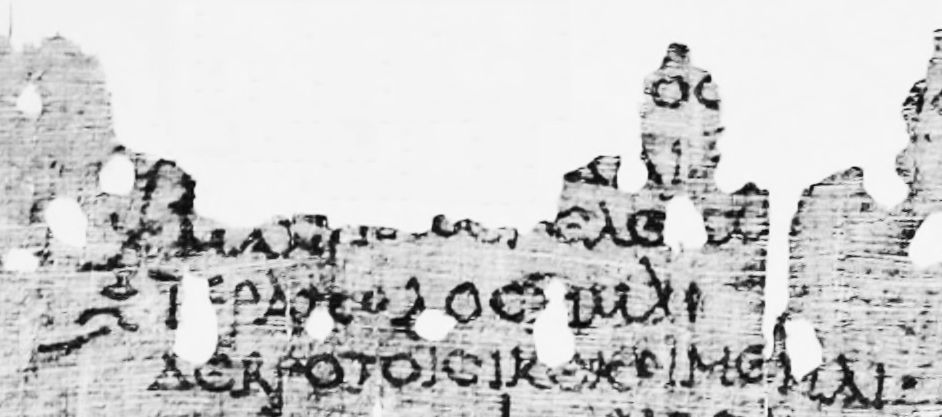
This dactylic manner carries epic habits with it:
- Stop + liquid at word-start. In early poetry a short vowel may stay short before stop + liquid, but normally only at the beginning of a word (δειλοῖσι βροτοῖσι). Early iambus and “normal” Lesbian lyric avoid even that. In Stesichorus, however, it is the rule.[9] The sounds explain the two treatments. Such a group may be split between the syllables, which makes the first syllable heavy. Or it may go whole to the next syllable, which leaves the first one light. The earliest Greek split such groups. In Homer, light syllables before a stop with ρ are rare and mostly made for the metre.[10]
- Older word-shapes. In epic, especially in formulae, and in Stesichorus, the scansion sometimes reflects how older forms of a word were divided into syllables. This is true above all of forms that still had the digamma.[11]
- Correption within the word is a tendency commonest in Ionic. It appears in Stesichorus’ Τρωΐας, Pindar’s ἰχνεύων and Bacchylides’ παιάνιξαν.[12]
- Final continuants. In epic, elegy, Pindar and Bacchylides a final ν, ρ or ς is occasionally lengthened as if it closed the syllable, although a vowel follows. An example is Pind. N. 1.51 ἔδραμον ἀθρόοι, scanned by West ⏑ ⏑ — — ⏑ —.[13]
ἔδραμον ἀθρόοι
edramon athrooi
“they ran up all together”
-μον ends in ν before a vowel, yet it counts as long, as if the ν closed it.
Pindar, Nemean 1.51
synthetic ∿
Pindar’s freedoms
Pindar is freer than early poetry in leaving a short vowel short before stop + liquid within the word. In this he goes with Theognis and Solon.[14]
His treatment of vowels at word-end is also distinctive. περί cannot be elided elsewhere, but in Pindar it can. He also shares with epic, Lesbian lyric and comedy the elision of -αι in middle and passive endings.[15]
Some other consonant groups leave a syllable short. σκ does so in σκοτεινόν (N. 7.61), as in Homer’s Σκάμανδρος. σλ does so in the dialect form ἐσλός, though Pindar more often scans it ἐσ-λός, with the first syllable long.[13]
“noble, good”
The same word, divided two ways: σ closes the first syllable, or σλ goes whole to the second.
Here dialect and metre meet in a single word. ἐσλός is the East Aeolic form, one of Pindar’s Aeolisms.[16] It is also the form that permits the short scansion. σκοτεινόν itself shows the lengthened result of the first compensatory lengthening, the “mild Doric” or Ionic one.[17]
In his aeolic poems the base takes the form ○ ○, and its first position may be resolved. Pindar also resolves further on in the colon and, now and then, contracts.[18] He and Bacchylides give up the fixed syllable-count of Lesbian aeolics.[19]
The resolved base ⏑⏑⏑ is frequent in Pindar, and he is perhaps the first Greek poet to resolve the base at all. The Lesbian poets and Anacreon never take this liberty, and Aeschylus takes it once.[20] These are freedoms the Lesbians, with their fixed syllable-count, never take.[21]
| Habit | Who | West 1987 |
|---|---|---|
| short before stop + liquid at word-start | the rule in Stesichorus | p. 16 n. 7 |
| short before stop + liquid within the word | Pindar (with Theognis, Solon) | p. 16 |
| correption within the word | Stesichorus, Pindar, Bacchylides | p. 14 |
| final ν, ρ, ς lengthened before a vowel | Pindar, Bacchylides (also epic, elegy) | p. 18 |
| περί elided | Pindar only | p. 13 |
| short syllable before σκ, σλ | Pindar (σκοτεινόν, ἐσλός) | p. 18 |
Notes
- ^ West 1987, p. 24.
- ^ West 1987, p. 36.
- ^ Battezzato 2009, p. 140.
- ^ a b West 1987, p. 37.
- ^ Battezzato 2009, p. 141.
- ^ a b West 1987, p. 38.
- ^ West 1987, p. 43.
- ^ Battezzato 2009, pp. 141–142.
- ^ West 1987, p. 16 with n. 7.
- ^ Allen 1968, pp. 100–102.
- ^ West 1987, p. 17.
- ^ West 1987, p. 14.
- ^ a b West 1987, p. 18.
- ^ West 1987, p. 16.
- ^ West 1987, p. 13.
- ^ de Kreij 2022, p. 158.
- ^ de Kreij 2022, p. 157.
- ^ West 1987, pp. 44–45.
- ^ Battezzato 2009, p. 142.
- ^ Itsumi 2009, p. 34.
- ^ See Lesbian Aeolic, tab 2.
Doric · 4 of 7
Bacchylides: language and prosody
Thanks to a single papyrus roll, Bacchylides of Ceos has the largest corpus of choral lyric after Pindar’s.[1] His language and his metre interact closely.[2] Line numbers are those of Maehler and Jebb.
An artificial literary Doric
Eumelos of Corinth (later eighth century) and Alkman of Sparta (c. 650–600) fixed Doric in writing. After them it became the main dialect of all later choral song, wherever the poet came from.[3]
Bacchylides’ language, like Simonides’, is “an artificial ‘literary’ Doric”. It has many epic words, forms and formulae. Among them are genitives in -οιο (ἀπλάτοιο 5.62), uncontracted forms (Ἰαόνων 17.3), unaugmented past tenses (θίγεν 17.12) and subjunctives in -ησι (λάχησι 19.3). There are also Aeolic infinitives in -μεν and -μεναι (ἔμμεν 5.144, ἔμμεναι 18.14) and datives in -σσι (πόδεσσι 6.2). Forms of his native Ionic appear here and there, and frs. 19 and 20A are almost entirely Ionic.[3]
His epic forms include unaugmented aorists, genitives in -οιο and subjunctives in -ησι. His native Ionic leaves a clear mark. It has also been argued that his encomia and erotic poems belonged to an Ionic tradition.[4]
The Doric colouring comes chiefly from long alpha. The papyrus does not keep it consistently. The scribes always write -ζη- (πολύζηλος). They often write η where another ᾱ follows (ἀδμήτᾱ 5.167 beside ἄδμᾱτοι 11.84). But they regularly have Ἀθάνα and σελάνα. Bacchylides himself may not have been consistent.[3] ᾱ is usually, but not always, kept.[1]
Other Doric marks are τοί and ταί, genitives in -ᾱ and -ᾶν, futures and aorists in -ξ- (παιάνιξαν 17.129), and νιν. Aeolic forms beyond the epic ones are rare (Μοῖσα 5.4, λαχοῖσαν 19.13, ἔλλᾱθι 11.8).[5]
Disputed. Maehler calls this language “very similar to Pindar’s”, apart from the Ionic forms.[3] De Kreij finds that equation “unhelpful”. Bacchylides, he points out, uses more epic and Ionic forms and avoids East Aeolic ones.[1]
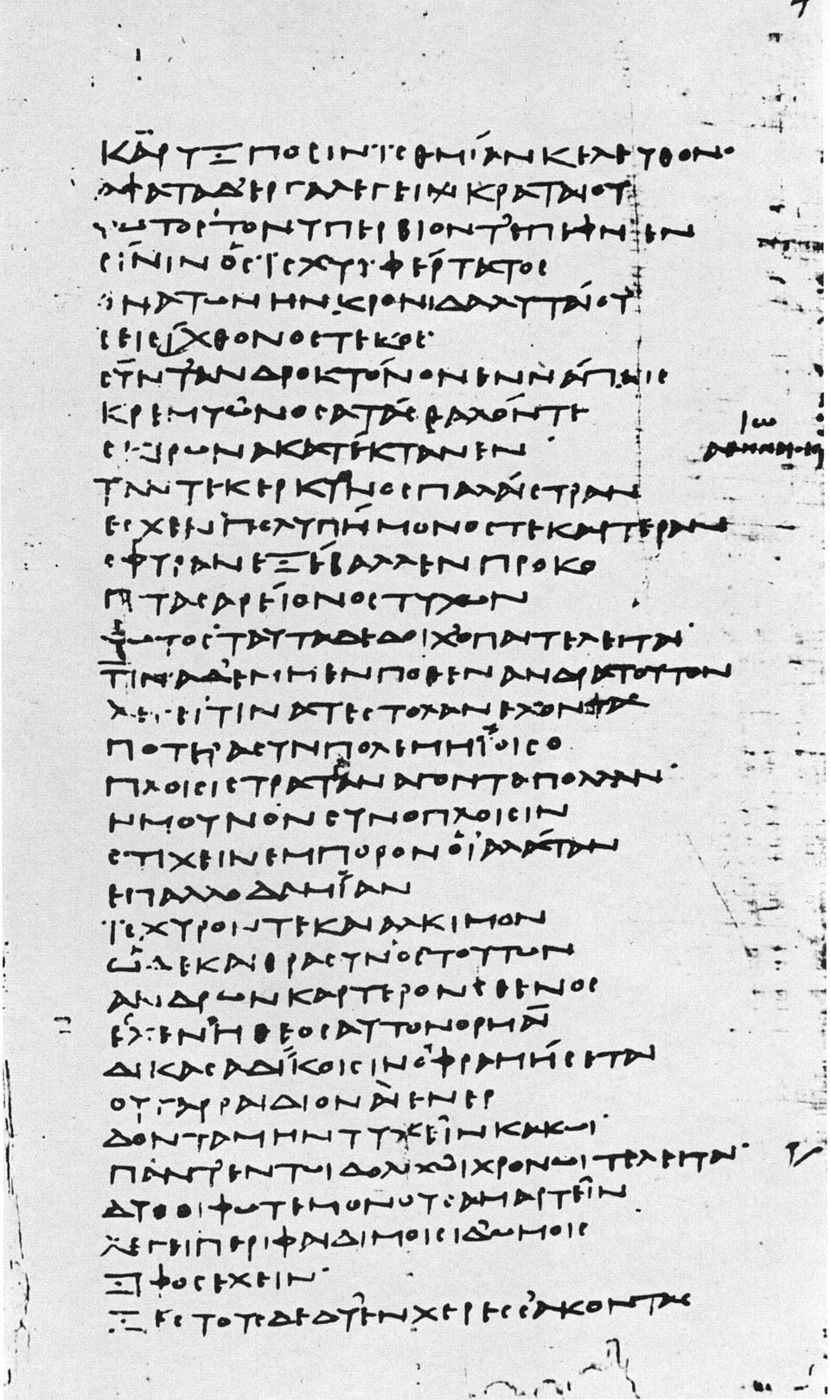
Where the metre chooses the form
- Infinitive -εν. The Doric ending -εν appears where the metre needs a short syllable before a vowel. One example is ἐρύκεν before ὕβριν at 17.41 (⏑ — ⏑). The -κεν is short because its ν begins the next syllable, whereas -κειν would be long. Another is οὖρον ἴσχεν εὐδαίδαλον at 17.87–88 (— ⏑ — ⏑ — — ⏑ —, -χε- short), though the papyrus reads ισχειν there. The ending also appears before a consonant (θύεν 16.18).[5] In three places in Bacchylides the metre guarantees the short infinitive.[6]
- -οντι. Doric -οντι replaces Ionic -ουσιν after σ or ξ. An example is πτάσσοντι, at 5.22 in Jebb’s and de Kreij’s numbering; Maehler prints “5.32”.[5]
- Long or short first syllable. κόρα/κούρα, μόνος/μοῦνος and ξένος/ξεῖνος alternate as the metre finds convenient (⏑ ⏑ or — ⏑). Conversely, the regular ῡ of χρυσο- is shortened in 16.2 χρῠσέαν.[7]
The first case in a box: the Doric infinitive gives the short syllable that the line needs, where the Attic-Ionic one would be long.[8]
“to check insolence”
In ἐρύκεν the ν goes over to ὕβριν, and -κε stays short. The diphthong of -κειν would be long whatever followed.
Bacchylides 17.41
Prosody
Stop + liquid makes position about three times in four. Where it does not, the group stands in one of a few places. It may stand at the beginning of a word, or of the second part of a compound (λεπτόπρυμνον 17.119). It may come after the augment (ἔκλαγεν 17.127) or after reduplication (πεπρωμέναν 17.26). It may be in a personal name (Ἴφικλον 5.128). Or it may be in a few other words, mostly with a stop + ρ (ὑγροῖσι 17.108).[9]
Initial ρ and σ, and final ν, can count as double consonants: ἐπὶ (ρ)ροδόεντι 16.34; δόρυ (σ)σόει 17.90, scanned δό-ρυσ-σό-ει, ⏑ — ⏑ — (σόει is σϝόει); πόλιν(ν) Ἀχαιοῖς 11.114.[7] The same δόρυ σ̄όει should not be written δόρῡ σόει. The υ stays short; it is the syllable that is long.[10]
δό · ρυσ · σό · ει
do · rys · so · ei
⏑ — ⏑ —
“the ship sped on” (δόρυ, “timber”, here the ship)
σόει was once σϝόει, so its σ counts double: one σ closes ρυ-, the other begins the next syllable. The vowel υ is still short; the syllable ρυσ- is long because it is closed.
Bacchylides 17.90
The lengthening of final -ε in 3.64 ὦ μεγαίνητε Ἱέρων Maehler finds most odd, though he cites Homeric parallels.[11]
Correption shortens καί, -ται and other final long vowels before a vowel. Within the word it occurs where the metre needs a short syllable: Μίνῳ 17.68, παιάνιξαν 17.129.[12]
The digamma was certainly neither pronounced nor written by Bacchylides. Yet it still prevents hiatus where an old ϝ-word follows, as in εὖ (ϝ)έρδων 5.36 (— — —, εὖ unshortened). In 18.43, however, αἰὲν ἔρδοντα (— ⏑ — — ⏑) is scanned without ϝ. Another case is (ϝ)οπί 17.129. In μεγιστο(ϝ)άνασσα 19.21 (⏑ — ⏑ ⏑ — ⏑) the lost ϝ keeps vowels apart inside the word.
Bacchylides even assumes a digamma where there was none. In 5.75 εἵλετο ἰόν he leaves -το unelided before ἰόν, “arrow”, which never had one.[7] So he treats the digamma inconsistently, sometimes letting it prevent hiatus and sometimes not.[13]
“doing well” · “always doing”
Left: εὖ keeps its length before ἔρδων, as if a consonant still stood there. Right: the ν of αἰέν goes over to ἔρδοντα, and nothing of the old ϝ is felt.
Hiatus is admitted before names (Ἱέρων 3.64, 92), as in Pindar.[7]
| Feature | Example | Effect | Maehler 2004 |
|---|---|---|---|
| infinitive -εν for -ειν | ἐρύκεν 17.41 | short syllable before a vowel | p. 12 |
| ρ, σ, ν doubled | δόρυ (σ)σόει 17.90 | preceding short syllable long | p. 13 |
| stop + liquid short | ἔκλαγεν 17.127 | in about one case in four | pp. 12–13 |
| epic lengthening | κούρα for κόρα | first syllable long | p. 13 |
| digamma | εὖ (ϝ)έρδων 5.36 | no correption or elision | p. 13 |
Notes
- ^ a b c de Kreij 2022, p. 158.
- ^ Maehler 2004, pp. 10–13.
- ^ a b c d Maehler 2004, p. 11.
- ^ de Kreij 2022, pp. 143, 158–159.
- ^ a b c Maehler 2004, p. 12; de Kreij 2022, p. 159.
- ^ D’Alessio 2009, p. 125 n. 38.
- ^ a b c d Maehler 2004, p. 13.
- ^ Maehler 2004, p. 12.
- ^ Maehler 2004, pp. 12–13.
- ^ West 1987, p. 17.
- ^ Maehler 2004, p. 13 n. 17.
- ^ Maehler 2004, p. 13; West 1987, p. 14.
- ^ de Kreij 2022, p. 159.
Doric · 5 of 7
Layers of the choral language, and what the metre guarantees
A choral text carries forms from several stages. Some are the poet’s own. Some come from the place where the songs went on being performed. Some come from the Hellenistic editors. D’Alessio (2009) shows how the metre helps to tell these layers apart, because only some forms are “metrically guaranteed”.
The earliest layer
Lesbos supplied Sparta’s first famous singers. Terpander of Antissa founded the kitharodic contest of the Karneia in the early seventh century. Arion of Methymna composed choral songs in Corinth, Italy and Sicily.[1]
The earliest fragment attributed to a choral poem is two lines quoted by Pausanias as Eumelus’ (PMG 696).[2] They may not really be eighth-century. Their diction is epic, apart from a non-Ionic long ᾱ and Μοῖσα for Μοῦσα. Then comes an ἔχουσα that most editors correct to ἔχοισα.[3] Μοῖσα and Μοῦσα (— ⏑) weigh the same, and so do ἔχοισα and ἔχουσα (⏑ — ⏑). Here the metre cannot decide.
“having” (feminine)
Same shape, different spelling: the metre cannot tell us which form the poet used.
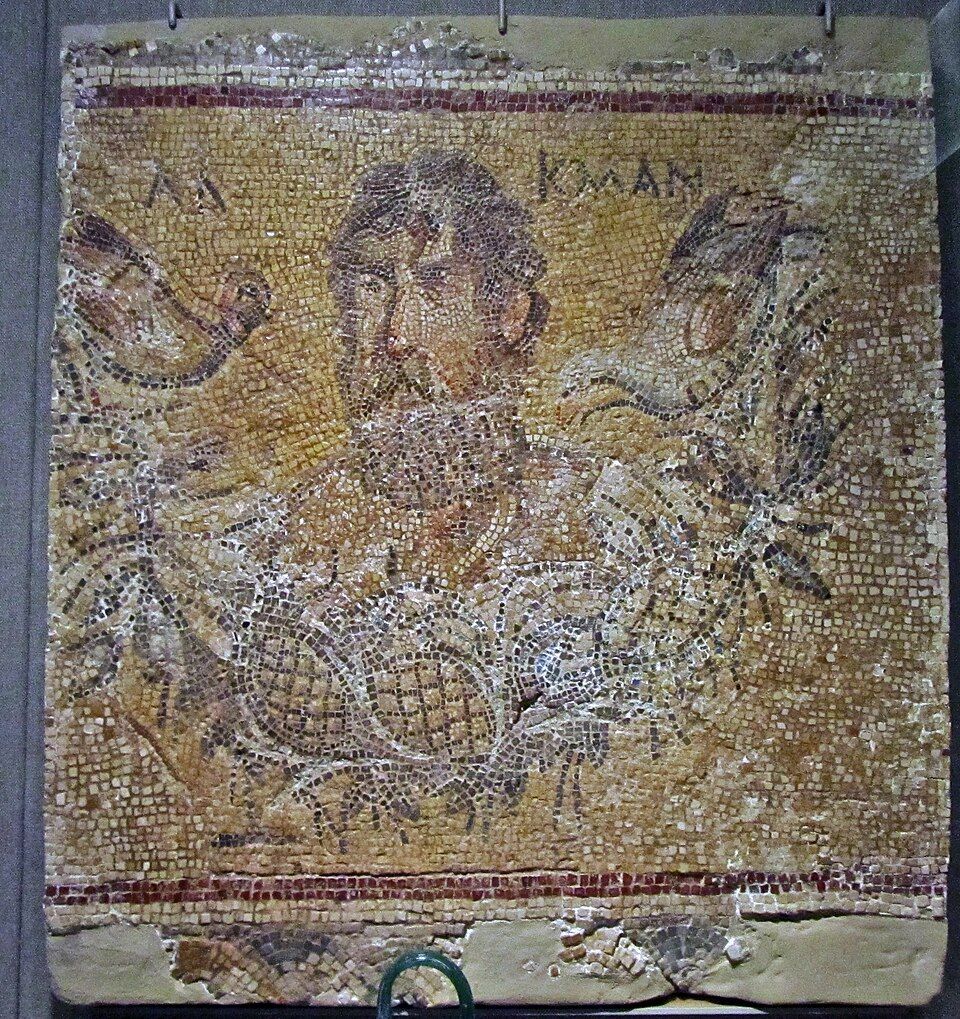
Alcman’s text: local, late, or unmetrical?
Several traits of Alcman’s text belong to the Spartan dialect, but some are not attested there until later. Most of them are not guaranteed by the metre, and a few actually break it.[4] An example is the short infinitive φαίνεν at 1.43 in PMGF. West prints φαίνην, and only the long syllable fits his hagesichorean:[5]
φαίνην· ἐμὲ δʼ οὔτʼ ἐπαινῆν ‖
phainēn; eme d’ out’ epainēn
“… (Agido calls on the sun) to shine; but me (the famous chorus-leader allows) neither to praise …”
With φαίνην the second syllable is long, as the hagesichorean (hag) needs. φαίνεν would make it short, because its ν would go over to ἐμέ.
Alcman 1.43: Smyth 1900 p. 5, public domain
synthetic ∿
With φαίνεν the syllable -νεν would be short before ἐμέ. The same short ending occurs later in Stesichorus, Simonides, Pindar and Bacchylides, mostly where the metre does not decide. It is metrically guaranteed three times in Bacchylides.[6] In Alcman the rule is -ην before a vowel, but -εν before a consonant or at verse-end. This rule describes the same distribution.[7]
Two sound changes show how hard dating is. The first is the Laconian change of θ to σ, as in σιειδής. It appears in inscriptions only sporadically from the early fourth century, though Aristophanes and Thucydides suggest that it was spoken earlier. The second is the change of σ between vowels to [h]. It is attested in Spartan inscriptions from the sixth century, yet it is absent from Alcman’s text.[4]
Hinge holds that the Alexandrian edition reflects Spartan performance of the late third or early second century. D’Alessio finds this view appealing but open to objections. He reads the evidence as pointing to σ between vowels still being pronounced in Alcman’s day.[8] σ for θ is likewise taken to be a later intrusion.[9]
The Aeolic layer
Ancient grammarians called Alcman’s digamma Aeolic. That was an error, since Laconian kept the digamma. But doubled consonants (φαεννός, ἄμμε) and -οισα (Ἀστυμέλοισα) are genuinely Aeolic traits. -οισα appears already in Eumelus. It also appears in seventh-century dactylic inscriptions from places where the spoken dialect did not have it.[10]
Disputed. There are three explanations of -οισα in Alcman:
- It was archaic Laconian, later lost.[11]
- Alexandrian editors were influenced by the dialect of Cyrene.[12]
- The archaic poets took it from Aeolic poetic diction.[13]
D’Alessio favours the third. The feature is restricted to certain morphemes and words, and so it is not a general sound change.[14] Page’s and Risch’s positions on Alcman’s dialect as a whole are set out in the same terms elsewhere.[15]
Thinner Doric, solid epic
In the later choral poets the West Greek (“Doric”) surface wears steadily thinner. The metre guarantees very few forms found only in that dialect. But it does guarantee several forms that are foreign to West Greek and Aeolic and at home in the Ionian epic tradition.[16] In the same way, Simonides and then Bacchylides show more of their native Ionic than the earlier choral poets.[17]
An example is Stesichorus’ ἄν (or κε(ν)) at 222(b).223 and 225 PMGF. He never uses the West Greek κᾱ there.[18] ἄν and κεν are short and κᾱ is long, so the metre fixes the non-Doric particle.
the particle of possibility (“would”, “perhaps”)
Where the line needs a short syllable, only ἄν or κε(ν) will do.
Similarly, Stesichorus’ Doric contracted futures (δωσοῦντι) are likely to be later intrusions.[19]
In short, the surface has three layers:[20]
| Layer | Example |
|---|---|
| the poets and the international festivals | Peloponnesian contests give the Doric surface |
| local transmission | Sparta for Alcman, perhaps Syracuse for Stesichorus and Ibycus, Tanagra for Corinna |
| the Hellenistic editions | perhaps the Doric accents in Ibycus’ papyri[21] |
Notes
- ^ D’Alessio 2009, pp. 123–124.
- ^ Maehler 2004, p. 11 n. 16.
- ^ D’Alessio 2009, p. 124.
- ^ a b D’Alessio 2009, p. 125.
- ^ West 1987, p. 36.
- ^ D’Alessio 2009, p. 125 n. 38.
- ^ de Kreij 2022, p. 146.
- ^ D’Alessio 2009, pp. 125–126.
- ^ de Kreij 2022, p. 145 n. 5.
- ^ D’Alessio 2009, p. 126.
- ^ Page 1951.
- ^ Risch 1954, Ruijgh 1984.
- ^ Ahrens 1853, Nagy 1990, Hinge 2006.
- ^ D’Alessio 2009, p. 126 with nn. 50–53.
- ^ de Kreij 2022, p. 144.
- ^ D’Alessio 2009, p. 127.
- ^ de Kreij 2022, p. 149.
- ^ D’Alessio 2009, p. 127 n. 55.
- ^ de Kreij 2022, p. 151.
- ^ D’Alessio 2009, p. 127 with n. 56.
- ^ de Kreij 2022, p. 154.
Doric · 6 of 7
Choral Doric in tragedy
Choral lyric gave Attic drama its sung metres, and with them a trace of its language. Attic drama is one of the genres into which Doric was incorporated, along with choral lyric and Hellenistic epigram.[1] The result is simple to describe. The sung parts of tragedy carry a Doric colouring, and the spoken parts are Attic.[2]
The lyric metres of tragedy go back to archaic choral song, and their language has a Doric patina.[3] But the Doric of the choral odes is far from thoroughgoing.[4] The colouring is shown below in a choral ode. The Attic of drama page shows how it marks the line between song and speech.
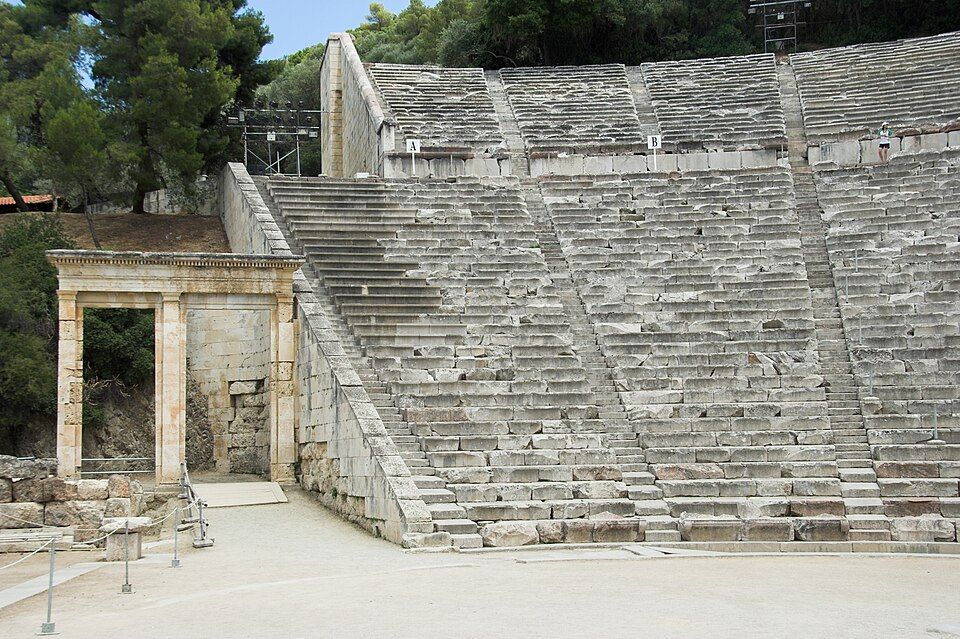
A choral ode in dactylo-epitrite
The choruses of fifth-century tragedy mix metres more freely still.[5] One of the metres taken over from choral lyric is the dactylo-epitrite of Pindar and Bacchylides. There is no D/e in the genuine plays of Aeschylus. It is used in Prometheus, in the earlier plays of Sophocles and Euripides (hardly at all after 415), in Rhesus, and occasionally in Old and Middle Comedy.[6] A good specimen is the chorus of Medea 410–20, where the ᾱ of choral Doric is everywhere:[6]
ἄνω ποταμῶν ἱερῶν χωροῦσι παγαί,
καὶ δίκα καὶ πάντα πάλιν στρέφεται.
anō potamōn hierōn chōrousi pāgai, / kai dikā kai panta palin strephetai.
“Upward flow the springs of the sacred rivers, and justice and all things are turned backwards.”
Line 410 is × D | – e – |; line 411 is e | – D ‖.
Euripides, Medea 410–411
synthetic ∿
οὐκέτι δυσκέλαδος φάμα γυναῖκας ἕξει.
ouketi dyskelados phāmā gynaikas hexei.
“No longer will ill-sounding rumour hold women in its grip.”
The line is D | – ith |||.
Euripides, Medea 420
synthetic ∿
West marks the ᾱ of παγαί, δίκα and φάμα (twice) long. In Attic these words would be πηγαί, δίκη and φήμη. The same ode has τὰν δ’ ἐμάν, βιοτάν and τιμά (415, 419). The vowel changes the sound, not the scansion, since ᾱ and η are both long.
| in the ode | Attic | meaning |
|---|---|---|
| πᾱγαίpāgai | πηγαίpēgai | “springs” (410) |
| δίκᾱdikā | δίκηdikē | “justice” (411) |
| ἐμάνemān | ἐμήνemēn | “my” (415) |
| βιοτάνbiotān | βιοτήνbiotēn | “life” (415–419) |
| τιμάtimā | τιμήtimē | “honour” (415–419) |
| φάμαphāmā | φήμηphēmē | “rumour” (420) |
The rule in one line: in a tragic chorus, expect ᾱ wherever spoken Attic would have η from the old ᾱ.
Colon-division often coincides with word-division, and it does so throughout E. Med. 410–20.[6] The ode ends with the ithyphallic. The dramatists use this colon at strophe-end, and in other places too.[6]
Where the colouring appears
The Doric colouring is the first of the features that set lyric anapaests apart from the recited, marching kind, in tragedy and in parody of tragedy.[7] In tragedy lyric anapaests are almost entirely limited to monodies and to dialogues in which an actor sings. Euripides uses them most, especially in the plays of his transitional period (Hecuba, Troades, IT, Ion).[8] So the colouring belongs to song, whether choral or solo, and not to the recited parts.
Two cautions are needed. First, drama sometimes uses the asymmetrical cola of Lesbian and Pindaric song. The metre is then called “aeolic”, but only as a broad family name, not as an exact description.[9] The dialect of such passages is not Lesbian. It is the same Attic with Doric colouring.
Second, the sources used here do not set out how far the colouring extends: which forms it includes, and which it leaves Attic. West’s statement on p. 60 and his marked texts[10] are the evidence, and the site claims no more.
| Part of the play | Delivery[11] | Language |
|---|---|---|
| dialogue (trimeters, tetrameters) | recited | Attic |
| marching anapaests | recited | Attic (no Doric colouring)[7] |
| choral odes, monodies, lyric dialogue | sung | Attic with Doric ᾱ[10] |
Notes
Doric · 7 of 7
Corinna's Boeotian: the contrast of a local dialect
Set against the choral koinē, Corinna of Tanagra shows what a choral poet’s language looks like when it is not the usual Doric-based Kunstsprache. Boeotian belongs to the Aeolic group, together with Thessalian and the dialect of Lesbos.[1] Corinna’s poetry stands alone among the Greek lyric poets in using a distinctive local dialect, Boeotian.[2]
Pindar was also a Boeotian, yet he keeps Boeotian words and forms almost entirely out of his language.[3] Pausanias (9.22.3) even used this to explain her reported victory over Pindar at Thebes. She wrote in a dialect the locals understood, while Pindar wrote in Doric.[2]
The spelling
Corinna’s poetry has come down in a spelling peculiar to Boeotia, which records the dialect’s vowels. Above all it shows monophthongisation (αι > η, οι > υ). In monophthongisation a diphthong becomes a single vowel. It also shows raising (η > ει, ει > ι). In raising, a vowel comes to be pronounced with the tongue higher in the mouth. There are further shifts as well, such as υ > ου.[4]
The diagram shows the two kinds of change. Each arrow means “is written as” in Corinna’s text. In the top row the diphthong αι becomes η, while the old η and ει each move one step higher (raising), so the whole series shifts along.
Left of each arrow, the older or Attic spelling; right of it, Corinna’s.
The key below gives the Attic equivalents, word by word:[5]
| Boeotian letter | Attic letter | Corinna | Attic | meaning |
|---|---|---|---|---|
| ει | η | ΚώρειτεςKōreites | ΚουρῆτεςKourētes | “the Curetes” |
| η | αι | ΚιθηρώνKithērōn | ΚιθαιρώνKithairōn | “Cithaeron” |
| ι | ει | ἔχιechi | ἔχειechei | “has” |
| οι | ῳ | ἄντροιantroi | ἄντρῳantrōi | “in a cave” |
| ου | υ | ἔκρουψανekroupsan | ἔκρυψανekrypsan | “they hid” |
| υ | οι | λόγυςlogys | λόγοιςlogois | “with words, stories” |
| ω | ου | ΚώρειτεςKōreites | ΚουρῆτεςKourētes | “the Curetes” |
The texts also have the digamma (Ϝελικών, “Welikon”), and words such as hiōnga for ἔγωγε and bana for γυνή.[6] ττ stands for σσ (λιττάδα).[5]
The dialect is mostly artificial and literary. It does not match the spoken Boeotian of any one period.[7] It is a literary construction that never matched a single Boeotian vernacular.[8]
For scansion the trap is ου. It is written for υ whether the vowel is short or long:[9] δουῖν = δυεῖν, Κούπρις, κρουφάδᾱν. So the spelling does not show the quantity.
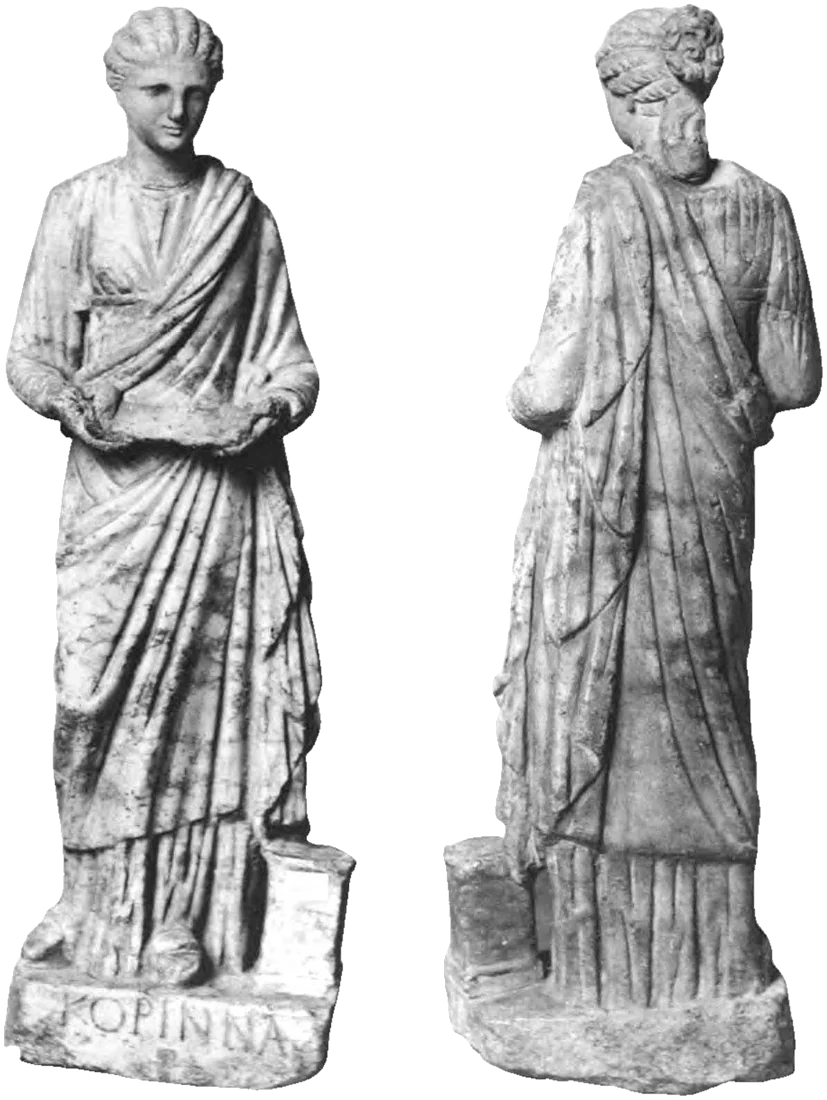
The metres
Hellenistic aeolic is simple. It is usually glyconics in short strophes ending with a pherecratean. The anaclastic glyconic (○ ○ — × — ⏑ ⏑ —, gl¨) becomes more and more common.[10] Corinna’s prefatory poem (PMG 655) is in stichic glyconics. 654 i is in strict ionics: five dimeters ⏑ ⏑ — — ⏑ ⏑ — — and a hypercatalectic close.[11] Here are two lines from the Asopus poem, with Greek from Diehl’s edition and West’s metrical analysis:
πῆς Ἑρμᾶς· οὔ[τ]ω γὰρ Ἔρως
κὴ Κούπρις πιθέτᾱν, τιὼς
pēs Hermās; ou[t]ō gar Erōs / kē Koupris pithetān, tiōs
“… the son (of Maia), Hermes; for so Eros and Cypris persuaded them, (going) secretly into your (house) …”
Line 18 is an anaclastic glyconic (gl¨), line 19 a plain glyconic (gl).
Corinna PMG 654 iii 18–19: Greek from Diehl 1917 p. 50
synthetic ∿
πῆς = παῖς, κή = καί, Κούπρις = Κύπρις, τιώς = σούς.[12]
| Corinna | Attic | meaning |
|---|---|---|
| πῆςpēs | παῖςpais | “child, son” |
| κήkē | καίkai | “and” |
| ΚούπριςKoupris | ΚύπριςKypris | “Cypris” (Aphrodite) |
| τιώςtiōs | σούςsous | “your” |
Κου- has a short υ.[9] It stands in the free base, so its weight before πρ need not be decided. Line 19 is the only plain glyconic in West’s two stanzas.[10]
Disputed: the date
The ancient tradition makes Corinna Pindar’s contemporary, and the Suda has her defeat him five times.[13]
Several scholars argue for a fifth-century date:
- Larson (2002), from her genealogical subject-matter, and Stewart, who identified (1998) a fourth-century statue of Myrtis, her reputed teacher;[14]
- Allen and Frel (1972), Snyder (1989) and Campbell’s earlier volumes;[15]
- Palumbo Stracca.[16]
Klinck leans towards an early date.[13]
Others argue for a Hellenistic date:
- Lobel (1930) and West (1970, 1990). They argue, among other things, that the text is in third-century Boeotian, and that a prefatory poem like PMG 655 is not attested before 300 BC.[17]
- Campbell in 1992, who called her “almost certainly 3rd century”.[18]
- Others, Skinner among them, read her simplicity as a deliberate archaism.[13]
D’Alessio reports that recent scholarly consensus favours the Hellenistic date.[16] A decade later Currie and Rutherford report the opposite balance: a fifth-century date is now generally believed. They also suggest a Boeotian archive as the channel by which her songs survived.[19]
The spelling cannot settle it. On Penney’s judgement, the stage of spelling that our texts show fits a date of about 200 BC.[20] But a later copyist could have written older, orally transmitted poems in the dialect of his own day, as Snyder argued.[21] Rewriting an older text in a later spelling like this is called metagrammatism.[22] D’Alessio suggests that the poems were first written down in the early Hellenistic period, after they had long been re-performed locally.[23] West prints her as an example of Hellenistic aeolic without arguing the date.[10]
Notes
- ^ Natoli et al. 2022, p. 328.
- ^ a b Natoli et al. 2022, p. 59.
- ^ de Kreij 2022, p. 160; cf. p. 156.
- ^ de Kreij 2022, p. 160.
- ^ a b Natoli et al. 2022, p. 331.
- ^ Klinck 2008, pp. 161–163.
- ^ Natoli et al. 2022, pp. 65, 331.
- ^ Collins 2006, p. 19.
- ^ a b West 1987, p. 72 n. 5.
- ^ a b c West 1987, p. 72.
- ^ West 1987, pp. 73–74.
- ^ Natoli et al. 2022, p. 71.
- ^ a b c Klinck 2008, p. 152.
- ^ Natoli et al. 2022, pp. 60–61.
- ^ Natoli et al. 2022, pp. 81–82 nn. 10, 14.
- ^ a b D’Alessio 2009, p. 128 n. 58.
- ^ Natoli et al. 2022, p. 61.
- ^ Natoli et al. 2022, p. 82 n. 10.
- ^ Currie and Rutherford 2020, p. 9.
- ^ de Kreij 2022, p. 160 n. 53.
- ^ Natoli et al. 2022, p. 82 n. 16.
- ^ Collins 2006, p. 19 with n. 7.
- ^ D’Alessio 2009, pp. 127–128.


